Article

Formation and Reversible Cleavage of an Unusual Trisulfide-Bridged Binuclear Pyridine Diimine Iridium Complex


Institute of Inorganic and Applied Chemistry, Department of Chemistry, University of Hamburg, Martin-Luther-King-Platz 6, 20146 Hamburg, Germany
*
Author to whom correspondence should be addressed.
Inorganics 2026, 14(1), 11; https://doi.org/10.3390/inorganics14010011 (registering DOI)
Submission received: 17 December 2025 / Revised: 22 December 2025 / Accepted: 23 December 2025 / Published: 26 December 2025
(This article belongs to the Section Coordination Chemistry)

Abstract

Iridium pyridine diimine (PDI) complexes provide a versatile platform for highly reactive Ir–nitrido species with pronounced multiple-bond character, capable of activating H–H, C–H, Si–H, and even C–C bonds. Building on this chemistry, we extended our studies to a system with a terminal Ir–S bond, starting from our recently reported PDI–Ir–SH complex, which exhibits partial multiple-bond character. Upon addition of the 2,4,6-tri-tert-butylphenoxy radical, the corresponding phenol and a tentative Ir–S• radical intermediate are formed at ambient temperature. DFT and LNO-CCSD(T) calculations consistently reveal a low barrier for this process, with the spin density localized primarily on sulfur, accounting for subsequent S–S coupling reactions. Instead of the anticipated dimeric disulfido Ir–S2–Ir complex formed along a least-motion pathway, a trisulfido Ir–S3–Ir species was obtained, and characterized by NMR spectroscopy, X-ray crystallography and mass spectrometry. The formation mechanism of the trisulfido complex was further elucidated by DFT calculations. Remarkably, the sulfur-bridge formation is thermally reversible, regenerating the monomeric sulfanido Ir–SH complex. The origin of the hydrogen atom was investigated using H2, D2, and deuterated solvents.

1. Introduction

Iridium complexes supported by pyridine diimine (PDI) ligands have emerged as versatile platforms in organometallic chemistry enabling activation of H–H, C–H, Si–H, and even C–C bonds [1,2,3,4] due to their ability to be “non-innocent” or redox-active [5,6,7,8,9,10,11]. We previously reported the synthesis of a square-planar Ir–PDI complex bearing a terminal thiolato SH ligand [5]. In contrast to alkoxido analogs, which readily react with dihydrogen to form Ir-H species [5], the corresponding thiolato complexes remain unreactive even under forcing conditions [12].
Our group is broadly interested in exploring terminal PDI-M–X complexes (X = N, O, S) and in understanding how the electronic nature of the terminal ligand influences structure and reactivity. For example, while attempts to isolate terminal oxo species from Ir–PDI–hydroxido precursors were unsuccessful [13], we could isolate terminal nitrido compounds [3]. Our previous studies of Ir–PDI–thiolato complexes revealed that the Ir–S bond possesses substantial double-bond character [5]. We reasoned that this enhanced bond order could provide sufficient stabilization for a terminal Ir–S moiety, making such a precursor a viable entry point to a terminal iridium–sulfur species.
Terminal metal–sulfur complexes are well documented, particularly for the group 5 and 6 transition metals [14,15,16,17,18,19]. In contrast, examples featuring late transition metals remain, to our knowledge, essentially unknown. Nevertheless, a nickel (II) system reported by Hayton and co-workers—described as a masked terminal nickel sulfide—comes very close. In this complex, the sulfur atom is coordinated by a potassium–cryptand unit [20]. The sulfide ligand is notably nucleophilic and is capable of activating small molecules such as nitrous oxide (N2O) and carbon disulfide (CS2) via nucleophilic attack [21,22,23].
Also relevant are studies by Jones and co-workers, who proposed the formation of a transient Ni=S species generated by benzene elimination from a phenyl hydrogen-sulfido precursor. Although this highly reactive intermediate could not be isolated, its formation was inferred from subsequent S–S coupling and trapping reactions [24].
Herein, we describe our efforts to access a terminal iridium–sulfur unit via hydrogen-atom abstraction (HAA) from a hydrogensulfido Ir–SH precursor using an organic radical. This strategy is well established for the formation of terminal M=O [25,26] and M≡N [27,28] units and was sought here as an analogous route to a terminal Ir=S species. Recently, Meyer and co-workers reported the successful isolation of a μ-sulfido dinickel complex generated by HAA from a dinuclear Ni2(µ-SH) precursor [29]. Also noteworthy is the reverse reactivity observed for a structurally characterized terminal high-spin Fe=S complex, which undergoes HAA with dihydroanthracene to yield the corresponding hydrosulfido Fe–SH compound [30,31].

2. Results and Discussion

2.1. HAA Reaction

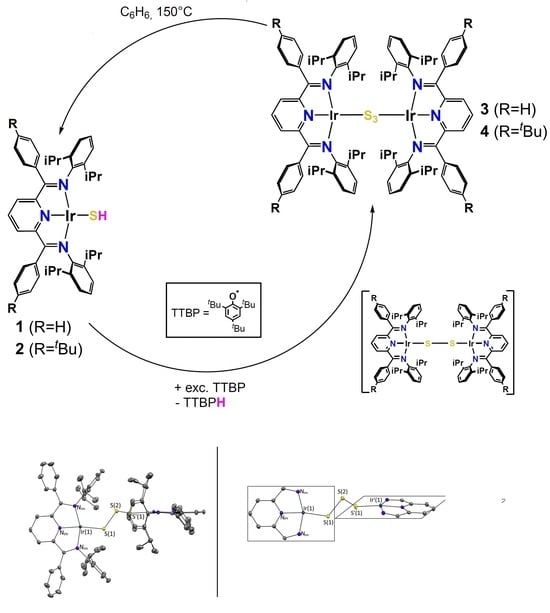
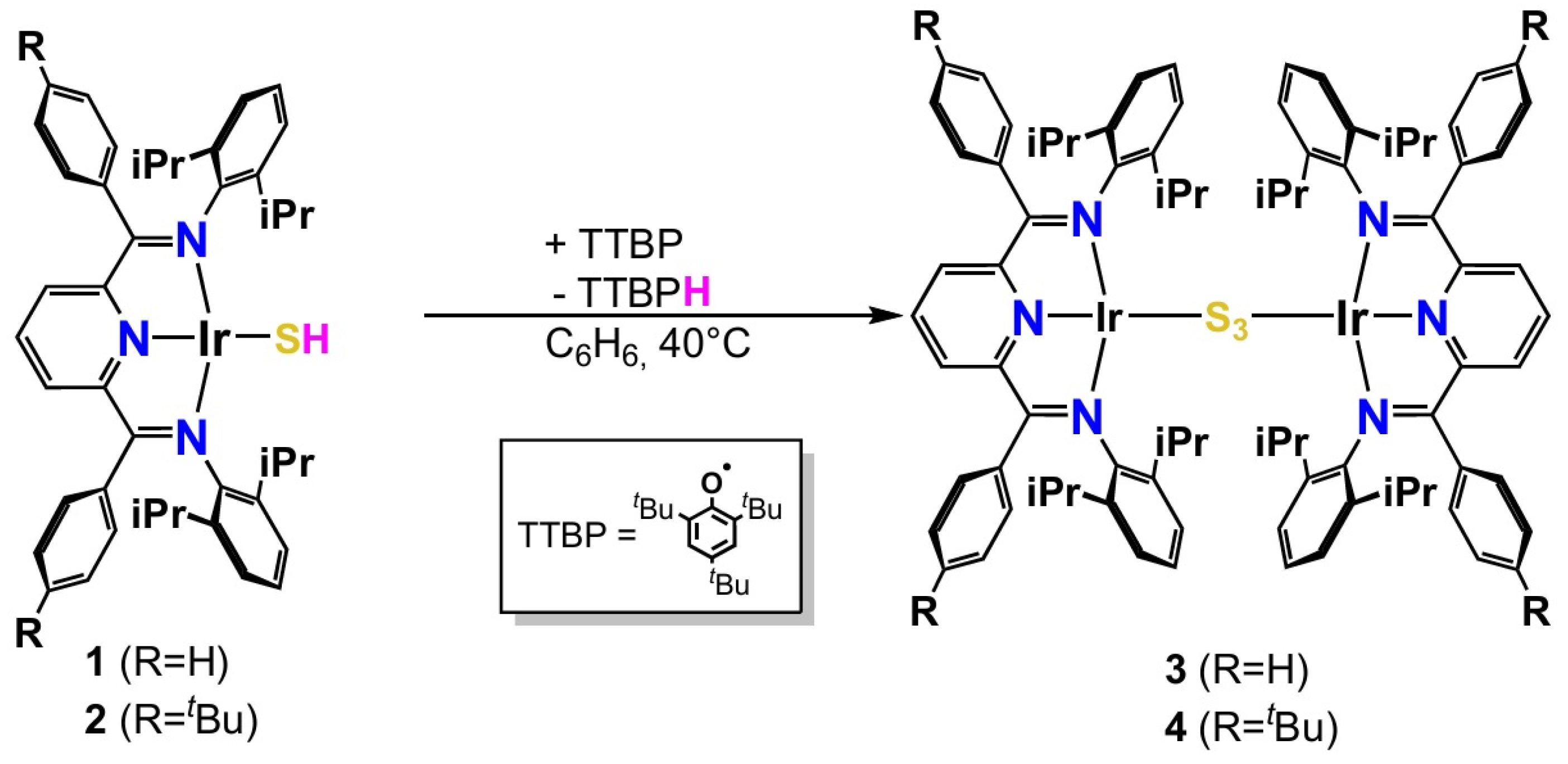
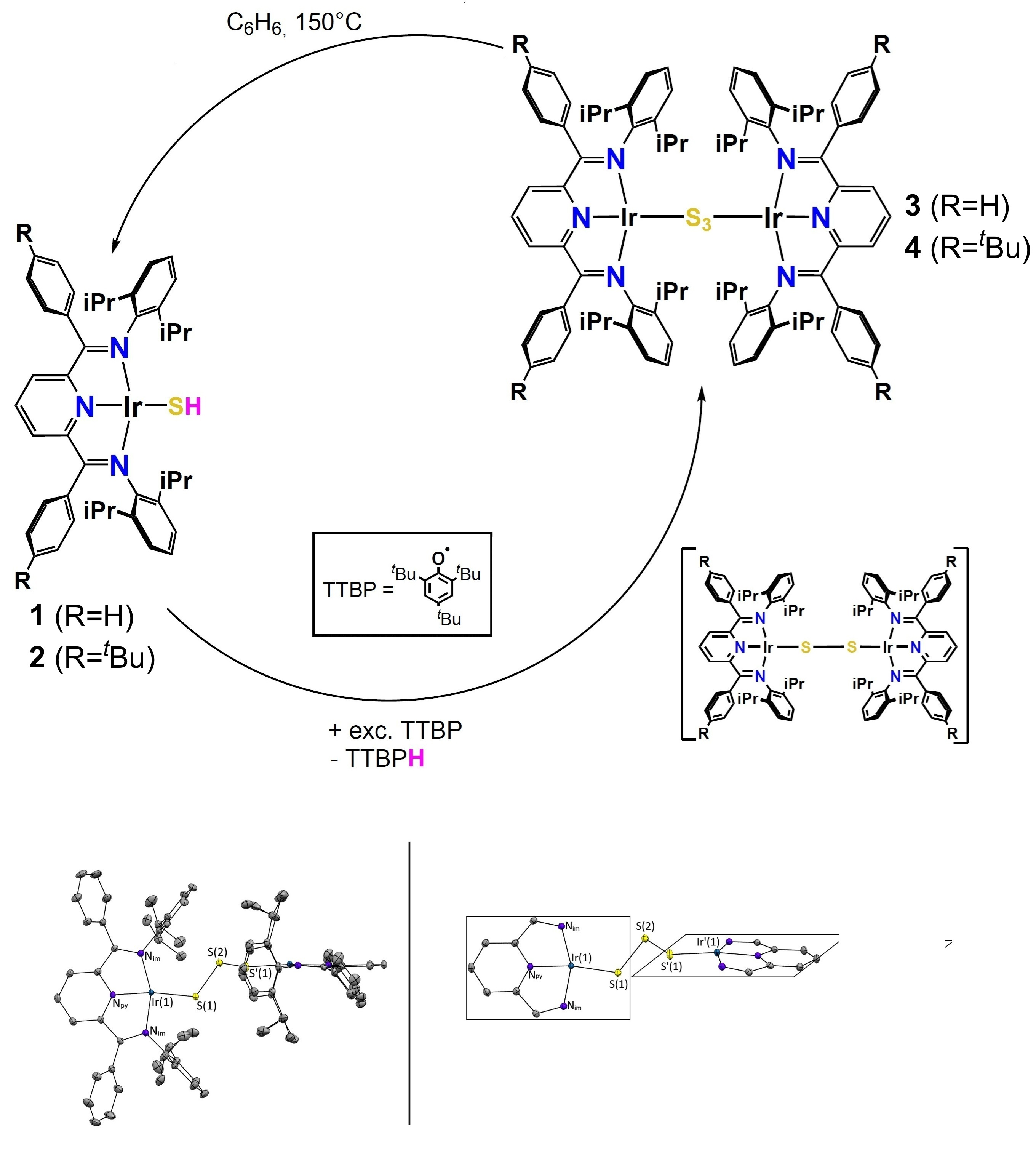
Upon addition of the 2,4,6-tri-tert-butylphenoxy (TTBP) radical to the thiolato complexes 1 and 2, the solution changed color from dark violet to dark blue/purple (cf. Supporting Information, Figure S19). While we were not able to separate complex 4 from the organic phenol reagents, product 3 could be isolated in 51% yield. In the forthcoming we will accordingly focus on the characterization of 3.
The sharp 1H NMR resonances indicated that the product is diamagnetic rather than expected for a sulfur-centered radical species. The 1H NMR spectrum in C6D6 evidenced complete disappearance of the diagnostic thiol proton resonance at 5.6 ppm (in 1) and 5.7 ppm (in 2), along with the appearance of a new signal at δ = 5.0 ppm corresponding to the phenol HAA product (B, Figure S19). These observations are consistent with successful hydrogen atom abstraction from the Ir–SH moiety.
In addition to the loss of the thiol proton resonance, the homotopic aromatic protons of complex 3 in the 2- and 6-positions of the phenyl substituents, now appeared as two distinct doublets (D/D′, Figure S19). Likewise, the methyl groups of the diisopropyl (DIPP) substituents, which in the starting complex gave rise to two doublets, are now observed as four doublets; two of which overlap to form an apparent pseudo-triplet (F/F′). The methine protons of the DIPP groups remained as a septet, but the resonance was broadened in the product (E/E′).
In the 13C NMR spectrum of 3 we observed two resonances for the DIPP methine carbon atoms, four resonances for the DIPP methyl groups and 8 resonances in the quaternary carbon atoms (140 to 170 ppm; Cimine/C-1,2,6-aryl/C-1-ph/C2,4-pyridine). For the precursor we previously reported [5] one resonance for the DIPP methine carbon atoms, two resonances for the DIPP methyl groups and 4 resonances in the quaternary carbon atoms (140 to 170 ppm; Cimine/C-1,2,6-ar/C-1-ph/C2,4-py).
The emergence of distinct resonances for previously homotopic protons indicated that the reaction product has a lower symmetry than the thiolato precursor on the NMR time scale. These findings suggest that the tentative Ir–S sulfido intermediate undergoes a subsequent reaction. Initially, we anticipated conversion to a diamagnetic dimer featuring an S2 bridge. In contrast, the formation of a bis-μ-sulfido (M–μ-S)2 structure, as reported by Jones et al. [24,32] for a putative nickel sulfido transient (Figure 1), was considered less likely for the PDI–iridium system because the steric bulk of the DIPP phenyl substituents would strongly disfavor such a dimeric arrangement.
A variety of iridium sulfido complexes have been reported in the literature. Dobbs et al. [33] described an Ir2(μ-S)2 bis(sulfido)-bridged complex formed by hydrogen-atom abstraction from a terminal thiolato Cp–Ir precursor. Additional μ-sulfido Ir2 species have been obtained through sulfur abstraction from thiophene [34] or via hydrogen abstraction from coordinated thiolates [35]. Moreover, Hernández et al. [36] reported a heterobimetallic Zr–Ir complex featuring a μ-sulfido bridge. Similar reactivity has been observed for nickel systems. Hydrogen abstraction from bimetallic thiolato Ni complexes using either the TTBP radical [29] or a phenoxy radical [37] results in the formation of sulfido-bridged nickel dimers.
To test this hypothesis, a DOSY NMR experiment was performed in toluene-d8 to evaluate the molecular size of the reaction product. The diffusion coefficient determined from the experiment (D = 5.43 × 10⁻⁶ cm2 s−1) corresponds to an estimated molecular mass of 1259 g/mol and a hydrodynamic radius of 9.3 10−10 Å [38,39,40]. In comparison, the monomeric thiolato complex displays a faster diffusion coefficient (D = 7.30 × 10⁻⁶ cm2 s−1). This corresponds to an apparent molecular mass of 940 g/mol [38,39,40] and is in the range of the expected value of 830 g/mol.
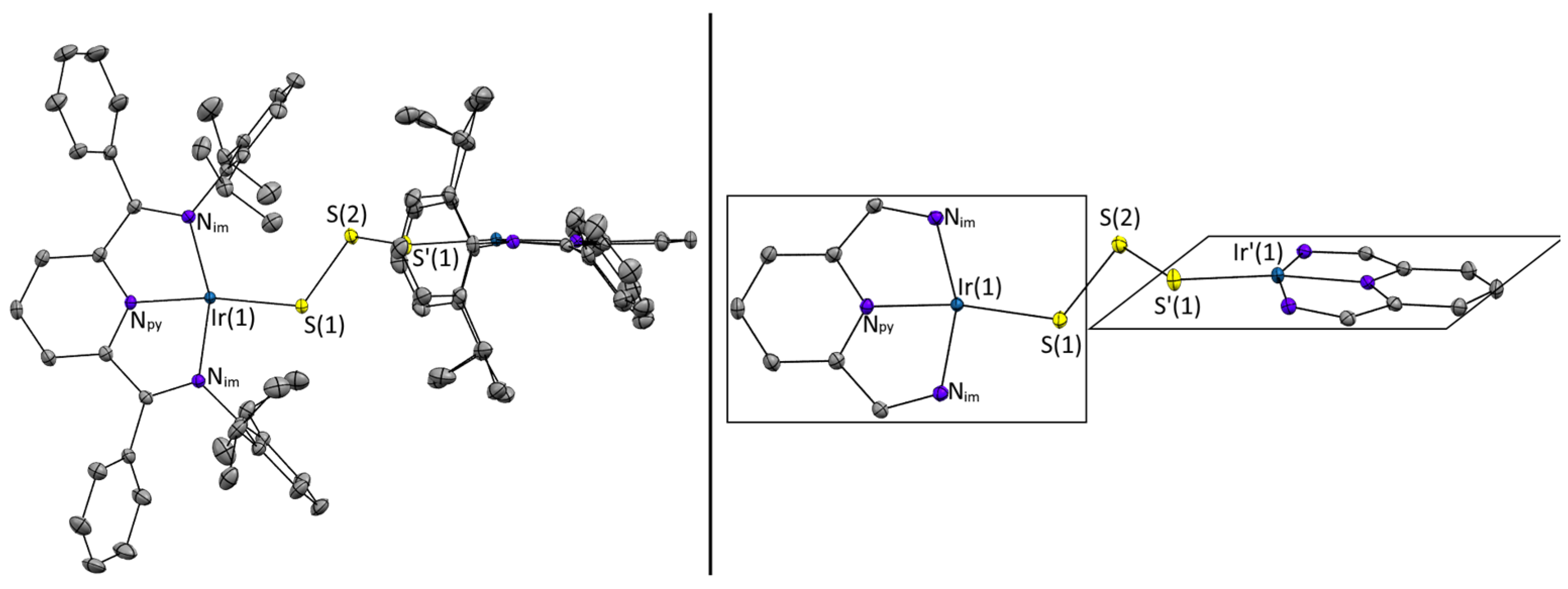
Efforts to crystallize the product at ambient or low temperature were unsuccessful. In contrast, heating the solution to 80 °C followed by slow cooling yielded suitable single crystals for X-ray diffraction. The crystal structure is shown in Figure 2, and selected distances are summarized in Table 1 and Table 2.
To our surprise, the X-ray crystal structure revealed a trisulfide-bridged species rather than the anticipated disulfide-bridged Ir2S2 dimer. Interestingly, the solid-state structure of the PDI–Ir–S3–Ir–PDI complex exhibits C2 symmetry consistent with the observed NMR spectroscopic data. Both iridium metal centers are essentially square planar as evidenced by the sum of angles around 359.7°.
In the crystal structure, Ir(1), S(1), and its associated PDI ligand lie in the same plane, while Ir′(1), S′(2), and the associated PDI ligand define a second plane (c.f. Figure 2 Right). The two planes are oriented approximately 90° relative to each other. Selected bond metrics and Wieghardt’s diagnostic (geometric) parameter [6] for complex 3 as well as the precursors are summarized in Table 2. The Ir(1)–S(1) bond (2.226 Å) in the trisulfido-bridged complex 3 is slightly shorter than the corresponding Ir–S bonds in the thiolato precursors 1 and 2 and related S2-bridged diiridium complexes (2.34–2.37 Å) [41,42].
The Nimine–Cimine distances in complex 3 are marginally elongated relative to those in the monomeric thiolato complexes, whereas the Cimine–Cpyridine and Npyridine–Cimine bonds are essentially unchanged. The empirical Wieghardt’s diagnostic (geometric) parameters [6], which diagnose the degree of redox non-innocence in PDI ligands, indicate that all PDI units of complexes 13 fall in the same category and can be considered innocent.
The symmetrically equivalent S–S bond lengths in the Ir2S3 binuclear species (2.0849 Å; c.f. Table 1) are slightly longer than those observed in other metal trisulfido-bridged systems (2.040–2.068 Å) [43,44,45,46,47,48,49,50]. The S–S–S angle in the iridium binuclear species (101.47°) is also smaller than in other metal trisulfido-bridged systems (105.37–111.64°) [46,49], possibly due to steric effects of the bulky ligand framework.
At this stage, however, it remained unclear whether the formation of the S3-bridge occurred as a direct outcome of the radical-induced reaction or arose during the elevated-temperature crystallization process of an initial disulfido-bridged dimer. To shed light on its formation the reaction of complex 1 with the phenoxy radical was monitored by UV/Vis spectroscopy (Figures S48–S51). This revealed the decay of complex 1 and the phenoxy radical and formation of the final product. The absence of long-lived intermediates is suggested through the observation of isosbestic points (Figure S56). It should be noted that TD-DFT calculations using the PBE and CAM-B3LYP functionals for both the S2- and S3-bridged complexes revealed only negligible differences in the vertical excitations in the UV/Vis region (Figure S56). Thus, only subtle spectral differences are expected, preventing clear experimental discrimination between the S2- and S3-bridged species.
Furthermore, we turned to mass spectrometry of the reaction product. The MALDI spectrum shows a peak at m/z = 1692, clearly indicating the molecular ion of the Ir2S3 complex (Figures S36–S42). In contrast, no clear peak for the disulfido-bridged dimer Ir2S2 was observed under the same conditions, thus providing no mass spectrometric evidence for its formation. Because MALDI ionization can induce oxidation or fragmentation, LIFDI mass spectrometry (low resolution) was employed as a milder alternative. The advantages of LIFDI have been demonstrated previously in our group: several dimeric complexes, such as iridium μ-azido and iridium μ-nitrido species, were detectable only by LIFDI mass spectrometry and could not be observed using MALDI [51].
Two principal signals were observed at m/z = 1692.6 and 796.3, both of which correspond to peaks detected in the MALDI spectrum. The signal at m/z = 1692.6 displayed an isotopic pattern that matched the calculated distribution for a PDI–Ir–S3–Ir–PDI+ ion, supporting its assignment to the trisulfide-bridged binuclear species. On the other hand, a peak for the Ir-S2-Ir dimer at m/z = 1660 could not be detected. The second signal at m/z = 796.3, with an isotopic pattern consistent with the PDI–Ir+ ion, likely arises from fragmentation under ionization.
Elemental analysis of the isolated product was inconclusive, with the measured sulfur content falling between the theoretical values for S2- and S3-bridged complexes, preventing definitive assignment of the bridging motif (cf. Supplementary Materials). It is notable, however, that the measured carbon and sulfur values are closer to the S2-complex than the S3-complex.
To further examine the reaction stoichiometry, the experiment shown in Scheme 1 was repeated with ferrocene as an internal standard. Formation of a S3-bridged binuclear species would theoretically consume one-third of the PDI protons from the starting material, while formation of a S2-bridged dimer would preserve all protons in the product mixture. The observed yield was 51%.
For this analysis, the methine (E/E′) and pyridine (C/C′, Figure S19) resonances were used to determine the conversion rate. Comparison of the integrated methine resonances relative to the ferrocene standard revealed recovery of only 63% of the initial proton integral after the reaction. A similar decrease was observed for the pyridine resonances, where 61% of the integral was retained relative to ferrocene. Although the recovered 61–63% proton intensities fall slightly below the theoretical 66% expected for a pure S3-bridged binuclear species, they align far more closely with this scenario than with the 100% recovery expected for an S2-bridged product. Taken together with the X-ray crystallographic data and mass spectrometric evidence, these results strongly support the conclusion that the radical-induced reaction yields the S3-bridged binuclear species.
To rationalize the formation of the S3-bridged binuclear species and to elucidate the energetics and possible mechanistic pathways of the dimerization process, density functional theory (DFT) calculations were performed at the PBE-D4/def2-TZVP level (Ir: ECP-60-MWB). For comparison, we also calculated the D2-symmetric linear IrS3Ir system. This hypothetical species is strongly thermodynamically uphill by approximately +50 kcal/mol. Moreover, the presence of several imaginary frequencies indicates that this structure does not correspond to a (local) minimum and instead distorts toward a non-linear geometry.
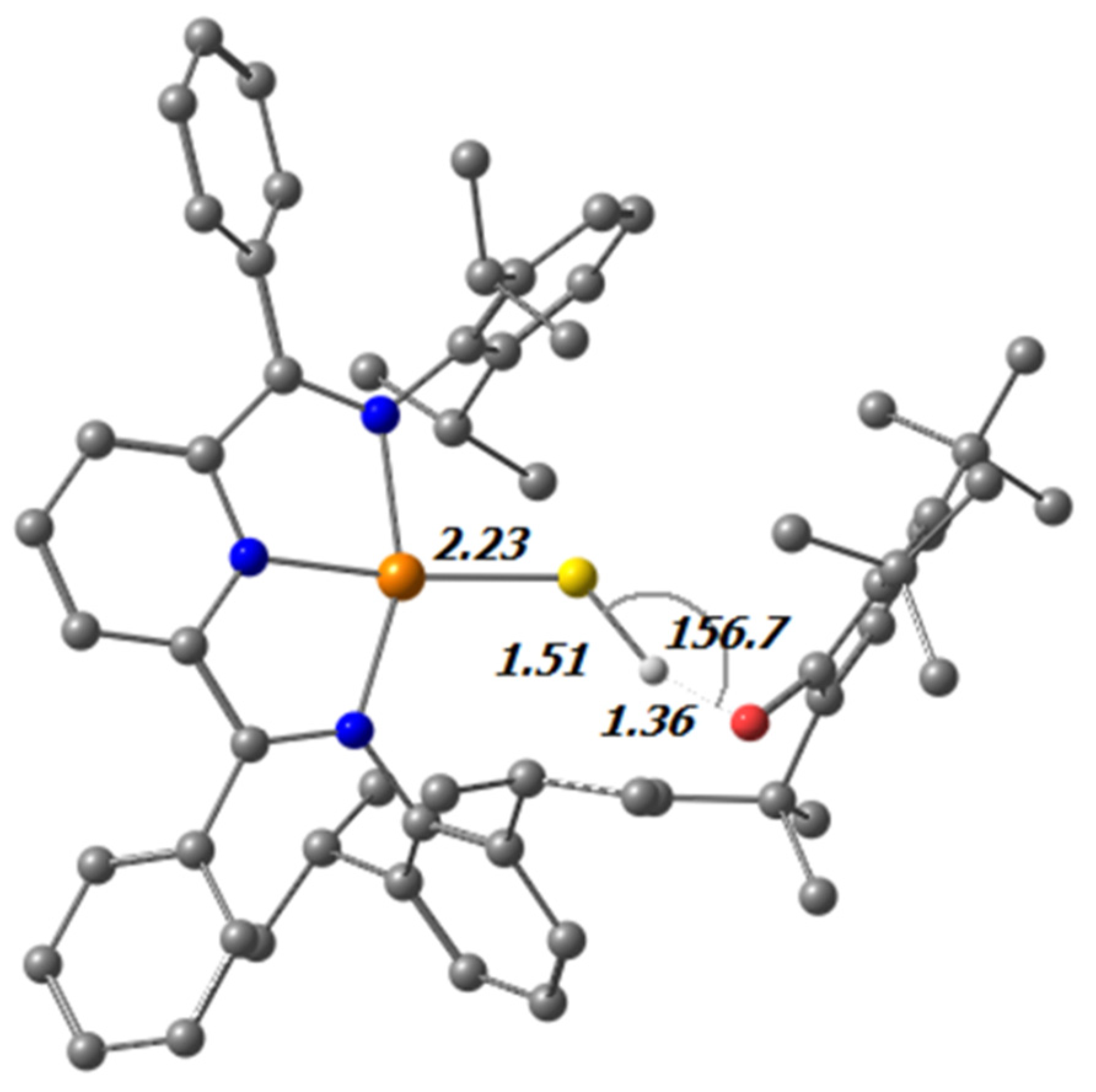
We looked first into the tentative initial HAA reaction of the Ir-SH complex 1 with the phenoxy radical. Based on the calculated and/or measured S-H and O-H bond dissociation enthalpies of 81.2 [12] and 88.7 kcal/mol [52] an exothermic reaction was estimated. This was confirmed by the calculated free enthalpy of ΔG298 = −12.7 kcal/mol (DE = −15.2 kcal/mol) at the LNO-CCSD(T)/CBS(def2-XVPP, X = 3,4)//PBE-D4/def2-TZVP (Ir: ECP-60MWB) level. The barrier for this calculation was estimated at G# = 18.1 kcal/mol with the r2scan-3c density functional and def2-mTZVPP basis. The corresponding nearly linear transition state for this HAA process is shown below in Figure 3.
The IrSH unit and the oxygen atom lie in the same plane; the S-H bond is stretched from 1.35 Å in the starting material to 1.51 Å in the transition state. The Ir-S bond is shortened by 0.06 Å to 2.23 Å in the TS and further to 2.18 Å in the Ir-S radical. Together with the rather long O-H-distance of 1.36 Å, this suggests an early-to-middle transition state consistent with the sizable exergonicity of the HAA step.
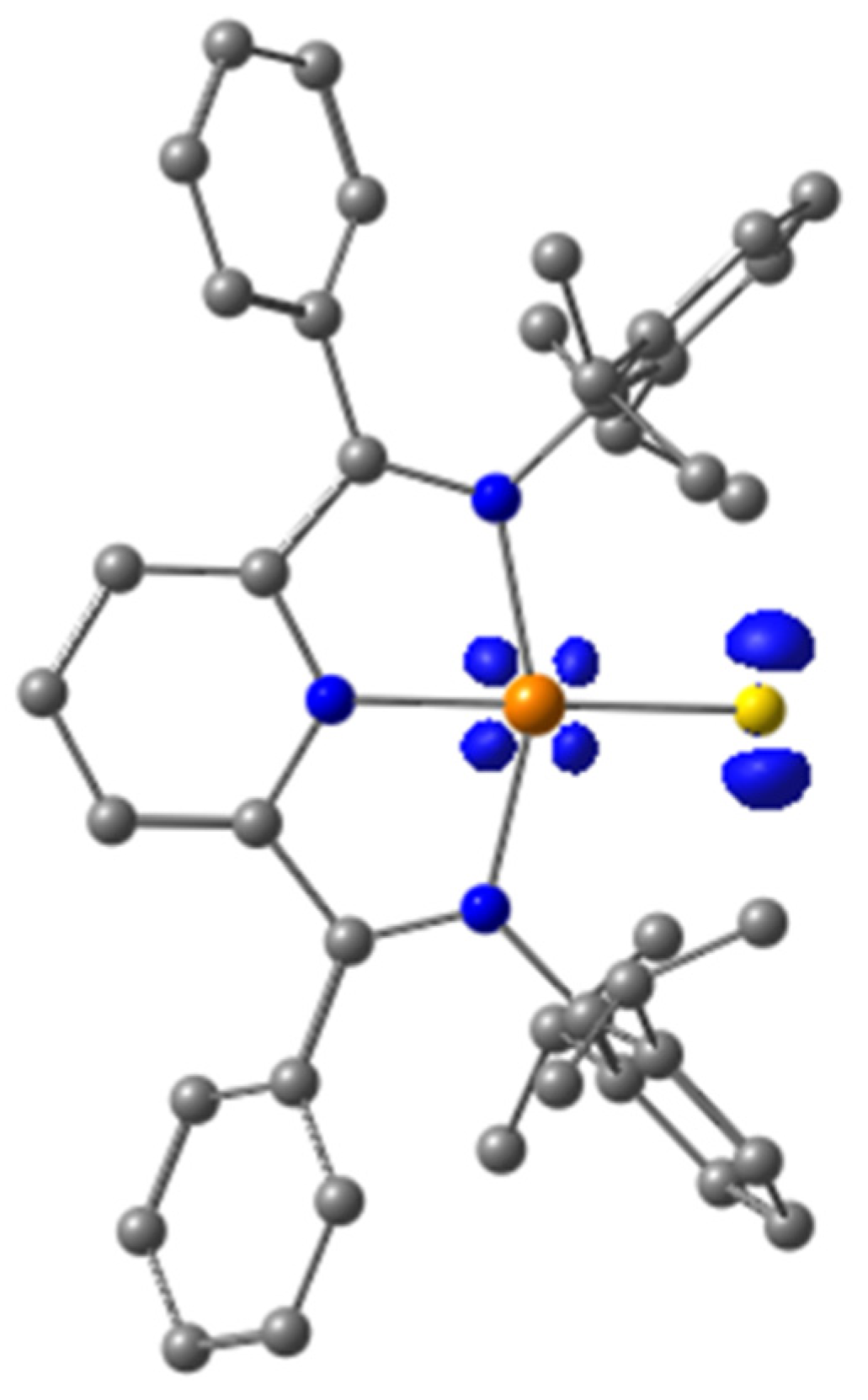
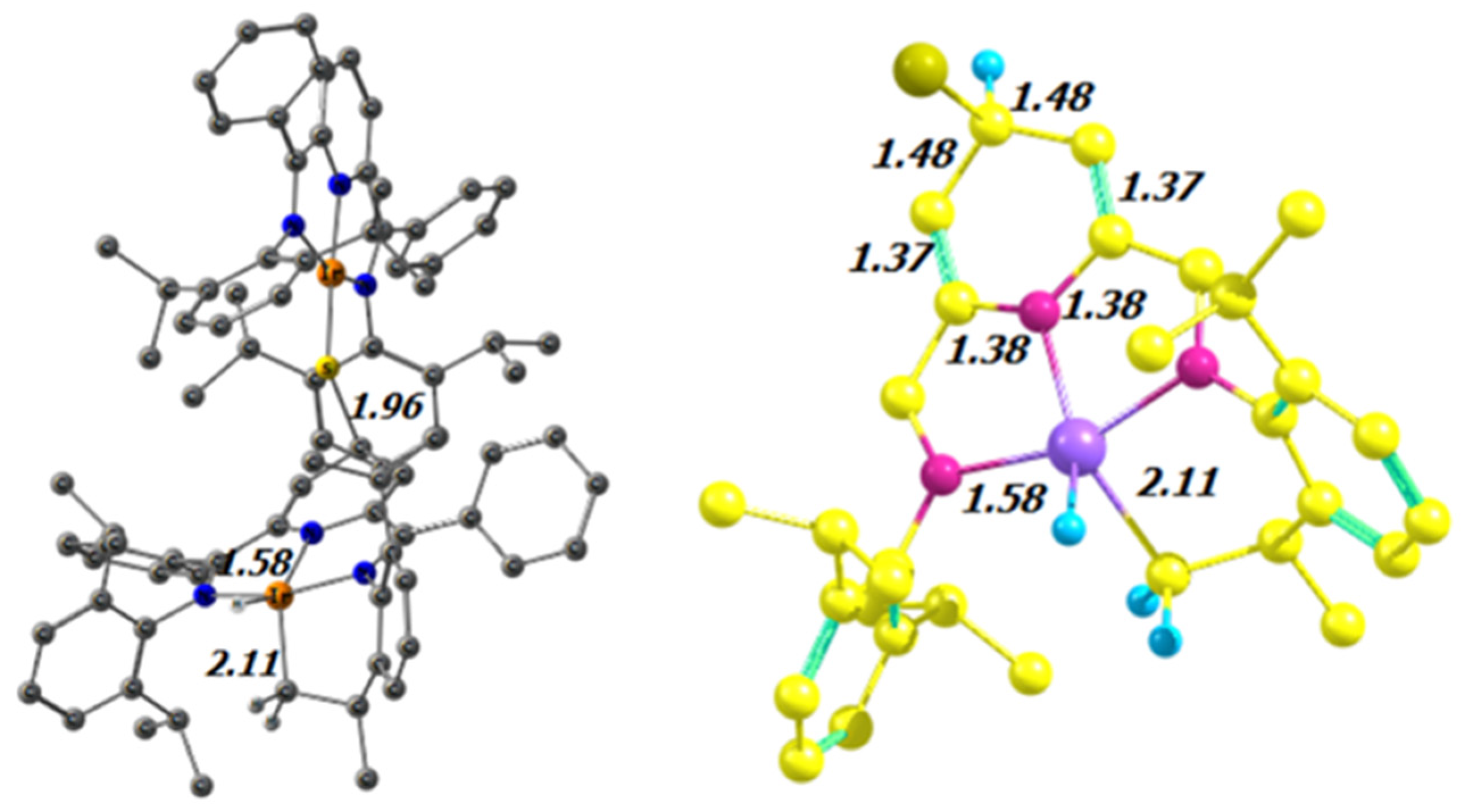
The calculated Ir-S-distance of 2.18 Å in the sulfido product reflects the partial Ir-S multiple bond character, which is also signaled by the Wiberg bond order of 1.19 and increased from 1.02 in the Ir-S-H complex. The spin density is strongly localized on the sulfur atom (Figure 4) with a neutral innocent PDI ligand and a d8-configured iridium(I) center. Similar electronic features have been observed in DFT studies of Ni=S complexes reported by Tagliavini et al. [29] and Zhang et al. [53], where the sulfur atom was likewise found to bear the dominant share of the spin density.
The tentative Ir–S• radical is expected to readily dimerize to form a disulfido-bridged species, (PDI)Ir–S–S–Ir(PDI). This expectation is based on our earlier studies of related PDI–iridium complexes bearing terminal Ir≡N units, which were found to display highly exergonic dimerization to give a linear μ-dinitrogen complex, 2 (PDI)Ir≡N → (PDI)Ir–N≡N–Ir(PDI). Only because of the pronounced steric protection provided by the bulky 2,6-DIPP substituents on the N-imine donors system, the corresponding (kinetically) inert terminal nitrido complex could be isolated.
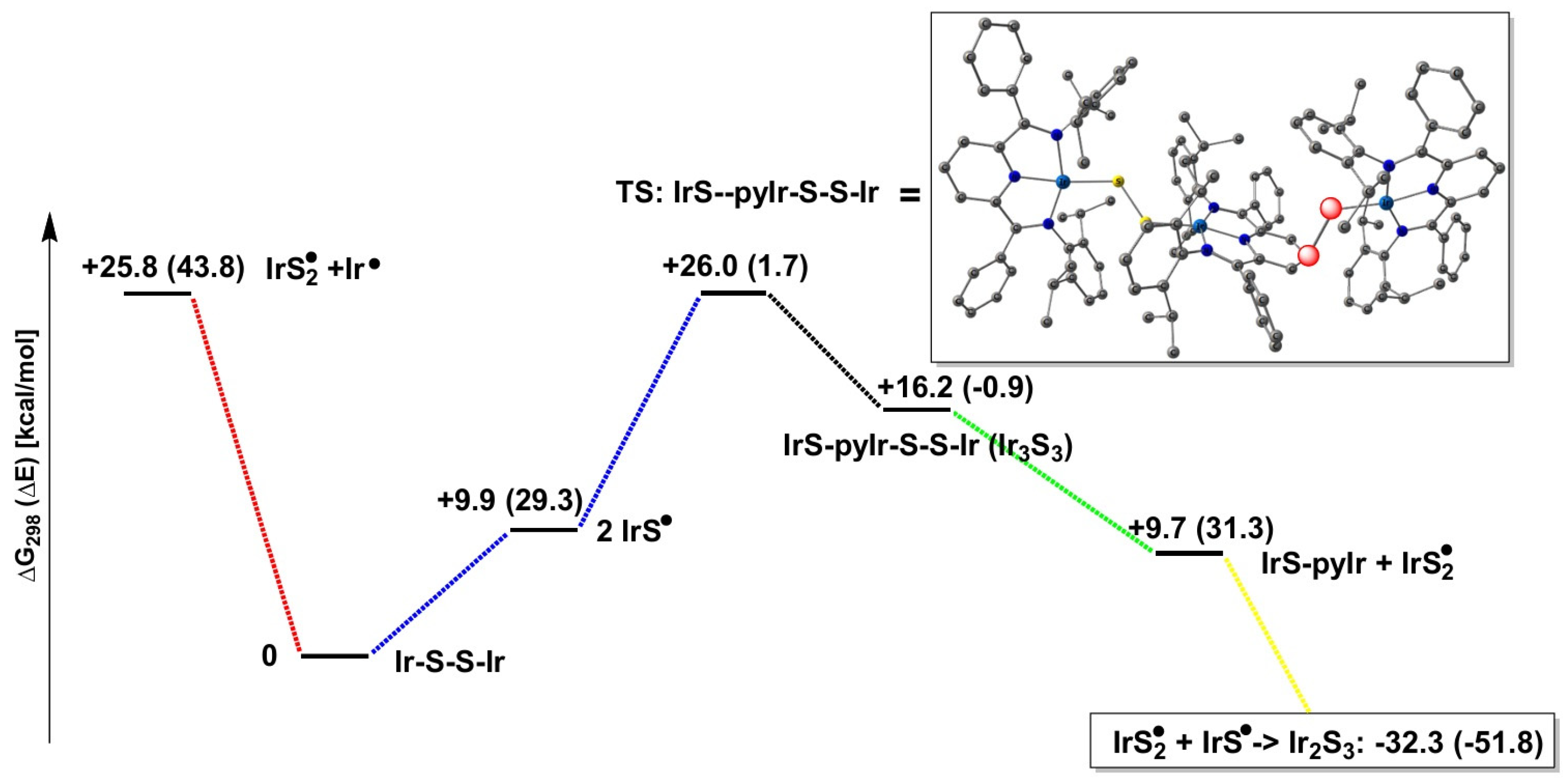
The markedly longer Ir–S bond (2.18 Å vs. 1.64 Å in the nitrido analog), together with the increased S–S distance (2.11 Å) and the non-linear geometry of the bent disulfido-bridged dimer, substantially alleviates steric congestion and therefore suggests that only a small barrier to dimerization is present. This expectation is confirmed by DFT calculations, which indicate that formation of the disulfide dimer is essentially barrierless and diffusion-controlled. Such low-barrier radical coupling is well established for both organic and inorganic radicals, including alkyl [54] and thiol radicals [55], as well as (CO)5Mn [56,57,58]. Considering also that dimerization is thermodynamically favorable according to DFT (ΔG298 = −9.9 kcal/mol, ΔE = −29.3 kcal/mol), we therefore concluded that rapid dimerization is the most likely initial step following radical formation (Scheme 2).
This naturally raises the question of how the trisulfide-bridged dinuclear complex is formed. As noted above, the M–S–S–S–M structural motif is rare, and in the few known examples—aside from those derived from HS—elemental sulfur (S8) was typically employed as starting material. Consequently, there is little precedent in the literature to guide a mechanistic proposal. Several conditions must therefore be satisfied: (i) no stable long-lived intermediates should be present, as indicated by the isosbestic points observed during UV/Vis monitoring; (ii) the activation barrier must be on the order of ~25 kcal/mol to be compatible with the reaction occurring under ambient conditions; and (iii) the mechanism should account for both the ~66% yield and the origin of the third sulfur atom and the fate of this source.
According to the DFT calculations, symmetric homolytic splitting of the disulfide bridge in 3, i.e., the reverse of the dimerization step, requires only 9.9 kcal/mol (Equation (1)):
Ir–S2–Ir → 2 IrS•
It is therefore reasonable to assume that the IrS• radical plays an important role in the mechanism. Asymmetric splitting with cleavage of an Ir–S bond according to
Ir–S2–Ir → IrS2• + Ir•
followed by
IrS2• + IrS• → Ir–S3–Ir
initially appeared to be an attractive pathway, as it would avoid the most sterically congested transition states (cf. below) and was thus expected to proceed with a comparatively low barrier to trisulfide formation. The mechanism is conceptually simple, requires no additional reagents, and satisfies Occam’s razor by invoking only the IrS• radical generated via Equation (1) and well-precedented radical recombination chemistry.
However, the feasibility of Equation (2) depends on breaking a single Ir–S bond under ambient conditions—a significant limitation. Previous high-level calculations on the hydrosulfido precursor 1 (LNO-CCSD(T)/def2-TZVPP) determined the Ir–S bond dissociation energy to be approximately 79 kcal/mol, making such cleavage unlikely [5].
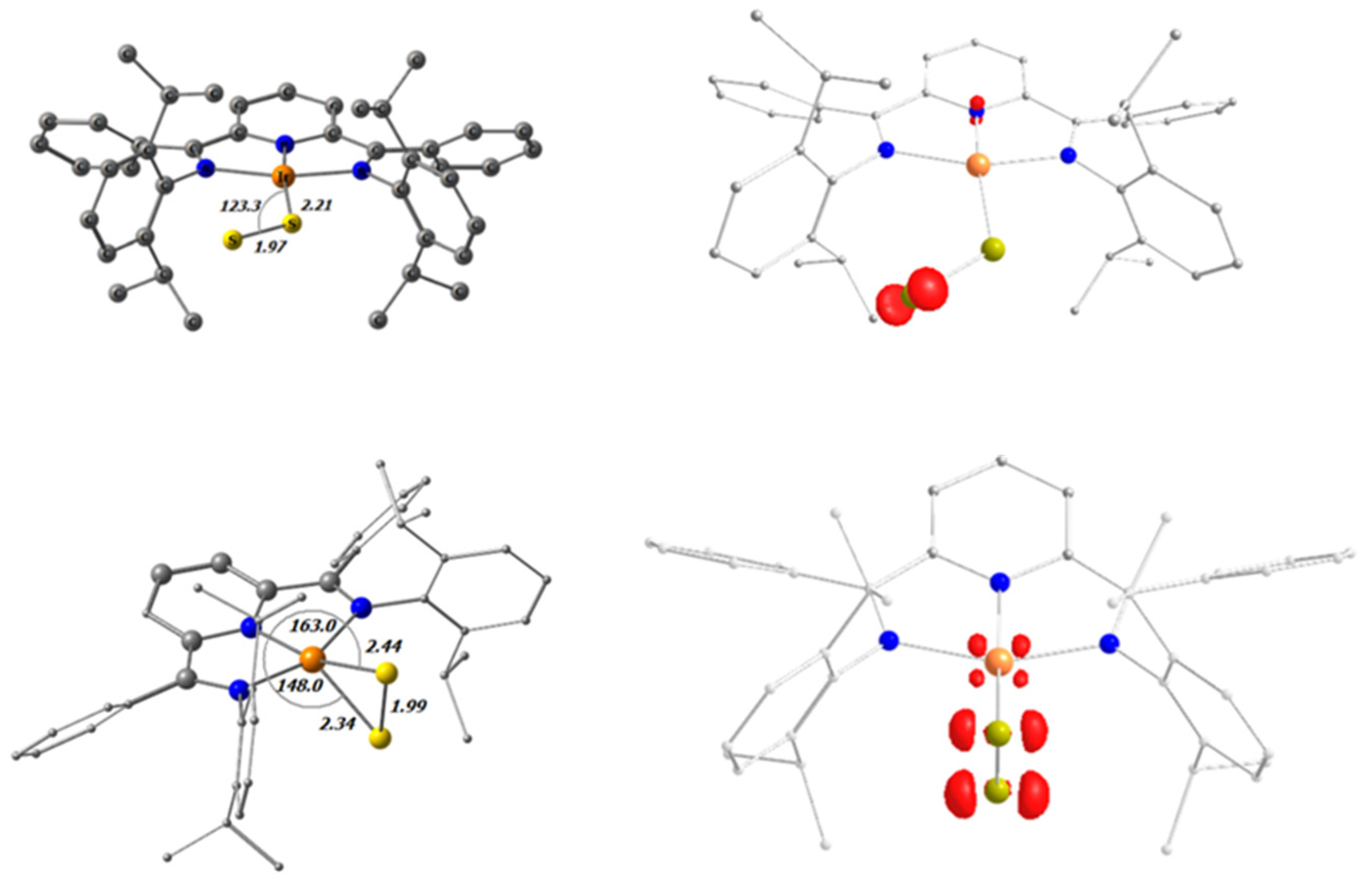
Dissociation of the Ir–S bond can, in principle, generate either a side-on κ2-S22-disulfido) or an end-on κ1-S21-disulfido) product but in both cases the process is strongly thermodynamically uphill. The computed free energies are ΔG298 = +25.8 and +32.5 kcal mol−1 (ΔE = +43.8 and +52.6 kcal mol−1) for the side-on and end-on complexes, respectively, as shown in Figure 5. In both structures, the unpaired spin density resides on the S2 fragment, rendering it readily capable of coupling to the S–S bond in the trisulfide intermediate according to Equation (3). This effect is particularly pronounced in the end-on disulfido species, where the spin density is localized on the β-sulfur atom. Side-on transition-metal disulfido complexes are far more common in the literature [29,59,60,61], which may correlate with the greater stability of the side-on species observed here [29,59,60,61,62].
Formation of the IrS2• unit according to Equation (2) is strongly energetically disfavored and lies at the limit of what could be considered compatible with the experimental ambient conditions. We therefore explored an alternative pathway to this species that proceeds via the IrS• radical:
(i)
Direct addition to the disulfide Ir-S2-Ir core or
(ii)
Rear-side nucleophilic addition to the pyridine para-position of IrS2Ir, yielding an IrSpy-Ir-S2Ir adduct and consecutive release of IrS2•.
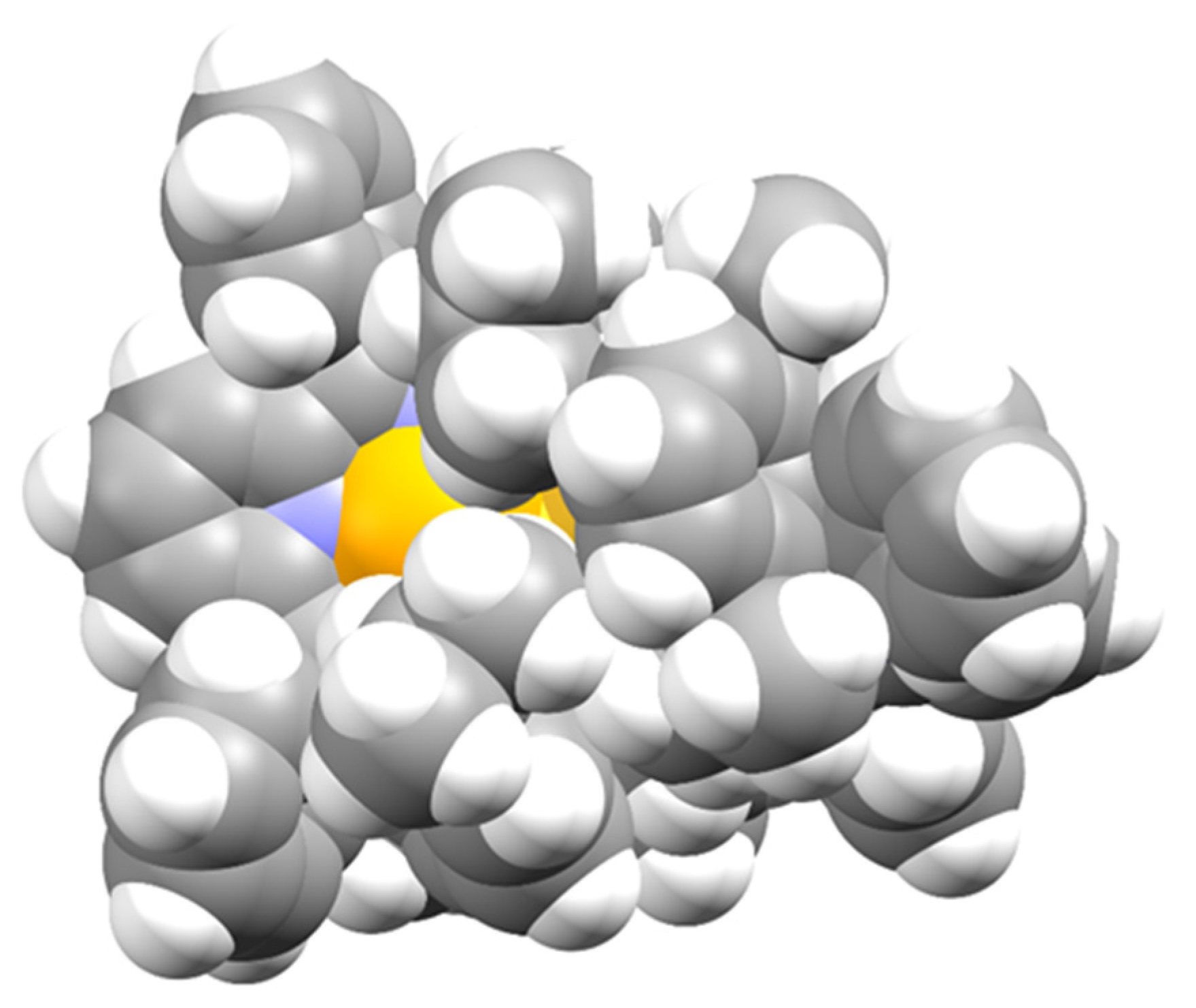
Step (i) is highly unlikely due to steric congestion around the disulfide core, which becomes immediately apparent by inspection of the space-filling model shown in Figure 6.
Figure 6 also illustrates that the pyridine ring is readily available for rear-side attack by an IrS• radical according to step (ii). The latter relates to the Minisci reaction of nucleophilic organic radicals, which are known to add to electron-deficient aromatic systems, e.g., pyridine [63,64]. This type of reaction is indeed employed synthetically by us to introduce a t-butyl group in 2,6-diacetylpyridine [65]. As shown in Scheme 2 the calculated barrier for this rear-side attack is reasonably low, ΔG298 = 26.0 kcal/mol. The resulting adduct is slightly uphill in energy, lying 16.2 kcal mol−1 above the starting Ir–S2–Ir disulfide. The computed structure of this adduct is depicted in Scheme 2.
In a subsequent step, the IrS2• radical is released, which is exergonic by 6.5 kcal mol−1 relative to the adduct. The nature of the remaining IrS-pyIr species is unclear. In the calculation, stabilization is realized at the front-side Ir center by tuck-in formation corresponding to a presumed facile intramolecular CH-activation of a d8-configured T-shaped fragment (Figure 7). This tentative side product is diamagnetic; it might further stabilize itself by re-aromatization with accompanying loss of H2 or formation of a hydrido complex and reinstallation of the isopropyl group by C-H reductive elimination (cf ESI). In any case, it should be noted that we did not observe hydride signals in the 1H NMR spectrum in support of this proposal.
Once the Ir3S3 addition species has formed, the aforementioned asymmetric cleavage of the S-S moiety becomes energetically feasible (green step, Scheme 2). Finally, the formation of the IrS3Ir product is calculated to be strongly exergonically favorable in comparison to the IrS2• and IrS• species (ΔE = −51.8 kcal mol−1). These calculations thus support a stepwise radical pathway in which sulfur-centered radical coupling and rearrangement drive the formation of the trisulfide-bridged binuclear species as the thermodynamically preferred product.

2.2. Dissociation Reaction

Although the formation of a terminal Ir–S species could not be observed experimentally, we identified a sulfur-bridged binuclear species as the major product of the radical activation chemistry. We next sought to determine whether its reactivity differs from that of the monomeric sulfanido precursor. In particular, we investigated its behavior toward small molecules such as dihydrogen. In our previous study, the corresponding monomeric sulfanido complex was found to be resistant to H2 activation on thermodynamic grounds, in contrast to related alkoxido analogs [12]. We were therefore interested in assessing whether formation of the S3-bridged binuclear species modifies this reactivity pattern or enables interaction with dihydrogen under thermal conditions. In addition, we wanted to examine the intrinsic stability of the Ir2S3 core itself.

2.2.1. In the Presence of H2 Atmosphere

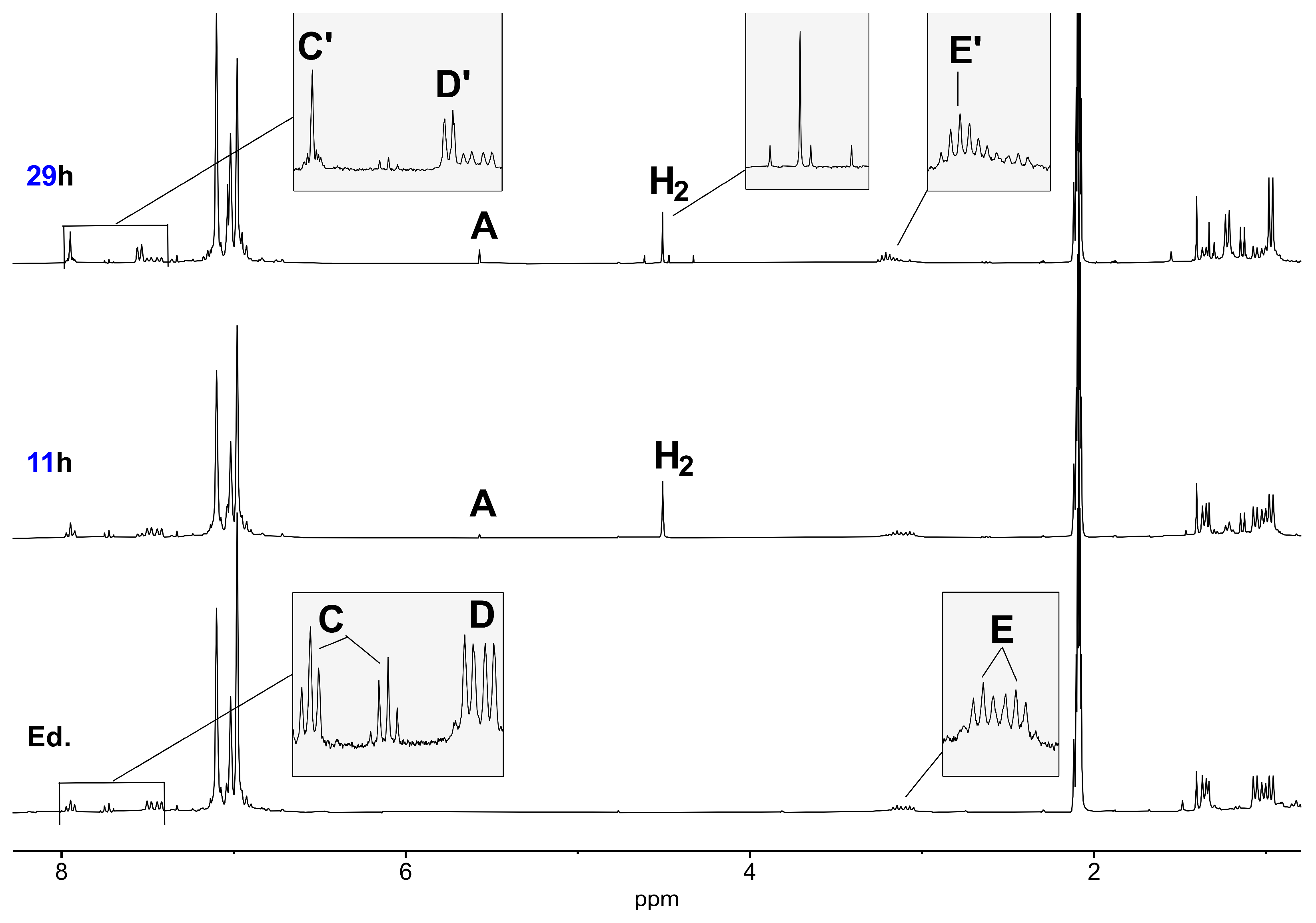
Upon heating the sulfur-bridged binuclear species in deuterated solvent under an atmosphere of dihydrogen at 80 °C for several hours, the characteristic resonances of the binuclear species progressively disappeared (Figure 8). In the 1H NMR spectra, the two triplets in the pyridine region at δ = 7.9 and 7.7 ppm (C) collapse into a sharp singlet (C′), and the two doublets for the PDI phenyl rings (D) converge into a single doublet (D′). Likewise, the pair of septets associated with the DIPP methine protons shift and sharpen into one septet (F/F′). These spectral changes collectively indicate formation of a species of higher symmetry (Figure 8).
Importantly, a singlet reappeared at the chemical shift previously assigned to the SH proton of the sulfanido SH complex 1 (A). The final 1H and 13C NMR spectra obtained after thermolysis coincide with those of the sulfanido complex, confirming that the reaction yields the monomeric thiolato species.
In addition, a distinct triplet (1:1:1) at δ ≈ 4.5 ppm (1J = 43 Hz) was detected, consistent with the formation of HD through exchange between H2 and the deuterated solvent. A related transformation has been reported for a bimetallic Rh2(μ-S)2 complex, which is converted to the Rh2(μ-SH)2 analog upon exposure to a hydrogen atmosphere [66].
To investigate the origin of the hydrogen atom in the regenerated thiolato SH group, the thermolysis experiment was repeated under an atmosphere of D2 in C6H6. If dihydrogen directly contributed to formation of the monomer, deuterium incorporation at sulfur would be expected, producing an Ir–SD species. 2H NMR analysis, however, revealed no signal at 5.6 ppm, anticipated for the Ir–SD unit. Instead, a resonance at 4.5 ppm corresponding to free D2 was observed, while additional signals at 3.6 and 3.3 ppm indicated deuterium incorporation at the methine positions of the DIPP substituents. Further resonances at 1.4, 1.3, and 1.0 ppm were assigned to deuterium incorporation into the methyl groups, consistent with H/D exchange at these positions rather than at sulfur.
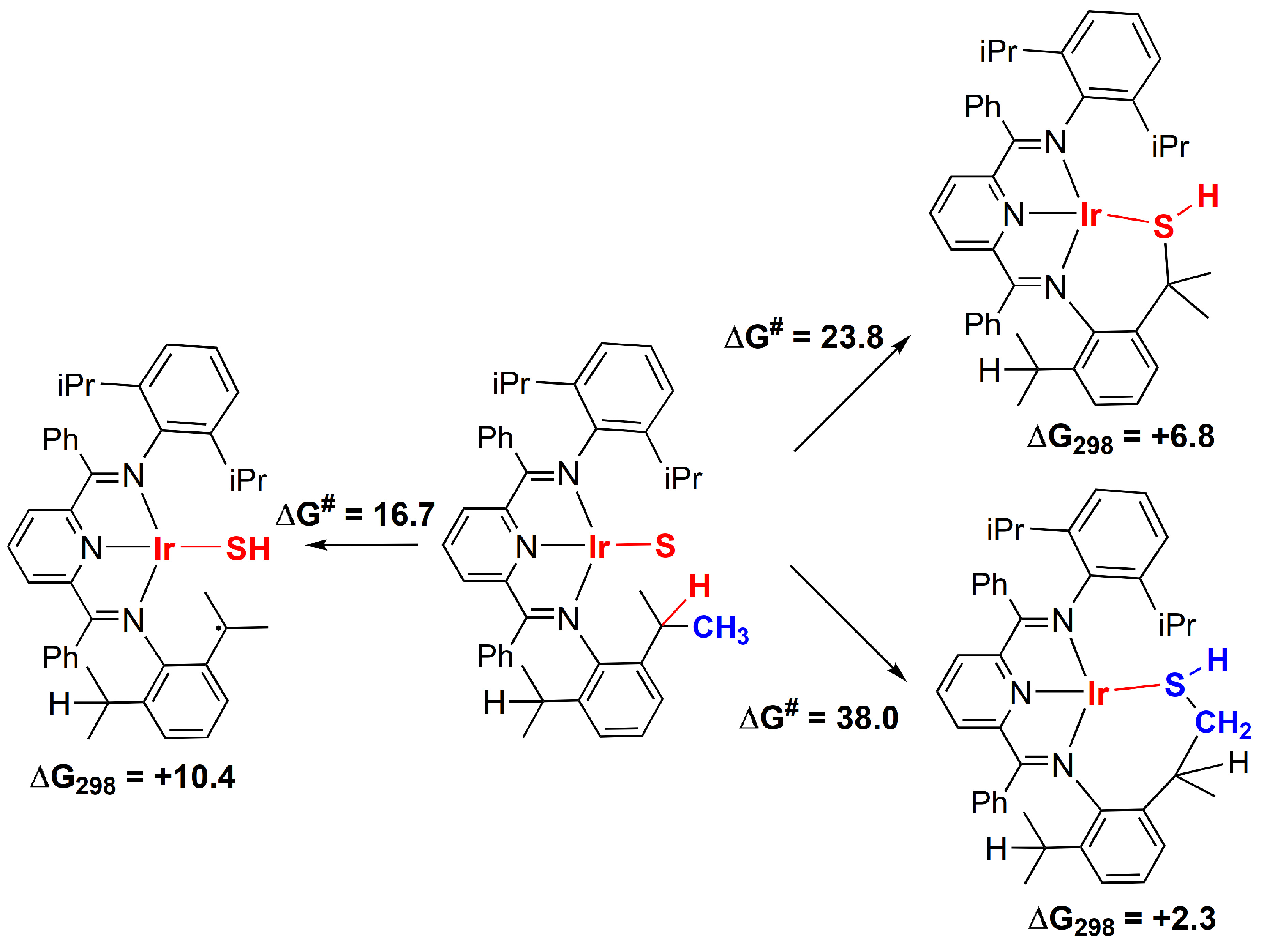
These observations prompted us to consider whether an intramolecular hydrogen-transfer process could account for the reappearance of the SH group. Such pathways are well precedented in related rhodium and iridium PDI nitrido systems, which undergo thermally induced intramolecular activation to generate tuck-in motifs [4]. In light of these precedents, the observed deuterium incorporation into both the methine and methyl positions of the DIPP substituents is entirely consistent with ligand-based hydrogen transfer to the metal–sulfur unit in the present system. This interpretation is further supported by the DFT results shown in Figure 9, in which three distinct C–H activation pathways were considered: (i) hydrogen-atom transfer (HAT) from the isopropyl methine position, and C–H activation at either (ii) the DIPP methyl groups or (iii) the methine positions.

2.2.2. Absence of H2 Atmosphere

To determine whether external dihydrogen is required for reformation of the thiolato monomer, the thermolysis was repeated under an atmosphere of nitrogen. Under these conditions, only partial regeneration of the monomeric species was observed (51% of 1 based on H-2-dipp integrals, c.f. Figure S26) and resonances attributable to the S3-bridged binuclear species remained detectable even upon heating to 90 °C for additional three days (44% of 3 based on H-2-dipp integrals, c.f. Figure S26). Complete disappearance of the binuclear species signals and exclusive formation of the monomer were achieved only at elevated temperatures up to 150 °C overnight. These findings demonstrate that the thiolato monomer can be regenerated in the absence of dihydrogen, shifting the mechanistic question toward whether the sulfur-bound hydrogen atom originates from the solvent or from an intramolecular pathway of the type discussed above.
Considering the requirement of microscopic reversibility, the steps leading to formation of the Ir–S3–Ir unit must be reversed to regenerate the IrS species. At 150 °C, the cleavage of the bridging trisulfide according to Ir–S3–Ir → IrS2 + IrS is calculated to be uphill by 24.8 kcal/mol, which is compatible with experimental conditions. A point that needed to be addressed is the fate of the additional third sulfur atom and the hydrogen source(s) in the absence of dihydrogen.
To evaluate whether the solvent could serve as the hydrogen source in the absence of dihydrogen, the thermolysis was repeated in deuterated methylcyclohexane (methylcyclohexane-d14) under otherwise identical conditions. Analysis of the reaction mixture revealed deuterium incorporation neither into the regenerated thiolato ligand nor into the ligand framework of the PDI backbone. These findings strengthen an intramolecular hydrogen transfer mechanism operating within the Ir-PDI complex.
To enable quantitative analysis of the proton balance during thermolysis, the sulfur-bridged binuclear species was heated at 150 °C in C6D6 using 1,4-dimethoxybenzene as an internal standard. Integration of the proton resonances before and after heating revealed that only 79% of the expected proton count was recovered following the thermolysis. To verify the reliability of this measurement and to exclude that the internal standard might have reacted under the reaction conditions, the experiment was repeated using an external ferrocene standard contained in a sealed capillary to prevent interaction with the reaction mixture. This setup reproduced the earlier result, with approximately 80% of the expected proton count detected after thermolysis. EPR analysis of the reaction mixture obtained after thermolysis revealed a paramagnetic signal, indicating formation of at least one paramagnetic species; this signal, however, is present only in small amount as evidenced by quantitative analysis of the EPR signal.
The missing proton intensities could therefore be explained by partial decomposition and/or the formation of NMR-silent paramagnetic species alongside the monomeric thio-lato complex. These observations are consistent with the incomplete proton recovery (79–80%) determined by quantitative NMR analysis and indicate that the thermolysis does not yield exclusively the monomer.
Related transformations of metal–sulfido complexes in the absence of molecular hydrogen have been reported in the literature. Valdez-Moreira et al. [31] and Larsen et al. [30] described hydrogen-atom abstraction (HAA) from dihydroanthracene (C14H12) by terminal sulfido iron complexes, yielding the corresponding thiolato iron species along with anthracene (C14H10). Tagliavini et al. showed that μ-sulfido dinickel complexes participate in reversible hydrogen-atom transfer, regenerating thiolato dinickel species upon treatment with TEMPO-H or xanthene [29].
The proton balance experiments indicate that under the thermolysis conditions additional processes occur; either the formation of secondary species or partial decomposition. If the sulfur-bridged binuclear species were to dissociate cleanly into two monomeric thiolato complexes, 100% of the original proton count should be recovered. Conversely, if each binuclear species furnished only one monomer while the second fragment became NMR-silent (e.g., paramagnetic or decomposed), only 50% of the protons would remain detectable. The experimentally observed recovery of 70–80% therefore falls between these two limiting scenarios. The data imply that additional, more complex pathways might contribute to the hydrogen and mass balance under the reaction conditions.
Overall, the thermolysis experiments show that dissociation of the binuclear species is possible both in the presence and in the absence of a hydrogen atmosphere. Even for methylcyclohexane-d14, which displays substantially weaker carbon–hydrogen bonds than benzene, no deuterium abstraction from the solvent was detected. This further supports that the solvent does not participate in the hydrogen transfer process. When conducted under D2, the reaction regenerated an S–H bond rather than an S–D bond, while deuterium incorporation was observed in the methyl and methine positions of the DIPP substituents. This pattern is consistent with an intramolecular hydrogen-transfer pathway, potentially involving formation of a transient tuck-in motif as suggested by our DFT calculations (Figure 9). However, no hydride resonances corresponding to diamagnetic tuck-in intermediates were detected in the 1H NMR spectra. Finally, thermolysis under an inert atmosphere does not yield the monomer exclusively; the formation of paramagnetic, NMR-silent byproducts is evident, though their structures could not be conclusively identified in this study.

3. Materials and Methods

Unless otherwise specified all preparations of the complexes were performed under an inert atmosphere of nitrogen in an MBraun (Garching, Germany) or an Innovative Technology (Pinneberg, Germany) glovebox. The solvents were purified according to standard procedures. Deuterated NMR solvents THF, benzene, toluene and methylcyclohexane were dried in vacuum over sodium benzophenone ketyl and stored under nitrogen. The TTBP phenoxy radical was prepared according to Manner et al. [67]. The ligands and the iridium thiolato complex 1 were synthesized following published procedures [5]. The synthesis of the thiolato complex 2, together with the precursor chlorido complexes, as well as the dimerization & reversion conditions, are reported in the Supplementary Material. All other chemicals were purchased from commercial sources and used as received (SigmaAldrich (Taufkirchen, Germany), TCI (Eschborn, Germany), ABCR (Karlsruhe Germany)).

3.1. Instrumentation

NMR spectra were recorded on Bruker NMR spectrometers (Fourier 300, 300 MHz or Avance, 400 and 600 MHz) (Ettlingen, Germany). Unless otherwise stated, the spectra were recorded at room temperature. The resonances of the residual protons of the deuterated solvents used served as references for the 1H NMR spectra.
The MALDI-MS spectra were recorded on a MALDI-TOF from Bruker with a Smartbeam II laser. Sample preparation was carried out, where necessary, under a nitrogen atmosphere in a glove box. Anthracene was used as the matrix for the MALDI-MS measurements. The LIFDI-MS spectra were measured by the Linden CMS company (Weyhe, Germany). LIFDI spectra are acquired with a Thermo Fisher Orbitrap Exploris 240. A more detailed description is given the supporting information.
Single X-ray crystal measurements were performed using a Bruker Smart Apex APEX single-crystal diffractometer with graphite monochromatic MoKα radiation (λ = 0.71073 Å) (Ettlingen, Germany). or an Oxford Diffractometer Supernova from Agilent Technology (Waldbronn, Germany) equipped with CuKα and a MoKα radiation sources at 100 K. The single crystals were mounted in high viscosity polybutene oil on a glass fiber of the goniometer head. Data were analyzed using the software packages Saint v8.34A (Bruker, 2013) and Sadabs-2012/1 (Bruker2012) and ChrysAlis Pro 1.171.41.123a (Oxford Diffraction, 2022). The structures were solved and refined with the Shelx [68] and Olex2 [69] program packages. All atoms were refined anisotropically except for the hydrogen atoms.
UV/Vis spectra were recorded in quartz glass cuvettes (1 cm path length) using a Varian Cary50 Scan UV/Vis spectrometer (Darmstadt, Germany). The NIR spectra in solution were recorded using a Varian Cary5000 spectrometer in quartz glass cuvettes (1 cm path length) (Darmstadt, Germany).
Elemental analyses were performed using a Vario EL III CHN elemental analyzer from Elementar Analysesysteme GmbH (Langenselbold, Germany) or an EuroEA CHNS-O elemental analyzer with Hekatech HAT oxygen analyzer from EuroVec-Tor/Hekatech (Wegberg, Germany).
The EPR measurements were performed in 4 mm quartz glass tubes on a MiniScope MS 400 spectrometer from Magnettech (Ettlingen, Germany).

3.2. Synthesis and Characterization

3.2.1. Complexes 2, 5 and 6

For the syntheses of the iridium chlorido 5, the methoxido 6 and the sulfido complex 2 we followed our previously established route [5]. Synthetical and analytical details are described in the supporting information.

3.2.2. Complex 3

To 103 mg (124 µmol) of complex 1 dissolved in 5 mL benzene, 96 mg (372 µmol, 3 equiv.) 2,4,6-tris-tert-butylphenoxy radical dissolved in 2 mL benzene was added and stirred for 17 h at 40 °C. The solvent was then removed in high vacuum. The crude product was washed excessively with pentane to remove the formed phenol species. The obtained dark solid (54 mg, 32 µmol, 51%) was dried under high vacuum. Suitable crystals of complex 3 for X-ray diffraction were grown from cooling an 80 °C toluene solution to 25 °C over the course of 72 h.
1H NMR (300 MHz, THF-d8): δ [ppm] = 7.97 (t, (3JH,H: 8.0 Hz), 4H, H-3-py), 7.71 (t, (3JH,H: 7.9 Hz), 2H, H-4-py), 7.55 (d, (3JH,H: 7.3 Hz), 4H, H-2,6-ph), 7.46 (d, (3JH,H: 7.3 Hz), 4H, H-2,6-ph), 7.11-7.01 (m, 13H,H-ph, H-ar), 7.00-6.88 (m, 11H, H -ph, H-ar), 3.29-3.15 (m, 8H, H-1-dipp), 1.44-1.39(m, 12H (3JH,H:= 6.9 Hz) H-2-dipp), 1.10(t, 24H (3JH,H:= 6.4 Hz) H-2-dipp), 0.98 (d, 12H (3JH,H:= 6.7 Hz) H-2-dipp).
Other signals: 3.58 THF, 1.41 THF.
13C{1H}-NMR (75 MHz, THF-d8): δ [ppm] = 167.5 (C-im), 163.4 (C-im/C-2-py), 156.6 (C-2-py/C-ph/C-ar), 153.6 (C-ph/C-ar), 150.5 (C-ph/C-ar), 149.6 (C-ph/C-ar), 139.8 (C-ph/C-ar), 139.2 (C-ph/C-ar), 125.7 (C-2a-ph), 125.3 (C-2b-ph), 124.4 (C-3-py), 123.6 (C-ph/C-ar), 123.4 (C-ph/C-ar), 122.7 (C-ph/C-ar), 120.1 (C-4-py), 28.5 (C-1a-dipp), 28.3 (C-1b-dipp), 26.9(C-2a-dipp), 26.2 (C-2b-dipp), 23.9 (C-2c-dipp), 23.8(C-2d-dipp).
Other signals: 67.8 THF, 25.8 THF.
LIFDI-MS(C86H94Ir2N6S3)+:calc.: 1692.60 Dameas.: 1692.6 Da (100%)
(C43H45IrN3)+:calc.: 796.3 Dameas.: 796.3 Da (85%)
CHN
Ir-S3-Ir (C86H94Ir2N6S3)calc. [%]C: 61.04H: 5.60N: 4.97S: 5.68
Ir-S2-Ir (C86H94Ir2N3S2)calc. [%]C: 62.21H: 5.71N: 5.06S: 3.86
meas. [%]C: 62.90H: 6.16N: 4.69S: 4.05

3.2.3. Complex 4

A total of 72 mg (76 mmol) of complex 2 and 60 mg of the TTBP radical were dissolved in benzene and stirred for 24 h at 60 °C. The solvent was removed in high vacuum and the solid remainder was washed with pentane and benzene. The complex 4 could not be isolated; attempts by recrystallization, extraction and column chromatography on Al2O3 (activity II-III) were not successful.
1H NMR (300 MHz, C6D6): δ [ppm] = 8.09–8.04, 7.77–7.75,.7.58–7.29, 6.79, 6.60, 3.30–3.10, 1.42–1.30, 1.26, 1.15–0.90, 0.86.
Other Signals δ [ppm]: 7.48 (TTBP-Phenol), 4.83, 1.42, 1.38, 0.30.(grease).
MALDI[Ir-S]+calc.: 942.437 Dameas.: 942.584 Da (11%)
[Ir-S-S-Ir]-3H+calc.: 1881.851 Dameas.: 1181.890 Da (2%)
[Ir-S-S-S-Ir]+:calc.: 1916.786 Dameas.: 1916.870 Da (2%)

3.2.4. Dimerization of Complex 1 with External Ferrocene Standard

A total of 20 mg (24 mmol) of complex 1 was dissolved in 0.6 mL C6D6 in a 5 mm NMR tube with Young Teflon tap. A sealed capillary with a ferrocene (Fc) solution (5.3 mol/L; 1 mg Fc per mL C6D6) was inserted and 1H NMR spectra were measured. The capillary with the external standard was removed and 19 mg (72 µmol, 3.0 e.q) of TTBP radical was added. The NMR sample was stored at 50 °C for 22 h. After reaching RT, the capillary with the external standard was again added and another 1H NMR spectrum was measured.

3.2.5. Thermolysis with Internal Standard 1,4-Dimethoxybenzene

A total of 20 mg (12 µmol) of the binuclear species 3 and 0.1 mg (0.72 µmol) of 1,4-dimethoxybenzene of a stock solution in C6D6 were dissolved in 0.7 mL C6D6 and the 1H NMR spectrum was measured. The NMR sample was thermolyzed for 17 h at 150 °C in an NMR tube with Young Teflon tap and the 1H NMR spectrum was measured.

3.2.6. Thermolysis with External Standard Ferrocene

A total of 20 mg (12 µmol) of the binuclear species 3 was dissolved in 0.6 mL C6D6, a sealed capillary with a ferrocene solution (5.3 mol/L; 1 mg Fc per ml C6D6) was inserted and the 1H NMR spectrum was measured. Then the sealed capillary was removed and the sample was thermolyzed at 150 °C overnight in an NMR tube with Young Teflon tap. Then the sample was allowed to cool to RT and the capillary (external standard) was reinserted and the 1H NMR spectrum was measured again.

3.3. DOSY 1H NMR Spectroscopy

DOSY 1H NMR spectra were measured at 300 K in toluene-d8 on a 600 MHz spectrometer. The molecular diameters were calculated from the mean diffusion coefficients by using the Stokes-Einstein equation and the SEGWE calculator from the Manchester NMR Methodology Group [38,39,40,70].

3.4. LIFDI-MS

Sample Synthesis/Preparation

A total of 220 mg (265 µmol) of 1 and 207 mg (793 µmoL, 3.0 eq) TTBP-radical were dissolved in 10 mL benzene and stirred for 18 h at 50 °C. Then the solvent was removed and the solid was washed twice with 10 mL pentane and finally with 6 mL hexane. The solid was crystallized in pentane at −35 °C for 18 h. 32 mg (19 µmol, 22% of Ir2S3-binuclear species) of a dark solid were obtained. The LIFDI sample(solid) and THF were measured by Linden CMS (Weyhe, Germany).

3.5. Theoretical Methods

3.5.1. DFT Calculations

Density Functional Theory (DFT) calculations were carried out using version 7.9 of the Turbomole program package [40]. The def2-TZVP basis set was used for all atoms, which includes the relativistic def2-ECP pseudopotential ECP-60-MWB for iridium. For calculations with the r2scan-3c density functional [71] the prescribed def2-mTZVPP basis was utilized and an ECP-60-MWB pseudopotential for iridium. The resolution-of-identity (RI-DFT) approximation was employed with the corresponding RIJ-auxiliary basis sets.
The PBE [72], r2scan-3c meta-GGA and PW6B95 [73] hybrid functionals were used, with seminumerical exchange included for the latter (activated via the $senex keyword). Dispersion corrections were incorporated using Grimme’s D4 method [74]. Unless otherwise noted, all geometries were fully optimized without imposing any geometry or symmetry constraints.
Stationary points were characterized by frequency calculations: minima were confirmed by the absence of imaginary frequencies, while transition states exhibited exactly one imaginary frequency. Transition state optimizations were started from approximate geometries obtained from linear transit searches. We employed Kästner’s DL-FIND optimizer as implemented in TCL-Chemshell 3.7 [75], and alternatively Wang’s GeomeTRIC Optimizer [76] using (tric coordinates) (https://github.com/leeping/geomeTRIC accessed on 15 December 2025) interfaced to Turbomole with Ragnar Bjornssons excellent ASH python interface (available at https://github.com/RagnarB83/ash accessed on 15 December 2025). Intrinsic Reaction Coordinate (IRC) calculations were subsequently performed to ensure proper connection between each transition state and the corresponding reactant and product. Cartesian coordinates of all optimized geometries are provided in the SI.

3.5.2. Local Coupled Cluster Calculations

Local natural orbital coupled-cluster calculations [LNO-CCSD(T)] were performed using the freely available MRCC (2022) program package (https://www.mrcc.hu/ accessed on 15 December 2025) [41], employing default thresholds (lcorthr = normal). Geometries optimized at the PBE-D4/def2-TZVP level were used. The def2-TZVPPD basis sets were employed together with complementary def2-QZVPP/C auxiliary correlation basis sets and the previously mentioned pseudopotentials.

3.5.3. Thermochemical Corrections

Corrections from electronic energies to Gibbs free energies (ΔG298) were obtained using thermochemical data from PBE-D4/def2-TZVP frequency calculations, applying a scaling factor of 1.011 from Truhlar’s database (version 5.0) [77] and 0.9688 for the r2scan-3c functional [78].

3.5.4. Excited-State Calculations

RPA-TDDFT calculations were performed with the PBE functional based on PBE-D4/def2-TZVP optimized geometries. The resulting spectra were visualized using the freely available SPECDIS program (version 1.71; T. Bruhn, A. Schaumlöffel, Y. Hemberger, G. Pescitelli, SpecDis, Berlin, Germany, 2017; https://specdis-software.jimdo.com accessed on 15 December 2025), employing calculated vertical transitions and a Gaussian broadening of 0.16 eV.

4. Conclusions

In this article, we analyzed the reactivity of thiolato complexes with phenoxy radicals to form µ-sulfido-bridged binuclear species. To our surprise, instead of the anticipated dimeric disulfido Ir–S2–Ir complex formed along a least-motion pathway, a trisulfido Ir–S3–Ir species was characterized by X-ray crystallography and mass spectrometry. DFT calculations of the radical reaction mechanism confirmed that the IrS3Ir motif is more stable than the corresponding IrS2Ir analog, rationalizing the preference for the µ-trisulfido bridge. Reactivity studies of the bridged binuclear species revealed regeneration of the monomeric thiolato complex after thermolysis in a hydrogen atmosphere, as well as in the absence of a hydrogen atmosphere at higher temperatures.

Supplementary Materials

The following supporting information can be downloaded at: https://www.mdpi.com/article/10.3390/inorganics14010011/s1, Figure S1: NMR naming scheme for complexes 2, 4, 5, 6 on the left & for complexes 1, 3 on the right side; Figure S2: Free energy plot for the dimerization mechanism of the mechanism of 1; Figure S3: Transition state of the reaction: IrS + Ir2S2 -> Ir3S3 (Figure S2). Highlighted in red is the rear side attack at the 4-position of the pyridine ring of the Ir2S2 species; Figure S4: The calculated Ir2Spyaddd structure. Selected Hydrogen Atoms are shown. Highlighted in red are the sulfur-carbon (para-pyridine) and the tuck-in iridium metal center; Figure S5: The DFT (2-component X2c relativisticPBE-D4/X2c-TZVPall-2c-s) calculated NMR shifts of Ir2Spyaddd δ in ppm and selected structural parameters in Å; Figure S6: 1H NMR spectrum of 5 in thf-d8 (300 MHz).; Figure S7: 13C-DEPTQ NMR spectrum of 5 in thf-d8 (100 MHz), Figure S8: 1H NMR spectrum of 6 in thf-d8 (300 MHz); Figure S9: 13C-DEPTQ NMR spectrum of 6 in thf-d8 (100 MHz); Figure S10: 1H NMR spectrum of 1 in C6D6 (300 MHz); Figure S11: 1H NMR spectrum of 2 in C6D6 (300 MHz); Figure S 12: 13C-DEPTQ NMR spectrum of 2 in thf-d8 (100 MHz); Figure S13: 1H NMR spectrum of complex 3 in Tol-d8 (300 MHz); Figure S14: 1H NMR spectrum of complex 3 in C6D6 (300 MHz); Figure S15: 13C{1H} NMR spectrum of complex 3 in C6D6 (125 MHz); Figure S16: 1H NMR spectra before (bottom) and after (top) reaction of 1 with TTBP-radical (3.0 eq.) in the presence of external 1H-standard (ferrocene) in C6D6 (300 MHz). A = SH, Fc = Fe(C5H5)2, B = TTBPH, C = H-1-dipp, C′ = H-2-dipp.; Figure S17: 1H NMR spectrum of complex 1 (before radical reaction) in the presence of an external 1H NMR standard (ferrocene) in C6D6 (bottom of Figure S16). A/B = H-py, C = H-2,6-ph, D = H-1-dipp, E = H-2-dipp; Figure S18: 1H NMR spectrum of complex 3 (after radical reaction) in the presence of TTBPH and external 1H NMR standard (ferrocene) in C6D6 (top of Figure S16). A = H-3-py, B = H-4-py, C = H-2,6-ph, D = H-1-dipp, E = H-2-dipp; Figure S19: 1H NMR spectra in C6D6 (300 MHz). Bottom: Complex 1 in the presence of external 1H standard (ferrocene). Middle: Immediately recorded after the addition of TBP-radical (3.0 eq.) to 1. Top: product of reaction after workup. A = SH, Fc = Fe(C5H5)2, B = TTBPH, C/C′ = H-py, D/D′ = H-2,6-ph, E/E′ = H-1-dipp, F/F′ = H-2-dipp; Figure S20: 1H NMR spectra of complex 3 (bottom) and after thermolysis in the presence of dihydrogen (top) in C6D6; Figure S21: 1H NMR spectrum (RT) after thermolysis reaction of complex 3 in the presence of dihydrogen (top of Figure S20) in C6D6. Highlighted parts of the spectrum with larger magnification; A = SH, B = H2, C = HD (1J = 43 Hz); Figure S22: Part of deuterium NMR spectrum (RT) of the thermolysis product at 80°C of 3 in D2 atmosphere in C6H6 (600 MHz); Figure S23: RT 1H NMR spectrum of the thermolysis mixture (80°C) of 3 under D2 atmosphere in C6D6 (300 MHz); Figure S24: Part of the RT 1H NMR spectrum of the thermolysis mixture (at 80°C) of 3 under D2 atmosphere in C6D6 (300 MHz); Figure S25: 1H NMR spectra at RT of the thermolysis reaction of complex 3 (bottom) and at 80 °C for 72 h (top) in C6D6 in the absence of dihydrogen. Highlighted resonances of the thiol group (A) and the sharp resonance for the three pyridine protons (B) assigned to complex 1; Figure S26: 1H NMR spectra of the thermolysis of complex 3 in C6D6 (all recorded at RT). Red: complex 3 at RT (bottom); yellow: 1 h at 80 °C; green: 2 h at 80 °C; light blue: 72 h at 80 °C; dark blue: 72 h at 80 °C & 24 h at 90 °C; purple: 72 h at 80 °C & 72 h at 90 °C; Figure S27: RT 1H NMR spectra of the thermolysis of complex 3 in methylcyclohexane-d14. Bottom: 1H NMR spectrum of complex 1 as a reference; middle: 1H NMR spectrum of complex 3 before thermolysis; top: 1H NMR spectrum of complex 3 after 2.5 h at 80 °C. Highlighted part shows resonance at 5.23 ppm with higher magnification. A = SH at 5.23 ppm.; Figure S28: Part of 1H NMR spectra (RT) of the thermolysis of complex 3 in methylcyclohexane-d14 from Figure S27. Bottom: 1H NMR spectrum of complex 1 as a reference (A; thiol group); middle: 1H NMR spectrum of complex 3 before thermolysis; top: 1H NMR spectrum of complex 3 after 2.5 h at 80 °C; Figure S29: 1H NMR spectra (RT) before (bottom) and after (top) thermolysis reaction of 3 in the presence of an internal 1H-standard (1,4-DMB) in C6D6 (500 MHz); Figure S30: 1H NMR spectrum of complex 3 (before thermolysis) in the presence of an internal 1H-standard (1,4-DMB) in C6D6 (bottom of Figure S29). A = H-3-py, B = H-4-py, C = H-2,6-ph, D = H-1-dipp, E = H-2-dipp; Figure S31: 1H NMR spectrum of complex 1 (after thermolysis of 3) in the presence of internal 1H-standard (1,4-DMB) in C6D6 (top of Figure S29). A/B = H-py, C = H-2,6-ph, D = H-1-dipp, E = H-2-dipp; Figure S32: 1H NMR spectra before (bottom) and after (top) thermolysis reaction of 3 in the presence of external 1H NMR standard (ferrocene) in C6D6 (RT, 300 MHz); Figure S33: 1H NMR spectrum of complex 3 (before thermolysis) in the presence of an external 1H NMR standard (ferrocene) in C6D6 (bottom of Figure S32). A = H-3-py, B = H-4-py, C = H-2,6-ph, D = H-1-dipp, E = H-2-dipp; Figure S34: 1H NMR spectrum of complex 1 (after thermolysis of 3) in the presence of external 1H NMR standard (ferrocene) in C6D6 (top of Figure S32). A/B = H-py, C = H-2,6-ph, D = H-1-dipp, E = H-2-dipp; Figure S35: MALDI spectrum of complex 2; Figure S36: MALDI spectrum of complex 3; Figure S37: Part of MALDI spectrum of complex 3; Figure S38: Part of MALDI spectrum of complex 3; Figure S39: Simulated MALDI spectrum of complex 3 (C86H94Ir2N6S3) with Chem Draw Version 23.1.1.3.; Figure S40: LIFDI-MS of complex 3; Figure S41: Part of LIFDI-MS of Figure S40 peak with highest intensity at 1692 m/z (top) and the simulated spectrum for C86H94Ir2N6S3+ = complex 3 (bottom); Figure S42: Part of LIFDI-MS of Figure S40 peak with second highest intensity at 796 m/z (top) and the simulated spectrum for C43H45IrN3+ (bottom); Figure S43: MALDI spectrum of complex 4; Figure S44: Zoomed MALDI spectrum of complex 4; Figure S45: MALDI spectrum of complex 5; Figure S46: MALDI spectrum of complex 6; Figure S47: ATR-IR spectra of reaction of 1 + TTBP. No Dinitrogen complex was observed. The bands of phenol (3642 cm−1) and benzene (1957, 1814, 1573 and 1478 cm−1) were observed; Figure S48: UV/Vis spectrum of complex 1 in C6H6 with addition of TTBP at 50 °C over time. TTBP: λmax [nm] = 382, 401, 628. IrSH: λmax [nm] = 474, 562, 719; Figure S49: At vs. time of selected UV/Vis bands of complex 1 in C6H6 with addition of TTBP at 50 °C over time; Figure S50: ln(At/A0) vs. time of selected UV/Vis bands of complex 1 in C6H6 with addition of TTBP at 50 °C over time; Figure S51: 1/At vs. time of selected UV/Vis bands of complex 1 in C6H6 with addition of TTBP at 50 °C over time; Figure S52: UV/vis spectrum of complex 2 in benzene at RT; Figure S53: UV/vis spectrum of complex 5 in benzene at RT; Figure S54: UV/vis spectrum of complex 6 in benzene at RT; Figure S55: UV/vis spectrum of TTBP radical in toluene at room temperature; Figure S56: Calculated TD/DFT (PBE/def2-TZVP) spectra of µ-di- and the µ-trisulfido species 3; Figure S57: Raman spectrum (excitation at 532 nm) of 1; Figure S58: Raman spectrum (excitation at 532 nm) of 2; Figure S59: EPR spectrum of complex 3 after workup in benzene at room temperature; Figure S60: EPR spectrum of complex 3 after thermolysis in benzene at room temperature; Figure S61: Ortep diagram of the molecular structure of 5. Hydrogen atoms are omitted for clarity, ellipsoids are shown at the 50% probability level. (Carbon atoms = grey, nitrogen atoms = light blue, iridium atom = dark blue, chloro atom = green) Wieghardt et al. structure parameter: Δ = 0.102 Å; Figure S62: Ortep diagram of the molecular structure of 2. Hydrogen atoms are omitted for clarity, ellipsoids are shown at the 50% probability level. (Carbon atoms = grey, nitrogen atoms = blue, iridium atom = teal, sulfur atom = yellow). WIEGHARDT et al. structure parameter: Δ = 0.088 Å; Figure S63: Ortep diagram of the molecular structure of 3. Hydrogen atoms are omitted for clarity, ellipsoids are shown at the 50% probability level. (Carbon atoms = grey, nitrogen atoms = blue, iridium atom = teal, sulfur atom = yellow), Figure S64: Ortep diagram of the molecular structure of 3. Hydrogen atoms and aryl groups at imine nitrogens are omitted for clarity, ellipsoids are shown at the 50% probability level. (Carbon atoms = grey, nitrogen atoms = blue, iridium atom = teal, sulfur atom = yellow); Table S1: Calculated ΔE and ΔG298 for the reaction of the sulfanido species 1 with the tbbp phenoxy radical at different levels of theory: Ir-S-H + O-(2,6-tBu)Ph -> IrS + H-O-(2,6-tBu)Ph; Table S2: Calculated ΔE and ΔG298 of dissociation of potentially formed Ir2S2 species with multiple DFT functionals; Table S3: Calculated ΔE and ΔG298 of dissociation of potentially formed Ir3S3 species with multiple DFT functionals; Table S4: Integrals of 1H NMR spectra before and after reaction of IrSH, 1, with TTBP (with external standard ferrocene) from Figure S17 and S18; Table S5: Integrals of 1H NMR spectra before and after thermolysis of Ir2S3 (with internal standard para-dimethoxybenzene) from Figure S30 and S31; Table S6: Integrals of 1H NMR spectra before and after thermolysis of 3 (with external standard ferrocene) from Figure S33 and S34; Table S7: Summary of important structural parameters with esd’s on parentheses; Table S8: Summary of crystal data collection and structure refinements. Additional references in Supplementary Materials: [79,80].

Author Contributions

Conceptualization, P.B. and M.V.; Methodology, M.V. and T.M.; Resources, M.V. and T.M.; Data curation, M.V. and T.M.; Writing—original draft, M.V.; Writing—review and editing, P.B., M.V. and T.M.; Supervision, P.B. All authors have read and agreed to the published version of the manuscript.

Funding

This research received funding from the University of Hamburg.

Institutional Review Board Statement

Not applicable.

Informed Consent Statement

Not applicable.

Data Availability Statement

The X-ray crystallographic data were submitted to the Cambridge Crystallographic Database and can be accessed via the deposition numbers: 2512154, 2514286 and 2514287.

Acknowledgments

Funds by the University of Hamburg are gratefully acknowledged.

Conflicts of Interest

The authors declare no conflicts of interest.

References

  1. Sieh, D.; Burger, P. Si-H Activation in an Iridium Nitrido Complex—A Mechanistic and Theoretical Study. J. Am. Chem. Soc. 2013, 135, 3971–3982. [Google Scholar] [CrossRef] [PubMed]
  2. Schiller, C.; Sieh, D.; Lindenmaier, N.; Stephan, M.; Junker, N.; Reijerse, E.; Granovsky, A.A.; Burger, P. Cleavage of an Aromatic C-C Bond in Ferrocene by Insertion of an Iridium Nitrido Nitrogen Atom. J. Am. Chem. Soc. 2023, 145, 11392–11401. [Google Scholar] [CrossRef] [PubMed]
  3. Schöffel, J.; Rogachev, A.Y.; George, S.D.B.; Burger, P. Isolation and Hydrogenation of a Complex with a Terminal Iridium-Nitrido Bond. Angew. Chem. Int. Ed. 2009, 48, 4734–4738. [Google Scholar] [CrossRef]
  4. Schöffel, J.; Šušnjar, N.; Nückel, S.; Sieh, D.; Burger, P. 4d vs. 5d—Reactivity and Fate of Terminal Nitrido Complexes of Rhodium and Iridium. Eur. J. Inorg. Chem. 2010, 2010, 4911–4915. [Google Scholar] [CrossRef]
  5. Stephan, M.; Völker, M.; Schreyer, M.; Burger, P. Syntheses, Crystal and Electronic Structures of Rhodium and Iridium Pyridine Di-Imine Complexes with O- and S-Donor Ligands: (Hydroxido, Methoxido and Thiolato). Chemistry 2023, 5, 1961–1989. [Google Scholar] [CrossRef]
  6. Römelt, C.; Weyhermüller, T.; Wieghardt, K. Structural Characteristics of Redox-Active Pyridine-1,6-Diimine Complexes: Electronic Structures and Ligand Oxidation Levels. Coord. Chem. Rev. 2019, 380, 287–317. [Google Scholar] [CrossRef]
  7. Szabo, K.J.; Wendt, O.F. Pincer-Type Complexes, 1st ed.; Wiley-VCH: Weinheim, Germany, 2014. [Google Scholar]
  8. De Bruin, B.; Bill, E.; Bothe, E.; Weyhermüller, T.; Wieghardt, K. Molecular and Electronic Structures of Bis(Pyridine-2,6-Diimine)Metal Complexes [ML2](PF6)(n) (n = 0, 1, 2, 3; M = Mn, Fe, Co, Ni, Cu, Zn). Inorg. Chem. 2000, 39, 2936–2947. [Google Scholar] [CrossRef]
  9. Budzelaar, P.H.M.; De Bruin, B.; Gal, A.W.; Wieghardt, K.; Van Lenthe, J.H. Metal-to-Ligand Electron Transfer in Diiminopyridine Complexes of Mn-Zn. A Theoretical Study. Inorg. Chem. 2001, 40, 4649–4655. [Google Scholar] [CrossRef]
  10. Zhu, D.; Budzelaar, P.H.M. A Measure for σ-Donor and π-Acceptor Properties of Diiminepyridine-Type Ligands. Organometallics 2008, 27, 2699–2705. [Google Scholar] [CrossRef]
  11. Sieh, D.; Schlimm, M.; Andernach, L.; Angersbach, F.; Nückel, S.; Schöffel, J.; Šušnjar, N.; Burger, P. Metal-Ligand Electron Transfer in 4d and 5d Group 9 Transition Metal Complexes with Pyridine, Diimine Ligands. Eur. J. Inorg. Chem. 2012, 2012, 444–462. [Google Scholar] [CrossRef]
  12. Völker, M.; Schreyer, M.; Burger, P. Hydrogenation Studies of Iridium Pyridine Diimine Complexes with O- and S-Donor Ligands (Hydroxido, Methoxido and Thiolato). Chemistry 2024, 6, 1230–1245. [Google Scholar] [CrossRef]
  13. Šušnjar, N. Towards Rhodium and Iridium Oxo Complexes. Ph.D. Dissertation, Universität Hamburg, Hamburg, Germany, 2006. [Google Scholar]
  14. Kuwata, S.; Hidai, M. Hydrosulfido complexes of transition metals. Coord. Chem. Rev. 2001, 213, 211–305. [Google Scholar] [CrossRef]
  15. Rabinovich, D.; Parkin, G. Terminal Sulfido, Selenido, and Tellurido Complexes of Tungsten. Inorg. Chem. 1995, 34, 6341–6361. [Google Scholar] [CrossRef]
  16. Seino, H.; Iwata, N.; Kawarai, N.; Hidai, M.; Mizobe, Y. A Series of Dinuclear Homo- and Heterometallic Complexes with Two or Three Bridging Sulfido Ligands Derived from the Tungsten Tris(Sulfido) Complex [Et4N][(Me2Tp)WS3] (Me2Tp=Hydridotris (3,5-Dimethylpyrazol-1-yl) Borate). Inorg. Chem. 2003, 42, 7387–7395. [Google Scholar] [CrossRef]
  17. Kawaguchi, H.; Yamada, K.; Lang, J.; Tatsumi, K. A New Entry into Molybdenum/ Tungsten Sulfur Chemistry: Synthesis and Reactions of Mononuclear Sulfido Complexes of Pentamethylcyclopentadienyl—Molybdenum (VI) and—Tungsten (VI). J. Am. Chem. Soc. 1997, 119, 10346–10358. [Google Scholar] [CrossRef]
  18. Tatsumi, K.; Inoue, Y.; Kawaguchi, H.; Kohsaka, M.; Nakamura, A.; Cramer, R.E.; Vandoorne, W.; Taogoshi, G.J.; Richmann, P.N. Structural Diversity of Sulfide Complexes Containing Half-Sandwich Cp*Ta and Cp*Nb Fragments. Organometallics 1993, 12, 352–364. [Google Scholar] [CrossRef]
  19. Tatsumi, K.; Inoue, Y.; Nakamura, A.; Cramer, R.E.; VanDoorne, W.; Gilje, J.W. Synthesis of (C5Me5)Ta(S)3 2− and the Structure of a Hexagonal- Prismatic Ta2Li4S6 Core. J. Am. Chem. Soc. 1989, 111, 782–783. [Google Scholar] [CrossRef]
  20. Hartmann, N.J.; Wu, G.; Hayton, T.W. Synthesis of a “Masked” Terminal Nickel (II) Sulfide by Reductive Deprotection and its Reaction with Nitrous Oxide. Angew. Chem. 2015, 127, 15169–15172. [Google Scholar] [CrossRef]
  21. Hartmann, N.J.; Wu, G.; Hayton, T.W. Activation of CS2 by a “Masked” Terminal Nickel Sulfide. Dalton Trans. 2016, 45, 14508–14510. [Google Scholar] [CrossRef] [PubMed]
  22. Esmieu, C.; Orio, M.; Torelli, S.; Le Pape, L.; Pécaut, J.; Lebrun, C.; Ménage, S. N2O Reduction at a Dissymmetric {Cu2S}-Containing Mixed-Valent Center. Chem. Sci. 2014, 5, 4774–4784. [Google Scholar] [CrossRef]
  23. Bagherzadeh, S.; Mankad, N.P. Oxidation of a [Cu2S] Complex by N2O and CO2: Insights into a Role of Tetranuclearity in the CuZ Site of Nitrous Oxide Reductase. Chem. Commun. 2018, 54, 1097–1100. [Google Scholar] [CrossRef]
  24. Shanahan, J.P.; Vicic, D.A.; Brennessel, W.W.; Jones, W.D. Trapping of a Late-Metal Terminal Sulfido Intermediate with Phenyl Isothiocyanate. Organometallics 2022, 41, 3448–3453. [Google Scholar] [CrossRef]
  25. Zhao, N.; Goetz, M.K.; Schneider, J.E.; Anderson, J.S. Testing the Limits of Imbalanced CPET Reactivity: Mechanistic Crossover in H-Atom Abstraction by Co(III)−Oxo Complexes. J. Am. Chem. Soc. 2023, 145, 5664–5673. [Google Scholar] [CrossRef]
  26. Mayer, J.M. Hydrogen Atom Abstraction by Metal—Oxo Complexes: Understanding the Analogy with Organic Radical Reactions. Acc. Chem. Res. 1998, 31, 441–450. [Google Scholar] [CrossRef]
  27. Lee, W.-T.; Juarez, R.A.; Scepaniak, J.J.; Munoz, S.B.; Dickie, D.A.; Wang, H.; Smith, J.M. Reaction of an Iron(IV) Nitrido Complex with Cyclohexadienes: Cycloaddition and Hydrogen-Atom Abstraction. Inorg. Chem. 2014, 53, 8425–8430. [Google Scholar] [CrossRef]
  28. Cook, B.J.; Barona, M.; Johnson, S.I.; Raugei, S.; Bullock, R.M. Weakening the N−H Bonds of NH3 Ligands: Triple Hydrogen-Atom Abstraction to Form a Chromium(V) Nitride. Inorg. Chem. 2022, 61, 11165–11172. [Google Scholar] [CrossRef]
  29. Tagliavini, V.; Duan, P.C.; Chatterjee, S.; Ferretti, E.; Dechert, S.; Demeshko, S.; Kang, L.; Peredkov, S.; DeBeer, S.; Meyer, F. Cooperative Sulfur Transformations at a Dinickel Site: A Metal Bridging Sulfur Radical and Its H-Atom Abstraction Thermochemistry. J. Am. Chem. Soc. 2024, 146, 23158–23170. [Google Scholar] [CrossRef]
  30. Larsen, P.L.; Gupta, R.; Powell, D.R.; Borovik, A.S. Chalcogens as Terminal Ligands to Iron: Synthesis and Structure of Complexes with Fe III—S and Fe III—Se Motifs. J. Am. Chem. Soc. 2004, 126, 6522–6523. [Google Scholar] [CrossRef]
  31. Valdez-Moreira, J.A.; Wannipurage, D.C.; Pink, M.; Carta, V.; Smith, J.M.; Valdez-moreira, J.A.; Wannipurage, D.C.; Pink, M.; Carta, V. Hydrogen Atom Abstraction by a High-Spin [FeIII = S] Complex. Chem 2023, 9, 2601–2609. [Google Scholar] [CrossRef]
  32. Vicic, D.A.; Jones, W.D. Evidence for the Existence of a Late-Metal Terminal Sulfido Complex. J. Am. Chem. Soc. 1999, 121, 4070–4071. [Google Scholar] [CrossRef]
  33. Dobbs, D.A.; Bergman, R.G. Late Transition-Metal Sulfido Complexes: Reactivity Studies and Mechanistic Analysis of Their Conversion into Metal-Sulfur Cubane Complexes. Inorg. Chem. 1994, 33, 5329–5336. [Google Scholar] [CrossRef]
  34. Selnau, H.E.; Merola, J.S. Reactions of [Ir(COD)(PMe3)3]Cl with Benzene, Pyridine, Furan, and Thiophene: C-H Cleavage vs Ring Opening. Organometallics 1993, 12, 1583–1591. [Google Scholar] [CrossRef]
  35. McDonald, R.; Cowie, M. Sulfur-Hydrogen and Selenium- Hydrogen Bond Activation by Both Metal Centers in [MM’(CO)3(Ph2PCH2PPh2)2] (M, M’=Rh, Ir). Inorg. Chem. 1993, 32, 1671–1680. [Google Scholar] [CrossRef]
  36. Hernandez-Gruel, M.A.F.; Dobrinovitch, I.T.; Lahoz, F.J.; Oro, L.A. The Anions [Cp(Tt)2Zr(µ-S)2M(CO)2]- (M=Rh, Ir) as Versatile Precursors for the Synthesis of Sulfido-Bridged Early—Late Heterotrimetallic (ELHT) Compounds. Organometallics 2007, 26, 6437–6446. [Google Scholar] [CrossRef]
  37. Olechnowicz, F.; Hillhouse, G.L.; Jordan, R.F. Synthesis and Reactivity of NHC-Supported Ni222, η2-S2)-Bridging Disulfide and Ni2(μ-S)2-Bridging Sulfide Complexes. Inorg. Chem. 2015, 54, 2705–2712. [Google Scholar] [CrossRef]
  38. Evans, R.; Deng, Z.; Rogerson, A.K.; Mclachlan, A.S.; Richards, J.J.; Nilsson, M.; Morris, G.A. Quantitative Interpretation of Diffusion-Ordered NMR Spectra : Can We Rationalize Small Molecule Diffusion Coefficients? Angew. Chem. 2013, 125, 3281–3284. [Google Scholar] [CrossRef]
  39. Evans, R.; Poggetto, G.D.; Nilsson, M.; Morris, G.A. Improving the Interpretation of Small Molecule Diffusion Coefficients. Anal. Chem. 2018, 90, 3987–3994. [Google Scholar] [CrossRef]
  40. SEGWE Calculator: Diffusion Coefficient and Molecular Weight Estimation. Available online: https://nmr.chemistry.manchester.ac.uk/?q=node/432 (accessed on 15 December 2025).
  41. Teo, B.-K.; Snyder-Robinson, P.A. Metal-Tetrathiolene Chemistry: The First Disulphur Bridge in the Novel Di -Iridium Cluster (Ph3P)2(CO)2Br2Ir2(C10H4S4). X-Ray Crystal Structure. J. Chem. Soc. Chem. Commun. 1979, 255–256. [Google Scholar] [CrossRef]
  42. Nishioka, T.; Kitayama, H.; Breedlove, B.K.; Shiomi, K.; Kinoshita, I.; Isobe, K. Novel Nucleophilic Reactivity of Disulfido Ligands Coordinated Parallel to M − M (M= Rh, Ir) Bonds. Inorg. Chem. 2004, 43, 5688–5697. [Google Scholar] [CrossRef]
  43. Bolinger, C.M.; Rauchfuss, T.B.; Wilson, S.R. Synthesis and Characterization of a Cyclic Bimetallic Complex of the Trisulfide Ion. J. Am. Chem. Soc. 1981, 103, 5620–5621. [Google Scholar] [CrossRef]
  44. El-Hinnawi, M.A.; Aruffo, A.A.; Santarsiero, B.D.; McAlister, D.R.; Schomaker, V. Organometallic Sulfur Complexes. 1. Syntheses, Structures, and Characterizations of Organoiron Sulfane Complexes (µ -Sx)[(η5 -C5H5)Fe(CO)2]2 (x = 1-4). Inorg. Chem. 1983, 22, 1585–1590. [Google Scholar] [CrossRef]
  45. Strianese, M.; Mirra, S.; Bertolasi, V.; Milione, S.; Pellecchia, C. Organometallic Sulfur Complexes: Reactivity of the Hydrogen Sulfide Anion with Cobaloximes. New J. Chem. 2015, 39, 4093–4099. [Google Scholar] [CrossRef]
  46. Pelties, S.; Herrmann, D.; de Bruin, B.; Hartl, F.; Wolf, R. Selective P4 Activation by an Organometallic Nickel(I) Radical: Formation of a Dinuclear Nickel(II) Tetraphosphide and Related Di- and Trichalcogenides. Chem. Commun. 2014, 50, 7014–7016. [Google Scholar] [CrossRef]
  47. Emirdag-Eanes, M.; Ibers, J.A. Synthesis and Characterization of New Oxidopolysulfidovanadates. Inorg. Chem. 2001, 40, 6910–6912. [Google Scholar] [CrossRef]
  48. Atta, S.; Mandal, A.; Majumdar, A. Generation of Thiosulfate, Selenite, Dithiosulfite, Perthionitrite, Nitric Oxide, and Reactive Chalcogen Species by Binuclear Zinc(II)- Chalcogenolato/-Polychalcogenido Complexes. Inorg. Chem. 2024, 63, 15161–15176. [Google Scholar] [CrossRef]
  49. Galardon, E.; Daguet, H.; Deschamps, P.; Roussel, P.; Tomas, A.; Artaud, I. Influence of the Diamine on the Reactivity of Thiosulfonato Ruthenium Complexes with Hydrosulfide (HS-). Dalton Trans. 2013, 42, 2817–2821. [Google Scholar] [CrossRef]
  50. Wern, M.; Hoppe, T.; Becker, J.; Zahn, S.; Mollenhauer, D.; Schindler, S. Sulfur versus Dioxygen: Dinuclear (Trisulfido) Copper Complexes. Eur. J. Inorg. Chem. 2016, 2016, 3384–3388. [Google Scholar] [CrossRef]
  51. Angersbach-Bludau, F.; Schulz, C.; Schöffel, J.; Burger, P. Syntheses and Electronic Structures of μ-Nitrido Bridged Pyridine, Diimine Iridium Complexes. Chem. Commun. 2014, 50, 8735–8738. [Google Scholar] [CrossRef]
  52. Borges, R.M.; Cabral, B.J.C.; Simões, J.A.M. Bond-Dissociation Enthalpies in the Gas Phase and in Organic Solvents: Making Ends Meet. Pure Appl. Chem. 2007, 79, 1369–1382. [Google Scholar] [CrossRef]
  53. Zhang, C.; Brennessel, W.W.; Vicic, D.A. Synthesis and Structure of a Bis-Trifluoromethylthiolate Complex of Nickel. J. Fluor. Chem. 2012, 140, 112–115. [Google Scholar] [CrossRef]
  54. Hayes, C.J.; Burgess, D.R. Kinetic Barriers of H-Atom Transfer Reactions in Alkyl, Allylic, and Oxoallylic Radicals as Calculated by Composite Ab Initio Methods. J. Phys. Chem. 2009, 113, 2473–2482. [Google Scholar] [CrossRef]
  55. Dénès, F.; Pichowicz, M.; Povie, G.; Renaud, P. Thiyl Radicals in Organic Synthesis. Chem. Rev. 2014, 114, 2587–2693. [Google Scholar] [CrossRef]
  56. Wang, L.; Lear, J.M.; Rafferty, S.M.; Fosu, S.C.; Nagib, D.A. Ketyl Radical Reactivity via Atom Transfer Catalysis. Science 2018, 362, 225–229. [Google Scholar] [CrossRef]
  57. Asandei, A.D.; Adebolu, O.I.; Simpson, C.P. Mild-Temperature Mn2(CO)10-Photomediated Controlled Radical Polymerization of Vinylidene Fluoride and Synthesis of Well-Defined Poly(Vinylidene Fluoride) Block Copolymers. J. Am. Chem. Soc. 2012, 134, 6068–6083. [Google Scholar] [CrossRef]
  58. Koumura, K.; Satoh, K.; Kamigaito, M. Manganese-Based Controlled/Living Radical Polymerization of Vinyl Acetate, Methyl Acrylate, and Styrene: Highly Active, Versatile, and Photoresponsive Systems. Macromolecules 2008, 41, 7359–7367. [Google Scholar] [CrossRef]
  59. Mealli, C.; Midollini, S. An Unusual Disulfur-Bridged Nickel Dimer with a Ni2S2 Planar Framework. An Example of Binuclear Coupling Promoted by Transition Metals. Inorg. Chem. 1983, 22, 2785–2786. [Google Scholar] [CrossRef]
  60. Chaudhuri, U.P.; Powell, D.R.; Houser, R.P. New Examples of μ-η22 -Disulfido Dicopper(II,II) Complexes with Bis(Tetramethylguanidine) Ligands. Inorg. Chim. Acta 2009, 362, 2371–2378. [Google Scholar] [CrossRef]
  61. DuBois, M.R.; Jagirdar, B.R.; Dietz, S.; Noll, B.C. Syntheses of Dinuclear Rhenium Complexes with Disulfido and Sulfido Ligands. Organometallics 1997, 16, 294–296. [Google Scholar] [CrossRef]
  62. Moreland, A.C.; Rauchfuss, T.B. Synthesis, Structure, and Reactivity of a Remarkable Iron Sulfide: (TACN)2Fe2S6. J. Am. Chem. Soc. 1998, 120, 9376–9377. [Google Scholar] [CrossRef]
  63. Minisci, F.; Bernardi, R.; Bertini, F.; Galli, R.; Perchinummo, M. Nucleophilic Character of Alkyl Radicals-VI: A New Convenient Selective Alkylation of Heteroaromatic Bases. Tetrahedron 1971, 27, 3575–3579. [Google Scholar] [CrossRef]
  64. Minisci, F.; Mondelli, R.; Gardini, G.; Porta, O. Nucleophilic Character of Alkyl Radicals-VII: Substituent Effects on the Homolytic Alkylation of Protonated Heteroaromatic Bases with Methyl, Primary, Secondary and Tertiary Alkyl Radicals. Tetrahedron 1972, 28, 2403–2413. [Google Scholar] [CrossRef]
  65. Nückel, S.; Burger, P. Transition Metal Complexes with Sterically Demanding Ligands, 3. Synthetic Access to Square-Planar Terdentate Pyridine-Diimine Rhodium(I) and Iridium(I) Methyl Complexes: Successful Detour via Reactive Triflate and Methoxide Complexes. Organometallics 2001, 20, 4345–4359. [Google Scholar] [CrossRef]
  66. Jiménez, M.V.; Lahoz, F.J.; Lukesová, L.; Miranda, J.R.; Modrego, F.J.; Nguyen, D.H.; Oro, L.A.; Pérez-Torrente, J.J. Hydride Mobility in Trinuclear Sulfido Clusters with the Core [Rh3(µ-H)-(µ3-S)2]: Molecular Models for Hydrogen Migration on Metal Sulfide Hydrotreating Catalysts. Chem. Eur. J. 2011, 17, 8115–8128. [Google Scholar] [CrossRef]
  67. Manner, V.W.; Markle, T.F.; Freudenthal, J.H.; Roth, J.P.; Mayer, J.M. The First Crystal Structure of a Monomeric Phenoxyl Radical: 2,4,6-Tri-Tert-Butylphenoxyl Radical. Chem. Commun. 2008, 256–258. [Google Scholar] [CrossRef] [PubMed]
  68. Sheldrick, G.M. A Short History of SHELX. Acta Crystallogr. Sect. A Found. Crystallogr. 2008, 64, 112–122. [Google Scholar] [CrossRef]
  69. Dolomanov, O.V.; Bourhis, L.J.; Gildea, R.J.; Howard, J.A.K.; Puschmann, H. OLEX2: A Complete Structure Solution, Refinement and Analysis Program. J. Appl. Crystallogr. 2009, 42, 339–341. [Google Scholar] [CrossRef]
  70. Price, W.S. NMR Studies of Translational Motion: Principles and Applications; Cambridge University Press: Cambridge, UK, 2009. [Google Scholar]
  71. Grimme, S.; Hansen, A.; Ehlert, S.; Mewes, J.-M. R2SCAN-3c: A “Swiss Army Knife” Composite Electronic-Structure Method. J. Chem. Phys. 2021, 154, 064103-01–064103-18. [Google Scholar] [CrossRef] [PubMed]
  72. Perdew, J.P.; Burke, K.; Ernzerhof, M. Generalized Gradient Approximation Made Simple. Phys. Rev. Lett. 1996, 77, 3865–3868. [Google Scholar] [CrossRef] [PubMed]
  73. Zhao, Y.; Truhlar, D.G. Design of Density Functionals That Are Broadly Accurate for Thermochemistry, Thermochemical Kinetics, and Nonbonded Interactions. J. Phys. Chem. 2005, 109, 5656–5667. [Google Scholar] [CrossRef]
  74. Caldeweyher, E.; Ehlert, S.; Hansen, A.; Bannwarth, C.; Grimme, S.; Neugebauer, H.; Spicher, S. A Generally Applicable Atomic-Charge Dependent London Dispersion Correction. J. Chem. Phys. 2019, 150, 154122. [Google Scholar] [CrossRef]
  75. Kästner, J.; Carr, J.M.; Keal, T.W.; Thiel, W.; Wander, A.; Sherwood, P. DL-FIND: An Open-Source Geometry Optimizer for Atomistic Simulations. J. Phys. Chem. 2009, 113, 11856–11865. [Google Scholar] [CrossRef]
  76. Wang, L.-P.; Song, C. Geometry Optimization Made Simple with Translation and Rotation Coordinates. J. Chem. Phys. 2016, 144, 214108. [Google Scholar] [CrossRef] [PubMed]
  77. University of Minesota. Database of Freq Scale Factors. Available online: https://comp.chem.umn.edu/freqscale/210722_Database_of_Freq_Scale_Factors_v5.pdf (accessed on 15 December 2025).
  78. Nagy, P.R. State-of-the-Art Local Correlation Methods Enable Affordable Gold Standard Quantum Chemistry for up to Hundreds of Atoms. Chem. Sci. 2024, 15, 14556–14584. [Google Scholar] [CrossRef] [PubMed]
  79. Tikhonov, D.S.; Gordiy, I.; Iakovlev, D.A.; Gorislav, A.A.; Kalinin, M.A.; Nikolenko, S.A.; Malaskeevich, K.M.; Yureva, K.; Matsokin, N.A.; Schnell, M. Harmonic Scale Factors of Fundamental Transitions for Dispersion-Corrected Quantum Chemical Methods. ChemPhysChem 2024, 25, e202400547. [Google Scholar] [CrossRef] [PubMed]
  80. Mester, D.; Nagy, P.R.; Csóka, J.; Gyevi-Nagy, L.; Szabó, P.B.; Horváth, R.A.; Petrov, K.; Hégely, B.; Ladóczki, B.; Samu, G.; et al. Overview of Developments in the MRCC Program System. J. Phys. Chem. 2025, 129, 2086–2107. [Google Scholar] [CrossRef]
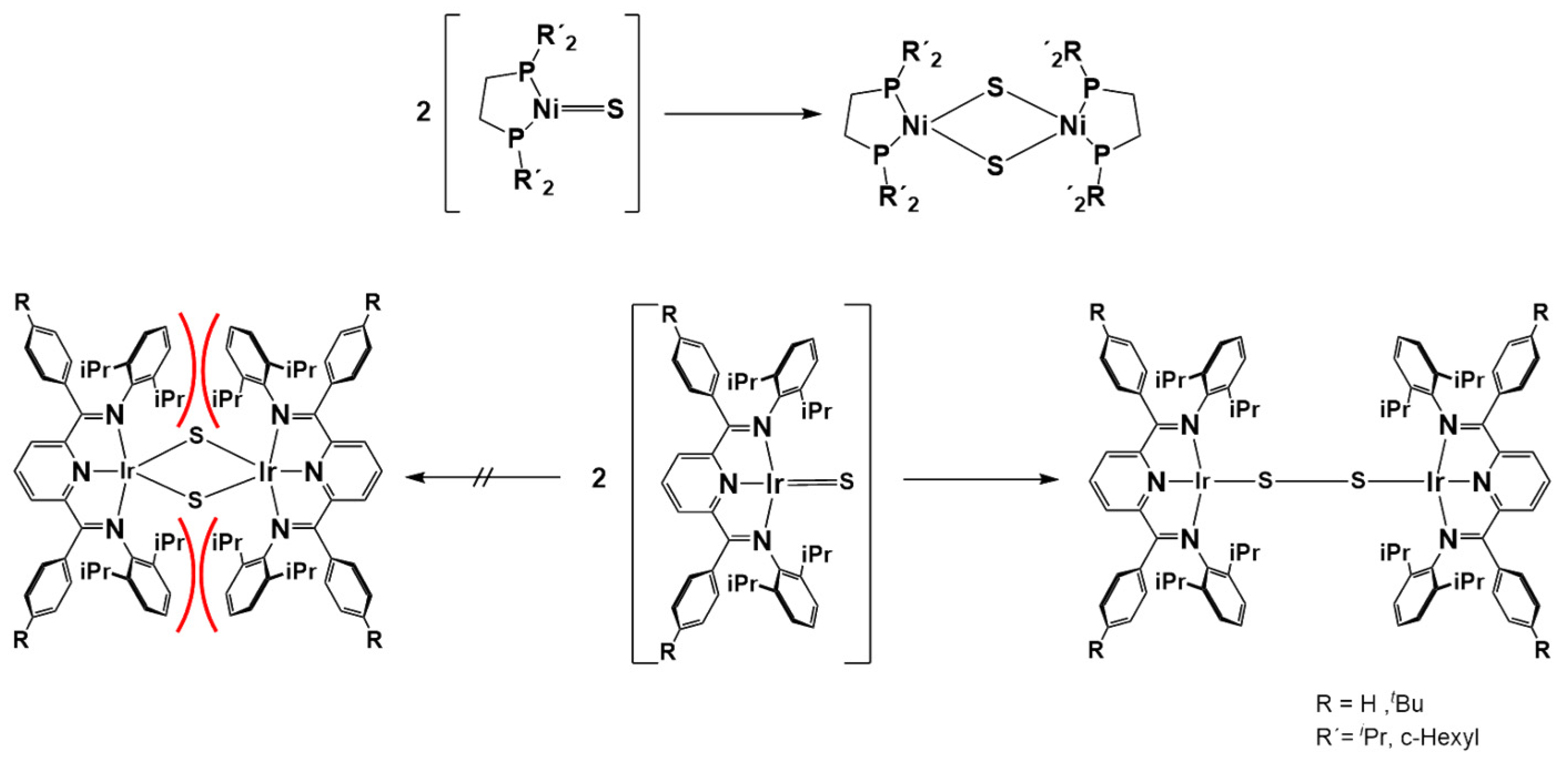
Figure 1. Formation of bimetallic nickel (top) [24,32] and iridium (bottom) disulfido complexes. The red arcs highlight areas of significant steric congestion around the metal–sulfur framework.
Inorganics 14 00011 g001
Figure 2. Ortep diagram of the molecular structure of 3. (Left): Hydrogen atoms are omitted for clarity, ellipsoids are shown at the 50% probability level. (Right): Additionally, aryl and phenyl groups are omitted for clarity. (Carbon atoms = gray, nitrogen atoms = blue, iridium atom = teal, sulfur atom = yellow).
Inorganics 14 00011 g002
Figure 3. Transition state for the reaction of complex 1 with the TTBP radical: Ir-S-H + •O-(2,6-tBu)Ph → IrS• + H-O-(2,4,6-tBu)Ph. Selected distances in Å and angles in ° are given.
Inorganics 14 00011 g003
Figure 4. DFT-calculated spin density of the tentative HAA intermediate Ir-S• radical (isosurface value = 0.02e3).
Inorganics 14 00011 g004
Figure 5. End on (top,left) and side on (bottom,left) disulfido complexes with selected distances and angles in A and °. The corresponding spin densities are shown on the right (isosurface value 0.02e3).
Inorganics 14 00011 g005
Figure 6. Space-filling model of IrS2Ir.
Inorganics 14 00011 g006
Figure 7. Tentative side product.
Inorganics 14 00011 g007
Figure 8. 1H NMR spectra of the thermolysis reaction of 3 in the presence of dihydrogen in toluene-d8 (300 MHz). Spectrum of complex 3 (educt; (bottom)), 11 h at 80 °C after addition of dihydrogen (middle) and after 29 h at 80 °C. A = SH, C/C′ = H-py, D/D′ = H-2,6-ph, E/E′ = H-1-dipp.
Inorganics 14 00011 g008
Figure 9. Results of DFT calculations for HAA and tuck-in formation.
Inorganics 14 00011 g009
Scheme 1. Reaction of thiolato complexes with the TTBP radical (stoichiometry is unbalanced).
Inorganics 14 00011 sch001
Scheme 2. Free energy plot of the mechanism of the dimerization reaction to form trisulfide-bridged species (DFT: PBE-D4/def2-TZVP).
Inorganics 14 00011 sch002
Table 1. Selected distances and angles for molecular structure of complex 3 (Figure 2). S′(1): -X,+Y,1/2-Z symmetry equivalent (2 axis).
BondDistance [Å]BondAngles [°]
Ir(1)-S(1)2.2263(4)Ir(1)-S(1)-S(2)119.87(2)
S(1)-S(2)2.0850(5)S(1)-S(2)-S′(1)101.47(3)
Ir(1)-Npyridine1.9307(13)S-Ir-Nimine92.66(4)
110.09(4)
Ir(1)-Nimine2.0331(13)
2.0329(13)
Nimine-Ir(1)-Nimne78.63(6)
78.34(6)
Table 2. Selected distances and angles for complexes 1, 2, and 3.
BondIr-SH (1)tBu-IrSH (2)Ir2S3 (3)
Nimine-Cimine [Å]1.336(0)
1.336(4)
1.332(2)
1.334(2)
1.342(2)
1.341(2)
Cimine-Cpyridine [Å]1.438(0)
1.447(9)
1.442(2)
1.442(3)
1.438(2)
1.439(2)
Npyridine-Cimine [Å]1.380(1)
1.378(9)
1.377(2)
1.373(2)
1.378(2)
1.378(2)
Δgeo (a)0.0850.0880.079
Ir(1)-S(1) [Å]2.273(0)2.2544(7)2.2263(4)
(a) Wieghardt’s diagnostic (geometric) parameter: [6] Δgeo = ravg(Cpy − Cim) − (ravg (Cpy − Npy) + ravg (Cim − Nim))/2.
Disclaimer/Publisher’s Note: The statements, opinions and data contained in all publications are solely those of the individual author(s) and contributor(s) and not of MDPI and/or the editor(s). MDPI and/or the editor(s) disclaim responsibility for any injury to people or property resulting from any ideas, methods, instructions or products referred to in the content.