1. Introduction
The separation of complex mixtures remains one of the most critical challenges in modern analytical and industrial chemistry. Among the various separation methods, high-performance liquid chromatography (HPLC) and solid-phase extraction (SPE) occupy a central position due to their universality, high efficiency, and applicability to non-volatile and thermolabile compounds [
1]. The key factor determining the selectivity and resolution of these systems is the sorbent, specifically the chemical nature of its surface. While commercial stationary phases (e.g., alkyl-bonded silica) are effective for a wide range of standard applications, they often fail to provide the necessary selectivity for the separation of structural isomers, pharmacologically active compounds, or specific metal cations [
2]. Consequently, the design of novel functionalized materials with tailored surface properties is a priority in materials science [
3].
In this context, polyhedral boron hydrides—specifically
closo-borate anions and carboranes—represent a unique and promising class of surface modifiers. These clusters possess a combination of physicochemical properties that distinguishes them from traditional organic ligands: high thermal and chemical stability, spherical geometry, three-dimensional aromaticity, and a hydridic surface capable of forming dihydrogen bonds (B-H…H-X) [
4,
5]. Furthermore, the specific electronic structure of anions such as
closo-decaborate [B
10H
10]
2− and
closo-dodecaborate [B
12H
12]
2− allows them to act as chemically robust pharmacophores and selective ligands for “soft” metal cations [
6,
7]. Due to these properties, boron anions have found applications in diverse fields, including materials science [
8,
9,
10,
11,
12], optics [
13,
14,
15], energetics [
16], and medicine [
17,
18].
Despite their high potential, a major challenge in this field remains the development of efficient synthetic protocols for immobilization. The reactivity of the
closo-borate cage allows for the introduction of various
exo-polyhedral functional groups; however, methods for the covalent attachment of such derivatives to solid supports are not well established. The modification of the
closo-dodecaborate anion via the substitution of one or more hydrogen atoms opens pathways to derivatives suitable for sorbent functionalization. One of the most extensively studied classes of such compounds is nitrilium derivatives [
19,
20,
21,
22]. Their synthetic methodology is well-developed, and the presence of a labile N≡C bond, prone to nucleophilic addition, makes these substances excellent candidates for use as modifiers. However, in contrast to other types of derivatives, examples of using nitrilium derivatives specifically for immobilization on silica gel are absent in the literature.
Existing methods for immobilizing boron anions are based on other types of derivatives. For instance, diazo- [1-B
10H
9N
2]
− and carbonyl [2-B
10H
9CO]
− derivatives were first synthesized and subsequently silylated and grafted onto mesoporous silica gel [
23]. The modification of polyoxometalates with [B
10H
10]
2− anions using an aminopropylsilyl ligand (APTES) as a linker has been described [
24], as well as the preparation of modified silicon nanoparticles [
25]. Another approach involves the use of oxonium derivatives, such as cobalt bis(dicarbollide), for modifying amino-silica via oxonium ring opening [
26], or alkoxysiloxane derivatives for modifying SiO
2 aerogels [
27].
In the present work, we report the synthesis and characterization of novel sorbents based on commercially available silica gel modified with derivatives of the closo-dodecaborate anion. We investigated two strategies for covalent immobilization: the direct nucleophilic addition of surface amino groups to activated cluster derivatives and the sol–gel condensation of pre-synthesized boron-containing silanes. The structural features of the obtained materials are discussed in detail, along with their potential for selective separation processes.
2. Results and Discussion
In this work, two distinct strategies for the immobilization of closo-dodecaborate anions onto silica gel surfaces were developed and evaluated: the direct nucleophilic addition of aminopropyl groups from a commercial amino-silica to the nitrilium derivative (Bu4N)[B12H11NCCH3], and the sol–gel condensation of a pre-synthesized boron-containing silane onto activated silica. Both approaches rely on a common chemical principle—the formation of an amidine linkage between an amino group and the activated nitrile group of the boron cluster. However, the results revealed significant differences in immobilization efficiency between the two methods.
2.1. Synthesis and Characterization of Modified Sorbents
The nucleophilic addition of primary amines to the multiple bond of the nitrilium derivative was selected as the functionalization pathway due to its rapidity, high selectivity, and simple experimental setup. Commercial Amino-3-functionalized silica gel containing aminopropyl fragments was used as the nucleophilic solid support (
Scheme 1).
Elemental analysis (CHNS) determined the surface amino group content of the initial silica to be 1.7 mmol/g. Since surface amino groups readily interact with atmospheric CO2, an activation step was performed prior to the reaction: the silica was washed with acetonitrile and subsequently with a triethylamine solution in dichloromethane to convert any bicarbonates into free bases.
The nucleophilic addition was conducted in refluxing acetonitrile. This solvent was chosen to increase the reaction temperature and to mitigate the electrostatic repulsion between the immobilized anionic amidine fragments, thereby enhancing the degree of surface modification. To this end, a two-fold excess of the nitrilium derivative (1) relative to the surface amino groups was employed. Upon completion, unreacted starting materials and by-products were rigorously removed by multiple washings with highly polar solvents. The completeness of the washing was monitored by IR spectroscopy of the filtrate until the characteristic B–H bond absorption signal disappeared.
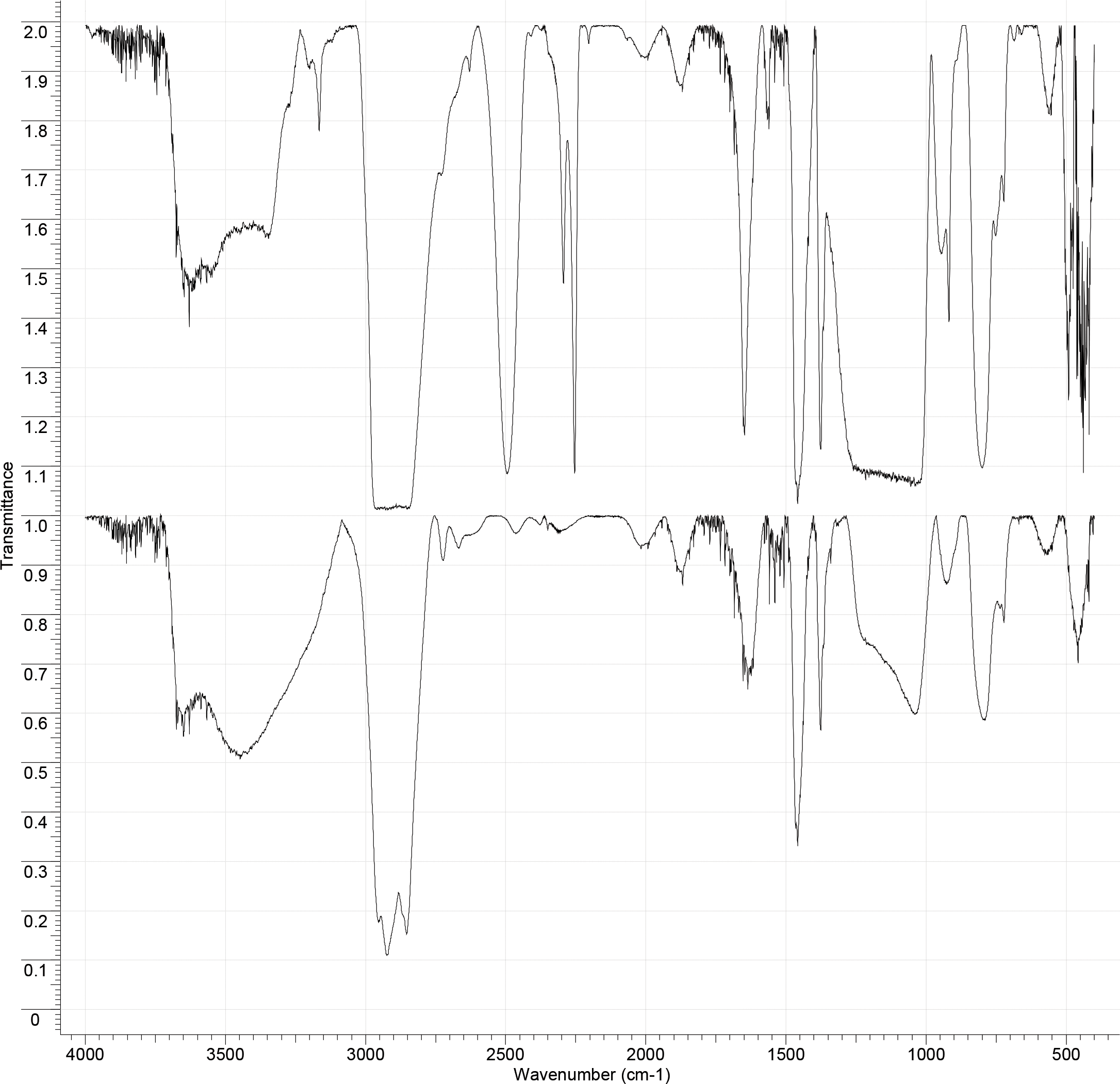
The IR spectrum of the obtained sorbent (
Figure 1) clearly exhibits a distinct peak at 2500 cm
−1, confirming the presence of covalently bound
closo-dodecaborate clusters. The boron content, determined by ICP-OES, was found to be 4.5 wt%.
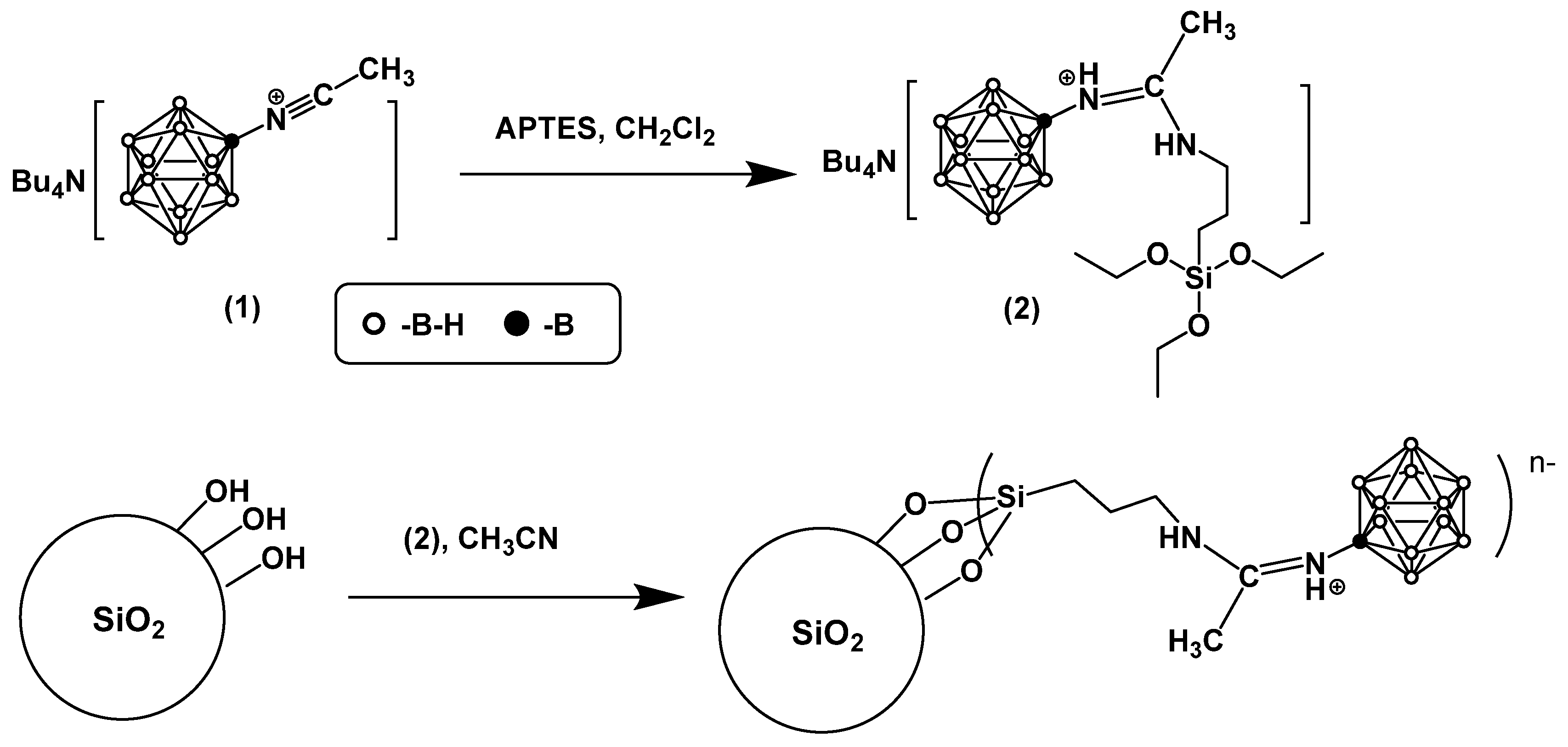
For the second strategy (
B12_APTES@SiO2), a two-step protocol was employed. First, the boron-functionalized amidine (Bu
4N)[B
12H
11NH=C(CH
3)NHC
3H
6Si(OC
2H
5)
3]
(2) was synthesized, followed by its immobilization onto the silica surface (
Scheme 2).
The purity and completeness of the formation of the precursor (2) were monitored by 11B NMR spectroscopy. The 11B NMR spectrum of (2) displays a singlet at –7.0 ppm, corresponding to the substituted boron atom B(1) bonded to the amidine ligand. The boron atoms of the unsubstituted cluster cage appear as two doublets in the higher field: an intense signal at –15.8 ppm (JB-H = 130 Hz) assigned to the equatorial atoms B(2-11), and a signal at –17.2 ppm from the antipodal vertex B(12). The 1:10:1 intensity ratio confirms the formation of the monosubstituted product.
The structure of the organic substituent was confirmed by
1H and
13C NMR spectroscopy. In the
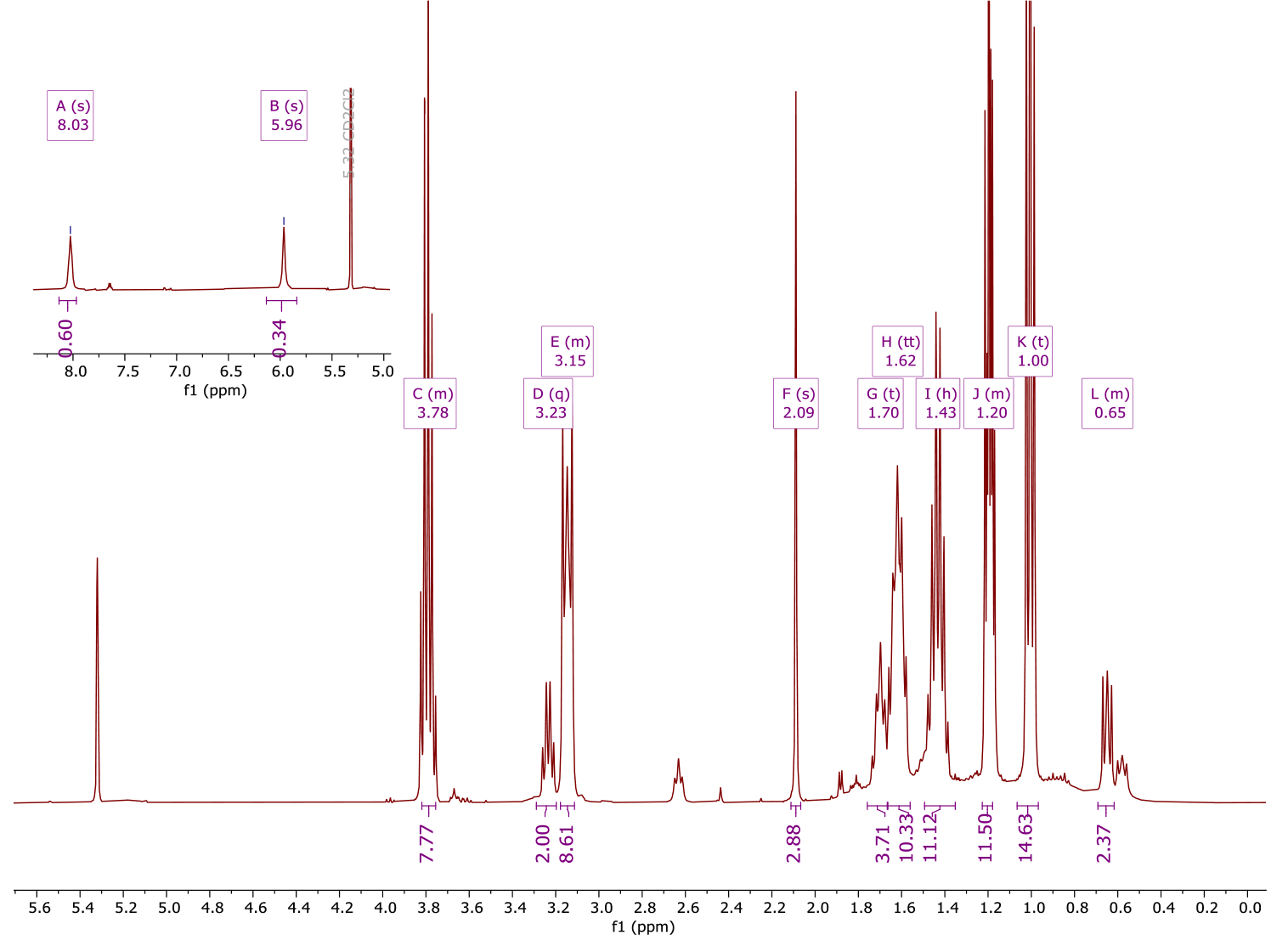
1H NMR spectrum (
Figure 2), the amidine fragment is characterized by two broad singlets from the nitrogen-bound protons in the low field region: 8.03 ppm (amine proton) and 5.96 ppm (imine proton), along with a methyl group singlet at 2.09 ppm. Signals from the ethoxy group (OCH
2CH
3) appear as a quintet at 3.78 ppm and a triplet at 1.20 ppm. The partial doubling of the ethoxy signals is likely due to ongoing hydrolysis rather than excess starting APTES, as no free amino group protons were detected. Literature data indicate that this type of amidine is prone to spontaneous hydrolysis. The silane fragment is characterized by three methylene signals at 3.23, 1.70, and 0.65 ppm.
In the
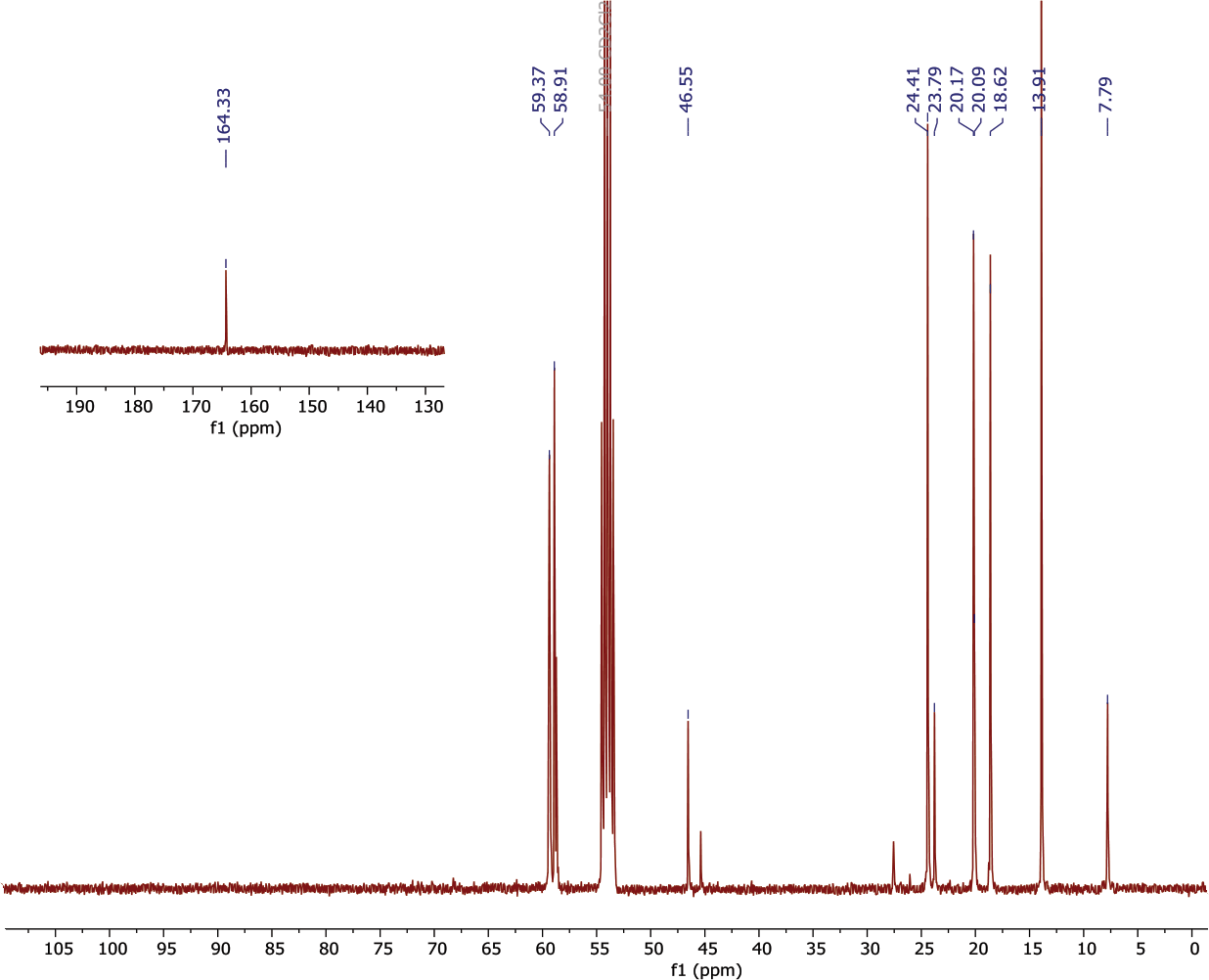
13C NMR spectrum (
Figure 3), the amidine carbon is observed in the characteristic low-field region at 164.3 ppm. Ethoxy group signals are found at 58.9 and 18.6 ppm. The amidine methyl group appears at 20.1 ppm, while the carbon attached to silicon (C–Si) yields the most high-field signal at 7.8 ppm. The absence of additional carbonyl signals and the presence of a single set of amidine signals indicate the formation of a single isomer.
In the second step, the solution of the borylated amidine was reacted with activated silica gel (ratio: 2 mmol amidine per 1 g silica). This excess was calculated based on literature values for average immobilization capacities (apr. 1.5 mmol/g) and potential losses due to spontaneous hydrolysis. To minimize adsorption losses, the reaction was conducted in a polypropylene reactor.
Analysis of the resulting B12_APTES@SiO2 sorbent was performed analogously. After thorough washing, the IR spectrum exhibited the characteristic B–H absorption band, confirming covalent bonding. However, elemental analysis revealed a low boron content (0.085 mmol/g). This is attributed to the textural properties of the silica used (large particle size, 40–63 μm), which results in a low surface-to-volume ratio. Crucially, the absence of signals from free cluster anions in the final washing fractions (monitored by IR) confirms the covalent nature of the binding, rather than physical adsorption. This prevents leaching of the active component during operation.
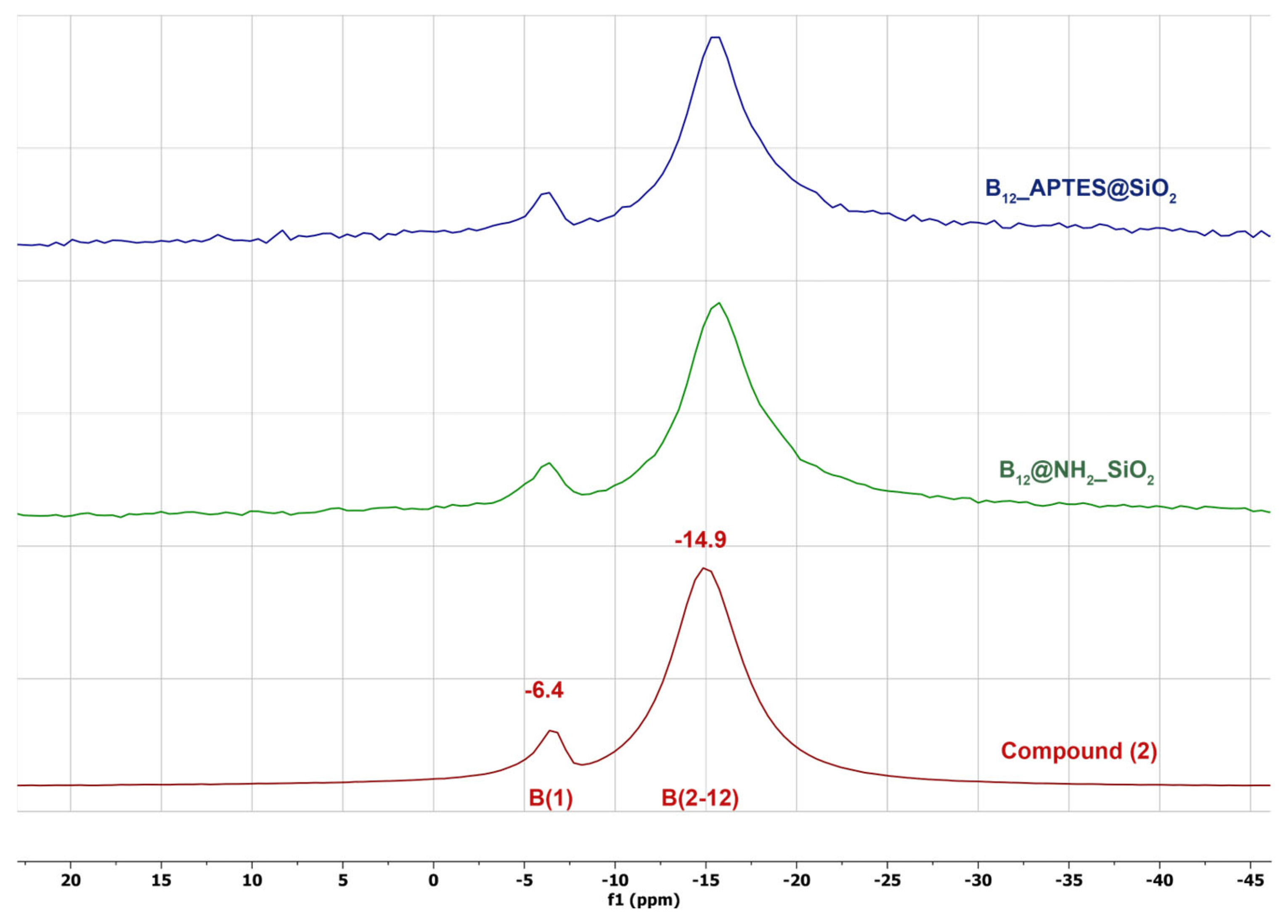
Solid-state MAS
11B NMR was used to confirm the preservation of the amidine structure on the surface (
Figure 4). The spectrum of the modified silica mirrors that of the precursor
(2): the signal from the substituted boron atom appears as a distinct singlet around –6.5 ppm, while the unsubstituted boron atoms merge into a broad signal in the –15 ppm region. This confirms that the cluster integrity and amidine linkage remain intact upon immobilization.
It should be noted that the tetrabutylammonium (Bu4N)+ cations, originally serving as counterions for the anionic boron clusters in the precursors, are retained in the final hybrid materials to balance the negative charge of the closo-dodecaborate cage. Their presence is confirmed by the characteristic aliphatic signals in the solid-state 1H MAS NMR spectra and the C/N ratio in the elemental analysis data. While these bulky organic cations contribute to the hydrophobicity of the sorbent surface, they can potentially be exchanged for other cations (e.g., protons or metal ions) in future applications to tune the selectivity and surface properties.
2.2. Comparison of Synthetic Approaches
The
direct grafting method (
B12@NH2_SiO2) demonstrated relatively low efficiency, with a modification degree of approximately 20% of the theoretical maximum (4.5 wt% B vs. 1.7 mmol/g amino groups). This can be explained by electrostatic repulsion. The initial formation of anionic amidine fragments [B
12H
11NH=C(CH
3)-NH-]
− imparts a negative charge to the silica surface, creating an energy barrier that hinders the approach of subsequent anionic [B
12H
11NCCH
3]
− reagents. This “poly-anion effect” has been observed in other surface modification studies and highlights the impact of interfacial electrostatics [
28].
The pre-synthesis method (B12_APTES@SiO2) circumvents the electrostatic repulsion issue, as the negatively charged cluster is introduced as part of a less charged silane complex. However, the absolute loading was lower (0.085 mmol/g) due to the low specific surface area of the chosen silica support. This result emphasizes that for maximum functionalization density, mesoporous silica with a high specific surface area (>300 m2/g) should be employed.
To quantitatively assess the efficiency of the two immobilization strategies, we normalized the boron loading to the specific surface area of the final hybrid materials (SBET: 158 m2/g for direct grafting method and 231 m2/g for pre-synthesis method). The direct nucleophilic addition (B12@NH2_SiO2) affords a surface density of 2.22 µmol clusters/m2, whereas the sol–gel co-condensation (B12_APTES@SiO2) yields only 0.39 µmol clusters/m2. This nearly six-fold difference highlights the superior efficiency of the post-synthetic modification strategy for incorporating bulky closo-dodecaborate anions. We attribute this primarily to the better accessibility of surface-anchored amino groups compared to the entrapment of large precursors within the silica matrix. Additionally, the smaller particle size of the amino-silica precursor compared to the silica surface used in the sol–gel method likely facilitated diffusion of the reagents, further contributing to the higher loading observed for direct grafting method.
2.3. Morphological Characterization
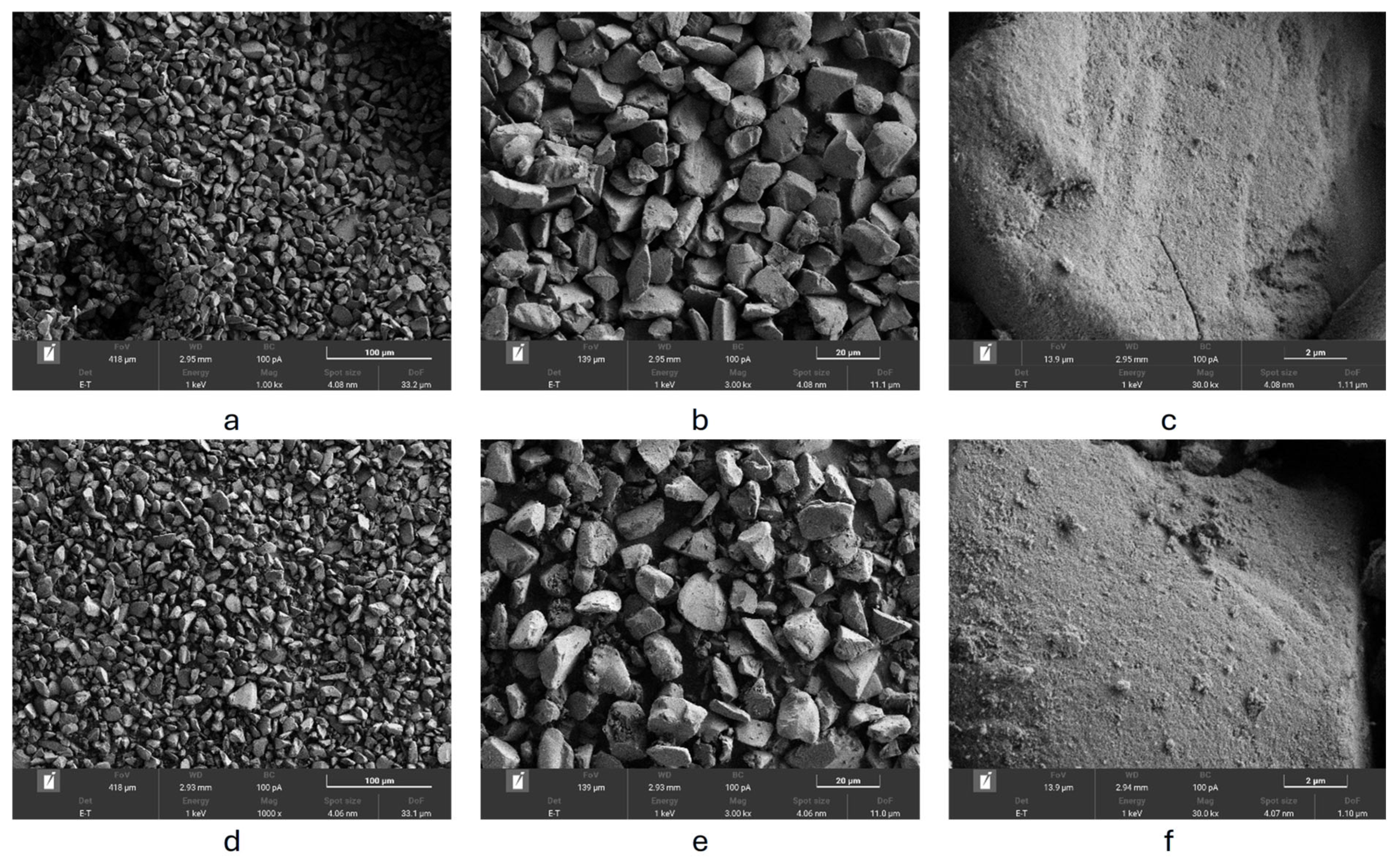
The surface morphology was investigated by SEM.
Figure 5 compares the commercial Amino-3-functionalized silica gel (top row) with the boron-modified composite (bottom row).
The initial amino-silica (
Figure 5a–c) consists of irregular, crushed-type particles with a relatively smooth surface. After modification (
Figure 5d–f), the overall particle morphology is preserved, indicating no destruction of the silica matrix. A slight change in surface roughness is observed, indirectly confirming the successful attachment of the modifier without blocking macropores.
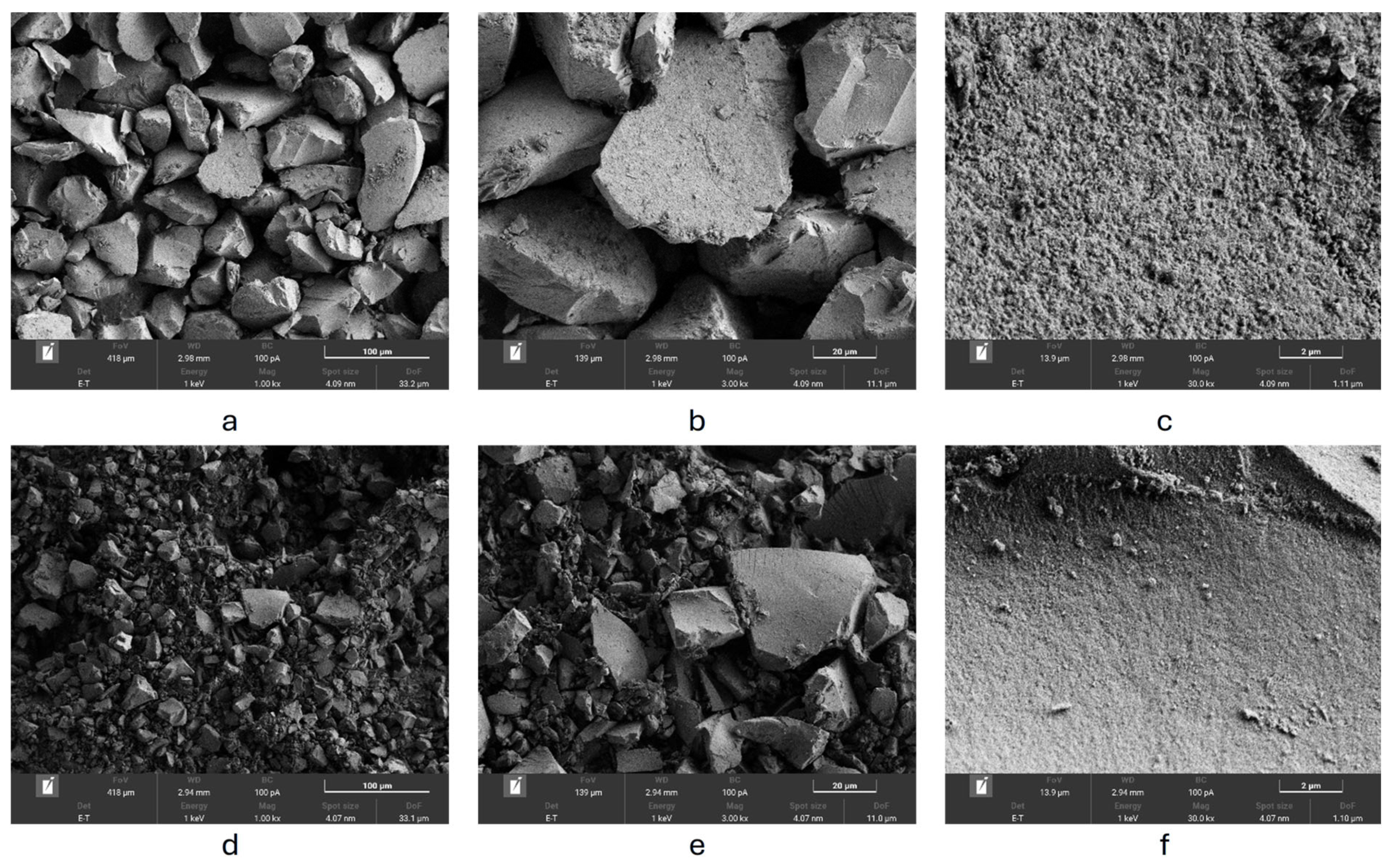
A similar trend is observed for the second series (
Figure 6), derived from silica gel (40–63 μm) via sol–gel condensation. The modified sample (
Figure 6d–f) exhibits a smoother surface compared to the porous structure of the pristine silica (
Figure 6a–c), typical for sorbents with grafted layers. The absence of particle fragmentation confirms the mechanical stability of the composites.
The chemical stability of the synthesized hybrids is a crucial factor for their potential application as stationary phases. The materials demonstrated high robustness during the synthesis and purification steps, withstanding repeated washing cycles with polar organic solvents (acetonitrile, ethanol) and vacuum drying without any signs of degradation. Furthermore, solid-state 11B NMR and FTIR spectra of the samples recorded after two months of storage under ambient conditions showed no changes compared to the freshly prepared materials, confirming the hydrolytic stability of the amidine linkage and the integrity of the boron cluster framework.
2.4. Conclusions and Future Outlook
Despite the relatively low modification degree achieved in this preliminary study, the synthesized composites hold promise for specialized chromatographic applications. The unique properties of closo-dodecaborates—pronounced hydrophobicity combined with specific B–H...M+ and dihydrogen (B–H...H–X) bonding capabilities—may offer selective retention for analytes that are difficult to separate on traditional phases (e.g., structural isomers or transition metal complexes).
To improve the efficiency of the direct grafting method, future work will focus on using high ionic strength buffers or non-polar aprotic solvents (e.g., toluene) to screen electrostatic repulsion. Alternatively, neutral derivatives of the closo-dodecaborate anion (e.g., diamines or oxonium derivatives) could be employed to avoid charge repulsion during the attachment step. For the sol–gel method, transitioning to nanostructured supports (e.g., SBA-15 or MCM-41) is expected to increase the grafting density significantly.
Overall, the developed methods demonstrate the feasibility of covalently anchoring bulky polyhedral boron clusters onto silica matrices, expanding the toolkit for designing novel functional materials.
3. Materials and Methods
Elemental analysis for carbon, hydrogen, and nitrogen was performed using a CHNS-3 FA 1108 Elemental Analyser (Carlo Erba, Milan, Italy) automated elemental analyzer. Quantitative boron determination was conducted using inductively coupled plasma optical emission spectroscopy (ICP-OES). The measurements were performed on a high-resolution ICP-OES spectrometer (PlasmaQuant 9100 Series, Analytik Jena, Jena, Germany) using a standard multicalibration solution (ICP multi-element standard solution IV, Supelco Certipur, Darmstadt, Germany). For boron concentration measurements, two emission wavelengths, 249.773 nm and 249.678 nm, were used. Each sample was measured three times at each wavelength. The obtained signal intensities were compared with a calibration curve (correlation coefficient R2 > 0.9999; measurement range from 0.05 µg B/mL to 4 µg B/mL), and quantitative values of boron concentration in the sample were determined.
Nitrogen adsorption–desorption measurements were performed at 77 K using an ATX-06 analyzer (Katakon, Novosibirsk, Russia). Prior to analysis, the samples were degassed under a nitrogen flow (1 atm) at 80 °C for 2 h. The specific surface area was calculated using the Brunauer–Emmett–Teller (BET) model based on five adsorption points in the relative pressure range of P/P0 = 0.05–0.25.
Determination of Surface Grafting Density
The surface grafting density (ρ, µmol clusters/m
2) was calculated based on the boron content determined by ICP-OES and the specific surface area (S
BET) of the modified materials according to Equation (1):
where
is the boron mass fraction (wt%) determined by elemental analysis,
MB is the atomic mass of boron (10.81 g/mol),
NB is the number of boron atoms in the cluster (
NB = 12), and S
BET is the specific surface area of the sample (m
2/g).
IR spectra were recorded on an FT-08 Infralum infrared spectrometer in the range of 4000–600 cm−1 with a resolution of 1 cm−1. Samples were prepared as Nujol mulls (suspensions in mineral oil).
1H, 13C{1H}, 11B{1H} NMR spectra of solutions in CD2Cl2 were recorded on a q-ONE AS400 Quantum I Plus spectrometer (QOneTec, Wuhan, China) at frequencies of 399.879; 161.874; 128.297 MHz, respectively, with internal deuterium stabilization. TMS and BF3*OEt2 were used as external standards, respectively.
11B NMR measurements of solid samples were performed on a Bruker AVANCE 400 spectrometer (Bruker, Billerica, MA, USA) operating at 128.4 MHz, respectively, for 11B. The spectra were recorded with a standard one-pulse sequence with 90° flip angle for excitation and a relaxation time fixed at 1 s. A total of 128 scans were acquired for each spectrum. Magic angle rotation frequency: –15 kHz.
Scanning electron microscopy (SEM) images were taken using a Tescan Amber GMH scanning electron microscope (Tescan, Brno, Czech Republic). SEM images were obtained using an Everhart-Thornley detector at an accelerating voltage of 1 kV. To obtain SEM images, samples were placed on the carbon tape.
Reagents and Materials.
Amino-3-functionalized silica gel was purchased from Thermo Scientific Chemicals (Waltham, MA, USA). Silica (40–63 μm, 60 Å Irregular) was purchased from Santai Science (Montreal, QC, Canada). According to the supplier specifications, the specific surface areas of the commercial amino-3 silica and the pristine silica gel are approximately 300 m
2/g and 500 m
2/g, respectively. 3-Aminopropyltriethoxysilane (APTES) was purchased from Shanghai Macklin Biochemical Technology Co. (Shanghai, China). Solvents with 99% purity (Khimmed, Moscow, Russia) were used without additional purification. Trifluoroacetic acid (Chemical Line, St. Petersburg, Russia) was distilled immediately before use. The acetonitrile derivative of the closo-dodecaborate anion (Bu
4N)[B
12H
11NCCH
3]
(1) was synthesized according to the known method [
21].
Synthesis of (Bu4N)[B12H11NH=C(CH3)NHC3H6Si(OC2H5)3] (2)
To a solution of (Bu4N)[B12H11NCCH3] (1) (852 mg, 2 mmol) in HPLC-grade dichloromethane, APTES (442 mg, 2 mmol) was added. The reaction mixture was stirred at room temperature under a dry argon atmosphere until the reaction was complete as monitored by 11B NMR spectroscopy (30 min). The solution was then concentrated using a rotary evaporator, and the resulting residue was dried under dynamic vacuum.
11B NMR (CD2Cl2, δ, ppm): –7.0 (s, 1B, B(1), –15.8 (d, JB–H = 130 Hz, 10B, B(2-11)), –17.2 (d, 1B, B(12)). 1H NMR (CD2Cl2, δ, ppm): 8.03 (br s, 1H, NH=C(NH)–CH3), 5.96 (br s, 1H, NH=C(NH)–CH3), 3.79 (q, J = 6.8 Hz, 6H, O-CH2-CH3), 3.23 (q, J = 6.8 Hz, 2H, NH-CH2), 3.19–3.07 (8H, TBA), 2.09 (s, 3H, NH=C(NH)–CH3), 1.70 (p, J = 7.8 Hz, 2H, CH2-CH2-CH2), 1.43 (8H, TBA), 1.19 (td, J = 7.0, 3.8 Hz, 12H, O-CH2-CH3), 1.00 (12H, TBA), 0.65 (m, 2H, CH2-Si). 13C{1H} NMR (CD2Cl2, δ, ppm): 164.3 (NH=C(NH)–CH3), 59.4 (TBA), 58.9 (O-CH2-CH3), 46.5 (NH-CH2), 24.4 (TBA), 23.8 (CH2-CH2-CH2), 20.2(TBA), 20.1 (NH=C(NH)–CH3), 18.6(O-CH2-CH3), 13.9 (TBA), 7.8 (CH2-Si).
Synthesis of Modified Silica Gel via Direct Nucleophilic Addition. (B12@NH2_SiO2)
A sample of amine-functionalized silica gel (approximately 1.0 g) was suspended in acetonitrile (20 mL) with stirring for 10 min. The silica gel was filtered, washed with dichloromethane, and resuspended in 20 mL of a 5% solution of triethylamine in dichloromethane. The suspension was stirred under an argon atmosphere for 10 min. The silica gel was then filtered again under argon, washed with 40 mL of the triethylamine solution in dichloromethane, followed by 40 mL of pure dichloromethane, and subsequently dried under vacuum. A portion of the activated silica gel (588 mg, corresponding to 1 mmol of amino groups) was suspended in 20 mL of HPLC-grade acetonitrile. To this suspension, a solution of (Bu4N)[B12H11NCCH3] (1) (2 mmol) in 5 mL of acetonitrile was added. The reaction mixture was refluxed under an argon atmosphere for 12 h. Upon completion of the reaction, the silica gel was filtered and washed with 40 mL of dichloromethane (in 20 mL portions) followed by 100 mL of acetonitrile. The resulting modified silica gel was dried under a stream of argon and then under dynamic vacuum.
Synthesis of Modified Silica Gel via Sol–gel Condensation. (B12_APTES@SiO2)
A sample of pre-activated silica gel (1.0 g) was suspended in 20 mL of a 0.1 M solution of (Bu4N)[B12H11NH=C(CH3)NHC3H6Si(OC2H5)3] (2) in dichloromethane. The suspension was stirred under an argon atmosphere for 24 h. The silica gel was then filtered off and washed successively with dichloromethane (40 mL, in 20 mL portions) and acetonitrile (100 mL). The resulting modified silica gel was dried under a stream of argon followed by dynamic vacuum.




 ,
,