


You are currently viewing a new version of our website. To view the old version click .

Insects, Volume 11, Issue 1

January 2020 - 67 articles

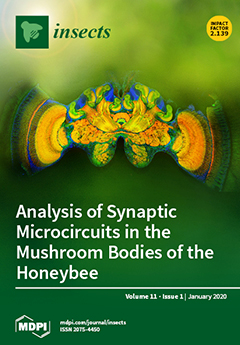
Cover Story: Honeybees have impressive capabilities for sensory orientation, learning and memory. They emerge into adult life in a colony of thousands of individuals. Young worker bees first perform tasks inside the dark hive for about three weeks before commencing foraging under bright sunlight. This drastic transition exposes bees to changing demands on spatial orientation, and profitable food sources must be explored in highly variable environments. Mushroom bodies are multisensory integration centers in the insect brain involved in learning and memory. They are particularly large in the honeybee (cover) and contain thousands of synaptic circuits with remarkable plasticity related to age, sensory experience and long-term memory. This review highlights the progress in understanding neuroplasticity in mushroom body microcircuits and its role in behavioral plasticity of this important social insect. View this paper
  • Issues are regarded as officially published after their release is announced to the table of contents alert mailing list .
  • You may sign up for email alerts to receive table of contents of newly released issues.
  • PDF is the official format for papers published in both, html and pdf forms. To view the papers in pdf format, click on the "PDF Full-text" link, and use the free Adobe Reader to open them.

Articles (67)

  • Article
  • Open Access
7 Citations
5,903 Views
19 Pages

20 January 2020

The ant-loving beetle genus Panabachia Park 1942 is a poorly studied beetle lineage from the new world tropics. We recently collected Panabachia from several previously unrecorded locations in the páramo biome of the high Ecuadorian Andes, with males...

  • Communication
  • Open Access
8 Citations
5,130 Views
7 Pages

20 January 2020

Osmia cornifrons (Radoszkowski) (Hymenoptera: Megachilidae) is an effective orchard pollinator. Considering the honey bee population decline in recent years, the conservation and propagation of O. cornifrons as an alternative managed pollinator is im...

  • Article
  • Open Access
28 Citations
5,896 Views
21 Pages

The Role of Annual Flowering Plant Strips on a Melon Crop in Central Spain. Influence on Pollinators and Crop

  • Celeste Azpiazu,
  • Pilar Medina,
  • Ángeles Adán,
  • Ismael Sánchez-Ramos,
  • Pedro del Estal,
  • Alberto Fereres and
  • Elisa Viñuela

20 January 2020

Planting flower strips adjacent to crops is among the habitat-management practices employed to offer alternative floral resources to pollinators. However, more information is needed to understand their potential spill-over of pollinators on nearby in...

  • Article
  • Open Access
8 Citations
3,944 Views
14 Pages

20 January 2020

There are many reasons to study the survival and recovery of animals after starvation in simulated transport conditions or other passive dispersal methods. To do so, we chose Dendrolimus pini, an economically important pest of Scots pine with great p...

  • Review
  • Open Access
26 Citations
5,779 Views
11 Pages

19 January 2020

Several insect innate immune mechanisms are activated in response to infection by entomopathogenic nematodes (EPNs). In this review, we focus on the coagulation of hemolymph, which acts to stop bleeding after injury and prevent access of pathogens to...

  • Article
  • Open Access
2 Citations
4,166 Views
9 Pages

19 January 2020

In this study, cytogenetic analysis of the metaphase chromosomes from imaginal discs of Aedes (Diptera: Culicidae) mosquitoes—Aedes communis, Ae. punctor, Ae. intrudens, and Ae. rossicus—was performed. The patterns of C-banding and DAPI s...

  • Article
  • Open Access
32 Citations
5,897 Views
17 Pages

Vegetation Pattern Modulates Ground Arthropod Diversity in Semi-Arid Mediterranean Steppes

  • Fernando Meloni,
  • Berta F. Civieta,
  • Juan A. Zaragoza,
  • María Lourdes Moraza and
  • Susana Bautista

18 January 2020

The ecological functioning of dryland ecosystems is closely related to the spatial pattern of the vegetation, which is typically structured in patches. Ground arthropods mediate key soil functions and ecological processes, yet little is known about t...

  • Article
  • Open Access
18 Citations
4,545 Views
15 Pages

18 January 2020

Entomopathogenic nematodes (EPNs) have been a useful model for studying wound healing in insects due to their natural mechanism of entering an insect host either through the cuticle or an orifice. While many experiments have shed light on nematode an...

  • Perspective
  • Open Access
10 Citations
4,798 Views
13 Pages

18 January 2020

Gains in our knowledge of dispersal and migration in insects have been largely limited to either wing-dimorphic species or current genetic model systems. Species belonging to these categories, however, represent only a tiny fraction of insect biodive...

  • Article
  • Open Access
20 Citations
5,457 Views
16 Pages

17 January 2020

The aim of this study was to evaluate the potential of entomopathogenic fungi (EPF) for the control of aphid pests of field vegetable crops. Four biopesticides based on the EPF Beauveria bassiana (Botanigard ES and Naturalis L), Cordyceps fumosorosea...

of 7

Get Alerted

Add your email address to receive forthcoming issues of this journal.

XFacebookLinkedIn
Insects - ISSN 2075-4450