

You are currently viewing a new version of our website. To view the old version click .

Future Internet, Volume 14, Issue 1

January 2022 - 29 articles

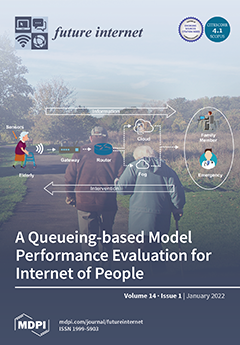
Cover Story: Low latency is required in order to achieve great service quality in ambient assisted living facilities, the so-called Internet of People (IoP). Assessing the performance of such systems in a real-world setting is difficult. This paper presents a performance evaluation of aged care monitoring systems using an M/M/c/K queuing network. The model enables resource capacity, communication, and service delays to be calibrated. The proposed model was shown to be capable of predicting the system’s mean response time (MRT) and calculating the quantity of resources required to satisfy certain user requirements. To analyze data from IoT solutions, the examined architecture incorporates cloud and fog resources. Simulations have tested various routing algorithms with the goal of improving performance metrics. View this paper
  • Issues are regarded as officially published after their release is announced to the table of contents alert mailing list .
  • You may sign up for email alerts to receive table of contents of newly released issues.
  • PDF is the official format for papers published in both, html and pdf forms. To view the papers in pdf format, click on the "PDF Full-text" link, and use the free Adobe Reader to open them.

Articles (29)

  • Review
  • Open Access
9 Citations
7,638 Views
22 Pages

17 January 2022

The Internet architecture has been undergoing a significant refactoring, where the past preeminence of transit providers has been replaced by content providers, which have a ubiquitous presence throughout the world, seeking to improve the user experi...

  • Article
  • Open Access
9 Citations
3,729 Views
20 Pages

15 January 2022

In wireless ad hoc networks, security and communication challenges are frequently addressed by deploying a trust mechanism. A number of approaches for evaluating trust of ad hoc network nodes have been proposed, including the one that uses neural net...

  • Article
  • Open Access
2 Citations
3,376 Views
10 Pages

13 January 2022

Current two-stage object detectors extract the local visual features of Regions of Interest (RoIs) for object recognition and bounding-box regression. However, only using local visual features will lose global contextual dependencies, which are helpf...

  • Article
  • Open Access
9 Citations
4,459 Views
19 Pages

A Semantic Preprocessing Framework for Breaking News Detection to Support Future Drone Journalism Services

  • Michail Niarchos,
  • Marina Eirini Stamatiadou,
  • Charalampos Dimoulas,
  • Andreas Veglis and
  • Andreas Symeonidis

10 January 2022

Nowadays, news coverage implies the existence of video footage and sound, from which arises the need for fast reflexes by media organizations. Social media and mobile journalists assist in fulfilling this requirement, but quick on-site presence is no...

  • Article
  • Open Access
8 Citations
4,239 Views
21 Pages

Mobility in Unsupervised Word Embeddings for Knowledge Extraction—The Scholars’ Trajectories across Research Topics

  • Gianfranco Lombardo,
  • Michele Tomaiuolo,
  • Monica Mordonini,
  • Gaia Codeluppi and
  • Agostino Poggi

9 January 2022

In the knowledge discovery field of the Big Data domain the analysis of geographic positioning and mobility information plays a key role. At the same time, in the Natural Language Processing (NLP) domain pre-trained models such as BERT and word embed...

  • Article
  • Open Access
4 Citations
6,574 Views
12 Pages

8 January 2022

Cache side channel attacks, as a type of cryptanalysis, seriously threaten the security of the cryptosystem. These attacks continuously monitor the memory addresses associated with the victim’s secret information, which cause frequent memory access o...

  • Article
  • Open Access
17 Citations
4,765 Views
18 Pages

A Queueing-Based Model Performance Evaluation for Internet of People Supported by Fog Computing

  • Laécio Rodrigues,
  • Joel J. P. C. Rodrigues,
  • Antonio de Barros Serra and
  • Francisco Airton Silva

8 January 2022

Following the Internet of Things (IoT) and the Internet of Space (IoS), we are now approaching IoP (Internet of People), or the Internet of Individuals, with the integration of chips inside people that link to other chips and the Internet. Low latenc...

  • Article
  • Open Access
11 Citations
4,723 Views
22 Pages

S4 Features and Artificial Intelligence for Designing a Robot against COVID-19—Robocov

  • Pedro Ponce,
  • Omar Mata,
  • Esteban Perez,
  • Juan Roberto Lopez,
  • Arturo Molina and
  • Troy McDaniel

6 January 2022

Since the COVID-19 Pandemic began, there have been several efforts to create new technology to mitigate the impact of the COVID-19 Pandemic around the world. One of those efforts is to design a new task force, robots, to deal with fundamental goals s...

  • Article
  • Open Access
11 Citations
4,218 Views
19 Pages

Utilizing Half Convolutional Autoencoder to Generate User and Item Vectors for Initialization in Matrix Factorization

  • Tan Nghia Duong,
  • Nguyen Nam Doan,
  • Truong Giang Do,
  • Manh Hoang Tran,
  • Duc Minh Nguyen and
  • Quang Hieu Dang

4 January 2022

Recommendation systems based on convolutional neural network (CNN) have attracted great attention due to their effectiveness in processing unstructured data such as images or audio. However, a huge amount of raw data produced by data crawling and dig...

  • Article
  • Open Access
5 Citations
3,257 Views
14 Pages

SMYOLO: Lightweight Pedestrian Target Detection Algorithm in Low-Altitude Scenarios

  • Weiwei Zhang,
  • Xin Ma,
  • Yuzhao Zhang,
  • Ming Ji and
  • Chenghui Zhen

4 January 2022

Due to the arbitrariness of the drone’s shooting angle of view and camera movement and the limited computing power of the drone platform, pedestrian detection in the drone scene poses a greater challenge. This paper proposes a new convolutional...

of 3

Get Alerted

Add your email address to receive forthcoming issues of this journal.

XFacebookLinkedIn
Future Internet - ISSN 1999-5903