


Journal Menu
► ▼ Journal Menu-
- Future Internet Home
- Aims & Scope
- Editorial Board
- Reviewer Board
- Topical Advisory Panel
- Instructions for Authors
- Special Issues
- Topics
- Sections & Collections
- Article Processing Charge
- Indexing & Archiving
- Editor’s Choice Articles
- Most Cited & Viewed
- Journal Statistics
- Journal History
- Journal Awards
- Conferences
- Editorial Office
Journal Browser
► ▼ Journal BrowserNeed Help?
Announcements
9 October 2025
Meet Us at the 3rd International Conference on AI Sensors and Transducers, 2–7 August 2026, Jeju, South Korea

Following from our two previous successful editions, we invite you to submit your abstracts and participate in the 3rd International Conference on AI Sensors and Transducers, taking place from 2 to 7 August 2026 in Jeju, South Korea.
Organized by MDPI and the open access journals Sensors, Micromachines, AI Sensors, Micro and Remote Sensing, this in-person conference will once again bring together experts and participating researchers who will share insights and innovations in sensors, sensing technology, transducers and artificial intelligence.
Start preparing your abstracts:
Don’t miss this opportunity to showcase your work to peers and leading experts in AI-enhanced sensing systems and transducers. We will be announcing the session topics at AIS 2026 soon.
Find out more about the instructions for authors: https://sciforum.net/event/AIS2026?section=#instructions.
Find out more about the publication opportunities available for authors: https://sciforum.net/event/AIS2026?section=#Publicationopportunities.
Please feel free to share the information about this conference to your colleagues and students.
We look forward to welcoming you in Jeju!
The organizing committee of the 3rd International Conference on AI Sensors and Transducers (AIS 2026).
7 July 2026
Interview with Mr. Paul Scalise—Winner of the Future Internet Best Paper Award
We are honoured to announce that Mr. Paul Scalise has been selected as the winner of the Future Internet Best Paper Award 2024.
“A Systematic Survey on 5G and 6G Security Considerations, Challenges, Trends, and Research Areas”
by Paul Scalise, Matthew Boeding, Michael Hempel, Hamid Sharif, Joseph Delloiacovo and John Reed
Future Internet 2024, 16(3), 67; https://doi.org/10.3390/fi16030067
The following is an interview with Mr. Paul Scalise:
- Congratulations on winning the Future Internet 2024 Best Paper Award! Could you please briefly introduce yourself and what led you to write this review?
My name is Paul Scalise and I am honored to receive this award from MDPI Future Internet for the best paper of 2024. I am currently a PhD student at the University of Nebraska–Lincoln studying Computer Engineering in the Advanced Telecommunications Engineering Lab (TEL), headed by my advisor Dr. Hamid Sharif. My research interests have revolved around the tight relationship between hardware and software along with privacy and security of computing systems. With 5G becoming ever more important across the world, this review was a great place to share perspective of the current state of the art and future considerations for these complex architectures.
- With so many studies published in this area, how did you decide which works to include and how to structure the narrative?
I thought that bringing a systematic viewpoint for this review was super important for readers to get a full picture of all the different aspects of security in 5G and future 6G systems. In doing so, I believe it allows for better understanding and enables researchers to tackle open research questions.
- What emerging trend or underexplored direction did you uncover while surveying the literature that surprised you most?
In this study we emphasized the applications and considerations of zero-trust architectures in future cellular networks. This topic had been gaining ground in other research areas, and I thought that this was important to incorporate as a main portion of this study and how ZT principals will be increasingly valuable in the near future.
- How do you hope this review will guide researchers or practitioners who are new to this field?
I hope our study allows newer researchers in our field, and people from adjacent fields, to understand the impacts of how security within complex cellular systems are vital to end user protection. Security of any system must be a forefront thought while designing and conceptualizing future networks to allow for a prosperous ecosystem that respects the users, maintainers, operators, and anyone in-between.
- Based on your experience preparing and submitting this review to Future Internet, what suggestions do you have for us to improve the review article submission and peer review process?
Overall, the process went smoothly. I appreciate that there is some leniency in the time for responding to reviewers when some revisions take longer than expected.
- What does receiving this award mean to you, and is there anyone you would like to acknowledge?
This award is greatly meaningful in that it reflects the hard work of our team at UNL. Writing this review would have been impossible for me without the diligent efforts of the leaders within my lab: Dr. Hamid Sharif, Dr. Michael Hempel, and Dr. Matthew Boeding. I also thank our partner authors from Belcan for their input from their industry knowledge. A huge thank you as well goes to my family and friends for their continued support and belief in my abilities.
7 July 2026
Interview with Dr. Aristeidis Karras—Winner of the Future Internet Best Paper Award
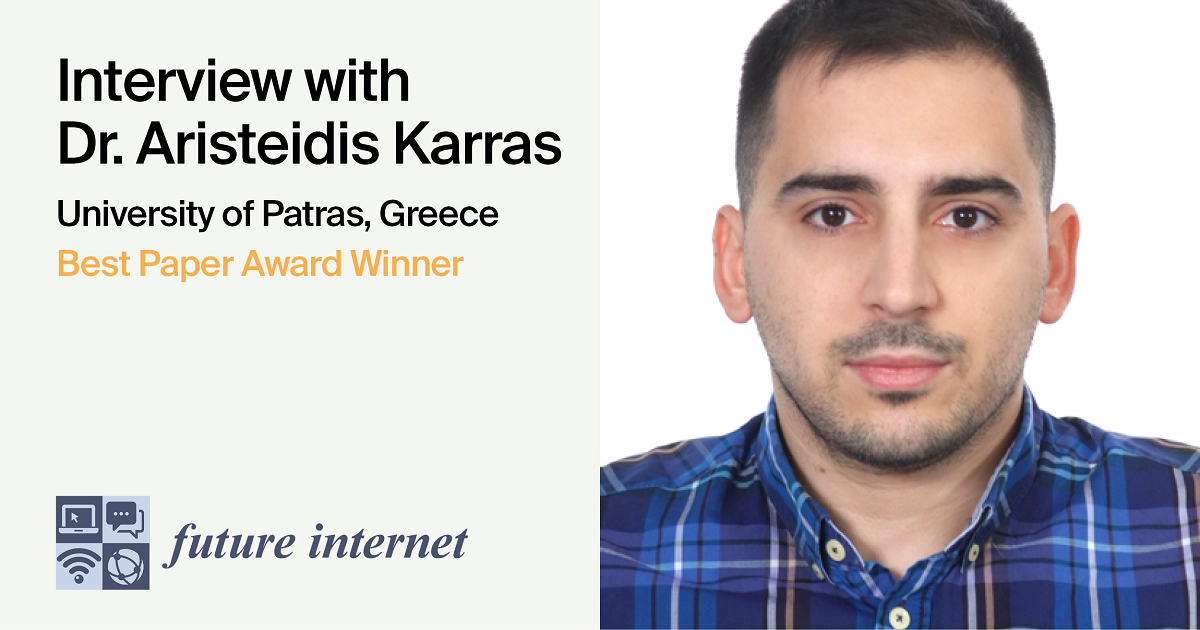
We are honored to announce that Dr. Aristeidis Karras has been selected as the winner of the Future Internet Best Paper Award 2024.
The following is an interview with Dr. Aristeidis Karras:
1. Congratulations on winning the Future Internet 2024 Best Paper Award! Could you please briefly introduce yourself and your research background?
Thank you very much. It is a great honor for me and for all the authors to receive this award.
My research focuses on efficient Big Data management in large-scale Internet of Things systems. More specifically, I work in areas including distributed and edge computing, TinyML, machine learning, data engineering, and intelligent processing on resource-constrained devices.
A central question in my research is how we can process data closer to where it is generated. In a large IoT environment, transmitting every raw measurement to a central server is often inefficient. It increases communication overhead, latency, and storage requirements. Edge computing and TinyML provide opportunities to clean, analyze, compress, organize, and prioritize data locally before it is transferred to a central infrastructure.
I would also like to emphasize that this award reflects the collective work of the entire research team. All co-authors contributed to the study's conception, experimental work, result analysis, and manuscript preparation.
2. Could you give a brief overview of the key findings of this award-winning paper?
The main purpose of the paper was to examine whether TinyML could support not only machine learning inference but also broader data-management operations in large-scale IoT systems.
We proposed five algorithms, each addressing a different part of the IoT data-management process. TinyCleanEDF uses federated learning for distributed data cleaning and anomaly detection and employs autoencoders for feature extraction. EdgeClusterML combines reinforcement learning with self-organizing maps for adaptive clustering at the edge. CompressEdgeML performs neural-network-based adaptive data compression. CacheEdgeML uses predictive analytics and tiered caching to improve access to frequently requested data. Finally, TinyHybridSenseQ assesses data quality and decides whether data should be stored locally, in the cloud, or in a central database according to their quality and priority.
The algorithms were evaluated using different configurations ranging from one to ten Raspberry Pi devices and a heterogeneous collection of sensor data. The dataset included environmental, motion, orientation, light, distance, and soil-moisture measurements and contained more than one terabyte of raw data.
The results showed that TinyML can support several important data-management functions directly at the edge. EdgeClusterML achieved approximately 90% clustering accuracy. CompressEdgeML maintained data integrity above 90% while reducing compression time from approximately 1200 milliseconds with one device to around 300 milliseconds with ten devices. CacheEdgeML increased its cache hit rate from 85% to 92%. TinyHybridSenseQ maintained a data-quality score between 90% and 95%, increased storage efficiency from 85% to 91%, and reduced data-transfer latency from 250 milliseconds to 160 milliseconds.
An important observation is that adding more devices did not improve every metric equally. Some measurements, such as compression efficiency and data-quality score, decreased slightly as the system scaled, although they remained at high levels. This illustrates the practical trade-offs involved in distributed edge processing.
Overall, the study demonstrated that TinyML can become an active part of the data-management architecture. It can help decide which data should be cleaned, compressed, cached, prioritized, stored, or transmitted before that data reaches the central Big Data infrastructure.
3. What were the biggest challenges you faced during this research, and how did you overcome them?
One of the main challenges was the diversity and volume of the data. Our experimental environment included several types of sensors producing data with different characteristics and collection frequencies. Managing more than one terabyte of raw sensor data required careful preprocessing, including data cleaning and normalization, before the algorithms could be evaluated consistently.
A second challenge was the distributed experimental environment. We needed to evaluate the algorithms on resource-constrained edge devices while also considering communication with a central computing infrastructure. The system included Raspberry Pi devices, an HPC cluster, local model training, model aggregation, and communication under both Ethernet and Wi-Fi conditions.
Scalability was another important challenge. Demonstrating that an algorithm works on one device is not sufficient for a study concerning large-scale IoT systems. We therefore evaluated the algorithms using one, two, five, and ten devices and examined how accuracy, processing time, communication efficiency, resource utilization, caching, storage, and latency changed as the system expanded.
We addressed these challenges by designing the system in a modular way. Each algorithm was responsible for a clearly defined data-management function. We also used a common architecture connecting the edge devices to the central Big Data system and applied consistent evaluation metrics across the different configurations.
Perhaps the most important lesson was that scalability always involves trade-offs. Some metrics improved significantly as the workload was distributed, while others remained stable or declined slightly. Reporting these trade-offs honestly was essential for presenting a realistic evaluation of the proposed system.
4. What advice would you give to young researchers who aspire to produce high-impact research results?
My first piece would be to begin with a real and clearly defined problem rather than with a fashionable technology. A technology is useful only when it addresses a genuine scientific or practical need.
Researchers should also try to implement and test their ideas whenever possible. A theoretical model may appear effective, but practical experimentation often reveals issues related to hardware limitations, communication overhead, data quality, scalability, and reproducibility. Even a modest prototype can provide valuable scientific evidence.
It is equally important to report limitations and negative results. A strong research paper does not need to claim that every method performs perfectly. In many cases, the most useful result is an honest explanation of the conditions under which a method works well and the situations in which it requires further development.
Young researchers should also be patient. Research involves failed experiments, repeated implementation, manuscript revisions, and critical feedback. These are not exceptions to the research process; they are part of it.
Finally, collaboration is essential. This study combined knowledge from IoT systems, Big Data management, machine learning, edge computing, and embedded platforms. Such work becomes stronger when researchers with different areas of expertise contribute to the same problem.
5. How was your experience with the editorial and peer-review process for Future Internet?
My overall experience with Future Internet was positive. The editorial communication was clear, and the manuscript progressed through the submission, review, revision, and publication stages in an organized manner.
The peer-review process gave us the opportunity to revisit the manuscript carefully and improve the clarity of the methodology, the description of the proposed algorithms, and the presentation of the experimental results. We treated the revision process as an opportunity to strengthen the paper rather than simply as a procedural requirement.
I also appreciated the journal’s willingness to consider interdisciplinary research. The paper brings together IoT, Big Data management, TinyML, machine learning, embedded computing, and cloud-edge coordination. Research of this kind needs reviewers and editors who can appreciate contributions that extend across several technical areas.
Receiving the Best Paper Award has made the publication experience particularly meaningful for the entire author team.
6. Is there anything else you would like to share—perhaps thoughts on how journals like Future Internet can better support researchers, or reflections that have not come up yet?
I believe that journals can further support researchers by encouraging reproducibility and practical validation. In fields such as IoT, TinyML, and Edge AI, it is important to report not only algorithmic results but also hardware configurations, communication conditions, data characteristics, resource limitations, and implementation details.
Journals can also encourage authors to discuss trade-offs more openly. Results that show a limitation or a decline in one metric can still be scientifically valuable when they help researchers understand the behavior of a system under realistic conditions.
Where possible, sharing code, configurations, datasets, and experimental protocols can also help other researchers reproduce and extend published work. Standardized benchmarks for TinyML and distributed edge systems would be particularly valuable because comparisons between studies are often difficult when different hardware platforms, datasets, and metrics are used.
From a research perspective, several important challenges remain. These include more accurate anomaly detection, lower energy consumption, improved cloud-edge integration, secure and privacy-preserving processing, faster analysis of streaming data, greater adaptability to different IoT applications, and improved interoperability between heterogeneous devices and platforms.
Finally, I would like to thank the Future Internet Editorial Office, the Best Paper Awards Committee, the reviewers, and all my co-authors. This award is a significant encouragement for us to continue investigating practical and efficient approaches to intelligent data management in future IoT systems.
6 July 2026
Future Internet | Selected Editor’s Choice Articles Published in the Second Quarter of 2025

1. “An Optimized Transformer–GAN–AE for Intrusion Detection in Edge and IIoT Systems: Experimental Insights from WUSTL-IIoT-2021, EdgeIIoTset, and TON_IoT Datasets”
by Ahmad Salehiyan, Pardis Sadatian Moghaddam and Masoud Kaveh
Future Internet 2025, 17(7), 279; https://doi.org/10.3390/fi17070279
Available online: https://www.mdpi.com/1999-5903/17/7/279
2. “JorGPT: Instructor-Aided Grading of Programming Assignments with Large Language Models (LLMs)”
by Jorge Cisneros-González, Natalia Gordo-Herrera, Iván Barcia-Santos and Javier Sánchez-Soriano
Future Internet 2025, 17(6), 265; https://doi.org/10.3390/fi17060265
Available online: https://www.mdpi.com/1999-5903/17/6/265
3. “Generative Adversarial and Transformer Network Synergy for Robust Intrusion Detection in IoT Environments”
by Pardis Sadatian Moghaddam, Ali Vaziri, Sarvenaz Sadat Khatami, Francisco Hernando-Gallego and Diego Martín
Future Internet 2025, 17(6), 258; https://doi.org/10.3390/fi17060258
Available online: https://www.mdpi.com/1999-5903/17/6/258
4. “Advancing TinyML in IoT: A Holistic System-Level Perspective for Resource-Constrained AI”
by Leandro Antonio Pazmiño Ortiz, Ivonne Fernanda Maldonado Soliz and Vanessa Katherine Guevara Balarezo
Future Internet 2025, 17(6), 257; https://doi.org/10.3390/fi17060257
Available online: https://www.mdpi.com/1999-5903/17/6/257
5. “AI-Driven Framework for Evaluating Climate Misinformation and Data Quality on Social Media”
by Zeinab Shahbazi, Rezvan Jalali and Zahra Shahbazi
Future Internet 2025, 17(6), 231; https://doi.org/10.3390/fi17060231
Available online: https://www.mdpi.com/1999-5903/17/6/231
6. “DNS over HTTPS Tunneling Detection System Based on Selected Features via Ant Colony Optimization”
by Hardi Sabah Talabani, Zrar Khalid Abdul and Hardi Mohammed Mohammed Saleh
Future Internet 2025, 17(5), 211; https://doi.org/10.3390/fi17050211
Available online: https://www.mdpi.com/1999-5903/17/5/211
7. “Integrating AIoT Technologies in Aquaculture: A Systematic Review”
by Fahmida Wazed Tina, Nasrin Afsarimanesh, Anindya Nag and Md Eshrat E. Alahi
Future Internet 2025, 17(5), 199; https://doi.org/10.3390/fi17050199
Available online: https://www.mdpi.com/1999-5903/17/5/199
8. “Edge AI for Real-Time Anomaly Detection in Smart Homes”
by Manuel J. C. S. Reis and Carlos Serôdio
Future Internet 2025, 17(4), 179; https://doi.org/10.3390/fi17040179
Available online: https://www.mdpi.com/1999-5903/17/4/179
9. “A Survey on Edge Computing (EC) Security Challenges: Classification, Threats, and Mitigation Strategies”
by Abdul Manan Sheikh, Md. Rafiqul Islam, Mohamed Hadi Habaebi, Suriza Ahmad Zabidi, Athaur Rahman Bin Najeeb and Adnan Kabbani
Future Internet 2025, 17(4), 175; https://doi.org/10.3390/fi17040175
Available online: https://www.mdpi.com/1999-5903/17/4/175
by Dimitris Kostadimas, Vlasios Kasapakis and Konstantinos Kotis
Future Internet 2025, 17(4), 163; https://doi.org/10.3390/fi17040163
Available online: https://www.mdpi.com/1999-5903/17/4/163
3 July 2026
Prof. Dr. Qiang Qu Appointed Section Editor-in-Chief of Section “Big Data and Augmented Intelligence” in Future Internet

We are pleased to announce that Prof. Dr. Qiang Qu has been appointed Editor-in-Chief of the Section “Big Data and Augmented Intelligence”. We look forward to his contributions to Future Internet (ISSN 1999-5903).
Prof. Dr. Qiang Qu is a full professor at Shenzhen Institutes of Advanced Technology, Chinese Academy of Sciences. He is currently the director of Guangdong Provincial Blockchain and Distributed IOT Security Engineering Research Center, and the deputy director of Shenzhen Key Laboratory on High-performance Data Mining. He is a senior member of the China Computer Federation. Qiang received his PhD from Aarhus University, supervised by Obel Professor Christian S. Jensen in 2014. He has work experience from Innopolis University, Carnegie Mellon University, ETH Zurich and Singapore Management University. His research endeavors focus on blockchain/Web3 technologies, databases, data mining, and advanced data intelligence systems. He joined the Chinese Academy of Sciences at the end of 2016, and he was promoted to a full professor in 2020. He has been a principle investigator (PI) for a number of projects, and he is now the chief scientist for a project supported by the National key research and development Program of China.
The following is a short Q&A with Prof. Qiang Qu, who shared his vision for the journal with us, as well as his views of the research area and open access publishing:
1. Could you briefly introduce your main research areas and achievements?
My research focuses on trustworthy data intelligence, integrating blockchain and AI. I was among the first to systematically propose the Blockchain+AI paradigm and also proposed the concept of spatial–temporal blockchain to anchor data in real-world contexts. I published a pioneering book on this paradigm in 2019, and have since led national key R&D projects, authored 180+ papers, and deployed solutions at Huawei Cloud. I believe this paradigm is the core technology for the future intelligent society and the emerging agent economy.
2. What appealed to you about the journal that made you want to take the role as its Section Editor-in-Chief?
Future Internet’s Section “Big Data and Augmented Intelligence” sits at the perfect intersection of my work. The journal’s forward-looking, open access spirit aligns with my belief that data is the foundation and moat of AI. I see this role as a platform to shape rigorous, impactful discourse on how decentralized intelligence and big data co-evolve.
3. What are your expectations and suggestions for the future development of our Section and the journal?
I expect the section to become a hub for cross-disciplinary research on trustworthy, decentralized data systems. My suggestion is to actively encourage submissions on blockchain–AI integration, multi-agent systems, and data sovereignty, areas that are often siloed. We should also foster industry–academic dialogues to ground research in real-world agent economy needs.
4. What is your vision for the journal?
My vision is to position Future Internet as the leading venue for actionable intelligence on future data ecosystems, where big data meets augmented intelligence via verifiable, decentralized infrastructure. I want the journal to bridge theoretical advances (e.g., Web4, agent economies) with practical engineering, emphasizing data as both the foundation and the competitive moat for AI systems.
5. What does the future of this field of research look like?
The future lies in agent economies powered by trustworthy data intelligence. We will see massive multi-agent collaboration underpinned by blockchain for trust and AI for decision-making. Data will not only fuel AI but also serve as a strategic asset, the moat. Research will shift from isolated models to verifiable, interoperable, and human-centric intelligent systems.
6. What do you think of the development of open access in the publishing field?
Open access is essential for democratizing knowledge, especially in fast-moving fields like blockchain and AI. It accelerates the translation of research into real-world impact, enabling startups, policymakers, and global researchers to access cutting-edge insights. However, we must ensure quality and sustainability with rigorous peer review are the way forward.
We wish Prof. Dr. Qiang Qu every success in his new position, and we look forward to his contributions to the journal.
2 July 2026
MDPI INSIGHTS: The CEO’s Letter #36 – Basel Anniversary Summit, 2025 Impact Factors & CiteScores, CSAL Partnership & ncRNA2026

Welcome to the MDPI Insights: The CEO's Letter.
In these monthly letters, I will showcase two key aspects of our work at MDPI: our commitment to empowering researchers and our determination to facilitating open scientific exchange.
Opening Thoughts

Reflections from the MDPI 30th Anniversary Summit in Basel
On 4 June, we welcomed 30 Editors-in-Chief (EiCs) from across Europe, North America, and Asia-Pacific to A 66, MDPI’s former headquarters in Basel, for our 30th Anniversary Summit.
In the middle of the year that we celebrate 30 years since MDPI’s founding in 1996, the Summit provided an opportunity to reflect on our journey and recognize the academic community that has helped shape MDPI over the past three decades.
Designed as a small invitation-only event, the Summit brought together long-standing editorial leaders whose experience and perspectives continue to shape our journals. Throughout the day, one message emerged consistently: strong journals are built together, through partnership between publishers, editors, reviewers, and researchers.
MDPI at 30
During my opening presentation, I reflected on MDPI’s evolution from a single journal (Molecules) to a global Open Access (OA) publisher supporting more than 500 peer-reviewed journals, thousands of editors, and millions of researchers worldwide.
While our growth has been significant, our purpose remains unchanged: to help researchers communicate their work openly, efficiently, and responsibly.

I also took the opportunity to recognize that MDPI’s success has never been achieved alone. It has been built alongside our EiCs, Editorial Board Members, reviewers, authors, institutional partners, and colleagues around the world.
Agenda
The agenda combined moments for reflection, discussion, and direct engagement with our guests. The event was moderated by Damaris Critchlow (Editorial Engagement Manager, MDPI) and the program focused on dialogue rather than presentations alone, combining expert talks, panel discussions, and open forums covering:
- MDPI at 30: reflections and the road ahead
- Research integrity and editorial responsibility
- Partnerships and collaboration in publishing
- Editorial leadership and journal development
- Artificial intelligence and the future of scholarly publishing
|
|
|
|


|
|
|
|
|
|


Research Integrity and Editorial Responsibility
A key theme throughout the summit was the continued importance of research integrity and editorial independence. Tim Tait-Jamieson provided an overview of MDPI’s approach to publication ethics, emerging industry challenges, and ongoing investments in prevention, detection, and post-publication oversight. This was a key topic, as it created discussions on the evolving role of publishers, editors, and institutions in safeguarding the scientific record while maintaining transparency and trust.

Editors Panel: Building Journals and Communities
The EiC panel focused on the role of editorial leadership in developing journals and academic communities. Discussions highlighted the importance of active editorial boards, constructive peer review, community engagement, and maintaining quality as scholarly publishing continues to evolve. Thank you to our panelists: Dr. Ester Ballana (Viruses), Dr. Dilantha Fernando (Plants), and Dr. Ting Chi (Journal of Theoretical and Applied Electronic Commerce Research).

MDPI Panel: The Future of Scholarly Publishing
We also had a roundtable discussion on the future of scholarly publishing. Topics included:
- Artificial intelligence and its role in publishing workflows
- Technology and innovation in scholarly communication
- Research integrity and quality assurance
- The future of peer review
- Open Access and Open Science
- The evolving expectations of researchers, institutions, and funders
|
|
|
|


Recognizing Editorial Leadership
A highlight of the Summit was recognizing EiCs whose long-term leadership has helped strengthen both their journals and their research communities.
Through the Decade of Editorial Leadership Award and the Outstanding Editorial Impact Award, we celebrated individuals whose dedication has made a lasting contribution to scientific publishing.
|
|
|
|


As we look ahead to MDPI’s next chapter, partnerships with our editors and the wider academic community will remain central to everything we do.
Thank You
My sincere thanks to everyone who participated, and to the many colleagues whose planning and commitment made the Summit such a memorable event.
|
|
|
|
|


Impactful Research

2025 Impact Factors Released
June marked another important milestone, with the release of the 2025 Journal Citation Reports (JCR).
Learn more: https://www.mdpi.com/about/announcements/17055
This year:
- 330 MDPI journals received a Journal Impact Factor
- 254 journals increased their Impact Factor
- 29 journals received their first Journal Impact Factor
- 71% of ranked journals are now positioned in Q1 or Q2
- MDPI publications have now accumulated 25 million citations
While journal metrics should never be viewed as the sole measure of research quality, they remain an important indicator of journal visibility, community engagement, and scientific influence.
These achievements reflect the collective work of our Editors-in-Chief, Editorial Board Members, reviewers, authors, Publishing teams, and everyone involved in developing our journals.
Congratulations to every journal team that contributed to these results.
Inside MDPI

MDPI Journals Receive 2025 CiteScores
In June, Scopus published the 2025 CiteScores, providing another positive indication of the continued development of MDPI journals.
You can find more details about the 2025 CiteScore release here: Open Access, Broadly Recognized: 363 MDPI Journals Receive CiteScores for 2025
This year’s highlights include:
- 363 journals received a CiteScore
- 41 journals received a CiteScore for the first time
- 314 journals (86%) rank in Q1 or Q2
- 42 journals are now within the top 10% of their subject categories
Although no single metric defines journal quality, these results demonstrate the continued recognition and visibility of our journals across many research disciplines.
Particularly encouraging is the growing number of journals receiving their first CiteScore, reflecting years of sustained editorial development, successful indexing, and close collaboration between our Publishing teams, Indexing team, editors, and academic communities.
Thank you to everyone across MDPI whose daily work contributes to these achievements.
Coming Together for Science

Supporting Open Access in Switzerland: MDPI Renews Agreement with CSAL
I am pleased to share that MDPI has renewed its Open Access (OA) publishing agreement with the Consortium of Swiss Academic Libraries (CSAL), extending support for researchers across 24 Swiss institutions through our Institutional Open Access Program (IOAP).
As a Swiss-founded publisher, we are particularly proud to continue supporting Switzerland’s research community through long-term institutional partnerships that improve accessibility to Open Access publishing.
The renewal also coincides with the release of our 2025 Switzerland Country Report, highlighting continued national leadership in Open Science. Between 2021 and 2025, Switzerland maintained an OA publication rate of approximately 65–70%, while more than 14,000 Switzerland-affiliated papers have been published with MDPI since 2021.
“We are particularly proud to continue supporting Switzerland’s research community”
The announcement also received coverage across several leading international publishing and research news platforms, including STM, Research Information, EurekAlert!, Bytes Europe, and EdTech Innovation Hub, helping increase visibility for both the partnership and the broader discussion around OA.
My thanks to our IOAP, External Affairs, Communications, and Publishing teams, whose work continues to strengthen relationships with institutions around the world.
Closing Thoughts

Highlights from MDPI Conference ncRNA2026 in Leuven, Belgium (24–26 June)
From 24–26 June, MDPI hosted the ncRNA2026: From Molecular Mechanisms to Clinical Impact Conference in Leuven, Belgium.
The conference welcomed 125 participants from 22 countries and territories, providing an international forum for exchange across molecular biology, medicine, biotechnology, artificial intelligence, and translational research.

Bringing the Global Research Community Together
Over three days, participants exchanged ideas through:
- 4 Chair Talks
- 8 Invited Lectures
- 29 Selected Oral Presentations
- 51 Poster Presentations
Sessions covered topics including molecular biology, clinical applications, artificial intelligence, and emerging non-coding RNA research, creating a dynamic forum for scientific exchange.
|
|
|


Beyond the scientific program, the conference created opportunities for researchers, journal teams, sponsors, and academic partners to exchange ideas, build existing relationships, and create new collaborations across the global research community.
|
|
|


Our thanks to Conference Chairs Professors George Calin, Manuela Ferracin, Eleonora Leucci, and Isidore Rigoutsos, together with the invited speakers, for delivering an outstanding scientific program.
|
|
|


“By creating opportunities for researchers to exchange ideas, we continue to support the advancement of research worldwide”
Recognizing the Team
The conference also took place during an exceptional heatwave in Belgium, with temperatures reaching 38°C. Thanks to the excellent planning by the Conference team and collaboration with the venue, additional cooling measures and attendee support ensured that the event ran safely and successfully despite challenging conditions.
|
|
|
|


It is often these behind-the-scenes efforts that make the greatest difference to the participant experience. Thank you to everyone involved for your professionalism, flexibility, and commitment throughout the event.
Thank You
My sincere thanks to the Conference Chairs, invited speakers, sponsors, Editorial Office, Conference team, Marketing colleagues, volunteers, and everyone who contributed to making ncRNA2026 such a success.

As MDPI celebrates its 30th anniversary, events such as ncRNA2026 remind us that our contribution extends well beyond publishing journals. By creating opportunities for researchers to exchange ideas, establish collaborations, and build scientific communities, we continue to support the advancement of research worldwide.
Thank you for your continued dedication throughout another busy month, and I wish you all an enjoyable July!
Chief Executive Officer
MDPI AG
24 June 2026
Welcoming New Editorial Board Members of Future Internet
We are pleased to announce that two new scholars has been appointed as an Editorial Board Member (EBM) for Future Internet (ISSN 1999-5903), effective June 2026. We wish our new member success in both his research and his efforts to develop the journal.

Name: Dr. Kewei Sha
Affiliation: College of Information, University of North Texas (UNT), Denton, TX 76201, USA
Interests: secure sensor systems; cyber–physical systems; IoT sensing; resilient and trustworthy sensor data processing; edge intelligence

Name: Dr. Guobin Xu
Affiliation: Department of Computer Science, Morgan State University, Baltimore, MD 21251, USA
Interests: cyber–physical systems; Internet of Things; computer security; quantum cryptography; data mining
22 June 2026
Interview with Dr. Aristeidis Karras—Winner of the Future Internet Outstanding Reviewer Award

Name: Dr. Aristeidis Karras
Affiliation: Computer Engineering and Informatics Department, University of Patras, 26504 Patras, Greece
Research interests: internet of things; edge AI; IoT data engineering; data management; big data; distributed systems
1. Can you briefly introduce yourself to our readers and tell us a little bit about your fields of interest?
I am Dr. Aristeidis Karras, and my research interests focus on big data, artificial intelligence, cybersecurity, IoT systems, and intelligent data management. My research in particular focuses on how emerging technology can be used in facilitating secure, scalable, and efficient digital systems.
2. How has your experience as a reviewer with Future Internet been? What kind of support would you like to see from the journal?
My experience with Future Internet has been very positive and pleasant. The review process is clear, well-organized, and respectful of the reviewer’s time. I also appreciate the journal’s broad scope, which allows reviewers to engage with interesting work in areas such as artificial intelligence, IoT, cybersecurity, data management, and emerging digital technologies. In terms of support, it would be useful to have more structured reviewer guidance, especially for interdisciplinary papers, and perhaps clearer criteria for evaluating methodological quality, novelty, and practical impact.
3. How has serving as a reviewer shaped your perspective on manuscript quality and improved your own writing or research practices?
As a reviewer, I have gained more insight into what constitutes a strong manuscript in terms of being coherent, novel, methodologically sound, and actually applicable. It has also helped me to become more precise, structured, and critical in my writing and research practices because it motivates me to be more exact in the way I present my work.
4. Based on your reviewing experience, what are some common problems that authors face?
In my reviewing experience, some common challenges authors face include unclear research motivation, limited methodological detail, weak discussion of results, and insufficient positioning of their contribution within the existing literature. In many cases, improving structure and clarity can greatly strengthen a manuscript.
5. As an exceptional reviewer for MDPI, do you have any tips or experiences to share that could help other reviewers improve the quality of their reviews?
One suggestion that reviewers might have is to strive to make constructive, balanced, and specific reviews. It is essential not just to find some weaknesses, but also to give some practical recommendations which may assist the authors to enhance their work. An effective review ought to not only aid in quality assurance, but also academic growth.
6. How do you see the role of reviewers evolving with advancements in artificial intelligence and automated tools in research publishing?
I believe the role of reviewers will remain essential, but it will also become more focused. AI tools can help with technical checks, language quality, similarity screening, formatting, and even the first identification of possible issues. But they cannot fully judge the originality, scientific value, reasoning, and real contribution of a manuscript. These still need human expertise. So, I see reviewers working more alongside these tools, using them to save time, but still providing the critical thinking and academic judgment that publishing needs.
7. Future Internet is an open access journal; what is your opinion of the open access model of publication?
I strongly support the open access model when it is applied with strong editorial standards and rigorous peer review. Open access makes research more visible and more useful, especially for researchers, students, and institutions that may not have access to expensive subscription-based journals. It also helps knowledge move faster across countries, disciplines, and communities. At the same time, maintaining quality, transparency, and fairness in the publication process is very important.
I would like to sincerely thank the editorial team of Future Internet for this recognition. Receiving the Future Internet Outstanding Reviewer Award 2025 is a real honor for me. I also want to thank the academic community around the journal, since reviewing is not only about evaluation but also about helping authors improve their work and supporting the quality of published research. I am grateful for the opportunity to contribute to this process.
17 June 2026
2025 Impact Factors Released
Impact Factors measure how often articles in scientific journals are cited—specifically, the average number of citations received in a given year by articles published in that journal over the previous two years, as tracked in the Web of Science. For researchers, the number answers a practical question: how often is work published in this journal being picked up and built upon?
The metric is assigned to the journal as a whole, not to individual articles. A high Impact Factor tells you something useful about a journal's place in its field; it tells you less about any single paper within it.
For a complementary, article-level view, MDPI lists an Altmetric score on each article page. Where the Impact Factor tracks academic citations, the Altmetric score captures broader online attention: how an article is being shared, discussed, and referenced beyond the journal literature. Together, they offer two different ways of asking the same question: is this research reaching people?
With 2025 CiteScores from Scopus published a few weeks ago, Clarivate has now released this year's Journal Impact Factors in the Journal Citation Reports (JCR).
254 MDPI Journals Saw a Rise in Impact Factor
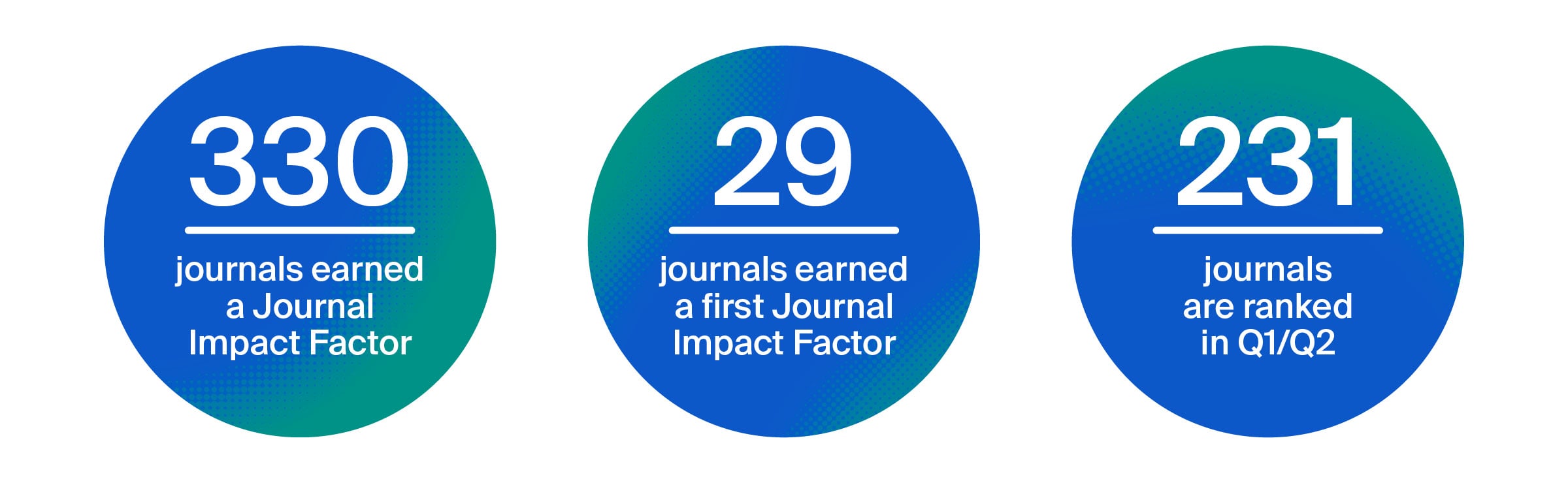
This year's JCR include 330 MDPI journals across a wide range of disciplines. Of these, 231 journals are placed in the top 50% (Q1 or Q2) of their respective subject categories, a result that spans fields as different as materials science, public health, environmental studies, and mathematics. 78 journals hold a top-quartile position (Q1), and 33 journals have a JIF of 5.0 or above.
- 330 journals earned a Journal Impact Factor (JIF)
- 29 journals earned a first JIF
- 254 journals had an increase in JIF
- 71% of ranked journals are in Q1 or Q2
For the full metrics on any MDPI journal, visit our Web of Science journals overview page or a journal's individual statistics page.
29 MDPI Journals Received Their First Journal Impact Factor
A first Impact Factor is a confirmation for an emerging journal. It marks the point at which a journal has been publishing long enough, and cited broadly enough, to enter the formal record of scientific influence. For the research communities those journals serve, it signals that the work being published is being read and built upon.
This year, 29 MDPI journals received a Journal Impact Factor for the first time, across a range of emerging and established research areas. Each represents years of editorial development and peer review—recognized in 2026 for the first time in the JCR.
This is also part of a longer shift in how science gets indexed. When the Emerging Sources Citation Index (ESCI) launched in 2016, 24 MDPI journals were included. By 2024 that number had grown to over 200, reflecting a broader change in the visibility of open access publishing within major citation tracking systems, not just at MDPI but across the sector.
Open Access with Impact
MDPI journals have received a total of 25.2 million citations in Web of Science. That figure matters less as a measure of MDPI's reach and more as a measure of what happens when research is freely available: it gets found, read, and used. Open access is only meaningful if the work actually travels and citations are one indicator that it does.
More than 4.6 million authors have published with MDPI. That breadth, across disciplines, institutions, and geographies, is what makes open access at this scale worth doing.
Thank You to the MDPI Scholarly Community
These results belong to the people who do the actual work: the Editors-in-Chief who set the standards, the Editorial Board Members and reviewers who hold them, and the authors who choose open access for their research. The numbers in the Journal Citation Reports are the downstream effect of decisions made at the desk, in the review, and at submission. Thank you for making them.
Data: 2025 Journal Impact Factors, Journal Citation Reports™ (Clarivate, 2026)
17 June 2026
Meet Us at IEEE International Symposium on Personal, Indoor and Mobile Radio Communications (PIMRC 2026), 1–4 September 2026, Singapore

MDPI will attend IEEE International Symposium on Personal, Indoor and Mobile Radio Communications as an exhibitor. This event will be held in Singapore, from 1 to 4 September 2026.
IEEE International Symposium on Personal, Indoor and Mobile Radio Communications (PIMRC) brings together leading researchers and professionals in the cellular, PCS, wireless LAN and mobile data industries to discuss key topics, such as AI and machine learning in communications, channel modeling, cooperative communications, integrated sensing, millimeter wave and terahertz communications, multi-user communications, optical wireless communications, physical layer security and quantum communications.
The following open access journals will be represented:
- Future Internet;
- AI;
- Information;
- Computers;
- Entropy;
- Electronics;
- IoT;
- JCP;
- MAKE;
- MCA;
- Network;
- Sensors;
- Telecom.
If you are attending this event, please feel free to start an online conversation with us. Our delegates look forward to meeting you in person at our booth and answering any questions you may have. For more information about the conference, please visit the following website: https://pimrc2026.ieee-pimrc.org/.
