



Pharmaceutics, Volume 17, Issue 12 (December 2025) – 125 articles
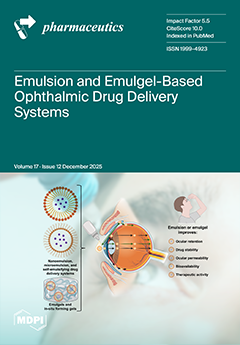
Cover Story (view full-size image):
Ophthalmic drug delivery faces major anatomical and physiological barriers, necessitating the development of novel drug delivery systems. This review highlights nanoemulsions, microemulsions, self-emulsifying drug delivery systems including self-nano emulsifying drug delivery systems and self-micro emulsifying drug delivery systems, emulgels, and in situ-forming emulgels as emerging platforms that improve ocular retention, stability, permeability, bioavailability, and ultimately therapeutic activity. It covers ocular diseases, limitations of conventional formulations, mechanisms of enhanced permeation by emulsion systems, formulation and optimization strategies, characterization, recent patents, clinical trials, marketed products, and future prospects of these systems for ocular diseases. View this paper
- Issues are regarded as officially published after their release is announced to the table of contents alert mailing list.
- You may sign up for e-mail alerts to receive table of contents of newly released issues.
- PDF is the official format for papers published in both, html and pdf forms. To view the papers in pdf format, click on the "PDF Full-text" link, and use the free Adobe Reader to open them.
Previous Issue
Next Issue
