Advances in Mesoporous Silica and Hybrid Nanoparticles for Drug Delivery: Synthesis, Functionalization, and Biomedical Applications


Abstract
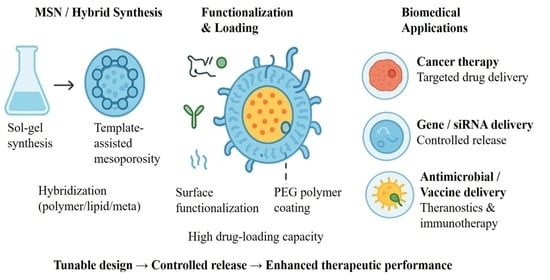
1. Introduction
2. Synthesis of Mesoporous Silica and Hybrid Nanoparticles
2.1. Chemical and Sol–Gel-Based Synthesis
2.1.1. The Sol–Gel Process
2.1.2. Surfactant- or Template-Assisted Synthesis
2.1.3. Doping and Co-Condensation Approaches
2.2. Post-Synthetic Surface Modification
2.2.1. Surface Grafting and Functionalization
2.2.2. Polymer and Lipid Coating
2.2.3. Gatekeeper and Stimuli-Responsive Systems
2.3. Hybridization Strategies
2.3.1. Polymer–Silica Hybrids
2.3.2. Lipid–Silica Hybrids
2.3.3. Metal– or Magnetic Silica Hybrids
2.4. Comparative Evaluation of Synthesis Approaches
2.5. Parameters Affecting MSN Formation
- pH and Catalyst Concentration: The basic conditions promote hydrolysis and condensation and give smaller monodisperse particles; acidic media prefer large, irregular morphologies [87].
- Surfactant Concentration: This defines the size of the micelle and therefore the size of the pore; too much surfactant may result in aggregation [88].
- Temperature and Reaction Time: They increase the kinetics of condensation with high temperatures but can kill the mesostructure when not controlled [89].
- Solvent Ratio: Modulates precursor solubility and micellar organization [90].
- Calcination Conditions: Affect framework integrity; overly high temperatures shrink pore volume or induce sintering [91].
3. Physicochemical Characterization of Mesoporous Silica and Hybrid Nanoparticles
3.1. Particle Size, Pore Size, and Surface Area Analysis
3.2. Morphological and Structural Characterization
3.2.1. Transmission and Scanning Electron Microscopy (TEM and SEM)

3.2.2. Atomic Force Microscopy (AFM) and High-Resolution Imaging
3.3. Porosity and Pore Structure Evaluation
3.4. Surface Chemistry and Functional Group Analysis
3.4.1. Fourier Transform Infrared Spectroscopy (FTIR)
3.4.2. X-Ray Photoelectron Spectroscopy (XPS)
3.5. Colloidal Stability and Surface Charge
3.6. Crystallinity and Structural Order
3.7. Comprehensive Assessment and Relevance to Drug Delivery
4. Functionalization and Stimuli-Responsive Designs
4.1. Surface Grafting of Targeting Ligands
4.1.1. Ligand Functionalization for Active Targeting
4.1.2. Multivalent and Dual-Ligand Systems
4.2. Polymer Functionalization and Coatings
4.2.1. Polyethylene Glycol (PEG) and Stealth Properties
4.2.2. Stimuli-Responsive Polymers
4.3. Stimuli-Responsive Mechanisms
4.3.1. pH-Responsive Systems
4.3.2. Redox-Responsive Systems
4.3.3. Enzyme-Responsive Systems
4.3.4. Light- and Temperature-Responsive Systems
4.4. Gatekeeper Strategies and Molecular Valves
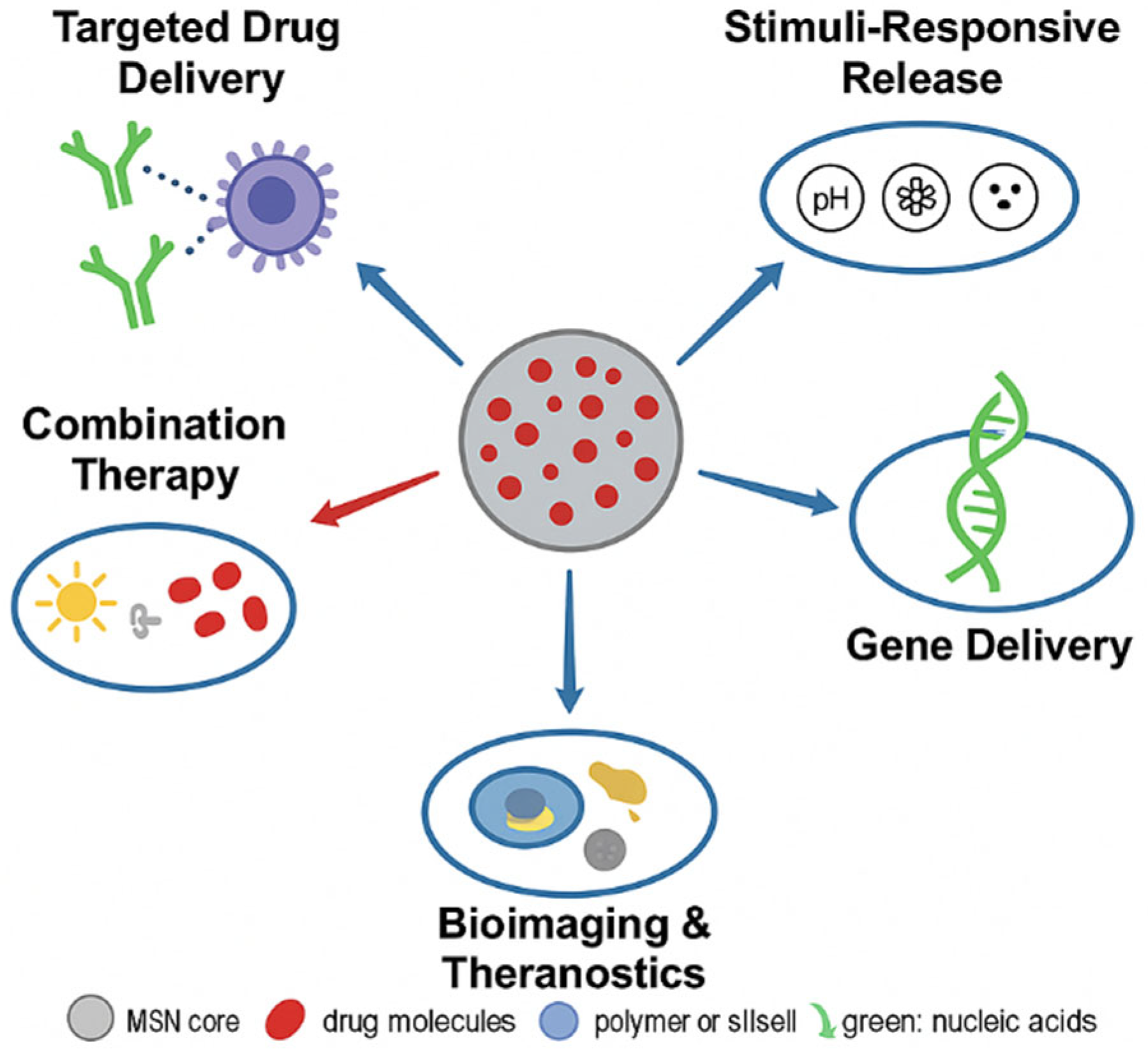
4.5. Co-Delivery and Theragnostic Hybrid Systems
4.5.1. Drug/Gene Co-Delivery
4.5.2. Theragnostic Hybrids
4.6. Challenges and Future Outlook
5. Drug Loading and Release Mechanisms
5.1. Drug Loading Mechanisms
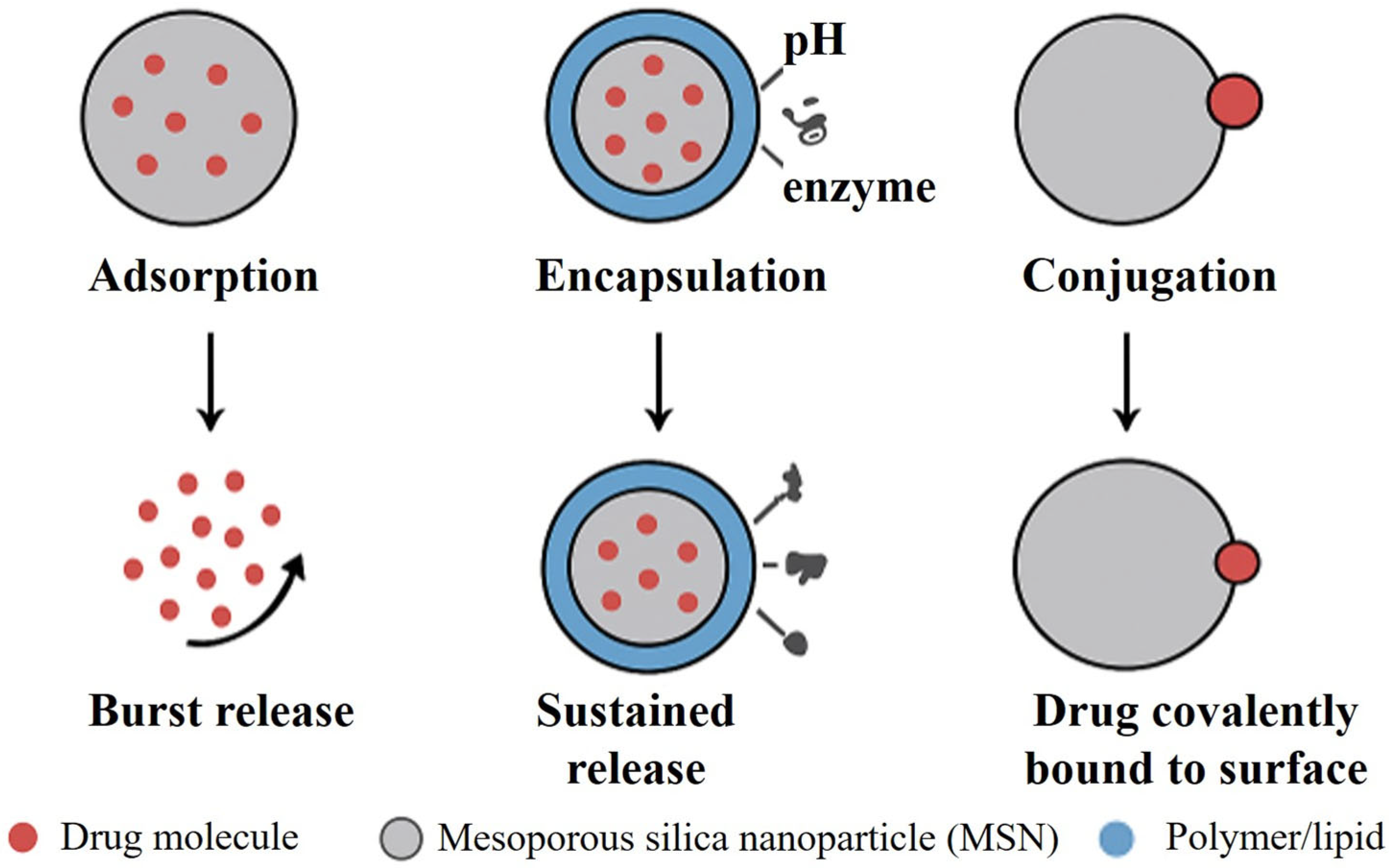
5.1.1. Adsorption Within Mesopores
5.1.2. Covalent Conjugation
5.1.3. Encapsulation Within Hybrid Matrices
5.2. Release Behavior and Kinetic Profiles
5.2.1. Burst vs. Sustained Release
5.2.2. Controlled and Triggered Release
5.3. Mathematical Models of Drug Release
- Zero-Order Model:
- Higuchi Model:
- Korsmeyer–Peppas Model:
5.4. Co-Delivery and Multifunctional Systems
5.4.1. Drug and Gene Co-Delivery
5.4.2. Drug and Imaging Agent Co-Delivery
5.5. Factors Influencing Drug Loading and Release
- Pore Volume and Size: Large pores are used to load macromolecules (siRNA, proteins) while diffusion is limited in small pores [26].
- Surface Chemistry: Drug–carrier interactions are controlled by functional groups; amine-functionalized MSNs facilitate acidic drug loading [24].
- pH and Ionic Strength: Controls ionization status of silica and drug molecules, affecting electrostatic adsorption [235].
- Solvent polarity and viscosity: Control rates of diffusion and solubility during loading and release [224].
5.6. Summary and Outlook
6. Biomedical Applications and Case Studies
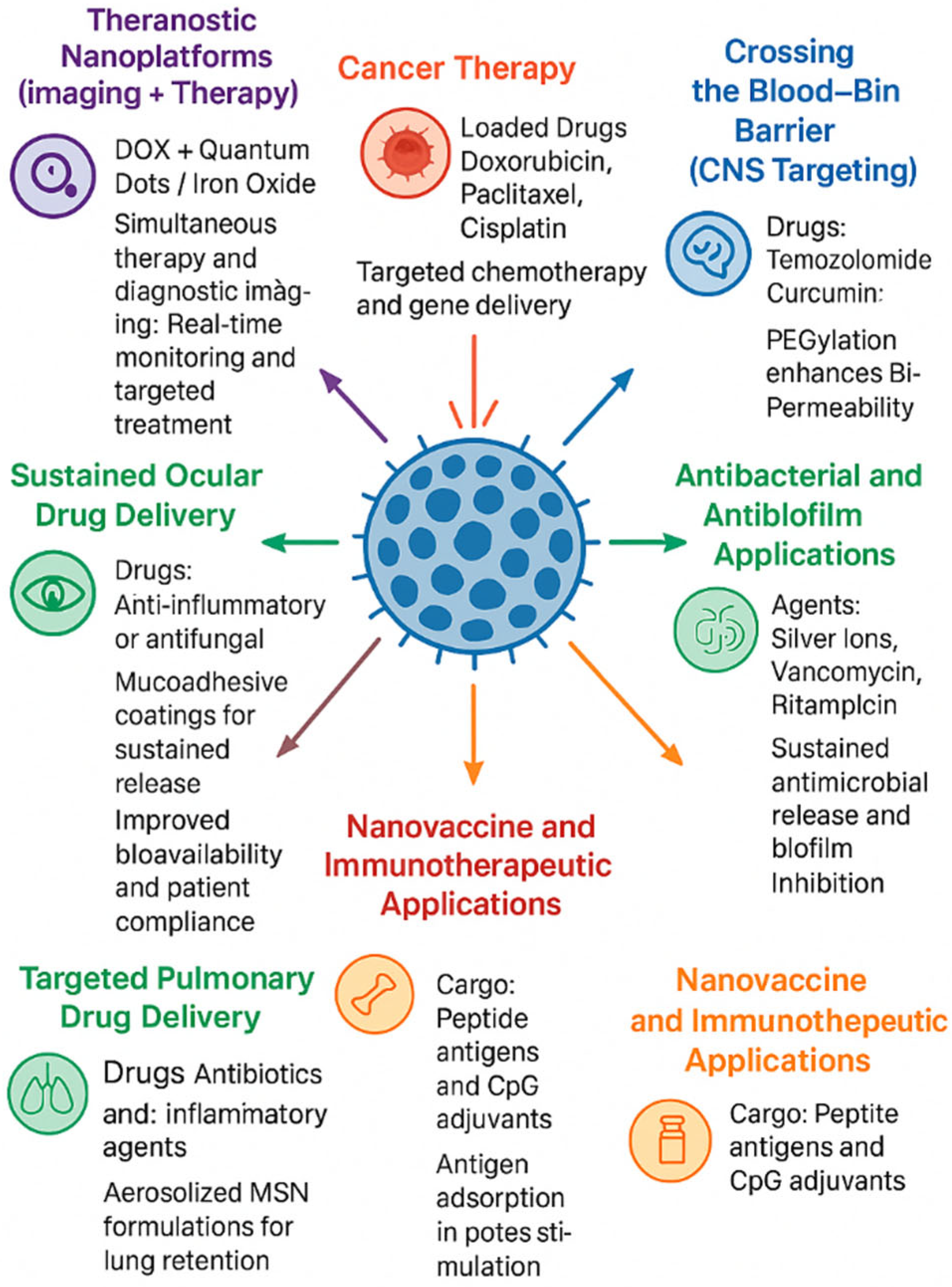
6.1. Cancer Therapy (Chemotherapy, Gene Delivery)
6.1.1. Chemotherapeutic Delivery
6.1.2. Gene and Nucleic Acid Delivery
6.2. CNS/Brain Delivery (Crossing the BBB)
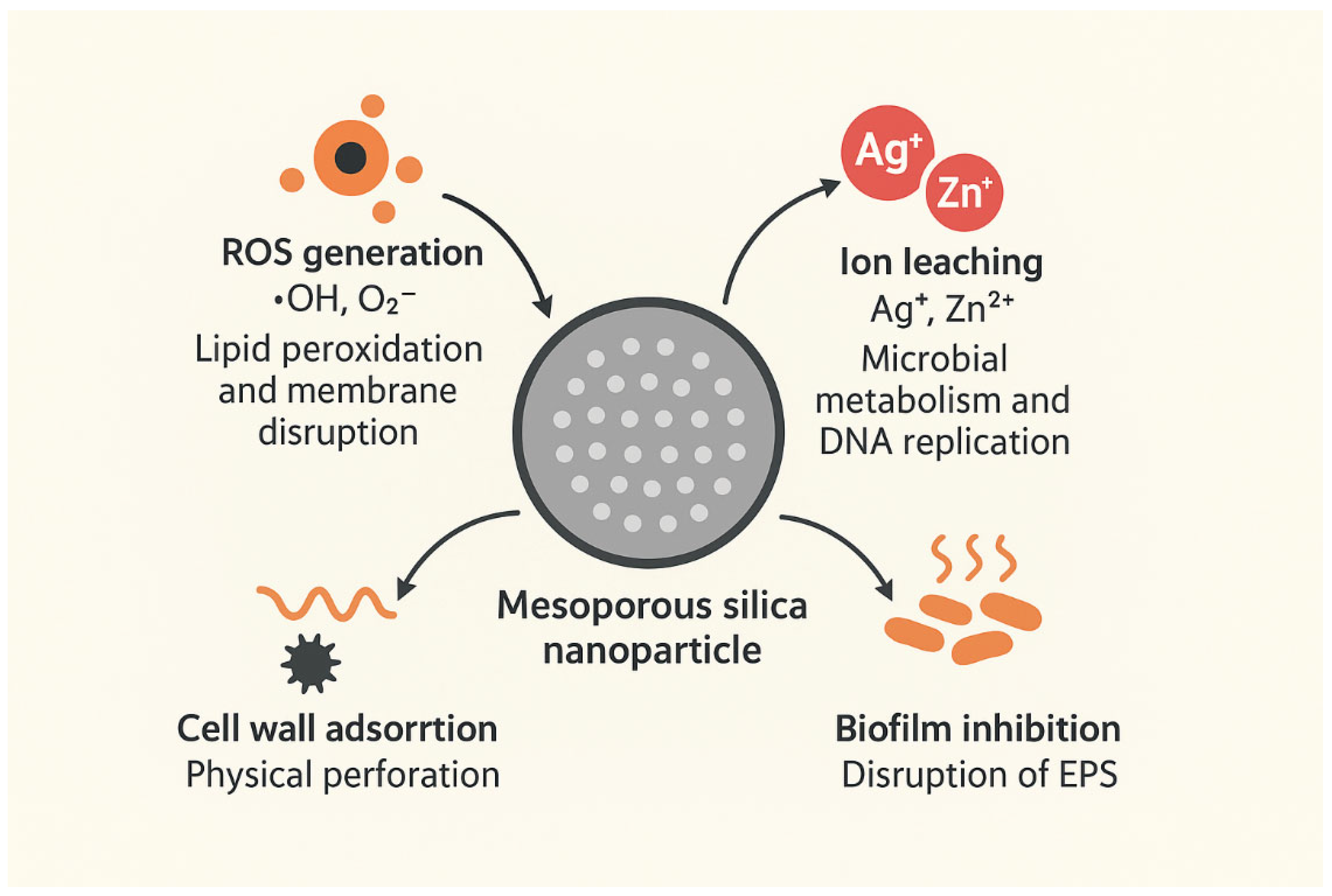
6.3. Antimicrobial/Antibacterial Delivery
6.4. Vaccine and Immunotherapy Delivery
6.5. Other Targeted Delivery (Bone, Lung, Ocular)
- Bone targeting: Bisphosphonate or targeting peptide-decorated MSNs have been utilized for the osteotropic delivery of anticancer agents or growth factors and antibiotics for bone metastases and osteomyelitis. Local drug exposure is enhanced with controlled release and increased bone affinity while minimizing systemic dosing [262].
- Pulmonary delivery: Spray-dried or aerosolized inhalable MSN formulations for lung cancer or lung infections utilize high surface area and tunable aerodynamic diameter; mucopenetration is enhanced and macrophage clearance minimized with polymer coatings [263].
- Ocular delivery: MSNs offer controlled release in ocular spaces (conjunctiva, vitreous), counteracting the fast drainage and short residence time of traditional eye drops; mucoadhesive coatings (chitosan) enhance retention and therapeutic contact [264].
6.6. Antimicrobial Spectrum: Anti-Biofilm, Antiviral, and Antiparasitic
6.7. Overarching Challenges and Translation Considerations
7. Biocompatibility, Safety, and In Vivo Behavior
7.1. Cytotoxicity and Hemocompatibility
7.2. Immunogenicity and Inflammatory Response
7.3. Biodistribution, Clearance, and Degradation
7.4. Protein Corona Effects
7.5. Long-Term Fate and In Vivo Toxicology
8. Scale-Up, Manufacturing, and Regulatory Considerations
8.1. Reproducibility and Batch Consistency
8.2. Scalability and Process Optimization
8.3. Stability, Storage, and Shelf Life
8.4. Regulatory and Quality Control Perspective
9. Challenges, Limitations, and Future Outlook
9.1. Current Limitations
9.2. Smart and Programmable Silica Hybrids
9.3. Integration with Emerging Modalities
9.4. Sustainable and Green Synthesis
9.5. Path Forward for Clinical Translation
10. Conclusions
Funding
Institutional Review Board Statement
Informed Consent Statement
Data Availability Statement
Acknowledgments
Conflicts of Interest
References
- Cong, V.T.; Gaus, K.; Tilley, R.D.; Gooding, J.J. Rod-shaped mesoporous silica nanoparticles for nanomedicine: Recent progress and perspectives. Expert Opin. Drug Deliv. 2018, 15, 881–892. [Google Scholar] [CrossRef] [PubMed]
- Tang, F.; Li, L.; Chen, D. Mesoporous silica nanoparticles: Synthesis, biocompatibility and drug delivery. Adv. Mater. 2012, 24, 1504–1534. [Google Scholar] [CrossRef] [PubMed]
- Tarn, D.; Ashley, C.E.; Xue, M.; Carnes, E.C.; Zink, J.I.; Brinker, C.J. Mesoporous silica nanoparticle nanocarriers: Biofunctionality and biocompatibility. Acc. Chem. Res. 2013, 46, 792–801. [Google Scholar] [CrossRef] [PubMed]
- Hu, J.J.; Xiao, D.; Zhang, X.Z. Advances in peptide functionalization on mesoporous silica nanoparticles for controlled drug release. Small 2016, 12, 3344–3359. [Google Scholar] [CrossRef]
- Zhang, W.; Liu, H.; Qiu, X.; Zuo, F.; Wang, B. Mesoporous silica nanoparticles as a drug delivery mechanism. Open Life Sci. 2024, 19, 20220867. [Google Scholar] [CrossRef]
- Wang, Y.; Zhao, Q.; Han, N.; Bai, L.; Li, J.; Liu, J.; Che, E.; Hu, L.; Zhang, Q.; Jiang, T. Mesoporous silica nanoparticles in drug delivery and biomedical applications. Nanomed. Nanotechnol. Biol. Med. 2015, 11, 313–327. [Google Scholar] [CrossRef]
- Wu, S.-H.; Mou, C.-Y.; Lin, H.-P. Synthesis of mesoporous silica nanoparticles. Chem. Soc. Rev. 2013, 42, 3862–3875. [Google Scholar] [CrossRef]
- Zhou, Y.; Quan, G.; Wu, Q.; Zhang, X.; Niu, B.; Wu, B.; Huang, Y.; Pan, X.; Wu, C. Mesoporous silica nanoparticles for drug and gene delivery. Acta Pharm. Sin. B 2018, 8, 165–177. [Google Scholar] [CrossRef]
- Santhamoorthy, M.; Asaithambi, P.; Ramkumar, V.; Elangovan, N.; Perumal, I.; Kim, S.C. A Review on the Recent Advancements of Polymer-Modified Mesoporous Silica Nanoparticles for Drug Delivery Under Stimuli-Trigger. Polymers 2025, 17, 1640. [Google Scholar] [CrossRef]
- Kwon, S.; Singh, R.K.; Perez, R.A.; Abou Neel, E.A.; Kim, H.-W.; Chrzanowski, W. Silica-based mesoporous nanoparticles for controlled drug delivery. J. Tissue Eng. 2013, 4, 2041731413503357. [Google Scholar] [CrossRef]
- Patra, S.; Madhuri, R.; Sharma, P.K. Stimuli-responsive polymers for treatment of diabetes mellitus. In Stimuli Responsive Polymeric Nanocarriers for Drug Delivery Applications; Elsevier: Amsterdam, The Netherlands, 2019; pp. 491–524. [Google Scholar]
- Macchione, M.A.; Strumia, M.C. Stimuli-responsive nanosystems as smart nanotheranostics. In Advanced Nanoformulations; Elsevier: Amsterdam, The Netherlands, 2023; pp. 363–396. [Google Scholar] [CrossRef]
- Li, Y.; Deng, G.; Hu, X.; Li, C.; Wang, X.; Zhu, Q.; Zheng, K.; Xiong, W.; Wu, H. Recent advances in mesoporous silica nanoparticle-based targeted drug-delivery systems for cancer therapy. Nanomedicine 2022, 17, 1253–1279. [Google Scholar] [CrossRef]
- Din, F.U.; Aman, W.; Ullah, I.; Qureshi, O.S.; Mustapha, O.; Shafique, S.; Zeb, A. Effective use of nanocarriers as drug delivery systems for the treatment of selected tumors. Int. J. Nanomed. 2017, 12, 7291–7309. [Google Scholar] [CrossRef]
- Shi, S.; Chen, F.; Cai, W. Biomedical applications of functionalized hollow mesoporous silica nanoparticles: Focusing on molecular imaging. Nanomedicine 2013, 8, 2027–2039. [Google Scholar] [CrossRef] [PubMed]
- Lim, W.Q.; Phua, S.Z.F.; Xu, H.V.; Sreejith, S.; Zhao, Y. Recent advances in multifunctional silica-based hybrid nanocarriers for bioimaging and cancer therapy. Nanoscale 2016, 8, 12510–12519. [Google Scholar] [CrossRef] [PubMed]
- Khoz, R.; Yazdian, F.; Pourmadadi, M.; Rahdar, A.; Fathi-karkan, S.; Pandey, S. Current trends in silica based drug delivery systems. Eur. J. Med. Chem. Rep. 2024, 12, 100206. [Google Scholar] [CrossRef]
- Bai, Z.; Wan, D.; Lan, T.; Hong, W.; Dong, H.; Wei, Y.; Wei, X. Nanoplatform based intranasal vaccines: Current progress and clinical challenges. ACS Nano 2024, 18, 24650–24681. [Google Scholar] [CrossRef]
- Song, Y.; Li, Y.; Xu, Q.; Liu, Z. Mesoporous silica nanoparticles for stimuli-responsive controlled drug delivery: Advances, challenges, and outlook. Int. J. Nanomed. 2017, 12, 87–110. [Google Scholar] [CrossRef]
- dos Apostolos, R.C.; Andrade, G.F.; da Silva, W.M.; de Assis Gomes, D.; de Miranda, M.C.; de Sousa, E.M. Hybrid polymeric systems of mesoporous silica/hydroxyapatite nanoparticles applied as antitumor drug delivery platform. Int. J. Appl. Ceram. Technol. 2019, 16, 1836–1849. [Google Scholar] [CrossRef]
- Manzano, M.; Vallet-Regí, M. Mesoporous Silica Nanoparticles in Biomedicine: Advances and Prospects. Adv. Mater. 2025, e12433. [Google Scholar] [CrossRef]
- Fotie, J. Applications of Tailored Mesoporous Silicate Nanomaterials in Regenerative Medicine and Theranostics. Int. J. Mol. Sci. 2025, 26, 7918. [Google Scholar] [CrossRef]
- Hosseinpour, S.; Walsh, L.J.; Xu, C. Biomedical application of mesoporous silica nanoparticles as delivery systems: A biological safety perspective. J. Mater. Chem. B 2020, 8, 9863–9876. [Google Scholar] [CrossRef]
- Liu, Y.; Zhao, M.; Zhang, M.; Yang, B.; Qi, Y.-K.; Fu, Q. Mesoporous silica nanoparticle-based nanomedicine: Preparation, functional modification, and theranostic applications. Mater. Today Bio 2025, 34, 102223. [Google Scholar] [CrossRef] [PubMed]
- Slowing, I.; Trewyn, B.G.; Lin, V.S.-Y. Effect of surface functionalization of MCM-41-type mesoporous silica nanoparticles on the endocytosis by human cancer cells. J. Am. Chem. Soc. 2006, 128, 14792–14793. [Google Scholar] [CrossRef]
- Narayan, R.; Nayak, U.Y.; Raichur, A.M.; Garg, S. Mesoporous silica nanoparticles: A comprehensive review on synthesis and recent advances. Pharmaceutics 2018, 10, 118. [Google Scholar] [CrossRef] [PubMed]
- Brinker, C.J.; Scherer, G.W. Sol-Gel Science: The Physics and Chemistry of Sol-Gel Processing; Gulf Professional Publishing: Houston, TX, USA, 1990. [Google Scholar]
- Owens, G.J.; Singh, R.K.; Foroutan, F.; Alqaysi, M.; Han, C.-M.; Mahapatra, C.; Kim, H.-W.; Knowles, J.C. Sol–gel based materials for biomedical applications. Prog. Mater. Sci. 2016, 77, 1–79. [Google Scholar] [CrossRef]
- Stöber, W.; Fink, A.; Bohn, E. Controlled growth of monodisperse silica spheres in the micron size range. J. Colloid Interface Sci. 1968, 26, 62–69. [Google Scholar] [CrossRef]
- Florensa, M.; Llenas, M.; Medina-Gutierrez, E.; Sandoval, S.; Tobias-Rossell, G. Key parameters for the rational design, synthesis, and functionalization of biocompatible mesoporous silica nanoparticles. Pharmaceutics 2022, 14, 2703. [Google Scholar] [CrossRef]
- Vallet-Regí, M.; Balas, F.; Arcos, D. Mesoporous materials for drug delivery. Angew. Chem. Int. Ed. 2007, 46, 7548–7558. [Google Scholar] [CrossRef]
- Khan, I.; Saeed, K.; Khan, I. Nanoparticles: Properties, applications and toxicities. Arab. J. Chem. 2019, 12, 908–931. [Google Scholar] [CrossRef]
- Holmberg, K. Surfactant-templated nanomaterials synthesis. J. Colloid Interface Sci. 2004, 274, 355–364. [Google Scholar] [CrossRef]
- Kresge, a.C.; Leonowicz, M.E.; Roth, W.J.; Vartuli, J.; Beck, J. Ordered mesoporous molecular sieves synthesized by a liquid-crystal template mechanism. Nature 1992, 359, 710–712. [Google Scholar] [CrossRef]
- Li, Y.; Tjandra, W.; Tam, K.C. Synthesis and characterization of nanoporous hydroxyapatite using cationic surfactants as templates. Mater. Res. Bull. 2008, 43, 2318–2326. [Google Scholar] [CrossRef]
- Zhao, D.; Feng, J.; Huo, Q.; Melosh, N.; Fredrickson, G.H.; Chmelka, B.F.; Stucky, G.D. Triblock copolymer syntheses of mesoporous silica with periodic 50 to 300 angstrom pores. Science 1998, 279, 548–552. [Google Scholar] [CrossRef] [PubMed]
- Savic, S.; Vojisavljevic, K.; uč a-Nešić, M.P.; Zivojevic, K.; Mladenovic, M.; Knezevic, N. Hard template synthesis of nanomaterials based on mesoporous silica. Metall. Mater. Eng. 2018, 24, 227–238. [Google Scholar] [CrossRef]
- Lai, C.-Y.; Trewyn, B.G.; Jeftinija, D.M.; Jeftinija, K.; Xu, S.; Jeftinija, S.; Lin, V.S.-Y. A mesoporous silica nanosphere-based carrier system with chemically removable CdS nanoparticle caps for stimuli-responsive controlled release of neurotransmitters and drug molecules. J. Am. Chem. Soc. 2003, 125, 4451–4459. [Google Scholar] [CrossRef]
- Ghaedi, H.; Zhao, M. Review on template removal techniques for synthesis of mesoporous silica materials. Energy Fuels 2022, 36, 2424–2446. [Google Scholar] [CrossRef]
- Islam, M.S.; Ahmed, M.S.; Kuddus, M.A.; Tabassum, S.; Ismail, A.B.M. Microwave-assisted, surfactant-free synthesis of high-purity mesoporous silica from sugarcane bagasse ash for rapid and reusable textile dye removal. Next Mater. 2025, 9, 101165. [Google Scholar] [CrossRef]
- Zheng, C.-W.; Luo, Y.-H.; Long, X.; Gu, H.; Cheng, J.; Zhang, L.; Lai, Y.J.S.; Rittmann, B.E. The structure of biodegradable surfactants shaped the microbial community, antimicrobial resistance, and potential for horizontal gene transfer. Water Res. 2023, 236, 119944. [Google Scholar] [CrossRef]
- Vamsi, E.B.; Devatha, C. Green synthesis of mesoporous silica nanoparticles (MSNs) and its application on degradation of triclosan. Case Stud. Chem. Environ. Eng. 2024, 10, 100818. [Google Scholar] [CrossRef]
- Karthik, V.; Senthil Kumar, P.; Vo, D.-V.N.; Selvakumar, P.; Gokulakrishnan, M.; Keerthana, P.; Audilakshmi, V.; Jeyanthi, J. Enzyme-loaded nanoparticles for the degradation of wastewater contaminants: A review. Environ. Chem. Lett. 2021, 19, 2331–2350. [Google Scholar] [CrossRef]
- Rosenholm, J.M.; Sahlgren, C.; Lindén, M. Towards multifunctional, targeted drug delivery systems using mesoporous silica nanoparticles–opportunities & challenges. Nanoscale 2010, 2, 1870–1883. [Google Scholar] [PubMed]
- Yokoi, T.; Yoshitake, H.; Tatsumi, T. Synthesis of amino-functionalized MCM-41 via direct co-condensation and post-synthesis grafting methods using mono-, di-and tri-amino-organoalkoxysilanes. J. Mater. Chem. 2004, 14, 951–957. [Google Scholar] [CrossRef]
- Hudson, S.P.; Padera, R.F.; Langer, R.; Kohane, D.S. The biocompatibility of mesoporous silicates. Biomaterials 2008, 29, 4045–4055. [Google Scholar] [CrossRef]
- Singh, N.; Karambelkar, A.; Gu, L.; Lin, K.; Miller, J.S.; Chen, C.S.; Sailor, M.J.; Bhatia, S.N. Bioresponsive mesoporous silica nanoparticles for triggered drug release. J. Am. Chem. Soc. 2011, 133, 19582–19585. [Google Scholar] [CrossRef]
- Liu, C.; Meng, D.; Pang, H.; Wu, X.; Xie, J.; Yu, X.; Chen, L.; Liu, X. Influence of Fe-doping on the structural, optical and magnetic properties of ZnO nanoparticles. J. Magn. Magn. Mater. 2012, 324, 3356–3360. [Google Scholar] [CrossRef]
- He, Q.; Shi, J. Mesoporous silica nanoparticle based nano drug delivery systems: Synthesis, controlled drug release and delivery, pharmacokinetics and biocompatibility. J. Mater. Chem. 2011, 21, 5845–5855. [Google Scholar] [CrossRef]
- Vallet-Regí, M.; Colilla, M.; Izquierdo-Barba, I.; Manzano, M. Mesoporous silica nanoparticles for drug delivery: Current insights. Molecules 2017, 23, 47. [Google Scholar] [CrossRef]
- Zhang, J.; Liu, Z.; Zhang, Z.; Yang, H.; Wang, H.; Yang, Z.; Xu, Y.; Li, S.; Yang, D. Recent advances in silica-based nanomaterials for enhanced tumor imaging and therapy. ACS Appl. Bio Mater. 2024, 7, 7133–7169. [Google Scholar] [CrossRef]
- Chen, Y.; Chen, H.-R.; Shi, J.-L. Construction of homogenous/heterogeneous hollow mesoporous silica nanostructures by silica-etching chemistry: Principles, synthesis, and applications. Acc. Chem. Res. 2014, 47, 125–137. [Google Scholar] [CrossRef]
- Shah, I.U.; Jadhav, S.A.; Belekar, V.M.; Patil, P.S. Smart polymer grafted silica based drug delivery systems. Polym. Adv. Technol. 2023, 34, 24–43. [Google Scholar] [CrossRef]
- Ghosh, S. Mesoporous silica-based nano drug-delivery system synthesis, characterization, and applications. In Nanocarriers for Drug Delivery; Elsevier: Amsterdam, The Netherlands, 2019; pp. 285–317. [Google Scholar] [CrossRef]
- de Oliveira Freitas, L.B.; de Melo Corgosinho, L.; Faria, J.A.Q.A.; dos Santos, V.M.; Resende, J.M.; Leal, A.S.; Gomes, D.A.; de Sousa, E.M.B. Multifunctional mesoporous silica nanoparticles for cancer-targeted, controlled drug delivery and imaging. Microporous Mesoporous Mater. 2017, 242, 271–283. [Google Scholar] [CrossRef]
- Ilhan-Ayisigi, E.; Yesil-Celiktas, O. Silica-based organic-inorganic hybrid nanoparticles and nanoconjugates for improved anticancer drug delivery. Eng. Life Sci. 2018, 18, 882–892. [Google Scholar] [CrossRef]
- Kankala, R.K.; Han, Y.-H.; Xia, H.-Y.; Wang, S.-B.; Chen, A.-Z. Nanoarchitectured prototypes of mesoporous silica nanoparticles for innovative biomedical applications. J. Nanobiotechnol. 2022, 20, 126. [Google Scholar] [CrossRef] [PubMed]
- Ardestani, E.A.; Zakariaee, S.J.S.; Fard, M.H.p.S.; Mirshekari, B. Synthesis of biogenic mesoporous silica nanoparticles from rice husks waste materials via sol–gel method. Biomass Convers. Biorefin. 2025, 15, 29191–29206. [Google Scholar] [CrossRef]
- Shafiei, N.; Nasrollahzadeh, M.; Iravani, S. Green synthesis of silica and silicon nanoparticles and their biomedical and catalytic applications. Comments Inorg. Chem. 2021, 41, 317–372. [Google Scholar] [CrossRef]
- Popat, A.; Hartono, S.B.; Stahr, F.; Liu, J.; Qiao, S.Z.; Lu, G.Q.M. Mesoporous silica nanoparticles for bioadsorption, enzyme immobilisation, and delivery carriers. Nanoscale 2011, 3, 2801–2818. [Google Scholar] [CrossRef]
- Mohanan, S.; Guan, X.; Liang, M.; Karakoti, A.; Vinu, A. Stimuli-Responsive Silica Silanol Conjugates: Strategic Nanoarchitectonics in Targeted Drug Delivery. Small 2024, 20, 2301113. [Google Scholar] [CrossRef]
- Mehmood, A.; Ghafar, H.; Yaqoob, S.; Gohar, U.F.; Ahmad, B. Mesoporous silica nanoparticles: A review. J. Dev. Drugs 2017, 6, 100174. [Google Scholar] [CrossRef]
- Bagheri, E.; Ansari, L.; Abnous, K.; Taghdisi, S.M.; Charbgoo, F.; Ramezani, M.; Alibolandi, M. Silica based hybrid materials for drug delivery and bioimaging. J. Control. Release 2018, 277, 57–76. [Google Scholar] [CrossRef] [PubMed]
- Nair, A.; Day, C.M.; Garg, S.; Nayak, Y.; Shenoy, P.A.; Nayak, U.Y. Polymeric functionalization of mesoporous silica nanoparticles: Biomedical insights. Int. J. Pharm. 2024, 660, 124314. [Google Scholar] [CrossRef]
- Dumontel, B.; Conejo-Rodríguez, V.; Vallet-Regí, M.; Manzano, M. Natural biopolymers as smart coating materials of mesoporous silica nanoparticles for drug delivery. Pharmaceutics 2023, 15, 447. [Google Scholar] [CrossRef]
- Shao, D.; Li, M.; Wang, Z.; Zheng, X.; Lao, Y.H.; Chang, Z.; Zhang, F.; Lu, M.; Yue, J.; Hu, H. Bioinspired diselenide-bridged mesoporous silica nanoparticles for dual-responsive protein delivery. Adv. Mater. 2018, 30, 1801198. [Google Scholar] [CrossRef] [PubMed]
- Dengler, E.C.; Liu, J.; Kerwin, A.; Torres, S.; Olcott, C.M.; Bowman, B.N.; Armijo, L.; Gentry, K.; Wilkerson, J.; Wallace, J. Mesoporous silica-supported lipid bilayers (protocells) for DNA cargo delivery to the spinal cord. J. Control. Release 2013, 168, 209–224. [Google Scholar] [CrossRef]
- Wu, C.; Chang, J. Mesoporous bioactive glasses: Structure characteristics, drug/growth factor delivery and bone regeneration application. Interface Focus 2012, 2, 292–306. [Google Scholar] [CrossRef] [PubMed]
- Janßen, H.C.; Angrisani, N.; Kalies, S.; Hansmann, F.; Kietzmann, M.; Warwas, D.P.; Behrens, P.; Reifenrath, J. Biodistribution, biocompatibility and targeted accumulation of magnetic nanoporous silica nanoparticles as drug carrier in orthopedics. J. Nanobiotechnol. 2020, 18, 14. [Google Scholar] [CrossRef] [PubMed]
- Yang, S.; Chen, D.; Li, N.; Xu, Q.; Li, H.; Gu, F.; Xie, J.; Lu, J. Hollow mesoporous silica nanocarriers with multifunctional capping agents for in vivo cancer imaging and therapy. Small 2016, 12, 360–370. [Google Scholar] [CrossRef]
- Beach, M.A.; Nayanathara, U.; Gao, Y.; Zhang, C.; Xiong, Y.; Wang, Y.; Such, G.K. Polymeric nanoparticles for drug delivery. Chem. Rev. 2024, 124, 5505–5616. [Google Scholar] [CrossRef]
- Soares, D.C.F.; Domingues, S.C.; Viana, D.B.; Tebaldi, M.L. Polymer-hybrid nanoparticles: Current advances in biomedical applications. Biomed. Pharmacother. 2020, 131, 110695. [Google Scholar] [CrossRef]
- Thirupathi, K.; Santhamoorthy, M.; Radhakrishnan, S.; Ulagesan, S.; Nam, T.-J.; Phan, T.T.V.; Kim, S.-C. Thermosensitive polymer-modified mesoporous silica for pH and temperature-responsive drug delivery. Pharmaceutics 2023, 15, 795. [Google Scholar] [CrossRef]
- Pablos, J.L.; Lozano, D.; Manzano, M.; Vallet-Regí, M. Regenerative medicine: Hydrogels and mesoporous silica nanoparticles. Mater. Today Bio 2024, 29, 101342. [Google Scholar] [CrossRef]
- Zhang, Q.; Chen, X.; Shi, H.; Dong, G.; Zhou, M.; Wang, T.; Xin, H. Thermo-responsive mesoporous silica/lipid bilayer hybrid nanoparticles for doxorubicin on-demand delivery and reduced premature release. Colloids Surf. B Biointerfaces 2017, 160, 527–534. [Google Scholar] [CrossRef] [PubMed]
- Hussein, H.A.; Abdullah, M.A. Novel drug delivery systems based on silver nanoparticles, hyaluronic acid, lipid nanoparticles and liposomes for cancer treatment. Appl. Nanosci. 2022, 12, 3071–3096. [Google Scholar] [CrossRef]
- Kim, J.; Kim, H.S.; Lee, N.; Kim, T.; Kim, H.; Yu, T.; Song, I.C.; Moon, W.K.; Hyeon, T. Multifunctional uniform nanoparticles composed of a magnetite nanocrystal core and a mesoporous silica shell for magnetic resonance and fluorescence imaging and for drug delivery. Angew. Chem. 2008, 47, 8438–8441. [Google Scholar] [CrossRef]
- Kang, N.; Xu, D.; Han, Y.; Lv, X.; Chen, Z.; Zhou, T.; Ren, L.; Zhou, X. Magnetic targeting core/shell Fe3O4/Au nanoparticles for magnetic resonance/photoacoustic dual-modal imaging. Mater. Sci. Eng. C 2019, 98, 545–549. [Google Scholar] [CrossRef]
- Chen, F.; Hong, H.; Shi, S.; Goel, S.; Valdovinos, H.F.; Hernandez, R.; Theuer, C.P.; Barnhart, T.E.; Cai, W. Engineering of hollow mesoporous silica nanoparticles for remarkably enhanced tumor active targeting efficacy. Sci. Rep. 2014, 4, 5080. [Google Scholar] [CrossRef] [PubMed]
- Wu, M.; Huang, S. Magnetic nanoparticles in cancer diagnosis, drug delivery and treatment. Mol. Clin. Oncol. 2017, 7, 738–746. [Google Scholar] [CrossRef]
- Li, J.; Lu, W.; Yang, Y.; Xiang, R.; Ling, Y.; Yu, C.; Zhou, Y. Hybrid nanomaterials for cancer immunotherapy. Adv. Sci. 2023, 10, 2204932. [Google Scholar] [CrossRef]
- Liu, H.; Su, Y.-Y.; Jiang, X.-C.; Gao, J.-Q. Cell membrane-coated nanoparticles: A novel multifunctional biomimetic drug delivery system. Drug Deliv. Transl. Res. 2023, 13, 716–737. [Google Scholar] [CrossRef]
- Kaur, J.; Kaur, B.; Singh, P. Rational modification of semaxanib and sunitinib for developing a tumor growth inhibitor targeting ATP binding site of tyrosine kinase. Bioorg. Med. Chem. Lett. 2018, 28, 129–133. [Google Scholar] [CrossRef]
- Choudhury, S. A review of the sol-gel process and its application. Int. Educ. Res. J. 2024, 10, 145–152. [Google Scholar] [CrossRef]
- Li, Z.; Barnes, J.C.; Bosoy, A.; Stoddart, J.F.; Zink, J.I. Mesoporous silica nanoparticles in biomedical applications. Chem. Soc. Rev. 2012, 41, 2590–2605. [Google Scholar] [CrossRef] [PubMed]
- Nicole, L.; Laberty-Robert, C.; Rozes, L.; Sanchez, C. Hybrid materials science: A promised land for the integrative design of multifunctional materials. Nanoscale 2014, 6, 6267–6292. [Google Scholar] [CrossRef] [PubMed]
- Semeykina, V.; Zharov, I. Medium controlled aggregative growth as a key step in mesoporous silica nanoparticle formation. J. Colloid Interface Sci. 2022, 615, 236–247. [Google Scholar] [CrossRef] [PubMed]
- Bouchoucha, M.; Côté, M.-F.; C.-Gaudreault, R.; Fortin, M.-A.; Kleitz, F. Size-controlled functionalized mesoporous silica nanoparticles for tunable drug release and enhanced anti-tumoral activity. Chem. Mater. 2016, 28, 4243–4258. [Google Scholar] [CrossRef]
- Yao, P.; Zou, A.; Tian, Z.; Meng, W.; Fang, X.; Wu, T.; Cheng, J. Construction and characterization of a temperature-responsive nanocarrier for imidacloprid based on mesoporous silica nanoparticles. Colloids Surf. B Biointerfaces 2021, 198, 111464. [Google Scholar] [CrossRef]
- Khalbas, A.H.; Albayati, T.M.; Ali, N.S.; Salih, I.K. Drug loading methods and kinetic release models using of mesoporous silica nanoparticles as a drug delivery system: A review. S. Afr. J. Chem. Eng. 2024, 50, 261–280. [Google Scholar] [CrossRef]
- Charmforoushan, A.; Roknabadi, M.R.; Shahtahmassebi, N.; Malaekeh-Nikouei, B.; Bagherabadi, M. Synthesis and controlled drug release behavior of micro-mesoporous wollastonite nanoparticles. Effect of calcination temperature on the structural and biodegradability properties. Mater. Chem. Phys. 2022, 280, 125825. [Google Scholar] [CrossRef]
- Manzano, M.; Vallet-Regí, M. Mesoporous silica nanoparticles for drug delivery. Adv. Funct. Mater. 2020, 30, 1902634. [Google Scholar] [CrossRef]
- Bilardo, R.; Traldi, F.; Vdovchenko, A.; Resmini, M. Influence of surface chemistry and morphology of nanoparticles on protein corona formation. Wiley Interdiscip. Rev. Nanomed. Nanobiotechnol. 2022, 14, e1788. [Google Scholar] [CrossRef]
- Dave, P.N.; Chopda, L.V. A review on application of multifunctional mesoporous nanoparticles in controlled release of drug delivery. In Materials Science Forum; Trans Tech Publications Ltd.: Bäch, Switzerland, 2014; pp. 17–24. [Google Scholar] [CrossRef]
- Manaia, E.B.; Abuçafy, M.P.; Chiari-Andréo, B.G.; Silva, B.L.; Oshiro Junior, J.A.; Chiavacci, L.A. Physicochemical characterization of drug nanocarriers. Int. J. Nanomed. 2017, 12, 4991–5011. [Google Scholar] [CrossRef]
- Lu, J.; Liong, M.; Zink, J.I.; Tamanoi, F. Mesoporous silica nanoparticles as a delivery system for hydrophobic anticancer drugs. Small 2007, 3, 1341–1346. [Google Scholar] [CrossRef]
- Mamaeva, V.; Sahlgren, C.; Lindén, M. Mesoporous silica nanoparticles in medicine—Recent advances. Adv. Drug Deliv. Rev. 2013, 65, 689–702. [Google Scholar] [CrossRef]
- Filippov, S.K.; Khusnutdinov, R.; Murmiliuk, A.; Inam, W.; Zakharova, L.Y.; Zhang, H.; Khutoryanskiy, V.V. Dynamic light scattering and transmission electron microscopy in drug delivery: A roadmap for correct characterization of nanoparticles and interpretation of results. Mater. Horiz. 2023, 10, 5354–5370. [Google Scholar] [CrossRef]
- Barrett, E.P.; Joyner, L.G.; Halenda, P.P. The determination of pore volume and area distributions in porous substances. I. Computations from nitrogen isotherms. J. Am. Chem. Soc. 1951, 73, 373–380. [Google Scholar] [CrossRef]
- Tan, Y.H.; Davis, J.A.; Fujikawa, K.; Ganesh, N.V.; Demchenko, A.V.; Stine, K.J. Surface area and pore size characteristics of nanoporous gold subjected to thermal, mechanical, or surface modification studied using gas adsorption isotherms, cyclic voltammetry, thermogravimetric analysis, and scanning electron microscopy. J. Mater. Chem. 2012, 22, 6733–6745. [Google Scholar] [CrossRef]
- Bhagat, S.D.; Rao, A.V. Surface chemical modification of TEOS based silica aerogels synthesized by two step (acid–base) sol–gel process. Appl. Surf. Sci. 2006, 252, 4289–4297. [Google Scholar] [CrossRef]
- Manzano, M.; Aina, V.; Areán, C.; Balas, F.; Cauda, V.; Colilla, M.; Delgado, M.; Vallet-Regí, M. Studies on MCM-41 mesoporous silica for drug delivery: Effect of particle morphology and amine functionalization. Chem. Eng. J. 2008, 137, 30–37. [Google Scholar] [CrossRef]
- Jiang, B.; Pang, X.; Li, B.; Lin, Z. Organic–inorganic nanocomposites via placing monodisperse ferroelectric nanocrystals in direct and permanent contact with ferroelectric polymers. J. Am. Chem. Soc. 2015, 137, 11760–11767. [Google Scholar] [CrossRef] [PubMed]
- Xu, B.; Li, S.; Shi, R.; Liu, H. Multifunctional mesoporous silica nanoparticles for biomedical applications. Signal Transduct. Target. Ther. 2023, 8, 435. [Google Scholar] [CrossRef] [PubMed]
- Ramli, R.A.; Laftah, W.A.; Hashim, S. Core–shell polymers: A review. Rsc Adv. 2013, 3, 15543–15565. [Google Scholar] [CrossRef]
- Pal, N.; Lee, J.-H.; Cho, E.-B. Recent trends in morphology-controlled synthesis and application of mesoporous silica nanoparticles. Nanomaterials 2020, 10, 2122. [Google Scholar] [CrossRef] [PubMed]
- Tella, J.O.; Adekoya, J.A.; Ajanaku, K.O. Mesoporous silica nanocarriers as drug delivery systems for anti-tubercular agents: A review. R. Soc. Open Sci. 2022, 9, 220013. [Google Scholar] [CrossRef]
- Vallet-Regí, M.; Schüth, F.; Lozano, D.; Colilla, M.; Manzano, M. Engineering mesoporous silica nanoparticles for drug delivery: Where are we after two decades? Chem. Soc. Rev. 2022, 51, 5365–5451. [Google Scholar] [CrossRef]
- Fang, W.; Yu, K.; Zhang, S.; Jiang, L.; Zheng, H.; Huang, Q.; Li, F. Shape matters: Impact of mesoporous silica nanoparticle morphology on anti-tumor efficacy. Pharmaceutics 2024, 16, 632. [Google Scholar] [CrossRef] [PubMed]
- Gao, M.; Zeng, J.; Liang, K.; Zhao, D.; Kong, B. Interfacial assembly of mesoporous silica-based optical heterostructures for sensing applications. Adv. Funct. Mater. 2020, 30, 1906950. [Google Scholar] [CrossRef]
- Nguyen, V.H.; Lee, B.-J. Protein corona: A new approach for nanomedicine design. Int. J. Nanomed. 2017, 12, 3137–3151. [Google Scholar] [CrossRef]
- Nguyen-Tri, P.; Ghassemi, P.; Carriere, P.; Nanda, S.; Assadi, A.A.; Nguyen, D.D. Recent applications of advanced atomic force microscopy in polymer science: A review. Polymers 2020, 12, 1142. [Google Scholar] [CrossRef]
- Sing, K.S. Adsorption methods for the characterization of porous materials. Adv. Colloid Interface Sci. 1998, 76, 3–11. [Google Scholar] [CrossRef]
- Zhang, R.; Hua, M.; Liu, H.; Li, J. How to design nanoporous silica nanoparticles in regulating drug delivery: Surface modification and porous control. Mater. Sci. Eng. B 2021, 263, 114835. [Google Scholar] [CrossRef]
- Thommes, M.; Smarsly, B.; Groenewolt, M.; Ravikovitch, P.I.; Neimark, A.V. Adsorption hysteresis of nitrogen and argon in pore networks and characterization of novel micro-and mesoporous silicas. Langmuir 2006, 22, 756–764. [Google Scholar] [CrossRef]
- Yassin, F.M.; Fathy, M.M.; Fahmy, H.M.; Elshemey, W.M. Low-angle X-ray scattering for the determination of the size of mesoporous silica nanoparticles. Radiat. Phys. Chem. 2021, 179, 109235. [Google Scholar] [CrossRef]
- Zienkiewicz-Strzałka, M.; Skibińska, M.; Pikus, S. Small-angle X-ray scattering (SAXS) studies of the structure of mesoporous silicas. Nucl. Instrum. Methods Phys. Res. Sect. B Beam Interact. Mater. At. 2017, 411, 72–77. [Google Scholar] [CrossRef]
- Bansal, K.K.; Mishra, D.K.; Rosling, A.; Rosenholm, J.M. Therapeutic potential of polymer-coated mesoporous silica nanoparticles. Appl. Sci. 2019, 10, 289. [Google Scholar] [CrossRef]
- Vallet-Regí, M.; Colilla, M.; González, B. Medical applications of organic–inorganic hybrid materials within the field of silica-based bioceramics. Chem. Soc. Rev. 2011, 40, 596–607. [Google Scholar] [CrossRef]
- Fathima, N.N.; Dhathathreyan, A.; Ramasami, T. Mercury intrusion porosimetry, nitrogen adsorption, and scanning electron microscopy analysis of pores in skin. Biomacromolecules 2002, 3, 899–904. [Google Scholar] [CrossRef]
- Zhao, Y.; Trewyn, B.G.; Slowing, I.I.; Lin, V.S.-Y. Mesoporous silica nanoparticle-based double drug delivery system for glucose-responsive controlled release of insulin and cyclic AMP. J. Am. Chem. Soc. 2009, 131, 8398–8400. [Google Scholar] [CrossRef]
- Capeletti, L.B.; Zimnoch, J.H. Fourier transform infrared and Raman characterization of silica-based materials. In Applications of Molecular Spectroscopy to Current Research in the Chemical and Biological Sciences; IntechOpen: London, UK, 2016. [Google Scholar] [CrossRef]
- Siddiqui, B.; Haq, I.-u.; Al-Dossary, A.A.; Elaissari, A.; Ahmed, N. Exploiting recent trends for the synthesis and surface functionalization of mesoporous silica nanoparticles towards biomedical applications. Int. J. Pharm. X 2022, 4, 100116. [Google Scholar] [CrossRef] [PubMed]
- Boukaoud, A.; Chiba, Y.; Sebbar, D. A periodic DFT study of IR spectra of amino acids: An approach toward a better understanding of the NH and OH stretching regions. Vib. Spectrosc. 2021, 116, 103280. [Google Scholar] [CrossRef]
- Chen, Y. Design, Synthesis, Multifunctionalization and Biomedical Applications of Multifunctional Mesoporous Silica-Based Drug Delivery Nanosystems; Springer: Berlin/Heidelberg, Germany, 2015; ISBN 978-3-662-51699-7. [Google Scholar]
- Oswald, S. X-ray photoelectron spectroscopy in analysis of surfaces. In Encyclopedia of Analytical Chemistry: Applications, Theory and Instrumentation; John Wiley & Sons, Ltd.: Hoboken, NJ, USA, 2006. [Google Scholar] [CrossRef]
- Kankala, R.K.; Han, Y.H.; Na, J.; Lee, C.H.; Sun, Z.; Wang, S.B.; Kimura, T.; Ok, Y.S.; Yamauchi, Y.; Chen, A.Z. Nanoarchitectured structure and surface biofunctionality of mesoporous silica nanoparticles. Adv. Mater. 2020, 32, 1907035. [Google Scholar] [CrossRef] [PubMed]
- Pleul, D.; Frenzel, R.; Eschner, M.; Simon, F. X-ray photoelectron spectroscopy for detection of the different Si–O bonding states of silicon. Anal. Bioanal. Chem. 2003, 375, 1276–1281. [Google Scholar] [CrossRef]
- Kovtareva, S.; Kusepova, L.; Tazhkenova, G.; Mashan, T.; Bazarbaeva, K.; Kopishev, E. Surface modification of mesoporous silica nanoparticles for application in targeted delivery systems of antitumour drugs. Polymers 2024, 16, 1105. [Google Scholar] [CrossRef]
- Krishna, D.N.G.; Philip, J. Review on surface-characterization applications of X-ray photoelectron spectroscopy (XPS): Recent developments and challenges. Appl. Surf. Sci. Adv. 2022, 12, 100332. [Google Scholar] [CrossRef]
- Huang, P.; Lian, D.; Ma, H.; Gao, N.; Zhao, L.; Luan, P.; Zeng, X. New advances in gated materials of mesoporous silica for drug controlled release. Chin. Chem. Lett. 2021, 32, 3696–3704. [Google Scholar] [CrossRef]
- Ramaye, Y.; Dabrio, M.; Roebben, G.; Kestens, V. Development and validation of optical methods for zeta potential determination of silica and polystyrene particles in aqueous suspensions. Materials 2021, 14, 290. [Google Scholar] [CrossRef]
- Djayanti, K.; Maharjan, P.; Cho, K.H.; Jeong, S.; Kim, M.S.; Shin, M.C.; Min, K.A. Mesoporous silica nanoparticles as a potential nanoplatform: Therapeutic applications and considerations. Int. J. Mol. Sci. 2023, 24, 6349. [Google Scholar] [CrossRef]
- Rosenholm, J.M.; Lindén, M. Wet-chemical analysis of surface concentration of accessible groups on different amino-functionalized mesoporous SBA-15 silicas. Chem. Mater. 2007, 19, 5023–5034. [Google Scholar] [CrossRef]
- Das, D.; Yang, Y.; O’Brien, J.S.; Breznan, D.; Nimesh, S.; Bernatchez, S.; Hill, M.; Sayari, A.; Vincent, R.; Kumarathasan, P. Synthesis and physicochemical characterization of mesoporous SiO2 nanoparticles. J. Nanomater. 2014, 2014, 176015. [Google Scholar] [CrossRef]
- Rzigalinski, B.A.; Strobl, J.S. Cadmium-containing nanoparticles: Perspectives on pharmacology and toxicology of quantum dots. Toxicol. Appl. Pharmacol. 2009, 238, 280–288. [Google Scholar] [CrossRef] [PubMed]
- Moore, T.L.; Rodriguez-Lorenzo, L.; Hirsch, V.; Balog, S.; Urban, D.; Jud, C.; Rothen-Rutishauser, B.; Lattuada, M.; Petri-Fink, A. Nanoparticle colloidal stability in cell culture media and impact on cellular interactions. Chem. Soc. Rev. 2015, 44, 6287–6305. [Google Scholar] [CrossRef]
- Das, A.; Mandal, S.K.; Kumar, N.; Maity, N.; Kumar, A.; Sinha, S.; Bahadur, J.; Chowdhury, B.; Sen, D. Diverse pore ordering in porous silica: Synthesis and quantitative structural insights based on combining scattering and imaging techniques. Phys. Chem. Chem. Phys. 2025, 27, 5505–5519. [Google Scholar] [CrossRef] [PubMed]
- González Vargas, O.; De los Reyes Heredia, J.; Suárez-Toriello, V.; Hurtado Rangel, R.; Wang, J.; Chen, L. Characterization of structural and optical properties of the mesoporous Ce-MCM-41 hybrid materials. J. Mater. Sci. Mater. Electron. 2018, 29, 15621–15631. [Google Scholar] [CrossRef]
- Xie, M.; Shi, H.; Ma, K.; Shen, H.; Li, B.; Shen, S.; Wang, X.; Jin, Y. Hybrid nanoparticles for drug delivery and bioimaging: Mesoporous silica nanoparticles functionalized with carboxyl groups and a near-infrared fluorescent dye. J. Colloid Interface Sci. 2013, 395, 306–314. [Google Scholar] [CrossRef]
- Carta, P.; Cara, C.; Cannas, C.; Scorciapino, M.A. Experiments-Guided Modeling of MCM-41: Impact of Pore Symmetry on Gas Adsorption. Adv. Mater. Interfaces 2022, 9, 2201591. [Google Scholar] [CrossRef]
- Almaghrabi, M.; Alqurshi, A.; Jadhav, S.A.; Mazzacuva, F.; Cilibrizzi, A.; Raimi-Abraham, B.; Royall, P.G. Evaluating thermogravimetric analysis for the measurement of drug loading in mesoporous silica nanoparticles (MSNs). Thermochim. Acta 2023, 730, 179616. [Google Scholar] [CrossRef]
- Nurazzi, N.; Abdullah, N.; Norrrahim, M.; Kamarudin, S.; Ahmad, S.; Shazleen, S.; Rayung, M.; Asyraf, M.; Ilyas, R.; Kuzmin, M. Thermogravimetric analysis (TGA) and differential scanning calorimetry (DSC) of PLA/cellulose composites. In Polylactic Acid-Based Nanocellulose and Cellulose Composites; CRC Press: Boca Raton, FL, USA, 2022; pp. 145–164. [Google Scholar] [CrossRef]
- Li, T.; Shi, S.; Goel, S.; Shen, X.; Xie, X.; Chen, Z.; Zhang, H.; Li, S.; Qin, X.; Yang, H. Recent advancements in mesoporous silica nanoparticles towards therapeutic applications for cancer. Acta Biomater. 2019, 89, 1–13. [Google Scholar] [CrossRef]
- Llopis-Lorente, A.; Lozano-Torres, B.; Bernardos, A.; Martínez-Máñez, R.; Sancenón, F. Mesoporous silica materials for controlled delivery based on enzymes. J. Mater. Chem. B 2017, 5, 3069–3083. [Google Scholar] [CrossRef] [PubMed]
- Mitran, R.-A.; Matei, C.; Berger, D. Correlation of mesoporous silica structural and morphological features with theoretical three-parameter model for drug release kinetics. J. Phys. Chem. C 2016, 120, 29202–29209. [Google Scholar] [CrossRef]
- Murtaza, G.; Ahmad, M.; Khan, S.A. Release behavior of different physicochemical properties drug models from the ethylcellulose microcapsules. J. Pharm. Bioallied Sci. 2010, 2, 153. [Google Scholar] [CrossRef]
- Chang, B.; Guo, J.; Liu, C.; Qian, J.; Yang, W. Surface functionalization of magnetic mesoporous silica nanoparticles for controlled drug release. J. Mater. Chem. 2010, 20, 9941–9947. [Google Scholar] [CrossRef]
- Latorre, A.; Couleaud, P.; Aires, A.; Cortajarena, A.L.; Somoza, Á. Multifunctionalization of magnetic nanoparticles for controlled drug release: A general approach. Eur. J. Med. Chem. 2014, 82, 355–362. [Google Scholar] [CrossRef] [PubMed]
- Seidu, T.A.; Kutoka, P.T.; Asante, D.O.; Farooq, M.A.; Alolga, R.N.; Bo, W. Functionalization of nanoparticulate drug delivery systems and its influence in cancer therapy. Pharmaceutics 2022, 14, 1113. [Google Scholar] [CrossRef] [PubMed]
- Paris, J.L.; Cabañas, M.V.; Manzano, M.; Vallet-Regí, M. Polymer-grafted mesoporous silica nanoparticles as ultrasound-responsive drug carriers. ACS Nano 2015, 9, 11023–11033. [Google Scholar] [CrossRef] [PubMed]
- Mohamed Isa, E.D.; Ahmad, H.; Abdul Rahman, M.B.; Gill, M.R. Progress in mesoporous silica nanoparticles as drug delivery agents for cancer treatment. Pharmaceutics 2021, 13, 152. [Google Scholar] [CrossRef]
- Ge, Y.; Kwon, M.-H.; Kou, F.; Uthamapriya, R.A.; Zhang, P.; Lee, D.-J.; Yang, R.; Bao, H.; Palanisamy, S.; You, S. Folic-acid-targeted drug delivery system implementing Angelica gigas polysaccharide: A potential strategy for colorectal cancer treatment. Int. J. Biol. Macromol. 2024, 283, 137653. [Google Scholar] [CrossRef]
- Thi, T.T.H.; Nguyen, T.N.Q.; Hoang, D.T.; Ngo, V.C.; Nguyen, D.H. Functionalized mesoporous silica nanoparticles and biomedical applications. Mater. Sci. Eng. C 2019, 99, 631–656. [Google Scholar] [CrossRef] [PubMed]
- Taleghani, A.S.; Ebrahimnejad, P.; Heydarinasab, A.; Akbarzadeh, A. Adsorption and controlled release of iron-chelating drug from the amino-terminated PAMAM/ordered mesoporous silica hybrid materials. J. Drug Deliv. Sci. Technol. 2020, 56, 101579. [Google Scholar] [CrossRef]
- Zhu, G.; Niu, G.; Chen, X. Aptamer–drug conjugates. Bioconjug. Chem. 2015, 26, 2186–2197. [Google Scholar] [CrossRef]
- Zhang, Q.; Liu, F.; Nguyen, K.T.; Ma, X.; Wang, X.; Xing, B.; Zhao, Y. Multifunctional mesoporous silica nanoparticles for cancer-targeted and controlled drug delivery. Adv. Funct. Mater. 2012, 22, 5144–5156. [Google Scholar] [CrossRef]
- Marques, A.C.; da Costa, P.C.; Velho, S.; Amaral, M.H. Antibody-functionalized nanoparticles for targeted drug delivery in cancer therapy. In Handbook of Cancer and Immunology; Springer: Berlin/Heidelberg, Germany, 2023; pp. 349–390. [Google Scholar] [CrossRef]
- Juere, E.; Caillard, R.; Kleitz, F. Pore confinement and surface charge effects in protein-mesoporous silica nanoparticles formulation for oral drug delivery. Microporous Mesoporous Mater. 2020, 306, 110482. [Google Scholar] [CrossRef]
- Kratschmer, C.; Levy, M. Effect of chemical modifications on aptamer stability in serum. Nucleic Acid Ther. 2017, 27, 335–344. [Google Scholar] [CrossRef]
- Wagh, A.; Song, H.; Zeng, M.; Tao, L.; Das, T.K. Challenges and new frontiers in analytical characterization of antibody-drug conjugates. In Proceedings of the MABS: 19th International Workshop on Multi-Agent-Based Simulation, Stockholm, Sweden, 14–15 July 2018; pp. 222–243. [Google Scholar] [CrossRef]
- Pasqua, L.; De Napoli, I.E.; De Santo, M.; Greco, M.; Catizzone, E.; Lombardo, D.; Montera, G.; Comandè, A.; Nigro, A.; Morelli, C. Mesoporous silica-based hybrid materials for bone-specific drug delivery. Nanoscale Adv. 2019, 1, 3269–3278. [Google Scholar] [CrossRef] [PubMed]
- Bajracharya, R.; Song, J.G.; Patil, B.R.; Lee, S.H.; Noh, H.-M.; Kim, D.-H.; Kim, G.-L.; Seo, S.-H.; Park, J.-W.; Jeong, S.H. Functional ligands for improving anticancer drug therapy: Current status and applications to drug delivery systems. Drug Deliv. 2022, 29, 1959–1970. [Google Scholar] [CrossRef]
- Duan, L.; Li, X.; Ji, R.; Hao, Z.; Kong, M.; Wen, X.; Guan, F.; Ma, S. Nanoparticle-based drug delivery systems: An inspiring therapeutic strategy for neurodegenerative diseases. Polymers 2023, 15, 2196. [Google Scholar] [CrossRef] [PubMed]
- Corma, A.; Botella, P.; Rivero-Buceta, E. Silica-based stimuli-responsive systems for antitumor drug delivery and controlled release. Pharmaceutics 2022, 14, 110. [Google Scholar] [CrossRef]
- Trewyn, B.G.; Slowing, I.I.; Giri, S.; Chen, H.-T.; Lin, V.S.-Y. Synthesis and functionalization of a mesoporous silica nanoparticle based on the sol–gel process and applications in controlled release. Acc. Chem. Res. 2007, 40, 846–853. [Google Scholar] [CrossRef] [PubMed]
- Bitar, A.; Ahmad, N.M.; Fessi, H.; Elaissari, A. Silica-based nanoparticles for biomedical applications. Drug Discov. Today 2012, 17, 1147–1154. [Google Scholar] [CrossRef]
- Salis, A.; Fanti, M.; Medda, L.; Nairi, V.; Cugia, F.; Piludu, M.; Sogos, V.; Monduzzi, M. Mesoporous silica nanoparticles functionalized with hyaluronic acid and chitosan biopolymers. Effect of functionalization on cell internalization. ACS Biomater. Sci. Eng. 2016, 2, 741–751. [Google Scholar] [CrossRef]
- Alexander, C. Temperature-and pH-responsive smart polymers for gene delivery. Expert Opin. Drug Deliv. 2006, 3, 573–581. [Google Scholar] [CrossRef]
- Živojević, K.; Mladenović, M.; Djisalov, M.; Mundzic, M.; Ruiz-Hernandez, E.; Gadjanski, I.; Knežević, N.Ž. Advanced mesoporous silica nanocarriers in cancer theranostics and gene editing applications. J. Control. Release 2021, 337, 193–211. [Google Scholar] [CrossRef]
- He, Q.; Chen, J.; Yan, J.; Cai, S.; Xiong, H.; Liu, Y.; Peng, D.; Mo, M.; Liu, Z. Tumor microenvironment responsive drug delivery systems. Asian J. Pharm. Sci. 2020, 15, 416–448. [Google Scholar] [CrossRef]
- Huang, P.; Wang, C.; Deng, H.; Zhou, Y.; Chen, X. Surface engineering of nanoparticles toward cancer theranostics. Acc. Chem. Res. 2023, 56, 1766–1779. [Google Scholar] [CrossRef]
- Kratz, F.; Beyer, U.; Schutte, M.T. Drug-polymer conjugates containing acid-cleavable bonds. Crit. Rev. Ther. Drug Carr. Syst. 1999, 16. [Google Scholar] [CrossRef] [PubMed]
- Păduraru, L.; Panainte, A.-D.; Peptu, C.-A.; Apostu, M.; Vieriu, M.; Bibire, T.; Sava, A.; Bibire, N. Smart Drug Delivery Systems Based on Cyclodextrins and Chitosan for Cancer Therapy. Pharmaceuticals 2025, 18, 564. [Google Scholar] [CrossRef]
- Porrang, S.; Rahemi, N.; Davaran, S.; Mahdavi, M.; Hassanzadeh, B.; Gholipour, A.M. Direct surface modification of mesoporous silica nanoparticles by DBD plasma as a green approach to prepare dual-responsive drug delivery system. J. Taiwan Inst. Chem. Eng. 2021, 123, 47–58. [Google Scholar] [CrossRef]
- Zhou, W.; Jia, Y.; Liu, Y.; Chen, Y.; Zhao, P. Tumor microenvironment-based stimuli-responsive nanoparticles for controlled release of drugs in cancer therapy. Pharmaceutics 2022, 14, 2346. [Google Scholar] [CrossRef]
- Popova, M.; Trendafilova, I.; Zgureva, D.; Kalvachev, Y.; Boycheva, S.; Tušar, N.N.; Szegedi, A. Polymer-coated mesoporous silica nanoparticles for controlled release of the prodrug sulfasalazine. J. Drug Deliv. Sci. Technol. 2018, 44, 415–420. [Google Scholar] [CrossRef]
- Gao, Y.; Gao, D.; Shen, J.; Wang, Q. A review of mesoporous silica nanoparticle delivery systems in chemo-based combination cancer therapies. Front. Chem. 2020, 8, 598722. [Google Scholar] [CrossRef] [PubMed]
- Klein, T.; Bischoff, R. Physiology and pathophysiology of matrix metalloproteases. Amino Acids 2011, 41, 271–290. [Google Scholar] [CrossRef] [PubMed]
- He, X.; Chen, F.; Chang, Z.; Waqar, K.; Hu, H.; Zheng, X.; Wang, Y.; Dong, W.f.; Yang, C. Silver mesoporous silica nanoparticles: Fabrication to combination therapies for cancer and infection. Chem. Rec. 2022, 22, e202100287. [Google Scholar] [CrossRef]
- Park, S.S.; Ha, C.S. Hollow mesoporous functional hybrid materials: Fascinating platforms for advanced applications. Adv. Funct. Mater. 2018, 28, 1703814. [Google Scholar] [CrossRef]
- Liu, Y.; Wang, T.; Wang, W. Photopharmacology and photoresponsive drug delivery. Chem. Soc. Rev. 2025, 54, 5792–5835. [Google Scholar] [CrossRef] [PubMed]
- Castillo, R.R.; Colilla, M.; Vallet-Regí, M. Advances in mesoporous silica-based nanocarriers for co-delivery and combination therapy against cancer. Expert Opin. Drug Deliv. 2017, 14, 229–243. [Google Scholar] [CrossRef]
- Bhattacharyya, S.; Wang, H.; Ducheyne, P. Polymer-coated mesoporous silica nanoparticles for the controlled release of macromolecules. Acta Biomater. 2012, 8, 3429–3435. [Google Scholar] [CrossRef]
- Kuang, G.; Zhang, Q.; He, S.; Liu, Y. Curcumin-loaded PEGylated mesoporous silica nanoparticles for effective photodynamic therapy. RSC Adv. 2020, 10, 24624–24630. [Google Scholar] [CrossRef]
- Kanniyappan, H.; Jose, J.; Chakraborty, S.; Ramasamy, M.; Muthuvijayan, V. pH-responsive drug release from positively charged mesoporous silica nanoparticles and their potential for anticancer drug delivery. J. Aust. Ceram. Soc. 2023, 59, 207–220. [Google Scholar] [CrossRef]
- Chen, X.; Sun, H.; Hu, J.; Han, X.; Liu, H.; Hu, Y. Transferrin gated mesoporous silica nanoparticles for redox-responsive and targeted drug delivery. Colloids Surf. B Biointerfaces 2017, 152, 77–84. [Google Scholar] [CrossRef]
- Luo, Z.; Hu, Y.; Cai, K.; Ding, X.; Zhang, Q.; Li, M.; Ma, X.; Zhang, B.; Zeng, Y.; Li, P. Intracellular redox-activated anticancer drug delivery by functionalized hollow mesoporous silica nanoreservoirs with tumor specificity. Biomaterials 2014, 35, 7951–7962. [Google Scholar] [CrossRef]
- Liu, J.; Zhang, B.; Luo, Z.; Ding, X.; Li, J.; Dai, L.; Zhou, J.; Zhao, X.; Ye, J.; Cai, K. Enzyme responsive mesoporous silica nanoparticles for targeted tumor therapy in vitro and in vivo. Nanoscale 2015, 7, 3614–3626. [Google Scholar] [CrossRef] [PubMed]
- Li, M.; Zhao, G.; Su, W.-K.; Shuai, Q. Enzyme-responsive nanoparticles for anti-tumor drug delivery. Front. Chem. 2020, 8, 647. [Google Scholar] [CrossRef] [PubMed]
- Yousefiasl, S.; Zare, I.; Ghovvati, M.; Ghomi, M. Enzyme-responsive materials: Properties, design, and applications. In Stimuli-Responsive Materials for Biomedical Applications; ACS Publications: Washington, DC, USA, 2023; pp. 203–229. [Google Scholar] [CrossRef]
- Zhang, C.-W.; Zhang, J.-G.; Yang, X.; Du, W.-L.; Yu, Z.-L.; Lv, Z.-Y.; Mou, X.-Z. Carbohydrates based stimulus responsive nanocarriers for cancer-targeted chemotherapy: A review of current practices. Expert Opin. Drug Deliv. 2022, 19, 623–640. [Google Scholar] [CrossRef]
- Tian, Y.; Kong, Y.; Li, X.; Wu, J.; Ko, A.C.-T.; Xing, M. Light-and pH-activated intracellular drug release from polymeric mesoporous silica nanoparticles. Colloids Surf. B Biointerfaces 2015, 134, 147–155. [Google Scholar] [CrossRef]
- Guo, B.; Fan, R.; Shen, S.; Xue, Y.; Zhu, Z.; Xu, R.X. A photo-responsive membrane for tailored drug delivery with spatially and temporally controlled release. J. Mater. Chem. B 2021, 9, 8615–8625. [Google Scholar] [CrossRef]
- Wang, M.; Wang, T.; Wang, D.; Jiang, W.; Fu, J. Acid and light stimuli-responsive mesoporous silica nanoparticles for controlled release. J. Mater. Sci. 2019, 54, 6199–6211. [Google Scholar] [CrossRef]
- Gao, Y.; Xiao, Y.; Mao, K.; Qin, X.; Zhang, Y.; Li, D.; Zhang, Y.; Li, J.; Wan, H.; He, S. Thermoresponsive polymer-encapsulated hollow mesoporous silica nanoparticles and their application in insecticide delivery. Chem. Eng. J. 2020, 383, 123169. [Google Scholar] [CrossRef]
- Anirudhan, T.; Nair, A.S. Temperature and ultrasound sensitive gatekeepers for the controlled release of chemotherapeutic drugs from mesoporous silica nanoparticles. J. Mater. Chem. B 2018, 6, 428–439. [Google Scholar] [CrossRef]
- Bolisetty, S.; Vallooran, J.J.; Adamcik, J.; Mezzenga, R. Magnetic-responsive hybrids of Fe3O4 nanoparticles with β-lactoglobulin amyloid fibrils and nanoclusters. ACS Nano 2013, 7, 6146–6155. [Google Scholar] [CrossRef]
- Gao, S.; Golovynska, I.; Liu, J.; Huang, Z.; Xu, H.; Qu, J.; Lin, F.; Ostrovska, G.; Qu, J.; Ohulchanskyy, T.Y. Magnetic field-induced synergistic therapy of cancer using magnetoplasmonic nanoplatform. Mater. Today Bio 2025, 30, 101393. [Google Scholar] [CrossRef]
- Xiao, Y.; Wang, T.; Cao, Y.; Wang, X.; Zhang, Y.; Liu, Y.; Huo, Q. Enzyme and voltage stimuli-responsive controlled release system based on β-cyclodextrin-capped mesoporous silica nanoparticles. Dalton Trans. 2015, 44, 4355–4361. [Google Scholar] [CrossRef] [PubMed]
- Majumder, J.; Minko, T. Multifunctional and stimuli-responsive nanocarriers for targeted therapeutic delivery. Expert Opin. Drug Deliv. 2021, 18, 205–227. [Google Scholar] [CrossRef] [PubMed]
- Xu, J.; Zhang, J.; Song, J.; Liu, Y.; Li, J.; Wang, X.; Tang, R. Construction of multifunctional mesoporous silicon nano-drug delivery system and study of dual sensitization of chemo-photodynamic therapy in vitro and in vivo. J. Colloid Interface Sci. 2022, 628, 271–285. [Google Scholar] [CrossRef]
- Sun, Q.; You, Q.; Wang, J.; Liu, L.; Wang, Y.; Song, Y.; Cheng, Y.; Wang, S.; Tan, F.; Li, N. Theranostic nanoplatform: Triple-modal imaging-guided synergistic cancer therapy based on liposome-conjugated mesoporous silica nanoparticles. ACS Appl. Mater. Interfaces 2018, 10, 1963–1975. [Google Scholar] [CrossRef]
- Cheng, C.-A.; Deng, T.; Lin, F.-C.; Cai, Y.; Zink, J.I. Supramolecular nanomachines as stimuli-responsive gatekeepers on mesoporous silica nanoparticles for antibiotic and cancer drug delivery. Theranostics 2019, 9, 3341. [Google Scholar] [CrossRef]
- Kajani, A.A.; Rafiee, L.; Javanmard, S.H.; Dana, N.; Jandaghian, S. Carbon dot incorporated mesoporous silica nanoparticles for targeted cancer therapy and fluorescence imaging. RSC Adv. 2023, 13, 9491–9500. [Google Scholar] [CrossRef]
- Lee, D.-W.; Jo, J.; Jo, D.; Kim, J.; Min, J.-J.; Yang, D.H.; Hyun, H. Supramolecular assembly based on host–guest interaction between beta-cyclodextrin and adamantane for specifically targeted cancer imaging. J. Ind. Eng. Chem. 2018, 57, 37–44. [Google Scholar] [CrossRef]
- Wu, Y.; Xu, Z.; Sun, W.; Yang, Y.; Jin, H.; Qiu, L.; Chen, J.; Chen, J. Co-responsive smart cyclodextrin-gated mesoporous silica nanoparticles with ligand-receptor engagement for anti-cancer treatment. Mater. Sci. Eng. C 2019, 103, 109831. [Google Scholar] [CrossRef]
- Barui, S.; Cauda, V. Multimodal decorations of mesoporous silica nanoparticles for improved cancer therapy. Pharmaceutics 2020, 12, 527. [Google Scholar] [CrossRef]
- Wang, Y.; Han, N.; Zhao, Q.; Bai, L.; Li, J.; Jiang, T.; Wang, S. Redox-responsive mesoporous silica as carriers for controlled drug delivery: A comparative study based on silica and PEG gatekeepers. Eur. J. Pharm. Sci. 2015, 72, 12–20. [Google Scholar] [CrossRef]
- Abed, H.F.; Abuwatfa, W.H.; Husseini, G.A. Redox-responsive drug delivery systems: A chemical perspective. Nanomaterials 2022, 12, 3183. [Google Scholar] [CrossRef]
- Moreira, A.F.; Dias, D.R.; Correia, I.J. Stimuli-responsive mesoporous silica nanoparticles for cancer therapy: A review. Microporous Mesoporous Mater. 2016, 236, 141–157. [Google Scholar] [CrossRef]
- Khaliq, N.U.; Lee, J.; Kim, J.; Kim, Y.; Yu, S.; Kim, J.; Kim, S.; Sung, D.; Kim, H. Mesoporous silica nanoparticles as a gene delivery platform for cancer therapy. Pharmaceutics 2023, 15, 1432. [Google Scholar] [CrossRef] [PubMed]
- Li, Z.; Zhang, Y.; Feng, N. Mesoporous silica nanoparticles: Synthesis, classification, drug loading, pharmacokinetics, biocompatibility, and application in drug delivery. Expert Opin. Drug Deliv. 2019, 16, 219–237. [Google Scholar] [CrossRef]
- Butt, A.M.; Amin, M.C.I.M.; Katas, H.; Abdul Murad, N.A.; Jamal, R.; Kesharwani, P. Doxorubicin and siRNA codelivery via chitosan-coated pH-responsive mixed micellar polyplexes for enhanced cancer therapy in multidrug-resistant tumors. Mol. Pharm. 2016, 13, 4179–4190. [Google Scholar] [CrossRef]
- Yang, P.; Gai, S.; Lin, J. Functionalized mesoporous silica materials for controlled drug delivery. Chem. Soc. Rev. 2012, 41, 3679–3698. [Google Scholar] [CrossRef]
- Zhu, L.; Zhou, Z.; Mao, H.; Yang, L. Magnetic nanoparticles for precision oncology: Theranostic magnetic iron oxide nanoparticles for image-guided and targeted cancer therapy. Nanomedicine 2017, 12, 73–87. [Google Scholar] [CrossRef]
- Jung, Y.; Kim, D. Recent advances in hybrid system of porous silicon nanoparticles and biocompatible polymers for biomedical applications. Biomed. Eng. Lett. 2021, 11, 171–181. [Google Scholar] [CrossRef]
- Zhang, J.; Zhou, J.; Tang, L.; Ma, J.; Wang, Y.; Yang, H.; Wang, X.; Fan, W. Custom-Design of Multi-Stimuli-Responsive Degradable Silica Nanoparticles for Advanced Cancer-Specific Chemotherapy. Small 2024, 20, 2400353. [Google Scholar] [CrossRef]
- Wang, G.; Chen, G.; Wei, Z.; Dong, X.; Qi, M. Multifunctional Fe3O4/graphene oxide nanocomposites for magnetic resonance imaging and drug delivery. Mater. Chem. Phys. 2013, 141, 997–1004. [Google Scholar] [CrossRef]
- Bouchoucha, M.; C.-Gaudreault, R.; Fortin, M.A.; Kleitz, F. Mesoporous silica nanoparticles: Selective surface functionalization for optimal relaxometric and drug loading performances. Adv. Funct. Mater. 2014, 24, 5911–5923. [Google Scholar] [CrossRef]
- Azani, M.-R.; Hassanpour, A. High-performance polymer nanocomposites: Advanced fabrication methods and critical insights. J. Polym. Res. 2024, 31, 168. [Google Scholar] [CrossRef]
- Lérida-Viso, A.; Estepa-Fernández, A.; García-Fernández, A.; Martí-Centelles, V.; Martinez-Manez, R. Biosafety of mesoporous silica nanoparticles; towards clinical translation. Adv. Drug Deliv. Rev. 2023, 201, 115049. [Google Scholar] [CrossRef] [PubMed]
- Castillo, R.R.; Lozano, D.; González, B.; Manzano, M.; Izquierdo-Barba, I.; Vallet-Regí, M. Advances in mesoporous silica nanoparticles for targeted stimuli-responsive drug delivery: An update. Expert Opin. Drug Deliv. 2019, 16, 415–439. [Google Scholar] [CrossRef]
- Trzeciak, K.; Chotera-Ouda, A.; Bak-Sypien, I.I.; Potrzebowski, M.J. Mesoporous silica particles as drug delivery systems—The state of the art in loading methods and the recent progress in analytical techniques for monitoring these processes. Pharmaceutics 2021, 13, 950. [Google Scholar] [CrossRef]
- Galabova, B.B. Mesoporous silica nanoparticles: Synthesis, functionalization, drug loading and release-A review. Trop. J. Pharm. Res. 2021, 20, 1091–1100. [Google Scholar] [CrossRef]
- Lim, E.-B.; Vy, T.A.; Lee, S.-W. Comparative release kinetics of small drugs (ibuprofen and acetaminophen) from multifunctional mesoporous silica nanoparticles. J. Mater. Chem. B 2020, 8, 2096–2106. [Google Scholar] [CrossRef]
- Zhang, P.; Cheng, F.; Zhou, R.; Cao, J.; Li, J.; Burda, C.; Min, Q.; Zhu, J.J. DNA-hybrid-gated multifunctional mesoporous silica nanocarriers for dual-targeted and microRNA-responsive controlled drug delivery. Angew. Chem. 2014, 126, 2403–2407. [Google Scholar] [CrossRef]
- Bharti, C.; Nagaich, U.; Pal, A.K.; Gulati, N. Mesoporous silica nanoparticles in target drug delivery system: A review. Int. J. Pharm. Investig. 2015, 5, 124. [Google Scholar] [CrossRef]
- Tran, V.A.; Lee, S.-W. A prominent anchoring effect on the kinetic control of drug release from mesoporous silica nanoparticles (MSNs). J. Colloid Interface Sci. 2018, 510, 345–356. [Google Scholar] [CrossRef] [PubMed]
- Fu, Y.; Kao, W.J. Drug release kinetics and transport mechanisms of non-degradable and degradable polymeric delivery systems. Expert Opin. Drug Deliv. 2010, 7, 429–444. [Google Scholar] [CrossRef]
- Borowy, C.S.; Ashurst, J.V. Physiology, Zero and First Order Kinetics; StatPearls Publishing: Treasure Island, FL, USA, 2018. [Google Scholar]
- Petropoulos, J.H.; Papadokostaki, K.G.; Sanopoulou, M. Higuchi’s equation and beyond: Overview of the formulation and application of a generalized model of drug release from polymeric matrices. Int. J. Pharm. 2012, 437, 178–191. [Google Scholar] [CrossRef]
- Uskoković, V. Mechanism of formation governs the mechanism of release of antibiotics from calcium phosphate nanopowders and cements in a drug-dependent manner. J. Mater. Chem. B 2019, 7, 3982–3992. [Google Scholar] [CrossRef]
- Zaharudin, N.S.; Isa, E.D.M.; Ahmad, H.; Rahman, M.B.A.; Jumbri, K. Functionalized mesoporous silica nanoparticles templated by pyridinium ionic liquid for hydrophilic and hydrophobic drug release application. J. Saudi Chem. Soc. 2020, 24, 289–302. [Google Scholar] [CrossRef]
- Liu, W.; Liu, J.; Yang, X.; Wang, K.; Wang, Q.; Yang, M.; Li, L.; Xu, J. pH and ion strength modulated ionic species loading in mesoporous silica nanoparticles. Nanotechnology 2013, 24, 415501. [Google Scholar] [CrossRef]
- Liu, B.; Liu, W.; Xu, M.; Zhao, T.; Zhou, B.; Zhou, R.; Zhu, Z.; Chen, X.; Bao, Z.; Wang, K. Drug delivery systems based on mesoporous silica nanoparticles for the management of hepatic diseases. Acta Pharm. Sin. B 2024, 15, 809–833. [Google Scholar] [CrossRef]
- Feng, Y.; Liao, Z.; Li, M.; Zhang, H.; Li, T.; Qin, X.; Li, S.; Wu, C.; You, F.; Liao, X. Mesoporous silica nanoparticles-based nanoplatforms: Basic construction, current state, and emerging applications in anticancer therapeutics. Adv. Healthc. Mater. 2023, 12, 2201884. [Google Scholar] [CrossRef]
- Mendiratta, S.; Hussein, M.; Nasser, H.A.; Ali, A.A.A. Multidisciplinary role of mesoporous silica nanoparticles in brain regeneration and cancers: From crossing the blood–brain barrier to treatment. Part. Part. Syst. Charact. 2019, 36, 1900195. [Google Scholar] [CrossRef]
- Yu, M.; Jambhrunkar, S.; Thorn, P.; Chen, J.; Gu, W.; Yu, C. Hyaluronic acid modified mesoporous silica nanoparticles for targeted drug delivery to CD44-overexpressing cancer cells. Nanoscale 2013, 5, 178–183. [Google Scholar] [CrossRef]
- Moharir, K.; Kale, V.; Ittadwar, A.; Paul, M.K. Polymeric Nanoparticle-Based Drug–Gene Delivery for Lung Cancer. In Handbook of Lung Targeted Drug Delivery Systems; CRC Press: Boca Raton, FL, USA, 2021; pp. 193–207. [Google Scholar]
- Ranjbari, J.; Mokhtarzadeh, A.; Alibakhshi, A.; Tabarzad, M.; Hejazi, M.; Ramezani, M. Anti-cancer drug delivery using carbohydrate-based polymers. Curr. Pharm. Des. 2017, 23, 6019–6032. [Google Scholar] [CrossRef]
- Gisbert-Garzaran, M.; Vallet-Regi, M. Redox-responsive mesoporous silica nanoparticles for cancer treatment: Recent updates. Nanomaterials 2021, 11, 2222. [Google Scholar] [CrossRef]
- Gautam, S.; Marwaha, D.; Singh, N.; Rai, N.; Sharma, M.; Tiwari, P.; Urandur, S.; Shukla, R.P.; Banala, V.T.; Mishra, P.R. Self-assembled redox-sensitive polymeric nanostructures facilitate the intracellular delivery of paclitaxel for improved breast cancer therapy. Mol. Pharm. 2023, 20, 1914–1932. [Google Scholar] [CrossRef] [PubMed]
- Rahikkala, A.; Pereira, S.A.; Figueiredo, P.; Passos, M.L.; Araújo, A.R.; Saraiva, M.L.M.; Santos, H.A. Mesoporous silica nanoparticles for targeted and stimuli-responsive delivery of chemotherapeutics: A review. Adv. Biosyst. 2018, 2, 1800020. [Google Scholar] [CrossRef]
- Lin, V.; Trewyn, B.; Huh, S.; Whitman, C. Antimicrobial Mesoporous Silica Nanoparticles. U.S. Patent US20060018966A1, 26 January 2006. [Google Scholar]
- Memar, M.Y.; Yekani, M.; Farajnia, S.; Ghadiri Moghaddam, F.; Nabizadeh, E.; Sharifi, S.; Maleki Dizaj, S. Antibacterial and biofilm-inhibitory effects of vancomycin-loaded mesoporous silica nanoparticles on methicillin-resistant staphylococcus aureus and gram-negative bacteria. Arch. Microbiol. 2023, 205, 109. [Google Scholar] [CrossRef] [PubMed]
- Mody, K.T.; Popat, A.; Mahony, D.; Cavallaro, A.S.; Yu, C.; Mitter, N. Mesoporous silica nanoparticles as antigen carriers and adjuvants for vaccine delivery. Nanoscale 2013, 5, 5167–5179. [Google Scholar] [CrossRef]
- Godakhindi, V.; Tarannum, M.; Dam, S.K.; Vivero-Escoto, J.L. Mesoporous Silica Nanoparticles as an Ideal Platform for Cancer Immunotherapy: Recent Advances and Future Directions. Adv. Healthc. Mater. 2024, 13, 2400323. [Google Scholar] [CrossRef]
- Huq, T.B.; Anil Kumar Jeeja, P.; Dam, S.K.; Das, S.S.; Vivero-Escoto, J.L. Recent Applications of Mesoporous Silica Nanoparticles in Gene Therapy. Adv. Healthc. Mater. 2025, 14, 2404781. [Google Scholar] [CrossRef]
- Yao, X.; Guan, Y.; Wang, J.; Wang, D. Cerium oxide nanoparticles modulating the Parkinson’s disease conditions: From the alpha synuclein structural point of view and antioxidant properties of cerium oxide nanoparticles. Heliyon 2024, 10, e21789. [Google Scholar] [CrossRef] [PubMed]
- Zhou, S.; Zhang, Y.; Casals, E.; Zeng, M.; Morales-Ruiz, M.; Liu, Q.; Zhang, B.; Casals, G. Mesoporous Silica-Encapsulated Cerium Oxide Nanozymes and Quercetin for Synergistic ROS-Modulated Downregulation of Inflammatory Cytokines. Int. J. Nanomed. 2025, 20, 8191–8207. [Google Scholar] [CrossRef] [PubMed]
- Vafapour, F.; Bagheri, F.; Farokhi, M. Development of pH-sensitive alendronate-decorated silk fibroin/alginate nanoparticles for active targeting of doxorubicin to bone cancers. J. Clust. Sci. 2024, 35, 1317–1328. [Google Scholar] [CrossRef]
- Luo, Z.; Deng, Y.; Zhang, R.; Wang, M.; Bai, Y.; Zhao, Q.; Lyu, Y.; Wei, J.; Wei, S. Peptide-laden mesoporous silica nanoparticles with promoted bioactivity and osteo-differentiation ability for bone tissue engineering. Colloids Surf. B Biointerfaces 2015, 131, 73–82. [Google Scholar] [CrossRef]
- Shadjou, N.; Hasanzadeh, M. Bone tissue engineering using silica-based mesoporous nanobiomaterials: Recent progress. Mater. Sci. Eng. C 2015, 55, 401–409. [Google Scholar] [CrossRef]
- Frickenstein, A.N.; Hagood, J.M.; Britten, C.N.; Abbott, B.S.; McNally, M.W.; Vopat, C.A.; Patterson, E.G.; MacCuaig, W.M.; Jain, A.; Walters, K.B. Mesoporous silica nanoparticles: Properties and strategies for enhancing clinical effect. Pharmaceutics 2021, 13, 570. [Google Scholar] [CrossRef]
- Paris, J.L.; Vallet-Regí, M. Mesoporous silica nanoparticles for co-delivery of drugs and nucleic acids in oncology: A review. Pharmaceutics 2020, 12, 526. [Google Scholar] [CrossRef]
- Sun, H.; Yarovoy, I.; Capeling, M.; Cheng, C. Polymers in the co-delivery of siRNA and anticancer drugs for the treatment of drug-resistant cancers. Polym. Gene Deliv. Syst. 2017, 329–358. [Google Scholar] [CrossRef]
- Gomes, M.; Ramalho, M.J.; Loureiro, J.A.; Pereira, M.C. Advancing Brain Targeting: Cost-Effective Surface-Modified Nanoparticles for Faster Market Entry. Pharmaceutics 2025, 17, 661. [Google Scholar] [CrossRef]
- Teixeira, M.I.; Lopes, C.M.; Amaral, M.H.; Costa, P.C. Surface-modified lipid nanocarriers for crossing the blood-brain barrier (BBB): A current overview of active targeting in brain diseases. Colloids Surf. B Biointerfaces 2023, 221, 112999. [Google Scholar] [CrossRef]
- Colilla, M.; Vallet-Regí, M. Organically modified mesoporous silica nanoparticles against bacterial resistance. Chem. Mater. 2023, 35, 8788–8805. [Google Scholar] [CrossRef]
- Colilla, M.; Vallet-Regí, M. Targeted stimuli-responsive mesoporous silica nanoparticles for bacterial infection treatment. Int. J. Mol. Sci. 2020, 21, 8605. [Google Scholar] [CrossRef]
- Wu, Y.; Sun, B.; Tang, Y.; Shen, A.; Lin, Y.; Zhao, X.; Li, J.; Monteiro, M.J.; Gu, W. Bone targeted nano-drug and nano-delivery. Bone Res. 2024, 12, 51. [Google Scholar] [CrossRef]
- Abu Elella, M.H.; Al Khatib, A.O.; Al-Obaidi, H. Spray-dried nanolipid powders for pulmonary drug delivery: A comprehensive mini review. Pharmaceutics 2024, 16, 680. [Google Scholar] [CrossRef]
- Bairagi, R.D.; Reon, R.R.; Hasan, M.M.; Sarker, S.; Debnath, D.; Rahman, M.T.; Rahman, S.; Islam, M.A.; Siddique, M.A.T.; Bokshi, B. Ocular drug delivery systems based on nanotechnology: A comprehensive review for the treatment of eye diseases. Discov. Nano 2025, 20, 75. [Google Scholar] [CrossRef]
- Li, B.; Liao, Y.; Su, X.; Chen, S.; Wang, X.; Shen, B.; Song, H.; Yue, P. Powering mesoporous silica nanoparticles into bioactive nanoplatforms for antibacterial therapies: Strategies and challenges. J. Nanobiotechnol. 2023, 21, 325. [Google Scholar] [CrossRef]
- Li, H.; Yang, Z.; Khan, S.A.; Walsh, L.J.; Seneviratne, C.J.; Ziora, Z.M. Characteristics of metallic nanoparticles (especially silver nanoparticles) as anti-biofilm agents. Antibiotics 2024, 13, 819. [Google Scholar] [CrossRef]
- Durán, N.; Durán, M.; De Jesus, M.B.; Seabra, A.B.; Fávaro, W.J.; Nakazato, G. Silver nanoparticles: A new view on mechanistic aspects on antimicrobial activity. Nanomed. Nanotechnol. Biol. Med. 2016, 12, 789–799. [Google Scholar] [CrossRef]
- Guo, Y.; Mao, Z.; Ran, F.; Sun, J.; Zhang, J.; Chai, G.; Wang, J. Nanotechnology-based drug delivery systems to control bacterial-biofilm-associated lung infections. Pharmaceutics 2023, 15, 2582. [Google Scholar] [CrossRef] [PubMed]
- Alshweiat, A.; Al-Khresieh, R.O.; Alzarieni, K.Z.; Rashaid, A.H.B. A significant antibiofilm and antimicrobial activity of chitosan-polyacrylic acid nanoparticles against pathogenic bacteria. Saudi Pharm. J. 2024, 32, 101918. [Google Scholar] [CrossRef] [PubMed]
- Osminkina, L.A.; Agafilushkina, S.N.; Kropotkina, E.A.; Saushkin, N.Y.; Bozhev, I.V.; Abramchuk, S.S.; Samsonova, J.V.; Gambaryan, A.S. Antiviral adsorption activity of porous silicon nanoparticles against different pathogenic human viruses. Bioact. Mater. 2022, 7, 39–46. [Google Scholar] [CrossRef]
- Tng, D.J.H.; Low, J.G.H. Current status of silica-based nanoparticles as therapeutics and its potential as therapies against viruses. Antivir. Res. 2023, 210, 105488. [Google Scholar] [CrossRef]
- Luceri, A.; Francese, R.; Lembo, D.; Ferraris, M.; Balagna, C. Silver nanoparticles: Review of antiviral properties, mechanism of action and applications. Microorganisms 2023, 11, 629. [Google Scholar] [CrossRef]
- Tortella, G.; Pieretti, J.; Rubilar, O.; Fernández-Baldo, M.; Benavides-Mendoza, A.; Diez, M.; Seabra, A. Silver, copper and copper oxide nanoparticles in the fight against human viruses: Progress and perspectives. Crit. Rev. Biotechnol. 2022, 42, 431–449. [Google Scholar] [CrossRef]
- Chen, L.; Liang, J. An overview of functional nanoparticles as novel emerging antiviral therapeutic agents. Mater. Sci. Eng. C 2020, 112, 110924. [Google Scholar] [CrossRef]
- Allahverdiyev, A.M.; Abamor, E.S.; Bagirova, M.; Ustundag, C.B.; Kaya, C.; Kaya, F.; Rafailovich, M. Antileishmanial effect of silver nanoparticles and their enhanced antiparasitic activity under ultraviolet light. Int. J. Nanomed. 2011, 6, 2705–2714. [Google Scholar] [CrossRef]
- Petcu, G.; Ciobanu, E.M.; Paun, G.; Neagu, E.; Baran, A.; Trica, B.; Neacsu, A.; Atkinson, I.; Bucuresteanu, R.; Badaluta, A. Hybrid materials obtained by immobilization of biosynthesized ag nanoparticles with antioxidant and antimicrobial activity. Int. J. Mol. Sci. 2024, 25, 4003. [Google Scholar] [CrossRef]
- Tsamesidis, I.; Lymperaki, E.; Egwu, C.O.; Pouroutzidou, G.K.; Kazeli, K.; Reybier, K.; Bourgeade-Delmas, S.; Valentin, A.; Kontonasaki, E. Effect of Silica Based Nanoparticles against Plasmodium falciparum and Leishmania infantum parasites. J. Xenobiot. 2021, 11, 155–162. [Google Scholar] [CrossRef]
- Bessa, I.A.; D’Amato, D.L.; Souza, A.B.C.; Levita, D.P.; Mello, C.C.; da Silva, A.F.; Dos Santos, T.C.; Ronconi, C.M. Innovating leishmaniasis treatment: A critical chemist’s review of inorganic nanomaterials. ACS Infect. Dis. 2024, 10, 2485–2506. [Google Scholar] [CrossRef]
- Hanna, D.H.; Nady, D.S.; Wasef, M.W.; Fakhry, M.H.; Mohamed, F.S.; Isaac, D.M.; Kirolos, M.M.; Azmy, M.S.; Hakeem, G.E.; Fathy, C.A. Plant-derived nanoparticles: Green synthesis, factors, and bioactivities. Next Mater. 2025, 9, 101275. [Google Scholar] [CrossRef]
- Francis, R.; Parthasarathy, S.; Aly, S.H.; Kalyanaraman, R.; Boominathan, V.; Tharumasivam, S.V.; El-Shazly, M.; Murugan, B.M.; Gnanadesigan, M. Development of Novel Piperine-Loaded Mesoporous Silica Nanoparticles: Enhanced Drug Delivery and Comprehensive In Vivo Safety Analysis. Chem. Biodivers. 2025, 22, e202401901. [Google Scholar] [CrossRef]
- Carvalho, G.C.; Sabio, R.M.; de Cassia Ribeiro, T.; Monteiro, A.S.; Pereira, D.V.; Ribeiro, S.J.L.; Chorilli, M. Highlights in mesoporous silica nanoparticles as a multifunctional controlled drug delivery nanoplatform for infectious diseases treatment. Pharm. Res. 2020, 37, 191. [Google Scholar] [CrossRef]
- Zhang, C.; Xie, H.; Zhang, Z.; Wen, B.; Cao, H.; Bai, Y.; Che, Q.; Guo, J.; Su, Z. Applications and biocompatibility of mesoporous silica nanocarriers in the field of medicine. Front. Pharmacol. 2022, 13, 829796. [Google Scholar] [CrossRef]
- Ahmadi, A.; Sokunbi, M.; Patel, T.; Chang, M.-W.; Ahmad, Z.; Singh, N. Influence of critical parameters on cytotoxicity induced by mesoporous silica nanoparticles. Nanomaterials 2022, 12, 2016. [Google Scholar] [CrossRef]
- de la Harpe, K.M.; Kondiah, P.P.; Choonara, Y.E.; Marimuthu, T.; du Toit, L.C.; Pillay, V. The hemocompatibility of nanoparticles: A review of cell–nanoparticle interactions and hemostasis. Cells 2019, 8, 1209. [Google Scholar] [CrossRef]
- Fröhlich, E. The role of surface charge in cellular uptake and cytotoxicity of medical nanoparticles. Int. J. Nanomed. 2012, 7, 5577–5591. [Google Scholar] [CrossRef]
- Mukhopadhyay, S.; Veroniaina, H.; Chimombe, T.; Han, L.; Zhenghong, W.; Xiaole, Q. Synthesis and compatibility evaluation of versatile mesoporous silica nanoparticles with red blood cells: An overview. RSC Adv. 2019, 9, 35566–35578. [Google Scholar] [CrossRef]
- Thangaraju, P.; Varthya, S.B. ISO 10993: Biological evaluation of medical devices. In Medical Device Guidelines and Regulations Handbook; Springer: Berlin/Heidelberg, Germany, 2022; pp. 163–187. [Google Scholar]
- Croissant, J.G.; Fatieiev, Y.; Almalik, A.; Khashab, N.M. Mesoporous silica and organosilica nanoparticles: Physical chemistry, biosafety, delivery strategies, and biomedical applications. Adv. Healthc. Mater. 2018, 7, 1700831. [Google Scholar] [CrossRef]
- He, Q.; Zhang, Z.; Gao, F.; Li, Y.; Shi, J. In vivo biodistribution and urinary excretion of mesoporous silica nanoparticles: Effects of particle size and PEGylation. Small 2011, 7, 271–280. [Google Scholar] [CrossRef]
- Rosenholm, J.M.; Sahlgren, C.; Linden, M. Multifunctional mesoporous silica nanoparticles for combined therapeutic, diagnostic and targeted action in cancer treatment. Curr. Drug Targets 2011, 12, 1166–1186. [Google Scholar] [CrossRef]
- Lu, J.; Liong, M.; Li, Z.; Zink, J.I.; Tamanoi, F. Biocompatibility, biodistribution, and drug-delivery efficiency of mesoporous silica nanoparticles for cancer therapy in animals. Small 2010, 6, 1794–1805. [Google Scholar] [CrossRef]
- Yousefiasl, S.; Ghovvati, M.; Alibakhshi, A.; Azizi, M.; Samadi, P.; Kumar, A.; Shojaeian, A.; Sharifi, E.; Zare, E.N.; Dey, A.D. Smart Mesoporous Silica Nanoparticles in Cancer: Diagnosis, Treatment, Immunogenicity, and Clinical Translation. Small 2025, 21, 2408898. [Google Scholar] [CrossRef]
- Wang, Y.; Mo, Y.; Sun, Y.; Li, J.; An, Y.; Feng, N.; Liu, Y. Intestinal nanoparticle delivery and cellular response: A review of the bidirectional nanoparticle-cell interplay in mucosa based on physiochemical properties. J. Nanobiotechnol. 2024, 22, 669. [Google Scholar] [CrossRef]
- Heidegger, S.; Gößl, D.; Schmidt, A.; Niedermayer, S.; Argyo, C.; Endres, S.; Bein, T.; Bourquin, C. Immune response to functionalized mesoporous silica nanoparticles for targeted drug delivery. Nanoscale 2016, 8, 938–948. [Google Scholar] [CrossRef]
- Anselmo, A.C.; Gupta, V.; Zern, B.J.; Pan, D.; Zakrewsky, M.; Muzykantov, V.; Mitragotri, S. Delivering nanoparticles to lungs while avoiding liver and spleen through adsorption on red blood cells. ACS Nano 2013, 7, 11129–11137. [Google Scholar] [CrossRef]
- Belton, D.J.; Deschaume, O.; Perry, C.C. An overview of the fundamentals of the chemistry of silica with relevance to biosilicification and technological advances. FEBS J. 2012, 279, 1710–1720. [Google Scholar] [CrossRef]
- Pandita, D.; Kumar, S.; Lather, V. Hybrid poly (lactic-co-glycolic acid) nanoparticles: Design and delivery prospectives. Drug Discov. Today 2015, 20, 95–104. [Google Scholar] [CrossRef]
- Mahmoud, A.M.; Desouky, E.M.; Hozayen, W.G.; Bin-Jumah, M.; El-Nahass, E.-S.; Soliman, H.A.; Farghali, A.A. Mesoporous silica nanoparticles trigger liver and kidney injury and fibrosis via altering TLR4/NF-κB, JAK2/STAT3 and Nrf2/HO-1 signaling in rats. Biomolecules 2019, 9, 528. [Google Scholar] [CrossRef]
- Krystek, P.; Cirtiu, C.M.; Braakhuis, H.; Park, M.; de Jong, W.H. Inductively Coupled Plasma-Mass Spectrometry in Biodistribution Studies of (Engineered) Nanoparticles. Encycl. Anal. Chem. Appl. Theory Instrum. 2006, 1–23. [Google Scholar] [CrossRef]
- Desai, N.; Rana, D.; Patel, M.; Bajwa, N.; Prasad, R.; Vora, L.K. Nanoparticle Therapeutics in Clinical Perspective: Classification, Marketed Products, and Regulatory Landscape. Small 2025, 21, 2502315. [Google Scholar] [CrossRef]
- Andreani, T.; Kiill, C.P.; De Souza, A.L.R.; Fangueiro, J.F.; Doktorovova, S.; Garcia, M.L.; Gramiao, M.P.D.; Silva, A.M.; Souto, E.B. Effect of cryoprotectants on the reconstitution of silica nanoparticles produced by sol–gel technology. J. Therm. Anal. Calorim. 2015, 120, 1001–1007. [Google Scholar] [CrossRef]
- Guideline, ICH Harmonised Tripartite. Pharmaceutical Development. Q8 (2R). As Revised in August 2009; Volume 23. Available online: https://www.aktinchem.com/u_file/download/23_12_18/47b77bea10.pdf (accessed on 30 October 2025).
- Guideline, ICH Harmonised Tripartite. Quality Risk Management. Q9, Current Step 2005; Volume 4, p. 408. Available online: https://www.pharmatech.nl/pdf/part3/quality_risk_management_en.pdf (accessed on 30 October 2025).
- Guideline, ICH Harmonised Tripartite. Pharmaceutical Quality System Q10. Current Step 2008; Volume 4. Available online: https://www.cls.co.at/media/files/ich-q10---pharmaceutial-quality-system.pdf (accessed on 30 October 2025).
- Mühlebach, S.; Borchard, G.; Yildiz, S. Regulatory challenges and approaches to characterize nanomedicines and their follow-on similars. Nanomedicine 2015, 10, 659–674. [Google Scholar] [CrossRef] [PubMed]
- Janjua, T.I.; Cao, Y.; Kleitz, F.; Linden, M.; Yu, C.; Popat, A. Silica nanoparticles: A review of their safety and current strategies to overcome biological barriers. Adv. Drug Deliv. Rev. 2023, 203, 115115. [Google Scholar] [CrossRef]
- Patel, R.V. Challenges in Development of Nanoparticle-Based Therapeutics. IJSAT-Int. J. Sci. Technol. 2025, 16, 1–11. [Google Scholar] [CrossRef]
- Das, S.S.; Bharadwaj, P.; Bilal, M.; Barani, M.; Rahdar, A.; Taboada, P.; Bungau, S.; Kyzas, G.Z. Stimuli-responsive polymeric nanocarriers for drug delivery, imaging, and theragnosis. Polymers 2020, 12, 1397. [Google Scholar] [CrossRef] [PubMed]
- Li, D.; Liu, H.; Li, X.; Yang, C.; Zhu, H.; Wang, H.; Liu, J.; Ding, B. Applications of DNA-based nanostructures in immunotherapy. Adv. Drug Deliv. Rev. 2025, 224, 115660. [Google Scholar] [CrossRef]
- Karthika, V.; Sridharan, B.; Nam, J.W.; Kim, D.; Gyun Lim, H. Neuromodulation by nanozymes and ultrasound during Alzheimer’s disease management. J. Nanobiotechnol. 2024, 22, 139. [Google Scholar] [CrossRef]
- Li, M.; Chen, F.; Yang, Q.; Tang, Q.; Xiao, Z.; Tong, X.; Zhang, Y.; Lei, L.; Li, S. Biomaterial-based CRISPR/Cas9 delivery systems for tumor treatment. Biomater. Res. 2024, 28, 0023. [Google Scholar] [CrossRef]
- Dargah, M.M.; Pedram, P.; Cabrera-Barjas, G.; Delattre, C.; Nesic, A.; Santagata, G.; Cerruti, P.; Moeini, A. Biomimetic synthesis of nanoparticles: A comprehensive review on green synthesis of nanoparticles with a focus on Prosopis farcta plant extracts and biomedical applications. Adv. Colloid Interface Sci. 2024, 332, 103277. [Google Scholar] [CrossRef]
- Estevão, B.M.; Miletto, I.; Hioka, N.; Marchese, L.; Gianotti, E. Mesoporous silica nanoparticles functionalized with amino groups for biomedical applications. ChemistryOpen 2021, 10, 1251–1259. [Google Scholar] [CrossRef]
- He, Q.; Zhang, J.; Shi, J.; Zhu, Z.; Zhang, L.; Bu, W.; Guo, L.; Chen, Y. The effect of PEGylation of mesoporous silica nanoparticles on nonspecific binding of serum proteins and cellular responses. Biomaterials 2010, 31, 1085–1092. [Google Scholar] [CrossRef]
- Tamarov, K.; Näkki, S.; Xu, W.; Lehto, V.-P. Approaches to improve the biocompatibility and systemic circulation of inorganic porous nanoparticles. J. Mater. Chem. B 2018, 6, 3632–3649. [Google Scholar] [CrossRef]
- Becicka, W.M.; Bielecki, P.A.; Lorkowski, M.E.; Moon, T.J.; Zhang, Y.; Atukorale, P.U.; Covarrubias, G.; Karathanasis, E. The effect of PEGylation on the efficacy and uptake of an immunostimulatory nanoparticle in the tumor immune microenvironment. Nanoscale Adv. 2021, 3, 4961–4972. [Google Scholar] [CrossRef]
- Liu, W.; Wang, F.; Zhu, Y.; Li, X.; Liu, X.; Pang, J.; Pan, W. Galactosylated chitosan-functionalized mesoporous silica nanoparticle loading by calcium leucovorin for colon cancer cell-targeted drug delivery. Molecules 2018, 23, 3082. [Google Scholar] [CrossRef]
- Alhowyan, A.A.; Kalam, M.A.; Iqbal, M.; Raish, M.; El-Toni, A.M.; Alkholief, M.; Almomen, A.A.; Alshamsan, A. Mesoporous silica nanoparticles coated with carboxymethyl chitosan for 5-fluorouracil ocular delivery: Characterization, in vitro and in vivo studies. Molecules 2023, 28, 1260. [Google Scholar] [CrossRef]
- Wu, X.; Farooq, M.A.; Li, T.; Geng, T.; Kutoka, P.T.; Wang, B. Cationic chitosan-modified silica nanoparticles for oral delivery of protein vaccine. J. Biomed. Mater. Res. Part A 2021, 109, 2111–2119. [Google Scholar] [CrossRef]
- Han, N.; Zhao, Q.; Wan, L.; Wang, Y.; Gao, Y.; Wang, P.; Wang, Z.; Zhang, J.; Jiang, T.; Wang, S. Hybrid lipid-capped mesoporous silica for stimuli-responsive drug release and overcoming multidrug resistance. ACS Appl. Mater. Interfaces 2015, 7, 3342–3351. [Google Scholar] [CrossRef]
- Meola, T.R.; Abuhelwa, A.Y.; Joyce, P.; Clifton, P.; Prestidge, C.A. A safety, tolerability, and pharmacokinetic study of a novel simvastatin silica-lipid hybrid formulation in healthy male participants. Drug Deliv. Transl. Res. 2021, 11, 1261–1272. [Google Scholar] [CrossRef]
- Ganapathe, L.S.; Mohamed, M.A.; Mohamad Yunus, R.; Berhanuddin, D.D. Magnetite (Fe3O4) nanoparticles in biomedical application: From synthesis to surface functionalisation. Magnetochemistry 2020, 6, 68. [Google Scholar] [CrossRef]
- Nowak-Jary, J.; Machnicka, B. In vivo biodistribution and clearance of magnetic iron oxide nanoparticles for medical applications. Int. J. Nanomed. 2023, 18, 4067–4100. [Google Scholar] [CrossRef]
- Li, Z.; Guo, J.; Qi, G.; Zhang, M.; Hao, L. pH-responsive drug delivery and imaging study of hybrid mesoporous silica nanoparticles. Molecules 2022, 27, 6519. [Google Scholar] [CrossRef]
- Nigro, A.; Andò, S.; Sisci, D. Evaluation of a PH-Sensitive Mesoporous Silca-Based Nanosystem as a Vehicle for Targetedcancer Therapy; Università della Calabria: Arcavacata, Italy, 2020. [Google Scholar]
- Men, W.; Zhu, P.; Dong, S.; Liu, W.; Zhou, K.; Bai, Y.; Liu, X.; Gong, S.; Zhang, C.Y.; Zhang, S. Fabrication of dual pH/redox-responsive lipid-polymer hybrid nanoparticles for anticancer drug delivery and controlled release. Int. J. Nanomed. 2019, 14, 8001–8011. [Google Scholar] [CrossRef]
- Xie, Z.; Wu, J.; Xie, J.; Chen, H.; Wang, X.; Huang, J.; Shen, B.; Song, H.; Fu, L.; Yue, P. Mesoporous nanomaterial-based smart nanoplatforms for precise therapies of ulcerative colitis: Strategies and challenges. Theranostics 2025, 15, 7872. [Google Scholar] [CrossRef]
- Long, M.; Liu, X.; Huang, X.; Lu, M.; Wu, X.; Weng, L.; Chen, Q.; Wang, X.; Zhu, L.; Chen, Z. Alendronate-functionalized hypoxia-responsive polymeric micelles for targeted therapy of bone metastatic prostate cancer. J. Control. Release 2021, 334, 303–317. [Google Scholar] [CrossRef]
- Zhou, X.; Liu, P.; Nie, W.; Peng, C.; Li, T.; Qiang, L.; He, C.; Wang, J. Incorporation of dexamethasone-loaded mesoporous silica nanoparticles into mineralized porous biocomposite scaffolds for improving osteogenic activity. Int. J. Biol. Macromol. 2020, 149, 116–126. [Google Scholar] [CrossRef]
- Chen, Y.; Chen, H.; Shi, J. In vivo bio-safety evaluations and diagnostic/therapeutic applications of chemically designed mesoporous silica nanoparticles. Adv. Mater. 2013, 25, 3144–3176. [Google Scholar] [CrossRef]
- Li, S.; Zhang, Y.; He, X.-W.; Li, W.-Y.; Zhang, Y.-K. Multifunctional mesoporous silica nanoplatform based on silicon nanoparticles for targeted two-photon-excited fluorescence imaging-guided chemo/photodynamic synergetic therapy in vitro. Talanta 2020, 209, 120552. [Google Scholar] [CrossRef] [PubMed]
- Pires, I.C.; Filho, I.A.; Nunes, C.T.; Junior, S.A.; Mathis, J.M. Mesoporous silica nanoparticles for breast cancer theranostics: Advances in imaging and therapy. J. Nanopart. Res. 2025, 27, 181. [Google Scholar] [CrossRef]



| Method | Precursors/Reagents | Template/Surfactant Used | Typical Pore Size (nm) | Key Parameters/Conditions | Major Advantages | References |
|---|---|---|---|---|---|---|
| Sol–gel process | Tetraethyl orthosilicate (TEOS), tetramethyl orthosilicate (TMOS), ethanol, water, acid/base catalyst | Cetyltrimethylammonium bromide (CTAB), Pluronic P123 | 2–10 | Hydrolysis condensation at mild temperature and controlled pH | Simple, reproducible, tunable pore size, scalable synthesis | [2,7,49] |
| Soft-templating | Silica precursors (TEOS/TMOS), polymeric or ionic surfactants | CTAB, F127, PEG | 2–20 | Surfactant–silica self-assembly under mild conditions | Excellent control over morphology and mesostructure | [50,51] |
| Hard-templating (nanocasting) | Silica precursors + solid template (carbon spheres, polystyrene, SBA-15) | Carbon/polymer templates | 5–30 | Template impregnation → calcination/etching | High structural precision, ordered pore network | [52,53] |
| Co-condensation/Grafting | TEOS + functional silanes (e.g., APTES, MPTMS) | CTAB/P123 | 2–8 | Functional silanes added during or after synthesis | Enables in situ surface functionalization; stable covalent bonding | [54,55] |
| Hybridization (Polymer/Lipid/Metal composites) | Silica precursors + organic or metal components | Surfactant/lipid stabilizers | 5–50 | Sol–gel or microemulsion route with polymeric coating/metal doping | Enhanced biocompatibility, stability, and stimuli responsiveness | [13,56,57] |
| Green synthesis | Silica precursors + plant extracts/biomolecules | Biomolecule-assisted self-assembly | 5–15 | Conducted under mild, eco-friendly conditions | Non-toxic, sustainable, environmentally benign synthesis | [58,59] |
| Functionalization Strategy | Stimuli Type/Trigger | Representative Drug/Model System | Mechanism/Outcome | References |
|---|---|---|---|---|
| Surface Grafting of Targeting Ligands | Passive (ligand–receptor interaction) | Doxorubicin-loaded folic acid-functionalized MSNs | Targeted delivery via receptor-mediated endocytosis; enhanced uptake in folate-receptor-positive cancer cells | [2,49,50] |
| PEGylation (Polyethylene Glycol Coating) | Passive (stealth modification) | Curcumin-loaded PEG–MSNs | Improves systemic circulation, reduces immune clearance, and enhances stability | [183,184,185] |
| pH-Responsive Polymer Coating (e.g., Polyacrylic acid, Chitosan) | Internal (acidic tumor microenvironment) | Doxorubicin, Cisplatin | pH-triggered swelling or degradation causes drug release in tumor environment | [53,54,186] |
| Redox-Responsive Functionalization (Disulfide Bridges, Thiol–PEG) | Internal (glutathione-mediated reduction) | Paclitaxel, Doxorubicin | Drug release triggered by intracellular redox potential; selective cytotoxicity to cancer cells | [55,187,188] |
| Enzyme-Responsive Gatekeepers (Peptide, Gelatin, or Hyaluronic acid coating) | Internal (MMPs, hyaluronidase activity) | Doxorubicin, Gemcitabine | Enzyme-mediated cleavage removes caps, releasing the payload locally | [189,190,191,192] |
| Light-Triggered Release Systems (Photothermal/Photocleavable groups) | External (NIR/UV light irradiation) | Camptothecin, Doxorubicin | Light-induced heating or bond cleavage triggers controlled release | [193,194,195] |
| Temperature-Responsive Polymers (e.g., PNIPAM, Pluronic F127) | External (temperature variation) | 5-Fluorouracil, Ibuprofen | Polymer phase transition near body temperature controls drug release rate | [75,196,197] |
| Magnetic/Redox Hybrid Nanoparticles | Combined (magnetic field + redox potential) | Doxorubicin + Fe3O4@MSN | Dual-triggered release with magnetic targeting and intracellular reduction | [198,199] |
| Gatekeeper-Based Systems (β-cyclodextrin, Mesopore Caps, Quantum Dots) | Multiple (pH, redox, light) | Doxorubicin, Rhodamine B | Controlled, multi-stimuli-responsive release via pore opening | [183,200,201] |
| Co-delivery Systems (Drug + siRNA/Drug + Imaging agent) | Multiple (pH/redox/enzyme) | Doxorubicin + siRNA, Cisplatin + Quantum dots | Enables combination therapy and real-time tracking; improved efficacy | [183,202,203] |
| Type of MSN/Hybrid System | Target Disease/Application Area | Loaded Drug or Cargo | Key Outcome/Findings | References |
|---|---|---|---|---|
| Folic acid-functionalized MSNs (FA-MSNs) | Breast cancer | Doxorubicin (DOX) | Enhanced selective uptake in MCF-7 cells; pH-responsive release and reduced off-target toxicity. | [49,50,237] |
| Chitosan-coated MSNs (CS-MSNs) | Colon cancer | 5-Fluorouracil (5-FU) | Improved intestinal stability, delayed release in acidic pH, and higher cytotoxicity to HT-29 cells. | [168,183,184] |
| Magnetic hybrid MSNs (Fe3O4@MSNs) | Liver cancer | Doxorubicin | Dual magnetic targeting and redox-triggered release; increased intracellular accumulation in HepG2 cells. | [55,198,199] |
| PEGylated mesoporous silica nanocarriers | Glioblastoma multiforme | Temozolomide (TMZ) | Extended circulation time and improved blood–brain barrier permeability for CNS drug delivery. | [185,238] |
| Hyaluronic acid (HA)-modified MSNs | Lung cancer | Cisplatin | Enhanced CD44 receptor-mediated targeting and reduced systemic toxicity in A549 cells. | [239,240] |
| Lipid–silica hybrid nanoparticles (LSHNs) | Pancreatic cancer | Gemcitabine | Improved drug encapsulation efficiency, controlled release, and higher apoptotic activity in PANC-1 cells. | [53,241] |
| pH/redox dual-responsive MSNs | Ovarian cancer | Paclitaxel | Controlled release under acidic and reductive conditions; selective cytotoxicity in SKOV-3 cells. | [242,243] |
| Enzyme-responsive peptide-capped MSNs | Prostate cancer | Curcumin | MMP-triggered gatekeeper removal led to enhanced local release and reduced tumor growth. | [189,244] |
| MSNs loaded with antibacterial agents (Ag+, vancomycin) | Bacterial infections | Silver ions, Vancomycin | Sustained antibacterial activity against S. aureus and E. coli; improved biofilm inhibition. | [245,246] |
| MSN-based vaccine nanocarriers | Immunotherapy/Vaccine delivery | Peptide antigens, CpG adjuvants | Stronger antigen presentation and immune activation; enhanced IgG and cytokine response in mice. | [247,248] |
| MSNs co-loaded with DOX and siRNA (theranostic) | Multidrug-resistant breast cancer | Doxorubicin + MDR1 siRNA | Synergistic gene–drug therapy; suppression of P-gp expression and increased cancer cell apoptosis. | [183,249] |
| Cerium oxide-doped silica nanohybrids (CeO2–MSNs) | Oxidative stress/Neuroprotection | Antioxidant enzymes | ROS scavenging activity and neuronal protection in oxidative injury models. | [250,251] |
| Bone-targeted MSNs (alendronate-functionalized) | Osteosarcoma/Bone regeneration | Doxorubicin, BMP-2 | Controlled release and enhanced osteogenic differentiation with localized drug action. | [252,253,254] |
| Nanoparticle System | Experimental Model | Cytotoxicity/In Vitro Findings | In Vivo/Biodegradation Outcomes | Immune or Hemocompatibility Response | References |
|---|---|---|---|---|---|
| Bare MSNs (50–100 nm) | Human fibroblasts (HFF-1), HeLa cells | Dose-dependent cytotoxicity above 200 µg/mL; low ROS generation at therapeutic concentrations. | Partial biodegradation in lysosomal conditions within 7–10 days; renal clearance confirmed. | No significant inflammatory cytokine elevation (IL-6, TNF-α) at ≤100 µg/mL. | [10,21,213] |
| Amino-functionalized MSNs (NH2–MSNs) | HepG2, MCF-7 cells | Enhanced cell viability (>85%) up to 150 µg/mL; improved dispersibility. | Moderate degradation observed via Si release in serum (24–72 h). | Slight complement activation; no hemolytic activity at physiological pH. | [3,49,313] |
| PEGylated MSNs (PEG–MSNs) | Caco-2, RAW 264.7 cells | PEGylation reduced cellular uptake but improved long-term biocompatibility. | Prolonged blood circulation and minimal liver accumulation in mice. | Negligible macrophage activation; improved stealth behavior in vivo. | [314,315,316] |
| Chitosan-coated MSNs (CS–MSNs) | HT-29, A549 cells | Non-toxic up to 250 µg/mL; enhanced mucoadhesion and cellular internalization. | Gradual degradation with complete clearance after 30 days in BALB/c mice. | Mild immune stimulation beneficial for oral vaccine adjuvant applications. | [317,318,319] |
| Lipid–silica hybrid nanoparticles (LSHNs) | MDA-MB-231, HEK-293 cells | High viability (>90%) and reduced oxidative stress; favorable drug encapsulation. | Stable in plasma; enzymatic lipid degradation followed by silica dissolution. | No hemolysis or complement activation detected in vitro. | [320,321] |
| Magnetic Fe3O4@MSNs | PC-3, HepG2 cells | Minimal cytotoxicity below 100 µg/mL; increased internalization via endocytosis. | Accumulation in reticuloendothelial organs (liver, spleen) reduced by PEG coating; excreted via biliary route. | No abnormal hematological or immunological response in murine models. | [322,323,324] |
| pH/Redox dual-responsive hybrid MSNs | SKOV-3, MCF-7 cells | Excellent cytocompatibility and selective toxicity in acidic/redox microenvironments. | Efficient in vivo degradation through glutathione-mediated silica dissolution. | Immune-neutral profile; no cytokine elevation in serum. | [325,326] |
| Enzyme-responsive peptide-capped MSNs | LNCaP cells, macrophage assays | Safe at therapeutic concentrations; enzymatic cleavage did not trigger inflammation. | Rapid clearance after enzymatic degradation; minimal residual silica in major organs. | Reduced macrophage uptake and cytokine secretion compared to uncoated MSNs. | [244,326,327] |
| Alendronate-functionalized MSNs (Bone-targeted) | MG-63 osteoblasts, rat femur model | Non-cytotoxic and osteoinductive; promoted cell proliferation and ALP activity. | Gradual silica resorption observed in bone microenvironment. | No systemic immune or inflammatory response detected. | [328,329] |
| MSNs co-loaded with drug/imaging agents (Theranostic hybrids) | 4T1 tumor-bearing mice | Dual-functional MSNs exhibited low systemic toxicity; stable in serum. | Efficient biodegradation after 2–3 weeks; visualized via MRI tracking. | No hematological abnormalities or organ damage observed histologically. | [330,331,332] |
Disclaimer/Publisher’s Note: The statements, opinions and data contained in all publications are solely those of the individual author(s) and contributor(s) and not of MDPI and/or the editor(s). MDPI and/or the editor(s) disclaim responsibility for any injury to people or property resulting from any ideas, methods, instructions or products referred to in the content. |
© 2025 by the author. Licensee MDPI, Basel, Switzerland. This article is an open access article distributed under the terms and conditions of the Creative Commons Attribution (CC BY) license (https://creativecommons.org/licenses/by/4.0/).
Share and Cite
Almatroudi, A. Advances in Mesoporous Silica and Hybrid Nanoparticles for Drug Delivery: Synthesis, Functionalization, and Biomedical Applications. Pharmaceutics 2025, 17, 1602. https://doi.org/10.3390/pharmaceutics17121602
Almatroudi A. Advances in Mesoporous Silica and Hybrid Nanoparticles for Drug Delivery: Synthesis, Functionalization, and Biomedical Applications. Pharmaceutics. 2025; 17(12):1602. https://doi.org/10.3390/pharmaceutics17121602
Chicago/Turabian StyleAlmatroudi, Ahmad. 2025. "Advances in Mesoporous Silica and Hybrid Nanoparticles for Drug Delivery: Synthesis, Functionalization, and Biomedical Applications" Pharmaceutics 17, no. 12: 1602. https://doi.org/10.3390/pharmaceutics17121602
APA StyleAlmatroudi, A. (2025). Advances in Mesoporous Silica and Hybrid Nanoparticles for Drug Delivery: Synthesis, Functionalization, and Biomedical Applications. Pharmaceutics, 17(12), 1602. https://doi.org/10.3390/pharmaceutics17121602