
Skip to Content
  • 3.3
    Impact Factor
  • 5.2
    CiteScore
  • 17 days
    Submission to First Decision
  • 3 days
    Acceptance to Publication

Journal of Clinical Medicine

Journal of Clinical Medicine is an international, peer-reviewed, open access journal of clinical medicine, published semimonthly online by MDPI. The International Bone Research Association (IBRA), Spanish Society of Hematology and Hemotherapy (SEHH), Japan Association for Clinical Engineers (JACE), European Independent Foundation in Angiology/ Vascular Medicine (VAS) and others are all affiliated with JCM, and their members receive a discount on article processing charges.

Get Alerted

Add your email address to receive forthcoming issues of this journal.

All Articles (54,149)

  • Review
  • Open Access

Chronic subdural hematoma (cSDH) is an increasingly common neurological disorder in older adults and may present with cognitive decline, gait instability, recurrent falls, and loss of independence rather than overt focal deficits. Because these symptoms overlap with dementia, delirium, parkinsonism, and frailty, diagnosis may be delayed despite the potential for meaningful recovery after treatment. This narrative review summarizes evidence on clinical recognition, treatment, early mobilization, rehabilitation, and patient-centered recovery in older adults with cSDH. A targeted search of PubMed/MEDLINE, Scopus, and Web of Science identified randomized trials, observational studies, systematic reviews, meta-analyses, guidelines, and consensus statements available through July 2026. Surgical decompression may improve cognition and mobility, but the magnitude and durability of recovery vary. Premorbid cognitive and functional status, frailty, malnutrition, postoperative delirium, and complications are associated with outcomes, although causal effects are incompletely established. Postoperative drainage reduces recurrence; selected randomized trials suggest that middle meningeal artery embolization reduces recurrence or treatment failure, whereas evidence for independent cognitive and gait benefits remains limited. Early mobilization may reduce medical complications. Evidence specific to cSDH remains insufficient to prescribe a standardized exercise dose or progression. Multidimensional follow-up and prospective trials using cognitive, gait, quality-of-life, and participation outcomes are needed to determine whether successful hematoma treatment translates into restored independence and meaningful daily function.

J. Clin. Med.

4 November 2026
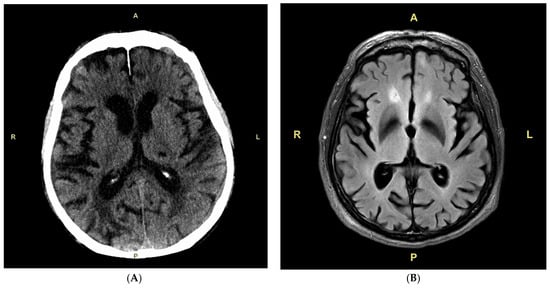
(A) Axial non-contrast CT image of the brain showing cortical and subcortical atrophy with widening of the intracranial cerebrospinal fluid spaces, consistent with cerebral atrophy. (B) Axial T2-weighted FLAIR image of the brain acquired on a 3-T MRI scanner, showing cortical and subcortical atrophy with enlargement of the intracranial cerebrospinal fluid spaces, consistent with cerebral atrophy. Neither panel depicts a subdural hematoma; both illustrate the predisposing anatomical context rather than cSDH itself. Own material. A—anterior; L—left; P—posterior; R—right.
  • Systematic Review
  • Open Access

Background/Objectives: Intermittent claudication (IC) secondary to peripheral artery disease (PAD) causes exertional leg pain and discomfort, which limits functional walking capacity. The clinical efficacy of Ginkgo biloba extract (GBE) as a therapeutic agent for IC is debatable. This systematic review and meta-analysis evaluated the efficacy and safety of GBE compared with a placebo in patients with IC due to PAD. Methods: Databases including PubMed, Embase, the Cochrane Library, and CINAHL were searched until 24 April 2026. Eligible studies included randomized, double-blind, controlled trials (RCTs) comparing placebo. Primary outcome was absolute claudication distance (ACD) at the end of the study. Secondary outcomes were initial claudication distance (ICD), ankle-brachial index (ABI), ankle pressure, and adverse events. Walking outcomes across various treadmill protocols were standardized to estimate caloric expenditure (kcal). A random-effects model was used to pool the effect estimates across trials. Risk of bias was assessed using the Cochrane risk-of-bias tool (RoB 2). Results: A total of 14 RCTs comprising 893 participants represent the total number randomized were included. GBE was associated with a statistically significant but modest improvement in ACD compared with placebo (mean difference [MD], 3.50 kcal; 95% CI, 0.02 to 6.98; p = 0.049). This benefit was significant in trials with a 24-week duration (MD, 4.67 kcal; 95% CI, 2.26 to 7.08; p < 0.001) but not in 12–16 weeks trials (MD, 1.35 kcal; 95% CI, −2.39 to 5.09; p = 0.48). No significant changes were observed for ICD or resting ABI/ankle pressure. GBE was well tolerated, with an overall adverse event incidence comparable to placebo. Conclusions: In patients with IC due to PAD, GBE therapy improves absolute walking performance, with a significant effect observed in trials evaluating 24 weeks of treatment. Given its favorable safety and tolerability profile, GBE can represent a clinically relevant and well-tolerated therapeutic option to support functional walking capacity, particularly for patients unable to tolerate or use conventional pharmacological agents.

J. Clin. Med.

4 November 2026
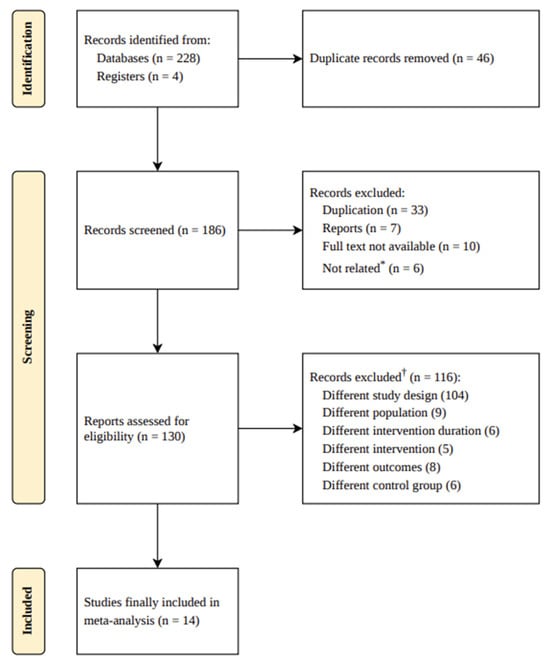
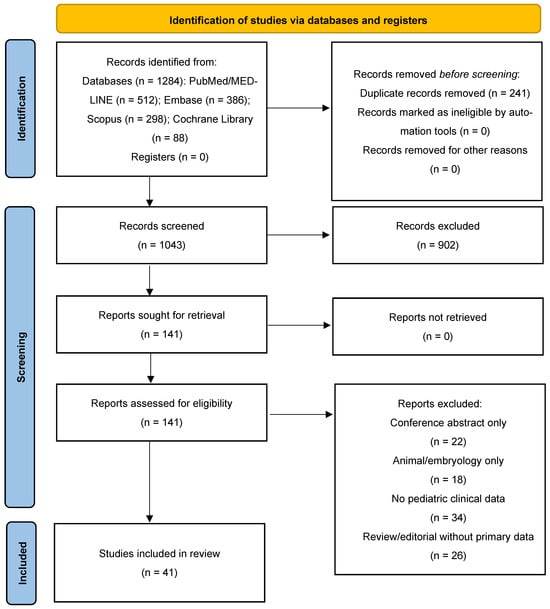
PRISMA diagram. * Studies that did not meet all predefined PICO criteria. † Some reports met more than one exclusion criterion. Reasons are therefore not mutually exclusive, and their sum (n = 138) exceeds the number of excluded reports (n = 116).
  • Systematic Review
  • Open Access

Digitally Guided Tooth Autotransplantation: A Systematic Review of Clinical, Radiographic and Operative Outcomes

  • Abdullah Saleh Almutairi,
  • Osama Mansour Alnoodaly and
  • Shaul Hameed Kolarkodi
  • + 2 authors

Background/Objectives: Digital guidance of tooth autotransplantation, using cone beam computed tomography (CBCT)-based planning with three-dimensionally (3D) printed donor tooth replicas, surgical guides, navigation or robotics, aims to shorten extra-alveolar time and improve positioning. This systematic review synthesised the clinical, radiographic and operative outcomes of digitally guided autotransplantation and compared them with conventional technique. Methods: Following PRISMA 2020 and PROSPERO registration CRD420261434791, MEDLINE (PubMed and Ovid), Embase, Scopus, Web of Science, CENTRAL and ClinicalTrials.gov were searched from inception to August 2026, with Google Scholar and reference-list screening. Clinical studies of at least five digitally guided transplanted teeth or patients were eligible. Two reviewers independently screened, extracted data and assessed risk of bias (RoB 2, ROBINS-I or the JBI case-series checklist); certainty was rated with GRADE. Results: Twenty-five studies reported in 33 publications (2012–2026; one randomised, eight comparative non-randomised, sixteen single-arm; approximately 1300 patients) were included. All used CBCT- or CT-derived 3D-printed replicas, eleven with printed guides; none used navigation or robotics. In guided arms, survival was 92–100% and success 86–100% at 6 months to 5 years. Extra-alveolar time was under one minute in eleven reports, most donor teeth fitted at the first attempt, and positional deviation from the plan was about 1–2 mm. Compared with the conventional technique, guidance shortened surgical time by 13–15 min in two studies (low certainty) and was associated with higher survival and success and less root resorption in retrospective cohorts at serious risk of bias, whereas the registered controlled trial and a prospective paediatric cohort found no significant clinical difference (very low certainty). Conclusions: Digital guidance improves the operative efficiency and positional control of autotransplantation. Clinical superiority over conventional technique remains unproven; randomised trials with standardised outcomes and follow-up beyond two years are needed.

J. Clin. Med.

4 November 2026

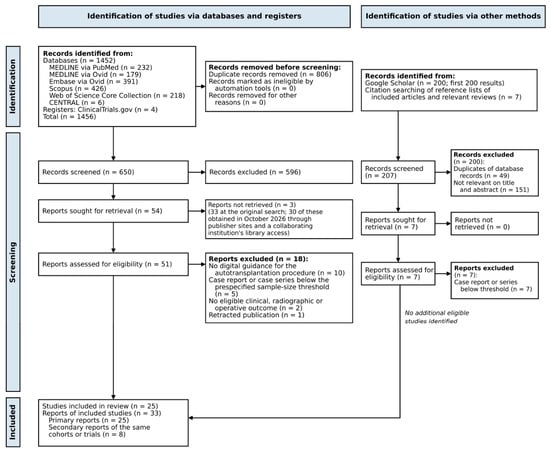
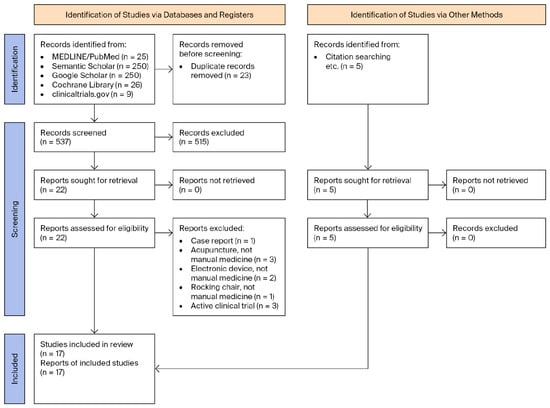
PRISMA 2020 flow diagram of study selection. Databases and registers were searched from inception to August 2026; full texts not obtained at that time were sought again in October 2026 through additional routes (Section 2.5). No automation tool was used at any stage of the selection process.
  • Review
  • Open Access

Central serous chorioretinopathy (CSC) is increasingly understood within the pachychoroid disease spectrum, with choroidal abnormalities playing a central pathogenic role. Nevertheless, the retinal pigment epithelium (RPE) remains critical to outer blood–retinal barrier function and subretinal fluid (SRF) homeostasis, and represents a potentially modifiable therapeutic target. RPE-targeted laser therapies employ biologically distinct approaches, ranging from sublethal RPE modulation with subthreshold micropulse laser and nondamaging retinal laser therapy to selective RPE injury followed by repair with selective retina therapy. We reviewed their laser–tissue interactions, dosimetry, clinical outcomes, and safety in CSC, focusing on how different RPE responses contribute to fluid resolution. Experimental and clinical observations provide a biological basis for considering how sublethal RPE modulation and selective RPE injury followed by repair may contribute to restoration of the RPE barrier and fluid homeostasis through distinct biological responses. Nevertheless, the mechanisms linking these RPE responses to SRF resolution remain incompletely understood. RPE-targeted laser therapies represent both potential therapeutic approaches and a means of gaining mechanistic insight into the contribution of RPE dysfunction to CSC. However, despite their distinct biological rationales, the clinical evidence supporting these modalities remains heterogeneous and insufficient to establish their comparative efficacy. Optimal treatment parameters, patient selection, and the long-term efficacy and safety of repeated treatment remain to be established.

J. Clin. Med.

4 November 2026

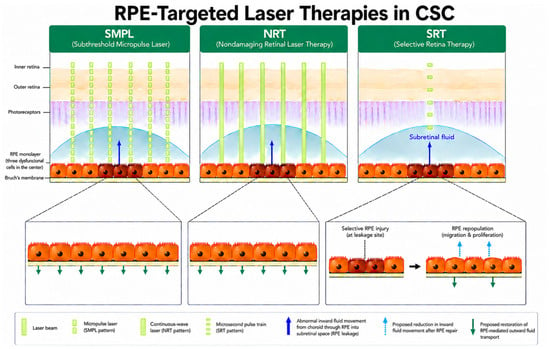
Conceptual illustration of RPE-targeted laser therapies in central serous chorioretinopathy (CSC).

Featured Articles of Last Quarter

Highly Accessed Articles

News & Conferences

Latest Issues

Open for Submission

Journal Sections

XFacebookLinkedIn
J. Clin. Med. - ISSN 2077-0383