



Next Issue
Volume 9, August
Previous Issue
Volume 9, June


Fire, Volume 9, Issue 7 (July 2026) – 48 articles
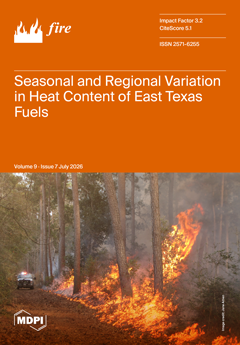
Cover Story (view full-size image): Ash-free net heat content (AF-NHC) is an important fuel property used in fire behavior and fire effects modeling, yet seasonal and regional variation among southeastern U.S. woody fuels remains poorly understood. We quantified AF-NHC of five common woody species across the Pineywoods, Post Oak Savannah, and Blackland Prairie ecoregions of eastern Texas using oxygen bomb calorimetry. AF-NHC ranged from 17.35 to 19.92 MJ kg−1 and differed significantly among species and seasons, with distinct seasonal responses. Regional variation accounted for approximately 41% of model variance, indicating an important environmental influence on fuel thermal properties. Yaupon and eastern red cedar exhibited the highest AF-NHC, greenbrier and Chinese privet were intermediate, and live oak had the lowest values. View this paper
  • Issues are regarded as officially published after their release is announced to the table of contents alert mailing list.
  • You may sign up for e-mail alerts to receive table of contents of newly released issues.
  • PDF is the official format for papers published in both, html and pdf forms. To view the papers in pdf format, click on the "PDF Full-text" link, and use the free Adobe Reader to open them.
Order results
Result details
Section
Select all
Export citation of selected articles as:
27 pages, 6946 KB  
Article
Thermal Runaway Simulation and Fire Risk Assessment of Electric Vehicle Power Battery Packs
by Junwei Shi, Ziyan Zhang and Mengyao Zhang
Fire 2026, 9(7), 313; https://doi.org/10.3390/fire9070313 - 22 Jul 2026
Viewed by 761
Abstract
Thermal runaway in electric vehicle power battery packs is a key risk in fire prevention and control for electric transportation. Its triggering, propagation, and failure modes are jointly affected by external thermal abuse, material insulation performance, and side reactions inside cells. To identify [...] Read more.
Thermal runaway in electric vehicle power battery packs is a key risk in fire prevention and control for electric transportation. Its triggering, propagation, and failure modes are jointly affected by external thermal abuse, material insulation performance, and side reactions inside cells. To identify the temperature response and fire risk of power battery packs under different thermal abuse intensities, this study established a three-dimensional multiphysics thermal runaway simulation model in COMSOL Multiphysics 6.1, coupling solid heat transfer, electrochemical heat generation, and side-reaction heat release. A semi-quantitative risk ranking was then performed using failure mode, effects, and criticality analysis (FMECA). The model considered the low-temperature safe conditions, 120 °C, 140 °C, and 170 °C, as the main ambient temperature conditions, while also analyzing the effects of the heat transfer coefficient on trigger time and peak temperature. The results show that, under the low-temperature safe condition and the 120 °C condition, the battery module mainly exhibits slow heating and does not undergo thermal runaway. Based on the side-reaction characteristics, the temperature near 125 °C can be used as a risk warning threshold for thermal runaway. At 140 °C, the side-reaction heat source increases markedly, and the system enters the thermal runaway risk region. Because the trigger time is strongly affected by the heat transfer coefficient and monitoring position, this condition is interpreted only as a risk-acceleration stage under critical thermal abuse. Approximately 167 °C can be regarded as the critical threshold for irreversible thermal runaway. Under severe thermal abuse at 170 °C, rapid intensification of internal side reactions increases the peak module temperature to 375–385 °C. Temperature field evolution shows that heat is transferred mainly from the exterior to the interior before thermal runaway, forming an outside-high- and inside-low-temperature distribution. After the runaway stage begins, heat release from internal cell side reactions becomes dominant, and the high-temperature region concentrates inside the module, producing a gradient reversal with a higher internal temperature. The FMECA results show that the positive electrode–electrolyte reaction has the highest RPN, with a value of 405. Accelerated SEI decomposition and the negative electrode–electrolyte reaction also form key risk links in the chain heat-release pathway. This study provides a reference for thermal management, fire barrier design, and fire risk classification of power battery packs. Full article
Show Figures

Figure 1

17 pages, 2816 KB  
Article
The Preparation and Performance Study of Organic–Inorganic Nanocomposite Intumescent Fire-Retardant Coatings
by Youhao Xie, Wenjie Wei, Liangyuan Qi, Weiyi Xing and Yuan Hu
Fire 2026, 9(7), 312; https://doi.org/10.3390/fire9070312 - 21 Jul 2026
Viewed by 378
Abstract
The issue of thermal runaway in power batteries of new-energy vehicles occurs frequently, posing a serious threat to life and property safety. This study aims to develop a high-performance fire-proof coating to address this problem. Specifically, the research focused on constructing an organic-inorganic [...] Read more.
The issue of thermal runaway in power batteries of new-energy vehicles occurs frequently, posing a serious threat to life and property safety. This study aims to develop a high-performance fire-proof coating to address this problem. Specifically, the research focused on constructing an organic-inorganic composite intumescent fire-resistant coating, with modified halloysites (Ti-HNTs) serving as the key component. In this coating system, the intumescent flame-retardant (IFR) system and Ti-HNTs were employed as the organic and inorganic components, respectively, while water-based epoxy resin emulsion was selected as the matrix material. Through the utilization of XPS, FTIR, and SEM techniques, it was verified that the Ti-HNTs were successfully modified and integrated well with the coating matrix. Following further optimization of the Ti-HNTs proportion and coating thickness, it was determined that the coating containing 4% Ti-HNTs with a designed thickness of 1.5 mm exhibited the optimal fire-proofing performance. In the fire-resistance experiment, after 10 min of testing, the temperature of this coating could reach a minimum of 215.9 °C. Compared to the control group, its heat-insulation effect was enhanced by 49.4%, with an expansion multiplier of 37.7 and a maximum smoke density of 22.55. These results were significantly superior to those of the control group without the addition of Ti-HNTs. SEM analysis indicated that the coating could form a uniform and dense carbon layer, with an inner surface featuring a honeycomb-bubble structure. This SEM-analyzed Ti-HNTs-modified fire-proof coating demonstrated excellent fire resistance and thermal-isolation effects in new-energy vehicle batteries, thus providing reliable fire protection for the batteries. Additionally, impact-resistance tests revealed that the coating could withstand a simulated battery pressure-relief impact without penetration, maintaining its structural integrity and thermal-barrier function. This further validated its reliability for battery fire protection. Full article
Show Figures

Figure 1

28 pages, 5109 KB  
Article
Comparative Analysis of Wildfire Spread Models Under Differing Environmental Conditions in Central Europe
by Katrin Kuhnen, Mariana S. Andrade, Mortimer M. Müller and Harald Vacik
Fire 2026, 9(7), 311; https://doi.org/10.3390/fire9070311 - 21 Jul 2026
Viewed by 840
Abstract
Wildfires are an increasing threat in Central Europe and pose challenges for protective forests and areas at the wildland–urban interface (WUI). Understanding, describing and predicting fire behaviour is therefore becoming more relevant for fire management. This work aims to reconstruct the fire spread [...] Read more.
Wildfires are an increasing threat in Central Europe and pose challenges for protective forests and areas at the wildland–urban interface (WUI). Understanding, describing and predicting fire behaviour is therefore becoming more relevant for fire management. This work aims to reconstruct the fire spread behaviour of past fire events occurred under differing environmental conditions with selected fire spread models. The three fire spread models Farsite, SimtableTM and Prometheus were selected according to a list of predefined properties they were expected to fulfil. Subsequently, they were tested under different environmental conditions and evaluated against documented perimeter of past fire events. The focus of the analysis was on the spatial perimeter to quantify metrices such as over- and underestimated areas in percent, Sørensen–Dice coefficient and the Jaccard similarity coefficient. Farsite showed the best overall results in both regions. Simtable performed well in steep and complex terrain but produced underestimations in flat terrain. Prometheus lagged, likely due to inadequate parametrization of fuel data, which is a key input parameter in fire spread modelling. As Farsite is readily accessible, it has the greatest potential for further application and more in-depth research. For higher reliability, additional empirical data on fire behaviour are needed to develop custom fuel models or refine current adjustments used to simulate fire spread. Full article
Show Figures

Figure 1

20 pages, 848 KB  
Article
Predicting Wildfire Damage Severity with Composite Indexing and Fire Weather Features: A Case Study in Gangwon Province, South Korea
by Jaeun Choi, Wonseok Yang, Seokju Kim, Ahyeon Jeong, Jiwoo Baek, Nanggyun Ko, Chumni Jeon and Eun Sang Jung
Fire 2026, 9(7), 310; https://doi.org/10.3390/fire9070310 - 20 Jul 2026
Viewed by 699
Abstract
Accurate wildfire prediction increasingly determines whether emergency resources arrive before a disaster becomes uncontrollable, yet the dominant paradigm reduces the problem to binary occurrence, offering no estimate of the severity that drives suppression planning. This study develops a machine-learning framework for four-class wildfire [...] Read more.
Accurate wildfire prediction increasingly determines whether emergency resources arrive before a disaster becomes uncontrollable, yet the dominant paradigm reduces the problem to binary occurrence, offering no estimate of the severity that drives suppression planning. This study develops a machine-learning framework for four-class wildfire severity prediction, conditional on ignition, from weather-station observations and calendar terms alone. We construct a composite severity index (CSI) by applying principal component analysis to five damage dimensions (burned area, suppression equipment, personnel, duration, and property loss) recorded for 868 wildfires in Gangwon Province, South Korea (2011–2022) and pair standard observations with effective humidity and six indices of the Canadian Forest Fire Weather Index (FWI) System. Under a leakage-safe protocol, the strongest tree ensembles reach a macro F1 of 0.46 to 0.50 (recommended configuration: 0.41 ± 0.03 across 20 repeated splits) against a four-class chance level of 0.25, and the recommended Random Forest attains an extreme-class recall of 0.474; the CSI target outperforms burned area by 5.5 macro-F1 points under identical inputs. A weather-only screen separates extreme from non-extreme events with an ROC AUC of 0.758, capturing 47% of extreme events at a 20% alert budget. We also quantify how oversampling misplaced before the train-test split inflates the macro F1 to 0.65–0.83, a cause for caution for the severity-prediction literature. Full article
Show Figures

Figure 1

22 pages, 15345 KB  
Article
Mapping the Fire–Ecosystem–People Nexus in a Southern African Mosaic: Explainable Fire-Regime Typologies and Stewardship Zones for Eswatini, 2001–2025
by Wisdom M. D. Dlamini
Fire 2026, 9(7), 309; https://doi.org/10.3390/fire9070309 - 20 Jul 2026
Viewed by 695
Abstract
Burned-area totals are useful for national monitoring, but they do not reveal how, when or under what social and ecological conditions a landscape burns. We developed an event-based fire-regime and stewardship framework for Eswatini, a topographically compressed southern African country where protected areas, [...] Read more.
Burned-area totals are useful for national monitoring, but they do not reveal how, when or under what social and ecological conditions a landscape burns. We developed an event-based fire-regime and stewardship framework for Eswatini, a topographically compressed southern African country where protected areas, communal rangelands, cropland margins, plantation landscapes and peri-urban interfaces occur in close proximity. Global Fire Atlas event histories for 2001–2025 were organised by fire year and intersected with approximately 10 km2 hexagonal units. The burned-area rate, event frequency, recurrence, seasonality, large-fire dominance, pyrodiversity and trend were used to classify fire-regime types independently of socio-ecological predictors. An XGBoost regression model, evaluated on a 20% held-out test set, was interpreted using exact TreeSHAP diagnostics. Fire activity was strongly seasonal: July–September accounted for 78.2% of the burned area, with August alone accounting for 34.2%. Eight fire-regime types were identified, ranging from low-information and episodic units to frequent small-fire mosaics, large-fire-dominated areas and emerging burned-area intensification regimes. The burned-area-rate model performed well on held-out data (R2 = 0.71; Spearman rho = 0.75). Human modification, goat density, elevation, forest probability, fuelwood dependence and precipitation seasonality ranked among the most influential predictors, but their fitted effects were non-linear and often bidirectional. The combined diagnostics supported six adaptive management zones covering protected-area stewardship, conservation-sensitive management, settlement–livelihood interfaces, late-season risk reduction, monitoring and integrated landscape management. Although the Eswatini results are context-specific, the workflow offers a transferable way to connect fire histories, socio-ecological contexts and place-based stewardship in African mosaic landscapes. Full article
(This article belongs to the Special Issue Creating a Platform to Understand Fire Management in Africa)
Show Figures

Graphical abstract

17 pages, 3853 KB  
Article
Sensor Layout Optimization and Natural Gas Leakage Source Term Estimation Based on Non-Dominated Sorting Genetic Algorithm
by Jinrui Deng, Jianfeng Li, Yang Cao, Bingcai Sun, Yinghua Jing and Shengli Chu
Fire 2026, 9(7), 308; https://doi.org/10.3390/fire9070308 - 20 Jul 2026
Viewed by 485
Abstract
For gas leakage monitoring in obstacle environments such as oil and gas stations, the layout of fixed sensors directly affects the validity of monitoring data and the accuracy of subsequent leakage source localization. To achieve effective coverage of high-risk areas with a limited [...] Read more.
For gas leakage monitoring in obstacle environments such as oil and gas stations, the layout of fixed sensors directly affects the validity of monitoring data and the accuracy of subsequent leakage source localization. To achieve effective coverage of high-risk areas with a limited number of sensors and reduce deployment costs, this paper proposes a multi-objective optimization method for sensor layout based on the non-dominated sorting genetic algorithm-II (NSGA-II). Based on multi-scenario computational fluid dynamics simulation data, the peak concentration, hazardous concentration duration, and leakage probability at each monitoring point are extracted as risk characteristic indicators. The NSGA-II analytic hierarchy process is employed to determine the weight of each indicator, and a comprehensive risk classification model for the monitored area is established. This is adopted for solution seeking. Through non-dominated sorting and crowding distance calculation, the Pareto optimal front is searched in the solution space. The optimized layout scheme is applied to the leakage source term estimation based on particle filter, and the performance of different layout schemes is compared and analyzed with the source localization error as the evaluation index. Case studies show that the sensor layout optimized by the non-dominated sorting genetic algorithm achieves effective coverage of high-risk areas. With the same number of sensors, its high-risk area coverage rate outperforms that of the multi-objective particle swarm optimization algorithm (MPSOA). Following the application of the optimized layout, the localization accuracy of leakage source term estimation is significantly improved. Compared with the traditional grid and circular layouts, the source localization error is reduced by approximately 44%. Compared with the layouts optimized by the MPSOA and genetic algorithm (GA), the error is decreased by 30.4% and 33.3%, respectively. The proposed sensor layout optimization method based on the NSGA-II can effectively balance monitoring coverage and economic cost, and significantly improve the localization accuracy of gas leakage sources. This study provides a theoretical basis and technical support for the optimal deployment of fixed gas sensor networks in complex scenarios. Full article
(This article belongs to the Special Issue Fire and Explosion Safety with Risk Assessment and Early Warning)
Show Figures

Figure 1

30 pages, 15230 KB  
Article
Spatio-Temporal Assessment of a Live Fuel Moisture Content Monitoring Model from an Operational Perspective
by María Alicia Arcos, Ángel Balaguer-Beser, Luis Á. Ruiz and José L. Soriano-Sancho
Fire 2026, 9(7), 307; https://doi.org/10.3390/fire9070307 - 19 Jul 2026
Viewed by 678
Abstract
Live fuel moisture content (LFMC) is a key determinant of fuel flammability and forest fire danger; however, its operational monitoring remains challenging due to the limited spatial and temporal coverage of field measurements. This study aims to assess the operational suitability of a [...] Read more.
Live fuel moisture content (LFMC) is a key determinant of fuel flammability and forest fire danger; however, its operational monitoring remains challenging due to the limited spatial and temporal coverage of field measurements. This study aims to assess the operational suitability of a Random Forest-based methodology for LFMC estimation by extending a previously validated local-scale approach to a regional and multi-year context. Weighted average LFMC was modeled across 67 shrubland plots in the Valencian Region (eastern Spain) from 2017 to 2025 using Sentinel-2 spectral indices and aggregated meteorological variables consistent with prior research. Model performance was evaluated under spatially independent and combined spatio-temporal training–testing scenarios designed to approximate real-world wildfire monitoring conditions. Results show that the model exhibits good spatial transferability when applied to shrubland plots not used during training within the same temporal domain, while temporal extrapolation is more limited and dependent on the stability of climatic conditions represented in the training data, with a marked decline in performance under changing temperature and precipitation regimes. These findings highlight key drivers of LFMC prediction, identify validation strategies under operational constraints, and contribute to the development of scalable monitoring approaches for wildfire danger assessment and fuel management in Mediterranean shrublands. Full article
Show Figures

Figure 1

12 pages, 2484 KB  
Article
Physiological Recovery Following Repeated Firefighting Work in Recruit Firefighters
by A. Maleah Winkler, Andrew R. Moore and William R. Kinnaird
Fire 2026, 9(7), 306; https://doi.org/10.3390/fire9070306 - 18 Jul 2026
Viewed by 795
Abstract
Firefighters often perform multiple consecutive bouts of high-intensity work in hot environments, which can lead to physiological fatigue and increased health risks. This study examined changes in core temperature, skin temperature, and heart rate during recovery periods following repeated bouts of work in [...] Read more.
Firefighters often perform multiple consecutive bouts of high-intensity work in hot environments, which can lead to physiological fatigue and increased health risks. This study examined changes in core temperature, skin temperature, and heart rate during recovery periods following repeated bouts of work in recruit firefighters (n = 10) across a full day of outdoor training. Participants completed four work–rest cycles consisting of firefighting drills performed in full personal protective equipment (PPE), followed by passive recovery after PPE removal. Physiological measurements were recorded one minute prior to recovery and then at 5, 10, and 20 min throughout recovery. Skin temperature and heart rate decreased significantly (p < 0.05) within 5–10 min of recovery in most rounds. However, core temperature required at least 20 min to significantly decline (p < 0.05). These findings suggest that shorter recovery periods may be sufficient for heart rate and skin temperature to return to baseline, whereas longer recovery periods are needed for heat to dissipate from the core, especially as work intensity increases. Thus, standard rehabilitation protocols may be insufficient under more extreme working conditions and should be adjusted accordingly to ensure firefighter safety. Full article
(This article belongs to the Section Fire Social Science)
Show Figures

Figure 1

24 pages, 32241 KB  
Article
A Real-Time Decision Support Framework for Helicopter Dispatch During Multiple Simultaneous Forest Fires in the Republic of Korea
by Duckha Jeon, Woodam Chung, Geonho Kim, Byung-Doo Lee, Chun Geun Kwon, Hee-Young Ahn, Ye-Eun Lee and Hee Han
Fire 2026, 9(7), 305; https://doi.org/10.3390/fire9070305 - 16 Jul 2026
Viewed by 956
Abstract
The Republic of Korea experiences over 500 forest fires annually, consuming more than 4000 ha. Helicopters are the primary resource for initial attack, but effectively dispatching these limited resources during multiple simultaneous fires poses a significant challenge, as these incidents compete for the [...] Read more.
The Republic of Korea experiences over 500 forest fires annually, consuming more than 4000 ha. Helicopters are the primary resource for initial attack, but effectively dispatching these limited resources during multiple simultaneous fires poses a significant challenge, as these incidents compete for the same pool of helicopter resources. To support real-time, operational-level helicopter dispatch decisions, an interactive decision support framework was developed that integrates information gathering, fire prioritization, and dispatch optimization. This framework employs an integer linear programming (ILP) approach to minimize the weighted sum of suppression costs and resulting burn perimeters, while allowing for uncontained fires when fire spread rates exceed the cumulative suppression capacity of available helicopters. The framework was applied to two test cases: (1) five hypothetical simultaneous fire incidents, and (2) four actual simultaneous fire incidents recorded on 22 March 2025, with the resulting solutions compared against manual dispatch decisions made by the Korea Forest Service (KFS). The results demonstrate the framework’s capability to analyze diverse fire suppression scenarios and generate a range of effective dispatch options. By integrating real-time fire behavior simulation and optimization, incorporating fire damage potential, and replicating the Republic of Korea’s unique suppression practices, this framework aims to enhance real-time helicopter dispatch decision-making, contributing to the KFS’s ongoing efforts to integrate scientific knowledge into forest fire suppression and management. Full article
Show Figures

Figure 1

13 pages, 20674 KB  
Article
Mechanism Analysis of Monnex Fire Extinguishing Performance and Particular Burning Fragmentation Phenomenon
by Sai Yao, Zilong Liang, Zixuan Zhang, Suqin Chen, Lijing Wang, Mingchao Wang and Haijun Zhang
Fire 2026, 9(7), 304; https://doi.org/10.3390/fire9070304 - 16 Jul 2026
Viewed by 557
Abstract
Monnex has become the most efficient dry powder extinguishing agent due to its unique fire extinguishing mechanism—the “burning fragmentation” phenomenon. To study the fire extinguishing mechanism of Monnex in detail and elucidate the process of its “burning fragmentation” phenomenon, we have examined the [...] Read more.
Monnex has become the most efficient dry powder extinguishing agent due to its unique fire extinguishing mechanism—the “burning fragmentation” phenomenon. To study the fire extinguishing mechanism of Monnex in detail and elucidate the process of its “burning fragmentation” phenomenon, we have examined the microstructure changes and compositions of Monnex powder during its thermal decomposition process. The results indicate that Monnex undergoes complex iterative reactions and produces explosive intermediates (NH4NO3, KCN, and KN3) when entering the fire. Upon reaching the temperature of 240 °C, the explosive substance is completely pyrolyzed and undergoes a mini- burning fragmentation, resulting in the decomposition of Monnex powder into particles and the release of a large amount of inert gases and free radicals. This is the reason why Monnex has become an optimal dry powder. Toxic substances KCN and KOCN were found during the whole pyrolysis process, so personal protection should be paid attention to in practical applications. Our research not only improves the understanding of the Monnex fire extinguisher, but also provides important scientific evidence for the development of fire extinguishing technologies and environmentally friendly fire protection materials. Full article
Show Figures

Graphical abstract

24 pages, 4007 KB  
Article
SemaFire-YOLO: A Lightweight and Robust Fire-Smoke Detection Model via Semantic Enhancement and Frequency-Aware Perception
by Jiaxu Pei, Ruihuan Zhang, Hualong Yan, Yulu Hao, Yu Huang and Jin Xiao
Fire 2026, 9(7), 303; https://doi.org/10.3390/fire9070303 - 16 Jul 2026
Viewed by 707
Abstract
Accurate detection in the early stages of a fire is a crucial prerequisite for the efficient implementation of fire suppression and emergency rescue operations. Its accuracy and timeliness directly affect the control of disaster loss severity. Traditional fire detection methods mainly include three [...] Read more.
Accurate detection in the early stages of a fire is a crucial prerequisite for the efficient implementation of fire suppression and emergency rescue operations. Its accuracy and timeliness directly affect the control of disaster loss severity. Traditional fire detection methods mainly include three categories, which are manual inspection, sensor detection, and visual recognition. However, manual inspection is restricted by labor costs and time efficiency, making it difficult to achieve large-scale, high-frequency and real-time fire monitoring. Sensor detection is easily interfered by environmental factors such as temperature, humidity, and dust, leading to frequent false alarms and missed alarms. Visual recognition technology has shortcomings in aspects such as detailed feature perception, dynamic scene modeling, and reasoning robustness in complex environments, making it difficult to meet the requirements of high-precision detection. To address these issues, this study innovatively proposes a lightweight fire and smoke detection model based on semantic enhancement and frequency domain perception modeling, which is named the SemaFire you only look once (SemaFire-YOLO) model. The model constructs a large language and vision assistant (LLaVA) semantic guidance module, which uses a large language model to understand and guide the semantic features of images, thereby enhancing the saliency representation intensity of small and weak target regions. Then, a Haar wavelet-based downsampling module is adopted, which compresses spatial information while preserving high-frequency features such as flame edges and smoke textures, improving the accuracy of target recognition. Next, the convolution modulation mechanism is introduced to replace the traditional attention mechanism, enhancing the overall modeling efficiency and reducing computational overhead. Finally, a Dynamic Tanh normalization module is adopted to replace the batch normalization module in the traditional YOLO algorithm, strengthening the model’s representation stability and reasoning robustness under unstable input distributions. Experimental results show that the SemaFire-YOLO model achieves a mean average precision (mAP@0.5) of 64.30% on the fire image dataset, which is 0.8, 2.0, 0.6, and 3.8 percentage points higher than that of mainstream models such as YOLOv5n, YOLOv8n, YOLOv11n, and YOLOv12n, respectively. It exhibits better boundary detection capability and practical deployment potential. Through visual analysis, the results indicate that the improved SemaFire-YOLO model achieves more accurate detection and higher confidence in actual complex scenarios, further verifying the model’s robustness and accuracy in complex scenarios such as low contrast and dynamic fire conditions. Full article
(This article belongs to the Special Issue Fire and Explosion Safety with Risk Assessment and Early Warning)
Show Figures

Figure 1

28 pages, 1549 KB  
Article
Simple Spread Models for Understory Surface Fires
by Daniel D. B. Perrakis, Nicholas J. R. Hebda and S. W. Taylor
Fire 2026, 9(7), 302; https://doi.org/10.3390/fire9070302 - 15 Jul 2026
Viewed by 824
Abstract
Surface fire frequently occurs beneath the canopy of North American forests under moderate wind speed and moisture-deficit conditions. Surface rate of spread (sROS) models can provide guidance for suppression operations and can be incorporated into fire growth modelling systems and other tools. We [...] Read more.
Surface fire frequently occurs beneath the canopy of North American forests under moderate wind speed and moisture-deficit conditions. Surface rate of spread (sROS) models can provide guidance for suppression operations and can be incorporated into fire growth modelling systems and other tools. We used a database of primarily Canadian experimental surface fires in conifer and deciduous stands from multiple sites to fit empirical sROS models for operational use and compare with pre-existing models. Various predictor combinations represented fires in boreal conifer (BOCON), deciduous, and Ponderosa pine-dominated stands, the latter analyzed to estimate grass-curing influence. The main predictors were wind speed (WS10), estimated fuel moisture, and Canadian Fire Weather Index (FWI) System components (original and stand-adjusted). The ensuing fitted models (N = 51–93) were evaluated using standard metrics and tested using an independent conifer dataset (N = 26). The simplest model finds BOCON sROS to be equal to 1.2% of the WS10, 1/7th the speed of crown fire spread under similar conditions; it is easily calculated as 20% of WS10 using a common unit conversion (WS10 in km h−1, sROS in m min−1). The best-performing sROS models displayed nonlinear-sigmoidal responses to wind and litter moisture variables, including the Initial Spread Index (ISI), and improved upon pre-existing models. Estimated accuracy was mostly +/− 2–4 m min−1 within the range of the data in both training and validation datasets. These models reflect a dataset gathered from multiple sites using varying experimental methods. While imprecise, they are suitable for many applications, including operational forecasting and designing hazard reduction treatments. Full article
(This article belongs to the Section Fire Science Models, Remote Sensing, and Data)
Show Figures

Figure 1

15 pages, 581 KB  
Article
Footwear-Dependent Effects of Fatigue on Ankle Proprioception and Perceived Exertion: A Comparison of Firefighter Boots and Sports Shoes
by Se Yeon Jung and Su-Young Son
Fire 2026, 9(7), 301; https://doi.org/10.3390/fire9070301 - 15 Jul 2026
Viewed by 748
Abstract
This study investigated how fatigue induced in firefighter boots (FBs) versus sport shoes (SSs) affects ankle joint position sense (JPS), range of motion (ROM), and subjective responses. Twelve healthy males participated in a mixed-design study, performing a calf-raise fatigue protocol in either FB [...] Read more.
This study investigated how fatigue induced in firefighter boots (FBs) versus sport shoes (SSs) affects ankle joint position sense (JPS), range of motion (ROM), and subjective responses. Twelve healthy males participated in a mixed-design study, performing a calf-raise fatigue protocol in either FB or SS randomly. Ankle JPS, ROM, subjective ankle movement scores (SAMSs), and ratings of perceived exertion (RPEs) were assessed barefoot pre- and post-fatigue. A significant fatigue × footwear × ankle position interaction was observed for JPS constant error (CE) (p = 0.017, ηp2 = 0.183). Follow-up analyses revealed a significant fatigue × ankle position interaction for CE in the SS condition (p = 0.032, ηp2 = 0.299), whereas no significant fatigue-related effects were found in the FB condition. No significant footwear × fatigue × movement direction interaction was observed for ankle ROM (p = 0.561, ηp2 = 0.065), and fatigue-related ROM changes did not differ between footwear conditions. Subjective outcomes differed between footwear conditions after fatigue, with higher SAMS scores in the SS condition (p = 0.016, d = 1.67) and higher RPE scores in the FB condition (p = 0.020, d = 1.66). These findings indicate a dissociation between objective and subjective responses to fatigue, with objective changes limited to a CE interaction pattern in JPS, whereas subjective responses were clearly differentiated by footwear condition. Full article
Show Figures

Figure 1

19 pages, 16289 KB  
Article
Dispersion and Explosion Characteristics of Hydrogen Released from a Hydrogen Fuel Cell Vehicle
by Zhixin Wu, Dianji Wang, Xuefang Li, Huan Liu, Shishuai Nie, Peirong Chen and Wenfeng Zhan
Fire 2026, 9(7), 300; https://doi.org/10.3390/fire9070300 - 15 Jul 2026
Viewed by 899
Abstract
Safety concerns regarding hydrogen dispersion, fire, and explosion hinder the commercialization of hydrogen fuel cell vehicles (HFCVs). This study developed and validated a numerical model for hydrogen leakage, dispersion, and explosion in representative accident scenarios using real-vehicle experimental data from a manufacturer-provided HFCV. [...] Read more.
Safety concerns regarding hydrogen dispersion, fire, and explosion hinder the commercialization of hydrogen fuel cell vehicles (HFCVs). This study developed and validated a numerical model for hydrogen leakage, dispersion, and explosion in representative accident scenarios using real-vehicle experimental data from a manufacturer-provided HFCV. The analysis examined the effects of leakage orifice diameter, leakage orientation, vehicle motion, and ignition timing on hazard evolution. Large-orifice leakage accelerates flammable cloud formation and expands the hazard range, whereas small-orifice leakage prolongs cloud persistence. Vehicle motion enhances turbulent mixing and reduces near-field accumulation. Immediate ignition produces a jet flame with a maximum radiative heat-flux impact distance of 44.1 m, whereas delayed ignition increases explosion severity and generates a peak overpressure of 0.14 bar. These findings support the risk assessment and safety design of HFCVs. Full article
(This article belongs to the Special Issue Assessment and Mitigation of Hydrogen-Fuelled Fire Hazards)
Show Figures

Figure 1

21 pages, 7054 KB  
Article
Effect of Ceramic Thermal Barrier Coatings on a Diesel Engine Fueled with Jatropha Biodiesel Ternary Emulsion Blends
by Nagesh Babu Vemula, Farooq Shaik, Gopinath Dhamodaran and Radha Krishna Gopidesi
Fire 2026, 9(7), 299; https://doi.org/10.3390/fire9070299 - 14 Jul 2026
Viewed by 669
Abstract
This work examines the performance, combustion, and emission characteristics of a diesel engine coated with a ceramic thermal barrier coating and fueled with emulsified Jatropha biodiesel blended with water and butanol. A low heat rejection (LHR) engine was prepared by depositing a 100 [...] Read more.
This work examines the performance, combustion, and emission characteristics of a diesel engine coated with a ceramic thermal barrier coating and fueled with emulsified Jatropha biodiesel blended with water and butanol. A low heat rejection (LHR) engine was prepared by depositing a 100 µm NiCrAlY bond coat and a 200 µm of 8YSZ ceramic top coat via air plasma spraying. B20W10Bu5, B20W10Bu10, and B20W10Bu15 ternary emulsions were successfully produced using ultrasonic homogenization. The experimental outcomes indicate that the ceramic-coated engine exhibited higher thermal efficiency than that of the conventional engine. The highest performance was achieved with B20W10Bu10 fuel, which resulted in a 7.4% increase in the brake thermal efficiency and a 7.8% decrease in the brake-specific fuel consumption relative to the results for the conventional coated diesel engine. Hydrocarbons, carbon monoxide, and smoke emissions decreased considerably due to the combined impacts of oxygenated fuel composition, micro-explosions, and thermal insulation capability. It can be seen from the discussion above that the utilization of a ceramic thermal barrier coating and the Jatropha-based ternary emulsion fuel, especially B20W10Bu10, shows great promise for enhancing engine performance while lowering exhaust emissions. Full article
Show Figures

Figure 1

18 pages, 1698 KB  
Brief Report
Impacts of Invasive Vegetation on Fire and Burn-Severity Patterns in Otay Valley Regional Park, San Diego
by Anahi Méndez Lozano, Brittany Barreto Martinez, Dalston J. Karto and Alicia M. Kinoshita
Fire 2026, 9(7), 298; https://doi.org/10.3390/fire9070298 - 14 Jul 2026
Viewed by 659
Abstract
Riparian zones provide vital ecosystem services, including water purification, soil aeration, and recreation. Anthropogenic activities and invasive plant species threaten native vegetation and alter fire patterns. This study investigates the impact of invasive vegetation cover (IVC) on riparian fire patterns in Otay Valley [...] Read more.
Riparian zones provide vital ecosystem services, including water purification, soil aeration, and recreation. Anthropogenic activities and invasive plant species threaten native vegetation and alter fire patterns. This study investigates the impact of invasive vegetation cover (IVC) on riparian fire patterns in Otay Valley Regional Park, San Diego, California, using Sentinel-2 imagery to analyze 13 fires that occurred in 2019. The impact of IVC on fire patterns was assessed using high-resolution Normalized Difference Vegetation Index (NDVI) and Differenced Normalized Burn Ratio (dNBR) from 2019 to 2023. We found nuanced fire dynamics relationship driven by species-specific traits. Results showed that post-fire NDVI was consistently highest in areas with <25% IVC, suggesting more stable vegetation recovery in native areas. In contrast, areas with >75% IVC had high NDVI variability and greater canopy loss, particularly where species such as Melilotus albus and mixed annual forbs dominated. IVC was evaluated descriptively rather than as an inferential predictor due to the small number of fire counts. Descriptive patterns indicate that post-fire vegetation response varied by dominant invasive species, with resilient taxa such as Arundo donax, Tamarix ramosissima, and Eucalyptus spp. showing evidence of rapid or sustained recovery. These findings highlight the complexity of fire dynamics in invaded riparian systems and the importance of species-specific monitoring. We recommend integrating remote sensing with targeted invasive vegetation species management to improve fire resilience and ecological integrity in urban riparian corridors. Full article
(This article belongs to the Section Fire Science Models, Remote Sensing, and Data)
Show Figures

Figure 1

35 pages, 10906 KB  
Article
Effects of Natural Gas Substitution Rate and Diesel Injection Strategies on Performance and NOx Emissions of Diesel–Natural Gas Dual-Fuel Engines
by Chuanfu Kou, Xigan Chen, Shiqi Zeng, Jiaqiang E and Yinjie Ma
Fire 2026, 9(7), 297; https://doi.org/10.3390/fire9070297 - 13 Jul 2026
Cited by 2 | Viewed by 669
Abstract
Background: As global environmental issues and the energy crisis continue to intensify, diesel–natural gas dual-fuel engines have been extensively studied due to their stable combustion, low emissions, abundant natural gas reserves, and relatively low cost. Methods: Based on a modified YCK15 [...] Read more.
Background: As global environmental issues and the energy crisis continue to intensify, diesel–natural gas dual-fuel engines have been extensively studied due to their stable combustion, low emissions, abundant natural gas reserves, and relatively low cost. Methods: Based on a modified YCK15 six-cylinder heavy-duty diesel engine, the experiments and GT-SUITE v2016 simulation were used to study the effects of NG substitution rate (NGSR) and diesel injection timing (DIT) on the combustion characteristics, power and emission performance of a diesel–NG dual-fuel engine running at 1800 rpm, with NGSR ranging from 0 to 50% and DIT ranging from 5 °CA BTDC to 17 °CA BTDC under four engine load conditions: 100%, 75%, 50% and 25%. Significant Findings: The results showed that the NGSR and DIT have considerable impact on performance enhancement and emission reduction. As NGSR increased, cylinder pressure decreased under high load and increased under low load. Under four loads, the temperature inside the cylinder revealed a downward trend, and the power and indicated thermal efficiency (ITE) decreased slightly, with power and ITE declining by less than 5% and 2%, but the fuel economy and emissions were well improved. Compared to 50% NGSR and pure diesel condition, brake-specific fuel consumption (BSFC) decreased by 5.63%, 4.60%, 2.98%, and 1.83%, respectively, and NOx emissions decreased by 32.68%, 36.41%, 37.90%, and 38.99%, respectively. As DIT increased, cylinder pressure and temperature both increased under all four load conditions, and the power and ITE improved significantly, but this caused an increase in NOx emissions. Compared to DIT of 17 °CA BTDC with 5 °CA BTDC, power increased by 8.29%, 9.76%, 13.38%, and 16.51%, respectively, and ITE increased by 7.69%, 8.77%, 11.46%, and 12.77%, respectively. The response surface was established and performance optimized using the design of experiments (DOE) module in GT-SUITE v2016. At an NGSR of 50% and 100% loads, the optimized power was 0.431% higher than the pure diesel mode, ITE was 0.396% higher, brake-specific fuel consumption was reduced by 7.397%, and NOx emissions were reduced by 27.027%. Full article
Show Figures

Figure 1

22 pages, 3712 KB  
Article
Cross-Passage Blockage Probability in Railway Tunnels: A Geometric-Probabilistic Contribution to Collective Risk Assessment
by Jan Hora, Petr Kučera, Adéla Snohová, Martin Trčka and Tereza Česelská
Fire 2026, 9(7), 296; https://doi.org/10.3390/fire9070296 - 13 Jul 2026
Viewed by 603
Abstract
This study examines whether a train fire near an evacuation interface in a railway tunnel can create an adverse configuration relevant to evacuation design and collective risk assessment. It focuses on twin single-track tunnels, in which the parallel tunnel serves as a safe [...] Read more.
This study examines whether a train fire near an evacuation interface in a railway tunnel can create an adverse configuration relevant to evacuation design and collective risk assessment. It focuses on twin single-track tunnels, in which the parallel tunnel serves as a safe area, and evacuation is carried out through cross-passages and boundary portals. If a fire impairs such an interface, evacuees may be forced to continue to a more distant exit. The problem is formulated as a geometric-probabilistic screening task. The model calculates the probability that, after the train has stopped, the fire lies within a tolerance zone around an evacuation interface. The probability is derived analytically using deterministic convolution and verified via Monte Carlo simulation for trains with lengths of 200 m and 400 m. This verification concerns mathematical calculation only, not the physical, smoke, operational, or evacuation assumptions. The geometric probability is linked to collective risk through representative train fire frequencies, external consequence indicators, and selected F/N criteria. With ε = 37 m and portals included as boundary evacuation interfaces of the finite tunnel domain, the adverse-configuration probabilities are similar: approximately 14.0% for the 200 m train and 14.6% for the 400 m train. The difference becomes decisive only after considering the magnitude of the consequences and the traffic intensity. Under the reference assumptions, the 400 m high-occupancy case reaches the selected Dutch criterion at about four train passages per day. A fire near an evacuation interface, therefore, cannot be treated as marginal solely because the tunnel meets the 500 m cross-passage spacing requirement. Acceptability depends on geometry, occupancy, fire frequency, the definition of consequences, traffic intensity, and the selected risk framework. The homogeneous fire-origin distribution is used only as a neutral first-order assumption; more refined spatial fire-origin models and broader comparisons across safety criteria are needed. Full article
Show Figures

Figure 1

18 pages, 1628 KB  
Article
Comparative Assessment of Fire Effluent Toxicity of Flame-Retardant Coatings and Films
by Yoo Youl Choi, Kyu Nam Jeon, A Young Choi, Ha Young Kwon and Chang Hoon Song
Fire 2026, 9(7), 295; https://doi.org/10.3390/fire9070295 - 13 Jul 2026
Viewed by 648
Abstract
Flame-retardant coatings and films are widely used to delay flame spread on interior finishing and wood-based materials; however, their fire effluent toxicity has not been sufficiently characterized, and direct comparisons between these product types remain scarce. This study evaluated three commercial flame-retardant coatings [...] Read more.
Flame-retardant coatings and films are widely used to delay flame spread on interior finishing and wood-based materials; however, their fire effluent toxicity has not been sufficiently characterized, and direct comparisons between these product types remain scarce. This study evaluated three commercial flame-retardant coatings and three flame-retardant films using the KS F 2271 gas toxicity test, NES 713 toxicity index test, and Py-GC/MS and HS-GC/MS analyses. Representative coating and film products were also applied to medium-density fiberboard (MDF) to assess average incapacitation time, total smoke release (TSR), and total heat release (THR). All tested specimens, including the 1 coat/layer, increased-loading, and MDF-applied conditions, satisfied the Korean gas toxicity criterion of 9 min. However, increased loading affected the two product groups differently; the intumescent coating showed a marked reduction in average incapacitation time, whereas the films remained relatively stable. The coatings produced higher toxicity indices and more diverse detected gases and pyrolysis products than the films. In MDF-based specimens, flame-retardant treatment increased average incapacitation time and reduced TSR and THR. These findings show that fire effluent toxicity differs between coatings and films and should be considered together with flame-retardant performance. Full article
(This article belongs to the Special Issue Advances in Fire Science and Fire Protection Engineering)
Show Figures

Figure 1

10 pages, 402 KB  
Review
Firefighter Fatalities and Injuries: A Review of Contributing Factors and Future Directions for Risk Mitigation
by Kelsey Glover, Rohit Mittal and Steven A. Kahn
Fire 2026, 9(7), 294; https://doi.org/10.3390/fire9070294 - 13 Jul 2026
Viewed by 822
Abstract
Firefighting is a high-risk occupation involving intense physical exertion and hazardous environments. Occupational exposures, including combustion byproducts, contribute to long-term cancer risk and acute burn injuries. While line-of-duty fatalities have declined, substantial morbidity remains, particularly among female and wildland firefighters who have historically [...] Read more.
Firefighting is a high-risk occupation involving intense physical exertion and hazardous environments. Occupational exposures, including combustion byproducts, contribute to long-term cancer risk and acute burn injuries. While line-of-duty fatalities have declined, substantial morbidity remains, particularly among female and wildland firefighters who have historically been underrepresented in research. A narrative review was conducted using PubMed, Scopus, and Google Scholar to identify relevant studies published after 2010. Search terms included firefighter, fatality, injury, cardiovascular disease, occupational exposure, cancer, wildland, and female. Articles were synthesized using the NIOSH Hierarchy of Controls framework. Cardiovascular events and overexertion remain leading contributors to line-of-duty deaths, while non-fatal injuries are commonly musculoskeletal. Occupational exposures, related to dermal absorption of toxins and improper use of protective equipment, contribute to burn injuries and may increase long-term cancer risk. Wildland firefighters face risks in the expanding wildland-urban interface, such as prolonged smoke exposure and extended exertion, which may elevate cardiopulmonary and cancer risks. Female firefighters face challenges related to ergonomic mismatch with protective equipment primarily designed for male body dimensions. Firefighters face health risks from a variety of environmental and operational factors. Risk mitigation must transition from a reliance on PPE to higher-level engineering and administrative controls. Future research should prioritize longitudinal health tracking and standardized equipment for diverse fire service populations. Full article
Show Figures

Figure 1

28 pages, 13699 KB  
Article
Path Choice Behavior at Potential Evacuation Bottlenecks in the Deep Underground Space: An Experimental Study
by Yilang Zhou, Chao Li, Ruihang Yang, Tiejun Zhou, Jiayi Chen and Haobin Li
Fire 2026, 9(7), 293; https://doi.org/10.3390/fire9070293 - 12 Jul 2026
Viewed by 536
Abstract
Due to enclosed space, long evacuation distances, and complex path structures, key nodes in deep underground spaces are prone to forming bottlenecks during fire evacuation. To collect evacuation behavior data at potential bottlenecks, an interactive video-based hypothetical choice (HC) experiment was conducted with [...] Read more.
Due to enclosed space, long evacuation distances, and complex path structures, key nodes in deep underground spaces are prone to forming bottlenecks during fire evacuation. To collect evacuation behavior data at potential bottlenecks, an interactive video-based hypothetical choice (HC) experiment was conducted with 104 valid samples. Exit distance, sub-safe zone setting, congestion, pedestrian flow guidance, and smoke were systematically examined. The results showed that: (a) exit distance, sub-safe zone setting, congestion at the nearest exit, and smoke significantly affected evacuation decisions, with clear avoidance of near-exit congestion and smoke; (b) congestion on paths to non-nearest exits had a relatively weak effect, and pedestrian flow guidance did not produce significant herding; and (c) gender, age, professional background, and evacuation experience influenced path choice differences under certain conditions. Notably, evacuees prioritized smoke avoidance over all other cues, while congestion triggered non-compensatory route switching rather than herding behavior. These findings enrich the empirical database on pedestrian evacuation dynamics in deep underground spaces and provide a quantitative basis for evacuation simulation, spatial optimization, and safety management. Full article
(This article belongs to the Special Issue Evacuation Design and Smoke Control in Fire Safety Management)
Show Figures

Figure 1

24 pages, 1889 KB  
Article
Assessing Factors Driving Lightning-Induced Fire Ignition in the Region of East Macedonia and Thrace, Greece
by Ioannis Mitsopoulos, Irene Chrysafis, Konstantinos Lagouvardos and Giorgos Mallinis
Fire 2026, 9(7), 292; https://doi.org/10.3390/fire9070292 - 10 Jul 2026
Viewed by 849
Abstract
The spatial relationships between lightning-induced fire ignition and topography, vegetation, climate, and weather were analyzed in the region of East Macedonia and Thrace, northeastern Greece. The study was based on reported lightning-induced ignitions during the 2009 fire period. Lightning data for the same [...] Read more.
The spatial relationships between lightning-induced fire ignition and topography, vegetation, climate, and weather were analyzed in the region of East Macedonia and Thrace, northeastern Greece. The study was based on reported lightning-induced ignitions during the 2009 fire period. Lightning data for the same period was provided by the ZEUS lightning detection network operated by the National Observatory of Athens, while fire statistics were obtained from the official records of the Greek Fire Service. A total of 198 lightning strike events (66 fire ignitions and 132 non-fire events) were used for model development. Statistical models based on Logistic Regression (LR) and random forests (RF) were developed to estimate the probability of lightning-induced fire using topography, climate, weather, and vegetation indices as predictor variables. According to the analysis results, the probability of an area being affected by lightning-induced fire is primarily determined by the Normalized Difference Vegetation Index (NDVI) and the accumulated precipitation in 24 h equal to or less than 2.5 mm expressed by Dry Thunderstorm (DT) day occurrence in this dataset. The logistic regression model achieved an area under the ROC curve of 0.94 and an overall classification accuracy of 91.9%, while the random forest model produced an Out-Of-Bag (OOB) error rate of 3.0%. Although the models have not been subjected to independent validation and include a single year’s data, the results demonstrate high internal classification performance and provide valuable insights into the primary drivers of fire ignition following lightning strikes in the study region. The outcomes of the present study will be useful in assessing spatially explicit fire risk, the planning and coordination of efforts to identify high-fire-risk areas, and designing long-term fire management and climate change adaptation strategies. Full article
Show Figures

Figure 1

17 pages, 15316 KB  
Article
Integrated Geospatial Machine Learning Frameworks for Forest Fire Risk Prediction: A Data-Driven Approach Using Random Forest and Non-Linear Feature Transformation in Anhui Province
by Jiaqing Zhang, Hanlin Zhou, Binbin Zhang, Zhuo Song, Yuning Guo and Weiguo Song
Fire 2026, 9(7), 291; https://doi.org/10.3390/fire9070291 - 10 Jul 2026
Viewed by 637
Abstract
Forest fire susceptibility mapping is an important component of disaster risk reduction, particularly in transitional climatic zones such as Anhui Province, China. Traditional approaches often rely on expert weighting (AHP) or linear assumptions, which may be insufficient for capturing the complex, non-linear interactions [...] Read more.
Forest fire susceptibility mapping is an important component of disaster risk reduction, particularly in transitional climatic zones such as Anhui Province, China. Traditional approaches often rely on expert weighting (AHP) or linear assumptions, which may be insufficient for capturing the complex, non-linear interactions of fire drivers. This study develops a data-driven framework integrating 816 field-surveyed fuel plots with MODIS active fire data (2000–2025). We applied a systematic preprocessing pipeline, including 1–99% Winsorization to reduce the influence of sensor outliers, Non-Linear Gamma Curvature Normalization to represent asymmetrical risk responses, and a spatial buffer-based pseudo-absence protocol combined with semantic land-cover masking to reduce label ambiguity and macro-environmental bias. Benchmarking against seven machine learning algorithms on a naturally balanced dataset showed that the Random Forest (RF) model achieved the highest test-set performance among the evaluated models (Test AUC = 0.831). Youden’s J statistic was used to define a data-driven risk threshold. The results suggest that topographic configuration and forest stand density act as important baseline constraints and interact with physiological moisture stress indicators to influence fire susceptibility. The species-level risk analysis was broadly consistent with ecological expectations: coniferous forests showed the highest predicted high-risk proportion (79.10%), whereas soft broadleaves showed a substantially lower predicted high-risk proportion (4.29%). Spatial mapping indicated a “South-High, North-Low” pattern associated with topographic forcing and fuel continuity, which may provide useful information for regional fire management and the planning of green firebreaks. Full article
Show Figures

Figure 1

22 pages, 25702 KB  
Article
DBFANet: A Three-Channel Architecture Network with Attention Mechanism for Dual-Band Flame Fusion Detection
by Zhuozhi Cheng, Jinyang Dai, Qiuyang Cao, Xiaoning Song and Qixing Zhang
Fire 2026, 9(7), 290; https://doi.org/10.3390/fire9070290 - 10 Jul 2026
Viewed by 623
Abstract
Fires pose a serious threat to life and property, making early flame detection critical for reducing fire losses. However, existing single-band flame detection methods cannot fully exploit complementary spectral information and are prone to false alarms in complex environments. To address this issue, [...] Read more.
Fires pose a serious threat to life and property, making early flame detection critical for reducing fire losses. However, existing single-band flame detection methods cannot fully exploit complementary spectral information and are prone to false alarms in complex environments. To address this issue, we propose a Dual-Band Flame Attention Network (DBFANet), which consists of a visible-light channel, a near-infrared channel, and a fusion channel. The visible-light and near-infrared channels employ DAB-DETR for flame detection, while the fusion channel adopts a multi-level feature fusion structure with spatial and channel attention mechanisms to enhance effective fusion information. In addition, a Dual-Band Flame Deep Context Fusion Module and a Flame Texture Information Aggregation Module are designed to improve cross-band feature representation and multi-scale flame perception. A Dual-Band Comprehensive Decision Module is further introduced to integrate the detection results from all three channels and suppress false positives under complex illumination conditions. Experimental results on a self-built dual-band flame dataset show that DBFANet achieves average precisions of 95.0% and 93.1% in the visible-light and near-infrared bands, respectively, with false alarm rates as low as 0.013 and 0.025. These results demonstrate the effectiveness and robustness of the proposed method for flame detection in challenging environments. Full article
Show Figures

Graphical abstract

23 pages, 31684 KB  
Article
Predicting Wildfire Susceptibility in Tanzanian Miombo Woodlands: A Random Forest-Based Spatio-Temporal Assessment in Iringa
by John Rogath John, Hui Huang, Haifeng Gao, Xiaoying Han, Faris Jamal Mohamedi, Abbas Khurram, Xiangxuan Zeng and Zhan Shu
Fire 2026, 9(7), 289; https://doi.org/10.3390/fire9070289 - 9 Jul 2026
Viewed by 584
Abstract
Wildfires threaten natural ecosystems and human livelihoods in the Tanzanian Miombo woodlands. This study presents the first locally calibrated, high-resolution wildfire susceptibility map for the Iringa region, developed using a robust machine learning framework. Multi-decadal remote sensing data (MODIS fire occurrences, 2001–2024) were [...] Read more.
Wildfires threaten natural ecosystems and human livelihoods in the Tanzanian Miombo woodlands. This study presents the first locally calibrated, high-resolution wildfire susceptibility map for the Iringa region, developed using a robust machine learning framework. Multi-decadal remote sensing data (MODIS fire occurrences, 2001–2024) were integrated with climatic, topographic, vegetation, and anthropogenic variables to train four classifiers: Random Forest, XGBoost, support vector machine with RBF kernel, and Logistic Regression. A balanced dataset of 9096 fire points and an equal number of randomly sampled non-fire points was used. The data were split into 70% for training and 30% for testing. Model performance was evaluated using accuracy, area under the ROC curve (AUC), accuracy, precision, and F1-score. Random Forest achieved the highest overall performance (AUC = 0.845, accuracy = 0.759, precision = 0.789 and F1 = 0.771), followed by XGBoost (AUC = 0.828, accuracy = 0.736, precision = 0.700 and F1 = 0.757), SVM (AUC = 0.755, accuracy = 0.679, precision = 0.648 and F1 = 0.709), and Logistic Regression (AUC = 0.740, accuracy = 0.661, precision = 0.631 and F1 = 0.696). Feature importance analysis identified altitude as the most influential variable, followed by wind speed, distance to road, and NDVI. Kernel Density Estimation revealed spatially distinct fire clusters concentrated in central and southern hotspots. Temporal analysis showed that 94% of fires occur during the dry season (June–November), peaking sharply in October. These findings provide an evidence-based framework for fire prevention and sustainable management of Iringa’s Miombo woodlands. Full article
Show Figures

Figure 1

20 pages, 13640 KB  
Article
2D Flameballs: An Enhanced Classification Based on Soliton Theory
by Jorge Yanez, Mike Kuznetsov, Leonid Kagan and Gregory Sivashinsky
Fire 2026, 9(7), 288; https://doi.org/10.3390/fire9070288 - 9 Jul 2026
Viewed by 690
Abstract
In a Hele-Shaw cell, unconventional fragmented flame propagation occurs for Peclet numbers less than 15. Until now, the regimes arising were organized in a simple taxonomy. Here, we endeavor to classify our experiments in view of the Theory of Solitons, a part of [...] Read more.
In a Hele-Shaw cell, unconventional fragmented flame propagation occurs for Peclet numbers less than 15. Until now, the regimes arising were organized in a simple taxonomy. Here, we endeavor to classify our experiments in view of the Theory of Solitons, a part of Synergetics discipline. This approach allows us to recognize new general patterns previously unidentified. Furthermore, this permits us to identify a much richer variety of topologies and typologies of regimes than initially thought. Full article
Show Figures

Figure 1

20 pages, 18535 KB  
Article
Study on the Synergistic Spontaneous-Combustion Effects and Critical Behavior of Polyurethane and Residual Coal Based on Large-Scale Programmed Heating Tests
by Yu Wang, Baoshan Jia, Zikun Pi, Rui Li, Tianzhi Yang, Zhanpeng He, Hui Zhuo and Tongren Li
Fire 2026, 9(7), 287; https://doi.org/10.3390/fire9070287 - 7 Jul 2026
Viewed by 581
Abstract
To address the major safety hazard that heat released from mining polyurethane (PU) reinforcement materials may induce spontaneous combustion of residual coal in goaf, this study selected No. 3 coal from Wangzhuang Coal Mine, Shanxi Lu’an, as the research object. A self-developed large-capacity, [...] Read more.
To address the major safety hazard that heat released from mining polyurethane (PU) reinforcement materials may induce spontaneous combustion of residual coal in goaf, this study selected No. 3 coal from Wangzhuang Coal Mine, Shanxi Lu’an, as the research object. A self-developed large-capacity, large-scale experimental system was used to conduct programmed heating experiments on 2.0 kg multi-particle-size coal-PU mixed samples. The effects of PU content on characteristic gas release, crossing point temperature (CPT), residue morphology, and TGA-DSC characteristic temperatures were systematically investigated, and the reaction-kinetic evolution was further analyzed using the distributed activation energy model (DAEM). The results show that coal and PU exhibit a significant synergistic enhancement effect during co-heating. As the PU content increased, the release concentrations of CO, C2H4, and C2H6 increased markedly, and their initial release temperatures decreased, whereas CH4 generation was inhibited by hydrogen-radical competition; no C2H2 was produced below 400 °C. The CPT decreased linearly with an increasing PU content, with an average decrease of approximately 8.5 °C for every 10% increase in PU content. Residue morphology showed clear critical features: glassy agglomerates appeared when the PU content exceeded 16.67%, and dense bulk coking occurred when the PU/coal mass ratio was greater than 1:10. TGA-DSC analysis showed that when the PU/coal ratio was lower than 1:10, the ignition temperature of the mixed sample was higher than that of pure coal, indicating an inhibitory synergistic effect. When the ratio exceeded 1:10, the ignition temperature decreased significantly, and the synergy shifted to promotion; increasing the heating rate shifted the characteristic temperatures to higher values and increased the reaction intensity. DAEM analysis further confirmed that when the PU ratio exceeded 1:10, the apparent activation energy of the mixed samples was lower than that of pure coal. Coal powder also acted as a physical skeleton that effectively dispersed molten PU, eliminated the activation-energy peaks of pure PU in the conversion ranges of 30–50% and 70–90%, and substantially improved combustion stability. Mechanistically, low-temperature PU melting and coating optimized heat and mass transfer, medium-temperature pyrolysis released active radicals and combustible gases that altered coal pyrolysis pathways and the radical reaction environment, and high-temperature hydrogen-radical competition reshaped the gas-product distribution. Together, these processes form a complete chain of synergistic spontaneous combustion. This study identifies key safety threshold parameters for PU reinforcement materials, recommends a PU content of ≤9.10%, and identifies CO and C2H4 as priority early-warning gases, providing direct experimental evidence for characteristic-gas-based early warning and mine fire prevention. Full article
(This article belongs to the Special Issue Innovative Methods and Insights into Coal Mine Fire Prevention)
Show Figures

Figure 1

29 pages, 1507 KB  
Article
Federated Edge-Semantic Learning for Decentralized and Resilient Indoor Evacuation Under Dynamic Hazards
by Mansoor Alghamdi, Ahmad Abadleh, Sami Mnasri, Malek Alrashidi, Ibrahim S. Alkhazi, Majed Abdullah Alrowaily and Charles Z. Liu
Fire 2026, 9(7), 286; https://doi.org/10.3390/fire9070286 - 7 Jul 2026
Viewed by 545
Abstract
Indoor evacuation under emergency conditions remains a challenging problem due to dynamic hazards, uncertain infrastructure availability, and variability in human behavior. Traditional evacuation systems rely heavily on centralized architectures, making them vulnerable to communication failures and delayed global decision making. To address these [...] Read more.
Indoor evacuation under emergency conditions remains a challenging problem due to dynamic hazards, uncertain infrastructure availability, and variability in human behavior. Traditional evacuation systems rely heavily on centralized architectures, making them vulnerable to communication failures and delayed global decision making. To address these limitations, this paper proposes a novel framework termed Federated Edge-Semantic Learning for Decentralized Resilient Evacuation (FESL-DRE). The proposed framework distributes evacuation intelligence across edge nodes, enabling autonomous decision making without dependence on a central controller. It integrates semantic reasoning to transform raw sensor data into interpretable environmental states, federated learning to model behavioral patterns in a privacy-preserving manner, and a gossip-based coordination mechanism to propagate hazard information across neighboring nodes. An adaptive routing strategy is developed to account for hazard levels, crowd density, and human behavioral variability. The framework is evaluated using a simulation-based environment under dynamic hazard conditions and varying levels of node failure. Experimental results demonstrate that FESL-DRE achieves superior performance compared to classical and centralized adaptive methods, with improvements in evacuation success rate, reduced blocked movement attempts, and enhanced resilience under moderate infrastructure degradation. Furthermore, the proposed approach maintains low communication overhead and demonstrates promising scalability characteristics within the evaluated simulation environment. The results highlight the potential of decentralized intelligence for evacuation support and provide a foundation for future validation in realistic smart building and IoT-enabled environments. Full article
Show Figures

Figure 1

18 pages, 4458 KB  
Article
Study on Hydrogen Leakage, Explosion and Safety Protection in an Underground Parking Garage
by Peng Cai, Rui Liu, Zhi Zhang, Zhilei Wang, Shishuai Nie, Huan Liu, Yi Liu and Anfeng Yu
Fire 2026, 9(7), 285; https://doi.org/10.3390/fire9070285 - 7 Jul 2026
Viewed by 718
Abstract
To investigate the hydrogen leakage dispersion and explosion characteristics of fuel cell vehicles in an underground parking garage, experimental and numerical simulation studies were conducted. The results show that the hydrogen leakage concentration exhibits an evolutionary pattern of a rising stage followed by [...] Read more.
To investigate the hydrogen leakage dispersion and explosion characteristics of fuel cell vehicles in an underground parking garage, experimental and numerical simulation studies were conducted. The results show that the hydrogen leakage concentration exhibits an evolutionary pattern of a rising stage followed by a plateau stage, with a stratified distribution characterized by higher concentration at the top and lower concentration at the bottom. Higher leakage flow rate leads to a faster concentration growth rate, while the two are not in a direct proportional relationship. The hydrogen concentration near the leakage outlet was relatively low. The maximum explosion overpressure reached 194 kPa at a hydrogen concentration of 20%, with higher overpressure observed on the walls. Flame propagation followed a four-stage law, and a Laval nozzle effect appeared at the leakage outlet. Ventilation can rapidly suppress hydrogen accumulation, and the ventilation effect approached optimality at a wind speed of 8 m/s. The explosion venting area exerted the most significant influence: when the venting area increased from 0.36 m2 to 1.44 m2, the overpressure decreased by 76%. The explosion venting position was the second most influential factor, while the vent shape had negligible effects. This study provides a scientific basis for the safety prevention and control of hydrogen energy applications in underground spaces. Full article
Show Figures

Figure 1

19 pages, 11966 KB  
Article
Performance Optimization of Methanol Piezoelectric Injectors and Compression-Ignition Engines
by Luan Zang, Mingzhou Liu, Yangyi Wu, Hongyan Zhu, Yueqi Han, Wei Gao, Jingrui Li and Haifeng Liu
Fire 2026, 9(7), 284; https://doi.org/10.3390/fire9070284 - 7 Jul 2026
Cited by 1 | Viewed by 646
Abstract
This study presented a comprehensive optimization of a piezoelectric injector specifically designed for pure methanol compression-ignition engines. As a fuel for compression-ignition engines, methanol exhibits broad application prospects. To overcome the challenges posed by methanol’s low cetane number and energy density, a co-optimization [...] Read more.
This study presented a comprehensive optimization of a piezoelectric injector specifically designed for pure methanol compression-ignition engines. As a fuel for compression-ignition engines, methanol exhibits broad application prospects. To overcome the challenges posed by methanol’s low cetane number and energy density, a co-optimization strategy was implemented, targeting the actuator, drive waveform, and internal flow geometry. The redesigned injector exhibited superior dynamic performance, featuring significantly faster response times and enhanced operational stability, which were critical for precise fuel delivery control. Furthermore, the optimized internal flow path increased the effective flow rate, ensuring sufficient fuel supply across all engine operating conditions. The upgraded injector was rigorously tested on an engine bench, demonstrating substantial performance gains. Brake thermal efficiency improved from 38.9% to 40.4% at low load and from 43.68% to 46.07% at high load. Emissions of CO, formaldehyde, acetaldehyde, and unburned methanol were consistently reduced, with the maximum reduction reaching 23.1%, confirming markedly enhanced combustion completeness. This improvement was directly attributed to the injector’s refined spray characteristics and precise control, although it led to a slight increase in NOx emissions due to higher peak combustion temperatures. Full article
Show Figures

Figure 1

Previous Issue
Next Issue
Back to TopTop
