1. Introduction
Firefighters are exposed to various ergonomic challenges [
1], encompassing physical, mental, and emotional aspects, such as social-psychological stress, physiological strain, and a high risk of musculoskeletal injuries. In particular, irregular shift work, intense physical workload, and the need for agile movements during emergencies make tasks even more demanding [
2,
3,
4]. Given the physical workload, slips, trips, and falls are among the leading causes of firefighter injuries, making balance crucial for firefighters. In this regard, impaired balance and gait are related to muscular fatigue and musculoskeletal disorders during firefighting tasks [
5]. Ergonomic design not only improves comfort but also directly reduces the risk of slips, trips, and falls. Therefore, clarifying the factors related to enhancing health, safety, and performance in the field among firefighters is crucial.
The personal protective equipment (PPE) used by firefighters is one of the primary factors contributing to mobility restriction and injury prevention in the field. Proprioception, which involves both conscious and unconscious sensations related to body positioning and movement, is crucial for balance and injury prevention because it is processed through receptors that integrate kinesthetic information and joint position sense (JPS) [
6,
7]. A recent survey of firefighters by the National Fire Agency of Korea (2024) confirmed that firefighting gear causes proprioceptive interference, despite the systematic change in mechanics: 77.9% of firefighters expressed a need for improvements in PPE [
8]. Among them, 29.7% prioritized helmets with vision-enhancement devices, 24.2% sought greater mobility in firefighting uniforms and boots, and 13.2% requested lighter firefighter boots, all of which are related to proprioceptive interference. These survey findings correspond with a previous study on the role of firefighter PPE in limiting movement and vision, which also contribute to the challenges faced by firefighters [
9]. These limitations are associated with declines in cognition, disrupting not only abstract thinking but also exercise tolerance [
10]. Consequently, the physical demands of firefighting may increase firefighters’ risk of musculoskeletal disorders [
11,
12].
Most previous studies have focused on the significant weight of firefighter gear, such as thermal protective clothing and self-contained breathing apparatuses (SCBAs), and how it challenges both static and dynamic balance [
13,
14]. Among these studies, dynamic balance impairments caused by PPE are relatively well-documented, regardless of physical stress or occupational task requirements [
13,
14,
15]. However, the impact of PPE on static balance remains unclear. Some studies report no significant changes in postural stability when PPE is worn in the absence of physical stress [
13,
15,
16]. Others found that under physically demanding conditions, wearing thermal protective clothing and SCBA increases postural sway during static balance tasks [
16]. In contrast, one study even reported improved postural stability among firefighters with and without SCBA, indicating that the lower center of gravity due to external loads could have enhanced firefighters’ stability in a static posture [
17]. These findings point to the need for further research on how firefighter gear influences postural control, particularly static balance.
Firefighter boots (FBs), which have high flexural resistance, limit natural gait mechanics, reduce step lengths and gait speed, and alter support times when experiencing fatigue and asymmetric loading [
18,
19]. These findings further highlight the importance of PPE material and design. Similar results were observed in running conditions with an additional load on participants, with their gait becoming slower and less efficient. These conditions also increase the risk of lower limb injuries, particularly in the hip and knee joints [
20]. Therefore, increased gear weight and altered biomechanics disrupt dynamic balance, increasing the risk of tripping or falling. Despite these findings, most studies have examined the effects of the full set of firefighter PPE, leaving a gap in understanding how individual gear components, such as uniforms and boots, affect proprioception. This study aims to fill this gap by investigating how firefighter boots without additional PPE influence proprioception and balance.
Several studies indicate that fatigue impairs joint position sense in the upper limb by disrupting kinesthetic awareness and motor control, as well as in the ankle joint, where localized fatigue specifically degrades ankle force sense, an essential component of proprioception and balance regulation [
21,
22,
23,
24]. However, a critical gap remains in the literature. JPS and joint force sense are independent proprioceptive components, meaning that a decline in force sense due to fatigue is not necessarily associated with impairments in JPS. This independence has been demonstrated not only at the shoulder joint [
25] but also at the ankle joint, where studies have shown no correlation between JPS and force sense in healthy individuals and those with functional ankle instability [
26]. While most studies focus on the impacts of complete PPE, fewer have examined how FB alone impacts balance under fatigue. Understanding this relationship is crucial for designing safer and more efficient firefighting gear. Therefore, this study aims to explore the independent effects of FB on the human body in comparison to sport shoes (SSs), focusing on ankle range of motion (ROM) and subjective evaluation. By examining these biomechanical and proprioceptive factors, this study offers preliminary insights on how gear-related constraints affect firefighter performance, extending beyond mere weight considerations.
Against this background, the following hypotheses were posed:
H1. Fatigue will increase ankle JPS error, which is greater in FB compared to SS.
H2. Ankle ROM will decrease after fatigue, which is greater in FB compared to SS.
H3. The effects of fatigue on JPS and ROM will interact with footwear.
H4. Compared with SS, FB will be associated with a lower SAMS and higher RPE under fatigue.
2. Materials and Methods
2.1. Participants
Twelve male adults with no firefighting experience (mean ± SD: age = 22.42 ± 2.54 yr; height = 175.67 ± 5.66 cm; body mass = 72.33 ± 12.47 kg; body mass index = 23.34 ± 2.97 kg/m2 with no firefighting experience) participated in this study. Only participants with no history of musculoskeletal disorders, neurological conditions, or balance-related impairments were included. Additionally, those taking any medication that could affect proprioception or motor function were excluded. Healthy participants were recruited instead of professional firefighters to minimize potential confounding factors, such as prior experience with firefighting equipment, occupational adaptation, and training effects. Firefighters are typically accustomed to wearing protective gear, which may mask the biomechanics and proprioceptive effect of footwear. Therefore, using a non-firefighter population allows the current study to isolate independent effects of firefighter boots. Before participating, all participants provided written informed consent, in compliance with the Kyungpook National University Institutional Review Board (KNU-2024-0395). Participants were informed by the researchers that their anonymity would be maintained and that they could withdraw from this study at any time without penalty.
2.2. Experimental Procedure
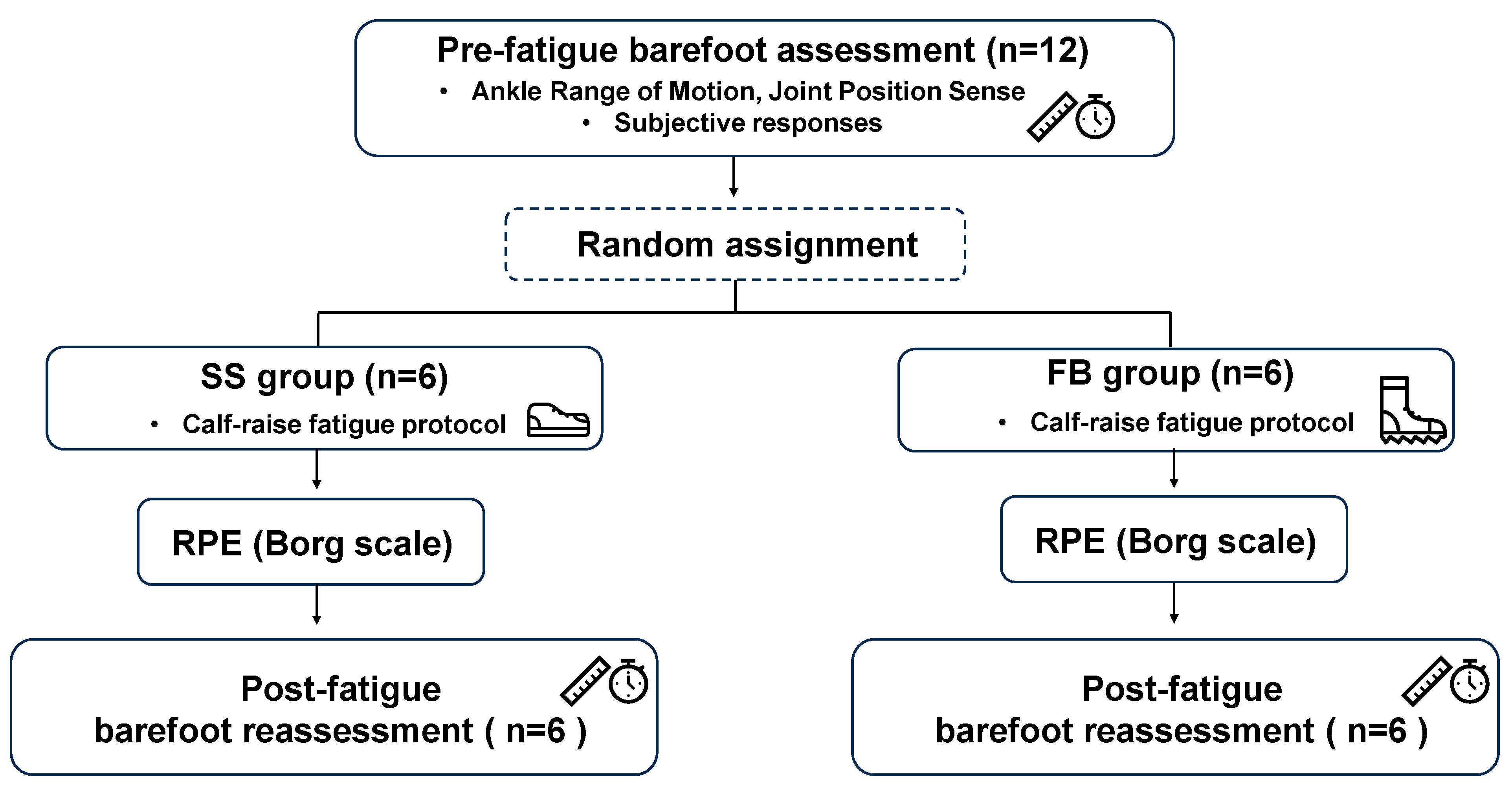
The research protocol sequence is shown in
Figure 1. Participants completed all assessments across four stages, designed to evaluate biomechanical and proprioceptive functions under different footwear conditions. They also completed a questionnaire to collect demographic and activity-related information, including occupational background and typical levels of physical activity. Subsequently, a questionnaire was administered to obtain a more comprehensive understanding of participants’ proprioceptive function on baseline measurement. A subjective ankle movement score (SAMS) questionnaire was administered under each footwear condition (SS and FB) to capture condition-specific sensory feedback. These measures are intended to complement the objective assessments by providing broader insight into proprioceptive awareness and individual perception of ankle movement and support.
Participants first underwent barefoot measurements of ankle ROM and JPS, serving as a pre-fatigue reference. Next, they were randomly assigned to one of two footwear conditions, SS or FB, for the fatigue protocol. Both footwear conditions were provided with shoe sizes of 260 mm, 270 mm, and 280 mm. For the SS condition, participants wore ordinary running shoes made of a combination of polyester and synthetic resin, with a mean weight of 0.54 kg. For the FB condition, rubber boots were used, with a mean weight of 2.6 kg and a standing height of 32 cm.
Fatigue was induced through a standardized calf raise protocol performed to volitional exhaustion, with verbal encouragement provided throughout to ensure maximal effort at 40 bpm [
24]. Although Barbieri et al. (2019) used a 30 bpm cadence, this study adopted Vuillerme and Bisgontier’s 40 bpm protocol to induce muscular fatigue more efficiently while minimizing unnecessary delay [
27]. This approach was selected to enhance the precision and efficiency of fatigue induction and to better address the specific requirements related to footwear conditions and proprioceptive function.
Immediately after completing the fatigue protocol, participants rated their RPE using the Borg Scale (6–20) [
28] and remeasured their SAMS for post-fatigue conditions. Subsequently, they removed their footwear and repeated the ROM and JPS tests while barefoot to assess how fatigue induced under different footwear conditions (SS vs. FB) affects ankle function when measured in the barefoot state.
2.3. Measurements
2.3.1. Joint Position Sense
Generally, ankle proprioception is most often evaluated by assessing JPS and force sense (FS) [
29,
30]. Thus, JPS was assessed using an active angle-repositioning task to evaluate ankle proprioception. Target angles for each movement (dorsiflexion, plantarflexion, inversion, and eversion) were individually set at 25%, 50%, and 75%, respectively, of the participant’s previously recorded maximum ROM values. These target angles were defined based on the absolute endpoint positions attained during voluntary movements rather than on relative displacements from a neutral position. Participants were seated on a height-adjustable chair with the trunk upright, hips flexed at approximately 90°, and knees flexed at 90°. The lower leg was unsupported, allowing the foot to move freely in space. The neutral position was set with the knee flexed at 90° above the ankle, and the ankle was maintained at a 90° angle.
The JPS assessment consists of two phases: practice trials and formal testing. During the practice phase, participants maintained each target angle for five seconds. A 1 min practice session was conducted prior to each JPS. In the testing phase, the participant’s foot was returned to the previously calibrated neutral position (0°) before each trial. The participant then actively repositioned the foot to match the previously demonstrated target angle (25%, 50%, and 75% of maximal angle). To eliminate visual feedback, participants were blindfolded (or instructed to keep their eyes closed) throughout the repositioning task. Each target position was tested three times, and the error between the target and reproduced angles was calculated for subsequent analyses of proprioceptive accuracy. JPS testing was performed solely on the dominant leg [
26].
Proprioceptive accuracy was quantified using three error metrics:
Absolute Error (AE): The average unsigned difference between the target and reproduced angle, reflecting overall accuracy without directional bias:
Constant Error (CE): The signed difference between the reproduced and target angle, indicating consistent over- or underestimation:
Variable Error (VE): The standard deviation of constant errors across trials, reflecting response consistency regardless of direction:
AE, CE, and VE together offer a comprehensive view of proprioceptive accuracy, as supported by previous studies. While AE is the most commonly used [
31,
32], CE and VE additionally capture directional bias and consistency, allowing for a more detailed assessment of sensorimotor function [
33,
34,
35].
2.3.2. Ankle Range of Motion
During the measurement, active ankle ROM was assessed solely in the barefoot state before and after each fatigue protocol. A two-axis electrogoniometer and DataLog (Biometrics Ltd., Newport, United Kingdom) were used to measure maximal dorsiflexion, plantarflexion, inversion, and eversion angles in degrees. The maximal angle among three trials for each movement was used for analysis.
2.3.3. Rate of Perceived Exertion
Fatigue was induced using a calf raise protocol and performed until volitional failure. This method was adopted from previous studies that confirmed its effectiveness in inducing targeted plantar-flexor fatigue [
24,
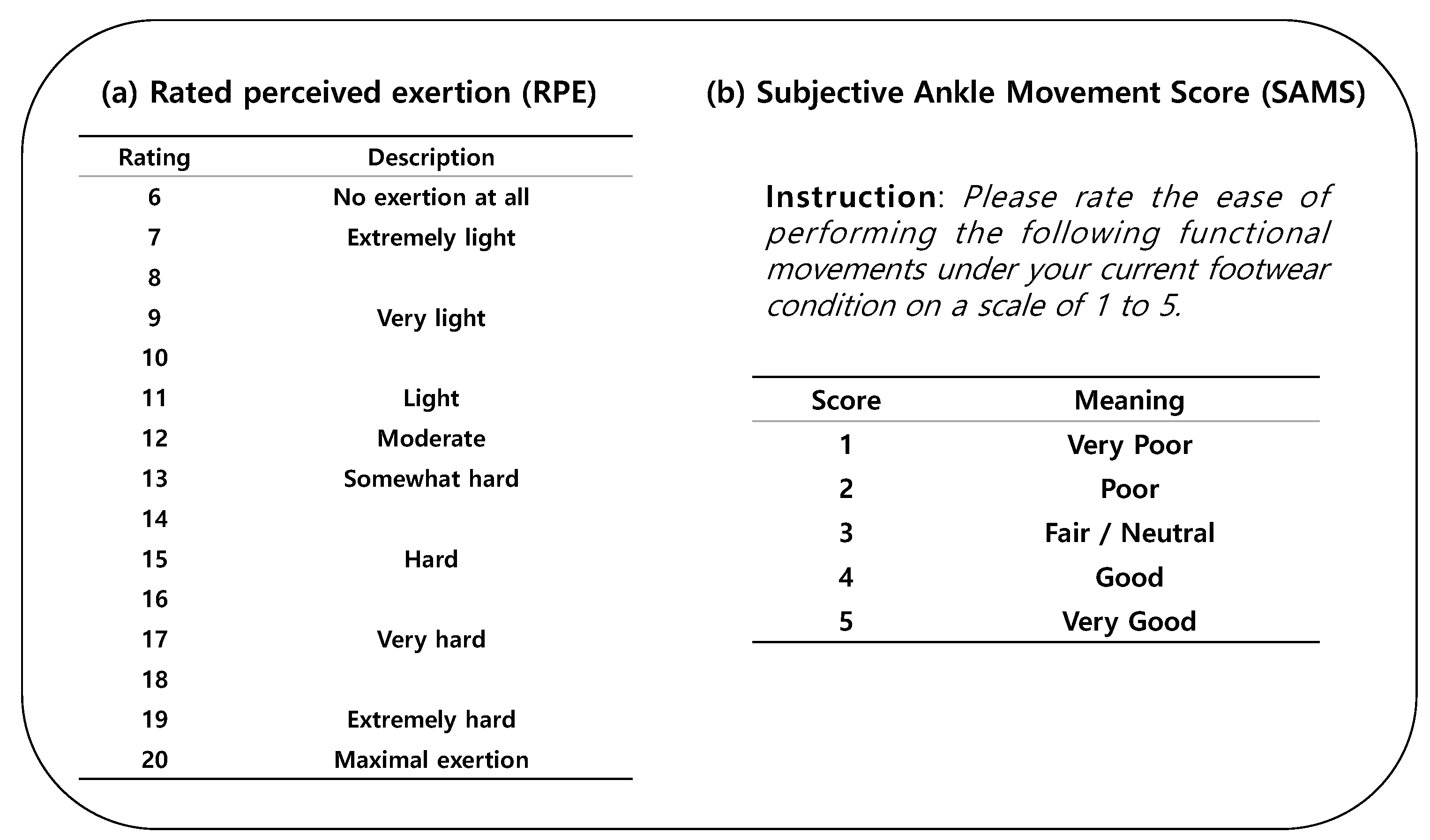
28]. Participants followed a metronome set at 40 beats per minute, completing as many repetitions as possible on both legs while wearing either SS or FB depending on group assignment. Verbal encouragement was provided throughout the exercise to ensure maximal effort. The protocol was terminated when participants could no longer maintain the required pace or full range of motion despite verbal encouragement, indicating volitional exhaustion. Immediately after the exercise, participants reported their perceived exertion using the Borg RPE scale (6–20), and a level of RPE ≥ 15 was considered indicative of a high level of fatigue (
Figure 2a).
2.3.4. Subjective Ankle Movement Score
To complement objective proprioceptive assessments, participants completed a subjective ankle movement evaluation following each footwear condition (SS and FB). This evaluation captures participants’ perceived ease of performing ankle-related tasks. Using a 5-point Likert scale (1 = very poor; 5 = very good), participants rated the ease of performing ten functional movements involving ankle control and mobility (
Figure 2b). The ten functional movements were evaluated in the following order: ankle dorsiflexion, ankle plantarflexion, ankle inversion, ankle eversion, toe walking, heel walking, one-leg balance, squat, lateral hopping, and step up and down.
2.4. Statistical Analysis
Independent variables included footwear conditions (SS and FB), fatigue conditions (pre-fatigue and post-fatigue), and task-specific within-subject factors. For JPS analyses, ankle position was included as a within-subject factor, whereas movement direction was included as a within-subject factor for ROM analyses. The dependent variables are ankle ROM, JPS error, SAMS, and RPE. All analyses were conducted in R (version 4.3.3; R Foundation for Statistical Computing, Vienna, Austria). The significance level was set at p < 0.05. Effect sizes are reported as partial eta squared (ηp2) for ANOVA models and Cohen’s d for t-tests.
Prior to inferential analyses, assumptions of normality, homogeneity of variance, and sphericity were assessed. Normality was evaluated using the Shapiro–Wilk test, homogeneity of variance was evaluated using Levene’s test, and sphericity was evaluated using Mauchly’s test when applicable. Specifically, the variable error (VE) showed positive skewness in several conditions. Therefore, log transformation (log1p) was applied to improve normality prior to analysis.
For JPS data analysis (AE, VE, and CE), three-way mixed-design ANOVAs were performed with condition (pre-fatigue vs. post-fatigue) and ankle position (12 target angles) as within-subject factors and group (SS vs. FB) as a between-subject factor. To identify specific ankle positions at which fatigue-related changes occurred, repeated-measures ANOVA (fatigue × ankle position) was performed to examine fatigue effects within each footwear condition. When interaction effects were significant, Bonferroni-corrected post hoc tests were conducted at each ankle position.
For ROM data analysis (dorsiflexion, plantarflexion, inversion, and eversion), the same analytical approach was applied. Three-way mixed-design ANOVAs (footwear × fatigue × movement direction) were used to examine overall effects. In addition, change scores (post–pre) were analyzed using two-way mixed-design ANOVAs (footwear × movement direction) to evaluate between-group differences in fatigue-related changes, and two-way repeated-measures ANOVAs (fatigue × movement direction) were used to assess fatigue effects within each footwear condition.
For SAMS, independent t-tests were used to compare SS and FB under each condition, and paired t-tests were used to assess within-group pre–post-changes. Planned comparisons were restricted to predefined contrasts, including within-group pre–post-changes and direct comparisons between footwear conditions under fatigue. Additionally, SAMS scores averaged across protocols were compared between footwear conditions. For RPE (Borg 6–20), independent t-tests were used to compare footwear groups under fatigued conditions.
To control for Type I errors, Bonferroni adjustments were applied, and statistical comparisons were restricted to predefined contrasts aligned with this study’s hypotheses. This combined approach allowed for the identification of overall effects through ANOVA models while testing specific, hypothesis-driven differences using adjusted pairwise comparisons, which is particularly important given the relatively small sample size.
4. Discussion
4.1. Summary of Key Findings
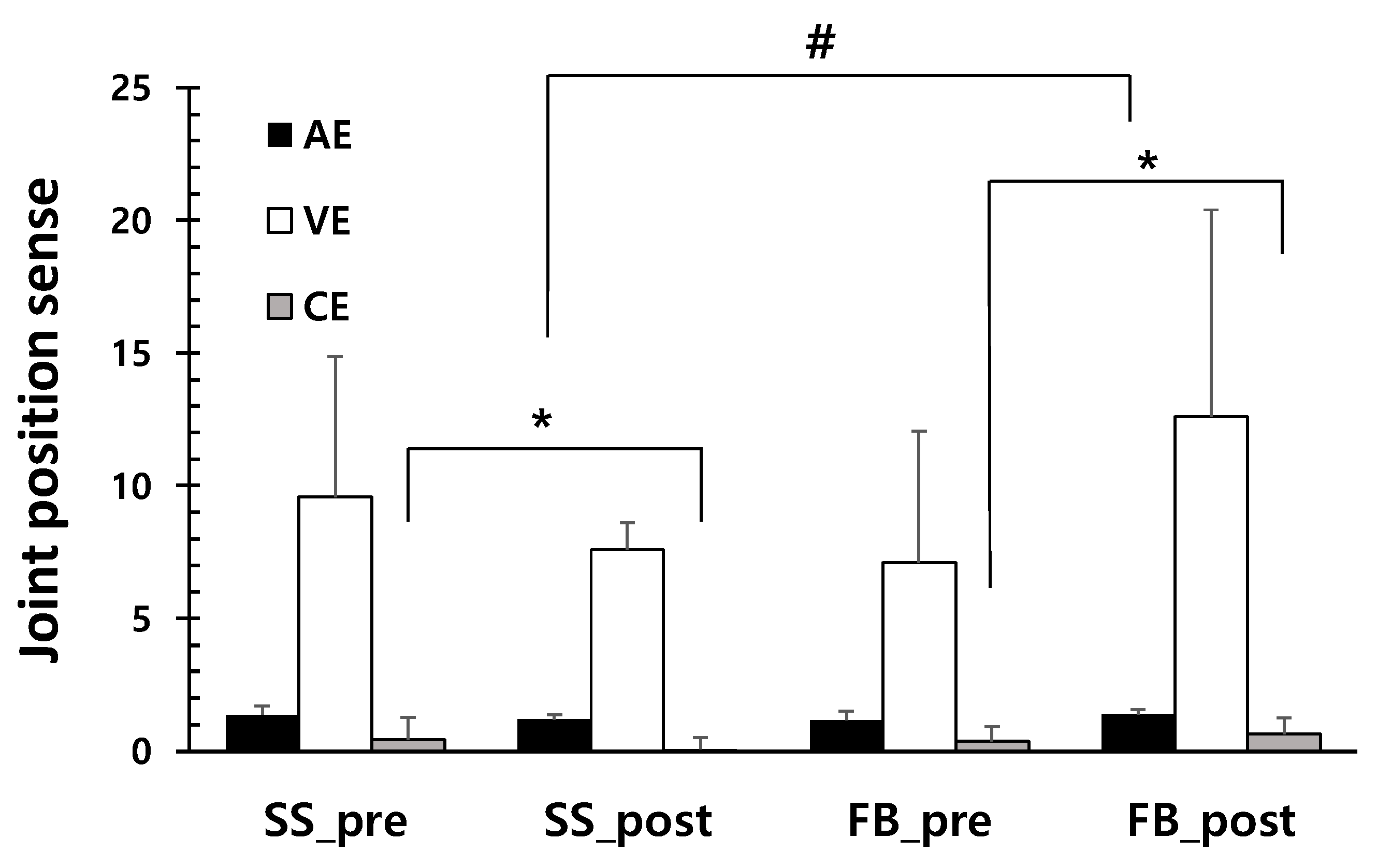
The primary aim of this study was to investigate whether fatigue-related changes in ankle JPS and ROM differed according to footwear condition. Contrary to H1, fatigue did not increase JPS errors in the FB condition, nor did it produce generalized proprioceptive impairments across footwear conditions. Instead, significant fatigue-related effects were observed only for CE, including a fatigue × footwear × ankle position interaction and a fatigue × ankle position interaction within the SS condition. However, Bonferroni-corrected post hoc analyses did not identify significant differences at individual ankle positions. H2 was not supported, as fatigue did not significantly affect ankle ROM regardless of footwear type. H3 was partially supported, as a significant fatigue × footwear × ankle position interaction was observed for CE, whereas no footwear-dependent fatigue effects were found for ROM. Finally, H4 was supported, as participants reported lower perceived ankle mobility in the FB condition and significantly higher perceived exertion following fatigue compared with the SS condition. Overall, the findings indicate that footwear-dependent fatigue responses were more clearly reflected in subjective measures than in objective measures.
4.2. Footwear-Dependent Fatigue Effects on Joint Position Sense
Fatigue-related changes in JPS were observed only in the SS condition. Although the omnibus analysis revealed a significant fatigue × footwear × ankle position interaction for CE, follow-up analyses showed a significant fatigue × ankle position interaction only in the SS condition and not in the FB condition. However, Bonferroni-corrected post hoc analyses did not reveal significant differences at individual ankle positions. In addition, no significant fatigue-related effects were observed in the FB condition for AE, VE, or CE.
These findings do not support the original hypothesis that fatigue would produce greater proprioceptive impairment in the FB condition. Rather, fatigue-related alterations appeared more readily detectable in the SS condition. Although statistical significance was not reached in FB, JPS errors generally tended to increase following fatigue across AE, VE, and CE. Conversely, JPS errors in the SS condition generally showed a decreasing tendency across several measures. This opposing pattern suggests that fatigue may have been expressed differently across footwear conditions.
One potential explanation relates to the mechanical characteristics of FB. Compared with SS, firefighter boots are generally heavier, stiffer, and more restrictive around the ankle joint. Previous studies have demonstrated that firefighter boots alter lower-limb biomechanics and joint loading patterns during locomotion and occupational tasks [
18,
36,
37]. Consequently, fatigue induced during the calf-raise protocol may not have been expressed exclusively through localized ankle proprioceptive deficits. Instead, fatigue-related demands may have been distributed across multiple lower-limb segments, reducing the likelihood of detecting isolated ankle-specific impairments during the barefoot JPS assessment. However, because no physiological markers of fatigue were collected in the present study, this explanation remains speculative and should be interpreted cautiously.
In addition, the significant CE interaction observed in the SS condition may be related to the movement demands of the calf-raise fatigue protocol, which primarily involves plantarflexion and dorsiflexion-related actions. Thus, fatigue-related proprioceptive responses may have varied across ankle positions depending on their relevance to the fatiguing task. However, because post hoc tests did not confirm significant differences at specific ankle positions, this interpretation should be regarded as exploratory rather than confirmatory.
4.3. Practice Effects and Fatigue Expression
The observed JPS findings should also be considered in terms of potential practice effects. Joint position reproduction tasks are known to be sensitive to repeated exposure, and previous studies have reported that repeated trials can reduce repositioning errors through short-term learning and familiarization processes [
38,
39]. In the present study, participants completed multiple repetitions of each target angle before and after fatigue, which may have facilitated improvements in task performance independent of physiological state.
This explanation is particularly relevant because JPS errors in the SS condition generally showed a tendency to decrease following fatigue. Such reductions are difficult to reconcile with a purely fatigue-based interpretation and instead suggest that task familiarization likely contributed to performance improvements. Nevertheless, practice effects alone cannot fully explain the results. Despite the general tendency toward reduced errors, significant decreases in CE remained evident at several dorsiflexion and plantarflexion positions. Therefore, these findings suggest that repeated task exposure may have contributed to overall improvements in repositioning accuracy, whereas condition-related directional bias may have varied across ankle positions. However, because post hoc comparisons did not identify significant differences at individual ankle positions after correction, this position-dependent pattern should be interpreted cautiously.
Overall, the observed JPS outcomes likely reflect a combination of fatigue and familiarization effects rather than either mechanism operating independently. Future studies would benefit from incorporating greater familiarization periods, randomized testing sessions, or separate control conditions to better distinguish genuine fatigue-related effects from short-term motor learning.
4.4. Stability of Ankle Range of Motion Following Fatigue
Unlike JPS, ankle ROM was not significantly affected by fatigue or footwear condition. Neither the three-way mixed-design ANOVA nor the subsequent change-score and within-footwear analyses revealed significant effects. Thus, the present findings do not support the hypothesis that fatigue would decrease ankle ROM to a greater extent in the FB condition. In contrast to the perceptual outcomes, ROM showed no significant fatigue-related changes or footwear-dependent modulation. This finding suggests that the fatigue protocol did not produce measurable restrictions in ankle mobility, despite clear differences in perceived exertion and perceived ankle mobility between footwear conditions. The absence of substantial ROM deficits may indicate that ankle mobility is relatively resilient to the short-duration localized fatigue protocol employed in the present study. Alternatively, participants may have been able to maintain ROM through compensatory neuromuscular strategies despite experiencing fatigue-related discomfort. While the protocol appears to have increased perceived exertion, its influence on ankle ROM was limited.
4.5. Dissociation Between Objective Performance and Subjective Perception
A dissociation between objective and subjective outcomes was observed in the present study. While objective measures showed relatively limited fatigue-related changes, subjective measures revealed clear differences between footwear conditions.
Participants in the FB condition reported significantly greater perceived exertion following fatigue, while participants in the SS condition reported significantly greater perceived ankle mobility. These perceptual differences were considerably more pronounced than the objective changes observed in JPS and ROM. Such findings suggest that subjective experiences of fatigue and movement restriction may not always correspond directly with measurable biomechanical impairments.
Several mechanisms may explain this discrepancy. First, the structural characteristics of firefighter boots may amplify perceptions of restriction and effort even when objective performance is preserved. This interpretation is consistent with footwear theories such as the comfort filter and preferred movement path concepts, which propose that footwear affects perception and movement experience through pathways that are not always reflected in traditional biomechanical measures [
40]. Second, compensatory motor strategies may have helped maintain ankle function despite increased subjective strain. Previous research suggests that individuals can shift control demands toward proximal joints and trunk musculature under fatigue, thereby preserving task performance while increasing overall perceived effort [
41].
Consequently, the present findings suggest that subjective measures such as SAMS and RPE may capture dimensions of fatigue that are not fully represented by conventional proprioceptive or ROM assessments. This distinction may be particularly relevant in occupational environments where workers often report discomfort and fatigue before measurable performance decrements become apparent.
4.6. Methodological Considerations and Limitations
Several limitations should be considered when interpreting the present findings. First, the sample size was relatively small (
n = 12), which may have limited statistical power and increased the likelihood of Type II errors. Consequently, some potentially meaningful differences between footwear conditions may not have reached statistical significance. Therefore, replication with a larger sample is warranted to confirm the robustness and generalizability of the present findings. Second, fatigue was induced using a localized calf-raise protocol. Although this approach successfully increased perceived exertion and produced a significant interaction pattern in JPS, it may not fully represent the complex physiological demands experienced during actual firefighting activities. Firefighters are frequently exposed to prolonged physical exertion, external loads, heat stress, and cognitively demanding environments, all of which may influence fatigue development and proprioceptive performance differently from the relatively short-duration protocol used in this study. Third, the assessment of proprioception was limited to an active joint position reproduction (JPR) task. While this method is widely used and possesses ecological relevance, performance in JPR tasks is influenced not only by proprioceptive acuity but also by motor planning, working memory, attention, and efferent control processes. As a result, subtle changes in sensory function may have been masked by cognitive or motor factors [
39]. Future studies may benefit from incorporating complementary proprioceptive assessments, such as threshold to detection of passive motion or active movement extent discrimination tasks, to provide a more comprehensive evaluation of proprioceptive function [
42]. Finally, no direct physiological markers of fatigue were collected. Consequently, the mechanisms underlying the observed differences between footwear conditions remain uncertain. In particular, the interpretation that firefighter boots may alter the expression or distribution of fatigue could not be directly verified. Future research should integrate physiological measures such as surface electromyography (sEMG), metabolic markers, or other indices of neuromuscular fatigue alongside biomechanical and perceptual assessments. Such an approach would help clarify how fatigue develops across objective and subjective domains and how these responses are influenced by occupational footwear.
Overall, the present study demonstrated that fatigue-related responses were influenced by footwear condition, although these effects were more limited and nuanced than originally hypothesized. Significant fatigue-related changes were observed only for CE during JPS testing, including a fatigue × footwear × ankle position interaction and a fatigue × ankle position interaction within the SS condition, while ankle ROM remained unaffected by fatigue regardless of footwear type. In contrast, subjective outcomes revealed clear footwear-dependent differences, with firefighter boots associated with greater perceived exertion and reduced perceived ankle mobility. These findings highlight a dissociation between objective and subjective indicators of fatigue and suggest that footwear may influence not only biomechanical performance but also how fatigue is perceived and experienced. Future research incorporating larger sample sizes, physiological fatigue measurements, and more sensitive proprioceptive assessments is needed to clarify the mechanisms underlying footwear-dependent fatigue responses in occupational settings.
5. Conclusions
This study investigated the effects of fatigue induced under two footwear conditions, firefighter boots (FBs) and sports shoes (SSs), on ankle joint position sense (JPS), range of motion (ROM), and subjective responses in healthy young adults. The findings did not support the hypotheses that fatigue would increase JPS errors or decrease ROM to a greater extent in the FB condition. Significant interaction effects were observed only for constant error (CE) during JPS testing, including a fatigue × footwear × ankle position interaction and a fatigue × ankle position interaction within the SS condition. In contrast, ankle ROM remained unchanged following fatigue regardless of footwear condition. Despite the limited objective changes, clear differences were observed in subjective responses. Participants reported lower perceived ankle mobility in the FB condition and greater perceived exertion following fatigue. These findings indicate that objective and subjective responses to fatigue may not always correspond and that footwear condition can influence how fatigue is perceived, even when measurable changes in ankle function are limited. Taken together, the present findings suggest that footwear condition may influence the expression of fatigue-related responses, particularly in relation to proprioceptive performance and subjective perception. Future studies incorporating larger sample sizes, physiological fatigue measures, and complementary proprioceptive assessments are needed to clarify the mechanisms underlying these footwear-dependent responses and to better understand their relevance in occupational settings.