Article

Confirmatory Factor Analysis of the Alcohol Use Disorders Identification Test and the Revised, Short-Form Drinking Motives Questionnaire Among Firefighters


by
Maya Zegel
1,2,*,
Anka A. Vujanovic
2,3,* and
Matthew W. Gallagher
2,4
1
Department of Psychiatry, Massachusetts General Hospital, Boston, MA 02114, USA
2
Department of Psychology, University of Houston, Houston, TX 77204, USA
3
Department of Psychological and Brain Sciences, Texas A&M University, College Station, TX 77843, USA
4
Texas Institute for Measurement, Evaluation and Statistics (TIMES), University of Houston, Houston, TX 77204, USA
*
Authors to whom correspondence should be addressed.
Fire 2026, 9(7), 282; https://doi.org/10.3390/fire9070282
Submission received: 28 March 2026 / Revised: 17 June 2026 / Accepted: 1 July 2026 / Published: 6 July 2026

Abstract

Extant research has documented elevated rates of alcohol use among the fire service. While some studies have sought to examine the role of drinking motives in firefighter alcohol use, findings are limited by a lack of exploration into the validity of established alcohol use measures among this population. The present study explored the factor structure of the Alcohol Use Disorders Identification Test (AUDIT) and the revised, short-form Drinking Motives Questionnaire (DMQ-R-SF) among a large sample of career firefighters in the southern U.S. (N = 679). Participants were included in this secondary analysis if they reported any lifetime alcohol use and completed the measures of interest. Confirmatory factor analyses supported the established three-factor AUDIT and four-factor DMQ-R-SF. SEM results indicated that coping-motivated alcohol use was statistically significantly positively associated with each AUDIT subscale (i.e., hazardous consumption, dependence symptoms, and harmful consequences). Notably, conformity-motivated alcohol use was inversely associated with hazardous consumption. Findings underscore the importance of understanding and addressing alcohol use among firefighters, particularly drinking to cope with negative affect.

1. Introduction

Firefighters demonstrate uniquely elevated rates of alcohol use compared to the general population. A national study of firefighters found that more than 85% reported drinking alcohol in the past month, compared to only 50.6% of U.S. adults [1,2,3]. Further, more than 50% of firefighters in this national survey reported episodic heavy drinking in the past month (i.e., binge drinking, defined as consuming more than five drinks on one occasion), whereas only 21.7% of U.S. adults report comparable drinking behavior [1,3]. Among firefighters in this study who reported binge drinking, the majority (72.5%) reported doing so on multiple occasions in the past month [1].
Firefighter cultural norms surrounding drinking likely contribute to such pervasive alcohol use among firefighters. A recent national study of firefighters’ perceptions related to various drinking behaviors demonstrated that firefighters’ “acceptable” levels of alcohol consumption exceeded federally recommended guidelines [3,4]. For example, male career firefighters who drink alcohol reported that consuming approximately 3–4 drinks on one occasion was acceptable, despite this equating to heavy alcohol use per the National Institute of Alcohol Abuse and Alcoholism (NIAAA) definition. Additionally, career firefighters reported that rates of binge drinking among firefighters were greater than 50%, and a majority of firefighters who drink alcohol reported that drinking until intoxicated was acceptable as long as it does not “interfere with responsibilities” [4]. Lastly, male volunteer firefighters who reported past-month heavy drinking (i.e., an average of three or more drinks per day) reported an average acceptable duration between their last drink and start of their next shift to be only 6.7 h [4]. These notable deviations in perceived norms about drinking underscore the importance of understanding and addressing firefighter culture as it relates to problematic alcohol use.
Research has consistently demonstrated that firefighters report drinking to cope with, avoid, or “numb” negative affect [5,6]. In a large study of municipal firefighters, post-traumatic stress symptoms were statistically significantly positively associated with hazardous alcohol consumption, alcohol-related problems, and coping-motivated alcohol use (i.e., drinking to cope; [6]). Further, coping-motivated alcohol use was strongly positively associated with hazardous alcohol consumption and alcohol-related problems, underscoring the interrelatedness of alcohol consumption, coping motives, and related problems [6]. Alcohol consumption serves as a direct link between emotional and physical health problems, as evidenced by recent work which demonstrated a statistically significant association between firefighters’ alcohol consumption and cardiometabolic risk [7].
Firefighters are a largely understudied population compared to military or college samples; however, alarming rates of alcohol use are evident. Current research among firefighters, while designed to inform clinical work, is limited by the variety of measures used. The complexity of drinking behavior is evidenced by the various definitions for problematic drinking, hazardous drinking, binge drinking, and/or heavy episodic drinking. Many cited studies rely upon standard drink amounts to categorize behavior, while others utilize standardized measures and cutoff points. For example, one study reported that the rate of problematic alcohol use is 63.0% among male firefighters and 64.2% among women, per the clinical cutoff for the Alcohol Use Disorders Identification Test consumption subscale [8]. While certainly informative, it is difficult to compare this finding to the estimated 50% rate of binge drinking among firefighters determined by the quantity of standard drinks consumed [1]. Thus, with numerous measures utilized to assess drinking behavior, it is challenging to summarize findings across studies. Extant research is further hindered by the lack of established validity of these measures among firefighter samples.
Therefore, the present study aims to explore the validity of established measures of alcohol use and drinking motives among a large sample of career firefighters. We examined the Alcohol Use Disorders Identification Test (AUDIT; [9]) and the short-form, revised Drinking Motives Questionnaire (DMQ-R-SF; [10]) as these measures have been extensively employed among a variety of populations and their factor structures were recently examined among a military sample [11]. First, we hypothesized that the three-factor structure of the AUDIT (i.e., hazardous consumption, dependence symptoms, and harmful consequences of alcohol use) would be supported. Second, we hypothesized that the four-factor structure of the DMQ-R-SF (i.e., coping-, conformity-, enhancement-, and socially motivated alcohol use) would be supported. Third, we hypothesized that coping-motivated alcohol use would be uniquely associated with each AUDIT subscale, given extant research among firefighters documenting robust associations between coping-motivated alcohol use and alcohol use severity (e.g., [5,6]).

2. Methods

2.1. Participants

The current study is a secondary analysis of data from a larger project examining stress and health behaviors among firefighters [12]. Overall study inclusion criteria required participants to be over age 18, be currently working as a firefighter, and consent to complete the online questionnaires. A subset of data was utilized by analyzing responses from firefighters who reported lifetime alcohol use and who provided complete responses to the AUDIT and DMQ-R-SF. For the present analysis, participants included 679 career firefighters (94.3% men; Mage = 38.6, SD = 8.6), all of whom provide Emergency Medical Services (EMS) in addition to fire suppression. Please see Table 1 for sociodemographic and job characteristics of this sample.

2.2. Procedure

Participants were recruited for the parent study from a large metropolitan fire department in the southern U.S. All firefighters in the department were notified via their continuing education (CE) portal of an opportunity to participate in an online research survey for CE credit. Upon clicking the link, firefighters were provided with a description of the survey and the choice to review the informed consent form, which informed them that the study was completely voluntary and they could discontinue participation at any time without penalty. Those who consented by clicking “yes” to indicate their interest in participating were directed to the survey in Qualtrics. The total survey duration was estimated to be 30–45 min. The study protocol was approved by the relevant Institutional Review Board and participating fire department.

2.3. Measures

Demographic Questionnaire: Participants self-reported sociodemographic and career-related information, such as age, gender, marital status, and number of years in the fire service.
Alcohol Use Disorders Identification Test (AUDIT; [9]): The AUDIT is a well-established 10-item screening instrument designed to identify problematic alcohol use [9,13]. Total scores range from 0 to 40, and the generally accepted cutoff to identify potentially hazardous drinking is 8 or greater [9]. Hazardous consumption is measured by the sum of the first three items, which inquire about drinking frequency and quantity. Dependence symptoms are assessed via the subsequent three items, which evaluate difficulty controlling drinking, difficulty managing other responsibilities due to drinking, and morning drinking. The remaining four items evaluate harmful consequences of alcohol use by inquiring about guilt after drinking, difficulty remembering after a night of heavy drinking, alcohol-related injuries to oneself or others, and others’ concern about the individual’s drinking. The AUDIT has demonstrated good psychometric properties [9,14,15,16,17]. In the present study, the internal consistency was good for the AUDIT total score (α = 0.85) and dependence symptoms (α = 0.86), and acceptable for hazardous consumption (α = 0.73). Harmful consequences demonstrated questionable internal consistency (α = 0.68); however, this is understandable as the participants in this sample report a range of drinking behavior and widely varied levels of alcohol-related problems.
Drinking Motives Questionnaire Revised Short Form (DMQ-R-SF; [10]): The DMQ-R-SF is a 12-item self-report measure designed to assess frequency of drinking due to specific reasons for consuming alcohol. Drinking motives are separated into four subscales: coping (i.e., drinking to avoid or reduce negative emotions), enhancement (i.e., drinking to enhance positive emotions), conformity (i.e., drinking to adhere to social norms/expectations and to avoid rejection), and social (i.e., drinking to enhance social situations). Each subscale consists of three items summed to produce scores ranging from 3 to 9. The subscales can be further categorized as internal (coping and enhancement) and external (conformity and social) motives, as well as positive (enhancement and social) and negative (coping and conformity) motives [10]. The latter two are also referred to as approach and avoidant motives, respectively. The DMQ-R-SF has been validated across samples varying by age, gender, and nationalities [10,18,19]. The internal consistency was excellent for socially motivated alcohol use (α = 0.92), good for conformity (α = 0.87)- and coping-motivated alcohol use (α = 0.86), and acceptable for enhancement-motivated alcohol use (α = 0.71).

2.4. Data Analytic Strategy

We used SPSS Version 28.0 to identify a subset of participants from the parent study who reported lifetime alcohol use and provided complete responses to the AUDIT and DMQ-R-SF. We employed independent-sample t-tests to examine demographic differences between the subset of participants selected for the present analysis versus those who did not respond to any items in the AUDIT or DMQ-R-SF (n = 506) or who provided partial responses (n = 17). There were no statistically significant demographic differences observed between the subset of participants selected from the parent study compared to those who did not respond to the alcohol measures of interest or who provided incomplete responses (N = 523).
Among the subset of participants included in the present analysis (N = 679), we first examined data normality and correlations across demographic variables and the AUDIT and DMQ-R-SF subscales. Age, hazardous consumption, and enhancement- and socially motivated alcohol use appeared normally distributed. As anticipated, dependence symptoms, harmful consequences of alcohol use, and conformity-motivated alcohol use appeared positively skewed (values > 2.0), with kurtosis statistics indicating heavier right-sided tails (values > 7.0). To account for this non-normality, we employed a robust maximum likelihood (MLR) estimator and have reported results accordingly [20]. Next, we conducted a confirmatory factor analysis (CFA) to examine the factor structure of the AUDIT and DMQ-R-SF among firefighters using MPlus Version 8.7 [21] to address our first and second hypotheses. Finally, for our third hypothesis, we employed structural equation modeling (SEM) to examine the interrelatedness of drinking motives on AUDIT subscales. In this model, item distributions were treated as continuous and the same MLR estimator was utilized.
Model fit was assessed with consideration given to absolute fit indices, including the normed chi-square (χ2/df) and standardized root mean square residual (SRMR), with an SRMR ≤ 0.08 indicative of good model fit. Relative indices, such as the comparative adjustment index (CFI) and the Tucker–Lewis index (TLI), were evaluated with values > 0.90 indicating acceptable model fit. Additionally, the root mean square error of approximation (RMSEA) was reviewed as an index not based on centrality, with values < 0.05 indicative of good fit and values ≤ 0.08 indicative of acceptable model fit [22,23].

3. Results

3.1. Bivariate Correlations

All AUDIT and DMQ-R-SF subscales were positively correlated with one another, as expected. Many of the correlations between subscales ranged from low to moderate (r’s = 0.32 to 0.55). Notably, only a slight correlation was observed between hazardous consumption and conformity-motivated alcohol use (r = 0.20), and between dependence symptoms and socially motivated alcohol use (r = 0.25). Expectedly high correlations were observed between dependence symptoms and harmful consequences of alcohol use (r = 0.83), as well as between enhancement- and socially motivated alcohol use (r = 0.75). Please see Table 2 for descriptive statistics and bivariate correlations. Of note, the reported alcohol use severity in this sample per the mean AUDIT score was similar to other large firefighter samples [24].

3.2. Confirmatory Factor Analysis

In the initial confirmatory factor analysis (CFA), we examined the three-factor AUDIT with the four-factor DMQ-R-SF, as hypothesized. This model demonstrated acceptable fit (χ2 = 515.944, df = 188, p < 0.001; CFI = 0.934; TLI = 0.919; RMSEA = 0.051, 90% CI [0.045, 0.056], SRMR = 0.069). All items loaded onto each factor appropriately, and standardized loadings ranged from 0.411 to 0.944, except for one item assessing harmful consequences of alcohol use whose estimate was 0.207 (“Have you or someone else been injured because of your drinking?”). Please see Table 3 for all standardized and unstandardized factor loadings. The majority of latent variable subscales were statistically significantly correlated with one another, demonstrating low to robust associations (r’s = 0.23 to 0.63).
Notably, results also indicated a very strong correlation between the enhancement- and socially motivated alcohol use subscales (r = 0.91, se = 0.02, p < 0.001). To promote parsimony, we therefore examined a three-factor model for the DMQ-R-SF: coping, conformity, and positive drinking motives (i.e., socially and enhancement-motivated alcohol use). The model demonstrated acceptable fit (χ2 = 574.807, df = 194, p < 0.001; CFI = 0.924; TLI = 0.909; RMSEA = 0.054, 90% CI [0.049, 0.059], SRMR = 0.077); however, each index of model fit was slightly worse than the four-factor model. Similarly, a strong correlation was observed between AUDIT subscales of dependence symptoms and harmful consequences of alcohol use (r = 0.99, se = 0.03, p < 0.001). Therefore, we examined a two-factor model for the AUDIT by combining dependence symptoms with harmful consequences of alcohol use. This model demonstrated acceptable fit (χ2 = 520.065, df = 194, p < 0.001; CFI = 0.935; TLI = 0.922; RMSEA = 0.050, 90% CI [0.045, 0.055], SRMR = 0.070); however, each index of model fit was similar or slightly worse than the model examining the three-factor AUDIT. Because the patterns of results remained consistent, we report on the original four-factor DMQ-R-SF and three-factor AUDIT.

3.3. Structural Equation Model

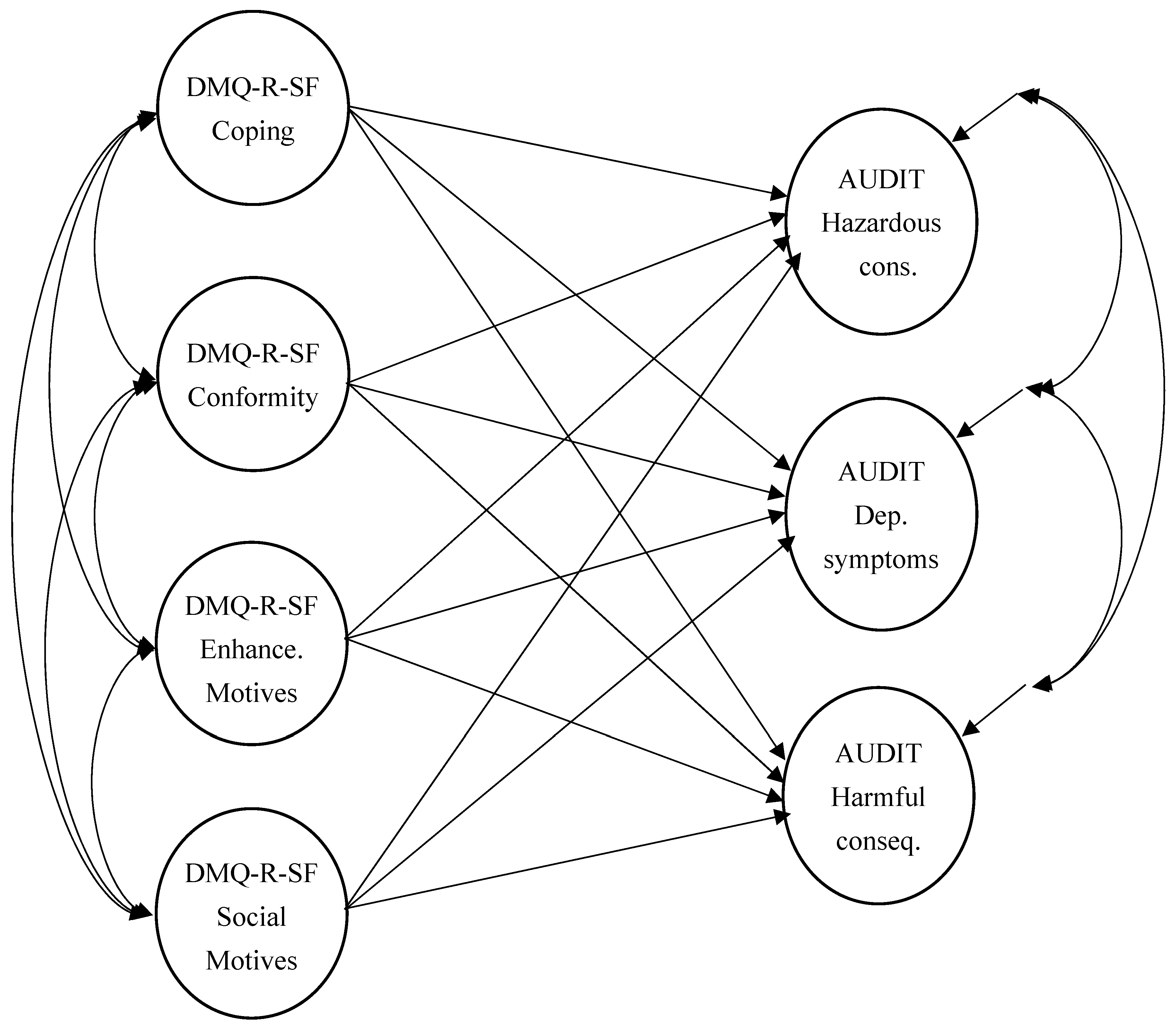
Structural equation modeling was subsequently employed to examine the associations between the four-factor DMQ-R-SF on the three-factor AUDIT, as proposed in our third hypothesis. All four alcohol use motives were positively associated with one another, as were the three AUDIT subscales. Coping (β = 0.216, 95% CI [0.050, 0.542])- and enhancement-motivated alcohol use (β = 0.775, 95% CI [0.324, 1.420]) were statistically significantly positively associated with and accounted for 44% of the variance in hazardous consumption. Coping-motivated alcohol use was the only drinking motive positively associated with dependence symptoms (β = 0.426, 95% CI [0.351, 0.972]) and harmful consequences of alcohol use (β = 0.456, 95% CI [0.352, 0.936]), and the four DMQ-R-SF subscales together accounted for 29% and 33% of their variances, respectively. Please see Table 4 for all latent variable associations between subscales in the structural equation model. Figure 1 depicts a visual representation of the relationships examined by the structural equation model.

4. Discussion

The present study sought to explore the factor structure of two commonly used measures of alcohol use and drinking motives among a large sample of firefighters. Given the elevated rates of alcohol use among firefighters, we considered the role of cultural norms and drinking to cope with negative affect. The three-factor AUDIT and four-factor DMQ-R-SF model demonstrated good fit, supporting our hypothesis regarding the utility of these measures among firefighter samples. However, the results also indicated a very strong correlation between the enhancement- and socially motivated alcohol use subscales. Despite the four-factor model demonstrating better fit, it is possible that there is substantial overlap between enhancement- and socially motivated alcohol use among firefighters. Further research is needed to explore the intricacies of positive drinking motives among firefighters in various situational contexts, such as socializing. It is possible that dimensional traits, such as introversion–extroversion, have a further moderating effect on these drinking motives. Similarly, dependence symptoms and harmful consequences of alcohol use demonstrated a very strong correlation. While we report results on the three-factor AUDIT given the similar model fit statistics, future work is needed to explore the utility of separating dependence symptoms (i.e., difficulty stopping drinking once started, failure to fulfill responsibilities due to drinking, and morning drinking after a night of heavy consumption) from harmful consequences of alcohol use (i.e., feeling guilt or remorse, inability to remember what happened while drinking, injuring oneself or others due to drinking, and others expressing concern about one’s drinking), and whether an underlying construct may better capture problematic alcohol use among firefighters.
Results of the structural equation model were consistent with extant findings documenting associations between hazardous consumption, alcohol-related problems, and drinking motives among firefighters (e.g., [6]). As expected, coping-motivated alcohol use was statistically significantly positively associated with hazardous consumption, dependence symptoms, and harmful consequences of alcohol use, underscoring the need to further assess firefighters’ tendency to drink to avoid or numb their negative emotions. Notably, enhancement-motivated alcohol use was also associated with hazardous consumption, suggesting that firefighters may engage in greater levels of drinking to amplify positive emotions, in addition to coping motives to reduce or “numb” negative emotions.
Given the associations between coping motives and alcohol use severity, it is imperative to consider firefighter mental health as further context when addressing alcohol use. This is particularly important due to the exceedingly high rates of trauma among firefighters [25], with an estimated 91.5% of firefighters reporting trauma exposure and nearly one-third reporting exposure to three or more potentially traumatic events [26]. A recent study of firefighters documented that 38.8% met criteria for probable alcohol use disorder, and the severity of alcohol use was associated with PTSD and depression symptoms [27]. Similar work among firefighters with probable AUD found that 18.3% met criteria for probable post-traumatic stress disorder (PTSD), a rate nearly five times greater than the prevalence of current PTSD among the general population [28,29]. Indeed, PTSD symptoms have been shown to be positively associated with the number of drinks consumed per week among early career firefighters [30]. Additionally, a national study of female career firefighters demonstrated that those who reported problematic drinking were 2.5 more likely to report PTSD symptoms or to have received a diagnosis of depression [31]. Taken together, these findings highlight the importance of future research to further our understanding of firefighter alcohol use within a greater mental health context.
Although the goal of the present study necessitated the use of self-report measures, findings are limited by a lack of clinician-administered assessments, secondary independent reporting (e.g., a spouse or significant other), or biomedical tests to corroborate reported alcohol use. Additional limitations include the potential for self-selection bias, whereby firefighters with more severe alcohol use may have not participated or underreported their consumption, as well as the use of cross-sectional data, which precluded our ability to draw causal interferences regarding the direction of alcohol use motives and AUDIT subscales. For example, it is unclear whether coping-motivated alcohol use precedes hazardous consumption, or whether there is a bidirectional effect. Lastly, the sample consisted predominately of white, non-Hispanic men from a single fire department, thus limiting the generalizability of our findings to a more racially, ethnically, and gender-diverse sample.
Future research is needed to explore demographic factors that may provide greater information regarding differences in alcohol use across gender [32], racial and ethnic groups [1,2,31,33], and marital status [34]. Additional research is necessary to consider job-related factors that may affect firefighter alcohol consumption, including years of service [1,2,31], career or volunteer status [4,35], and on-the-job injuries [31]. Improved understanding of contextual factors that may exacerbate or mitigate firefighter alcohol use will support screening, prevention, and intervention efforts for this population, such as personalized feedback/psychoeducation during academy training, targeted peer support initiatives, and culturally informed clinical care.
Extant research has sought to gain greater understanding of firefighter alcohol use, yet overarching conclusions have been limited by the variety in measurement, as well as a lack of established validity in commonly used measures. The present study closes this gap by providing evidence to support the three-factor structure of the AUDIT and four-factor structure of the DMQ-R-SF among a sample of career firefighters in the southern U.S. Our findings suggest that drinking motives may have the greatest impact on hazardous alcohol consumption, compared to other AUDIT subscales. These motives are related to affect, with firefighters in this sample reporting drinking to cope with negative mood or drinking to enhance positive emotion reporting higher levels of hazardous consumption. Alcohol use among firefighters remains a notable clinical concern, and future research is needed to explore the impact of firefighters’ cultural norms and perceptions surrounding alcohol use, as well as contextual differences related to demographics and mental health.

Author Contributions

Conceptualization, M.Z. and M.W.G.; methodology, M.Z. and M.W.G.; software, M.Z. and A.A.V.; validation, M.Z., M.W.G. and A.A.V.; formal analysis, M.Z.; investigation, M.Z. and M.W.G.; resources, A.A.V.; data curation, A.A.V.; writing—original draft preparation, M.Z.; writing—review and editing, A.A.V. and M.W.G.; visualization, M.Z.; supervision, A.A.V. and M.W.G.; project administration, A.A.V.; funding acquisition, M.Z. All authors have read and agreed to the published version of the manuscript.

Funding

This work was supported, in part, by a National Institute on Alcohol Abuse and Alcoholism award to the first author (NIAAA F31AA029022). Research reported in this publication was supported, in part, by the National Institute on Minority Health and Health Disparities (NIMHD U54MD015946). The content is solely the responsibility of the authors and does not necessarily represent the official views of the National Institutes of Health.

Data Availability Statement

Data is unavailable due to privacy restrictions.

Conflicts of Interest

The authors declare no conflicts of interest.

References

  1. Haddock, C.K.; Day, R.S.; Poston, W.S.; Jahnke, S.A.; Jitnarin, N. Alcohol use and caloric intake from alcohol in a national cohort of U.S. career firefighters. J. Stud. Alcohol Drugs 2015, 76, 360–366. [Google Scholar] [CrossRef] [PubMed]
  2. Piazza-Gardner, A.K.; Barry, A.E.; Chaney, E.; Dodd, V.; Weiler, R.; Delisle, A. Covariates of alcohol consumption among career firefighters. Occup. Med. 2014, 64, 580–582. [Google Scholar] [CrossRef] [PubMed]
  3. NIAAA. Alcohol Use in the United States: Age Groups and Demographic Characteristics. 2025. Available online: https://www.niaaa.nih.gov/alcohols-effects-health/alcohol-topics-z/alcohol-facts-and-statistics/alcohol-use-united-states-age-groups-and-demographic-characteristics (accessed on 21 December 2025).
  4. Haddock, C.K.; Jitnarin, N.; Caetano, R.; Jahnke, S.A.; Hollerbach, B.S.; Kaipust, C.M.; Poston, W.S.C. Norms about Alcohol Use among US Firefighters. Saf. Health Work 2022, 13, 387–393. [Google Scholar] [CrossRef] [PubMed]
  5. Zegel, M.; Tran, J.K.; Vujanovic, A.A. Posttraumatic stress, alcohol use, and alcohol use motives among firefighters: The role of distress tolerance. Psychiatry Res. 2019, 282, 112633. [Google Scholar] [CrossRef] [PubMed]
  6. Tomaka, J.; Magoc, D.; Morales-Monks, S.M.; Reyes, A.C. Posttraumatic stress symptoms and alcohol-related outcomes among municipal firefighters. J. Trauma. Stress 2017, 30, 416–424. [Google Scholar] [CrossRef] [PubMed]
  7. Levitt, D.E.; Wohlgemuth, K.J.; Burnham, E.F.; Conner, M.J.; Collier, J.J.; Mota, J.A. Hazardous alcohol use and cardiometabolic risk among firefighters. Alcohol Clin. Exp. Res. 2025, 49, 392–406. [Google Scholar] [CrossRef]
  8. Gallyer, A.J.; Dougherty, S.P.; Gai, A.R.; Stanley, I.H.; Hom, M.A.; Rogers, M.L.; Duffy, M.E.; Buchman-Schmitt, J.M.; Spencer-Thomas, S.; Joiner, T.E. Problematic alcohol use and suicidal ideation among firefighters: A multi-study investigation of the explanatory roles of perceived burdensomeness and thwarted belongingness. J. Affect. Disord. 2018, 238, 281–288. [Google Scholar] [CrossRef] [PubMed]
  9. Saunders, J.B.; Aasland, O.G.; Babor, T.F.; De La Fuente, J.R.; Grant, M. Development of the Alcohol Use Disorders Identification Test (AUDIT): WHO collaborative project on early detection of persons with harmful alcohol consumption-II. Addiction 1993, 88, 791–804. [Google Scholar] [CrossRef] [PubMed]
  10. Kuntsche, E.; Kuntsche, S. Development and validation of the Drinking Motive Questionnaire Revised Short Form (DMQ-R SF). J. Clin. Child Adolesc. Psychol. 2009, 38, 899–908. [Google Scholar] [CrossRef] [PubMed]
  11. Mohr, C.D.; McCabe, C.T.; Haverly, S.N.; Hammer, L.B.; Carlson, K.F. Drinking motives and alcohol use: The SERVe study of US current and former service members. J. Stud. Alcohol Drugs 2018, 79, 79–87. [Google Scholar] [CrossRef] [PubMed]
  12. Paulus, D.J.; Gallagher, M.W.; Bartlett, B.A.; Tran, J.; Vujanovic, A.A. The unique and interactive effects of anxiety sensitivity and emotion dysregulation in relation to posttraumatic stress, depressive, and anxiety symptoms among trauma-exposed firefighters. Compr. Psychiatry 2018, 84, 54–61. [Google Scholar] [CrossRef] [PubMed]
  13. Newcombe, D.A.; Humeniuk, R.E.; Ali, R. Validation of the World Health Organization Alcohol, Smoking and Substance Involvement Screening Test (ASSIST): Report of results from the Australian site. Drug Alcohol Rev. 2005, 24, 217–226. [Google Scholar] [CrossRef] [PubMed]
  14. Selin, K.H. Test-retest reliability of the Alcohol Use Disorder Identification Test in a general population sample. Alcohol Clin. Exp. Res. 2003, 27, 1428–1435. [Google Scholar] [CrossRef] [PubMed]
  15. Bohn, M.J.; Babor, T.F.; Kranzler, H.R. The Alcohol Use Disorders Identification Test (AUDIT): Validation of a screening instrument for use in medical settings. J. Stud. Alcohol Drugs 1995, 56, 423–432. [Google Scholar] [CrossRef] [PubMed]
  16. Barry, K.L.; Fleming, M.F. The Alcohol Use Disorders Identification Test (AUDIT) and the SMAST-13: Predictive validity in a rural primary care sample. Alcohol Alcohol. 1993, 28, 33–42. [Google Scholar] [CrossRef]
  17. Schmidt, A.; Barry, K.L.; Fleming, M.F. Detection of problem drinkers: The Alcohol Use Disorders Identification Test (AUDIT). South. Med. J. 1995, 88, 52–59. [Google Scholar] [CrossRef] [PubMed]
  18. Mazzardis, S.; Vieno, A.; Kuntsche, E.; Santinello, M. Italian validation of the drinking motives questionnaire revised short form (DMQ-R SF). Addict. Behav. 2010, 35, 905–908. [Google Scholar] [CrossRef] [PubMed]
  19. Németh, Z.; Urban, R.; Kuntsche, E.; San Pedro, E.M.; Roales Nieto, J.G.; Farkas, J.; Futaki, L.; Kun, B.; Mervo, B.; Olah, A.; et al. Drinking motives among Spanish and Hungarian young adults: A cross-national study. Alcohol Alcohol. 2011, 46, 261–269. [Google Scholar] [CrossRef] [PubMed]
  20. Li, C.H. Confirmatory factor analysis with ordinal data: Comparing robust maximum likelihood and diagonally weighted least squares. Behav. Res. Methods 2016, 48, 936–949. [Google Scholar] [CrossRef] [PubMed]
  21. Muthén, L.K.; Muthén, B.O. Mplus User’s Guide, 8th ed.; Muthén & Muthén: Los Angeles, CA, USA, 2017. [Google Scholar]
  22. Hu, L.; Bentler, P.M. Cutoff criteria for fit indexes in covariance structure analysis: Conventional criteria versus new alternatives. Struct. Equ. Model. 1999, 6, 1–55. [Google Scholar] [CrossRef]
  23. Rigdon, E.E. CFI versus RMSEA: A comparison of two fit indexes for structural equation modeling. Struct. Equ. Model. A Multidiscip. J. 1996, 3, 369–379. [Google Scholar] [CrossRef]
  24. Carleton, R.N.; Afifi, T.O.; Turner, S.; Taillieu, T.; Duranceau, S.; LeBouthillier, D.M.; Sareen, J.; Ricciardelli, R.; MacPhee, R.S.; Groll, D.; et al. Mental disorder symptoms among public safety personnel in Canada. Can. J. Psychiatry 2018, 63, 54–64. [Google Scholar] [CrossRef] [PubMed]
  25. Carleton, R.N.; Afifi, T.O.; Taillieu, T.; Turner, S.; Krakauer, R.; Anderson, G.S.; MacPhee, R.S.; Ricciardelli, R.; Cramm, H.A.; Groll, D.; et al. Exposures to potentially traumatic events among public safety personnel in Canada. Can. J. Behav. Sci./Rev. Can. Des. Sci. DU Comport. 2019, 51, 37–52. [Google Scholar] [CrossRef]
  26. Meyer, E.C.; Zimering, R.; Daly, E.; Knight, J.; Kamholz, B.W.; Gulliver, S.B. Predictors of posttraumatic stress disorder and other psychological symptoms in trauma-exposed firefighters. Psychol. Serv. 2012, 9, 1–15. [Google Scholar] [CrossRef] [PubMed]
  27. Rotunda, R.J.; Herzog, J.; Dillard, D.R.; King, E.; O’Dare, K. Alcohol Misuse and Correlates with Mental Health Indicators among Firefighters. Subst. Use Misuse 2025, 60, 236–243. [Google Scholar] [CrossRef] [PubMed]
  28. Kilpatrick, D.G.; Resnick, H.S.; Milanak, M.E.; Miller, M.W.; Keyes, K.M.; Friedman, M.J. National estimates of exposure to traumatic events and PTSD prevalence using DSM-IV and DSM-5 criteria. J. Trauma. Stress 2013, 26, 537–547. [Google Scholar] [CrossRef] [PubMed]
  29. Zegel, M.; Lebeaut, A.; Healy, N.; Tran, J.K.; Vujanovic, A.A. Mental health correlates of probable posttraumatic stress disorder, probable alcohol use disorder, and their co-occurrence among firefighters. Behav. Modif. 2022, 46, 395–421. [Google Scholar] [PubMed]
  30. Gulliver, S.B.; Zimering, R.; Knight, J.; Morissette, S.; Kamholz, B.; Meyer, E.; Keane, T.; Pennington, M.; Denman, T.; Carpenter, T.; et al. Tobacco and alcohol use among firefighters during their first 3 years of service. Psychol. Addict. Behav. 2018, 32, 255–263. [Google Scholar] [CrossRef] [PubMed]
  31. Haddock, C.K.; Poston, W.S.C.; Jahnke, S.A.; Jitnarin, N. Alcohol use and problem drinking among women firefighters. Womens Health Issues 2017, 27, 632–638. [Google Scholar] [CrossRef] [PubMed]
  32. Jahnke, S.A.; Haddock, C.K.; Jitnarin, N.; Kaipust, C.M.; Hollerbach, B.S.; Poston, W.S.C. The Prevalence and Health Impacts of Frequent Work Discrimination and Harassment among Women Firefighters in the US Fire Service. BioMed Res. Int. 2019, 2019, 6740207. [Google Scholar] [CrossRef] [PubMed]
  33. Arbona, C.; Schwartz, J.P. Posttraumatic Stress Disorder Symptom Clusters, Depression, Alcohol Abuse, and General Stress Among Hispanic Male Firefighters. Hisp. J. Behav. Sci. 2016, 38, 507–522. [Google Scholar] [CrossRef]
  34. Lee, M.R.; Chassin, L.; MacKinnon, D.P. Role transitions and young adult maturing out of heavy drinking: Evidence for larger effects of marriage among more severe premarriage problem drinkers. Alcohol Clin. Exp. Res. 2015, 39, 1064–1074. [Google Scholar] [CrossRef] [PubMed]
  35. Haddock, C.K.; Jahnke, S.A.; Poston, W.S.; Jitnarin, N.; Kaipust, C.M.; Tuley, B.; Hyder, M.L. Alcohol use among firefighters in the central United States. Occup. Med. 2012, 62, 661–664. [Google Scholar] [CrossRef] [PubMed]
Figure 1. Structural equation model of drinking motives on AUDIT subscales. Note: N = 679. AUDIT = Alcohol Use Disorders Identification Test [9]; DMQ-R-SF = Drinking Motives Questionnaire—Revised, Short Form [10]. AUDIT subscales include hazardous consumption, dependence symptoms, and harmful consequences of alcohol use.
Fire 09 00282 g001
Table 1. Participant sociodemographic and career-related characteristics.
VariablenValid%
Gender
  Men64094.3%
  Women395.7%
Race
  White52977.9%
  Black or African American7511.0%
  Other517.5%
  American Indian or Alaskan Native121.8%
  Asian111.6%
  Native Hawaiian or other Pacific Islander10.1%
Ethnicity
  Hispanic or Latinx17726.1%
  Not Hispanic or Latinx50273.9%
Relationship Status
  Married46067.7%
  Single12919.0%
  Divorced537.8%
  Living with partner355.2%
  Widowed20.3%
Education
  8th grade20.3%
  Partial completion of high school or GED equivalent20.3%
  High school graduate568.2%
  Partial completion of college32047.1%
  College graduate29944.0%
Meeting criteria for:
  Probable AUD diagnosis 119328.4%
Note. N = 701; 1 Probable AUD diagnosis was considered a score of 8 or greater for men and 7 or greater for women on the Alcohol Use Disorders Identification Test (AUDIT; [9]).
Table 2. Descriptive statistics and bivariate correlations of study variables.
Variable12345678910111213
1. Age--
2. Gender0.03--
3. Relationship Status0.21 ***0.09--
4. Educational Attainment0.020.060.05--
5. Years in the Fire Service0.87 ***0.010.20 ***0.07--
6. AUDIT Total−0.07−0.04−0.11 **−0.01−0.04--
7. AUDIT Hazardous Consumption−0.05−0.01−0.08 *0.01−0.020.82 ***--
8. AUDIT Dependence Symptoms−0.07−0.04−0.10 **−0.02−0.050.85 ***0.44 ***--
9. AUDIT Harmful Consequences−0.06−0.06−0.10 *−0.03−0.040.87 ***0.50 ***0.83 ***--
10. DMQ-R-SF Coping−0.05−0.13 **−0.06−0.02−0.030.53 ***0.42 ***0.46 ***0.48 ***--
11. DMQ-R-SF Conformity−0.05−0.01−0.03−0.03−0.030.35 ***0.20 ***0.36 ***0.37 ***0.53 ***--
12. DMQ-R-SF Enhancement−0.08 *−0.05−0.11 **−0.04−0.11 **0.51 ***0.53 ***0.34 ***0.39 ***0.55 ***0.40 ***--
13. DMQ-R-SF Social−0.11 **−0.03−0.09 *−0.01−0.11 **0.42 ***0.45 ***0.25 ***0.32 ***0.47 ***0.40 ***0.75 ***--
Mean38.630.940.733.8613.306.324.920.690.703.773.414.514.88
Standard Deviation8.600.230.441.128.824.662.341.701.481.371.011.461.80
Note. N = 679. *** p < 0.001; ** p < 0.01; * p < 0.05. Gender coded as 1 = men, 0 = women. Relationship status coded as 1 = married or living with partner, 0 = single, widowed, divorced. AUDIT = Alcohol Use Disorders Identification Test [9]; DMQ-R-SF = Drinking Motives Questionnaire—Revised, Short Form [10].
Table 3. DMQ-R-SF and AUDIT unstandardized (unstd.) and standardized (std.) factor loadings.
Scale/Subscale/ItemUnstd.
Loading
Std.
Loading
DMQ-R-SF Coping Motives
  2. Because it helps you when you feel depressed or nervous1.0000.799
  6. To forget about your problems1.0250.860
  10. To cheer up when you’re in a bad mood1.1120.797
DMQ-R-SF Conformity Motives
  5. So you won’t feel left out1.0000.761
  11. To be liked0.8370.824
  12. To fit in with a group you like1.0590.944
DMQ-R-SF Enhancement Motives
  1. Because you like the feeling1.0000.706
  3. To get high0.4150.486
  9. Because it’s fun1.1560.839
DMQ-R-SF Social Motives
  4. Because it helps you enjoy a party1.0000.827
  7. Because it makes social gatherings more fun1.1530.912
  8. Because it improves parties and celebrations1.1960.942
AUDIT Hazardous Consumption
  1. How often do you have a drink containing alcohol?1.0000.543
  2. How many standard drinks do you have on a typical day when you are drinking?1.0450.651
  3. How often do you have six or more standard drinks on one occasion?1.6840.933
AUDIT Dependence Symptoms
  4. … found that you were not able to stop drinking once you had started?1.0000.815
  5. … failed to do what was normally expected of you because of drinking?0.8620.889
  6. … needed a first drink in the morning to get yourself going after a heavy drinking session?0.6840.829
AUDIT Harmful Consequences
  7. … had a feeling of guilt or remorse after drinking?1.0000.896
  8. … been unable to remember what happened the night before because you had been drinking?0.8480.810
  9. Have you or someone else been injured because of your drinking?0.0940.207
  10. Has a relative, friend, doctor, or other health care worker been concerned about your drinking or suggested you cut down? 0.2870.411
Note. DMQ-R-SF = Drinking Motives Questionnaire—Revised, Short Form [10]. AUDIT = Alcohol Use Disorders Identification Test [9]; in the current table, AUDIT items #4–8 are prefaced with “How often in the last year have you…”.
Table 4. Structural equation model for the unstandardized and standardized associations between drinking motives and AUDIT subscales.
VariableBSEβ90% CIr2
AUDIT Hazardous Consumption 0.44
  DMQ-R-SF Coping Motives0.296 *0.1260.216[0.09, 0.50]
  DMQ-R-SF Conformity Motives−0.1630.098−0.097[−0.32, −0.003]
  DMQ-R-SF Enhancement Motives0.872 **0.2800.775[0.41, 1.33]
  DMQ-R-SF Social Motives−0.2740.219−0.256[−0.63, 0.09]
AUDIT Dependence Symptoms 0.29
  DMQ-R-SF Coping Motives0.662 ***0.1590.426[0.40, 0.92]
  DMQ-R-SF Conformity Motives0.1760.1780.092[−0.12, 0.47]
  DMQ-R-SF Enhancement Motives0.3620.2250.284[−0.01, 0.73]
  DMQ-R-SF Social Motives−0.3010.188−0.249[−0.61, 0.01]
AUDIT Harmful Consequences 0.33
  DMQ-R-SF Coping Motives0.669 ***0.1620.456[0.40, 0.94]
  DMQ-R-SF Conformity Motives0.1490.1600.082[−0.11, 0.41]
  DMQ-R-SF Enhancement Motives0.2260.2410.187[−0.17, 0.62]
  DMQ-R-SF Social Motives−0.1170.202−0.102[−0.45, 0.22]
Note. B = unstandardized coefficients; SE = standard error; β = standardized coefficient. AUDIT = Alcohol Use Disorders Identification Test [9]; DMQ-R-SF = Drinking Motives Questionnaire—Revised, Short Form [10]. *** p < 0.001; ** p < 0.01; * p < 0.05.
Disclaimer/Publisher’s Note: The statements, opinions and data contained in all publications are solely those of the individual author(s) and contributor(s) and not of MDPI and/or the editor(s). MDPI and/or the editor(s) disclaim responsibility for any injury to people or property resulting from any ideas, methods, instructions or products referred to in the content.