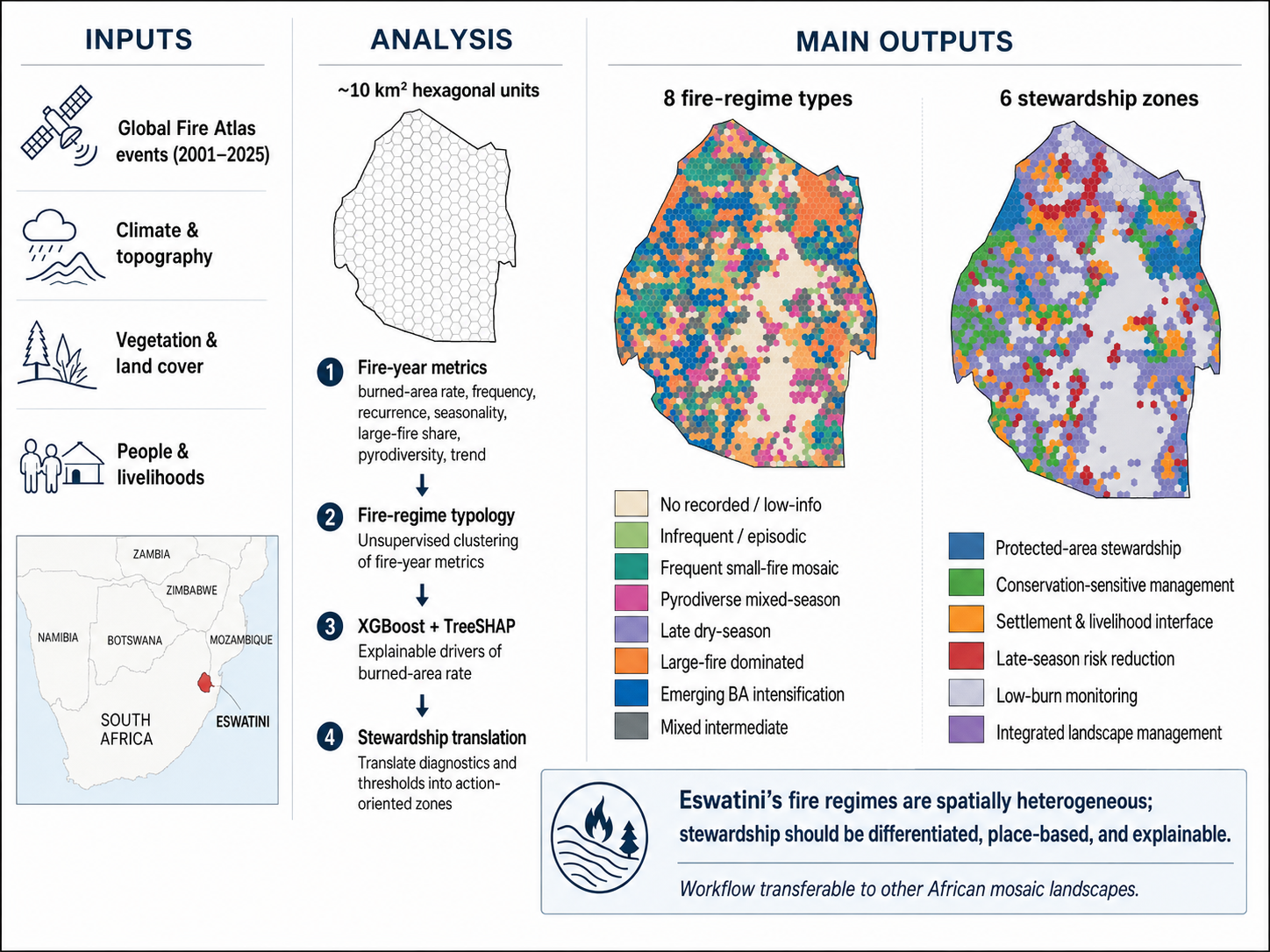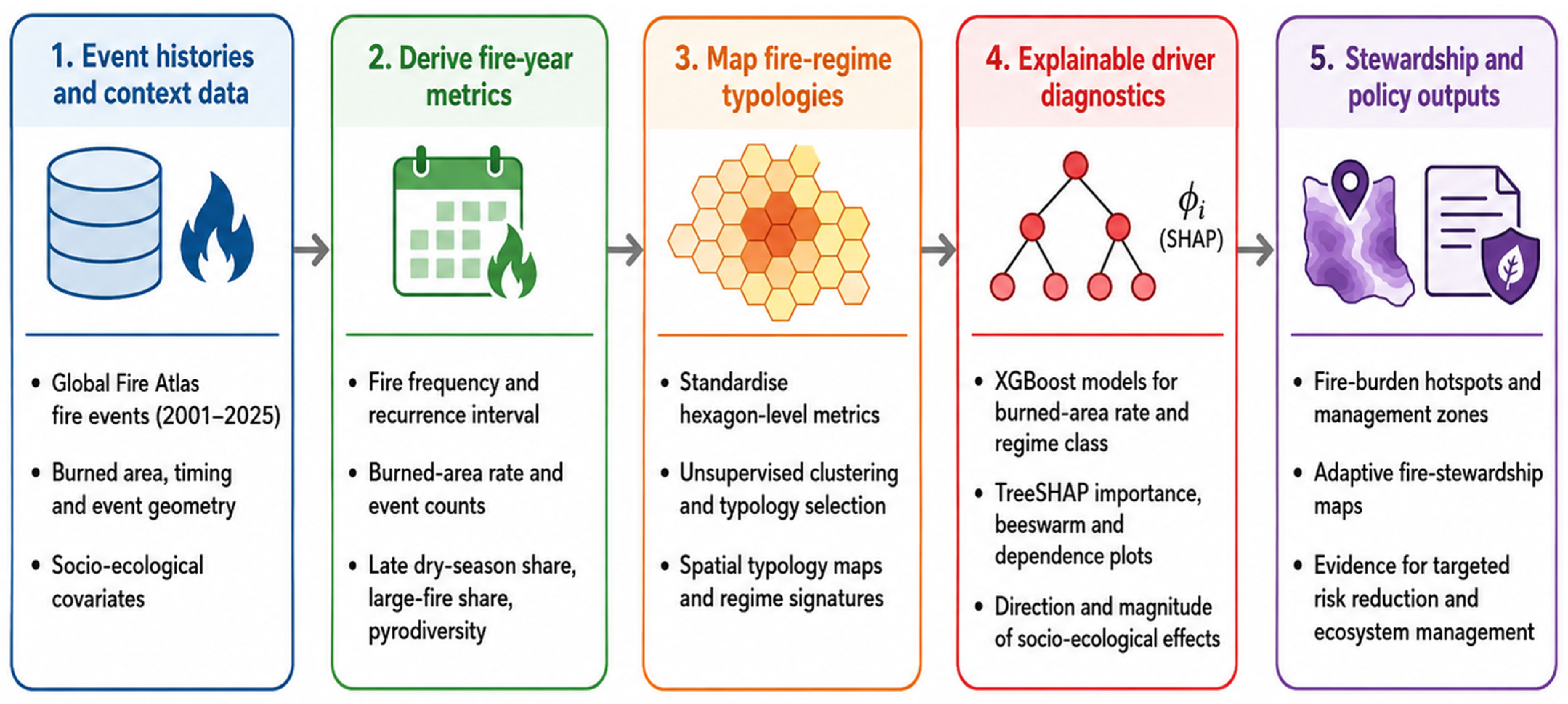



Mapping the Fire–Ecosystem–People Nexus in a Southern African Mosaic: Explainable Fire-Regime Typologies and Stewardship Zones for Eswatini, 2001–2025


Abstract
1. Introduction
2. Materials and Methods
2.1. Study Area and Fire-Management Setting
2.2. Fire-Event Histories and Fire-Year Accounting
2.3. Hexagonal Fire-Regime Units and Fire Metrics
2.4. Fire-Regime Typology
2.5. Socio-Ecological Context, Composite Indices and Driver Screening
2.6. Explainable Modelling of the Burned-Area Rate
2.7. Empirical Thresholds and Stewardship-Zone Translation
3. Results
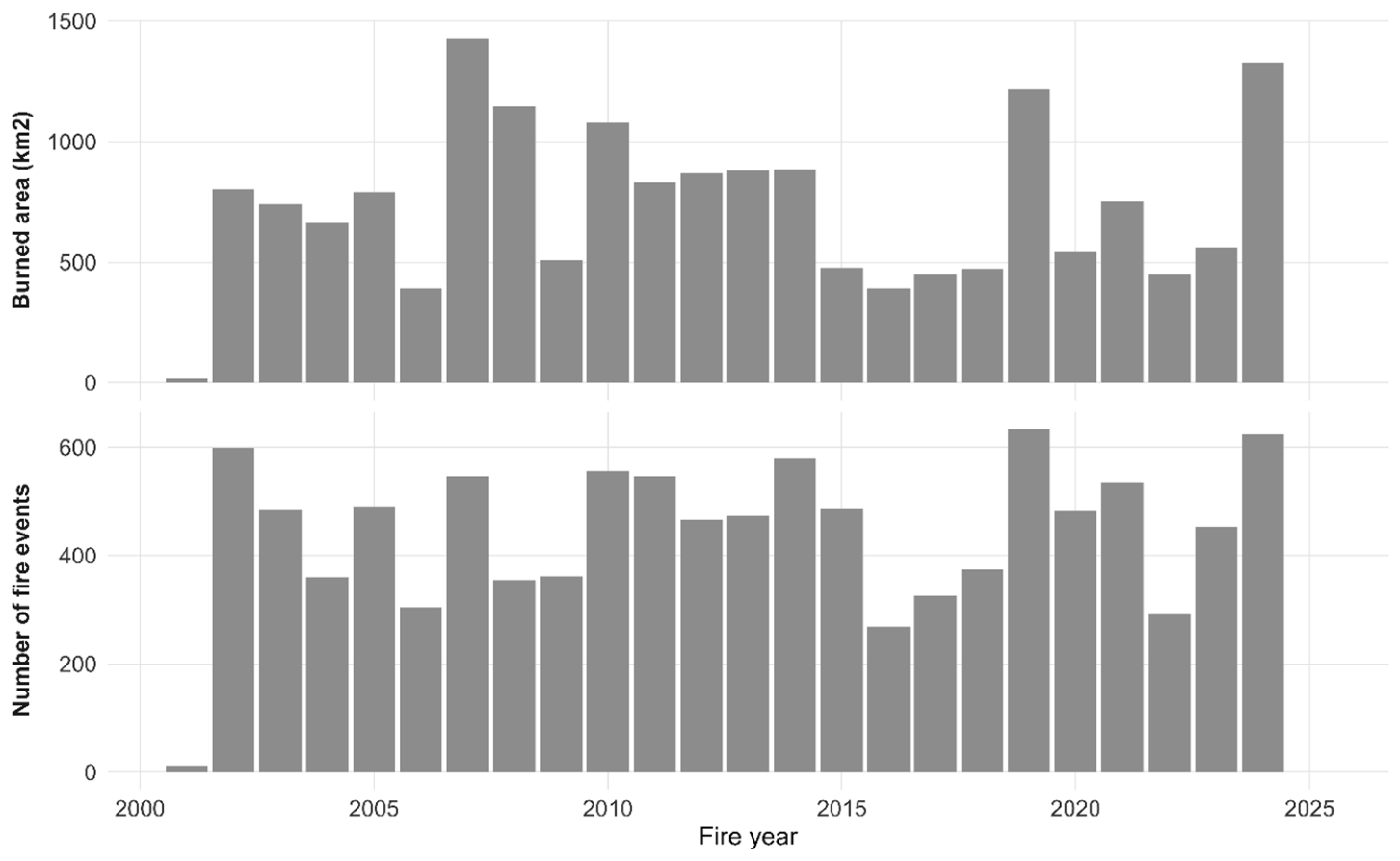
3.1. Seasonal and Interannual Fire Activity
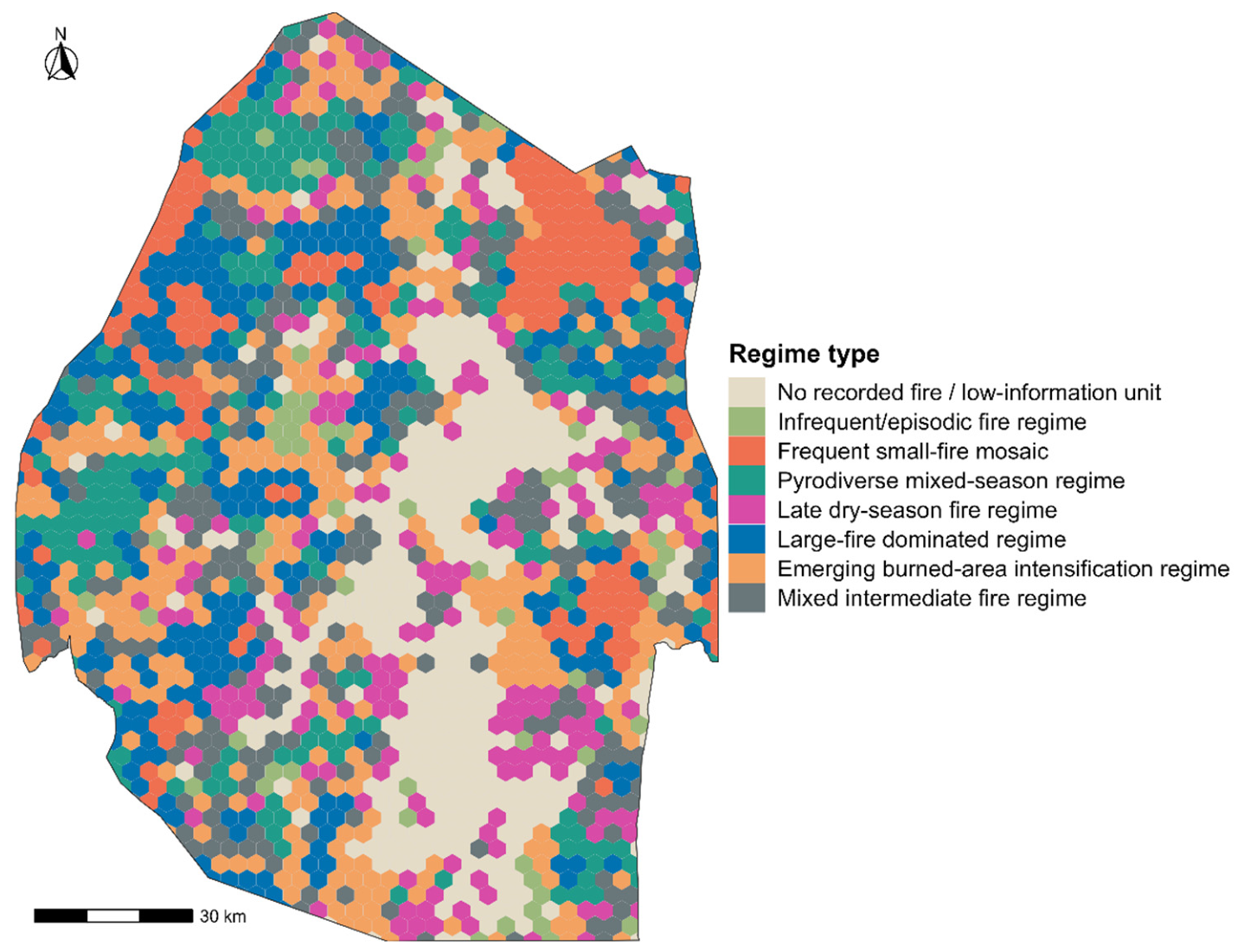
3.2. Fire-Regime Typology
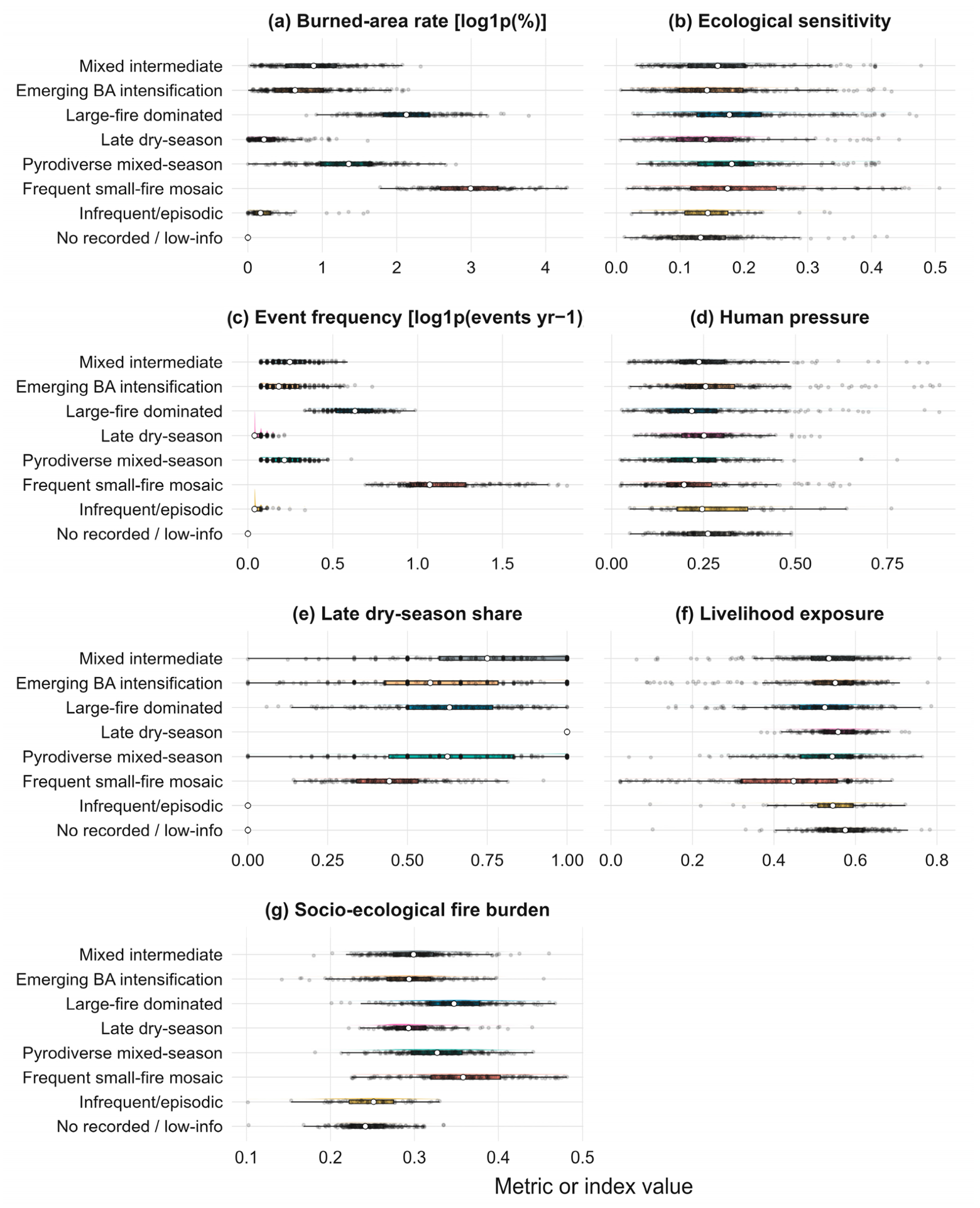
3.3. Standardised Signatures and Distributions Clarify Typology Contrasts
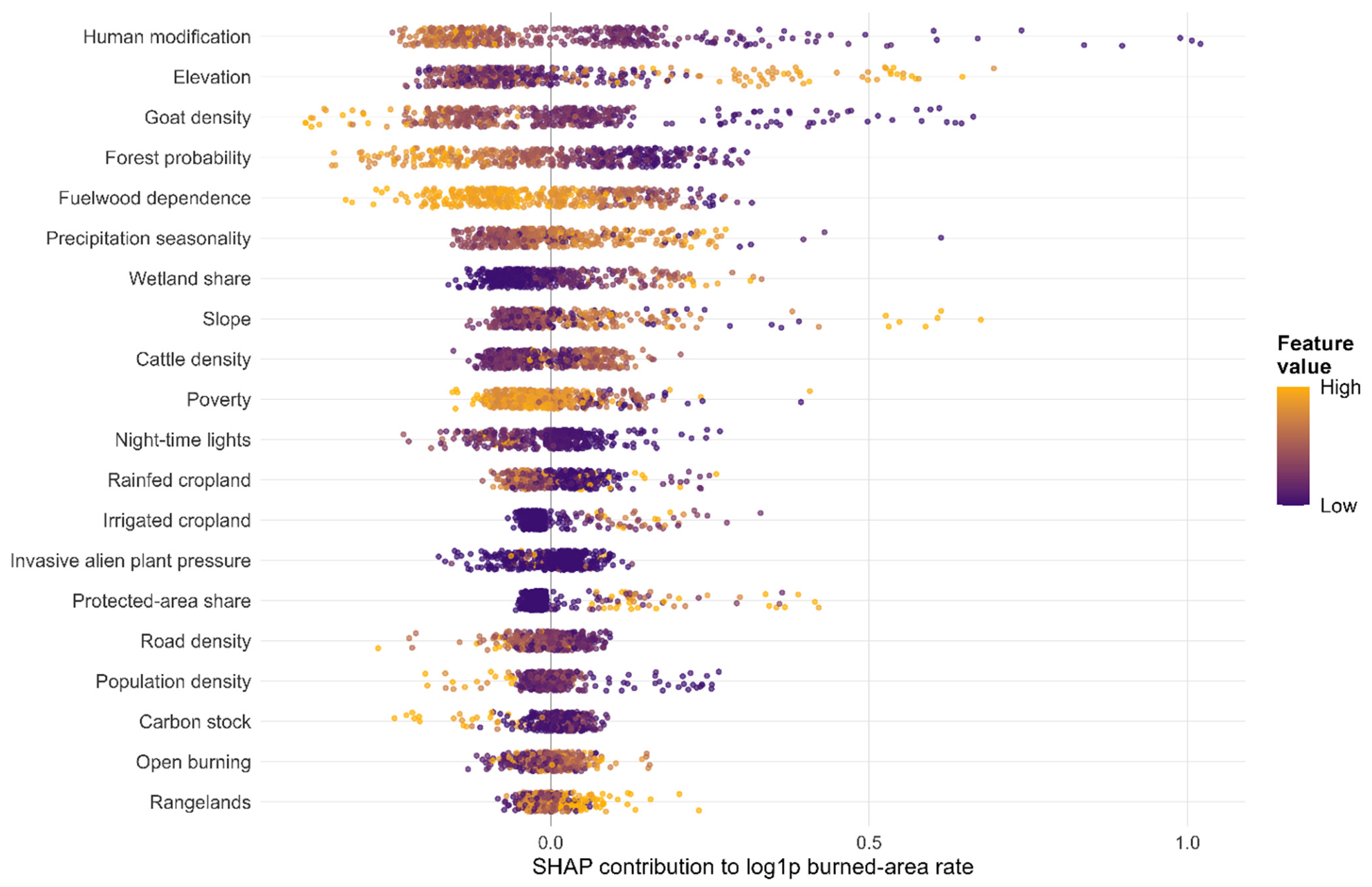
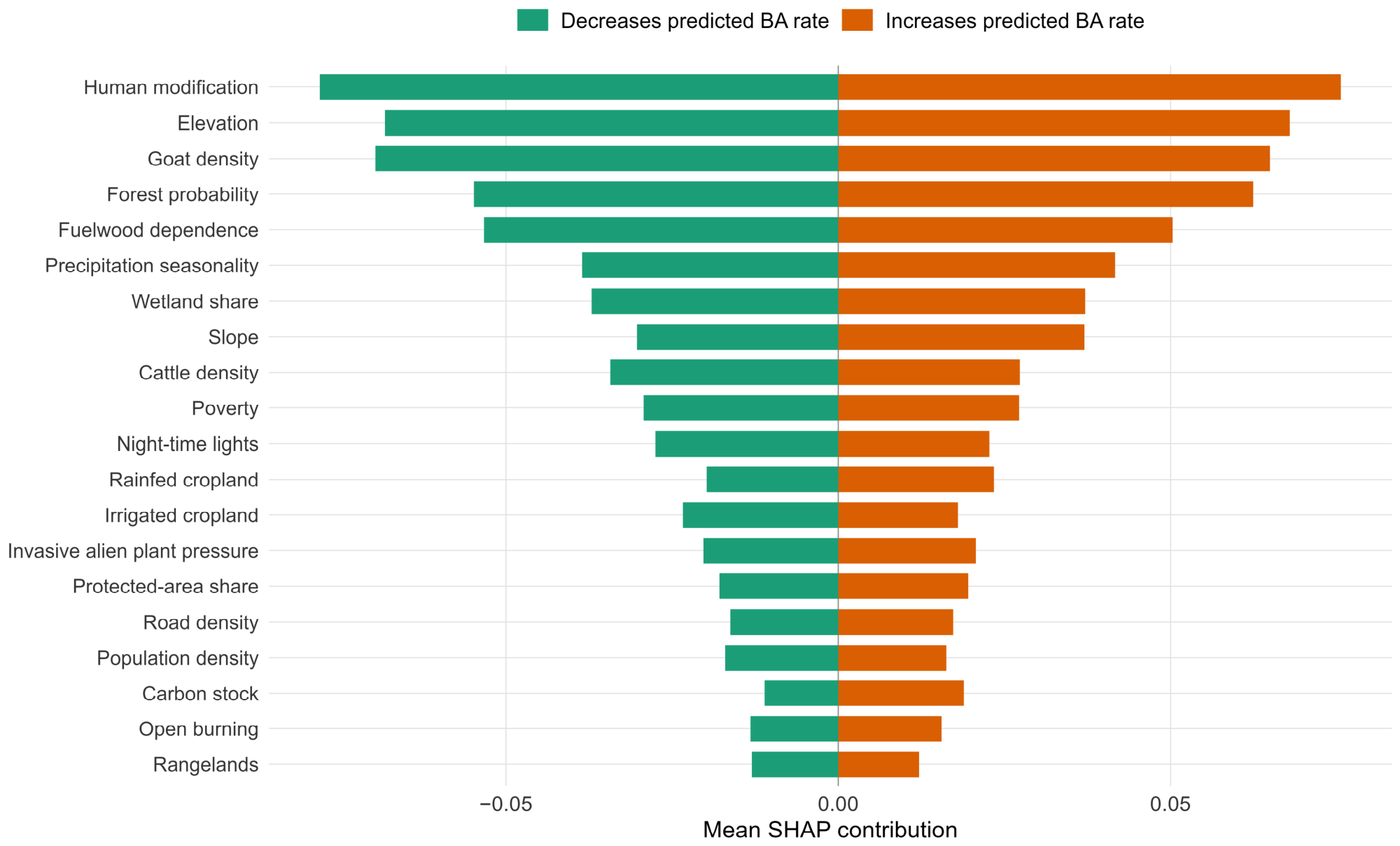
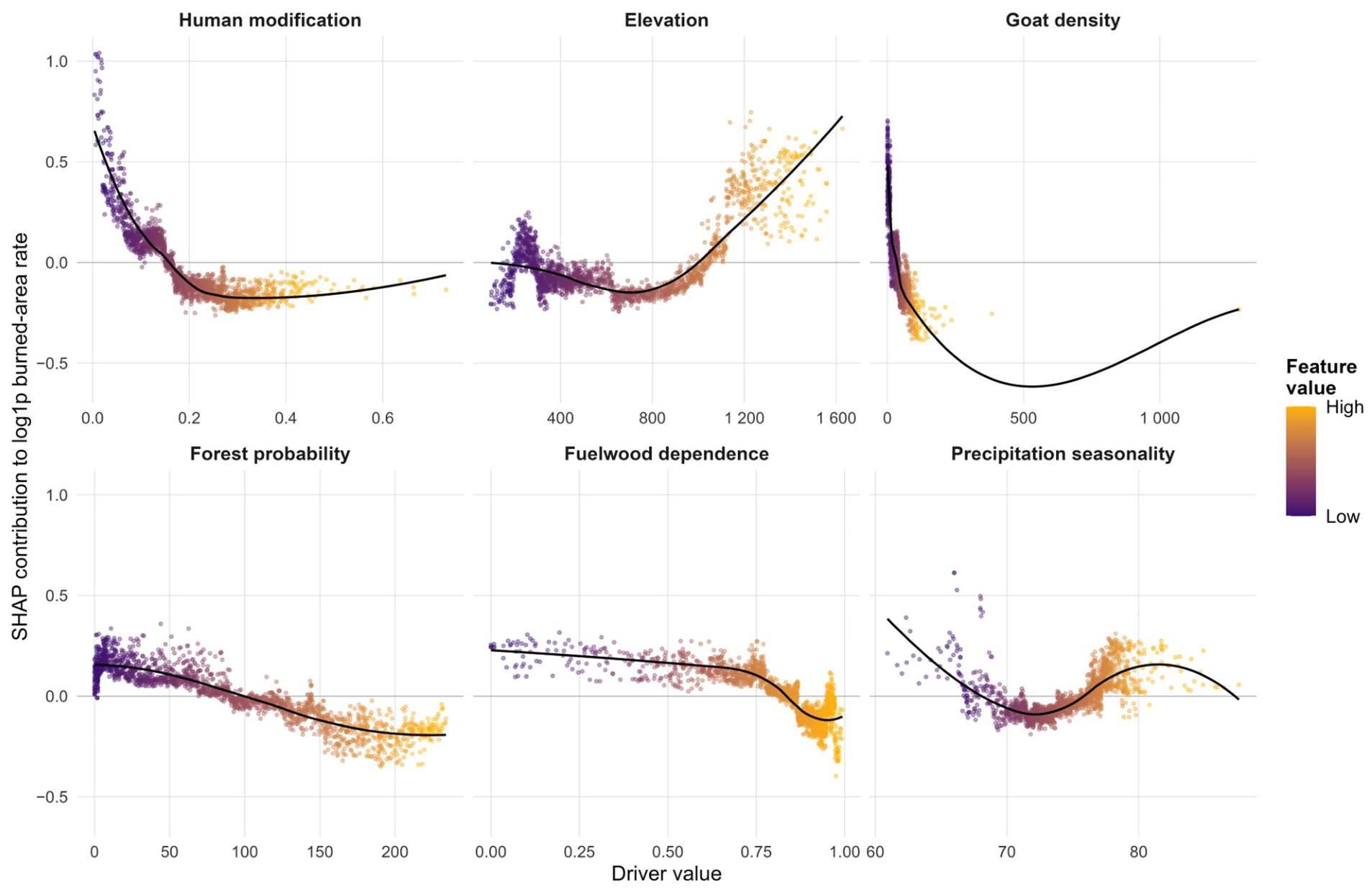
3.4. Explainable Models Identified Non-Linear Socio-Ecological Associations with Burned-Area Rates
3.5. Empirical Separation Thresholds
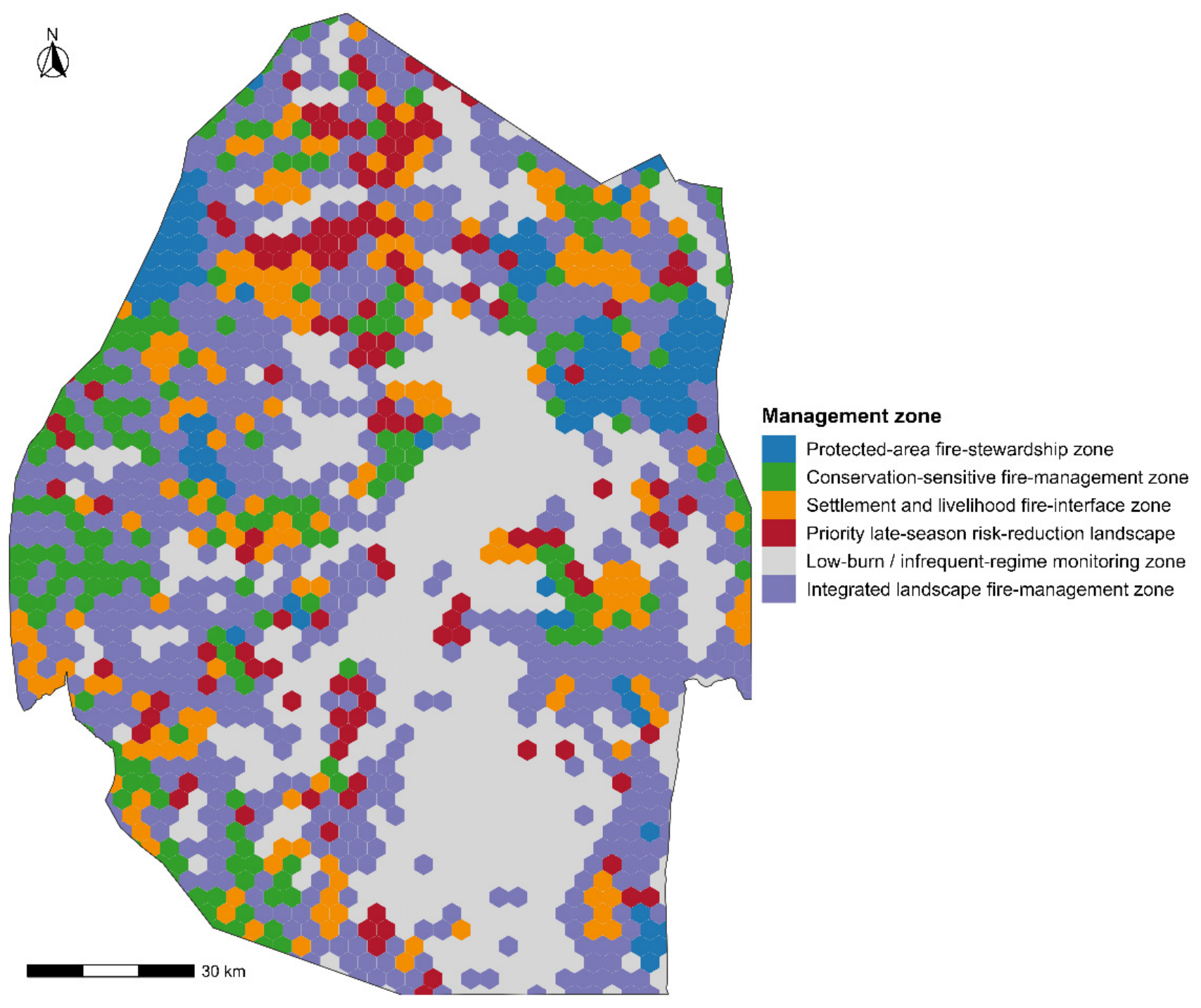
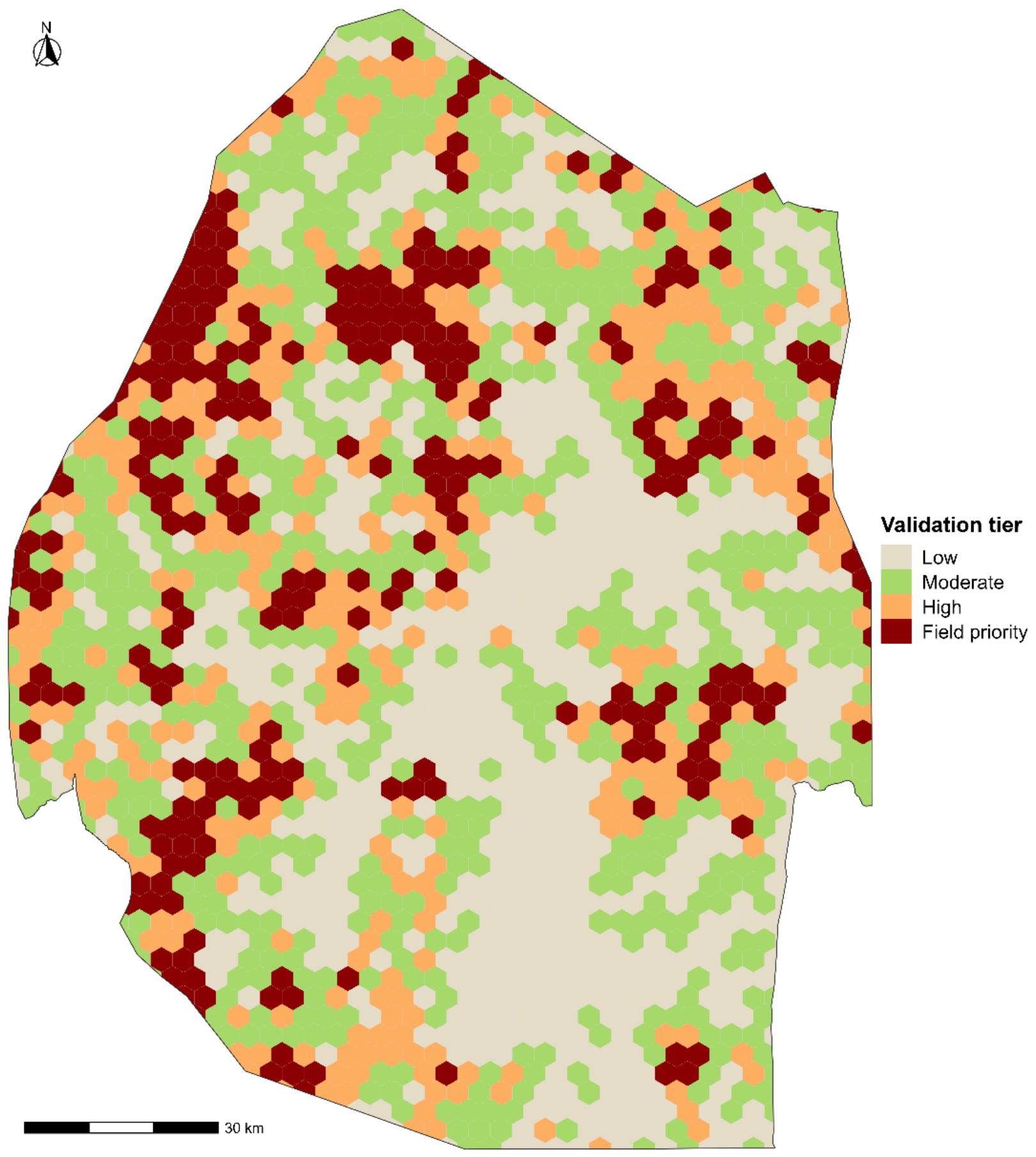
3.6. Fire-Stewardship Zones Translate Diagnostics into Action Classes
4. Discussion
4.1. Heterogeneous Fire Regimes Within a Compact National Mosaic
4.2. Seasonal Concentration and Management Windows
4.3. Non-Linear Socio-Ecological Associations and Limits of Explanation
4.4. From Typologies to Differentiated Stewardship in Eswatini
4.5. Transferability to African Mosaic Landscapes
4.6. Uncertainty, Scale Effects and Future Research
5. Conclusions
Supplementary Materials
Funding
Institutional Review Board Statement
Informed Consent Statement
Data Availability Statement
Acknowledgments
Conflicts of Interest
References
- Bowman, D.M.J.S.; Balch, J.K.; Artaxo, P.; Bond, W.J.; Carlson, J.M.; Cochrane, M.A.; D’Antonio, C.M.; DeFries, R.S.; Doyle, J.C.; Harrison, S.P.; et al. Fire in the Earth system. Science 2009, 324, 481–484. [Google Scholar] [CrossRef] [Scilit] [PubMed]
- Bond, W.J.; Keeley, J.E. Fire as a global herbivore: The ecology and evolution of flammable ecosystems. Trends Ecol. Evol. 2005, 20, 387–394. [Google Scholar] [CrossRef] [Scilit] [PubMed]
- Pausas, J.G.; Keeley, J.E. A burning story: The role of fire in the history of life. BioScience 2009, 59, 593–601. [Google Scholar] [CrossRef] [Scilit]
- Bowman, D.M.J.S.; Balch, J.K.; Artaxo, P.; Bond, W.J.; Cochrane, M.A.; D’Antonio, C.M.; DeFries, R.; Johnston, F.H.; Keeley, J.E.; Krawchuk, M.A.; et al. The human dimension of fire regimes on Earth. J. Biogeogr. 2011, 38, 2223–2236. [Google Scholar] [CrossRef] [Scilit] [PubMed]
- Archibald, S. Managing the human component of fire regimes: Lessons from Africa. Philos. Trans. R. Soc. B 2016, 371, 20150346. [Google Scholar] [CrossRef] [Scilit] [PubMed]
- Krawchuk, M.A.; Moritz, M.A.; Parisien, M.-A.; Van Dorn, J.; Hayhoe, K. Global pyrogeography: The current and future distribution of wildfire. PLoS ONE 2009, 4, e5102. [Google Scholar] [CrossRef] [Scilit] [PubMed]
- Archibald, S.; Lehmann, C.E.R.; Gómez-Dans, J.L.; Bradstock, R.A. Defining pyromes and global syndromes of fire regimes. Proc. Natl. Acad. Sci. USA 2013, 110, 6442–6447. [Google Scholar] [CrossRef] [Scilit] [PubMed]
- Sankaran, M.; Hanan, N.P.; Scholes, R.J.; Ratnam, J.; Augustine, D.J.; Cade, B.S.; Gignoux, J.; Higgins, S.I.; Le Roux, X.; Ludwig, F.; et al. Determinants of woody cover in African savannas. Nature 2005, 438, 846–849. [Google Scholar] [CrossRef] [Scilit] [PubMed]
- Staver, A.C.; Archibald, S.; Levin, S.A. Tree cover in sub-Saharan Africa: Rainfall and fire constrain forest and savanna as alternative stable states. Ecology 2011, 92, 1063–1072. [Google Scholar] [CrossRef] [PubMed]
- Lehmann, C.E.R.; Anderson, T.M.; Sankaran, M.; Higgins, S.I.; Archibald, S.; Hoffmann, W.A.; Hanan, N.P.; Williams, R.J.; Fensham, R.J.; Felfili, J.; et al. Savanna vegetation–fire–climate relationships differ among continents. Science 2014, 343, 548–552. [Google Scholar] [CrossRef] [Scilit] [PubMed]
- Ramo, R.; Roteta, E.; Bistinas, I.; van Wees, D.; Bastarrika, A.; Chuvieco, E.; van der Werf, G.R.; Boschetti, L. African burned area and fire carbon emissions are strongly impacted by small fires undetected by coarse-resolution satellite data. Proc. Natl. Acad. Sci. USA 2021, 118, e2011160118. [Google Scholar] [CrossRef] [Scilit] [PubMed]
- Andela, N.; Morton, D.C.; Giglio, L.; Chen, Y.; van der Werf, G.R.; Kasibhatla, P.S.; DeFries, R.S.; Collatz, G.J.; Hantson, S.; Kloster, S.; et al. A human-driven decline in global burned area. Science 2017, 356, 1356–1362. [Google Scholar] [CrossRef] [Scilit] [PubMed]
- Kelly, L.T.; Giljohann, K.M.; Duane, A.; Aquilué, N.; Archibald, S.; Batllori, E.; Bennett, A.F.; Buckland, S.T.; Canelles, Q.; Clarke, M.F.; et al. Fire and biodiversity in the Anthropocene. Science 2020, 370, eabb0355. [Google Scholar] [CrossRef] [Scilit] [PubMed]
- van der Werf, G.R.; Randerson, J.T.; Giglio, L.; van Leeuwen, T.T.; Chen, Y.; Rogers, B.M.; Mu, M.; van Marle, M.J.E.; Morton, D.C.; Collatz, G.J.; et al. Global fire emissions estimates during 1997–2016. Earth Syst. Sci. Data 2017, 9, 697–720. [Google Scholar] [CrossRef] [Scilit]
- Randerson, J.T.; Chen, Y.; van der Werf, G.R.; Rogers, B.M.; Morton, D.C. Global burned area and biomass burning emissions from small fires. J. Geophys. Res. Biogeosci. 2012, 117, G04012. [Google Scholar] [CrossRef] [Scilit]
- Andela, N.; Morton, D.C.; Giglio, L.; Paugam, R.; Chen, Y.; Hantson, S.; van der Werf, G.R.; Randerson, J.T. The Global Fire Atlas of individual fire size, duration, speed and direction. Earth Syst. Sci. Data 2019, 11, 529–552. [Google Scholar] [CrossRef] [Scilit]
- Giglio, L.; Boschetti, L.; Roy, D.P.; Humber, M.L.; Justice, C.O. The Collection 6 MODIS burned area mapping algorithm and product. Remote. Sens. Environ. 2018, 217, 72–85. [Google Scholar] [CrossRef] [Scilit] [PubMed]
- Roy, D.P.; Boschetti, L.; Justice, C.O.; Ju, J. The Collection 5 MODIS burned area product: Global evaluation by comparison with the MODIS active fire product. Remote Sens. Environ. 2008, 112, 3690–3707. [Google Scholar] [CrossRef] [Scilit]
- Chuvieco, E.; Lizundia-Loiola, J.; Pettinari, M.L.; Ramo, R.; Padilla, M.; Tansey, K.; Mouillot, F.; Laurent, P.; Storm, T.; Heil, A.; et al. Generation and analysis of a new global burned area product based on MODIS 250 m reflectance bands and thermal anomalies. Earth Syst. Sci. Data 2018, 10, 2015–2031. [Google Scholar] [CrossRef] [Scilit]
- Humber, M.L.; Boschetti, L.; Giglio, L.; Justice, C.O. Spatial and temporal intercomparison of four global burned area products. Int. J. Digit. Earth 2019, 12, 460–484. [Google Scholar] [CrossRef] [Scilit] [PubMed]
- Boschetti, L.; Roy, D.P.; Giglio, L.; Huang, H.; Zubkova, M.; Humber, M.L. Global validation of the Collection 6 MODIS burned area product. Remote Sens. Environ. 2019, 235, 111490. [Google Scholar] [CrossRef] [Scilit] [PubMed]
- Nieman, W.A.; van Wilgen, B.W.; Leslie, A.J. A review of fire management practices in African savanna-protected areas. Koedoe 2021, 63, a1655. [Google Scholar] [CrossRef] [Scilit]
- Croker, A.R.; Woods, J.; Kountouris, Y. Changing fire regimes in East and Southern Africa’s savanna-protected areas: Opportunities and challenges for indigenous-led savanna burning emissions abatement schemes. Fire Ecol. 2023, 19, 63. [Google Scholar] [CrossRef] [Scilit]
- Croker, A.R.; Woods, J.; Kountouris, Y. Community-based fire management in East and Southern African savanna-protected areas: A review of the published evidence. Earth’s Future 2023, 11, e2023EF003552. [Google Scholar] [CrossRef] [Scilit]
- van Wilgen, B.W.; Govender, N.; Biggs, H.C.; Ntsala, D.; Funda, X.N. Response of savanna fire regimes to changing fire-management policies in a large African national park. Conserv. Biol. 2004, 18, 1533–1540. [Google Scholar] [CrossRef] [Scilit]
- Parr, C.L.; Andersen, A.N. Patch mosaic burning for biodiversity conservation: A critique of the pyrodiversity paradigm. Conserv. Biol. 2006, 20, 1610–1619. [Google Scholar] [CrossRef] [Scilit] [PubMed]
- Russell-Smith, J.; Cook, G.D.; Cooke, P.M.; Edwards, A.C.; Lendrum, M.; Meyer, C.P.; Whitehead, P.J. Managing fire regimes in north Australian savannas: Applying Aboriginal approaches to contemporary global problems. Front. Ecol. Environ. 2013, 11, e55–e63. [Google Scholar] [CrossRef] [Scilit]
- Moritz, M.A.; Batllori, E.; Bradstock, R.A.; Gill, A.M.; Handmer, J.; Hessburg, P.F.; Leonard, J.; McCaffrey, S.; Odion, D.C.; Schoennagel, T.; et al. Learning to coexist with wildfire. Nature 2014, 515, 58–66. [Google Scholar] [CrossRef] [Scilit] [PubMed]
- Gill, A.M.; Stephens, S.L. Scientific and social challenges for the management of fire-prone wildland–urban interfaces. Environ. Res. Lett. 2009, 4, 034014. [Google Scholar] [CrossRef] [Scilit]
- Kingdom of Eswatini, Central Statistical Office. 2017 Population and Housing Census; Central Statistical Office: Mbabane, Eswatini, 2019.
- Government of the Kingdom of Eswatini. Swaziland’s Second National Biodiversity Strategy and Action Plan 2016–2022; Ministry of Tourism and Environmental Affairs: Mbabane, Eswatini, 2016.
- Government of the Kingdom of Eswatini. Sixth National Report to the Convention on Biological Diversity; Ministry of Tourism and Environmental Affairs: Mbabane, Eswatini, 2019.
- Government of the Kingdom of Eswatini. National Climate Change Policy; Ministry of Tourism and Environmental Affairs: Mbabane, Eswatini, 2016.
- Turner, M.G. Landscape ecology: The effect of pattern on process. Annu. Rev. Ecol. Syst. 1989, 20, 171–197. [Google Scholar] [CrossRef]
- Forman, R.T.T. Land Mosaics: The Ecology of Landscapes and Regions; Cambridge University Press: Cambridge, UK, 1995. [Google Scholar]
- Shannon, C.E. A mathematical theory of communication. Bell Syst. Tech. J. 1948, 27, 379–423, 623–656. [Google Scholar] [CrossRef] [Scilit]
- Pielou, E.C. The measurement of diversity in different types of biological collections. J. Theor. Biol. 1966, 13, 131–144. [Google Scholar] [CrossRef] [Scilit]
- Martin, R.E.; Sapsis, D.B. Fires as agents of biodiversity: Pyrodiversity promotes biodiversity. In Proceedings of the Symposium on Biodiversity of Northwestern California, Santa Rosa, CA, USA, 28–30 October 1991; Kerner, H.M., Ed.; Wildland Resources Center, University of California: Berkeley, CA, USA, 1992; pp. 150–157. [Google Scholar]
- MacQueen, J. Some methods for classification and analysis of multivariate observations. In Proceedings of the Fifth Berkeley Symposium on Mathematical Statistics and Probability, Berkeley, CA, USA, 21 June 1967; Volume 1, pp. 281–297. [Google Scholar]
- Lloyd, S. Least squares quantization in PCM. IEEE Trans. Inf. Theory 1982, 28, 129–137. [Google Scholar] [CrossRef] [Scilit]
- Rousseeuw, P.J. Silhouettes: A graphical aid to the interpretation and validation of cluster analysis. J. Comput. Appl. Math. 1987, 20, 53–65. [Google Scholar] [CrossRef] [Scilit]
- Laris, P. Humanizing savanna biogeography: Linking human practices with ecological patterns in a frequently burned savanna of southern Mali. Ann. Assoc. Am. Geogr. 2011, 101, 1067–1088. [Google Scholar] [CrossRef] [Scilit]
- Kennedy, C.M.; Oakleaf, J.R.; Theobald, D.M.; Baruch-Mordo, S.; Kiesecker, J. Managing the middle: A shift in conservation priorities based on the global human modification gradient. Glob. Change Biol. 2019, 25, 811–826. [Google Scholar] [CrossRef] [Scilit] [PubMed]
- Elvidge, C.D.; Baugh, K.; Zhizhin, M.; Hsu, F.-C.; Ghosh, T. VIIRS night-time lights. Int. J. Remote Sens. 2017, 38, 5860–5879. [Google Scholar] [CrossRef] [Scilit]
- Hansen, M.C.; Potapov, P.V.; Moore, R.; Hancher, M.; Turubanova, S.A.; Tyukavina, A.; Thau, D.; Stehman, S.V.; Goetz, S.J.; Loveland, T.R.; et al. High-resolution global maps of 21st-century forest cover change. Science 2013, 342, 850–853. [Google Scholar] [CrossRef] [Scilit] [PubMed]
- Zanaga, D.; Van De Kerchove, R.; De Keersmaecker, W.; Souverijns, N.; Brockmann, C.; Quast, R.; Wevers, J.; Grosu, A.; Paccini, A.; Vergnaud, S.; et al. ESA WorldCover 10 m 2020 v100. Zenodo 2021. Available online: https://zenodo.org/records/5571936 (accessed on 11 February 2026).
- Funk, C.; Peterson, P.; Landsfeld, M.; Pedreros, D.; Verdin, J.; Shukla, S.; Husak, G.; Rowland, J.; Harrison, L.; Hoell, A.; et al. The Climate Hazards Infrared Precipitation with Stations: A new environmental record for monitoring extremes. Sci. Data 2015, 2, 150066. [Google Scholar] [CrossRef] [Scilit] [PubMed]
- Fick, S.E.; Hijmans, R.J. WorldClim 2: New 1-km spatial resolution climate surfaces for global land areas. Int. J. Climatol. 2017, 37, 4302–4315. [Google Scholar] [CrossRef] [Scilit]
- Hersbach, H.; Bell, B.; Berrisford, P.; Hirahara, S.; Horányi, A.; Muñoz-Sabater, J.; Nicolas, J.; Peubey, C.; Radu, R.; Schepers, D.; et al. The ERA5 global reanalysis. Q. J. R. Meteorol. Soc. 2020, 146, 1999–2049. [Google Scholar] [CrossRef] [Scilit]
- Venter, O.; Sanderson, E.W.; Magrach, A.; Allan, J.R.; Beher, J.; Jones, K.R.; Possingham, H.P.; Laurance, W.F.; Wood, P.; Fekete, B.M.; et al. Global terrestrial human footprint maps for 1993 and 2009. Sci. Data 2016, 3, 160067. [Google Scholar] [CrossRef] [Scilit] [PubMed]
- Friedman, J.H. Greedy function approximation: A gradient boosting machine. Ann. Stat. 2001, 29, 1189–1232. [Google Scholar] [CrossRef] [Scilit]
- Chen, T.; Guestrin, C. XGBoost: A scalable tree boosting system. In Proceedings of the 22nd ACM SIGKDD International Conference on Knowledge Discovery and Data Mining, San Francisco, CA, USA, 13–17 August 2016; pp. 785–794. [Google Scholar] [CrossRef] [Scilit]
- Natekin, A.; Knoll, A. Gradient boosting machines, a tutorial. Front. Neurorobot. 2013, 7, 21. [Google Scholar] [CrossRef] [Scilit] [PubMed]
- Lundberg, S.M.; Lee, S.-I. A unified approach to interpreting model predictions. In Advances in Neural Information Processing Systems 30; Curran Associates: Red Hook, NY, USA, 2017; pp. 4765–4774. [Google Scholar]
- Lundberg, S.M.; Erion, G.; Chen, H.; DeGrave, A.; Prutkin, J.M.; Nair, B.; Katz, R.; Himmelfarb, J.; Bansal, N.; Lee, S.-I. From local explanations to global understanding with explainable AI for trees. Nat. Mach. Intell. 2020, 2, 56–67. [Google Scholar] [CrossRef] [Scilit] [PubMed]
- Molnar, C. Interpretable Machine Learning, 2nd ed.; Independently Published: Munich, Germany, 2022; Available online: https://christophm.github.io/interpretable-ml-book/ (accessed on 13 June 2026).
- Myers, R.L. Living with Fire: Sustaining Ecosystems and Livelihoods Through Integrated Fire Management; The Nature Conservancy: Tallahassee, FL, USA, 2006. [Google Scholar]
- Food and Agriculture Organization of the United Nations. Fire Management: Voluntary Guidelines; Fire Management Working Paper 17; FAO: Rome, Italy, 2006. [Google Scholar]
- Food and Agriculture Organization of the United Nations. Community-Based Fire Management: A Review; FAO Forestry Paper 166; FAO: Rome, Italy, 2011. [Google Scholar]
- Kull, C.A. Isle of Fire: The Political Ecology of Landscape Burning in Madagascar; University of Chicago Press: Chicago, IL, USA, 2004. [Google Scholar]
- Pyne, S.J. World Fire: The Culture of Fire on Earth; University of Washington Press: Seattle, WA, USA, 1995. [Google Scholar]
- Smit, I.P.J.; Baard, J.A.; van Wilgen, B.W. Fire regimes and management options in mixed grassland-fynbos vegetation, South Africa. Fire Ecol. 2024, 20, 29. [Google Scholar] [CrossRef] [Scilit]
- Hudak, A.T.; Brockett, B.H. Trends in fire patterns in a southern African savanna under alternative land use practices. Agric. Ecosyst. Environ. 2004, 101, 307–325. [Google Scholar] [CrossRef] [Scilit]
- Archibald, S.; Nickless, A.; Govender, N.; Scholes, R.J.; Lehsten, V. Climate and the inter-annual variability of fire in southern Africa: A meta-analysis using long-term field data and satellite-derived burnt area data. Glob. Ecol. Biogeogr. 2010, 19, 794–809. [Google Scholar] [CrossRef] [Scilit]








| Metric | Operational Definition | Management Rationale |
|---|---|---|
| Burned area | Mapped area per hexagon-year | Absolute extent |
| Burned-area rate | Percentage of hexagon burned per fire year | Fire pressure and exposure to repeated burning |
| Events/fire year | Mean number of GFA events intersecting a hexagon per fire year | Separates frequent small-fire mosaics from infrequent large-fire regimes |
| Active fire-year share | Share of fire years with any recorded burned area | Recurrence and persistence of fire activity |
| Fire-year recurrence interval | Number of observed fire years divided by number of fire years with recorded fire; no-fire units retained explicitly | Approximate return interval for field interpretation |
| Late dry-season share | Share of events occurring during August–October | Indicator of late-season hazard and management timing |
| Large-fire share | Share of burned area from events above the national 95th percentile size threshold | Identifies dominance of large events rather than many small burns |
| Pyrodiversity | Normalised diversity of season × size-class combinations | Captures variation in fire timing and event-size structure |
| Burned-area trend | Kendall tau trend in fire-year burned area | Highlights emerging intensification or decline |
| Class | n | Area % | BA Rate % | Events yr-1 | Active Share | FYRI yr | Late Dry | Large Fire | Trend τ |
|---|---|---|---|---|---|---|---|---|---|
| NFI | 332 | 18.4 | 0.00 | 0.00 | 0.00 | — | 0.00 | 0.00 | 0.00 |
| INF | 63 | 3.5 | 0.19 | 0.04 | 0.04 | 25.0 | 0.00 | 0.00 | 0.00 |
| FSM | 180 | 9.3 | 18.95 | 1.92 | 0.88 | 1.1 | 0.44 | 0.21 | −0.02 |
| PMS | 211 | 11.6 | 2.87 | 0.24 | 0.20 | 5.0 | 0.62 | 0.73 | −0.03 |
| LDS | 182 | 10.2 | 0.24 | 0.04 | 0.04 | 25.0 | 1.00 | 0.00 | 0.00 |
| LFD | 287 | 15.3 | 7.40 | 0.88 | 0.56 | 1.8 | 0.63 | 0.36 | −0.03 |
| EBI | 314 | 17.5 | 0.88 | 0.20 | 0.16 | 6.2 | 0.57 | 0.00 | 0.14 |
| MIX | 263 | 14.2 | 1.42 | 0.28 | 0.20 | 5.0 | 0.75 | 0.00 | −0.13 |
| Model | Test n | Response | Held-Out Performance | Use in Study |
|---|---|---|---|---|
| Burned-area-rate regression | 367 | log1p burned-area rate | R2 = 0.71; Spearman rho = 0.75; RMSE = 4.21 | Retained for TreeSHAP interpretation |
| Regime-type classification | 367 | eight typology classes | accuracy = 0.16; balanced accuracy = 0.15 | Diagnostic only; not used as headline evidence |
| Variable/Index | Threshold | Low-Side Burden | High-Side Burden | Score |
|---|---|---|---|---|
| Fire–ecosystem–people nexus | 0.268 | 0.000 | 0.500 | 0.500 |
| Socio-ecological fire burden | 0.299 | 0.000 | 0.500 | 0.500 |
| Cattle density | 37.000 | 0.145 | 0.356 | 0.210 |
| Ecological sensitivity | 0.153 | 0.145 | 0.355 | 0.210 |
| Wetland share | 0.006 | 0.165 | 0.336 | 0.170 |
| Population density | 59.745 | 0.165 | 0.329 | 0.151 |
| Precipitation seasonality | 74.832 | 0.176 | 0.326 | 0.147 |
| Elevation | 510.751 | 0.180 | 0.320 | 0.140 |
| Forest probability | 86.653 | 0.314 | 0.186 | 0.128 |
| Carbon stock | −81.124 | 0.176 | 0.313 | 0.117 |
| Management Zone | Area (km2) | Share of Hex-Grid Area (%) |
|---|---|---|
| Integrated landscape | 6106 | 35.2 |
| Low-burn monitoring | 5426 | 31.3 |
| Settlement–livelihood interface | 1789 | 10.3 |
| Conservation sensitive | 1775 | 10.2 |
| Late-season risk reduction | 1257 | 7.2 |
| Protected-area stewardship | 1008 | 5.8 |
Disclaimer/Publisher’s Note: The statements, opinions and data contained in all publications are solely those of the individual author(s) and contributor(s) and not of MDPI and/or the editor(s). MDPI and/or the editor(s) disclaim responsibility for any injury to people or property resulting from any ideas, methods, instructions or products referred to in the content. |
© 2026 by the author. Licensee MDPI, Basel, Switzerland. This article is an open access article distributed under the terms and conditions of the Creative Commons Attribution (CC BY) license.
Share and Cite
Dlamini, W.M.D. Mapping the Fire–Ecosystem–People Nexus in a Southern African Mosaic: Explainable Fire-Regime Typologies and Stewardship Zones for Eswatini, 2001–2025. Fire 2026, 9, 309. https://doi.org/10.3390/fire9070309
Dlamini WMD. Mapping the Fire–Ecosystem–People Nexus in a Southern African Mosaic: Explainable Fire-Regime Typologies and Stewardship Zones for Eswatini, 2001–2025. Fire. 2026; 9(7):309. https://doi.org/10.3390/fire9070309
Chicago/Turabian StyleDlamini, Wisdom M. D. 2026. "Mapping the Fire–Ecosystem–People Nexus in a Southern African Mosaic: Explainable Fire-Regime Typologies and Stewardship Zones for Eswatini, 2001–2025" Fire 9, no. 7: 309. https://doi.org/10.3390/fire9070309
APA StyleDlamini, W. M. D. (2026). Mapping the Fire–Ecosystem–People Nexus in a Southern African Mosaic: Explainable Fire-Regime Typologies and Stewardship Zones for Eswatini, 2001–2025. Fire, 9(7), 309. https://doi.org/10.3390/fire9070309