
Article

Experimental Investigation on Morphology of Hydrogen-Blended Natural Gas Jet Fires Under Inclined Conditions


1
College of Safety Science and Engineering, Nanjing Tech University, Nanjing 211816, China
2
Institute of Fire Science and Engineering, Nanjing Tech University, Nanjing 211816, China
*
Authors to whom correspondence should be addressed.
Fire 2026, 9(7), 270; https://doi.org/10.3390/fire9070270
Submission received: 8 May 2026 / Revised: 12 June 2026 / Accepted: 22 June 2026 / Published: 25 June 2026

Abstract

Growing interest in transporting hydrogen via natural gas pipelines highlights the need to understand flame characteristics during accidental leakage. However, limited literature is available on addressing the flame horizontal projection length of hydrogen-blended natural gas jet fires under inclined conditions. Therefore, a series of experiments was conducted to investigate inclined H2/CH4 jet fires, with methane used as a surrogate for natural gas. Experiments with hydrogen content ranging from 0% to 20% were performed to examine the effects of inclination angle (0°, 30°, 45°, 60°, and 90°), nozzle diameter (2, 3, and 4 mm), and gas flow rate (4–25 L/min) on the flame morphological characteristics. It was found that the flame color evolves from a transparent blue base to a yellow luminous tip with increasing hydrogen content or fuel exit velocity, accompanied by soot enrichment in the luminous region. The flame horizontal projection length was quantified under different conditions. Results show it is only slightly affected when the hydrogen content is below 20%, whereas it increases with fuel exit velocity and nozzle diameter, and decreases with inclination angle. An explicit model was proposed by introducing the dimensionless heat release rate ( Q ˙ * ), which predicts the flame horizontal projection length with good agreement with experimental data. The findings provide a basis for the safety design and risk assessment of hydrogen-blended natural gas pipelines.

1. Introduction

By 2050, hydrogen energy is expected to contribute 80 EJ (80 × 1018 J), accounting for roughly 18% of final energy demand [1]. In this context of rapid development, its large-scale application remains a critical bottleneck [2,3]. Hydrogen can be transported in various forms, including gaseous hydrogen (e.g., pipelines and tube trailers), liquid hydrogen (e.g., cryogenic tanker trucks), and material-based storage (e.g., metal hydrides). Among them, blending hydrogen into existing natural gas pipelines at a certain ratio is a particularly promising transport approach, as it facilitates large-scale and long-distance hydrogen delivery while avoiding the construction of pure hydrogen pipelines and other costly infrastructure [4,5]. Nevertheless, the addition of hydrogen increases the leakage probability and elevates the risk of non-premixed jet fires, which may adversely affect surrounding equipment and pose serious threats to personnel [5,6]. Therefore, investigating the flame combustion characteristics of hydrogen-blended natural gas is of significant practical importance for assessing and mitigating jet fire risks in hydrogen-blending pipeline applications.
The orientation of a jet fire is inherently uncertain and depends on leakage and surrounding conditions. Vertical and horizontal jet fires are the two most representative configurations, where jet momentum and buoyancy act either in alignment or orthogonally. Extensive prior research has been conducted on these configurations, with emphasis on flame morphology (e.g., flame height, lift-off distance, width, projection, and trajectory), as well as thermal and radiative characteristics. For example, Zhao et al. [7] experimentally investigated an H2/CH4-fueled cooktop burner and suggested that hydrogen addition up to about 15% by volume has little effect on combustion characteristics. Wu et al. [8] conducted experiments on laminar H2/CH4 flames and reported that increasing hydrogen volume fraction (0–50%) results in shorter flame lengths, higher flame temperatures, and a significant increase in the soot-free length fraction. Ouyang et al. [9] used FireFOAM to simulate vertical H2/CH4 jet fires (with a maximum flame height of 0.73 m) and found that increasing the hydrogen volume fraction (0–20%) reduces the maximum flame height by up to 11%. Lowesmith and Hankinson [10] conducted full-scale experiments on H2/CH4 jet fires and argued that the flame height and incident radiation at a hydrogen volume fraction of 22% are comparable to those of natural gas. Zhao et al. [6] performed systematic laboratory-scale experiments on vertical H2/CH4 jet fires over a wide range of hydrogen volume fractions (0–90%). The results demonstrate that, for a 3 mm nozzle, flame height decreases with increasing hydrogen content; however, for a 5 mm nozzle, it remains nearly constant at hydrogen volume fractions ≤ 50%. Furthermore, the normalized flame width follows a power dependence on the dimensionless heat release rate ( Q ˙ * ), with exponents of 0.48 and 0.59 for the two nozzles. Jiang et al. [11] observed experimentally that increasing hydrogen volume fraction (0–30%) reduces flame height by 14.1–17.3% and extends the applicability of the Kalghatgi model [12] for H2/CH4 flame lift-off prediction. Han et al. [13] investigated the effect of leakage geometry on vertical H2/CH4 jet fires and identified it as a primary determinant of consequence severity. They also discovered that a 20% hydrogen addition reduces the methane flame height by 9.4–14.5%.
Studer et al. [14] conducted large-scale experiments on horizontal H2/CH4 jet fires at high hydrogen volume fractions greater than 50% and indicated that the dimensionless flame length in the momentum-dominated regime is affected. Wang et al. [15] further validated Studer’s experimental case at a hydrogen volume fraction of 80% using FireFOAM, showing good agreement in flame length and a radiative fraction of approximately 0.1. Kong et al. [16] examined horizontal H2/CH4 jet fires with flame lengths of about 1 m at hydrogen volume fractions of 0–50% and reported that hydrogen addition increases flame temperature and reduces lift-off distance. Moreover, they proposed an empirical correlation for the horizontal flame projection as a function of hydrogen content. It is observed in their subsequent large-scale experimental work [17] that when the hydrogen volume fraction exceeds 50%, the region of high radiative heat flux decreases significantly, and the accurate prediction of thermal radiation relies on flame length models. Li et al. [18] showed that, for under-expanded horizontal H2/CH4 jet fires, both flame length and radiative fraction are inversely proportional to the flame Froude number (Frf), while flame length also exhibits a clear dependence on hydrogen volume fraction. Compared with the above studies on vertical and horizontal H2/CH4 jet fires, research on inclined configurations remains limited, despite their practical relevance. In an early classic work, a physical model based on the continuity, momentum, and mixture fraction equations was developed by Peters and Göttgens [19] to predict the trajectory of inclined jet fires, and subsequently, Gore and Jian [20] provided an analytical solution. Recently, Wu et al. [21] attempted to determine the flame trajectory of inclined H2/CH4 jet fires with inclination angles ranging from −30° to 30° by solving an integral model, and further incorporated a flame trajectory length correlation to quantify the flame envelope boundary. In addition, they proposed a theoretical framework consisting of their developed flame trajectory model, a notional nozzle model, and a line-source radiation model to predict the radiative heat flux of H2/CH4 jet fires [22]. The framework is applicable to jet fires under both high- and low-pressure leak conditions. The above studies have provided valuable insights into the combustion characteristics of H2/CH4 jet fires. However, the effect of inclination angle on flame behavior is insufficiently explored. Given their frequent occurrence in real-fire scenarios, further investigation is required.
In summary, adding hydrogen to natural gas pipelines and safely transporting the mixture is of critical importance in practical applications. Nevertheless, research on diffusion H2/CH4 jet fires under different inclination angles remains scarce. Thus, in this study, a series of jet fire experiments involving H2/CH4 mixtures were conducted under varying inclination angles (0–90°), leakage orifice sizes (2–4 mm), hydrogen contents (0–20% by volume), and gas flow rates (4–25 L/min). First, the evolution of flame morphology was experimentally characterized and analyzed. Particular attention is then paid to quantifying the horizontal projection length of inclined H2/CH4 jet fires, thereby filling the existing data gap. Finally, a physics-based correlation was developed to predict the horizontal projection length in all conditions. The findings of this study help to understand the inclined H2/CH4 jet fires better and provide meaningful guidance for the safety design and risk mitigation of hydrogen transport using existing natural gas pipeline systems.

2. Experiments

2.1. Experiment Methodology

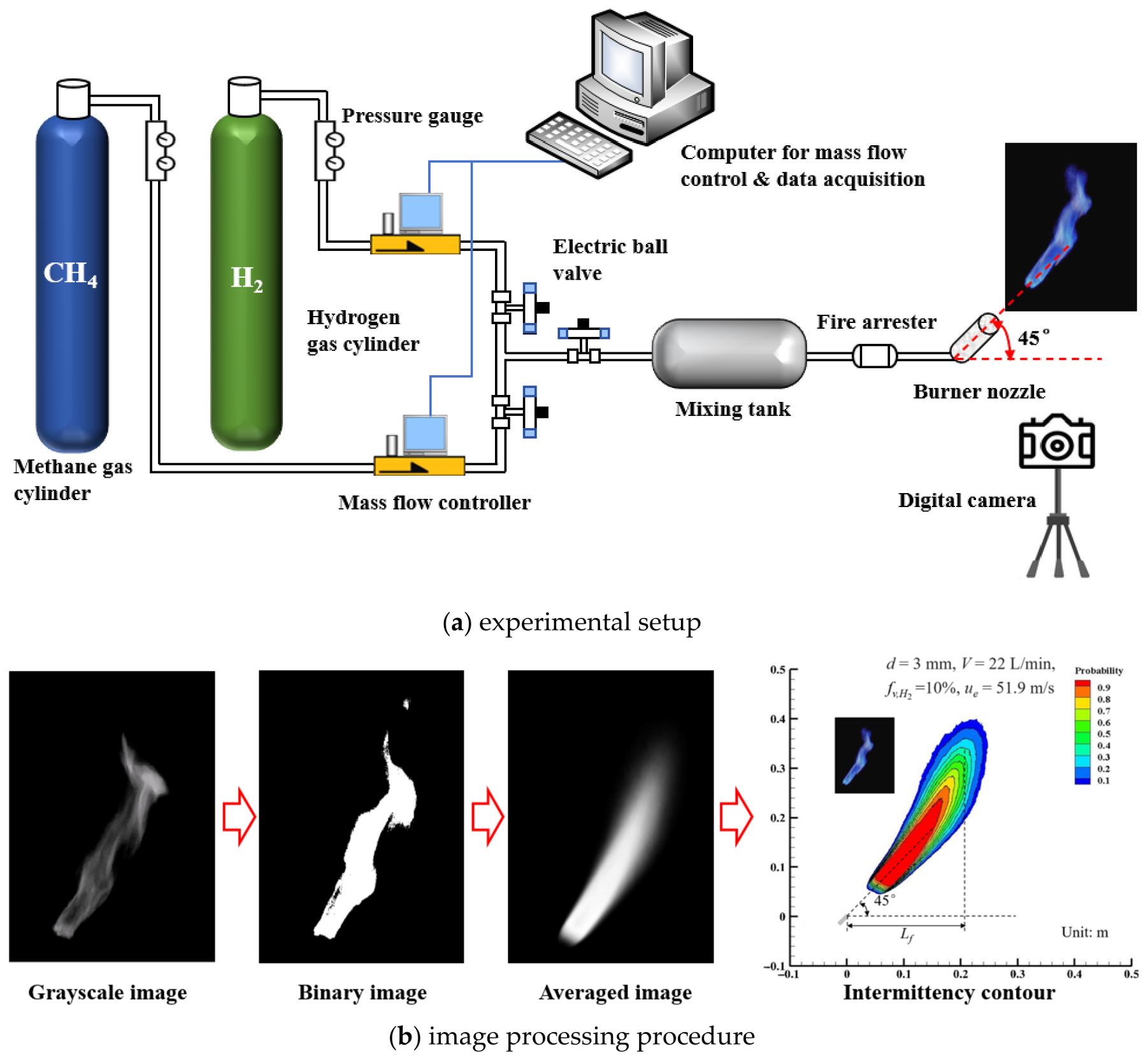
Figure 1a depicts a schematic of the experimental setup for the inclined H2/CH4 jet fires, which consists of a stainless-steel piping system, a gas supply system, an adjustable-angle burner, and a data acquisition system. The gas supply system includes methane and hydrogen cylinders (purity of 99.9%). The gases were premixed in a high-pressure tank to obtain the desired hydrogen volume fractions prior to discharge through the burner nozzle. Flow rates of methane and hydrogen were independently regulated using two identical Alicat mass flow controllers (Alicat Scientific, Tucson, AZ, USA) with an accuracy of 0.1 SLPM (standard liters per minute). Three stainless-steel round nozzles with inner diameters of 2, 3, and 4 mm, positioned 1 m above the ground, were employed to generate the jet fires. As summarized in Table 1, the experimental conditions in this paper include five hydrogen volume fractions ranging from 0 to 20% (interval: 5%) and five inclination angles (0°, 30°, 45°, 60°, and 90°, with respect to the horizontal). Note that for each nozzle, 3–7 cases with different gas flow rates were studied, since excessively high flow rates in smaller nozzles can result in flame blowout. The corresponding fuel exit velocity ranged from 5.3 m/s to 51.9 m/s, yielding Reynolds numbers ( R e = u e d / ν ) from 5.6 × 10² to 8.3 × 10³ and Froude numbers ( F r = u e 2 / g d ) from 7.2 × 10² to 1.2 × 10⁵. These results indicate that the jet flows span the transition from buoyancy- to momentum-controlled regimes, approaching momentum-dominated conditions at higher Fr.
To precisely capture the morphology of inclined H2/CH4 jet fires, a digital camera with a resolution of 3840 × 2160 (Sony Corporation, Tokyo, Japan) was used to record the flame shape at 25 fps. The camera was positioned perpendicular to the nozzle axis at a distance of 2 m. The recording duration was at least 1 min, and 1000 consecutive flame images were extracted from the middle 40 s of the video for subsequent image processing. The images were first converted to grayscale and then binarized using Otsu’s method [23]. Averaging all binarized images yielded an intermittency contour of the flame, from which the flame boundary was finally determined, as indicated in Figure 1b, The intermittency of 50%, as widely adopted in previous studies [21,24,25], was used to determine the flame horizontal projection length in this work. Specifically, it is defined as the horizontal distance from the nozzle exit to the rightmost edge of the 50% intermittency contour.

2.2. Test Repeatability

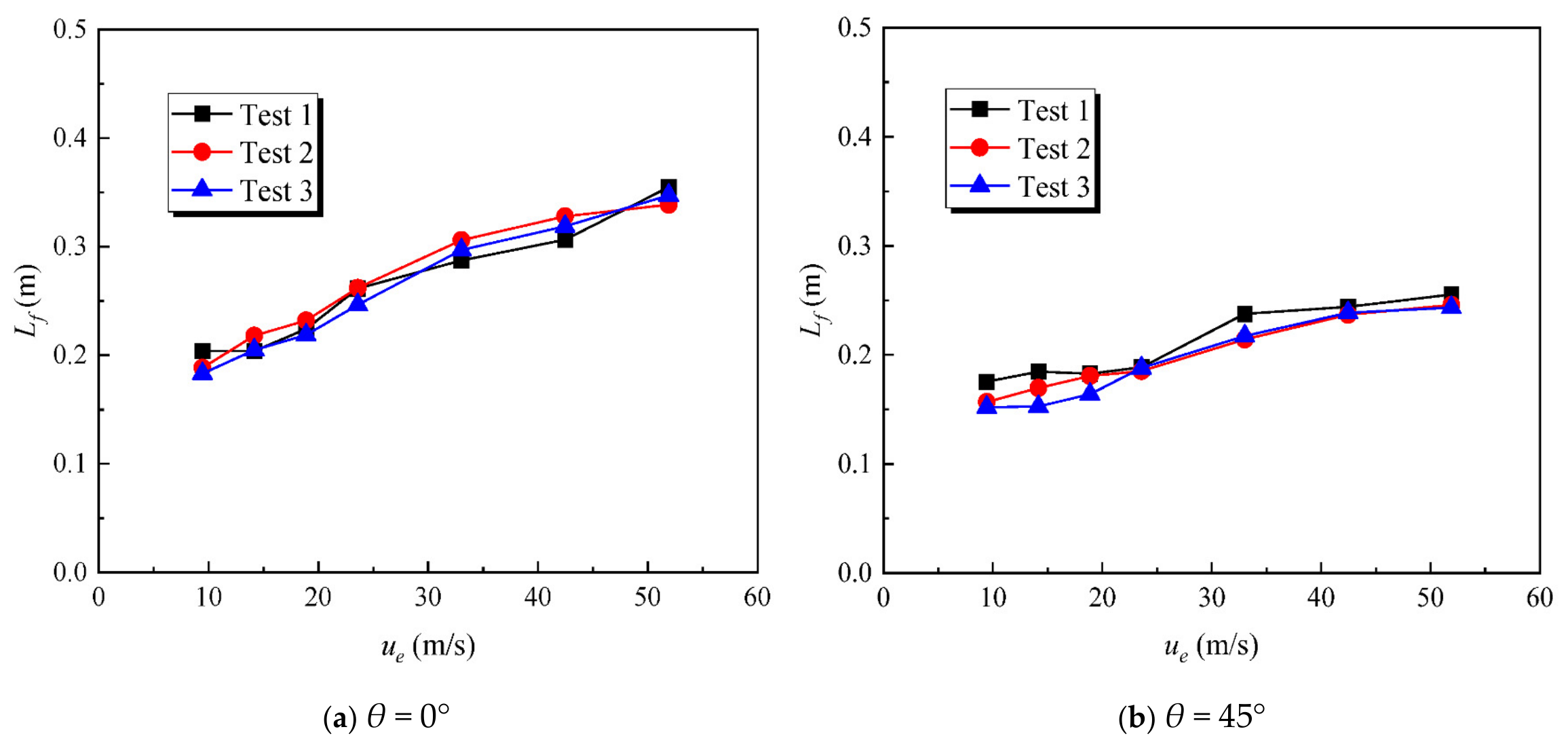
All experiments were conducted in a dark indoor environment to avoid disturbances from external airflow. The ambient pressure was 101 ± 5 kPa, and the temperature was approximately 298 K. To ensure the repeatability, each experimental condition was repeated three times. Figure 2 shows the measured flame horizontal projection lengths versus fuel exit velocity for typical cases with inclination angles of 0° and 45° and a nozzle diameter of 3 mm. The overall mean flame horizontal projection length, based on all measurements, was 0.26 ± 0.056 m and 0.20 ± 0.035 m (mean ± standard deviation), respectively. The variations are within the experimental uncertainty, indicating acceptable measurement repeatability.

3. Results and Discussion

3.1. Phenomenon Observations

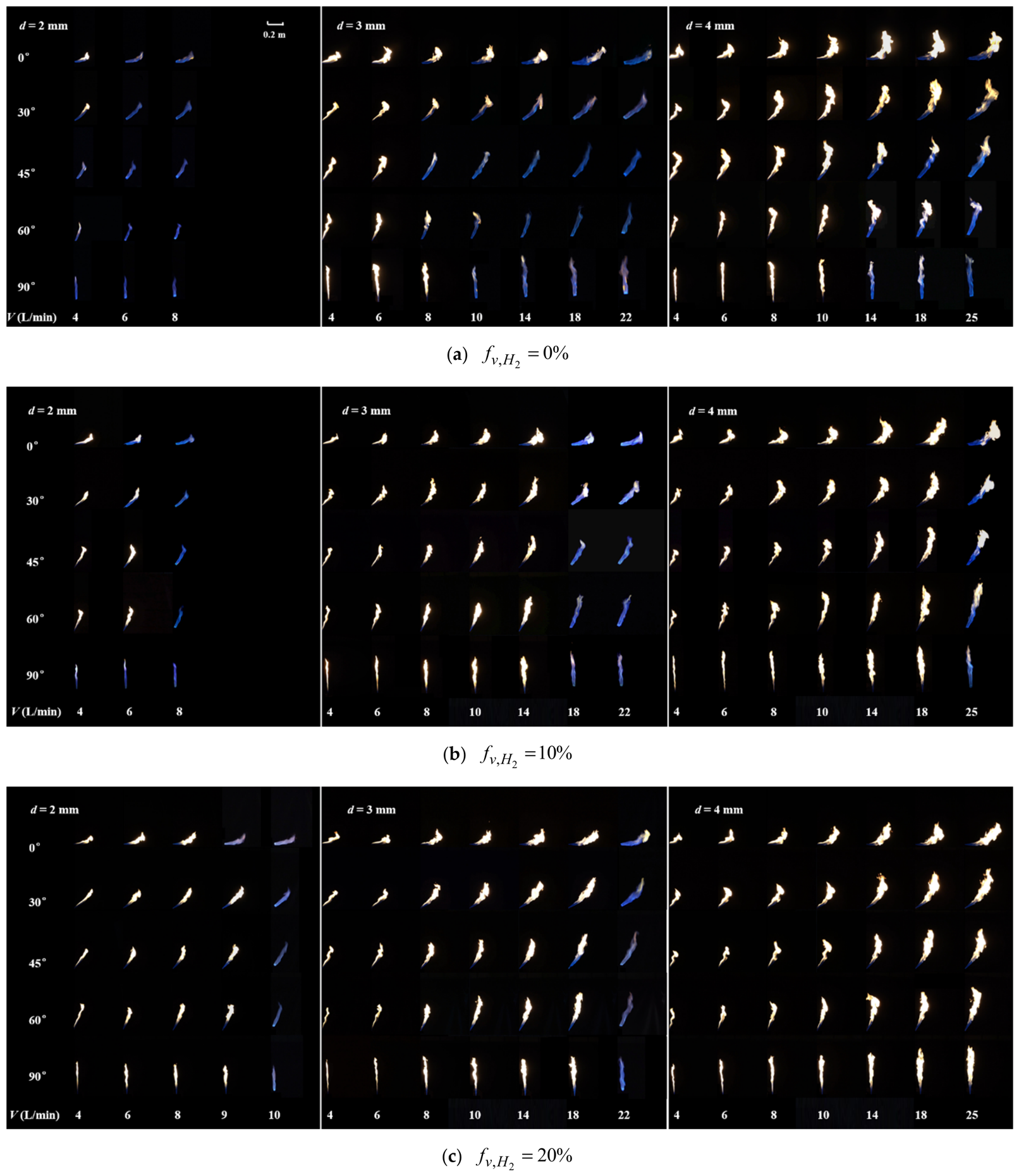
Figure 3 illustrates the typical flame morphologies of inclined H2/CH4 jet fires under different experimental conditions. It is seen that, for a fixed nozzle diameter and hydrogen content, increasing the inclination angle gradually changes the flame orientation from horizontal toward vertical. This weakens the competition between buoyancy and momentum effects, resulting in a decrease in the flame horizontal projection length. Meanwhile, with increasing fuel exit velocity, the flame horizontal projection length increases significantly due to the enhanced fuel supply. However, at higher fuel exit velocities, the horizontal projection length tends to remain nearly constant. In this regime, the outer edge of the flame transitions from smooth to sharp, which can be attributed to intensified interaction between the jet and the surrounding air [26].
In contrast, for a fixed nozzle diameter and inclination angle, increasing the hydrogen content within the range of 0–20% considered in this study has a limited effect on the flame horizontal projection length. This is because, on the one hand, hydrogen addition alters the jet flow properties by reducing the mixture density and increasing the jet momentum flux, thereby promoting flame extension. On the other hand, owing to hydrogen’s higher diffusivity and faster reaction rates, the chemical reactions proceed more rapidly, leading to a more compact flame region [21]. These two effects tend to offset each other in influencing the flame horizontal projection length. Of note, the hydrogen-enriched flames are more stable and less prone to blow out, which enables a broader measurable range of the flame horizontal projection length (Figure 3b,c). In addition, another visually evident feature is that, as hydrogen content increases, the blue, soot-free region extends from the flame base and progressively covers the bright yellow flame tip, likely due to the reduced C/H ratio and suppressed the formation of soot precursors [8]. For the nozzle diameter, the flame horizontal projection length generally increases with increasing diameter, as expected, due to the greater fuel availability for combustion. Overall, these factors jointly influence the flame horizontal projection length.

3.2. Correlation for Flame Horizontal Projection Length

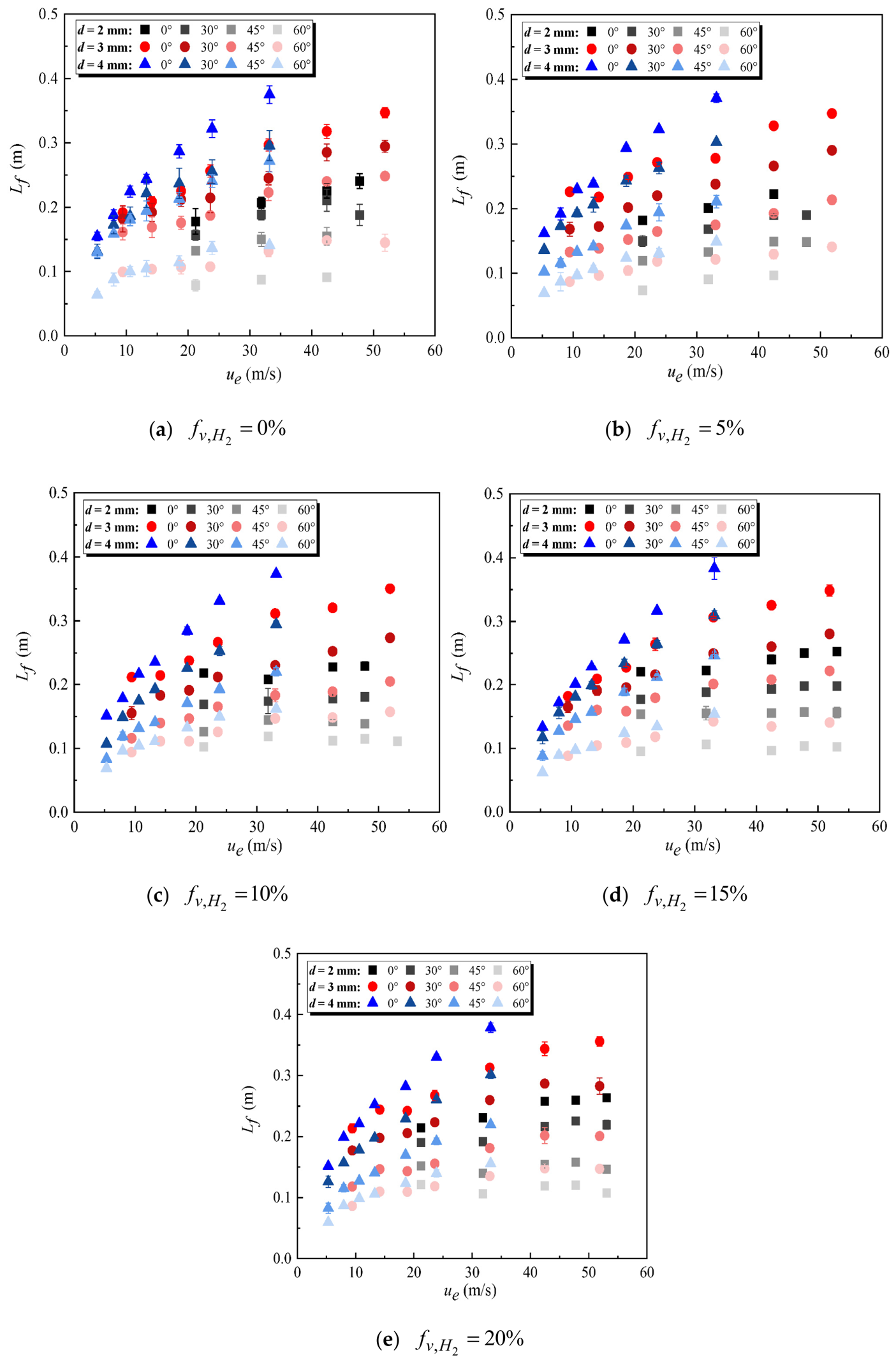
For these flame images, the horizontal projection length, as defined in Figure 1b, was evaluated under all conditions listed in Table 1. The corresponding quantitative results for different hydrogen volume fractions are plotted in Figure 4. It is worth noting that the flame horizontal projection length of vertical jet fires is approximately equal to the flame diameter and negligible compared with that of inclined ones. Therefore, only data within the 0–60° inclined range are presented in the following analysis. The major findings are as follows: (1) At a given inclination angle, the attainable flame horizontal projection length depends on both hydrogen content and nozzle diameter; (2) Under the same hydrogen content, the flame horizontal projection length increases with fuel exit velocity and nozzle diameter, while decreasing with inclination angle; (3) The variation in flame horizontal projection length with fuel exit velocity exhibits a similar trend across hydrogen contents ranging from 0 to 20%.
Physically, the flame horizontal projection length is governed by the initial momentum and buoyancy, which determine the mixing rate between the jet and surrounding air and thereby influence the flame extent. Delichatsios [27] proposed that jet diffusion flames can be classified into several regimes based on the relative importance of laminar–turbulent transition and buoyancy-momentum competition. As the fuel exit velocity increases, the flame evolves from a laminar regime to a transitional and then turbulent regime, with the influence of momentum on the flame horizontal projection length becoming increasingly significant. At low exit velocities, molecular diffusion dominates, and the flame horizontal projection length increases approximately linearly with fuel exit velocity. With further increases in exit velocity, the flame enters a transitional regime, where buoyancy effects are reduced. Because air entrainment becomes much more efficient than molecular diffusion and intensifies with increasing fuel exit velocity, the flame horizontal projection length tends to level off in transitional and fully turbulent regimes.
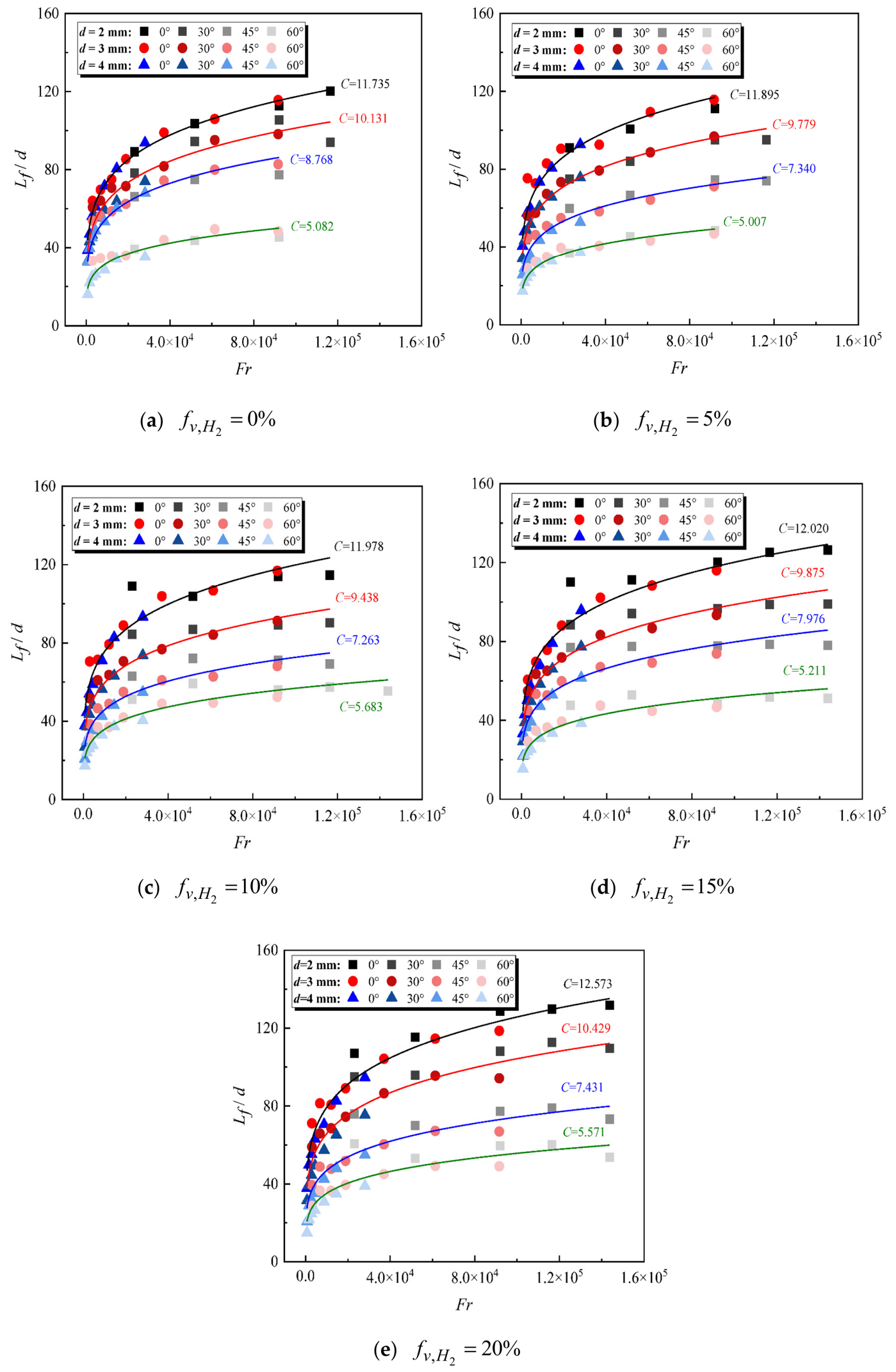
In previous studies [24,28,29], the flame length normalized by the nozzle diameter is frequently correlated with the Froude number at the nozzle exit (Fr) for horizontal jet fires involving different fuels. In particular, Zhou et al. [30] reviewed the available experimental data and proposed a semi-empirical correlation with a power-law exponent of 2/5, which can be expressed as:
L f / d = C F r 2 / 5
where C is an empirical coefficient. Following this approach, Equation (1) is applied to correlate the flame horizontal projection length of inclined H2/CH4 jet fires, as presented in Figure 5. It can be observed that, for the same hydrogen content, the dimensionless flame horizontal projection length at each inclination angle still follows the above correlation with the Froude number; however, the empirical coefficient C decreases with increasing inclination angle. Similarly as for the flame length, different flow regimes can also be identified based on a critical Froude number of 1 × 10⁵ [29]. When Fr < 1 × 10⁵, the flame is buoyancy-dominated and the horizontal projection length increases approximately proportionally with Fr; when Fr > 1 × 10⁵, it approaches a nearly constant value, indicating a transition to a momentum-dominated regime.
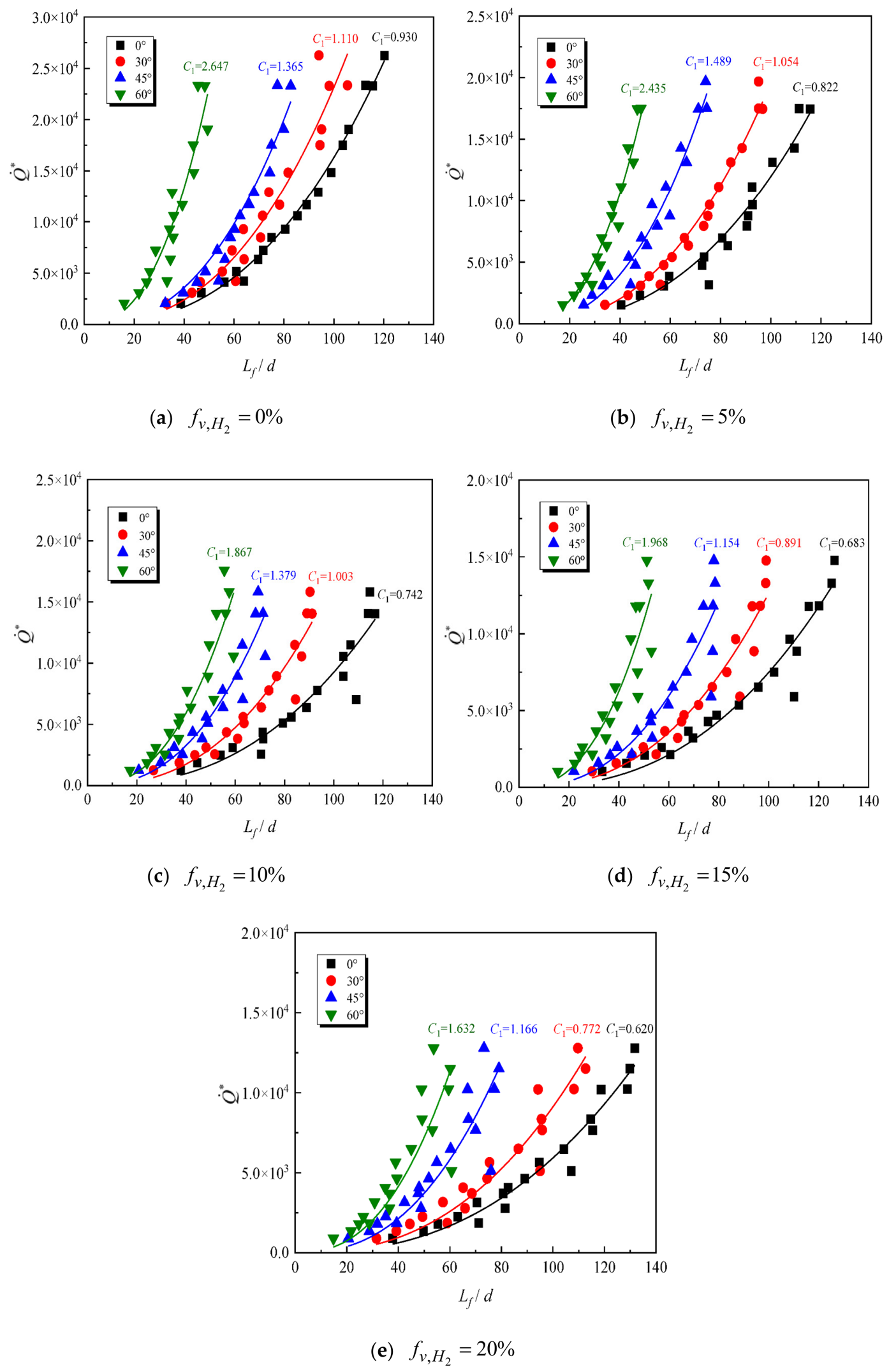
Notably, the scaling relationship between the flame horizontal projection length and the Froude number is not self-similar at different inclination angles. A classical flame length correlation for fire plumes, proposed by Quintiere and Grove [31] based on a unified entrainment analysis, is introduced here. It is in the form of
Q ˙ * = 0.0059 1 χ r 1 / 2 Δ H c / s c p T 3 / 2 L f d 1 / 2 1 + 2 C 1 L f d 2
where Q ˙ * = Q ˙ / ρ T c p g d 5 / 2 is the dimensionless heat release rate, χr is the flame radiation fraction, Δ H c is heat of combustion, s is the air to fuel mass stoichiometric ratio, C1 is an empirical coefficient reflecting the near-field entrainment strength, g is the acceleration of gravity, and cp, ρ and T are the specific heat, density and temperature of ambient air, respectively.
The stoichiometric ratio of the H2/CH4 mixture can be calculated as follows [32]:
m C H 4 + b H 2 + 2 m + b 2 O 2 + 3.76 N 2 m C O 2 + 2 m + b H 2 O + 3.76 2 m + b 2 N 2
s = 4.76 2 m + b / 2 m + b M a i r M f u e l
where m and b are the stoichiometric coefficients, and Mair and Mfuel are the molar masses of air and fuel, respectively.
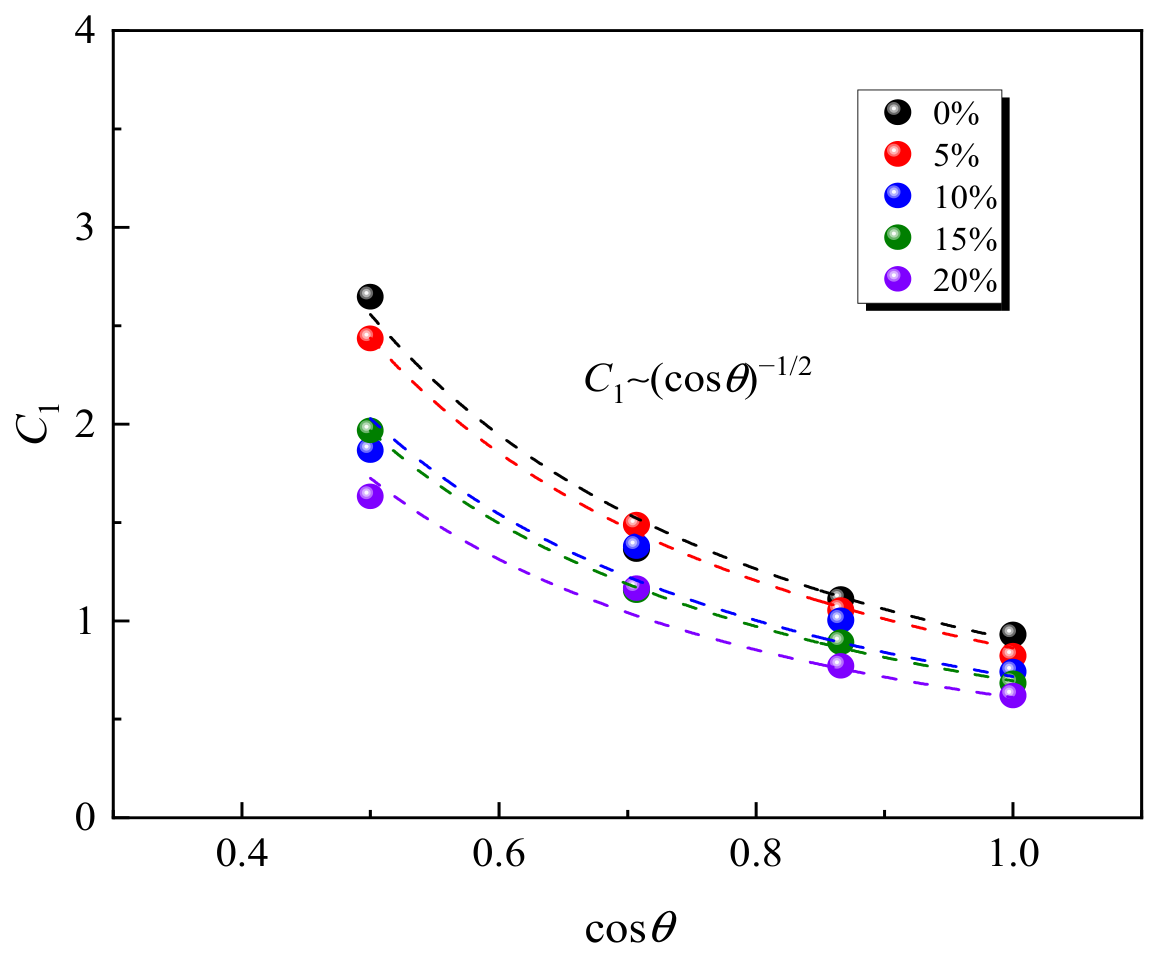
Figure 6 presents the data fitting of Q ˙ * versus L f / d for each inclination angle within each hydrogen content, based on Equation (2). The results show that the inclination angle significantly affects the entrainment coefficient C1, whereas its dependence on hydrogen content is weak. Specifically, C1 increases with increasing inclination angle. Furthermore, for each hydrogen content, the relationship between C1 and the inclination angle is examined, as shown in Figure 7. It is found that C1 follows a power-law with respect to cos θ with an exponent of −1/2, i.e.,
C 1 cos θ 1 / 2
Although the relationship between the entrainment coefficient C1 and the inclination angle has been clarified, it cannot be directly applied to predict the flame horizontal projection length. Therefore, an explicit and practical correlation is required.
As suggested by Heskestad [33] and Tao et al. [34], the dimensionless heat release rate ( Q ˙ * ) can be used to directly calculate the flame length. By introducing Q ˙ * , it is given that
L f / d C 2 Q ˙ * 2 / 5
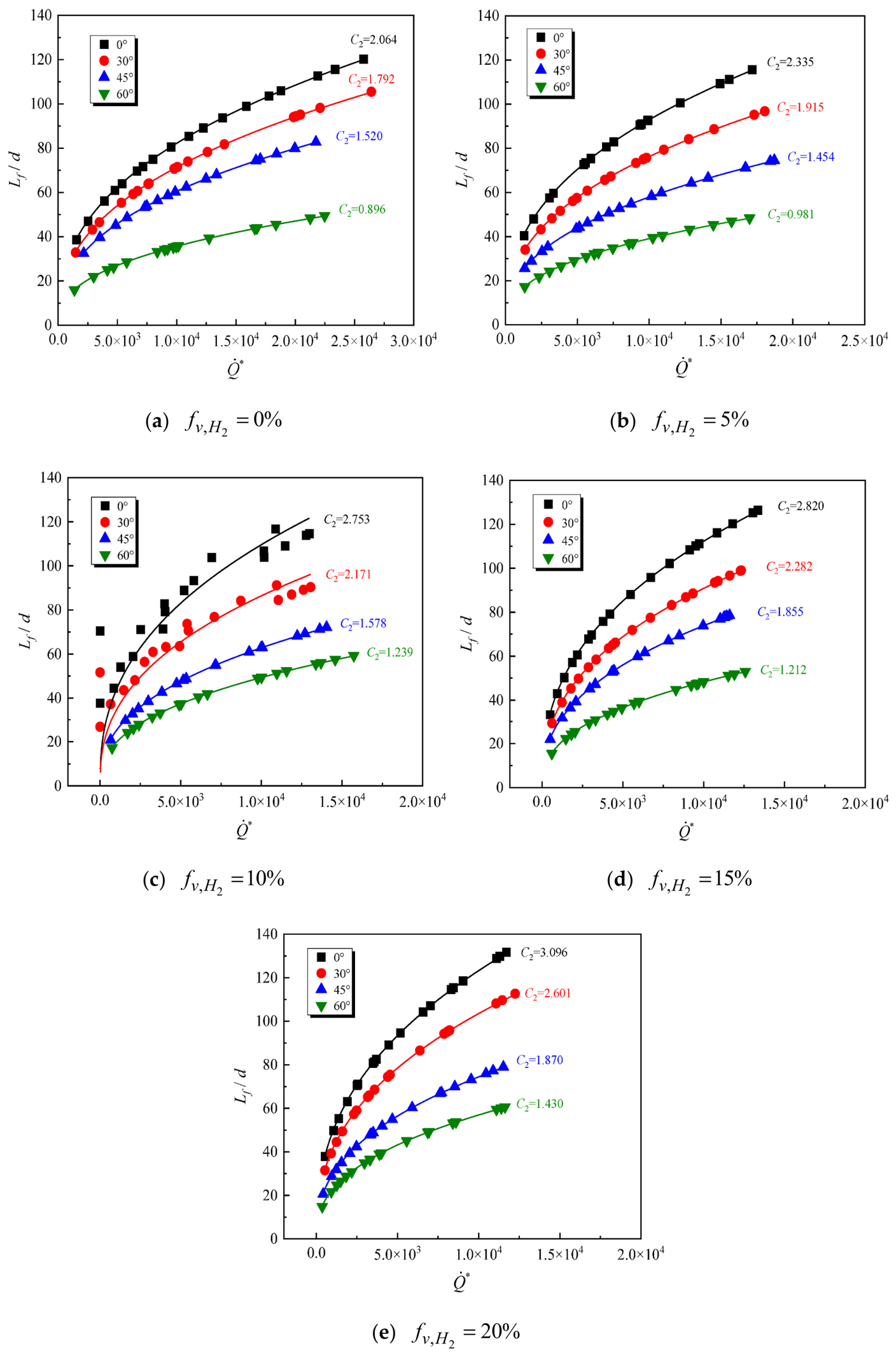
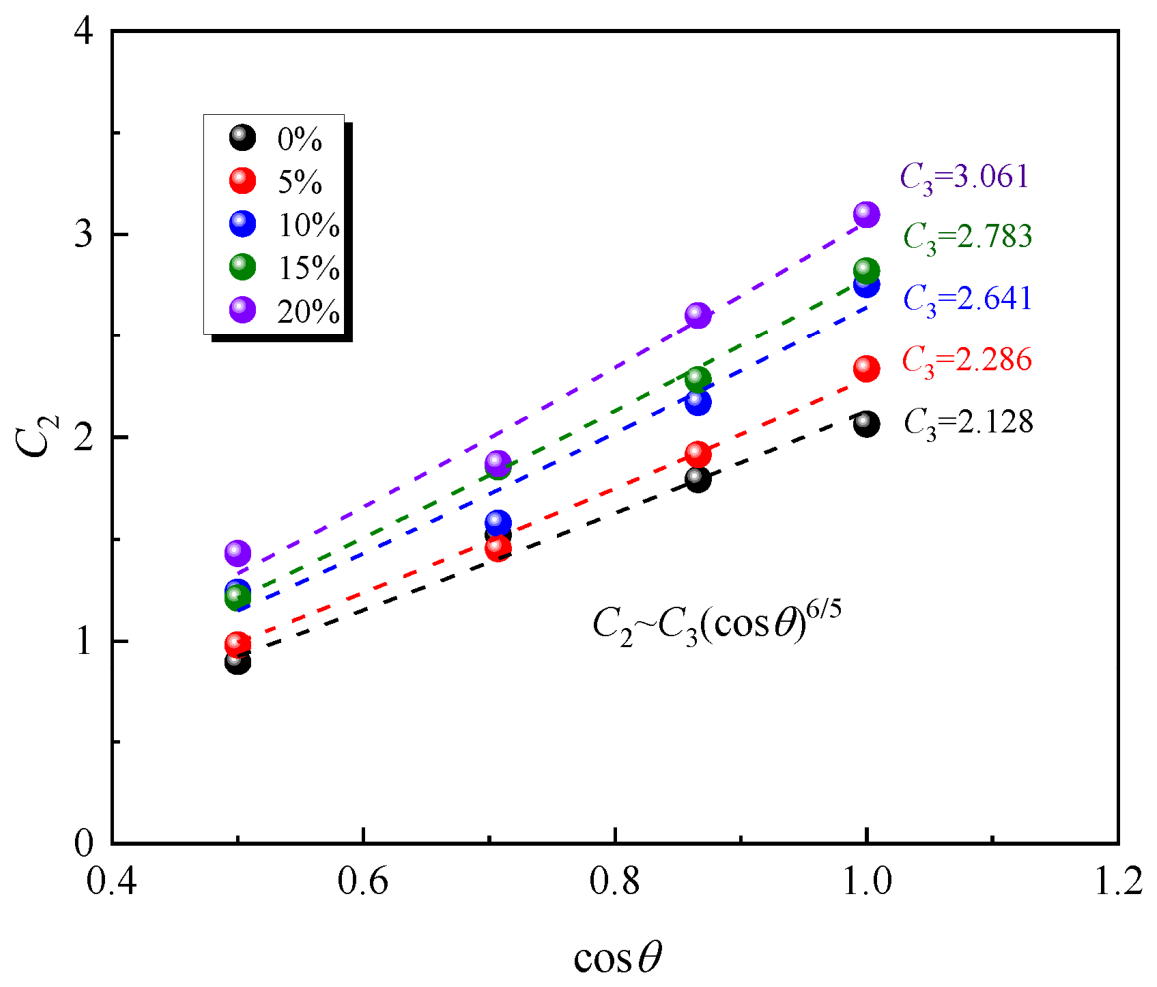
Figure 8 shows the dimensionless flame horizontal projection length ( L f / d ) can be well fitted by Equation (6) at different inclination angles for each hydrogen content. Note that, in contrast to C1, the coefficient C2 decreases with increasing inclination angle, and exhibits a power-law dependence on cos θ with an exponent of 6/5. Accordingly, the relationship can be written as:
C 2 C 3 cos θ 6 / 5
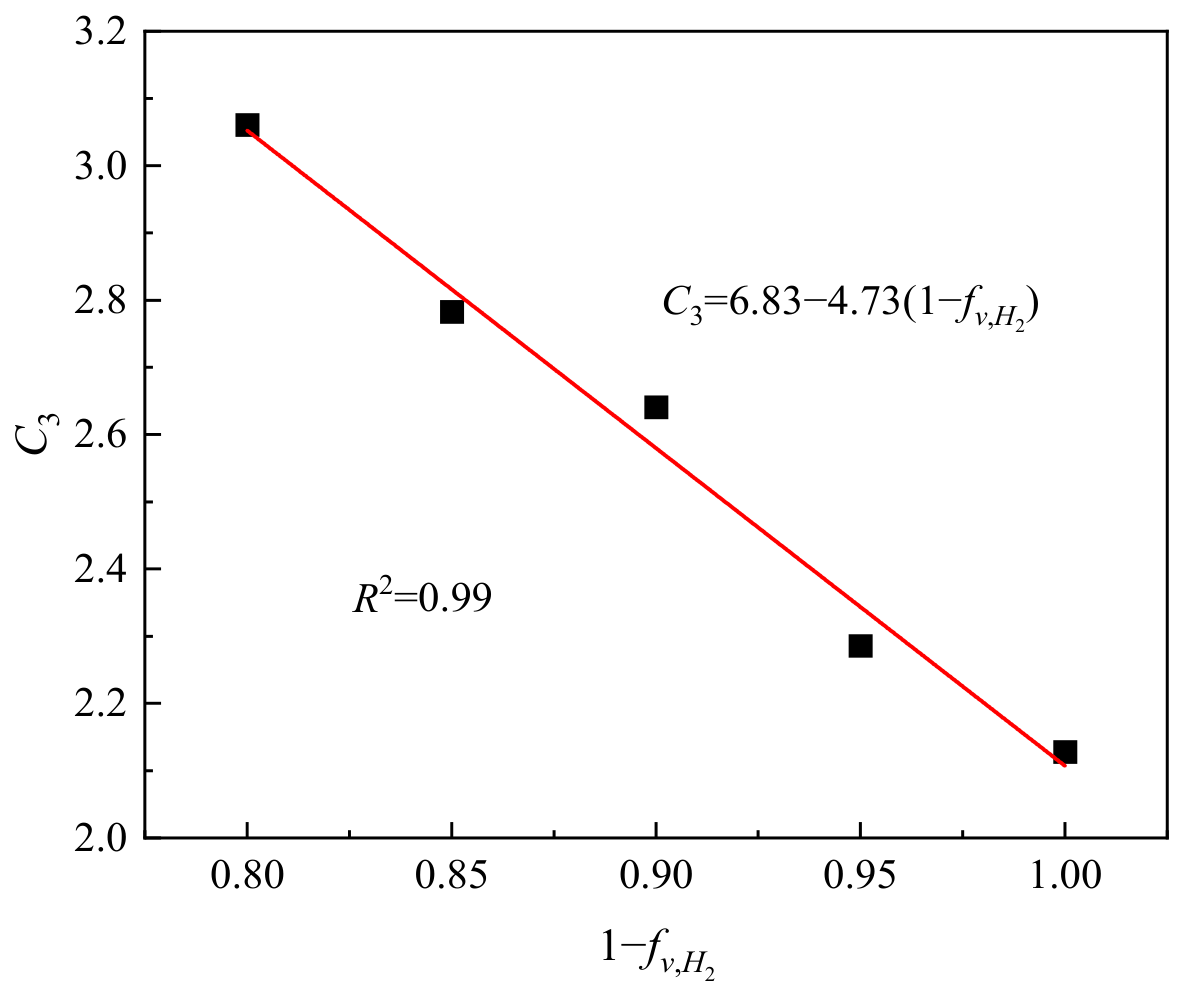
As indicated in Figure 9, the coefficient C3 inferred from Equation (7) shows an approximately linear dependence on hydrogen content. Hence, an attempt was made to correlate C3 with ( 1 f v , H 2 ), as depicts in Figure 10, yielding:
C 3 = 6.83 4.73 1 f v , H 2
By combining Equations (6)–(8), a unified model for predicting the flame horizontal projection length of inclined H2/CH4 jet fires can be established as:
L f / d = 6.83 4.73 1 f v , H 2 cos θ 6 / 5 Q ˙ * 2 / 5   ( 366   Q ˙ *   26,419 )
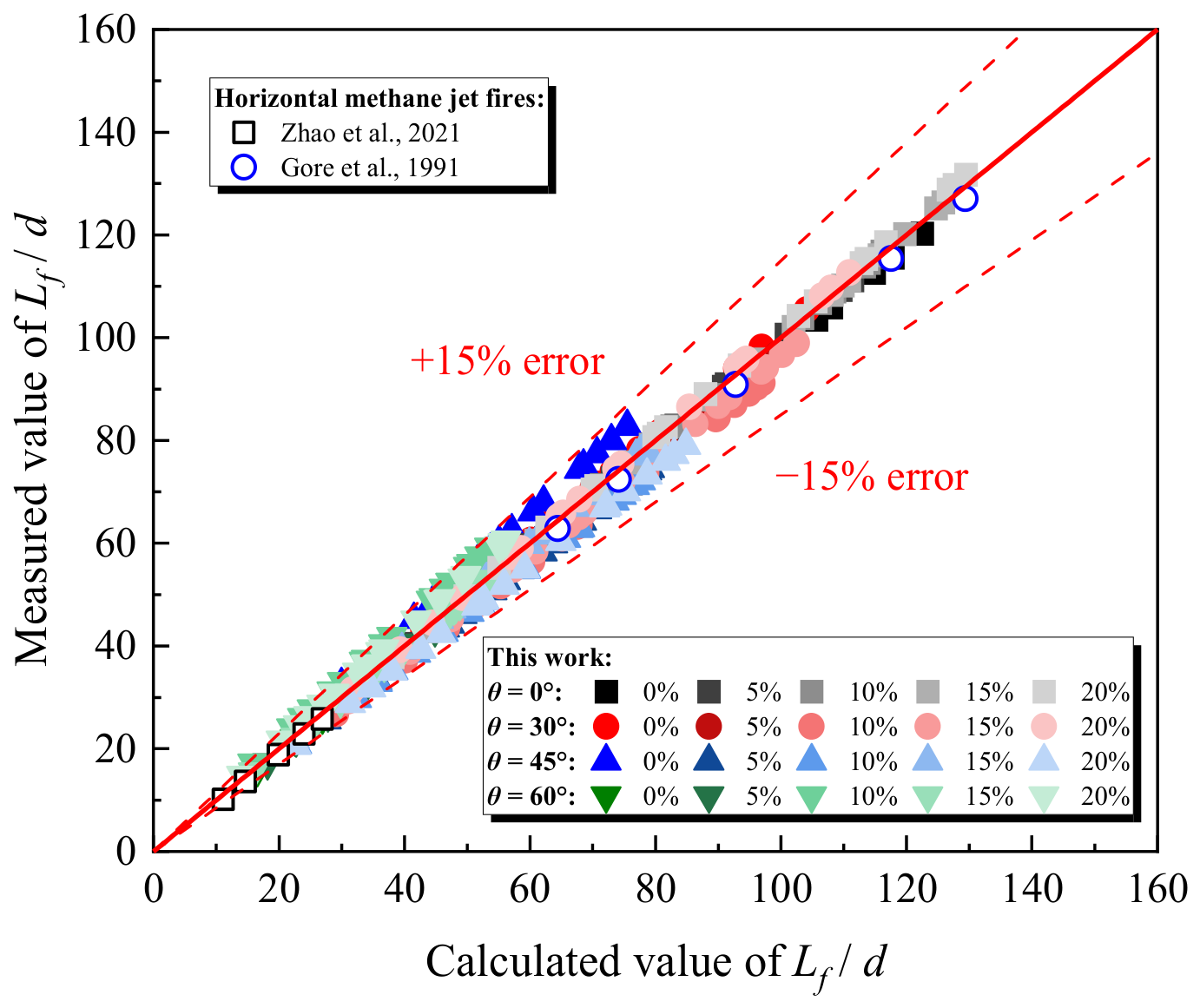
The derived model in Equation (9) clearly indicates the dependence of the flame horizontal projection length of an inclined H2/CH4 jet fire on the nozzle diameter, inclination angle, hydrogen content and heat release rate. Figure 11 further presents a comparison between the predictions of Equation (9) and the experimental measurements obtained in this study, as well as those reported by Zhao et al. [35] and Gore et al. [36] for horizontal methane jet fires ( f v , H 2 = 0 % ). The results suggest that Equation (9) provides a reliable prediction.

4. Conclusions

A systematic experimental study was conducted to investigate the morphological characteristics of H2/CH4 jet fires under varying inclination conditions. The major findings and contributions of this work are summarized as follows:
(1)
As the hydrogen content or fuel exit velocity increases, the flame color gradually evolves from a blue, transparent flame base to a yellow, luminous flame tip. For a given inclination angle, the flame horizontal projection length available depends on both hydrogen content and nozzle diameter.
(2)
Within the range of hydrogen content (≤20%), the flame horizontal projection length shows only minor variation with hydrogen content, while it decreases with increasing inclination angle and increases with increasing fuel exit velocity and nozzle diameter.
(3)
An explicit model based on the dimensionless heat release rate ( Q ˙ * ) is developed for predicting the flame horizontal projection length of inclined H2/CH4 jet fires. The predicted results show good agreement with the experimental data.
These findings enhance the understanding of flame behavior in inclined H2/CH4 jet fires and support the safety design of hydrogen-blended natural gas systems. However, limitations remain, such as the absence of high-hydrogen-content conditions, which are prospective to be explored in future work.

Author Contributions

Conceptualization, Z.W. and J.W.; methodology, Z.W. and M.L.; validation, M.L., J.W. and Z.W.; formal analysis, M.L., J.W. and Z.W.; investigation, M.L., Z.W. and M.Z.; resources, Z.W.; data curation, Q.L. and K.W.; writing—original draft preparation, Z.W. and J.W.; writing—review and editing, Z.W. and Y.P.; visualization, L.M., R.Z. and L.N.; supervision, Z.W. and J.J.; project administration, Z.W. and J.J.; funding acquisition, Z.W. All authors have read and agreed to the published version of the manuscript.

Funding

This research was funded by the National Key R&D Program of China (No. 2024YFC3016201), National Natural Science Foundation of China (No. 52504229), Jiangsu Provincial Key R&D Programme-Social Development (No. BE2023809), Natural Science Foundation of Jiangsu Province (No. BK20230318), Sichuan Provincial Key Laboratory of Public Fire Prevention and Control Technology (No. SC_KLPFPCT2024Y07), and Jiangsu Province Youth Science and Technology Talent Support Program (No. JSTJ-2025-242).

Data Availability Statement

The original contributions presented in this study are included in the article. Further inquiries can be directed to the corresponding authors.

Conflicts of Interest

The authors declare no conflicts of interest.

Nomenclature

b stoichiometric coefficient in Equation (3)
c p specific heat of air at constant pressure (kJ/(kg∙K))
C , C 1 , C 2 , C 3 empirical coefficients in Equations (1), (2), (6) and (7)
d nozzle diameter (m)
f v , H 2 hydrogen content in volume fraction (%)
F r Froude number
g gravitational acceleration (m/s2)
Δ H c fuel heat of combustion (kJ/kg)
L f flame horizontal projection length (m)
m stoichiometric coefficient in Equation (3)
M a i r molar mass of air (g/mol)
M f u e l molar mass of fuel (g/mol)
Q ˙ heat release rate (kW)
Q ˙ * dimensionless heat release rate, Q ˙ * = Q ˙ / ρ T c p g d 5 / 2
R e Reynolds number
s air to fuel mass stoichiometric ratio
T temperature (K)
u e fuel exit velocity (m/s)
V fuel volumetric flow rate (L/min)
Greek symbols
θ inclined angle (°)
ν kinematic viscosity (m2/s)
ρ density (kg/m3)
χ r flame radiation fraction
Subscripts
f flame
e fuel
ambient

References

  1. Council, H. Hydrogen Scaling Up: A Sustainable Pathway for the Global Energy Transition. 2017. Available online: https://hydrogencouncil.com/wp-content/uploads/2017/11/Hydrogen-Scaling-up_Hydrogen-Council_2017.compressed.pdf (accessed on 10 June 2026).
  2. Tahan, M.-R. Recent advances in hydrogen compressors for use in large-scale renewable energy integration. Int. J. Hydrogen Energy 2022, 47, 35275–35292. [Google Scholar] [CrossRef]
  3. Wang, X.; Cheng, T.; Hong, H.; Guo, H.; Lin, X.; Yang, X.; Nie, B.; Hu, Z.; Zou, J. Challenges and opportunities in hydrogen storage and transportation: A comprehensive review. Renew. Sustain. Energy Rev. 2025, 219, 115881. [Google Scholar] [CrossRef]
  4. Messaoudani, Z.L.; Rigas, F.; Binti Hamid, M.D.; Che Hassan, C.R. Hazards, safety and knowledge gaps on hydrogen transmission via natural gas grid: A critical review. Int. J. Hydrogen Energy 2016, 41, 17511–17525. [Google Scholar] [CrossRef]
  5. Lowesmith, B.J.; Hankinson, G. Large scale high pressure jet fires involving natural gas and natural gas/hydrogen mixtures. Process Saf. Environ. Prot. 2012, 90, 108–120. [Google Scholar] [CrossRef]
  6. Zhao, C.; Li, X.; Wang, X.; Li, M.; Xiao, H. An experimental study of the characteristics of blended hydrogen-methane non-premixed jet flames. Process Saf. Environ. Prot. 2023, 174, 838–847. [Google Scholar] [CrossRef]
  7. Zhao, Y.; McDonell, V.; Samuelsen, S. Influence of hydrogen addition to pipeline natural gas on the combustion performance of a cooktop burner. Int. J. Hydrogen Energy 2019, 44, 12239–12253. [Google Scholar] [CrossRef]
  8. Wu, L.; Kobayashi, N.; Li, Z.; Huang, H.; Li, J. Emission and heat transfer characteristics of methane–hydrogen hybrid fuel laminar diffusion flame. Int. J. Hydrogen Energy 2015, 40, 9579–9589. [Google Scholar] [CrossRef]
  9. Ouyang, Y.; He, Q.; Wang, C.; Shen, Z. Numerical study of hydrogen/methane buoyant fires using FireFoam. Int. J. Hydrogen Energy 2020, 45, 13551–13558. [Google Scholar] [CrossRef]
  10. Lowesmith, B.J.; Hankinson, G. Large scale experiments to study fires following the rupture of high pressure pipelines conveying natural gas and natural gas/hydrogen mixtures. Process Saf. Environ. Prot. 2013, 91, 101–111. [Google Scholar] [CrossRef]
  11. Jiang, H.; Lei, P.; Lu, H.; Xu, T.; Li, Y.; He, F.; Li, Y. Experimental study on the combustion flame morphology of hydrogen-blended natural gas in non-premixed jet flames. Int. J. Hydrogen Energy 2025, 143, 479–488. [Google Scholar] [CrossRef]
  12. Kalghatgi, G.T. Lift-off Heights and Visible Lengths of Vertical Turbulent Jet Diffusion Flames in Still Air. Combust. Sci. Technol. 1984, 41, 17–29. [Google Scholar] [CrossRef]
  13. Han, Z.; Dong, S.; Sun, M.; Han, B.; Chen, L. Full-scale pipeline experimental study on combustion flame characteristics of hydrogen-blended natural gas crack leakage. Int. J. Hydrogen Energy 2026, 212, 153701. [Google Scholar] [CrossRef]
  14. Studer, E.; Jamois, D.; Jallais, S.; Leroy, G.; Hebrard, J.; Blanchetière, V. Properties of large-scale methane/hydrogen jet fires. Int. J. Hydrogen Energy 2009, 34, 9611–9619. [Google Scholar] [CrossRef]
  15. Wang, C.J.; Wen, J.X.; Chen, Z.B.; Dembele, S. Predicting radiative characteristics of hydrogen and hydrogen/methane jet fires using FireFOAM. Int. J. Hydrogen Energy 2014, 39, 20560–20569. [Google Scholar] [CrossRef]
  16. Kong, Y.; Li, Y.; Wang, S.; Han, H.; Duan, P.; Yu, X.; Han, J. Experimental study on jet fire characteristics of hydrogen-blended natural gas. Int. J. Hydrogen Energy 2024, 49, 1250–1260. [Google Scholar] [CrossRef]
  17. Kong, Y.; Li, Y.; Wang, S.; Duan, P.; Zhu, J.; Han, H.; Han, J. Large-scale experimental study on jet flame length of hydrogen-blended natural gas and inverse methods for optimizing the weighted multi-point source model. Fuel 2024, 367, 131434. [Google Scholar] [CrossRef]
  18. Li, X.; Wang, Z.; Fan, Z.; Li, Y.; Liu, C.; Wu, D. Effect of under-expanded jet fires on parallel pipelines induced by leakage of high pressure hydrogen and natural gas/hydrogen pipelines. Process Saf. Environ. Prot. 2025, 203, 108016. [Google Scholar] [CrossRef]
  19. Peters, N.; Göttgens, J. Scaling of buoyant turbulent jet diffusion flames. Combust. Flame 1991, 85, 206–214. [Google Scholar] [CrossRef]
  20. Gore, J.P.; Jian, C.Q. Analytical solution to the flame trajectory based on the analysis of “Scaling of buoyant turbulent jet diffusion flames” by N. Peters and J. Göttgens. Combust. Flame 1993, 93, 336–337. [Google Scholar] [CrossRef]
  21. Wu, P.; Luo, Z.; Wen, H.; Liu, C.; Ji, X.; Liu, L. Experimental and modeling study on the geometric characteristics of inclined hydrogen-blending natural gas jet flames. Fire Saf. J. 2026, 161, 104654. [Google Scholar] [CrossRef]
  22. Wu, P.; Luo, Z.; Wen, H.; Liu, C.; Zhao, S.; Liu, L. Experimental and semi-empirical study on the radiative characteristics of inclined hydrogen-blended natural gas jet flames. Energy 2026, 347, 140467. [Google Scholar] [CrossRef]
  23. Otsu, N. A Threshold Selection Method from Gray-Level Histograms. IEEE Trans. Syst. Man Cybern. 1979, 9, 62–66. [Google Scholar] [CrossRef]
  24. Wang, Z.; Jiang, J.; Wang, G.; Ni, L.; Pan, Y.; Li, M. Flame morphologic characteristics of horizontally oriented jet fires impinging on a vertical plate: Experiments and theoretical analysis. Energy 2023, 264, 126210. [Google Scholar] [CrossRef]
  25. Wang, Z.; Zhou, K.; Zhang, L.; Nie, X.; Wu, Y.; Jiang, J.; Dederichs, A.S.; He, L. Flame extension area and temperature profile of horizontal jet fire impinging on a vertical plate. Process Saf. Environ. Prot. 2021, 147, 547–558. [Google Scholar] [CrossRef]
  26. Wang, Z.; Jiang, K.; Zhao, K.; Guo, P. Macroscopic characteristics and prediction model of horizontal extension length for syngas jet flame under inclined conditions. Int. J. Hydrogen Energy 2021, 46, 23091–23099. [Google Scholar] [CrossRef]
  27. Delichatsios, M.A. Transition from momentum to buoyancy-controlled turbulent jet diffusion flames and flame height relationships. Combust. Flame 1993, 92, 349–364. [Google Scholar] [CrossRef]
  28. Gopalaswami, N.; Liu, Y.; Laboureur, D.M.; Zhang, B.; Mannan, M.S. Experimental study on propane jet fire hazards: Comparison of main geometrical features with empirical models. J. Loss Prev. Process Ind. 2016, 41, 365–375. [Google Scholar] [CrossRef]
  29. Palacios, A.; Muñoz, M.; Casal, J. Jet fires: An experimental study of the main geometrical features of the flame in subsonic and sonic regimes. AIChE J. 2009, 55, 256–263. [Google Scholar] [CrossRef]
  30. Zhou, K.; Liu, J.; Jiang, J. Prediction of radiant heat flux from horizontal propane jet fire. Appl. Therm. Eng. 2016, 106, 634–639. [Google Scholar] [CrossRef]
  31. Quintiere, J.G.; Grove, B.S. A unified analysis for fire plumes. Symp. (Int.) Combust. 1998, 27, 2757–2766. [Google Scholar] [CrossRef]
  32. He, Q.; Gu, M.; Tang, F.; Sun, X.; Wang, Y. Ceiling radiation heat flux and downward received radiation heat flux of methane jet fire with hydrogen addition. Int. J. Hydrogen Energy 2024, 51, 741–753. [Google Scholar] [CrossRef]
  33. Heskestad, G. Luminous heights of turbulent diffusion flames. Fire Saf. J. 1983, 5, 103–108. [Google Scholar] [CrossRef]
  34. Tao, C.; Shen, Y.; Zong, R. Experimental determination of flame length of buoyancy-controlled turbulent jet diffusion flames from inclined nozzles. Appl. Therm. Eng. 2016, 93, 884–887. [Google Scholar] [CrossRef]
  35. Zhao, J.; Liu, J.; Li, H.; Wang, J. Flame projection lengths of horizontally oriented buoyant jet fires under different air pressures. Case Stud. Therm. Eng. 2021, 27, 101327. [Google Scholar] [CrossRef]
  36. Gore, J.P.; Jian, C.Q. Trajectories of horizontal buoyant free jet flames. In Proceedings of the ASME/JSME Thermal Engineering Proceedings; American Society of Mechanical Engineers (ASME): New York, NY, USA, 1991; pp. 127–138. [Google Scholar]
Figure 1. Experimental methodology.
Fire 09 00270 g001
Figure 2. Test repeatability verification based on flame horizontal projection length versus fuel exit velocity.
Fire 09 00270 g002
Figure 3. Typical images of inclined H2/CH4 jet fires.
Fire 09 00270 g003
Figure 4. Flame horizontal extension length versus fuel exit velocity for different hydrogen contents.
Fire 09 00270 g004
Figure 5. Normalized flame horizontal projection length versus Froude number for different hydrogen contents.
Fire 09 00270 g005
Figure 6. Dimensionless heat release rate ( Q ˙ * ) versus normalized flame horizontal projection length for different hydrogen contents.
Fire 09 00270 g006
Figure 7. Relationship between C1 and cos θ.
Fire 09 00270 g007
Figure 8. Normalized flame horizontal projection length versus dimensionless heat release rate ( Q ˙ * ) for different hydrogen contents.
Fire 09 00270 g008
Figure 9. Relationship between C2 and cos θ.
Fire 09 00270 g009
Figure 10. Relationship between C3 and ( 1 f v , H 2 ).
Fire 09 00270 g010
Figure 11. Comparison of flame horizontal projection lengths predicted by Equation (9) with experimental measurements.
Fire 09 00270 g011
Table 1. Summary of experimental conditions.
Nozzle Diameter
d (mm)
Hydrogen Volume Fraction
fv,H2 (%)
Jet Angle
θ (°)
SLPM
V (L/min)
Exit Velocity
ue (m/s)
Re × 10−3Fr × 10−4
20/5/10/15/200/30/45/60/904–1021.2–47.81.1–5.92.3–11.6
34–229.4–51.90.8–9.70.3–9.2
44–255.3–33.20.6–8.30.07–2.8
Disclaimer/Publisher’s Note: The statements, opinions and data contained in all publications are solely those of the individual author(s) and contributor(s) and not of MDPI and/or the editor(s). MDPI and/or the editor(s) disclaim responsibility for any injury to people or property resulting from any ideas, methods, instructions or products referred to in the content.