


Abstract
Ash-free net heat content (AF-NHC) represents the combustible heat content of plant biomass and is an important parameter in fire behavior and fire effects modeling. Despite its widespread use, little information exists regarding seasonal and regional variation in AF-NHC among common woody fuels of the southeastern US. This study quantified seasonal and regional variation in AF-NHC among five common woody species in eastern Texas: yaupon (Ilex vomitoria), greenbrier (Smilax spp.), eastern red cedar (Juniperus virginiana), Chinese privet (Ligustrum sinense), and escarpment live oak (Quercus fusiformis). Foliage samples were collected during the dormant and growing seasons across the Pineywoods, Post Oak Savannah, and Blackland Prairie ecoregions and were analyzed using oxygen bomb calorimetry. Linear mixed-effects models evaluated species, season, and species × season effects while accounting for regional variation. AF-NHC ranged from 17.35 to 19.92 MJ kg−1 and differed significantly among species and seasons, with distinct species-specific seasonal trajectories (p < 0.05). Regional variation accounted for approximately 41% of total model variance, indicating that environmental conditions influence fuel thermal properties. AF-NHC was greatest in yaupon and red cedar, intermediate in privet and greenbrier, and lowest in live oak. Although AF-NHC likely exerts less influence on fire behavior than fuel consumption and the rate of spread, species-specific differences in combustible heat content may contribute to variation in potential heat release and fuel combustibility. These findings provide baseline AF-NHC values for common eastern Texas woody fuels and improve the understanding of spatial and temporal variation in fuel thermal properties relevant to fire effects and wildfire hazard assessment.
1. Introduction
Wildland fuel heat content is a fundamental property of plant biomass that influences combustion processes, fuel flammability, and the amount of energy available to drive fire behavior and fire effects [1,2]. Heat released during combustion affects the transfer of radiant and convective energy to surrounding fuels, thereby influencing fire propagation, fuel consumption, and the thermal environment experienced by vegetation, soils, and other ecosystem components [3]. Consequently, variation in fuel heat content may contribute to differences in plant flammability characteristics related to combustion intensity, combustion duration, and total energy release [4,5]. Net heat content (NHC) is the amount of energy released during combustion after accounting for the latent heat required to vaporize the water formed during the combustion process, making it a useful measure of the energy available for fire spread and the heating of biological tissues [2]. Because heat content is directly incorporated into fire behavior and fire effects models, NHC is a key parameter in estimates of fireline intensity, flame length, total heat-release, fuel consumption, smoke emissions, and other fire-related processes [6,7]. Although variation in fuel consumption and the rate of spread generally exerts a greater influence on fire behavior than variation in NHC, differences in species-specific heat content can affect estimates of energy release and associated fire effects because NHC remains a multiplicative component of fireline intensity and total heat release calculations [6,8]. Despite its widespread use in fire behavior modeling, relatively little is known about seasonal and species-specific variation in ash-free net heat content (AF-NHC) among common understory fuels, particularly across contrasting plant functional groups and environmental conditions.
While NHC is widely accepted as a standardized heat content (~18.60 MJ kg−1) in common fire models like BehavePlus, FARSITE, FlamMap, and the First Order Fire Effects Model [7,9], numerous studies have demonstrated substantial variation in plant heat content and combustion characteristics among plant species, tissue types, and phenological stages owing to differences in chemical composition and environmentally driven physiological factors, particularly fuel moisture content [4,10,11]. Although net heat content (NHC) exerts less influence on fireline intensity (FLI) than fuel consumption and the rate of spread because it varies over a comparatively narrow range among wildland fuels [12], variation in NHC can nonetheless affect estimates of FLI, flame length (FL), total heat release, and smoke production. Consequently, differences in NHC may indirectly influence fire effects associated with heat dose and residence-time-weighted heating, including plant tissue necrosis near 60 °C, cambial injury, and soil heating [8,13,14,15]. Wildland fuel chemistry variability is important because it influences fundamental fuel flammability characteristics related to ease of ignition (ignitability), combustion intensity (combustibility), combustion duration (sustainability), and the proportion of fuel consumed during burning (consumability) [4,16].
Species-specific variation in flammability has been linked to differences in plant tissue chemistry, particularly the relative abundance of volatile extractives, hemicellulose, cellulose, and lignin, which influence fuel ignition, thermal degradation, heat release, and combustion thermodynamics [4,17]. However, variation in inorganic mineral fractions can substantially dilute the energy content of combustible organic constituents, resulting in differences in measured heat content among fuels. Mineral and ash concentrations are known to vary among species, plant tissues, environmental conditions, soil chemistry, phenological stages, and seasons, contributing to spatial and temporal variability in fuel thermal properties [18]. Consequently, correcting net heat content for ash content (AF-NHC) can improve comparisons of fuel chemistry among species, tissues, and ecosystems by removing variation associated with non-combustible mineral constituents and providing a more representative estimate of the energy content of combustible organic matter [19]. Because AF-NHC isolates the combustible organic fraction of biomass and removes the variability associated with non-combustible mineral constituents, it may provide a useful indicator of species-specific flammability potential by reflecting differences in fuel chemistry associated with heat release during combustion [4].
Since species-specific AF-NHC is linked to fire behavior and species flammability, improved species AF-NHC characterization could prove useful in elucidating potential interactions between species-specific flammability and fire behavior, especially across fire-excluded ecosystems where fuel beds have been highly altered. Fire has played a key role in shaping fire-dependent forests, savannahs, and grasslands of the East Texas Pineywoods (PW), Blackland Prairie (BP) and Post Oak Savannah (POS) ecoregions [20,21,22,23]. Decades of fire suppression, landscape-level fragmentation, agricultural expansion, livestock overgrazing, and land use changes have significantly altered the historic fire cycle resulting in significant changes in plant community structure and composition [24,25,26]. Fire exclusion, land use change, and passive management have also facilitated extensive woody plant encroachment into many remnant grasslands, savannas, and abandoned agricultural fields [23,26]. Yaupon (Ilex vomitoria) and Chinese privet (Ligustrum sinense) have been particularly problematic in terms of forming dense thickets in forest and savannah understories [27,28,29,30]. Subsequent increases in woody fuel loading in combination with potential seasonal and regional variances in species-specific heat content could potentially add to surface fire intensity.
These plant community compositional and structural shifts have important implications for fire behavior modeling and hazardous fuel assessments because existing fuel models and operational fuel descriptions may not fully capture changes in fuel characteristics associated with woody encroachment, altered fuel structure, and species-specific fuel chemistry [7,31,32]. Although fire behavior is generally more sensitive to variation in fuel consumption and rate of spread than to heat content alone [6], variation in AF-NHC can still influence estimates of fireline intensity (FLI), flame length (FL), total heat release, and total heat per unit area (THUA) because heat content remains a multiplicative component of fire behavior calculations. These effects may be particularly relevant in dense shrub-dominated fuel complexes, where increased fuel loading, horizontal and vertical fuel continuity, and prolonged combustion can increase fireline intensity, flame length, heat release, and residence time [33,34]. Additionally, an increasing abundance of evergreen shrubs and trees may elevate the fire hazard by providing highly combustible live fuels that remain available for combustion throughout much of the year and may contribute to increased fire spread and spotting potential under conducive weather conditions [4,35]. Therefore, incorporating improved species-specific AF-NHC estimates into fire behavior and fire effects modeling frameworks may improve the characterization of fuel thermal properties and heat release under scenarios of increasing woody fuel abundance in both prescribed fire and wildfire contexts.
Improved characterization of species-specific AF-NHC may also have practical applications for assessing community wildfire risk and informing Firewise landscaping recommendations. Firewise plant lists are widely used to guide residential landscaping with the goal of reducing the home ignition potential and improving defensible space effectiveness in the wildland–urban interface (WUI) [36]. While these recommendations provide valuable guidance, plant selection criteria are often based primarily on qualitative assessments of plant flammability characteristics, including fuel moisture retention, plant architecture, branching structure, fuel continuity, the accumulation of dead material, and observed burning behavior, rather than standardized quantitative measurements of fuel thermal properties [4,5]. Since current Firewise recommendations rarely incorporate direct measurements of fuel thermal properties, AF-NHC may offer a novel quantitative metric for evaluating potential heat release among landscape species. When interpreted alongside established flammability traits such as fuel moisture content, fuel structure, and volatile compound concentrations, AF-NHC may improve the understanding of species-specific differences in potential heat release during combustion [4]. Improved insight into these relationships could ultimately enhance Firewise landscaping recommendations by integrating quantitative fuel chemistry metrics with existing qualitative assessments of plant structure and flammability.
Seasonal and regional variation in AF-NHC may further complicate fire behavior prediction and fuel flammability assessments in eastern Texas. Temporal shifts in foliar chemistry, non-structural carbohydrate reserves, moisture content, phenology, and concentrations of secondary metabolites can alter fuel thermal properties and combustion behavior throughout the year [4,18,37]. Evergreen shrubs, evergreen trees, and drought-adapted species may maintain elevated concentrations of lignin, waxes, terpenoids, and other flammable extractives during periods when deciduous species are dormant or exhibit reduced physiological activity, potentially altering seasonal patterns of fuel flammability and fire hazard [4,37,38]. Spatial variability may also influence fuel thermal properties across eastern Texas, where strong west-to-east gradients in precipitation, productivity, and soil fertility contribute to shifts in vegetation composition and plant functional traits among forest, savanna, and prairie ecosystems [25]. Therefore, an improved understanding of seasonal and regional variation in species-specific AF-NHC may help elucidate broad-scale patterns in fuel thermal properties, flammability potential, and the wildfire hazard across eastern Texas.
Relatively few studies have quantified oxygen bomb calorimeter-derived net heat content (NHC) or ash-free net heat content (AF-NHC) for common southeastern United States wildland fuels. However [39] reported heat content values for numerous southeastern plant species collected across Georgia, Florida, North Carolina, and Texas, including yaupon (Ilex vomitoria), greenbrier (Smilax spp.), and live oak (Quercus virginiana). Nevertheless, little information exists regarding seasonal and regional variation in AF-NHC among many common woody species that increasingly dominate contemporary fuel beds in eastern Texas. Therefore, this study expands upon Hough’s foundational work by evaluating the seasonal and regional variation in AF-NHC of yaupon and greenbrier while also providing new AF-NHC estimates for Chinese privet (Ligustrum sinense), eastern red cedar (Juniperus virginiana), and escarpment live oak (Quercus fusiformis).
Woody plant encroachment and the increasing abundance of evergreen shrubs and trees have altered fuel composition and structure across many ecosystems of eastern Texas, potentially influencing fuel loading, fuel continuity, and fire behavior [40,41]. Consequently, an improved understanding of seasonal and regional variation in species-specific AF-NHC may help elucidate patterns in wildland fuel chemical and thermal properties as well as potential flammability associated with increasing woody fuel abundance. Therefore, the objectives of this study were to (1) quantify spatial and temporal variation in AF-NHC among five common evergreen woody species in eastern Texas and (2) identify significant seasonal and regional patterns in species-specific AF-NHC that may influence fuel chemistry and thermal properties and potential flammability.
2. Methods
2.1. Materials
Five plant species were selected based on their semi/evergreen traits that present a year-round potential fire hazard: yaupon, Chinese privet, greenbrier, eastern red cedar, and escarpment live oak. Escarpment live oak was collected only in the POS and BP due to its biological absence in the PW. Fresh foliar samples were collected from five individual plants of each focal species averaging 2 m in height across the PW, POS, and BP ecoregions. Collection sites included the Stephen F. Austin Experimental Forest, the Texas A&M Equine Center, Somerville Lake, and the Trinity River Audubon Center (Table 1). Foliar sampling occurred in 2013, 2016, and 2017 in the growing (August) and dormant (February) seasons. Leaves and needle clusters were free of berries and stems and were clipped at breast height (1.37 m) from randomly selected individual plants. Clipped samples were immediately brought back to the laboratory for processing.
Table 1.
Locations of sampled sites throughout the east Texas region.
Fresh foliar samples were treated with liquid nitrogen to increase sample rigidity and to facilitate grinding in a standard coffee grinder. Foliar samples were dried at 40 °C in an air-convection oven until repeated sample measurements were within ±0.2–0.5 mg to confirm constant dry mass. A lower drying temperature was used to ensure that the samples retained volatile secondary compounds and extractives that contribute to fuel heat content. After drying, samples were passed through a series 10-, 20-, 35-, 42-, 100-, and 150-mesh U.S. Standard sieves to obtain a uniform texture. Preliminary analyses indicated that measured heat content did not differ among particle size fractions (ANOVA, F6,77 = 1.01, p = 0.426). Therefore, a 35-mesh screen was selected because this fraction provided adequate homogenization while minimizing processing effort and sample loss. Samples were stored in sealed sample bags in a climate-controlled environment until undergoing the OBC analysis. Five individual plant foliar samples from each focal species underwent five replicate OBC tests using a Parr calorimeter (Parr Instrument Company, Moline, IL, USA) that was standardized with benzoic acid per manufacturer specifications [42]. To facilitate sample preparation, we used double ought (OO) gelatin capsules as sample holders. The water content associated with the gelatin capsules was corrected with a mean heat of water vaporization correction of 13%, which was adjusted accordingly for spike corrections every time the OBC was re-standardized with benzoic acid. Previous work from Chang et al. [43] identified that gelatin capsule water content ranged from 13 to 16%; based on these results, we used a 13% correction because the capsules were stored in a desiccator. Foliar sample higher heating values (HHV) were corrected for the heat of water vaporization by averaging the weight loss associated with the first differential thermogravimetric analysis (DTG) peak of each of the five samples collected for each focal species in an oxidative atmosphere [44,45]. Five DTG thermograms were evaluated for heat of water vaporization corrections for each species, which returned an overall mean correction of 1.24 MJ kg−1, only 0.02 points off from the Williams and Agee [46] water vaporization correction of 1.26 MJ kg−1. Foliar sample low heating values (LHV) were further adjusted with ash corrections that were calculated by performing thermogravimetric analytic (TGA) proximate analysis procedures [47] on each of the five individual plant foliar samples collected for each focal species.
2.2. Data Analysis
Focal species AF-NHC was analyzed using a linear mixed-effects model using JMP 19 [48]. We treated species, season, and their interaction as fixed effects while ecoregion was treated as a random effect to account for the non-independence associated with samples collected within the same region. Regarding the unbalanced data set for escarpment live oak, linear mixed-effects models were fitted using a restricted maximum likelihood technique, which accommodates unbalanced sampling and unequal observations among factor combinations. The significance level for fixed effects F-tests were set at = 0.05. Any significant main or interaction effects were further analyzed with least-squares means using Tukey’s honestly significant difference pairwise comparisons.
Model assumptions were evaluated using residual diagnostics, including residual histograms, residual-versus-predicted plots, and residual quantile plots. Studentized residuals, leverage values, and Cook’s distance values were also evaluated to identify potentially influential observations. All model assumptions were analyzed to identify any potentially severe departures from normality or homogeneity of variance. Random effects were accounted for by calculating the intraclass correlation coefficient (ICC) to quantify the proportion of variance associated with differences among ecoregions.
3. Results
3.1. Model Performance
Residual diagnostics confirmed the assumptions of normality and homogeneity of variance associated with the linear mixed-effects model. There were no indications of significant heteroscedasticity, nonlinear patterns, or systematic deviations from model assumptions. Histograms and residual quantile plots exhibited normal distributions, with only minor deviations present at the extreme tails. Studentized residuals, leverage, and Cook’s distance values did not exert any significant influence on the model estimates.
Random effect variance partitioning revealed significant clustering within ecoregions. In terms of total variation, the ICC indicated that 41.48% of the AF-NHC variation occurred among ecoregions while 58.52% occurred within ecoregions. Therefore, this suggests that regional environmental conditions exert a relevant amount of variance to AF-NHC values.
3.2. Species, Season, and Species × Season Effects
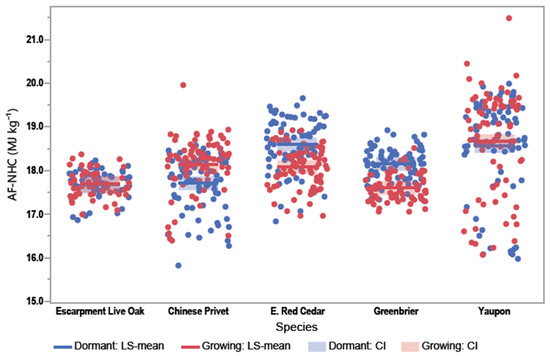
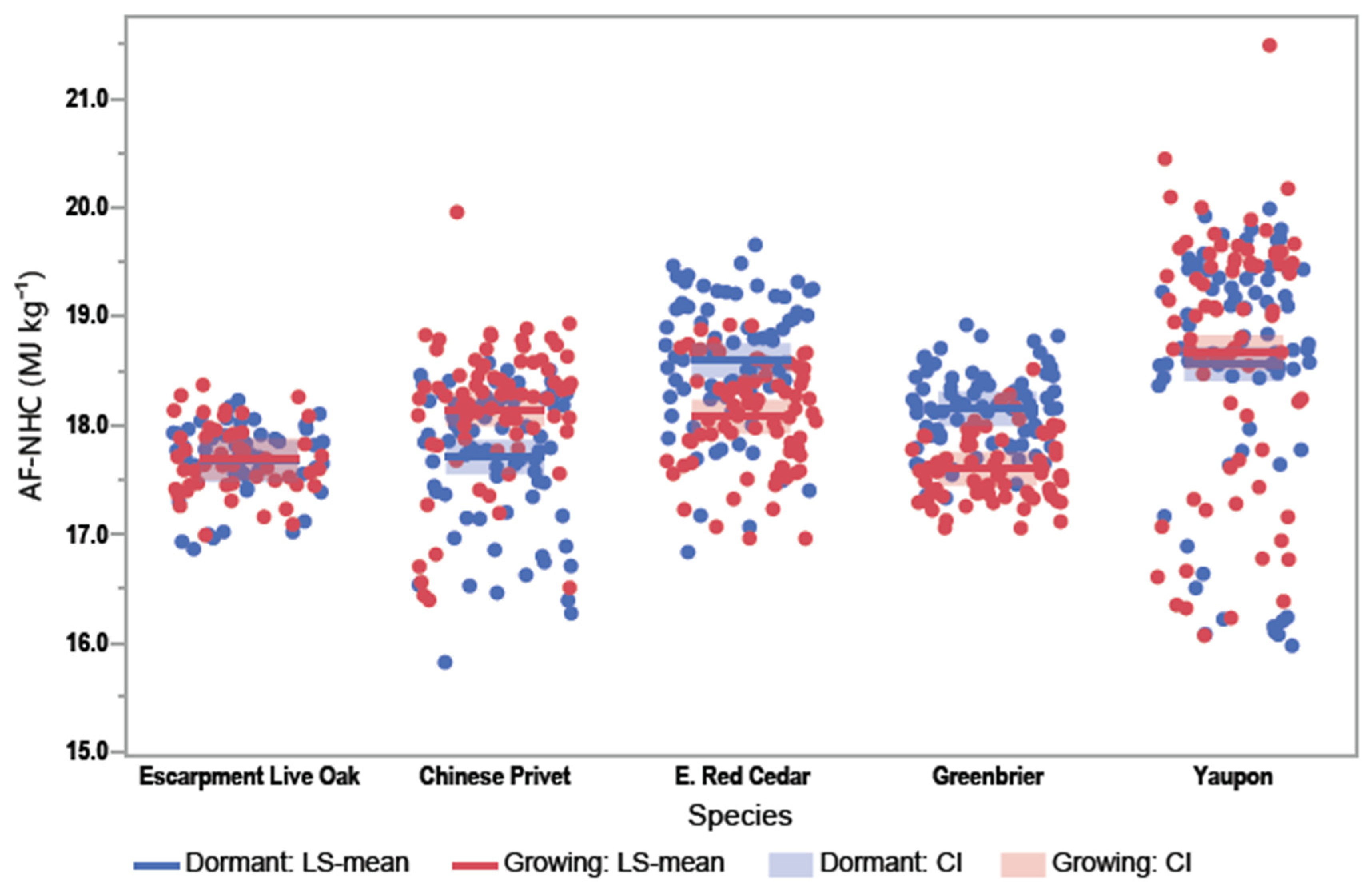
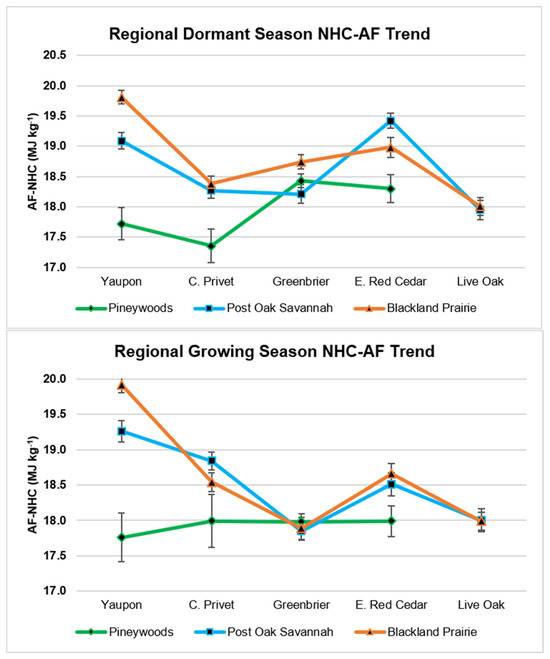
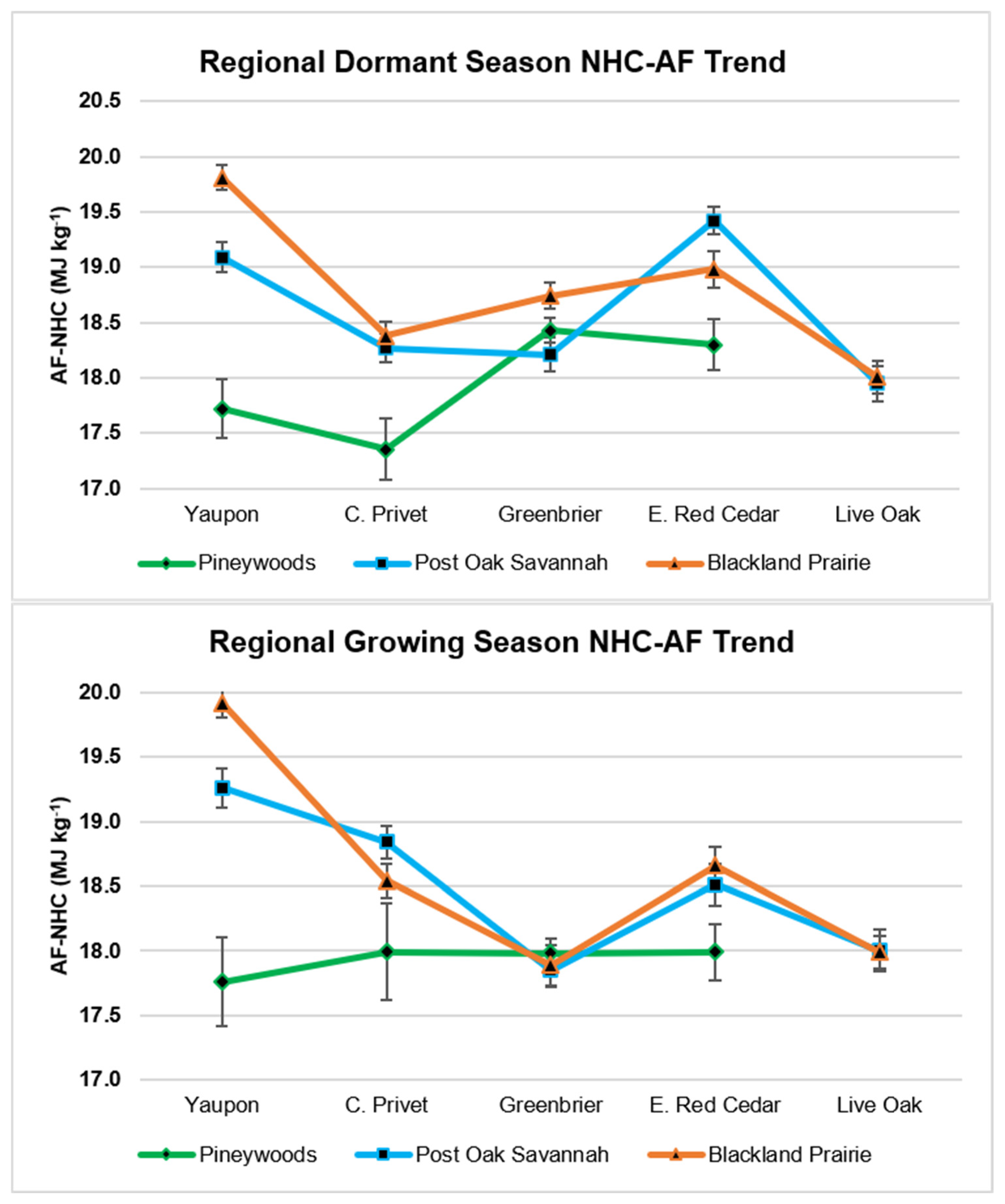
Mean AF-NHC values varied among species and seasons, ranging from 17.59 to 18.67 MJ kg−1 across all species (Table 2). Yaupon and red cedar exhibited the highest mean AF-NHC values, while escarpment live oak exhibited the lowest mean values. AF-NHC was significantly influenced with respect to species, season, and species × season interactions (Table 3). Species AF-NHC differed significantly across all samples (F = 78.55, df = 4, p < 0.0001), thus indicating considerable variation in heat content and foliar chemistry. Seasonality also played a significant role in AF-NHC variability (F = 19.88, df = 4, p < 0.0001) across the dormant and growing seasons. A significant interaction between species × season was also detected (F = 5.02, df = 1, p < 0.0254), which suggests that seasonal variation in AF-NHC was species-dependent. Furthermore, the species seasonal response in AF-NHC varied in direction and magnitude, thus indicating that seasonal effects on heat content and foliar chemistry were not uniform across species (Figure 1). As such, statistical inferences associated with seasonal effects were conducted within species rather than solely through the main effects. However, while seasonal variation in AF-NHC was a primary inferential focus, regional variation was apparent for several species, particularly yaupon, Chinese privet, and red cedar, which exhibited greater separation between the dormant and growing seasons in the PW as compared to the PS and BP (Figure 2).
Table 2.
Descriptive statistics of focal species AF-NHC sampled throughout eastern Texas.
Table 3.
Linear mixed-effects model output for focal species AF-NHC.
Figure 1.
Species-season interaction plot with 95% shaded confidence intervals.
Figure 2.
Regional and seasonal differences in foliar AF-NHC of five east Texas semi/evergreen woody plant species. Error bars represent standard error of the mean.
The least-squares means (LS-means) associated with the species × season interactions were almost identical to the arithmetic means, which suggests that the sample size was well balanced and the data lacks severe bias (Table 1 and Table 4). Distinct species-specific patterns were exhibited across the LS-means, with notable dormant season AF-NHC shifts in greenbrier (+0.54 MJ kg−1) and red cedar (+0.51 MJ kg−1), while Chinese privet exhibited the opposite trend, with a greater AF-NHC shift in the growing season. By contrast, yaupon and escarpment live oak exhibited little seasonal change, and maintained relatively stable AF-NHC values across the seasons (Figure 1). In sum, the interaction effects highlighted significant variation in AF-NHC, thus indicating that seasonal heat content and foliar chemistry are moderately influenced by species-specific traits; therefore, species-specific heat content and foliar chemistry cannot be adequately characterized using single-season responses across taxa.
Table 4.
Species-season interaction table with least-squares means table and Tukey HSD groups. Groups with no shared letters are significantly different.
3.3. Post Hoc Comparisons
Tukey-adjusted pairwise comparisons revealed several contrasting seasonal trajectories among species resulting in substantial separation among species-season combinations (Table 4). Pairwise comparisons of LS-means indicated significant AF-NHC differences among multiple species within the same season as well as within species across seasons. Dormant season yaupon and red cedar and growing season yaupon yielded the highest grouped AF-NHC values, whereas dormant season Chinese privet and escarpment live oak as well as growing season greenbrier and escarpment live oak produced the lowest grouped values.
In terms of dormant season observations, red cedar and yaupon yielded significantly higher AF-NHC values compared to escarpment live oak and Chinese privet. In contrast, growing season AF-NHC values were significantly higher in yaupon, Chinese privet, and red cedar as opposed to greenbrier and escarpment live oak. There were also clear seasonal differences within species, with yaupon, Chinese privet, and escarpment live oak yielding the expected increase in growing season AF-NHC, whereas greenbrier and red cedar exhibited an unexpected increase in dormant season AF-NHC. Overall, the Tukey-adjusted comparisons aligned well with the species-specific seasonal patterns of the interactions, which further demonstrates considerable seasonal AF-NHC variability across taxa.
4. Discussion
4.1. Species-Specific Variation in AF-NHC
As expected, AF-NHC varied significantly across species, season, and species–season combinations, thus highlighting the dynamic taxonomic and temporal nature of foliar heat content and chemistry. Significant species effects confirm that inherent differences in plant physiological traits and chemistry contribute substantially to variation in AF-NHC, while significant seasonal effects suggest that variation in species heat content and chemistry is likely a physiological response to changing seasonal photoperiods, temperature, and evapotranspiration rates. However, more importantly, significant variation in species-specific seasonal AF-NHC trajectories suggests that generalized assumptions regarding seasonal heat content may be inappropriate in mixed-species fuel beds, further supporting the need for the species-specific characterization of wildland fuel properties.
While species taxa were identified as a major driver of AF-NHC variation, it comes as no surprise that differences among species reflect unique evolutionary adaptations, plant cell wall structural investment strategies, and physiological traits that govern the relative abundance of hemicellulose, cellulose, lignin, terpenes, waxes, oils, and resins that contribute disproportionately to foliar heat content and chemistry. Previous studies [37,49] demonstrated that variations in energy-dense plant extractives can have a significant effect on plant foliar heat content, as opposed to less energy-rich structural carbohydrates such as hemicellulose and cellulose. Although structural carbohydrates constitute a major proportion of foliar biomass and generally account for a much larger fraction of dry mass than extractives [49], the heat of combustion of hemicellulose and cellulose varies relatively little compared to lignin and extractive compounds [49,50] which often exert a disproportionate influence on species-specific heat content. Consequently, interspecific differences in lignin and extractive compounds may explain the more meaningful fluctuations in observed AF-NHC among focal species.
In terms of previous comparative wildland fuel calorimetric work (AF-NHC) for yaupon, Chinese privet, greenbrier, red cedar, and escarpment live oak, few contemporary studies exist in the published literature, except for values for yaupon, greenbrier, and eastern red cedar [39]. Therefore, this study provides one of the few contemporary evaluations of seasonal and regional variation in AF-NHC for these southeastern US species. It is also worth noting that this is the first evaluation of Chinese privet AF-NHC. While the AF-NHC estimates for yaupon, greenbrier, and eastern red cedar in this study were comparatively lower than those in [39], there are several potential reasons that could explain this discrepancy. First, Hough [39] reported ash-free HHV, not ash-free LHV (AF-NHC) with latent heat of water vaporization corrections (~1.25 MJ kg−1), which brings the heat content values into a more reasonable alignment. Second, the species foliar samples in that study were likely collected over a broader geographic range of the southeastern US, which can potentially influence species-specific heat content due to climatic and edaphic variability. Lastly, it has been over five decades since Hough’s study, and there have likely been significant changes across ecosystems with respect to plant composition and structure, as well as climatic changes that may impact plant physiology and trends in foliar heat content.
4.2. Seasonal Dynamics
The species’ seasonal variation in AF-NHC was particularly notable in Chinese privet, greenbrier, and red cedar, while yaupon and escarpment live oak remained relatively stable throughout the year. Seasonal variation and shifts in AF-NHC among the focal species are likely governed by phenology, foliage age, environmental stress, and differential carbon allocation. While hemicellulose and cellulose constitute a relatively large proportion of foliar plant tissue, their heat content is relatively uniform. As such, seasonal variation in AF-NHC is more likely driven by changes in energy-dense lipophilic extractives and secondary metabolites such as terpenoids and phenols. This biological pathway aligns well with eastern red cedar, where its terpene-rich foliage is widely known to elevate heat content through the accumulation of volatile extractives. Higher dormant season AF-NHC in eastern red cedar may be a potential physiological response to cold acclimation where photosynthetic deregulation and metabolic reorganization accumulate foliar metabolites as a protective mechanism in the winter [51]. On the other hand, increased eastern red cedar growth in the spring and early summer may dilute the proportional contributions of extractive compounds due to significant increases in foliar growth [52].
Seasonal variation in AF-NHC among evergreen broadleaf species, on the one hand, is more likely associated with phenological changes in foliar chemistry rather than seasonal fluctuations in structural carbohydrates. For example, newly expanding foliar growth in the late spring and early summer may contain greater concentrations of non-structural carbohydrates and inorganic solutes compared to mature foliage in the fall and winter that contains greater concentrations of lignin, waxes, terpenoids, and phenolics that are linked to leaf structural integrity and longevity, herbivore defense and drought tolerance [52]. Since lignin, extractives, and secondary metabolites yield greater foliar heat content, relatively smaller seasonal shifts in secondary metabolites can yield measurable differences in seasonal AF-NHC [51,53].
4.3. Ecoregion Influences
Considerable variance in species-specific ecoregional AF-NHC was identified through random effect testing associated with mixed-effects modeling, which further highlights the importance of environmental factors potentially influencing plant foliar heat content and chemistry. Roughly 41.48% of the total variation in AF-NHC was associated with differences among ecoregions, which suggests that regional edaphic and environmental conditions exert a significant influence on plant foliar heat content and chemistry. Broad-scale differences in regional climate, soil properties, precipitation gradients, and differential plant stressors among the different ecoregions likely contribute to variable foliar chemistry within species, which ultimately affects AF-NHC. Since AF-NHC is significantly influenced by increased lignin and secondary metabolites, differences in ecoregional nutrient availability, precipitation gradients, evapotranspiration rates, and drought stress may partially explain the observed clustering of AF-NHC values across ecoregions.
In addition to broad-scale environmental factors, plant community structure may also play a role in modulating forest understory environments in the PW as opposed to more open conditions in the POS and BP. For example, plant AF-NHC is closely linked to lignin and extractive concentrations [51], which can vary significantly due to differences in structural plant cell wall chemistry and extractive concentrations that are linked to selective pressure between shaded and open environments where plants differentially invest in lignin and extractives to regulate plant water loss [54,55]. As a result, focal species in the PW could potentially reflect this physiological strategy by investing in higher specific leaf area and thinner leaf tissue, which suggests reduced structural reinforcement and less investment in lignin- and cellulose-based cell wall components [42,56]. Conversely, savanna focal species may exhibit greater investment in structural cell wall tissue, resulting in thicker leaf tissue that aids in fire resistance, enhances drought tolerance, and helps modulate high-irradiance environments [56,57]. In addition to differential cell wall structural chemistry, forest understory shrubs and mid-story trees are much more likely to exhibit reduced foliar extractive concentrations relative to species growing in open savanna environments due to reduced exposure to drought, solar insolation, and thermal stress. Recent research has demonstrated a strong linkage between epicuticular wax accumulation and composition that is modulated by varying levels of light exposure, with sun leaves containing significantly greater wax loads, up to 1.6–2.6 times greater than shade leaves [57,58]. Therefore, focal species occurring in the POS and BP could potentially yield greater AF-NHC values as compared to the PW species.
In terms of edaphic variation between ecoregions, the PW ecoregion generally exhibits a wide distribution of Ultisol soils that are of lower fertility and more acidic [59], whereas the POS is more consistent with the intermediate fertility characteristic of Alfisol soils [60], and the BP is generally dominated by Vertisols and more clay-rich productive soils [61]. In some cases, higher soil fertility has been linked to greater mineral uptake, which can increase the ash fraction, potentially reducing the HHV [62]. Conversely, low-nutrient-status soil can increase the allocation of carbon-rich extractives and phenolic compounds that can elicit small gains in ash-free energy density [63,64]. While these edaphic nutrient status trends may exist, it is important to note that water stress and available light can easily override fertility effects. Furthermore, Texas exhibits a strong east-to-west precipitation gradient as a function of decreasing Gulf moisture influence across the continental interior of the state, with mean annual rainfall declining by approximately 1500 mm year−1 in eastern Texas to less than 400 mm year−1 in western Texas [65,66]. This precipitation gradient projects mean annual rainfall totals of 1016–1168, 889–1143, and 762–1016 mm year−1 in the PW, POS, and BP, respectively. While edaphic, environmental, and precipitation gradients may play a role in potentially modulating ecoregional plant foliar heat content and chemistry in the eastern Texas region, these factors are not well understood and require a more focused research approach to elucidate the environmental factors that could be linked to AF-NHC variability.
4.4. Potential Fire Behavior and Fuel Characterization Implications
The relatively narrow range of AF-NHC observed across many woody and herbaceous plants is unlikely to exert a proportionally relevant increase in fireline intensity as compared to fuel load and consumption, live fuel moisture, and wind-driven spread rates. Therefore, seasonal and ecoregional variation in species-specific AF-NHC has limited use as a dominant factor governing fire behavior but it should rather be used as a relatively direct estimate of combustibility and potential energy release because AF-NHC is more closely associated with total chemical energy per unit mass as a function of differential proportions of plant secondary metabolites. These metabolites are fundamentally linked to combustibility metrics that contribute to species-specific flammability characteristics. Consequently, species with higher AF-NHC are more likely to exhibit greater energy release potential that could increase radiant and convective heat transfer, which influences fuel preheating and combustion sustainability. Future research should consider inserting these AF-NHC values into fire behavior models to assess how these specific heat-content values influence potential fire behavior.
Increasing woody plant encroachment in savannas and prairies as well as increasing woody shrub and tree density in forest understories have the potential to not only increase the woody fuel load but also to alter fuel bed composition and structure, as woody plants tend to increase fuel bed height and restrict herbaceous growth due to shading. As such, a transition from herbaceous-dominated communities to dense shrub and tree thickets can alter fuel bed chemical dynamics through a shift in species-specific evolutionary adaptations and physiological traits associated with the woody plant species’ general tendency to invest more biomass in lignin-rich woody tissue, waxes, terpenes, phenolics, and other volatile secondary metabolites associated with foliar tissue defense and longevity [58]. Conversely, herbaceous plants generally tend to invest less in secondary metabolites and more in growth. In other words, woody plant encroachment can increase the average AF-NHC across the live fuel component of the fuel bed, although this effect would be somewhat muted compared to the concurrent increase in fuel loading and vertical continuity. It is also worth noting that a fuel bed transition from flashy herbaceous fuels to a dominant woody fuel bed would likely decrease overall fuel bed ignitability with a concomitant decrease in receptive herbaceous fuels. However, more importantly, increased woody fuel loads of moderate to high AF-NHC would likely enhance fire behavior by several orders of magnitude during times of decreased live fuel moisture in combination with dry, windy weather associated with red-flag fire weather.
4.5. Management Implications and Future Research
The results of this study indicate that AF-NHC exhibits significant variation among species, seasons, and ecoregions, which further demonstrates the variability of species-specific plant chemistry, heat content, and physiology, as well as the spatial and temporal influences on overall plant physiology and fluctuations in energy content. The use of AF-NHC metrics could serve as an indicator of fuel combustibility and potential heat-release capacity that complements other fuel flammability metrics such as ignitability, sustainability, and consumability. Species-specific heat-release potential can also provide insight into radiant and convective heat transfer dynamics, which could be especially useful in dense, monotypic stands of invasive shrubs such as Chinese privet. In terms of the increasing abundance of widespread woody fuels, Chinese privet presents the greatest challenge due to its prevalence across all three eastern Texas ecoregions, while yaupon tends to form dense thickets in the PW and POS. Greenbrier has also been cited as being highly flammable [61,62], with the potential to serve as a ladder fuel in unmanaged stands where twining vines extend up the boles of trees, especially pines. Eastern red cedar has also increased in density throughout east Texas [63] and has contributed to increasing fuel loads of energy-dense evergreen trees that are anecdotally known to contribute to elevated fire behavior.
In terms of fuel flammability assessments, AF-NHC may provide additional understanding of species-specific differences in combustion thermodynamics. Because AF-NHC is directly linked to variations in energy-dense plant extractives and secondary metabolites, it can serve as a general indicator of plant foliar combustibility, especially in woody plants that tend to accumulate lignin in maturing leaf tissue and invest in volatile extractives such as cuticular waxes to help regulate water stress, as well as secondary metabolites to mitigate herbivore and insect grazing pressure. Consequently, AF-NHC metrics may offer valuable information when assessing woody plant encroachment and the expansion of both native and invasive species in terms of potential shifts in the thermodynamics of mixed and monotypic fuel beds, as well as changes in seasonal fuel dynamics.
While this study offered valuable insight into the species, seasonal, and ecoregional variation in AF-NHC and plant thermodynamics, it has several limitations. First, AF-NHC only represents one element of fuel flammability and therefore does not measure the full range of plant flammability parameters such as ignitability, sustainability, and consumability. Second, though ecoregional effects accounted for considerable variability, the environmental factors driving the underlying differences were not explicitly measured. Lastly, this study did not quantify the key biochemicals influencing AF-NHC variation such as volatile extractives and secondary metabolites; therefore, these data remain inferential and cannot be verified in the present dataset.
With respect to future research, several experimental designs and data processing techniques could be used to improve these evaluations. In terms of data processing, coupling bomb calorimetry, thermogravimetric analysis (TGA), cone calorimetry (CC), and comprehensive chemical analysis of both dead and live foliar tissue together could improve our mechanistic understanding of slow and fast pyrolytic combustion behavior (TGA) and direct flammability measurements (CC), as well as how they are linked to varying proportions of lignin and volatile extractives. The chemical analysis would especially benefit from quantifying total extractives, Klason lignin, and GC-MS terpene profile testing.
Author Contributions
Conceptualization, M.B.T. and B.P.O.; methodology, M.B.T., B.P.O., A.S.F., I.-K.H. and Y.W.; formal analysis, M.B.T., B.P.O., A.S.F. and Y.W.; investigation, M.B.T. and B.P.O.; resources, B.P.O. and A.S.F.; data curation, M.B.T. and B.P.O.; writing-original draft preparation, M.B.T., B.P.O., A.S.F., I.-K.H. and Y.W.; writing-review and editing, M.B.T., B.P.O., A.S.F., I.-K.H. and Y.W.; funding acquisition, B.P.O. and A.S.F. All authors have read and agreed to the published version of the manuscript.
Funding
Funding was provided by the McIntire-Stennis Cooperative Research Program, Welch Grant AN-0008 and Stephen F. Austin State University.
Data Availability Statement
The original contributions presented in this study are included in the article. Further inquiries can be directed to the corresponding author.
Conflicts of Interest
The authors declare no conflicts of interest.
References
- Susott, R.A.; Degroot, W.F.; Shafizadeh, F. Heat content of natural fuels. J. Fire Flammab. 1975, 6, 311–325. [Google Scholar]
- Matthews, S. Dead fuel moisture research: 1991–2012. Int. J. Wildland Fire 2014, 23, 78–92. [Google Scholar]
- Rothermel, R.C. A Mathematical Model for Predicting Fire Spread in Wildland Fuels; Intermountain Forest & Range Experiment Station, Forest Service, US Department of Agriculture: Ogden, UT, USA, 1972; Volume 115. [Google Scholar]
- White, R.H.; Zipperer, W.C. Testing and classification of individual plants for fire behaviour: Plant selection for the wildland–urban interface. Int. J. Wildland Fire 2010, 19, 213–227. [Google Scholar] [CrossRef] [Scilit]
- Pausas, J.G.; Keeley, J.E.; Schwilk, D.W. Flammability as an ecological and evolutionary driver. J. Ecol. 2017, 105, 289–297. [Google Scholar]
- Byram, G.M. Combustion of forest fuels. In Forest Fire: Control and Use; Davis, K.P., Ed.; McGraw-Hill Book Company Inc.: London, UK, 1959; pp. 61–89. [Google Scholar]
- Scott, J.H.; Burgan, R.E. Standard Fire Behavior Fuel Models: A Comprehensive Set for Use with Rothermel’s Surface Fire Spread Model; US Department of Agriculture, Forest Service, Rocky Mountain Research Station: Fort Collins, CO, USA, 2005. [Google Scholar]
- Alexander, M.E.; Cruz, M.G. Interdependencies between flame length and fireline intensity in predicting crown fire initiation and crown scorch height. Int. J. Wildland Fire 2012, 21, 95–113. [Google Scholar] [CrossRef] [Scilit]
- Andrews, P.L. BehavePlus Fire Modeling System, Version 5.0: Variables; Gen. Tech. Rep. RMRS-GTR-213 Revised; Department of Agriculture, Forest Service, Rocky Mountain Research Station: Fort Collins, CO, USA, 2009; Volume 111, p. 213. [Google Scholar]
- Dibble, A.C.; White, R.H.; Lebow, P.K. Combustion characteristics of north-eastern USA vegetation tested in the cone calorimeter: Invasive versus non-invasive plants. Int. J. Wildland Fire 2007, 16, 426–443. [Google Scholar]
- Wong, W.Y.; Cawson, J.; Duff, T.; Lane, P.; Sheridan, G. Understanding variability in heat yields of wet sclerophyll forest fuels. Int. J. Wildland Fire 2025, 34, WF24227. [Google Scholar] [CrossRef] [Scilit]
- Wagner, C.V. Duff consumption by fire in eastern pine stands. Can. J. For. Res. 1972, 2, 34–39. [Google Scholar] [CrossRef] [Scilit]
- Albini, F.A. Dynamics and modeling of vegetation fires: Observations. Fire in the environment: The ecological, atmospheric, and climatic importance of vegetation fires. Environ. Sci. Res. Rep. 1993, 13, 39–52. [Google Scholar]
- Dickinson, M.B.; Wold, C.E.; Butler, B.W.; Kremens, R.L.; Jimenez, D.; Sopko, P.; O’Brien, J.J. The wildland fire heat budget—Using bi-directional probes to measure sensible heat flux and energy in surface fires. Sensors 2021, 21, 2135. [Google Scholar] [CrossRef] [Scilit] [PubMed]
- Ryan, K.C.; Frandsen, W.H. Basal injury from smoldering fires in mature Pinus ponderosa Laws. Int. J. Wildland Fire 1991, 1, 107–118. [Google Scholar] [CrossRef] [Scilit]
- Anderson, H.E. Forest fuel ignitibility. Fire Technol. 1970, 6, 312–319. [Google Scholar] [CrossRef] [Scilit]
- Leroy, V.; Leoni, E.; Cancellieri, D.; Leroy, V.; Leoni, E.; Cancellieri, D. Thermal degradation of lignocellulosic fuels: Biopolymers contribution. Biopolymers 2010, 16, 303–318. [Google Scholar]
- Matt, F.J.; Dietenberger, M.A.; Weise, D.R. Summative and ultimate analysis of live leaves from southern US forest plants for use in fire modeling. Energy Fuels 2020, 34, 4703–4720. [Google Scholar] [CrossRef] [Scilit]
- Demirbas, A. Relationships between heating value and lignin, moisture, ash and extractive contents of biomass fuels. Energy Explor. Exploit. 2002, 20, 105–111. [Google Scholar] [CrossRef] [Scilit]
- Smeins, F.E. Influence of fire and mowing on vegetation of the Blackland Prairie of Texas. In Proceedings of the Third Midwest Prairie Conference Proceedings, Manhattan, KS, USA, 22–23 September 1972; pp. 4–7. [Google Scholar]
- Smeins, F.E.; Fuhlendorf, S.D.; Taylor, C.A., Jr. History and Use of Fire in Texas. Fire as a Tool for Managing Wildlife Habitat in Texas; Texas Cooperative Extension: San Angelo, TX, USA, 2005; pp. 6–16. [Google Scholar]
- Stambaugh, M.C.; Creacy, G.; Sparks, J.; Rooney, M. Three centuries of fire and forest vegetation transitions preceding Texas’ most destructive wildfire: Lost Pines or lost oaks? For. Ecol. Manag. 2017, 396, 91–101. [Google Scholar] [CrossRef] [Scilit]
- Stambaugh, M.C.; Sparks, J.C.; Abadir, E.R. Historical pyrogeography of Texas, USA. Fire Ecol. 2014, 10, 72–89. [Google Scholar] [CrossRef] [Scilit]
- Glitzenstein, J.S.; Harcombe, P.A.; Streng, D.R. Disturbance, succession, and maintenance of species diversity in an east Texas forest. Ecol. Monogr. 1986, 56, 243–258. [Google Scholar] [CrossRef] [Scilit]
- Diggs, G.M., Jr.; Schulze, P.C. Soil-dependent fire frequency: A new hypothesis for the distribution of prairies and oak woodlands/savannas in north central and east Texas. SIDA Contrib. Bot. 2003, 20, 1139–1153. [Google Scholar]
- Diggs, G.M.; Lipscomb, B.L.; Reed, M.D.; O’Kennon, R.J. Illustrated Flora of East Texas; SIDA, Botanical Miscellany, No. 26; Botanical Research Institute of Texas & Austin College: Austin, TX, USA, 2006; 1594p. [Google Scholar]
- Cathey, J.C.; Mitchell, R.; Dabbert, B.; Prochaska, D.F.; DuPree, S.; Sosebee, R. Managing Yaupon in the Post Oak Savannah: Yaupon can be effectively managed during March or June, with individual plant treatments of triclopyr and diesel, which can be an effective tool for restoring fragmented grassland savannahs. Rangelands 2006, 28, 24–27. [Google Scholar] [CrossRef] [Scilit]
- Wang, H.H.; Grant, W.E. Invasion of eastern Texas forestlands by Chinese privet: Efficacy of alternative management strategies. Diversity 2014, 6, 652–664. [Google Scholar] [CrossRef] [Scilit]
- Tiller, M.; Oswald, B.P.; Frantzen, A.; Conway, W.; Hung, I. Biomass estimations of invasives yaupon, Chinese privet and Chinese tallow in east Texas hardwood and pine ecosystems. For. Res. 2017, 6, 208. [Google Scholar]
- Gignac, J.E.; Basant, S.; Leite, P.A.; Wilcox, B.P. Thicketization by Yaupon Holly Increases Canopy Interception in the Texas Post Oak Savannah. Rangel. Ecol. Manag. 2025, 103, 431–440. [Google Scholar] [CrossRef] [Scilit]
- Keane, R.E. Wildland Fuel Fundamentals and Applications; No. 11904; Springer International Publishing: Cham, Switzerland, 2015. [Google Scholar]
- Ottmar, R.D.; Sandberg, D.V.; Riccardi, C.L.; Prichard, S.J. An overview of the fuel characteristic classification system—Quantifying, classifying, and creating fuelbeds for resource planning. Can. J. For. Res. 2007, 37, 2383–2393. [Google Scholar] [CrossRef] [Scilit]
- Brown, J.K.; Smith, J.K. Wildland Fire in Ecosystems: Effects of Fire on Flora; US Department of Agriculture, Forest Service, Rocky Mountain Research Station: Fort Collins, CO, USA, 2000. [Google Scholar]
- Kreye, J.K.; Varner, J.M.; Hiers, J.K.; Mola, J. Toward a mechanism for eastern North American forest mesophication: Differential litter drying across 17 species. Ecol. Appl. 2013, 23, 1976–1986. [Google Scholar] [CrossRef] [Scilit] [PubMed]
- Varner, J.M.; Kane, J.M.; Kreye, J.K.; Engber, E. The flammability of forest and woodland litter: A synthesis. Curr. For. Rep. 2015, 1, 91–99. [Google Scholar] [CrossRef] [Scilit]
- Cohen, J.D. Preventing disaster: Home ignitability in the wildland-urban interface. J. For. 2000, 98, 15–21. [Google Scholar] [CrossRef] [Scilit]
- Philpot, C.W. Influence of mineral content on the pyrolysis of plant materials. For. Sci. 1970, 16, 461–471. [Google Scholar] [CrossRef] [Scilit]
- Ormeno, E.; Cespedes, B.; Sanchez, I.A.; Velasco-García, A.; Moreno, J.M.; Fernandez, C.; Baldy, V. The relationship between terpenes and flammability of leaf litter. For. Ecol. Manag. 2009, 257, 471–482. [Google Scholar] [CrossRef] [Scilit]
- Hough, W.A. Caloric Value of Some Forest Fuels of the Southern; United States Southeastern Forest Experiment Station, US Department of Agriculture, Forest Service: Fort Collins, CO, USA, 1969; Volume 120. [Google Scholar]
- Archer, S.R.; Andersen, E.M.; Predick, K.I.; Schwinning, S.; Steidl, R.J.; Woods, S.R. Woody Plant encroachment: Causes and consequences. In Rangeland Systems: Processes, Management and Challenges; Springer International Publishing: Cham, Switzerland, 2017; pp. 25–84. [Google Scholar]
- Twidwell, D.; Rogers, W.E.; Fuhlendorf, S.D.; Wonkka, C.L.; Engle, D.M.; Weir, J.R.; Kreuter, U.P.; Taylor, C.A., Jr. The rising Great Plains fire campaign: Citizens’ response to woody plant encroachment. Front. Ecol. Environ. 2013, 11, e64–e71. [Google Scholar] [CrossRef] [Scilit]
- Wright, I.J.; Reich, P.B.; Westoby, M.; Ackerly, D.D.; Baruch, Z.; Bongers, F.; Cavender-Bares, J.; Chapin, T.; Cornelissen, J.H.; Diemer, M.; et al. The worldwide leaf economics spectrum. Nature 2004, 428, 821–827. [Google Scholar] [CrossRef] [Scilit] [PubMed]
- Reich, P.B. The world-wide ‘fast–slow’plant economics spectrum: A traits manifesto. J. Ecol. 2014, 102, 275–301. [Google Scholar]
- Jetter, R.; Riederer, M. Localization of the transpiration barrier in the epi-and intracuticular waxes of eight plant species: Water transport resistances are associated with fatty acyl rather than alicyclic components. Plant Physiol. 2016, 170, 921–934. [Google Scholar] [PubMed]
- Seufert, P.; Staiger, S.; Arand, K.; Bueno, A.; Burghardt, M.; Riederer, M. Building a barrier: The influence of different wax fractions on the water transpiration barrier of leaf cuticles. Front. Plant Sci. 2022, 12, 766602. [Google Scholar] [CrossRef] [Scilit] [PubMed]
- Hoffmann, W.A.; Franco, A.C. Comparative growth analysis of tropical forest and savanna woody plants using phylogenetically independent contrasts. J. Ecol. 2003, 91, 475–484. [Google Scholar] [CrossRef] [Scilit]
- Lykholat, Y.V.; Khromykh, N.A.; Didur, O.O.; Alexeyeva, A.A.; Lykholat, T.Y. Modification of the epicuticular waxes of plant leaves due to increased sunlight intensity. Biosyst. Divers. 2020, 28, 29–33. [Google Scholar] [CrossRef] [Scilit]
- JMP Statistical Discovery LLC. JMP Student Edition, Version 19; JMP Statistical Discovery LLC: Cary, NC, USA, 2026. [Google Scholar]
- Schädel, C.; Blöchl, A.; Richter, A.; Hoch, G. Quantification and monosaccharide composition of hemicelluloses from different plant functional types. Plant Physiol. Biochem. 2010, 48, 1–8. [Google Scholar] [CrossRef] [Scilit] [PubMed]
- White, R.H. Effect of lignin content and extractives on the higher heating value of wood. Wood Fiber Sci. 1987, 4, 446–452. [Google Scholar]
- Yang, Q.; Blanco, N.E.; Hermida-Carrera, C.; Lehotai, N.; Hurry, V.; Strand, Å. Two dominant boreal conifers use contrasting mechanisms to reactivate photosynthesis in the spring. Nat. Commun. 2020, 11, 128. [Google Scholar] [CrossRef] [Scilit] [PubMed]
- Shanjani, P.S.; Mirza, M.; Calagari, M.; Adams, R.P. Effects drying and harvest season on the essential oil composition from foliage and berries of Juniperus excelsa. Ind. Crops Prod. 2010, 32, 83–87. [Google Scholar] [CrossRef] [Scilit]
- Philpot, C.W. Seasonal Changes in Heat Content and Ether Extractive Content of Chamise; Intermountain Forest and Range Experiment Station: Ogden, UT, USA, 1969; Volume 61. [Google Scholar]
- Riederer, M.; Schreiber, L. Protecting against water loss: Analysis of the barrier properties of plant cuticles. J. Exp. Bot. 2001, 52, 2023–2032. [Google Scholar] [CrossRef] [Scilit] [PubMed]
- Zhao, Y.; Liu, X.; Wang, M.; Bi, Q.; Cui, Y.; Wang, L. Transcriptome and physiological analyses provide insights into the leaf epicuticular wax accumulation mechanism in yellowhorn. Hortic. Res. 2021, 8, 134. [Google Scholar] [CrossRef] [Scilit] [PubMed]
- Brockway, D.G. Restoration of Longleaf Pine Ecosystems; No. 83; USDA Forest Service, Southern Research Station: Fort Collins, CO, USA, 2005. [Google Scholar]
- Diamond, D.D.; Smeins, F.E. Composition, classification and species response patterns of remnant tallgrass prairies in Texas. Am. Midl. Nat. 1985, 113, 294–308. [Google Scholar] [CrossRef] [Scilit]
- Shaw, R.B. Guide to Texas Grasses; Texas A&M University Press: College Station, TX, USA, 2011. [Google Scholar]
- Ruiz-Aquino, F.; Feria-Reyes, R.; Santiago-García, W.; Suárez-Mota, M.E.; Mijangos-Ricárdez, Ó.F.; Pérez-Ramos, A.E.; Rutiaga-Quiñones, J.G. Effect of chemical components on the energy properties of wood from two forest species. Results Eng. 2025, 28, 107816. [Google Scholar] [CrossRef] [Scilit]
- Li, H.; Li, M.; Luo, J.; Cao, X.; Qu, L.; Gai, Y.; Jiang, X.; Liu, T.; Bai, H.; Janz, D.; et al. N-fertilization has different effects on the growth, carbon and nitrogen physiology, and wood properties of slow-and fast-growing Populus species. J. Exp. Bot. 2012, 63, 6173–6185. [Google Scholar] [PubMed]
- Caretto, S.; Linsalata, V.; Colella, G.; Mita, G.; Lattanzio, V. Carbon fluxes between primary metabolism and phenolic pathway in plant tissues under stress. Int. J. Mol. Sci. 2015, 16, 26378–26394. [Google Scholar] [CrossRef] [Scilit] [PubMed]
- Brooke, C.T.; Rogers, W.E.; Lafon, C.W.; Lawing, A.M. Annual precipitation drives fire occurrence across sub-humid and semi-arid ecological gradients. Front. Biogeogr. 2021, 13, e949797. [Google Scholar] [CrossRef] [Scilit]
- Lawal, S.; Costanza, J.; Koch, F.H.; Scheller, R.M. Modeling the impacts of hot drought on forests in Texas. Front. For. Glob. Change 2024, 7, 1280254. [Google Scholar] [CrossRef] [Scilit]
- Richburg, J.A. Timing Treatments to the Phenology of Root Carbohydrate Reserves to Control Woody Invasive Plants; University of Massachusetts Amherst: Amherst, MA, USA, 2005. [Google Scholar]
- Ohman, M.C.; Patterson, W.A., III; Richburg, J.A. Fuel bed characteristics and fire behavior in catbrier shrublands. In Proceedings of the 23rd Tall Timbers Fire Ecology Conference: Fire in Grassland and Shrubland Ecosystems; Tall Timbers Research Station: Tallahassee, FL, USA, 2007; pp. 203–209. [Google Scholar]
- Joshi, O.; Will, R.E.; Zou, C.B.; Kharel, G. Sustaining cross-timbers forest resources: Current knowledge and future research needs. Sustainability 2019, 11, 4703. [Google Scholar] [CrossRef] [Scilit]

Disclaimer/Publisher’s Note: The statements, opinions and data contained in all publications are solely those of the individual author(s) and contributor(s) and not of MDPI and/or the editor(s). MDPI and/or the editor(s) disclaim responsibility for any injury to people or property resulting from any ideas, methods, instructions or products referred to in the content. |
© 2026 by the authors. Licensee MDPI, Basel, Switzerland. This article is an open access article distributed under the terms and conditions of the Creative Commons Attribution (CC BY) license.