

You are currently viewing a new version of our website. To view the old version click .

Current Oncology, Volume 31, Issue 6

June 2024 - 45 articles

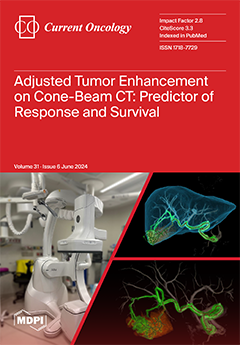
Cover Story: Hepatic artery embolization (HAE) is a well-established treatment for primary and secondary hepatic malignancies. The pattern of retained contrast on immediate post-procedure CT and cone-beam CT (CBCT) after HAE has been used to document the completion of treatment and predict treatment response. Visual or subjective evaluation of the post-treatment CT or CBCT is the most popular method. However, these methods are non-automated, solely dependent on the reviewer’s assessment, and not precise when evaluating tumors with inhomogeneous uptake. Therefore, there is a need to explore other objective imaging markers. This study aimed to examine the value of automated tumor enhancement parameters on CBCT obtained before and immediately after HAE in predicting treatment response, local progression-free survival, and overall survival. View this paper
  • Issues are regarded as officially published after their release is announced to the table of contents alert mailing list .
  • You may sign up for email alerts to receive table of contents of newly released issues.
  • PDF is the official format for papers published in both, html and pdf forms. To view the papers in pdf format, click on the "PDF Full-text" link, and use the free Adobe Reader to open them.

Articles (45)

  • Article
  • Open Access
1 Citations
2,340 Views
12 Pages

20 June 2024

Background: Involvement of the recurrent laryngeal nerve (RLN) in papillary thyroid carcinoma (PTC) is an important prognostic factor and is associated with a higher risk of recurrence. This study aimed to retrospectively analyze the outcomes of pati...

  • Article
  • Open Access
2 Citations
3,010 Views
12 Pages

Real-World Safety of Niraparib for Maintenance Treatment of Ovarian Cancer in Canada

  • Qi Guan,
  • Suriya J. Aktar,
  • Reka E. Pataky,
  • Mariet Mathew Stephen,
  • Maud Marques,
  • Karen Gambaro,
  • Kahina Rachedi,
  • Katharina Forster,
  • Samara Strub and
  • David Stock
  • + 8 authors

19 June 2024

Niraparib was recently funded in Canada for the maintenance treatment of ovarian cancer following platinum-based chemotherapy. However, the drug’s safety profile in the real world remains uncertain. We conducted a cohort study to describe the p...

  • Article
  • Open Access
3 Citations
2,455 Views
12 Pages

Impact of the COVID-19 Pandemic on Thyroid Cancer Surgery

  • Max L. Lee,
  • Uchechukwu C. Megwalu,
  • Andrey Finegersh,
  • Julia E. Noel and
  • Michelle M. Chen

19 June 2024

The COVID-19 pandemic caused major disruptions to healthcare services in 2020, delaying cancer diagnosis and treatment. While early-stage thyroid cancer often progresses slowly, it is crucial to determine whether treatment delays associated with the...

  • Article
  • Open Access
4 Citations
3,482 Views
16 Pages

Testing Machine Learning Models to Predict Postoperative Ileus after Colorectal Surgery

  • Garry Brydges,
  • George J. Chang,
  • Tong J. Gan,
  • Tsuyoshi Konishi,
  • Vijaya Gottumukkala and
  • Abhineet Uppal

19 June 2024

Background: Postoperative ileus (POI) is a common complication after colorectal surgery, leading to increased hospital stay and costs. This study aimed to explore patient comorbidities that contribute to the development of POI in the colorectal surgi...

  • Article
  • Open Access
4 Citations
3,484 Views
17 Pages

Health Economic Evaluation of Lung Cancer Screening Using a Diagnostic Blood Test: The Early Detection of Cancer of the Lung Scotland (ECLS)

  • Jose Antonio Robles-Zurita,
  • Nicola McMeekin,
  • Frank Sullivan,
  • Frances S. Mair and
  • Andrew Briggs

18 June 2024

Background: Diagnostic blood tests have the potential to identify lung cancer in people at high risk. We assessed the cost-effectiveness of a lung cancer screening intervention, using the EarlyCDT®-Lung Test (ECLS) with subsequent X-ray and low-d...

  • Article
  • Open Access
2,484 Views
17 Pages

18 June 2024

Immune-mediated diarrhea represents a serious complication of checkpoint inhibitor therapy, especially following ipilimumab-based treatment. Efficient diagnosis and control of diarrhea remains an ongoing challenge. We developed an accelerated managem...

  • Article
  • Open Access
1 Citations
2,957 Views
16 Pages

How to Balance Prognostic Factors in Controlled Phase II Trials: Stratified Permuted Block Randomization or Minimization? An Analysis of Clinical Trials in Digestive Oncology

  • Elodie Martin,
  • Karine Le Malicot,
  • Catherine Guérin-Charbonnel,
  • François Bocquet,
  • Olivier Bouché,
  • Anthony Turpin,
  • Thomas Aparicio,
  • Jean-Louis Legoux,
  • Laetitia Dahan and
  • Julien Taieb
  • + 6 authors

17 June 2024

In controlled phase II trials, major prognostic factors need to be well balanced between arms. The main procedures used are SPBR (Stratified Permuted Block Randomization) and minimization. First, we provide a systematic review of the treatment alloca...

  • Review
  • Open Access
9 Citations
7,414 Views
18 Pages

A Review of Immunotherapy in Non-Small-Cell Lung Cancer

  • Mariana Pilon Capella,
  • Steph A. Pang,
  • Marcos A. Magalhaes and
  • Khashayar Esfahani

17 June 2024

Cancer immunotherapy in the form of immune checkpoint inhibitors has led to a dramatic increase in the survival of patients with lung cancer across all stages. Over the past decade, the field has experienced rapid maturation; however, several challen...

  • Conference Report
  • Open Access
4,337 Views
116 Pages

16 June 2024

On behalf of the Canadian Association of Psychosocial Oncology, we are pleased to present the Abstracts from the 2024 Annual Conference, titled “Building Hope: Integrating Sustainable, Innovative and Accessible Care in Psychosocial Oncology&rdq...

  • Article
  • Open Access
2 Citations
2,284 Views
18 Pages

The Development and Evaluation of Novel Patient Educational Material for a Variant of Uncertain Significance (VUS) Result in Hereditary Cancer Genes

  • Deborah Cragun,
  • Marleah Dean,
  • David Baker,
  • Meghan Kelley,
  • Gillian Hooker,
  • Anne Weidner,
  • Paige Hunt and
  • Tuya Pal

16 June 2024

A Variant of Uncertain Significance (VUS) is a difference in the DNA sequence with uncertain consequences for gene function. A VUS in a hereditary cancer gene should not change medical care, yet some patients undergo medical procedures based on their...

of 5

Get Alerted

Add your email address to receive forthcoming issues of this journal.

XFacebookLinkedIn
Curr. Oncol. - ISSN 1718-7729