Skip to Content
  • 6.0
    Impact Factor
  • 10.3
    CiteScore
  • 15 days
    Submission to First Decision
  • 3 days
    Acceptance to Publication

Foods

Foods is an international, peer-reviewed, open access journal on food science published semimonthly online by MDPI. The Italian Society of Food Sciences (SISA) and Spanish Nutrition Foundation (FEN) are affiliated with Foods and their members receive discounts on the article processing charges.  

Get Alerted

Add your email address to receive forthcoming issues of this journal.

All Articles (27,177)

  • Article
  • Open Access

The red-claw crayfish, Cherax quadricarinatus, is a commercially valuable freshwater aquaculture species, with muscle flavor representing a core trait driving consumer preference and market value. Under identical farming conditions, same-batch crayfish commonly develop marked size divergence within and between sexes, but the impacts of this variation on muscle volatile flavor profiles remain largely unexplored. Here, C. quadricarinatus reared under consistent environmental conditions were categorized into four groups by body weight and sex: large-size female (GUBF), large-size male (GUBM), small-size female (GUSF), and small-size male (GUSM). Headspace solid-phase microextraction–gas chromatography–mass spectrometry (HS-SPME/GC-MS) was employed to profile volatile organic compounds. Multivariate statistical analysis, relative odor activity value calculation, metabolic pathway and network analysis, and receiver operating characteristic (ROC) analysis were combined to dissect flavor variation patterns, identify key aroma compounds, reveal underlying metabolic mechanisms, and screen potential biomarkers. Proximate composition analysis showed significant size differences in crude protein, lipid, moisture, and meat yield, with no significant sex differences. One hundred thirty-six volatile metabolites across 15 chemical categories were identified in all samples. Multivariate statistical analyses revealed clear separation among the four groups, suggesting that both body size and sex shape muscle volatile metabolite profiles, with stronger effects observed in females. Thirty-eight shared aroma-active compounds were detected, mainly including alcohols, aldehydes, ketones, esters, and aromatic hydrocarbons. The overall sensory profile was dominated by sweet-like notes, followed by fruity and green notes. Sex-related flavor differences were relatively slight in large-size crayfish but pronounced in small-size individuals. Large-size female crayfish had simpler flavor composition, while small-size females showed higher diversity and abundance of flavor compounds; size variation had limited effects on male flavor. Butanoate metabolism was significantly enriched in both the small-size sex comparison and female size comparison. Core metabolic frameworks were generally conserved across groups, but key hub metabolites differed by comparison type. This study systematically characterized the volatile flavor profiles of C. quadricarinatus muscle across different body sizes and sexes under controlled farming conditions, providing preliminary references for quality evaluation and premium aquaculture optimization of C. quadricarinatus.

Foods

15 October 2026
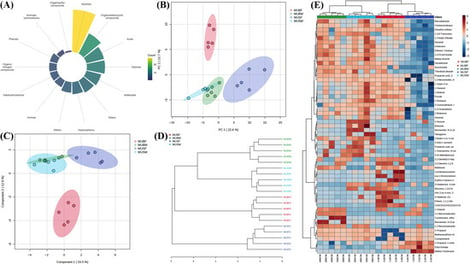
Multivariate statistical analysis of volatile compound profiles for C. quadricarinatus muscle samples. (A) Donut Plot of volatile compound classification; (B) PCA score plot showing the spatial distribution of MUBF, MUBM, MUSF, and MUSM sample groups. (C) sPLS-DA score plot presenting the distribution of MUBF, MUBM, MUSF, and MUSM sample groups. (D) Dendrogram plot showing clustering outcomes and the degree of inter-group differentiation across the MUBF, MUBM, MUSF, and MUSM sample groups; (E) Heatmap showing the clustering profiles of metabolites with significant abundance variation among the MUBF, MUBM, MUSF, and MUSM sample groups.
  • Article
  • Open Access

Since different geographical origins of black beans have different nutritional and economic values, their classification is of great significance in the field of agriculture. Therefore, this study aims to develop a classification model for black bean origin identification based on chemometric analysis of near-infrared (NIR) spectral data. Due to the overlap and complex distribution characteristics of raw NIR spectral data, traditional linear discriminant analysis algorithms are unable to extract effective discriminative information from them. To overcome these limitations and improve the performance of the algorithms, fuzzy set theory was incorporated into orthogonal linear discriminant analysis (OLDA), and the fuzzy OLDA (FOLDA) was proposed to extract discriminant features from the NIR absorption spectra of black beans. FOLDA enhances sample diversity and better handles noisy data. Furthermore, by combining FOLDA with a linear kernel function, the kernel FOLDA (KFOLDA) algorithm was proposed to address the challenge of linear algorithms in processing nonlinear data. KFOLDA not only effectively captures and processes nonlinear information within the data but also significantly improves the model’s classification accuracy. The experimental results show that the K-nearest neighbor (KNN) classifier achieved classification accuracies of 86.4% and 95.5% for FOLDA and KFOLDA, respectively. Thus, the proposed model demonstrates satisfactory classification accuracy and performance metrics for distinguishing different geographical origins of black beans.

Foods

15 October 2026

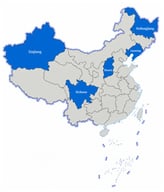
Geographical locations of sample origins for black beans.
  • Article
  • Open Access

To elucidate the molecular basis of the functional deterioration of Qula-derived casein, proteomic analysis was conducted, and the protein composition, structural characteristics, and functional properties of imported casein, fresh yak milk casein, and Qula-derived casein were systematically compared. Structural characterization was performed by spectroscopic and microscopic analyses, and physicochemical properties were measured in parallel. Qula-derived casein contained higher proportions of αs1-casein than imported casein and β-casein than both imported and fresh yak milk casein, but a lower proportion of κ-casein than either sample. Relative to fresh yak milk casein, Qula-derived casein showed decreases of 31.8% and 12.3% in α-helix and β-sheet contents, respectively, accompanied by a 22.3% increase in random coil content. Its microstructure also changed from a loose, porous morphology to dense, block-like aggregates. Accordingly, its emulsifying activity index, emulsion stability index, solubility, and surface hydrophobicity decreased to 29.3 m2/g, 23 min, 0.6%, and 199, respectively, representing reductions of 36.7%, 25.8%, 33.3%, and 32.1% compared with fresh yak milk casein. These findings indicate that alterations in casein isoform composition are associated with protein unfolding, aggregation, and the deterioration of functional properties during Qula processing. The new knowledge of this study lies in providing insight into the molecular mechanism by which traditional Qula processing may induce casein subtype changes, unfolding, and aggregation, and in describing a possible association between decreased κ-casein abundance and impaired functionality. These findings support the value-added utilization of Qula-derived casein and the optimization of traditional processing.

Foods

15 October 2026

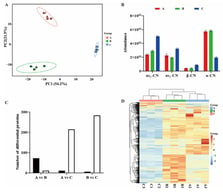
Proteomic analysis of the three casein samples. Sample A, imported casein; Sample B, fresh yak milk casein; Sample C, Qula-derived casein. (A) Principal component analysis (PCA) score plot. The numbers 1–3 indicate three biological replicates, and the unnumbered point represents the group mean. Ellipses indicate the distribution range of each sample group. (B) Relative abundances of the four casein subtypes. (C) Numbers of upregulated and downregulated proteins in the three pairwise comparison groups; filled squares indicate upregulated proteins, whereas open squares indicate downregulated proteins. (D) Heatmap of the abundance of all identified proteins. Each column represents one sample, and each row represents one protein. Different colors indicate different protein abundance levels, with darker and lighter colors representing higher and lower abundances, respectively.
  • Article
  • Open Access

Hyperlipidemia is a widespread metabolic disease that triggers abnormal lipid accumulation. Plant polyphenols possess great potential for lipid metabolism regulation. Small-leaved kuding tea (Ligustrum robustum Roxb. Blume, SLKDT) is abundant in polyphenols with proven hypolipidemic activity, whereas its key active constituents and molecular targets remain unclear. This study aimed to identify the key active components and core targets responsible for the lipid-lowering effects of SLKDT polyphenols. Response surface methodology (RSM) was employed to optimize the extraction process of SLKDT polyphenols. In vitro cell experiments were performed to verify the lipid-lowering effect of SLKDT polyphenols, while the obtained polyphenols were further qualitatively characterized via LC-MS/MS. Furthermore, network pharmacology prediction combined with molecular docking was used to screen the key bioactive compounds and their target proteins associated with lipid metabolism regulation. Under the optimal extraction conditions (43% ethanol concentration, ultrasound time of 40 min, solid-to-liquid ratio of 1:56 g/mL, and ultrasonic temperature of 57 °C), the yield of polyphenols from SLKDT was 131.88 mg/g. In vitro experiments confirmed that SLKDT polyphenols significantly reduced intracellular lipid accumulation in HepG2 cells, increased the activities of antioxidant enzymes including GSH-PX, CAT, and T-SOD, and decreased MDA content. Furthermore, SLKDT polyphenols markedly downregulated the expression of lipid synthesis-related genes, including ACC, HMGCR, SREBP-1c, and FASN, while upregulating CYP7A1 expression. A total of 88 compounds were Preliminary identified by LC-MS/MS, mainly including glycosides, flavonoids and phenolic acids. Network pharmacology analysis revealed that chrysin, 6-demethoxytangeretin, bavachinin, isobavachin, and bavachalcone were the core components mediating the lipid-lowering activity of SLKDT polyphenols, with target proteins including TP53, STAT3, AKT1, HSP90AA1, and EGFR. This study elucidates the key components and critical targets underlying the lipid-lowering effects of SLKDT polyphenols, providing experimental evidence and theoretical support for the development of SLKDT-derived products and natural lipid-lowering agents.

Foods

15 October 2026

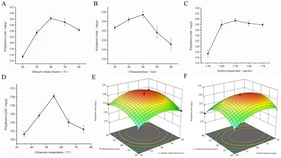
Optimization of extraction process of polyphenols from SLKDT. (A) Effect of ethanol volume fraction on the yield of polyphenols, (B) effect of ultrasound time on the yield of polyphenols, (C) effect of solid-to-liquid ratio on the yield of polyphenols, (D) effect of ultrasonic temperature on the yield of polyphenols, (E,K) effect of ethanol volume fraction and ultrasound time on polyphenol yield, (F,L) effects of ultrasound time and solid-to-liquid ratio on the yield of polyphenols, (G,M) effect of solid-to-liquid ratio and ultrasonic temperature on the yield of polyphenols, (H,N) effect of ethanol volume fraction and ultrasonic temperature on the yield of polyphenols, (I,O) effect of ethanol volume fraction and solid-to-liquid ratio on the yield of polyphenols, and (J,P) effect of ultrasound time and ultrasonic temperature on the yield of polyphenols.

Highly Accessed Articles

News & Conferences

Latest Issues

Open for Submission

Journal Sections

Sensory Detection and Analysis in Food Industry
Reprint

Sensory Detection and Analysis in Food Industry

Editors: Dongrui Zhao, Jianan Zhang
New Insights in Agriculture
Reprint

New Insights in Agriculture

Sustainability, Digitalization and Food Safety
Editors: Kristina Kljak, Klaudija Carović-Stanko, Darija Lemić, Jernej Jakše, Kurt A. Rosentrater, Arup Kumar Goswami, Craig Sturrock
XFacebookLinkedIn
Foods - ISSN 2304-8158