

Journal Menu
► ▼ Journal Menu-
- ASI Home
- Aims & Scope
- Editorial Board
- Topical Advisory Panel
- Instructions for Authors
- Special Issues
- Topics
- Sections & Collections
- Article Processing Charge
- Indexing & Archiving
- Editor’s Choice Articles
- Most Cited & Viewed
- Journal Statistics
- Journal History
- Journal Awards
- Society Collaborations
- Conferences
- Editorial Office
Journal Browser
► ▼ Journal BrowserNeed Help?
Announcements
19 November 2025
Meet Us Virtually at the 1st International Online Conference on Sensor and Actuator Networks (CSAN 2026), 9–10 July 2026
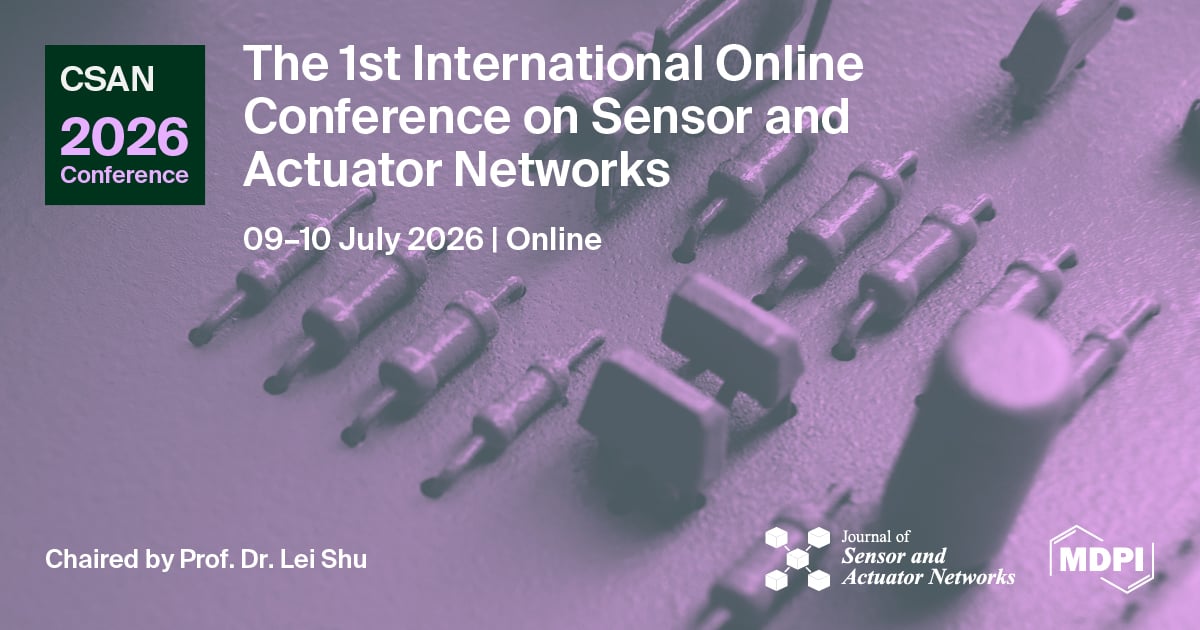
We are pleased to announce that the 1st International Online Conference on Sensor and Actuator Networks (CSAN 2026) will be held online from 9 to 10 July 2026. The conference is organized by MDPI’s Journal of Sensor and Actuator Networks (JSAN, ISSN: 2224-2708, Impact Factor: 3.3).
CSAN 2026 will present the latest studies in sensor and actuator network-related research in the fields of healthcare, smart agriculture, industry, mobile systems, intelligent transportation, manufacturing, smart cities, and engineering.
We welcome all past authors to speak at CSAN2026. All invited speakers will get the award.
Conference Chair:
- Prof. Dr. Lei Shu, 1 Nanjing Agricultural University, Nanjing, China; 2 University of Lincoln, Lincoln, UK.
Session topics:
S1. Industry 4.0 and embedded wireless sensor/actuator systems;
- Session Chair: Prof. Adnan M. Abu-Mahfouz, Council for Scientific and Industrial Research (CSIR), South Africa.
S2. Blockchain technologies and Internet-of-Things-based WSAN;
- Session Chair: Prof. Pascal Lorenz, University of Haute-Alsace, France.
S3. WSAN and next-generation networks (5G, 6G, etc.);
- Session Chair: Prof. Jordi Mongay Batalla, Warsaw University of Technology, Poland.
S4. Applications of WSAN in agriculture, vehicles, wearable sensors, smart cities, manufacturing, mobile systems, and health and medical care;
- Session Chair: Prof. Sye-Loong Keoh, University of Glasgow, UK.
S5. Big data, computing and artificial intelligence.
- Session Chair: Prof. Jianwei Niu, Bei hang University, China.
Conference awards:
- The Best Oral Presentation Award is given to the invited speakers; we appreciate your contribution and time at CSAN2026;
- The Best Video Presentation Award is given to the submission judged to make the most significant and interesting video presentation for the conference.
Guide for Authors:
Abstracts written for CSAN 2026 will be directly submitted to the Topic “The 1st International Online Conference on Sensor and Actuator Networks (CSAN 2026)” within the “Special Issue” section of JSAN with a 15% discount on the publication fee.

Submit your abstract before 9 March 2026!

Register before 6 July 2026!

Register for Early Bird by 6 June 2026. The registration fee includes attendance costs for all conference sessions.
For detailed information, please visit https://sciforum.net/event/CSAN2026.
For any enquiries regarding the event, please contact csan2026@mdpi.com.
We look forward to seeing you at CSAN 2026.
6 November 2025
MDPI Launches the Michele Parrinello Award for Pioneering Contributions in Computational Physical Science

MDPI is delighted to announce the establishment of the Michele Parrinello Award. Named in honor of Professor Michele Parrinello, the award celebrates his exceptional contributions and his profound impact on the field of computational physical science research.
The award will be presented biennially to distinguished scientists who have made outstanding achievements and contributions in the field of computational physical science—spanning physics, chemistry, and materials science.
About Professor Michele Parrinello
"Do not be afraid of new things. I see it many times when we discuss a new thing that young people are scared to go against the mainstream a little bit, thinking what is going to happen to me and so on. Be confident that what you do is meaningful, and do not be afraid, do not listen too much to what other people have to say.”
——Professor Michele Parrinello
 |
Born in Messina in 1945, he received his degree from the University of Bologna and is currently affiliated with the Italian Institute of Technology. Professor Parrinello is known for his many technical innovations in the field of atomistic simulations and for a wealth of interdisciplinary applications ranging from materials science to chemistry and biology. Together with Roberto Car, he introduced ab initio molecular dynamics, also known as the Car–Parrinello method, marking the beginning of a new era both in the area of electronic structure calculations and in molecular dynamics simulations. He is also known for the Parrinello–Rahman method, which allows crystalline phase transitions to be studied by molecular dynamics. More recently, he has introduced metadynamics for the study of rare events and the calculation of free energies. |
For his work, he has been awarded many prizes and honorary degrees. He is a member of numerous academies and learned societies, including the German Berlin-Brandenburgische Akademie der Wissenschaften, the British Royal Society, and the Italian Accademia Nazionale dei Lincei, which is the major academy in his home country of Italy.
Award Committee
 |
The award committee will be chaired by Professor Xin-Gao Gong, a computational condensed matter physicist, academician of the Chinese Academy of Sciences, and professor at the Department of Physics, Fudan University. Professor Xin-Gao Gong will lead a panel of several senior experts in the field to oversee the evaluation and selection process. The Institute for Computational Physical Sciences at Fudan University (Shanghai, China), led by Professor Xin-Gao Gong, will serve as the supporting institute for the award. |
"We hope the Michele Parrinello Award will recognize scientists who have made significant contributions to the field of computational condensed matter physics and at the same time set a benchmark for the younger generation, providing clear direction for their pursuit—this is precisely the original intention behind establishing the award."
——Professor Xin-Gao Gong
The first edition of the award was officially launched on 1 November 2025. Nominations will be accepted before the end of March 2026. For further details, please visit mparrinelloaward.org.
About the MDPI Sustainability Foundation and MDPI Awards 
The Michele Parrinello Award is part of the MDPI Sustainability Foundation, which is dedicated to advancing sustainable development through scientific progress and global collaboration. The foundation also oversees the World Sustainability Award, the Emerging Sustainability Leader Award, and the Tu Youyou Award. The establishment of the Michele Parrinello Award will further enrich the existing award portfolio, providing continued and diversified financial support to outstanding professionals across various fields.
In addition to these foundation-level awards, MDPI journals also recognize outstanding contributions through a range of honors, including Best Paper Awards, Outstanding Reviewer Awards, Young Investigator Awards, Travel Awards, Best PhD Thesis Awards, Editor of Distinction Awards, and others. These initiatives aim to recognize excellence across disciplines and career stages, contributing to the long-term vitality and sustainability of scientific research.
Find more information on awards here.
9 October 2025
Meet Us at the 3rd International Conference on AI Sensors and Transducers, 2–7 August 2026, Jeju, South Korea

Following from our two previous successful editions, we invite you to submit your abstracts and participate in the 3rd International Conference on AI Sensors and Transducers, taking place from 2 to 7 August 2026 in Jeju, South Korea.
Organized by MDPI and the open access journals Sensors, Micromachines, AI Sensors, Micro and Remote Sensing, this in-person conference will once again bring together experts and participating researchers who will share insights and innovations in sensors, sensing technology, transducers and artificial intelligence.
Start preparing your abstracts:
Don’t miss this opportunity to showcase your work to peers and leading experts in AI-enhanced sensing systems and transducers. We will be announcing the session topics at AIS 2026 soon.
Find out more about the instructions for authors: https://sciforum.net/event/AIS2026?section=#instructions.
Find out more about the publication opportunities available for authors: https://sciforum.net/event/AIS2026?section=#Publicationopportunities.
Please feel free to share the information about this conference to your colleagues and students.
We look forward to welcoming you in Jeju!
The organizing committee of the 3rd International Conference on AI Sensors and Transducers (AIS 2026).
28 February 2026
MDPI INSIGHTS: The CEO’s Letter #32 - MDPI China and Thailand, China Science Daily, 1,000 Partnerships, R2R

Welcome to the MDPI Insights: The CEO's Letter.
In these monthly letters, I will showcase two key aspects of our work at MDPI: our commitment to empowering researchers and our determination to facilitating open scientific exchange.
Opening Thoughts

Reflections from China: Year-End-Celebrations and Open Access Publishing
In February, I had the pleasure of joining over a thousand colleagues from our Tongzhou and Haidian offices at their end-of-year annual celebration in Beijing.
Spending time with our teams in China is also a powerful reminder of the scale and complexity of MDPI as a global organization. Our colleagues in Beijing, Wuhan, and across the country play a significant role in our day-to-day operations and long-term development. I’m grateful for the hospitality, collaboration, and commitment shown by our managers and teams in China, alongside colleagues worldwide, who have helped steadily build MDPI, brick by brick, over the years.
Below are some data on Open Access (OA) publishing in China and our collaboration in this important research market.
Open Access Publishing in China
China has been the world’s leading country in research and review article publication volume since 2019, exceeding one million publications in 2025. Over the past five years, the gap between China and the second-ranked country, the United States, has continued to widen.
In 2025:
- 47% of China’s research output was published Open Access
- Of those OA publications, 76% were Gold Open Access (approximately 382,930 articles)
- The overall OA distribution remained stable compared with 2024, with Gold OA increasing by 1%
Over the past five years (2021–2025):
- China published 4,398,050 research and review articles
- Approximately 48% of this output was OA
According to Dimensions, when comparing the top 20 countries by publication volume (2021–2025):
- China ranks 1st worldwide in publication volume
- China ranks 9th in citation performance within this group (for comparison, the US ranks 2nd in publication volume and 10th in citation ranking)
- Average citations per article: 12.51
Among the top 10 universities globally by publication volume, six are Chinese institutions, alongside Harvard University (USA), the University of São Paulo (Brazil), the University of Toronto (Canada), and the University of Oxford (UK).

MDPI and China
China is an important and long-standing part of MDPI’s global publishing ecosystem:
- In 2025, MDPI was the largest fully Open Access publisher in China
- MDPI published 22% of China’s Gold Open Access output (82,133 papers)
- We received 290,999 submissions from China-affiliated authors and published 82,133 articles
- There are 8,500+ active Editorial Board Members based in China
- 64% (5,438) have an H-index above 26
- MDPI works with:
- 117 Editors-in-Chief
- 103 Section Editors-in-Chief
- 71 China-based institutions currently hold IOAP agreements with MDPI, seven of which rank among the top 10 Chinese institutions by publication volume
China's scale in research output means that the publishing platforms chosen by Chinese scholars will continue to influence the direction of scholarly publishing. At the same time, MDPI’s strength comes from its international collaboration, with colleagues, editors, reviewers, and authors working together across regions and disciplines.
Thank you to all our colleagues in China, and around the world, who support MDPI’s publishing activities across departments and help advance open access research every day.
Impactful Research

“Progress in open science is built through trust, dialogue, and relationships”
Behind the Scenes: A Conversation with China Science Daily
During my trip to Beijing, I also had the opportunity to visit China Science Daily and take part in an interview and broader exchange with their team in Beijing. Visits like this matter because progress in open science is built not only through platforms and infrastructure, but also through trust, dialogue, and relationships across research communities and regions.
China Science Daily: History Museum
As part of the visit, I was given a tour of their History Museum, which offers a thorough perspective on the evolution of China’s first science and technology newspaper, established in 1959. The exhibition highlights how the organization developed into a trusted institution connecting research with the public and policymakers. It was a helpful reminder that at the core of publishing is stewardship, credibility, and long-term public engagement with science.

An Open Exchange on Open Science
During the visit, I met with Dr. Zhao Yan, Editor-in-Chief of ScienceNet. We had an open and engaging conversation about MDPI’s role in Open Access, the evolution of open science globally, and the potential for more collaboration going forward. He especially appreciated the candid and personal nature of our exchange, noting that this kind of dialogue feels important in a landscape where trust and transparency matter.

Interview on Open Access
I also participated in an interview with Ms. Yan Jie, from the Online Media Center and Editor-in-Chief of ScienceNet, China Science Daily. Our discussion covered the growth of Open Access over the past 30 years, MDPI’s mission and values, academic integrity, collaboration with the Chinese research community, and MDPI’s own 30th anniversary milestone. It was a great opportunity to reflect on how open science has matured, and where shared responsibility across publishers, institutions, and researchers continues to matter most.
“Progress in open science is built by more than scale and infrastructure”
I’m sharing a few photos from the visit as a glimpse behind the scenes. The full interview will be published by China Science Daily in due course, and I look forward to sharing it when it is available.

More broadly, visits like this reinforce something I’ve always believed in: progress in open science is built not only through scale and infrastructure, but also through continued dialogue, mutual respect, collaboration, and a willingness to listen across regions and perspectives. That remains central to our work, especially as MDPI reflects on 30 years of publishing, built together.
Inside MDPI

Bangkok Visit: Growth, Partnership, and Local Impact
In February, I also had the opportunity to visit our Bangkok office for the second time in two years to support their local meetings and deliver a training session on how we present MDPI at a corporate level.
It’s easy to spend time with our colleagues in Thailand. From Editorial and Production to Conferences, Marketing, Design, and our Regional Journal Relations Specialist (RJRS), the team continues to grow in scale and professionalism. I’d also like to recognize our local management and admin teams, who have been steadily expanding our office and supporting more than 500 colleagues on the ground.
Academic Partnerships
During the visit, we met with the Engineering Department at King Mongkut’s Institute of Technology Ladkrabang (KMITL). Our discussion focused on the recent MDPI developments, Institutional Open Access Program (IOAP) opportunities, Author Publishing Workshops (APW), and the potential use of JAMS to support their institutional journal.

“MDPI is the third-largest OA publisher in Thailand”
We also shared insights into the growth of Open Access (OA) in Thailand and KMITL’s own publishing trends. These conversations matter because institutions are looking for sustainable ways to support their researchers. Our IOAP agreements are one simple example of how we can provide value in this area while maintaining accessibility for authors.
Thailand and MDPI: 2025 Snapshot
Our Bangkok office, officially launched in 2022, has been growing to support over 500 staff members while continuing to expand its engagement in scholar visits, workshops, and conference collaborations. As at 2025, Thailand submissions to MDPI have increased about 21% and publications by about 25%, maintaining a rejection rate close to the company average. MDPI is the third-largest OA publisher in Thailand, publishing 15% of all Gold OA output in 2025.
Representing MDPI Externally
During the visit, I delivered a training session on how we present MDPI at external events.

This session covered topics related to:
- Our aim and guiding principles
- High-level company milestones and Indexing facts and figures
- Industry partnerships and collaborations
- Market trends in OA and subscription publishing
- Country-specific publishing data and collaborations with MDPI
- Insights from our Voice of Community report
I find that while many colleagues are very familiar with the specific journal for which they have responsibility, fewer have visibility into the broader MDPI ecosystem and the company’s global positioning. These sessions help build alignment, confidence, and consistency in how we represent the company.
What stands out most is that MDPI’s growth is not abstract: it’s visible in the people, the partnerships, and the professionalism developing across our offices.
Coming Together for Science

1,000 Institutional Partners: A Milestone Built on Trust
This month, we reached an important milestone: more than 1,000 institutions worldwide are now part of MDPI’s Institutional Open Access Program (IOAP). On paper, that is a number. In practice, it represents trust.
This milestone symbolizes thousands of conversations with libraries and institutions. It stands for negotiations, renewals, consortium expansions, and, most importantly, relationships built over time. It reflects the work of colleagues across publishing, institutional partnerships, marketing, editorial, finance, and many other teams who contribute to making these agreements operational.
In 2025 alone, more than 61,300 research articles benefited from article processing charge (APC) discounts through IOAP agreements. Tens of thousands of authors were able to publish through a simplified and structured process. At the same time, institutional administrators gained clearer oversight and streamlined workflows.

Why IOAP Matters
When we launched IOAP, the objective was straightforward: to reduce barriers for researchers while supporting institutions in navigating the evolving OA landscape. Over the past decade, the research ecosystem has changed. Funder mandates, national policies, and Plan S–aligned requirements have accelerated the transition to OA.
Institutions need publishing partners who provide transparency, scalability, and operational efficiency. IOAP was designed to support that reality.
For colleagues who would like to better understand the program, this blog-post overview of MDPI’s IOAP provides additional context, including common questions around the transition to OA and how our institutional partnerships are structured.
“Institutions need publishing partners who provide transparency, scalability, and operational efficiency”
Recent Examples
Our agreements continue to evolve across regions:
- In Sweden, MDPI signed a national Open Access publishing agreement with 96 institutions, enabling affiliated researchers to publish without managing individual APC payments.
- In Spain, we extended our flat-fee agreement with Universidad Católica de Valencia, reinforcing institutional support for OA publishing.
These examples show that institutions seek structured, predictable models that support their researchers at scale.
Looking Ahead
Crossing the threshold of 1,000 partners tells us that institutions see MDPI not just as a publisher but as a reliable operational partner in advancing open science. This milestone is not a finish line. It is a reminder that the work continues.
Thank you to the entire IOAP team and to all colleagues who contributed to reaching this achievement.
P.S. You can read about this milestone across industry outlets, including STM Publishing News, ALPSP, Research Information, EurekAlert, Brightsurf, among others. You can also read about the coverage in Poland (e.g., media-room, bomega) Korea (newstap), and Romania (EduLike).
Closing Thoughts

Reflections from the Researcher to Reader Conference
During 24–25 February, I attended the 2026 Researcher to Reader Conference in London, UK. Leaders from across scholarly publishing, research infrastructure, libraries, and technology gathered to discuss AI and research integrity, peer review reform, metadata and infrastructure, community engagement, open research policy, and the evolving role of publishers in a rapidly shifting ecosystem.
The conversations were open and honest, and at times uncomfortable – exactly what we need at times. Below are a few reflections that stayed with me.
The Battle for Knowledge: What Becomes Accepted as ‘True’?
One recurring theme was not whether science evolves but whether our infrastructure is resilient enough to sustain trust at scale. Science does not promise certainty: it promises process. As publishing systems grow more complex and become more technologically mediated, the question is how intentionally we design, monitor, and strengthen that process.
Peer Review: Speed, Credentials, and Structural Loops
Researchers consistently call for faster peer review. At the same time, reviewer credentials are often tied to publication records. This creates a structural loop. Publishing history opens reviewing opportunities, reviewing strengthens credentials, and those without early access remain outside the cycle.
There is a need for us to reflect on how opportunity circulates within our systems: we should ask how we create more inclusive pathways for researchers globally to participate in peer review.
Community Engagement Workshop
One of the highlights of R2R was the workshop format, whereby small groups met repeatedly over two days and moved from ideas to tangible strategies.
I joined the Community Engagement workshop led by Lou Peck (CEO at The International Bunch) and Godwyns Onwuchekwa (Principal Consultant at Global Tapestry Consulting). We explored two deceptively simple questions: What is a community? and What does engagement truly mean?
“Engagement requires shared design and shared responsibility”
Too often, organizations equate communication with engagement. The framework discussed mapped a maturity spectrum – from enablement (broadcasting, informing and consulting) to true engagement (collaborating and co-creating).
It was a useful reminder of the fact that if we want trust and loyalty, engagement must go beyond announcements and surveys. It requires shared design and shared responsibility.
AI: Democratization or Digital Colonialism?
I especially enjoyed the thought-provoking presentation from Nikesh Gosalia (Chief Partnership Officer at Cactus Communications), which highlighted an uncomfortable reality:

- 93% of AI-generated content is in English
- Approximately 2% is in French
- Approximately 2% is in German
- More than 7,000 languages are represented in less than 5% of the content within large AI systems
The implications are profound. Is AI democratizing access to scholarly publishing (making it easier for researchers everywhere to participate in global knowledge production)? Or are we encoding colonialism at scale (entrenching linguistic and structural hierarchies, and making it harder for voices from the Global South to be heard)?
AI is already reshaping how research is created, reviewed, discovered, and shared. Its potential is enormous. But its impact depends not only on capability, but on governance, design, and intentionality. Publishers, funders, and researchers all share responsibility in shaping how these systems evolve.
Ethicality in practice (Lightening Talk)

It was also great to have our colleague Dr Miloš Čučulović (Head of Technology Innovation at MDPI) present MDPI’s Ethicality platform during a lightning talk.
“Technology alone is not the answer”
Ethicality embeds AI-driven checks directly into the submission workflow, supporting editors proactively rather than reacting after publication. As we scale, tools like this help balance trust, efficiency, and research integrity.
This goes back into the underlying theme of the conference that technology alone is not the answer. However, technology embedded thoughtfully within clear governance frameworks can strengthen confidence in the editorial process.
Final thought
The question is no longer whether technology will transform research infrastructure: it is already doing so. The real question is what role each of us will play in shaping that transformation deliberately, with structural maturity, inclusive governance, and engagement that moves from informing to co-creating.
Science needs to evolve, responsibly. And that responsibility extends not only to what we publish, but also to how the systems behind publication are designed. Some important topics to continue reflecting on both internally and within our broader community.
Chief Executive Officer
MDPI AG
20 February 2026
MDPI Virtual Academic Publishing Workshop (New Harvest), 25 February 2026
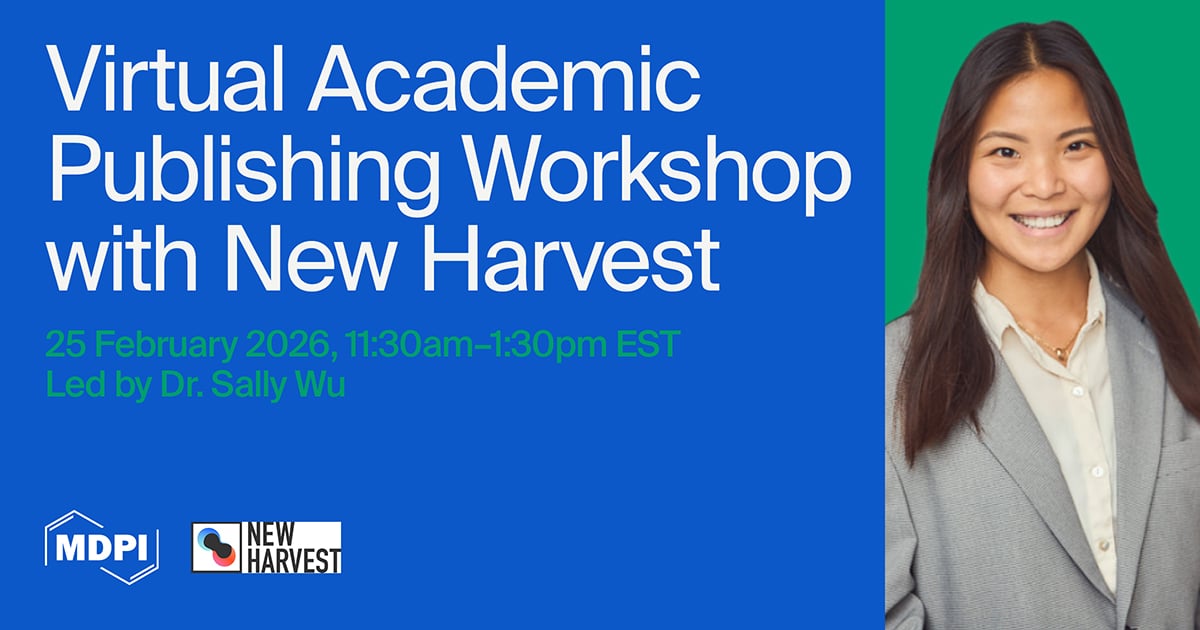
This Academic Publishing Workshop will be led by MDPI Regional Journal Relations Specialist, Dr. Sally Wu, on “Author Training”. Participants will receive practical advice on essential aspects of writing academic articles. Participants will leave with a clearer understanding of the academic publishing landscape and how to successfully contribute to it.
Date: 25 February 2026
Time: 11:30 a.m.–1:30 p.m. EST
Schedule:
|
Speaker |
Program |
Time in EST |
|
Dr. Sally Wu |
Introduction |
11:30–11:40 a.m. |
|
Dr. Sally Wu |
Tips for Writing Great Research Papers
|
11:40 a.m.–12:15 p.m. |
|
Dr. Sally Wu |
How to Respond to Peer Reviewers
|
12:15–12:50 p.m. |
|
Dr. Sally Wu |
AI in Publishing: Challenges and Opportunities
|
12:50–13:30 p.m. |
Speakers:
|
|
Dr. Sally Wu received a PhD in medical science from the University of Toronto in the fall of 2025. She joined MDPI in February 2025 as an Assistant Editor for Cells. She was recently promoted to Regional Journal Relations Specialist position in August. In this role, she works with many journals, liaising with authors, board members, and EiCs. She has attended several conferences across North America, hosted scholar visits, and taken part in other outreach events. |

18 February 2026
MDPI’s Open Access Program Reaches 1,000 Institutions Worldwide
MDPI has surpassed the milestone of 1,000 partners within the Institutional Open Access Program (IOAP). The agreements span 59 countries, covering North and South America, Europe, Asia, Africa, and Oceania.
Last year alone, more than 150 new libraries and academic institutions joined MDPI’s IOAP. With the expansion of an existing consortium deal in Sweden we welcomed a further 75 partners to the program in January 2026, enabling us to surpass the 1,000-partners milestone.
The IOAP supports affiliated researchers by streamlining submission processes, reducing administrative burdens, and offering discounted Article Processing Charges (APCs). Through IOAP membership, more than 61,300 research articles received APC discounts in 2025, driving greater visibility and accessibility for partner institutions and global research communities alike.
"This milestone marks a significant step towards expanding MDPI’s global impact," said Stefan Tochev, MDPI's CEO. "Reaching 1,000 IOAP partnerships is a true testament to the growing trust and collaboration we’ve built with universities, libraries, and research organizations worldwide. We are proud to lead the way in Open Access publishing, ensuring researchers have the support they need to reach global audiences." "The success of our program is reflected in the growing global demand for Open Science and quality publishing services," said Becky Castellon, MDPI institutional partnerships manager. "Equally, institutions are increasingly seeking Open Access publishing options that support funder and national mandates. Joining the IOAP makes compliance simple."
6 February 2026
Acknowledgment to the Reviewers of Applied System Innovation in 2025

The editorial office of Applied System Innovation would like to extend its sincere gratitude to all reviewers who contributed to the improvement of the journal quality by providing their expert opinion and evaluation of the submitted research.
We appreciate that thorough peer review demands considerable time and intellectual investment from our reviewers. In 2025, Applied System Innovation received 1201 review reports from contributors across 61 countries and territories, demonstrating the breadth of international expertise and scholarly engagement that has strengthened our publication standards.
The reviewers who agreed to have their names published this year are listed below in alphabetical order by first name. The editorial team acknowledges with gratitude all reviewers, named and anonymous alike, for their vital role in maintaining the scholarly standards of Applied System Innovation.
| Abdelkader Aguir | Mario Alberto Garcia-Ramirez |
| Abdellatif Jarjar | Marius Gabriel Petrescu |
| Adriana Berdich | Mariusz Dzieńkowski |
| Agostinho Antunes Da Silva | Marjetka Savic |
| Agustín Leobardo Herrera-May | Mateusz Olszewski |
| Aleksey Filippov | Miguel Angel Dominguez-Jimenez |
| Alexander Kocian | Mihaela Hnatiuc |
| Alexander Molnar | Mihaela Tudose |
| Alexey I. Shinkevich | Mina Tadros |
| Algirdas Baskys | Ming Wu |
| Allard Jan Van Marle | Mircea Fulea |
| Ana Isabel Santos | Mohammad Hossein Ghaemi |
| Ana Pérez Gimeno | Mohammad Reza Maghami |
| André Andrade Longaray | Mohammad Reza Raveshi |
| Andrea Majlingova | Moulay Rachid Douiri |
| Andreas Kanavos | Muhammad Faizan Shah |
| Andrei Dumitrescu | Muhammad Yousuf Irfan Zia |
| Andrei Tumarkin | Murodbek Safaraliev |
| Andrej M. Savić | Mustapha Adar |
| Andrey Romanenko | Mustapha Ahlaqqach |
| Anja Terzic | Myroslava Vovk |
| Anton Antonov | Naireeta Deb |
| Anton Basson | Nancy Serwint |
| Antonio Luiz Schalata Pacheco | Nataliia Lysa |
| Armando Roman-Flores | Neeraj Dhanraj Bokde |
| Athanasios G. Lazaropoulos | Nemanja Zdravković |
| Aurel Burciu | Niloy Chandra Sarker |
| Benedictus Rahardjo | Nina Brutch |
| Bin Yan | Oana Cristina Beniuga |
| Boglárka Eisinger Balassa | Oleh Strelko |
| Brett Bligh | Olympia Roeva |
| Calin Corciova | Onur Can Kalay |
| Celso Cruz | Oscar E. Cigarroa-Mayorga |
| César De Oliveira Ferreira Silva | Osslan Osiris Vergara Villegas |
| Chang-Duo Liang | Panzheng Zhou |
| Chao Lian | Parvesh Saini |
| Cheng-Kai Yao | Pavlo Radiuk |
| Christopher Randles | Paweł Droździel |
| Chunning Wang | Pedro Catalão Moura |
| Cong Wu | Pengfei Wang |
| Constantin Daniel Oancea | Pengfei Yang |
| Constantinos Challoumis | Pinelopi Vlotinou |
| Dan Pescaru | Piotr Nowotarski |
| Davis Montenegro | Popescu Paul Stefan |
| Daxiong Ji | Przemysław Podulka |
| Da-Zhi Sun | Qing Lu |
| Deni Librado Torres-Roman | Radoslava Stankova Kraleva |
| Deyu Li | Radoslaw Wolniak |
| Dominika Siwiec | Ramin Soltanmohammadi |
| Eddie N. Armendáriz-Mireles | Ramūnas Deltuva |
| Edgar Lenymirko Moreno-Goytia | Raul Matsushita |
| Emmanouil Marakakis | Renars Erts |
| Enrico Aymerich | Ricardo P. Arciniega-Rocha |
| Ericka Janet Rechy-Ramirez | Ricardo Pieralisi |
| Érick-G. Espinosa-Martínez | Ricardo Tejeida Padilla |
| Ermelinda Oro | Romeo Marin Marian |
| Fabian Andres Lara-Molina | Said El Kafhali |
| Fabio Rocha Barbosa | Sanda Budea |
| Fengcheng Jiang | Sang-Lok Yoo |
| Fernando Daniel Farfán | Sarfaraz Hashemkhani Zolfani |
| Florin Nicolae | Sedelnikov Andry |
| Francisco Javier González-Cañete | Sercan Demir |
| Gaetano Zazzaro | Sergey V. Panin |
| Galina Vitkina | Sergii Sagin |
| Genett Isabel Jimenez | Simone Servadio |
| George Vlahavas | Siong Thye Goh |
| Gloria Cerasela Crisan | Srinivas Gandrothula |
| Gorazd Bombek | Stefanos Balaskas |
| Grzegorz Michalski | Stephen Oladipo |
| Guna Sekhar Sajja | Stoyan Dimitrov Slavov |
| Haihua Wang | Stoyan Kirilov |
| Hamed Nozari | Szymon Sieciński |
| Hamid Naseem | Tae-Young Choe |
| Hao Sun | Tamara Radivilova |
| Hector Obrien Kaschel | Tatiana P. Moschovou |
| Hiroyuki Tomiyama | Teresa Isabel Costa De Oliveira Martins Matos |
| Hongru Li | Thanyani Pandelani |
| Huibing Gan | Thiago B. Murari |
| Igor Litvinchev | Thiago Mota Soares |
| Irina Makarova | Tien Anh Tran |
| Iryna Oleksandrivna Bondarenko | Todor Tagarev |
| Issam Hanafi | Todorka Glushkova |
| Iván Juan Carlos Pérez Olguín | Tommaso Pecorella |
| Ivan Pavlenko | Tuan Anh Nguyen |
| Ivan Rozhnov | Vadim Parfenov |
| Ivana Vasiljević | Vahid Hajihashemi |
| Iwona Grobelna | Velichka Traneva |
| Jaejong Park | Veneta Veselinova Tabakova-Komsalova |
| Jana Fabianova | Veta Ghenescu |
| Javier Fernando Jiménez Alonso | Viacheslav Osadchyi |
| Jessica S. Ortiz | Victor Monzon Baeza |
| Jia Mao | Vitaliy Korendiy |
| Jian Liu | Vittorio Solina |
| Jing Xu | Vivek Kumar |
| Jinsu Kim | Vladimir Shakhov |
| João Carlos Gonçalves Dos Reis | Volodymyr Hrytsyk |
| Jorge De Andrés-Sánchez | Volodymyr Ierin |
| José Ángel Sánchez-Fernández | Volodymyr Sokolov |
| Jose Carlos Montes Ninaquispe | Wang Shih Ming |
| José R. García-Martínez | Weidong Fang |
| José-Joel Gonzalez-Barbosa | William Joel Marin-Rodriguez |
| Jozef Hrbček | Wojciech Marek Zabołotny |
| Ka-Hou Chan | Xiaoling Liang |
| Kaixin Liu | Xiaoning Shen |
| Ke Song | Xiaoyu Li |
| Kheir Eddine Bouazza | Xiong Shu |
| Kristina Rudžionienė | Xuelong Yang |
| Kun Qian | Yahir Hernández-Mier |
| Lei Shi | Yan-Pu Yang |
| Lesley S. J. Farmer | Yazhi Liu |
| Lijana Maskeliūnaitė | Yongsheng Bai |
| Liu Kai | Yu-Chi Wu |
| Ljubica Kazi | Yuri Gordienko |
| Longlong Zhao | Yurii Kynash |
| Luciano De Tommasi | Yushun Lian |
| Luhaibo Zhao | Željko Stević Stević |
| Luminita Parv | Zhenya Wang |
| Madhusudan Puttaswamy | Zhichong Wang |
| Małgorzata Gawlik-Kobylińska | Zhongqiang Luo |
| Manas Ranjan Biswal | Zied Ben Hazem |
| Marcelo Tsuguio Okano | Zisheng Wang |
| Marco Vaccari | Zixin Dou |
| Marek Šolc | Zongshui Wang |
| Maria Osipenko |
2 February 2026
MDPI INSIGHTS: The CEO's Letter #31 - MDPI 30 Years, 500 Journals, UK Summit, Z-Forum Conference, APE
Welcome to the MDPI Insights: The CEO's Letter.
In these monthly letters, I will showcase two key aspects of our work at MDPI: our commitment to empowering researchers and our determination to facilitating open scientific exchange.
Opening Thoughts

MDPI at 30: Three Decades of Open Science, Built Together
As we begin 2026, we approach a meaningful milestone in MDPI’s history: 30 years of advancing Open Science.
What began in 1996 as a small, researcher-driven initiative has grown into a global open-access publisher, supporting hundreds of journals, millions of researchers, and a shared belief that scientific knowledge should be openly available to all. Over these three decades, Open Access has moved from the margins to the mainstream, and MDPI has been proud to help shape that transformation.
To mark this anniversary year, we are pleased to share our MDPI 30th Anniversary logo.
The Anniversary logo is intentionally simple, confident, and enduring, designed to work across cultures, disciplines, and digital environments. It reflects both continuity and progress, honouring MDPI’s established identity while representing the company we are today. The green accent symbolizes our connection to the research communities we serve and the collaborative nature of Open Science itself.
Alongside the visual identity, we are also introducing our 30th Anniversary tagline:
30 Years of Open Science, Built Together.

This phrase captures what has always defined MDPI. Open Science is not the work of a single organization: it is a collective effort shaped by researchers, editors, reviewers, institutions, and the many teams who support the publishing process every day. MDPI’s role has been to provide the infrastructure and commitment that allow this collaboration to thrive.
Throughout 2026, we will mark this anniversary through regional events, global conversations, and editorial initiatives that reflect on MDPI’s evolution, its impact across disciplines, and the communities that make this work possible.
“Open Science is a collective effort”
Whether you have been part of MDPI’s journey for decades or are engaging with us for the first time this year, this milestone belongs to all of us. The past 30 years have shown what is possible when openness, trust, and collaboration are placed at the centre of scholarly communication.
As we look ahead, our focus remains clear: continuing to strengthen quality, integrity, and partnership – so that Open Science can keep moving forward, together.
Impactful Research

A Shared Milestone: MDPI’s Journal Portfolio Reaches 500 Titles
MDPI has reached an important milestone: our journal portfolio grew to more than 500 academic journals last year, spanning the fields of chemistry, engineering, biology, medicine, environmental sciences, the social sciences, and beyond.
The number itself is significant, but what matters more is what supports it: hundreds of scholarly communities that have chosen to collaborate, grow, and publish with MDPI.
From our beginnings nearly 30 years ago with a single Open Access journal (Molecules), MDPI has been guided by a simple aim: advancing Open Science. Reaching 500 journals is not an endpoint. It reflects the diversity of disciplines, ideas, and research cultures that now form part of our shared ecosystem.
Growth with Purpose
Every journal exists because a specific community believes there is a need for focus, visibility, and dialogue in a particular field. As our portfolio has expanded, so has our responsibility to ensure that scale is matched with strong editorial standards, robust research integrity practices, and meaningful academic leadership.
This milestone comes as we enter MDPI’s 30th anniversary year, a fitting moment to reflect on what scale in scholarly publishing truly requires: not only reach, but also dedicated long-term stewardship.
New Journals, New Communities
In December 2025 alone, MDPI welcomed eight newly launched journals and three journal transfers (details below), all of which published their inaugural issues by year-end.

Each of these journals is shaped by its Editors-in-Chief, Associate Editors, and Editorial Board Members, who define its scope, standards, and direction. We are grateful for the time, expertise, and commitment they bring to building these new communities.
Welcoming Transferred and Acquired Journals
We were pleased to publish the first MDPI issues of three recently transferred or acquired journals:
- Cardiovascular Medicine – advancing research on the prevention, diagnosis, and treatment of cardiovascular disease
- Germs – addressing infectious diseases through clinical, public health, and translational perspectives
- Romanian Journal of Preventive Medicine (RJPM) – supporting population health, early detection, and preventive care in collaboration with the Romanian Society of Preventive Medicine
Each of these journals brings an established identity and legacy. Our role is to support their continued development with the same editorial rigor, transparency, and Open Access principles that guide our broader portfolio.
A Collective Achievement
Reaching more than 500 journals is not the achievement of any single team or individual. It is the result of collaboration across the entire scholarly ecosystem. As such, I would like to thank our authors, reviewers, academic editors, and Editorial Board Members, as well as our colleagues across MDPI, who support these communities every day.
As we look ahead, we will continue to expand the breadth and depth of our publishing activities while remaining attentive to the evolving expectations of Open Science, research integrity, and responsible growth.
This milestone is a reminder that Open Access publishing is not only about making research available. It is about building platforms where knowledge can be shared, challenged, improved, and trusted, at scale, and with care.
Inside Research

MDPI UK Summit 2026 in Manchester (21–22 January)
On 21–22 January, we had the pleasure of hosting the MDPI UK Summit 2026 in Manchester. Over two days, we welcomed more than 20 Editors-in-Chief (EiC), Section Editors-in-Chief (SEiC), and Associate Editors for an open, in-depth conversations about how MDPI supports Open Science, editorial independence, and research standards across our journals.
What stood out most was not just the quality of the discussions, but the openness, curiosity, and mutual respect that shaped every session.
|
|
|
|
|
|
|
|


What We Covered
The programme was designed to give insight into how MDPI works behind the scenes and how different teams collaborate to support our journals and editors. Topics included:
- MDPI overview and the evolving Open Access market
- MDPI–UK collaboration and local engagement
- Editorial and peer-review processes
- Research integrity and publication ethics
- Institutional partnerships
- Indexing, journal development, and academic community engagement
Sessions were led by MDPI colleagues across editorial, research integrity, indexing, partnerships, and UK operations, showing how cross-functional our work truly is.
What We Heard
The feedback from editors was both encouraging and grounding:
- 92% rated the Summit Excellent (8% Good)
- 100% said their understanding of MDPI’s values, editorial processes, and local collaborations had significantly improved
- 69% attended primarily to stay informed about academic publishing and research integrity
- 85% felt fully heard and engaged
A few comments that stayed with me:
- “Today’s event truly gave me the opportunity to see the heart of MDPI UK.”
- “The summit was very informative – I really enjoyed seeing the behind-the-scenes operations.”
- “Keep being open to discussions and making editors feel part of the MDPI family.”
These reflections remind us that transparency, listening, and dialogue are not nice-to-haves: they are foundational to trust.
|
|
|
|


Looking Ahead
The UK Summit is one of more than 10 MDPI Summits we are organizing this year across North America, Europe, and APAC. Each one is an investment in relationships, shared understanding, and improvement.
Thank you to the MDPI UK team and supporting colleagues across departments who made this event possible. This was a positive step in strengthening our editorial engagement and kicking off a year of MDPI Summits.
Coming Together for Science

Recapping the Z-Forum 2026 Conference on Sustainability and Innovation (15–16 January 2026)
In January, MDPI supported and participated in the Z-Forum on Sustainability and Innovation, held across Zurich (ETH Zurich) and the city of Baden. With 96 participants and more than 30 speakers and panellists, the forum brought together leaders from government, academia, industry, and innovation ecosystems to explore how sustainability, Open Science, and innovation intersect in practice.
Why this mattered for MDPI
As a Swiss-based publisher with global reach, our investment in Z-Forum reflects a strategic intent: to anchor MDPI more deeply within Swiss research networks while contributing to national and international conversations on sustainability and innovation.
This was not only about visibility; it was also about relationship-building and long-term engagement with institutions shaping research policy and practice in Switzerland.
|
|
|
|
|
|
|
|
|
|


High-level participation and credibility
The forum was supported and sponsored by several key Swiss institutions, including:
- The Swiss National Science Foundation (SNSF) – Switzerland’s central research funding body
- ETH Zurich
- The University of Zurich
- The University of Basel
- Swiss Innovation Park Central
The sponsorship of SNSF lent the forum strong institutional credibility and signalled the relevance of the themes discussed, especially around sustainability, innovation frameworks, and responsible research practices.
|
|
|


Beyond the Room: Extending the Conversation
While attendance was intentionally focused to encourage dialogue, the forum’s reach extended well beyond the venue. Multiple LinkedIn posts before and during the event (e.g., Link 1, Link 2, Link 3, and more) built on the discussions and helped position MDPI as an active and credible contributor within Switzerland’s research and innovation landscape.
A Broader Strategic Signal
Z-Forum is part of a wider effort to:
- Build on MDPI’s Swiss institutional relationships
- Reinforce our leadership in Open Science and sustainability
- Engage proactively with funders, universities, and innovation bodies
- Ensure MDPI remains a visible and constructive partner in the ecosystems where research policy and practice are shaped
Thank you to our Conference team and everyone involved in supporting this event, both behind the scenes and on the ground. These moments of engagement may be small in scale, but they are foundational in impact.

Closing Thoughts

Reflections from the Academic Publishing in Europe Conference
During 13-14 January, I attended the Academic Publishing in Europe (APE) Conference in Berlin, a long-standing forum for discussing scholarly publishing and the deeper principles that support it.

MDPI was proud to be a Gold Sponsor of the 20th Anniversary of the APE conference, reflecting our continued commitment to supporting the scholarly community to engage in critical industry discussions.
This year’s program covered a range of topics, from AI and research integrity to policy, infrastructure, and trust, but one theme stood out clearly for me: academic freedom, and what it means to protect the conditions under which knowledge can be produced, evaluated, and shared responsibly.
Before turning to that, I would like to highlight the opening keynote by Carolin Sutton (CEO, STM), which helped set the tone for the conference.
An Independent Publishing Industry: The Case for Checks and Balances
In her opening remarks, Carolin focused on the importance of continually evolving systems of checks and balances, both operationally and at the marketplace level, to prevent any single actor from dominating knowledge production. Her framing emphasized shared responsibility across publishers, institutions, and research communities, rather than placing the burden on any one group.
As part of this, she revisited the work of sociologist Robert K. Merton, and his CUDOS norms of scientific ethos, first articulated in his 1942 work, The Normative Structure of Science.

Merton outlined four ideals that support healthy scientific systems:
- Communalism – knowledge as a public good
- Universalism – evaluation based on merit, not status or identity
- Disinterestedness – orientation toward truth over personal or financial gain
- Organized Skepticism – systematic, critical scrutiny of claims
While these are ideals, and not guarantees that are perfectly lived up to, they remain powerful reference points today for research systems and organizations as they aim to grow and scale.
It was interesting to see how closely these norms align with foundational principles of Open Access. For example, making research openly available supports communalism. Transparent peer review and editorial processes reinforce universalism and organized skepticism. Strong ethics frameworks and governance help counter conflicts of interest and support disinterestedness.
“Merton’s ideals remain powerful reference points today”
Safeguarding Research: Academic Freedom
Several of the conference sessions touched on the pressures faced by researchers, editors, and institutions: geopolitical tensions, online harassment, misinformation, reputational risk, shrinking resources, and politicized narratives around science.

“Integrity is not static. It must be actively maintained as systems grow.”
A particularly timely presentation came from Ilyas Saliba, who talked about academic freedom. His remarks resonated strongly and underlined the fact that safety in academia is not only physical or digital, but also intellectual.
Academic freedom means safeguarding the ability to ask difficult questions, challenge consensus, publish negative or unexpected results, and participate in scholarly debate without fear of undue personal, political, or commercial consequences. These discussions were a reminder that publishers play an important role in supporting the integrity, accessibility, and credibility of scholarly knowledge, particularly as researchers and institutions face mounting external pressures.
Looking Ahead
The discussions at APE reminded me that integrity is not static. It must be actively maintained as systems grow, expectations evolve, and pressures increase. This applies equally to research integrity, academic freedom, and the broader trust placed in scholarly communication.
I left APE encouraged by the openness of the dialogue and the willingness across publishers, institutions, and communities to engage with difficult questions rather than avoid them. Forums like this play a pivotal role in helping our industry pause, reflect, and recalibrate.
As MDPI continues to grow and as we enter our 30th anniversary, these conversations remind me of the core purpose of science: advancing knowledge for the benefit of society.
Chief Executive Officer
MDPI AG
29 January 2026
MDPI Reviewer Club Webinar 2026 | Engineering Session 2, 5 February 2026

At MDPI, we recognize that peer review is the foundation of scientific progress. The integrity, transparency, and quality of our journals depend on the careful evaluations provided by our reviewers. In 2024 alone, more than 215,000 reviewers contributed over 1.2 million reports to MDPI journals. This achievement reflects the strength of our community, and it is through the expertise and dedication of reviewers like you that scholarly communication continues to advance worldwide.
The MDPI Reviewer Club series was created to acknowledge this important role and to provide a vibrant forum for sharing experiences, exchanging best practices, and building meaningful connections across disciplines.
We are delighted to invite you to our upcoming webinar: “MDPI Reviewer Club Webinar 2026 | Engineering Session 2”.
This session is designed as a dedicated space for reviewers in the Engineering discipline to connect, exchange insights, and celebrate the vital role they play in advancing scholarly publishing.
With the consent of our speakers, presentations will be recorded and shared on MDPI platforms, accompanied by introductions and discussion threads to continue the exchange long after the event.
If you are not yet part of our reviewer community, we warmly invite you to apply to join us as a reviewer. For further details about reviewing with MDPI, please also visit our page here, where you will find information on reviewer responsibilities, ethics, and the peer review process.
We warmly welcome you to join us for this inspiring exchange at the MDPI Reviewer Club 2026 | Engineering Session 2.
Keywords: peer review; reviewer guidelines; reviewer experience; ethics in peer review
Date: 5 February 2026 | 2:00 p.m. CET | 9:00 p.m. CST Asia | 7:00 a.m. EDT
Webinar ID: 814 6288 4944
Website: https://sciforum.net/event/MRC2026-ES2
Register now for free!

|
Speaker |
Presentation Title |
Time in CET |
Time in CST (Asia) |
|
|
Introduction |
2:00–3:10 p.m. |
9:00–11:10 a.m. |
|
Dr. Giacomo Peruzzi |
Peer Review Between Judgment and Automation - Keeping it Human in the Age of AI |
5:10–5:30 p.m. |
11:10–11:30 a.m. |
|
Dr. Georgi Gary Rozenman
|
Rewiring Peer Review in the Age of Screenshots, Simulations, and AI Generated Synthetic Data |
5:30–5:50 p.m. |
11:30–11:50 a.m. |
|
|
Q&A Session |
6:10–6:30 p.m. |
12:10–12:30 p.m. |
|
|
Closing of Webinar |
6:30–6:35 p.m. |
12:30–12:35 p.m. |
After registering, you will receive a confirmation email on how to join the webinar. Registrations with academic institutional email addresses will be prioritized.
Unable to attend? Register anyway, and we will let you know when the recording is available for viewing.
Webinar Speakers:
- Dr. Giacomo Peruzzi, Department of Information Engineering, University of Padova, Italy;
- Dr. Georgi Gary Rozenman, Department of Mathematics, Massachusetts Institute of Technology, USA.
9 January 2026
MDPI’s Newly Launched Journals in December 2025

We have expanded our open access portfolio with eight new journals publishing their inaugural issues in December 2025, as well as three journal transfers. These additions span physical sciences, social sciences, arts and humanities, environmental and Earth sciences, medicine and pharmacology, and public health and healthcare. We extend our sincere thanks to the Editors-in-Chief, Associate Editors, and Editorial Board Members who are shaping these journals’ direction. All journals uphold strong editorial standards through a thorough peer review process, ensuring impactful open access scholarship.
Please feel free to browse and discover more about the new journals below.
|
New Journals |
Founding Editor-in-Chief(s) |
Journal Topics (Selected) |
|
|
Dr. Elisa Felicitas Arias, Université PSL, France |
atomic clocks; time and frequency metrology; GNSS systems; relativity and relativistic timekeeping; fundamental physics in space | |
|
|
Prof. Dr. José F.F. Mendes, University of Aveiro, Portugal |
complex systems; network science; nonlinear dynamics and chaotic behaviour; information theory and complexity; computational complexity | |
|
|
Prof. Dr. Roberto Morandotti, Institut National de la Recherche Scientifique—Énergie, Matériaux et Télécommunications (INRS), Canada |
light generation; light sources and applications; light control and measurement; human responses to light; lighting design | |
|
|
Prof. Dr. Savvas A. Chatzichristofis, Neapolis University Pafos, Cyprus |
generative AI and large language models in education; multimodal and embodied AI; personalization and adaptive systems; assessment, feedback, and academic integrity; learning analytics | |
|
|
Prof. Dr. Jon Andoni Duñabeitia, Universidad Nebrija, Spain |
cognitive psychology; cognitive neuroscience; psycholinguistics; applied linguistics; experimental psychology | |
|
|
Prof. Dr. Caiwu Fu, Wuhan University, China; Prof. Dr. Longxi Zhang, Peking University, China |
cultural practices; cultural theory; cultural policy; cultural heritage; transregional and transnational cultural flows| |
|
|
Dr. Ghassem R. Asrar, iCREST Environmental Education Foundation, USA |
biosphere interactions, processes, and sustainability; ecosystem science and dynamics; biodiversity conservation; global change and environmental adaptation; biogeochemical cycles | |
|
|
Dr. Giuseppe Mulè, University of Palermo, Italy |
cardiorenal syndromes; chronic heart failure and chronic kidney disease; cardiorenalmetabolic syndrome; hypertension and diabetes in relation to the abovementioned syndromes; diagnostic techniques | |








|
Transferred Journals |
Editor-in-Chief |
Journal Topics (Selected) |
|
|
Prof. Dr. Peter Matt, Lucerne Cantonal Hospital (LUKS), Switzerland |
cardiology; cardiovascular and aortic surgery; cardiovascular anatomy, physiology and pathophysiology; congenital heart disease and pediatric cardiology; cardiovascular regenerative and reparative medicine | |
|
|
Prof. Dr. Oana Săndulescu, Carol Davila University of Medicine and Pharmacy, Romania; National Institute for Infectious Diseases “Prof. Dr. Matei Bals”, Romania |
infectious diseases across clinical and public health domains; epidemiology of communicable diseases; clinical microbiology and applied virology; vaccinology and immunization; host–pathogen interactions and immunity | |
|
|
Dr. Roxana Elena Bohiltea, “Carol Davila” University of Medicine and Pharmacy, Romania |
public health; disease prevention; screening and early detection; lifestyle interventions and health education; digital and innovative prevention | |



We would like to thank everyone who has supported the development of open access publishing. If you would like to create more new journals, you are welcome to send an application here, or contact the New Journal Committee (newjournal-committee@mdpi.com).
