Multimedia 2026, 2(2), 9; https://doi.org/10.3390/multimedia2020009 - 5 Jun 2026
Abstract
►
Show Figures
Various industry organisations point to a pressing need for future employees to master a variety of soft skills. These include skills such as communication, empathy, active listening, flexibility, and so on. As higher education institutions have noted this industry need, they are dedicating
[...] Read more.
Various industry organisations point to a pressing need for future employees to master a variety of soft skills. These include skills such as communication, empathy, active listening, flexibility, and so on. As higher education institutions have noted this industry need, they are dedicating more attention to integrating the development of these skills throughout their curricula. However, they are faced with several organisational challenges in doing so. Immersive virtual reality has been identified as a promising avenue to address both industry need and higher education challenges. In this study, we investigate the perceptions of higher education instructors of IVR technology for soft skills training, using Bodyswaps software. A total of 103 instructors from 45 higher education institutions across five countries participated in our study, via self-selection within a vendor-coupled, grant-driven deployment. An extended UTAUT2 research model was adopted to investigate their perceptions. Next, we asked them to rate commonly cited educational affordances of IVR technology, further detailing the concept of performance expectancy. The results indicate that our research model could account for 57% of the explained variance and show that performance expectancy, facilitating conditions, and personal innovativeness significantly affect the behavioural intention to use. No significant moderating effects of age, gender, or prior IVR experience could be retrieved. Despite the limitations of self-selection recruitment bias in this grant-driven study, our findings provide both theoretical and practical contributions, following the ecological validity of this study. Several directions for future research are formulated.
Full article
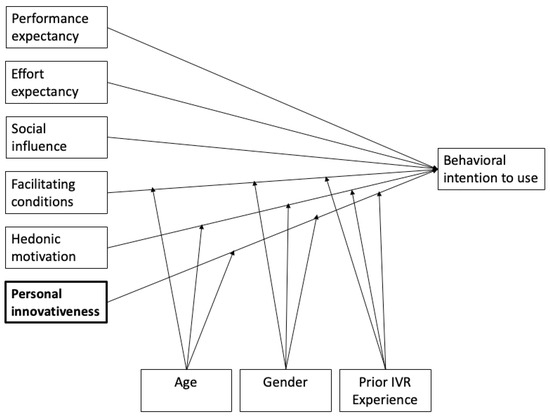
Figure 1