


Journal Menu
► ▼ Journal Menu-
- Applied Sciences Home
- Aims & Scope
- Editorial Board
- Reviewer Board
- Topical Advisory Panel
- Early Career Editorial Board
- Instructions for Authors
- Special Issues
- Topics
- Sections & Collections
- Article Processing Charge
- Indexing & Archiving
- Editor’s Choice Articles
- Most Cited & Viewed
- Journal Statistics
- Journal History
- Journal Awards
- Society Collaborations
- Conferences
- Editorial Office
Journal Browser
► ▼ Journal BrowserNeed Help?
Announcements
26 August 2026
Meet Us Virtually at the 7th International Electronic Conference on Applied Sciences, 14–16 December 2026

We cordially invite you to attend the 7th International Electronic Conference on Applied Sciences organized by MDPI Applied Sciences (ISSN 2076-3417, Impact Factor: 2.9). It will take place virtually from 14 to 16 December 2026.
Conference Chairs:
- Prof. Dr. Nunzio Cennamo, Department of Engineering, University of Campania Luigi Vanvitelli, Naples, Italy;
- Prof. Dr. Pedro A. S. Jorge, Centre for Applied Photonics, INESC TEC, Portugal.
The topics of interest:
S1. Applied Biosciences and Bioengineering;
S2. Nanosciences, Chemistry and Materials Science;
S3. Computing and Artificial Intelligence;
S4. Electrical, Electronics and Communications Engineering;
S5. Mechanical and Aerospace Engineering;
S6. Energy, Environmental and Earth Science;
S7. Food Science and Technology;
S8. Applied Physical Science.
Important dates:
Deadline for abstract submission: 18 September 2026;
Notification of acceptance: 16 October 2026;
Deadline for early bird registration: 11 November 2026;
Deadline for covering author registration: 11 November 2026;
Registration end date: 8 December 2026.
Guide for authors:
To submit your abstract, please click on the following link: https://sciforum.net/submissions/ASEC2026/link/1.
To register for the event, please click on the following link: https://sciforum.net/registration/ASEC2026/tickets.
For details regarding Abstract Submission, Poster and Slide Submission, and Publication Opportunities, you may refer to the “Instructions for Authors” section: https://sciforum.net/event/ASEC2026/instructions-for-authors.
For any enquiries regarding the event, please contact asec2026@mdpi.com.
We look forward to seeing you at the 7th International Electronic Conference on Applied Sciences.
8 September 2026
Meet Us at the 4th International Conference on AI Sensors and Transducers (AIS 2027), 29 July–3 August 2027, Kunming, Yunnan, China
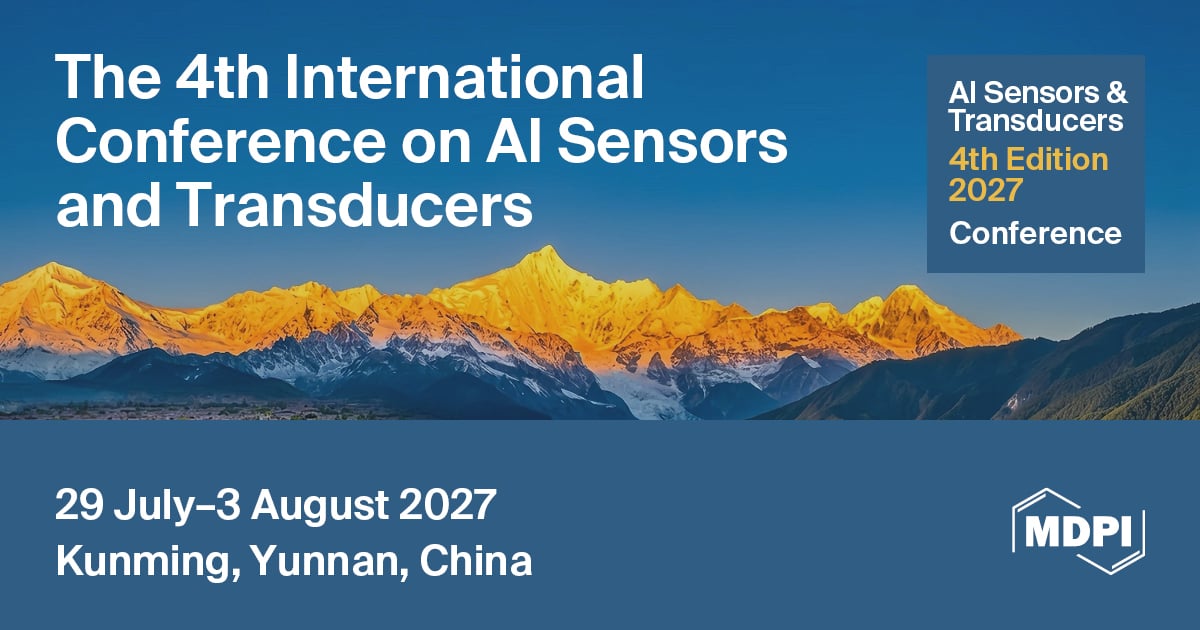
We invite you to submit your abstract and participate in the upcoming 4th International Conference on AI Sensors and Transducers (AIS 2027), co-organized by MDPI’s Sensors (ISSN 1424-8220), Micromachines (ISSN 2072-666X), AI Sensors (ISSN 3042-5999), Micro (ISSN 2673-8023) and Robotics (ISSN 2218-6581). The conference will be held from 29 July to 3 August 2027 in Kunming, Yunnan, China.
Following successful editions in Singapore (2024), Kuala Lumpur, Malaysia (2025), and Jeju, South Korea (2026), which collectively brought together nearly 1,350 participants from over 40 countries, AIS 2027 will continue to bring together leading researchers, engineers, and industry experts to explore emerging technologies and future directions.
Event Chairs:
- Prof. Eric M. Yeatman, University of Glasgow, Scotland, UK;
- Prof. Alexander Star, University of Pittsburgh, USA;
- Prof. Wen Jung Li, City University of Hong Kong, China;
- Prof. Chengkuo Lee, National University of Singapore, Singapore.
Plenary Speaker:
- Prof. Zhonglin Wang, Beijing Institute of Nanoenergy and Nanosystems, China.
(The speaker lineup will be updated continuously.)
Important dates:
Deadline for abstract submission: 26 March 2027;
Abstract acceptance notification: 30 April 2027;
Early Bird registration deadline: 7 June 2027;
Covering author registration deadline: 11 June 2027;
Registration deadline: 30 July 2027.
Guide for authors:
To submit your abstract, please click: 
To register for the event, please click:
For details regarding abstract submission, poster and slide submission, please refer to the “Instructions for Authors” Section: https://sciforum.net/event/AIS2027/instructions-for-authors.
For more information, you may refer to the following link: https://sciforum.net/event/AIS2027.
For any inquiries regarding the event, please contact ais@mdpi.com.
Please feel free to share information about this conference with your colleagues and students. We look forward to receiving your submissions and learning about your research at AIS 2027!
1 September 2026
MDPI INSIGHTS: The CEO’s Letter #38 – 2 Million Published Articles, Outstanding Reviewers, Michele Parrinello Award, AIS 2026 & WSF-12

Welcome to the MDPI Insights: The CEO's Letter.
In these monthly letters, I will showcase two key aspects of our work at MDPI: our commitment to empowering researchers and our determination to facilitating open scientific exchange.
Opening Thoughts

MDPI Reaches 2 million Published Articles
This month, MDPI reached an important milestone: the publication of our two-millionth article.
It is a number that would have been difficult to imagine in 1996, when MDPI’s first journal, Molecules, published its first volume of 74 papers. It took 25 years to reach our first million published articles in December 2022, and less than four years to reach the second million in August 2026.
From 74 Papers to Two Million Articles
The milestone also comes during our 30th anniversary year, providing another opportunity to reflect on how both MDPI and Open Access publishing have developed over the past three decades. Today, more than half of the world’s published research is Open Access, while MDPI has grown into a portfolio of journals supported by more than 70,000 Editorial Board Members. In 2025 alone, articles published in MDPI journals received 1.9 billion views and downloads.
While two million is an impressive number, what matters most is what sits behind it. Every article represents research conducted and shared by authors, editorial decisions made by academic editors, expertise contributed by reviewers, and the work of colleagues across MDPI supporting the publication and dissemination of research.
Many of the stories in this month’s CEO Letter reflect these communities. We recognize the contributions of the more than 209,000 reviewers who supported MDPI journals in 2025, celebrate scientific excellence through the inaugural Michele Parrinello Award, and look at how communities continue to develop through AIS 2026 and the 12th World Sustainability Forum.
“In 2025 alone, articles published in MDPI journals received 1.9 billion views and downloads”
Publishing at Scale, with Purpose
Reaching two million articles is an important milestone in MDPI’s history, but it is also a reminder of the responsibility that comes with publishing at this scale. As we look ahead, our focus remains on quality, research integrity, strong editorial standards, and providing researchers with reliable and efficient ways to share their work openly with the world.
Thank you to our authors, editors, reviewers, institutional partners, and colleagues around the world who have contributed to this journey.
Impactful Research

Recognizing Scientific Excellence: The Michele Parrinello Award
Supporting researchers means more than publishing and disseminating scientific work. It also means recognizing the researchers, editors, reviewers, and scholars whose contributions advance their fields.
I’m pleased to highlight the inaugural Michele Parrinello Award, which has been awarded to Prof. Ursula Röthlisberger of the École Polytechnique Fédérale de Lausanne (EPFL), Switzerland. Prof. Röthlisberger was recognized for her contributions to computational chemistry and molecular simulation, particularly her pioneering work in ab initio molecular dynamics and quantum mechanical/molecular mechanical (QM/MM) multiscale simulation methods.
Prof. Röthlisberger leads the Laboratory of Computational Chemistry and Biochemistry at EPFL, developing computational approaches to understand complex chemical, biological, and materials systems at the atomic level. Her work also extends to next-generation photovoltaic materials, demonstrating the interdisciplinary reach of computational science.
The Michele Parrinello Award was established in 2025 to honor Prof. Michele Parrinello's pioneering contributions to atomistic simulation and computational science. Presented biennially, it recognizes senior researchers who have made significant contributions across physics, chemistry, and materials science. The recipient receives a EUR 50,000 prize, commemorative medal, and certificate.
Awarding Scientific Excellence
The selection was overseen by an international Award Committee, chaired by Prof. Dr. Xin-Gao Gong of Fudan University and a group of researchers from institutions in China, Italy, the UK, and the USA. Nominations were evaluated based on rigor, integrity, and academic excellence. In announcing the winner, Prof. Gong highlighted the impact of Prof. Röthlisberger’s research across multiple scientific disciplines, alongside her contributions to education and leadership within the international research community.
Recognizing Contributions Across the Research Community
The Michele Parrinello Award is part of MDPI’s broader commitment to recognizing excellence across different disciplines, contributions, and career stages.
Our journal awards include:
- Best Paper Awards – recognizing outstanding published research
- Young Investigator Awards – supporting exceptional early-career researchers
- Best PhD Thesis Awards – recognizing promising emerging scholars
- Outstanding Reviewer Awards – acknowledging the essential contribution of peer reviewers
- Travel Awards – helping early-career researchers participate in international conferences
- Editor of Distinction Awards – recognizing exceptional contributions from Editorial Board Members.
Alongside these journal awards, MDPI supports flagship initiatives including the Tu Youyou Award, the World Sustainability Award, the Emerging Sustainability Leader Award, and now the Michele Parrinello Award.
Learn More:
Inside MDPI

Recognizing the People Behind Peer Review: MDPI’s 2025 Outstanding Reviewer Awards
Behind every published article is a network of people contributing their expertise to the scholarly record. Among them, reviewers play an essential role, providing independent assessment, feedback, and subject expertise that help editors make informed decisions and authors build on their research.
In 2025, more than 209,000 individuals contributed their expertise as reviewers for MDPI journals. This represents an enormous contribution of time and knowledge from researchers around the world, occurring often alongside their own research, teaching, and professional responsibilities.
I’m pleased to share the recipients of MDPI’s 2025 Outstanding Reviewer Awards, recognizing reviewers who have shown great dedication, expertise, and responsiveness throughout the peer-review process.
Outstanding Reviewers
As at July 2026, 181 MDPI journals have presented Outstanding Reviewer Awards to 412 recipients, highlighting their work across disciplines ranging from biology, chemistry, engineering, and medicine to environmental sciences, public health, and the social sciences. To learn more about the list of outstanding reviewers, please visit the following pages:
- Biology and Life Sciences;
- Business and Economics;
- Chemistry and Materials Science;
- Computer Science and Mathematics;
- Engineering;
- Environmental and Earth Sciences;
- Medicine and Pharmacology;
- Physical Sciences;
- Public Health and Healthcare;
- Social Sciences, Arts and Humanities.
While these awards highlight a select group of outstanding contributors, they also create an opportunity to acknowledge our entire reviewer community. Peer review depends on researchers sharing their knowledge and experience with others. Their feedback can improve manuscripts, support editors in making informed decisions, and contribute to maintaining the quality and integrity of the scientific record.
“Reviewers play an essential role, providing independent assessment, feedback, and subject expertise”
Supporting the Academic Community
The Outstanding Reviewer Awards are part of MDPI’s awards program, through which our journals recognize contributions across the academic community, including those from researchers, early-career scholars, reviewers, and Editorial Board Members.
Bringing these contributions to the forefront is important because much of the work that supports scholarly publishing happens behind the scenes. The time, expertise, and critical feedback provided by reviewers are essential to a rigorous and constructive peer-review process.
As MDPI celebrates its 30th anniversary, I would like to thank the more than 209,000 reviewers who contributed to our journals in 2025 and to congratulate the 412 Outstanding Reviewer Award recipients recognized for going above and beyond in supporting their respective research communities.
Coming Together for Science

AIS 2026: Growing a Community Around AI and Sensor Research
One of the most rewarding aspects of our conference program is seeing scientific communities develop over time. A conference may begin by bringing together researchers around an emerging field, but with each edition it can create new relationships, collaborations, and opportunities for researchers to reconnect and exchange ideas.
The 3rd International Conference on AI Sensors and Transducers (AIS 2026) is a good example of this growth.

“What stands out is the community developing around AIS”
This year’s conference took place from 2 to 7 August in Jeju, South Korea, welcoming over 560 participants – an increase of 225 attendees compared with 2025 and 160 compared with the inaugural conference of 2024. Across the program, participants contributed 373 presentations and 109 poster displays, including four plenary presentations, 52 keynote speeches, 192 invited talks, and 125 oral presentations.
Building an International Research Community
Beyond the numbers, what stands out is the community developing around AIS. Many researchers have now participated in all three editions of the conference, with delegates already expressing their intention to return for AIS 2027. The program also brought together established researchers from across the field for discussions on AI sensors and emerging sensing technologies.
 |
 |
Building Engagement in South Korea
This year’s conference reflects our continued engagement with the research community in South Korea. AIS 2026 welcomed 150 participants from the Korean academic community and strengthened our cooperation with the Korean Sensors Society.

This is an important part of what our conferences can achieve. By bringing researchers together in person, we create opportunities to present the latest research and build relationships between scholars, institutions, societies, and at MDPI that can continue after an event concludes.
Looking Ahead
With this momentum, AIS 2027 is planned for 29 July to 3 August 2027 in Kunming, Yunnan, China, with the participation of an international group of Conference Chairs already confirmed from institutions in Europe, North America, and Asia-Pacific.
Three editions into AIS, the continued growth of this conference shows what is possible when we invest consistently in scientific communities. The objective is not simply to organize larger conferences each year but to create spaces where researchers return, new collaborations develop, and scientific communities become stronger.
Many thanks to the Conference Chairs, speakers, sponsors, supporting organizations, participants, and all MDPI colleagues who contributed to AIS 2026. Growing an international event takes years of relationship-building and considerable work behind the scenes, and this year’s conference reflects that collective effort.

Closing Thoughts

World Sustainability Forum 12: Coming Together for a More Sustainable Future
Sustainability challenges rarely sit within a single discipline, institution, or country. Addressing them requires researchers, policymakers, industry, and communities to exchange ideas and work across traditional boundaries.
This is one of the ideas behind the World Sustainability Forum (WSF), which has now reached its 12th edition.
 |
 |
From 21 to 24 August, the 12th World Sustainability Forum (WSF-12) took place in Hong Kong, bringing together more than 300 experts, scholars, policymakers, and industry representatives from over 100 universities and research institutions across 53 countries and regions. The Forum received 543 abstract submissions, showcasing international interest in sustainability research.
Connecting Research, Policy, and Industry
Across four days, the scientific program featured 230 onsite presentations, including plenary, keynote, invited and oral presentations, together with 53 poster presentations. The program also included a plenary panel discussion, Connecting Sustainability Solutions Across Sectors, presenting perspectives from academia, government, and industry.
 |
 |
This interdisciplinary exchange is particularly important in sustainability research. Challenges relating to our cities, environment, energy systems, economies, and societies are increasingly interconnected, and progress depends on creating opportunities for different disciplines and sectors to learn from one another.
WSF-12 also generated opportunities for industry participation. As a Strategic Partner, the China National Petroleum Corporation (CNPC) E-Light International Communication Brand contributed to industry engagement throughout the Forum.

MDPI Sustainability Foundation Awards
Another highlight of WSF-12 was the presentation of three MDPI Sustainability Foundation Awards, celebrating the 2025 and 2026 winners of the World Sustainability Award and the 2026 winner of the Emerging Sustainability Leader Award.
 |
 |
 |
Recognizing researchers and emerging leaders in their fields is an important part of supporting scientific communities. These awards are an opportunity to celebrate individual achievements and highlight research that contributes to a more sustainable future.
Looking Ahead to WSF-13
After twelve editions, WSF is a great example of how a scientific community can develop over time. This is also what we hope to achieve through MDPI’s broader conference program. Scientific meetings should be more than individual events: by investing consistently in research communities, we can create spaces where people return, new relationships develop, different perspectives meet, and collaboration continues beyond the conference itself.

The next chapter is already taking shape. The 13th World Sustainability Forum(WSF-13) will take place from 8 to 11 June 2027 in Nice, France. Chaired by Prof. Dr. Adel Ben Youssef and organized by MDPI and the journal Sustainability in collaboration with Université Côte d’Azur, WSF-13 will continue the Forum’s interdisciplinary approach across the natural sciences, engineering, and social sciences.
Thank You
Many thanks to the Conference Chairs, speakers, strategic partners, sponsors, supporting organizations, participants, and all MDPI colleagues who contributed to WSF-12. Events of this scale require considerable coordination and collaboration behind the scenes, and the continued growth of WSF reflects the collective efforts of the MDPI Conference Department and a global community committed to sustainability research, innovation, and collaboration.

Chief Executive Officer
MDPI AG
26 August 2026
Meet Us at the 10th Asia-Pacific Conference on Plasma Physics (AAPPS-DPP2026), 11–16 October 2026, Busan, Republic of Korea

Conference: 10th Asia-Pacific Conference on Plasma Physics (AAPPS-DPP2026)
Date: 11–16 October 2026
Location: BPEX, Busan, Republic of Korea
The AAPPS-DPP was established in 2014 as the first division under AAPPS (the Association of Asia Pacific Physical Societies) and has since then held annual in-person conferences. These conferences have made steady progress in terms of scientific excellence and strength of attendance. In previous conferences, researchers in various fields of plasma physics (plasma application, astronomical plasma, laser plasma, magnetic fusion plasma, etc.) actively exchanged information and presented their research.
AAPPS-DPP has steadily evolved into one of the most significant gatherings for the plasma physics community across the Asia-Pacific region. Each year, the conference brings together researchers at every career stage to exchange scientific insights, explore new directions, and strengthen collaborative networks.
MDPI will be attending the 10th Asia-Pacific Conference on Plasma Physics as an exhibitor. This event will be held from 11 to 16 October, and we invite researchers to visit our booth and discuss their latest research with us.
The following MDPI journals will be represented at the conference:
Our delegates look forward to meeting you in person at MDPI’S booth and answering any questions you may have. For more information regarding the conference, please visit the following website: https://www.aappsdpp.org/DPP2026/index.html.
25 August 2026
Meet Us at the 23rd European Conference on Eye Movements (ECEM 2026), 30 August–3 September 2026, Ulm, Germany

Conference: 23rd European Conference on Eye Movements, ECEM 2026
Date: 30 August–3 September 2026
Location: Ulm, Germany
Over its more than four-decade history, ECEM has grown to become the largest scientific meeting on eye movement research worldwide. The conference brings together a vibrant community of researchers working towards a better understanding of eye movements, while also using them as a tool to study a wide range of topics in neuroscience, cognitive science, and various fields of application. ECEM 2026 shall promote exchange and cooperation between participants from diverse areas such as neurophysiology, psychology, medical sciences, linguistics, computer science, human factors, and many others.
MDPI will be attending the conference as an exhibitor and warmly invites researchers to visit our booth to discuss their latest research and publishing opportunities with us.
The following open access journals will be represented at the conference:
- JEMR;
- JCTO;
- Applied Sciences;
- Behavioral Sciences;
- Virtual Worlds;
- Vision;
- EJIHPE;
- Languages;
- NeuroSci;
- CTN.
We look forward to welcoming participants to our booth and discussing the latest research and publishing opportunities together. For more information about the conference, please visit the official website: 23rd European Conference on Eye Movements, ECEM 2026.
20 August 2026
Interview with Dr. Manuel Reis Carneiro—Winner of the Applied Sciences Best PhD Thesis Award

We are pleased to announce that Dr. Manuel Reis Carneiro has won the Applied Sciences 2025 Best PhD Thesis Award. The winner will receive CHF 800 and a chance to publish a paper free of charge after peer review in Applied Sciences in 2026.
- What motivated you to pursue a PhD in your field?
I started conducting research during my master’s degree, where I worked on wearable electronics. Through that experience, I realized there was still a great deal to be explored and developed in the field. This inspired me to pursue a PhD focused on soft electronics, wearable devices and biomedical instrumentation.
- Could you please give us a brief overview of your research topic? What motivated you to pursue this research topic?
During my master’s research I became aware of the many limitations of current biomedical monitoring devices. Most existing systems are bulky, rigid, and uncomfortable, making them difficult to use outside clinical settings.
My research focuses on developing soft, wearable biomedical devices that can be comfortably worn for extended periods and even integrated into clothing. The goal is to improve patient comfort and enable continuous monitoring in everyday life while maintaining the same signal quality as conventional clinical-grade devices. This challenge and potential impact motivated me to pursue this research direction.
- How did you manage your time and prioritize your tasks during your PhD program, and what strategies did you use to stay focused and motivated?
A PhD is a long journey. Mine lasted five years, from 2020 to 2025, and staying motivated all the time is simply not realistic. Taking breaks, holidays, and time to recharge is important.
My main advice is to choose a topic you genuinely enjoy, because you will spend many years and countless hours working on it. In terms of organization, I have always been a structured person. I typically divided my day into laboratory work and writing tasks. I preferred to do experimental work in the morning, when I felt most productive, and dedicate the afternoons to reading papers and writing. Aligning tasks with my energy levels helped me remain effective throughout the day.
- What were some of the biggest challenges you faced during your PhD journey, and how did you overcome them?
The biggest challenge was undoubtedly beginning my PhD during the COVID-19 pandemic. I started my PhD at the University of Coimbra in Portugal and later moved to Carnegie Mellon University in the United States during my second and third years. Relocating alone from Europe to the United States during such an uncertain period brought many personal and professional challenges. Adapting to a new country and working through the restrictions associated with the pandemic made this the most difficult part of my PhD experience.
- Looking back, is there anything you would have done differently during your PhD?
Overall, I am very satisfied with how my PhD turned out and have very few regrets. If I were to change one thing, I would probably place greater emphasis on maintaining a healthier work–life balance.
There were occasions when I spent very long hours in the laboratory, sometimes well beyond the end of the working day. In hindsight, I would prioritize rest and personal well-being a little more. Nevertheless, I am happy with the outcome of my PhD journey.
- What advice would you give to students starting or coming to the end of their theses?
First and foremost, choose a topic that you truly enjoy. Passion for your work is essential when undertaking a long-term project such as a PhD.
I would also encourage students to make the most of every opportunity available to them. This includes applying for funding, travel grants, awards, and other professional development opportunities. Organizations and journals offer many valuable programs, but if you do not apply, you cannot benefit from them. Taking initiative is extremely important.
- When and how did you access Applied Sciences? What prompted you to apply for this award, and what is your experience with Applied Sciences?
I have been serving as a reviewer for Applied Sciences for approximately two years and have reviewed several manuscripts. Through this involvement, I learned about the Best PhD Thesis Award. What I particularly appreciate about Applied Sciences and MDPI journals in general is the efficiency and transparency of communication. Interactions are always straightforward, timely, and professional. Whenever I need assistance, I receive prompt responses, which greatly enhances the overall experience.
- Finally, how do you plan to continue building on your research in the future, and what are your long-term career aspirations?
I am currently a postdoctoral fellow and lecturer at ETH Zurich in Switzerland, a position I have held for nearly a year. At present, I am applying for assistant professor positions, as my long-term goal is to continue in academia in a more permanent and independent role.
This award comes at an ideal time because it will help me initiate a new line of research focused on multimodal sensing. Up to now, my work has largely centered on devices that measure a single physiological parameter, such as electrocardiograms (ECGs).
Going forward, I aim to develop wearable systems capable of measuring multiple types of data simultaneously, including ECG, blood pressure, movement, or sweat biomarkers. Such devices could provide a more comprehensive understanding of an individual's health and physiological condition.
19 August 2026
Applied Sciences | Invitation to Read the Updated Editor’s Choice Articles

The goal of the Editor’s Choice Articles project is to promote high-quality articles published in Applied Sciences (ISSN 2076-3417). Please find below the list of articles carefully handpicked by the scientific editors of the journal, which we believe will be of interest to you. The full list of Editor’s Choice Articles can be viewed at the following link: https://www.mdpi.com/journal/applsci/editors_choice.
1. “An RL-Guided Hybrid Forecasting Framework for Aircraft Engine RUL and Performance Emission Prediction”
by Ukbe Üsame Uçar and Hakan Aygün
Appl. Sci. 2026, 16(9), 4271; https://doi.org/10.3390/app16094271
2. “Electromagnetic Interference Simulation and Shielding Design for Aircraft Engine Nacelle Subjected to EMALS”
by Xuan Zhao, Jingxuan Xia, Chulin Wang, Huang Xu, Pingan Du and Baolin Nie
Appl. Sci. 2026, 16(10), 4789; https://doi.org/10.3390/app16104789
3. “Drone Flight Demonstration of a Self-Positioning Scheme and Devices for Small-Body Exploration”
by Shingo Nishimoto, Junichiro Kawaguchi, Kawsihen Elankumaran and Saki Komachi
Appl. Sci. 2026, 16(9), 4574; https://doi.org/10.3390/app16094574
4. “Thymosin Beta-4 and TB-500 in Tissue Healing, Regeneration, and Musculoskeletal Repair: A Scoping Review”
by Flynn McGuire, Emma Hughes, Travis Maak and Daniel M. Cushman
Appl. Sci. 2026, 16(12), 6202; https://doi.org/10.3390/app16126202
5. “Movement Direction Is the Primary Determinant of Force and Impulse in the Knife-Hand Strike (Sonkal Taerigi) in ITF Taekwon-Do”
by Tomasz Góra, Jacek Wąsik and Michalina Błażkiewicz
Appl. Sci. 2026, 16(10), 4993; https://doi.org/10.3390/app16104993
6. “Multifunctional Polymeric Coatings for Stone Heritage: Hydrophobic–Antimicrobial Mechanisms and Field Performance”
by Ricardo Estevinho, Ana Teresa Caldeira, Sérgio Martins, José Mirão and Pedro Barrulas
Appl. Sci. 2026, 16(8), 4050; https://doi.org/10.3390/app16084050
7. “Sprout Extracts in Skin Care and Hair Growth: Evidence and Future Opportunities”
by Wojciech Paździora, Paweł Paśko and Agnieszka Galanty
Appl. Sci. 2026, 16(9), 4520; https://doi.org/10.3390/app16094520
8. “The Application of Bio-Banding in Youth Soccer: A Systematic Review of Crossover Controlled Trials”
by Salvatore Mazzei, Alessandro Guarnieri, Fabiana Laurenti, Valentina Presta, Giuliana Gobbi, Ronan Kavanagh, Mauro Mandorino, Mathieu Lacome and Giancarlo Condello
Appl. Sci. 2026, 16(9), 4300; https://doi.org/10.3390/app16094300
9. “Early Prediction of Well-Being Outcomes in Older Adults Using Explainable AI and Emotional Intelligence Measures”
by Evgenia Kouli, Evangelos Bebetsos, Maria Michalopoulou and Filippos Filippou
Appl. Sci. 2026, 16(7), 3586; https://doi.org/10.3390/app16073586
10. “Conditional Generative AI in Oncology Diagnostics”
by Chiara Frascarelli, Alberto Concardi, Elisa Mangione, Mariachiara Negrelli, Francesca Maria Porta, Michela Tulino, Joana Sorino, Antonio Marra, Nicola Fusco, Elena Guerini-Rocco et al.
Appl. Sci. 2026, 16(8), 4015; https://doi.org/10.3390/app16084015
11. “Quantifying Emotional Responses to Traditional and Modern Architecture: The Case of US Federal Buildings”
by Alexandros A. Lavdas and Ann Sussman
Appl. Sci. 2026, 16(9), 4406; https://doi.org/10.3390/app16094406
12. “Evidence-Driven Simulated Data in Reinforcement Learning Training for Personalized mHealth Interventions”
by Juan Carlos Caro, Giorgio Galgano, Melissa Muñoz, Jorge Díaz Ramírez and Jorge Maluenda
Appl. Sci. 2026, 16(7), 3463; https://doi.org/10.3390/app16073463
13. “Long-Term Aging Effects of Breast Implant Materials”
by Luca Di Landro, Gerardus Janszen, Anna Sandrin, Valeriano Vinci, Roberto Rusconi and Marco Klinger
Appl. Sci. 2026, 16(8), 3717; https://doi.org/10.3390/app16083717
14. “Functional Symmetry of Upper Limbs in Young Adults: An Analysis of Muscle Strength and Mobility”
by Piotr Osial, Michalina Błażkiewicz, Dagmara Iwańska and Jacek Wąsik
Appl. Sci. 2026, 16(8), 3874; https://doi.org/10.3390/app16083874
15. “Extraction of Stone Positions from a Sheet Image for Curling Match Database Construction”
by Kei Suzumura, Yasumasa Tamura, Shimpei Aihara and Masahito Yamamoto
Appl. Sci. 2026, 16(7), 3453; https://doi.org/10.3390/app16073453
16. “Synthesis and Characterization of Size- and Shape-Controlled CoFe2O4 Nanoparticles via Polyvinylpyrrolidone (PVP)-Assisted Hydrothermal Synthesis”
by Rareș Bortnic, Tamás Szilárd, Ádám Szatmári, Razvan Hirian, Rareș Ionuț Știufiuc, Alin-Iulian Moldovan, Roxana Dudric and Romulus Tetean
Appl. Sci. 2026, 16(7), 3547; https://doi.org/10.3390/app16073547
17. “Efficient Adsorptive Removal of Methyl Orange from Aqueous Solutions Using a Cu2O/CuO Nanocomposite”
by Yordani Arce-Argote, Antonella Soncco, Rodrigo Rios-Cabala, Albeniz Huaracallo, Marcelo Rodriguez and Rivalino Guzmán
Appl. Sci. 2026, 16(8), 3713; https://doi.org/10.3390/app16083713
18. “Titania Nanotubes Modification with Cisplatin and Its Oxalate Analog Using Mercaptoorganosilanes as Bridging Ligands”
by Mateusz Bielicki, Natalia Godlewska, Aleksandra Janecka, Adrianna Kolas and Adrian Topolski
Appl. Sci. 2026, 16(11), 5419; https://doi.org/10.3390/app16115419
19. “A Novel Approach to Design Flood Hydrograph Plotting in Water Management”
by Cornel Ilinca, Constantin Albert, Dmytro Rozputniak and Valentin Minghiraș
Appl. Sci. 2026, 16(9), 4475; https://doi.org/10.3390/app16094475
20. “Formation of a High-Density Algal-Bacterial Flocculent Biomass in a Pilot-Scale Raceway Pond Treating Municipal Wastewater”
by Styliani E. Biliani, Dimitrios Kakavas and Ioannis D. Manariotis
Appl. Sci. 2026, 16(8), 3761; https://doi.org/10.3390/app16083761
21. “Megacities, Hazy Air, and Other Not-So-Cool Things: Mapping the Known and Unknown Intersections Between Climate Change, Health, and Urbanization”
by Raymond Roy, Alfonso Giordano, Rosalyn Kefas, Aldo Ferrara and Amedeo D’Angiulli
Appl. Sci. 2026, 16(10), 4851; https://doi.org/10.3390/app16104851
22. “Agronomic Valorization of Sewage Sludge Through Composting and Liming”
by Henda Lopes, Elisabete Gonçalves, Maria Morais, Ana Coimbra, João Sousa, Paula Oliveira, Henrique Trindade and Marta Roboredo
Appl. Sci. 2026, 16(10), 4805; https://doi.org/10.3390/app16104805
We would like to thank all of the research groups that authored these exceptional papers for their contribution. We sincerely hope you find these articles of Applied Sciences as useful and insightful as we have found them.
19 August 2026
Meet Us at The 30th International Conference on Miniaturized Systems for Chemistry and Life Sciences (µTAS 2026), 18–22 October 2026, Granada, Spain

Conference: The 30th International Conference on Miniaturized Systems for Chemistry and Life Sciences (µTAS 2026)
Date: 18–22 October 2026
Location: Granada, Spain
Booth No.: 8
MDPI will be attending The 30th International Conference on Miniaturized Systems for Chemistry and Life Sciences (µTAS 2026) as an exhibitor. The conference will be held from 18 to 22 October 2026. We welcome researchers from different backgrounds to visit and share their latest ideas with us.
The µTAS international conference series is the premier forum for reporting research results in microfluidics, lab-on-a-chip, organ-on-a-chip, wearables, BioMEMS, microfabrication, 3D printing, nanotechnology, integration, materials and surfaces, analysis and synthesis, and detection technologies for chemistry, the life sciences, medicine, and the environment, as well as agriculture, energy, and food.
µTAS 2026 will feature plenary and keynote talks from world luminaries, and themed “hot topics” sessions in the following areas:
1. Microphysiological Systems, Organ on Chip, and Organoids (Organ on Chip, Organoids, Spheroids);
2. Wearables and Hand-held Devices (Humans and their Environment, Continuous Sensing and Monitoring, Point of Care, Point of Need, Implantable and Ingestible Devices, Bioelectronics);
3. Microfluidics as Facilitating Technology (Remote Sensing, Harsh Conditions, Resource-Limited Settings, Resilient Technologies: Energy Harvesting and Sustainable Materials, Digital Microfluidics, Droplet Microfluidics);
4. Micro and Nanophotonic Technologies (Optofluidics, Photonics, Quantum Technology, Nanomaterials).
The following open access journals will be represented:
If you are planning to attend this conference, please do not hesitate to start an online conversation with us. Our delegates look forward to meeting you in person and answering any questions that you may have. For more information about the conference, please visit the following website: https://microtas2026.org/.
18 August 2026
Empowering Academic Growth with the MDPI Academic Publishing Workshop at Faculty of Engineering, Naresuan University, 7 September 2026

We are delighted to announce the MDPI Academic Publishing Workshop, organized in partnership with the Faculty of Engineering, Naresuan University, Phitsanulok, Thailand. This workshop reflects a shared commitment to promoting research excellence, advancing scholarly communication, and supporting academic publishing through international collaboration and open access dissemination.
As part of MDPI’s ongoing dedication to researcher development, the workshop aims to improve academic writing skills, facilitate scholarly communication between authors and the Editorial Office, and guide researchers in selecting appropriate journals for publication. Participants will also gain practical insights into MDPI’s editorial process, how to respond effectively to peer reviewers, publication ethics, and the responsible use of artificial intelligence in scientific publishing. Designed for early career researchers, PhD and master’s students, international students, potential authors, and Editorial Board Members, the workshop will provide practical knowledge for enhancing the quality, visibility, and impact of scholarly research while fostering meaningful engagement with MDPI editors and publishing professionals.
Date: 7 September 2026
Time: 13:00–16:00
Location: Gearlaxy Space, Faculty of Engineering, Naresuan University, Phitsanulok, Thailand
Language: English
Registration: https://www.surveymonkey.com/r/6R2WDF5
|
Speaker |
Program |
Time |
| Assoc. Prof. Dr. Kumpon Subsomboon |
Opening Speech |
13:00–13:15 |
|
Dr. Siriporn Tantiwatcharothai |
MDPI and Journal Introduction |
13:15–13:40 |
|
Dr. Juthathip Poofery |
Writing Scientific Papers |
13:40–14:10 |
|
Q&A Session |
14:10–14:20 |
|
|
Ms. Hathaipat Kittirojana |
MDPI Editorial Process and How to Respond to Peer Reviewers |
14:20–15:00 |
|
Q&A Session |
15:00–15:10 |
|
|
Dr. Krit Inthajak |
Publication Ethics for Authors and Artificial Intelligence in Scientific Publication |
15:10–15:50 |
|
Q&A Session |
15:50–16:00 |
|
Chair: |
|
|
|
Assoc. Prof. Dr. Kumpon Subsomboon is an Assistant Professor of civil engineering at the Faculty of Engineering, Naresuan University, Thailand. He has extensive experience in teaching, research, and academic services in civil engineering, construction engineering and management, and water resources engineering. He served as Dean of the Faculty of Engineering from 2023 to 2030. He has also served as Director of the Water Resources Research Center (WRRC) from 2017 to 2025. Previously, he served as Associate Dean for Administrative Affairs and Head of the Department of Civil Engineering at Naresuan University. He earned a PhD and MPhil in civil engineering and engineering mechanics from Columbia University, USA. He also holds an MEng in structural engineering from the Asian Institute of Technology and a BEng in civil engineering from Kasetsart University, Thailand. His research interests include construction management, BIM, infrastructure development, water resources, and engineering management. |

|
MDPI Speakers: |
|
|
|
Dr. Siriporn Tantiwatcharothai obtained her PhD in applied chemistry from the Faculty of Science, King Mongkut’s Institute of Technology Ladkrabang. She joined MDPI in December 2022 as an Assistant Editor for Catalysts. In 2024, she was promoted to Section Managing Editor, and served as a Chief Section Managing Editor in April 2025. Currently, she is one of MDPI’s Regional Engagement Editors for the Asia–Pacific region. |
|
|
Dr. Juthathip Poofery holds a PhD in biochemistry from the Faculty of Medicine, Chiang Mai University, Thailand. She began working at MDPI in 2021 as an Assistant Editor for Medicina and advanced to the position of Section Managing Editor in 2022. Since 2023, Dr. Poofery has been serving as the Group Leader of the Medical Science Section, where she oversees editorial operations and contributes to the advancement of research in the field. She currently works as a Regional Engagement Editor for the Asia–Pacific region. |
|
|
Ms. Hathaipat Kittirojana obtained her master’s degree in food science and biotechnology from Teesside University. She joined MDPI in December 2020 as an Assistant Editor for the Journal of Imaging. She was appointed as a Section Managing Editor in March 2023 and a Regional Engagement Editor for the Asia–Pacific region in July 2024. |
|
|
Dr. Krit Inthajak obtained his PhD in engineering and technology from Sirindhorn International Institute of Technology, Thammasat University. He joined MDPI in March 2020 as an Assistant Editor for Molecules. He was appointed as a Section Managing Editor in 2021 and worked as a Group Leader from 2021 to 2024. He is now one of MDPI’s Regional Engagement Editors for the Asia–Pacific region. |


10 August 2026
Advancing Academic Publishing with MDPI: Gold-Tier Sponsorship of the University of Alberta’s Faculty of Engineering Graduate Research Symposium (FEGRS) and Academic Publishing Workshop, 18 August 2026

MDPI is pleased to participate in the Faculty of Engineering Graduate Research Symposium (FEGRS) 2026 at the University of Alberta as a gold-tier sponsor by hosting an Academic Publishing Workshop for graduate students and early career researchers. As a premier platform for showcasing research and fostering academic collaboration, FEGRS brings together emerging scholars from across engineering disciplines to exchange ideas, advance innovation, and to network within professional and academic spaces.
The interactive workshop will provide a practical introduction to scientific publishing and the skills needed for publication success. Participants will begin with an overview of the evolution of scholarly publishing before exploring today's publishing landscape. The second part of the workshop will focus on the peer review process, offering a step-by-step guide to navigating manuscript review and best practices for conducting peer reviews. Each session will conclude with a dedicated Q and A segment, allowing attendees to discuss publishing questions and challenges with experienced publishing professionals. In addition, MDPI representatives will be present at the Industry Mixer on August 18, engaging with participants to share insights into MDPI and opportunities to contribute as authors, reviewers, and editors.
By supporting educational initiatives such as FEGRS, MDPI remains committed to promoting transparency, accessibility, and excellence in scholarly communication while empowering the next generation of researchers to maximize the impact of their work.
For additional information on the event and our sponsorship, please see the event website here.
Date: 18 August 2026
Time: 14:30–15:30 (ET)
Venue: University of Alberta, Faculty of Engineering, DICE 8-207
Schedule:
|
Program |
Time |
|
Scientific Publishing: An Introduction |
14:30–15:00 |
|
Responding to Peer Reviewers |
15:00–15:30 |
MDPI Speakers:
Moderator and Panelist: Dr. Barnaby Crook, Regional Engagement Editor, MDPI
|
Dr. Barnaby Crook completed an MA in philosophy and neuroscience at the Humboldt University of Berlin in 2021 and a PhD in the philosophy of artificial intelligence at the University of Bayreuth in 2025. After moving from Germany to Toronto, Dr. Crook began working for MDPI as an Assistant Editor with the journal IJERPH. He now works as a Regional Engagement Editor for North America. In this role, Dr. Crook builds and maintains relationships with academic stakeholders, fostering collaboration and developing partnerships. He is passionate about scientific communication and research integrity. |

Panelist: Ms. Diana Tosato, Deputy Managing Editor, MDPI
|
Ms. Diana Tosato holds an MSc in development and environmental sciences and a second MSc in biology from Brock University. After completing her studies, she joined MDPI as an Assistant Editor for the journals Remote Sensing and Heritage. She currently serves as Deputy Managing Editor for journals across North and South America. In addition, Diana serves as External Affairs Coordinator for MDPI, with a focus on Brazil, where she develops and maintains relationships with academic stakeholders, fosters collaboration, and supports strategic partnerships within the research community. |

Organizers:
|
|
The University of Alberta’s Faculty of Engineering Graduate Research Symposium (FEGRS) is an annual event where graduate students can present their research to their colleagues and professors across all disciplines. This event gives many early-career researchers a place to present their ideas to an interdisciplinary audience without the pressures of larger conferences. Additionally, multiple career development workshops are organized with industry partners and professional organizations, and the event ends with an Industry–Student Mixer. The whole event is organized and planned by graduate student volunteers. |

|
|
A pioneer in scholarly open access publishing, MDPI has supported academic communities since 1996. Based in Basel, Switzerland, MDPI’s mission is to foster open scientific exchange in all forms and across all disciplines. |

