Systematic Review

The Application of Bio-Banding in Youth Soccer: A Systematic Review of Crossover Controlled Trials


1
Department of Medicine and Surgery, University of Parma, Parma 43126, Italy
2
Performance and Analytics Department, Parma Calcio 1913, Parma 43121, Italy
3
Medical & Performance Department, Paris Saint-Germain Football Club, Poissy 78300, France
4
Sport Expertise and Performance Laboratory, French National Institute of Sports (INSEP), Paris 75012, France
*
Authors to whom correspondence should be addressed.
Appl. Sci. 2026, 16(9), 4300; https://doi.org/10.3390/app16094300
Submission received: 17 March 2026 / Revised: 16 April 2026 / Accepted: 22 April 2026 / Published: 28 April 2026
(This article belongs to the Section Applied Biosciences and Bioengineering)

Abstract

In elite youth soccer, the objective is to identify, develop, and enhance players’ ability to support their progression. During adolescence, players of the same chronological age often show differences in technical, tactical, physical, and psychological performance due to variations in biological maturation. The bio-banding (BB) format tries to reduce these discrepancies by grouping players with maturity-matched peers, promoting development within a maturity-respecting environment. This review synthesizes the effects of BB on soccer-specific performance in comparison to traditional chronological-age (CA) grouping. PubMed, Scopus, Web of Science (Core and Medline), and BASE databases were searched, and experimental studies using crossover, such as those applying both BB and CA in young soccer players, were considered eligible. Eleven experimental studies were included. Most of the investigated outcomes focused on physical performance (n = 9) and technical and tactical characteristics (n = 8), while psychological aspects were less examined (n = 2). Moreover, two studies further assessed how different BB methods influenced the investigated outcomes. The evidence confirms that BB influences youth soccer player characteristics, showing differences compared to CA grouping. BB can be an approach for optimizing individual growth but is not a definitive solution, presenting limits that require careful management, appropriate challenge, and integration with injury prevention and workload monitoring. Further research is needed to clarify its performance-related impact across maturity statuses.

1. Introduction

Soccer is one of the most played sports in the world, with a total of 128,694 male professional soccer players according to the most recent FIFA report [1]. Since the elite clubs need to compete for the top national and international achievements, there is a growing trend among clubs of constantly seeking out young talent [2]. Talent identification refers to the process that recognizes players participating in a sport with the potential to become elite players [3]. This process should be pursued using a multidisciplinary approach due to the various factors that characterize soccer performance, such as biological characteristics, sport-specific technical and tactical skills, physical qualities, and behavioural and psychological traits [3,4]. All these elements may be altered during the sensitive period of puberty in young players because of their individual maturity status [5]. Biological maturation is defined as the “process that marks progress toward the adult (mature) state”, and it concerns the diverse timing and rates of growth among the different tissues and organs in the human body. Furthermore, sex-based differences play a key role, as it is well established that females reach biological maturation earlier than males [6]. Therefore, a mismatch could exist between the biological age and the chronological age of players belonging to the same age group [7], especially between 13 and 16 years of age, where performance differences mostly appear [8].
The determination of the individual maturity status of young players and its influence on the different aspects of soccer performance becomes vital during the critical phase of puberty and can be used for talent identification and development processes. More invasive and direct methods and less invasive, indirect, and predictive methods have been widely described in the literature [9]. Among the latter, maturity offset is used to detect the time (in years) away from the peak height velocity (PHV) [10,11,12]. To this aim, Mirwald and colleagues [10] collected stature, sitting height, and weight to obtain maturity offset. Using a similar approach, Moore and colleagues [11] aimed to reduce prediction error by removing seated stature from the equation. Finally, Fransen and colleagues [12] adopted a polynomial model to estimate a maturity ratio to better reflect the non-linear growth process. Alternatively, the actual percentage of predicted adult height (%PAH) is estimated by an individual’s current stature, weight, and mid-parental height [13]. The monitoring of the maturity status of players allows for the categorization of them as early-, on-time-, or late-maturing based on the distance from the average growth peak or from the individual predicted adult stature [14,15]. Therefore, players can be grouped based on their maturity status rather than their chronological age, in the so-called bio-banding format [15]. This process could aim at accommodating interindividual performance differences derived from maturity status among players of the same chronological age. Moreover, it allows for talent development in a more appropriate environment and challenge exposure [16]. Recent reviews and commentaries summarized the application of bio-banding and its influence on youth soccer performance, with a focus on injury prevention, training load, physical, technical and tactical performance, psychological traits, and talent identification [15,16,17,18], with one article focused also on maturity assessment methods [16]. Recently, a first systematic review on soccer players highlighted a lack of conclusive evidence due to methodological limitations [19]. Moreover, it included both quantitative and qualitative analysis and it did not consider psychological variables. Therefore, the aim of this study was to conduct a systematic literature review to summarize the available evidence on the application of the bio-banding format in soccer, analyzing the different outcomes that characterized the performance.

2. Materials and Methods

2.1. Protocol Registration

The procedure of this systematic review, including objectives, inclusion criteria, and methods of analysis, were specified in advance and documented in an a priori protocol officially registered in the International Prospective Register of Systematic Reviews (PROSPERO; CRD42025639007; January 2025). Prior registration can facilitate optimal transparency, reproducibility, and usability of systematic reviews.

2.2. Search Strategy

The literature search was performed on 15 April 2025 by two independent reviewers (SM and AG) for articles published across the following databases: PubMed, Scopus, Web of Science (Core), Web of Science (Medline) and BASE, according to the Preferred Reporting Items for Systematic Reviews and Meta-analysis [20] and the literature evidence evaluating retrieval qualities of academic search systems [21]. The chosen databases guarantee the use of specific queries for the searching process with high levels of precision and reproducibility [21]. The following keywords, along with Boolean operators, were used in the search process: (“bio banding” OR “biobanding” OR “biological age”) AND (“team sport*” OR “sport*” OR “soccer” OR “football”). The reference lists of the selected articles were also considered.

2.3. Study Selection and Eligibility Criteria

The initial screening of studies examining the application of bio-banding in soccer was performed independently by two reviewers (SM and AG), based on titles and abstracts. Thereafter, studies were evaluated for eligibility according to the following inclusion criteria: (i) crossover controlled trials; (ii) youth soccer focus; (iii) participants of all genders aged 9–16 years; (iv) all competitive levels and rankings; (v) study published in a peer-reviewed journal before 15 April 2025 (date of literature search) covering all available previous years; (vi) availability of full text in English. Studies regarding individual, strength, power, and endurance sports were excluded, as well as other team sports. The selection process was independently carried out by two authors (SM and AG), with any disagreements resolved by a third author (VP). Titles, abstracts, and full texts were reviewed for eligibility using standardized extraction forms that captured details on study design, sample characteristics, and outcomes.

2.4. Data Extraction

Two authors (SM and FL) independently carried out the data extraction process, with any discrepancies resolved by a third author (VP). Key information—such as study design, sample characteristics (e.g., age, sample size, and age categories), maturity status assessment, game format, outcomes measured, and main findings—was organized into tables to facilitate the presentation and synthesis of each included study (Supplementary Tables S1 and S2).

2.5. Risk-of-Bias Assessment

For randomized studies, the ROB 2 (risk of bias 2) tool for crossover trials was employed, which evaluates five domains: bias arising from the randomization process, bias due to deviations from the intended interventions, bias from missing outcome data, bias in measurement of the outcome, and bias in the selection of reported results [22]. For non-randomized studies, the ROBINS-I tool (Risk of Bias In Non-randomized Studies of Interventions) was used to assess the risk of bias across seven domains: confounding, selection of participants into the study, classification of interventions, deviations from intended interventions, missing data, measurement of outcomes, and selection of the reported result [23]. The overall risk of bias in ROB 2 (categorized as low, some concerns and high) and in ROBINS-I (categorized as low, moderate, serious, or critical) was determined based on the highest risk level identified across all domains. Two authors (SM and FL) independently assessed the quality and risk of bias of the included studies, with any discordances resolved by consultation with a third author (VP).

2.6. Data Synthesis

Quantitative synthesis (meta-analysis) was not feasible due to the heterogeneity in study characteristics, methodological approaches, and the limited number of studies available for the measured outcomes. Consequently, data synthesis followed the Synthesis Without Meta-analysis (SWiM) guidelines [24]. The included studies were categorized and analyzed based on their investigated outcomes (e.g., physical, technical and tactical, and psychological characteristics) and methodological frameworks (e.g., maturity assessment methods, bio-banding formats, and performance analysis approaches).

3. Results

3.1. Selection Process

A total of 1577 studies were initially identified. After removing 996 duplicates, resulting from a comprehensive search strategy designed to ensure maximum literature coverage, 581 unique studies were screened by title and abstract in relation to the primary aim. Of these, 24 articles were selected for full-text assessment. Here, studies were excluded if they involved other team or individual sports, were written in languages other than English, or were deemed irrelevant to the research topic. Following the evaluation of eligibility, 13 studies were excluded for various reasons. Ultimately, 11 studies were included in this systematic review (Figure 1). All studies were conducted with a crossover design where the same group was evaluated under both the chronological-age and bio-banding formats.

3.2. Study Characteristics

Tables S1 and S2 of the Supplementary Materials (Supplementary Tables S1 and S2) summarize the characteristics of the included studies. The publication date of the studies ranged between 2019 and 2025; one study adopted a randomized crossover design [25] while ten studies adopted a non-randomized crossover design [26,27,28,29,30,31,32,33,34,35].
The United Kingdom emerged as the most investigated country (n = 7) [26,28,30,32,33,34,35] with studies conducted in England (n = 4) [26,28,32,33], in Scotland (n = 1) [30], and some in both countries (n = 2) [34,35]. The second most investigated country was Switzerland (n = 2) [25,31], followed by Brazil (n = 1) [29] and Portugal (n = 1) [27].
The sample size ranged from 20 [29] to 116 participants [27]. All the studies investigated a male sample except for one study that also included females [31].
Three studies investigated the U12 category [26,28,32], whilst one study focused exclusively on the U13 category [29]. Three studies examined both the U13 and U14 category [25,27,31]. One study included the U12, U13, and U14 categories [28], while another investigated the U12, U13, U14, and U15 categories [26].
Two studies considered a broader range of categories, including U13, U14, U15, and U16 [34,35]. Only one study encompassed all categories from U12 to U16 [32]. Finally, two studies did not specify the team category investigated [30,33].
Nine studies involved elite youth soccer players [25,26,28,30,31,32,33,34,35], whereas the remaining two studies included non-elite youth soccer teams [27,29].
Regarding the assessment of maturity status in soccer players, five studies used the Khamis–Roche method [26,27,28,32,33], three studies applied the Mirwald equation [25,29,31], and one study employed the Fransen method [30]. Additionally, two studies utilized both the Khamis–Roche and Fransen methods [34,35].
Regarding the game formats used in the studies, four studies implemented a 4 vs. 4 format [28,33,34,35], one study used 7 vs. 7 [27], one study used 5 vs. 5 [29], one study applied 11 vs. 11 [26], one study employed 6 vs. 6 [32], one study included multiple formats (i.e., 4 vs. 4, 5 vs. 5, and 6 vs. 6) [30], one study used 9 vs. 9 [25], and one study did not report the game format [31].
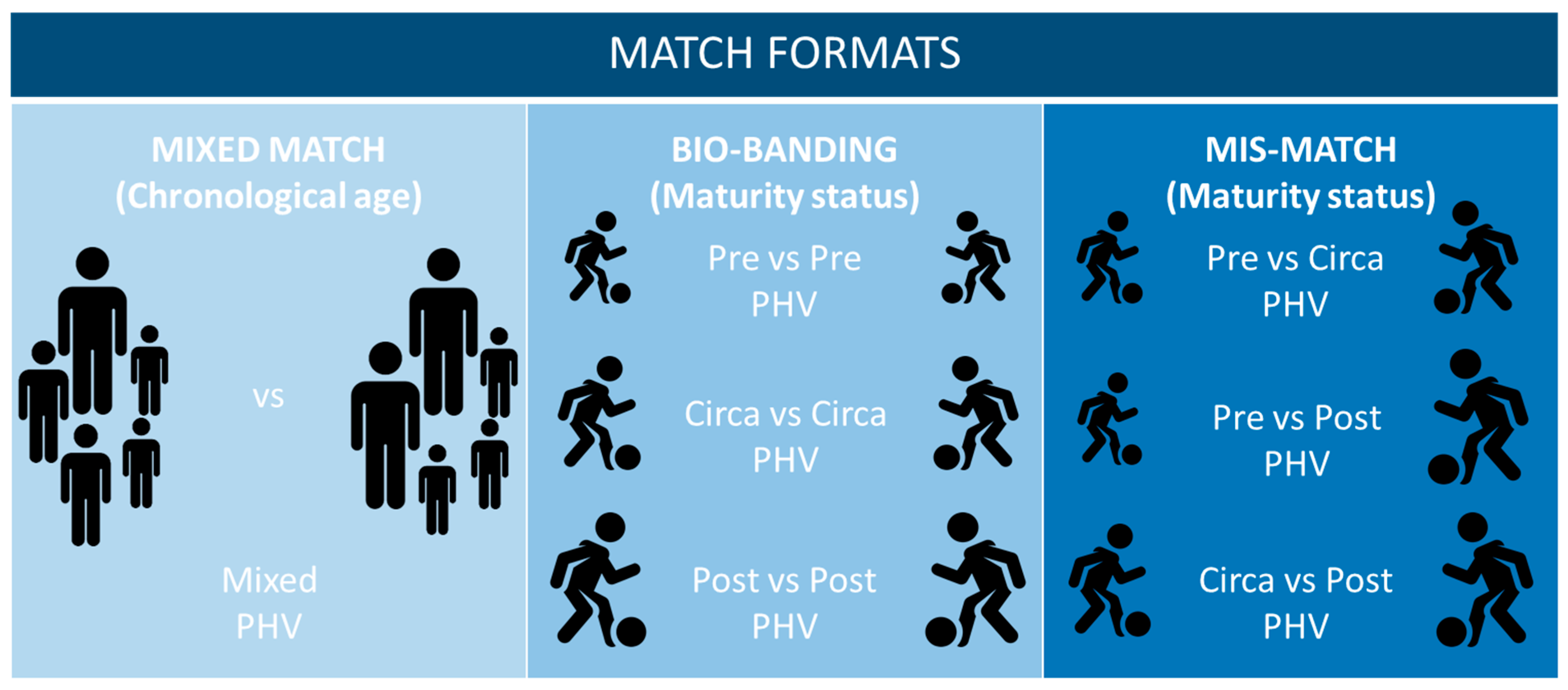
Five studies compared mismatched competitions (i.e., pre-PHV vs. circa-PHV, pre-PHV vs. post-PHV, or circa-PHV vs. post-PHV) within the bio-banding format (maturity-matched) and the chronological-age format (mixed-maturity) [28,30,33,34,35] (Figure 2).
Additionally, only three studies used goalkeepers in the experimental design [27,29,32].

3.3. Investigated Outcomes

Nine studies focused on physical performance outcomes [25,26,27,28,29,30,31,32,34], followed by eight studies that examined technical and tactical outcomes [25,26,27,29,30,31,33,35], and two studies analyzed the psychological outcomes [30,34]. Finally, two studies investigated differences in the variance explained by two predictive methods applied to bio-banding [34,35].

3.3.1. Assessment of Physical Outcomes

Across the studies, different monitoring systems were employed to collect and to analyze physical outcomes, focusing predominantly on external and internal workload metrics. The primary tool for collecting external workload data was the global positioning system (GPS), used in five studies [25,26,27,31,34], whilst two studies used inertial measurement units (IMUs) [30,32] and one study used a triaxial accelerometer [29]. Table S3 summarizes the devices and the measured variables for the physical assessment.

3.3.2. Assessment of Technical and Tactical Outcomes

The technical outcomes were investigated using various methodologies, primarily involving video analysis and sensor-based tracking, sometimes integrated with tactical metrics. Three studies used video-recording protocols coupled with specialized software for coding and analysis [26,29,35]. Two of those [26,35] employed SportsCode Elite software (Version 10.3.36, Sportstec Ltd., Geluksburg, South Africa) for video analysis, while one study [30] used a foot-mounted IMU (PlayerMakerTM, Tel Aviv, Israel). Conversely, two studies [33,35] investigated technical metrics using the game technical scoring chart (GTSC). Table S4 summarizes the devices and the measured variables for the technical and tactical assessment.

3.3.3. Assessment of Psychological Outcomes

Two studies [30,34] examined the psychological outcomes using the Hull Soccer Behavioural Scoring Tool [36]. This method investigated confidence, competitiveness, x-factor, and positive attitude, each representing a crucial psychological trait for youth academies. The definition provided by the Hull Soccer Behavioural Scoring Tool had to be assessed by coaches from 1 to 5 for each player. The criteria were as follows: 1—poor, 2—below average, 3—average, 4—very good, and 5—excellent. The scores from the various items were then summed and scaled to a maximum total of 20.

3.3.4. Assessment of Bio-Banding Methods

Two of the included studies [34,35] examined the difference in the explanation of the variance among the measured variables between two methods used to group players by maturity status: the Khamis–Roche [13] and Fransen method [12]. While the Khamis–Roche method estimates adult stature based on current stature, using current weight and mid-parent stature to obtain the percentage of estimated adult stature attainment (EASA) as a maturity reference, the Fransen method estimates the maturity status from the somatic interaction of stature, sitting height and body mass, deriving it from a maturity ratio (chronological age/age at peak height velocity). Using the Khamis–Roche method, an adjusted threshold of 87.0–92.0% of final EASA is used to group players into their maturity bands: pre-PHV = 85.0–87.0%, circa-PHV = 87.0–92.0 and post-PHV = 92.0–95.0%. The Fransen method defines years-to-PHV categories: pre-PHV < −1.0 years to PHV, circa-PHV −1.0–0.0 years to PHV and post-PHV > 0.0 years to PHV.

3.4. Comparisons Between Chronological-Age vs. Bio-Banding Formats

3.4.1. Physical Outcomes

Nine studies [25,26,27,28,29,30,31,32,34] investigated the effect of the bio-banding (BB) format on physical outcomes compared to the chronological-age (CA) format. Generally, the BB format was found to reduce the overall physical load compared to the CA format. In the BB format, players covered significantly less total running distance, moved at a lower average speed, and ran fewer high-speed and jogging distances [27,31]. However, maximal running velocity and maximal accelerations showed no significant difference between the BB and CA formats [31]. Maturity status had a strong influence on physical metrics, regardless of format. Late developers consistently covered significantly greater total distances and explosive distances than early developers [26]. Similarly, in a maturity-mismatched format (i.e., pre-PHV vs. post-PHV), more-mature players covered significantly greater total high-intensity distance than less-mature players [30]. In maturity-matched games (i.e., post-PHV vs. post-PHV), more-mature players also maintained greater total high-intensity distance; however, only less-mature players covered significantly greater total distance in mixed-maturity format [30]. Another study found that the largest differences across physical measures occurred between pre-PHV and circa-PHV players [34]. Post-PHV players displayed a higher PlayerLoadAP, while pre-PHV players showed a higher PlayerLoadML. A difference was found in mean heart rate during on-time maturity group competition [34]. The BB format generally led to fewer high-intensity actions. Players in BB games performed fewer decelerations compared to CA games [27]. Moreover, early U14 developers performed significantly more high accelerations in the CA format compared to U13 early developers, whilst during BB, the early U13 group exhibited a greater number of fast accelerations [25]. Generally, other subgroups showed fewer fast accelerations in the BB versus CA format [25]. Players in BB competitions also exhibited a lower number of body impacts and lower peak heart rates compared to CA games [27]. One study found significant effects of maturation, format, and their interaction on external training load [29]. For pre-PHV players, the CA condition resulted in a lower PlayerLoad compared to the BB condition. In contrast, for circa-PHV players, the CA condition led to a higher PlayerLoad, although this was not statistically significant [29].
Internal workload consistently highlighted maturation-related differences. Overall, pre-PHV players showed the highest sRPE when competing in mismatched BB small-sided games, reaching the largest effect size for any variable measured [34]. Pre-PHV players also generally reported higher perceived exertion values across different RPE scales [28]. Conversely, one study found that late developers reported significantly higher RPE values compared with early developers [26], and another study showed that PHV players reported sRPE values lower than those of pre-PHV players [29]. Post-PHV athletes tended to show higher RPE values [28]. Early developers showed significantly higher RPE in BB competition compared with CA competition, while no significant differences in RPE were observed for on-time or late developers across the two formats [26]. Another study showed that increases in RPE during the mixed-maturity format were greatest among post-PHV players [28]. However, one study found that BB did not influence sRPE and TRIMP [29]. In another study [32], players perceived the BB training sessions as less intense across both sRPE and all differentiated RPE measures (RPE-T, RPE-B, RPE-L).
The BB format generally reduced the magnitude of within-session changes in neuromuscular performance [32]. Post-session, the pre-PHV group experienced a small, yet significant, reduction in stride length. Overall, while effect sizes suggested differences in several performance markers, only measures like absolute stiffness, stride length, and cadence demonstrated statistically significant changes [32].

3.4.2. Technical and Tactical Outcomes

Eight studies [25,26,27,29,30,31,33,35] explored technical–tactical changes across match formats, revealing that the effects of competition structure are highly dependent on player maturity status and game constraints.
In the technical performance domain, the influence of the competition format was strongly linked to maturity status [26]. The BB format significantly increased the frequency of short passes compared to CA competitions, specifically benefiting early and on-time developers. Conversely, CA games were associated with a higher occurrence of long passes for the on-time and late developers [26]. The BB environment also demonstrated a selective impact on individual actions: it increased dribbling actions [26] and time spent dribbling the ball [35] for on-time developers but decreased them for early developers, and similarly, increased tackling frequency only for late developers [26]. Other technical variables, such as shots and crosses, showed no significant differences across formats or maturity groups. It is worth nothing that one study found no overall effects of bio-banding or maturation on technical involvement, suggesting complexity in outcome interpretation [29]. The largest observed differences in video-recorded technical actions (excluding ground challenges) and technical rating scores generally occurred when maturity groups were matched (i.e., post-PHV vs. post-PHV or circa-PHV vs. circa-PHV), while during the mixed-maturity format, only goals scored showed a significant difference [31].
The analysis of game constraints, such as group composition and pitch size, further revealed modulation in technical activity [30,33]. In the maturity-matched format, post-PHV groups showed the highest technical differences, while playing against early developers resulted in the lowest technical sum scores for late-developing players [33]. Furthermore, the size of the small-sided game was a crucial factor in determining individual characteristics [30]. In maturity-mismatched games, less-mature players increased their technical involvement with reducing team size (e.g., from 6 vs. 6 to 5 vs. 5 or 4 vs. 4). Instead, mixed-maturity games significantly increased the frequency of all individual technical actions, including touches, releases, possessions, and time spent on the ball, for players of both maturity levels [30]. However, in maturity-matched games, these team size changes had no significant effect. When comparing performance across groups, more-mature players recorded a higher frequency of technical actions than less-mature ones in a 6 vs. 6 game format [30]. Additionally, pitch size modulated possession strategy, with larger pitches leading to longer possession duration and fewer pass attempts [33].
Regarding technical–tactical outcomes, the BB format appeared to promote a more intensive, direct, and confrontational style of play [31]. BB sessions led to a significant increase in duels and set pieces, resulting in a decreased average time of ball possession per action and a lower rate of successful passes [31]. However, there were significant interactions with maturity status for specific tactical KPIs [25]. Late developers showed enhanced performance in competitive metrics such as conquered balls, attack balls, volume of play on the ball, and efficiency on the ball during BB games compared to CA competition [25].
Finally, the assessment of pure tactical outcomes focused mainly on spatial behaviour. The highest values for the spatial exploration index (SEI), indicating greater pitch coverage, were consistently observed when circa-PHV groups played each other in maturity-matched games [35]. In the same format, post-PHV groups also exhibited the largest differences in key positional metrics, such as the distance to the nearest teammate and the team centroid, pointing out homogeneous maturity’s collective behaviours [35]. Despite these results, one study found no significant differences in SEI between the BB and CA match formats overall [27].

3.4.3. Psychological Outcomes

Two studies investigated the influence of competition structure and maturity status on psychological characteristics among young players [30,34]. In one study [30], the team size of the small-sided game had an important impact. Across both maturity-matched and maturity-mismatched games, more-mature players showed stronger psychological characteristics in the 4 vs. 4 format compared to the larger 5 vs. 5 and 6 vs. 6 games. In contrast, less-mature players maintained similar psychological characteristics across all team sizes (4 vs. 4, 5 vs. 5, and 6 vs. 6) in the maturity-matched and maturity-mismatched formats. This pattern shifted during the mixed-maturity format, where the 4 vs. 4 format promoted the highest scores for both groups. More-mature players showed stronger characteristics in 4 vs. 4 compared to the larger formats, and less-mature players also displayed significantly stronger psychological characteristics in 4 vs. 4 compared to 5 vs. 5 and 6 vs. 6. When comparing the groups directly, more-mature players scored higher than less-mature players during only the 4 vs. 4 maturity-mismatched games. On the contrary, less-mature players displayed stronger psychological characteristics than their more-mature counterparts across three specific scenarios: in the maturity-matched 5 vs. 5 and 6 vs. 6 formats and in the mixed-maturity 6 vs. 6 format. Another study [34] identified the largest individual differences in psychological outcomes as occurring between pre-PHV and post-PHV players. This disparity was found in core traits, with pre-PHV players consistently showing the highest ratings in variables such as positive attitude, confidence, competitiveness, and total psychological score. While differences for mixed-maturity groups were generally smaller, post-PHV players showed higher x-factor ratings, and the largest x-factor differences were noted when on-time groups played each other.

3.4.4. Differences Between Bio-Banding Methods

One study [34] showed that the Khamis–Roche method explained more of the variance in eight of the physical variables but outperformed the Fransen method across all indices used in two of the variables only—PlayerLoadTM per minute and PlayerLoadML. In terms of the psychological variables, the Fransen method outperformed Khamis–Roche in all variables. Another study [35] stated that the Fransen method accounted for the highest percentage of variance explained across all variables in the total technical score, with the model explaining 67% of the variance in practitioner ratings. However, when considering variance explained across all tactical and technical variables, Fransen and Khamis and Roche methods performed similarly in terms of the highest R2 values. In conclusion, the Fransen method produced the best out-of-sample prediction (LOOIC) values for 19 of the 25 variables.

3.5. Risk-of-Bias Assessment

The quality assessments of the included studies are summarized in Tables S5 and S6 (Supplementary Tables S5 and S6). Risk of bias was assessed using the ROB-2 (risk of bias 2) for randomized studies [22] (Supplementary Table S5), and the ROBINS-I (Risk of Bias in Non-randomized Studies of Interventions) for non-randomized studies [23] (Supplementary Table S6). Among the 11 included studies, 3 resulted in a low risk of bias [26,28,33], and 8 were considered at moderate risk of bias [25,27,29,30,31,32,34,35]. Most of the studies revealed limitations regarding the analysis of confounding factors [26,27,29,30,31,32,34,35], such as selection bias [27,29,30,31], classification of intervention [30], deviations from intended interventions [32], missing data [30] and randomization process [25] (Supplementary Tables S3 and S4). Regarding the analysis of confounding factors, many studies failed to account for variables that could systematically influence the results. Selection bias was also prevalent, characterized by insufficient detail regarding participants recruitment, controversial grouping methodologies, and lack of transparency in exclusion criteria. Furthermore, a lack of clarity in intervention protocols was observed, which may have led to inconsistencies in the subsequent result analysis. Deviations from intended interventions were noted, often involving external influences such as coach behaviour or the inclusion of “bounce players” within the experimental setups. Issues concerning missing data were also present, originating from the improper handling of data from excluded participants and their subsequent replacements. Finally, randomization bias represents some concerns considering the inherent nature of bio-banding which requires grouping players based on specific biological markers frequently precluding the implementation of a strictly rigorous randomization process.

4. Discussion

This systematic review aimed to comprehensively synthesize the findings of previous studies comparing chronological-age (or mixed-maturity) and bio-banding formats, seeking to determine if the latter approach can solve the maturity disparity in age-based soccer teams and highlight differences in performance outcomes. The synthesized evidence focused on several characteristics of youth soccer performance, relative to sport-specific technical and tactical skills, workload management, physical performance optimization, and psychological skills. These metrics strongly rely on individual variability associated with differing degrees of biological maturity, which is a distinguishing factor between youth and adult performance [37]. Unfortunately, only one study has examined the bio-banding approach in females, and it was limited by a very small sample size that was mixed into male teams [31].

4.1. Physical Outcomes

The analysis of physical performance revealed contrasting trends in total exercise volume across formats. In mixed-maturity format, late-maturing players covered greater total distance than their more-mature counterparts, whereas in the bio-banding format, more-mature players covered higher total distances [30]. Specifically, these findings are not consistent in the U9-U10 age group, where early-maturing players generally covered a lower total distance [38]. Despite these discrepancies in total volume, the results are consistent across studies for high-intensity metrics: more-mature players performed at a higher level in both chronological-age and bio-banding matches [25,30]. This consistency strongly aligns with match running performance analyses examining the impact of maturation in academy soccer players [39]. Given these findings, stakeholders must account for maturation as a valuable factor in predicting and evaluating the diverse running profiles observed on the pitch.
Moving forward to external workload, the observation that pre-PHV players registered a significantly lower PlayerLoad during chronological-age competition than in the bio-banding condition [29] is particularly noteworthy and controversial. This outcome is difficult to reconcile with previous evidence showing a negative correlation between PlayerLoad per minute and maturational age [40]. Hence, it becomes essential to consider that variations in the quality of the opposing team represent a significant factor capable of influencing the external workload imposed on the players.
Furthermore, the PlayerLoad discrepancy in movement direction is likely related to the different playing positions, which are known to significantly influence the direction of purposeful movements on the pitch [41]. Conversely, when players compete in maturity-matched games, there is a general reduction in running metrics, which also affects the number of body impacts and average speed [27]. Consequently, heart rate responses decreased [27,34], a physiological change hypothetically attributed to the balancing effect of the bio-banding format, which effectively reduces the overperformance gap—specifically for total distance covered and total high-intensity distance—between less- and more-mature players [27,34]. The pre-PHV’s reduction in stride length [32] is likely attributable to underdeveloped motor schemas and the players’ relatively reduced stature, which restricts the maximum range of motion in the lower limbs. This observation is further corroborated by findings that indicate a reduction in anthropometric values for late-developing players [42]. In conclusion, by minimizing differences in adaptive responses among players, bio-banding could reduce mechanical and physiological variability, allowing stakeholders to manage training loads with greater precision and consistency.
The measure of internal workload by means of rating of perceived exertion (RPE) consistently showed that biological maturation significantly influences how players perceived the workload [43], though the specific effect varies by competition format. Findings generally indicate that overall reported RPE values are higher in players with a lower maturity status [26,28,29]. This is consistent with the previous literature [44], which highlighted a lower perception of intensity of training sessions with an increase in maturity status. Furthermore, while the bio-banding format generally resulted in lower d-RPE values for the overall group [32], early-maturing players reported significantly higher RPE than they did in traditional age-group formats [26]. This discrepancy can be partially explained to the fact that early-maturing players often rely on their physical advantage [45] during the chronological-age format, allowing them to achieve success without exerting maximum effort. When this advantage is minimized in bio-banding competition, they are forced to increase their effort and intensity, leading to a heightened perception of effort. This also can explain why, in a mismatched format, pre-PHV players accumulated higher RPE [34]. The current literature presents controversial results, such as an increasing RPE during the chronological-age format, especially among post-PHV players [28], alongside reports of overall reductions across various RPE measures (sRPE, RPE-B, RPE-L and RPE-T) for both pre- and post-PHV players in other studies [32]. Finally, RPE comparisons across playing formats should be approached with caution, as the evidence remains somewhat controversial regarding its impact and practical significance.

4.2. Technical and Tactical Outcomes

The bio-banding format suggests a shift in technical focus compared to chronological-age competitions. Specifically, it results in a higher frequency of short passes for early and on-time developers, whereas chronological-age formats tend to produce more long passes among on-time and late developers [26]. This distinction aligns with the significant gains in muscular strength and power observed in male adolescents near PHV [5,46], which makes executing long passes more feasible for earlier-maturing players than for their late-maturing peers. Within bio-banding, the greatest differences in successful passes are observed when pre-PHV groups compete against one another [35]. This may stem from the differing developmental characteristics among players of the same chronological age who experience the adolescent growth spurt at different times [6]. Such asynchronous development can lead to temporary “motor awkwardness,” often attributed to a slight immaturity in sensorimotor mechanisms during the PHV phase [47]. Furthermore, while biological maturity itself does not directly affect dribbling performance [48], the bio-banding format increases dribbling variability [26,35]. By removing the typical physical advantages of early maturation found in chronological competitions, bio-banding exposes players to a wider range of technical solutions that might otherwise be suppressed [26,35]. The bio-banding format also had effects on the number of tackles [26] and ground ball challenges produced [35]. It is speculated that bio-banding enables late-developing players to have greater participation in competitive actions, such as challenging balls, while early-developing players are usually predominant in mixed-maturity formats due to their superior force and power development [49]. Bio-banding games resulted in a significant increase in the number of duels and set pieces, concurrent with a decrease in the average time of ball possession per action compared to chronological-age games. Furthermore, the bio-banding format showed a lower rate of successful passes and a higher rate of unsuccessful passes, despite the overall number of passes remaining unchanged [31]. These technical and tactical shifts are attributed to the balancing of maturity levels, which effectively reduces the impact of physical attributes on the game [49]. This mechanism enables early-developing players to seek out more opportunities to dribble rather than pass. Since their peers no longer rely on physical superiority to resolve actions, early developers are stimulated to attempt more challenging dribbling maneuvers, altering performance metrics. Consistent with this explanation, during the bio-banding format, late developers subsequently recorded more conquered and attack balls and collected a higher volume of on-ball possession [25]. Differences regarding the game technical scoring chart (GTSC) were found during maturity-matched games [35], especially for post-PHV players who demonstrated higher ratings in communication skills. In contrast, mixed-maturity groups showed fewer significant GTSC differences, limited to cover, control, shooting, and passing [35], probably due to the advantage of physical aspects that may result in obscuring technical ratings. Furthermore, passing scores showed only small effects for late-developing players in the mixed-maturity format, a value that was slightly affected by pitch size (highest on medium pitch, lowest on small pitch) [33], which contradicts evidence stating that passing performance was not susceptible to different pitch dimensions [50].
Finally, regarding team dynamics, in mixed-maturity format, more-mature players generally dominate technical actions, while less-mature players only achieve high involvement in 4 vs. 4 games [30]. This technical dominance is largely mitigated in bio-banding matches, where more-mature players recorded greater releases and possession only in the larger 6 vs. 6 format [30], a finding consistent with previous observations that technical performance has a moderate-to-large relationship with a set of variables regarding maturational development [51]. In summary, bio-banding shifts the competitive focus from physical advantages to a broader range of technical solutions, fostering a more equitable environment where skill and dribbling execution are no longer overshadowed by maturational advantages.
The analysis of technical and tactical outcomes demonstrated medium-to-large effects of pitch size on mean possession time and pass attempts [33], pointing out, as in previous findings, that larger pitch sizes are associated with progressively longer possessions, while pass attempts decrease sequentially as pitch dimensions increase [50].
Differences in spatial exploration index during inter-group competition may be partially explained by the balancing effect of the bio-banding format, wherein mitigating the variability in players’ maturity status can facilitate the adoption of more complex and challenging tactical approaches [35]. Furthermore, circa-PHV players are undergoing a period of rapid physical growth which may induce improvements in physical performance [52], hence turning this accelerated development into an overperforming disposition relative to their early- and late-maturing teammates. Consequently, these findings demonstrate that bio-banding format is able to level the physical playing field, forcing a transition from possession-based play to more challenging individual technical maneuvers and tactical exploration.

4.3. Psychological Outcomes

The evaluation of psychological traits highlighted consistently higher psychological ratings for pre-PHV players [34]. The tendency for late-maturing players to achieve higher overall psychological scores aligns with previous evidence [53] that supports superior coping skills with adversity, as well as enhanced goal-setting and mental preparation capabilities in late developers relative to early-maturing athletes. This evidence underscores the significant psychological adaptation required by late-maturing players to cope with the challenges of maturational imbalances.

4.4. Differences Between Bio-Banding Methods

Evidence from this review underscores that the Khamis–Roche and Fransen methods possess distinct predictive architecture, making their application highly dependent on the performance domain being analyzed. While the Khamis–Roche model demonstrates greater efficacy in accounting for variance within specific physical load metrics [34], the Fransen method consistently exhibits superior diagnostic power in psychological and technical assessments [35]. Given that the Fransen approach demonstrates broader utility across a more extensive range of performance indices, the selection of a specific model should be strategically aligned with the evaluative focus—whether it be physical, technical, or psychological. Consequently, practitioners are strongly cautioned against using these bio-banding methods interchangeably and must remain aware of the divergent statistical strengths and inherent limitations that characterize each predictive approach [9].
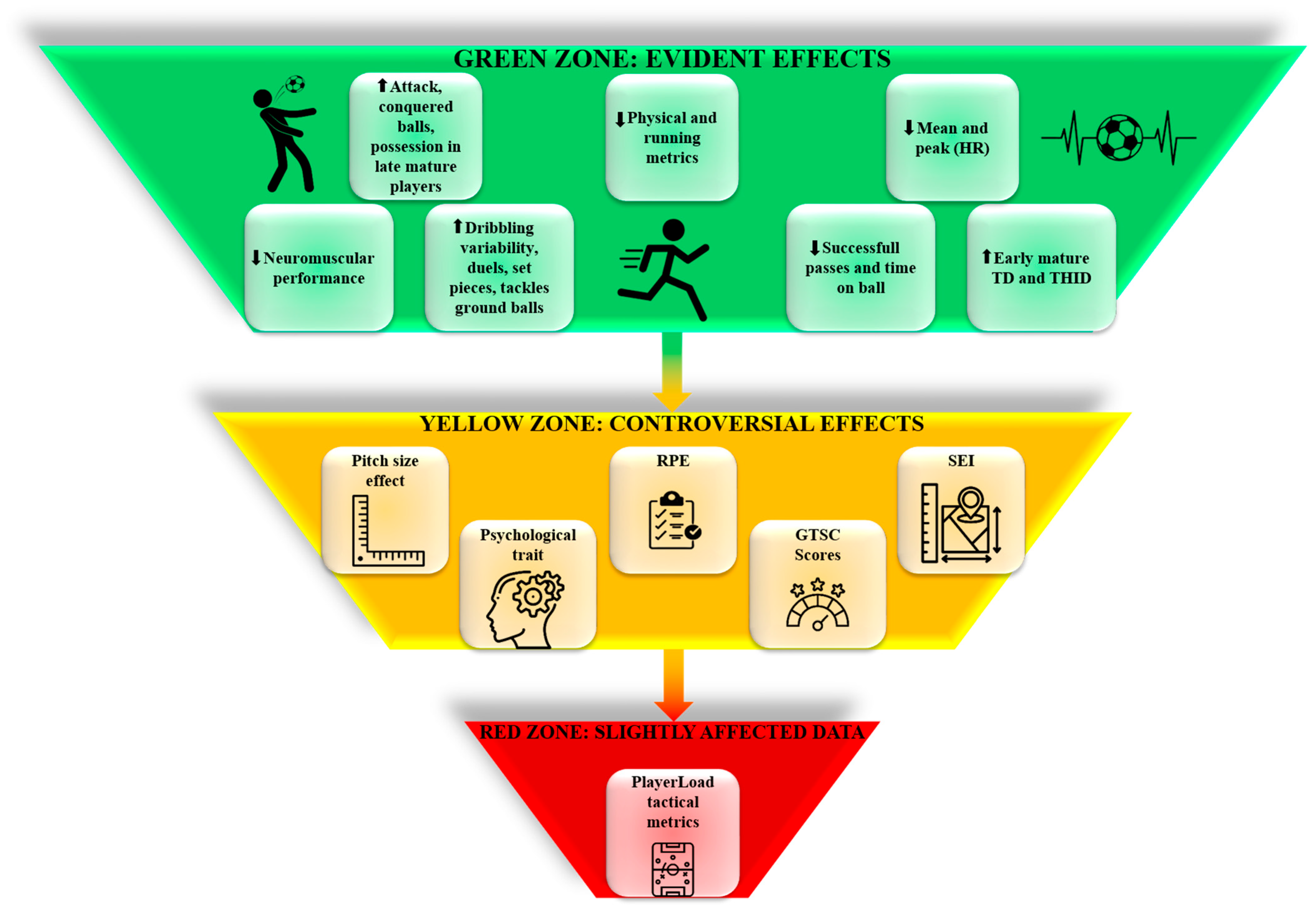
To our knowledge, this is the first systematic review to evaluate and synthesize evidence from crossover controlled trials exploring the impact of bio-banding in youth soccer players on all the domains of the performance, physical, technical–tactical, and psychological domain. Despite the comprehensive nature of this work, Figure 3 provides a detailed synthesis of bio-banding’s on-field effects. These are categorized into evident, controversial and slightly affected based on the strength and consistency of the examined literature.
Notably, several outcomes remain equivocal due to conflicting results within the included literature. For instance, parameters such as RPE, psychological traits, some technical–tactical components and the impact of pitch size do not exhibit consistent response patterns across studies, which may lead to uncertainty among youth soccer practitioners.
The overall strength of the evidence must be characterized as emerging rather than definitive. Furthermore, a significant methodological limitation is the high heterogeneity in how “success” is measured across studies—ranging from subjective RPE to objective GPS metrics, which complicates the ability to draw universal conclusions.
From a clinical and practical applicability point of view, these findings suggest that bio-banding should not be viewed as a total replacement for chronological age groups, but as a periodic intervention. Clinically, the reduction in physical overperformance by early-maturers and the normalization of internal workload (RPE) suggest that bio-banding may be useful as a protective mechanism against overreaching and growth-related overuse injuries. Practitioners should therefore implement bio-banding sessions specifically during periods of rapid growth (circa-PHV) to stabilize the mechanical and physiological variability that often leads to “motor awkwardness” and injury risk. By acknowledging these limitations and focusing on targeted application, stakeholders can move beyond a “one-size-fits-all” approach to a more detailed, evidence-based maturity management strategy. In addition, although Khamis–Roche is more precise for physical workload, Fransen is better suited for technical and psychological traits; applying these methods interchangeably is not ideal. Using different models for different goals creates a fragmented approach that leads to methodological inconsistency across different objectives. To ensure clear communication and long-term data tracking, stakeholders should pick one single method and stick to it according to the methods’ validity. Standardizing the choice is better than switching between models, as it provides a more consistent way to evaluate player progress, as long as the limitations of the chosen tool are kept in mind.
Further research is needed to clarify the impact of bio-banding on these doubtful metrics. This requires a more integrated approach, combining the most practical and meaningful variables across larger groups of players, particularly those navigating the sensitive PHV period and avoiding the inclusion of players who are either well before or far beyond this developmental phase. Establishing clearer evidence knowledge would provide coaches and practitioners with an effective tool to enhance talent identification and development processes. Furthermore, it would allow for more effective injury prevention programmes tailored to an athlete’s specific maturity status, since evidence supports higher injury vulnerability during adolescence, especially for circa-PHV players of U14 and U15 team categories [54]. Finally, such a method fosters the maturity-respecting tactical and technical growth of youth players.

5. Conclusions

The results of this review highlight the significant influence of the bio-banding format on the characteristics and development of youth soccer players. This method reveals important and meaningful differences when compared to the traditional age-based grouping systems currently adopted by the majority of youth soccer federations. Further investigation is needed to better understand the impact of this approach on players with different maturity statuses to ensure optimal development and foster youth talent. Elements such as workload capability, and technical and tactical performance must be carefully analyzed, particularly considering the controversial evidence found in studies examining the application of bio-banding versus the chronological-age format. A key aspect for future investigation is the relevance of game format selection, given that the studies included in this review employed different formats within their experimental designs, bringing out controversial variety of results. The same should be kept in mind for the use of goalkeepers during matches, considering that an extra player can change a lot especially in technical–tactical insights. Furthermore, considering the paucity of the literature regarding female cohorts, applying this approach in female soccer could be essential for enhancing the long-term development of its participants and for understanding the differences in outcomes compared to those of males.
Bio-banding should not be viewed as the definitive solution for eliminating all discrepancies in soccer training or match performance. Rather, it should be utilized as a strategic tool to facilitate individual growth within a maturation-respecting environment. This environment should be balanced with the challenge of overperformance—stimulating adaptation, especially among late-maturing players, against more challenging opponents— thereby encouraging the development of an adaptive technical–tactical soccer style that contrasts physical characteristics not achievable in the immediate future. This strategy must be implemented in conjunction with injury prevention measures, always respecting both the internal and external workload features controlled by coaches, as these combined metrics provide critical insight into potentially detrimental overperformance, thereby avoiding the onset of burden.

Supplementary Materials

The following supporting information can be downloaded at https://www.mdpi.com/article/10.3390/app16094300/s1, Table S1: Studies characteristics and main findings. Table S2: Studies characteristics and main findings. Table S3: Assessment of physical outcomes. Table S4: Assessment of technical and tactical outcomes. Table S5: Rob 2 tool for the assessment of the five risk of bias domains. Table S6: ROBINS-I tool for the assessment of the seven risk of bias domains.

Author Contributions

Conceptualization, S.M., V.P., G.G., M.M., M.L. and G.C.; methodology, S.M., V.P., M.M., M.L. and G.C.; literature search and data analysis S.M., A.G., F.L. and V.P.; writing—original draft preparation, S.M., A.G., and F.L.; writing—review and editing, S.M., A.G., F.L., V.P., G.G., R.K., M.M., M.L. and G.C.; supervision, M.L. and G.C. All authors have read and agreed to the published version of the manuscript.

Funding

This research received no external funding.

Institutional Review Board Statement

Not applicable.

Informed Consent Statement

Not applicable.

Data Availability Statement

No new data were created or analyzed in this study.

Conflicts of Interest

The authors declare no conflicts of interest.

Abbreviations

The following abbreviations are used in this manuscript:
APAnterior–posterior
BBBio-banding
CAChronological age
dRPEDifferential ratings of perceived exertion
EASAEstimated adult stature attainment
GKGoalkeeper
GPSGlobal positioning system
GTSCGame technical scoring chart
HRHeart rate
KPIsKey performance indicators
IMUInertial measurement unit
LOOICLeave-one-out information criterion
LPMLocal position measurement
MLMedial–lateral
MOMaturity offset
PAHPredicted adult height
PHVPeak height velocity
RPERate of perceived exertion
RSIReactive strength index
SEISpatial exploration index
sRPESession ratings of perceived exertion
sRPE-BSession ratings of perceived exertion—breathlessness
sRPE-LSession ratings of perceived exertion—leg muscle exertion
sRPE-TSession ratings of perceived exertion—technical demand
SSGSmall-sided game
TDTotal distance
THIDTotal high-intensity distance
TRIMPTraining impulse
TSAPTeam sports assessment procedure
U13MOhighU13 in the higher bio-band
U14MOlowU14 in the lower bio-band
VVertical

References

  1. FIFA. Professional Football Report 2023; FIFA: Zurich, Switzerland, 2023; Available online: https://inside.fifa.com/legal/news/fifa-publishes-professional-football-report-2023 (accessed on 25 April 2025).
  2. Liu, B.; Zhou, C.; Ma, H.; Gong, B. Mapping the youth soccer: A bibliometrix analysis using R-tool. Digit. Health 2023, 9, 1–16. [Google Scholar] [CrossRef]
  3. Williams, A.M.; Reilly, T. Talent identification and development in soccer. J. Sports Sci. 2000, 18, 657–667. [Google Scholar] [CrossRef]
  4. Figueiredo, A.J.; Gonçalves, C.E.; Coelho-e-Silva, M.J.; Malina, R.M. Characteristics of youth soccer players who drop out, persist or move up. J. Sports Sci. 2009, 27, 883–891. [Google Scholar] [CrossRef] [PubMed]
  5. Malina, R.M.; Bouchard, C.; Bar-Or, O. Growth, Maturation, and Physical Activity, 2nd ed.; Human Kinetics: Champaign, IL, USA, 2004. [Google Scholar]
  6. Beunen, G.P.; Rogol, A.D.; Malina, R.M. Indicators of biological maturation and secular changes in biological maturation. Food Nutr. Bull. 2006, 27, 31–38. [Google Scholar] [CrossRef]
  7. Ginés, H.J.; Huertas, F.; García Calvo, T.; Ponce-Bordón, J.C.; Figueiredo, A.J.; Ballester, R. Age and maturation matter in youth elite soccer, but depending on competitive level and gender. Int. J. Environ. Res. Public Health 2023, 20, 2015. [Google Scholar] [CrossRef] [PubMed]
  8. Malina, R.M.; Eisenmann, J.C.; Cumming, S.P.; Ribeiro, B.; Aroso, J. Maturity-associated variation in the growth and functional capacities of youth football (soccer) players 13–15 years. Eur. J. Appl. Physiol. 2004, 91, 555–562. [Google Scholar] [CrossRef] [PubMed]
  9. Sullivan, J.; Roberts, S.J.; Mckeown, J.; Littlewood, M.; McLaren-Towlson, C.; Andrew, M.; Enright, K. Methods to predict the timing and status of biological maturation in male adolescent soccer players: A narrative systematic review. PLoS ONE 2023, 18, e0286768. [Google Scholar] [CrossRef]
  10. Mirwald, R.L.; Baxter-Jones, A.D.; Bailey, D.A.; Beunen, G.P. An assessment of maturity from anthropometric measurements. Med. Sci. Sports Exerc. 2002, 34, 689–694. [Google Scholar] [CrossRef]
  11. Moore, S.A.; McKay, H.A.; Macdonald, H.; Nettlefold, L.; Baxter-Jones, A.D.G.; Cameron, N.; Brasher, P.M.A. Enhancing a somatic maturity prediction model. Med. Sci. Sports Exerc. 2015, 47, 1755–1764. [Google Scholar] [CrossRef]
  12. Fransen, J.; Bush, S.; Woodcock, S.; Novak, A.; Baxter-Jones, A.D.G.; Deprez, D.; Baxter-Jones, A.D.G.; Vaeyens, R.; Lenoir, M. Improving the prediction of maturity from anthropometric variables using a maturity ratio. Pediatr. Exerc. Sci. 2018, 30, 296–307. [Google Scholar] [CrossRef]
  13. Khamis, H.J.; Roche, A.F. Predicting adult stature without using skeletal age: The Khamis-Roche method. Pediatrics 1994, 94, 504–507. [Google Scholar] [CrossRef] [PubMed]
  14. Albaladejo-Saura, M.; Vaquero-Cristóbal, R.; García-Roca, J.A.; Esparza-Ros, F. Influence of biological maturation status on selected anthropometric and physical fitness variables in adolescent male volleyball players. PeerJ 2022, 10, e13216. [Google Scholar] [CrossRef] [PubMed]
  15. Cumming, S.P.; Lloyd, R.S.; Oliver, J.L.; Eisenmann, J.C.; Malina, R.M. Bio-banding in sport: Applications to competition, talent identification, and strength and conditioning of youth athletes. Strength Cond. J. 2017, 39, 34–47. [Google Scholar] [CrossRef]
  16. Malina, R.M.; Cumming, S.P.; Rogol, A.D.; Coelho-e-Silva, M.J.; Figueiredo, A.J.; Konarski, J.M.; Kozieł, S.M. Bio-banding in youth sports: Background, concept, and application. Sports Med. 2019, 49, 1671–1685. [Google Scholar] [CrossRef]
  17. Stănilă, A.M.; Matichescu Lupșa, M.; Stănilă, C. Bio-banding from concept to practice in sports: “Bio-banding will create better leaders and people” by Pete Lansley. Timişoara Phys. Educ. Rehabil. J. 2020, 13, 19–24. [Google Scholar] [CrossRef]
  18. Hill, M.; Spencer, A.; McGee, D.; Scott, S.; Frame, M.; Cumming, S. The psychology of bio-banding: A Vygotskian perspective. Ann. Hum. Biol. 2020, 47, 328–335. [Google Scholar] [CrossRef]
  19. Jäger, J.; Rumpf, M.; Lochmann, M. The effect of bio-banded game formats on physiological, physical, technical, and tactical parameters in youth soccer—A systematic review. Pediatr. Exerc. Sci. 2025, 1–12. [Google Scholar] [CrossRef]
  20. Page, M.J.; McKenzie, J.E.; Bossuyt, P.M.; Boutron, I.; Hoffmann, T.C.; Mulrow, C.D.; Shamseer, L.; Tetzlaff, J.M.; Akl, E.A.; Brennan, S.E.; et al. The PRISMA 2020 statement: An updated guideline for reporting systematic reviews. BMJ 2021, 372, n71. [Google Scholar] [CrossRef]
  21. Gusenbauer, M.; Haddaway, N.R. Which academic search systems are suitable for systematic reviews or meta-analyses? Evaluating retrieval qualities of Google Scholar, PubMed, and 26 other resources. Res. Synth. Methods 2020, 11, 181–217. [Google Scholar] [CrossRef]
  22. Sterne, J.A.C.; Savović, J.; Page, M.J.; Elbers, R.G.; Blencowe, N.S.; Boutron, I.; Cates, C.J.; Cheng, H.-Y.; Corbett, M.S.; Eldridge, S.M.; et al. RoB 2: A revised tool for assessing risk of bias in randomised trials. BMJ 2019, 366, l4898. [Google Scholar] [CrossRef] [PubMed]
  23. Sterne, J.A.; Hernán, M.A.; Reeves, B.C.; Savović, J.; Berkman, N.D.; Viswanathan, M.; Henry, D.; Altman, D.G.; Ansari, M.T.; Boutron, I.; et al. ROBINS-I: A tool for assessing risk of bias in non-randomised studies of interventions. BMJ 2016, 355, i4919. [Google Scholar] [CrossRef]
  24. Campbell, M.; McKenzie, J.E.; Sowden, A.; Katikireddi, S.V.; Brennan, S.E.; Ellis, S.; Hartmann-Boyce, J.; Ryan, R.; Shepperd, S.; Thomas, J.; et al. Synthesis without meta-analysis (SWiM) in systematic reviews: Reporting guideline. BMJ 2020, 368, l6890. [Google Scholar] [CrossRef]
  25. Lüdin, D.; Donath, L.; Cobley, S.; Romann, M. Effect of bio-banding on physiological and technical-tactical key performance indicators in youth elite soccer. Eur. J. Sport Sci. 2022, 22, 1659–1667. [Google Scholar] [CrossRef] [PubMed]
  26. Abbott, W.; Williams, S.; Brickley, G.; Smeeton, N.J. Effects of bio-banding upon physical and technical performance during soccer competition: A preliminary analysis. Sports 2019, 7, 193. [Google Scholar] [CrossRef]
  27. Arede, J.; Radnor, J.M.; Gonzalo-Skok, O.; Leite, N. Chronological age-based vs. Bio-banded friendly football tournament: Effects on physical performance and spatial exploration behaviour in 7v7 match play. J. Sports Sci. 2024, 42, 2292–2300. [Google Scholar] [CrossRef] [PubMed]
  28. Barrett, S.; Short, K.; Lowthorpe, A.; Swinton, P.; Maughan, P.; Hamilton, A.; Towlson, C. Examination of differential ratings of perceived exertion (dRPE) during bio-banded small-sided games. PLoS ONE 2022, 17, e0270259. [Google Scholar] [CrossRef]
  29. de Macedo, J.F.S.; Laerte Lopes Ribeiro, B.; de Morais Ferreira, A.B.; Oliveira, R.S.; Mortatti, A.L. Effects of bio-banding on training loads and technical performance of young football players. PLoS ONE 2025, 20, e0317432. [Google Scholar] [CrossRef]
  30. King, M.; Barrett, S.; Mclellan, R.; Cox, J.; Brown, M.; Mackenzie, S.; Towlson, C. Does team size affect Scottish male academy soccer player technical, locomotor and psychosocial outcomes during age and maturity bio-banded small-sided games? J. Sports Sci. 2025, 1–11. [Google Scholar] [CrossRef] [PubMed]
  31. Romann, M.; Lüdin, D.; Born, D.P. Bio-banding in junior soccer players: A pilot study. BMC Res. Notes 2020, 13, 240. [Google Scholar] [CrossRef]
  32. Salter, J.; Black, J.; Mallett, J.; Barrett, S.; Towlson, C.; Hughes, J.D.; De St Croix, M. Does biologically categorised training alter the perceived exertion and neuromuscular movement profile of academy soccer players compared to traditional age-group categorisation? Eur. J. Sport Sci. 2023, 23, 1490–1499. [Google Scholar] [CrossRef]
  33. Towlson, C.; Abt, G.; Barrett, S.; Cumming, S.; Hunter, F.; Hamilton, A.; Lowthorpe, A.; Gonçalves, B.; Corsie, M.; Swinton, P. The effect of bio-banding on academy soccer player passing networks: Implications of relative pitch size. PLoS ONE 2021, 16, e0260867. [Google Scholar] [CrossRef] [PubMed]
  34. Towlson, C.; MacMaster, C.; Gonçalves, B.; Sampaio, J.; Toner, J.; MacFarlane, N.; Barrett, S.; Hamilton, A.; Jack, R.; Hunter, F.; et al. The Effect of bio-banding on physical and psychological indicators of talent identification in academy soccer players. Sci. Med. Footb. 2021, 5, 280–292. [Google Scholar] [CrossRef]
  35. Towlson, C.; MacMaster, C.; Gonçalves, B.; Sampaio, J.; Toner, J.; MacFarlane, N. The effect of bio-banding on technical and tactical indicators of talent identification in academy soccer players. Sci. Med. Footb. 2021, 5, 295–308. [Google Scholar] [CrossRef] [PubMed]
  36. Robinson, J.; Cumming, S.; Salter, J.; Toner, J.; Towlson, C.; Senel, E. A new method to identify key match-play behaviours of young soccer players: Development of the hull soccer behavioural scoring tool. PLoS ONE 2024, 19, e0295953. [Google Scholar] [CrossRef]
  37. Teixeira, J.E.; Alves, A.R.; Ferraz, R.; Forte, P.; Leal, M.; Ribeiro, J.; Silva, A.J.; Barbosa, T.M.; Monteiro, A.M. Effects of chronological age, relative age, and maturation status on accumulated training load and perceived exertion in young sub-elite football players. Front. Physiol. 2022, 13, 832202. [Google Scholar] [CrossRef]
  38. Goto, H.; Morris, J.G.; Nevill, M.E. Influence of biological maturity on the match performance of 8-to 16-year-old, elite, male, youth soccer players. J. Strength Cond. Res. 2019, 33, 3078–3084. [Google Scholar] [CrossRef] [PubMed]
  39. Buchheit, M.; Mendez-Villanueva, A. Effects of age, maturity and body dimensions on match running performance in highly trained under-15 soccer players. J. Sports Sci. 2014, 32, 1271–1278. [Google Scholar] [CrossRef]
  40. García-Ceberino, J.M.; Cantonero-Cobos, J.M.; Conde, C.; Fernández-Ozcorta, E.J. Variations in external and internal intensities and impact of maturational age on soccer training tasks. Sensors 2024, 24, 5656. [Google Scholar] [CrossRef]
  41. Bloomfield, J.; Polman, R.; O’Donoghue, P. Physical demands of different positions in FA Premier League soccer. J. Sports Sci. Med. 2007, 6, 63. [Google Scholar]
  42. Itoh, R.; Hirose, N. Relationship among biological maturation, physical characteristics, and motor abilities in youth elite soccer players. J. Strength Cond. Res. 2020, 34, 382–388. [Google Scholar] [CrossRef]
  43. Mandorino, M.; Figueiredo, A.J.; Condello, G.; Tessitore, A. The Influence of Maturity on Recovery and Perceived Exertion, and Its Relationship with Illnesses and Non-Contact Injuries in Young Soccer Players. Biol. Sport 2022, 39, 839–848. [Google Scholar] [CrossRef]
  44. Salter, J.; Julian, R.; Mentzel, S.V.; Hamilton, A.; Hughes, J.D.; De St Croix, M. Maturity status influences perceived training load and neuromuscular performance during an academy soccer season. Res. Sports Med. 2024, 32, 235–247. [Google Scholar] [CrossRef]
  45. Vaeyens, R.; Malina, R.M.; Janssens, M.; Van Renterghem, B.; Bourgois, J.; Vrijens, J.; Philippaerts, R.M. A multidisciplinary selection model for youth soccer: The Ghent Youth Soccer Project. Br. J. Sports Med. 2006, 40, 928–934. [Google Scholar] [CrossRef]
  46. Philippaerts, R.M.; Vaeyens, R.; Janssens, M.; Van Renterghem, B.; Matthys, D.; Craen, R.; Bourgois, J.; Vrijens, J.; Beunen, G.; Malina, R.M. The relationship between peak height velocity and physical performance in youth soccer players. J. Sports Sci. 2006, 24, 221–230. [Google Scholar] [CrossRef] [PubMed]
  47. Quatman-Yates, C.C.; Quatman, C.E.; Meszaros, A.J.; Paterno, M.V.; Hewett, T.E. A systematic review of sensorimotor function during adolescence: A developmental stage of increased motor awkwardness? Br. J. Sports Med. 2012, 46, 649–655. [Google Scholar] [CrossRef]
  48. Malina, R.M.; Cumming, S.P.; Kontos, A.P.; Eisenmann, J.C.; Ribeiro, B.; Aroso, J. Maturity-associated variation in sport-specific skills of youth soccer players aged 13–15 years. J. Sports Sci. 2005, 23, 515–522. [Google Scholar] [CrossRef]
  49. Gundersen, H.; Grendstad, H.; Rygh, C.B.; Hafstad, A.; Vestbøstad, M.; Algerøy, E.; Smith, O.R.F.; Joensen, M.; Kristoffersen, M. The role of growth and maturation in the physical development of youth male soccer players. Int. J. Sports Med. 2025, 47, 131–138. [Google Scholar] [CrossRef]
  50. Vilar, L.; Duarte, R.; Silva, P.; Chow, J.Y.; Davids, K. The influence of pitch dimensions on performance during small-sided and conditioned soccer games. J. Sports Sci. 2014, 32, 1751–1759. [Google Scholar] [CrossRef]
  51. Moreira, A.; Massa, M.; Thiengo, C.R.; Lopes, R.A.R.; Lima, M.R.; Vaeyens, R.; Barbosa, W.P.; Aoki, M.S. Is the technical performance of young soccer players influenced by hormonal status, sexual maturity, anthropometric profile, and physical performance? Biol. Sport 2017, 34, 305–311. [Google Scholar] [CrossRef] [PubMed]
  52. Morris, R.; Emmonds, S.; Jones, B.; Myers, T.D.; Clarke, N.D.; Lake, J.; Ellis, M.; Singleton, D.; Roe, G.; Till, K. Seasonal changes in physical qualities of elite youth soccer players according to maturity status: Comparisons with aged matched controls. Sci. Med. Footb. 2018, 2, 272–280. [Google Scholar] [CrossRef]
  53. Van Den Berg, L.; Grobbelaar, H.W.; Jooste, J.; Jacobs, S. Psychological factors may counterbalance physical disadvantage of late maturation among African junior soccer players. S. Afr. J. Res. Sport Phys. Educ. Recreat. 2019, 41, 117–127. [Google Scholar]
  54. Johnson, D.M.; Williams, S.; Bradley, B.; Sayer, S.; Murray Fisher, J.; Cumming, S. Growing pains: Maturity associated variation in injury risk in academy football. Eur. J. Sport Sci. 2020, 20, 544–552. [Google Scholar] [CrossRef] [PubMed]
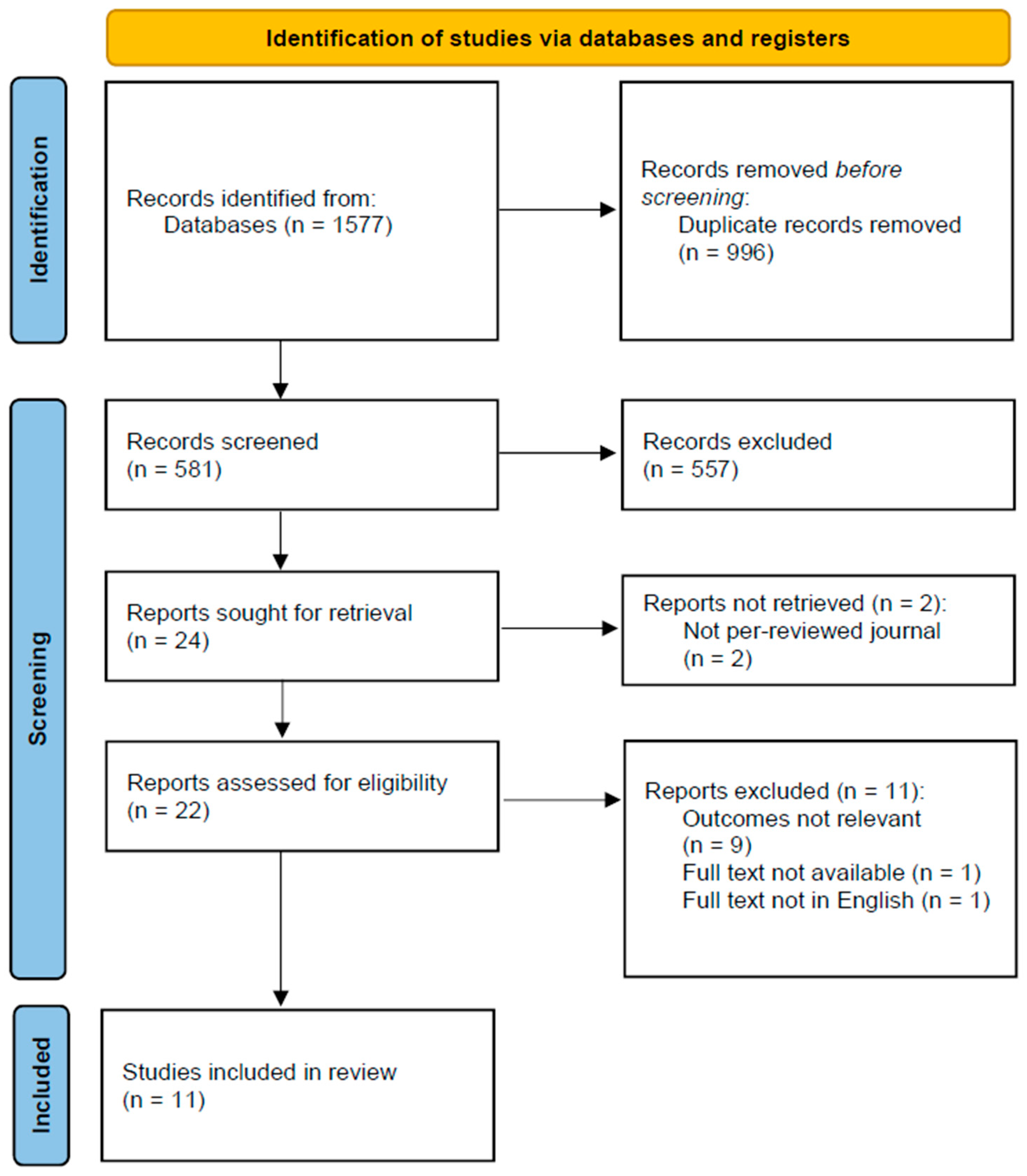
Figure 1. Preferred Reporting Items for Systematic Reviews and Meta-analyses (PRISMA) flow diagram of articles selected and included in the systematic review.
Applsci 16 04300 g001
Figure 2. Match format comparison across studies regarding the application of bio-banding. PHV = Peak height velocity.
Applsci 16 04300 g002
Figure 3. A synthesis of bio-banding’s effect according to the literature. GTSC = Game technical scoring chart; HR = heart rate; RPE = rate of perceived effort; SEI= spatial exploration index; TD = total distance; THID = total high-intensity distance.
Applsci 16 04300 g003
Disclaimer/Publisher’s Note: The statements, opinions and data contained in all publications are solely those of the individual author(s) and contributor(s) and not of MDPI and/or the editor(s). MDPI and/or the editor(s) disclaim responsibility for any injury to people or property resulting from any ideas, methods, instructions or products referred to in the content.