1. Introduction
Taekwon-do is a combat sport in which the effectiveness of striking techniques depends not only on the ability to generate high force values but also on how that force is applied over time [
1,
2,
3,
4]. In particular, hand techniques such as the knife-hand strike (according to taekwon-do terminology:
sonkal taerigi) require precise neuromuscular coordination, an appropriate movement structure, and efficient transfer of kinetic energy toward the target [
5]. For this reason, biomechanical analysis of striking techniques is essential for understanding the mechanisms underlying their effectiveness.
Previous research has emphasized the importance of both peak parameters (e.g., maximal force) and time-dependent characteristics such as impulse and contact time. Increasingly, it is recognized that maximal force alone is insufficient to fully describe technique effectiveness, as dynamic parameters reflect the ability to transmit force efficiently within a limited time frame [
6,
7,
8].
In the ITF taekwon-do competition format, the power test includes five techniques aimed at breaking a specified number of boards, among which the knife-hand strike (
sonkal taerigi) is performed in both inward (
sonkal anuro taerigi) and outward (
sonkal yop taerigi) directions [
9]. Despite the practical importance of both variants, their biomechanical characteristics and potential differences in force generation remain insufficiently understood.
An important yet underexplored issue is the combined effect of movement direction and limb laterality (right vs. left) on biomechanical performance [
10,
11,
12]. Inward and outward movements differ in muscle activation patterns, movement trajectories, and stabilization demands, which may result in different mechanical conditions for force generation. At the same time, limb dominance may influence motor control strategies and contribute to functional asymmetries, even in highly trained athletes [
13].
Previous studies in combat sports biomechanics have primarily focused on lower limb techniques, highlighting the role of intersegmental coordination and proximal-to-distal sequencing in force generation [
14,
15,
16,
17]. In contrast, upper-limb techniques, particularly the knife-hand strike, have received relatively little attention. Moreover, no studies have systematically examined biomechanical differences associated with both movement direction and limb side in upper-limb striking techniques, despite the potential importance of these factors for performance assessment and movement asymmetry evaluation.
Therefore, the aim of this study was to compare selected biomechanical variables between movement directions (inward vs. outward) and limb sides (right vs. left hand) during the execution of the sonkal taerigi technique in ITF taekwon-do. Both force-related parameters (resultant and relative force) and time-dependent variables (contact time and impulse) were included to provide a comprehensive evaluation of striking effectiveness. The effects of movement direction and limb side were analyzed separately using pairwise comparisons.
From a biomechanical perspective, inward striking movements may provide more favorable mechanical conditions for force generation and transmission than outward movements. Inward actions may facilitate more effective trunk involvement, more advantageous joint configurations, and more efficient proximal-to-distal force transfer within the kinetic chain. Additionally, differences in muscle moment arms, stabilization demands, and force–length relationships may influence the capacity to generate and transmit force during ballistic upper-limb movements. Previous biomechanical studies have emphasized the importance of intersegmental coordination and movement sequencing in maximizing impact effectiveness during striking techniques [
14,
15].
It was hypothesized that inward knife-hand strikes (sonkal anuro taerigi) would produce greater resultant force, relative force, and impulse than outward strikes, regardless of limb side.
2. Materials and Methods
2.1. Participants
Fifteen male taekwon-do practitioners participated in this study (age: 41.8 ± 10.3 years; body mass: 86.8 ± 8.0 kg; height: 178.6 ± 8.5 cm; BMI: 27.4 ± 3.6 kg·m−2). All participants were highly experienced ITF taekwon-do practitioners holding master ranks (1st–8th Dan) with at least 10 years of regular taekwon-do training and active involvement in systematic practice at the time of the study, representing an advanced technical level.
Descriptive characteristics were additionally expressed as medians and interquartile ranges: age 40 years (30–48; range: 29–66), body mass 87 kg (80–95; range: 72–100), height 180 cm (173–184; range: 160–191), and BMI 26.4 kg·m−2 (23.6–30.0; range: 22.7–33.3).
The inclusion criteria were as follows: (1) male sex; (2) black belt rank (minimum 1st Dan); (3) at least 10 years of regular taekwon-do training; (4) active participation in training at the time of the study; and (5) absence of musculoskeletal injuries or other health conditions that could affect performance, including the ability to perform maximal-effort knife-hand strikes without pain or functional limitations.
All participants were free from injury at the time of testing. They were informed about the study procedures and provided written informed consent prior to participation. The study was conducted in accordance with the Declaration of Helsinki and approved by the Ethics Committee of Jan Długosz University in Częstochowa (decision no. KE-O/4/2022).
2.2. Experimental Procedure and Data Processing
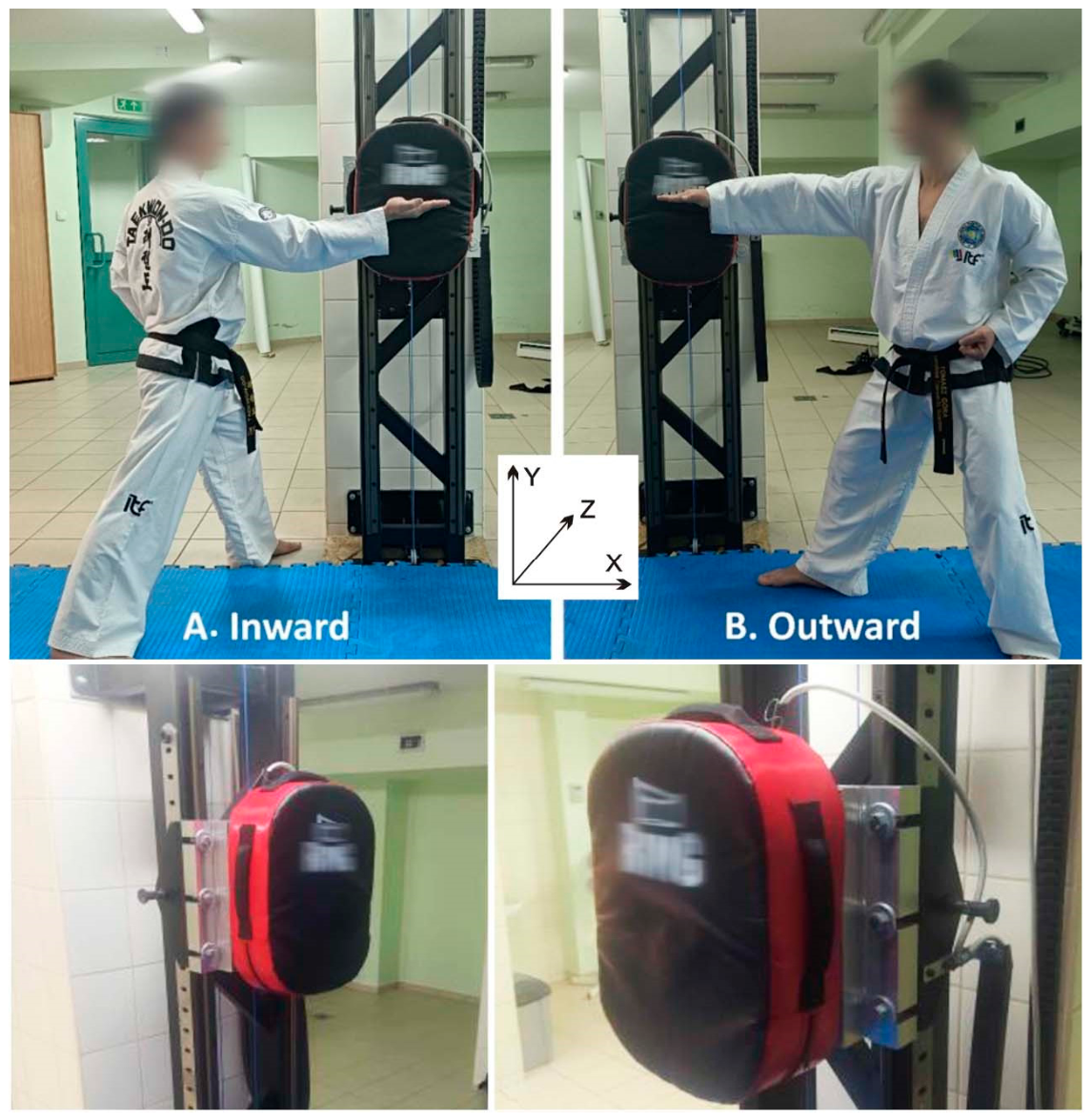
All measurements were conducted under controlled laboratory conditions using a ground reaction force platform (AMTI, model MC12-2K, Series 2000, Watertown, MA, USA) mounted on a rigid base (
Figure 1). To ensure participant safety and reduce the risk of hand injury during repeated maximal-effort strikes, the force plate was covered with a typical striking pad commonly used in combat sports training. The same pad configuration was used across all testing conditions to ensure measurement consistency. All strikes were delivered directly to the force platform through a typical combat sports striking pad, without the use of any additional suspended target. The distance between the participant and the platform was individually standardized according to the typical execution distance used in ITF taekwon-do practice. In accordance with ITF taekwon-do technical principles, the
sonkal taerigi technique should be executed approximately perpendicular to the target surface to maximize effective force transfer. Therefore, all strikes were performed by highly experienced practitioners under instructor supervision to minimize variability in impact angle. The platform (305 × 406 × 79 mm) recorded ground reaction force components along three orthogonal axes (Fx, Fy, Fz), with maximum measurement ranges of 4500 N for the horizontal axes (Fx, Fy) and 9000 N for the vertical axis (Fz). Data were sampled at 750 Hz and synchronized using Noraxon software (MR3, version 3.18, Scottsdale, AZ, USA). The sampling frequency of 750 Hz was selected in accordance with the technical capabilities of the synchronized AMTI–Noraxon acquisition system and was considered sufficient for reliable analysis of the investigated force-time variables. Given the observed contact durations (~0.028–0.030 s), each contact phase consisted of approximately 21–23 sampled data points, allowing stable identification of peak force and impulse characteristics.
Participants performed knife-hand strikes (
sonkal taerigi) in two movement directions, outward (
sonkal yop taerigi) and inward (
sonkal anuro taerigi), using the right and left hand (
Figure 1). The outward strike was performed by moving the arm away from the body’s midline, whereas the inward strike was directed toward the body’s center line. All techniques were executed according to standard ITF taekwon-do technical principles under instructor supervision.
Before testing, all participants completed a standardized warm-up consisting of general mobility exercises, dynamic upper-limb movements, and submaximal practice strikes. Rest intervals of approximately 1 min between trials and 3 min between movement conditions were provided to minimize fatigue effects.
Each participant performed three trials for every condition (hand × direction). The use of three trials represented a compromise between obtaining stable measurements and minimizing fatigue associated with repeated maximal-effort striking tasks. The order of movement directions and limb-side conditions was randomized individually for each participant using a simple randomized sequence in order to minimize potential fatigue and learning effects. Standardized rest intervals were provided between trials to minimize the effects of fatigue. Force signals were processed using custom-developed procedures. The resultant force (F) was calculated as the vector sum of the three orthogonal components (Fx, Fy, Fz). The onset of contact was defined as the instant when the resultant force exceeded 20 N, representing a balance between sensitivity and noise reduction. The selected threshold represented a compromise between sensitivity to initial contact detection and reduction in signal noise. Additionally, a sensitivity analysis was performed using alternative contact detection thresholds of 10 N, 30 N, and 50 N in order to evaluate the robustness of contact-time-dependent variables. Similar threshold ranges are commonly applied in force-platform analyses to ensure stable identification of contact events and force-time characteristics. This threshold is consistent with commonly applied criteria in ground reaction force analysis, where values between 10 and 50 N are used to ensure reliable detection of contact events while minimizing signal artifacts [
18,
19]. The end of contact was identified as the point following the main force peak at which the signal dropped below the same threshold. Only the main phase of the strike was included in further analysis.
For each trial, the following variables were calculated: peak resultant force (F), relative force (Fr, expressed in N·kg−1), contact time (t), and impulse (J). Relative force was defined as resultant force normalized to body mass (Fr = F/m). Impulse was calculated as the time integral of the resultant force over the contact phase (from threshold crossing to the end of contact). To reduce within-subject variability, mean values from three trials were calculated for each condition and used in subsequent statistical analyses.
2.3. Statistical Analysis
Statistical analyses were performed using Python (version 3.11) with computational packages including SciPy (version 1.11.4). Descriptive statistics are presented as medians and interquartile ranges (Q1–Q3) to ensure consistency across variables.
The normality of data distribution was assessed using the Shapiro–Wilk test. Relative force (Fr) met the assumption of normality, whereas the remaining variables (resultant force (F), contact time (t), and impulse (J)) showed significant deviations from a normal distribution.
Given the repeated-measures design, paired statistical tests were applied to compare movement direction (inward vs. outward) and limb side (right vs. left). For the normally distributed variable (Fr), paired t-tests were used. For variables that violated the assumption of normality (F, t, and J), the Wilcoxon signed-rank test was applied.
Effect sizes were calculated to quantify the magnitude of differences. Cohen’s d was reported for t-tests, whereas the effect size r was calculated for Wilcoxon tests. Effect sizes were interpreted as small (d = 0.20; r = 0.10), moderate (d = 0.50; r = 0.30), and large (d = 0.80; r = 0.50), with values above 1.20 for d considered very large.
The effects of movement direction and limb side were analyzed using planned pairwise repeated-measures comparisons. This analytical approach was selected due to the exploratory character of the study, the relatively small sample size, and violations of normality assumptions observed for several variables. Consequently, the results allow comparative interpretation between conditions but do not permit formal inference regarding independent or interaction effects between factors.
Due to the small sample size and violations of normality assumptions, a full factorial repeated-measures analysis was not applied.
An a priori sample size estimation was conducted using G*Power (version 3.1; Heinrich Heine University Düsseldorf, Düsseldorf, Germany). Assuming a large effect size (f = 0.40), a significance level (α = 0.05), and statistical power (1 − β = 0.80), the required sample size was 12 participants. The final sample size (N = 15) exceeded this requirement.
To assess the repeatability of measurements across the three trials, intraclass correlation coefficients (ICC) and coefficients of variation (CV) were calculated for the main analyzed variables. ICC values were interpreted as indicators of relative reliability, whereas CV values were used to evaluate within-subject variability across repeated measurements.
All statistical tests were two-tailed, and the level of statistical significance was set at α = 0.05.
3. Results
3.1. Repeatability of Measurements
The repeatability analysis demonstrated high to very high reliability of the measured variables across the three trials. The obtained ICC values were 0.944 for resultant force (F), 0.978 for relative force (Fr), 0.839 for contact time (t), and 0.950 for impulse (J). The corresponding coefficients of variation (CV) were 9.28%, 9.28%, 8.90%, and 12.43%, respectively, indicating acceptable within-subject variability and good measurement stability. The sensitivity analysis demonstrated that the general pattern of differences between movement conditions remained stable across the tested threshold range (10 N, 20 N, 30 N, and 50 N). Lower thresholds resulted in longer calculated contact times and slightly higher impulse values due to greater sensitivity to low-amplitude signal fluctuations at the beginning and end of the contact phase. Across the analyzed trials, the 10 N threshold produced contact times approximately 20–35% longer than the 20 N threshold, whereas the 50 N threshold reduced contact time by approximately 5–15%. Impulse values remained relatively stable, generally varying within approximately 3–10% across thresholds. Importantly, the relative relationships between experimental conditions and the overall interpretation of the findings remained unchanged.
3.2. Effect of Movement Direction
A statistically significant effect of movement direction was observed across all analyzed variables (
Table 1). Inward strikes produced higher resultant force (F), relative force (Fr), impulse (J), and slightly longer contact time (t) compared to outward strikes. These differences were significant in all pairwise comparisons (all
p ≤ 0.001) and were associated with large to very large effect sizes.
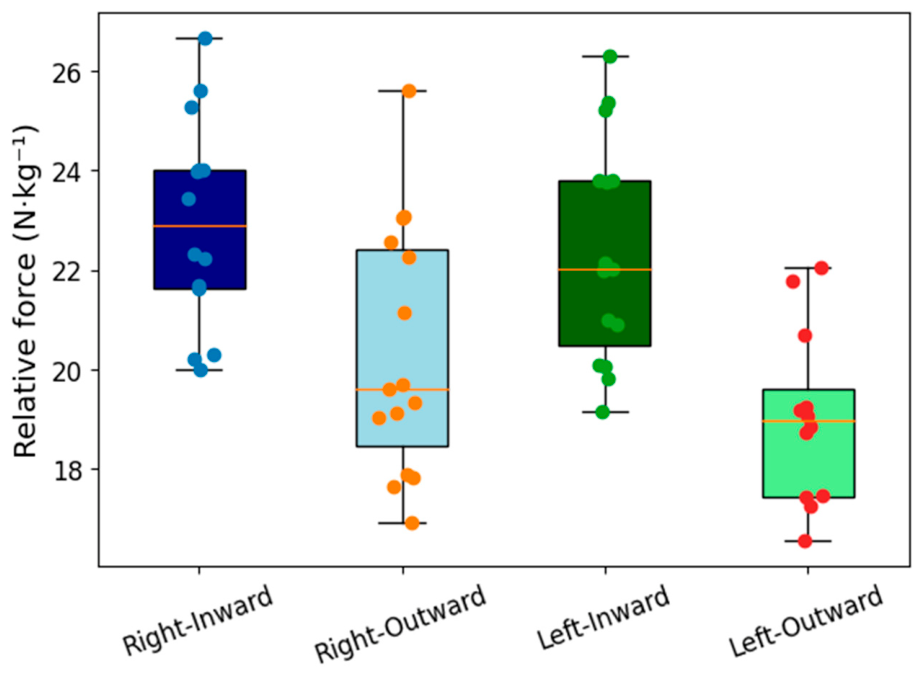
The distribution of relative force (Fr) across movement directions is presented in
Figure 2. Inward strikes consistently produced higher Fr values than outward strikes for both limbs. The separation of medians and interquartile ranges indicates a clear and systematic effect of movement direction across participants.
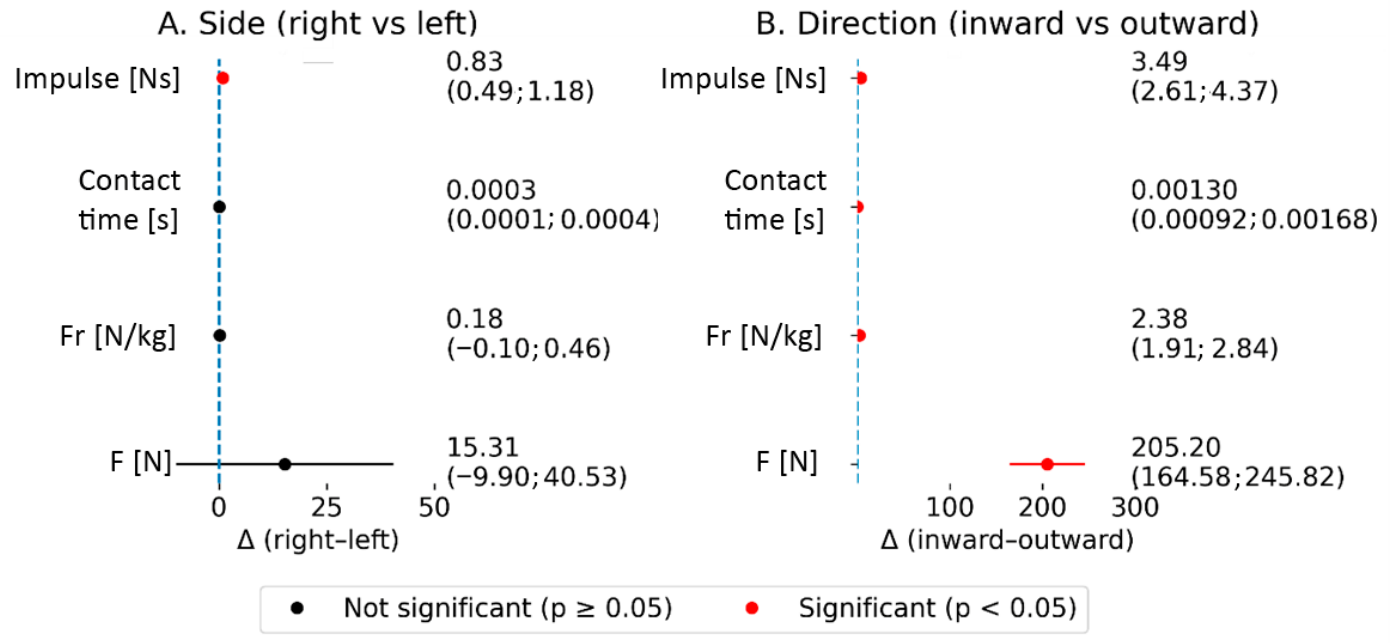
Further insight is provided by the analysis of mean differences with 95% confidence intervals (
Figure 3B). Inward strikes resulted in higher values of resultant force: Δ = 205.20 N, 95% CI: (164.58; 245.82), relative force: Δ = 2.38 N·kg
−1, 95% CI: (1.91; 2.84), contact time: Δ = 0.00130 s, 95% CI: (0.00092; 0.00168), and impulse: Δ = 3.49 Ns, 95% CI: (2.61; 4.37). In all cases, confidence intervals did not include zero, confirming the robustness of the observed effects.
3.3. Effect of Limb Side
The effect of limb side is summarized in
Table 1. No significant differences were observed between the right and left sides for force-related variables (F and Fr;
p > 0.05), indicating similar force production between the right and left sides.
Contact time showed a non-significant trend toward asymmetry (p = 0.076).
Impulse was the only variable that differed significantly between sides (p = 0.031), with a moderate effect size, indicating slightly higher values for the right limb.
The comparison of mean differences (
Figure 3A) supports these findings. Impulse showed a significant difference, Δ = 0.83 Ns, 95% CI: (0.49; 1.18), whereas the remaining variables—resultant force: Δ = 15.31 N, 95% CI: (−9.90; 40.53), relative force: Δ = 0.18 N·kg
−1, 95% CI: (−0.10; 0.46), and contact time: Δ = 0.0003 s, 95% CI: (−0.0001; 0.0004)—showed confidence intervals overlapping zero, indicating trivial or negligible effects.
3.4. Summary of Effects
Overall, the results indicate statistically significant differences between movement directions across all analyzed biomechanical variables. In contrast, the effect of limb side was limited and variable, reaching statistical significance only for impulse. The consistency of the movement direction effect across participants, combined with generally symmetrical performance between limbs, indicates that movement direction is the primary determinant of striking effectiveness under the tested conditions.
4. Discussion
The present study comparatively evaluated biomechanical differences associated with movement direction (inward vs. outward) and limb side (right vs. left hand) during the execution of the sonkal taerigi technique in ITF taekwon-do.
The findings generally support the initial hypotheses and indicate that movement direction appears to be the primary determinant of biomechanical effectiveness, whereas the influence of limb side is limited. Because the factors were analyzed using pairwise comparisons, the results should be interpreted as descriptive and do not permit inference regarding independent or interaction effects.
A key finding of this study is the clear advantage of inward strikes, which produced higher values of resultant force, relative force, impulse, and slightly longer contact time compared to outward strikes. These differences were consistent across participants and associated with large to very large effect sizes, indicating statistically significant differences associated with movement direction. The magnitude of these effect sizes may have been partially influenced by the high repeatability of measurements and the relatively low within-subject variability observed across repeated trials. This supports the existence of a direction-dependent pattern of force production and suggests that inward movements provide more favorable mechanical conditions for force generation and transmission [
20].
From a biomechanical perspective, this advantage may be partially explained by differences in joint configuration, moment arm length, and muscle function. Inward movements may potentially facilitate more effective torque production and allow muscles to operate closer to favorable regions of the force–length relationship; however, these proposed mechanisms remain hypothetical and require verification using combined kinematic and electromyographic analyses.
Additionally, these movements may occur under more stable joint conditions, supporting more efficient force transfer along the kinetic chain [
19]. However, due to the lack of kinematic and electromyographic data, these explanations remain indirect and require verification through integrative analyses combining motion capture and muscle activation measurements [
18].
The results also highlight the importance of impulse as a key indicator of striking effectiveness. Unlike peak force alone, impulse reflects both the magnitude of force and its duration, providing a more comprehensive representation of performance in ballistic movements [
6,
8]. The consistently higher impulse values observed in inward strikes further support its functional relevance. The absolute force values observed in the present study were generally comparable to the range of impact forces reported in previous combat sports biomechanics research involving manual striking techniques [
2,
5]. However, direct comparisons should be interpreted cautiously due to methodological differences related to measurement systems, target configuration, athlete characteristics, and strike type. In contrast, the effect of limb side was limited. No significant differences were observed between the right and left sides for force-related variables, indicating generally similar force-time characteristics between the right and left sides among experienced practitioners. At the same time, impulse demonstrated a statistically significant asymmetry, with slightly higher values observed on the right side, suggesting subtle differences in temporal coordination and force application rather than maximal force capacity [
11].
Although contact time differed significantly between movement directions, the absolute magnitude of this difference (~0.001 s) was very small. Therefore, despite statistical significance, its practical relevance appears negligible. This finding highlights the importance of interpreting statistical outcomes in the context of functional significance.
The present findings may be interpreted in light of previous research emphasizing the importance of intersegmental coordination and proximal-to-distal sequencing in ballistic movements [
19]. However, because previous studies primarily investigated lower-limb techniques, caution is required when extrapolating these mechanisms to upper-limb striking actions.
5. Limitations and Future Directions
Several limitations of the present study should be acknowledged. First, the relatively small sample size and the inclusion of only experienced male athletes limit the generalizability of the findings to other populations, including females and less experienced practitioners.
Second, the lack of kinematic and neuromuscular (e.g., electromyographic) measurements restricts the ability to directly verify the biomechanical mechanisms underlying the observed inter-limb differences between movement directions. Consequently, the proposed explanations regarding coordination patterns and muscle involvement remain indirect. The present study did not include a formal assessment of handedness or functional laterality. Therefore, the findings should be interpreted in relation to anatomical side (right vs. left) rather than limb dominance.
Third, although the experimental protocol was conducted under controlled laboratory conditions, it does not fully reflect real combat situations. In actual performance contexts, factors such as interaction with an opponent, time constraints, perceptual demands, and tactical variability may significantly influence movement execution and outcomes, as shown in studies comparing training and competition conditions [
21].
An additional limitation concerns the experimental setup used for force measurement. Although the force platform enabled reliable comparative assessment of resultant force-time characteristics, the use of a typical combat sports striking pad may have introduced a certain degree of damping and temporal smoothing of the impact signal. Furthermore, the applied sampling frequency (750 Hz), while sufficient for comparative analyses, may not fully capture the microdynamics of very-short-duration impact peaks. Therefore, the reported force values should be interpreted primarily in a comparative rather than absolute impact context.
Future research should adopt integrative approaches combining kinetic, kinematic, and electromyographic analyses to provide a more comprehensive understanding of striking mechanics. Including participants of different skill levels and both sexes would improve the external validity of the findings. Additionally, longitudinal and intervention-based studies are warranted to determine whether targeted training can enhance movement efficiency, improve force transmission, and reduce inter-limb asymmetries. Future investigations should also employ factorial or mixed-model analytical frameworks to enable direct assessment of independent and interaction effects between movement direction and limb laterality.
6. Practical Implications
The present findings provide important practical insights for training processes and performance optimization in taekwon-do.
First, movement direction should be considered a key determinant of striking effectiveness. The consistently higher force and impulse values observed in inward strikes indicate more favorable mechanical conditions for force generation and transmission. Therefore, inward strikes may provide potentially more favorable mechanical conditions for impact generation under the tested experimental conditions. However, these practical implications should be interpreted cautiously and require further verification in more ecologically valid performance settings.
Second, the lower biomechanical outputs observed in outward strikes highlight the need for targeted training interventions aimed at improving coordination and the efficiency of force transmission in this movement pattern. The present findings may support the inclusion of exercises focused on technical refinement, intersegmental coordination, and strength development in mechanically less advantageous movement directions.
Third, although movement direction was the dominant factor, the observed inter-limb differences were limited and mainly related to impulse. This suggests a relatively high level of symmetry in force production, while emphasizing the importance of bilateral training and monitoring subtle asymmetries, particularly in dynamic performance parameters.
Fourth, despite statistically significant differences in contact time, their absolute magnitude was small and of limited practical relevance. Consequently, training strategies should focus primarily on force-related parameters and their integration rather than attempting to modify contact time.
Finally, impulse appears to be a particularly useful indicator of performance, as it integrates both force magnitude and duration. Monitoring impulse may provide a more comprehensive assessment of striking effectiveness and serve as a sensitive marker of training adaptations over time.
In summary, the present findings provide preliminary biomechanical information that may be useful in the development of training strategies emphasizing movement direction, bilateral development, and dynamic performance indicators.
7. Conclusions
Movement direction appeared to exert a stronger influence on the analyzed biomechanical variables than anatomical side during the execution of the sonkal taerigi technique under the tested experimental conditions. Inward strikes consistently produced higher values of resultant force, relative force, and impulse compared with outward strikes, whereas differences between the right and left sides were generally limited.
The findings also indicate that impulse may represent a sensitive indicator of striking performance, integrating both force magnitude and contact duration. However, due to the exploratory analytical approach, the relatively small and homogeneous sample, and the limitations of the experimental setup, the present findings should be interpreted cautiously.
Future studies integrating kinetic, kinematic, and electromyographic analyses, as well as factorial or mixed-model statistical approaches, are needed to better understand the mechanisms underlying striking performance and potential interaction effects between movement direction and limb side.