Skip to Content
  • 3.9
    Impact Factor
  • 8.3
    CiteScore
  • 17 days
    Submission to First Decision
  • 4 days
    Acceptance to Publication

Energies

Energies is a peer-reviewed, open access journal of related scientific research, technology development, engineering policy and management studies related to the general field of energy (from technologies of energy supply, conversion, dispatch and final use to the physical and chemical processes behind such technologies), and is published semimonthly online by MDPI. The European Biomass Industry Association (EUBIA), Association of European Renewable Energy Research Centres (EUREC), Institute of Energy and Fuel Processing Technology (ITPE), International Society for Porous Media (InterPore), CYTED and others are affiliated with Energies and their members receive discounts on the article processing charges.

Get Alerted

Add your email address to receive forthcoming issues of this journal.

All Articles (64,914)

  • Article
  • Open Access

User-level electric vehicle (EV) charging records are valuable for vehicle-charger–grid studies, but raw longitudinal records are difficult to share because they may reveal mobility routines, charging preferences, station-use habits, and commercially sensitive network operation. Public EV charging datasets more often provide session-, station-, transaction-, or aggregate-level information. These data support load forecasting and station-utilization analysis, but they are less suited to studies that require traceable user-level charging-session sequences. This paper proposes a temporal–spatial load-consistent model for generating synthetic user-level EV charging sessions. The model first constructs uncalibrated simulated charging-session sets from vehicle attributes, user preferences, state of charge (SOC), charging power, and location choice. These charging sessions are aggregated into a temporal–spatial load matrix and calibrated by an entropy-regularized bi-marginal projection so that the generated charging sessions reduce deviations from the targets with minimum distortion of the pre-calibration structure. The calibrated matrix is then mapped back to individual charging sessions through a charging-session-level feedback operator, followed by physically constrained session allocation. A Shanghai electric-taxi case study compares temporal and spatial consistency with an MC baseline and a statistical generator and further evaluates behavioral fidelity, sensitivity to target uncertainty, and computational efficiency. Relative to the MC baseline, temporal RMSE decreased from 2423.79 kWh to 1082.08 kWh, and spatial WMAPE decreased from 0.07028 to 0.02351, while the largest energy-weighted Jensen–Shannon divergence, observed for final SOC, was 0.00652. The resulting synthetic charging-session set provides traceable inputs for charging-load simulation, infrastructure planning, distribution-network assessment, and vehicle–grid integration studies under data-sharing constraints.

Energies

16 October 2026
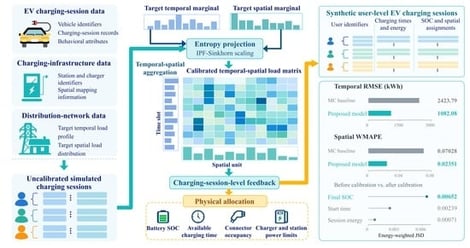
Framework of the proposed user-level EV charging-session generation and calibration model.
  • Article
  • Open Access

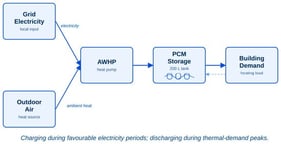
Heat pumps are increasingly used for low-temperature heating applications. But their operation can create electricity demand peaks during periods of high thermal load. This paper presents a concept and calculation study for integrating phase change materials (PCMs) with air-to-water heat pump (AWHP) systems as a condenser-side thermal buffer for residential buildings. The analyzed retrofit-oriented storage unit is a 200 L tank containing 30% PCM by volume, corresponding to 60 L of paraffin PCM and 140 L of water. The sizing calculation gives 3.08 kWh of PCM thermal storage, 0.81 kWh of sensible storage in the remaining water over the 55–60 °C interval, and almost 3.89 kWh of total short-term thermal reserve for the PCM-plus-water tank. A 200 L water tank over the same 5 °C interval would store approximately 1.16 kWh. At the nominal 14 kW heat pump output, the PCM buffer corresponds to about 13.2 min of operation. At representative part load it corresponds to about 53 min at 25% load and 26 min at 50% load. The PCM sizing model predicts storage capacity, buffer time and possible cycling relevance, but it does not by itself predict a seasonal COP increase. Therefore, annual electricity and economic effects are evaluated only as COP-uplift sensitivity cases, including 0%, 3%, 4%, 5%, 8%, 15% and 28.6%. Given the assumptions in this study, the PCM add-on reaches positive net present value at approximately 11% COP uplift when the initial marginal investment and discounted year 10 replacement cost are considered. Approximately 14.1% is reached if the replacement cost is added upfront as a simplified lifecycle basis. The results indicate that the condenser-side PCM buffer may be technically useful for short-term thermal buffering and possible on-off cycle reduction, but its annual energy and economic benefit requires dynamic simulation or experimental validation. Moreover, peak-demand reduction, demand shifting and renewable electricity utilization are discussed as potential applications of the buffer concept.

Energies

16 October 2026

Schematic representation of the AWHP coupled with a condenser PCM storage tank.
  • Article
  • Open Access

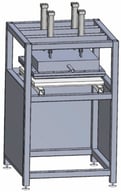
To address the temperature non-uniformity of heating platens in small-scale photovoltaic (PV) module laminators, this study develops a wire-wound hot platen with a Square loop layout and arithmetic-progression wire spacing. The heating wires are represented by an equivalent surface-heat-flux boundary, and CFD simulations are used to evaluate the effects of wiring layout, wire length, and spacing on the temperature field. The optimized Square loop layout reduces the full-field working-surface-temperature standard deviation from 1.887 °C to 0.552 °C, a reduction of 70.8%. A FLUENT-UDF incremental PID model is then developed using the top-surface area-weighted average temperature as feedback. At the 4800 s endpoint, the simulated controlled average is 150.55 °C, with a steady-state error of +0.55 °C and a maximum positive deviation of approximately 0.96 °C at approximately 4480 s; the holding-stage response shows a small limit-cycle oscillation of approximately ±1 °C. The local center-point temperature T1 is 153.0 °C, indicating a center-to-edge spatial non-uniformity that is distinct from the controller overshoot. A small-scale laminator platform with 13 thermocouples was used to benchmark the simulated platen-level temperature field. The measured 13-point average temperature is 150.55 °C, the maximum temperature difference is 3.0 °C, and the 13-point sample standard deviation is 1.05 °C; the maximum absolute error and mean absolute error are 1.30 °C and 0.913 °C, respectively. These results support the proposed surface-heat-flux model and incremental PID design for small laminator hot platens under the tested platen-level conditions.

Energies

16 October 2026

Overall structural drawing of photovoltaic module laminator.
  • Review
  • Open Access

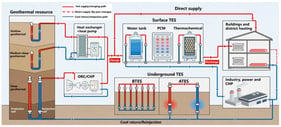
Temporal mismatches between geothermal output and user demand limit resource utilization, whereas thermal energy storage (TES) can decouple heat production from consumption. This review organizes geothermal–TES coupling by resource depth and answers four engineering questions. First, temperature, duration, geology, and end-use requirements determine compatibility: water tanks and low-temperature phase-change materials are preferred for short-term regulation; BTES and ATES provide seasonal capacity where geology permits; and pressurized-water, molten-salt, or thermochemical systems are reserved for higher-temperature resources. Second, short-term TES primarily suppresses cycling and peak demand, whereas seasonal TES restores annual subsurface balance and raises geothermal-well utilization. Third, selection must jointly consider recovery efficiency, usable discharge temperature, auxiliary electricity, land and drilling requirements, technology readiness level, and cost rather than storage density alone. Fourth, coupling introduces constraints that are absent from stand-alone components, including groundwater advection, thermal breakthrough, corrosion and scaling, well-flow limits, and temperature matching. Nordic experience demonstrates the value of integrating underground TES with district heating and cooling, but economic feasibility remains site specific. Indicative storage-capacity costs are approximately 0.1–1.3 EUR/kWhth for ATES, 0.6–3 EUR/kWhth for BTES, and 0.5–1.7 EUR/kWhth for PTES, with strong scale and boundary dependence. A compatibility matrix, maturity assessment, and staged development roadmap are provided to support system selection and research prioritization.

Energies

16 October 2026

Conceptual framework and heat-flow pathways for geothermal energy coupled with TES. The geothermal-resource column includes open-loop hydrothermal production–reinjection systems and closed-loop ground or downhole heat exchangers; both can connect to surface TES and underground TES through charging, direct-supply, discharging, and reinjection pathways.

Featured Articles of Last Quarter

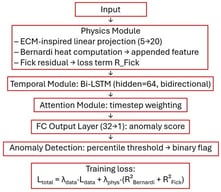
Flowchart of the PINN framework architecture.

Highly Accessed Articles

News & Conferences

Latest Issues

Open for Submission

Journal Sections

Advances in Coal Mine Disaster Prevention Technology
Reprint

Advances in Coal Mine Disaster Prevention Technology

Editors: Xuelong Li, Jia Lin, Zhibo Zhang, Baolin Li
XFacebookLinkedIn
Energies - ISSN 1996-1073