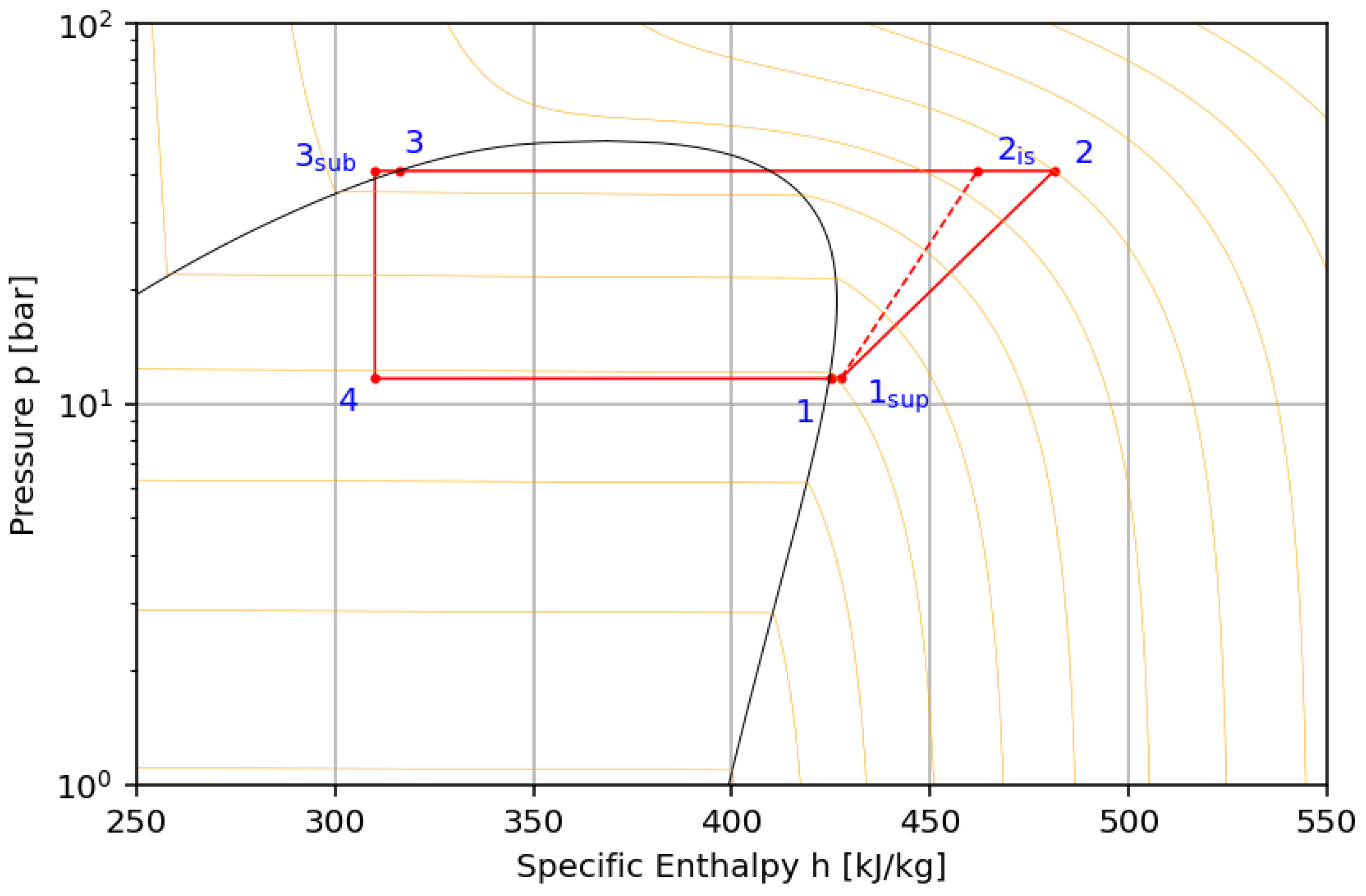
Detailed manufacturer data from five different geothermal heat pumps in a series is available for the real reference variables of the model [
19]. Demand heat output, electrical compressor power, and heat power of the source and the resulting COP in various operating states were provided. The operating states differ in source temperature T
S = [−5, −2, 0, 2, 5, 7, 10, 15] °C and demand temperature T
F = [30, 35, 40, 45, 50, 55, 62] °C. Data were available for this temperature range, covering an operating range in which heat pumps are commonly used in buildings. The data are available for every combination of temperatures (with the exception of −5 to 62 °C), resulting in 55 operating states per heat pump. The heat output supplied ranges from 46 to 209 kW. The COP varies between 2.25 and 7.93. The number of operating states and the range of data appear to provide a good database. This database was chosen because the data are freely accessible and provide a basis that significantly exceeds the energy consumption labeling requirements under Regulation (EU) No. 813/2013. The heat pumps tested in accordance with this regulation and EN 14511 have four operating points with a COP for air-to-water heat pumps and two operating points for water-to-water heat pumps. The methodology presented can also be applied here, but this does not appear to be useful due to the small number of data points and the resulting insufficient representation of temperature dependencies. Formulas (2)–(9) presented later are exclusively dependent on the refrigerant and are, therefore, readily transferable. Only Formulas (10)–(13) are heat pump-specific and are parameterized by input and output power. This makes the methodology transferable, even if the RMSE results have to be checked individually.
In addition to the known data, assumptions must be made for the temperature differences in the condenser and evaporator, the superheating and subcooling temperatures, and the efficiency of the condenser and evaporator. For this purpose, typical temperature differences within the usual ranges for water–water heat pumps have been assumed [
21,
22,
23,
24]. An overview of the modeling parameters can be seen in
Table 2. Technical losses in the components are neglected here. The pressure losses in the cycle depend, among other things, on the choice of refrigerant and the ambient temperature, and can reduce the COP by up to 5% [
25]. These losses are already implicitly accounted for in the data but are not explicitly modeled here. Since the input and output data are measured values, it seems sufficient to offset the corresponding losses in the cycle process instead of assigning them to individual components or process steps. The influence on the unmeasured modeling results is addressed in
Section 5. In the available datasets, the sum of compressor power and heat power of the source corresponded to the heat pump power, which is why these efficiencies are not modeled within the cycle and are assumed to be 1. The isentropic compressor efficiency represents a difference to this and must, of course, be modeled.
Further modeling is based on being able to solve potential tasks for optimization with variable supply or flow temperatures TS/TF for the given parameter heat demand QD. Therefore, all functions should be limited to dependencies on these two variables.
3.1. Reference Model and Model Derivation
Firstly, the temperatures T
3 and T
3sub can be calculated using the demand temperature T
F, temperature difference in the condenser ΔT
con, and subcooling temperature T
sub.
The now known temperature T
3 provides the upper pressure level, which is assumed to be the same at states 3, 3
sub, and 2. The pressure level is determined using the CoolProp substance data model for the refrigerant R410A [
20]. These data models correspond to nonlinear functions, which are characterized by f
NL. f
NL does not indicate a specific function but only shows that an arbitrary nonlinear calculation is performed for a state variable.
The enthalpies h
3, h
3sub, and h
4 result from the nonlinear functions of temperature and pressure. Since state 3 is located exactly on the boiling line, the enthalpy can be determined here without the associated pressure or other state variables. A calculation from temperature and pressure is just as possible. In state 3
sub, both state variables are necessary. The enthalpy h
4 is calculated because the change in state in the expansion valve is described as an isenthalpic pressure reduction in the cycle.
The calculation for the temperature T
1 and T
1sup is similar to before. The temperature T
4 corresponds to temperature T
1, as the changes in state between these two states take place entirely in the wet vapor region.
The lower pressure level for p
1, p
1sup, and p
4 results from temperature T
1.
As before, the enthalpies h
1 and h
1sup can also be determined by nonlinear functions of temperature or temperature and pressure.
The state variables temperature, pressure, and enthalpy are determined for all states, with the exception of state 2. The entropies for all states can be calculated using two of these variables, in this case, pressure and enthalpy. The index i here indicates any state from 1 to 4, as the calculation is always identical.
Using the upper pressure level and the entropy s
1sup, the theoretical isentropic enthalpy s
2is can be calculated. This is necessary in order to be able to calculate the isentropic compressor efficiency later.
Up to this point, the entire refrigerant cycle can be described on the basis of two temperatures and the assumption of certain temperature differences. The state variables that are not on the dew or boiling line can only be determined unambiguously with two other state variables. However, one of these is always a known temperature, and the other can be determined in advance using only the temperatures.
There are two ways to determine the missing state variables in state 2. The first is to determine the state changes caused by the compressor starting from state 1
sup. The second option is to calculate back from state 3 or 3
sub via the change in state in the condenser. In both cases, an efficiency must be assumed or known. This is feasible in the reference model, as the heat supplied via the evaporator and the enthalpy change are known. Since this method offsets the modeling of losses within the cycle, but the isentropic compressor efficiency is part of the research question, the second approach is chosen. Before h
2 can be determined, however, the refrigerant mass flow must be calculated. This is obtained by dividing the heat flow from the environment by the enthalpy change in the evaporator, while taking into account the evaporator efficiency η
ev.
The enthalpy upstream of the condenser inlet h
2 can then be determined using the mass flow and the heat flow on the demand side.
The enthalpy and the upper pressure level can be used to determine the missing state variables in state 2.
The isentropic compressor efficiency can be calculated by comparing the real and theoretical isentropic enthalpy change in the compressor.
Six models are derived from the reference model:
Model 1: Nonlinear functions, exact values from process calculation for compressor efficiency.
Model 2: Linearized functions, exact values from process calculation for compressor efficiency.
Model 3: Nonlinear functions, function calculation for compressor efficiency.
Model 4: Linearized functions, function calculation for compressor efficiency.
Model 5: Nonlinear functions, constant compressor efficiency.
Model 6: Linearized functions, constant compressor efficiency.
These models differ from the reference model in that they only assume the heat output of the heat pump Q
D as known, but not the resulting input variables Q
S and P
el. The models shown differ with regard to the calculation of the system variables (nonlinear and linearized) and the determination of the compressor efficiency (reference model values, determination with a function or a constant value). An overview can be seen in
Table 3. Models 1 and 2 use the real efficiency of the reference model. Models 3 and 4 are based on a function for the isentropic compressor efficiency, which is presented later and can be linear or nonlinear. Models 5 and 6 assume a constant compressor efficiency. The models with odd numbers (1, 3, and 5) describe the other system variables nonlinearly, while the models with even numbers (2, 4, and 6) are based on linearized functions.
3.2. Nonlinear Modeling of State Variables
Models 1, 3, and 5 calculate the state variables, if necessary, using nonlinear functions via the CoolProp library [
20]. The difference between these models is in the calculations of the compressor efficiency. The calculations in Formulas (2)–(9) are accordingly the same in these models as the calculation of the reference model. However, without knowing the heat power of the source, no refrigerant mass flow and, therefore, no enthalpy for state 2 can be derived in this way. The calculation is, therefore, based on the change in state in the compressor. For this purpose, a compressor efficiency is calculated or assumed using various methods, which is presented in
Section 3.3. This allows the enthalpy h
2 to be determined.
The temperature T
2 and entropy s
2 can then be determined as in Equation (12). The mass flow now results from the enthalpy changes in the condenser and the heat output Q
D.
The mass flow can be used to calculate the heat power of the source Q
S and the compressor power P
el. It should be noted that the overall technical compressor efficiency is not included in this equation. The isentropic compressor efficiency is calculated by the real entropy h
2, and the focus of this work is on the cyclic process and the comparison of the state variables. In practice, a technical efficiency would be added, and an overall efficiency would be formed.
3.3. Linearized Modeling of State Variables
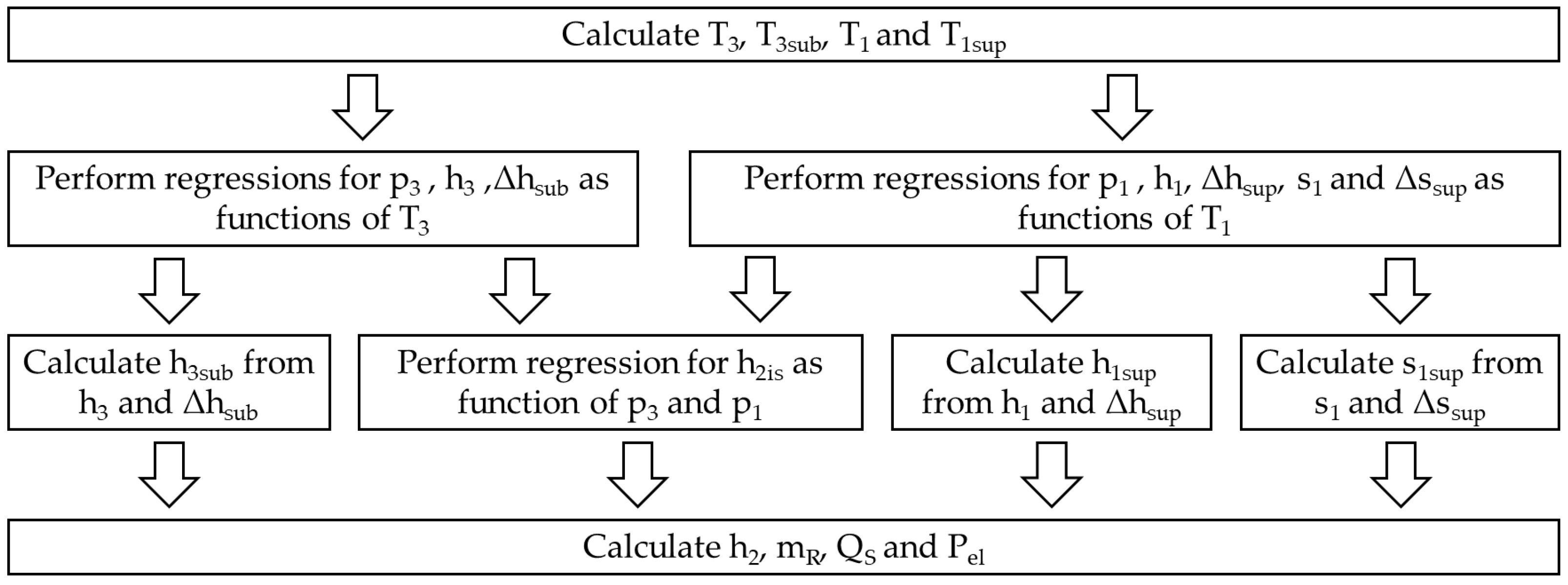
The sequence of calculations and regressions and how they build on each other is shown in
Figure 2. For models 2, 4, and 6, the temperatures T
3 and T
3sub are calculated as in Equation (2). Then, regressions for functions (3), (4), (6)–(9) have been carried out for the specified temperature ranges of T
S (−5 to 15 °C) and T
F (30 to 62 °C) in steps of 1 °C. This means that one data point corresponds to one integer temperature and the associated function value in the value range. The functions can also be applied to temperatures outside this range, but they have not been parameterized for these values, and it is then a matter of extrapolation or a wider regression. In order to avoid distorting the regressions by conditions that lie outside the valid operating range of the heat pumps, this range was kept as narrow as possible. For the following linear regressions, the coefficient of determination R
2 is listed next to all equations and shows the correlation with the nonlinear functions based on substance data models. Starting from the basic linear equation f(x) = ax + b, the following Equations (17)–(27) in
Table 4 result.
The upper pressure level and enthalpy h3 can be calculated from the temperature T3. The enthalpy change from state 3 to 3sub, resulting from the subcooling, must then be calculated. Equation (19) has been set up for this purpose, which, starting from a temperature level of T3, indicates how large the enthalpy change is per temperature change. The result of this equation multiplied by the subcooling temperature Tsub is added to the enthalpy h3 to calculate the enthalpy h3sub (20). Δhsub, Δhsup, and Δssup describe the rate of change in enthalpy or entropy per change in temperature during subcooling or superheating at a given temperature level.
The temperatures T
1, T
1sup, and T
4 can be determined as in (5). The lower pressure level and enthalpy h
1 are calculated analogously to Equations (17) and (18). The same procedure is used for the enthalpy difference for superheating in state 1
sup. Not all entropies are relevant for the further calculations, which is why only the entropies relevant for the calculation of the compressor efficiency s
1 and s
1sup are determined. These are calculated in the same way as the enthalpy in Equations (23) and (24). The enthalpy h
2is the result of an initial level in state 1
sup and an isentropic compression. It was, therefore, decided to model it as a function of the two variables p
1 and p
3 rather than a single variable. This equation, with the associated coefficient of determination, can be seen in (28). By substituting p
1 and p
3 with Equations (17) and (21), h
2is can also be described as a function of the input variables.
The enthalpy h2, mass flow, heat power of the source, and the compressor power are calculated according to Formulas (14)–(16).
3.4. Approaches for Compressor Efficiency
The previous modeling and calculation of the state variables are, with the exception of the assumption of efficiency, independent of the actual heat pump used. The influence of the efficiency of the evaporator and condenser is estimated to be rather low and was, therefore, assumed to be constant. In [
26], the effects of heat exchanger effectiveness have been investigated, with the result that, with an effectiveness range of 0.84 to 0.96, the COP changes by only a maximum of 0.07. This assumption is not fully transferable to the heat pumps in question, but it does provide an indication of the order of magnitude of the deviations. For this reason, and due to the fact that no data are available on the temperature dependence of the individual components, and modeling this would go beyond the scope of this work, constant efficiencies are assumed here. This assumption is not feasible for the compressor efficiency.
3.4.1. Calculated Compressor Efficiency
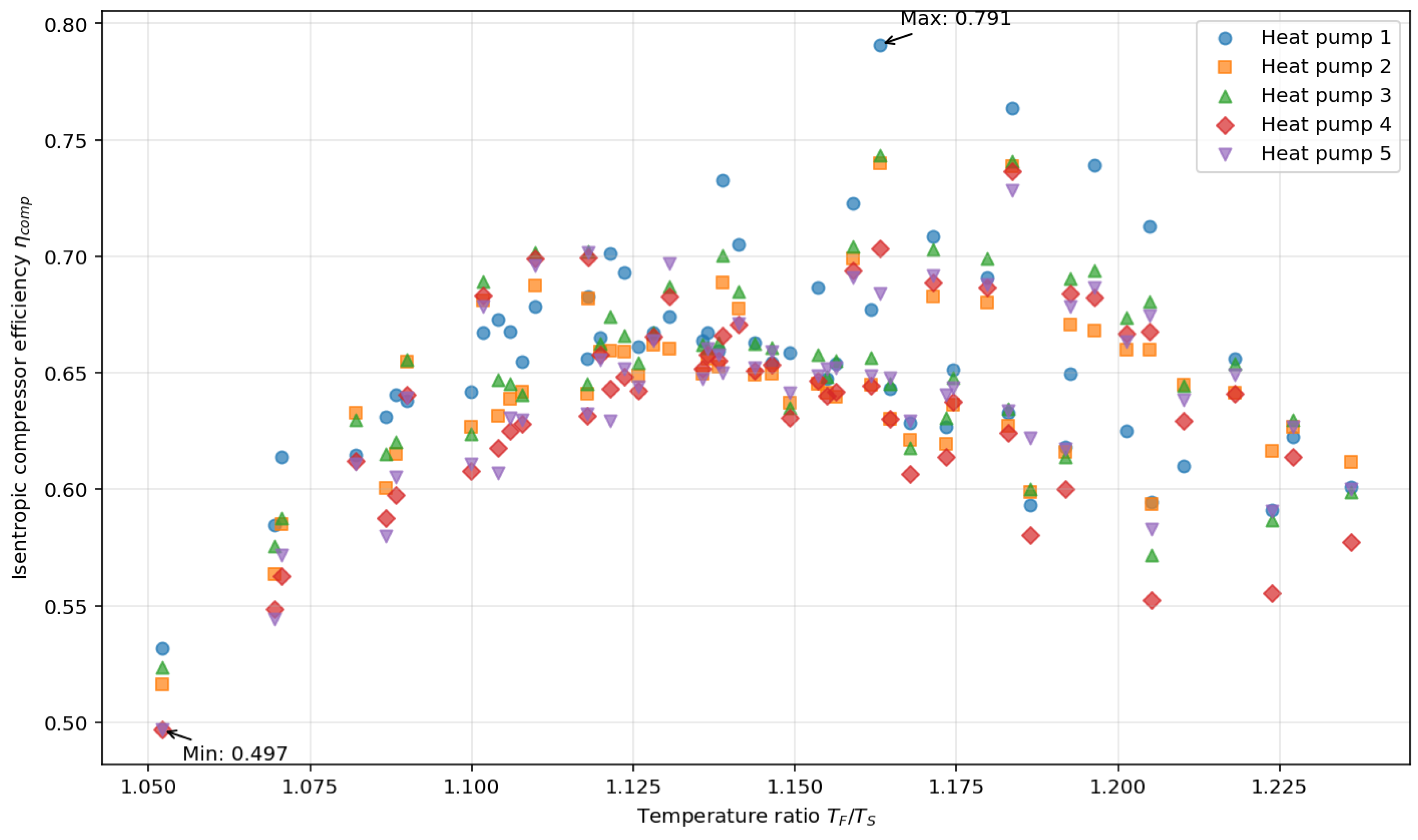
In order to analyze the influence of the nonlinear and linearized calculation of the state variables and data of the model without further assumptions and inaccuracies, the previously calculated, correct compressor efficiency can be used. The isentropic compressor efficiency determined from the reference model was, therefore, used for models 1 and 2. These values range from 0.497 to 0.791.
3.4.2. Function for the Compressor Efficiency
The compressor efficiency in a heat pump cycle process is influenced by several factors. These include, for example, the compression ratio, intake pressure and temperature, refrigerant overheating, and the mechanical behavior of the compressor, such as speed control and partial load behavior [
27]. No specific key figures are known about the mechanical behavior and technical modeling of individual components, so this is not part of this work. It is, therefore, examined whether the compressor efficiency can be modeled as a dependent variable of the input variables. The other state variables, pressure, enthalpy, and entropy, were also analyzed with regard to their predictive power of η
comp, but they did not show a stronger correlation, which is why they are not listed separately. It is assumed that this is due to the fact that these variables were also determined on the basis of the temperatures. However, this is not mathematically proven in the context of this work.
Table 5 presents several options for modeling compressor efficiency of the five heat pumps (HP1 to HP5) as a dependent variable using regression. T
S and T
F are included in the regression either individually as variables or as a subtraction or division of these variables. Regressions were performed with first and second-degree polynomials, and the coefficient of determination was analyzed.
All first-degree regressions have a coefficient of determination that has hardly any explanatory power. The second-degree polynomial with T
F/T
S as the independent variable has the best value, which is why this calculation is used for the compressor efficiency in the following, even if the R
2 values between 0.385 and 0.560 only offer limited predictive power.
Figure 3 shows the isentropic compressor efficiency of all heat pumps in dependency of the temperature ratio, which has the highest coefficient of determination.
The trend in the data points also clearly shows why first-degree polynomials have such low explanatory power. Both a bell-shaped curve and a large scatter of points can be seen, which makes regression challenging. The extent to which this inaccuracy also affects the accuracy of the modeling results is shown in
Section 4.
3.4.3. Constant Compressor Efficiency
A common approach is to assume a constant compressor efficiency. For this reason, a constant value per heat pump is assumed in models 5 and 6. This efficiency results from the mean value of all compressor efficiencies in the operating states. Each heat pump has its own value. The values are very close to each other, ranging from 0.637 to 0.658. The RMSE is between 0.036 and 0.045.