Article

A Large Eddy Simulation-Based Power Forecast Approach for Offshore Wind Farms

by
Yongjie Lu
1,
Tasnim Zaman
2,
Bin Ma
1,
Marina Astitha
2 and
Georgios Matheou
1,*
1
School of Mechanical, Aerospace, and Manufacturing Engineering, University of Connecticut, Storrs, CT 06269, USA
2
School of Civil and Environmental Engineering, University of Connecticut, Storrs, CT 06269, USA
*
Author to whom correspondence should be addressed.
Energies 2025, 18(24), 6386; https://doi.org/10.3390/en18246386
Submission received: 8 October 2025 / Revised: 19 November 2025 / Accepted: 28 November 2025 / Published: 5 December 2025

Abstract

Reliable power forecasts are essential for the grid integration of offshore wind. This work presents a physics-based forecasting framework that couples mesoscale numerical weather prediction with large-eddy simulation (LES) and an actuator-disk turbine representation to predict farm-scale flows and power under realistic atmospheric conditions. Mean meteorological profiles from the Weather Research and Forecasting model drive a concurrent–precursor LES generating turbulent inflow consistent with the evolving boundary layer, while a main LES resolves turbulence and wake formation within the wind farm. The LES configuration and turbine-forcing implementation are validated against canonical single- and multi-turbine benchmarks, showing close agreement in wake deficits and recovery trends. The framework is then demonstrated for the South Fork Wind project (12 turbines, ∼132 MW) using a set of time-varying cases over a 24 h period. Simulations reproduce hub-height wind variability, row-to-row power differences associated with wake interactions, and turbine-level power fluctuations (order 1 MW) that converge with appropriate averaging windows. The results illustrate how an LES-augmented hierarchical modeling system can complement conventional forecasting by providing physically interpretable flow fields and power estimates at operational scales.

1. Introduction

Offshore wind energy is becoming a cornerstone of the global renewable-energy transition because of its environmental benefits, including negligible operational carbon emissions and significant growth potential [1,2]. Compared with onshore sites, offshore wind resources have greater wind-power density and are more consistent. However, the power-generation potential hinges on fluid dynamics across scales, ranging from turbine-level wake interactions to farm–atmosphere interactions, including atmospheric boundary-layer stability and mesoscale effects.
Wind-generated power forecasting is central to the successful integration of wind energy into modern power systems. Because wind is variable, accurate forecasts of power output are essential for maintaining grid stability, ensuring reliable electricity supply, and reducing reliance on costly reserves. System operators use forecasts across multiple horizons: from minutes ahead to schedule balancing reserves, to hours and days ahead for market bidding and unit commitment, and up to weeks or longer for maintenance planning and resource adequacy [2,3,4,5]. For wind-farm developers and operators, forecasting improves economic performance by enabling more accurate energy trading, reducing imbalance penalties, and supporting efficient turbine operation and control. Widespread adoption of wind power depends on high-quality forecasting, which underpins reliability, market participation, and cost-efficient operation.
Wind-power forecasting methods are generally grouped into four main categories, organized by time horizon and data availability. Persistence models are the simplest, assuming that future wind conditions will remain similar to the present; they provide useful short-horizon baselines but quickly lose accuracy as lead time increases [3]. Statistical and machine-learning approaches (e.g., autoregressive integrated moving average and deep-learning architectures such as long short-term memory networks and transformers) learn relationships between historical data and future output [4]. These methods can be effective for short-term horizons (minutes to hours) when high-resolution data are available [2,6]. Physical models, based on numerical weather prediction (NWP), simulate atmospheric processes at regional to global scales and form the backbone of day-ahead to medium-range forecasts; when downscaled or bias-corrected, they can provide site-specific predictions [4]. Probabilistic frameworks provide forecasts with calibrated uncertainty ranges [5], and hybrid approaches combine physical forecasts with statistical or machine-learning post-processing [3].
Physical modeling approaches—especially large eddy simulation (LES)—offer distinct advantages for wind-power forecasting because they resolve turbulent atmospheric flow within the wind farm, which determines turbine performance. Unlike purely statistical or data-driven methods, LES captures the evolution of turbulent eddies and their interactions with wind-farm structures, providing high-fidelity, physics-based representations of wake formation, wake recovery, and turbulence intensity across turbines [7,8,9,10,11,12,13,14,15,16]. This capability is particularly important offshore, where complex stability regimes, low-level jets, and mesoscale variability strongly influence energy production [17]. As a benchmark for parameterized NWP forecasts, LES provides higher-fidelity wake fields across stability regimes, highlighting biases in mesoscale wind-farm parameterizations that can propagate into power errors [18]. With growing computational resources and more efficient numerical techniques, LES is becoming a feasible complement to traditional forecasting pipelines, offering a pathway to more accurate, physics-based power predictions at scales relevant to wind-farm operation and grid integration [19,20].
A physics-based power-forecasting method was developed in this study using LES modeling. Two key challenges were addressed: (a) modeling flow in the wind farm under realistic meteorological conditions and (b) coupling the LES model to an NWP model. Many prior studies have performed LES of wind-farm flows under idealized conditions (e.g., neutrally stratified atmospheres) without accounting for buoyancy stratification [7,8,9,10]. To capture realistic operating conditions, the dynamics of the real atmosphere must be faithfully represented. Likewise, prior NWP-based modeling with the Weather Research and Forecasting (WRF) model [21] does not explicitly resolve turbulence within the wind farm, including turbine–wake interactions [22,23,24,25,26], which can significantly affect power output.
A hierarchical modeling system is introduced to simulate wind-farm-scale flows and power generation driven by weather-forecast inputs. The approach is applied to the South Fork Wind project—the first commercial-scale offshore wind farm in the United States—comprising 12 turbines. The modeling system is demonstrated through mock power forecasts based on observed conditions, and the variability of wind-generated power is examined.

2. Methodology

2.1. Hierarchical Modeling System

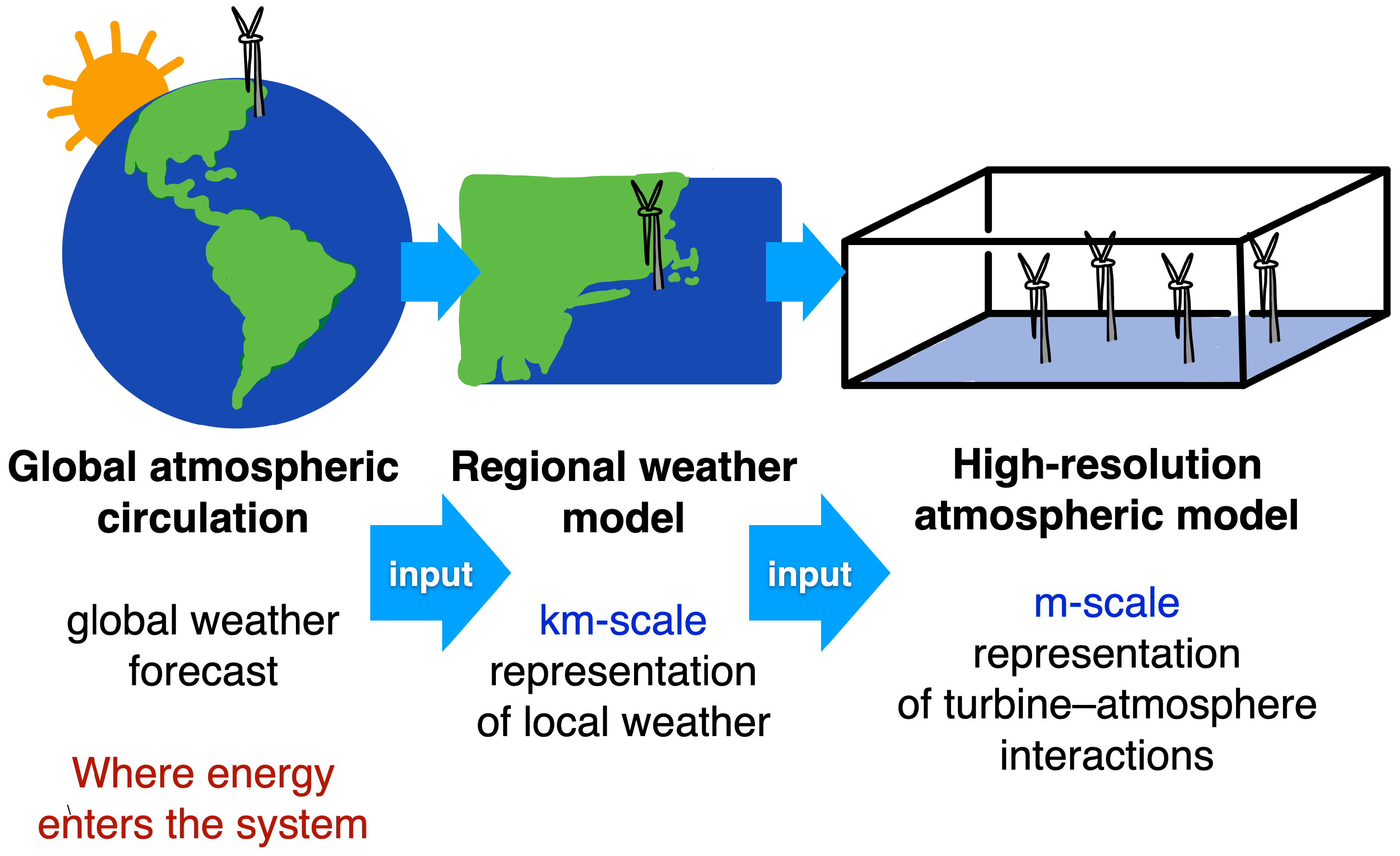
A hierarchical modeling system was developed to forecast wind-generated power. The goal of the modeling hierarchy is to utilize forecasted meteorological conditions at the wind-farm location. Figure 1 shows a schematic of the model hierarchy and the interactions between the different models. Long-range (1–2 weeks) weather predictions are based on global models, which not only represent the atmosphere but also include coupled ocean, land, and sea-ice components. The grid spacing of the global models is limited by available computational resources, resulting in relatively coarse horizontal resolutions (typically 10–100 km).
In regional weather models the horizontal resolution increases from hundreds of meters to a few kilometers. Computation is confined to a limited-area domain, and lateral boundary conditions are used to represent interactions with the larger-scale flow. Although regional models can achieve relatively high resolution for atmospheric flows, they typically rely on the Reynolds-averaged Navier–Stokes (RANS) formulation and therefore do not explicitly resolve small-scale turbulent motions; the effects of subgrid motions are included through parameterizations.
An additional model is used to capture the interaction of fine-scale atmospheric motions with the wind farm. An LES model is employed to simulate the atmospheric flow through the wind farm, including turbine–atmosphere interactions such as wake generation downstream of the rotors. In contrast to RANS, LES explicitly resolves the energetic turbulent motions down to grid scales of a few meters. As with the regional model, LES covers a limited area (typically O ( 10 2 10 4 ) km 2 horizontally) and requires boundary conditions derived from the regional model.
As shown in Figure 1, information transfer is one-way: from larger-scale models to smaller-scale models. In previous studies, the role of the global model is not always stated explicitly, but it is conceptually required as the source of large-scale energy input to the system. Overall, the hierarchy generates local meteorological conditions at the wind-farm location, including the meter-scale turbulence structure.

2.2. LES Model

The focus of the present study is the development of the LES component, with emphasis on two aspects relevant to wind-power forecasting: (a) generation of fine-scale turbulence consistent with the meteorological conditions forecast by the regional model and (b) representation of wind turbines and their power output.
The LES model of Matheou & Chung [27,28] is used. The model includes an extensive suite of atmospheric-process submodels, including moist thermodynamics, cloud microphysics, and radiation [29,30,31,32,33,34,35]. The LES numerically integrates the anelastic form of the conservation equations for mass, momentum, liquid-water potential temperature θ l , and total-water mixing ratio q t on an f-plane:
( ρ ¯ 0 u ˜ i ) x i = 0 ,
( ρ ¯ 0 u ˜ i ) t + ( ρ ¯ 0 u ˜ i u ˜ j ) x j + ( ρ ¯ 0 u ˜ i w s ) x 3 = θ 0 ρ ¯ 0 π ¯ 2 x i + δ i 3 g ρ ¯ 0 θ ˜ v θ 0 ϵ i j k ρ ¯ 0 f j ( u ˜ k u g , k ) τ i j x j + u ˜ i u i , n τ n ,
( ρ ¯ 0 θ ˜ l ) t + ( ρ ¯ 0 θ ˜ l u ˜ j ) x j + ( ρ ¯ 0 θ ˜ l w s ) x 3 = σ θ , j x j + θ ˜ l θ l , n τ n ,
( ρ ¯ 0 q ˜ t ) t + ( ρ ¯ 0 q ˜ t u ˜ j ) x j + ( ρ ¯ 0 q ˜ t w s ) x 3 = σ q , j x j + q ˜ t q t , n τ n ,
where ρ ¯ 0 ( z ) is the basic-state density, θ 0 the (constant) basic-state potential temperature, and u ˜ i the density-weighted filtered velocity components. Cartesian coordinates { x , y , z } (or { x 1 , x 2 , x 3 } ) are used. The buoyancy term includes the deviation of the virtual potential temperature θ v from its instantaneous horizontal average. The Coriolis vector is f = [ 0 , 0 , f 3 ] , and u g is the geostrophic wind. π ¯ 2 is the dynamic component of the Exner function that satisfies the anelastic constraint (1).
To account for large-scale atmospheric motion in the limited-area LES domain, a large-scale vertical velocity w s ( z ) , independent of x and y, is introduced. This subsidence term helps balance the boundary layer and suppresses unrealistic deepening in the streamwise direction. The last terms on the right-hand side of the θ l and q t equations are “nudging” terms that relax the horizontal means toward specified target profiles (e.g., u 1 , n ( t , z ) for the x component of the wind). The nudging time scale τ n controls the relaxation strength: small τ n reduces departures from the targets but can introduce excessive nonphysical forcing, whereas large τ n limits the forcing but allows larger departures. A compromise value τ n = 300 s is used here, corresponding to τ n 10 h / U , where h is the boundary-layer depth and U the mean wind speed.
Unresolved turbulence is represented by the subgrid-scale (SGS) stress tensor τ i j in the momentum equation and the SGS scalar fluxes σ in the θ l and q t equations. The buoyancy-adjusted stretched-vortex SGS model [27,28] is used.
Momentum and scalar advection are approximated with a fully conservative fourth-order centered scheme [36]. Time integration uses a third-order Runge–Kutta method [37]. A sponge layer near the model top minimizes spurious gravity-wave reflection.
Typical wind farms extend over several kilometers, making blade-resolved aerodynamics computationally prohibitive at the farm scale. To keep simulations tractable, wind-turbine parameterizations replace explicit blades with body-force representations that impose rotor forces on the numerical grid. Common formulations include the actuator-disk (ADM), actuator-line (ALM), and actuator-surface (ASM) methods. The ADM is one of the simplest and most widely used models. The ADM employs a smoothed indicator function to distribute rotor thrust (and, in some cases, torque) to nearby grid points, reproducing the aggregate momentum sink of each turbine [7,9,10,38,39,40]. Although the ALM provides higher fidelity by resolving three-dimensional effects such as blade rotation and tower shadow, it demands much finer resolution and greater computational cost for wind-farm-scale simulations [41].
In the present simulations, the ADM is used with a uniform thrust coefficient C T [7,10,42]. A smooth, normalized indicator function distributes the thrust forces. The turbine model primarily represents linear momentum extraction and does not include higher-order effects such as local rotation, radial variation along the blade, or tangential forces.

2.3. Boundary Conditions and Turbulent-Inflow Generation

The coordinate system is aligned with the prevailing wind direction; that is, the x axis is nearly aligned with the wind. The wind farm is rotated to account for the incidence angle between the wind vector and the farm orientation (see the Results section). Wind-aligned coordinates simplify the lateral boundary conditions: an inflow–outflow condition is applied in the x direction, and periodic boundary conditions are used in the transverse y direction.
The concurrent–precursor inflow method [43] is used to generate realistic turbulent inflow. The present LES adopts the implementation of Inoue et al. [30], where an additional LES domain (the “A” domain in [30]) generates turbulent inflow fields with specified mean vertical profiles. The precursor domain is concurrent and synchronized with the main LES. At each time step, fields on a vertical yz plane from the precursor LES provide the inflow to the main LES. The precursor domain is periodic in both horizontal directions. Unlike other LES approaches (e.g., [15]), the present LES uses open lateral boundaries without sponge or buffer regions. For the small domains considered here, the inflow–outflow condition performs well without numerical artifacts near the boundaries, allowing full utilization of the main LES domain.
A relaxation (nudging) method is applied in the precursor domain to impose the desired mean profiles. Consequently, the nudging terms (e.g., ( u ˜ i u i , n ) / τ n ) are present only in the precursor. For neutrally stratified validation cases (Section 2.4), a streamwise pressure gradient is used to drive the precursor flow instead of nudging. The Coriolis term is omitted in the present simulations. The main LES is free-running without artificial forcing or nudging; only the precursor is forced to generate realistic turbulent inflow. The turbine model is active only in the main domain.
The nudging profiles u i , n , θ l , n , and q t , n are derived from a WRF model v4.4 simulation [21]. Configuration details are given by Zaman et al. [44]. Profiles are horizontal averages over an area comparable to the wind-farm footprint and vary in time.
In summary, the precursor nudging method generates boundary-layer turbulence with mean profiles matching the WRF data, yielding a main LES that tracks local meteorological conditions through the inflow. Consequently, the problem is formulated as a boundary-value problem, and the initial condition is irrelevant. In practice, WRF profiles initialize both LES domains, and a two-hour spin-up allows turbulence to develop.
To help balance the boundary layer in the main domain and avoid unrealistic deepening along x, the large-scale vertical velocity w s ( t , z ) is computed consistently with the nudging profiles and applied in the subsidence terms (the third terms on the left-hand sides of Equations (2)–(4)).
Surface fluxes of momentum, θ l , and q t are estimated using Monin–Obukhov similarity theory with a constant sea-surface temperature (SST). Fluxes are computed dynamically in each surface grid cell and reflect turbine impacts on the near-surface flow. For neutrally stratified validation cases, the classical von Kármán logarithmic law is used to estimate the momentum flux. A no-penetration, no-stress boundary condition is applied at the model top.

2.4. Model Validation

The LES model, including the actuator-disk implementation, was assessed using the experiments of Chamorro and Porté-Agel [45] and the simulations of Stevens et al. [42]. The wind-tunnel experiments used small-scale turbine models with roughness height z 0 = 0.03 mm , turbine diameter D = 0.15 m , and hub height z h = 0.125 m . The thrust coefficient was C T = 0.5669 , and the local thrust coefficient was C T = 0.8248 [45]. The precursor-domain pressure gradient was adjusted to match the experimental velocity profile. For model–data comparisons, velocities were averaged over 100 flow-through times to smooth small-scale unsteadiness.
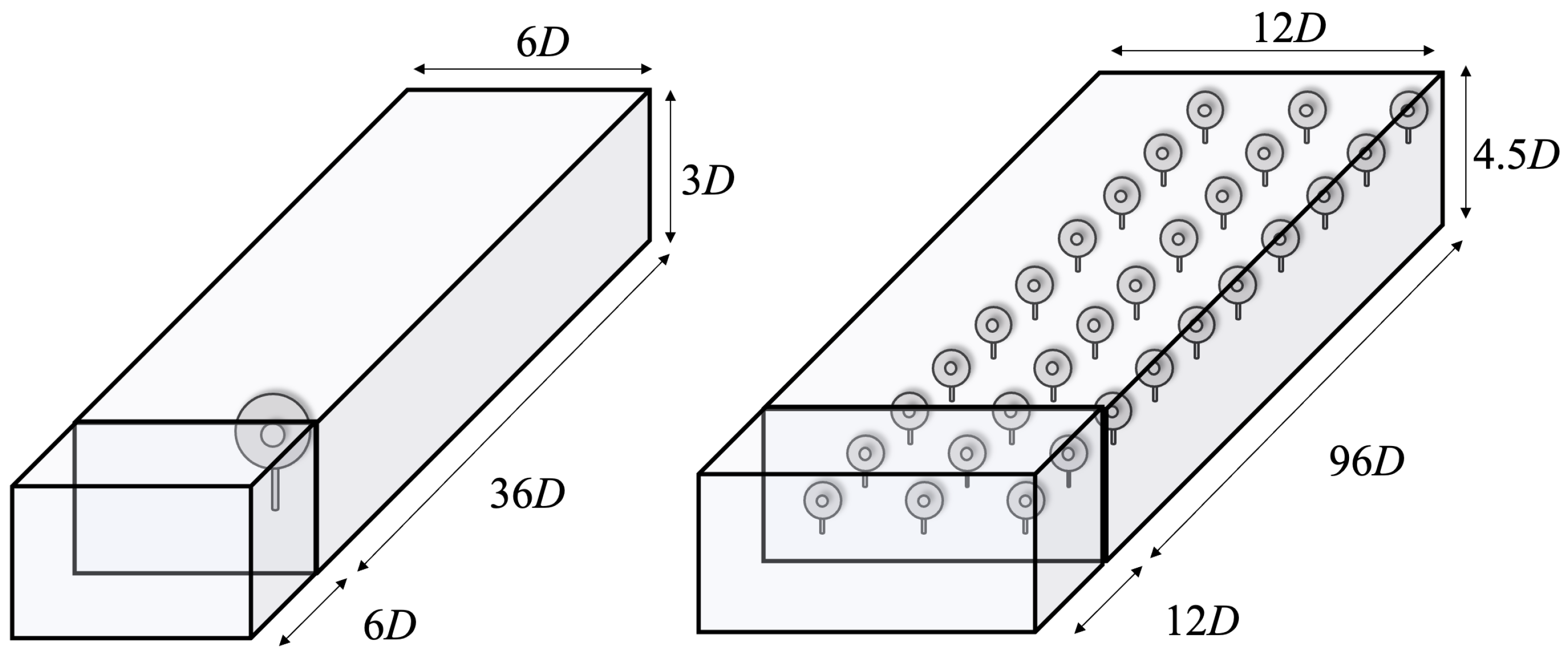
Two validation cases are considered: a single-turbine case and a multiple-turbine case [42]. The setups are shown in Figure 2. In the single-turbine configuration, the rotor is located 4.5 D from the upstream boundary of the LES domain. In the 30-turbine configuration, the first row is located 5 D from the inflow boundary, with a uniform row spacing of 5 D .

2.4.1. Single-Turbine Case

A single wind turbine is present in the main LES domain. The computational domain is 36 D × 5 D × 3 D in the streamwise, spanwise, and vertical directions. A uniform, isotropic grid of 384 × 64 × 32 cells is used, with Δ x / D = 0.09375 .
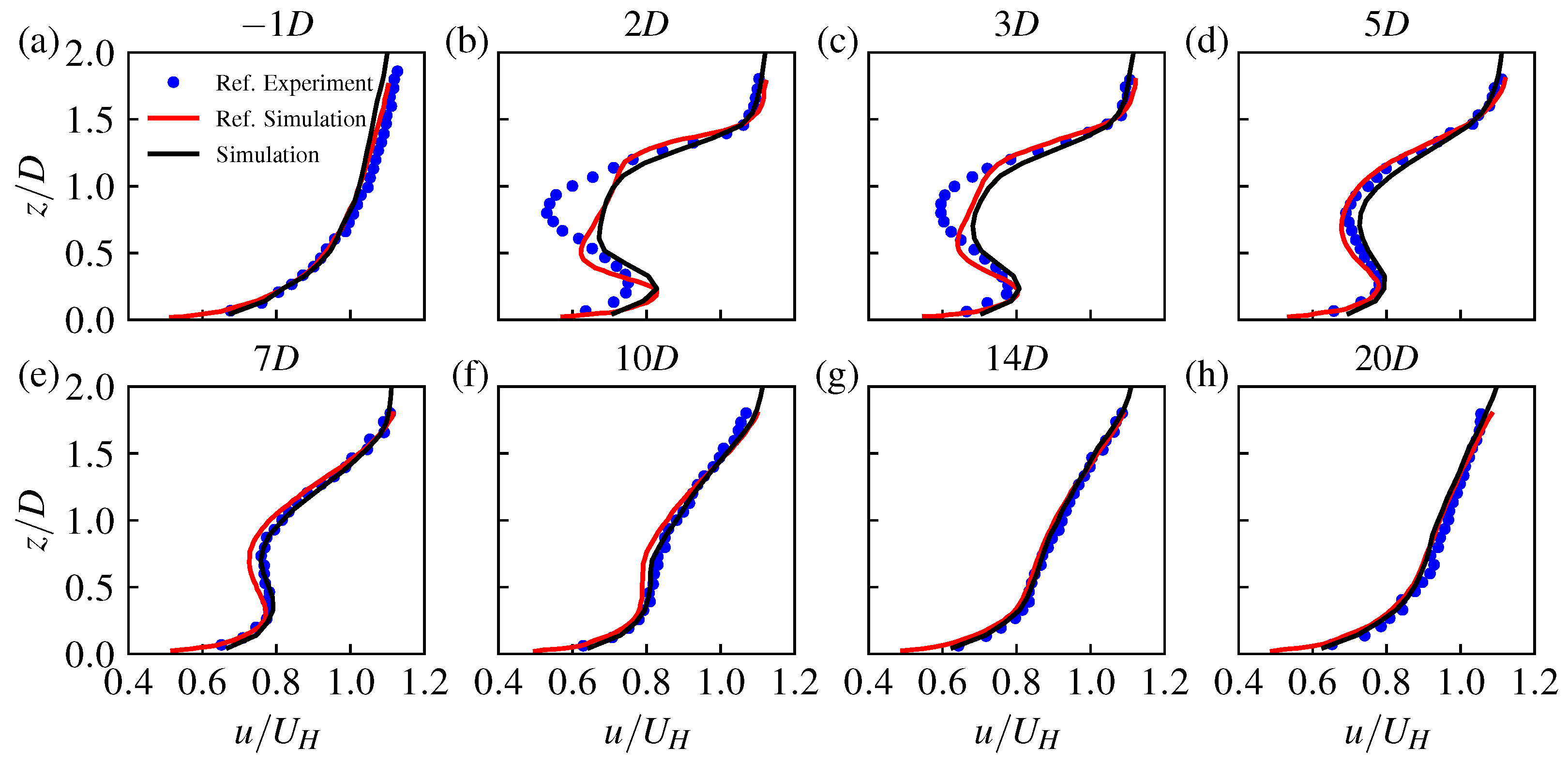
Time-averaged streamwise velocity profiles are compared with the experiment of Chamorro and Porté-Agel [45] and the simulations of Stevens et al. [42] in Figure 3. Each panel corresponds to a different streamwise position along the turbine centerline. The turbine is located at the origin of the x coordinate. Figure 3a shows x = D , i.e., the incoming profile upstream of the rotor. Velocity is normalized by the hub-height value u H , as in [45].
Figure 3 illustrates the wake effect on the mean u profile. The velocity deficit decreases, and the profile approaches the undisturbed state as x increases, although wake effects remain discernible at x = 20 D .
Overall, agreement between the present LES and the reference simulations [42] is very good. Small differences may arise from grid-spacing choices and from the use of a different SGS closure in [42]. Discrepancies close to the turbine ( x < 5 D ) relative to the experiment are expected, as the actuator-disk model does not include tower and nacelle effects. The experimental model had relatively large tower and nacelle elements compared with full-scale turbines [42,45], accentuating near-rotor deficits in the measurements.

2.4.2. Multiple-Turbine Case

The second validation case includes 30 turbines arranged in a 3 × 10 array [45]. Compared with the single-turbine case, flow complexity increases substantially due to wake–wake interactions.
The main LES domain is 96 D × 12 D × 4.5 D . The grid has 1024 × 128 × 48 cells with Δ x / D = 0.09375 . The thrust coefficient varies by turbine position; the values of C T follow [43] and are listed in Table 1.
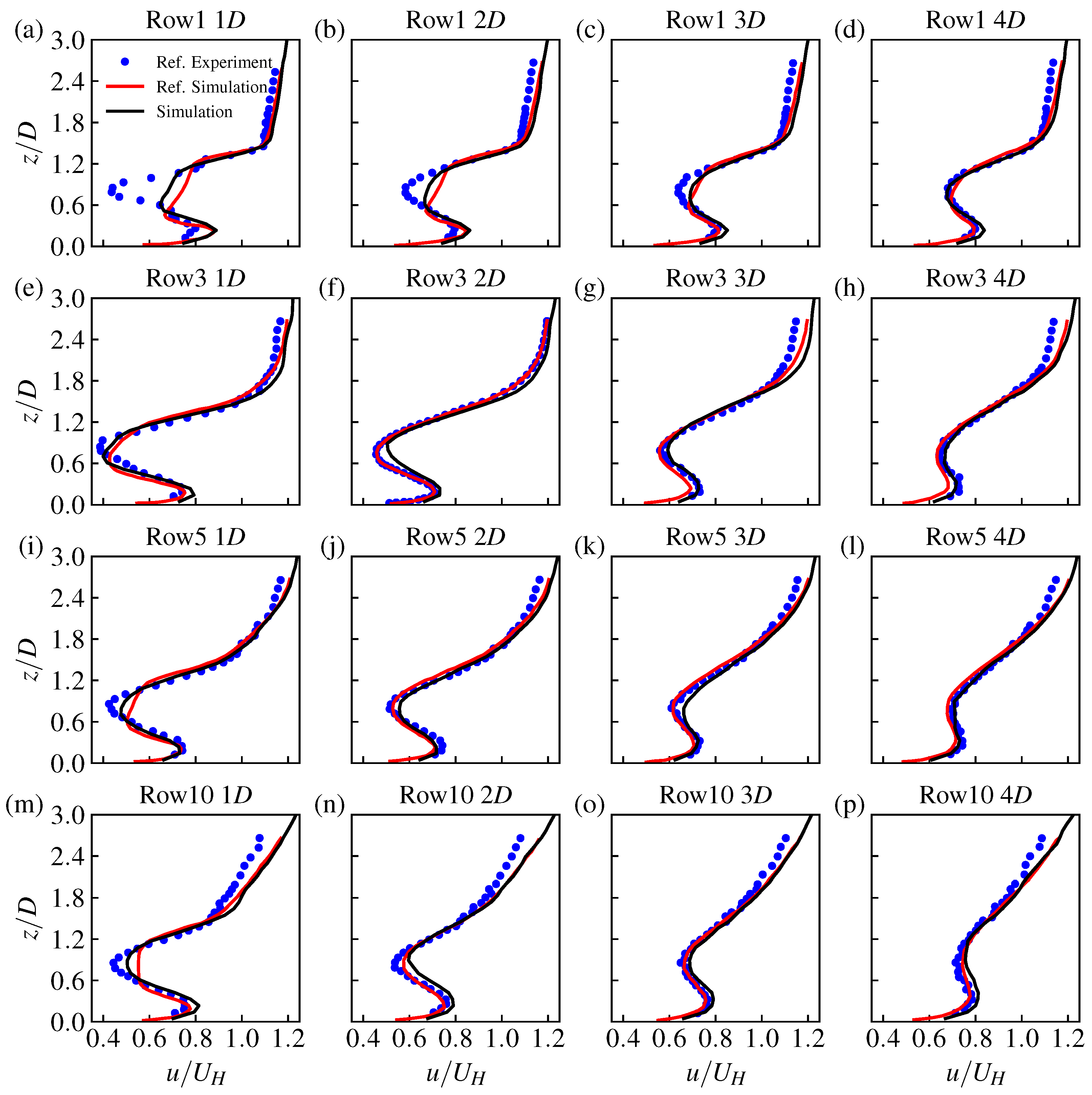
The streamwise velocity profiles for the multiple-turbine case are shown in Figure 4. As in the single-turbine comparison, agreement between the present simulations and Stevens et al. [42] is very good. Most differences occur in the near-wake region ( x < 3 D ), where both models underpredict the deficit due to the absence of tower and nacelle representations.
Overall, the single- and multiple-turbine comparisons validate the inflow-generation method and the actuator-disk implementation.

2.5. Offshore Wind-Farm Model Configuration

Regional weather modeling was conducted with WRF v4.4 over a domain of approximately 178 × 125 km 2 with 600 m horizontal resolution [44]. Output spanned 05:00 UTC (01:00 EDT) on 16 June 2020 to 05:00 UTC (01:00 EDT) on 17 June 2020, excluding the initial 12-hour spin-up. Atmospheric variables were averaged over a 20 × 20 km 2 region centered on South Fork Wind Farm ( 41 . 092 N, 71 . 311161 W) at model levels up to 2 km.
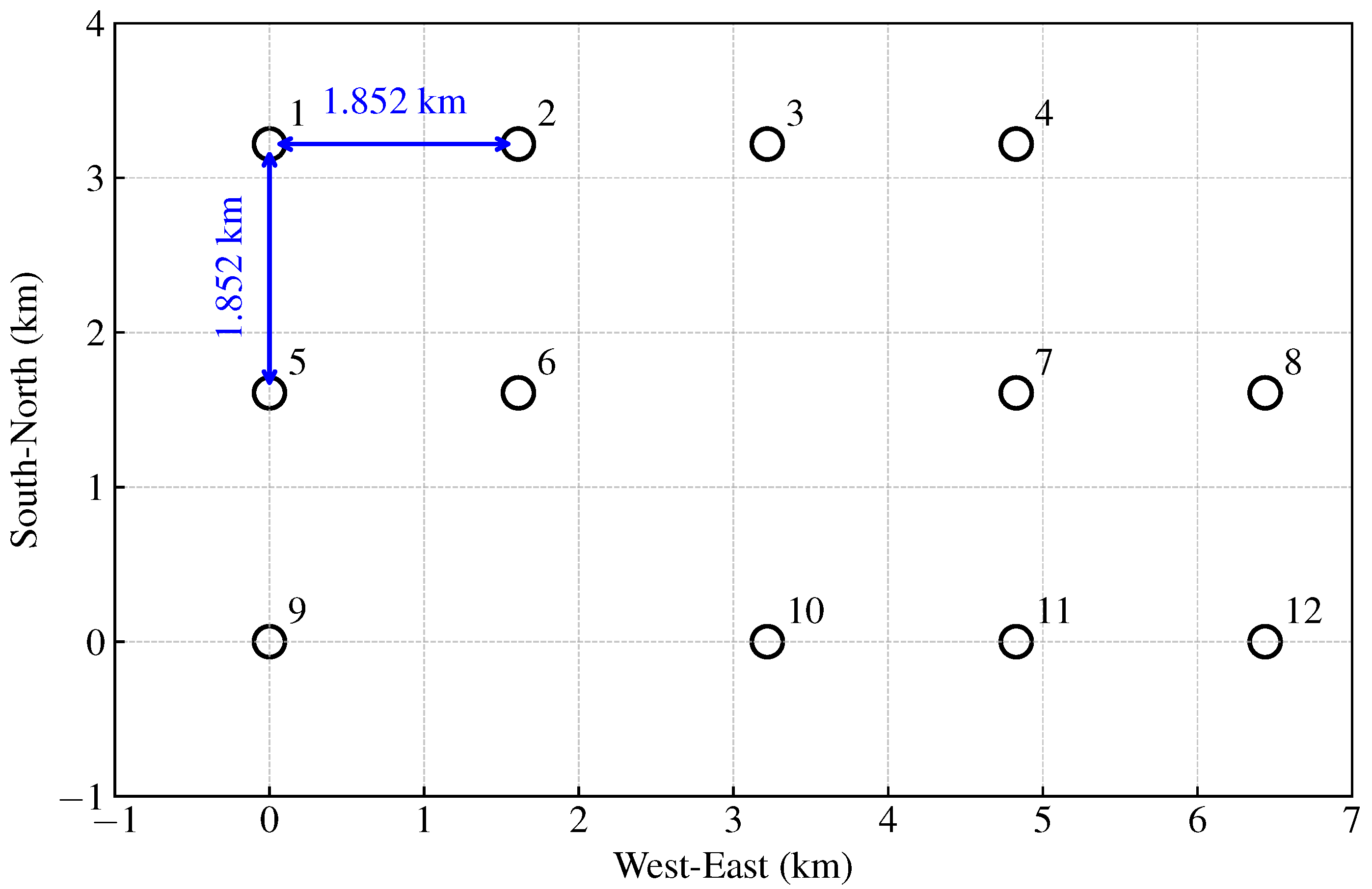
The South Fork turbine arrangement follows Figure 5. Turbines are placed on a 1 × 1 nautical-mile grid, with some locations empty due to environmental or construction constraints. The turbines are Siemens SG 11.0–200 DD with hub height 140 m and rotor diameter D = 200 m.
The main LES domain uses 1200 × 1200 × 100 grid points with Δ x = 10 m (i.e., Δ x / D = 0.05 ). Table 2 summarizes the simulation configurations. The grid is homogeneous and isotropic. The thrust coefficient of the Siemens SG 11.0–200 DD is not publicly available; following common practice, C T = 4 a ( 1 a ) and C T = C T / ( 1 a ) 2 with axial induction factor a = 1 / 4 are assumed [46], giving C T = 4 / 3 for the simulations.
Power generation for each turbine is estimated from the energy extracted from the flow [46]:
P = 1 2 C T ρ U d 3 A ,
where U d is the disk-averaged velocity, A is rotor area, and ρ is air density. With C T = 4 / 3 and a representative power coefficient C P 0.4 , the extracted power can be expressed as ( 0.2 / 0.56 ) C T ρ U d 3 A [46]. Wind turbines operate within defined cut-in and cut-off thresholds. To account for this in the power output simulation, if the disk-averaged velocity u d falls below the cut-in velocity ( 3 m s 1 ) or exceeds the cut-off velocity ( 25 m s 1 ), P is set to zero. Power is computed online in the LES for each turbine.
The Courant–Friedrichs–Lewy (CFL) number is set to 1.0 for the 10 m grid and 20 m grid, and to 1.2 for the 5 m grid, with time step Δ t in the range 0.4–1.0 s. For the 20 m grid, the simulation completed in 3 h of wall-clock time using 504 CPU cores. For the 10 m grid, it took 72 h using 240 CPU cores. The 5 m grid (16× more expensive) required 120 h using 600 cores. d t / d t CPU is estimated for each resolution in Table 2, where d t is the LES time step and d t C P U is the CPU time step. For 20 m grid run, the ratio is around 1, indicating the potential of quasi-real-time modeling in future applications.

3. Results

3.1. Inflow Profiles

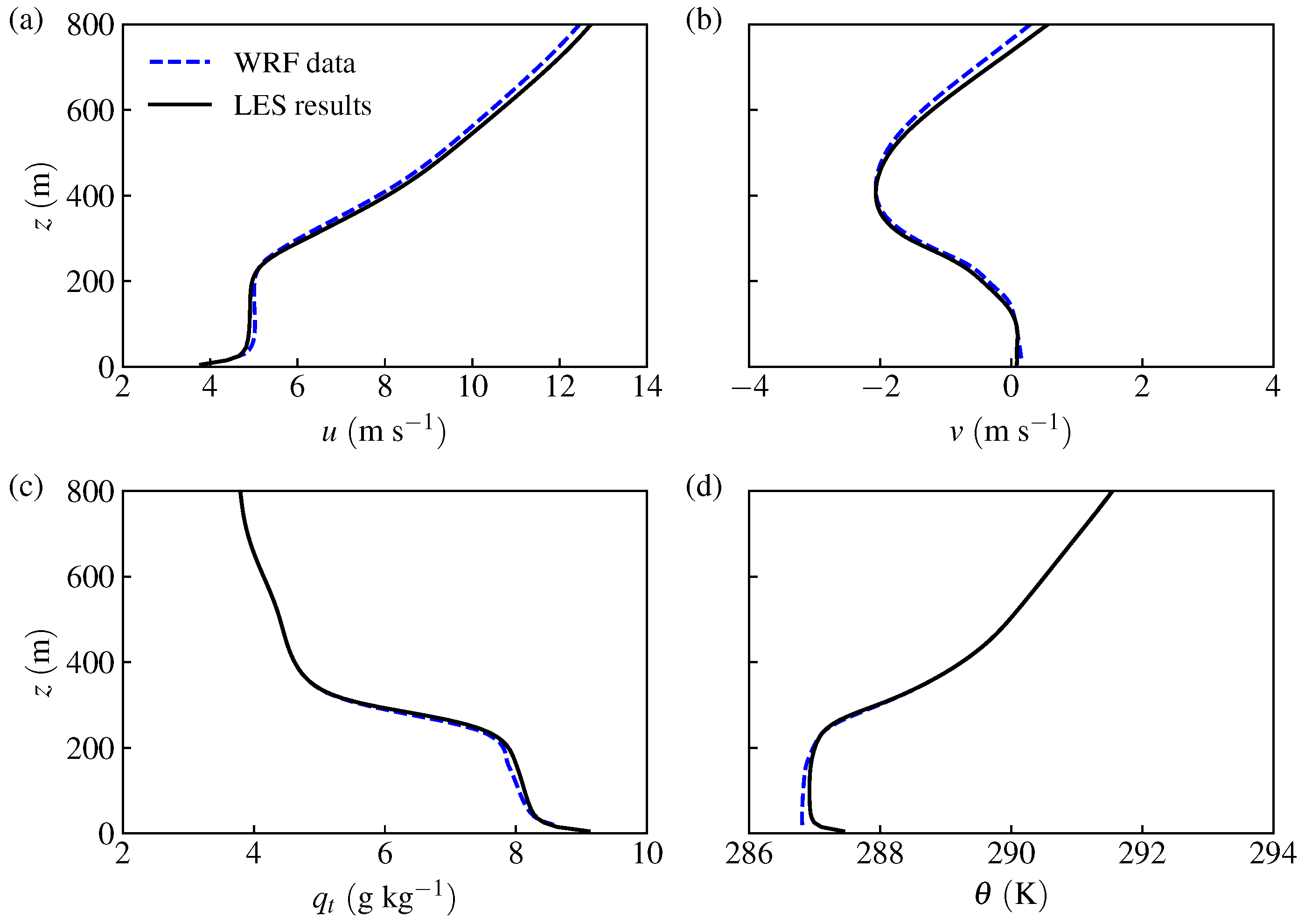
Figure 6 compares the LES results with WRF data at 05:00 UTC on 16 June 2020 for the streamwise wind speed u, spanwise wind speed v, total-water mixing ratio q t , and potential temperature θ . Differences are small, particularly within the turbine-height range of 40–240 m. The profiles in Figure 6 verify that the mean inflow in the main LES domain follows the local WRF mean profiles, indicating that the WRF and LES share consistent meteorological conditions. Profiles from the five simulations discussed in Section 3.4 are also examined. In all cases, the LES results show good consistency with the corresponding WRF data.

3.2. Flow Fields and Grid-Size Sensitivity

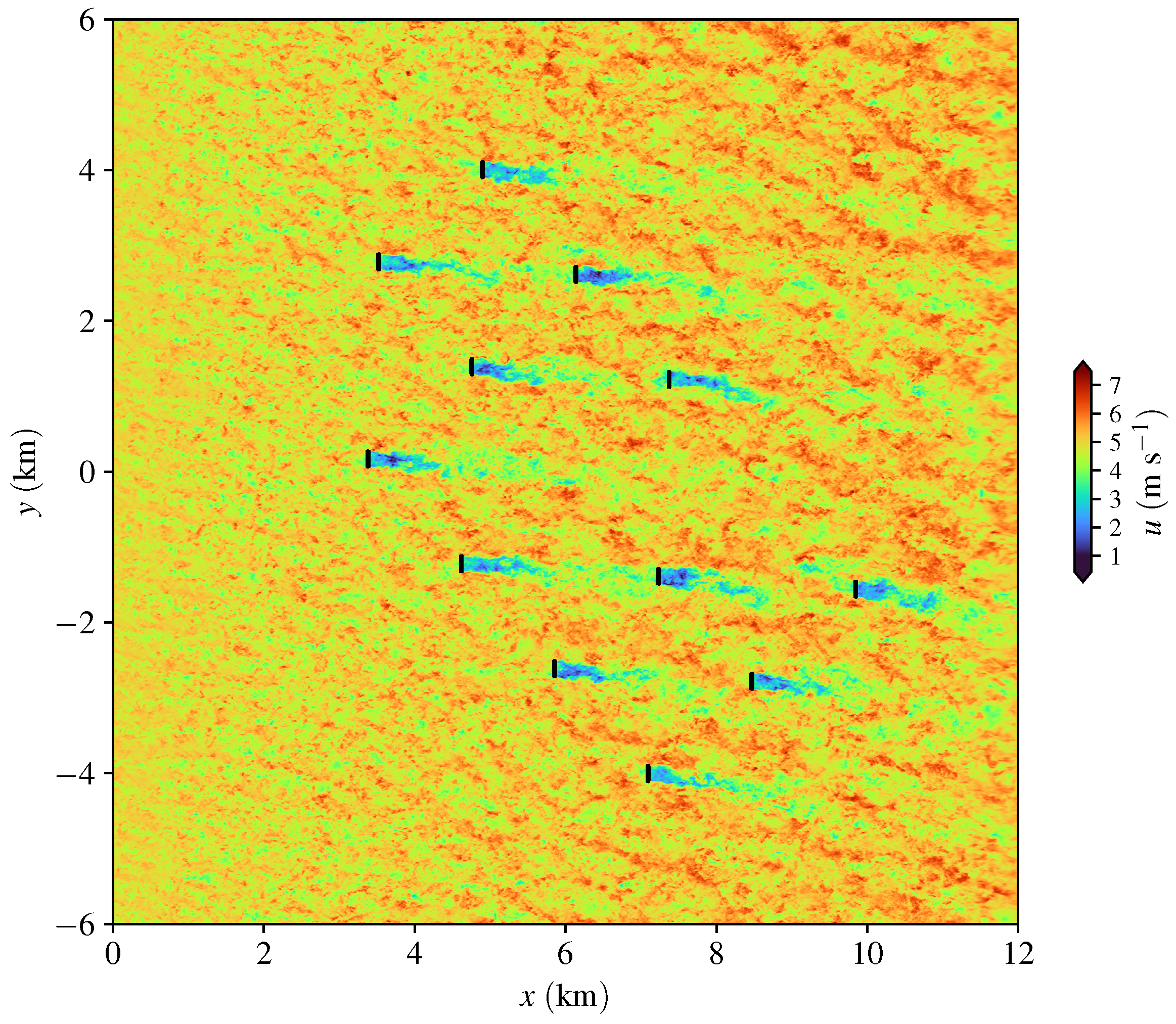
Figure 7 shows a contour plot of streamwise wind speed on a horizontal plane at hub height ( z = 140 m). Turbine disks are visualized by contours (black lines) of the indicator function. In the simulations, the wind is aligned with the x direction; thus, the wind farm appears rotated relative to the cardinal orientation in Figure 5. Turbine wakes are clearly visible as regions of reduced speed downstream of the rotors. The entire domain B is plotted in Figure 7, with the left and right edges corresponding to the inflow and outflow planes. The boundary conditions admit turbulent inflow and permit outflow without noticeable numerical artifacts.
Because the WRF forcing includes subsidence, the boundary layer tends to accelerate in the streamwise direction (Figure 7). For 16–17 June 2020, the subsidence velocity is approximately zero up to z = 700 m and decreases above that height at a rate of 4 × 10 5 s 1 .
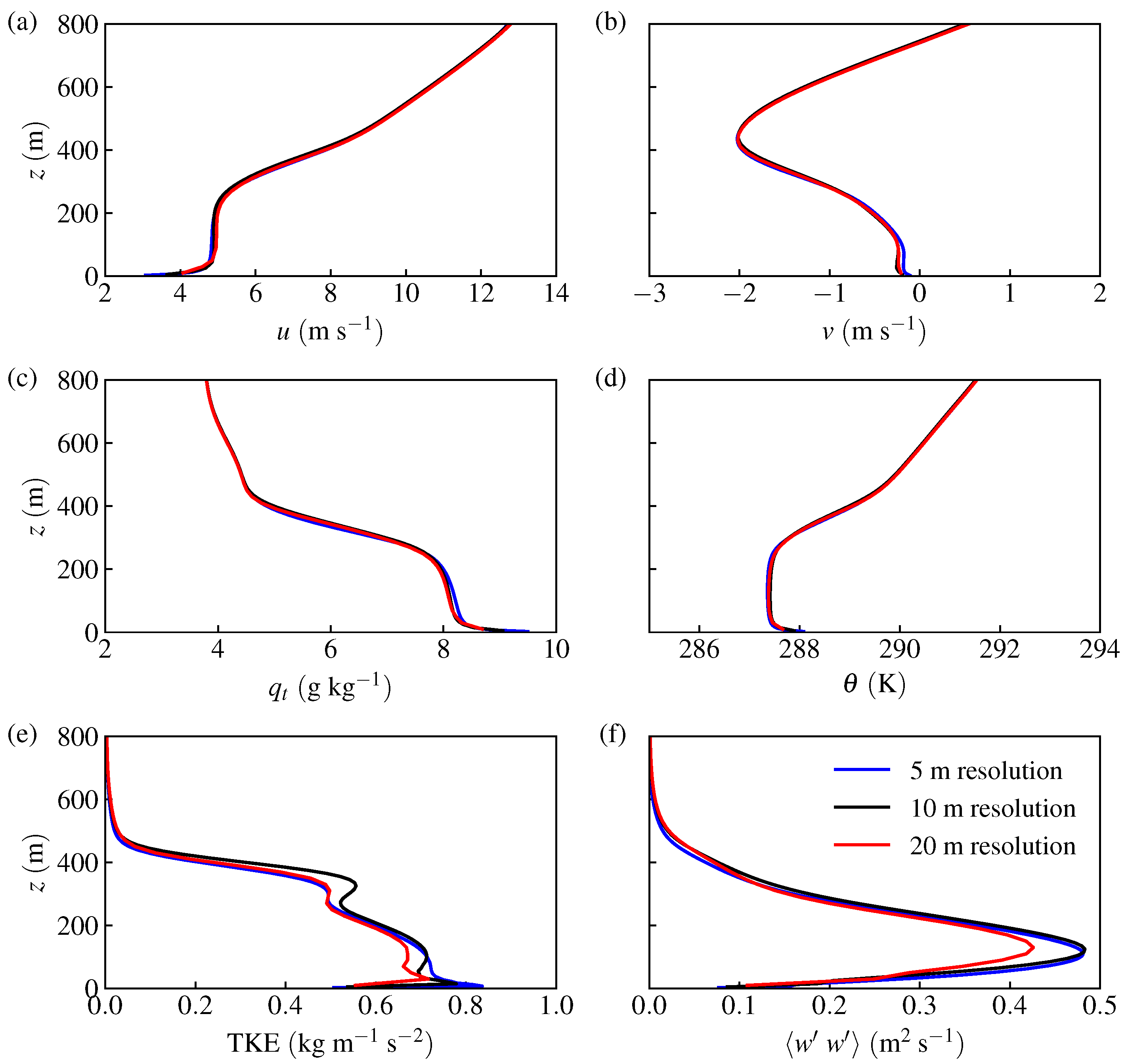
To assess grid-resolution effects, the flow over the wind farm was simulated with Δ x = 5 , 10 and 20 m. The mean profiles from the two simulations show close agreement, including within and downstream of wakes (Figure 8).

3.3. Power Output

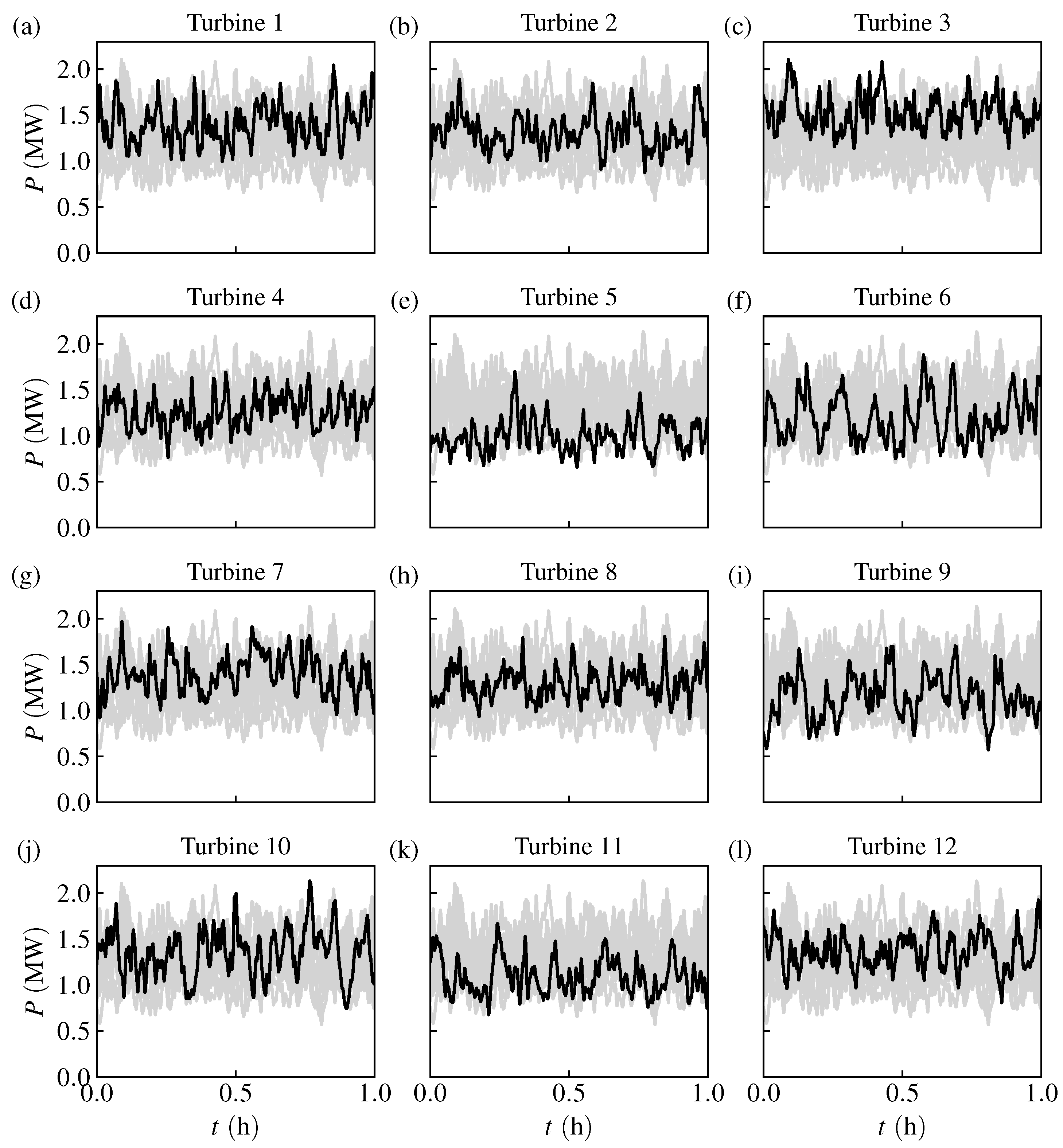
Using Equation (5), the power of each turbine is estimated as a function of time. Figure 9 shows the power output of each turbine over a 1 h period. In each panel, the black curve denotes the turbine highlighted in that panel; gray curves show the remaining turbines. The position of the black curve within the gray envelope indicates the relative magnitude of that turbine’s output.
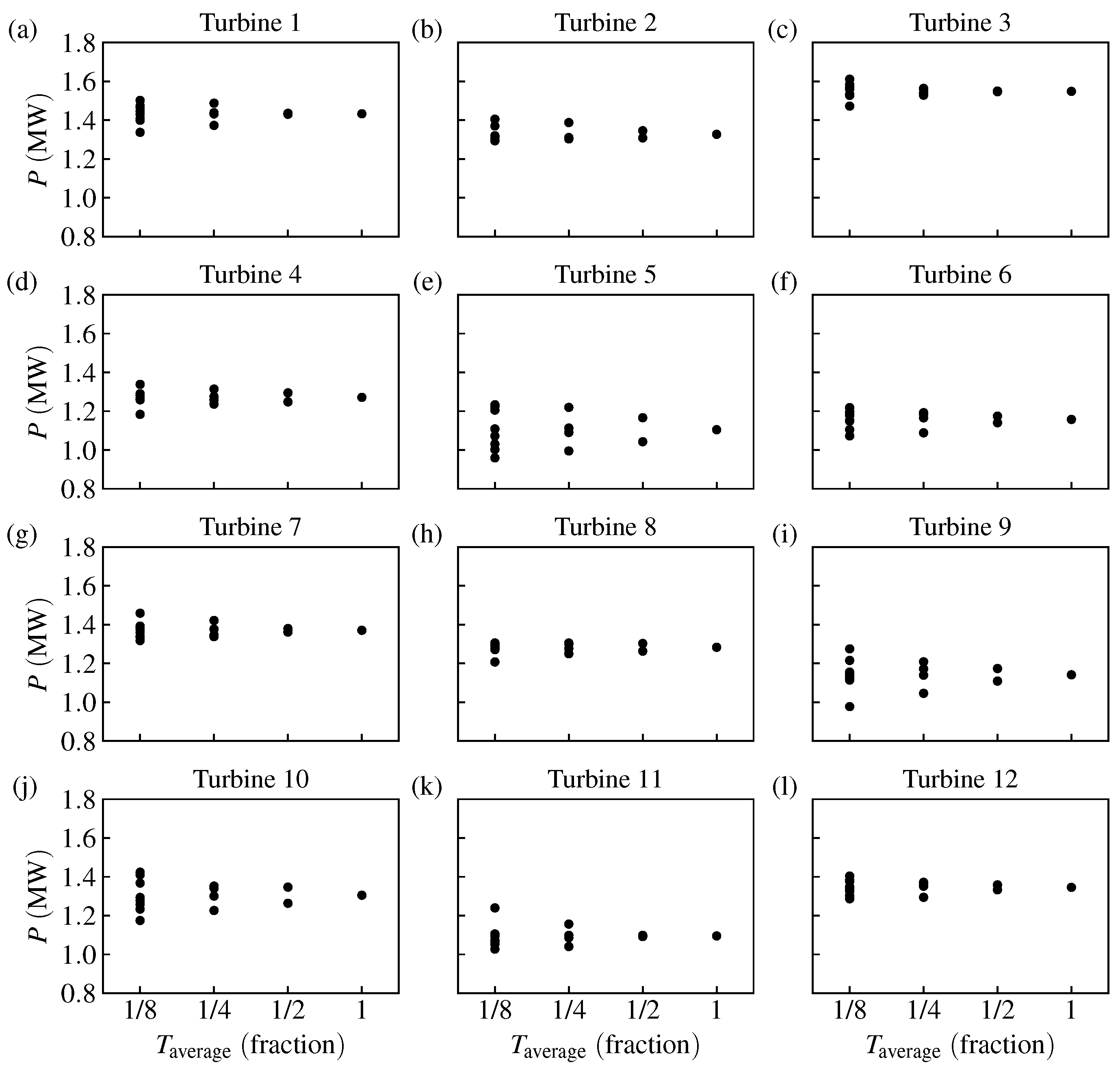
The simulation in Figure 9 uses time-invariant mean wind profiles (i.e., a steady wind vector), but boundary-layer turbulence—augmented and modulated by turbine wakes—produces fluctuations in instantaneous power. For the present case, turbine-level power swings can reach O ( 1 ) MW. Consequently, time-averaged power is a more meaningful metric of farm performance. To quantify temporal variability, the total analysis interval is partitioned into eight equal subperiods. Figure 10 reports average power for each turbine computed over 1/8, 1/4, and 1/2 of the full period. Most turbulent variability is averaged out over 0.5 h windows, as indicated by the similarity of the two half-period means for most turbines. This suggests that short-term fluctuations in the instantaneous power output, primarily driven by local turbulence and wake interactions, become negligible. Turbines 5, 9, and 10 show the largest differences at the 0.5 h scale, which is consistent with enhanced wake exposure from upstream rows; their locations coincide with persistent wakes in Figure 7.

3.4. Time-Variable Conditions

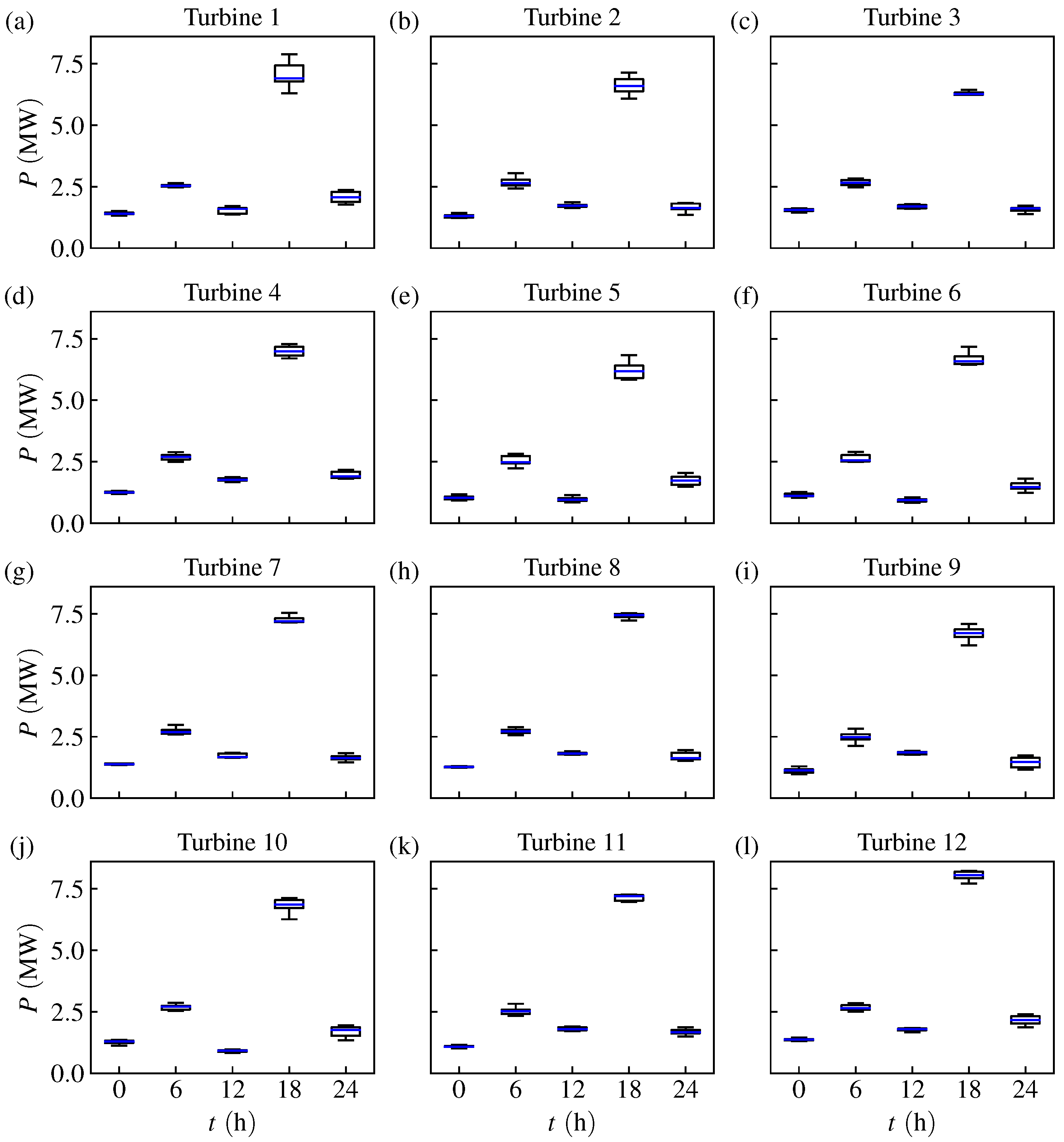
To evaluate the model under time-varying conditions, farm power was estimated over a 24 h period using WRF data from 05:00 UTC on 16 June 2020 to 05:00 UTC on 17 June 2020. The meteorological state varies slowly relative to the ∼0.5 h averaging required for adequate power convergence. Accordingly, five time points separated by six hours were selected, and 2 h LES segments were run for each. The grid resolution is Δ x = 10 m. This strategy efficiently samples the diurnal evolution without requiring a prohibitively long, continuously forced LES.
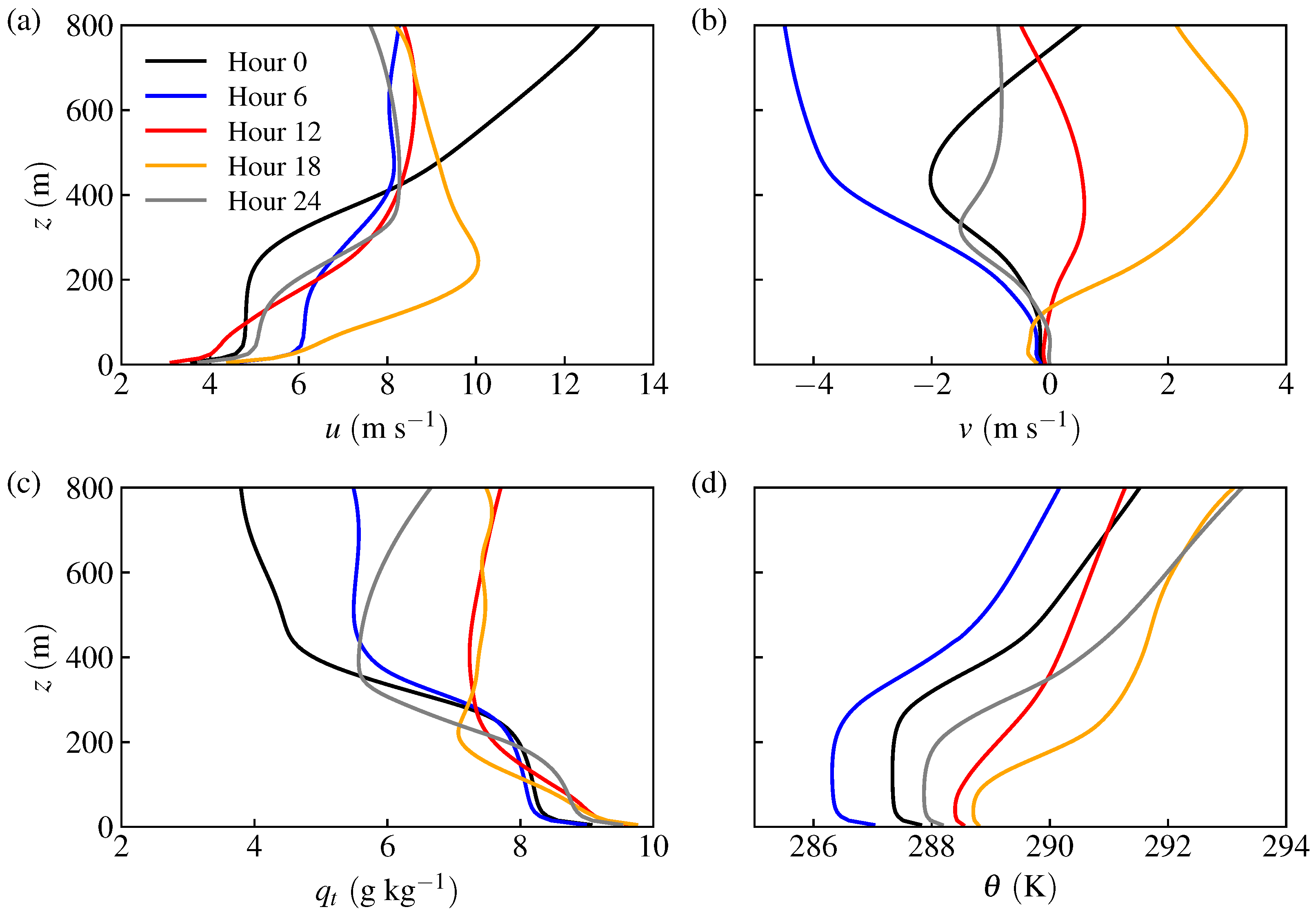
Time in the LES is referenced from the start of the period ( t = 0 at 05:00 UTC on 16 June 2020). Figure 11 shows boundary-layer profiles for the five segments. The variations in potential temperature among these profiles reflect transitions between stable, neutral, and unstable boundary-layer regimes, with the yellow and red profiles representing relatively stable stratification and the blue and black profiles indicating unstable conditions. The depth of the boundary layer and the magnitude of wind shear vary during the 24 h window. Corresponding wind speeds and directions at selected heights are listed in Table 3. Table 4 summarizes the averaging windows used for power statistics and reports the SST together with the resulting latent and sensible heat fluxes. The SST is prescribed from WRF as an area average over 20 × 20 km 2 centered on the wind farm.
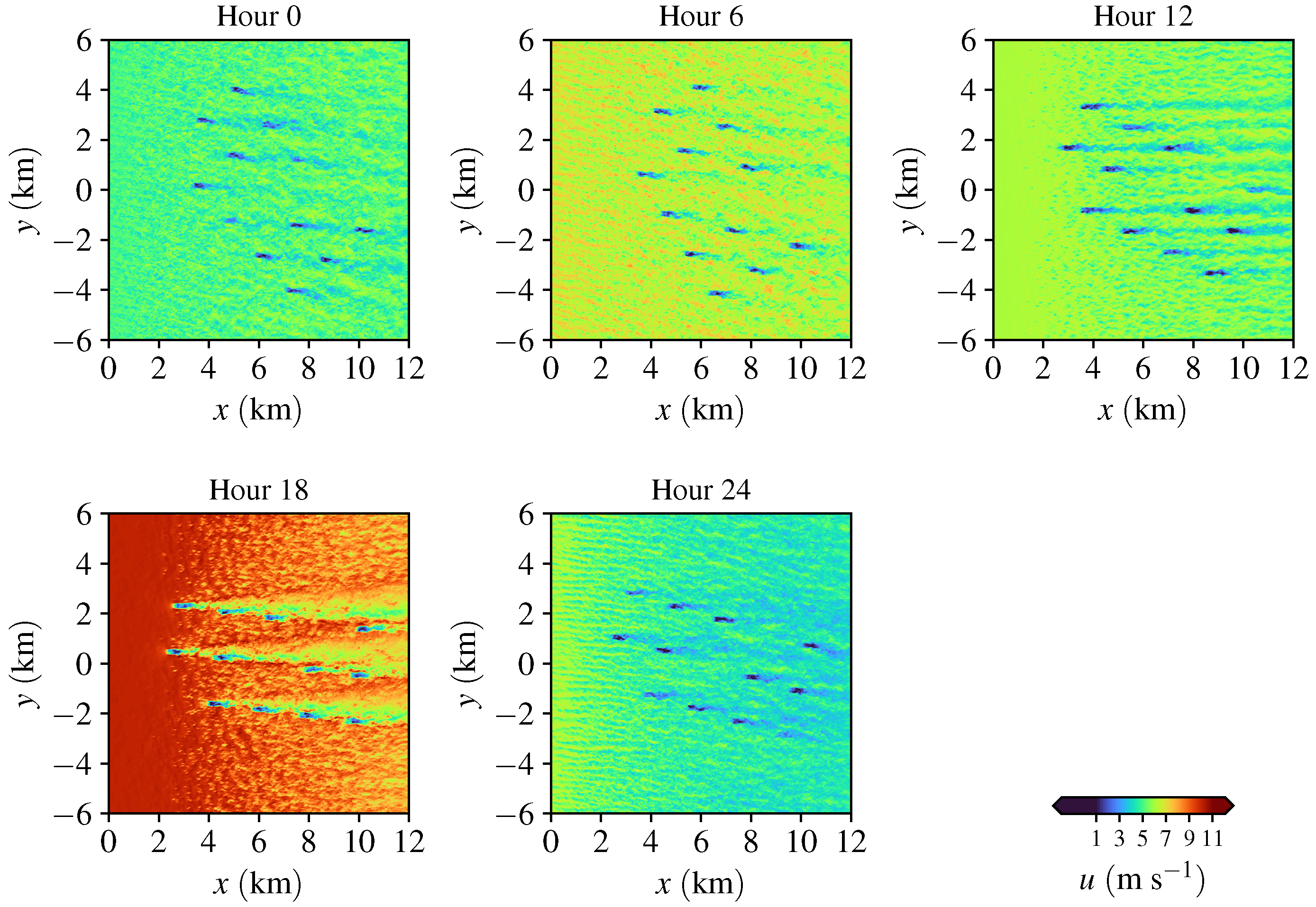
Figure 12 presents hub-height streamwise velocity contours for the five segments. As in Figure 7, the entire computational domain is shown, and turbulence enters and exits cleanly with no visible boundary artifacts. Despite broadly similar synoptic conditions, the flow patterns and turbine–wake interactions differ markedly among the segments. Variations in wind direction and speed produce distinct wake footprints that significantly affect power output.
Figure 13 summarizes power statistics for each turbine across the five segments. For each segment, the total statistics interval (Table 4) is divided into eight equal parts; the box plots are constructed from the eight subperiod means. At Hour 18, the wind speeds are highest, leading to increased power. In that segment, wake effects produce clear row-to-row gradients: front-row turbines (e.g., Turbine 4) generate more power than downstream machines (e.g., Turbine 5). Across the full set, turbine power ranges from roughly 1 MW to over 7.5 MW, depending on the turbine location and time of day.
In this study, the meteorological conditions on the selected date were relatively steady. To balance computational efficiency with model accuracy, five segments were selected to demonstrate the feasibility of a 24 h power forecasting framework based on the modeling system. Nevertheless, for other time periods or under more dynamic atmospheric conditions, such as during frontal passages or strong diurnal transitions, a finer temporal sampling strategy would provide additional fidelity of power forecasting and a better characterization of transient phenomena.

4. Conclusions

A physics-based power-forecasting framework for offshore wind farms was developed and demonstrated. A hierarchical modeling system predicts turbulent flow within the wind farm in a manner consistent with the local meteorology. The ADM represents turbine effects, capturing turbine–turbine interactions and associated wake dynamics.
The hierarchy employs global and regional NWP models to supply local meteorological conditions. NWP output does not resolve small-scale (1–100 m) turbulent fluctuations or the effects of turbines on the evolving boundary layer as it passes over the farm. Using the NWP information, the LES performs turbulence-resolving modeling of the wind farm. A concurrent precursor LES generates turbulent inflow with mean vertical profiles matched to the regional model; that is, with suitable forcing, the precursor produces small-scale turbulence consistent with the NWP-derived mean flow.
In this study, the coupling between WRF and LES is implemented in a one-way manner, allowing mesoscale information to drive the LES without feedback from the resolved turbulence. The modeling framework inherently assumes the accuracy of WRF inputs; therefore, biases in the mesoscale wind profiles or sea surface temperature can propagate into the LES and influence the simulation accuracy.
In this study, power was estimated from the turbine thrust coefficient via the energy-extraction relation in Equation (5). Other power-estimation approaches (e.g., turbine power curves) can be incorporated within the same framework.
The LES component, including turbulent-inflow generation and the ADM implementation, was validated against wind-tunnel experiments and reference simulations for single- and multiple-turbine cases. Additional assessment compared mean inflow profiles with the regional model and demonstrated grid independence of mean profiles.
The modeling framework was then used to generate mock power forecasts for the South Fork Offshore Wind Farm, a ∼132 MW site with 12 turbines. Flow and power were simulated over 24 h under fair-weather, light-wind conditions. For the cases considered, individual turbines exhibit power swings of order 1 MW. These fluctuations largely diminish with 0.5 h averaging for turbines in undisturbed inflow, whereas turbines persistently exposed to upstream wakes require longer averaging windows. As expected, the power potential of individual machines is strongly influenced by wind direction and the resulting wake–turbine interactions.
In the present forecasting system, particularly for offshore applications, the LES follows the NWP forcing closely because it models a limited area focused on the wind farm. A small LES domain is advantageous in that it enables computationally tractable simulations with present-day resources while providing physics-based flow fields and power estimates at operational scales.
To further quantify the benefits of the proposed physics-based approach, future work will compare the LES–WRF framework with established statistical forecasting methods under different meteorological conditions. In addition, statistical or spectral analyses of power fluctuations could provide insight into how turbulence intensity and wake–wake interactions contribute to power variability shown in Figure 10.

Author Contributions

Conceptualization, G.M. and M.A.; methodology, Y.L., B.M. and T.Z.; software, Y.L., B.M. and T.Z.; validation, Y.L.; formal analysis, Y.L. and G.M.; investigation, Y.L. and G.M.; resources, G.M. and M.A.; data curation, Y.L.; writing—original draft preparation, Y.L.; writing—review and editing, G.M. and M.A.; visualization, Y.L.; supervision, G.M.; project administration, G.M. and M.A.; funding acquisition, G.M. All authors have read and agreed to the published version of the manuscript.

Funding

This research was funded the U.S. Department of Energy’s Office of Electricity under award Number DE-OE0000966.

Data Availability Statement

The large eddy simulation model computer code and model output data are available at https://cfd.engr.uconn.edu (accessed on 27 November 2025).

Acknowledgments

This work was supported by the systems, services, and capabilities provided by the University of Connecticut Eversource Energy Center and the University of Connecticut High Performance Computing (HPC) facility. Figures were created with Matplotlib [47].

Conflicts of Interest

The authors declare no conflicts of interest.

References

  1. International Renewable Energy Agency (IRENA). Renewable Energy Statistics 2023; Technical report; International Renewable Energy Agency: Abu Dhabi, United Arab Emirates, 2023. [Google Scholar]
  2. Tuncar, E.A.; Sağlam, Ş.; Oral, B. A review of short-term wind power generation forecasting methods in recent technological trends. Energy Rep. 2024, 197, 197–209. [Google Scholar] [CrossRef]
  3. Soman, S.; Zareipour, H.; Malik, O.; Mandal, P. A review of wind power and wind speed forecasting methods with different time horizons. Energy Convers. Manag. 2010, 52, 1659–1672. [Google Scholar] [CrossRef]
  4. Foley, A.M.; Leahy, P.G.; Marvuglia, A.; McKeogh, E.J. Current methods and advances in forecasting of wind power generation. Renew. Energy 2012, 37, 1–8. [Google Scholar] [CrossRef]
  5. Pinson, P. Very short-term probabilistic forecasting of wind power with generalized logit–normal distributions. Int. J. Forecast. 2012, 28, 792–803. [Google Scholar] [CrossRef]
  6. Daenens, S.; Vervlimmeren, I.; Verstraeten, T.; Daems, P.J.; Nowé, A.; Helsen, J. Power prediction using high-resolution SCADA data with a farm-wide deep neural network approach. J. Phys. Conf. Ser. 2024, 2767, 092014. [Google Scholar] [CrossRef]
  7. Jimenez, A.; Crespo, A.; Migoya, E.; Garcia, J. Advances in large-eddy simulation of a wind turbine wake. J. Phys. Conf. Ser. 2007, 75, 012041. [Google Scholar] [CrossRef]
  8. Yang, X.; Kang, S.; Sotiropoulos, F. Computational study and modeling of turbine spacing effects in infinite aligned wind farms. Phys. Fluids 2012, 24, 115107. [Google Scholar] [CrossRef]
  9. Meyers, J.; Meneveau, C. Large Eddy Simulations of Large Wind-Turbine Arrays in the Atmospheric Boundary Layer. In Proceedings of the 48th AIAA Aerospace Sciences Meeting Including the New Horizons Forum and Aerospace Exposition, Orlando, FL, USA, 4–7 January 2010; Aerospace Sciences Meetings. American Institute of Aeronautics and Astronautics: Reston, VA, USA, 2010. [Google Scholar] [CrossRef]
  10. Calaf, M.; Meneveau, C.; Meyers, J. Large eddy simulation study of fully developed wind-turbine array boundary layers. Phys. Fluids 2010, 22, 015110. [Google Scholar] [CrossRef]
  11. Churchfield, M.; Lee, S.; Moriarty, P.; Martinez, L.; Leonardi, S.; Vijayakumar, G.; Brasseur, J. A Large-Eddy Simulation of Wind-Plant Aerodynamics. In Proceedings of the 50th AIAA Aerospace Sciences Meeting including the New Horizons Forum and Aerospace Exposition, Nashville, TN, USA, 9–12 January 2012; American Institute of Aeronautics and Astronautics: Reston, VA, USA, 2012. [Google Scholar] [CrossRef]
  12. Wu, Y.T.; Porté-Agel, F. Large-Eddy Simulation of Wind-Turbine Wakes: Evaluation of Turbine Parametrisations. Bound.-Layer Meteorol. 2011, 138, 345–366. [Google Scholar] [CrossRef]
  13. Mirocha, J.D.; Lundquist, J.K.; Kosović, B. Implementation of a generalized actuator disk wind turbine model into the Weather Research and Forecasting model for large-eddy simulation applications. J. Phys. Conf. Ser. 2014, 524, 012092. [Google Scholar] [CrossRef]
  14. Muñoz-Esparza, D.; Sauer, J.A.; Kosović, B.; John Roget, B. Toward low-cost large-eddy simulations of wind farms for real-time forecasting applications. Wind Energy 2018, 21, 940–953. [Google Scholar] [CrossRef]
  15. Baas, P.; Verzijlbergh, R.; van Dorp, P.; Jonker, H. Investigating energy production and wake losses of multi-gigawatt offshore wind farms with atmospheric large-eddy simulation. Wind Energy Sci. 2023, 8, 787–805. [Google Scholar] [CrossRef]
  16. Stipa, S.; Ajay, A.; Brinkerhoff, J. The actuator farm model for large eddy simulation (LES) of wind-farm-induced atmospheric gravity waves and farm–farm interaction. Wind Energy Sci. 2024, 9, 2301–2332. [Google Scholar] [CrossRef]
  17. Archer, C.L.; Xie, S.P.; Zhang, L.; Wu, S.; Fitch, A.C. Coupling of large-eddy simulations with mesoscale models for offshore wind farm applications. Atmosphere 2020, 11, 178. [Google Scholar] [CrossRef]
  18. García-Santiago, O.; Hahmann, A.N.; Badger, J.; Peña, A. Evaluation of wind farm parameterizations in the WRF model under different atmospheric stability conditions with high-resolution wake simulations. Wind Energy Sci. 2024, 9, 963–979. [Google Scholar] [CrossRef]
  19. Janssens, N.; Meyers, J. Towards real-time optimal control of wind farms using large-eddy simulations. Wind Energy Sci. 2024, 9, 65–95. [Google Scholar] [CrossRef]
  20. Taschner, E.; Folkersma, M.; Martínez-Tossas, L.A.; Verzijlbergh, R.; van Wingerden, J.W. A New Coupling of a GPU-Resident Large-Eddy Simulation Code with a Multiphysics Wind Turbine Simulation Tool. Wind Energy 2024, 27, 1152–1172. [Google Scholar] [CrossRef]
  21. Skamarock, W.C.; Klemp, J.B.; Dudhia, J.; Gill, D.O.; Liu, Z.; Berner, J.; Wang, W.; Powers, J.G.; Duda, M.G.; Barker, D.M.; et al. A Description of the Advanced Research WRF Model Version 4; Technical report, UCAR/NCAR: Boulder, CO, USA, 2019. [Google Scholar] [CrossRef]
  22. Ainslie, J.F. Calculating the flowfield in the wake of wind turbines. J. Wind Eng. Ind. Aerodyn. 1988, 27, 213–224. [Google Scholar] [CrossRef]
  23. Fitch, A.C.; Olson, J.B.; Lundquist, J.K.; Dudhia, J.; Gupta, A.K.; Michalakes, J.; Barstad, I. Local and Mesoscale Impacts of Wind Farms as Parameterized in a Mesoscale NWP Model. Mon. Weather Rev. 2012, 140, 3017–3038. [Google Scholar] [CrossRef]
  24. Jiménez, P.A.; Navarro, J.; Palomares, A.M.; Dudhia, J. Mesoscale modeling of offshore wind turbine wakes at the wind farm resolving scale: A composite-based analysis with the Weather Research and Forecasting model over Horns Rev. Wind Energy 2015, 18, 559–566. [Google Scholar] [CrossRef]
  25. Volker, P.J.H.; Badger, J.; Hahmann, A.N.; Ott, S. The Explicit Wake Parametrisation V1.0: A wind farm parametrisation in the mesoscale model WRF. Geosci. Model Dev. 2015, 8, 3715–3731. [Google Scholar] [CrossRef]
  26. Wise, A.S.; Arthur, R.; Abraham, A.; Wharton, S.; Krishnamurthy, R.; Newsom, R.; Hirth, B.; Schroeder, J.; Moriarty, P.; Chow, F. Large-eddy simulation of an atmospheric bore and associated gravity wave effects on wind farm performance in the Southern Great Plains. Wind Energy Sci. 2025, 10, 1007–1032. [Google Scholar] [CrossRef]
  27. Chung, D.; Matheou, G. Large-Eddy Simulation of Stratified Turbulence. Part I: A Vortex-Based Subgrid-Scale Model. J. Atmos. Sci. 2014, 71, 1863–1879. [Google Scholar] [CrossRef]
  28. Matheou, G.; Chung, D. Large-Eddy Simulation of Stratified Turbulence. Part II: Application of the Stretched-Vortex Model to the Atmospheric Boundary Layer. J. Atmos. Sci. 2014, 71, 4439–4460. [Google Scholar] [CrossRef]
  29. Matheou, G.; Chung, D.; Nuijens, L.; Stevens, B.; Teixeira, J. On the fidelity of large-eddy simulation of shallow precipitating cumulus convection. Mon. Weather Rev. 2011, 139, 2918–2939. [Google Scholar] [CrossRef]
  30. Inoue, M.; Matheou, G.; Teixeira, J. LES of a Spatially Developing Atmospheric Boundary Layer: Application of a Fringe Method for the Stratocumulus to Shallow Cumulus Cloud Transition. Mon. Weather Rev. 2014, 142, 3418–3424. [Google Scholar] [CrossRef]
  31. Matheou, G.; Bowman, K.W. A recycling method for the large-eddy simulation of plumes in the atmospheric boundary layer. Environ. Fluid Mech. 2016, 16, 69–85. [Google Scholar] [CrossRef]
  32. Matheou, G. Numerical discretization and subgrid-scale model effects on large-eddy simulations of a stable boundary layer. Q. J. R. Meteorol. Soc. 2016, 142, 3050–3062. [Google Scholar] [CrossRef]
  33. Matheou, G.; Lamaakel, O. Galilean invariance of shallow cumulus convection large-eddy simulation. J. Comput. Phys. 2021, 427, 11012. [Google Scholar] [CrossRef]
  34. Lamaakel, O.; Matheou, G. Organization development in precipitating shallow cumulus convection: Evolution of turbulence characteristics. J. Atmos. Sci. 2022, 79, 2419–2433. [Google Scholar] [CrossRef]
  35. Banhos, J.; Matheou, G. Effects of Discretization of Smagorinsky–Lilly Subgrid Scale Model on Large-Eddy Simulation of Stable Boundary Layers. Atmosphere 2025, 16, 310. [Google Scholar] [CrossRef]
  36. Morinishi, Y.; Lund, T.S.; Vasilyev, O.V.; Moin, P. Fully Conservative Higher Order Finite Difference Schemes for Incompressible Flow. J. Comput. Phys. 1998, 143, 90–124. [Google Scholar] [CrossRef]
  37. Spalart, P.R.; Moser, R.D.; Rogers, M.M. Spectral methods for the Navier-Stokes equations with one infinite and two periodic directions. J. Comput. Phys. 1991, 96, 297–324. [Google Scholar] [CrossRef]
  38. Cleijne, J.W. Results of Sexbierum Wind Farm: Single Wake Measurements; TNO: Apeldoorn, The Netherlands, 1993; Volume 93-082. [Google Scholar]
  39. Crespo, A.; Hernández, J. Turbulence characteristics in wind-turbine wakes. J. Wind Eng. Ind. Aerodyn. 1996, 61, 71–85. [Google Scholar] [CrossRef]
  40. Gómez-Elvira, R.; Crespo, A.; Migoya, E.; Manuel, F.; Hernández, J. Anisotropy of turbulence in wind turbine wakes. J. Wind Eng. Ind. Aerodyn. 2005, 93, 797–814. [Google Scholar] [CrossRef]
  41. Churchfield, M.J.; Schreck, S.J.; Martinez, L.A.; Meneveau, C.; Spalart, P.R. An Advanced Actuator Line Method for Wind Energy Applications and Beyond. In Proceedings of the 35th Wind Energy Symposium, Grapevine, TX, USA, 9–13 January 2017. [Google Scholar] [CrossRef]
  42. Stevens, R.J.; Martínez-Tossas, L.A.; Meneveau, C. Comparison of wind farm large eddy simulations using actuator disk and actuator line models with wind tunnel experiments. Renew. Energy 2018, 116, 470–478. [Google Scholar] [CrossRef]
  43. Stevens, R.J.; Graham, J.; Meneveau, C. A concurrent precursor inflow method for Large Eddy Simulations and applications to finite length wind farms. Renew. Energy 2014, 68, 46–50. [Google Scholar] [CrossRef]
  44. Zaman, T.; Juliano, T.W.; Hawbecker, P.; Astitha, M. On Predicting Offshore Hub Height Wind Speed and Wind Power Density in the Northeast US Coast Using High-Resolution WRF Model Configurations during Anticyclones Coinciding with Wind Drought. Energies 2024, 17, 2618. [Google Scholar] [CrossRef]
  45. Chamorro, L.P.; Porté-Agel, F. Effects of Thermal Stability and Incoming Boundary-Layer Flow Characteristics on Wind-Turbine Wakes: A Wind-Tunnel Study. Bound.-Layer Meteorol. 2010, 136, 515–533. [Google Scholar] [CrossRef]
  46. Stevens, R.J.A.M.; Gayme, D.F.; Meneveau, C. Large eddy simulation studies of the effects of alignment and wind farm length. J. Renew. Sustain. Energy 2014, 6, 023105. [Google Scholar] [CrossRef]
  47. Hunter, J.D. Matplotlib: A 2D graphics environment. Comput. Sci. Eng. 2007, 9, 90–95. [Google Scholar] [CrossRef]
Figure 1. Hierarchical modeling system that generates local meteorological conditions at the wind-farm location, including meter-scale atmospheric turbulence. Arrows denote the flow of information from larger-scale to finer-scale models in the form of boundary conditions.
Energies 18 06386 g001
Figure 2. Schematic of the two validation cases: a single-turbine case (left) and a multiple-turbine case. The configuration and dimensions of the precursor and main LES domains are shown, where D is the turbine diameter.
Energies 18 06386 g002
Figure 3. Comparison of streamwise velocity between experimental data from Chamorro and Porté-Agel [45] (“Ref. Experiment”), numerical simulations by Stevens et al. [42] (“Ref. Simulation”), and the present LES. Panels correspond to streamwise positions along the turbine centerline at (a) x / D = 1 (upstream of the turbine); (b) x / D = 2 ; (c) x / D = 3 ; (d) x / D = 5 ; (e) x / D = 7 ; (f) x / D = 10 ; (g) x / D = 14 ; (h) x / D = 20 , where D denotes rotor diameter.
Energies 18 06386 g003
Figure 4. Comparison of streamwise wind speed for the multiple-turbine case among the experimental measurements of Chamorro and Porté-Agel; the simulations of Stevens, Martinez-Tossas, and Meneveau; and the present LES results. Panels (ad) show streamwise velocity profiles at x/D = 1, 2, 3, and 4 behind the 1st turbine row. Panels (eh) show profiles at the same positions behind the 3rd row; (il) behind the 5th row; and (mp) behind the 10th row.
Energies 18 06386 g004
Figure 5. Schematic of the South Fork Wind Farm. Turbines are located on a 1 × 1 nautical-mile 3 × 5 grid with some locations empty, yielding 12 turbines. The farm is shown relative to cardinal directions; in subsequent plots, the farm is rotated such that the x axis aligns with the prevailing wind.
Energies 18 06386 g005
Figure 6. Comparison between WRF data and LES simulations in the precursor domain for 05:00 UTC on 16 June 2020. Panels (ad) show the profiles of streamwise and spanwise wind speed, total-water mixing ratio, and potential temperature, respectively, at various heights.
Energies 18 06386 g006
Figure 7. Streamwise velocity (color contours) at hub height for the conditions at 05:00 UTC on 16 June 2020. The 5 m grid-resolution simulation is shown. Black lines indicate turbine locations. Turbulent fluctuations and turbine wakes are evident. The full simulation domain is shown; the left and right boundaries correspond to the inflow and outflow planes, respectively.
Energies 18 06386 g007
Figure 8. Comparison between 5 m, 10 m, and 20 m resolution results in the second domain. Panels (af) show the profiles of streamwise and spanwise wind speed, total-water mixing ratio, potential temperature, turbulent kinetic energy, vertical velocity variance, respectively.
Energies 18 06386 g008
Figure 9. Continuous power generation for each turbine during the analysis period. Panels (al) present the power output of Turbines 1–12, respectively. Gray shaded areas represent the power output of the other turbines.
Energies 18 06386 g009
Figure 10. Average power output for each turbine over different time windows (1/8, 1/4, 1/2, and the full period), illustrating convergence with averaging duration. Panels (al) show results for Turbines 1–12, respectively.
Energies 18 06386 g010
Figure 11. LES boundary-layer profiles corresponding to WRF conditions at 0, 6, 12, 18, and 24 h. Panels (ad) show the profiles of streamwise and spanwise wind speed, total-water mixing ratio, and potential temperature, respectively.
Energies 18 06386 g011
Figure 12. Contours of streamwise wind speed at five times during the 24 h period. The color scale is identical across panels.
Energies 18 06386 g012
Figure 13. Box plots of average power output for each turbine over the 24 h period. Hour 0 to Hour 24 correspond to 05:00 UTC on 16 June 2020 through 05:00 UTC on 17 June 2020. Panels (al) show results for Turbines 1–12.
Energies 18 06386 g013
Table 1. Values of C T for turbine rows used in the multiple-turbine validation case.
CaseRow 1Row 2Row 3Row 4Row 5
C T 0.70410.80991.00150.92860.8799
CaseRow 6Row 7Row 8Row 9Row 10
C T 0.94960.92690.87680.88210.8899
Table 2. Details of the LES. N x , N y , and N z denote the number of grid points in the zonal (x), meridional (y), and vertical directions, respectively. The grid spacing is isotropic ( Δ x = Δ y = Δ z ).
WRF DateDomain A ( N x × N y × N z ) Domain B ( N x × N y × N z ) Δ x (m) dt / dt CPU Period for Statistics (h)
05:00 UTC, 16 June 300 × 600 × 50 600 × 600 × 50 200.70–1.150.22–2.67
05:00 UTC, 16 June 600 × 1200 × 100 1200 × 1200 × 100 100.03–0.040.22–2.85
05:00 UTC, 16 June 1200 × 2400 × 160 2400 × 2400 × 160 5∼0.010.08–1.25
Table 3. Wind speed and direction at selected heights and times.
Hour 0Hour 6Hour 12Hour 18Hour 24
u at 40 m ( m s 1 )4.906.313.676.944.90
u at 140 m ( m s 1 )5.016.835.949.876.14
u at 240 m ( m s 1 )5.187.706.9310.157.62
Wind direction 41.92 (NE) 31.02 (NNE) 63.28 (ENE) 82.75 (E) 73.42 (ENE)
Table 4. Power-calculation intervals and surface fluxes for the five LES runs. SST denotes sea-surface temperature; LHF and SHF denote latent and sensible surface heat flux, respectively.
WRF DatePeriod for Power Calculation (h)SST (K)Average LHF
(W m−2)
Average SHF
(W m−2)
05:00 UTC, 16 June0.5–1.8289.4351.282.2
11:00 UTC, 16 June0.5–1.8289.0403.7135.0
17:00 UTC, 16 June0.5–1.8289.1196.922.8
23:00 UTC, 16 June0.5–1.8289.1249.416.3
05:00 UTC, 17 June0.5–1.8289.1250.245.5
Disclaimer/Publisher’s Note: The statements, opinions and data contained in all publications are solely those of the individual author(s) and contributor(s) and not of MDPI and/or the editor(s). MDPI and/or the editor(s) disclaim responsibility for any injury to people or property resulting from any ideas, methods, instructions or products referred to in the content.