1. Introduction
With the increasing use of renewable energy, reduction in system inertia has become a critical problem, threatening the frequency stability of the power system. For example, insufficient system inertia was one of the critical causes of the recent large-scale blackout on the Iberian Peninsula in Europe, demonstrating the adverse impact of inertia deficiency [
1]. To solve this problem, grid-forming energy storage technology has become an efficient solution, providing flexible reserve power and scheduling capability, thereby improving the inertia and frequency stability of the system [
2]. Based on practical demands, the grid-forming ESS has been flourishing since the concept was first proposed by Zhong [
3]. According a report by NEOEN, which runs the first and biggest grid-forming energy storage system in South Australia, the 150 MW/193.5 MWh energy storage system now has the capacity to contribute an estimated 2000 MW of equivalent inertia, or around 15% of the predicted shortfall in the state’s network, showing the effectiveness of the grid-forming energy storage system [
4].
To better leverage the function of improving inertia and enhance economic efficiency, the grid-forming energy storage system is often operated within microgrids which are composed of flexible loads and renewable energy sources [
4]. Thus, ensuring the grid-forming energy storage system’s economic operation through scheduling and planning is an important issue. According to a report by Schierhorn [
5], the scheduling of microgrids composed of grid-forming energy storage systems can reduce the operations cost by 25% compared to the baseline, which shows promising potential in cost reduction and efficiency improvement.
Recent studies have proposed various scheduling and planning methods to enhance the operational efficiency of grid-forming microgrids and reduce operating costs [
6]. Scheduling and control optimization was first studied in the early stages of research. Vinayagam et al. introduced a PV-based microgrid scheme using grid-support and grid-forming inverter control to achieve proportional power sharing and seamless transitions between grid-connected and islanded modes while regulating voltage and frequency [
7]. Subsequently, optimal grid-forming control strategies for battery energy storage systems were developed to enable feeder dispatchability and provide frequency containment and voltage support [
8]. These studies can effectively reduce the operational cost and provide frequency support, but only achieve the optimization of the converter or battery level. At the microgrid operation level, several studies formulated dispatch or energy management schemes for grid-forming sources under different operating modes, including service restoration, feeder-level coordination, and real-time feedback-based control, demonstrating improved frequency support and reduced operational cost [
9,
10]. Reference [
11] proposed a dynamic security-constrained AC optimal power flow for microgrids, which can maintain security and optimize dispatch under faults and renewable variability on a microgrid with PV, a synchronous generator, and a BESS. Reference [
12] proposed a coordinated scheduling strategy in a 100% renewable energy microgrid scenario, developing a robust optimization model that coordinates grid-forming renewable stations, a battery/compressed-air hybrid storage system, and demand response to maintain frequency-dynamic security in a fully renewable system. Reference [
13] proposed a renewable-Integrated agent-based microgrid model with grid-forming support for improved frequency regulation which reduces frequency peaks by up to 1.14 Hz and shortens the recovery time by several minutes. References [
8,
14] proposed a near-optimal energy management strategy for a grid-forming PV and hybrid energy storage system which integrates Li-ion batteries and supercapacitors into a grid-forming PV system. These studies provide the system-level microgrid scheduling method, although planning is not taken into consideration. References [
15,
16] proposed an energy storage configuration and scheduling strategy for a microgrid with consideration of grid-forming capability which can increase minimum rotational kinetic energy by about 30% and reserved power by 15%. Overall, although the aforementioned scheduling and control optimization methods can improve the operational economic and frequency performance of grid-forming microgrids to a certain extent, they are primarily limited to optimizing the operation of pre-installed devices. The lack of explicit consideration of equipment planning and capacity design makes it difficult for these approaches to achieve life-cycle cost optimality at the system level.
More recent studies have extended the optimization scope from operational scheduling to capacity planning. Some works have investigated the optimal sizing of grid-forming energy storage systems under multi-timescale energy management frameworks, showing significant reductions in required storage capacity while maintaining system reliability [
17]. Reference [
18] explored the optimal size of grid-forming energy storage in an off-grid renewable P2H system under multi-timescale energy management and proposed an optimal capacity method which can shrink the battery capacity by over 50%. Capacity-oriented formulations have also been integrated with security-constrained optimal power flow and robust scheduling models to ensure frequency-dynamic security in renewable-dominated microgrids with grid-forming resources [
19,
20]. In addition, agent-based and hybrid energy storage models incorporating grid-forming support have been proposed to improve frequency-regulation performance and recovery speed [
21,
22]. A limited number of studies jointly optimized energy storage capacity and scheduling while explicitly considering grid-forming capability, demonstrating improvements in system inertia and reserve margins [
23]. These methods can reduce the cost and enhance the frequency-support function by skillfully optimizing the capacity and scheduling of a microgrid. However, the device lifetime is ignored in the existing method, and the scheduling flexibility of the electricity load is not taken into account, which is an important component of the existing electricity load.
Based on the formal research, this paper proposes a grid-forming battery energy storage system capacity planning method considering device lifetime, and case studies on the Gurobi simulation platform have verified the effectiveness of the proposed method. To address these gaps, this paper makes the following contributions, and the differences from existing methods are shown in
Table 1.
- (1)
An integrated planning and scheduling framework for grid-forming microgrids is proposed, in which the relationship between device aging and the capacity of grid-forming energy storage systems is explicitly modeled and optimized in cooperation with system-level operation, and the frequency-related parameters are modeled by RoCoF constraints in the energy storage capacity planning.
- (2)
A rain-flow-algorithm-based lifetime-aware energy storage scheduling model is incorporated into the proposed framework, which can describe the relationship between battery aging and scheduling operation and systematically evaluate the trade-off between overall cost and frequency-support capability.
- (3)
A novel data center microgrid model is built to verify the proposed method, firstly introducing the data center scenarios into frequency support and equipment depreciation research.
Table 1.
Comparison with related research.
Table 1.
Comparison with related research.
| Research | Microgrid Scheduling | Planning | Flexible Load | Device Lifetime |
|---|
| References [7,8,9,10,11,12,13,14,15,16] | √ | × | × | × |
| Reference [17] | √ | √ | × | × |
| Reference [18] | √ | √ | × | × |
| References [19,20] | √ | √ | × | × |
| This paper | √ | √ | √ | √ |
2. The Capacity Planning Problem and Lifetime Calculating Method
The planning of a grid-forming energy storage system and its microgrid can be formulated as a mixed-integer (nonlinear) programming problem, where the capacity of the devices and the operation of microgrids are the decisive variables, which are closely coupled and should be optimized together. In this process, the lifetime of the battery is decided by the charge and discharge operation, which should also be considered in the initial planning optimization for its influence on equipment depreciation and replacement cost. Therefore, this section first introduces the planning optimization of the capacity planning problem, and the situation in which the load can be scheduled flexibly is presented, which provides the scenario of the simulation. Then, the device lifetime and its relationship with the operation is illustrated. Finally, the rain-flow algorithm is introduced to evaluate the aging effect.
2.1. The Planning Optimization of the Grid-Forming ESS Microgrid
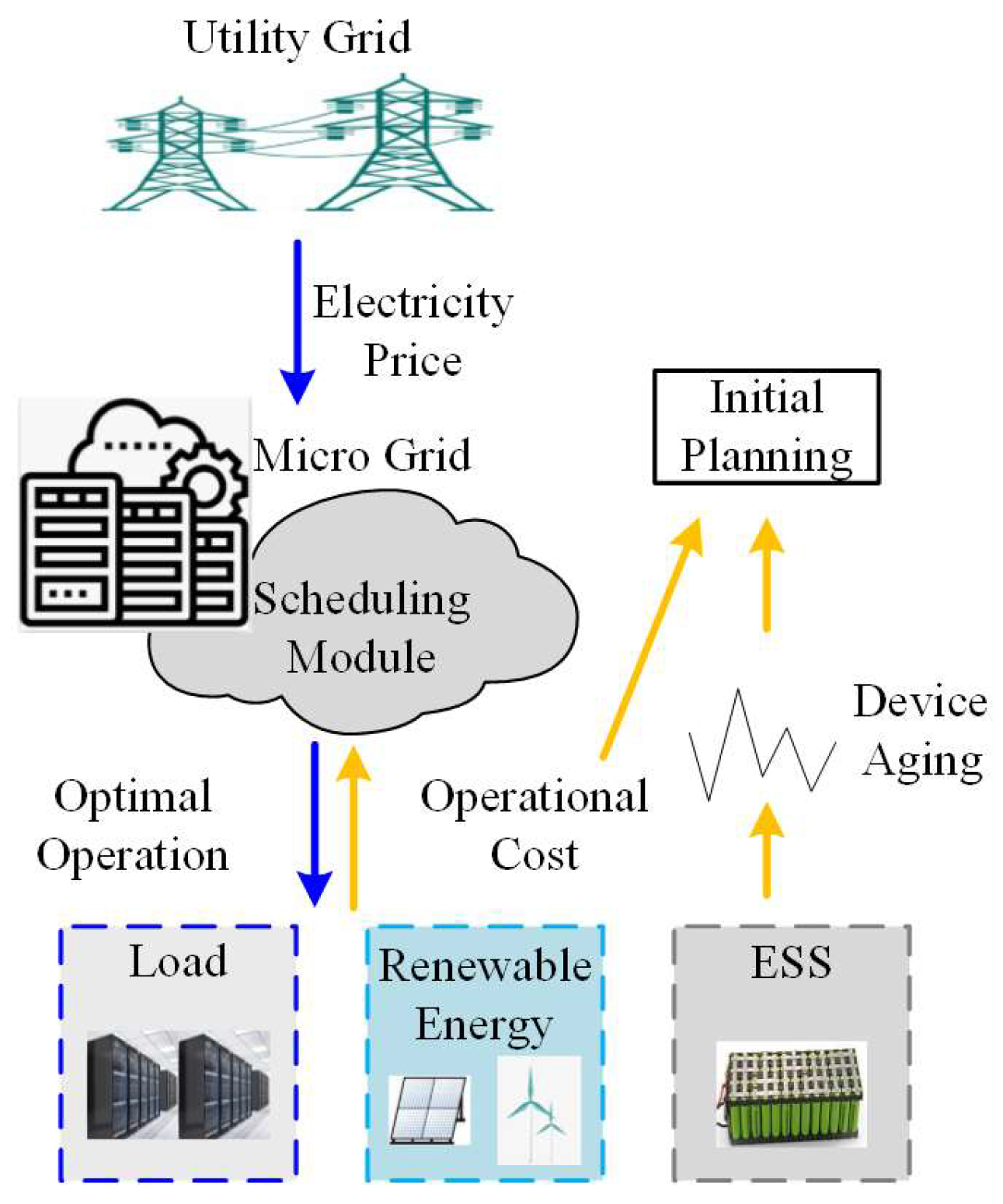
The framework of the grid-forming ESS microgrid planning problem is shown in
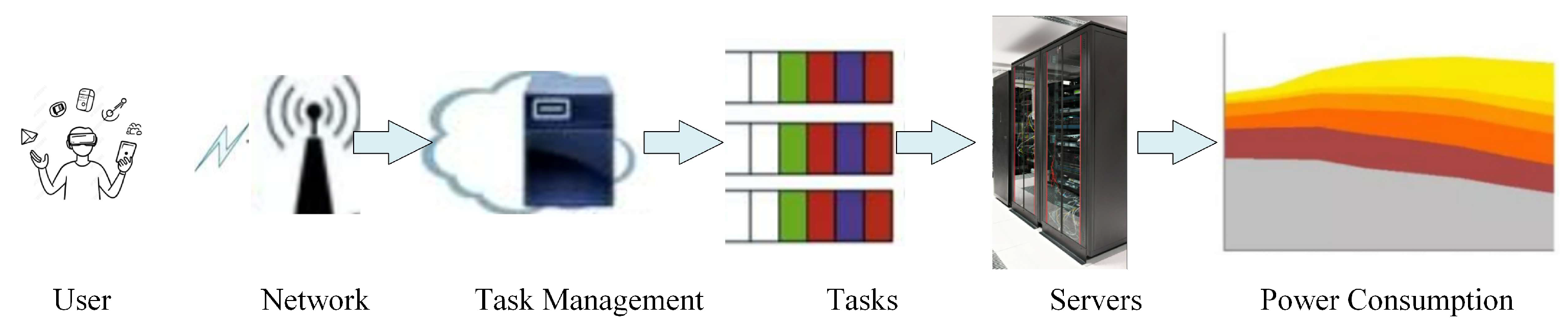
Figure 1. In the practical operation, the microgrid consists of an ESS, loads, generators, and renewable sources, which can be scheduled by the centralized scheduling module; the device capacity should be optimized in the initial planning. The initial construction cost and equipment replacement cost is decided by the device capacity, and real-time operational cost is decided by the operation and electricity price. To further analyze the system and consider the flexible scheduling characteristics exhibited by existing loads, a typical situation is shown in this section, which is a microgrid that contains a grid-forming ESS and data center, and the flexibility of the load is analyzed below.
2.1.1. Scheduling Flexibility of Electrical Load
As
Figure 2 shows, in the microgrid that contains the data center electrical load, the real-time power of the electrical load is determined by the computational workload, which exhibits a high degree of flexibility, as it can be scheduled in both time and space dimensions, and therefore can be scheduled freely to coordinate with renewable energy sources and electricity prices to minimize energy consumption and operational cost. In this paper, two kinds of workload are considered, where the first kind can be scheduled temporally and the second kind cannot be scheduled.
2.1.2. The Characteristics of Grid-Forming ESS
The grid-forming ESS can respond to the frequency and active-power changes by releasing or absorbing power and provide short-term frequency for the grid. The essence of the inertia-supporting ability of the grid-forming ESS lies in its power response capability. Let the equivalent inertia time constant of the storage at a given time interval be
, which is proportional to the tie-line transmission power of the storage
. When a large amount of energy is released from storage, the inertia time constant is high, and the rate of change of frequency is small, which is conducive to maintaining system power balance. When the released energy is small, the inertia time constant is low and the frequency changes more rapidly, which may cause frequency-stability problems. The
can be described by Equation (1):
where
is the maximum transmission power of the ESS and
,
are the upper and lower limits of the inertia time constant of the ESS.
The overall inertia requirement of a microgrid can be characterized by the maximum rate of change of frequency (RoCoF)
. In implementation, the
is often set to be 0.5–1 Hz to guarantee the stability of frequency. Since both wind turbines and photovoltaic systems adopt grid-following control strategies, their inertia contribution is relatively small. Therefore, the equivalent inertia of the microgrid is mainly provided by the grid-forming energy storage systems. Then, the minimum rotational kinetic energy of the microgrid during time period
t can be defined as
. Furthermore, the rotational kinetic energy constraint of the system can be formulated as follows:
To ensure that the power output can cover the power to achieve grid forming, the output power of the ESS should exceed the
; therefore, the following constraint should be satisfied:
In implementation, since the flexibility of
is mainly determined by the ESS power and the real-time power of data center electricity workload in our model, it is more reliable to conservatively set the following equation:
After a disturbance occurs and once the inverter has passed through the frequency-regulation dead band, the ESS supplies a frequency-regulation power based on the frequency deviation f and the primary frequency-response coefficient, thereby further reducing the microgrid’s power imbalance and frequency deviation.
In the above formulation, denotes the equivalent inertia time constant of the grid-forming ESS, which characterizes its inertia-like frequency-support capability in the short-term dynamics. The feasible range of is bounded by the maximum transferable (deliverable) active power of the ESS for grid-forming support, leading to the lower and upper limits and . Equation (1) establishes the mapping between and the ESS power , capturing the intuitive physical implication that a larger available ESS power generally enables stronger inertia support. represents the rate of change of frequency, which must not exceed a prescribed limit to ensure frequency security, as enforced by Equation (2). Since a discrete-time simulation is adopted, is approximated via the frequency difference between two consecutive time slots. Equation (3) provides the discrete expression (which is essentially ); in this study, the per-slot frequency variation is used to represent the RoCoF metric, and the time step and its units are consistently specified in the notation/definitions. Furthermore, denotes the equivalent rotational kinetic energy (i.e., the effective energy buffer) of microgrid during time slot , representing the amount of energy that can be rapidly exchanged to limit fast frequency deviations immediately after a disturbance. As shown in Equation (4), is determined by the equivalent inertia time constant and the ESS power . To guarantee frequency-dynamic security, must satisfy the minimum kinetic energy requirement derived from the swing equation, i.e., Equation (5). Finally, the deliverable inertia/frequency support is also constrained by the physical power capability of the ESS. To ensure implementation ability, the ESS output power must satisfy the maximum power constraint and the charge/discharge power bounds, as described in Equations (6) and (7), respectively.
2.2. The Aging and Lifetime Calculation of ESS
The aging of the ESS is decided by its charge and discharge operations, which in turn decide the construction and replacement cost throughout its lifetime. To describe the relationship between device aging and scheduling/planning and take the device lifetime into the optimization objective, the rain-flow counting algorithm is introduced into the optimization problem, which is analyzed in detail below.
2.2.1. The Rain-Flow Counting Algorithm
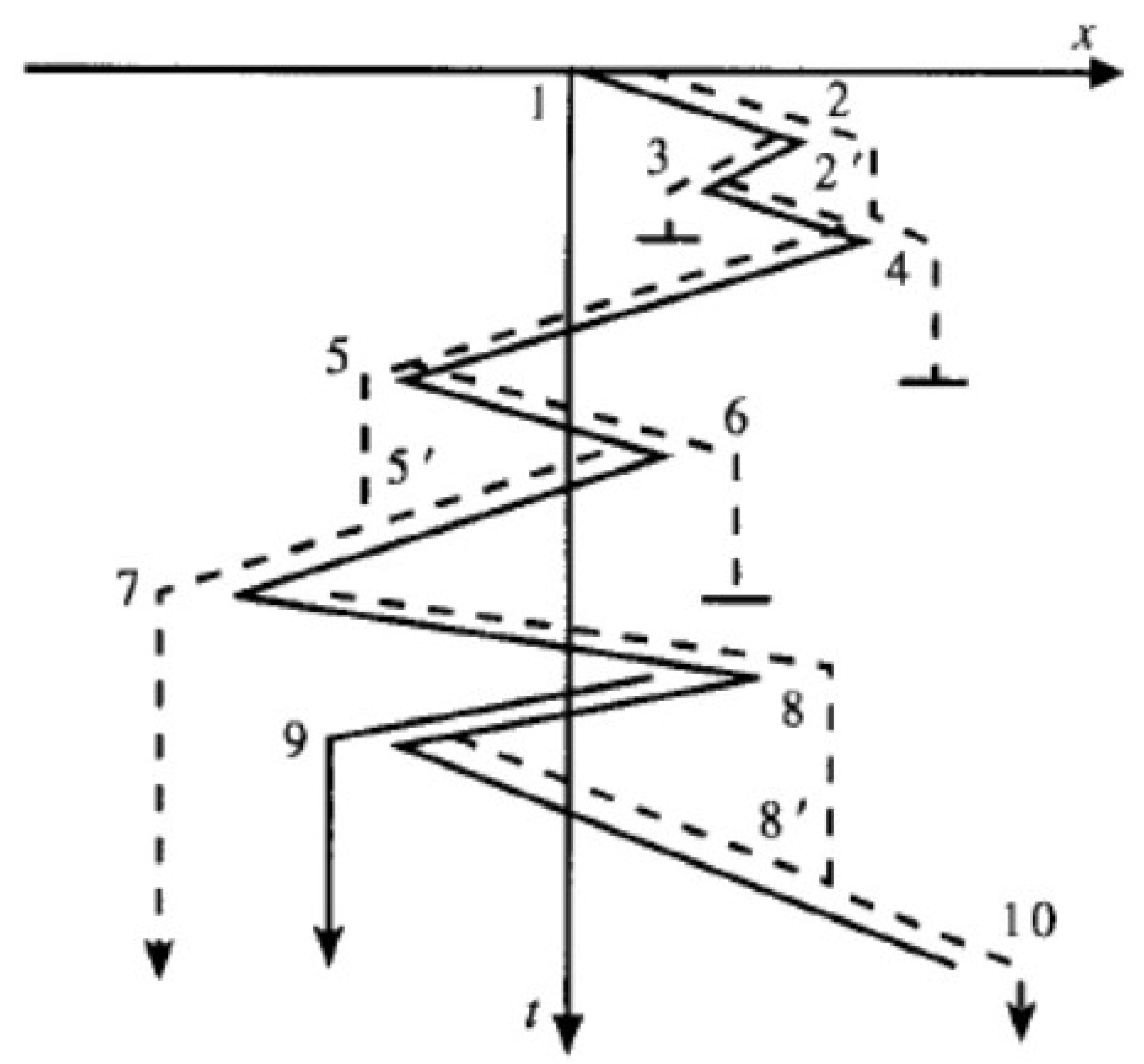
To properly account for the aging of equipment, especially the depreciation of batteries, the study uses the rain-flow algorithm to count charge and discharge cycles, as shown in
Figure 3. This algorithm, which is widely used in fatigue analysis, breaks the power operation of the ESS into simple charging and discharging cycles and uses the cycle ranges (DOD) to quantify degradation. The procedure usually involves the following:
Finding turning points: Identify the local peaks and troughs in the original signal.
Matching cycles: Compare successive peaks and troughs and, once they satisfy the rain-flow rule, treat them as a full cycle.
Half-cycle treatment: Any leftover segments that do not form a full cycle are counted as half cycles.
2.2.2. The ESS Lifetime Calculation
The ESS lifetime can be calculated according to its depth of discharge (DOD), which can be calculated through Equations (8) and (9).
where
and
are the maximum and minimum value of the state of charge (SOC) of the ESS.
and
represent the
i-th charge–discharge cycle and its battery aging.
By introducing the ESS lifetime into device capacity optimization, the proposed method achieves further optimization in overall cost, which is composed of the construction cost and operational cost.
It is worth noting that the degradation modeling in this paper focuses on cycle aging induced by charge/discharge operations, while calendar aging is not explicitly considered. This simplification may underestimate the actual degradation in operating conditions with long-term storage at high SOC and/or elevated temperature or when cycling is infrequent, which could introduce bias in the life-cycle cost assessment; however, since the studied scenario features intensive cycling under a relatively benign operating environment, and cycle aging is expected to be the dominant contributor, this hypothesis is acceptable.
3. System Model and Mathematical Formulation
The system model and mathematical model of the optimization problem are provided in this section. A typical system architecture of the grid-forming ESS microgrid is shown in
Figure 1, where renewable power (solar and wind power), flexible electrical load, and energy storage devices are deployed. The system is modeled as a discrete-time system with equal length time slots. Each time slot is 15 min.
The system is divided into two main components: the power-demand side and the power-supply side. On the demand side, a workload model is established to describe the relationship between computational workloads and their corresponding power consumption. On the supply side, an energy storage system model is developed, where the overall power balance of the system is maintained. Finally, an optimization objective is formulated within this part, aiming to minimize the total system cost, which includes the operational cost and construction cost of the total system.
3.1. Power-Demand Side
The main load of the data center is the servers, whose energy consumption is linearly determined by the computational workload rate, which can be briefly divided into flexible workload and fixed workload. The interactive workload, such as online shopping and gaming services, should be dealt with within a short time delay, which is usually no more than minutes or seconds. The service delay of this kind of workload will lead to high economic losses. So, the interactive workload cannot be scheduled across different time periods. The batch workload, such as processing of scientific research data and training neural networks, can tolerate an hourly response delay and can be scheduled between several time slots. Assuming that the batch workload arrives at time
T and its maximum waiting time is
D, the processing time can be described by the following equation:
For the batch workload, the total batch workload in each time slot from
T to
T +
D should equal to the total amount of the batch workload, as described in Equation (6). Additionally, since the quality-of-service penalty is also high, the quality of service is represented by constraints rather than a penalty function, which will lead to infeasibility of the problem, as is shown below:
The total task dealt with by the servers can be described by the following equations:
and the batch workload.
In addition, for every time slot, the total real-time power in the data center is:
In the above equations, represents the total computational workload, which is composed of the fixed workload and flexible workload . The total computational workload should not exceed the maximum computational workload capacity , and the total power of the servers in the data center is linearly determined by .
3.2. Power-Supply Side
In the microgrid, the electrical loads are powered by solar power, wind power, ESS, and the utility grid, whose model is given below.
3.2.1. The ESS Model
The ESS can be described by the following equations:
In the above equations, (16) describes the energy storage condition of every time slot, which is decided by the charging and discharging operation. Since there is conversion loss in the process of power charging and discharging, the energy conversion efficiency is considered in (16). Also, the state of charge should be within the maximum and minimum energy storage, so it should satisfy Equation (17). Equations (18)–(19) describe the charge/discharge constraints, and Equations (20)–(21) describe maximum charge/discharge power constraints [
22,
23,
24,
25,
26,
27,
28,
29,
30,
31,
32,
33,
34,
35,
36,
37,
38,
39].
3.2.2. The Solar and Wind Power Model
The real-time power output of the solar and wind power is decided by the device capacity and local weather conditions. Assuming that the power generation rate per unit capacity in the situation is
and
, the real-time power output in each time slot can be described as follows:
where
and
are the decision variables to represent the capacity of solar and wind power.
3.3. Frequency Supporting
The overall inertia requirement of a microgrid can be characterized by the maximum rate of change of frequency (RoCoF)
. Since both wind turbines and photovoltaic systems adopt grid-following control strategies, their inertia contribution is relatively small. Therefore, the equivalent inertia of the microgrid is mainly provided by the grid-forming energy storage systems. Then, the minimum rotational kinetic energy of the microgrid during time period
t can be defined as
. Furthermore, the rotational kinetic energy constraint of the system can be formulated as follows:
3.4. Power Balance and Optimization Objective
Combining the supply side and demand side together, the power balance constraints can be obtained as follows:
Since the electricity varies across different geographical locations and time slots, the electricity bill in each microgrid can be expressed by the following equation:
To reduce the operational cost and construction cost of the microgrid, the operational cost and construction cost should be comprehensively considered. In the process of calculating the construction cost of microgrid devices, to simplify the equation, the construction cost of the devices is converted to average daily cost, which is achieved by dividing the total construction cost by the lifespan of the device.
So, the optimization objective is formulated as follows:
where
3.5. Optimization Problem
The optimization problem can be described as follows:
As is shown above, the optimization goal is to minimize the operational cost of the system, which is composed of electricity cost and construction cost. Equations (32)–(36) are the constraints in the power-demand side, and Equations (37)–(44) are the constraints which ensure the running of power-supply side. Equations (45)–(50) describes the frequency supporting process and the power balance, and Equations (51)–(53) describe in detail the overall cost. The decision variables for the optimal problem include the allocation of workloads, the operation of ESS, and the capacity of wind, solar power, and ESS. The proposed resource planning model is formulated as a mixed-integer nonlinear programming problem.
4. Proposed Problem-Solving Method
The problem investigated in this study is formulated as a mixed-integer nonlinear programming (MINLP) problem, which poses significant challenges for conventional optimization solvers. In this framework, the operation optimization problem couples with the planning problem of photovoltaic (PV), wind power, and energy storage system (ESS) capacities, and the variables representing device capacity appear in the denominators of the model equations, thereby introducing nonlinearities. Moreover, the estimation of the energy storage lifespan employs the rain-flow counting algorithm to calculate the daily average construction cost, which further increases the problem’s nonlinearity. As a result, general optimization solvers such as Gurobi and CPLEX are incapable of solving the formulated problem directly.
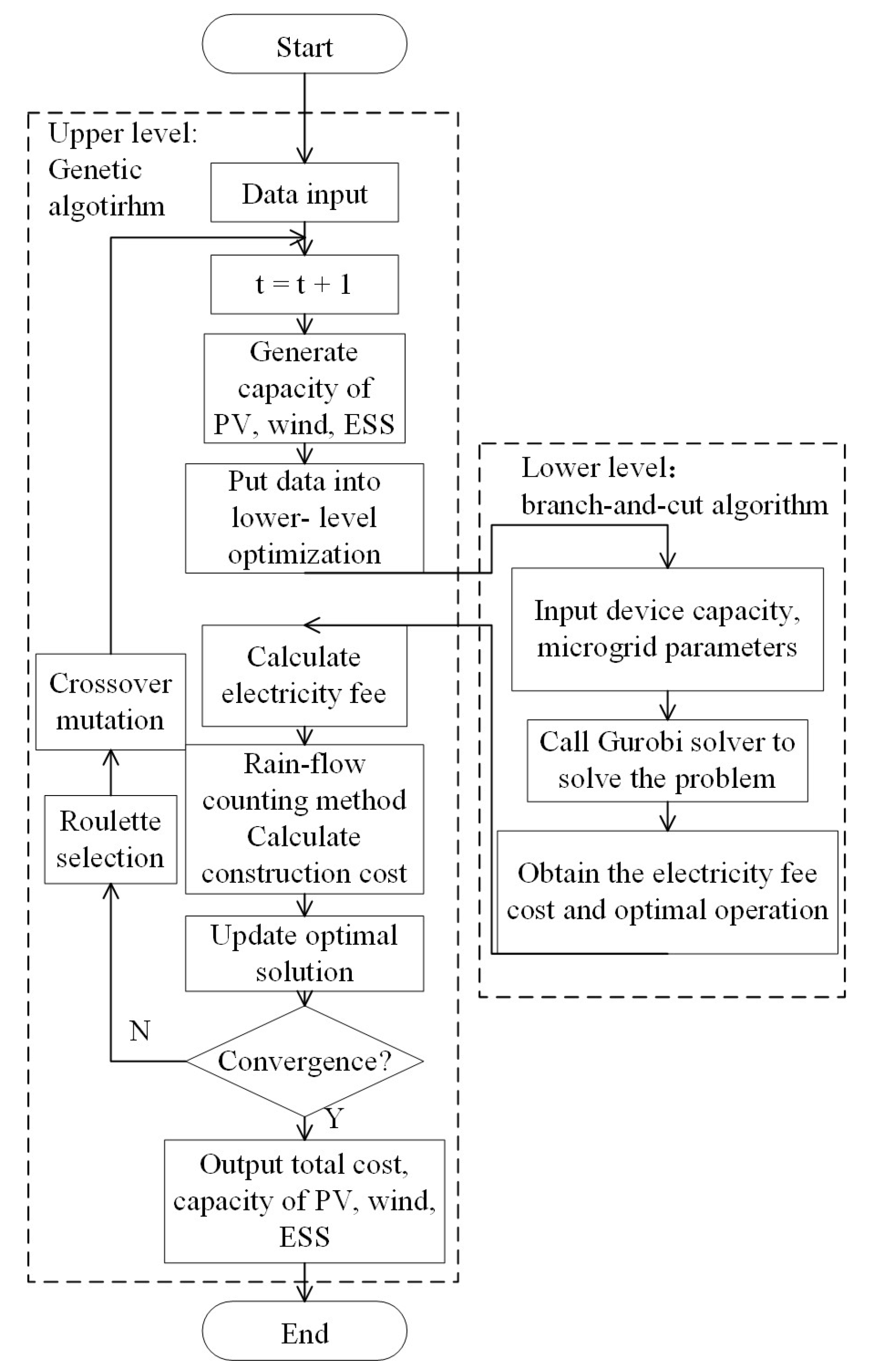
To address this issue, a two-layer optimization framework is adopted, as shown in
Figure 4. The upper layer utilizes an intelligent optimization algorithm to determine the optimal capacities of PV, wind power, and ESS, while the lower layer solves the corresponding operational scheduling problem of the microgrid with given device capacities. Specifically, a genetic algorithm (GA) is employed in the upper layer, where the capacities of the PV, wind power, and ESS units are represented as chromosomes encoded in binary form. Each individual solution is randomly initialized and evaluated using a fitness function. Then, these data are used in the lower-level optimization as constant, and the problem is solved by the branch-and-cut algorithm, as shown in Algorithm 1 [
40].
Figure 4.
Flow chart of the proposed problem-solving algorithm.
Figure 4.
Flow chart of the proposed problem-solving algorithm.
| Algorithm 1: Branch-and-cut algorithm |
Input: Gap, renewable power output data, device capacity data (given by upper-layer algorithm)
Output: Overall cost, scheduling plan, ESS charge–discharge operation.
Step 1: Initialize.Assume is , the relaxation of is . The tree of the nodes to be solved is . Assume the up bound of the tree is . For a node , assume its low bound .
Step 2: Terminate.If or , then solve the corresponding to the best and turn to Step 8. If there is no available, the problem is infeasible.
Step 3: Choose.Step 4: Relaxation.
Solve the relation problem of .
If it is infeasible,
set
and turn to Step 6.
If it is feasible, set to be the optimal value of the relation problem, and set as the optimal solution.
Else .
Step 5: Add the cutting plane.Step 6: Estimate and prune.If , return to Step 2. Else, if , , prune all the nodes with in and return to Step 2.
Step 7: Branch.
branch the problem as two sub-problems.
Step 8: Output.
If the problem is feasible, output the overall cost, scheduling plan, and ESS charge–discharge operation. |
The optimal operating cost obtained from the lower-layer problem is passed back to the GA as the fitness value. Based on this value, the GA performs evolutionary operations such as selection, crossover, and mutation to identify superior individuals for subsequent generations. During the evaluation process, the rain-flow counting algorithm, which is shown in Algorithm 2, is invoked to count the charge–discharge cycles of the ESS and estimate its lifetime, thereby calculating the average daily construction cost.
| Algorithm 2: Rain-flow Counting Algorithm |
Input: Load signal data (time series)
Output: Cycle list (complete cycles and half cycles with corresponding amplitudes)
Step 1: Initialization. Extract turning points from the load signal. Initialize an empty stack S. Initialize an empty list C to store cycle counts.
Step 2: Cycle matching.
For each turning point p in the extracted sequence,
• Push p onto S.
• While S contains at least three points:
- Let X = third-last element in S, Y = second-last element, Z = last element.
- If |Y − X| ≤ |Z − Y|:
‣ Count a complete cycle with amplitude = |Y − X|.
‣ Append this cycle to C.
‣ Remove Y (the second-last element) from S.
- Else, exit the inner loop.
Step 3: Half-cycle processing.
For each adjacent pair of points in the remaining stack S:
• Compute half-cycle amplitude = |next point − current point|.
• Append this half cycle (with a count of 0.5) to C.
Step 4: Termination.
Return the cycle list C as the final output.
If there any node can be relaxed and feasible,
branch the problem as two sub-problems. |
The proposed planning approach adopts a bi-level architecture, where the upper level determines the device capacities using a genetic algorithm (GA) and the lower level computes the operating schedule using the branch-and-cut method. For larger-scale microgrids (or microgrid clusters), the number of capacity-related decision variables remains relatively limited, and thus the GA can explore the planning space efficiently. In contrast, the computational burden of the lower-level branch-and-cut solver may grow exponentially with the number of parameters, as is typical for mixed-integer optimization. In practical engineering applications, however, the solution time can be expressed as the product of the number of explored search-tree nodes and the time required to solve the continuous relaxation at each node. The size of the root-node relaxation typically scales approximately linearly with the number of time steps, and commercial solvers such as Gurobi can solve the resulting lower-level problem within seconds when the model size is moderate. Therefore, the overall computation time is usually acceptable for practical use. For example, the proposed method can solve the optimization problem with a 15 min time slot and nearly 7000 decision variables in two minutes, and the problem with a time slot of 1 h and 1728 decision variables within 20 s. Nevertheless, increasing the temporal resolution (i.e., the number of time steps) rapidly enlarges the lower-level problem and can lead to super-linear growth in runtime. For example, when the time slot is set to be 5 min and the number of decision variables extends to 21,000, the time to solve the problem extends to hours according to our previous research. To mitigate this issue, a practical remedy is to decompose the lower-level scheduling problem into a two-stage optimization, e.g., an hourly optimization followed by an intra-hour refinement, thereby decoupling decision variables across time scales and substantially reducing the solution time.
Additionally, it should be noted that the aforementioned calculation time was obtained on a desktop computer equipped with an 11th Gen Intel(R) Core (TM) i7-11800H processor running at 2.30 GHz and 16 GB of memory. This time may vary depending on the computing equipment and software platform used. However, the overall trend reflected by the aforementioned data remains unchanged, thus indicating to some extent the impact of time slot and number of variables on the algorithm’s calculation speed.
5. Case Study and Results
In this section, a representative microgrid system is established to evaluate the effectiveness of the proposed optimization method. All system models and solution algorithms are implemented on the Gurobi platform [
41], which is widely utilized for solving linear and mixed-integer programming problems. The simulations are executed on a desktop computer equipped with an 11th Gen Intel(R) Core(TM) i7-11800H processor running at 2.30 GHz and 16 GB of memory.
5.1. Simulation Setup
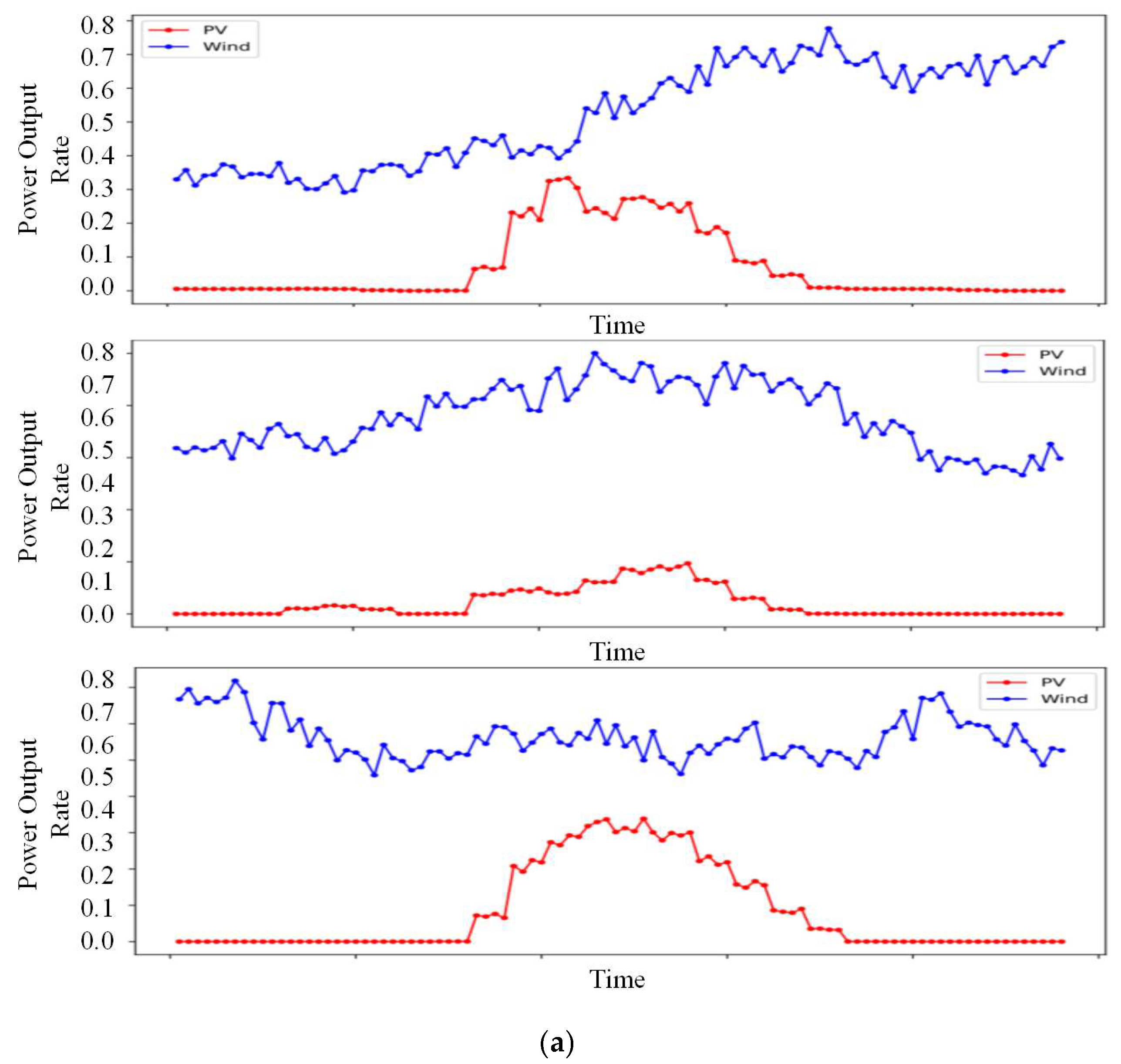
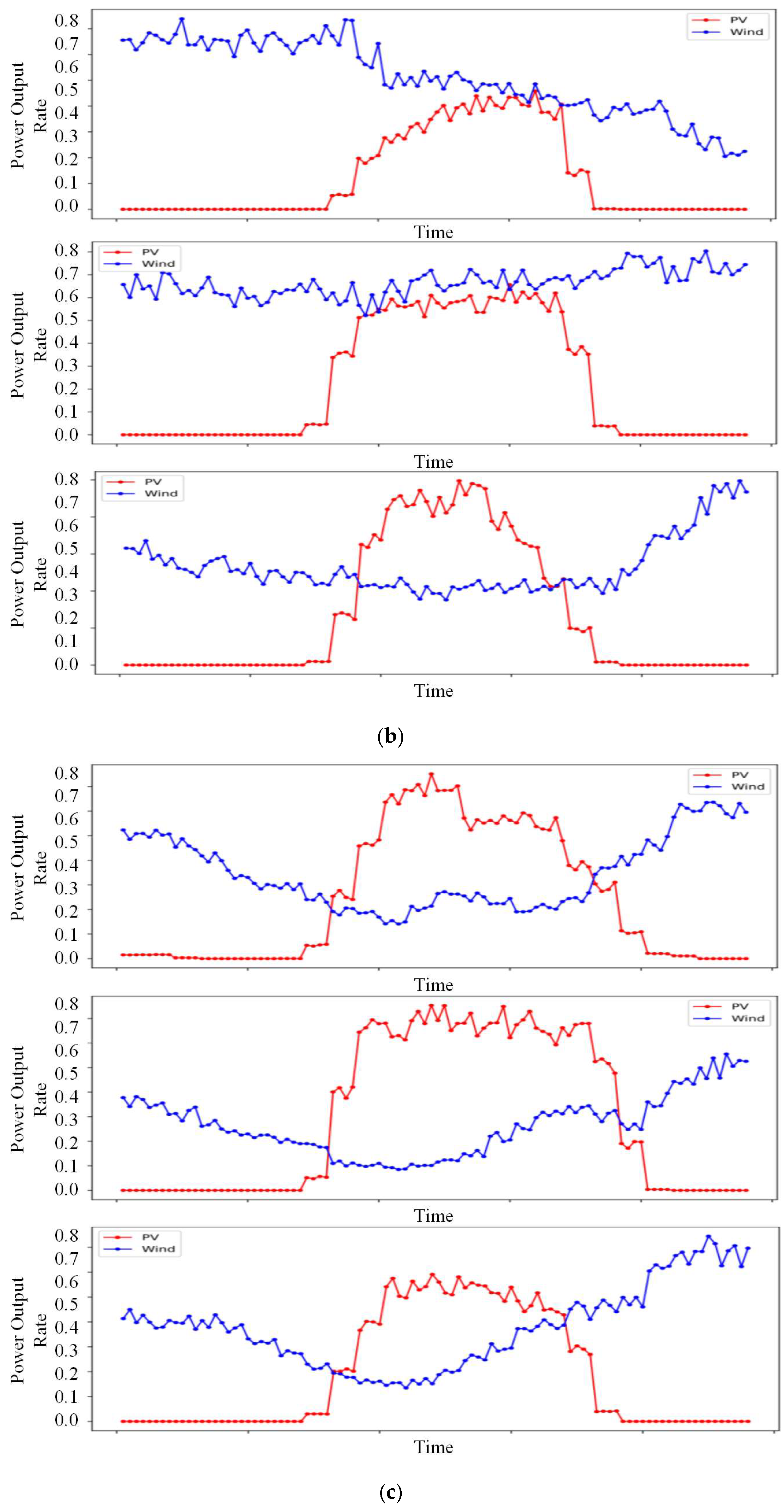
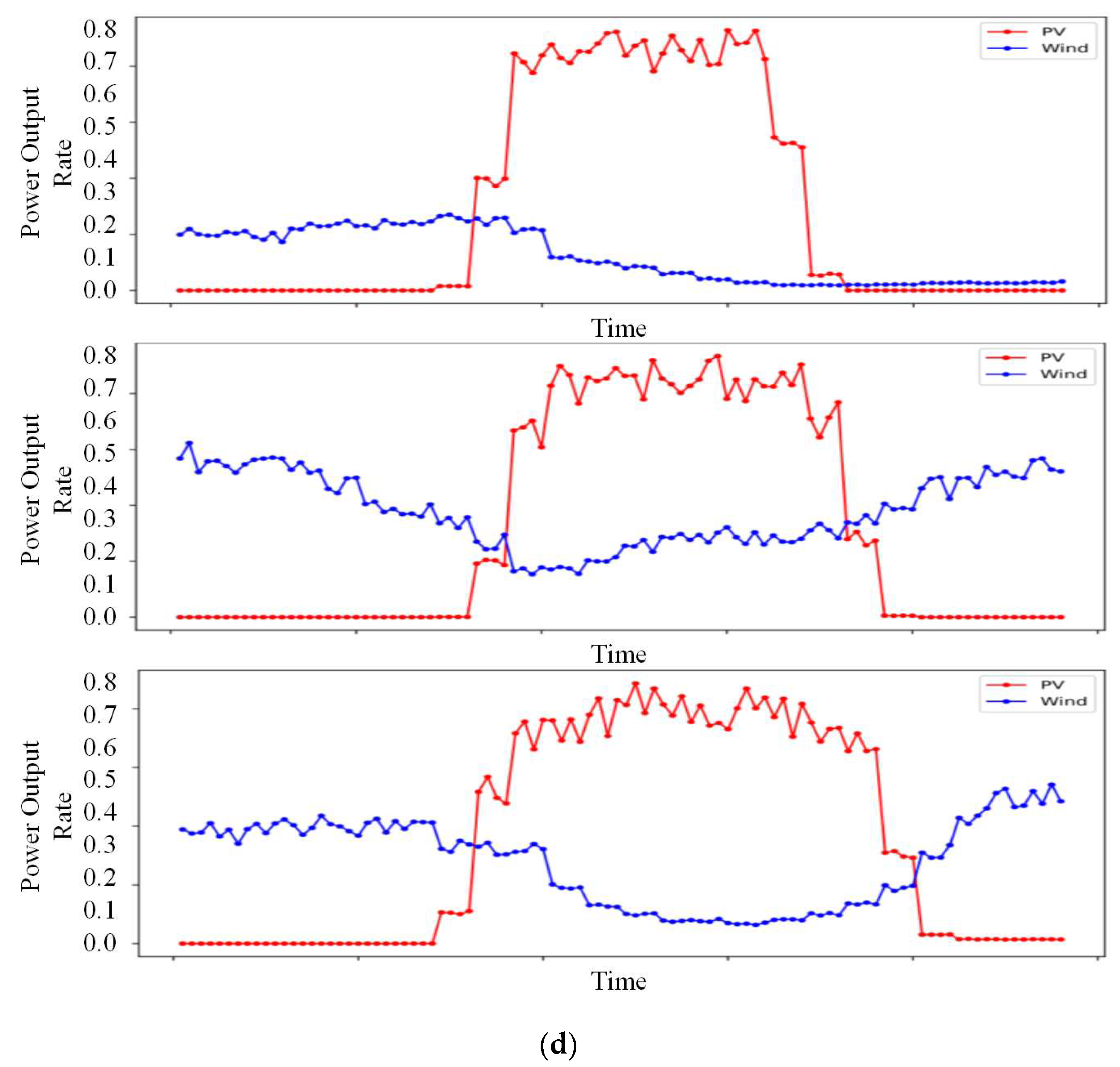
To verify the effectiveness of the proposed method, a microgrid with grid-forming ESS, renewable energy, and flexible electricity load is simulated. In the simulation, the microgrid is geographically located in Texas, and the real-time electricity price, as well as solar and wind generation data, are obtained from ERCOT [
42], as shown in
Figure 5. In
Figure 5, the typical days are classified into four categories to capture typical weather conditions occurring throughout the year. The parameters of the energy storage system are derived and scaled from ERCOT scheduling data [
42]. The workload profiles are constructed based on the datasets provided in [
33,
42], which are distributed across three nodes, and maximum power of each node is 15 MW, as shown in
Table 2 [
40]. The construction cost of the solar, wind, and energy storage systems is listed in
Table 3, and the parameters of the ESS, which were collected in related research, are listed in
Table 4.
The selected data center (DC) scenario is representative of real-world loads in modern microgrids for three main reasons. First, the data centers have been expanding in scale and electricity consumption, becoming a major demand-side sector and a practically meaningful flexible-load use case. Second, in the studied DC load composition, time-shiftable workloads and real-time workloads each account for 50%, which reasonably captures the coexistence of flexible (schedulable) and inflexible (non-deferrable) demand commonly observed in practice, thereby improving the representativeness and comparability of the case study. Third, DC microgrids typically offer strong temporal and spatial controllability (e.g., adjusting job start times, workload migration, and consolidation), providing greater scheduling freedom than traditional loads and a larger synergy space with renewable generation and energy storage. As a result, the proposed framework can more clearly demonstrate benefits in renewable energy utilization, peak shaving/valley filling, and reductions in operating cost and carbon emissions. Therefore, using a data center as the flexible-load case study provides an engineering-relevant and practically grounded benchmark for validating the proposed planning and scheduling method.
5.2. Case Study
In the proposed optimization framework, the capacities of devices within the data center microgrid are jointly optimized. To validate the effectiveness of the method, two simulation cases are designed for comparison:
Case I: The capacities of the microgrid components—including photovoltaic, wind generation, and energy storage systems—are fixed based on data from a typical data center, as shown in
Table 5 and
Table 6. In this case, only the operational scheduling of the microgrid is optimized.
Case II: Both the device capacities and the operational scheduling of the microgrid are jointly optimized, and the lifetime is considered in the optimization.
Moreover, to isolate the marginal benefit of the joint capacity–operation optimization, verify the effectiveness of ESS capacity, and highlight the influence of lifetime estimation, three simulation cases are designed to for comparison.
Case III: The capacity of photovoltaic, wind generation, and energy storage systems is optimized, and the lifetime is considered in the optimization, but the batch workload is replaced by interactive workload with equal total amount.
Case IV: The capacity of photovoltaic and wind generation is fixed as the data in
Table 6; the ESS capacity and workload are optimized by the proposed method.
Case V: The capacity of photovoltaic, wind generation, and energy storage systems is optimized, but the lifetime is not taken into consideration.
In the above cases, Case II represents the proposed method. By comparing the result in Case I and Case II, the effectiveness of proposed method can be verified. By comparing results in Case II, Case III, and Case IV, the ESS capacity optimization is verified without the interference of renewable power and flexible workload. By comparing the results in Case II and Case V, the effectiveness of considering lifetime is verified. Based on the above case definitions,
Section 5.3 reports the numerical results and interprets the cost and lifetime impacts of joint planning–scheduling and lifetime awareness.
5.3. Result Analysis
5.3.1. Average Daily Costs
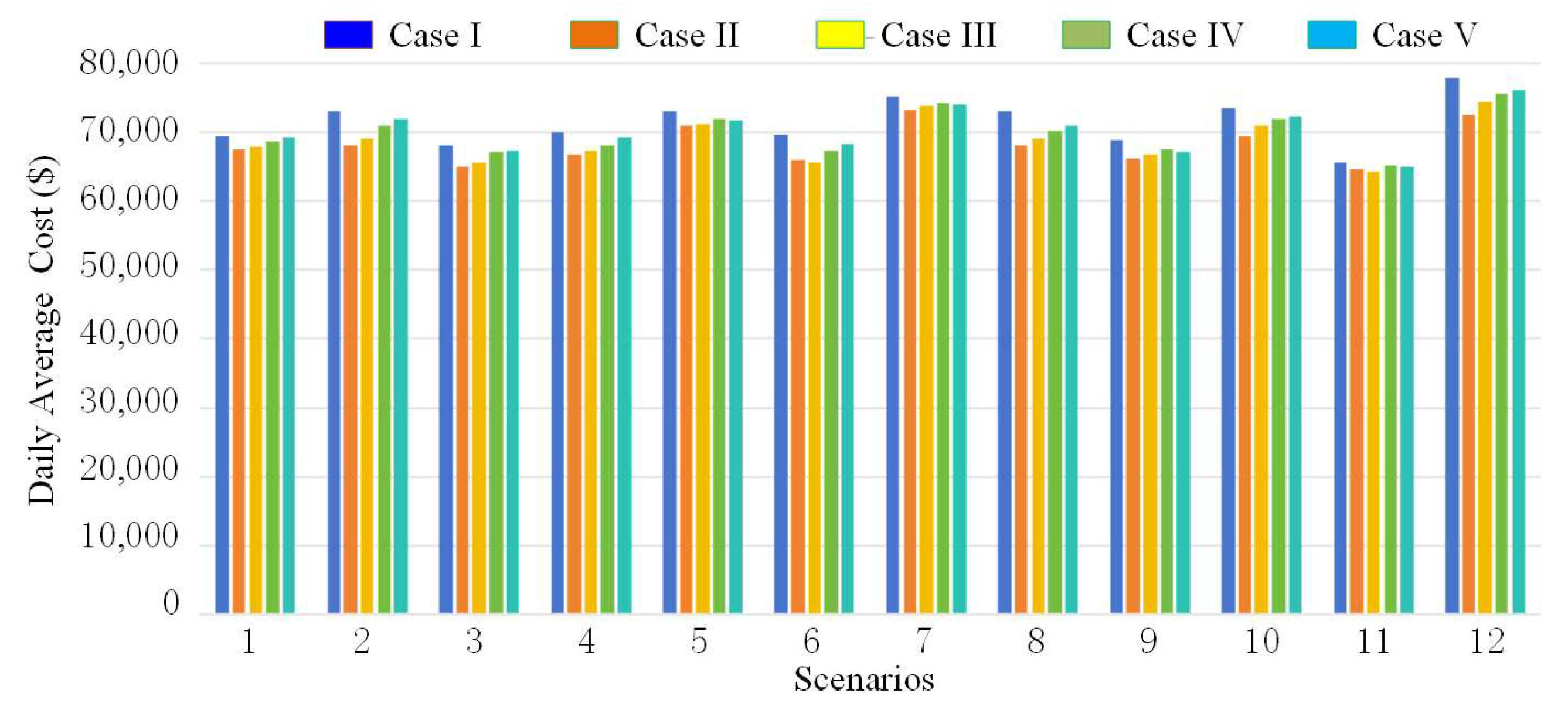
The average daily costs for the aforementioned cases were plotted in
Figure 6 based on simulations of 12 typical days. The differences among cases were normalized by the corresponding baseline cost to compute the cost-reduction rate, which is reported in
Table 7.
In
Figure 6, Case II presented the lowest cost among the five cases, which can demonstrate the effectiveness of the proposed method. The results across the 12 typical days also indicated that the method remained robust under different environmental conditions.
Moreover, by analyzing the detailed cost reduction listed in
Table 7, the interference of elements in the microgrid can be eliminated to some extent. Comparing the result of Case I and Case II, the proposed method reduced the overall cost by 1.51–6.82% compared with the existing microgrid with optimized device capacity. Moreover, device capacity in typical day 1 is listed in
Table 8. By comparing the results in Case II and Case III, it can be seen that the workload scheduling flexibility contributed to the cost reduction, which proved the necessity of considering load flexibility in optimization. By comparing the results in Case II and Case IV, we can find the reduction was relatively minor, which illustrated that the capacity optimization of wind and solar power does not dominate the improvement. By comparing the results in Case II and Case IV, it can be seen that the reduction varied from 1.03% to 5.53% in different situations, which was considered acceptable. Beyond the cost comparison, we further analyzed how lifetime-aware scheduling changed the ESS cycling behavior, which directly affected degradation and replacement cost.
5.3.2. Device Lifetime of ESS
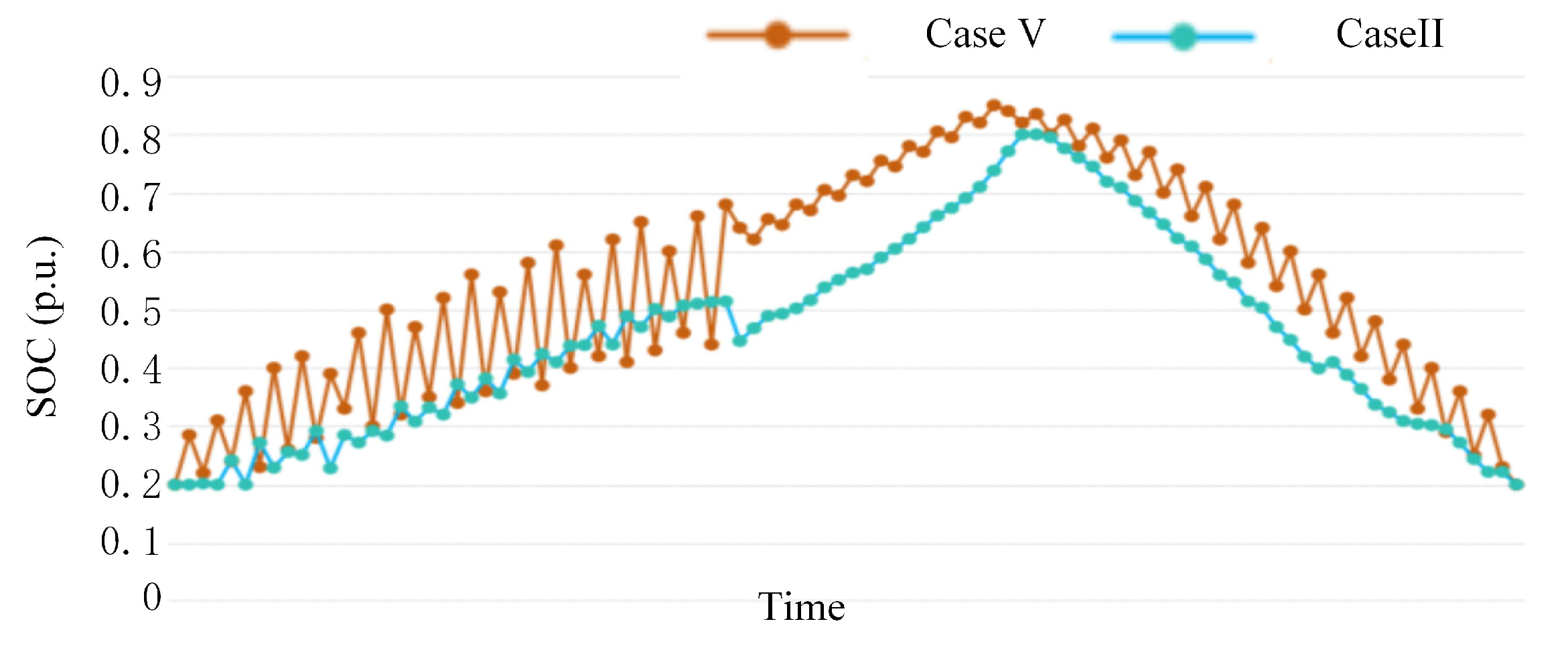
The SOC of the energy storage system in Case II (proposed method) and Case V (not considering the lifetime) is given below. After statistical analysis using the rain-flow counting method, the equivalent number of cycles was 1.938 in Case V and 1.193 in Case II. The number of charge and discharge cycles decreased obviously after the optimization, as shown in
Figure 7, which illustrated the effectiveness of the proposed method in extending the device lifetime and reducing the overall cost.
5.4. Limitations and Potential Improvements
Although the proposed method demonstrates certain advantages in terms of life-cycle cost and operational performance, we have to admit the limitations in this work. First, the measurement delays are not considered in the optimization. This may lead to slightly overly optimistic results, but is unlikely to cause a significant difference. Because the measurement delay is minor compared to the time slot (15 min), it would not lead to a large deviation. Second, the communication failures are not considered in the optimization. This may lead to dropout of computational tasks, but can be avoided by existing algorithms built into the task scheduling platform. Therefore, the above two technical details are ignored in the paper. Third, the study lacks hardware experiments and does not address detailed control processes, as it primarily focuses on a static optimization of modeling and planning rather than a real-time control strategy.
In future research, we plan to explore the real-time control process and conduct real-time simulation in validation using tools such as Simulink. Furthermore, the simulation step size is set to 15 min rather than a shorter time scale. This is due to the fact that the original data used in the study was recorded at 15 min intervals. In practical applications, this issue can be addressed by collecting or experimentally obtaining higher-resolution data.