

You are currently viewing a new version of our website. To view the old version click .

Pathogens, Volume 8, Issue 1

March 2019 - 41 articles

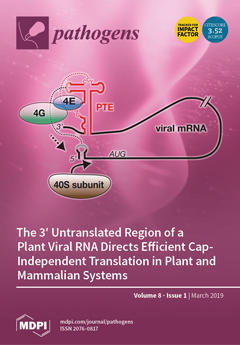
Cover Story: Model for cap-independent translation mediated by a plant viral sequence in mammalian cells. The panicum mosaic virus-like translation element (PTE), found in the 3’ untranslated region of several plant viruses, binds translation initiation factor eIF4E (4E) via a G-rich bulge in a pseudoknot (red dashed line). eIF4E also binds eIF4G (4G), which recruits other initiation factors (not shown). Long-distance base pairing (black dashed line) places the factors near or on the 5’ end, to which they recruit the 40S ribosomal subunit, which then scans to the start codon (AUG), where protein synthesis begins. Kraft et al. show that the PTE of a plant virus functions efficiently in mammalian cells and extracts, possibly because of the conserved structure of eIF4E in plants and animals. This leads the authors to propose that such PTE-like elements may exist in mammalian viral or host mRNAs. View this paper.
  • Issues are regarded as officially published after their release is announced to the table of contents alert mailing list .
  • You may sign up for email alerts to receive table of contents of newly released issues.
  • PDF is the official format for papers published in both, html and pdf forms. To view the papers in pdf format, click on the "PDF Full-text" link, and use the free Adobe Reader to open them.

Articles (41)

  • Review
  • Open Access
38 Citations
6,712 Views
14 Pages

Over the last decades, fungal infections have emerged as a growing threat to human health. Although the human body is at potential risk, various body sites host several commensal fungal species, including Candida albicans. In healthy individuals, C....

  • Article
  • Open Access
1 Citations
3,815 Views
8 Pages

Lymphatic filariasis, caused by lymphatic filarial parasites, Wuchereria bancrofti, and Brugia malayi, causes significant morbidity and disability to 120 million people in the tropics and subtropics. Chitin has an important role for embryogenesis in...

  • Review
  • Open Access
18 Citations
4,899 Views
11 Pages

Bacterial sialoglycosidases in Virulence and Pathogenesis

  • Preethi Sudhakara,
  • Iyappan Sellamuthu and
  • A. Wilson Aruni

Human oral microbiome and dysbiotic infections have been recently evidently identified. One of the major reasons for such dysbiosis is impairment of the immune system. Periodontitis is a chronic inflammatory disease affecting the tissues that surroun...

  • Article
  • Open Access
14 Citations
4,938 Views
15 Pages

A Simple Genotyping Method for Rapid Differentiation of Blastocystis Subtypes and Subtype Distribution of Blastocystis spp. in Thailand

  • Nittaya Srichaipon,
  • Surang Nuchprayoon,
  • Sarit Charuchaibovorn,
  • Pattadon Sukkapan and
  • Vivornpun Sanprasert

Blastocystis spp. is one of the most common protozoa of humans and animals worldwide. The genetic diversity of Blastocystis spp. might be associated with a wide range of symptoms. However, the prevalence of each subtype is different in each country....

  • Article
  • Open Access
39 Citations
7,204 Views
18 Pages

Ready-to-eat (RTE) leafy salad vegetables are considered foods that can be consumed immediately at the point of sale without further treatment. The aim of the study was to investigate the bacterial community composition of RTE salads at the point of...

  • Article
  • Open Access
21 Citations
5,015 Views
12 Pages

In Situ Characterization of Hfq Bacterial Amyloid: A Fourier-Transform Infrared Spectroscopy Study

  • David Partouche,
  • Valeria Militello,
  • Andrea Gomez-Zavaglia,
  • Frank Wien,
  • Christophe Sandt and
  • Véronique Arluison

Hfq is a bacterial protein that regulates gene expression at the post-transcriptional level in Gram-negative bacteria. We have previously shown that Escherichia coli Hfq protein, and more precisely its C-terminal region (CTR), self-assembles into an...

  • Article
  • Open Access
26 Citations
5,511 Views
14 Pages

Colonization of HIV-Infected Children with Methicillin-Resistant Staphylococcus aureus

  • Eric S. Donkor,
  • Fleischer C. N. Kotey,
  • Nicholas T. K. D. Dayie,
  • Samuel Duodu,
  • Patience B. Tetteh-Quarcoo,
  • Mary-Magdalene Osei and
  • Edem M. A. Tette

Background: Methicillin-resistant Staphylococcus aureus (MRSA) poses a public health threat owing to its extensive resistance to antibiotics, association with persistent outbreaks, and markedly increased healthcare costs. Moreover, HIV-infected indiv...

  • Article
  • Open Access
25 Citations
4,812 Views
12 Pages

Intra-Species and Inter-Species Differences in Cytokine Production by Porcine Antigen-Presenting Cells Stimulated by Mycoplasma hyopneumoniae, M. hyorhinis, and M. flocculare

  • Sarah Fourour,
  • Corinne Marois-Créhan,
  • Léa Martelet,
  • Christelle Fablet,
  • Isabelle Kempf,
  • Marcelo Gottschalk and
  • Mariela Segura

Mycoplasma hyorhinis and M. flocculare are commonly co-isolated with M. hyopneumoniae (primary agent of swine enzootic pneumonia) in gross pneumonia-like lesions, but their involvement in the disease process remains unknown. T cells play an immuno-pa...

  • Article
  • Open Access
15 Citations
7,241 Views
16 Pages

HIV Replication in Humanized IL-3/GM-CSF-Transgenic NOG Mice

  • Federico Perdomo-Celis,
  • Sandra Medina-Moreno,
  • Harry Davis,
  • Joseph Bryant and
  • Juan C. Zapata

The development of mouse models that mimic the kinetics of Human Immunodeficiency Virus (HIV) infection is critical for the understanding of the pathogenesis of disease and for the design of novel therapeutic strategies. Here, we describe the dynamic...

  • Article
  • Open Access
69 Citations
7,358 Views
16 Pages

Listeria monocytogenes can persist in food production facilities, resulting in serious threats to consumers due to the high mortality associated with listeriosis, especially in the very young, old and pregnant. We subtyped 124 strains of L. monocytog...

of 5

Get Alerted

Add your email address to receive forthcoming issues of this journal.

XFacebookLinkedIn
Pathogens - ISSN 2076-0817