You are currently viewing a new version of our website. To view the old version click .

Toxins, Volume 11, Issue 2

February 2019 - 74 articles

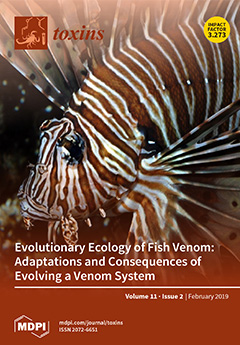
Cover Story: Venomous fish have been relatively poorly studied, with respect to both the composition and evolution of their venoms. This review attempts to summarize what is known about the evolution of fish venoms from an ecological perspective and, where possible, to place it in the context of the evolutionary ecology of other venomous/toxic taxa. It delves into the consequences and adaptations associated with evolving a venom system from aposematism and mimicry to niche ecology, coevolution, and natural enemy interactions. Understanding these broad ecological facets can shed more light on other areas of toxinology, with applications across multiple disciplinary fields. View this paper.
  • Issues are regarded as officially published after their release is announced to the table of contents alert mailing list .
  • You may sign up for email alerts to receive table of contents of newly released issues.
  • PDF is the official format for papers published in both, html and pdf forms. To view the papers in pdf format, click on the "PDF Full-text" link, and use the free Adobe Reader to open them.

Articles (74)

  • Article
  • Open Access
15 Citations
4,204 Views
10 Pages

18 February 2019

Thirty strains of Aspergillus niger, including 27 intended used in the food industry of China, were studied for their ochratoxin A (OTA) production on the three natural substrates—corn, rice, and wheat bran—at different time intervals by high-perform...

  • Article
  • Open Access
44 Citations
6,228 Views
20 Pages

Evaluation of Cellulosic Polymers and Curcumin to Reduce Aflatoxin B1 Toxic Effects on Performance, Biochemical, and Immunological Parameters of Broiler Chickens

  • Bruno Solis-Cruz,
  • Daniel Hernandez-Patlan,
  • Victor M. Petrone,
  • Karine P. Pontin,
  • Juan D. Latorre,
  • Eric Beyssac,
  • Xochitl Hernandez-Velasco,
  • Ruben Merino-Guzman,
  • Casey Owens and
  • Billy M. Hargis
  • + 2 authors

16 February 2019

To evaluate the effect of cellulosic polymers (CEL) and curcumin (CUR) on aflatoxin B1 (AFB1) toxic effects on performance, and the biochemical and immunological parameters in broiler chickens, 150 one-day-old male broiler chicks were randomly alloca...

  • Article
  • Open Access
39 Citations
5,772 Views
10 Pages

NaCl Inhibits Citrinin and Stimulates Monascus Pigments and Monacolin K Production

  • Zhixin Zhen,
  • Xiaoqian Xiong,
  • Yingbao Liu,
  • Jialan Zhang,
  • Shaojin Wang,
  • Li Li and
  • Mengxiang Gao

15 February 2019

Applications of beneficial secondary metabolites produced by Monascus purpureus (M. purpureus) could be greatly limited for citrinin, a kidney toxin. The link of NaCl with cell growth and secondary metabolites in M. purpureus was analyzed with supple...

  • Article
  • Open Access
4 Citations
4,818 Views
36 Pages

15 February 2019

Candida albicans (C. albicans) is the most prevalent fungal species. Although it is a healthy microbiota, genetic and epigenetic alterations in host and pathogen, and microenvironment changes would lead to thrush, vaginal yeast infection, and even he...

  • Review
  • Open Access
38 Citations
18,207 Views
36 Pages

The Toxins of Nemertean Worms

  • Ulf Göransson,
  • Erik Jacobsson,
  • Malin Strand and
  • Håkan S. Andersson

15 February 2019

Most ribbon worms (phylum: Nemertea) are found in marine environments, where they act as predators and scavengers. They are characterized by an eversible proboscis that is used to hunt for prey and thick mucus covering their skin. Both proboscis and...

  • Communication
  • Open Access
28 Citations
5,661 Views
12 Pages

14 February 2019

The protein abundances of phospholipases A2 in cobra venom proteomes appear to vary among cobra species. To determine the unique distribution of snake venom phospholipases A2 (svPLA2) in the cobras, the svPLA2 activities for 15 cobra species were exa...

  • Correction
  • Open Access
1 Citations
2,721 Views
1 Page

14 February 2019

The authors wish to make the following correction to their paper [...]

  • Opinion
  • Open Access
89 Citations
9,643 Views
9 Pages

Biocontrol of Aspergillus and Fusarium Mycotoxins in Africa: Benefits and Limitations

  • Victor Kagot,
  • Sheila Okoth,
  • Marthe De Boevre and
  • Sarah De Saeger

13 February 2019

Fungal contamination and the consequent mycotoxin production is a hindrance to food and feed safety, international trade and human and animal health. In Africa, fungal contamination by Fusarium and Aspergillus is heightened by tropical climatic condi...

  • Article
  • Open Access
28 Citations
5,665 Views
9 Pages

Aflatoxin Contamination of Milk Marketed in Pakistan: A Longitudinal Study

  • Agha Waqar Yunus,
  • Nida Imtiaz,
  • Haider Khan,
  • Mohammed Nawaz Mohammed Ibrahim and
  • Yusuf Zafar

13 February 2019

A longitudinal one-year study was conducted to determine aflatoxin M1 levels in different types of milk marketed in Pakistan. Processed and raw liquid milk from 21 sources, two milk powder and six tea whitener brands were sampled on monthly basis fro...

  • Brief Report
  • Open Access
3 Citations
3,919 Views
11 Pages

The Adenylate Cyclase (CyaA) Toxin from Bordetella pertussis Has No Detectable Phospholipase A (PLA) Activity In Vitro

  • Alexis Voegele,
  • Mirko Sadi,
  • Dorothée Raoux-Barbot,
  • Thibaut Douché,
  • Mariette Matondo,
  • Daniel Ladant and
  • Alexandre Chenal

13 February 2019

The adenylate cyclase (CyaA) toxin produced in Bordetella pertussis is the causative agent of whooping cough. CyaA exhibits the remarkable capacity to translocate its N-terminal adenyl cyclase domain (ACD) directly across the plasma membrane into the...

of 8

Get Alerted

Add your email address to receive forthcoming issues of this journal.

XFacebookLinkedIn
Toxins - ISSN 2072-6651