You are currently viewing a new version of our website. To view the old version click .

Toxins, Volume 11, Issue 1

January 2019 - 58 articles

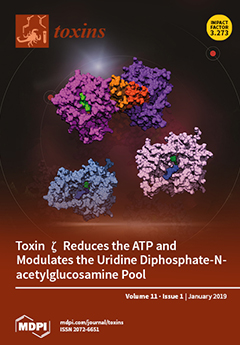
Cover Story: In the non-toxic ζε2ζ toxin–antitoxin complex, toxin ζ (e.g., magenta) interacts with the peptidoglycan precursor uridine diphosphate-N-acetylglucosamine (UNAG, green), but interactions with ε2 antitoxin (orange) and ATP (blue) are mutually exclusive. In the absence of ε2, ζ primarily hydrolyses ATP and, with very low efficiency, phosphorylates the C3´-OH group of UNAG (cyan: ζ with ATP close to UNAG), irreversibly producing unreactive UNAG-P. ζ binds ATP >5 Å apart from UNAG >75% of the time (orchid: ζ with ATP far from UNAG) and displays greater affinity for UNAG-P than for UNAG, disfavouring direct transfer of ATP-P to UNAG-O3’. View this paper.
  • Issues are regarded as officially published after their release is announced to the table of contents alert mailing list .
  • You may sign up for email alerts to receive table of contents of newly released issues.
  • PDF is the official format for papers published in both, html and pdf forms. To view the papers in pdf format, click on the "PDF Full-text" link, and use the free Adobe Reader to open them.

Articles (58)

  • Article
  • Open Access
4 Citations
4,570 Views
16 Pages

21 January 2019

The physiological and toxicological characteristics of Dinophysis acuminata have been increasingly studied in an attempt to better understand and predict diarrhetic shellfish poisoning (DSP) events worldwide. Recent work has identified prey quantity,...

  • Feature Paper
  • Review
  • Open Access
38 Citations
12,365 Views
50 Pages

21 January 2019

The occurrence of Harmful Algal Blooms (HABs) and bacteria can be one of the great threats to public health due to their ability to produce marine toxins (MTs). The most reported MTs include paralytic shellfish toxins (PSTs), amnesic shellfish toxins...

  • Article
  • Open Access
53 Citations
4,991 Views
11 Pages

Simultaneous Lateral Flow Immunoassay for Multi-Class Chemical Contaminants in Maize and Peanut with One-Stop Sample Preparation

  • Du Wang,
  • Jianguo Zhu,
  • Zhaowei Zhang,
  • Qi Zhang,
  • Wen Zhang,
  • Li Yu,
  • Jun Jiang,
  • Xiaomei Chen,
  • Xuefang Wang and
  • Peiwu Li

20 January 2019

Multi-class chemical contaminants, such as pesticides and mycotoxins, are recognized as the major risk factors in agro products. It is thus necessary to develop rapid and simple sensing methods to fulfill the on-site monitoring of multi-class chemica...

  • Article
  • Open Access
12 Citations
6,269 Views
19 Pages

18 January 2019

The nearly-ubiquitous food and feed-borne mycotoxin aflatoxin B1 (AFB1) is carcinogenic and mutagenic, posing a food safety threat to humans and animals. One of the most susceptible animal species known and thus a good model for characterizing toxico...

  • Article
  • Open Access
9 Citations
3,983 Views
13 Pages

Development of Indirect Competitive Enzyme-Linked Immunosorbent Assay to Detect Fusarium verticillioides in Poultry Feed Samples

  • Aline Myuki Omori,
  • Elisabete Yurie Sataque Ono,
  • Melissa Tiemi Hirozawa,
  • Igor Massahiro de Souza Suguiura,
  • Elisa Yoko Hirooka,
  • Maria Helena Pelegrinelli Fungaro and
  • Mario Augusto Ono

17 January 2019

Fumonisins are a group of toxic secondary metabolites that are produced by Fusarium verticillioides which are associated with poultry health hazard and great economic losses. The objective of the present study was to develop an immunological method t...

  • Article
  • Open Access
36 Citations
6,535 Views
16 Pages

Gut Microbiota Profiling of Aflatoxin B1-Induced Rats Treated with Lactobacillus casei Shirota

  • Winnie-Pui-Pui Liew,
  • Sabran Mohd-Redzwan and
  • Leslie Thian Lung Than

17 January 2019

Aflatoxin B1 (AFB1) is a ubiquitous carcinogenic food contaminant. Gut microbiota is of vital importance for the host’s health, regrettably, limited studies have reported the effects of xenobiotic toxins towards gut microbiota. Thus, the presen...

  • Article
  • Open Access
16 Citations
5,338 Views
15 Pages

Mass Spectrometry Analysis and Biological Characterization of the Predatory Ant Odontomachus monticola Venom and Venom Sac Components

  • Naoki Tani,
  • Kohei Kazuma,
  • Yukio Ohtsuka,
  • Yasushi Shigeri,
  • Keiichi Masuko,
  • Katsuhiro Konno and
  • Hidetoshi Inagaki

17 January 2019

We previously identified 92 toxin-like peptides and proteins, including pilosulin-like peptides 1–6 from the predatory ant Odontomachus monticola, by transcriptome analysis. Here, to further characterize venom components, we analyzed the venom and ve...

  • Article
  • Open Access
34 Citations
17,592 Views
18 Pages

17 January 2019

Lingual dystonia is a debilitating type of oromandibular dystonia characterized by involuntary, often task-specific, contractions of the tongue muscle activated by speaking or eating. Botulinum neurotoxin (BoNT) has been used to treat lingual dystoni...

  • Article
  • Open Access
6 Citations
4,625 Views
14 Pages

Monitoring the Disulfide Bonds of Folding Isomers of Synthetic CTX A3 Polypeptide Using MS-Based Technology

  • Sheng-Yu Huang,
  • Tin-Yu Wei,
  • Bing-Shin Liu,
  • Min-Han Lin,
  • Sheng-Kuo Chiang,
  • Sung-Fang Chen and
  • Wang-Chou Sung

17 January 2019

Native disulfide formation is crucial to the process of disulfide-rich protein folding in vitro. As such, analysis of the disulfide bonds can be used to track the process of the folding reaction; however, the diverse structural isomers interfere with...

  • Review
  • Open Access
40 Citations
11,680 Views
28 Pages

Toxin Neutralization Using Alternative Binding Proteins

  • Timothy Patrick Jenkins,
  • Thomas Fryer,
  • Rasmus Ibsen Dehli,
  • Jonas Arnold Jürgensen,
  • Albert Fuglsang-Madsen,
  • Sofie Føns and
  • Andreas Hougaard Laustsen

17 January 2019

Animal toxins present a major threat to human health worldwide, predominantly through snakebite envenomings, which are responsible for over 100,000 deaths each year. To date, the only available treatment against snakebite envenoming is plasma-derived...

of 6

Get Alerted

Add your email address to receive forthcoming issues of this journal.

XFacebookLinkedIn
Toxins - ISSN 2072-6651