



Pharmaceuticals, Volume 18, Issue 10 (October 2025) – 169 articles
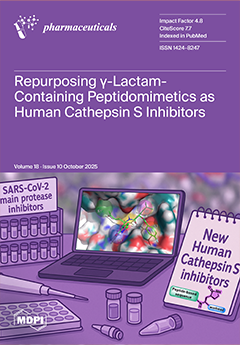
Cover Story (view full-size image):
Peptidomimetics incorporating a γ-lactam Gln derivative at the P1 site, originally developed as SARS-CoV-2 Mpro inhibitors, exhibited strong affinity for human cathepsin S (hCatS). In silico studies revealed that despite being solvent-exposed, the γ-lactam at P1 position might be involved in water-mediated hydrogen bonds. Molecular dynamics simulations suggested the presence of two predominant conformations, up and down, which differ in the γ-lactam orientation. Repurposing thousands of peptide-based SARS-CoV-2 Mpro inhibitors containing a γ-lactam at the P1 site, combined with new rational structure–activity relationship studies exploring the S1 pocket, could enable the identification of new potent and selective hCatS ligands. View this paper
- Issues are regarded as officially published after their release is announced to the table of contents alert mailing list.
- You may sign up for e-mail alerts to receive table of contents of newly released issues.
- PDF is the official format for papers published in both, html and pdf forms. To view the papers in pdf format, click on the "PDF Full-text" link, and use the free Adobe Reader to open them.
Previous Issue
Next Issue
