Skip to Content

International Journal of Molecular Sciences

International Journal of Molecular Sciences is an international, peer-reviewed, open access journal providing an advanced forum for biochemistry, molecular and cell biology, molecular biophysics, molecular medicine, and all aspects of molecular research in chemistry, and published semimonthly online by MDPI. The Epigenetics Society, European Chitin Society (EUCHIS), Spanish Society for Cell Biology (SEBC) and others are affiliated with IJMS and their members receive a discount on the article processing charges.

Get Alerted

Add your email address to receive forthcoming issues of this journal.

All Articles (114,882)

  • Brief Report
  • Open Access

Follicular lymphoma (FL) is an indolent B-cell malignancy typically associated with favourable outcomes and prolonged survival. However, histological transformation (HT) occurs in a subset of patients and significantly worsens survival outcomes, markedly altering the disease course. Currently, no clinical or molecular predictors of HT are available. We sought to evaluate the potential of Serpin family E member 1 (PAI-1) as a prognostic biomarker of HT in FL, with expression levels assessed by immunohistochemistry and quantified using digital image analysis. PAI-1 expression was evaluated in diagnostic lymphoma biopsies from 30 FL patients with no record of subsequent HT with a minimum follow-up of 10 years, ranging from 10.1 to 24.8 years (non-transforming FL, nt-FL), and 18 patients with subsequent HT occurring 0.7 to 14.6 years after diagnosis (subsequently transforming FL, st-FL); furthermore, the paired high-grade biopsy from the time of HT (transformed FL, tFL) was included. No significant differential expression patterns were identified comparing nt-FL, st-FL and tFL samples. However, high intrafollicular PAI-1 expression at FL diagnosis correlated with no transformation events observed. We believe high intrafollicular PAI-1 expression at presentation might define a minor subgroup of FL patients with reduced risk of HT.

Int. J. Mol. Sci.

1 October 2026
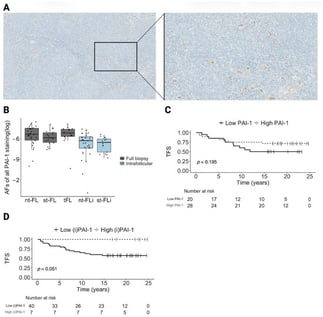
Tumoral expression of PAI-1 in FL and its association with TFS. (A) Immunohistochemical staining for PAI-1 in a diagnostic biopsy. Left: magnification at 5×, right: magnification at 10×. (B) Boxplot showing AFs of PAI-1 expression levels in full biopsy (grey) and intrafollicular areas (blue) in nt-FL, st-FL and tFL samples. No significant differences were observed. (C) Kaplan–Meier curves for TFS stratified by full biopsy PAI-1 expression (cutoff AF = 0.0029). (D) Kaplan–Meier curves for TFS stratified by intrafollicular PAI-1 expression (cutoff AF = 0.0046). Abbreviations: AF, area fraction; nt-FL, non-transforming FL; i, intrafollicular; PAI-1, Serpin family E member 1; st-FL, subsequently transforming FL; tFL, transformed FL; TFS, transformation-free survival.
  • Review
  • Open Access

Chronic rhinosinusitis (CRS) is a heterogeneous inflammatory disease imposing a substantial health and economic burden. Artificial intelligence (AI) has emerged as a promising tool to address CRS complexity in both clinical and research settings. We conducted a systematic review following PRISMA guidelines, searching PubMed, Web of Science, and Embase for peer-reviewed articles utilizing machine learning, deep learning, and natural language processing, with a focus on molecular-level or immunologic mechanisms in CRS. Thirty-one studies were included in the qualitative synthesis. Our results demonstrate that while AI-driven analysis helps stratify patient endotypes, the identified schemes exhibit substantial heterogeneity in cluster numbers and features, raising concerns about their reproducibility. AI applications also included histopathological image interpretation, drug discovery, biologic therapy selection, and prognostic modeling to evaluate revision surgery risks and olfactory dysfunction. However, using the PROBAST+AI framework, we found that 87.1% of the assessed studies carry a high overall risk of bias, mainly due to the reliance on apparent performance or internal validation and limited independent evaluation of model performance, indicating that many reported performance estimates may be optimistic. Future large-scale, multicenter collaborations integrating AI into clinical workflows will be essential to establish reliable and generalizable AI applications for personalized CRS management.

Int. J. Mol. Sci.

1 October 2026
Relationship between machine learning (ML), deep learning (DL), and natural language processing (NLP). ML is algorithms in AI that learn patterns from data. DL is a subfield of ML based on artificial neural networks (ANNs). NLP applies ML and DL techniques to analyze and represent human language.
  • Article
  • Open Access

Dielectric Response of Micelles Built from Intrinsically Disordered Beta-Casein

  • Yuriy F. Zuev,
  • Denis A. Smolei and
  • Ivan V. Lunev
  • + 5 authors

For many decades, protein function was associated with a rigid three-dimensional structure. However, in recent years, interest has grown rapidly in proteins that successfully perform their functions despite being intrinsically disordered. Unfortunately, to date, insufficient structural information has been collected on this novel protein family to analyze its structure–function correlations. To obtain the required structural information on intrinsically disordered beta-casein (b-CN), we used broadband dielectric spectroscopy, which has long been used to study structured proteins. Dielectric measurements in the frequency range from 1 Hz to 67 GHz detected three Cole–Cole relaxation processes in a micellar solution of disordered beta-casein. The experimental data obtained were used to estimate the dynamical hierarchy of dipole–dipole correlations involved in the relaxation of each dipole component of the system. The dielectric relaxation of micellized disordered b-CN is rather complex, indicating the cascade nature of protein relaxation, which involves long-range structural correlations of flexible charged protein chains. The relaxation of free and bound water is close to the Debye type, which is entirely consistent with the “wait and switch” model of dielectric relaxation, in which a water dipole waits for the arrival of a structural or ionic defect for reorientation. The relaxation rates of the two water fractions differ dramatically, with bound-water relaxation being two orders of magnitude slower than free-water relaxation. The most reasonable explanation for this difference probably lies in the spatial confinement of bound water resulting from the influence of the charged protein surface. The results obtained demonstrate the research potential of broadband dielectric spectroscopy not only for long-studied rigid, structured proteins with permanent dipole moments but also for the novel family of disordered proteins with fluctuating dipole moments.

Int. J. Mol. Sci.

1 October 2026
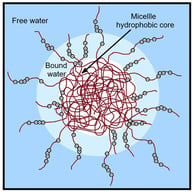
Schematic representation of a b-CN micelle. The white sphere shows the hydrophobic core of the micelle, formed by nonpolar amino acid residues. The light blue region represents the hydrophilic surface layer of the micelle, formed by polar amino acids, including negatively charged phosphoserines.
  • Article
  • Open Access

Maleylated-BSA-Coated Gold Nanopopcorns for Pulmonary Delivery of Quercetin

  • Onkar Nigade,
  • Bala Prabhakar and
  • Pravin Shende
  • + 1 author

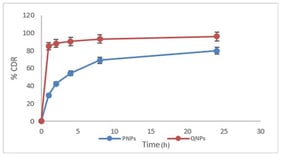
A non-motile bacterium, Mycobacterium tuberculosis (Mtb), causes tuberculosis (TB), an infection of the lower respiratory tract. Currently, rifampicin, isoniazid, ethambutol, and pyrazinamide are used as first-line treatment for drug-susceptible TB for two months, followed by four months of rifampicin and isoniazid. This treatment plan is linked to serious hepatic, dermatological, and hematopoietic adverse effects. The exploration of natural substances like quercetin for treating TB was driven by the significant side effects of the standard therapy protocol. Protein-coated gold nanopopcorns were developed as a dry-powder inhaler to deliver tailored medication to the lungs. The objective of this research article was to assess the effectiveness of quercetin-loaded gold nanopopcorns against Mtb H37Ra cells. The gold nanopopcorns prepared using the Turkevich method and subsequently coated with maleylated BSA (m-BSA) showed an adsorption efficiency of 87.02 ± 2.82%, particle size of 153.2 ± 26.45 nm, and a zeta potential of 29.3 ± 7.80 mV. In vitro release studies showed rapid initial release within 2 h, with a total drug release of 79.85 ± 1.33% over 24 h, with inhibition of 56.36% of H37Ra cells (IC50 = 2 μg/mL). These findings provide preliminary evidence for the potential of PNPs as a pulmonary quercetin delivery platform, warranting further evaluation in macrophage-based and tuberculosis disease models.

Int. J. Mol. Sci.

1 October 2026
In vitro release of QNPs and PNPs.

Featured Articles of Last Quarter

Highly Accessed Articles

News & Conferences

Latest Issues

Open for Submission

Journal Sections

Neurodegenerative Disease
Reprint

Neurodegenerative Disease

From Molecular Basis to Therapy, 3rd Edition
Editors: Claudia Ricci
XFacebookLinkedIn
Int. J. Mol. Sci. - ISSN 1422-0067