


Next Issue
Volume 16, January
Previous Issue
Volume 15, November
error_outline You can access the new MDPI.com website here. Explore and share your feedback with us.


Coatings, Volume 15, Issue 12 (December 2025) – 143 articles
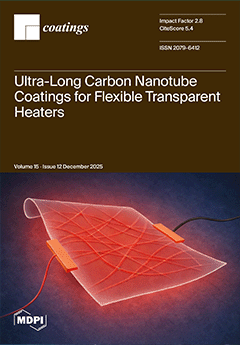
Cover Story (view full-size image): Transparent conductive coatings are essential for next-generation flexible electronics, yet conventional materials suffer from brittleness, instability, and high cost. This work presents a water-based, scalable coating approach using ultra-long carbon nanotube networks to fabricate flexible transparent heaters on plastic and glass substrates. The resulting coatings combine high optical transparency with stable electrical conductivity, enabling fast and uniform Joule heating while maintaining mechanical durability under repeated bending. Post-deposition flash photonic heating further enhances performance without damaging polymer substrates. This study highlights a simple, low-temperature pathway toward robust transparent heaters for defogging, sensing, and thermal actuation applications. View this paper
  • Issues are regarded as officially published after their release is announced to the table of contents alert mailing list.
  • You may sign up for e-mail alerts to receive table of contents of newly released issues.
  • PDF is the official format for papers published in both, html and pdf forms. To view the papers in pdf format, click on the "PDF Full-text" link, and use the free Adobe Reader to open them.
Order results
Result details
Section
Select all
Export citation of selected articles as:
8 pages, 177 KB  
Editorial
Progress and Perspectives in Nanostructured Thin Films
by Hummaira Khan and Yujun Song
Coatings 2025, 15(12), 1502; https://doi.org/10.3390/coatings15121502 - 18 Dec 2025
Viewed by 336
Abstract
The field of nanostructured thin films is experiencing rapid development, with materials scientists creating ever more fascinating structures at the nanoscale or even subnanoscale [...] Full article
(This article belongs to the Special Issue Advances in Nanostructured Thin Films and Coatings, 2nd Edition)
19 pages, 4008 KB  
Article
Enhanced PVDF Coating via Zr-Based Pretreatment on AZ31 Magnesium Alloy
by Hailuo Fu, Chenghao Zhu, Dali Wei, Qing Lin, Yihan Jiao and Shuyang Liu
Coatings 2025, 15(12), 1501; https://doi.org/10.3390/coatings15121501 - 18 Dec 2025
Viewed by 221
Abstract
Magnesium alloys are promising biodegradable orthopedic implant materials, but their clinical translation is hindered by rapid, unregulated corrosion in physiological environments. Polyvinylidene fluoride (PVDF) coating has attracted substantial attention for addressing the issue above. However, it suffers from insufficient interfacial adhesion to Mg [...] Read more.
Magnesium alloys are promising biodegradable orthopedic implant materials, but their clinical translation is hindered by rapid, unregulated corrosion in physiological environments. Polyvinylidene fluoride (PVDF) coating has attracted substantial attention for addressing the issue above. However, it suffers from insufficient interfacial adhesion to Mg alloy substrates. In this work, we propose a Zr-based pretreatment strategy to enhance PVDF coatings. The pretreatment was performed via a chemical conversion deposition method, which fabricated a Zr-based film on AZ31 magnesium alloy and greatly promoted the adhesion of the following PVDF coating. Interface analysis showed that coating adhesion was improved from 0.44 MPa to 2.48 MPa. In light of this, corrosion protection performance was significantly improved. Electrochemical tests in simulated body fluid revealed the enhanced PVDF coating shifted the corrosion potential from −1.594 V to −1.392 V and reduced the corrosion current density by over five orders of magnitude. Immersion tests also showed stable pH level, low weight loss, and good hydrophobicity with the enhanced PVDF coating. In summary, the enhanced PVDF coating provides excellent corrosion protection for magnesium alloys, thus boosting their biomedical use. Full article
Show Figures

Figure 1

17 pages, 4159 KB  
Article
Effect of Cathodic Voltage on Phase Composition, Microstructure, and Elevated-Temperature Oxidation Resistance of Micro-Arc Oxidation Ceramic Coatings on Ti65 Alloy
by Haitao Li, Yu Ma, Baicheng Liu, Xugang Wang and Hongliang Zhang
Coatings 2025, 15(12), 1500; https://doi.org/10.3390/coatings15121500 - 18 Dec 2025
Viewed by 201
Abstract
This study investigates the effect of cathodic voltage on the thickness, morphology, composition, phase structure, adhesion, and elevated-temperature oxidation resistance of the micro-arc oxidation (MAO) ceramic coatings on Ti65 alloy. Coatings were fabricated via MAO under cathodic voltages of 50 V, 100 V, [...] Read more.
This study investigates the effect of cathodic voltage on the thickness, morphology, composition, phase structure, adhesion, and elevated-temperature oxidation resistance of the micro-arc oxidation (MAO) ceramic coatings on Ti65 alloy. Coatings were fabricated via MAO under cathodic voltages of 50 V, 100 V, 150 V, and 200 V. Results indicate that the coatings primarily consist of rutile TiO2 (R-TiO2), anatase TiO2 (A-TiO2), and amorphous SiO2. The thickness of the MAO coatings increased with rising cathodic voltage, while the surface porosity and average pore size of the coatings were first decreased and then increased with the increase in cathodic voltage. Excellent coating adhesion to the substrate was confirmed by 50 thermal shock cycles between 700 °C and room temperature. Cyclic oxidation tests at 750 °C for 100 h demonstrated that all MAO coatings significantly enhanced elevated-temperature oxidation resistance compared to the bare Ti65 substrate. Notably, the coating produced at 100 V exhibited the lowest oxidation weight gain (0.50 mg/cm2), amounting to only one-third of the substrate’s gain. The effect of the cathodic voltage on the high-temperature oxidation performance of the MAO coatings was systematically analyzed. Full article
(This article belongs to the Section Ceramic Coatings and Engineering Technology)
Show Figures

Figure 1

17 pages, 14285 KB  
Article
Seismic Performance of Concrete Square Column Confined by Five-Spiral Composite Stirrups
by Shanshan Sun, Tao Yu, Xiangyu Gao, Zhaoqiang Zhang, Tian Su and Zhixing Hao
Coatings 2025, 15(12), 1499; https://doi.org/10.3390/coatings15121499 - 18 Dec 2025
Viewed by 258
Abstract
In order to solve the problem of inadequate confinement provided by traditional rectangular stirrups in concrete square columns under stringent seismic fortification requirements, a spiral stirrup with a better constraint effect was used in the square columns in this study. Through a comprehensive [...] Read more.
In order to solve the problem of inadequate confinement provided by traditional rectangular stirrups in concrete square columns under stringent seismic fortification requirements, a spiral stirrup with a better constraint effect was used in the square columns in this study. Through a comprehensive analysis of test results, numerical simulations, and theoretical derivations, the seismic performance and shear capacity calculation methods of concrete square columns confined with five-spiral composite stirrups were investigated. This study provides pertinent technical data to facilitate the engineering application of such columns. The existing low-cycle repeated loading tests of 13 concrete square columns confined with five-spiral composite stirrups were collected and analyzed; some of these specimens were selected for finite element numerical simulation, and the simulation results were compared with the test results. The results indicate that the hysteresis curves and skeleton curves obtained from the numerical simulation agree well with the experimental curves, which verifies the rationality of the numerical simulation model proposed in this paper; post-peak load behavior reveals a pronounced compound confinement effect attributable to the five-spiral stirrups; during mid-to-late loading stages, the tensile stress in small spiral stirrups at intersections with larger spirals escalates rapidly, resulting in maximum transverse confinement within these areas. Based on the validated numerical simulation approach, a comprehensive analysis was performed to investigate the effects of axial compression ratio, shear-span ratio, spacing of small spiral stirrups, and diameter ratio of large-to-small spiral stirrups on the seismic performance of the specimens. The results demonstrate that when the spacing of large and small spiral stirrups is kept consistent, the specimens yield optimal strength and ductility. With the diameter of the central large-spiral stirrup fixed, either an increase or a decrease in the diameter of small spiral stirrups will induce varying degrees of reduction in both strength and ductility of the specimens. Furthermore, the five-spiral reinforced columns achieve the best overall seismic performance when the diameter of the central large spiral stirrup reaches the maximum allowable value for the cross-section, and the diameter of small spiral stirrups is set to one-third that of the large spiral stirrup. Finally, the shear mechanism and influencing factors of the shear capacity of the concrete square columns confined with five-spiral composite stirrups were discussed, and a practical formula for calculating the shear capacity of such columns was proposed. Full article
(This article belongs to the Section Environmental Aspects in Colloid and Interface Science)
Show Figures

Figure 1

16 pages, 2368 KB  
Article
Thermo-Chemo-Mechanical Coupling in TGO Growth and Interfacial Stress Evolution of Coated Dual-Pipe System
by Weiao Song, Tianliang Wu, Junxiang Gao, Xiaofeng Guo, Bo Yuan and Kun Lv
Coatings 2025, 15(12), 1498; https://doi.org/10.3390/coatings15121498 - 18 Dec 2025
Viewed by 185
Abstract
Improving the energy efficiency of advanced ultra-supercritical (USC) power plants by increasing steam operating temperature up to 700 °C can be achieved, at reduced cost, by using novel engineering design concepts, such as coated steam pipe systems manufactured from high temperature materials commonly [...] Read more.
Improving the energy efficiency of advanced ultra-supercritical (USC) power plants by increasing steam operating temperature up to 700 °C can be achieved, at reduced cost, by using novel engineering design concepts, such as coated steam pipe systems manufactured from high temperature materials commonly used in current operational power plants. The durability of thermal barrier coatings (TBC) in advanced USC coal power systems is critically influenced by thermally grown oxide (TGO) evolution and interfacial stress under thermo-chemo-mechanical coupling. This study investigates a novel dual-pipe coating system comprising an inner P91 steel pipe with dual coatings and external cooling, designed to mitigate thermal mismatch stresses while operating at 700 °C. A finite element framework integrating thermo-chemo-mechanical coupling theory is developed to analyze TGO growth kinetics, oxygen diffusion, and interfacial stress evolution. Results reveal significant thermal gradients across the coating, reducing the inner pipe surface temperature to 560 °C under steady-state conditions. Oxygen diffusion and interfacial curvature drive non-uniform TGO thickening, with peak regions exhibiting 23% greater thickness than troughs after 500 h of oxidation. Stress analysis identifies axial stress dominance at top coat/TGO and TGO/bond coat interfaces, increasing from 570 MPa to 850 MPa due to constrained volumetric changes and incompatible growth strains. The parabolic TGO growth kinetics and stress redistribution mechanisms underscore the critical role of thermo-chemo-mechanical interactions in interfacial degradation. These research findings will facilitate the optimization of coating architectures and the enhancement of structural integrity in high-temperature energy systems. Meanwhile, clarifying the stress evolution within the coating can improve the ability to predict failures in USC coal power technology. Full article
(This article belongs to the Section Surface Characterization, Deposition and Modification)
Show Figures

Figure 1

16 pages, 4447 KB  
Article
Effects of Relaxation and Nanocrystallization on Wear and Corrosion Behaviors of Fe-Based Amorphous Coating
by Shenghai Weng, Zhibin Zhang, Yuxi Fu, Lin Xue, Peisong Song, Liliang Shao, Xiubing Liang, Jiangbo Cheng and Binbin Zhang
Coatings 2025, 15(12), 1497; https://doi.org/10.3390/coatings15121497 - 18 Dec 2025
Viewed by 280
Abstract
In this study, amorphous Fe60Nb3B17Si6Cr6Ni4Mo4 coatings were prepared using the high-velocity air fuel method. The microstructure, wear resistance, and corrosion resistance of the Fe60Nb3B17Si [...] Read more.
In this study, amorphous Fe60Nb3B17Si6Cr6Ni4Mo4 coatings were prepared using the high-velocity air fuel method. The microstructure, wear resistance, and corrosion resistance of the Fe60Nb3B17Si6Cr6Ni4Mo4 coatings were examined for various levels of nanocrystallization. In contrast to the as-sprayed coating, the samples that were heat-treated formed partial α-Fe and crystalline Cr2O3. The generated nanocrystals exerted a dispersion-strengthening effect on the coatings, leading to enhanced hardness and fracture toughness. When the annealing temperature was below the initial crystallization temperature, the wear resistance improved by approximately 1.65 times, the wear rate decreased to half of that in the as-sprayed state, and the depth of the wear scar reduced. However, the resistance of the coatings to corrosion deteriorated as the degree of crystallization increased. X-ray photoelectron spectroscopy analysis revealed that heat treatment modified the composition of the passive film, thereby influencing its corrosion resistance. These results provide crucial insights into the application of Fe-based amorphous coatings in wear- and corrosion-resistant environments. Full article
(This article belongs to the Special Issue Advanced Corrosion- and Wear-Resistant Coatings)
Show Figures

Figure 1

19 pages, 8828 KB  
Article
Properties of Chromium Nitride and Diamond-like Coatings in Tribological Systems Lubricated with Artificial Blood
by Krystyna Radoń-Kobus and Monika Madej
Coatings 2025, 15(12), 1496; https://doi.org/10.3390/coatings15121496 - 18 Dec 2025
Viewed by 267
Abstract
This study investigated the tribological and mechanical properties of chromium nitride (CrN and CrN/DLC) coatings applied to 316L steel in an artificial blood environment. The wettability of the tested surfaces was determined and the hardness was also tested using the instrumental indentation. Friction-wear [...] Read more.
This study investigated the tribological and mechanical properties of chromium nitride (CrN and CrN/DLC) coatings applied to 316L steel in an artificial blood environment. The wettability of the tested surfaces was determined and the hardness was also tested using the instrumental indentation. Friction-wear tests were performed using a TRB3 tribometer in a rotating ball-on-disc configuration. The tests were performed under dry friction conditions and with lubrication using artificial blood at pH 7.45 (neutral environment) and pH 7.15 (acidified environment). Wear of the friction pairs was examined using an interferometric-confocal microscope. Artificial blood was chosen to simulate human body fluids. The use of the CrN/DLC coating reduced the coefficient of friction by 83% for dry friction, by 62% for friction with neutral artificial blood lubrication, and by 69% for friction with acidic artificial blood lubrication, respectively. Despite the increased coefficient of friction of the CrN coating, its use also contributed to reduced material wear. Full article
(This article belongs to the Special Issue Advancements in Surface Engineering, Coatings and Tribology)
Show Figures

Graphical abstract

20 pages, 5137 KB  
Review
Recent Emerging MOF Textiles for Catalytic Degradation of Chemical Warfare Agents and Their Simulants
by Jia Liu, Yingqi Tang, Huijuan Zhao and Guodong Zhao
Coatings 2025, 15(12), 1495; https://doi.org/10.3390/coatings15121495 - 18 Dec 2025
Viewed by 416
Abstract
Chemical warfare agents (CWAs) threaten peace and global security due to their extreme toxicity and devastating effects. Prompt discovery and detoxification are imperative to protect ourselves from these perilous agents. Metal–organic frameworks (MOFs), characterized by high specific surface areas, tunable porosities, and chemical [...] Read more.
Chemical warfare agents (CWAs) threaten peace and global security due to their extreme toxicity and devastating effects. Prompt discovery and detoxification are imperative to protect ourselves from these perilous agents. Metal–organic frameworks (MOFs), characterized by high specific surface areas, tunable porosities, and chemical stability, have attracted growing interest for the catalytic degradation of CWAs. However, the powder form of MOFs hinders their application in protection, and it is challenging to combine them with flexible carriers to protect humans. In this context, we provide an update on the recent development of MOF textile materials for the efficient degradation of CWAs. The research progress on different technologies for the catalytic degradation of CWAs and their simulants in MOF textiles in recent years is presented. Furthermore, challenges in developing MOF textiles for the catalytic degradation of CWAs and their simulants are highlighted. It is expected that these useful insights will be beneficial in constructing relevant MOF textiles for the degradation of CWAs. Full article
(This article belongs to the Section Surface Characterization, Deposition and Modification)
Show Figures

Figure 1

15 pages, 1594 KB  
Article
Effects of Coated Knitted Polyester Fabric Properties on Strength and Color Fastness Performance of Automotive Seat Cover
by Umut Kıvanç Şahin
Coatings 2025, 15(12), 1494; https://doi.org/10.3390/coatings15121494 - 18 Dec 2025
Viewed by 294
Abstract
This article focuses on developing a high-performance coated knitted fabric for automotive seat covers designed to meet the demands of the automotive industry and offer a viable alternative to current products. To achieve this, polyester yarns—commonly used and widely accepted in the market—were [...] Read more.
This article focuses on developing a high-performance coated knitted fabric for automotive seat covers designed to meet the demands of the automotive industry and offer a viable alternative to current products. To achieve this, polyester yarns—commonly used and widely accepted in the market—were selected. Using these materials, six different knitted fabrics were produced, including two two-thread single jersey and four interlock structures. After undergoing pretreatment, the fabrics were stabilized using a stenter machine. Subsequently, they were coated using three distinct coating formulations with four layers and tested for tensile strength, elongation, bonding strength, and abrasion resistance (Martindale test) to assess their mechanical properties, as well as color fastness to perspiration, light, and crocking. The test results were then analyzed to identify the better fabric characteristics and the most effective coating formulation among those studied. Full article
(This article belongs to the Special Issue Advances in Coated Fabrics and Textiles)
Show Figures

Graphical abstract

10 pages, 4149 KB  
Article
Mg-Air Battery with High Coulombic Efficiency and Discharge Current by Electrode and Electrolyte Modification
by Taoran Wang, Yanyan An, Wenjuan Yang, Wenchang Yang, Yongqiang Ji and Fan Xu
Coatings 2025, 15(12), 1493; https://doi.org/10.3390/coatings15121493 - 18 Dec 2025
Viewed by 334
Abstract
Addressing corrosion issues in Mg-air batteries is vital for improving energy storage technologies. Unlike traditional methods that focus solely on electrode materials or electrolyte composition, this study introduces a novel integrated strategy that combines electrode surface modification and controlled electrolyte content. Through comprehensive [...] Read more.
Addressing corrosion issues in Mg-air batteries is vital for improving energy storage technologies. Unlike traditional methods that focus solely on electrode materials or electrolyte composition, this study introduces a novel integrated strategy that combines electrode surface modification and controlled electrolyte content. Through comprehensive numerical simulations, the details of corrosion kinetics and ion migration mechanisms at the atomic level are revealed. Our findings demonstrate exceptional Coulombic efficiencies (>97%) and enhanced ion diffusion by over three times, ensuring the desired discharge current. This approach not only overcomes traditional limitations but also offers important insights for the research community, paving the way for the design of high-performance Mg-air batteries in next-generation energy storage systems. Full article
Show Figures

Graphical abstract

18 pages, 8349 KB  
Article
Interfacial Gradient Optimization and Friction-Wear Response of Three Architectures of Ni-Based Cold Metal Transfer Overlays on L415QS Pipeline Steel
by Bowen Li, Min Zhang, Mi Zhou, Keren Zhang and Xiaoyong Zhang
Coatings 2025, 15(12), 1492; https://doi.org/10.3390/coatings15121492 - 18 Dec 2025
Viewed by 258
Abstract
Pipeline steels under cyclic loading in corrosive environments are prone to wear and corrosion–wear synergy. Low-dilution, high-reliability Ni-based Cold Metal Transfer (CMT) overlays are therefore required to ensure structural integrity. In this work, three overlay architectures were deposited on L415QS pipeline steel: a [...] Read more.
Pipeline steels under cyclic loading in corrosive environments are prone to wear and corrosion–wear synergy. Low-dilution, high-reliability Ni-based Cold Metal Transfer (CMT) overlays are therefore required to ensure structural integrity. In this work, three overlay architectures were deposited on L415QS pipeline steel: a single-layer ERNiFeCr-1 coating, a double-layer ERNiFeCr-1/ERNiFeCr-1 coating, and an ERNiCrMo-3 interlayer plus ERNiFeCr-1 working layer. The microstructure, interfacial composition gradients, and dry sliding wear behavior were systematically characterized to clarify the role of interlayer design. The single-layer ERNiFeCr-1 coating shows a graded transition from epitaxial columnar grains to cellular/dendritic and fine equiaxed grains, with smooth Fe dilution, Ni–Cr enrichment, and a high fraction of high-angle grain boundaries, resulting in sound metallurgical bonding and good crack resistance. The double-layer ERNiFeCr-1 coating contains coarse, strongly textured columnar grains and pronounced interdendritic segregation in the upper layer, which promotes adhesive fatigue and brittle spalling and degrades wear resistance and friction stability. The ERNiCrMo-3 interlayer introduces continuous Fe-decreasing and Ni-Cr/Mo-increasing gradients, refines grains, suppresses continuous brittle phases, and generates dispersed second phases that assist crack deflection and load redistribution. Under dry sliding, the tribological performance ranks as follows: interlayer + overlay > single-layer > double-layer. The ERNiCrMo-3 interlayer system maintains the lowest and most stable friction coefficient due to the formation of a dense tribo-oxidative glaze layer. These results demonstrate an effective hierarchical alloy-process design strategy for optimizing Ni-based CMT overlays on pipeline steels. Full article
Show Figures

Figure 1

29 pages, 18594 KB  
Article
Weathering and Restoration of Traditional Rammed-Earth Walls in Fujian, China
by Carlos Ka Nok Lo and Junxin Song
Coatings 2025, 15(12), 1491; https://doi.org/10.3390/coatings15121491 - 17 Dec 2025
Viewed by 339
Abstract
Traditional rammed-earth buildings, a key component of Fujian’s architectural heritage, are increasingly vulnerable to environmental degradation and urban relocation. This study focuses on the weathering patterns and restoration strategies of the rammed-earth walls at Zishantang, a typical 19th-century residence in Yongtai County. Through [...] Read more.
Traditional rammed-earth buildings, a key component of Fujian’s architectural heritage, are increasingly vulnerable to environmental degradation and urban relocation. This study focuses on the weathering patterns and restoration strategies of the rammed-earth walls at Zishantang, a typical 19th-century residence in Yongtai County. Through SEM, EDS, XRD, and Raman spectroscopy, eight groups of samples were analyzed to evaluate microstructural deterioration under different forms of environmental exposure. Results show that walls lacking intact soot ash coatings (“Wu-yan-hui”) exhibit greater porosity, microcracking, and mineral loss—particularly on exposed facades. These findings highlight the protective role of traditional soot–lime coatings and suggest that orientation and exposure-specific conservation strategies are essential. This study provides a scientific basis for preserving the material authenticity and structural integrity of relocated rammed-earth heritage in humid subtropical climates. Full article
Show Figures

Figure 1

17 pages, 8139 KB  
Article
Flow-Induced Groove Corrosion in Gas Well Deliquification Tubing: Synergistic Effects of Multiphase Flow and Electrochemistry
by Wenwen Song, Junfeng Xie, Jun Yi, Lei Wen, Pan Dai, Yongxu Li, Yanming Liu and Xianghong Lv
Coatings 2025, 15(12), 1490; https://doi.org/10.3390/coatings15121490 - 17 Dec 2025
Viewed by 317
Abstract
Gas well deliquification is a key technology for mitigating liquid loading and restoring or enhancing production capacity in ultra-deep, high-temperature, and high-pressure gas wells. The abnormal corrosion behavior observed in the gas lift tubing of the Well X-1 oilfield in western China, within [...] Read more.
Gas well deliquification is a key technology for mitigating liquid loading and restoring or enhancing production capacity in ultra-deep, high-temperature, and high-pressure gas wells. The abnormal corrosion behavior observed in the gas lift tubing of the Well X-1 oilfield in western China, within the 50–70 °C interval (1000–1500 m), was investigated. By analyzing the asymmetric wall thinning and axial groove morphology on the inner surface of tubing and then establishing a two-dimensional model of the vertical wellbore, the gas–liquid flow behavior and associated corrosion mechanisms were also elucidated. Results indicate that the flow pattern evolves from slug flow at the bottomhole, through a transitional pattern below the gas lift valve, to annular-mist flow at and above the valve. The wall shear stress peaks at the gas lift valve coupled with the significantly higher fluid velocity above the valve, which markedly elevates the corrosion rate. In this regime, the resultant annular-mist flow features a high-velocity gas core carrying entrained droplets, whose impingement synergistically enhances electrochemical corrosion, forming severe groove-like morphology along the inner tubing wall. Therefore, the corrosion in this well is attributed to the synergistic effect of the mechano-electrochemical coupling between multiphase flow and electrochemical processes on the inner surface of the tubing. Full article
(This article belongs to the Special Issue Tribological and Corrosion Properties of the Surfaces)
Show Figures

Figure 1

25 pages, 6143 KB  
Article
Adhesion Improvement Between Cu-Etched Commercial Polyimide/Cu Foils and Biopolymers for Sustainable In-Mold Electronics
by Zahra Fazlali, David Schaubroeck, Maarten Cauwe, Karen Leus, Rino Morent, Nathalie De Geyter, Ludwig Cardon, Pieter Bauwens and Jan Vanfleteren
Coatings 2025, 15(12), 1489; https://doi.org/10.3390/coatings15121489 - 17 Dec 2025
Viewed by 446
Abstract
Embedding flexible electronic circuits into a sustainable polymer is an emerging and significant topic in the field of in-mold electronics (IME). Ensuring strong adhesion between the flexible circuit and the molded polymer is critical for the durability of IME products. In this study, [...] Read more.
Embedding flexible electronic circuits into a sustainable polymer is an emerging and significant topic in the field of in-mold electronics (IME). Ensuring strong adhesion between the flexible circuit and the molded polymer is critical for the durability of IME products. In this study, three different types of etched copper polyimide (PI) foils were used as the substrate of electronic components. Two bio-based and biodegradable polymers of polylactic acid (PLA) and polyhydroxybutyrate (PHB) served as the overmolding material. Four different surface pretreatments: drying, polydopamine (PDA) coating, PDA coating followed by thermal treatment under vacuum, oxygen plasma, and 3-aminopropyltriethoxysilane (APTES) were applied to the PI surface prior to the overmolding process to investigate the influence on the adhesive strength. Additionally, a thermoplastic polyurethane (TPU) adhesive layer was introduced via vacuum lamination to further improve adhesion. The main objective of this study was to evaluate the adhesive strength between etched PI and overmolded biopolymers before and after surface modifications. The loci of failure were analyzed using scanning electron microscopy (SEM). The results indicate that laminated TPU is the most effective approach for improving adhesion between polyimide foils and biopolymers. Full article
(This article belongs to the Section Functional Polymer Coatings and Films)
Show Figures

Figure 1

14 pages, 1343 KB  
Article
Research on the Formation Mechanisms of Red Stains on Outdoor Marble Cultural Relics at Beijing Confucian Temple and the Imperial College
by Yuanyuan Wang, Jiaru Liu, Yi Zhou, Wenjia Hu, Jiao Pan and Jianrui Zha
Coatings 2025, 15(12), 1488; https://doi.org/10.3390/coatings15121488 - 17 Dec 2025
Viewed by 269
Abstract
Stone relics exposed to outdoor environments frequently experience surface deterioration, with red stains being a common and persistent issue. The stains often observed on marble and limestone surfaces arise from complex interactions involving chemical reaction, pollutant deposition, and microbiological process. Although microbial colonization [...] Read more.
Stone relics exposed to outdoor environments frequently experience surface deterioration, with red stains being a common and persistent issue. The stains often observed on marble and limestone surfaces arise from complex interactions involving chemical reaction, pollutant deposition, and microbiological process. Although microbial colonization has been associated with biodeterioration, the specific mechanisms remain poorly understood. This study focuses on the red stains found on the Danbi marble carvings at Beijing Confucian Temple and the Imperial College. Combining microbial cultivation, molecular identification (ITS sequencing), SEM-EDS (Scanning Electron Microscopy), Raman spectroscopy, and HPLC-MS (high-performance liquid chromatography with mass spectrometry), we identified the pigment-producing fungus Lizonia empirigonia as the dominant agent, with no evidence of inorganic contributors such as iron/lead oxides. Metabolite profiling revealed flavonoids and polyketides as key coloring material, while controlled infection experiments demonstrated the fungus’s reliance on exogenous organic matter rather than direct stone degradation. Our findings highlight microbial activity as a primary driver of red stains in marble relics and underscore the importance of organic contaminant control in conservation. Full article
Show Figures

Figure 1

16 pages, 3254 KB  
Article
Ultra-Long Carbon Nanotubes-Based Flexible Transparent Heaters
by Nov Dubnov, Shahar Artzi, Yousef Farraj, Ronen Gottesman, Shuki Yeshurun and Shlomo Magdassi
Coatings 2025, 15(12), 1487; https://doi.org/10.3390/coatings15121487 - 16 Dec 2025
Viewed by 342
Abstract
Transparent conductive materials (TCMs) are essential for optoelectrical devices ranging from smart windows and defogging films to soft sensors, display technologies, and flexible electronics. Materials, such as indium tin oxide (ITO) and silver nanowires (AgNWs), are commonly used and offer high optical transmittance [...] Read more.
Transparent conductive materials (TCMs) are essential for optoelectrical devices ranging from smart windows and defogging films to soft sensors, display technologies, and flexible electronics. Materials, such as indium tin oxide (ITO) and silver nanowires (AgNWs), are commonly used and offer high optical transmittance and electrical conductivity, but suffer from brittleness, oxidation susceptibility, and require high-cost materials, greatly limiting their use. Carbon nanotube (CNT) networks provide a promising alternative, featuring mechanical compliance, chemical robustness, and scalable processing. This study reports an aqueous ink formulation composed of ultra-long mix-walled carbon nanotubes (UL-CNTs), compatible with the flow coating process, yielding uniform transparent conductive films (TCFs) on polyethylene terephthalate (PET), glass, and polycarbonate (PC). The resulting films exhibit tunable transmittance (85%–88% for single layers; ~57% for three layers at 550 nm) and sheet resistance of 7.5 kΩ/□ to 1.5 kΩ/□ accordingly. These TCFs maintain stable sheet resistance for over 5000 bending cycles and show excellent mechanical durability with negligible effects on heating performance. Post-deposition treatments, including nitric acid vapor doping or flash photonic heating (FPH), further reduce sheet resistance by up to 80% (7.5 kΩ/□ to 1.2 kΩ/□). X-ray photoelectron spectroscopy (XPS) results in reduced surface oxygen content after FPH. The photonic-treated heaters attain ~100 °C within 20 s at 100 V. This scalable, water-based process provides a pathway toward low-cost, flexible, and stretchable devices in a variety of fields, including printed electronics, optoelectronics, and thermal actuators. Full article
Show Figures

Figure 1

30 pages, 3827 KB  
Review
A Review of Anticoagulant Surface Modification Strategies for Blood-Contacting Materials: From Inertness to Bioinspired and Biointegration
by Shuguang Zhang, Zhixiang Deng, Yuhe Wang and Chao Zhao
Coatings 2025, 15(12), 1486; https://doi.org/10.3390/coatings15121486 - 16 Dec 2025
Viewed by 484
Abstract
The coagulation cascade triggered by the contact between blood and the surface of implantable/interventional devices can lead to thrombosis, severely compromising the long-term safety and efficacy of medical devices. As an alternative to systemic anticoagulants, surface anticoagulant modification technology can achieve safer hemocompatibility [...] Read more.
The coagulation cascade triggered by the contact between blood and the surface of implantable/interventional devices can lead to thrombosis, severely compromising the long-term safety and efficacy of medical devices. As an alternative to systemic anticoagulants, surface anticoagulant modification technology can achieve safer hemocompatibility on the device surface, holding significant potential for clinical application. This article systematically elaborates on the latest research progress in the surface anticoagulant modification of blood-contacting materials. It analyzes and discusses the main strategies and their evolution, spanning from physically inert carbon-based coatings and heparin-based drug-functionalized surfaces to hydrophilic/hydrophobic dynamic physical barriers, biologically signaling regulatory coatings, and bio-integrative/regenerative endothelium-mimicking surfaces. The advantages and limitations of the respective methods are outlined, and the potential for synergistic application of multiple strategies is explored. A special emphasis is placed on current research hotspots regarding novel anticoagulant surface technologies, such as hydrogel coatings, liquid-infused surfaces, and 3D-printed endothelialization, aiming to provide insights and references for developing long-term, safe, and hemocompatible cardiovascular implantable devices. Full article
Show Figures

Figure 1

16 pages, 21768 KB  
Article
Evaluation of Fracture Toughness and Surface Roughness of a Novel Experimental Short Fiber-Reinforced CAD/CAM Block Material (In Vitro Study)
by Zakaria Jamal Mohammad and Diyar Khalid Bakr
Coatings 2025, 15(12), 1485; https://doi.org/10.3390/coatings15121485 - 16 Dec 2025
Viewed by 293
Abstract
The existing scientific literature indicates that flowable short fiber-reinforced composites (SFRCs) can be used for direct restoration due to their favorable mechanical properties. However, there is a lack of data on the mechanical properties of SFRCs designed specifically for indirect CAD/CAM restorations. This [...] Read more.
The existing scientific literature indicates that flowable short fiber-reinforced composites (SFRCs) can be used for direct restoration due to their favorable mechanical properties. However, there is a lack of data on the mechanical properties of SFRCs designed specifically for indirect CAD/CAM restorations. This study aims to fabricate a novel experimental SFRC CAD/CAM block and evaluate its fracture toughness and polishability as an indirect restoration in comparison with different conventional resin-based CAD/CAM blocks with different compositions. Fourier-transform infrared spectroscopy (FTIR) was employed to analyze the chemical structure of the Experimental SFRC group, while the microstructure of specimens from each group was examined using scanning electron microscopy (SEM). Then, this study divided the specimens into three groups—Group 1 (Grandio blocks), Group 2 (Cerasmart 270), and Group 3 (Experimental SFRC)—with 30 specimens in each group. Each group was then subdivided into sub-groups for the fracture toughness test, which evaluated resistance to crack propagation, and the surface roughness test, which assessed surface topography. FTIR analysis showed that the experimental SFRC exhibited distinct spectral changes after polymerization, confirming successful chemical reactions and network formation. SEM analysis showed that the Experimental SFRC block had a polymeric matrix with randomly oriented, well-dispersed short fibers. Grandio blocs exhibited a dense nanohybrid structure with irregular fillers, while Cerasmart 270 displayed a more uniform microstructure with evenly dispersed nano-sized spherical fillers. The Experimental SFRC showed the highest fracture toughness (2.758 MPa·√m), surpassing the other groups (p < 0.05) and highlighting its superior resistance to crack propagation. Regarding surface roughness Ra, the novel Experimental SFRC group (0.182) presented a significant difference compared to other groups (p < 0.05) but within clinical acceptance, and they can be well polished for clinical use after milling. The Cerasmart 270 block showed the lowest surface roughness Ra (0.135) among the groups, which is attributed to its filler size, geometry, and composition, resulting in a smoother surface. The higher fracture toughness of the Experimental SFRC among the groups suggests superior resistance to crack propagation, attributed to the incorporation of short fibers that enhance energy absorption and reduce brittleness, thereby supporting its suitability for high-stress-bearing clinical applications. Full article
(This article belongs to the Special Issue Progress and Prospects in Dental Materials and Endodontic Sciences)
Show Figures

Figure 1

11 pages, 2469 KB  
Article
Sonochemical Modification of ZrO2 Nanoparticles with Thiamine Hydrochloride for the Development of Films with PLA for the Adsorption of Hexavalent Chromium
by Carlos Rodrigo Muñiz-Valdez, Nelly Abigaíl Rodríguez-Rosales, Juan Carlos Ortiz-Cuellar, Jesús Fernando Martínez-Villafañe, Josué Gómez-Casas, Gregorio Cadenas-Pliego, Christian Javier Cabello-Alvarado, Marlene Andrade-Guel and Jesús Salvador Galindo-Valdés
Coatings 2025, 15(12), 1484; https://doi.org/10.3390/coatings15121484 - 16 Dec 2025
Viewed by 336
Abstract
Industrial wastewater can be reused in other everyday processes to help combat water scarcity worldwide. One contaminant in industrial wastewater is hexavalent chromium, which is highly toxic and can cause kidney, liver, and respiratory problems, making its removal vital. In this study, PLA-based [...] Read more.
Industrial wastewater can be reused in other everyday processes to help combat water scarcity worldwide. One contaminant in industrial wastewater is hexavalent chromium, which is highly toxic and can cause kidney, liver, and respiratory problems, making its removal vital. In this study, PLA-based films containing modified zirconia nanoparticles were developed via a solution-mixing process for hexavalent chromium adsorption. Obtaining the films involved two stages: the first was the chemical modification of ZrO2 nanoparticles with thiamine hydrochloride (vitamin B1) using fixed-frequency ultrasound at an output of 750 W and 50% amplitude for 60 min. The second stage involved preparing the films by mixing them in the solution using an ultrasonic bath. The nanoparticle concentrations were 0.25, 0.5, and 1 wt%. The results obtained from characterization using Fourier-transform infrared spectroscopy (FT-IR) revealed the characteristic bands of PLA and the characteristic peak of the Zr-O bond corresponding to the ZrO2 nanoparticles. Thermogravimetric analysis (TGA) showed that the ZrO2 nanoparticles provided thermal stability to the PLA polymer. X-ray diffraction (XRD) showed a broad peak of amorphous PLA at 16.8° and signals corresponding to the crystalline phase of ZrO2. The morphology of a cross-section of the films was observed using scanning electron microscopy (SEM), revealing a rough surface with pores. Finally, hexavalent chromium adsorption tests were carried out, measuring the adsorption efficiency under the parameters of pH, concentration, and contact time. The PLAZrO2 sample achieved an adsorption efficiency of 83% at pH 2. Full article
(This article belongs to the Special Issue New Trends in Films and Surfaces for Wastewater Treatment)
Show Figures

Figure 1

44 pages, 16029 KB  
Review
Research Progress on the Preparation and Performance of Recycled Mortars Using Solid Waste-Based Cementitious Materials
by Yanjiao Gao, Jiale Chen, Qing Li, Tian Su, Meng Li, Bangxiang Li and Xuefeng Mei
Coatings 2025, 15(12), 1483; https://doi.org/10.3390/coatings15121483 - 16 Dec 2025
Viewed by 417
Abstract
Solid waste-based cementitious materials (SWCMs) represent an innovative class of binders derived mainly from construction and demolition waste as well as industrial byproducts. Their application in recycled mortar offers a promising pathway to partially replace conventional cement, thereby advancing resource recycling and facilitating [...] Read more.
Solid waste-based cementitious materials (SWCMs) represent an innovative class of binders derived mainly from construction and demolition waste as well as industrial byproducts. Their application in recycled mortar offers a promising pathway to partially replace conventional cement, thereby advancing resource recycling and facilitating a low-carbon transition in the cement industry. This review systematically examines the properties, activation techniques, strength development, and corrosion resistance of recycled mortar prepared with SWCMs. Recycled powder (RP) and industrial solid waste have gelation potential, but their low reactivity requires activation treatment to enhance utilization efficiency. Activation methods, including thermal activation, carbonation, and alkali activation, effectively enhance reactivity and promote the formation of dense gel structures (e.g., C-(A)-S-H, N-A-S-H). While low replacement ratios optimize pore structure via the microfiller effect, higher ratios introduce excessive inert components, impairing mechanical properties. SWCMs demonstrate superior resistance to sulfate and chloride attacks, but their acid resistance is relatively limited. They also have excellent freeze–thaw resistance. SWCMs represent a viable and sustainable alternative to conventional cement, exhibiting commendable mechanical and durability properties when properly activated and formulated, thereby contributing to resource recycling and environmental sustainability in the cement industry. Full article
Show Figures

Figure 1

15 pages, 2861 KB  
Article
Effect of Aluminizing on the Oxidation of Inconel 718 and Inconel 738LC Superalloys at 925–1050 °C
by Yusuf Burak Telbakiroğlu and Erkan Konca
Coatings 2025, 15(12), 1482; https://doi.org/10.3390/coatings15121482 - 16 Dec 2025
Viewed by 496
Abstract
This study was undertaken to investigate the effect of aluminizing on the oxidation of Inconel 718 and Inconel 738LC superalloys. Bare and high-activity chemical vapor deposition (CVD) aluminized Inconel 718 and Inconel 738LC samples were oxidized in air at 925, 1000, and 1050 [...] Read more.
This study was undertaken to investigate the effect of aluminizing on the oxidation of Inconel 718 and Inconel 738LC superalloys. Bare and high-activity chemical vapor deposition (CVD) aluminized Inconel 718 and Inconel 738LC samples were oxidized in air at 925, 1000, and 1050 °C for 200 h. Detailed cross-sectional examinations, elemental analyses, mass change measurements, and X-ray diffraction studies were performed. It was observed that the oxidation resistances of both alloys were significantly improved by the Al2O3 scale formed on the NiAl layer that was created on the surfaces of the samples during aluminizing. The beneficial effect of aluminizing was found to be more evident in the case of Inconel 738LC alloy samples which showed lower oxidation rates at all test temperatures. The results have been discussed on the basis of the differences in aluminum contents of the alloys and their effects on diffusion. Full article
(This article belongs to the Section Surface Characterization, Deposition and Modification)
Show Figures

Figure 1

9 pages, 2240 KB  
Article
Controlling the Scandium Gradient and Microstructure in AlN Thin Films via a Magnetron Sputtering-Ion Implantation Strategy
by Xiaolu Yuan, Xueyang Bai, Ke Huang, Junjun Wei, Liangxian Chen, Jinlong Liu, Chengming Li and Wenrui Wang
Coatings 2025, 15(12), 1481; https://doi.org/10.3390/coatings15121481 - 15 Dec 2025
Viewed by 306
Abstract
Scandium (Sc)-doped aluminum nitride (AlN) thin films are critical for high-frequency, high-power surface acoustic wave (SAW) devices. A composite Sc doping strategy for AlN thin films is proposed, which combines magnetron sputtering pre-doping with post-doping via ion implantation to achieve gradient doping and [...] Read more.
Scandium (Sc)-doped aluminum nitride (AlN) thin films are critical for high-frequency, high-power surface acoustic wave (SAW) devices. A composite Sc doping strategy for AlN thin films is proposed, which combines magnetron sputtering pre-doping with post-doping via ion implantation to achieve gradient doping and tailor microstructural characteristics. The crystal structure, surface composition, and microstructural defects of the films were characterized using X-ray diffraction (XRD), X-ray photoelectron spectroscopy (XPS), energy-dispersive X-ray spectroscopy (EDS) and transmission electron microscopy (TEM). Results indicate that the Sc content in pre-doped ScAlN films was optimized from below 10 at.% to above 30 at.%, while the films maintained a stable (002) preferred orientation. XPS analysis confirmed the formation of Sc-N bonds, and EDS mapping revealed a gradient distribution of Sc within the subsurface region, extending to a depth of approximately 200 nm. High-resolution TEM revealed localized lattice distortions and surface amorphization induced by ion implantation. This work demonstrates the feasibility of ion implantation as a supplementary doping technique, offering theoretical insights for developing AlN films with high Sc doping concentrations and structural stability. These findings hold significant potential for optimizing the performance of high-frequency, high-power SAW devices. Full article
Show Figures

Graphical abstract

37 pages, 15016 KB  
Review
Technical Analyses of Particle Impact Simulation Methods for Modern and Prospective Coating Spraying Processes
by Yi Wang and Sergii Markovych
Coatings 2025, 15(12), 1480; https://doi.org/10.3390/coatings15121480 - 15 Dec 2025
Viewed by 300
Abstract
With the growing requirements for multi-particle process simulation, improving computational accuracy, efficiency, and scalability has become a critical challenge. This study generally focused on comprehensive analyses of existing numerical methods for simulating particle–substrate interactions in gas–thermal spraying (including gas–dynamic spraying processes), covering both [...] Read more.
With the growing requirements for multi-particle process simulation, improving computational accuracy, efficiency, and scalability has become a critical challenge. This study generally focused on comprehensive analyses of existing numerical methods for simulating particle–substrate interactions in gas–thermal spraying (including gas–dynamic spraying processes), covering both single-particle and multi-particle models to develop practical recommendations for the optimization of modern coating spraying processes. First of all, this paper systematically analyzes the key limitations of current approaches, including their inability to handle high deformations effectively or high computational complexity and their insufficient accuracy in dynamic scenarios. A comparative evaluation of four numerical methods (Lagrangian, Arbitrary Lagrangian–Eulerian (ALE), Coupled Eulerian–Lagrangian (CEL), and Smoothed Particle Hydrodynamics (SPH)) revealed their strengths and weaknesses in modeling of real gas–thermal spraying processes. Furthermore, this study identifies the limitations of the widely used Johnson–Cook (JC) constitutive model under extreme conditions. The authors considered the Zerilli–Armstrong (ZA), Mechanical Threshold Stress (MTS), and Preston–Tonks–Wallace (PTW) models as more realistic alternatives to the Jonson–Cook model. Finally, comparative analyses of theoretical and realistic deformation and defect-generation processes in gas–thermal coatings emphasize the critical need for fundamental changes in the simulation strategy for modern gas–thermal spraying processes. Full article
(This article belongs to the Section Surface Characterization, Deposition and Modification)
Show Figures

Figure 1

11 pages, 785 KB  
Article
Exploring the Mechanical and Thermal Properties of BaTiS3 and BaTiSe3 Chalcogenides via Density Functional Theory
by Adel Bandar Alruqi and Nicholas O. Ongwen
Coatings 2025, 15(12), 1479; https://doi.org/10.3390/coatings15121479 - 15 Dec 2025
Viewed by 189
Abstract
The exploration of chalcogenides is on the rise owing to their desirable optical, electronic, thermoelectric, and thermal properties. Chalcogenide materials have been investigated for possible applications in areas such as non-linear optics and solar cells. Among these materials are BaTiS3 and BaTiSe [...] Read more.
The exploration of chalcogenides is on the rise owing to their desirable optical, electronic, thermoelectric, and thermal properties. Chalcogenide materials have been investigated for possible applications in areas such as non-linear optics and solar cells. Among these materials are BaTiS3 and BaTiSe3. BaTiS3 has shown promise in the above-mentioned applications due to its low thermal conductivity. However, neither the thermal properties of BaTiSe3 nor the mechanical properties of both BaTiS3 and BaTiSe3 have been reported. In this work, we performed a computational study of the mechanical and thermal properties of both materials within the density functional theory using Quantum Espresso and BoltzTrap2 codes, employing generalized gradient approximation. The results showed that the computed thermal conductivity of BaTiS3 at 0.43 W/m/K is comparable to the literature values. The computed elastic constants of BaTiS3 (bulk modulus of 44.7 GPa, shear modulus of 11.2 GPa, Young’s modulus of 29.6 GPa, and Vickers hardness of 1.053 GPa) were higher than those of BaTiSe3. The calculated properties obtained in this work add to the literature on the properties of BaTiS3 and BaTiSe3. However, since the work was computational, the results can be verified by an experimental investigation. Full article
(This article belongs to the Special Issue Surface Chemistry in Science and Industry)
Show Figures

Figure 1

15 pages, 1822 KB  
Article
Synthesis and Performance of Triisopropanolamine-Modified Polycarboxylate Cement Grinding Aid
by Sanan Song, Yan Yan, Yu Liu, Chao Wang, Liyan Wang, Liping Zhang and Huan Wang
Coatings 2025, 15(12), 1478; https://doi.org/10.3390/coatings15121478 - 15 Dec 2025
Viewed by 215
Abstract
In this study, a triisopropanolamine (TIPA)-modified polycarboxylate cement grinding aid was synthesized via a free radical polymerization reaction, and its effects on cement properties were investigated. The synthesized grinding aid was evaluated through cement grinding experiments, by comparing cement samples with and without [...] Read more.
In this study, a triisopropanolamine (TIPA)-modified polycarboxylate cement grinding aid was synthesized via a free radical polymerization reaction, and its effects on cement properties were investigated. The synthesized grinding aid was evaluated through cement grinding experiments, by comparing cement samples with and without the additive. The influences on particle size distribution, specific surface area, residue content, setting behavior, flowability, and mechanical strength were systematically evaluated. The results demonstrated that the modified polycarboxylate cement grinding aid significantly refined size distribution of particles, enlarged the specific surface area to 4900 cm2/g (27.9% increase), decreased 45 μm residue content to 0.8%, accelerated setting, and improved the flowability of the cement paste. Strength tests of cement mortar indicated that the additive improved both early and late compressive strength, with 3d and 28d strengths increasing by 6.5 MPa and 5.7 MPa, respectively, compared to the blank sample, providing strong theoretical support for its potential use in industrial cement production. Full article
Show Figures

Figure 1

13 pages, 1817 KB  
Article
In Situ Characterization of the Growth of Passivation Films by Electrochemical-Synchrotron Radiation Methods
by Zhengyi Li, Zhiping Zhou, Wen Zhao, Xiaoming Liu, Yuhang Wang and Lei Wen
Coatings 2025, 15(12), 1477; https://doi.org/10.3390/coatings15121477 - 15 Dec 2025
Viewed by 284
Abstract
This study employed a combined electrochemical-Raman and synchrotron GIXRD-electrochemical approach to characterize the passive film growth on Fe-30Cr in situ. During passivation, adsorbed species such as (Cr,Fe)-OH ads and FeOOH evolved into stable oxides (Cr2O3, Fe2O3 [...] Read more.
This study employed a combined electrochemical-Raman and synchrotron GIXRD-electrochemical approach to characterize the passive film growth on Fe-30Cr in situ. During passivation, adsorbed species such as (Cr,Fe)-OH ads and FeOOH evolved into stable oxides (Cr2O3, Fe2O3, FeCr2O4), forming a dense, protective layer. The results provide direct evidence of the passivation mechanism of Cr-containing alloys in marine environments and offer insights into the structural evolution and corrosion resistance of passive films. Full article
Show Figures

Figure 1

16 pages, 3130 KB  
Article
Mechanical, Structural, and Electrochemical Performance of Polyurethane Coatings for Corrosion Protection in Wind Energy Systems
by Oscar Xosocotla, María del Pilar Rodríguez-Rojas, Rafael Campos-Amezcua, Horacio Martínez, Victoria Bustos-Terrones and Oscar Guadarrama Pérez
Coatings 2025, 15(12), 1476; https://doi.org/10.3390/coatings15121476 - 15 Dec 2025
Cited by 1 | Viewed by 360
Abstract
Erosion of the leading edge is one of the most severe forms of damage in wind turbine blades, particularly in offshore wind farms. This degradation, mainly caused by rain, sand, and airborne particles through droplet impingement wear, significantly decreases blade aerodynamic efficiency and [...] Read more.
Erosion of the leading edge is one of the most severe forms of damage in wind turbine blades, particularly in offshore wind farms. This degradation, mainly caused by rain, sand, and airborne particles through droplet impingement wear, significantly decreases blade aerodynamic efficiency and power output. Since blades, typically made of fiber-reinforced polymer composites, are the most expensive components of a turbine, developing protective coatings is essential. In this study, polyurethane (PU) composite coatings reinforced with titanium dioxide (TiO2) particles were added on glass fiber substrates by spray coating. The incorporation of TiO2 improved the mechanical and electrochemical performance of the PU coatings. FTIR and XRD confirmed that low TiO2 loadings (1 and 3 wt%) were well dispersed within the PU matrix due to hydrogen bonding between TiO2 –OH groups and PU –NH groups. The PU/TiO2 3% coating exhibited ~61% lower corrosion current density (I_corr) compared to neat PU, indicating superior corrosion resistance. Furthermore, uniform TiO2 dispersion resulted in statistically significant improvements (p < 0.05) in hardness, yield strength, elastic modulus, and adhesion strength. Overall, the PU/TiO2 coatings, particularly at 3 wt% loading, show strong potential as protective materials for wind turbine blades, given their enhanced mechanical integrity and corrosion resistance. Full article
Show Figures

Figure 1

11 pages, 346 KB  
Editorial
Advances in Surface Engineering and Biocompatible Coatings for Biomedical Applications
by Egemen Avcu, Yasemin Yıldıran Avcu, Berzah Yavuzyegit and Mert Guney
Coatings 2025, 15(12), 1475; https://doi.org/10.3390/coatings15121475 - 15 Dec 2025
Viewed by 381
Abstract
The two-volume Special Issue “Advances in Surface Engineering and Biocompatible Coatings for Biomedical Applications” has brought together a comprehensive collection of 26 peer-reviewed articles, reflecting the rapid scientific progress and sustained global interest in advanced surface modification strategies for biomaterials [...] Full article
Show Figures

Figure 1

3 pages, 147 KB  
Editorial
Bio-Nanocomposite Coatings: A Potential Strategy to Improve the Overall Performance of Food Packaging Materials
by Daniele Carullo and Stefano Farris
Coatings 2025, 15(12), 1474; https://doi.org/10.3390/coatings15121474 - 14 Dec 2025
Viewed by 279
Abstract
Growing concern over the environmental impact of fossil-based plastics used in food packaging has prompted new legislative action (most notably EU Regulation 2025/40, commonly referred to as the “Packaging and Packaging Waste Regulation”) demanding a transition toward more sustainable and highly functional alternatives [...] Read more.
Growing concern over the environmental impact of fossil-based plastics used in food packaging has prompted new legislative action (most notably EU Regulation 2025/40, commonly referred to as the “Packaging and Packaging Waste Regulation”) demanding a transition toward more sustainable and highly functional alternatives [...] Full article
14 pages, 1029 KB  
Article
Study on Aging Mechanism of HNBR Vulcanizate in High Temperature Oil and Water Environment
by Junan Lu, Xuliang Zhang, Jianglin Chen, Tianguo Xia, Jin Tao and Haobo Yu
Coatings 2025, 15(12), 1473; https://doi.org/10.3390/coatings15121473 - 13 Dec 2025
Viewed by 227
Abstract
Rubber is a crucial sealing material in the petroleum industry. Due to increasingly stringent industrial development, safety performance requirements are becoming extremely high, resulting in higher oil resistance requirements for rubber. HNBR exhibits good heat resistance, high tensile strength, tear strength, and excellent [...] Read more.
Rubber is a crucial sealing material in the petroleum industry. Due to increasingly stringent industrial development, safety performance requirements are becoming extremely high, resulting in higher oil resistance requirements for rubber. HNBR exhibits good heat resistance, high tensile strength, tear strength, and excellent wear resistance. However, a certain degree of aging will also occur in the actual service process, which will affect the service life of rubber. In order to explore the factors affecting the aging behavior of HNBR vulcanizates in an oil–water environment at 150 °C, HNBR vulcanizates were aged in an independent environment. IR (Infrared) spectroscopy analysis (FTIR), crosslinking density analysis, dynamic mechanical analysis (DMA), and scanning electron microscopy (SEM) testing were used to characterize the microstructural and morphological changes in HNBR vulcanizates before and after aging. The aging mechanism of HNBR vulcanizates in different environments was obtained. Since factors such as rubber fillers remained constant throughout the experimental process, the influence of formulation variables on aging was disregarded. Full article
(This article belongs to the Section Environmental Aspects in Colloid and Interface Science)
Show Figures

Figure 1

Previous Issue
Next Issue
Back to TopTop