Article

Mg-Air Battery with High Coulombic Efficiency and Discharge Current by Electrode and Electrolyte Modification

by
Taoran Wang
1,*,
Yanyan An
2,*,
Wenjuan Yang
2,
Wenchang Yang
3,
Yongqiang Ji
4 and
Fan Xu
2,*
1
Songshan Lake Materials Laboratory, Institute of Physics, Chinese Academy of Sciences, Dongguan 523808, China
2
Shenzhen Institute for Advanced Study, University of Electronic Science and Technology of China, Shenzhen 518110, China
3
Westa College, Southwest University, 500 Hongshi Byp, Yubei District, Chongqing 401147, China
4
Institute of Physics, Henan Academy of Sciences, Zhengzhou 450046, China
*
Authors to whom correspondence should be addressed.
Coatings 2025, 15(12), 1493; https://doi.org/10.3390/coatings15121493
Submission received: 26 November 2025 / Revised: 10 December 2025 / Accepted: 16 December 2025 / Published: 18 December 2025

Abstract

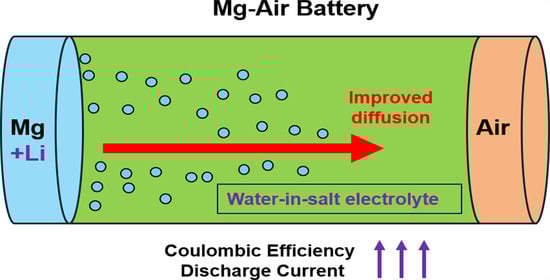
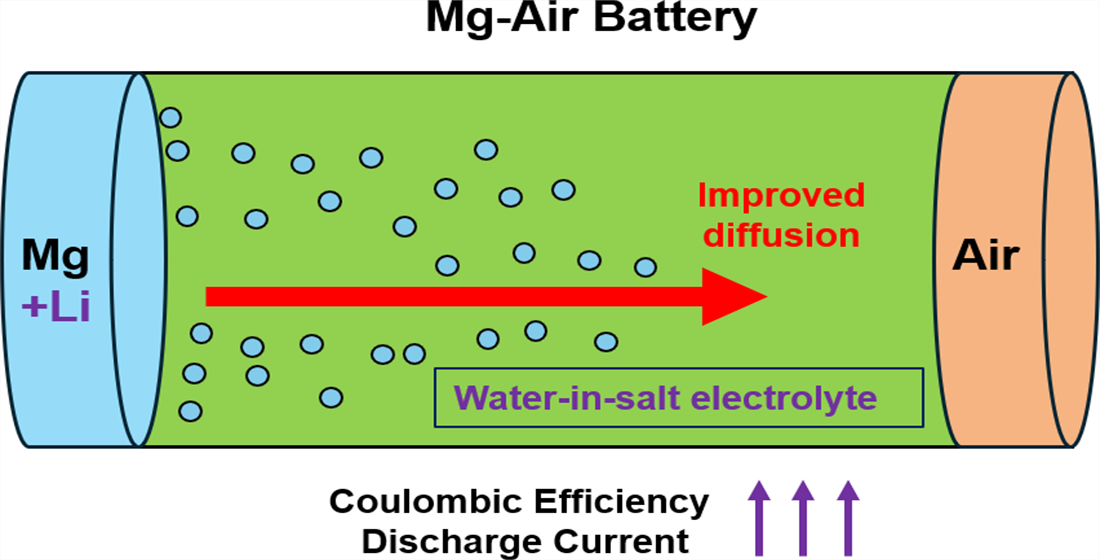
Addressing corrosion issues in Mg-air batteries is vital for improving energy storage technologies. Unlike traditional methods that focus solely on electrode materials or electrolyte composition, this study introduces a novel integrated strategy that combines electrode surface modification and controlled electrolyte content. Through comprehensive numerical simulations, the details of corrosion kinetics and ion migration mechanisms at the atomic level are revealed. Our findings demonstrate exceptional Coulombic efficiencies (>97%) and enhanced ion diffusion by over three times, ensuring the desired discharge current. This approach not only overcomes traditional limitations but also offers important insights for the research community, paving the way for the design of high-performance Mg-air batteries in next-generation energy storage systems.

Graphical Abstract

1. Introduction

Metal-air batteries have attracted much attention in recent years [1,2,3,4], due to the superior energy density compared to commercial metal ion batteries, which is attributed to the direct application of a metal anode instead of the intercalation design [5,6]. Among all the metals, a Mg anode showed much higher potential for commercialization, because of the low density and being less prone to dendrite formation during battery cycling [7,8]. However, corrosion and the rechargeability of a Mg-air battery hindered development, which remained the major challenge [9,10,11]. In an aqueous electrolyte, Mg tends to be corroded by free water to form a passivation layer of MgO or Mg(OH)2, which hindered the diffusion of Mg ions and slowed the electrode reaction [12,13,14].
To resolve this challenge, researchers have tried many methods [15,16,17,18,19]. For example, organic electrolytes have been proposed to reduce the formation of the passivation layer [20]. Although some of the organic solvents, such as dimethyl ether (DME), magnesium–aluminum chloro complexes (MACC), or tetrahydrofuran (THF), could restrict the growth of the passivation film, it is achieved at the expense of the reaction kinetics, as the Mg ions are much harder to detach from the anode [21,22]. As a result, the discharge current is much reduced. Others have tried to replace the aqueous solution with ionic liquid [23,24], which exhibited high electrochemical stability, low flammability, and fast ionic conductivity [25]. However, it requires an elevated working temperature, which poses a serious safety risk [26]. In recent years, a new type of water-in-salt electrolyte has been designed, which locks the free water by enhancing the molar ratio of solute and water [15,27,28,29]. The corrosion can be completely avoided by a water-in-salt electrolyte, due to the lack of free water, yet the reaction rate has also been suppressed for the same reason [27,28]. It is evident now that all these types of electrolytes cannot resolve the challenge, due not least to the lack of understanding of the kinetic details of the water corrosion and ion migration, which calls for further investigation. It is evident now that all these types of electrolytes cannot resolve the challenge, primarily due to the lack of understanding of the underlying mechanism. The previous literature has simulated the effects of surface energy [30], alloying [31], and cathode materials [32] on the corrosion behavior of the Mg anodes, as well as related reactions. Recently, the surface evolution of Mg anodes during discharge under different conditions was also demonstrated via mathematical models [33,34]. Nevertheless, it is necessary to unravel the kinetic details of the water corrosion and ion migration within Mg-air batteries.
The purpose of this research is to reveal the details of all the stages of electrode corrosion and ion migration during battery operation at the microscopic level by numerical simulation, as it has yet to be achieved by experiments. Unlike previous studies that often focus on either material properties or electrolyte behavior in isolation, our research simultaneously examines the interplay between surface defects, doping strategies, and electrolyte compositions to provide a comprehensive understanding of corrosion dynamics. It has been revealed that the corrosion rate of Mg is significantly influenced by surface imperfections, with idealized defect-free models showing markedly slower corrosion, highlighting the critical role of surface quality in practical applications. Additionally, our findings demonstrate that doping Mg with metals such as Al or Zn could initially accelerate corrosion due to lattice mismatch, but ultimately enhance structural stability through inter-metallic bonding, leading to a slight improvement in corrosion resistance. We also discovered that the discharge current is related to the corrosion rate. When the corrosion process is suppressed, the ion migration rate would be reduced, leading to a lower discharge current. As a result, the ionic liquid, organic, and water-in-salt electrolyte showed a high Coulombic efficiency but a slow ion migration rate, which is detrimental to battery performance. A new strategy was proposed to achieve both high Coulombic efficiency and ion migration rate via electrode and electrolyte modifications. These discoveries could provide fresh inspiration for advancing battery design and resolving one of the most significant challenges to commercialization.

2. Methods

2.1. Electrode Corrosion Simulation

Briefly, 100 × 100 lattices were created to simulate the pure Mg plate anode structure. Each site represented the smallest repeating part that constituted grains or a molecular-sized part of the anode material. The Dirichlet boundary conditions were adopted with the edges acting as sources or pathways for ions and electrons, simulating realistic open-system conditions. A dynamic bond percolation (DBP) model was applied, which is a type of percolation theory that adds a time-dependent element to a network of static bonds, allowing for the bonds to open and close over time. Unlike classic percolation models, the DBP model is used to describe processes in disordered systems that are also undergoing dynamic rearrangement, such as the diffusion of ions in electrolytes. To ensure the validity of the simulation, key parameters, including the hopping rate, percentage of available bonds, and bonding energy terms, were set based on the previous experimental observations.
When one site is corroded, it opens a diffusion path for the liquid. To accommodate the unconventional diffusion, the lattice was updated with each iteration due to the structural degradation, which has been experimentally observed. Each lattice was assigned several variables, and the energy value of these variables changed in each lattice due to the presence of imperfections, such as defects or internal strain, which altered the energy value in each lattice. W represents the driving force of water corrosion, and W (x, y, d = 1–4) represents the probable diffusion paths to its neighbors (left, right, upper, and down). Following data reported in the literature [35,36], the initial value of W was randomly set between 1.85 and −2.3 eV. Similarly, bonding energy B was introduced, which is against the corrosion, whose initial value was randomly set between 2 and −2.5 eV [18,35]. Dp represents the lattice mismatch caused by doping, which is in favor of the corrosion, whose initial value was randomly set between 0.2 and −0.3 eV [37].
The overall activation energy of corrosion is thus given by B-D-Dp, and the initial probability of structural breakdown P can be given by the classical kinetics calculation, which is the exponential of the overall activation energy divided by the universal gas constant and temperature. Mg corrosion involves oxide formation, hydrogen evolution, pitting, and electrolyte interactions, etc. However, the simulation applied here converted all those processes into an energy term W determined from the literature data, which may overlook the interplay between these processes that is worthy of further investigation in the follow-up study.
The p value of each lattice is updated after each iteration with the master formula (Equation (1)). The formula shows how the lattice is affected by the corrosion of its neighbors. To initiate the simulation, all the lattices will be assigned an initial random value of W, B, and Dp, unless the material is set to be free of defects, in which case the W value of the first left column will be set to 1, while B and Dp will still be randomly assigned.
d P i d t = j P j W j i P i W i j
The W (x, y, d) value will then be updated as the simulation proceeds; when any P(x, y) value reaches 0.3, its W (left) or W (right) value, with a 50/50 chance, is changed to 1.0, or 100% probability, simulating the corrosion process. Various colors were assigned to identify the probability P; blue implied the probability of corrosion was 0, meaning that the metal remained intact. Green represents 30% probability, and red for 100% probability. Once the P value of a lattice reaches 100%, it will cease to change, while the rest of the lattice will continue to be updated to simulate the corrosion.

2.2. Ion Migration Simulation

Following our previous work [38,39,40], the ion migration simulation was conducted by Python 3.7.0, where the electrolyte was represented by a 100 × 100 lattice. As each lattice shows variable stability, due to the presence of imperfections, the initial value of B in each lattice was therefore randomly assigned between 0.58 and 0.78 eV to reflect the variance [37,41].
Several types of electrolytes were investigated, including aqueous (such as MgCl2), ionic liquid (such as Aluminum Chloride ([EMIm]Cl/AlCl3) System), organic (such as Dichloro Complex (DCC) Electrolyte), and water-in-salt (Such as MgCl2·6H2O). To simulate the thermodynamics and kinetics of the ion migration, several energy terms were introduced based on the literature. H, which is given by the hindrance and activation barrier in the electrolyte. In aqueous electrolyte, the value of H was randomly distributed between 0.23 and −0.34 eV, as can be evidenced by the literature [42,43]. In ionic liquid, the value of H was randomly distributed between 0.31 and −0.40 eV [41,42]. In the organic electrolyte, the value of H was randomly distributed between 0.41 and −0.46 eV [44]. In water-in-salt electrolyte, the value of H was randomly distributed between 0.45 and −0.55 eV [15]. G represents the driving force for diffusion, which originated from the concentration gradient. The value of G of a specific lattice site was calculated by the average number of corroded sites in the surrounding, which represented the local ion concentration. The final barrier Ea* for migration could now be calculated by G-H-E. The migration probability P could be extrapolated by the exponential of Ea* divided by the gas constant and temperature.

3. Results and Discussion

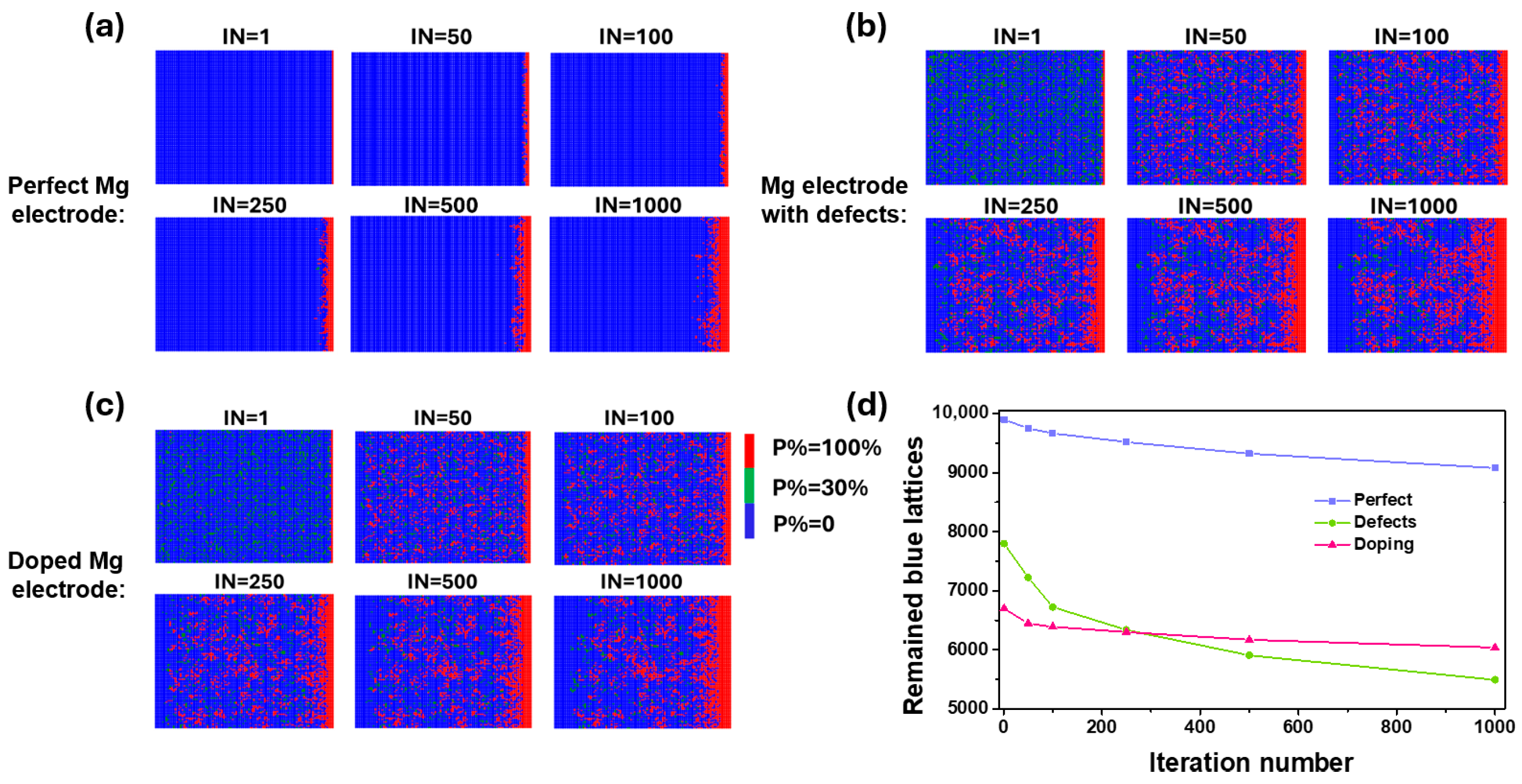
To unravel the detailed process of water corrosion on the anode, simulations were conducted under various conditions. As shown in Figure 1, each lattice exhibited different colors, representing the local concentration of water, which also indicates the probability of Mg being corroded by water: red = 100%, green = 30%, blue = 0%.
As the water diffusion requires available paths, which are often provided by the surface defects, the Mg electrode was set to be perfect first to simulate the water corrosion without the assistance of surface imperfections. As demonstrated in Figure 1a, the corrosion rate is slow under such conditions; the remaining intact metal site (blue lattice) is 9900 at the 1st iteration, 9749 at 50th iteration, 9668 at 100th iteration, 9518 at 250th iteration, 9323 at 500th iteration, and 9079 at 1000th iteration. Less than 10% of the Mg is corroded by water even after 1000 iterations, as the diffusion is hindered. On the other hand, the corrosion rate was much enhanced when the imperfections were introduced in Figure 1b, where the remaining intact metal site (blue lattice) is 7800 at the 1st iteration, 7223 at the 50th iteration, 6725 at the 100th iteration, 6338 at the 250th iteration, 5908 at the 500th iteration, and 5492 at the 1000th iteration. Compared to the perfect counterpart, more than 45% of the Mg was consumed by water, indicating a much lower Coulombic efficiency.
It seems that the corrosion issue of Mg can simply be resolved by the perfect structure, such as a single-crystal Mg. Although the simulation assumes an idealized, defect-free Mg surface to represent a perfect crystal, which does not reflect the reality of Mg materials that inherently contain surface imperfections, it uncovered for the first time the detailed corrosion kinetics at the microscopic level, which lays the ground for ion migration research in the following simulation. Moreover, the discharge current would also be reduced when the corrosion of the anode is reduced, greatly affecting the battery performance. Thus, we applied the 3rd simulation of doping other metals, such as Al or Zn, to enhance the corrosion resistance. As can be observed in Figure 1c, after mixing 10% Al in the Mg electrode, the remaining intact metal site (blue lattice) is 6699 at the 1st iteration, 6449 at 50th iteration, 6389at 100th iteration, 6303 at 250th iteration, 6170 at 500th iteration, and 6040 at 1000th iteration. The corrosion rate of the doped electrode is faster than pure Mg at first, due obviously to the formation of extra sites for localized corrosion, which may lead to pitting corrosion as time evolves. After 250 iterations, the consumption of Mg is slowed, as shown in Figure 1d, due obviously to the inter-metallic bond assisted by the stability of the Mg structure, and hindered the water attack. At the end of the iteration, only 40% of the Mg is corroded, indicating a slight enhancement in the corrosion resistance.
Although the Mg corrosion resistance can be slightly enhanced by doping, the Coulombic efficiency under such conditions is still not high enough. It is evident that the problem cannot be simply resolved by electrode modification, which is why electrolyte simulations were conducted. The ionic liquid, organic, and water-in-salt electrolytes were introduced in the following experiment.
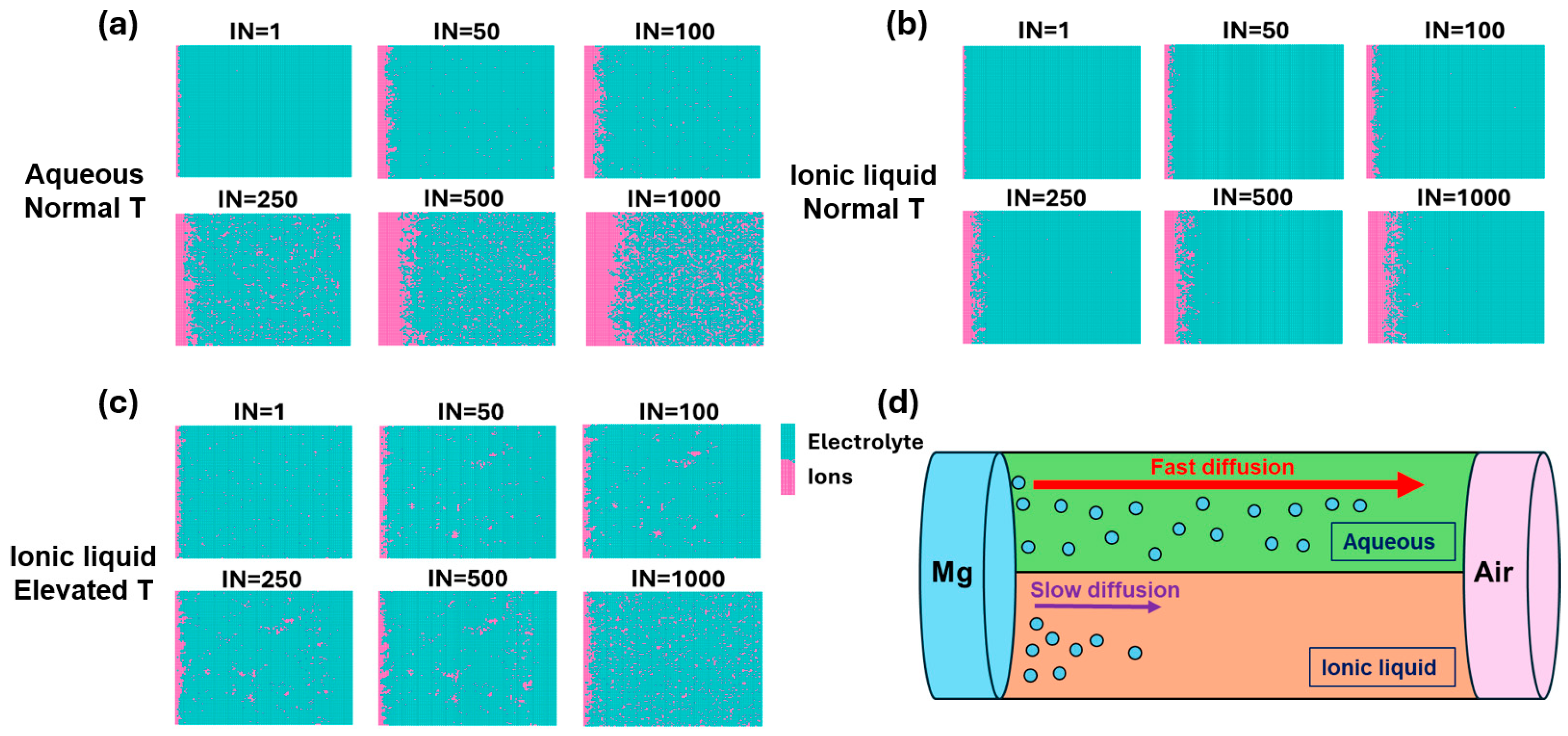
The ion migration in ionic liquids was simulated first. As shown in Figure 2a,b, most of the ions cross only around 20% of the lattices even after 1000 iterations in the ionic liquid, forming a clear comparison to that of water, where the majority of the free ions diffused to the right at the end of the simulation. Obviously, the diffusion rate in the ion liquid was low, which limited the discharge current of the battery, as has been experimentally observed [15]. For electrons to flow from the external circuit, corrosion must occur on the anode surface so that an overpotential can be created to force the electron transfer to the cathode, which, otherwise, would not spontaneously happen. Although such a rate can be enhanced at elevated temperatures, as demonstrated in Figure 2c, where many more ions crossed over the whole lattice after 1000 iterations, the higher working temperature poses a serious safety threat. A schematic illustration of ion migration in aqueous and ionic liquid electrolytes is presented in Figure 2d.
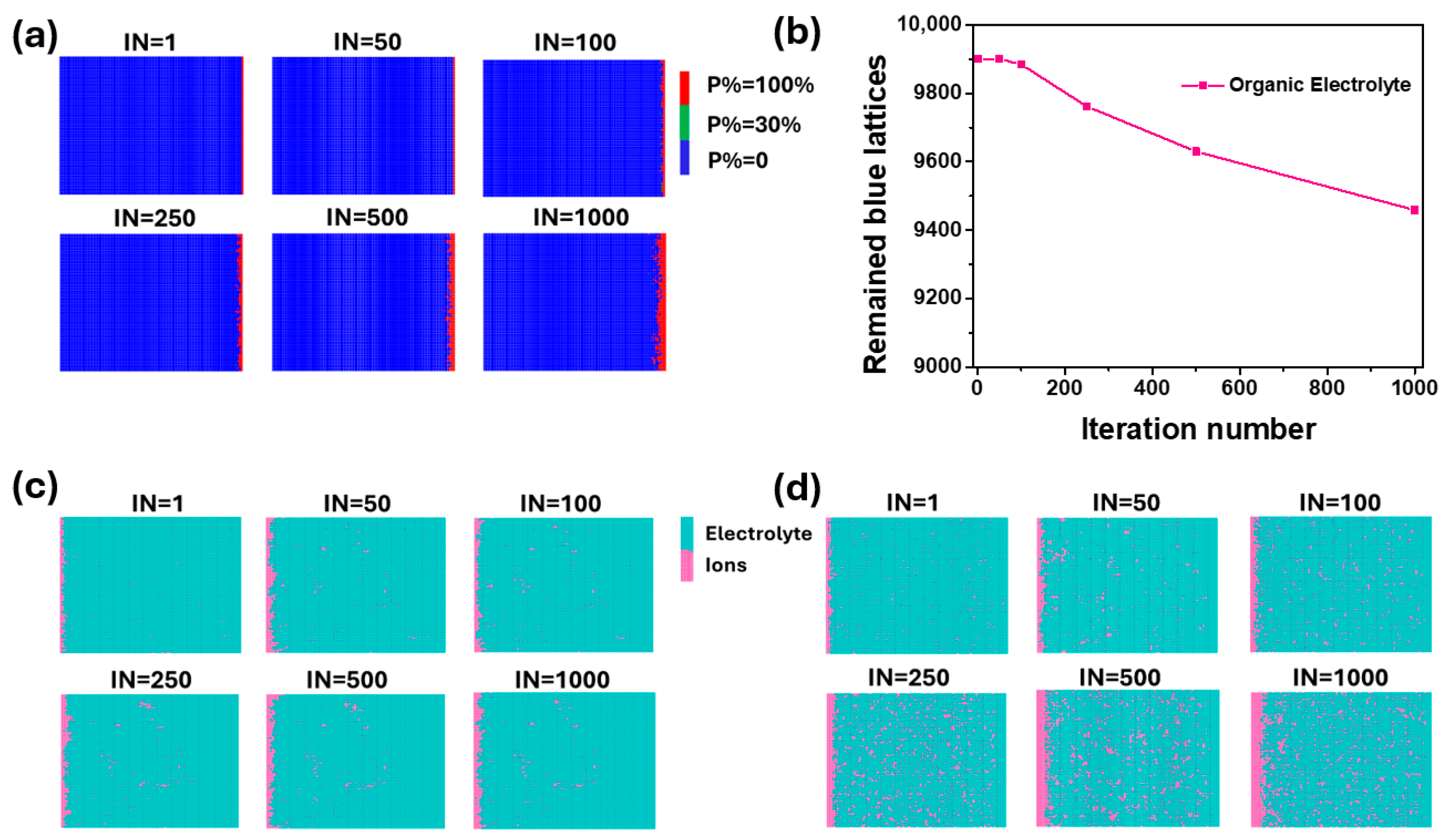
Next, the electrode corrosion and ion migration in the organic electrolyte were simulated. As has been expected, the corrosion is greatly suppressed in organic environments. As shown in Figure 3a,b, the remaining intact metal site (blue lattice) is 9900 at the 1st iteration, 9900 at the 50th iteration, 9884 at the 100th iteration, 9761 at the 250th iteration, 9630 at the 500th iteration, and 9459 at the 1000th iteration, indicating a Coulombic efficiency of around 95%. As a result, the number of ions that were detached from the metal surface is also much reduced, leading to the slow diffusion rate in the organic electrolyte, as demonstrated in Figure 3c. To enhance the ion moving speed, a simulation at an elevated temperature was conducted, as shown in Figure 3d, where five times the amount of ions traveled to the right at the 1000th iteration. Although the organic electrolyte exhibited good corrosion resistance and enhanced ion motion rate at an elevated temperature, such properties can be improved further by anode surface modification and water-in-salt electrolytes, as can be seen in Figure 4.
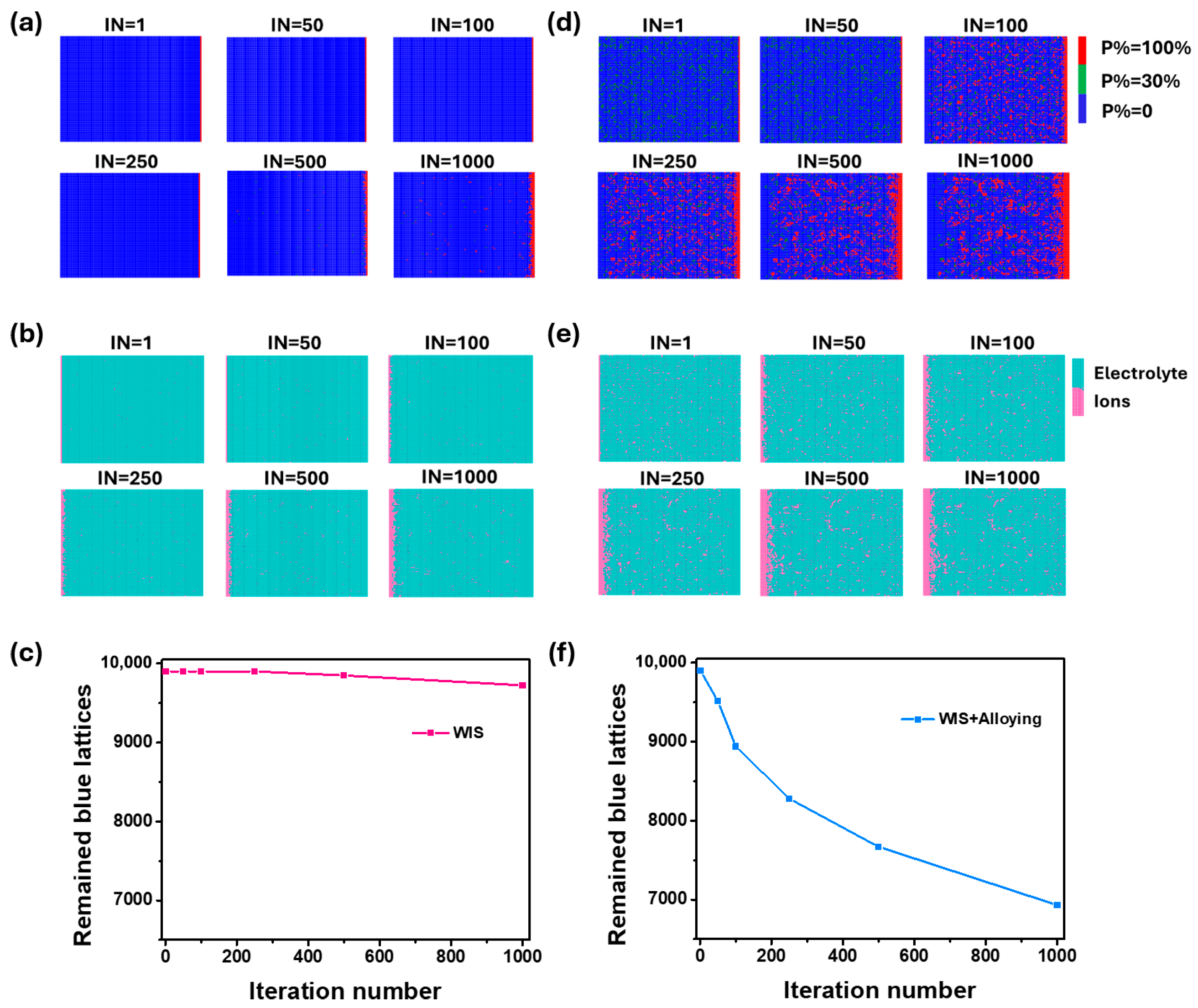
In the following work, the electrode corrosion and ion migration were simulated in the water-in-salt environment, where the corrosion resistivity can be enhanced further, as demonstrated in Figure 4a. The electrode was set to be pure Mg, which remained more than 97% of the blue lattices after 1000 iterations. Likewise, the ion migration rate in Figure 4b is also slow due to the low concentration on the left. Figure 4c presents the remaining blue lattice after certain iteration numbers. To resolve this problem, doping engineering has been introduced in Figure 4d. Unlike the previous design, reactive metals, such as Li, have only been doped onto the surface of the Mg electrode in the present study to create more diffusion paths. As shown in Figure 4e,f, many more susceptible sites are observed after the doping; the local reaction rate was thus successfully enhanced in the following iterations. More than 30% of the Mg metal was transformed into Mg ions, which means the diffusion concentration gradient is 15 times larger than the counterparts in Figure 4b, signifying an enhanced diffusion rate. These discoveries indicate that the future design of Mg-air battery may focus on the electrode modification and water-in-salt electrolyte, which will be able to provide a stable battery of high discharge current that is hoped for.
In summary, the future of Mg-based batteries faces several challenges related to corrosion resistance and ion migration. Simulations suggest that while a perfect Mg electrode could minimize corrosion, this idealized structure does not reflect reality, as real Mg materials contain surface imperfections that significantly increase corrosion rates. Doping with metals like Al or Zn seems promising for enhancing corrosion resistance, but may also introduce additional sites for localized corrosion. Moreover, the investigations into ionic liquid electrolytes revealed limited ion migration, which limits battery performance. While organic electrolytes demonstrate much lower corrosion rates, they suffer from slow ion diffusion, which requires further exploration of elevated temperatures to improve ion mobility. On the other hand, water-in-salt electrolytes achieved high corrosion resistance and ion mobility by surface doping with reactive metals like Li, which enhance local reaction rates and diffusion paths. Overall, the future design of Mg-air batteries may focus on electrode modification and strategic electrolyte choices to achieve both enhanced corrosion resistance and high discharge currents.

4. Conclusions

In conclusion, this study modeled the magnesium (Mg) anode corrosion process and ion diffusion under several conditions, including aqueous electrolytes, ionic liquid, organic electrolyte, and water-in-salt electrolyte. The results demonstrated that surface defects significantly accelerate water-induced corrosion by providing local transport pathways, with perfect Mg lattices exhibiting slow corrosion rates (<10% after 1000 iterations), while defective surfaces suffered accelerated degradation (>45% corrosion). As the corrosion of Mg generates electrons and ions, the extent of corrosion should be enhanced when the ions’ diffusion rate is enhanced. Thus, the key to increasing the Columbic efficiency is to ensure the electron is transferred from the external circuit instead of being consumed locally. Based on the ion migration simulation under several conditions, it was discovered that the ionic liquid and organic electrolyte suppressed corrosion but also hindered ion migration. A step forward has been achieved by our proposal, which kept more than 97% of the anode stable at the end of the simulation, with a faster ion migration rate after electrode modification. These findings will be able to advance the battery performance and provide fresh solutions towards the practical application of the Mg-air battery.

Author Contributions

Conceptualization, T.W., Y.A. and F.X.; methodology, T.W.; software, T.W.; validation, W.Y. (Wenjuan Yang), W.Y. (Wenchang Yang), and Y.J.; formal analysis, T.W.; investigation, T.W., Y.A. and W.Y. (Wenjuan Yang); resources, T.W.; data curation, W.Y. (Wenjuan Yang), W.Y. (Wenchang Yang), and Y.J.; writing—original draft preparation, T.W.; writing—review and editing, Y.A. and F.X.; visualization, W.Y. (Wenjuan Yang), W.Y. (Wenchang Yang), and Y.J.; supervision, F.X.; project administration, F.X.; funding acquisition, F.X. All authors have read and agreed to the published version of the manuscript.

Funding

This research was funded by the BIT University Student Innovation & Entrepreneurship Training Program, grant number BIT2024LH010; the Shenzhen Key Technology R&D Program, grant number KJZD20231023095359001; the High-level Talent Research Start-up Project Funding of Henan Academy of Sciences, grant number 251820025; and the Fundamental Research Fund of the Henan Academy of Sciences, grant number 20250620008. The APC was funded by F.X.

Data Availability Statement

The dataset is available on request from the authors.

Acknowledgments

The authors would like to acknowledge the insightful discussion with Gu Xu from McMaster University.

Conflicts of Interest

The authors declare no conflicts of interest.

References

  1. Huang, W.; Jiang, Z.; Wu, P.; Qiu, W.; Chen, W.; Chen, J. Tailoring the electrochemical behavior and discharge performance of Mg–Al–Ca–Mn anodes for Mg-air batteries by different extrusion ratios. J. Mater. Res. Technol. 2024, 28, 3494–3506. [Google Scholar] [CrossRef]
  2. Xiao, B.; Song, G.L.; Zheng, D.; Cao, F. A corrosion resistant die-cast Mg-9Al-1Zn anode with superior discharge performance for Mg-air battery. Mater. Des. 2020, 194, 108931. [Google Scholar] [CrossRef]
  3. Wang, C.; Yu, Y.; Niu, J.; Liu, Y.; Bridges, D.; Liu, X.; Pooran, J.; Zhang, Y.; Hu, A. Recent progress of metal-air batteries—A mini review. Appl. Sci. 2019, 9, 2787. [Google Scholar] [CrossRef]
  4. Zhang, X.; Wang, X.G.; Xie, Z.; Zhou, Z. Recent progress in rechargeable alkali metal–air batteries. Green Energy Environ. 2016, 1, 4–17. [Google Scholar] [CrossRef]
  5. Wang, H.F.; Xu, Q. Materials Design for Rechargeable Metal-Air Batteries. Matter 2019, 1, 565–595. [Google Scholar] [CrossRef]
  6. Olabi, A.G.; Sayed, E.T.; Wilberforce, T.; Jamal, A.; Alami, A.H.; Elsaid, K.; Rahman, S.M.A.; Shah, S.K.; Abdelkareem, M.A. Metal-air batteries—A review. Energies 2021, 14, 7373. [Google Scholar] [CrossRef]
  7. Tong, F.; Chen, X.; Wei, S.; Malmström, J.; Vella, J.; Gao, W. Microstructure and battery performance of Mg-Zn-Sn alloys as anodes for magnesium-air battery. J. Magnes. Alloy. 2021, 9, 1967–1976. [Google Scholar] [CrossRef]
  8. Richey, F.W.; McCloskey, B.D.; Luntz, A.C. Mg Anode Corrosion in Aqueous Electrolytes and Implications for Mg-Air Batteries. J. Electrochem. Soc. 2016, 163, A958–A963. [Google Scholar] [CrossRef]
  9. Liu, H.; Zhao, G.; Li, H.; Tang, S.; Xiu, D.; Wang, J.; Yu, H.; Cheng, K.; Huang, Y.; Zhou, J. The Discharge Performance of Mg-3In-xCa Alloy Anodes for Mg–Air Batteries. Coatings 2022, 12, 428. [Google Scholar] [CrossRef]
  10. Shangguan, F.E.; Cheng, W.L.; Chen, Y.H.; Cui, Z.Q.; Yu, H.; Wang, H.X.; Wang, L.F.; Li, H.; Hou, H. Role of micro-Ca/In alloying in tailoring the microstructural characteristics and discharge performance of dilute Mg-Bi-Sn-based alloys as anodes for Mg-air batteries. J. Magnes. Alloy. 2024, 12, 251–266. [Google Scholar] [CrossRef]
  11. Zhang, L.; Shao, Q.; Zhang, J. An overview of non-noble metal electrocatalysts and their associated air cathodes for Mg-air batteries. Mater. Rep. Energy 2021, 1, 100002. [Google Scholar] [CrossRef]
  12. Wang, H.; Chen, X.; Le, Q.; Zou, Q. Discharge performance of Mg-Al-Cd anode for Mg-air Battery. Mater. Res. Express 2021, 8, 046521. [Google Scholar] [CrossRef]
  13. Wang, Y.; Sun, Y.; Ren, W.; Zhang, D.; Yang, Y.; Yang, J.; Wang, J.; Zeng, X.; NuLi, Y. Challenges and prospects of Mg-air batteries: A review. Energy Mater. 2022, 2, 200024. [Google Scholar] [CrossRef]
  14. Tong, F.; Wei, S.; Chen, X.; Gao, W. Magnesium alloys as anodes for neutral aqueous magnesium-air batteries. J. Magnes. Alloy. 2021, 9, 1861–1883. [Google Scholar] [CrossRef]
  15. Leong, K.W.; Pan, W.; Wang, Y.; Luo, S.; Zhao, X.; Leung, D.Y.C. Reversibility of a High-Voltage, Cl—Regulated, Aqueous Mg Metal Battery Enabled by a Water-in-Salt Electrolyte. ACS Energy Lett. 2022, 7, 2657–2666. [Google Scholar] [CrossRef]
  16. Li, T.; Huang, M.; Bai, X.; Wang, Y.X. Metal–air batteries: A review on current status and future applications. Prog. Nat. Sci. Mater. Int. 2023, 33, 237362. [Google Scholar] [CrossRef]
  17. Tang, W.; Li, B.; Teng, K.; Wang, X.; Liu, R.; Wu, M.; Zhang, L.; Ren, P.; Zhang, J.; Feng, M. Advanced noble-metal-free bifunctional electrocatalysts for metal-air batteries. J. Mater. 2022, 8, 454–474. [Google Scholar] [CrossRef]
  18. Liu, J.; Hu, H.; Wu, T.; Chen, J.; Yang, X.; Wang, N.; Shi, Z. Tailoring the microstructure of Mg-Al-Sn-RE alloy via friction stir processing and the impact on its electrochemical discharge behaviour as the anode for Mg-air battery. J. Magnes. Alloy. 2024, 12, 1554–1565. [Google Scholar] [CrossRef]
  19. Zhang, W.; Feng, B.; Huang, L.; Liang, Y.; Chen, J.; Li, X.; Shi, Z.; Wang, N. Fe/Cu diatomic sites dispersed on nitrogen-doped mesoporous carbon for the boosted oxygen reduction reaction in Mg-air and Zn-air batteries. Appl. Catal. B Environ. Energy 2024, 358, 124450. [Google Scholar] [CrossRef]
  20. Ma, J.; Hu, P.; Jia, X.; Zhang, C.; Wang, G. Organic/inorganic double solutions for magnesium-air batteries. RSC Adv. 2021, 11, 7502–7510. [Google Scholar] [CrossRef] [PubMed]
  21. Li, C.S.; Sun, Y.; Gebert, F.; Chou, S.L. Current Progress on Rechargeable Magnesium–Air Battery. Adv. Energy Mater. 2017, 7, 1700869. [Google Scholar] [CrossRef]
  22. Qu, J.E.; Luo, H.; Liu, Z.; Wang, H.; Chen, Y.; Yang, L. Effect of sodium-zinc EDTA and sodium gluconate as electrolyte additives on corrosion and discharge behavior of Mg as anode for air battery. Mater. Corros. 2022, 73, 1776–1787. [Google Scholar] [CrossRef]
  23. Jia, X.; Yang, Y.; Wang, C.; Zhao, C.; Vijayaraghavan, R.; Macfarlane, D.R.; Forsyth, M.; Wallace, G.G. Biocompatible ionic liquid-biopolymer electrolyte-enabled thin and compact magnesium-Air batteries. ACS Appl. Mater. Interfaces 2014, 6, 21110–21117. [Google Scholar] [CrossRef]
  24. Law, Y.T.; Schnaidt, J.; Brimaud, S.; Behm, R.J. Oxygen reduction and evolution in an ionic liquid ([BMP][TFSA]) based electrolyte: A model study of the cathode reactions in Mg-air batteries. J. Power Sources 2016, 333, 173–183. [Google Scholar] [CrossRef]
  25. Ling, N.; Fan, H.; Song, S.; Zhang, J.; Wang, L. Enhancement of the discharge behavior for Mg-air battery by adjusting the chelate ability of ionic liquid electrolyte additives. J. Energy Storage 2023, 72, 108709. [Google Scholar] [CrossRef]
  26. Haskew, M.J.; Nikman, S.; O’Sullivan, C.E.; Galeb, H.A.; Halcovitch, N.R.; Hardy, J.G.; Murphy, S.T. Mg/Zn metal—Air primary batteries using silk fibroin—Ionic liquid polymer electrolytes. Nano Sel. 2023, 4, 90–101. [Google Scholar] [CrossRef]
  27. Fan, H.; Zhang, X.; Xiao, J.; Lin, Y.; Ren, S.; Zhao, Y.; Yuan, H.; Pan, L.; Lin, Q.; Liu, H.; et al. Simultaneous optimization of solvation structure and water-resistant capability of MgCl2-based electrolyte using an additive combination of organic and inorganic lithium salts. Energy Storage Mater. 2022, 51, 873–881. [Google Scholar] [CrossRef]
  28. Fombona-Pascual, A.; Patil, N.; García-Quismondo, E.; Goujon, N.; Mecerreyes, D.; Marcilla, R.; Palma, J.; Lado, J.J. A high performance all-polymer symmetric faradaic deionization cell. Chem. Eng. J. 2023, 461, 142001. [Google Scholar] [CrossRef]
  29. Leong, K.W.; Pan, W.; Yi, X.; Luo, S.; Zhao, X.; Zhang, Y.; Wang, Y.; Mao, J.; Chen, Y.; Xuan, J.; et al. Next-generation magnesium-ion batteries: The quasi-solid-state approach to multivalent metal ion storage. Sci. Adv. 2023, 9, eadh1181. [Google Scholar] [CrossRef]
  30. Ma, H.; Chen, X.Q.; Li, R.; Wang, S.; Dong, J.; Ke, W. First-principles modeling of anisotropic anodic dissolution of metals and alloys in corrosive environments. Acta Mater. 2017, 130, 137–146. [Google Scholar] [CrossRef]
  31. Liu, Z.; Bao, J.; Sha, J.; Zhang, Z. Modulation of the Discharge and Corrosion Properties of Aqueous Mg-Air Batteries by Alloying from First-Principles Theory. J. Phys. Chem. C 2023, 127, 10062–10068. [Google Scholar] [CrossRef]
  32. Bhauriyal, P.; Rawat, K.S.; Bhattacharyya, G.; Garg, P.; Pathak, B. First-Principles Study of Magnesium Peroxide Nucleation for Mg-Air Battery. Chem. Asian J. 2018, 13, 3198–3203. [Google Scholar] [CrossRef]
  33. Xu, W.; Wu, Y.; Snihirova, D.; Wang, L.; Deng, M.; Wang, C.; Lamaka, S.V.; Zheludkevich, M.L.; Höche, D. Mathematical modeling of salicylate effects on high-purity Mg anode for aqueous primary Mg-Air batteries. J. Magnes. Alloy. 2025, 13, 1506–1522. [Google Scholar] [CrossRef]
  34. Xu, W.; Snihirova, D.; Deng, M.; Wang, L.; Vaghefinazari, B.; Wang, C.; Lamaka, S.V.; Zheludkevich, M.L.; Höche, D. A mathematical model describing the surface evolution of Mg anode during discharge of aqueous Mg-air battery. J. Power Sources 2022, 542, 231745. [Google Scholar] [CrossRef]
  35. Li, Y.; Shi, Z.; Chen, X.; Atrens, A. Anodic hydrogen evolution on Mg. J. Magnes. Alloy. 2021, 9, 2049–2062. [Google Scholar] [CrossRef]
  36. Thomas, S.; Medhekar, N.V.; Frankel, G.S.; Birbilis, N. Corrosion mechanism and hydrogen evolution on Mg. Curr. Opin. Solid. State Mater. Sci. 2015, 19, 85–94. [Google Scholar] [CrossRef]
  37. Hu, B.; Quan, B.; Li, D.; Wang, X.; Li, Z.; Zeng, X. Solid solution strengthening mechanism in high pressure die casting Al–Ce–Mg alloys. Mater. Sci. Eng. A 2021, 812, 141109. [Google Scholar] [CrossRef]
  38. Wang, T.; Xu, F.; Wang, Q.; Tai, L.; Xu, G. Improved Perovskite Structural Stability by Halogen Bond from Excessive Lead Iodide via Numerical Simulation. Crystals 2022, 12, 1073. [Google Scholar] [CrossRef]
  39. Wang, R.T.; Xu, A.F.; Zhang, W.; Xu, G. The influence of compression on the lattice stability of α-FAPbI3 revealed by numerical simulation. New J. Chem. 2022, 46, 16130–16137. [Google Scholar] [CrossRef]
  40. Wang, R.T.; Jin, X.; Tan, W.; Zhang, Y.; Zhang, W.; Abbas, A.; Lyu, B.; Xu, F. Hindered Phase Transition Kinetics of α-CsPbI3 by External Tension. Energy Technol. 2023, 11, 2300523. [Google Scholar] [CrossRef]
  41. Huang, P.; Latham, J.A.; Macfarlane, D.R.; Howlett, P.C.; Forsyth, M. A review of ionic liquid surface film formation on Mg and its alloys for improved corrosion performance. Electrochim. Acta 2013, 110, 501–510. [Google Scholar] [CrossRef]
  42. Jiang, Y.; Liu, Y.; Gao, S.; Guo, X.; Zhang, J. Experimental and theoretical studies on corrosion inhibition behavior of three imidazolium-based ionic liquids for magnesium alloys in sodium chloride solution. J. Mol. Liq. 2022, 345, 116998. [Google Scholar] [CrossRef]
  43. Williams, G.; Kousis, C.; McMurray, N.; Keil, P. A mechanistic investigation of corrosion-driven organic coating failure on magnesium and its alloys. NPJ Mater. Degrad. 2019, 3, 41. [Google Scholar] [CrossRef]
  44. Zhou, Y.Q.; Zhou, Y.; Li, J.T.; Zanna, S.; Seyeux, A.; Marcus, P.; Światowska, J. Probing Mg anode interfacial and corrosion properties using an organic/inorganic hybrid electrolyte. Appl. Surf. Sci. 2022, 614, 156070. [Google Scholar] [CrossRef]
Figure 1. (a) Simulation of the corrosion in water on the Mg electrode with no defects. The color represents the probability of corrosion at the lattice: blue = 0%, green = 30%, red = 100%. The number of blue lattices at IN = 1 is 9900, IN = 50 is 9749, IN = 100 is 9668, IN = 250 is 9518, IN = 500 is 9323, and IN = 1000 is 9079. (b) Simulation of the corrosion in water on the Mg electrode with defects. The number of blue lattices at IN = 1, 50, 100, 250, 500, and 1000 is 7800, 7223, 6725, 6338, 5908, and 5492. (c) Simulation of the corrosion in water on the Mg electrode after alloying by Al/Zn. The number of blue lattices at IN = 1 is 6699, IN = 50 is 6449, IN = 100 is 6389, IN = 250 is 6303, IN = 500 is 6170, and IN = 1000 is 6040. (d) The curve fit of the remaining blue lattices is plotted as a function of iteration numbers.
Coatings 15 01493 g001
Figure 2. (a) Simulation of the ion migration in aqueous electrolyte, indicating a fast diffusion rate. (b) Simulation of the ion migration in ionic liquid electrolyte at room temperature, demonstrating a much reduced diffusion rate. (c) Simulation of the ion migration in ionic liquid electrolyte at elevated temperature, which enhanced the diffusion rate compared to (b). (d) Schematic illustration of ion diffusion in various electrolytes.
Coatings 15 01493 g002
Figure 3. (a) Simulation of the corrosion in organic electrolyte on the Mg electrode. The color represents the probability of corrosion at the lattice: blue = 0%, green = 30%, red = 100%. The number of blue lattices at IN = 1 is 9900, IN = 50 is 9900, IN = 100 is 9884, IN = 250 is 9761, IN = 500 is 9630, IN = 1000 is 9459. (b) The curve fit of the remaining blue lattices is plotted as a function of iteration numbers. (c) Simulation of the ion migration in an organic electrolyte at room temperature, which gives a slow diffusion rate. (d) Simulation of the ion migration in an organic electrolyte at an elevated temperature, which enhanced the diffusion rate compared to (c).
Coatings 15 01493 g003
Figure 4. (a) Simulation of the corrosion in water-in-salt electrolyte on the Mg electrode. The color represents the probability of corrosion at the lattice: blue = 0%, green = 30%, red = 100%. (b) Simulation of the ion migration of (a). (c) The curve fit of the remaining blue lattices of (a) is plotted as a function of iteration numbers. (d) Simulation of the corrosion in water-in-salt electrolyte on the Mg electrode after alloying by Li. (e) Simulation of the ion migration in the organic electrolyte of (d). (f) The curve fit of the remaining blue lattices of (d) is plotted as a function of iteration numbers.
Coatings 15 01493 g004
Disclaimer/Publisher’s Note: The statements, opinions and data contained in all publications are solely those of the individual author(s) and contributor(s) and not of MDPI and/or the editor(s). MDPI and/or the editor(s) disclaim responsibility for any injury to people or property resulting from any ideas, methods, instructions or products referred to in the content.