Article

Flow-Induced Groove Corrosion in Gas Well Deliquification Tubing: Synergistic Effects of Multiphase Flow and Electrochemistry
1
R&D Center for Ultra Deep Complex Reservior Exploration and Development, Korla 841000, China
2
Engineering Research Center for Ultra-Deep Complex Reservoir Exploration and Development, Xinjiang Uygur Autonomous Region, Korla 841000, China
3
Xinjiang Key Laboratory of Ultra-Deep Oil and Gas, Korla 841000, China
4
Oil and Gas Technology Research Institute of PetroChina Tarim Oilfield Branch, Korla 841000, China
5
National Center for Materials Service Safety, University of Science and Technology Beijing, Beijing 100083, China
6
School of Materials Science and Engineering, Xian Shiyou University, Xi’an 710065, China
*
Author to whom correspondence should be addressed.
Coatings 2025, 15(12), 1490; https://doi.org/10.3390/coatings15121490
Submission received: 10 November 2025 / Revised: 13 December 2025 / Accepted: 14 December 2025 / Published: 17 December 2025
(This article belongs to the Special Issue Tribological and Corrosion Properties of the Surfaces)

Abstract

Gas well deliquification is a key technology for mitigating liquid loading and restoring or enhancing production capacity in ultra-deep, high-temperature, and high-pressure gas wells. The abnormal corrosion behavior observed in the gas lift tubing of the Well X-1 oilfield in western China, within the 50–70 °C interval (1000–1500 m), was investigated. By analyzing the asymmetric wall thinning and axial groove morphology on the inner surface of tubing and then establishing a two-dimensional model of the vertical wellbore, the gas–liquid flow behavior and associated corrosion mechanisms were also elucidated. Results indicate that the flow pattern evolves from slug flow at the bottomhole, through a transitional pattern below the gas lift valve, to annular-mist flow at and above the valve. The wall shear stress peaks at the gas lift valve coupled with the significantly higher fluid velocity above the valve, which markedly elevates the corrosion rate. In this regime, the resultant annular-mist flow features a high-velocity gas core carrying entrained droplets, whose impingement synergistically enhances electrochemical corrosion, forming severe groove-like morphology along the inner tubing wall. Therefore, the corrosion in this well is attributed to the synergistic effect of the mechano-electrochemical coupling between multiphase flow and electrochemical processes on the inner surface of the tubing.

1. Introduction

As a cornerstone of the global energy landscape, natural gas is fundamental to economic stability and energy security. The sustainable development of this sector relies on the exploration of large gas fields, particularly in key regions such as China, where over 80% of proven gas reservoirs are water-bearing [1,2,3]. As exploration extends to greater depths, the downhole environment becomes increasingly severe, characterized by high temperature, high pressure and elevated H2S/CO2 content [4,5,6]. Concurrently, declining reservoir energy and formation pressure often lead to edge-water encroachment and bottom-water coning. This results in a continuous increase in water production from gas wells, along with the condensation of gaseous hydrocarbons. When wellbore energy is insufficient to carry these liquids to the surface, liquid loading intensifies. If not promptly and effectively managed, this situation increases backpressure on the gas reservoir, causing a sharp decline in gas production and potentially leading to water flooding or well shutdown. Furthermore, water invasion can block hydrocarbon flow, trapping significant natural gas reserves and substantially reducing recovery rates. This poses serious challenges to the stable production of gas fields and the reliability of national gas supply [7,8]. To mitigate water invasion and enhance gas recovery, drainage gas recovery (DGR) has been widely adopted as a primary method for water control in gas reservoirs [9,10,11,12]. Guided by the common strategy of “draining water from the flank while producing gas with carried water from higher structural positions,” frequently used DGR techniques include foam-assisted lift, electric submersible pumps, gas lift, jet pumps, progressive cavity pumps, beam pumps and ultrasonic-assisted liquid removal [13,14,15]. Among these, gas lift deliquification is extensively utilized in ultra-deep, high-temperature, high-pressure gas wells due to its operational simplicity, high automation and cost effectiveness. It represents a key technical approach for removing bottomhole liquid accumulation and restoring or enhancing well productivity [16,17].
Currently, research on gas lift deliquification technology primarily focuses on process optimization, auxiliary technology development, analysis of liquid loading behavior, simulations of wellbore pressure and temperature profiles and diagnosis of gas lift well failure [16,17,18,19,20,21]. Systematic studies on deliquification techniques tailored to different gas fields have led to a proposal for intelligent hybrid production methods. Prior research further highlights that for water-production gas reservoirs, achieving holistic optimization of production strategies necessitates integrated reservoir-wellbore-surface coupling models. Among these factors, wellbore integrity stands as a critical factor for the effective implementation of gas lift deliquification. During the deliquification process, the vertical wellbore contains multiphase fluids, including high-pressure gas and accumulated liquids. At the same time, the wellbore is simultaneously being subjected to complex multi-field coupling conditions involving temperature and pressure. These conditions result in highly intricate gas–liquid flow behaviors, which readily trigger multiphase flow-induced corrosion and accelerate the degradation of wellbore material [20].
The previous literature on multiphase flow corrosion in wellbores has primarily focused on modeling liquid holdup in vertical wells, optimizing the Turner model for liquid loading, and analyzing two-phase flow characteristics in horizontal wellbores [22,23,24,25,26]. Research concerning vertical wellbores has mainly addressed predicting highly dynamic flow systems during drilling and completion operations, as well as developing experimental setups for wellbore corrosion simulation. For example, Zhang Xuliang et al. [22] investigated gas–liquid two-phase flow in large-diameter annuli of deep wells and found that, compared to conventional-sized annuli, the bubbly flow regime expands in large annuli, with a transitional flow pattern—slug-churn flow—existing between bubbly and slug flows. Sun Baojiang et al. [24,25] from China University of Petroleum (East China) employed numerical methods incorporating continuity, momentum, and energy equations, along with auxiliary equations (such as hydrate phase equilibrium and acid gas solubility models), to study the complex multiphase flow processes involving gas, liquid, solid, and supercritical phases coexisting in wellbores during deepwater drilling and completion operations. However, the promoting mechanism of hydrodynamic factors on wellbore corrosion in drainage gas recovery processes remains poorly understood.
Therefore, clarifying the characteristics of gas–liquid two-phase flow in drainage wellbores and elucidating the mechanisms of multiphase flow-induced corrosion are critical to enabling the efficient development of gas reservoirs. To further reveal the flow behavior of multiphase flow in drainage wellbores, this study investigates the causes of corrosion in a gas well converted to a drainage well in an oilfield in western China. The variation in flow patterns under different production conditions was simulated via computational fluid dynamics (CFD) ANSYS Fluent 2021R software. This approach enabled the acquisition of the flow pattern transition behavior along the entire wellbore and the elucidation of the promoting mechanism of hydrodynamic factors on corrosion in the drainage wellbores. The findings are expected to provide theoretical and technical support for the high-efficiency and high-quality development of ultra-deep gas resources.

1.1. Current Status of Wellbore Corrosion in Drainage Wells

The problem of wellbore corrosion has become increasingly prominent in a certain block of an oilfield in western China. According to statistics, corrosion of varying degrees has been observed in 10 wells in this block. Taking Drainage Well X-1 as an example, significant corrosion characteristics were identified in the wellbore during tubing pulling operations in November 2021. Inspection results indicate that the corrosion was concentrated in the 1000–1500 m interval, located above the second-stage gas lift valve. The specific well conditions are illustrated in Figure 1.
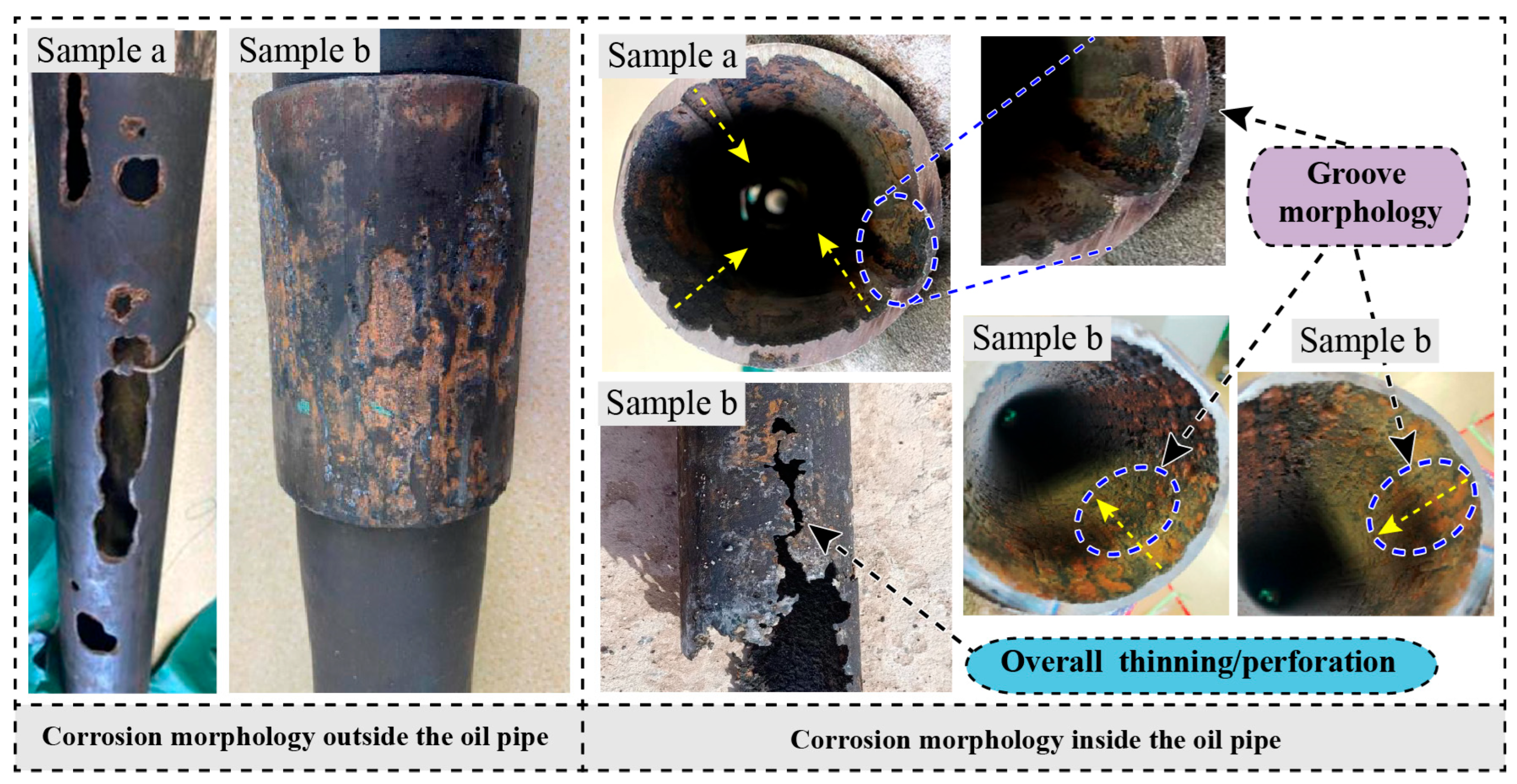
Samples were taken from the above severely corroded tubing sections at depths of 1311.87–1313.09 m (Sample a) and 1349.08–1350.20 m (Sample b). The corrosion morphologies of these two tubing samples are shown in Figure 2. It can be seen that both the samples exhibited thinning and perforation penetrating from the inner to the outer surface, with noticeable corrosion traces at the couplings. The inner surface of Sample a displayed groove-like/streamlined corrosion features, while that of Sample b showed groove-shaped corrosion morphology. The fluid flow direction is indicated by yellow dashed arrows. It can be found that the grooves exhibit a distinct, continuous alignment strictly parallel to the flow direction, which is a hallmark of flow-induced damage. In addition, it is noted that the retrieved tubing from this heavily corroded section was part of a P110 material gas lift string newly installed in May 2017. The material composition of this tubing string complies with the oilfield’s casing selection standards.
The original/nominal wall thickness of the tubing was 5.51 mm (for 2–7/8″). The remaining wall thickness in the severely corroded sections was measured at multiple points using vernier calipers. The detailed value of the remaining wall thickness is shown in Table 1. The minimum remaining thicknesses observed were approximately 2.22 × 10⁻³ m (Sample a) and 2.13 × 10⁻³ m (Sample b), corresponding to a maximum local wall loss of about 59.7% and 61.3% of the original thickness, respectively. The average remaining thickness was 3.46 × 10⁻³ m (Sample a) and 3.66 × 10⁻³ m (Sample b). Based on these measurements and the exposure period, the estimated corrosion rate in these severely corroded sections reached 0.46 and 0.41 mm/a, respectively.

1.2. Analysis of Corrosion Causes in Drainage Wellbores

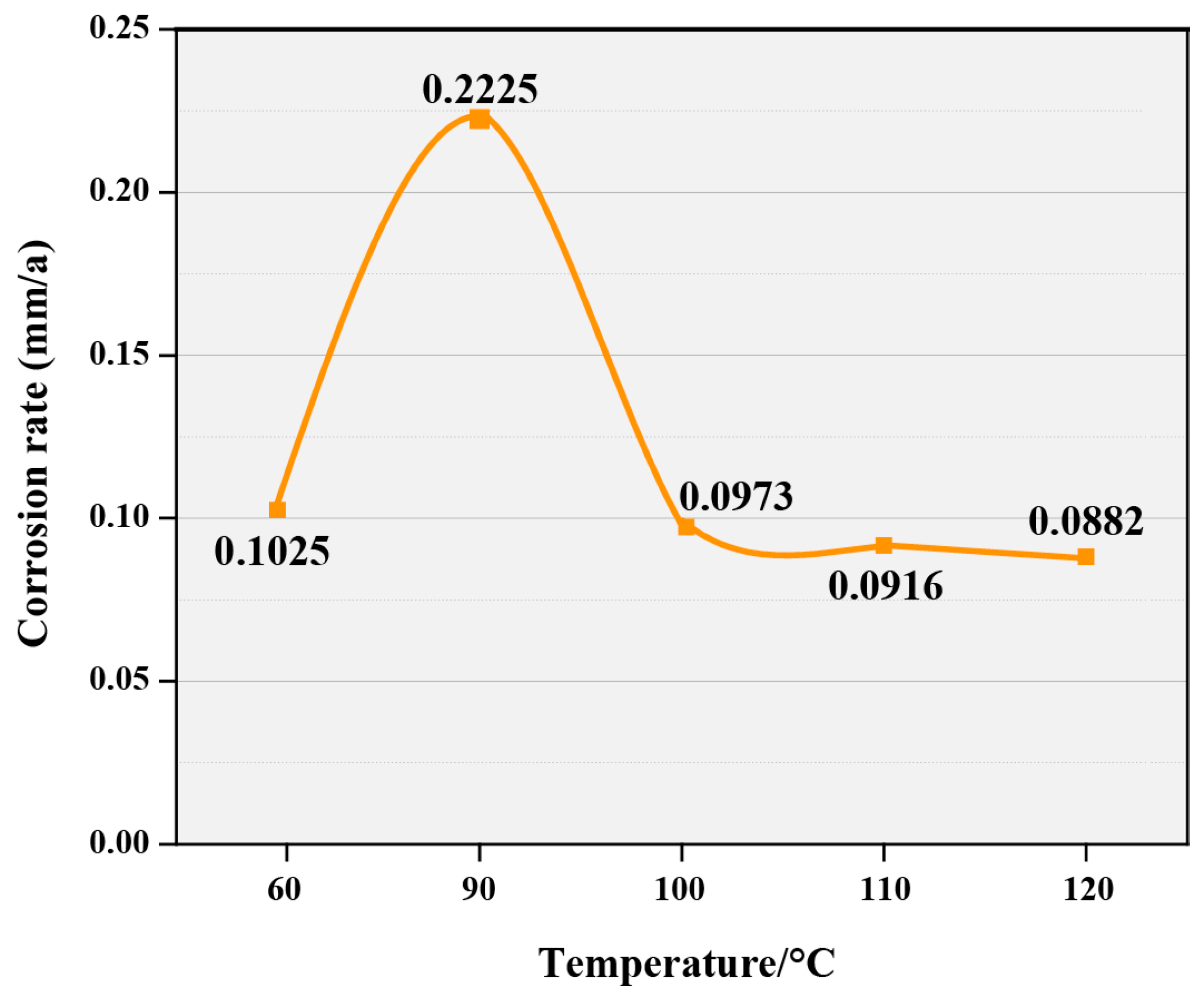
The corrosive environment in this well is characterized by a CO2-saturated, high-salinity formation water system. The solution has a total salinity of 117,600 mg/L and a pH of approximately 6.5. It is identified as a CaCl2 water type, with the primary ionic constituents being Cl (72,000 mg/L), Ca2+ (6450 mg/L), and Mg2+ (659 mg/L). No H2S was detected. CO2 corrosion is essentially a coupling process involving electrochemical dissolution of metal and dynamic evolution of corrosion product films. On one hand, dissolved CO2 forms carbonic acid, which initiates electrochemical corrosion reactions on the surface of carbon steel tubing (anodic reaction: Fe → Fe2+ + 2e). On the other hand, corrosion products such as FeCO3 can form a protective film on the tubing surface, which theoretically reduces the corrosion rate. However, due to uneven distribution or damage of the film, localized corrosion often occurs. The maximum partial pressure of CO2 in this well reaches 0.38 MPa, indicating a severe CO2 corrosion environment. Under such conditions, temperature becomes a critical parameter influencing CO2 corrosion. To elucidate the influence of temperature on the corrosion degree of carbon steel, high-temperature and high-pressure autoclave tests were performed, simulating the well conditions (salinity: 117,600 mg/L; CO2 partial pressure: 0.38 MPa; duration: 7 days). The results are presented in Figure 3. It can be seen that the corrosion rate of carbon steel in a CO2 environment exhibits a non-monotonic trend with increasing temperature—first increasing and then decreasing—with a typical corrosion peak occurring around 90 °C. It is worth noting that the temperature range (50–70 °C) corresponding to the severely corroded section of the gas lift string in this well significantly deviates from the conventional sensitive interval for CO2 corrosion. Furthermore, corrosion morphology analysis indicates that the tubing undergoes asymmetric wall thinning from the inside outward, with pronounced groove-like features on the inner wall surface, as shown in Figure 2.
Considering that the wellbore operates in a multiphase flow corrosion environment where gas and liquid coexist, the continuous scouring action of the flowing medium in the gas–liquid two-phase flow accelerates the removal of corrosion products. Additionally, the significant differences in physical properties (such as density, viscosity and surface tension) between the gas and liquid phases lead to evolution in flow patterns and fluid behavior. These hydrodynamic effects collectively exacerbate localized corrosion in the wellbore. Therefore, characterizing gas–liquid two-phase flow in drainage wellbores and elucidating the promoting mechanisms of hydrodynamic factors constitute essential research objectives for understanding the abnormal corrosion observed in this well.

2. Experiment and Procedure

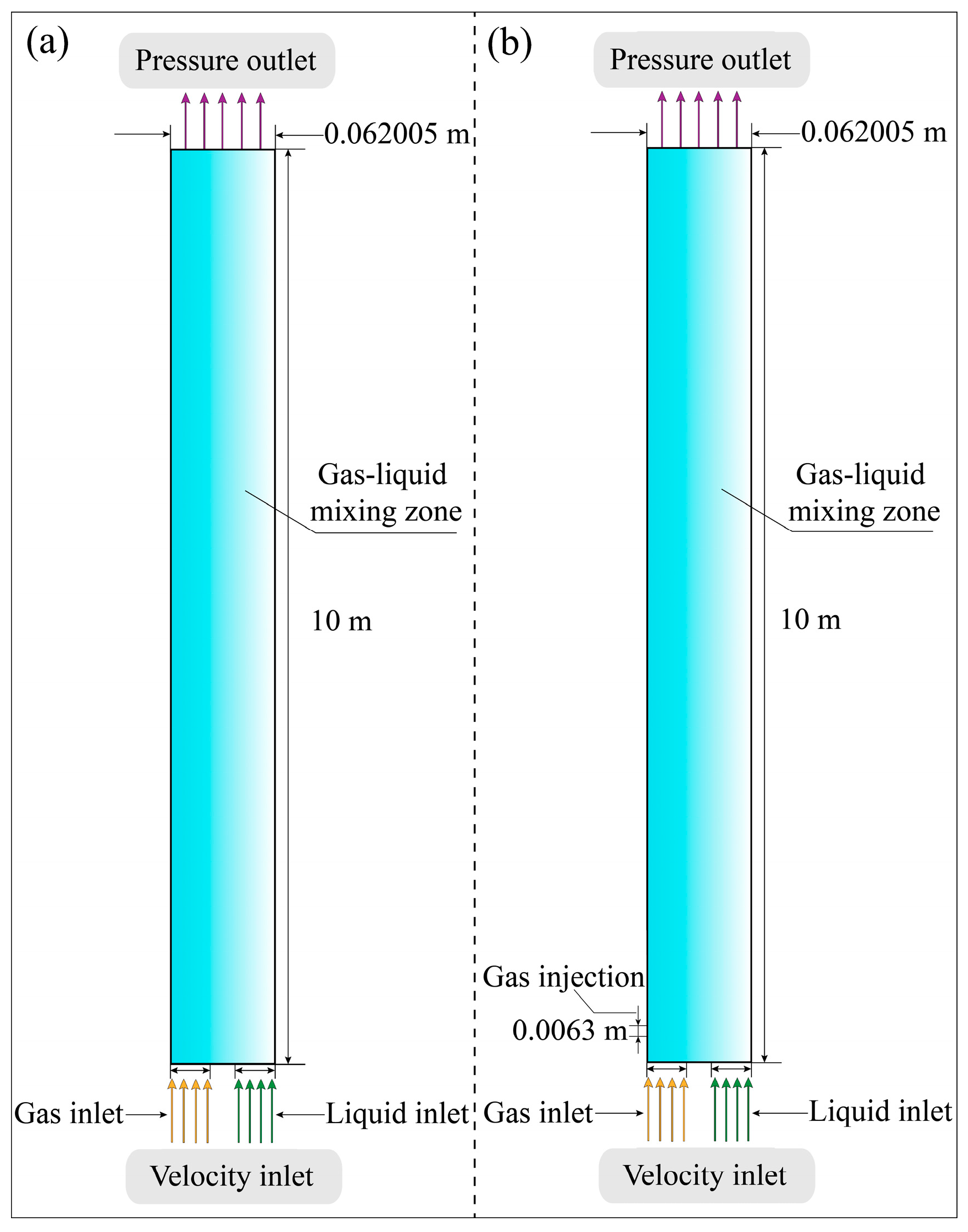
Based on the actual tubing dimensions and specific working conditions, a two-dimensional geometric model of the vertical wellbore was developed using fluid dynamics software. The specific geometric dimensions of the model are 10 m in height, 0.073025 m in outer diameter and 0.00551 m in wall thickness. As the well employs gas lift drainage, the model is configured as follows: the section below the gas lift valve includes a gas inlet on one side and a liquid inlet on the other at the bottom of the wellbore. At the gas lift valve section, a gas injection port is set on the bottom side with a diameter of 0.0063 m, while the bottom of the wellbore retains one side as the gas inlet and the other as the liquid inlet. Under the simulated working conditions, the gas inlet, liquid inlet and gas injection port are all defined as velocity inlet boundary conditions. The outlet is set as a pressure outlet boundary condition and the wall is treated as a no-slip boundary. According to the Euler-Euler approach [27,28], a VOF (Volume of Fluid) model was employed to simulate the gas–liquid two-phase flow. In the specific model calculation, as for the turbulence model, the simulation utilized the shear stress transport (SST) k-ω model with enhanced wall treatment. In terms of mesh characteristics, the computational domain adopts quadrilateral grid discretization. The final grid consists of approximately 1.05 million elements, with local refinement carried out near the gas lift valve, the pipe wall, the gas inlet and liquid inlet to address the issues of high speed and shear stress gradient. In addition, the meshing scheme for numerical calculation will affect the convergence of the calculation results. To ensure the accuracy and efficiency of the calculation, when analyzing the convergence of the meshing, multiple meshing schemes are selected for comparison, ranging from 112,517 to 1,285,433 elements. Based on the results of the wall shear force, the meshing scheme with a deviation of less than 5% from the calculation result of the densest meshing is selected as the final meshing scheme. The schematic of the specific computational model is presented in Figure 4.
Based on the aforementioned assumptions, the gas and liquid phases are treated as interpenetrating continua. Furthermore, accounting for the compressibility and expansibility of the gas phase, the mass conservation equations, continuity equations, and the ideal gas law are established for both phases as follows:
t ( ε g ρ g ) + ( ε g ρ g v g ) = 0
t ( ε l ρ l ) + ( ε l ρ l v l ) = 0
PVg = RT
where g is the gas; l is the liquid; ε is the volume fraction of the gas and liquid; ρ is the density of the gas and liquid, Kg/m3; v is the velocity of the gas and liquid, m/s; P is the pressure of the gas, Pa; Vg is the specific volume of the gas, m3/Kg; R is the gas constant, 287 J/(Kg·K); T is the absolute temperature of the gas, K.

3. Results and Discussion

3.1. The Variation Law of Multiphase Flow in the Wellbore String

The vertical wellbore primarily contains gas and liquid phases. The gas phase consists of natural gas used for gas lift, with methane as the main component. The liquid phase is predominantly formation water, with negligible oil content. The formation water has a pH of approximately 6.5 and a high Cl concentration, ranging from 111,000 to 118,000 mg/L. Based on the specific working conditions, the tubing is divided into seven characteristic points from the wellhead to the bottomhole, with detailed conditions provided in Table 2. Under different operating conditions, variations in pressure and temperature within the wellbore lead to differences in energy loss, in situ gas–liquid ratio, gas and liquid densities and viscosities, mixture density, and other parameters as the two-phase fluid ascends from the bottom to the top. These variations result in distinct flow patterns. Therefore, this study analyzes the characteristics of gas–liquid two-phase flow patterns in the vertical wellbore by examining different characteristic points along the depth from the bottomhole to the wellhead. The seven conditions (1#–7#) listed in Table 1 correspond to seven distinct characteristic locations along the wellbore depth, from the bottomhole to the wellhead. It is worth noting that the model is 2D, chemical environment and electrochemistry are simplified, and effects such as solids, scale, or long-term changes in water chemistry are not explicitly simulated.

3.1.1. Distributions of Flow Patterns Below the Gas Lift Valve

The flow pattern at the bottom of the wellbore (Operating Point 7#) is shown in Figure 5, where red represents the gas phase and blue represents the liquid phase. Based on the calculations from Table 1, the liquid velocity at the bottom is 0.062 m/s, and the gas velocity is 0.4 m/s. Under these conditions, the gas content in the wellbore exceeds that of the liquid. The flow pattern diagram shows an irregular yet distinct gas–liquid interface, with bubbles in the tubing colliding and coalescing into slugs of varying sizes, known as Taylor bubbles. These bubbles are primarily concentrated in the central region of the tubing, and some larger Taylor bubbles have diameters approaching that of the tubing itself. At this stage, the flow pattern in the wellbore is predominantly slug flow. In this regime, Taylor bubbles and liquid slugs alternate in upward motion. A falling liquid film surrounds the Taylor bubbles, and the tail of each bubble is followed by a liquid slug containing numerous small bubbles. Additionally, it can be observed that as the position changes from position 1 to position 4, the coalescence of Taylor bubbles remains relatively uniform.
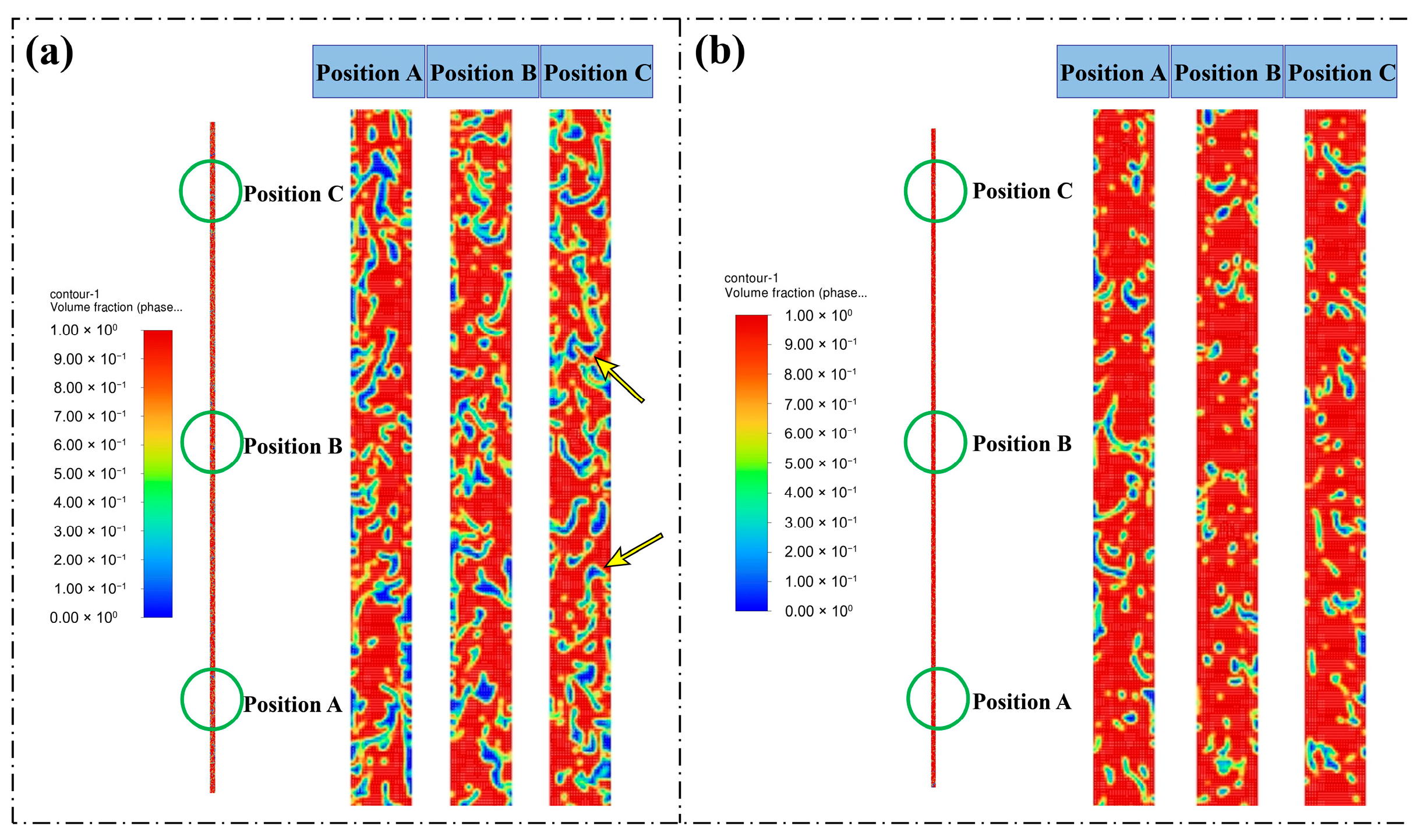
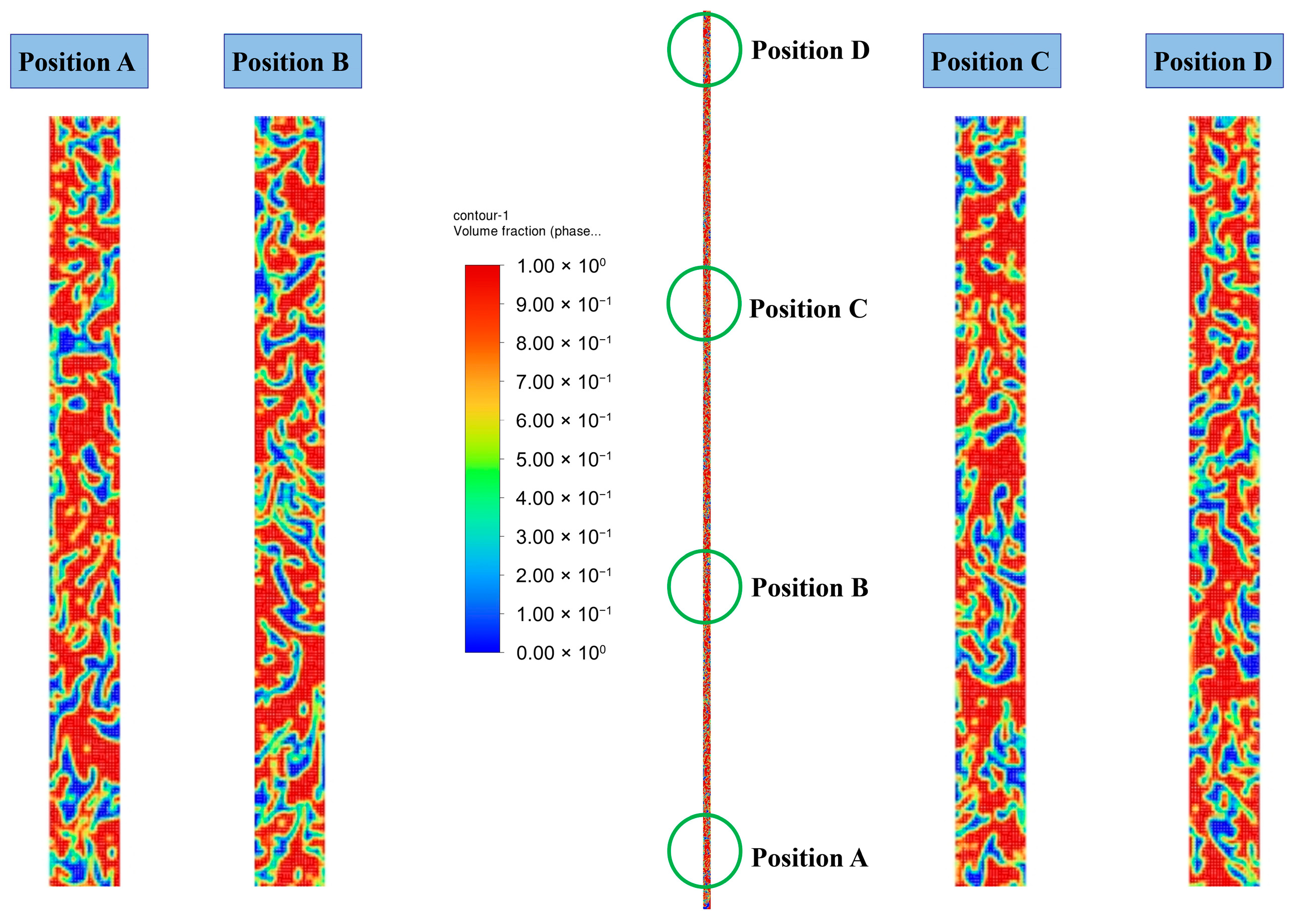
Figure 6a presents the flow pattern at operating point 6# (well depth of 2500 m). At this location, the gas velocity increases to 0.6 m/s, while the liquid velocity remains relatively low. The increased gas content results in an insufficient liquid phase flow rate to sustain a stable slug flow pattern. Consequently, the gas–liquid interface becomes irregular and the distinct profile of Taylor bubbles begins to disappear, then transforms into unstable gas channeling. The liquid slugs dispersed by the gas channeling mostly adhere to the tube wall and flow downward. These reversed liquid columns gradually accumulate at the tail of the gas churn, forming new liquid slugs, as indicated by the yellow arrows in Figure 6. This disordered flow pattern, characterized by the cyclic dispersion, recirculation, accumulation, and re-dispersion of the liquid phase, is defined as transitional flow. The flow pattern results at operating point 5# (well depth of 1715 m) are shown in Figure 6b. While the liquid velocity remains nearly constant, the gas velocity increases further to 1.15 m/s, which is approximately 18 times that of the liquid velocity. The larger liquid slugs are gradually broken up by the increasing gas phase, dispersing the liquid into smaller columns within the continuous gas stream. Most liquid slugs continue to adhere to the tubing wall, maintaining a transitional flow pattern. The sizes of liquid columns at positions A to D were statistically analyzed by measuring the maximum length and width of no fewer than 50 liquid slugs. The statistical results indicate an average diameter of approximately 21.38 ± 0.93 mm.

3.1.2. Flow Pattern Distribution at and Above the Gas Lift Valve

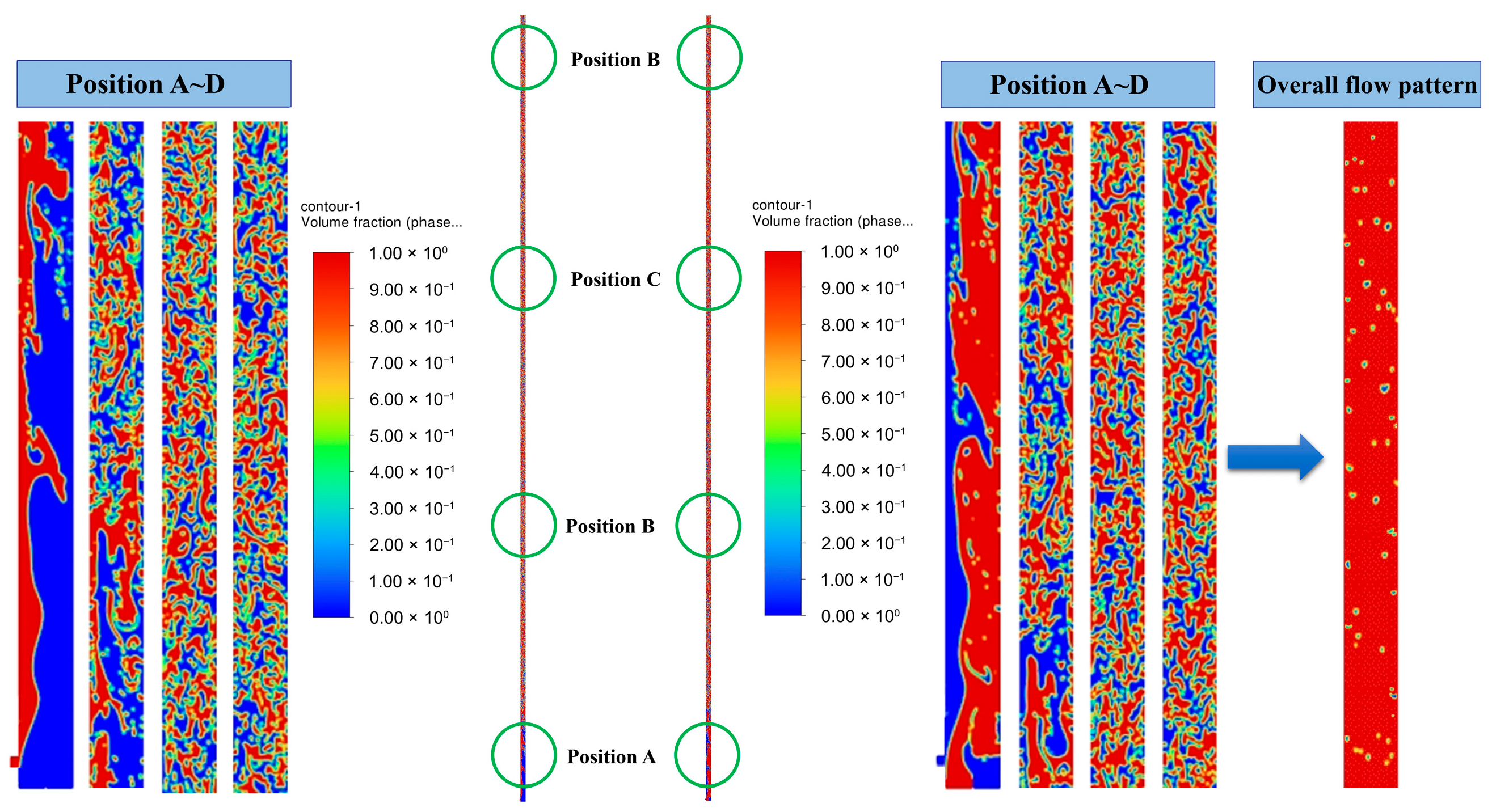
The flow pattern at the gas lift valve (Operating point 4#, well depth of 1674 m) is presented in Figure 7. At this position, the wellbore gas comprises two streams: injected gas (10.382 m/s) and the gas from the inlet (1.46 m/s), while the liquid velocity remains nearly constant. The influence of gas injection from these two sources on the flow patterns at Locations 1 to 4 is depicted in Figure 7, respectively. As observed from the changes in the gas–liquid flow patterns, gas injection significantly alters the wellbore flow regime, resulting in a transitional flow state. The overall gas–liquid two-phase flow pattern in the wellbore, integrating both gas sources, is shown in Figure 7. It is evident that the gas content increases markedly throughout the tubing. Under these conditions, the liquid phase flows at a low velocity and is present in small amounts, being dispersed into discontinuous droplets, while the gas phase becomes continuous. Due to the high-velocity gas flow, the accumulated liquid at the bottom of the wellbore is atomized and dispersed as discrete droplets within the continuous gas phase. At this stage, the flow in the wellbore undergoes a transition to an annular-mist flow regime.
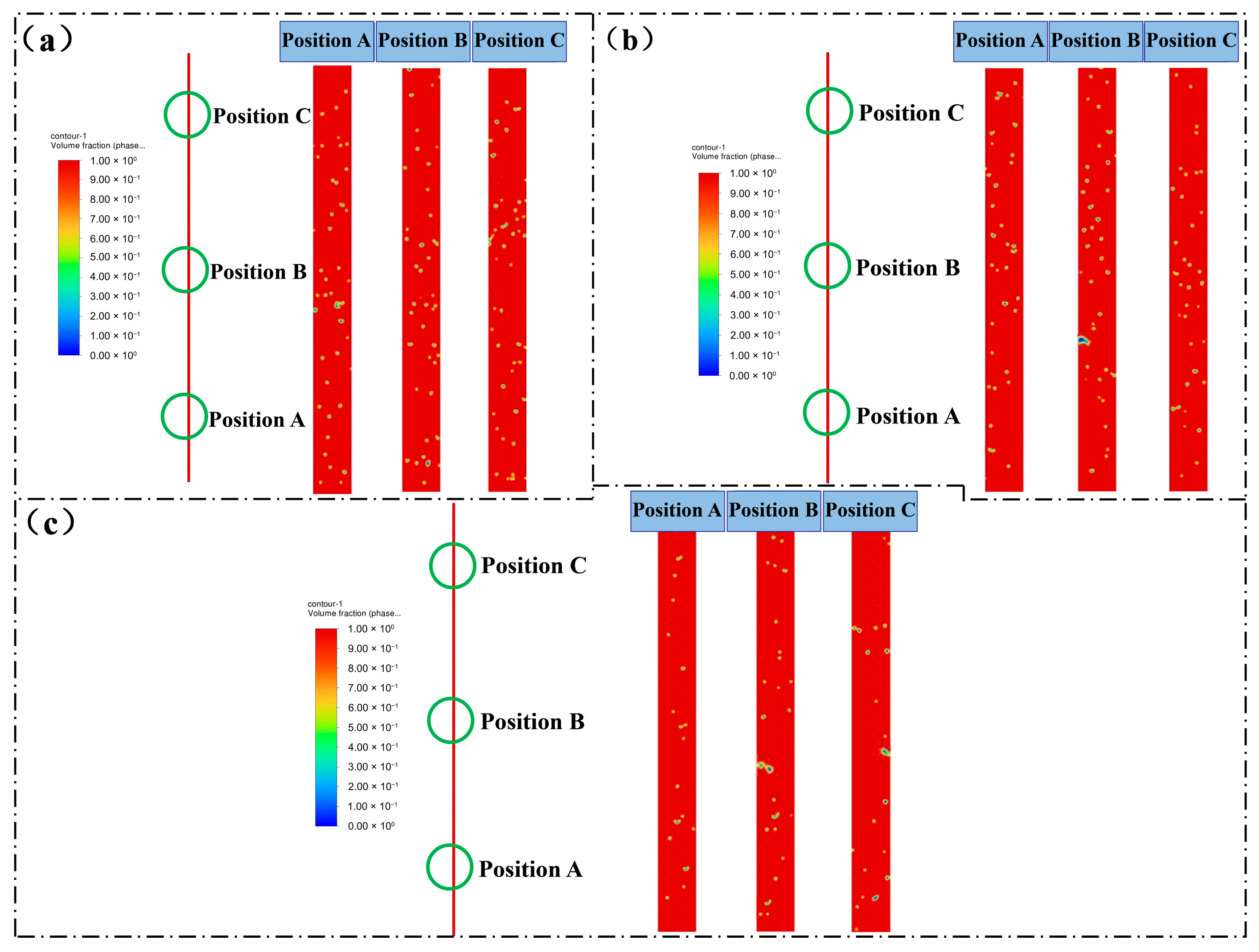
Figure 8a,b present the flow patterns at two locations above the gas lift valve: Operating Point 3# (1500 m depth) and Operating Point 2# (1200 m depth), respectively. As indicated in Table 1, the gas–liquid ratio increases significantly in the section above the gas lift valve in this drainage well. The two-phase flow behavior in this section exhibits strong consistency with the region near the gas lift valve, with both clearly demonstrating an annular-mist flow pattern. In this regime, the gas carries the liquid primarily in the form of dispersed droplets entrained within a continuously flowing gas core. The droplet size in different well segments depends on the formation mechanism as well as the subsequent breakup and coalescence processes within the gas core. To quantify the variation in droplet size along the wellbore, the Sauter mean diameter d (in meters) is introduced [19], defined as follows:
d = n = 1 N d n 3 n = 1 N d n 2
where dn is the diameter of the n-th droplet (in meters), and N represents the total number of the droplets.
Furthermore, the flow pattern at the wellhead is depicted in Figure 8c. The results indicate that the flow regime within the tubing string remains annular-mist. According to the data presented in Table 1, under these conditions, the liquid holdup remains constant while the gas volume fraction increases. Consequently, compared with the simulated flow patterns at operating points 3# and 2# in Figure 8a,b, the size of the liquid droplets entrained within the gas core at the wellhead section exhibits a slight variation.
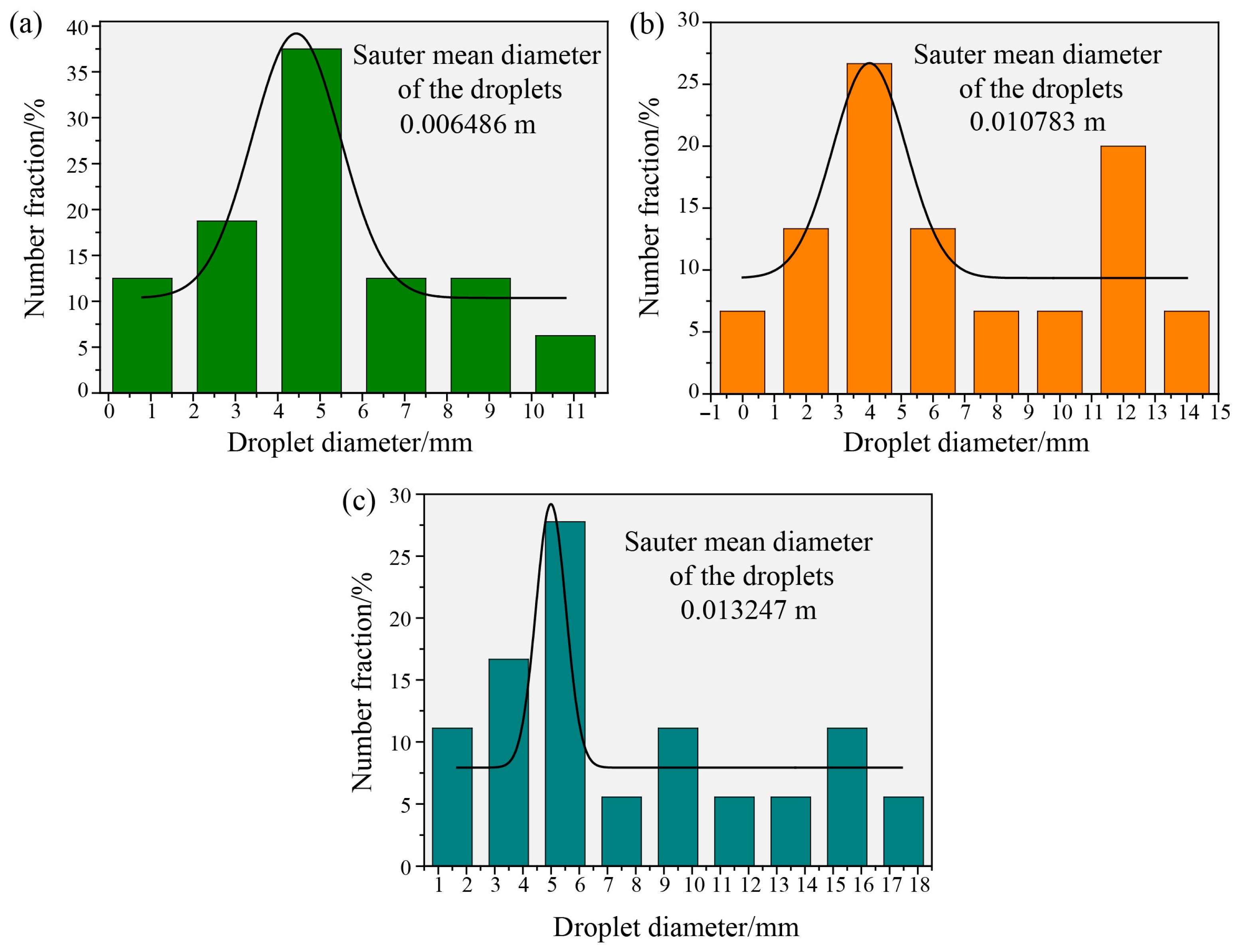
Due to the large number of dispersed droplets in the wellbores of the three working conditions 3#, 2# and 1#, the corresponding droplet sizes were statistically analyzed. Multiple flow patterns resulting from different positions in the wellbores were selected for each working condition for analysis. The droplet size distribution and Sauter mean diameter were obtained through quantitative post-processing of the transient gas–liquid interface data captured by the VOF model. The specific procedure is as follows: (a) Interface identification and droplet detection: After the flow reached a statistically steady annular-mist state, the instantaneous liquid-volume-fraction field was analyzed. Nearly circular or elliptical particles with a yellow boundary are identified as liquid structures (droplets). The equivalent diameter of each individual droplet was determined by averaging its major and minor axes, and measurements were conducted on more than 100 dispersed droplets. (b) Droplet parameter calculation: The corresponding values are obtained by using Equation 4 for calculation. The number of measured dispersed droplets was more than 100. The resulting droplet diameter distribution is shown in Figure 9. It can be seen from the figure that at working condition 3#, the droplet diameter distribution range in the wellbore is 0 to 0.011 m. With the decrease in well depth, the droplet size gradually increases. At working condition 1#, the droplet size distribution range in the wellbore expands to 0.001 to 0.018 m. By using the Formula (4), the Sauter mean diameters of the droplets in the wellbores at working conditions 3#, 2# and 1# are calculated to be 0.006486 m, 0.010783 m and 0.013247 m, respectively. This indicates an increased probability of droplet coalescence within the gas core, along with more intense droplet breakup. Consequently, the impact force exerted on the tubing wall by the shockwaves from droplet breakup is significantly amplified.

3.2. The Promoting Mechanism of Hydrodynamic Factors on Wellbore Corrosion

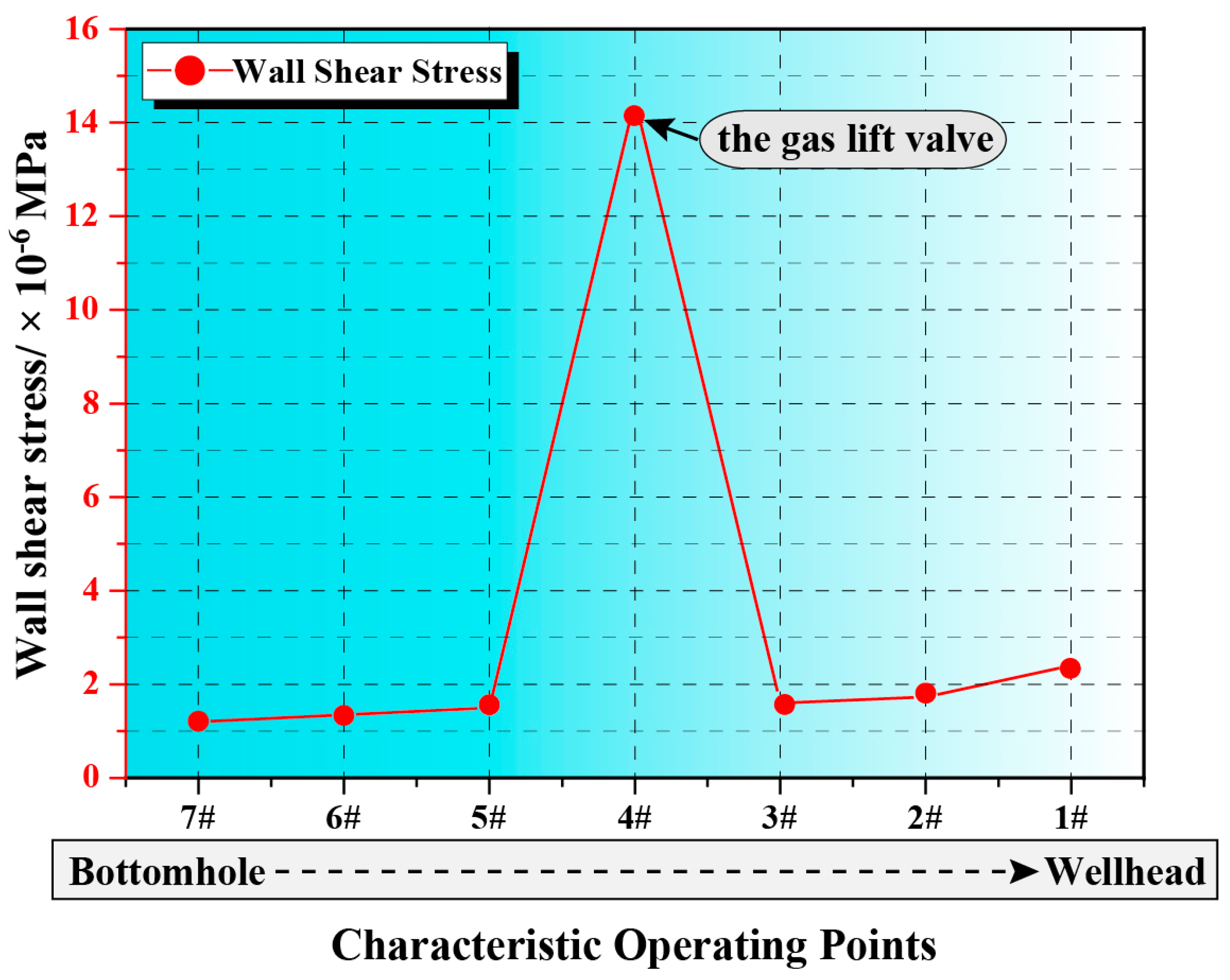
The variation in gas–liquid flow patterns across different well sections induces a dynamic response in wall shear stress. The calculated distribution of wall shear stress along the wellbore is presented in Figure 10. It can be observed that the wall shear stress increases gradually from the bottom hole toward the wellhead, reaching its maximum value at the gas lift valve. The presence of wall shear stress enhances charge transfer and mass transport on the metal surface, thereby promoting the formation of a corrosion product film. This phenomenon results from the variation in the gas–liquid mass ratio along the wellbore. Specifically, as the proportion of the gas phase increases, the fluid velocity, particularly that of the gas phase, rises significantly. Furthermore, the relatively small orifice size of the gas lift valve causes a notable increase in gas velocity at this location. Consequently, the flow regime alters, leading to a thinning of the hydrodynamic boundary layer and a corresponding increase in the velocity gradient near the tubing wall. These effects collectively enhance the wall shear stress through momentum transfer. Although elevated wall shear stress may intensify corrosion kinetics on the inner tubing surface, the results in Figure 10 indicate that the maximum wall shear stress at the gas lift valve is 1.421 × 10⁻⁵ MPa, while the values in other sections remain relatively low. This result is consistent with that of Li et al., who directly measure the wall shear stress in multiphase flow using a floating element wall probe [29]. Previous studies by Gao and Chen et al. have reported that the adhesion strength between the corrosion product film and carbon steel substrate typically ranges from 1 to 11.87 MPa [30,31]. Since the observed wall shear stress is orders of magnitude lower, it is insufficient to mechanically damage the protective corrosion product layer [29]. Therefore, wall shear stress plays a secondary role among factors controlling tubing corrosion, and its influence should be regarded as synergistic rather than deterministic.
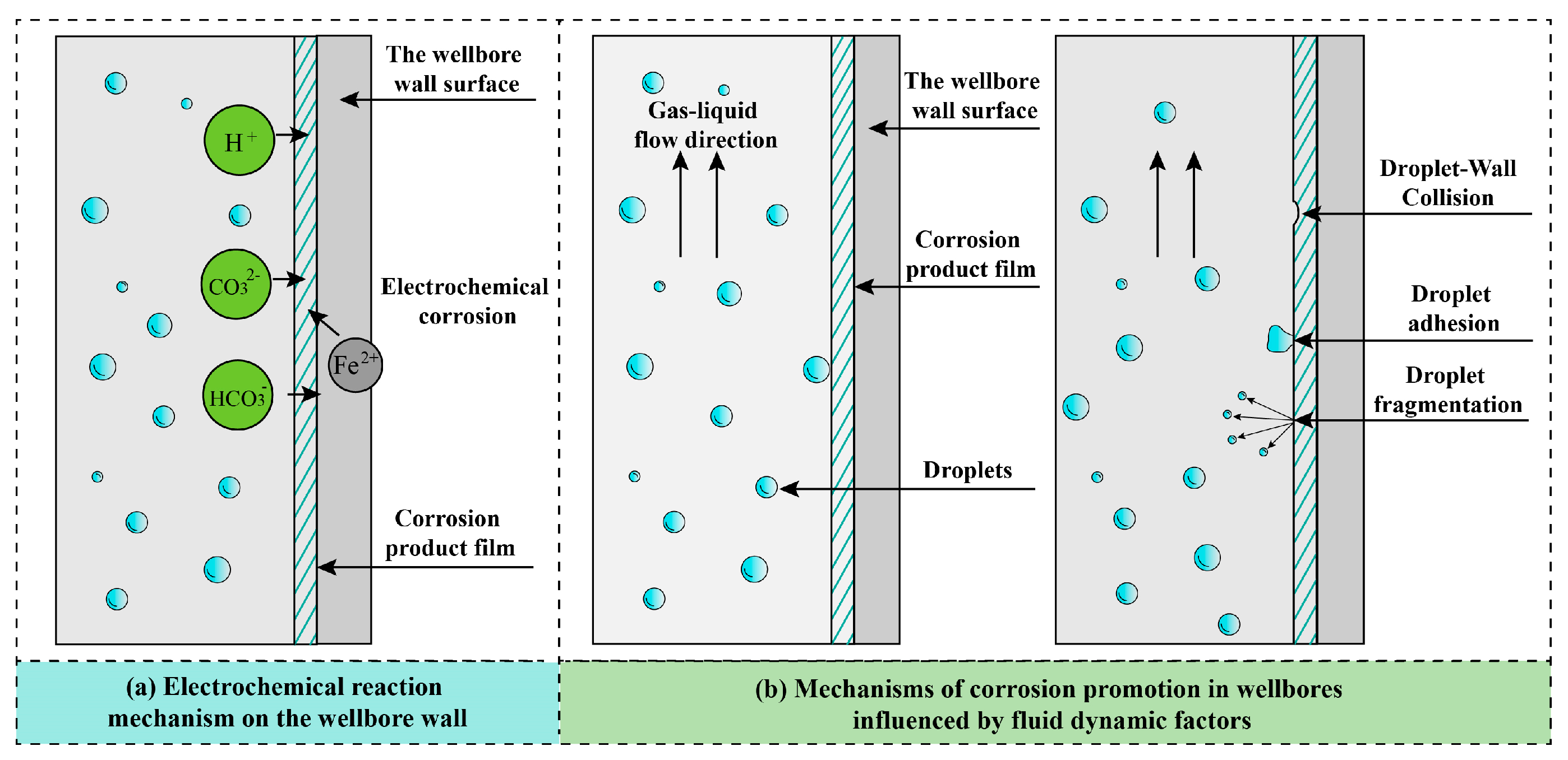
The section above the gas lift valve is identified as the severely corroded interval in this well, corresponding to a temperature range of 50–70 °C (depths of 1000–1500 m). Within this interval, the corrosion product film formed electrochemically on the wellbore wall is characteristically thick, loose, non-uniform and prone to damage [32], as shown in Figure 11. The medium inside the tubing above the secondary gas lift valve is a multiphase flow of gas-lift gas carrying produced fluids, whose volume is significantly larger than that in the tubing below the valve (see Table 1). From Figure 8a,b, it is evident that the gas phase is continuous in this section, while the aqueous phase is distributed within the gas phase in the form of droplets. As these droplets are carried upwards by the high-velocity gas lift gas towards the wellhead, they impact the tubing surface at certain velocities and angles. This impact generates high localized compressive stress at the points of impingement, leading to damage in microscopic areas of the wall. Furthermore, upon impacting the wellbore wall, the droplets undergo partial rebound and breakup [33], resulting in flow-induced erosion–corrosion, as illustrated in Figure 11. The consequences of the droplet-wall collision can be characterized by the Weber number (We), the expression for which is given by:
W e = ρ 1 V 1 2 d 2 σ
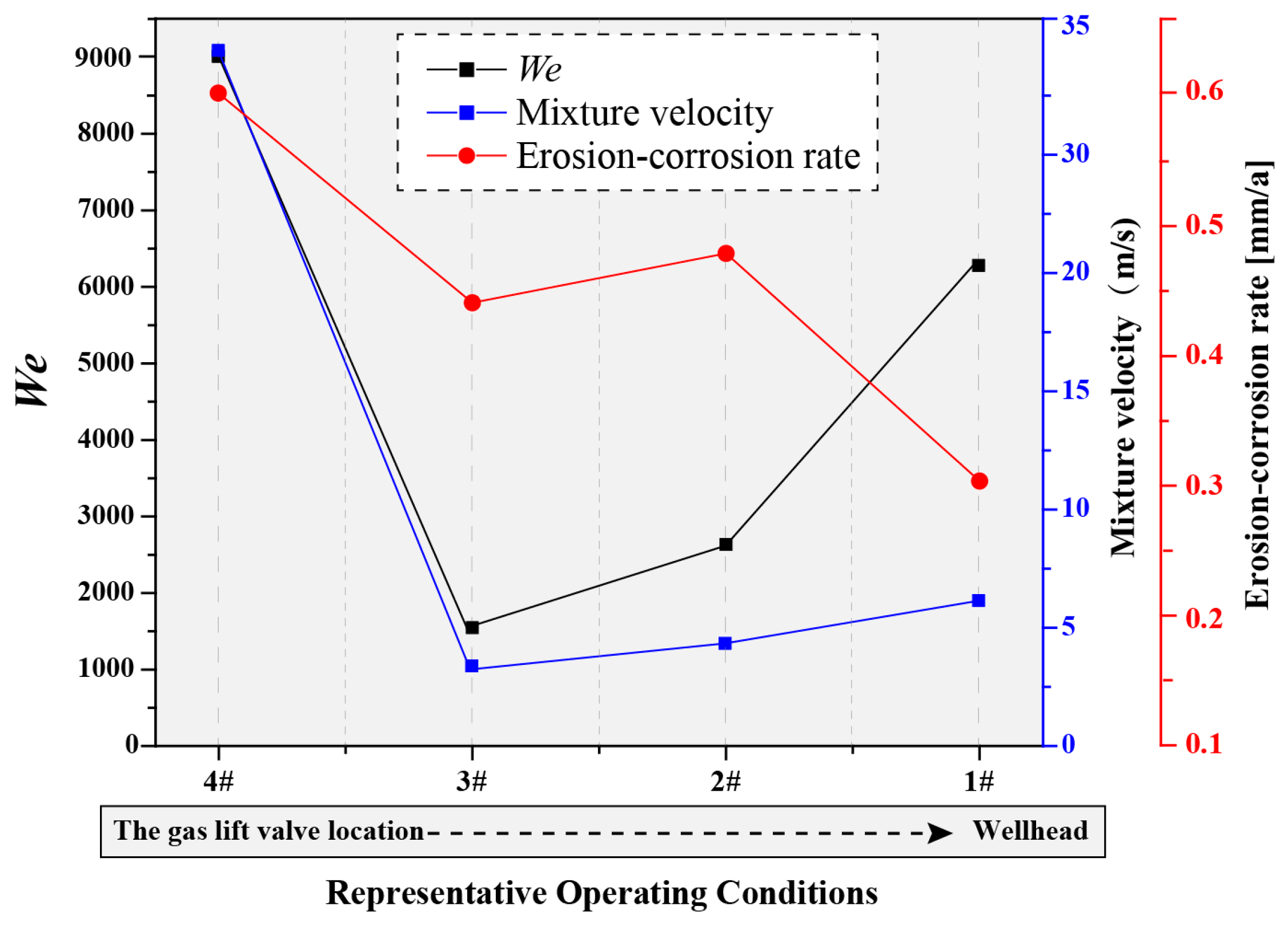
where ρ1 is the droplet density, kg/m3; Vl is the impact velocity, m/s; d is the droplet diameter, m and σ is the surface tension coefficient, N/m. It is noting that the droplet impact velocity is directly extracted from the transient CFD simulations of the annular-mist flow as follows: (a) CFD-based extraction: Using the VOF model, the motion of individual droplets entrained in the gas core was tracked. The velocity vector of each droplet at the instant of wall impingement was output from the simulation. The droplet impact velocity is taken as the magnitude of this velocity normal to the wall. (b) Relation to local gas/liquid velocities: In the annular-mist regime, the high-speed gas phase acts as the continuous carrier. Due to the small size and short relaxation time of the droplets, they are strongly coupled to the gas flow. Hence, droplet impact velocity is essentially equal to the local gas velocity at the same axial location, with negligible slip between the phases. The liquid velocity (which primarily describes the wall film) is not representative of the impacting droplets’ dynamics. Therefore, the calculated results are presented in Figure 12. It can be observed that the We reaches its maximum at the gas lift valve itself. In the section above the valve, the We value gradually increases with decreasing well depth, indicating a continuous rise in the initial kinetic energy of droplet impingement. Concurrently, the probability of droplet rebound and fragmentation upon impacting the wellbore wall increases.
The total erosion–corrosion rate is calculated as the algebraic sum of two components: the mechanical erosion rate and the electrochemical corrosion rate [34]. The calculation process and units are specified as follows: On one hand, the erosion rate due to droplet impingement was obtained through CFD simulation. Specifically, we employed the discrete phase model (DPM) in Fluent software, tracking the trajectories of liquid droplets in the annular-mist flow. The erosion rate on the tubing wall was calculated using a built-in erosion model within DPM, which is based on the impact velocity, angle, and size of the droplets, following the fundamental principle of deformation wear. The raw output from Fluent is a mass loss rate (e.g., kg/m2·s). This was converted to a depth-based rate (mm/a) using the density of the tube material (P110 steel) to be consistent with standard corrosion engineering practice and to allow direct comparison with the corrosion component.
On the other hand, the CO2 corrosion rate under the specific wellbore environment (temperature, pressure, salinity) was predicted using an empirical correlation based on the De Waard model. The specific corrosion rates are as follows:
lg v c = 6.2 2700 T + 273 + 0.0013 T + n c o r lg P CO 2 0.34 pH + λ C c o f
pH = 3.82 + 0.00384 T 0.51 lg P CO 2
where vc is the corrosion rate, T is the temperature, ncof is the CO2 partial pressure and λCcof is the correction term for the corrosion rate. The corresponding erosion–corrosion rate is the algebraic sum of the aforementioned erosion rate and corrosion rate. This component is directly calculated and expressed in mm/a. As a result, the two components are superimposed to obtain the total synergistic degradation rate, as conceptually described by the models in our original response. Figure 12 displays the erosion rate on the inner tubing wall under the annular-mist flow regime present at and above the gas lift valve. The figure also reveals that the erosion intensity is most severe at the gas lift valve, followed by the wellhead region. This distribution suggests that the scouring action of the gas–liquid two-phase flow thins the thick, loose, and uneven corrosion product film at and above the gas lift valve, thereby accelerating the corrosion of the pipe wall. Consequently, a synergistic corrosion mechanism occurs, combining the mechanical action induced by hydrodynamic factors and electrochemical processes. Under the synergistic action of multiphase flow erosion and corrosion, a distinct groove-shaped morphology develops on the tubing surface, accompanied by significant overall wall thinning, as marked by the black arrows in Figure 11.
In summary, wellbore corrosion is fundamentally a complex process involving the multi-field coupling of electrochemical factors and hydrodynamic parameters. Although the temperature zone in the upper section of the gas lift valve in this well (50–70 °C, 1000–1500 m interval) falls within the theoretical corrosion-inhibition window for CO2 corrosion, this section exhibited significant corrosion acceleration. This reveals the limitations of the traditional electrochemical corrosion theory, which is predominantly based on temperature-dependent protective corrosion product films. The underlying mechanisms are identified as follows: (1) Flow pattern transition effect: The formation of annular-mist flow facilitates the development of a continuous gas core, with the liquid phase being entrained upwards as discrete droplets, significantly intensifying phase interactions. (2) Fluid scouring action: The fluid velocity above the gas lift valve is markedly higher than in the section below it. (3) Shear stress gradient evolution: The wall shear stress increases from the bottomhole to the wellhead until reaching a maximum value of 1.421 × 10⁻⁵ MPa at the gas lift valve, subsequently decreasing, which can continuously hinder the formation and repair of a dense, stable corrosion product layer. (4) Flow-induced corrosion process: The high-velocity gas stream, carrying a small amount of liquid, forms a continuous gas core encapsulating water droplets moving upward along the tubing inner wall. The impingement of these droplets on the tubing surface induces flow-induced corrosion, which significantly promotes the electrochemical corrosion of the material. This synergy ultimately leads to the formation of a groove-shaped corrosion morphology along the flow direction on the inner wall of the wellbore tubing.
It is noteworthy that in the wellhead section, where a sharp temperature drop occurs (ΔT ≈ 22.83 °C), the degree of CO2 electrochemical corrosion is relatively weak, and the promoting effect of hydrodynamic factors on tubing corrosion is not significant. The corresponding erosion–corrosion rate is relatively low. Thus, the severe corrosion occurring in the 50–70 °C interval of this deliquification well is synergistically promoted by the mechano-electrochemical coupling effect between multiphase flow and electrochemical processes on the inner surface of the wellbore tubing.
In addition, while the observed synergistic effect belongs to the broad spectrum of mechano-electrochemical phenomena, the aim of this study lies in establishing a conclusive causal link between specific simulated hydrodynamic conditions—notably the annular-mist flow regime with its associated high local shear stress and droplet impingement—and the resultant severe corrosion. This advancement enables a critical shift from phenomenological description to a quantifiable, location-aware predictive tool, thereby providing a theoretical foundation for ensuring drainage wellbore integrity and safe service.

4. Conclusions

(1) The abnormal corrosion behavior observed in the gas lift tubing string of this deliquification well, within the 50–70 °C temperature interval, is primarily related to multiphase flow-induced corrosion. The flow pattern at the well bottom is slug flow, which transitions to a transitional flow pattern below the gas lift valve and further evolves into an annular-mist flow at and above the gas lift valve.
(2) The wall shear stress within the wellbore exhibits a trend of initial increase followed by a decrease from the bottomhole to the wellhead, reaching a maximum value (1.421 × 10⁻⁵ MPa) precisely at the gas lift valve. The fluid velocity in the section above the gas lift valve is significantly higher than that in the section below it, resulting in a substantially intensified mechanical action on the tubing surface.
(3) The corrosion in this deliquification well is synergistically accelerated by the mechano-electrochemical coupling effect between multiphase flow and electrochemical processes on the tubing’s inner surface. Within the 50–70 °C interval (1000–1500 m tubing section), high-velocity gas carrying a limited amount of liquid forms a continuous gas core with entrained droplets moving upward along the tubing wall. The impingement of these droplets on the tubing surface induces flow-accelerated erosion–corrosion, which markedly promotes the electrochemical corrosion of the pipe material. This synergistic action ultimately leads to the formation of a severe, groove-shaped corrosion morphology along the flow direction on the inner wall of the wellbore tubing.
(4) When selecting tubing materials for deliquification wells, materials should be selected not for their static passivity, but for their dynamic surface integrity under simultaneous chemical and mechanical attack. This calls for future material development and selection to focus on high strain-hardening capability to resist plastic deformation from impacts; a dense, adherent native surface layer that resists spallation under high shear force; and a homogeneous microstructure to prevent flow-accelerated localized galvanic corrosion.

Author Contributions

Conceptualization, formal analysis, writing—original draft preparation: P.D., Y.L. (Yongxu Li), and W.S.; formal analysis: J.X.; visualization: J.Y., Y.L. (Yanming Liu), and X.L.; funding acquisition: L.W. All authors have read and agreed to the published version of the manuscript.

Funding

The authors gratefully acknowledge the financial support of the Opening project fund of Materials Service Safety Assessment Facilities (No. MSAF-2023-001); the Qin Chuangyuan Originally Cited High-level Innovation and Entrepreneurship Talent Program (No. QCYRCXM-2022-138); and the Natural Science Foundation of Shaanxi Province of China (No. 2025JC-YBMS-613 and 2025JC-YBMS-466).

Institutional Review Board Statement

Not applicable.

Informed Consent Statement

Not applicable.

Data Availability Statement

Data are contained within the article.

Conflicts of Interest

The authors declare no conflicts of interest.

References

  1. Xiong, C.M.; Cao, G.Q.; Zhang, J.J.; Li, N.; Xu, W.L.; Wu, J.W.; Li, J.; Zhang, N. Nanoparticle foaming agents for major gas fields in China. Pet. Explor. Dev. 2019, 46, 1022–1030. [Google Scholar] [CrossRef]
  2. Jiang, J.T.; Song, Z.J.; Hu, Y.L.; Xu, Y.H.; Zhang, K.X.; Jiang, N.; Han, X.; Zhang, Y.H.; Wang, Z.F. Bubble formation and interface dynamics in oil-water systems: From gas-liquid-liquid interactions to CO2-assisted recovery. Adv. Colloid Interface Sci. 2026, 347, 103695. [Google Scholar] [CrossRef]
  3. Jin, Z.C.; Yang, C.D.; Zhang, S.L. Gas Production Engineering; Petroleum Industry Press: Beijing, China, 2004. [Google Scholar]
  4. Zhu, D.J.; Lin, Y.H.; Ma, H.Y.; Zhang, H.L.; Li, Y.F.; Zhang, L.; Deng, K.H. Experimental studies on CO2 corrosion of rubber materials for packer under compressive stress in gas wells. Eng. Fail. Anal. 2017, 80, 11–23. [Google Scholar] [CrossRef]
  5. Xu, B.H.; Yuan, B.; Wang, Y.Q.; Zhu, L. H2S-CO2 mixture corrosion-resistant Fe2O3-amended wellbore cement for sour gas storage and production wells. Constr. Build. Mater. 2018, 188, 161–169. [Google Scholar] [CrossRef]
  6. Ghadeer, M.; Mohamed, E.; Ibrahim, I.; Akram, A.; Imad, B. Failure analysis, corrosion rate prediction, and integrity assessment of J55 downhole tubing in ultra-deep gas and condensate well. Eng. Fail. Anal. 2023, 151, 107381. [Google Scholar] [CrossRef]
  7. Nimwegen, A.T.; Portela, L.M.; Henkes, R.A.W.M. The effect of the diameter on air-water annular and churn flow in vertical pipes with and without surfactants. Int. J. Multiph. Flow 2017, 88, 179–190. [Google Scholar] [CrossRef]
  8. Shi, J.T.; Wu, J.Y.; Lv, M.; Li, Q.; Liu, C.Y.; Zhang, T.; Sun, Z.; He, M.X.; Li, X.F. A new straight-line reserve evaluation method for water bearing gas reservoirs with high water production rate. J. Pet. Sci. Eng. 2021, 196, 107808. [Google Scholar] [CrossRef]
  9. Han, J.X.; Jiang, M.Q.; Wang, H.Y.; Liu, W.; Lu, Y.J.; Yang, Z.Z.; Chu, J. Probing the mechanism and impact of sand production on defoaming during foam drainage gas recovery: An experimental and molecular dynamics study. Colloids Surf. A Physicochem. Eng. Asp. 2025, 716, 136673. [Google Scholar] [CrossRef]
  10. Guet, S.; Ooms, G. Fluid mechanical aspects of the gas-lift technique. Annu. Rev. Fluid Mech. 2006, 38, 225–249. [Google Scholar] [CrossRef]
  11. Gupta, A.; Kaisare, N.S.; Nandola, N.N. Dynamic plunger lift model for deliquification of shale gas wells. Comput. Chem. Eng. 2017, 103, 81–90. [Google Scholar] [CrossRef]
  12. Kamari, A.; Bahadori, A.; Mohammadi, A.H. Prediction of maximum possible liquid rates produced from plunger lift by use of a rigorous modeling approach. SPE Prod. Oper. 2017, 32, 7–11. [Google Scholar] [CrossRef]
  13. Tasmi, T.; Rahmawati, S.D.; Sukarno, P.; Soewono, E. Applications of line-pack model of gas flow in intermittent gas lift injection line. J. Pet. Sci. Eng. 2017, 157, 930–940. [Google Scholar] [CrossRef]
  14. Akbari, S.; Frigaard, I.A.; Taghavi, S.M. Drainage flows in oil and gas well plugging: Experiments and modeling. Geonenergy Sci. Eng. 2024, 238, 212894. [Google Scholar] [CrossRef]
  15. Nwonodi, R.I. A novel model for predicting the productivity index of horizontal/vertical wells based on Darcy’s law, drainage radius, and flow convergence. Heliyon 2024, 10, 25073. [Google Scholar] [CrossRef] [PubMed]
  16. Hashmia, G.M.; Hasana, A.R.; Kabir, C.S. Simplified modeling of plunger-lift assisted production in gas wells. J. Nat. Gas Sci. Eng. 2018, 52, 454–460. [Google Scholar] [CrossRef]
  17. Liao, R.Q.; Li, Y.; Song, J.P.; Lei, Y. The establishment of multiphase flow experiment platform in gas lift test base. J. Oil Gas Technol. 2014, 36, 129–131. [Google Scholar]
  18. Nandola, N.N.; Kaisare, N.S.; Gupta, A. Online optimization for a plunger lift process in shale gas wells. Comput. Chem. Eng. 2018, 108, 89–97. [Google Scholar] [CrossRef]
  19. Shao, W.; Boiko, I.; Al-Durra, A. Plastic bag model of the artificial gas lift system for slug flow analysis. J. Nat. Gas Sci. Eng. 2016, 33, 573–586. [Google Scholar] [CrossRef]
  20. Qi, D.; Zou, H.L.; Chen, T.; Ding, Y.H. A method for comparison of lifting effects of plunger lift and continuous gas lift. J. Pet. Sci. Eng. 2020, 190, 107101. [Google Scholar] [CrossRef]
  21. Najeeb, A.S.; Ubedullah, A.; Bilal, S.; Muhammad, K.M.; Darya, K.B.; Zhang, R.; Yi, P. Optimizing gas well deliquification: Experimental analysis of surfactant-based strategies for liquid unloading in gas wells for enhanced recovery. Unconv. Resour. 2025, 7, 100200. [Google Scholar] [CrossRef]
  22. Zhang, X.L.; Zhang, C.; Zhou, B.; Yang, J.Q.; Lu, Y.H.; Yin, B.T. Numerical simulation of gas-liquid two-phase flow oattern in large annulus of deep well. Pet. Drill. Tech. 2024, 52, 37–49. [Google Scholar]
  23. Liu, H.; Liu, H.T.; Zhang, Q.; Fan, M.; Yin, B.T.; Wang, X.R.; Sun, X.H.; Wang, Z.Y. Effect of liquid viscosity on the gas-liquid two phase countercurrent flow in the wellbore of bullheading killing. Geoenergy Sci. Eng. 2023, 221, 111274. [Google Scholar] [CrossRef]
  24. Sun, B.J.; Sun, X.H.; Wang, Z.Y.; Chen, Y.H. Effects of phase transition on gas kick migration in deepwater horizontal drilling. J. Nat. Gas Sci. Eng. 2017, 46, 710–729. [Google Scholar] [CrossRef]
  25. Wang, N.; Sun, B.J.; Wang, Z.Y.; Wang, J.B.; Yang, C.F. Numerical simulation of two phase flow in wellbores by means of drift flux model and pressure based method. J. Nat. Gas Sci. Eng. 2016, 36, 811–823. [Google Scholar] [CrossRef]
  26. Alsanea, M.; Mateus-Rubiano, C.; Karami, H. Experimental investigation of well deliquification using the partial tubing restrictions. Geoenergy Sci. Eng. 2024, 243, 213278. [Google Scholar] [CrossRef]
  27. Washino, K.; Chan, E.L.; Kaji, T. On large scale CFD-DEM simulation for gas-liquid-solid three-phase flows. Particuology 2020, 59, 2–15. [Google Scholar] [CrossRef]
  28. Fajemidupe, O.T.; Aliyu, A.M.; Baba, Y.D. Sand minimum transport conditions in gas-solid-liquid three atratified flow in a horizontal pipe at low particle concentrations. Chem. Eng. Res. Des. 2019, 143, 114–126. [Google Scholar] [CrossRef]
  29. Li, W.; Pots, B.F.M.; Brown, B.; Kee, K.E.; Nesic, S. A direct measurement of wall shear stress in multiphase flow-Is it an important parameter in CO2 corrosion of carbon steel pipelines? Corros. Sci. 2016, 110, 35–45. [Google Scholar] [CrossRef]
  30. Gao, K.; Yu, F.; Pang, X.; Zhang, G.; Qiao, L.; Chu, W.; Lu, M. Mechanical properties of CO2 corrosion product scales and their relationship to corrosion rates. Corros. Sci. 2008, 50, 2796–2803. [Google Scholar] [CrossRef]
  31. Chen, C.F. Research on Electrochemical Behavior and Corrosion Scale Characteristics of CO2 Corrosion for Tubing and Casing Steel. Ph.D. Thesis, Northwestern Polytechnical University, Xi’an, China, 2002. [Google Scholar]
  32. He, T.J.; Jiang, P.; Liao, K.X.; Leng, J.H.; Liao, J.C.; He, G.X.; Zhao, S.; Tang, X. Investigation into flow-induced internal corrosion direct assessment in small-diameter dry gas fluctuating pipeline. Eng. Fail. Anal. 2024, 163, 108566. [Google Scholar] [CrossRef]
  33. Luca, B.B.; Lotte, H.; Jens, L.S.; John, H.; Morten, S.J. Flow-induced corrosion of brass flowmeters used for drinking water. Eng. Fail. Anal. 2025, 171, 109394. [Google Scholar] [CrossRef]
  34. Matsumura, M. Erosion-corrosion of metallic materials in slurries: Corrosion Reviews. Corros. Rev. 1994, 12, 3–4. [Google Scholar] [CrossRef]
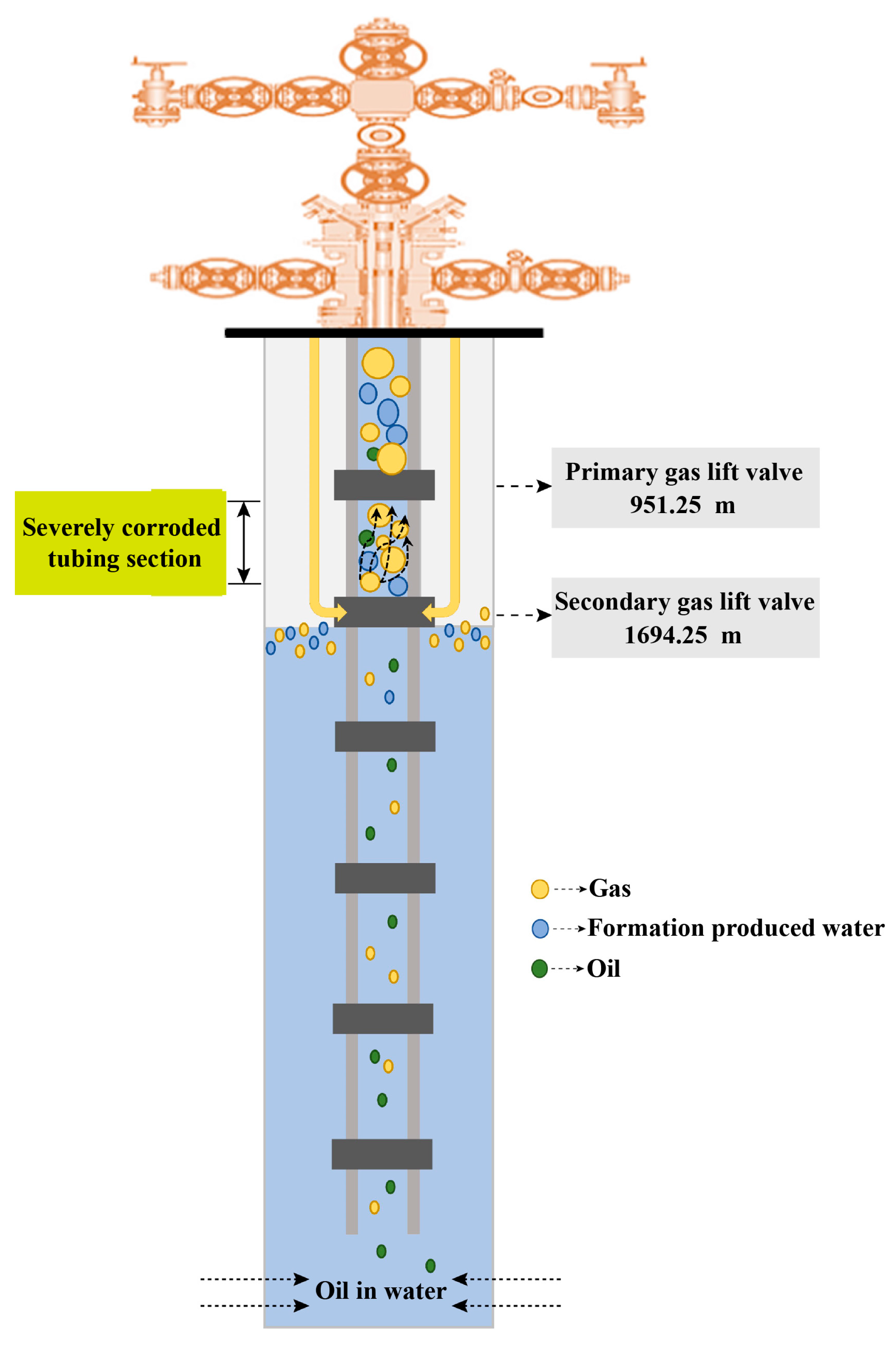
Figure 1. The status of the well shaft.
Coatings 15 01490 g001
Figure 2. Corrosion characteristics of tubing in different well sections.
Coatings 15 01490 g002
Figure 3. Average corrosion rate of P110 carbon steel at different temperatures (mm/a).
Coatings 15 01490 g003
Figure 4. Two-dimensional geometry model of vertical wellbore: (a) the up and down sections of the gas lift valve and (b) Position of the gas lift valve.
Coatings 15 01490 g004
Figure 5. The simulation flow pattern diagram results of the 7# working condition point (~3200 m well depth).
Coatings 15 01490 g005
Figure 6. (a) The simulation flow pattern diagram results of the 6# working condition point (~2500 m well depth); (b) The simulation flow pattern diagram results of the 5# working condition point (~1715 m well depth).
Coatings 15 01490 g006
Figure 7. The simulation flow pattern diagram results of the 4# working condition point (~1674 m well depth).
Coatings 15 01490 g007
Figure 8. (a) The simulation flow pattern diagram results of the 3# working condition point (~1500 m well depth); (b) The simulation flow pattern diagram results of the 2# working condition point (~1200 m well depth); (c) The simulation flow pattern diagram results of the 1# working condition point (at wellhead).
Coatings 15 01490 g008
Figure 9. (a) The distribution map of droplet diameters at the 3# working condition point (~1500 m well depth); (b) The distribution map of droplet diameters at the 2# working condition point (~1200 m well depth); (c) The distribution map of droplet diameters at the 1# working condition point (at wellhead).
Coatings 15 01490 g009
Figure 10. The wall shear force variation with well depth.
Coatings 15 01490 g010
Figure 11. Mechanism diagram of the flow-induced erosion–corrosion.
Coatings 15 01490 g011
Figure 12. The change in We, mixture velocity, and erosion–corrosion rate above the gas lift valve location.
Coatings 15 01490 g012
Table 1. The remaining wall thickness of samples a and b.
SamplesThe Remaining Wall Thickness (10−3 m)Average Wall Thickness (10−3 m)
a3.275.532.432.223.053.773.582.695.292.773.46
b3.852.134.982.554.223.543.773.353.434.793.66
Table 2. Vertical shaft characteristic working condition point parameters.
Operating PointSectionWell Depth (m)Outer Diameter
(m)
Wall Thickness (m)Pressure
(MPa)
Temperature
(°C)
Gas Production
(104 m3/d)
Injection Volume
(104 m3/d)
Liquid Production Volume (m3/d)
1#Upper part of the gas lift valve00.0730250.005511.4622.833.47/16.3
2#12000.0730250.005514.153.693.47/16.3
3#15000.0730250.005514.255.893.47/16.3
4#Gas lift valve position16740.0730250.005515.766.481.91.5716.3
5#Lower part of the gas lift valve17150.0730250.005517.369.911.9/16.3
6#25000.0730250.0055114.686.781.9/16.3
7#32000.0730250.0055122.6198.751.9/16.3
Disclaimer/Publisher’s Note: The statements, opinions and data contained in all publications are solely those of the individual author(s) and contributor(s) and not of MDPI and/or the editor(s). MDPI and/or the editor(s) disclaim responsibility for any injury to people or property resulting from any ideas, methods, instructions or products referred to in the content.