Review

Recent Emerging MOF Textiles for Catalytic Degradation of Chemical Warfare Agents and Their Simulants

College of Textiles and Clothing, State Key Laboratory of Bio-Fibers and Eco-Textiles, Qingdao University, Qingdao 266071, China
*
Authors to whom correspondence should be addressed.
These authors contributed equally to this work.
Coatings 2025, 15(12), 1495; https://doi.org/10.3390/coatings15121495
Submission received: 9 September 2025 / Revised: 29 November 2025 / Accepted: 12 December 2025 / Published: 18 December 2025
(This article belongs to the Section Surface Characterization, Deposition and Modification)

Abstract

Chemical warfare agents (CWAs) threaten peace and global security due to their extreme toxicity and devastating effects. Prompt discovery and detoxification are imperative to protect ourselves from these perilous agents. Metal–organic frameworks (MOFs), characterized by high specific surface areas, tunable porosities, and chemical stability, have attracted growing interest for the catalytic degradation of CWAs. However, the powder form of MOFs hinders their application in protection, and it is challenging to combine them with flexible carriers to protect humans. In this context, we provide an update on the recent development of MOF textile materials for the efficient degradation of CWAs. The research progress on different technologies for the catalytic degradation of CWAs and their simulants in MOF textiles in recent years is presented. Furthermore, challenges in developing MOF textiles for the catalytic degradation of CWAs and their simulants are highlighted. It is expected that these useful insights will be beneficial in constructing relevant MOF textiles for the degradation of CWAs.

1. Introduction

Chemical warfare agents (CWAs), as a major component of chemical weapons, have been a persistent threat to modern society and people for decades. Nerve agents and vesicant agents are considered the two most typical forms [1,2,3]. Nerve agents are derived from alkyl phosphonate esters, which can cause neurological disorders, damage the nervous regulatory system and respiratory processes, and lead to suffocation within minutes. Common nerve agents include tabun (GA), sarin (GB), and soman (GD) [4]. Vesicant agents have the capacity to cause intense skin corrosion, harm the respiratory and digestive systems, and exhibit systemic toxic consequences, with the potential to cause fatality. Mustard gas (HD) is a type of corrosive agent. Thus, the development of efficient, functional materials to degrade CWAs is of utmost importance. Owing to the harmful characteristics of nerve agents, their less toxic simulants are often employed in experimental studies to lower the risk of accidental intoxication [5,6,7].
To date, different substances have been widely applied to degrade CWAs and their simulants, such as metal oxides, activated carbon, and functionalized nanoparticles [8,9,10]. Among these, activated carbon has many advantages, such as its high specific surface area, large porosity, and adjustable pore windows, so it has been widely used for CWA capture. However, saturation is easily attained via adsorption, which shortens the protection time and causes secondary pollution [11,12,13]. In addition, some common metal oxides have been used to react with CWAs through the elimination and oxidation pathways. Taking CuO as an example, its surface structural properties, such as acidity or redox, change based on changes in calcination temperature. An increase in temperature leads to a reduction in acidic sites, and the adsorbed water/water components result in a decrease in the hydrolysis matrix. Furthermore, the hydrolysis products are derived from surface hydroxyl and water molecules inside the porous structures of nanosized metal oxides. The main drawback of wearable garments made of elastomer butyl rubber is their lack of moisture delivery, making the wearer feel uncomfortable, despite being impermeable to CWAs [12,14,15]. As a result, researchers are now focusing on addressing these challenges and trying to find alternatives to detect and detoxify CWAs and their simulants.
Recently, metal–organic frameworks (MOFs), assembled from the coordination of metal ions/clusters and organic linkers, have demonstrated fascinating properties for the catalytic degradation of CWAs and their simulants due to their high surface area, tunable structures, and periodically distributed abundant catalytic sites [16,17,18,19,20]. Among all reported MOFs, zirconium-based MOFs show great potential in detoxification of CWAs due to their accessible Lewis acid sites and excellent chemical stability [21,22,23]. However, the poor processability of MOF powders hampers their further applications. MOFs exist in powder form, their intrinsic fragile nature renders them susceptible to being dislodged by gas fluids, and their inherent self-agglomeration tendency increases pressure drops, eventually leading to slow gas mass transfer [24,25,26,27]. To solve this issue, various supports (e.g., polymers, nanofibers, aerogels, and foams, etc.) have been used to load MOFs to obtain a novel MOF composite, which can fully leverage their overall advantages [28,29,30]. On the one hand, the mechanical stability of the MOF composites can be effectively improved. On the other hand, the multiscale pore structure of MOF composites is favorable for the catalytic degradation of CWAs. Thus, MOF composites exhibit good application prospects in the catalytic degradation of CWAs and their simulants due to this unique combination of properties.
In the past, researchers have reviewed the preparation and applications of MOFs in the catalytic degradation of CWAs and their simulants [3,14]. However, different approaches to developing MOFs into MOF textiles (e.g., electrospun membranes, fibrous aerogels, cottons, and nonwovens) for efficient catalytic degradation of CWAs and their simulants have not been covered, despite an increasing relevance of such materials. Based on this consideration, this study summarizes the relevant research progress of MOF textiles in the catalytic degradation of CWAs and their simulants. This review provides a detailed overview of the preparation, characteristics, and functions of MOF textiles in the catalytic degradation of CWAs and their simulants (Figure 1). Furthermore, the challenges and prospects of the future practical application of MOFs and MOF textiles are debated. We believe that this summary can greatly encourage readers to effectively develop MOF textiles for application in the catalytic degradation of CWAs and their simulants.

2. Characteristics of Typical Chemical Warfare Agents and Their Simulants

In the past decade, various CWAs and their simulants have been widely developed, which all have their own independent characteristics. Therefore, it is highly important to understand their features comprehensively in relation to catalytic degradation. Moreover, if the degradation of toxic substances is being studied, these features are of importance for understanding the significant differences between CWAs and their simulants. Some inherent characteristics of CWAs and their simulants are listed in Table 1.

2.1. Chemical Warfare Agents

Recent studies primarily concentrate on the nerve agents and foaming agents for the catalytic degradation of CWAs. Nerve agents are one of the most widely used targets, which include G and V types. The common G agents are Tabun (GA), Sarin (GB), and Soman (GD) [38,39,40]. Among these, GA is a compound based on cyanide (P-CN), while other G-type reagents all belong to a compound based on fluorine (P-F). The existence of these bonds is the reason for the toxicity of G-type agents. The common V agents are O-ethyl-S-[2-(diethylamino) ethyl] ethylphosphonothioate (VE), O,O-diethyl-S-[2-(diethylamino) ethyl] phosphorothioate (VG), and O-ethyl-S-[2-(diethylamino) ethyl] methylphosphonothioate (VM).

2.2. Simulants of Chemical Warfare Agents

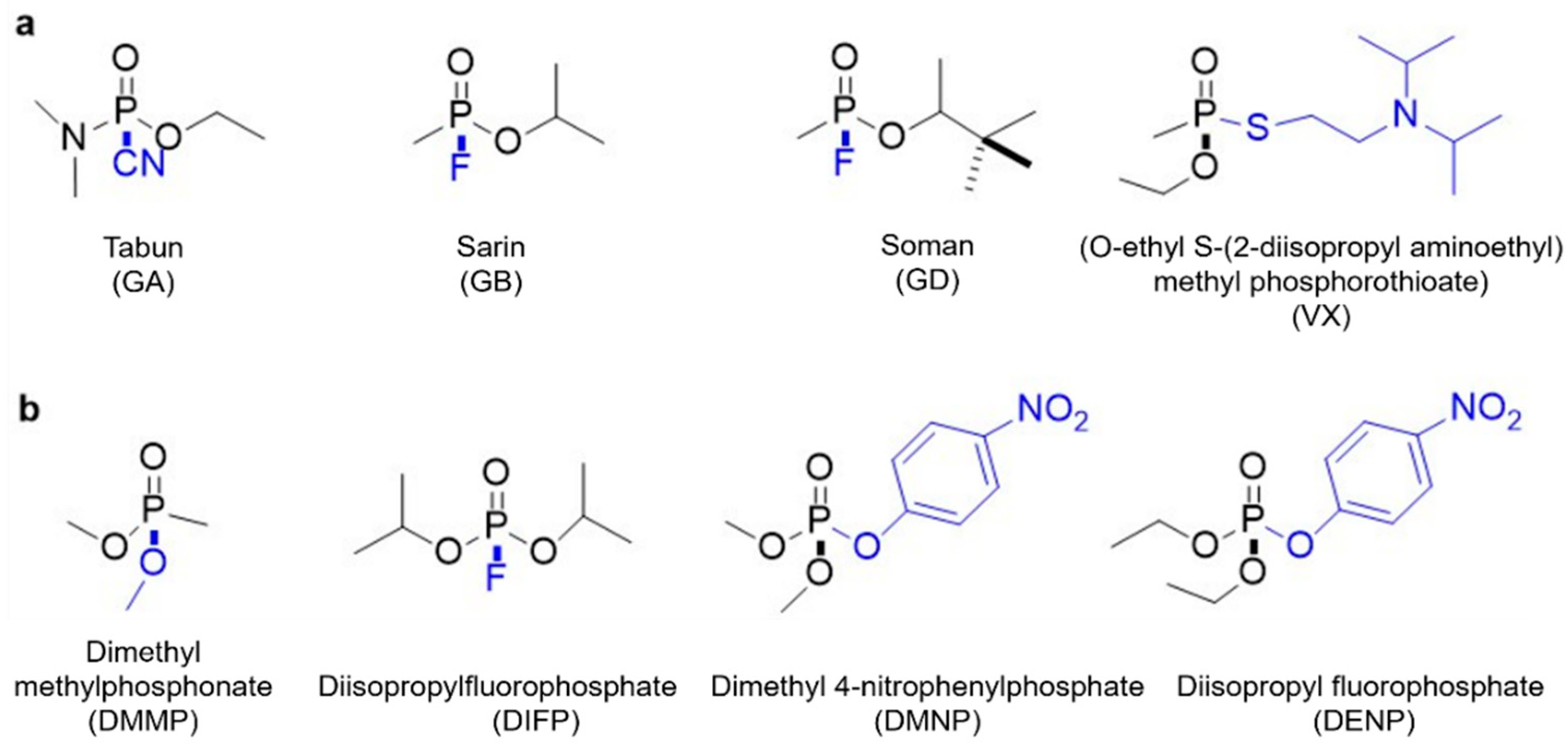
As is well known, due to the high toxicity of CWAs, it is difficult to obtain them in experimental environments; therefore, simulants play a crucial role in experimental studies [41,42,43]. As expected, simulants can simulate actual toxic substances in terms of molecular structure, size, and degradation mechanisms, and their toxicity is much lower than that of CWAs. In other words, this is a kind of molecule with complete bioavailability but no biological activity [44,45]. As displayed in Figure 2, some typical CWA simulants including DMMP, DIFP, DMNP, and DENP have recently been adopted as substitutes for actual poison when MOFs adsorb or decompose CWAs [46,47,48,49]. For instance, Asha and co-workers investigated the degradation performance of different types of Zr-MOFs towards CEES and DMMP, with GB and HD as corresponding simulants, respectively [50]. In addition, Kalinovskyy and co-workers reported that MOFs activated by acetic acid were utilized for the hydrolysis process of DMNP under microwave irradiation [51].
In experimental scenarios, the selection of simulants is vital for assessing adsorbents for the degradation of CWAs. If we plan to use a simulant as a substitute for a real agent, a high level of resemblance is required, for example in terms of structure, size, physicochemical traits, reaction pathways, adsorption characteristics, and degradation efficacy [52,53,54]. In addition, factors like the toxicity of the simulant and its substitutability across diverse settings merit consideration [55]. However, it must be emphasized that simulants may not fully replace chemical warfare agents in different scenarios or environments.

3. Importance of Metal–Organic Frameworks

Over the past few decades, several types of materials, such as activated carbon, nanoparticles, and MOFs, have been researched for the effective degradation of CWAs and their simulants [56]. They have gathered some attentions in the catalytic breakdown of CWAs, resulting from their remarkable adsorption, reactivity, and catalytic proficiency when dealing with CWAs. Therefore, a comprehensive exploration of the catalytic degradation characteristics of MOFs is described below.

3.1. Metal–Organic Frameworks

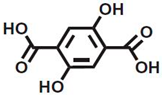
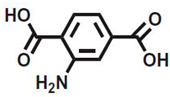
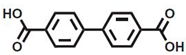
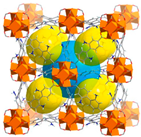
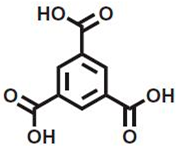
MOFs, a newly emerging class of porous crystalline materials, are composed of metal ions/clusters and organic linkers by strong coordination bonds [57,58,59]. For the detoxification of CWAs, metal nodes formed via missing linker defects in MOFs act as Lewis acid active catalytic sites, thereby leading to MOFs playing a potential catalysis role [60]. In addition, the strong Lewis acid metal nodes centered around metal ions demonstrate good structural stability. As a result, they are widely used in the catalytic degradation of CWAs [61]. The recently developed metal ions/clusters, organic ligands, and topology structures of MOFs for the catalytic degradation of CWAs and their simulants are listed in Table 2. Moreover, MOFs with highly valent and stable metal centers, such as Ti, Zn, and Cu, are deemed advantageous for the catalytic degradation of CWAs and their simulants. Take carboxylate Ti-MOF, namely MIP-177, as an example. It possesses good chemical stability and special pore size. Furthermore, its titanium catalytic sites promisingly lead to the fast degradation of some CWAs (e.g., GD and DMNP) [62].

3.2. Catalytic Degradation Routes of Chemical Warfare Agents

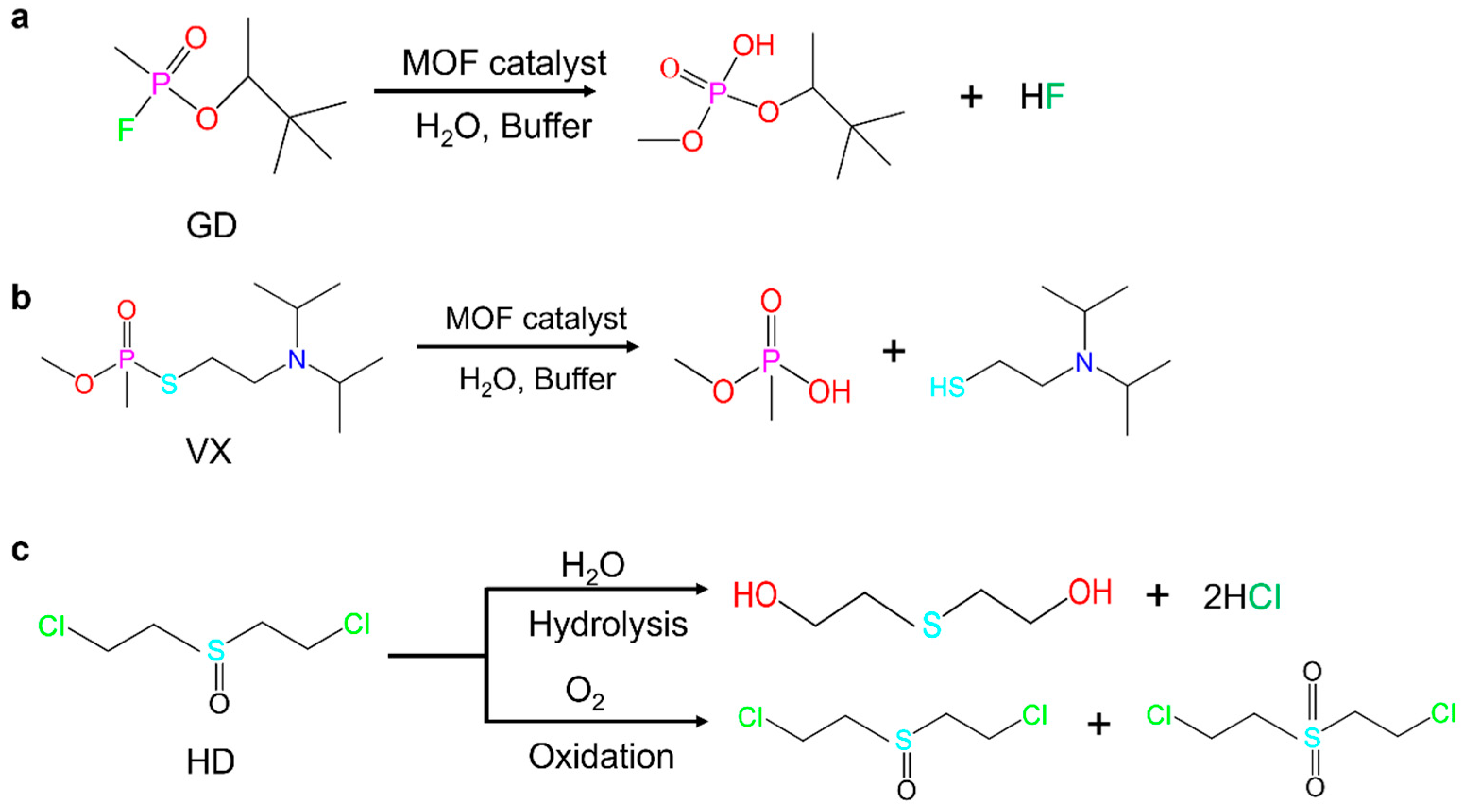
Given the differences in the structural characteristics of CWAs, their degradation routes vary accordingly. For instance, certain nerve agents such as GD, GB, and VX undergo degradation by the hydrolysis process [70,71,72]. For mustard gas and its simulants, the oxidative degradation approach is predominantly adopted due to their insolubility in water, with a small portion using hydrolysis [73]. As depicted in Figure 3, several catalytic degradation routes of a number of CWAs and their simulants are summarized in detail.
For example, for the degradation of GD, it was primarily by hydrolysis of the P-F bond (Figure 3a). Some previously reported Zr-MOFs (e.g., MOF-808, UiO-66-NH2, and NU-1000) have been widely utilized for the catalytic degradation of GD in alkaline N-ethylmorpholine (NEM) buffer; the half-life of GD was lower than 1 min, and the conversion rate of GD could reach 100% [74]. Notably, the NEM buffer plays an important role in this process. Specifically, the hydroxide ions in the reaction system are more prone to nucleophilic attacks on the substrate than water molecules; therefore, hydrolysis reactions are usually easier to carry out under alkaline conditions to ensure sufficient hydroxide ions. Overall, the catalytic reaction of Zr MOFs highly relies on alkaline aqueous solutions as reaction buffering agents, which can control the pH value of the reaction solution and continuously regenerate active sites. Figure 3b shows the hydrolysis process of VX. Recently, some newly developed Zr-MOFs have been adopted for achieving the swift and selective degradation of VX. Among these, UiO-67-N(Me)2 exhibits the most remarkable performance under catalytic conditions, because the half-life of UiO-67-N(Me)2 is only 1.8 min. Notably, this catalyst also demonstrates selectivity, relying solely on water, and it can eliminate the harmful matrix. In addition, some other types of MOFs (e.g., MOF-808, UiO-66-NH2, and PCN-777) have been put into use in both NEM buffer and pure water. The experimental results indicate that PCN-777 and MOF-808 might degrade VX faster than UiO-66-NH2 and NU-1000. This disparity was attributed to their relatively lower connectivity [75]. Therefore, developing MOFs-based composites has become an effective strategy for producing novel detoxifying substances. Typically, the dehydrated NU-1000/PEI composites have been applied to break down VX. Furthermore, the higher the molecular weight of NU-1000/PEI composites, the faster they can degrade VX [76].
In the realm of HD degradation, some common methods of oxidation, dehalogenation, and hydrolysis are involved [17]. It is worth highlighting that dehalogenation presents difficulties in real-world applications. Comparatively, the oxidation-based degradation approach outperforms hydrolysis when dealing with HD. In addition, it also generates some by-products including sulfoxide and sulfone derivatives during the complete oxidation process of HD (Figure 3c). Specifically, sulfone derivatives had analogous toxicity with the matrix, and sulfoxide could be innocuous. To avoid the generation of sulfone derivatives, partial oxidation might be adopted. For example, Liu and co-workers chose NU-1000 as an effective target for the catalytic degradation of HD with the assistance of UV LED irradiation [77]. Besides oxidation, there has been a certain degree of exploration regarding HD hydrolysis. For example, Ko and co-workers investigated the degradation process of HD in a mixture of ethanol and water; the result reflected a much faster degradation process of OA-UiO-66-NH2 [78]. Of course, specific solutions may promote the hydrolysis of HD, although at a slower rate than oxidation-based degradation.

4. Engineering Metal–Organic Frameworks into Textile Materials

Based on the high specific surface area, adjustable pore windows, and easy modification, MOFs are gradually applied in the catalytic degradation of CWAs [79,80,81]. However, with the increasing demand for effective protective materials against CWAs, single-function materials are no longer sufficient to meet the requirements for complex protective functionalities. Moreover, MOFs predominantly exist in powder form, giving rise to a series of additional issues. Generally, the size of MOF crystals is very small, which may lead to a heightened pressure drop, thus hampering the diffusion and transportation of gas mass. As a result, the next step in development is to combine MOFs with porous textile materials to further improve the structure, function, and degradation characteristics [82,83,84]. Correspondingly, a new type of MOF textiles has emerged, consisting of MOFs and other auxiliary materials, which can effectively combine the inherent advantages of the original textiles with the functions of MOFs [85,86,87,88]. In the following section, we will present several distinct types of MOF textiles for the catalytic degradation of CWAs and their simulants.

4.1. Metal–Organic Frameworks/Electrospun Membranes

Nanofibers, as a typical representation of textiles, have many fascinating properties, such as high aspect ratio, large specific surface area, multiscale porosity, and high flexibility [89,90,91,92]. Recently, electrospinning has been deemed as an effective method to develop MOFs into composites with structural stability and functional richness. For example, the prepared MOF/electrospun nanofiber membranes feature a multiscale pore architecture, which also demonstrates some exceptional properties including structural flexibility, low weight, and tunable pore size [93,94,95]. Furthermore, the highly open and interconnected pore structure can considerably strengthen the transport of gases and liquids, thereby improving the mass transfer efficiency [96]. Thus, compared to some other polymer supports (e.g., cottons and nonwovens), the electrospun nanofiber membranes have been widely used to load many types of MOFs and applied in different research fields.
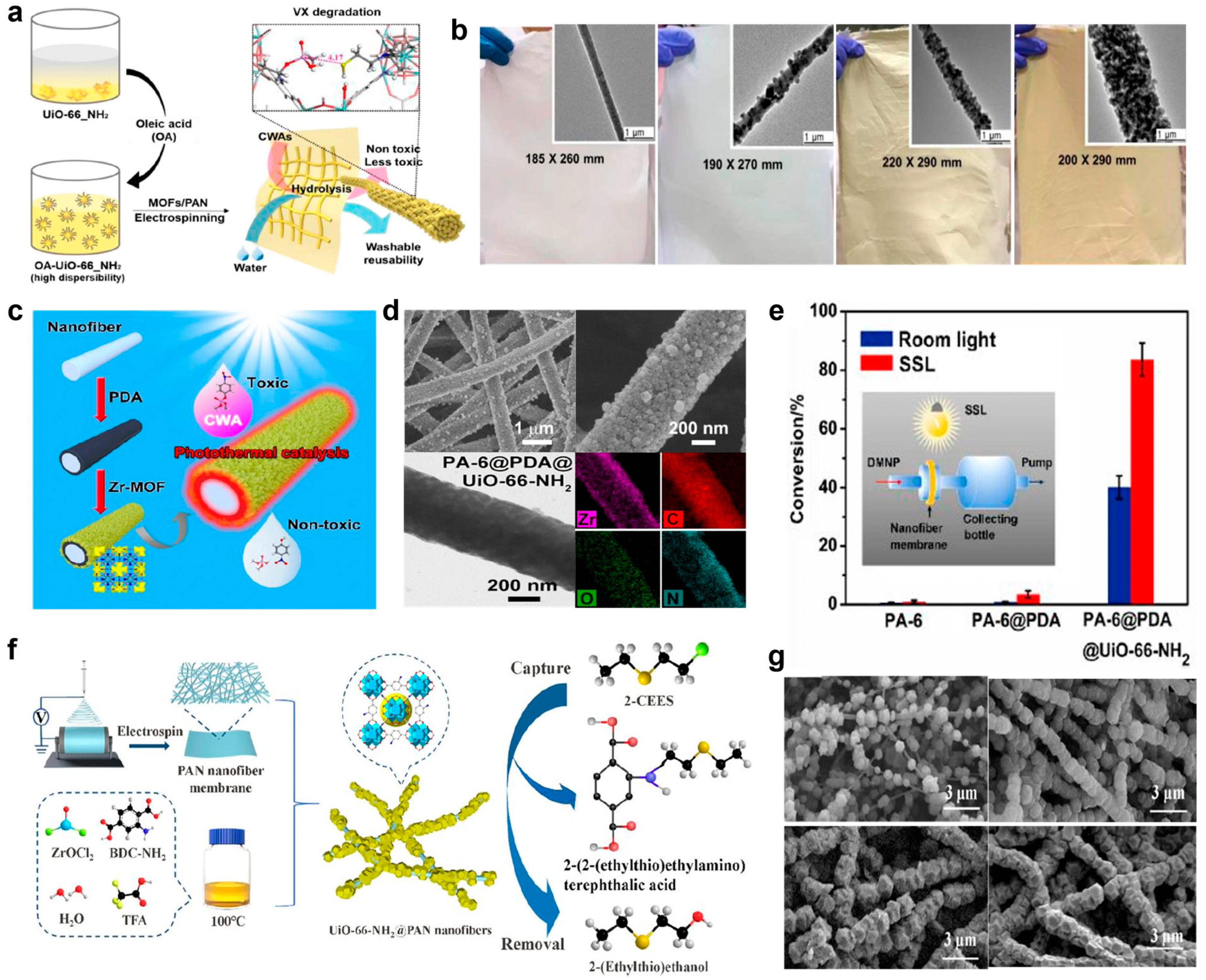
Lee et al. employed the typical direct electrospinning method (Figure 4a) to prepare fibrous UiO-66-NH2/PAN mats, which were designed for the catalytic degradation of CWAs [97]. The fibrous mats made with UiO-66-NH2 nanoparticles showed an excellent dispersion of MOFs in the polymer matrix (Figure 4b), resulting in very fine and uniform thickness of the fibers. The hydrolysis rate was found to be more than three times faster for HD than without catalysts, and the hydrolysis conversion of GD and VX was possible up to 98 and 96.2% for 3 h, respectively. Li and co-workers reported a promising strategy for preparing UiO-66-NH2-coated nanofiber membranes, which were equipped with the ability to execute photothermal catalytic degradation of CWA simulants (Figure 4c) [98]. The magnified SEM images revealed that the nanofibers were conformably covered by a nanoparticle film with a particle size of 30–100 nm (Figure 4d), without any bare fiber surface being found. As depicted in Figure 4e, PA-6@PDA@UiO-66-NH2 enabled 40% and 85% DMNP conversion under room light and SSL illumination, respectively. Similarly, Li and co-workers reported an in situ strategy for the rational growth of UiO-66-NH2 on PAN nanofibers, thus achieving interesting bead-on-string structured UiO-66-NH2@PAN fabrics for the degradation of a mustard gas simulant of CEES (Figure 4f) [99]. In contrast to relying on template assistance and pretreatment, trifluoroacetic acid (TFA) was introduced to decelerate the crystallization and generate more defective sites between the modifiers and MOF units to ensure that UiO-66-NH2 was firmly and continuously dispersed on nanofibers (Figure 4g). The obtained compounds showed a high specific surface area and abundant pore volume, contributing to the absorption of more toxic gases, impeding their diffusion, and then ultimately providing an extended protection time. Moreover, Chen and co-workers used electrospun ZrO2 nanofiber mats as the precursor and took advantage of the pseudomorphic oxide-to-MOF transformation to realize fibrous structured Zr-MOF filters that exhibited significantly swifter CWA simulant degradation relative to previously reported composite MOF fabrics [100].

4.2. Metal–Organic Frameworks/Fibrous Aerogels

Fibrous aerogels have recently attracted significant attention in the catalytic degradation of CWAs and their simulants owing to their fascinating features including three-dimensional structure, large porosity, and adjustable pore structure [101,102,103]. Capitalizing on these features of aerogels, large efforts have concentrated on preparing MOF/fibrous aerogel composites to enhance the catalytic degradation capabilities for CWAs. In one aspect, fibrous aerogels can serve as a foundational support for MOFs, effectively preventing agglomeration. From another perspective, the formed multiscale pore structures within MOFs/fibrous aerogels effectively promote efficient gas transfer in terms of the dynamic gas sorption process [104]. Therefore, it is expected that the catalytic degradation efficiency of CWAs by MOFs/fibrous aerogels will be enhanced based on the strong collaborative interactions. Currently, the utilization of aerogels to amplify the catalytic degradation performance of CWAs for MOFs is gradually attracting researchers’ widespread attention [105].
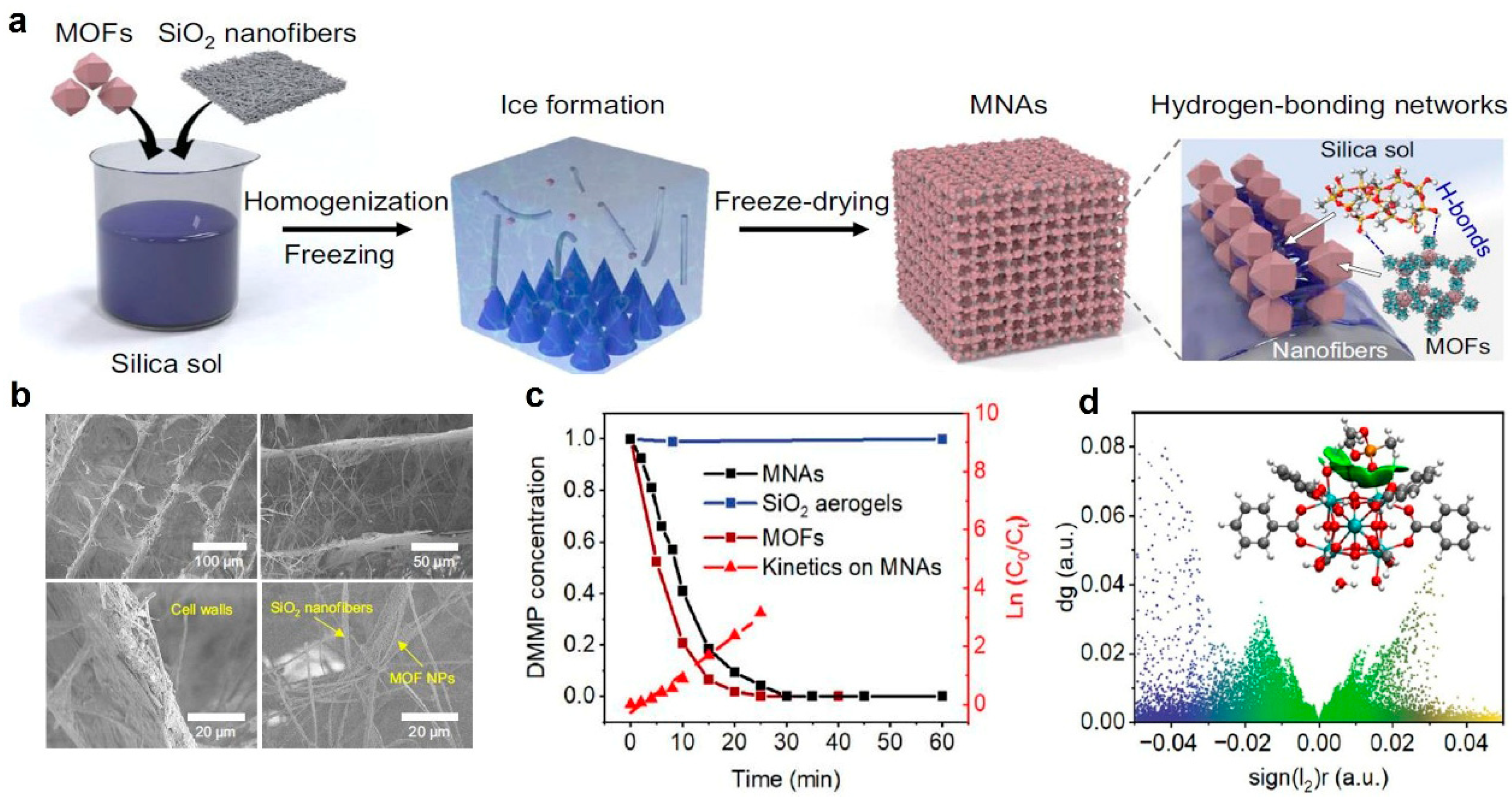
For instance, Si et al. investigated MOFs undergoing spatial realignment to form superelastic lamellar-structured fibrous aerogels by means of a ceramic network-assisted interfacial engineering approach (Figure 5a) [24]. As shown in Figure 5b, the MOF was evenly distributed in the interconnected pathways and maintained its porosity, crystallinity, and accessible chemical active sites, providing a suitable platform for physical capture and chemical catalysis in nerve agent treatment. In addition, the invading ceramic components within the interconnected channels provided a van der Waals barrier, promoting the preferential adsorption of active MOF sites towards nerve agents. The MOF aerogels had stable and swift adsorption and detoxification capabilities towards DMMP in NEM butter, converting it into nontoxic products completely within 30 min (Figure 5c,d). Similarly, our group reported an in situ growth strategy for loading UiO-66-NH2 onto the surface of aramid nanofibers (ANFs) to prepare hierarchical porous UiO-66-NH2@ANF composite aerogels [106]. The fibrous UiO-66-NH2@ANF aerogels had a high MOF loading amount 261%, high specific surface area value of 589.349 m2/g, and open and interconnected cellular structure. The fibrous UiO-66-NH2@ANF aerogels demonstrated an impressively high CEES removal rate of 98.9% and a short half-life of 8.15 min. Yang and co-workers reported a reduced graphene oxide (RGO) aerogel, which was decorated with UiO-66-NCS possessing elevate catalytic activity by in situ growing of UiO-66-NH2 inside the RGO hydrogels, converting the UiO-66-NH2 to more active UiO-66-NCS, and freeze-drying for realizing solar-thermally enhanced catalytic hydrolysis of DMNP [107]. In contrast to UiO-66-NH2, the UiO-66-NCS exhibited greater efficiency in catalytically hydrolyzing DMNP with a 30% reduction in half-life. Moreover, the in situ adornment of the RGO aerogel with UiO-66-NCS further enhanced the catalytic hydrolysis proficiency, attributable to the more accessible active sites of the UiO-66-NCS. Moreover, Sui and co-workers presented an in situ strategy to integrate functional MOF and cellulose nanofibers (CNF) into a flexible and porous sponge [108]. The main interactions between MOF and CNF were covalent bond and physical entanglement. The functional sponge effectively maintained its catalytic activity and showed rapid degradation of DMNP CWA simulant with a half-life as brief as 9 min.

4.3. Metal–Organic Frameworks/Cottons

As is well known, cotton surfaces are difficult to modify due to the fact that cellulose, which is the main component of cotton, consists of hydroxyl groups linked by hydrogen bonds [109]. Compared to the easy preparation and surface modification of electrospun nanofibers, there are currently few studies on MOF/cotton composites for the catalytic degradation of CWAs and their simulants. Recently, the mercerization process has been reported to improve the dye adsorption rate and mechanical durability, and is extensively applied in the dyeing process. This process can destroy certain hydrogen bonds within the cellulosic fabric and increase the content of free hydroxyl groups, modifies the crystallinity of cellulose, and boosts the fraction of functional groups inducing the nucleation of particles [22,110].
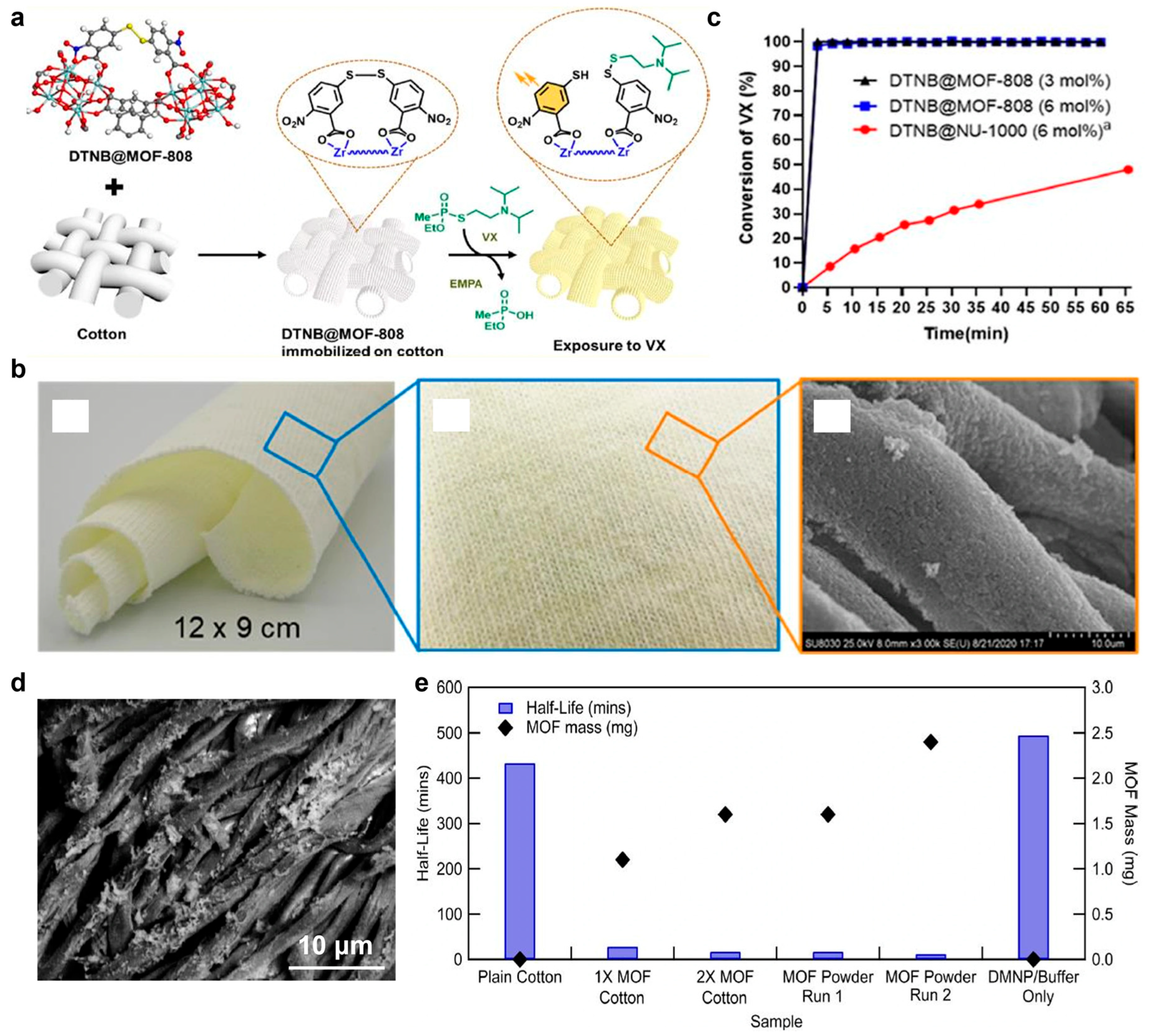
For example, Jung and co-workers reported that alkaline solution treatment was carried out on cotton fabric to study the mass ratio of active hydroxyl groups, following which it was functionalized with UiO-66-NH2 [111]. The instrumental examination of the fabric processed in this manner demonstrated that UiO-66-NH2 crystals uniformly covered its surface. The CWA protection performance of the MOF-coated fabric was evaluated using the swatch test, indicating that the above-mentioned fabrics could effectively degrade GD and HD, and the conclusion was drawn that the fabric was highly suitable for adsorbing and degrading CWAs. Farha and co-workers reported the development of MOF-808/cotton composites that gave a rapid, visual, and sensitive color response when pre-wetted and rubbed over a VX-contaminated surface, as depicted in Figure 6a [111]. The fabric was composed of cotton textile modified with MOF-808 (Figure 6b) that possessed a bidentate reactive dye, ditopic 5,5-dithiobis(2-nitrobenzoic acid) (DTNB), on its nodes. It was obvious that DTNB@MOF-808 had a substantial improvement in catalytic performance compared to previously reported materials. The improved catalytic performance was attributed to the lower occupation of non-structural Zr(OH)2 sites on the Zr6 cluster in MOF-808 (6-connected) compared to NU-1000 (8-connected) (Figure 6c) [112,113]. Similarly, Glover and co-workers prepared a cotton fabric functionalized with UiO-66-NH2. The composites were made by seeding the growth of the MOF on the cotton by first bonding zirconium (Zr) to the surface of the fabric utilizing cyanuric chloride modified with a thiol [114]. After seeding the fabrics with Zr, UiO-66-NH2 was grown on the fabric using a hydrothermal method, and the SEM image is displayed in Figure 6d. The functionalized cotton reacts with DMNP, a chemical nerve agent simulant, as monitored by UV-vis spectroscopy. The result showed that MOF/cotton composites could be created using natural fibers, and the resulting composites provided CWA simulants with reactivity similar to MOFs and synthetic polymer composite materials (Figure 6e).

4.4. Metal–Organic Frameworks/Nonwovens

In addition to the aforementioned textile materials, a small number of MOF/nonwoven composites are used to degrade CWAs and their simulants. For example, Ye and co-workers prepared MOF-808-loaded polypropylene (PP) nonwovens through a tannic acid (TA) and 3-aminopropyltriethoxysilane (APTES) hybrid coating (TA-APTES) [116]. The PP@TAAPTES@MOF-808 nonwovens showed a substantial mass loading of 23.4% and a fast degradation half-life of 1.3 min for DMNP. Similarly, Parsonso and co-workers investigated simple template-free low-temperature synthesis, and for the first time achieved deployable catalytic MOF/polymer textiles, demonstrating rapid hydrolysis and oxidation of various active chemical warfare agents, including GD and HD and their mimetics [117]. This method led to the advancement of a novel zirconium-porphyrin-based PCN-222 MOF textiles. These composites had an adjustable MOF loading amount and showed good mechanical adhesion on the surface of PP nonwoven fibers. The common untreated PP nonwoven fiber could be evenly covered with nanocrystalline PCN-222 MOFs without relying on a growth template, and the resulting PCN-222 textiles were doubly protective by rapidly hydrolyzing GD and selectively oxidizing HD and corresponding simulants. Significantly, when porphyrinic Zr6-based MOFs were employed, visible blue light played a crucial role in substantially enhancing the rate of GD and simulant hydrolysis compared to conditions in the dark or under normal room lighting. This functionality went beyond previous reports that showed photo-oxidation of 2-CEES using blue, red, or white light.
In addition, Yu and co-workers designed photothermal graphene-based nonwoven fabrics through wet-spinning and chemical reduction of graphene oxide fibers, subsequently followed by in situ growth of UiO-66-NH2 [118]. The flexible graphene fabrics adorned with UiO-66-NH2 demonstrated an extremely rapid photothermal catalytic decontamination ability for DMNP, a representative simulant of CWAs. Under simulated solar light irradiation, the half-life of the degradation reaction dropped from 3.4 to 1.6 min, which represented a substantial improvement compared to the values reported in the existing literature. In addition, the graphene/UiO-66-NH2 nonwoven fabric was able to degrade DMNP within 20 min. Moreover, even after undergoing five cycles, its degradation efficiency still remained above 92%.
Furthermore, Table 3 shows the degradation performances of MOF-based composites towards CWAs and their simulants. It is clearly observed that the MOF composite materials exhibit highly efficient catalytic degradation of CWAs and their simulants when compared to MOFs. Therefore, the combination of MOFs and textiles can synchronously improve the mechanical stability and dynamic gas transport process, thus enhancing the catalytic activity and reactivity of MOF textiles towards CWAs and their simulants.

5. Conclusions

MOF textiles are attracting researchers’ attention due to their promising characteristics in the catalytic degradation of CWAs and their simulants. Through persistent and long-term endeavors, remarkable accomplishments have been achieved in the research realm of MOF textiles. Based on recently published studies, utilizing the potential of functionalized MOF textiles has gradually become a highlighted approach for detoxifying CWAs and their simulants. This combination of MOFs and textiles can not only address the drawback of fly ash and intrinsic fragility of MOFs, but also create a hierarchical pore structure to promote the dynamic gas transport process and enhance the utilization efficiency of active adsorption sites, thereby improving the catalytic activity and reactivity of MOF textiles towards CWAs and their simulants. As a result, we summarize the relevant research advances regarding MOF textiles for the catalytic degradation of CWAs and their simulants.
Until now, most studies have still focused on improving the material properties rather than their practical implementations. During this process, it is also important to consider aspects such as breathability, low heat load capacity, and high filtration efficiency. Furthermore, the current research is still in the laboratory stage. There have been no reports of on-site experiments; thus, there is an urgent demand for large-scale and high-quality production of MOF textiles with precisely controlled structures in the future.
Moreover, the simulants have similar structural characteristics to the real CWAs and exhibit relatively low toxicity. There may be some differences in degradation performances in different situations. Based on this, some theoretical calculations at the molecular level should be used for analyzing the degradation of CWAs in the future, which is beneficial for selecting MOF materials and investigating the degradation mechanisms. Furthermore, simulation calculations can avoid contact with toxic CWAs, which seems to be a promising approach to validate the experimental results. Therefore, it is essential to effectively apply theory and experiments to explore the degradation approaches of CWAs from multiple perspectives.
We expect that this summary of the development of MOF textiles for the catalytic degradation of CWAs and their simulants, as well as the carefully selected research cases and some individual perspectives, will provide some guidance for relevant researchers to further study the development of MOF textiles. Although we face numerous challenges, we believe that the overall goal of the fabrication of multifarious MOF textiles with precisely regulated pore structures, excellent mechanical properties, and superior catalytic degradation characteristics of CWAs will be achieved.

Funding

This work was supported by the National Natural Science Foundation of China (22475021), Shandong Provincial Natural Science Foundation of China (ZR2024QE041), the Natural Science Foundation of Qingdao of China (24-4-4-zrjj-60-jch), the China Postdoctoral Science Foundation (2024M761559), and Shandong Provincial College Student Innovation and Entrepreneurship Training Program Project (S202511065040 and S202511065135).

Institutional Review Board Statement

Not applicable.

Informed Consent Statement

Not applicable.

Data Availability Statement

The original contributions presented in this study are included in the article. Further inquiries can be directed to the corresponding authors.

Conflicts of Interest

The authors declare no conflicts of interest.

References

  1. Yang, J.C.; Gao, M.K.; Zhang, M.K.; Zhang, Y.Q.; Gao, M.Y.; Wang, Z.Z.; Xu, L.F.; Wang, X.; Shen, B.X. Advances in the adsorption and degradation of chemical warfare agents and simulants by metal-organic frameworks. Coord. Chem. Rev. 2023, 493, 215289. [Google Scholar] [CrossRef]
  2. Szinicz, L. History of chemical and biological warfare agents. Toxicology 2005, 214, 167–181. [Google Scholar] [CrossRef]
  3. Liu, Y.Y.; Howarth, A.J.; Vermeulen, N.A.; Moon, S.Y.; Hupp, J.T.; Farha, O.K. Catalytic degradation of chemical warfare agents and their simulants by metal-organic frameworks. Coord. Chem. Rev. 2017, 346, 101–111. [Google Scholar] [CrossRef]
  4. Li, B.; Wen, H.M.; Cui, Y.; Zhou, W.; Qian, G.; Chen, B. Emerging multifunctional metal-organic framework materials. Adv. Mater. 2016, 28, 8819–8860. [Google Scholar] [CrossRef]
  5. DeCoste, J.B.; Peterson, G.W. Metal-organic frameworks for air purification of toxic chemicals. Chem. Rev. 2014, 114, 5695–5727. [Google Scholar] [CrossRef]
  6. Troya, D. Reaction mechanism of nerve-agent decomposition with Zr-based metal organic frameworks. J. Phys. Chem. C 2016, 120, 29312–29323. [Google Scholar] [CrossRef]
  7. Gutov, O.V.; Hevia, M.G.; Escudero-Adán, E.C.; Shafir, A. Metal-Organic Framework (MOF) Defects under Control: Insights into the Missing Linker Sites and their Implication in the Reactivity of Zirconium-Based Frameworks. Inorg. Chem. 2015, 54, 8396–8400. [Google Scholar] [CrossRef] [PubMed]
  8. Florent, M.; Giannakoudakis, D.A.; Wallace, R.; Bandosz, T.J. Carbon textiles modified with copper-based reactive adsorbents as efficient media for detoxification of chemical warfare agents. ACS Appl. Mater. Interfaces 2017, 9, 26965–26973. [Google Scholar] [CrossRef]
  9. Labaška, M.; Gál, M.; Mackuľak, T.; Švorec, J.; Kučera, J.; Helenin, J.; Svitková, V.; Ryba, J. Neutralizing the Threat: A Comprehensive Review of Chemical Warfare Agent Decontamination Strategies. J. Environ. Chem. Eng. 2024, 12, 114243. [Google Scholar] [CrossRef]
  10. Giannakoudakis, D.A.; Bandosz, T.J. Defectous UiO-66 MOF nanocomposites as reactive media of superior protection against toxic vapors. ACS Appl. Mater. Interfaces 2020, 13, 14678–14689. [Google Scholar] [CrossRef]
  11. Štengl, V.; Grygar, T.M.; Opluštil, F.; Němec, T. Sulphur mustard degradation on zirconium doped Ti-Fe oxides. J. Hazard. Mater. 2011, 192, 1491–1504. [Google Scholar] [CrossRef]
  12. Nagpal, M.; Kakkar, R. Use of metal oxides for the adsorptive removal of toxic organic pollutants. Sep. Purif. Technol. 2019, 211, 522–539. [Google Scholar] [CrossRef]
  13. Yue, G.; Su, S.; Li, N.; Shuai, M.; Lai, X.; Astruc, D.; Zhao, P. Gold nanoparticles as sensors in the colorimetric and fluorescence detection of chemical warfare agents. Coord. Chem. Rev. 2016, 311, 75–84. [Google Scholar] [CrossRef]
  14. Peterson, G.W.; Moon, S.-Y.; Wagner, G.W.; Hall, M.G.; DeCoste, J.B.; Hupp, J.T.; Farha, O.K. Tailoring the Pore Size and Functionality of UiO-Type Metal-Organic Frameworks for Optimal Nerve Agent Destruction. Inorg. Chem. 2015, 54, 9684–9686. [Google Scholar] [CrossRef] [PubMed]
  15. Balasubramanian, S.; Kulandaisamy, A.J.; Babu, K.J.; Das, A.; Rayappan, J.B.B. Metal organic framework functionalized textiles as protective clothing for the detection and detoxification of chemical warfare agents—A review. Ind. Eng. Chem. Res. 2021, 60, 4218–4239. [Google Scholar] [CrossRef]
  16. Zhao, H.J.; Dong, J.L.; Chen, S.J.; Wang, H.; Zhao, G.D. Metal-organic frameworks and their composites for carbon dioxide capture: Recent advances and challenges. Fuel 2024, 378, 132973. [Google Scholar] [CrossRef]
  17. López-Maya, E.; Montoro, C.; Rodríguez-Albelo, L.M.; Aznar Cervantes, S.D.; Lozano-Pérez, A.A.; Cenís, J.L.; Barea, E.; Navarro, J.A.R. Textile/Metal-Organic-Framework Composites as Self-Detoxifying Filters for Chemical-Warfare Agents. Angew. Chem. Int. Ed. 2015, 54, 6790–6794. [Google Scholar] [CrossRef]
  18. Giannakoudakis, D.A.; Hu, Y.; Florent, M.; Bandosz, T.J. Smart Textiles of MOF/g-C3N4 nanospheres for the rapid detection/detoxification of chemical warfare agents. Nanoscale Horiz. 2017, 2, 356–364. [Google Scholar] [CrossRef] [PubMed]
  19. Wang, B.; Huang, H.L.; Lv, X.L.; Xie, Y.B.; Li, M.; Li, J.R. Tuning CO2 Selective Adsorption over N2 and CH4 in UiO-67 Analogues through Ligand Functionalization. Inorg. Chem. 2014, 53, 9254−9259. [Google Scholar] [CrossRef]
  20. Xiong, X.H.; Song, L.; Liang, J.L.; Qin, Z.Y.; Huo, X.X.; Liang, Z.M.; Tan, L.L.; Wei, Z.W.; Li, M.; Huang, X.C.; et al. Synthesis of Single-Crystal UiO-67-(NH2)2 for Effective SO2 Adsorption and Separation from Fue Gas. Sep. Purif. Technol. 2025, 361, 131642. [Google Scholar] [CrossRef]
  21. Chen, Z.; Ma, K.; Mahle, J.J.; Wang, H.; Syed, Z.H.; Atilgan, A.; Chen, Y.; Xin, J.H.; Islamoglu, T.; Peterson, G.W.; et al. Integration of metal-organic frameworks on protective layers for destruction of nerve agents under relevant conditions. J. Am. Chem. Soc. 2019, 141, 20016–20021. [Google Scholar] [CrossRef]
  22. Zhao, J.; Lee, D.T.; Yaga, R.W.; Hall, M.G.; Barton, H.F.; Woodward, I.R.; Oldham, C.J.; Walls, H.J.; Peterson, G.W.; Parsons, G.N. Ultra-fast degradation of chemical warfare agents using MOF-nanofiber kebabs. Angew. Chem. Int. Ed. 2016, 55, 13224–13228. [Google Scholar] [CrossRef]
  23. Liu, Y.; Howarth, A.J.; Hupp, J.T.; Farha, O.K. Selective photooxidation of a mustard-gas simulant catalyzed by a porphyrinic metal-organic framework. Angew. Chem. Int. Ed. 2015, 54, 9001–9005. [Google Scholar] [CrossRef] [PubMed]
  24. Yan, Z.S.; Liu, X.Y.; Ding, B.; Yu, J.Y.; Si, Y. Interfacial engineered superelastic metal-organic framework aerogels with van-der-Waals barrier channels for nerve agents decomposition. Nat. Commun. 2023, 14, 2116. [Google Scholar] [CrossRef] [PubMed]
  25. Rosa, D.; Remmani, R.; Bavasso, I.; Bracciale, M.P.; Palma, L.D. Biochar supported Fe–TiO2 composite for wastewater treatment: Solid-stat synthesis and mechanistic insights. Chem. Eng. Sci. 2025, 317, 122076. [Google Scholar] [CrossRef]
  26. Couzon, N.; Dhainaut, J.; Campagne, C.; Royer, S.; Loiseau, T.; Volkringer, C. Porous textile composites (PTCs) for the removal and the decomposition of chemical warfare agents (CWAs)—A review. Coord. Chem. Rev. 2022, 467, 214598. [Google Scholar] [CrossRef]
  27. Zhao, H.J.; Jiang, Y.; Zhang, T.T.; Wang, H.; Chen, S.J.; Zhao, G.D. A fluoride-rich metal-organic framework for efficient CO2 capture under humid conditions. Fuel 2025, 381, 133553. [Google Scholar] [CrossRef]
  28. Wang, H.; Dong, X.; Colombo, V.; Wang, Q.; Liu, Y.; Liu, W.; Wang, X.L.; Huang, X.Y.; Proserpio, D.M.; Sironi, A. Tailor-made microporous metal-organic frameworks for the full separation of propane from propylene through selective size exclusion. Adv. Mater. 2018, 30, 1805088. [Google Scholar] [CrossRef]
  29. Liang, H.; Jiao, X.; Li, C.; Chen, D. Flexible self-supported metal-organic framework mats with exceptionally high porosity for enhanced separation and catalysis. J. Mater. Chem. A 2018, 6, 334–341. [Google Scholar] [CrossRef]
  30. Vellingiri, K.; Philip, L.; Kim, K.H. Metal-organic frameworks as media for the catalytic degradation of chemical warfare agents. Coord. Chem. Rev. 2017, 353, 159–179. [Google Scholar] [CrossRef]
  31. Zhao, G.D.; Liu, Y.; Pan, J.Y.; Liu, C.; Hu, Y.H.; Gao, Z.; Zhuang, X.P. Flexible nanofibrous membranes of dual metallic metal-organic framework with enhanced Lewis basic sites and high loading mass for efficient CO2 capture. J. Colloid Interface 2023, 651, 200–210. [Google Scholar] [CrossRef]
  32. Zhao, H.J.; Zhang, L.H.; Chen, S.J.; Zhuang, X.P.; Zhao, G.D. Bimetallic metal-organic framework aerogels supported by aramid nanofibers for efficient CO2 capture. J. Colloid Interface Sci. 2024, 674, 537–546. [Google Scholar] [CrossRef] [PubMed]
  33. Lu, A.X.; McEntee, M.; Browe, M.A.; Hall, M.G.; DeCoste, J.B.; Peterson, G.W. MOFabric: Electrospun nanofiber mats from PVDF/UiO-66-NH2 for chemical protection and decontamination. ACS Appl. Mater. Interfaces 2017, 9, 13632–13636. [Google Scholar] [CrossRef]
  34. Katz, M.J.; Moon, S.Y.; Mondloch, J.E.; Beyzavi, M.H.; Stephenson, C.J.; Hupp, J.T.; Farha, O.K. Exploiting parameter space in MOFs: A 20-fold enhancement of phosphate-ester hydrolysis with UiO-66-NH2. Chem. Sci. 2015, 6, 2286–2291. [Google Scholar] [CrossRef]
  35. Kalaj, M.; Palomba, J.M.; Bentz, K.C.; Cohen, S.M. Multiple functional groups in UiO-66 improve chemical warfare agent simulant degradation. Chem. Commun. 2019, 55, 5367–5370. [Google Scholar] [CrossRef]
  36. Katz, M.J.; Mondloch, J.E.; Totten, R.K.; Park, J.K.; Nguyen, S.T.; Farha, O.K.; Hupp, J.T. Simple and compelling biomimetic metal-organic framework catalyst for the degradation of nerve agent simulants. Angew. Chem. Int. Ed. 2014, 53, 497–501. [Google Scholar] [CrossRef]
  37. Goud, D.R.; Pardasani, D.; Tak, V.; Dubey, D.K. A Highly Selective Visual Detection of Tabun Mimic Diethyl Cyanophosphate (DCNP): Effective Discrimination of DCNP from Other Nerve Agent Mimics. RSC Adv. 2014, 4, 24645–24648. [Google Scholar] [CrossRef]
  38. Fan, S.; Zhang, G.; Dennison, G.H.; FitzGerald, N.; Burn, P.L.; Gentle, I.R.; Shaw, P.E. Challenges in fluorescence detection of chemical warfare agent vapors using solid-state films. Adv. Mater. 2020, 32, 1905785. [Google Scholar] [CrossRef] [PubMed]
  39. Franca, T.C.C.; Kitagawa, D.A.S.; Cavalcante, S.F.A.; da Silva, J.A.V.; Nepovimova, E.; Kuca, K.N. The dangerous fourth generation of chemical weapons. Int. J. Mol. Sci. 2019, 20, 1222. [Google Scholar] [CrossRef]
  40. Verma, M.; Gupta, V.K.; Dave, V.; Chandra, R.; Prasad, G.K. Synthesis of sputter deposited CuO nanoparticles and their use for decontamination of 2-chloroethyl ethyl sulfide (CEES). J. Colloid Interface Sci. 2015, 438, 102–109. [Google Scholar] [CrossRef]
  41. Praveen Kumar, J.; Prasad, G.K.; Allen, J.A.; Ramacharyulu, P.V.R.K.; Kadirvelu, K.; Singh, B. Synthesis of mesoporous metal aluminate nanoparticles and studies on the decontamination of sulfur mustard. J. Alloys Compd. 2016, 662, 44–53. [Google Scholar] [CrossRef]
  42. Orcutt, M.; Rayes, D.; Tarakji, A.; Katoub, M.; Spiegel, P.; Rubenstein, L.; Jabbour, S.; Alkhalil, M.; Alabbas, M.; Abbara, A. International failure in northwest Syria: Humanitarian health catastrophe demands action. Lancet 2019, 394, 100–103. [Google Scholar] [CrossRef] [PubMed]
  43. Qiu, F.; Xia, Y.; Wu, T.; Ye, P.; Jiao, X.; Chen, D. Rationally designed high-performance Zr(OH)4@PAN nanofibrous membrane for self-detoxification of mustard gas simulant under an ambient condition. Sep. Purif. Technol. 2020, 252, 117452. [Google Scholar] [CrossRef]
  44. Islamoglu, T.; Chen, Z.; Wasson, M.C.; Buru, C.T.; Kirlikovali, K.O.; Afrin, U.; Mian, M.R.; Farha, O.K. Metal-organic frameworks against toxic chemicals. Chem. Rev. 2020, 16, 8130–8160. [Google Scholar] [CrossRef]
  45. Turetsky, D.; Alzate-Sánchez, D.M.; Wasson, M.C.; Yang, A.; Noh, H.; Atilgan, A.; Islamoglu, T.; Farha, O.K.; Dichtel, W.R. Hot press synthesis of MOF/textile composites for nerve agent detoxification. ACS Mater. Lett. 2022, 4, 1511–1515. [Google Scholar] [CrossRef]
  46. Lausund, K.B.; Olsen, M.S.; Hansen, P.A.; Valen, H.; Nilsen, O. MOF thin films with bi-aromatic linkers grown by molecular layer deposition. J. Mater. Chem. A 2020, 8, 2539–2548. [Google Scholar] [CrossRef]
  47. Osovsky, R.; Kaplan, D.; Nir, I.; Rotter, H.; Elisha, S.; Columbus, I. Decontamination of adsorbed chemical warfare agents on activated carbon using hydrogen peroxide solutions. Environ. Sci. Technol. 2014, 48, 10912–10918. [Google Scholar] [CrossRef]
  48. Tušek, D.; Asperger, D.; Bacic, I.; Curkovic, L.; Macan, J. Environmentally acceptable sorbents of chemical warfare agent simulants. J. Mater. Sci. 2017, 52, 2591–2604. [Google Scholar] [CrossRef]
  49. Islamoglu, T.; Ortuño, M.A.; Proussaloglou, E.; Howarth, A.J.; Vermeulen, N.A.; Atilgan, A.; Asiri, A.M.; Cramer, C.J.; Farha, O.K. Presence versus Proximity: The Role of Pendant Amines in the Catalytic Hydrolysis of a Nerve Agent Simulant. Angew. Chem. Int. Ed. 2018, 57, 1949–1953. [Google Scholar] [CrossRef]
  50. Asha, P.; Sinha, M.; Mandal, S. Effective removal of chemical warfare agent simulants using water stable metal-organic frameworks: Mechanistic study and structure–property correlation. RSC Adv. 2017, 7, 6691–6696. [Google Scholar] [CrossRef]
  51. Kalinovskyy, Y.; Cooper, N.J.; Main, M.J.; Holder, S.J.; Blight, B.A. Microwave-assisted activation and modulator removal in zirconium MOFs for buffer-free CWA hydrolysis. Dalton Trans. 2017, 46, 15704–15709. [Google Scholar] [CrossRef] [PubMed]
  52. Lavoie, J.; Srinivasan, S.; Nagarajan, R. Using cheminformatics to find simulants for chemical warfare agents. J. Hazard. Mater. 2011, 194, 85–91. [Google Scholar] [CrossRef]
  53. Sava Gallis, D.F.; Harvey, J.A.; Pearce, C.J.; Hall, M.G.; DeCoste, J.B.; Kinnan, M.K.; Greathouse, J.A. Efficient MOF-based degradation of organophosphorus compounds in non-aqueous environments. J. Mater. Chem. A 2018, 6, 3038–3045. [Google Scholar] [CrossRef]
  54. Vieira Soares, C.; Leitao, A.A.; Maurin, G. Computational evaluation of the chemical warfare agents capture performances of robust MOFs. Microporous Mesoporous Mater. 2019, 280, 97–104. [Google Scholar] [CrossRef]
  55. Ploskonka, A.M.; DeCoste, J.B. Insight into organophosphate chemical warfare agent simulant hydrolysis in metal-organic frameworks. J. Hazard. Mater. 2019, 375, 191–197. [Google Scholar] [CrossRef]
  56. Zhao, H.J.; Lan, F.F.; Wang, H.; Chen, S.J.; Zhao, G.D.; Lin, T.; Zhuang, X.P. Fluorinated metal-organic framework aerogels with enhanced moisture resistance and efficient gas diffusion for CO2 capture. Chem. Eng. J. 2024, 498, 155177. [Google Scholar] [CrossRef]
  57. Saliba, D.; Ammar, M.; Rammal, M.; Al-Ghoul, M.; Hmadeh, M. Crystal Growth of ZIF-8, ZIF-67, and Their Mixed-Metal Derivatives. J. Am. Chem. Soc. 2018, 140, 1812–1823. [Google Scholar] [CrossRef]
  58. Georgiou, Y.; Perman, J.A.; Bourlinos, A.B.; Deligiannakis, Y. Highly Efficient Arsenite [As(III)] Adsorption by an [MIL-100(Fe)] Metal−Organic Framework: Structural and Mechanistic Insights. J. Phys. Chem. C 2018, 122, 4859–4869. [Google Scholar] [CrossRef]
  59. Wang, L.J.; Deng, H.X.; Furukawa, H.; Gándara, F.; Cordova, K.E.; Peri, D.; Yaghi, O.M. Synthesis and Characterization of Metal−Organic Framework-74 Containing 2, 4, 6, 8, and 10 Different Metals. Inorg. Chem. 2014, 53, 5881−5883. [Google Scholar] [CrossRef] [PubMed]
  60. Zhao, G.D.; Shi, L.; Yang, G.; Zhuang, X.P.; Cheng, B.W. 3D fibrous aerogels from 1D polymer nanofibers for energy and environmental applications. J. Mater. Chem. A 2023, 11, 512–547. [Google Scholar] [CrossRef]
  61. Mondloch, J.E.; Katz, M.J.; Isley, W.C.; Ghosh, P.; Liao, P.; Bury, W.; Wagner, G.W.; Hall, M.G.; Decoste, J.B.; Peterson, G.W.; et al. Destruction of chemical warfare agents using metal-organic frameworks. Nat. Mater. 2015, 14, 512–516. [Google Scholar] [CrossRef]
  62. Soares, C.V.; Maurin, G.; Leitao, A.A. Computational exploration of the catalytic degradation of Sarin and its simulants by a titanium metal-organic framework. J. Phys. Chem. C 2019, 123, 19077–19086. [Google Scholar] [CrossRef]
  63. Feng, X.; Jena, H.S.; Krishnaraj, C.; Leus, K.; Wang, G.; Chen, H.; Jia, C.; Voort, P.V.D. Generating Catalytic Sites in UiO-66 through Defect Engineering. ACS Appl. Mater. Interfaces 2021, 13, 60715–60735. [Google Scholar] [CrossRef]
  64. Son, F.; Wasson, M.C.; Islamoglu, T.; Chen, Z.; Gong, X.; Hanna, S.L.; Lyu, J.; Wang, X.; Idrees, K.B.; Mahle, J.J.; et al. Uncovering the role of metal-organic framework topology on the capture and reactivity of chemical warfare agents. Chem. Mater. 2020, 32, 4609–4617. [Google Scholar] [CrossRef]
  65. Cavka, J.H.; Jakobsen, S.; Olsbye, U.; Guillou, N.; Lamberti, C.; Bordiga, S.; Lillerud, K.P. A new zirconium inorganic building brick forming metal organic frameworks with exceptional stability. J. Am. Chem. Soc. 2008, 130, 13850–13851. [Google Scholar] [CrossRef]
  66. Peterson, G.W.; Wagner, G.W. Detoxification of chemical warfare agents by CuBTC. J. Porous Mater. 2014, 21, 121–126. [Google Scholar] [CrossRef]
  67. Mondloch, J.E.; Bury, W.; Fairen-Jimenez, D.; Kwon, S.; DeMarco, E.J.; Weston, M.H.; Sarjeant, A.A.; Nguyen, S.T.; Stair, P.C.; Snurr, R.Q.; et al. Vapor-phase metalation by atomic layer deposition in a metal-organic framework. J. Am. Chem. Soc. 2013, 135, 10294–10297. [Google Scholar] [CrossRef] [PubMed]
  68. Ma, K.; Idrees, K.B.; Son, F.A.; Maldonado, R.; Wasson, M.C.; Zhang, X.; Wang, X.; Shehaye, E.; Merhi, A.; Kaafarani, B.R.; et al. Fiber composites of metal-organic frameworks. Chem. Mater. 2020, 32, 7120–7140. [Google Scholar] [CrossRef]
  69. Liu, Y.; Moon, S.Y.; Hupp, J.T.; Farha, O.K. Dual-function metal-organic framework as a versatile catalyst for detoxifying chemical warfare agent simulants. ACS Nano 2015, 9, 12358–12364. [Google Scholar] [CrossRef]
  70. Chen, Z.; Li, P.; Wang, X.; Otake, K.I.; Zhang, X.; Robison, L.; Atilgan, A.; Islamoglu, T.; Hall, M.G.; Peterson, G.W.; et al. Ligand-directed reticular synthesis of catalytically active missing zirconium-based metal-organic frameworks. J. Am. Chem. Soc. 2019, 141, 12229–12235. [Google Scholar] [CrossRef]
  71. Peterson, G.W.; Mahle, J.J.; Tovar, T.M.; Epps, T.H. Bent-But-Not-Broken: Reactive metal-organic framework composites from elastomeric phase-inverted polymers. Adv. Funct. Mater. 2020, 30, 2005517. [Google Scholar] [CrossRef]
  72. Chen, M.; Tu, Y.; Wu, S. Preparation of UiO-66-NH2@PDA under water system for chemical warfare agents Degradation. Materials 2021, 14, 2419. [Google Scholar] [CrossRef] [PubMed]
  73. Dhummakupt, E.S.; Carmany, D.O.; Mach, P.M.; Tovar, T.M.; Ploskonka, A.M.; Demond, P.S.; DeCoste, J.B.; Glaros, T. Metal-organic framework modified glass substrate for analysis of highly volatile chemical warfare agents by paper spray mass spectrometry. ACS Appl. Mater. Interfaces 2018, 10, 8359–8365. [Google Scholar] [CrossRef] [PubMed]
  74. de Koning, M.C.; van Grol, M.; Breijaert, T. Degradation of paraoxon and the chemical warfare agents VX, Tabun, and Soman by the metal-organic frameworks UiO-66-NH2, MOF-808, NU-1000, and PCN-777. Inorg. Chem. 2017, 56, 11804–11809. [Google Scholar] [CrossRef]
  75. Larsson, A.; Qvarnstrom, J.; Lindberg, S.; Wigenstam, E.; Oberg, L.; Sander, R.A.; Johansson, S.; Bucht, A.; Thors, L. In vitro human skin decontamination efficacy of MOF-808 in decontamination lotion following exposure to the nerve agent VX. Toxicol. Lett. 2021, 339, 32–38. [Google Scholar] [CrossRef]
  76. Moon, S.Y.; Proussaloglou, E.; Peterson, G.W.; DeCoste, J.B.; Hall, M.G.; Howarth, A.J.; Hupp, J.T.; Farha, O.K. Detoxification of chemical warfare agents using a Zr6-based metal-organic framework/polymer mixture. Chem.-Eur. J. 2016, 22, 14864–14868. [Google Scholar] [CrossRef] [PubMed]
  77. Liu, Y.; Buru, C.T.; Howarth, A.J.; Mahle, J.J.; Buchanan, J.H.; DeCoste, J.B.; Hupp, J.T.; Farha, O.K. Efficient and selective oxidation of sulfur mustard using singlet oxygen generated by a pyrene-based metal-organic framework. J. Mater. Chem. A 2016, 4, 13809–13813. [Google Scholar] [CrossRef]
  78. Buru, C.T.; Majewski, M.B.; Howarth, A.J.; Lavroff, R.H.; Kung, C.W.; Peters, A.W.; Goswami, S.; Farha, O.K. Improving the efficiency of mustard gas simulant detoxification by tuning the singlet oxygen quantum yield in metal-organic frameworks and their corresponding thin films. ACS Appl. Mater. Interfaces 2018, 10, 23802–23806. [Google Scholar] [CrossRef]
  79. Valdez, C.A.; Leif, R.N.; Hok, S.; Vu, A.K.; Salazar, E.P.; Alcaraz, A. Methylation protocol for the retrospective detection of isopropyl-, pinacolyl- and cyclohexylmethylphosphonic acids, indicative markers for the nerve agents sarin, soman and cyclosarin, at Low levels in soils using EI-GC-MS. Sci. Total Environ. 2019, 683, 175–184. [Google Scholar] [CrossRef]
  80. Mondal, S.S.; Holdt, H.J. Breaking down chemical weapons by metal-organic frameworks. Angew. Chem. Int. Ed. 2016, 55, 42–44. [Google Scholar] [CrossRef]
  81. Plonka, A.M.; Wang, Q.; Gordon, W.O.; Balboa, A.; Troya, D.; Guo, W.; Sharp, C.H.; Senanayake, S.D.; Morris, J.R.; Hill, C.L.; et al. In situ probes of capture and decomposition of chemical warfare agent simulants by Zr-based metal organic frameworks. J. Am. Chem. Soc. 2017, 179, 599–602. [Google Scholar] [CrossRef]
  82. Cheung, Y.H.; Ma, K.K.; van Leeuwen, H.C.; Wasson, M.C.; Wang, X.J.; Idrees, K.B.; Gong, W.; Cao, R.; Mahle, J.J.; Islamoglu, T.; et al. Immobilized regenerable active chlorine within a zirconium-based MOF textile composite to eliminate biological and chemical threats. J. Am. Chem. Soc. 2021, 40, 16777–16785. [Google Scholar] [CrossRef]
  83. Lee, D.T.; Zhao, J.; Peterson, G.W.; Parsons, G.N. Catalytic “MOF-Cloth” formed via directed supramolecular assembly of UiO-66-NH2 crystals on atomic layer deposition-coated textiles for rapid degradation of chemical warfare agent simulants. Chem. Mater. 2017, 29, 4894–4903. [Google Scholar] [CrossRef]
  84. Chang, Z.; Zeng, J. Immobilization seeding layers using precursor for fabricating core–shell polyimide/Cu–BTC hierarchical nanofibers with high gas separation and adsorption of methylene blue from aqueous solution. Macromol. Chem. Phys. 2016, 217, 1007–1013. [Google Scholar] [CrossRef]
  85. Zhu, L.T.; Zong, L.; Wu, X.C.; Li, M.J.; Wang, H.S.; You, J.; Li, C.X. Shapeable fibrous aerogels of metal-organic-frameworks templated with nanocellulose for rapid and large-capacity adsorption. ACS Nano 2018, 12, 4462–4468. [Google Scholar] [CrossRef]
  86. Zhao, G.D.; Pan, J.Y.; Liu, C.; Hu, Y.H.; Gao, Z.; Zhuang, X.P. Sulfone-functionalized metal-organic framework aerogels for selective CO2 capture from natural gas. Chem. Eng. J. 2023, 477, 147291. [Google Scholar] [CrossRef]
  87. Rezaei, F.; Lawson, S.; Hosseini, H.; Thakkar, H.; Hajari, A.; Monjezi, S.; Rownaghi, A.A. MOF-74 and UTSA-16 film growth on monolithic structures and their CO2 adsorption performance. Chem. Eng. J. 2017, 313, 1346–1353. [Google Scholar] [CrossRef]
  88. Zhang, Y.Y.; Yuan, S.; Feng, X.; Li, H.W.; Zhou, J.W.; Wang, B. Preparation of nanofibrous metal-organic framework filters for efficient air pollution control. J. Am. Chem. Soc. 2016, 138, 5785–5788. [Google Scholar] [CrossRef] [PubMed]
  89. Ma, Y.L.; Xing, D.M.; Tian, M.W.; Qu, L.J.; Zhang, X.J.; Hu, X.L. Multiwalled hollow polyurethane and graphene oxide/polyurethane fibers in Janus textiles for thermal management and sensors. ACS Appl. Nano Mater. 2024, 7, 22884–22894. [Google Scholar] [CrossRef]
  90. Zhao, G.D.; Zhao, H.J.; Zhuang, X.P.; Shi, L.; Cheng, B.W.; Xu, X.L.; Yin, Y. Nanofiber hybrid membranes: Progress and application in proton exchange membranes. J. Mater. Chem. A 2021, 9, 3729–3766. [Google Scholar] [CrossRef]
  91. Jung, J.W.; Lee, C.L.; Yu, S.; Kim, I.D. Electrospun nanofibers as a platform for advanced secondary batteries: A comprehensive review. J. Mater. Chem. A 2016, 4, 703–750. [Google Scholar] [CrossRef]
  92. Luo, C.; Stoyanov, S.D.; Stride, E.; Pelan, E.; Edirisinghe, M. Electrospinning versus fibre production methods: From specifics to technological convergence. Chem. Soc. Rev. 2012, 41, 4708–4735. [Google Scholar] [CrossRef] [PubMed]
  93. Chen, C.F.; Wang, H.; Wang, Y.M.; Liu, H.; Tian, M.W. Highly sensitive and ultra-durable microfiber-based sensor with synergistic conductive network for motion detection. Surf. Interfaces 2024, 48, 104276. [Google Scholar] [CrossRef]
  94. Zhang, X.W.; Liu, Z.G.; Geng, J.L.; Liu, H.; Wang, H.; Tian, M.W. Construction of three-dimensional proton-conduction networks with functionalized PU@PAN/UiO-66 nanofibers for proton exchange membranes. J. Colloid Interface Sci. 2024, 678, 559–569. [Google Scholar]
  95. Dai, X.; Cao, Y.; Shi, X.; Wang, X. The PLA/ZIF-8 nanocomposite membranes: The diameter and surface roughness adjustment by ZIF-8 nanoparticles, high wettability, improved mechanical property, and efficient oil/water separation. Adv. Mater. Interfaces 2016, 3, 1600725. [Google Scholar]
  96. Dou, Y.B.; Zhang, W.J.; Kaiser, A. Electrospinning of metal-organic frameworks for energy and environmental applications. Adv. Sci. 2020, 7, 1902590. [Google Scholar]
  97. Ko, Y.; Bae, E.J.; Chitale, S.K.; Soares, C.V.; Leitão, A.A.; Kim, M.K.; Chang, J.S.; Maurin, G.; Ryu, S.G.; Lee, U. Washable and reusable Zr-metal-organic framework nanostructure/polyacrylonitrile fibrous mats for catalytic degradation of real chemical warfare agents. ACS Appl. Nano Mater. 2022, 5, 9657–9665. [Google Scholar] [CrossRef]
  98. Yao, A.; Jiao, X.L.; Chen, D.R.; Li, C. Bio-inspired polydopamine-mediated Zr-MOF fabrics for solar photothermal-driven instantaneous detoxification of chemical warfare agent simulants. ACS Appl. Mater. Interfaces 2020, 12, 18437–18445. [Google Scholar] [CrossRef]
  99. Zhang, X.L.; Sun, Y.X.; Liu, Y.F.; Zhai, Z.Y.; Guo, S.Q.; Peng, L.C.; Qin, Y.; Li, C.J. UiO-66-NH2 Fabrics: Role of trifluoroacetic acid as a modulator on MOF uniform coating on electrospun nanofibers and efficient decontamination of chemical warfare agent simulants. ACS Appl. Mater. Interfaces 2021, 13, 39976–39984. [Google Scholar]
  100. Liang, H.X.; Yao, A.; Jiao, X.L.; Li, C.; Chen, D.R. Fast and sustained degradation of chemical warfare agent simulants using flexible self-supported metal-organic framework filters. ACS Appl. Mater. Interfaces 2018, 10, 20396–20403. [Google Scholar] [PubMed]
  101. Han, Q.; Yang, L.; Liang, Q.; Ding, M. Three-dimensional hierarchical porous graphene aerogel for efficient adsorption and preconcentration of chemical warfare agents. Carbon 2017, 122, 556–563. [Google Scholar] [CrossRef]
  102. Kim, K.; Yu, S.; An, C.; Kim, S.W.; Jang, J.H. Mesoporous three-dimensional graphene networks for highly efficient solar desalination under 1 sun illumination. ACS Appl. Mater. Interfaces 2018, 10, 15602–15608. [Google Scholar] [CrossRef]
  103. Seo, J.Y.; Song, Y.; Lee, J.H.; Na, J.; Baek, K.Y. Robust and highly reactive membranes for continuous disposal of chemical warfare agents: Effects of nanostructure and functionality in MOF and nanochitin aerogel composites. Carbohydr. Polym. 2024, 324, 121489. [Google Scholar] [CrossRef]
  104. Zhang, Z.S.; Zhang, J.; Dou, G.L.; Zeng, Q.M. Synthesis of PI/ZIF-8 aerogel with hierarchical porous structure for enhanced CO2 capture performance. Chem. Phys. Lett. 2022, 801, 139703. [Google Scholar] [CrossRef]
  105. Seo, J.Y.; Song, Y.; Lee, J.H.; Kim, H.; Cho, S.; Baek, K.Y. Robust nanocellulose/metal–organic framework aerogel composites: Superior performance for static and continuous disposal of chemical warfare agent simulants. ACS Appl. Mater. Interfaces 2021, 13, 33516–33523. [Google Scholar]
  106. Jiang, N.; Liu, H.Y.; Zhao, G.D.; Li, H.Y.; Yang, S.; Xu, X.L.; Zhuang, X.P.; Cheng, B.W. Aramid nanofibers supported metal-organic framework aerogel for protection of chemical warfare agent. J. Colloid Interface Sci. 2023, 640, 192–198. [Google Scholar] [CrossRef] [PubMed]
  107. Hu, Q.; Wang, X.J.; Zheng, Y.X.; Zhao, T.Y.; Qu, J.; Yu, Z.Z.; Yang, D.Z. Solar-thermally enhanced catalytic hydrolysis of chemical warfare agent simulant with UiO-66-NCS decorated reduced graphene oxide aerogels. Chem. Eng. J. 2023, 476, 146606. [Google Scholar]
  108. Shen, C.K.; Mao, Z.P.; Xu, H.; Zhang, L.P.; Zhong, Y.; Wang, B.J.; Feng, X.L.; Tao, C.A.; Sui, X.F. Catalytic MOF-loaded cellulose sponge for rapid degradation of chemical warfare agents simulant. Carbohydr. Polym. 2019, 213, 184–191. [Google Scholar] [CrossRef]
  109. Karmakar, S.R. Chemical technology in the pre-treatment processes of textiles. Text. Sci. Technol. 1999, 12, 289. [Google Scholar]
  110. Ovalle-Serrano, S.A.; Carrillo, V.S.; Blanco-Tirado, C.; Hinestroza, J.P.; Combariza, M.Y. Controlled synthesis of ZnO particles on the surface of natural cellulosic fibers: Effect of concentration, heating and sonication. Cellulose 2015, 22, 1841–1852. [Google Scholar] [CrossRef]
  111. Kim, M.K.; Kim, S.H.; Park, M.; Ryu, S.G.; Jung, H. Degradation of chemical warfare agents over cotton fabric functionalized with UiO-66-NH2. RSC Adv. 2018, 8, 41633–41638. [Google Scholar] [CrossRef] [PubMed]
  112. Moon, S.Y.; Liu, Y.; Hupp, J.T.; Farha, O.K. Instantaneous hydrolysis of nerve-agent simulants with a six-connected zirconium-based metal-organic framework. Angew. Chem. Int. Ed. 2015, 54, 6795–6799. [Google Scholar]
  113. Koning, M.C.; Peterson, G.W.; Van Grol, M.; Iordanov, I.; McEntee, M. Degradation and detection of the nerve agent VX by a chromophore-functionalized zirconium MOF. Chem. Mater. 2019, 31, 7417–7424. [Google Scholar] [CrossRef]
  114. Bunge, M.A.; Davis, A.B.; West, K.N.; West, C.W.; Glover, T.G. Synthesis and characterization of UiO-66-NH2 metal-organic framework cotton composite textiles. Ind. Eng. Chem. Res. 2018, 57, 9151–9161. [Google Scholar]
  115. de Koning, M.C.; Ma, K.K.; van Grol, M.; Iordanov, I.; Kruijne, M.J.L.; Idrees, K.B.; Xie, H.M.; Islamoglu, T.; Bross, R.P.T.; Farha, O.K. Development of a metal-organic framework/textile composite for the rapid degradation and sensitive detection of the nerve agent VX. Chem. Mater. 2022, 34, 1269–1277. [Google Scholar]
  116. Zhang, S.Y.; Dong, C.S.; Wang, Y.L.; Huang, J.J.; Gu, S.J.; Yang, H.J.; Liu, X.; Xu, W.L.; Ye, D.Z. Construction of MOF-loaded polypropylene nonwoven fabrics for fast catalytic hydrolysis of chemical warfare agent simulants. Mater. Lett. 2022, 326, 132916. [Google Scholar] [CrossRef]
  117. Barton, H.F.; Jamir, J.D.; Davis, A.K.; Peterson, G.W.; Parsons, G.N. Doubly protective MOF-photo-fabrics: Facile template-free synthesis of PCN-222-Ttxtiles enables rapid hydrolysis, photo-hydrolysis and selective oxidation of multiple chemical warfare agents and simulants. Chem. Eur. J. 2021, 27, 1465–1472. [Google Scholar]
  118. Song, L.N.; Zhao, T.Y.; Yang, D.Z.; Wang, X.J.; Hao, X.M.; Liu, Y.X.; Zhang, S.Y.; Yu, Z.Z. Photothermal graphene/UiO-66-NH2 fabrics for ultrafast catalytic degradation of chemical warfare agent simulants. J. Hazard. Mater. 2020, 393, 122332. [Google Scholar] [CrossRef]
  119. Barea, E.; Montoro, C.; Navarro, J.A.R. Toxic Gas Removal-Metal-organic Frameworks for the Capture and Degradation of Toxic Gases and Vapours. Chem. Soc. Rev. 2014, 43, 5419–5430. [Google Scholar]
  120. Kim, H.H.; Seo, J.Y.; Kim, H.; Jeong, S.; Baek, K.Y.; Kim, J.; Min, S.; Kim, S.H.; Jeong, K. Decomposition of the Simulant 2-Chloroethyl Ethyl Sulfide Blister Agent under Ambient Conditions Using Metal–Organic Frameworks. ACS Appl. Mater. Interfaces 2021, 13, 3782–3792. [Google Scholar] [CrossRef] [PubMed]
  121. Ma, K.; Islamoglu, T.; Chen, Z.; Li, P.; Wasson, M.C.; Chen, Y.; Wang, Y.; Peterson, G.W.; Xin, J.H.; Farha, O.K. Scalable and Template-Free Aqueous Synthesis of Zirconium-Based Metal-Organic Framework Coating on Textile Fiber. J. Am. Chem. Soc. 2019, 141, 15626–15633. [Google Scholar] [CrossRef] [PubMed]
  122. Zhang, L.; Sun, J.; Zhou, Y.; Zhong, Y.; Ying, Y.; Li, Y.; Liu, Y.; Zuhra, Z.; Huang, C. Layer-by-layer Assembly of Cu-3(BTC) (2) on Chitosan Non-woven Fabrics: A Promising Haemostatic Decontaminant Composite Material Against Sulfur Mustard. J. Mater. Chem. B 2017, 5, 6138–6146. [Google Scholar] [CrossRef] [PubMed]
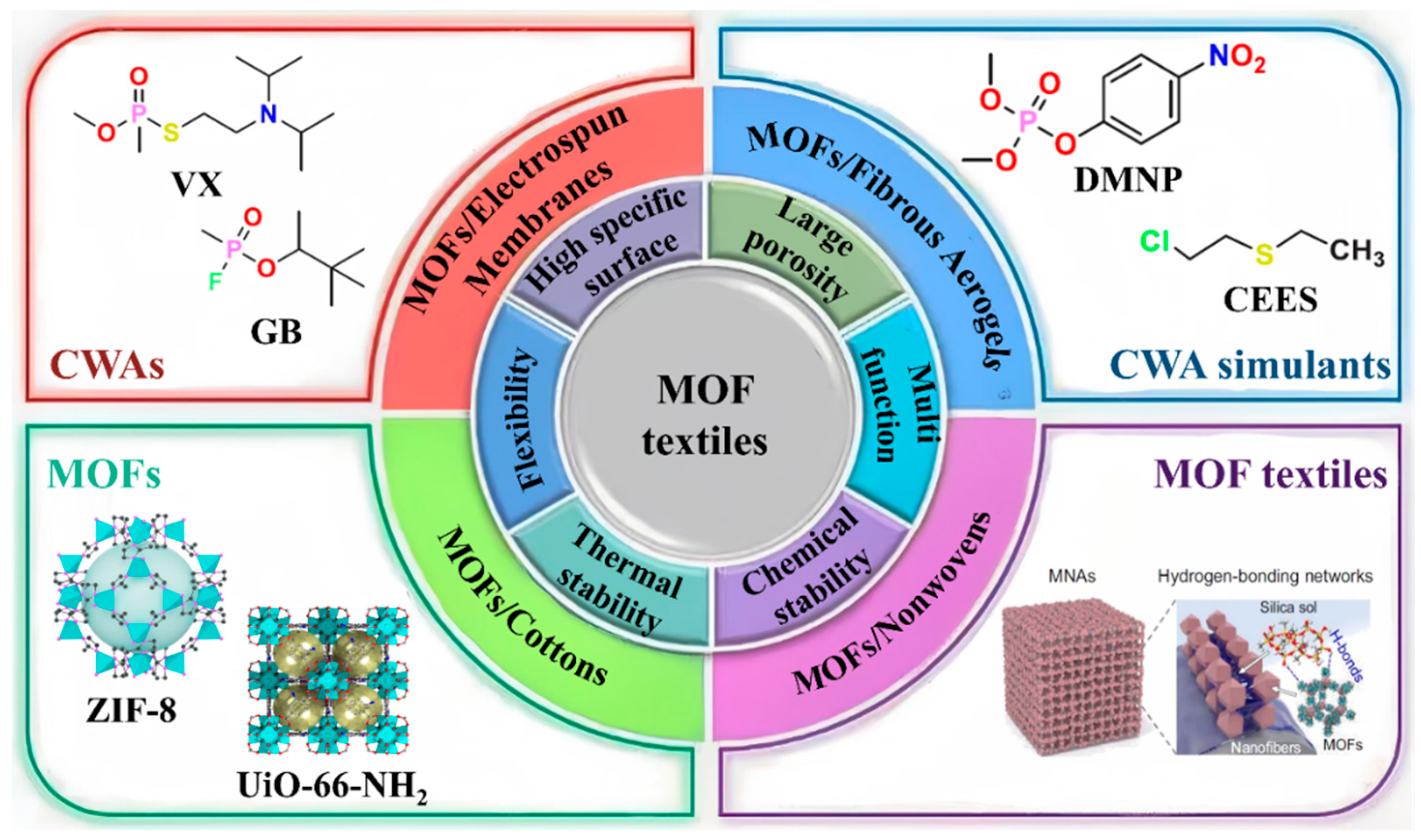
Figure 1. Schematic illustration of MOF textiles for application in the catalytic degradation of CWAs and their simulants. Reproduced with permission [24]. Copyright 2023, Springer Nature.
Coatings 15 01495 g001
Figure 2. Structure of some typical (a) CWAs and (b) their simulants.
Coatings 15 01495 g002
Figure 3. Several catalytic degradation routes of (a) GD, (b) VX, and (c) HD. Reproduced with permission [15]. Copyright 2021, American Chemical Society.
Coatings 15 01495 g003
Figure 4. (a) The fabrication process of the fibrous UiO-66-NH2/PAN mats. (b) Photograph of the fibrous UiO-66-NH2/PAN mats with different amounts of UiO-66-NH2. Reproduced with permission [97]. Copyright 2022, American Chemical Society. (c) A schematic diagram of the catalytic degradation of DMNP on PA-6@PDA@UiO-66-NH2 nanofibers. (d) SEM images of PA-6@PDA@UiO-66-NH2 nanofiber membranes. (e) Conversion of DMNP using PA-6@PDA@UiO-66-NH2 nanofiber membranes as filters against a DMNP aerosol under room and SSL irradiation. Reproduced with permission [98]. Copyright 2020, American Chemical Society. (f) Illustrated diagram of the preparation of UiO-66-NH2 fabrics and the removal process. (g) SEM images of the prepared UiO-66-NH2@PAN nanofibers under different reaction times. Reproduced with permission [99]. Copyright 2021, American Chemical Society.
Coatings 15 01495 g004
Figure 5. (a) Fabrication of SiO2/MOF-808 aerogels. (b) Fiber morphologies of SiO2/MOF-808 aerogels under different magnifications. (c) Catalytic degradation curves of DMMP. (d) Dynamic simulation of DMMP/MOF-808 component based on colored IGMH isosurfaces. Reproduced with permission [24]. Copyright 2023, Springer Nature.
Coatings 15 01495 g005
Figure 6. (a) Illustration scheme for preparation of DTNB@MOF-808@cotton composites. (b) Physical picture and SEM image of DTNB@MOF-808@cotton composites. (c) VX degradation by DTNB@MOF catalysts in morpholinopropylsulfonic acid buffer at pH = 7. Reproduced with permission [115]. Copyright 2022, American Chemical Society. (d) SEM image of UiO-66-NH2/cotton composite textiles. (e) Half-life of plain cotton, 1X MOF cotton, 2X MOF cotton, DMNP/buffer only, and two different MOF powder samples. Reproduced with permission [114]. Copyright 2018, American Chemical Society.
Coatings 15 01495 g006
Table 1. The inherent structure parameters of some CWAs and their simulants [31,32,33,34,35,36,37].
TypeFull NameWater Solubility
(mg/L)
Boiling Point
(°C)
Vapor Pressure
(pa)
Nerve agentsTabun (GA)98,000 (25 °C)2409.33
 Sarin (GB)1,000,000 (25 °C)147381.30
 O-Ethyl S-(2-diisopropyl aminoethyl) methyl phosphorothioate (VX)3000 (25 °C)2980.11
0.12
 Soman (GD)21,000 (20 °C)20154.66
Erosive agentsMustard gas (HD)684 (20 °C)21614.66
Simulantsdimethyl methyl phosphonate (DMMP)≥100,000 (25 °C)181128.25
 dimethyl 4-nitrophenyl phosphate (DMNP)3640 (20 °C)1700.00014
 diisopropyl fluorophosphate (DIFP)15,400 (25 °C)18377.19
 2-chloroethyl ethyl sulfide (CEES)1062 (25 °C)156453.29
 Diethyl chlorophosphite (DCP)18,030 (25 °C)93.56586
 Diethyl sulfide (DES)3130 (20 °C)92.18026
Table 2. MOFs used for catalytic degradation of chemical warfare agents and their simulants.
TypeStructureMetal ClusterLigandRef.
UiO-66Coatings 15 01495 i001Coatings 15 01495 i002Coatings 15 01495 i003[63]
UiO-66-(OH)2Coatings 15 01495 i004Coatings 15 01495 i005Coatings 15 01495 i006[64]
UiO-66-NH2Coatings 15 01495 i007Coatings 15 01495 i008Coatings 15 01495 i009[65]
UiO-67Coatings 15 01495 i010Coatings 15 01495 i011Coatings 15 01495 i012[19]
UiO-67-(NH2)2Coatings 15 01495 i013Coatings 15 01495 i014Coatings 15 01495 i015[20]
HKUST-1Coatings 15 01495 i016Coatings 15 01495 i017Coatings 15 01495 i018[66]
NENU-11Coatings 15 01495 i019Coatings 15 01495 i020Coatings 15 01495 i021[67]
MOF-808Coatings 15 01495 i022Coatings 15 01495 i023Coatings 15 01495 i024[68]
PCN-222Coatings 15 01495 i025Coatings 15 01495 i026Coatings 15 01495 i027[69]
ZIF-8Coatings 15 01495 i028Coatings 15 01495 i029Coatings 15 01495 i030[57]
MIL-100Coatings 15 01495 i031Coatings 15 01495 i032Coatings 15 01495 i033[58]
MM-MOF-74Coatings 15 01495 i034Coatings 15 01495 i035Coatings 15 01495 i036[59]
Table 3. Detoxification comparison of various CWAs and their simulants with different catalysts.
MaterialsMOF Loading
Mass (%)
Agent Volume
(μL)
Condition
(Buffer)
Removal
Efficiency (%)
Half-Life
(min)
Ref.
NU-10001VX (50)0.45 M NEM (pH = 10)/5.3[113]
UiO-66-NH21VX (50)0.45 M NEM (pH = 10)/35[74]
MOF-51HD (10)/78.1/[119]
UiO-661CEES (6)Phosphate (pH = 8)8378[120]
UiO-66-NH2/PET13GD (0.3)0.4 M NEM77.420[121]
[Cu3(BTC)2]4@chitosan21HD (4)/90.163[122]
OA-UiO-66-NH2@PAN32.6CEES (5)0.5 mL H2O and EtOH (1:1)60.630[97]
PA-6@PDA@UiO-66-NH227.8DMNP (4)0.15 M NEM800.5[98]
MOF-808@SiO233DMNP (4)0.15 M NEM/5.29[105]
UiO-66-NH2@ANF72.3CEES (5)/98.98.15[106]
PP@TA-APTES@MOF-80823.4DMNP (4)/1001.3[116]
Disclaimer/Publisher’s Note: The statements, opinions and data contained in all publications are solely those of the individual author(s) and contributor(s) and not of MDPI and/or the editor(s). MDPI and/or the editor(s) disclaim responsibility for any injury to people or property resulting from any ideas, methods, instructions or products referred to in the content.