Review

Research Progress on the Preparation and Performance of Recycled Mortars Using Solid Waste-Based Cementitious Materials

1
Department of Civil Engineering, School of Civil Engineering and Geomatics, Shandong University of Technology, Zibo 255000, China
2
School of Architectural and Hydraulic Engineering, Jiujiang Polytechnic University of Science and Technology, Jiujiang 332020, China
3
Department of Architecture, School of Civil Engineering and Architecture, Hebei University of Engineering Science, Shijiazhuang 050091, China
4
Department of Engineering and Management, International College, Krirk University, No. 3 Soi Ramintra 1, Ramintra Road, Anusaowaree, Bangkok 10220, Thailand
5
Department of Architectural Engineering, School of Civil Engineering, Inner Mongolia University of Science and Technology, 7 Alding Street, Baotou 014010, China
*
Authors to whom correspondence should be addressed.
Coatings 2025, 15(12), 1483; https://doi.org/10.3390/coatings15121483
Submission received: 13 November 2025 / Revised: 9 December 2025 / Accepted: 12 December 2025 / Published: 16 December 2025

Abstract

Solid waste-based cementitious materials (SWCMs) represent an innovative class of binders derived mainly from construction and demolition waste as well as industrial byproducts. Their application in recycled mortar offers a promising pathway to partially replace conventional cement, thereby advancing resource recycling and facilitating a low-carbon transition in the cement industry. This review systematically examines the properties, activation techniques, strength development, and corrosion resistance of recycled mortar prepared with SWCMs. Recycled powder (RP) and industrial solid waste have gelation potential, but their low reactivity requires activation treatment to enhance utilization efficiency. Activation methods, including thermal activation, carbonation, and alkali activation, effectively enhance reactivity and promote the formation of dense gel structures (e.g., C-(A)-S-H, N-A-S-H). While low replacement ratios optimize pore structure via the microfiller effect, higher ratios introduce excessive inert components, impairing mechanical properties. SWCMs demonstrate superior resistance to sulfate and chloride attacks, but their acid resistance is relatively limited. They also have excellent freeze–thaw resistance. SWCMs represent a viable and sustainable alternative to conventional cement, exhibiting commendable mechanical and durability properties when properly activated and formulated, thereby contributing to resource recycling and environmental sustainability in the cement industry.

1. Introduction

The advancement of economic globalization has accelerated the rapid development of industries worldwide, yet it has also resulted in substantial resource consumption and increased greenhouse gas emissions. Statistics indicate that the construction sector accounts for approximately 40% of the natural resources used in industrial production. In addition to emitting greenhouse gases during production and construction, this sector generates enormous amounts of construction and demolition waste [1]. Cement, as one of the most essential building materials, is responsible for approximately 40% of CO2 emissions during its production process while also consuming significant amounts of natural resources. Moreover, the total volume of solid waste generated from construction and demolition activities has reached 3.5 billion tons [2], constituting 30% to 50% of the global solid waste stream [3,4]. Simultaneously, industrial by-products such as fly ash, slag, and desulfurization gypsum, which are produced by metallurgical, chemical, and other industries, have also accumulated on a massive scale. Collectively, these materials exert considerable environmental pressure [5]. Currently, the resource utilization rate of such solid wastes remains relatively low, with a large proportion ultimately disposed of in landfills or stockpiles. This not only occupies valuable land resources but also causes complex pollution of soil, water, and the atmosphere, emerging as a critical bottleneck to sustainable urban development.
Among construction waste materials, waste concrete and waste clay bricks constitute the two predominant components. In recent years, beyond merely crushing and sieving these materials for use as recycled aggregates, further grinding them into recycled powder for application as cementitious materials has emerged as a cutting-edge research direction aimed at achieving high-value recycling of construction waste [6]. This approach seeks to transform waste from a simple physical filler into a key component that participates in cementitious reactions and is regarded as one of the core pathways to advance construction waste recycling from “downcycling” to “upcycling.” However, recycled powder often contains stabilized hydration products (such as C-S-H gel and Ca(OH)2) or high-temperature sintered inert phases (e.g., quartz and mullite), which generally lead to inherent drawbacks such as a low content of active components, high chemical inertness, irregular particle morphology, and high water demand [7]. As a result, composite cementitious systems incorporating recycled powder as a partial replacement for cement often suffer from slow hydration rates, insufficient early-age strength development, and poor microstructural densification. When used as a source of aluminosilicates in geopolymer synthesis, recycled powder presents challenges such as low reactivity, rapid consumption of alkaline species in solution, and the formation of loosely structured polymerization products [8,9]. These fundamental limitations in material activity severely restrict the high-volume application of recycled powder in structural materials, posing significant challenges to its widespread adoption in practical engineering.
Moreover, the disposal of industrial solid waste has become an equally pressing issue. Byproducts such as fly ash from coal-fired power plants, blast furnace slag from iron and steel smelting, and desulfurization gypsum and red mud have accumulated in massive quantities, posing serious environmental threats. In recent years, the advanced utilization of industrial solid waste has become a leading research direction for achieving high-value recycling. This approach moves beyond conventional applications, such as road base materials or cement blends, instead of using these wastes as essential raw materials for green construction materials, including geopolymers and alkali-activated binders [10,11,12]. This approach aims to transform industrial solid waste from an “environmental burden” into a strategic resource that supports the development of “zero-waste cities” and low-carbon building solutions, representing a shift from low-end disposal toward value-added creation [13,14,15]. However, owing to differences in sources and production processes, these wastes often present inherent drawbacks, such as significant variability in chemical composition, complex active phase constituents, and diverse physical characteristics [16]. These limitations make it challenging to precisely control reaction pathways, workability, and long-term volume stability when such wastes are used as sole or primary precursors in alkali-activated systems [17]. Furthermore, the design of blended systems and processing strategies for performance optimization is complicated by unclear structure-activity relationships among reaction mechanisms, resultant phases, and macroscopic properties, largely due to the heterogeneity and complexity of solid wastes [18,19]. These fundamental bottlenecks at both the material utilization and engineering application levels severely restrict the reliable, large-scale use of industrial solid waste-based cementitious materials in structural engineering, resulting in considerable challenges in industrialization.
Promoting the systematic integration and synergistic utilization of construction waste and industrial solid waste in the field of cementitious materials is crucial for achieving both high-performance and low-carbon objectives. By combining the use of recycled powder with alkali activation technology for industrial solid waste, it is possible not only to leverage their complementary advantages and enhance the overall performance and stability of the cementitious system but also to significantly reduce reliance on conventional cement [20,21], thereby substantially decreasing energy consumption and carbon emissions at the source.
Given the above considerations, there is a pressing need to systematically review, consolidate, and critically assess research progress in the field of solid waste-based cementitious materials for recycled mortar. This review specifically addresses a critical gap by establishing a comprehensive framework for solid waste-based cementitious materials, which synergistically utilize recycled powder derived from construction and demolition waste (CDW) and industrial solid wastes. It systematically elucidates how various activation methods, such as thermal activation, carbonation, and alkali activation treatments, relate to material properties. The review systematically links these activation mechanisms to the resulting material performance, particularly mechanical strength and resistance to diverse aggressive environments, including sulfate attack, acid corrosion, chloride penetration, and freeze–thaw cycles. By providing a comparative analysis of degradation mechanisms under different aggressive conditions and correlating them with gel chemistry and microstructure, this work offers novel insights for designing high-performance, low-carbon binders with enhanced durability. Thus, it bridges the knowledge gap between isolated activation studies and the practical, durable application of fully waste-based mortars.

2. Methodology Adopted for the Review

To ensure systematicity, representativeness, and relevance in selecting references for this review, a dynamic, evolutionary, and layered in-depth search and screening strategy was employed. The retrieval databases included the Web of Science (WoS) Core Collection (encompassing sub-databases such as SCI, SSCI and AHCI) and the China National Knowledge Infrastructure (CNKI) (including core databases of Peking University Chinese and CSCD), ensuring comprehensive coverage of internationally authoritative literature and important domestic research achievements. The determination of keywords was a gradual process, refined and expanded as research and understanding deepened. Initially, “recycled mortar” served as the entry point, which was then extended to material system keywords such as “polymer mortar” and “alkali-activated cementitious materials”. After clarifying the basic reaction mechanisms, the scope was further broadened to preparation methods such as “thermally activated mortar” and “carbonized mortar”. The focus shifted to material properties, introducing evaluation terms such as “corrosion resistance”, “freeze-thaw resistance”, “sulfate resistance”, and “acid corrosion resistance”. Based on this principle, the study constructed a multi-level keyword system comprising core concepts and their synonym clusters. These elements were strategically combined with Boolean operators including AND and OR, which enabled an optimal balance between recall and precision throughout the retrieval process and laid a reliable foundation for the review. After the initial literature acquisition, clear inclusion and exclusion criteria were defined: priority was given to original research articles and authoritative peer-reviewed reviews, while unreviewed conference abstracts, news reports, and literature for which the full text could not be obtained were excluded. Through this structured process, the study aimed to build a comprehensive and precise literature base, thereby supporting the reliability and relevance of the review’s arguments.

3. Feasibility of Solid Waste-Based Cementitious Materials for Recycled Mortars

Solid waste-based recycled mortar is an environmentally sustainable construction material made from solid wastes, including construction and demolition debris and industrial by-products. It is produced through the partial or complete replacement of conventional natural aggregates and cementitious materials via physical, chemical, or hybrid processing techniques according to specific mixture formulations. This approach seeks to valorize solid wastes as valuable resources, thereby reducing the consumption of natural resources, mitigating environmental pollution, and fostering the development of a circular economy.

3.1. Material Characteristics

3.1.1. Construction Solid Waste Materials

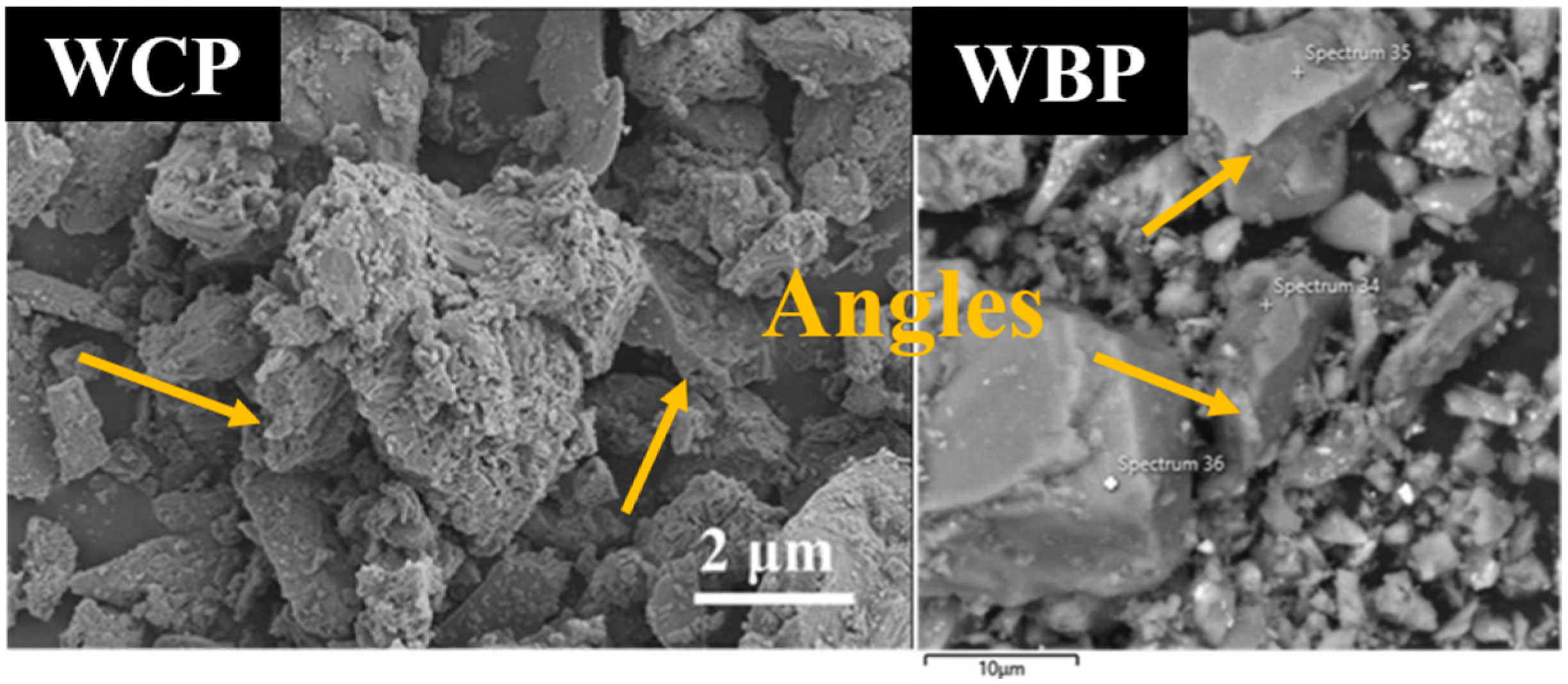
Recycled powder (RP) is an ultrafine powder (particle size < 0.16 mm) primarily produced from construction and demolition waste, such as waste concrete, bricks, and masonry, through a series of processing steps, including screening, crushing, and grinding. The raw materials are diverse in origin and are derived mainly from waste concrete and clay bricks generated during demolition projects, as well as from construction residues and laboratory waste. The physicochemical properties of RP, including its reactivity index and particle size distribution, exhibit considerable heterogeneity. This stems from significant variations in the source materials, such as building type, service life, and original composition. During production, the raw materials undergo meticulous processing involving crushing, sorting, drying, and high-precision grinding to meet standardized specifications [22]. Consequently, RP particles are characterized by rough surfaces, irregular and angular morphologies, and porous structures, as shown in Figure 1 [23,24]. The irregular particle shape increases interparticle friction, which adversely affects mortar fluidity, whereas the porous structure elevates water demand, thereby influencing rheological performance. However, the angular and rough surfaces of the particles provide a larger reactive area that promotes hydration, and the porous texture facilitates internal curing by absorbing and retaining water [25].
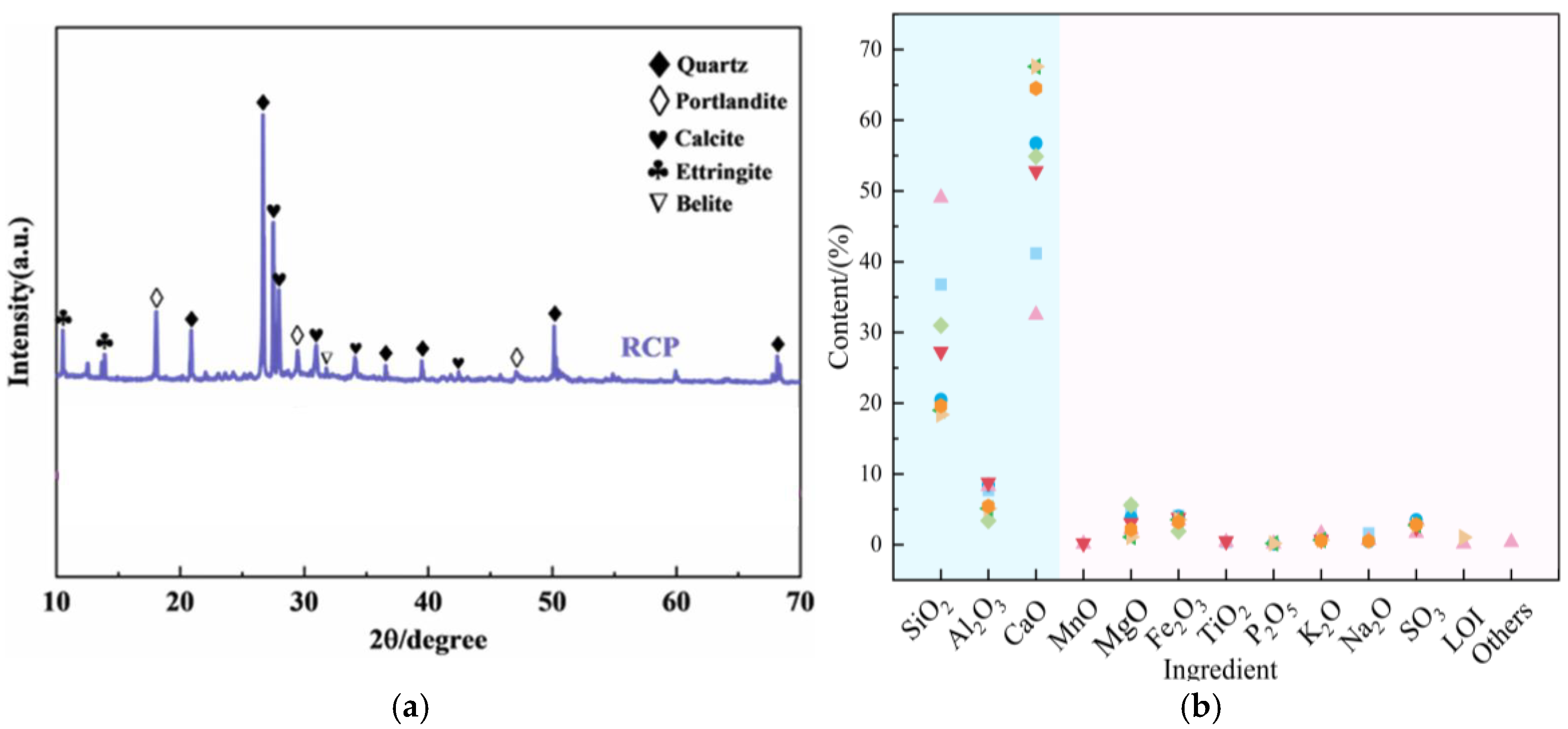
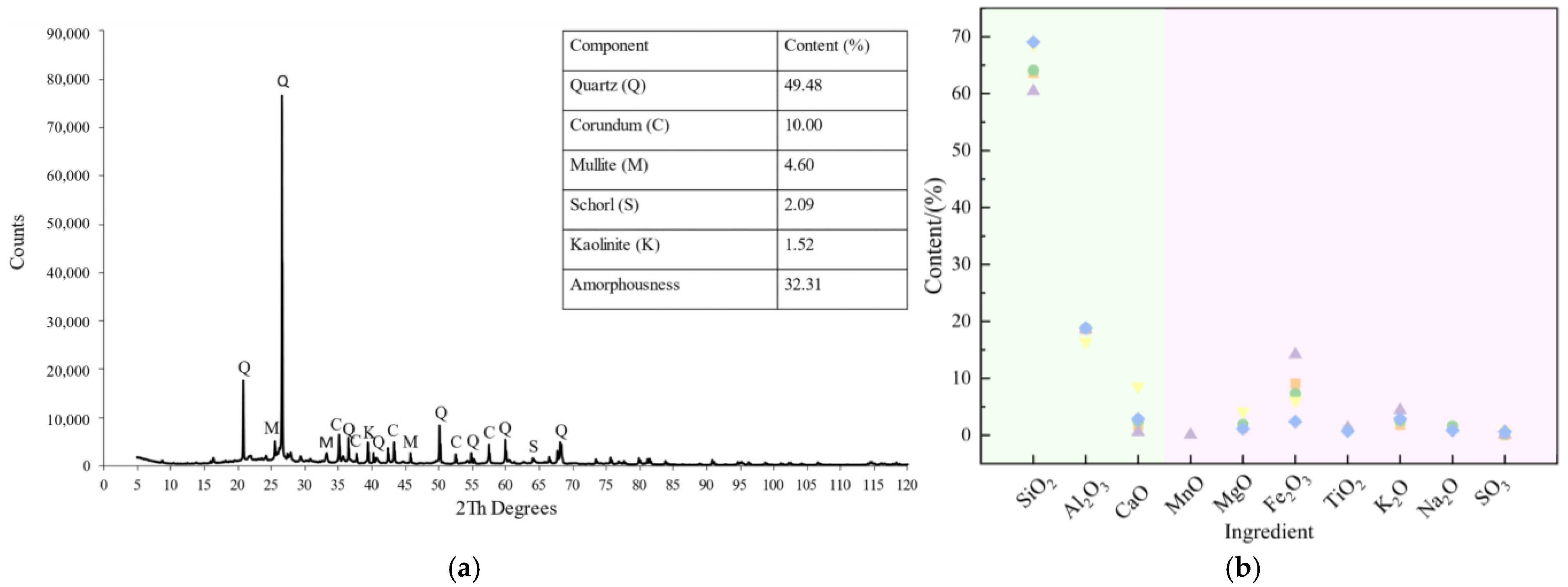
Owing to variations in raw material sources, the composition of RP can vary significantly. Waste concrete powder (WCP) primarily consists of both crystalline and amorphous phases, including quartz (SiO2), calcite (CaCO3), dolomite (CaMg(CO3)2), C-S-H gel, and ettringite, and unhydrated clinker phases, such as C2S, C3S, and C4AF, as illustrated in Figure 2a [23]. Quartz and dolomite originate from fine and coarse aggregates, respectively, introduced during the concrete crushing process. Calcite results from the carbonation of both the aggregate and the concrete. As shown in Figure 2b, the major chemical constituents of WCP are SiO2, CaO, Fe2O3, Al2O3, and MgO. Among these, SiO2 is the most abundant component, followed by CaO. In contrast, waste brick powder (WBP) has a distinctly different composition, characterized by high contents of SiO2 and Al2O3, as indicated in Figure 3b. The X-ray diffraction (XRD) pattern of WBP confirms that quartz is the predominant crystalline phase, as shown in Figure 3a [24]. The high concentrations of key oxides, such as CaO, SiO2, and Al2O3, in RP indicate its potential pozzolanic reactivity [26]. The presence of amorphous SiO2 and Al2O3 particles may promote the reaction of volcanic ash. However, CaO exists in the form of calcium carbonate, which prevents it from participating in new hydration reactions.

3.1.2. Industrial Solid Waste

Industrial solid wastes, such as slag and fly ash, present inherent advantages for developing alkali-activated materials because of their high contents of silicon and aluminum components, which are readily soluble in alkaline environments. By directly activating the silicoaluminate component in the precursor with an alkaline activator, depolymerization and reconstruction of the active components in solid waste can be achieved. This process overcomes the traditional cement’s reliance on C3S and C2S minerals, providing a more efficient reaction pathway. Owing to their low-carbon characteristics, these systems have attracted widespread attention.
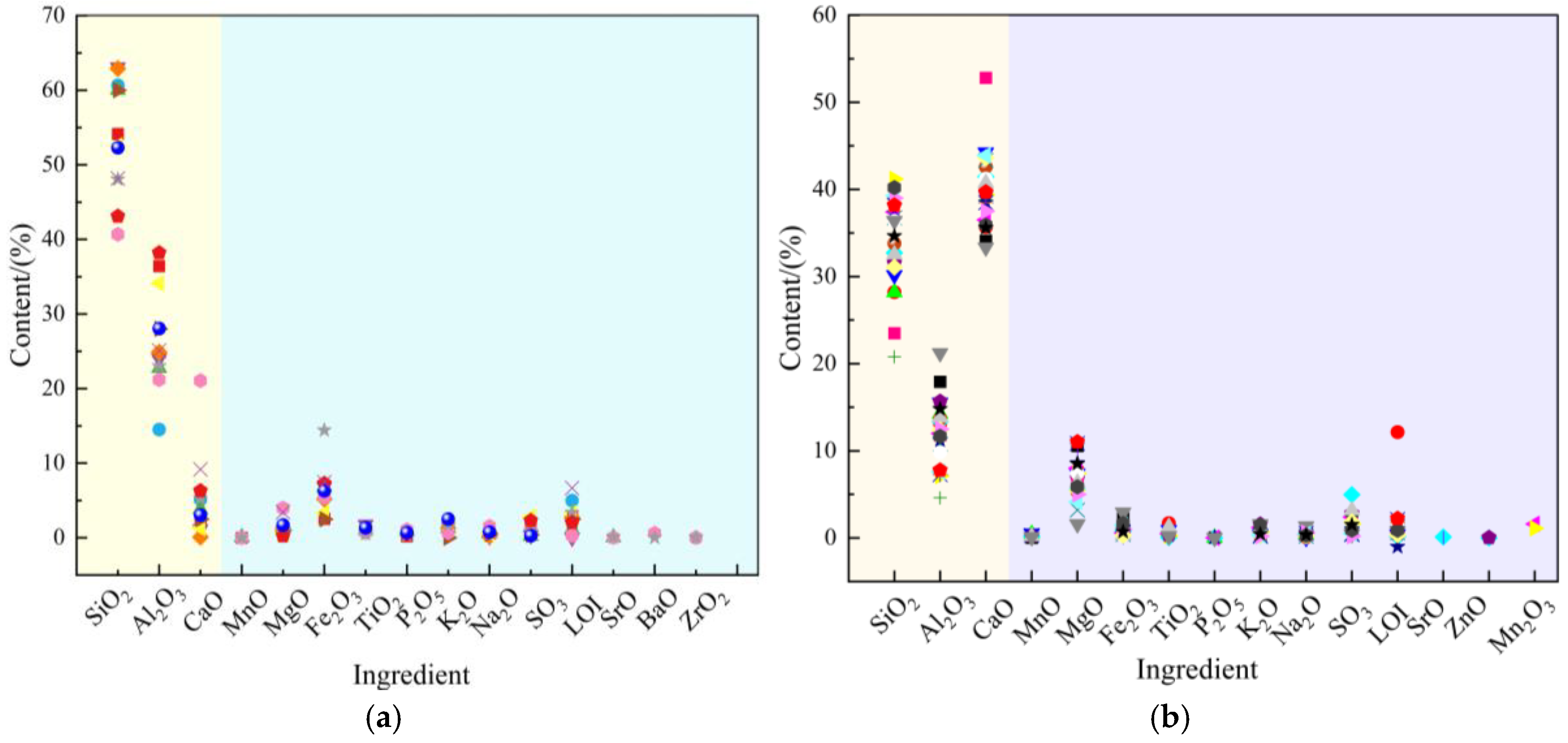
Compared with ordinary Portland cement, alkali-activated materials exhibit lower energy consumption, higher mechanical strength, and superior durability, making them promising alternatives to traditional cement [29,40]. The chemical compositions of two commonly used precursors, fly ash and slag, are presented in Figure 4. Although variations exist depending on the raw material sources, the main components of both are concentrated in three oxides, namely, SiO2, CaO, and Al2O3. Fly ash and slag represent two typical systems. As shown in Figure 4a, fly ash is a low-calcium system dominated by silica and alumina (SiO2 and Al2O3). Slag is a high-calcium system rich in silica and calcium oxides (SiO2 and CaO), as indicated in Figure 4b. The proportions of Si, Ca, and Al significantly influence the performance of the resulting hardened mortar [41].
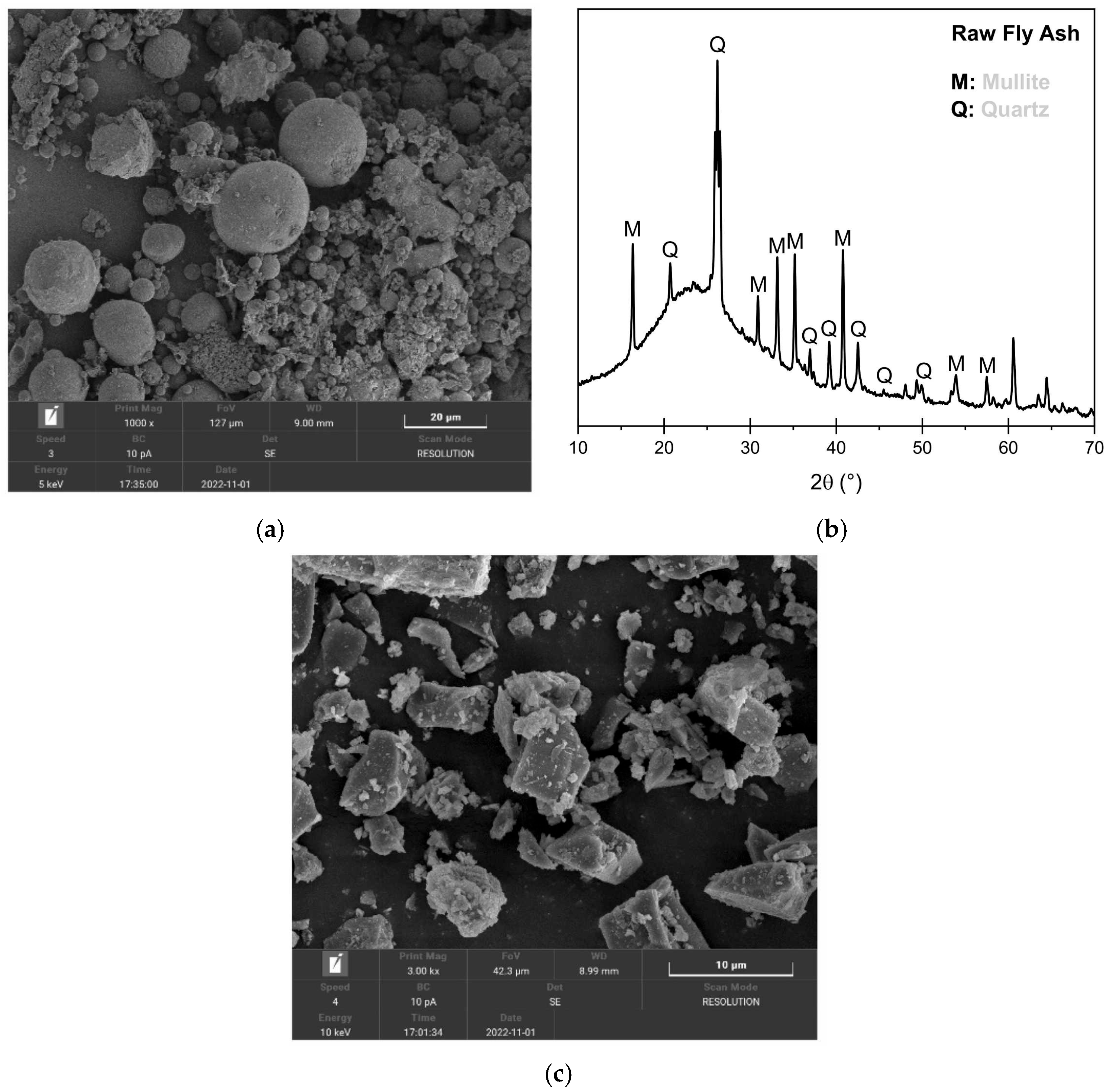
Fly ash (FA), one of the most prevalent industrial byproducts, is a fine powder collected from flue gas following the combustion of bituminous coal in coal-fired power plants. It typically exhibits gray to dark gray coloration, occasionally appearing light gray, depending on the unburned carbon content and mineral composition. Generally, higher carbon levels result in darker shades. Most FA particles range from 1–100 μm in size and have a high specific surface area [42,45]. Class F fly ash, also known as low-calcium FA, is typically derived from anthracite or bituminous coal, whereas Class C (high-calcium) FA is produced from lignite or subbituminous coal. Compared with high-calcium FA, low-calcium FA is richer in SiO2 and Al2O3, with a CaO content generally less than 15%, whereas the CaO content of high-calcium FA is between 15% and 30% [43]. As shown in Figure 5a, the FA particles are predominantly spherical and consist largely of an amorphous glass phase, along with minor crystalline phases such as quartz, mullite, and magnetite, as evidenced by the XRD pattern in Figure 5b [67]. Although fly ash is widely used as an alkali-activated precursor, the large-scale closure of coal-fired power plants and the transition of the power industry towards a more environmentally sustainable model are expected to significantly reduce its production in the future. Moreover, the extensive application of fly ash as a supplementary cementitious material in conventional building materials has generated significant competitive demand. This demand may hinder its large-scale development and utilization as an alkali-activated precursor for other applications.
Ground granulated blast furnace slag (GGBS) is a significant by-product generated during the iron-making process in blast furnaces and is widely utilized as an industrial solid waste material. As illustrated in Figure 5c, GGBS particles exhibit an angular and irregular morphology, with colors ranging from white to light gray. Its chemical composition predominantly consists of CaO, SiO2, Al2O3, and MgO. Upon rapid cooling from the molten state, GGBS solidifies into a primarily amorphous glassy phase. This metastable glassy structure imparts latent hydraulic activity, which is essential for its application as a cementitious material [28,46,47,48].
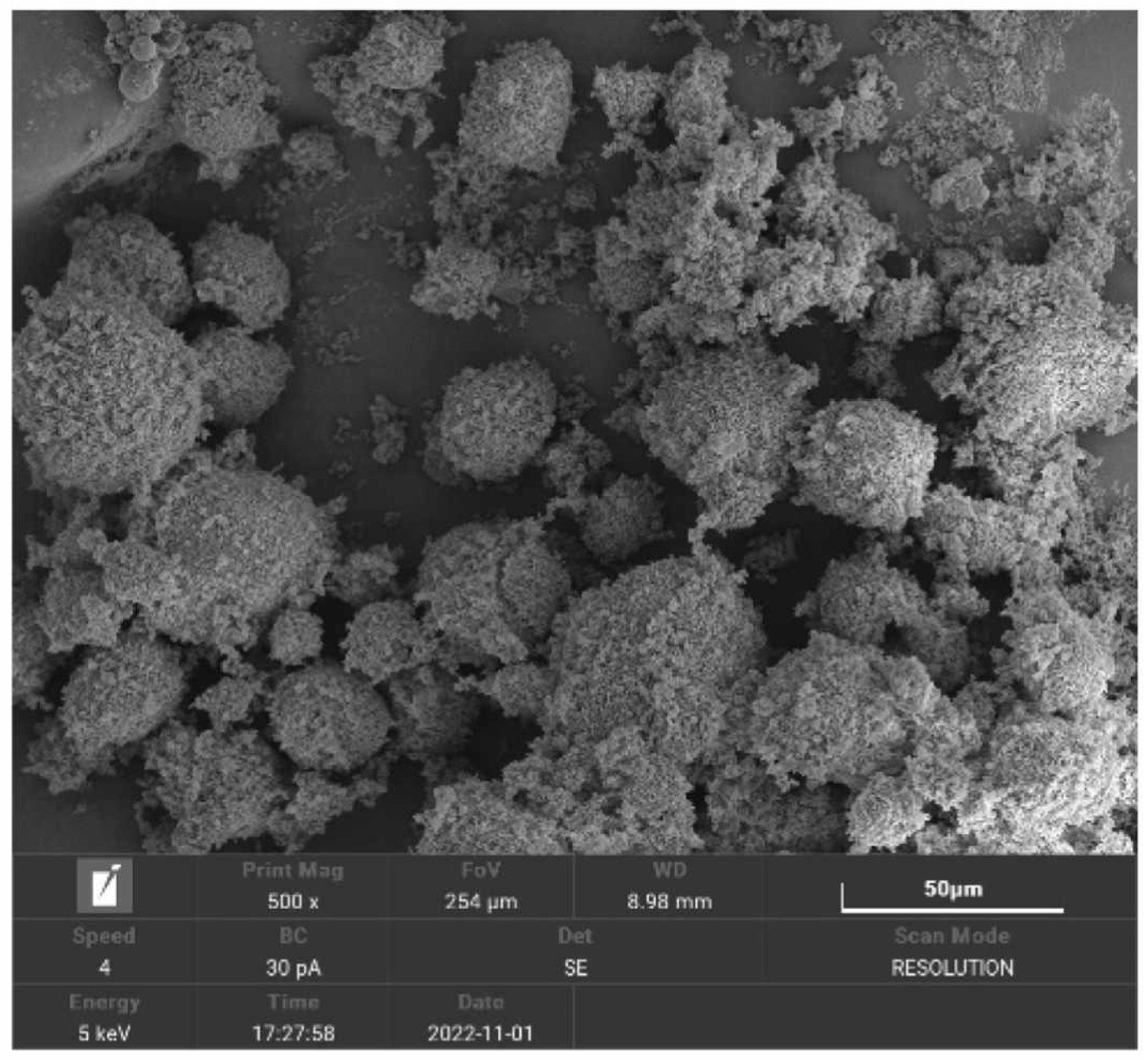
Silica fume (SF), also known as microsilica, is an ultrafine gray powder collected from flue gases during the production of silicon or ferrosilicon alloys. As illustrated in Figure 6, the SF particles are predominantly spherical and exhibit an amorphous structure. With an average particle size of approximately 0.1 μm, silica fume is approximately two orders of magnitude finer than cement particles are, classifying it as a nanoscale material. It is characterized by an exceptionally high SiO2 content, generally no less than 85%, along with minor oxides such as Al2O3, Fe2O3, CaO, and MgO. The silica in SF is almost entirely amorphous, which endows it with high chemical reactivity and significant pozzolanic activity [69].
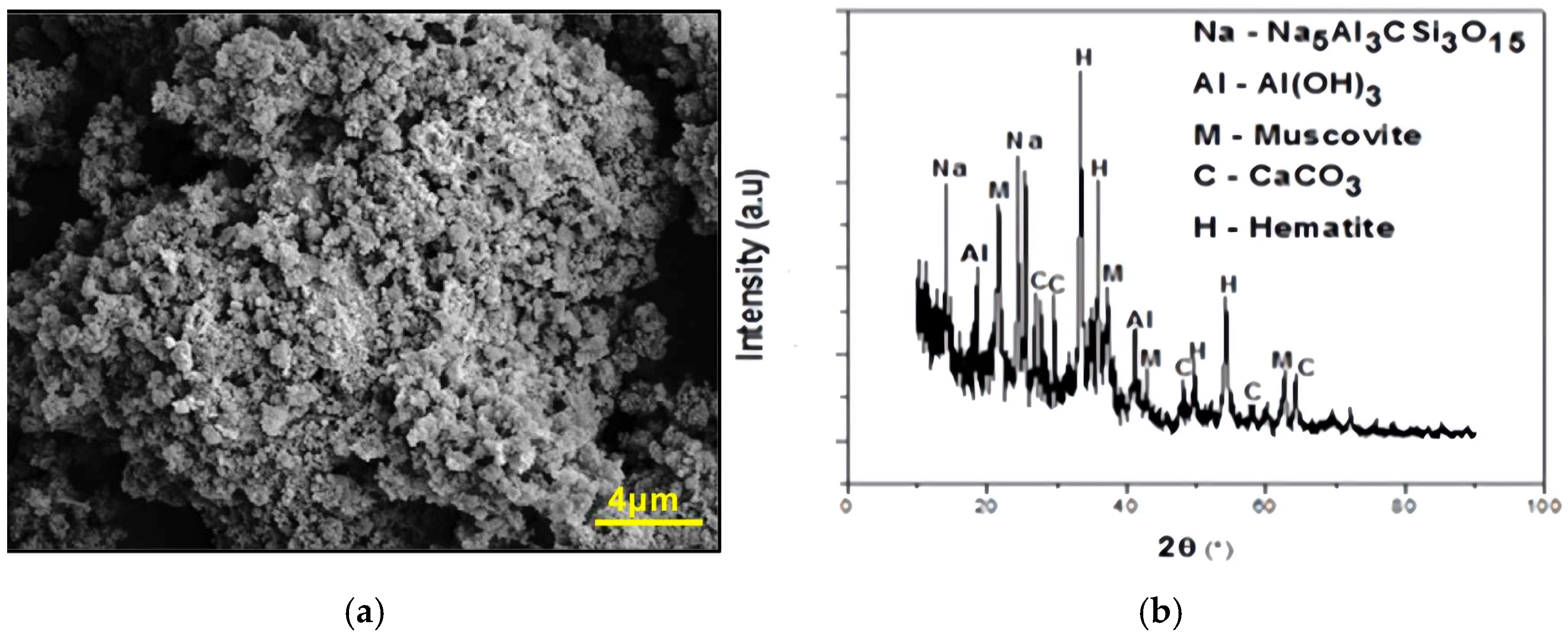
Red mud (RM) is a highly alkaline solid residue generated during the extraction of alumina (Al2O3) from bauxite ore. It is a characteristic reddish-brown color due to its high iron oxide content. As shown in Figure 7a, the microstructure of the RM predominantly consists of irregular platelets, along with some spherical beads and porous agglomerates. The pH value of red mud ranges from 10.5–13.5, indicating strong alkalinity. Its chemical composition includes Fe2O3, Al2O3, SiO2, TiO2, CaO, Na2O, and other oxides, which contribute to its potential suitability for use in alkali-activated systems. The main crystalline phases identified by XRD (Figure 7b) include hematite, goethite, calcite, katoite, and cancrinite. However, the presence of heavy metals such as Cr, V, and As, as well as naturally occurring radionuclides such as uranium-238 (238U), thorium-232 (232Th), and radium-226 (226Ra), may limit their widespread application [45,47].
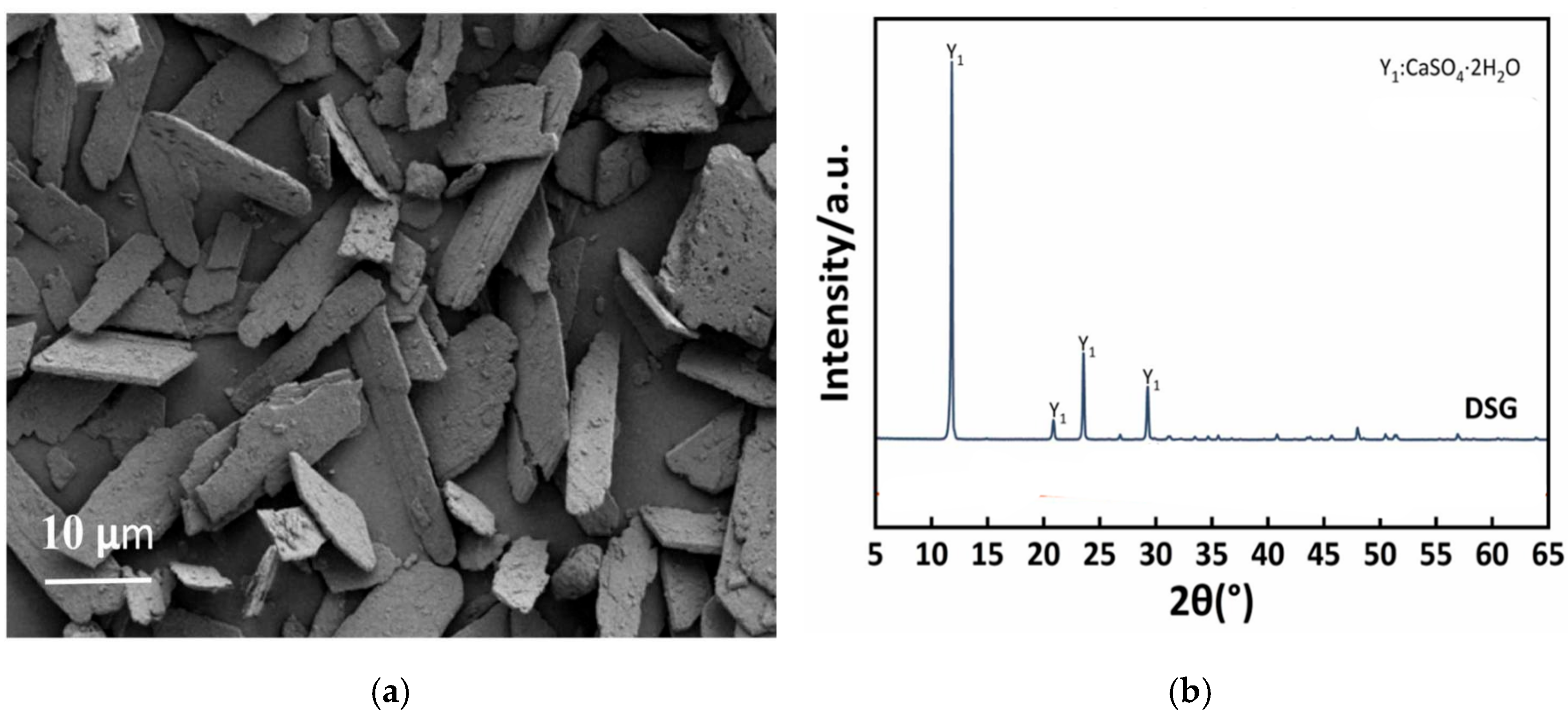
Desulfurization gypsum (DG) is an industrial byproduct generated during the flue gas purification process via limestone–gypsum wet desulfurization technology in coal-fired power plants and steel mills. Compared with natural gypsum, desulfurization gypsum appears grayish-white or light yellow in color, with a microscopic morphology characterized by short columnar or plate-like crystals, as shown in Figure 8a. Its main component is calcium sulfate dihydrate (CaSO4·2H2O), although it may contain small amounts of soluble salts such as chloride ions and magnesium oxide [46]. After drying treatment, this material exhibited excellent cementitious properties.

3.2. Activation Methods for Solid Waste-Based Cementitious Materials

Owing to the generally low reactivity of solid waste materials, their use as cementitious components is limited. However, certain potentially active constituents in solid waste, including amorphous silicoaluminates and substances within the glassy silicon-aluminum phase, can be activated. Through specific methods, these materials are transformed into highly reactive cementitious components, which enables efficient solid waste utilization.

3.2.1. Thermal Activation

Subjecting WCP to elevated temperatures significantly alters its physical and chemical properties, thereby affecting the performance of the mortar prepared with it. At high temperatures (>500 °C), dehydration and decomposition occur in hydration products, such as calcium silicate hydrate (C-S-H) and calcium carbonate (CaCO3). At high temperatures, CaCO3 undergoes thermal decomposition reactions, directly releasing CO2 gas and generating CaO. As the temperature increases, the C-S-H gel initially loses adsorbed water and some bound water, and its structure will gradually be damaged. With further temperature rises, its amorphous structure undergoes reconstruction, and calcium silicate minerals such as β-C2S and C3S crystallize through atomic rearrangement, as shown in reaction Equations (1) and (2). The common characteristic of these decomposition products is their relatively high reactivity [69].
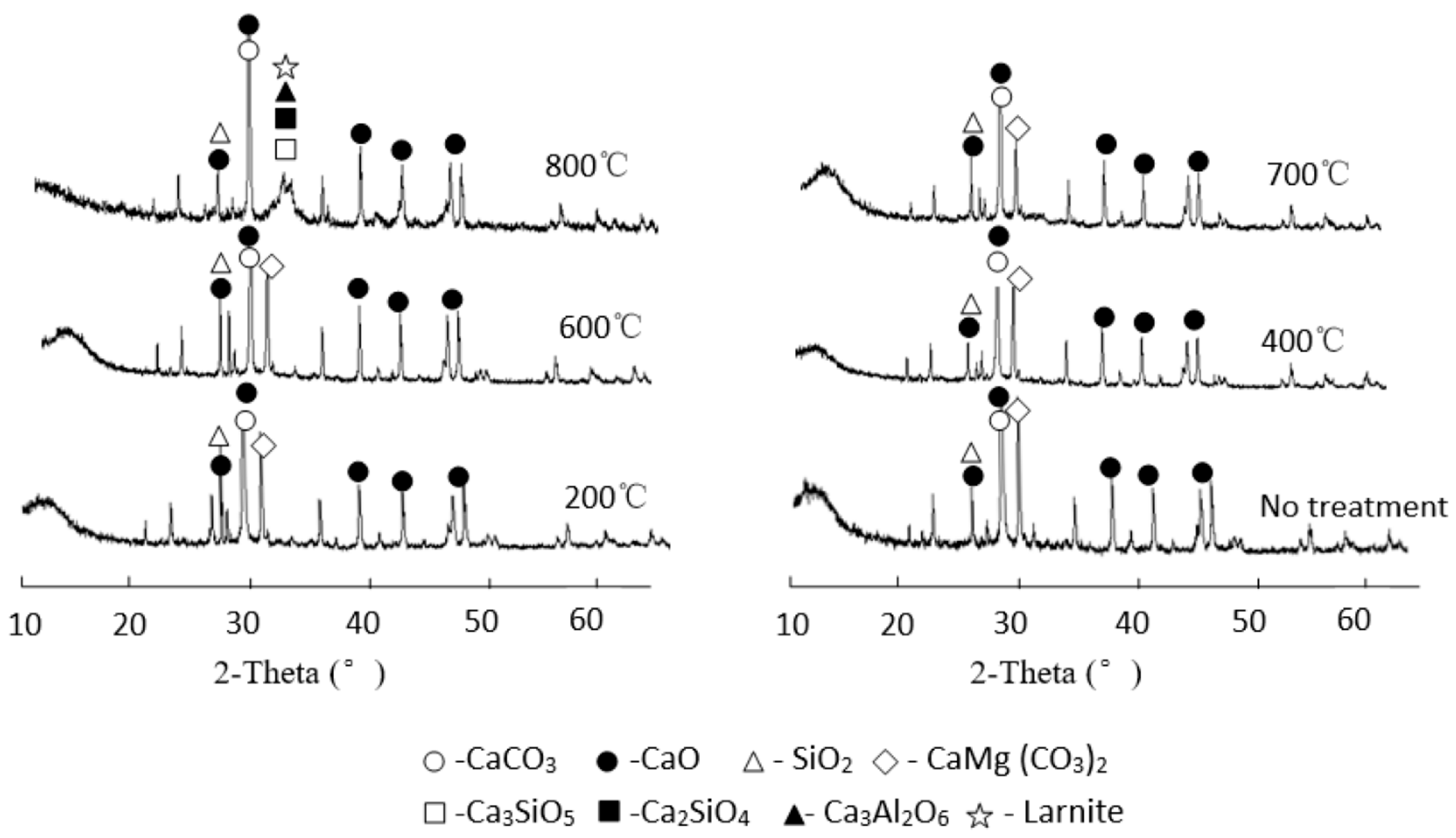
As the temperature rises, the phase composition undergoes significant changes. The XRD pattern of the thermally activated WCP is shown in Figure 9, where mineral phases such as quartz and dolomite (CaMg(CO3)2) can still be identified within the temperature range of room temperature to 600 °C. When the temperature rises from 600 °C to 800 °C, a diffraction peak of CaO appears at 2θ ≈ 37.5°, indicating the decomposition of calcite (CaCO3) at high temperatures. In addition, diffraction peaks of C2S and C3S are detected, which result from the decomposition of C-S-H at high temperatures. Since C-S-H gel is an amorphous mineral phase, it cannot be detected by XRD. All these decomposition products have potential pozzolanic activity. When the temperature continues to rise to 1000 °C, the diffraction peaks of CaO, C2S and C3S become significantly more intense, indicating ongoing decomposition [40]. At 1200 °C, diffraction peaks of gypsum are detected [31]. Furthermore, existing studies have shown that ettringite decomposes between 350 °C and 400 °C, while calcium hydroxide (CH) remains stable [72]. AFt gradually dehydrates within the range of 75 °C to 300 °C. Around 150 °C, AFt is almost completely dehydrated and can form Al2O3 and CaO, which possess certain gelling abilities [30].
CaCO 3 C a O + CO 2
C-S-H β -C 2 S + C 3 S
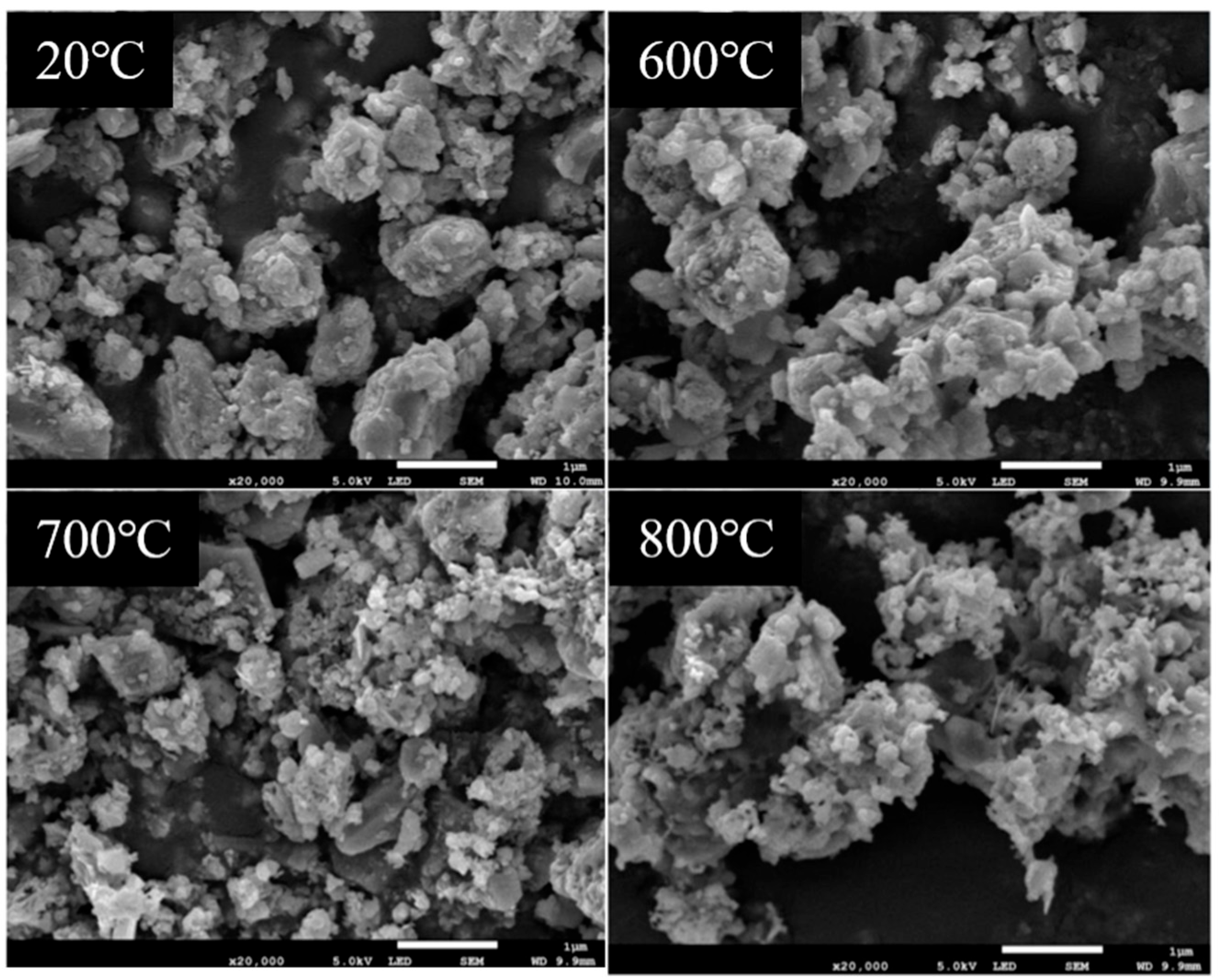
Furthermore, thermal activation significantly altered the microstructural characteristics of WCP. Unlike untreated WCP, the matrix has a denser microstructure within the temperature range of 300–400 °C because of the decomposition of hydration products (CH and C-S-H) and partial calcite [73]. At temperatures between 400 °C and 1000 °C, the particles exhibit increased density, which is attributed to the interlinking of newly formed hydration products on their surfaces [28]. However, when the temperature reaches 1200 °C, the WCP particles soften, and nearly all the hydration products decompose [74]. While this enhances particle flowability, it simultaneously weakens their nucleation effect. The microstructural evolution of WCP under different thermal activation temperatures is illustrated in Figure 10 [28]. As the temperature increases, the particles become finer and more rounded. However, above 750 °C, the finer particles gradually coalesce, leading to a reduction in the reactive surface area of the WCP particles [72]. Therefore, when conducting thermal activation treatment on raw materials, precise temperature control must be maintained to achieve the required performance.
Thermal activation treatment involves drying and calcining raw materials at specific temperatures and durations. This process requires external energy input, resulting in additional energy consumption. Table 1 presents the energy consumption of cement, untreated RP, and thermally activated RP, with the energy consumption of thermally activated waste powder calculated based on previous studies [75]. The results indicate that although the energy consumption for thermal activation of RP is higher than that of untreated RP, it remains relatively low compared to that of cement. Thermal activation enhances the activity and microstructure of RP, enabling it to replace cement to a greater extent. Future research should focus on expanding its applications to promote the recycling and utilization of solid waste more broadly. Therefore, thermally activating RP and applying it is both feasible and promising. Additionally, it is advisable to utilize clean energy sources such as wind, solar, and nuclear energy during the thermal activation process. This approach will further reduce energy consumption and make the process more low-carbon and environmentally friendly.
Research shows that the thermal activation of WCP enhances its reactivity and microstructure. By improving these properties, this method enables a higher cement replacement ratio and unlocks the material’s full utilization potential. However, thermal activation involves increased energy consumption, as achieving the required calcination temperature still depends on fossil fuels and electricity. Additionally, it requires precise control over the calcination parameters, including the temperature, duration, and cooling methods, which makes it relatively complex. Consequently, achieving efficient and low-carbon applications of thermal activation remains a critical challenge for future research.

3.2.2. Carbonation

Previous studies have confirmed that key components in solid waste materials, such as CH, C2S, and C3S, undergo carbonation when exposed to CO2. Existing research indicates that upon introducing CO2 gas, the components in solid waste materials (such as CH, C2S and C3S) undergo carbonation reactions with CO2. The essence of this reaction is “decalcification followed by re-precipitation”. For example, CH is directly carbonized to form CaCO3. Under the synergistic effect of CO2 and H2O, calcium ions from C2S and C3S precipitate as CaCO3, while the silicon-oxygen framework in the original structure reorganizes, primarily generating amorphous C-S-H gel. Therefore, the main products of the carbonation reaction are CaCO3 and C-S-H, which improve the material composition and optimize the microstructure, thereby enhancing the performance of the mortar. The carbonation reactions are represented by the following equations:
Ca ( O H ) 2 + CO 2 CaCO 3 + H 2 O
3 C a O 2 S i O 2 3 H 2 O + 3 C O 2 3 C a C O 3 2 S i O 2 3 H 2 O
3 ( 3 C a O 2 S i O 2 ) + ( 3 - x ) C O 2 + y H 2 O x C a O 2 S i O 2 y H 2 O + ( 3 - x ) C a C O 3
2 ( 3 CaO SiO 2 ) + ( 2 x ) CO 2 + y H 2 O x CaO 2 SiO 2 y H 2 O + ( 2 x ) CaCO 3
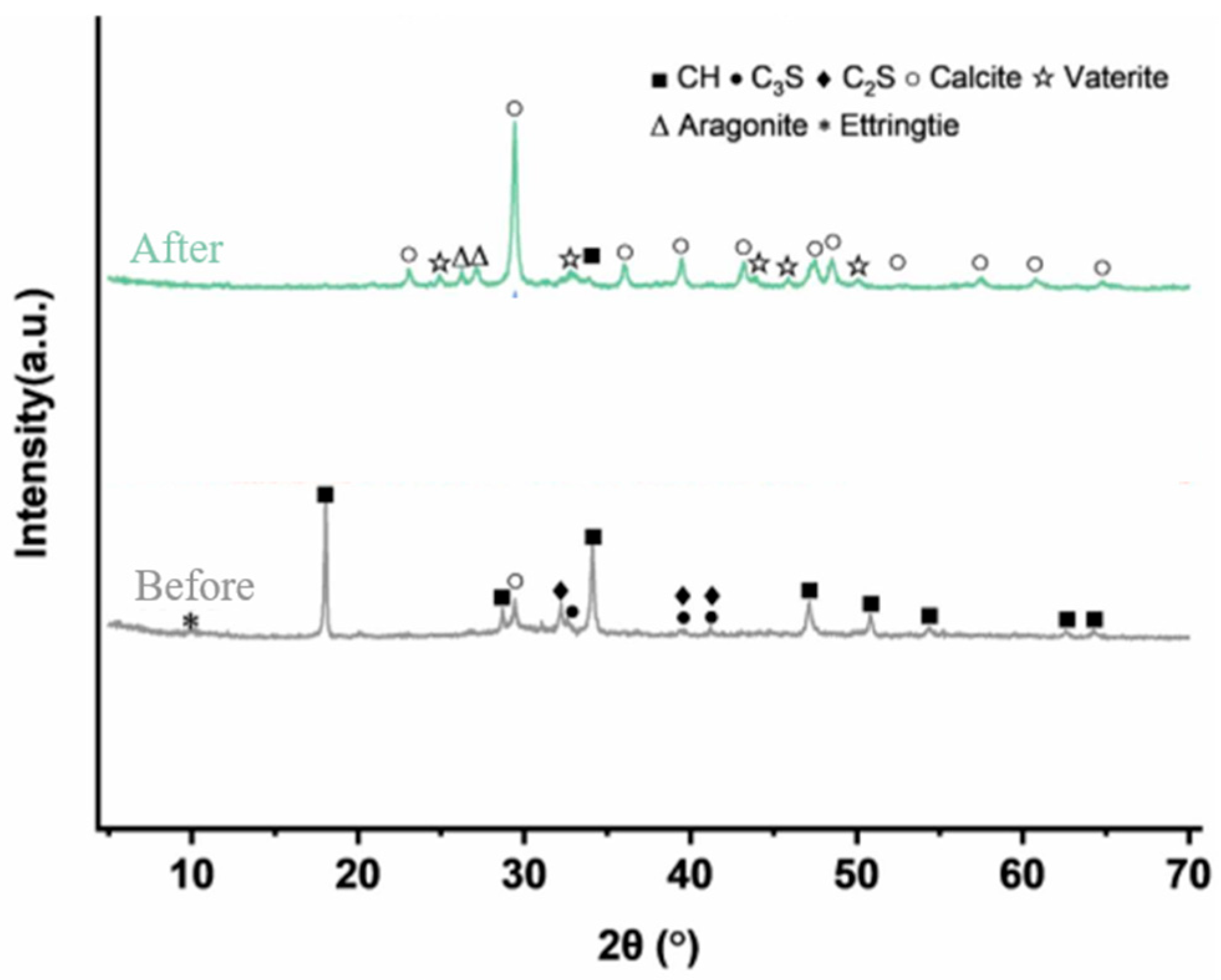
As noted in Section 3.1, untreated WCP, with quartz and calcite as the primary mineral phases, also contains a certain amount of CH, AFt, and partially hydrated C2S, C3S, and other compounds. XRD analysis (Figure 11) [29] revealed that after carbonation treatment, quartz and calcite remained the dominant crystalline phases, while the diffraction peak intensity of dolomite (CaO·MgO·2CO2) was markedly enhanced. In contrast, the characteristic peaks of phases such as CH, AFt, C2S, and C3S are significantly diminished or have disappeared. These observations indicate that the reactive phases mentioned above participate in carbonation reactions with CO2, leading to the formation of new products, predominantly CaCO3.
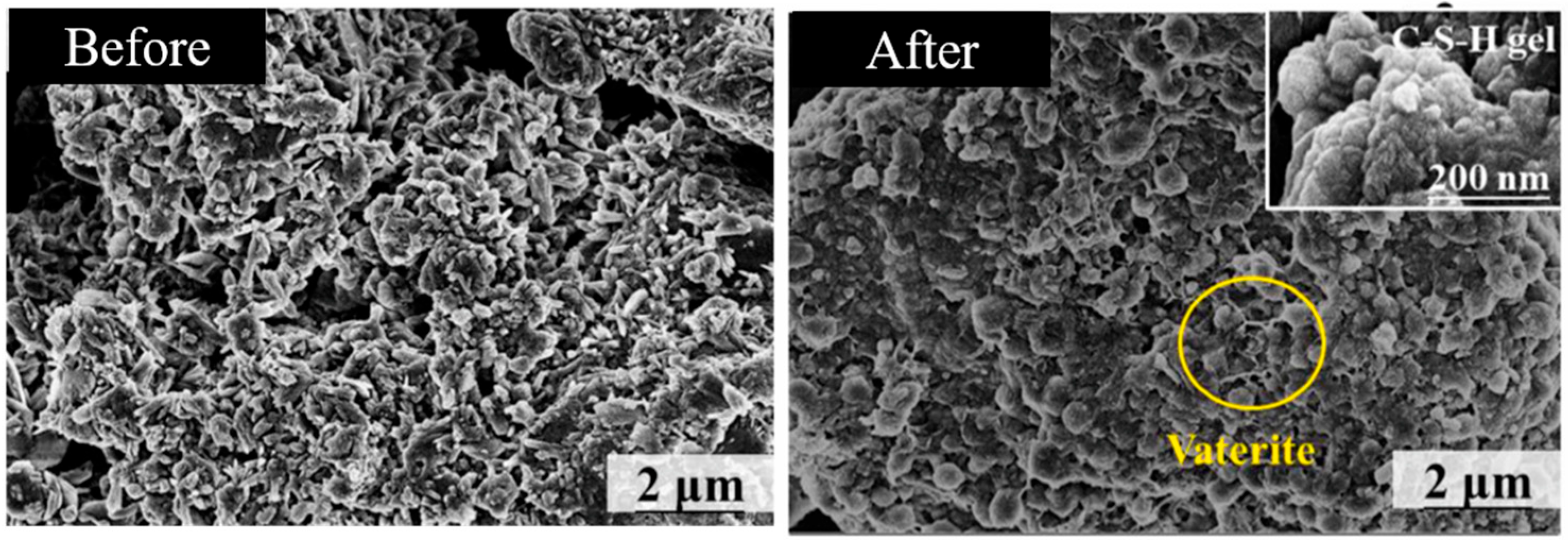
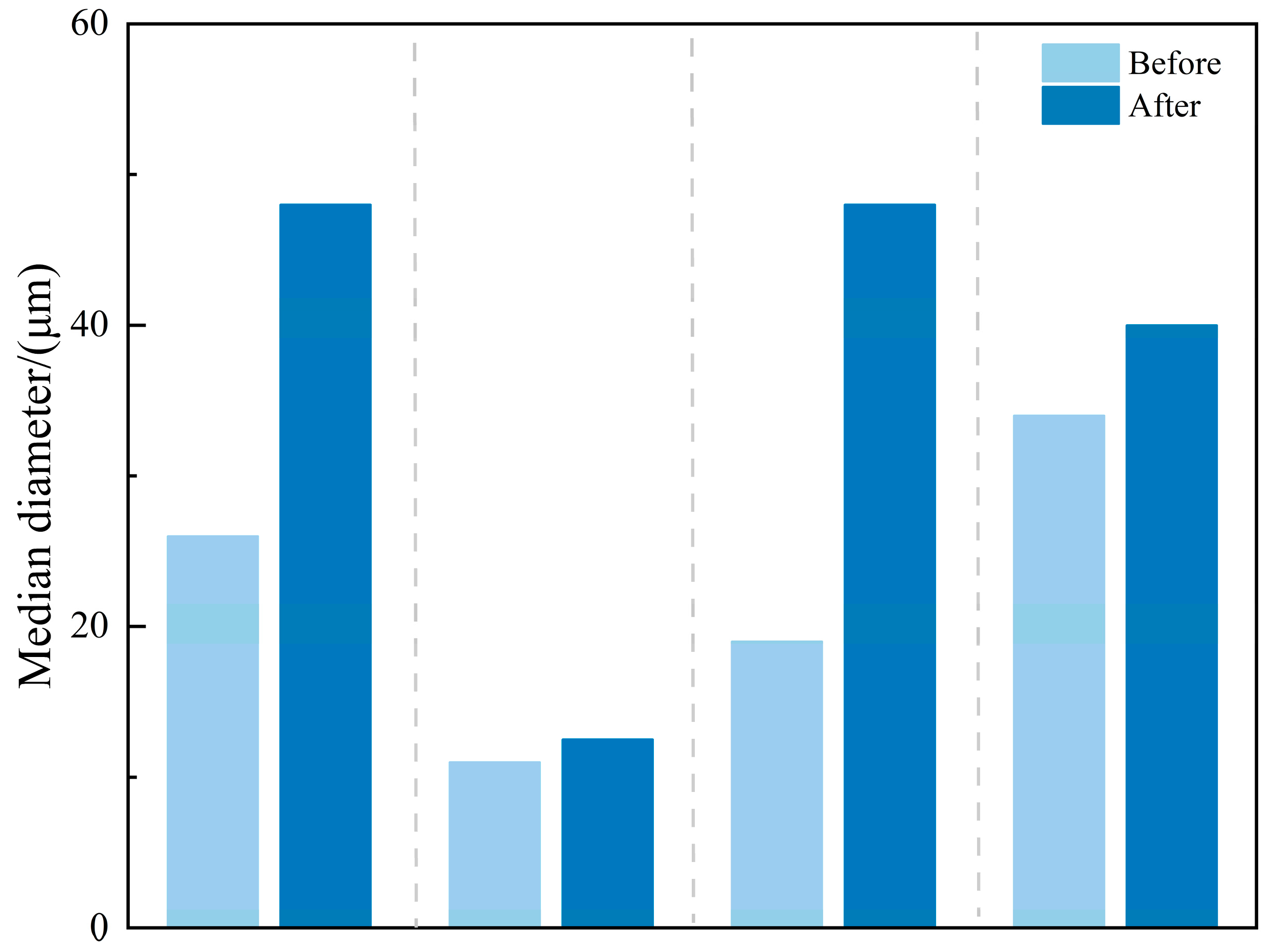
The carbonation reaction significantly influences the microstructure and macroscopic properties of the material. The precipitated CaCO3 and silica-based gels deposit and accumulate on particle surfaces and within pores, markedly refining the microstructural morphology. The microstructure of the carbonized WCP is shown in Figure 12 [30]. The carbonated WCP sample exhibited reduced porosity and a more regular pore morphology, with characteristic rhombohedral calcite crystals appearing on the surface. Previous studies have indicated that well-formed, fine calcite crystal precipitates facilitate nucleation and promote the growth of hydration products in cementitious composites [30], thereby contributing to the increased strength of the mortar. However, in large-scale processing, it is not guaranteed that all materials will achieve the desired carbonation effect. Uneven reactions can result in localized over-carbonation or under-carbonation, which may introduce new stress concentration points or weak areas within the material. Furthermore, carbonation improved the granulometric properties of WCP. The particle size analysis results before and after carbonation are presented in Figure 13. The median particle size of the samples after carbonation is generally larger than that before carbonation. This indicates that the carbonation reaction not only alters the phase composition but also increases particle size and enhances overall uniformity. This improvement is achieved through the deposition of newly formed fine CaCO3 crystals on the particle surfaces, which effectively fill the pores [29]. However, excessive carbonation may cause the carbonation products to block the pores, which instead hinders the further diffusion of CO2 and creating a self-inhibitory effect.
Carbonation treatment is a process that utilizes CO2-rich gas to treat solid waste under controlled conditions, such as temperature and relative humidity, converting CO2 into thermodynamically stable carbonates that can be permanently stored [80,81]. This process not only enhances material performance but also enables the storage of CO2 gas. Compared to traditional improved technologies, carbonation treatment is a green and sustainable technology. The amount of CO2 absorbed serves as a measure of the potential for carbon sequestration. Table 2 presents the amount of CO2 absorbed after carbonation. The data indicate that selecting appropriate carbonation conditions can maximize the carbon sequestration potential of the material. Therefore, future research should focus on optimizing carbonation conditions to improve the performance of carbonized materials, increase the carbon sequestration capacity, and reduce energy consumption and costs associated with CO2 capture and transportation. This will help achieve an optimal balance among performance, environmental protection, and cost in carbonation treatment.
In summary, carbonation treatment of RP effectively modifies the composition, microstructure, and particle size distribution of solid waste materials. By increasing their reactivity, carbonation increases the utilization rate of RP, reduces the cement demand, and simultaneously sequesters CO2, thereby lowering greenhouse gas emissions. Moreover, this process does not require high-temperature calcination, resulting in low energy consumption. However, variability in powder composition, including low CaO content, can lead to inconsistent carbonation efficiency. Additionally, the high costs associated with CO2 capture and purification, along with potential long-term stability issues caused by volumetric changes in carbonation products, present significant challenges. Therefore, achieving large-scale application of carbonation treatment remains a critical research priority.

3.2.3. Alkali Activation

The latent reactive components in solid waste materials can be effectively activated by alkaline activators to form a dense three-dimensional network structure. This reaction process does not depend on the C3S and C2S minerals found in traditional Portland cement. The performance of the resulting material can be compared with or even better than that of traditional cement materials. Therefore, it has the potential to be used as an alternative to traditional cement.
In such systems, the type and modulus of the activator, along with the reactivity of the precursor, jointly regulate the kinetics of gel formation and the densification of the microstructure. This synergy not only facilitates rapid development of early-age strength but also enables continuous polymerization, which enhances long-term mechanical performance. This unique reaction characteristic offers a novel approach to overcoming the inherent limitations of recycled micropowder in traditional cement. It also underscores the flexibility and potential of alkali-activated systems in material design and performance regulation.
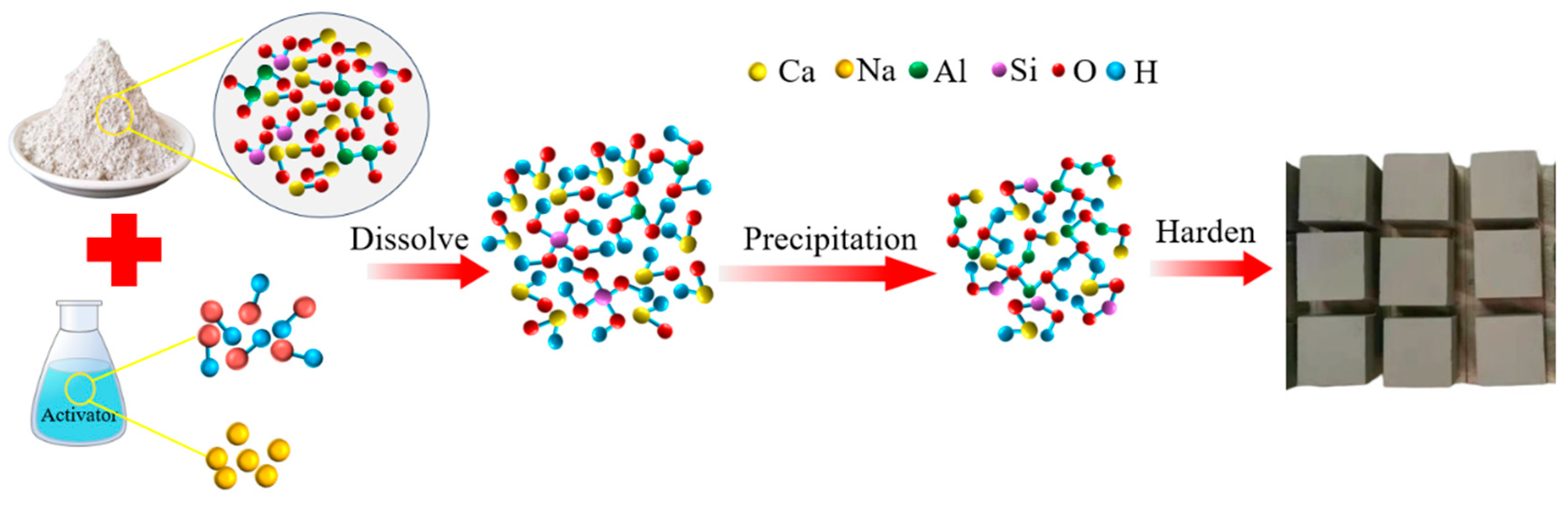
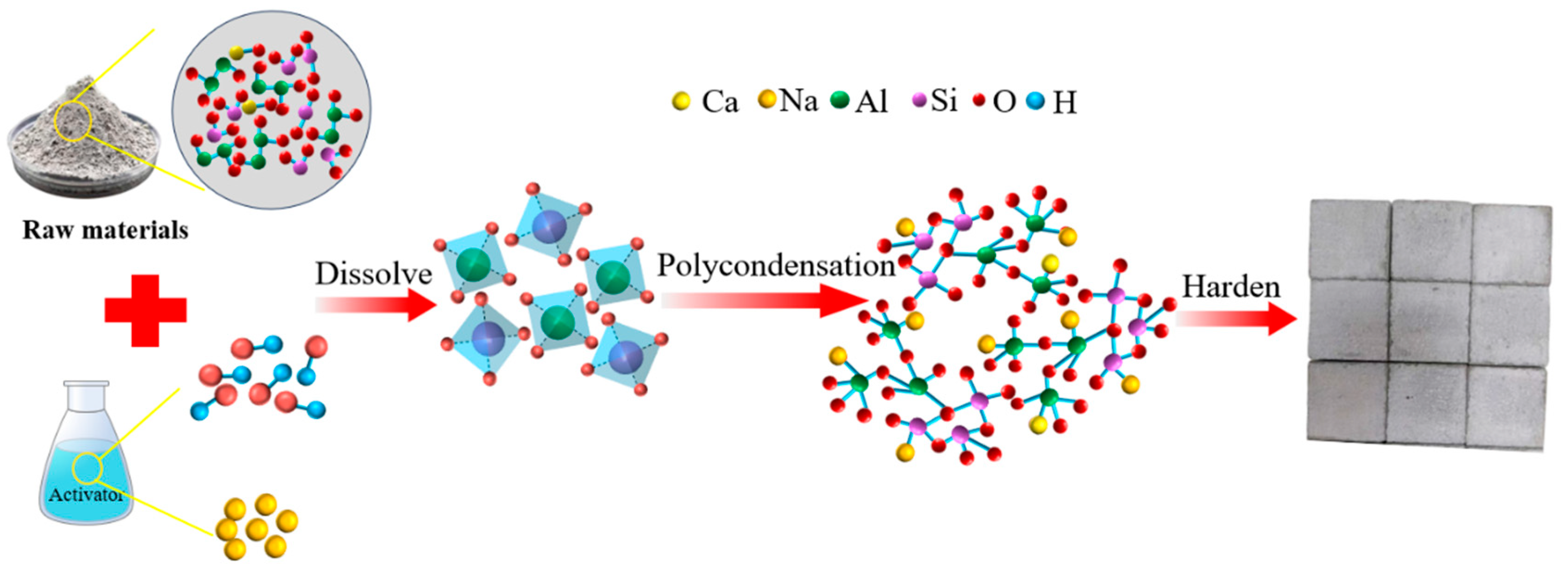
The alkali-activated elements Ca, Si and Al in cementitious materials work synergistically to regulate the reaction process and the formation of final products, thereby influencing the macroscopic properties of the materials. When the Ca content is relatively high, it is a high-calcium aluminosilicate system, which typically reacts efficiently at ambient temperature, primarily forming a C-A-S-H gel as the reaction product. The second type is a low-calcium aluminosilicate system, which often requires elevated temperatures and longer curing periods, with N-A-S-H gel as the main resulting phase [84]. The activation mechanism of high-calcium alkali-activated systems is illustrated in Figure 14. Under the influence of alkaline activators such as NaOH or Na2SiO3, elements such as Si, Ca, and Al are released from calcium silicate or aluminosilicate sources, forming soluble ionic species or hydroxyl compounds such as Si(OH)4, Al(OH)3, and Ca(OH)2. These dissolved species further react in an alkaline environment to produce amorphous calcium silicate hydrate (C-S-H) and calcium aluminate hydrate (C-A-H) gels [85]. In an environment rich in calcium elements, the reaction rate accelerates, promoting the rapid formation of a denser C-A-S-H gel, thereby enhancing the material with higher early strength [86]. In contrast, the reaction of low-calcium alkali-activated materials involves three main stages: (1) dissolution of aluminosilicate raw materials under strong alkali, releasing reactive aluminate and silicate tetrahedral units; (2) polycondensation of these active units, where silicate and aluminate tetrahedra connect via shared oxygen atoms, forming Si-O-Si and Si-O-Al bonds, leading to a three-dimensional gel network; and (3) continuous growth and cross-linking of the gel phase, resulting in final hardening [87,88,89], as depicted in Figure 15. The three-dimensional N-A-S-H gel network, composed of Si and Al, provides excellent long-term strength development and structural stability [90], thereby enhancing the material with better durability.
Alkaline activators stimulate the amorphous aluminosilicate components in solid waste materials to form cementitious reaction products. The type of activator influences mortar performance by modulating reaction pathways, gel phase composition, and microstructural development. For example, sodium-based base activators are used. The main function of NaOH is to provide a high-pH environment. OH destroys the glassy structure of raw materials, which releases active SiO2 and Al2O3 monomers and forms silicate ([SiO4]4−) and aluminate ([AlO4]5−) ions. Additionally, the Na+ ions supplied by NaOH not only maintain charge balance within the system but also catalyze polycondensation reactions. The dissolution rate is governed by both the NaOH concentration and the duration of the dissolution process. On the other hand, sodium silicate provides both OH and SiO32− ions. While OH contributes to the alkaline environment and facilitates the release of Si and Al species, SiO32− directly participates in the formation of the gel network. Owing to its higher silicon content, sodium silicate promotes the development of a more stable aluminosilicate network during the reaction, thereby increasing the mechanical strength [48].
The molar ratio of SiO2 to Na2O is known as the silicate modulus (denoted as M). It is a critical parameter influencing the performance of alkali-activated systems. By quantitatively regulating the alkalinity of the activator, the silicate modulus controls the composition and structure of the resulting gel phases, thereby ultimately determining the material properties. In current practice, composite activators comprising strong alkalis and silicate compounds are commonly used. Strong alkalis provide a high-pH environment that promotes the dissolution of Si and Al from the precursor, whereas silicate sources supply reactive silica that facilitates cross-linking within the gel network. By adjusting the proportions of alkali and silicate, the silicate modulus can be precisely controlled [49]. Research indicates that the optimal range of M varies with the type of precursor. For low-calcium systems, the modulus should generally not exceed 2 [91], as sufficient OH is required to break down the Al-O-Si networks. In contrast, for high-calcium systems, the modulus should not fall below 2, since although Ca2+ promotes the formation of C-S-H gel, adequate silicate ions are necessary to support the reorganization of aluminosilicate species. However, unreacted bases may remain in this system, and these alkaline substances can serve as potential internal alkali sources. This significantly increases the risk of alkali-aggregate reactions and severely compromises the long-term volumetric stability and durability of the material.
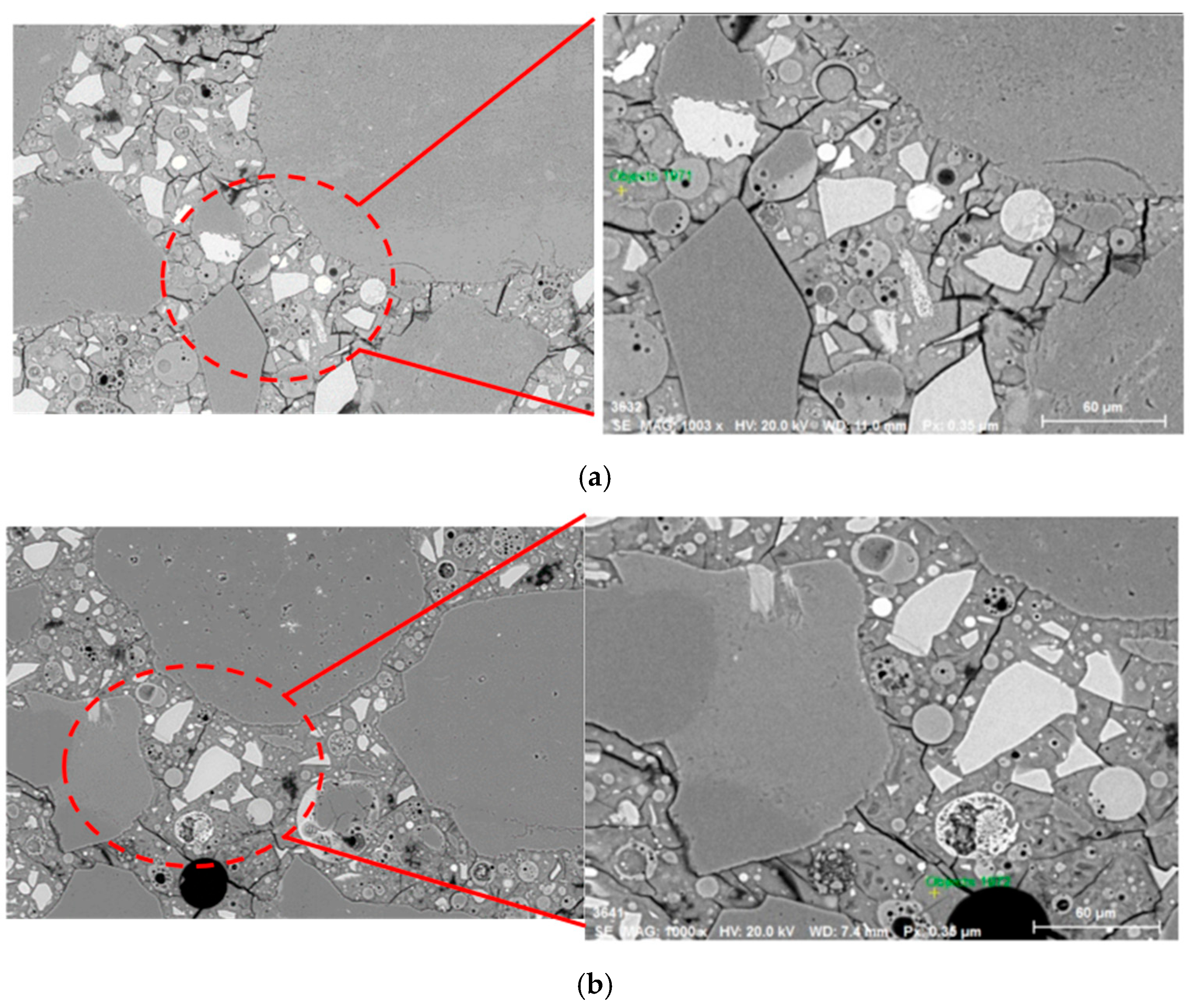
Furthermore, the type of alkali metal cation significantly influences the reaction process, gel structure, and final properties of the activated mortar. As shown in Figure 16a [52], the microstructure of the potassium-based activator (PS)-activated mortar exhibited a dense and homogeneous morphology with no obvious unreacted particles. The reaction products are uniformly distributed and compact, displaying minimal pores or cracks, along with a dense interfacial transition zone between the paste and fine aggregates. This indicates that the larger ionic radius and lower charge density of K+ result in slower migration rates, which moderate the dissolution kinetics of aluminosilicate precursors. The consequently more controlled reaction progression leads to homogeneous gel formation, reduced chemical shrinkage, and a strong bonding capacity with silicate tetrahedra (SiO44−) [50]. The resulting C-(K)-A-S-H gel possesses a stable structure with fewer microdefects, such as pores and cracks. Its chain-like configuration is more flexible than that of the C-(N)-A-S-H gel, contributing to a uniform pore structure [92]. As presented in Figure 16b, the microstructure of the sodium-based activator (SS)-activated mortar shows a more porous and cracked morphology. It has a microstructure with numerous pores and cracks, and many unreacted particles can be observed. Moreover, there are many cracks between the slurry and fine aggregates, and the interface transition zone is relatively weak [93]. This can be attributed to the smaller ionic radius and higher charge density of Na+, which accelerates the dissolution of aluminosilicate phases and leads to rapid early-age hydration. The resulting C-(N)-A-S-H gel tends to encapsulate unreacted particles, hindering further hydration, while the rapid reaction often induces localized shrinkage stress concentrations, resulting in microcracking. Moreover, the C-(N)-A-S-H gel is more rigid [50].
However, when solid waste undergoes alkaline activation treatment, self-shrinkage tends to occur, leading to the formation of structural cracks that compromise the performance of the mortar. Self-drying is the primary cause of mortar shrinkage [94]. The capillary pressure generated by water evaporation leads to drying shrinkage within the mortar. The drying shrinkage of AAM mortar is significantly greater than that of OPC mortar. This drying shrinkage in AAM mortar gradually develops after the final setting, with the shrinkage value increasing over time [95]. In the AAM system, this factor is not the sole dominant influence; the characteristics of the C-A-S-H gel also have a significant impact. The hydration product of AAM, C-A-S-H gel, should not be considered a continuous porous material. It is more like a gel-like or granular material containing micro-defects. Its chemical shrinkage during drying is associated with the rearrangement and redistribution of C-A-S-H nanoparticles [96]. Moreover, the contractions caused by both mechanisms are irreversible [92]. Therefore, mitigating mortar shrinkage requires addressing both of these aspects. Relative humidity (RH) significantly influences shrinkage by regulating capillary stress and surface free energy. At high RH levels (>50%), the rearrangement and reorganization of the C-A-S-H microstructure result in pronounced viscous behavior. This rearrangement causes the collapse of gel pores and refinement of the pore structure [97]. Conversely, at low RH levels (<40–50%), the direction, magnitude, and location of stresses induced by surface free energy differ, promoting the densification of the particles themselves [98,99]. Therefore, addressing shrinkage and cracking in alkali-activated material (AAM) mortar requires attention to both material design and curing conditions. Optimizing the mix ratio and activator parameters can produce a denser, more stable gel. Additionally, incorporating components that generate an appropriate amount of expansive hydration products (such as ettringite) during the early stages can induce compensatory expansion, offsetting some chemical and drying shrinkage. However, the dosage of these expansive components must be carefully controlled to prevent excessive expansion, which could cause greater damage. Finally, establishing a scientific curing regime and maintaining appropriate humidity levels are essential for effective shrinkage control.
Alkaline activation treatment of solid waste materials enables their efficient utilization by allowing the use of all solid waste cementitious materials, thereby addressing the high carbon emissions associated with traditional cement production. However, the dosage and modulus of alkali must be precisely controlled. Prolonged exposure can lead to alkali–aggregate reactions or carbonation shrinkage, which may compromise the service life of the structure. Additionally, the use of strong alkalis increases health and safety risks and complicates construction operations.
By replacing conventional cement, solid waste-based cementitious materials offer a viable route for significantly reducing resource consumption and carbon emissions. These materials incorporate construction solid wastes, such as discarded concrete and brick powder, as well as industrial solid wastes, such as slag and fly ash. The potential cementitious properties of these materials can be effectively activated through various treatment methods. These processes include thermal activation to break down the glassy structure, carbonation to capture CO2 and form strength-enhancing calcium carbonate, and alkali activation to depolymerize silico aluminate phases and reconstruct a three-dimensional gel network. However, it faces challenges such as low activation efficiency, high energy consumption, and significant contraction. Future efforts should focus on the development and application of solid waste materials [100] to achieve diverse application scenarios [101,102]. Additionally, future efforts should prioritize the development of low-carbon activation technologies, such as efficient carbonation and low-temperature alkali activation. Additionally, the synergistic effects of multiple solid wastes should be optimized, and long-term durability studies should be conducted. These measures are critical for overcoming technical bottlenecks and advancing the large-scale application of solid waste recycled mortar, thereby contributing to a circular economy.

4. Mechanical Strength of Solid Waste-Based Cementitious Recycled Mortars

In the engineering application of materials, their mechanical behavior in practical use is crucial in addition to their basic properties. As a core component of building structures, the strength of mortar is a key indicator for measuring its mechanical properties, which directly determines the safety and stability of the structure. Therefore, in-depth research on how replacing cement with solid waste affects mortar strength is essential. This research not only further verifies the effectiveness of using solid waste materials but also provides a necessary foundation for promoting the engineering application of recycled solid waste mortar.

4.1. Effect of the Solid Waste Replacement Ratio on Mortar Strength

Compared with that of conventional cement mortar, the incorporation of recycled powder (RP) generally leads to a reduction in mortar performance. This decline is attributed primarily to the dilution of the main reactive phases in the cement, namely, C2S and C3S, combined with the inherently low reactivity of RP, which has a limited capacity to participate in hydration reactions. Consequently, the formation of hydration products decreases, and the microstructural compactness is reduced, thereby compromising the overall mechanical properties of the mortar.
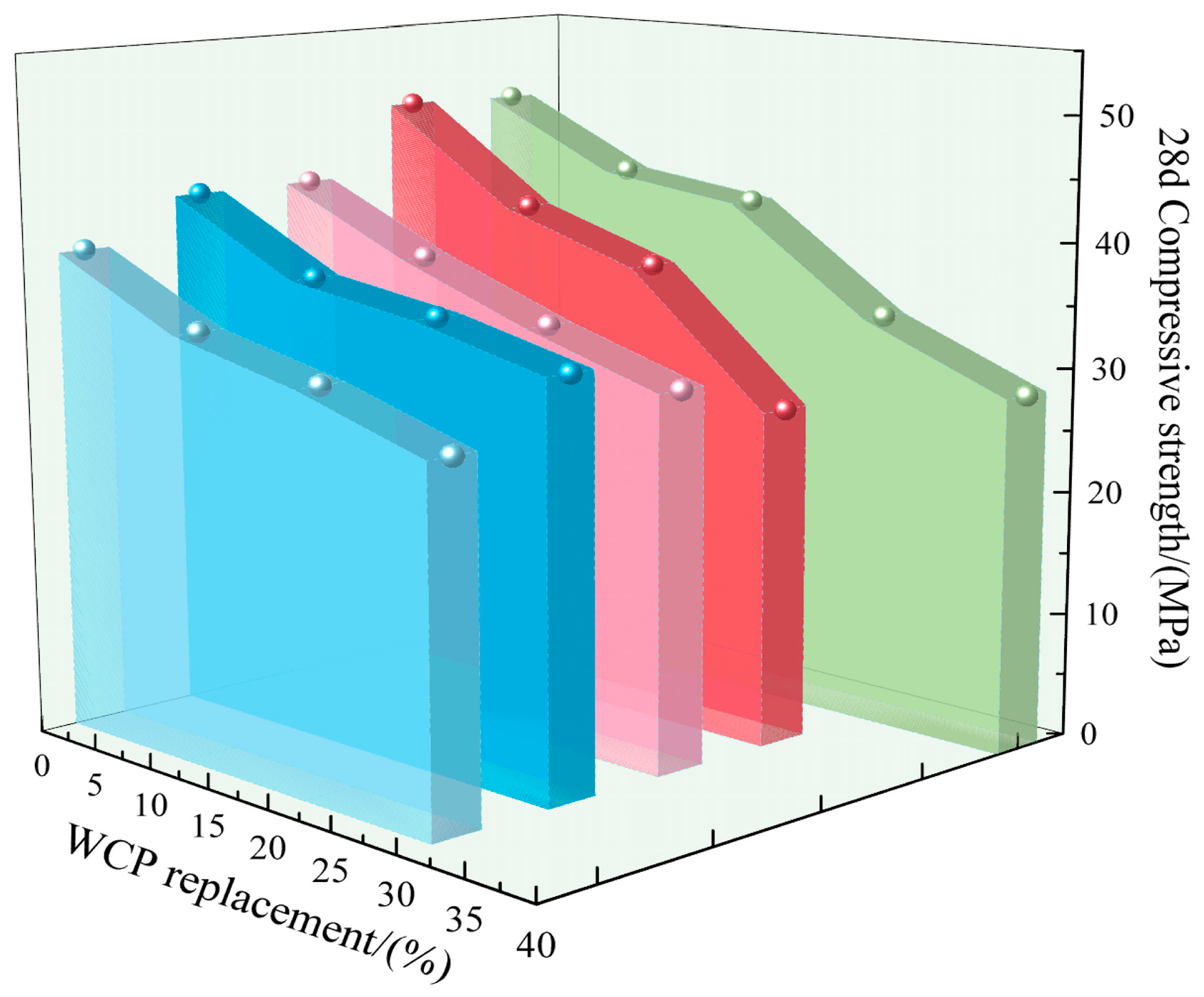
Studies have shown that when waste concrete powder (WCP) is used to partially replace ordinary Portland cement, the development trend of compressive strength follows the pattern illustrated in Figure 17. The compressive strength of the mortar decreases as the WCP replacement ratio increases. Under conditions of a low substitution rate, WCP has a distinct “microaggregate effect”. Its particles optimize the graded composition of the cementitious system, fill internal pores, block water migration channels, and thereby inhibit the self-shrinkage behavior of the mortar. Furthermore, the porous structure of the WCP can adsorb part of the free water, helping to maintain internal humidity and promote continued cement hydration, which contributes to increased compactness, reduced drying shrinkage, and an improved interfacial transition zone (ITZ) structure. Although the incorporation of WCP dilutes the active components in cement, leading to a reduction in the total amount of hydration products [103], the surfaces of WCP particles can serve as nucleation sites for hydration products, accelerating the cement hydration process. Additionally, unhydrated cement particles and active components (such as SiO2 and Al2O3) in WCP can undergo secondary hydration reactions, generating additional C-(A)-S-H gel, which partially compensates for the performance loss caused by the reduced cement content. Consequently, the impact on mortar strength remains relatively limited at low replacement ratios. At higher replacement levels, the dilution effect of WCP increases the proportion of inert components, which not only significantly reduces the amount of cementitious hydration products in the system but also retards the hydration process due to the adsorption of substantial free water [104]. This leads to pore coarsening, increased connectivity, and exacerbation of both autogenous and drying shrinkage, ultimately resulting in deterioration of the ITZ, reduced compactness, and decreased mortar strength.
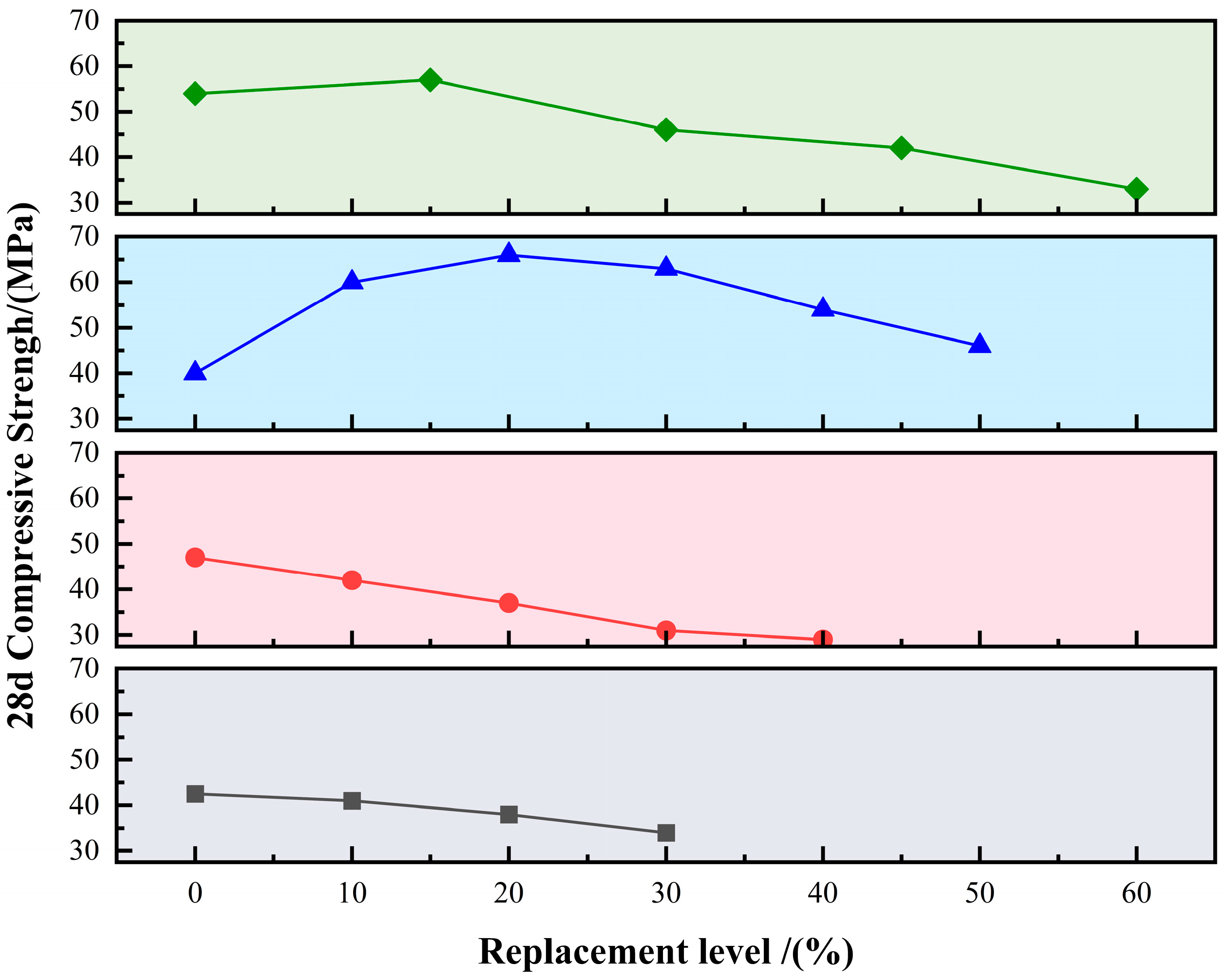
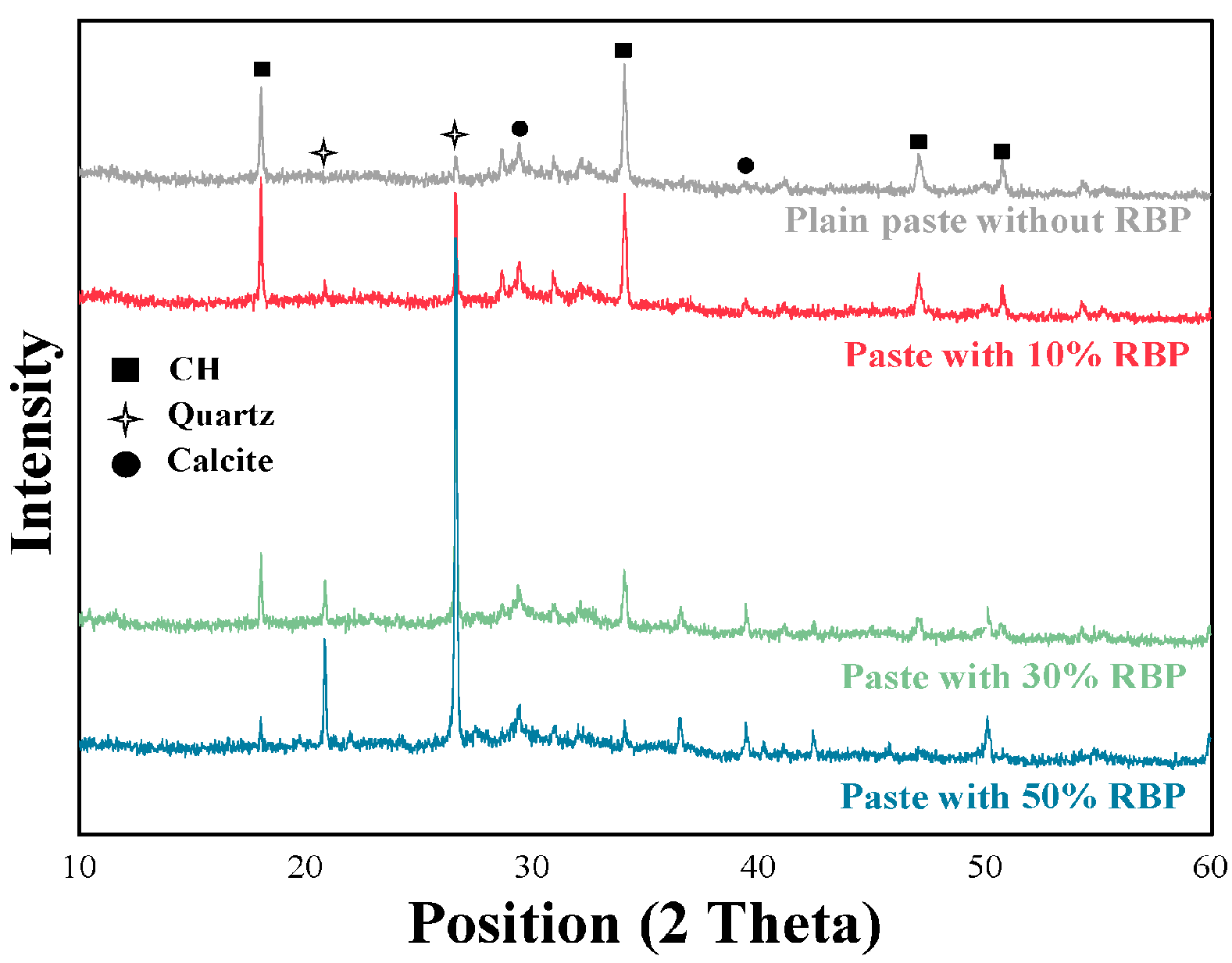
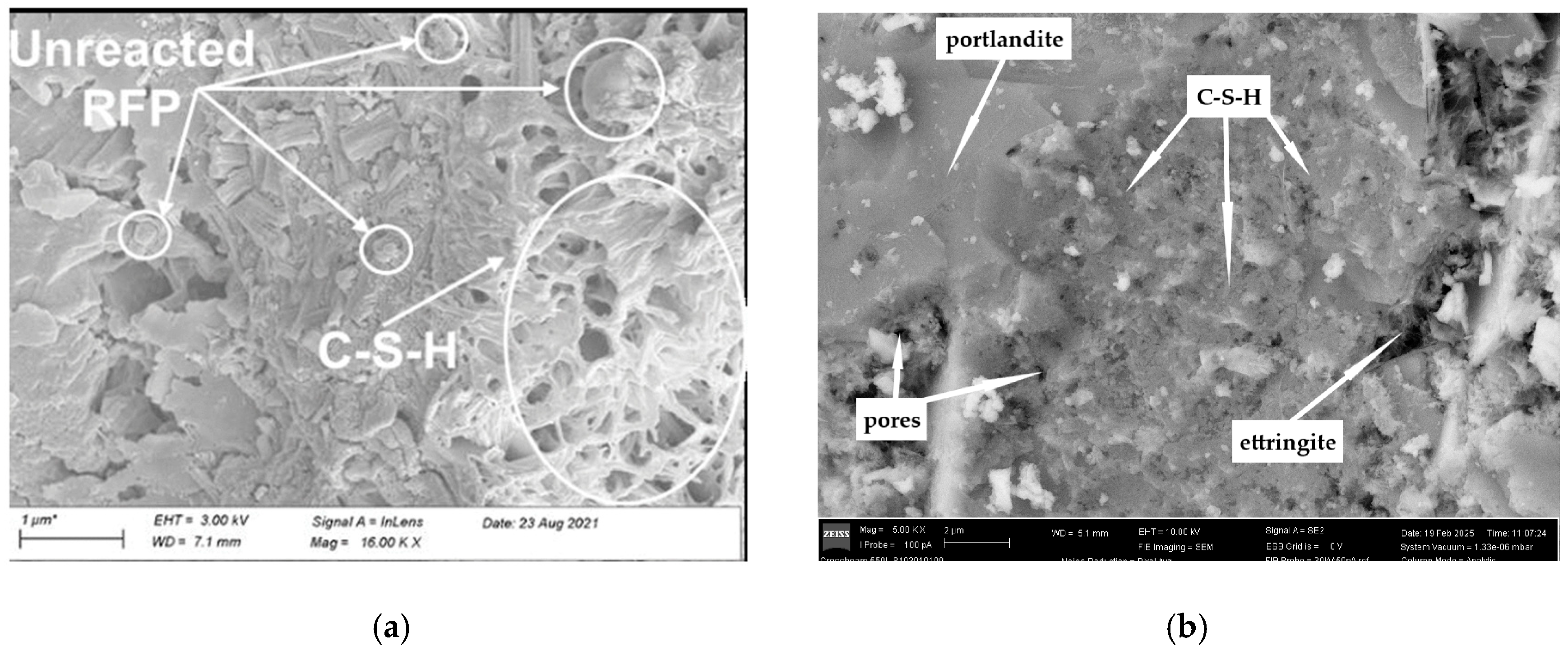
The use of RP with higher reactivity can lead to certain improvements in mortar performance. Waste brick powder (WBP), which contains a greater proportion of amorphous aluminosilicates capable of undergoing pozzolanic reactions, is more reactive than WCP. Consequently, when WBP is used to partially replace cement, the resulting mortar demonstrates greater strength than WCP-modified mortar at the same replacement ratio, as shown in Figure 17 and Figure 18. When the dosage ranges from 15% to 20%, the mortar can achieve its highest strength. This improvement is not only attributed to the previously mentioned volcanic ash reaction [109], but also because WBP exhibits a “micro-aggregate effect” similar to that of WCP, effectively filling the pores of the slurry [110]. This dual action comprehensively enhances the strength of the mortar. However, when the dosage exceeds this optimal range, the dilution effect of WBP becomes dominant, reducing the relative content of effective cementitious components in the system and subsequently causing a decline in macroscopic strength. Regarding the XRD patterns of pastes, different replacement levels of WBP are presented in Figure 19 [111]. In WCP-blended pastes, the diffraction peaks of CH are noticeably reduced, whereas those of CaCO3 and SiO2 increase significantly [72]. This indicates that the incorporation of WCP not only reduces the formation of cement hydration products but also introduces inert phases, such as quartz (SiO2) from aggregate minerals and calcite (CaCO3). Consequently, the overall reactivity and degree of hydration decrease. These factors contribute to the formation of a loose and porous microstructure, as illustrated in Figure 20a [112]. In contrast, WBP-modified pastes clearly exhibit a decrease in the diffraction peaks of CH and CaCO3, accompanied by a significant increase in the SiO2 peak. This indicates that WBP reduces the content of CH and CaCO3 in the binder system. Since WBP contains no hydrated phases, it initially decreases the total amount of hydration products. However, the SiO2 in WBP is predominantly present as amorphous silica with pozzolanic activity, which can further react with CH to form additional C-S-H gel [25]. This reaction refines the pore structure, resulting in a matrix with fewer capillary pores and cracks and greater compactness than WCP blends do, as shown in Figure 20b [113]. The abundant presence of C-S-H in the microstructure of the WBP paste indicates that, unlike WCP, the incorporation of WBP enhances the overall degree of hydration in the cementitious system.

4.2. Effects of Various Activation Methods on the Mortar Strength

4.2.1. The Influence of Thermal Activation on the Mortar Strength

Compared with mortar containing untreated RP, the use of thermally activated RP significantly enhances the mechanical performance. This improvement is attributed primarily to changes in the phase composition and microstructure of the RPs induced by the thermal treatment. On the one hand, the original cement hydration products, such as CH and C-S-H gel, undergo dehydration and decomposition, transforming into more reactive phases, including C2S, C3S, Al2O3, and CaO. On the other hand, the internal porosity and specific surface area of RP particles increase [31,72,73,114]. These modifications not only provide abundant nucleation sites that accelerate early-age hydration kinetics but also enable the activated components to participate in secondary pozzolanic reactions, generating additional C-S-H gels. Consequently, the microstructure of the paste is refined, resulting in improved mechanical properties.
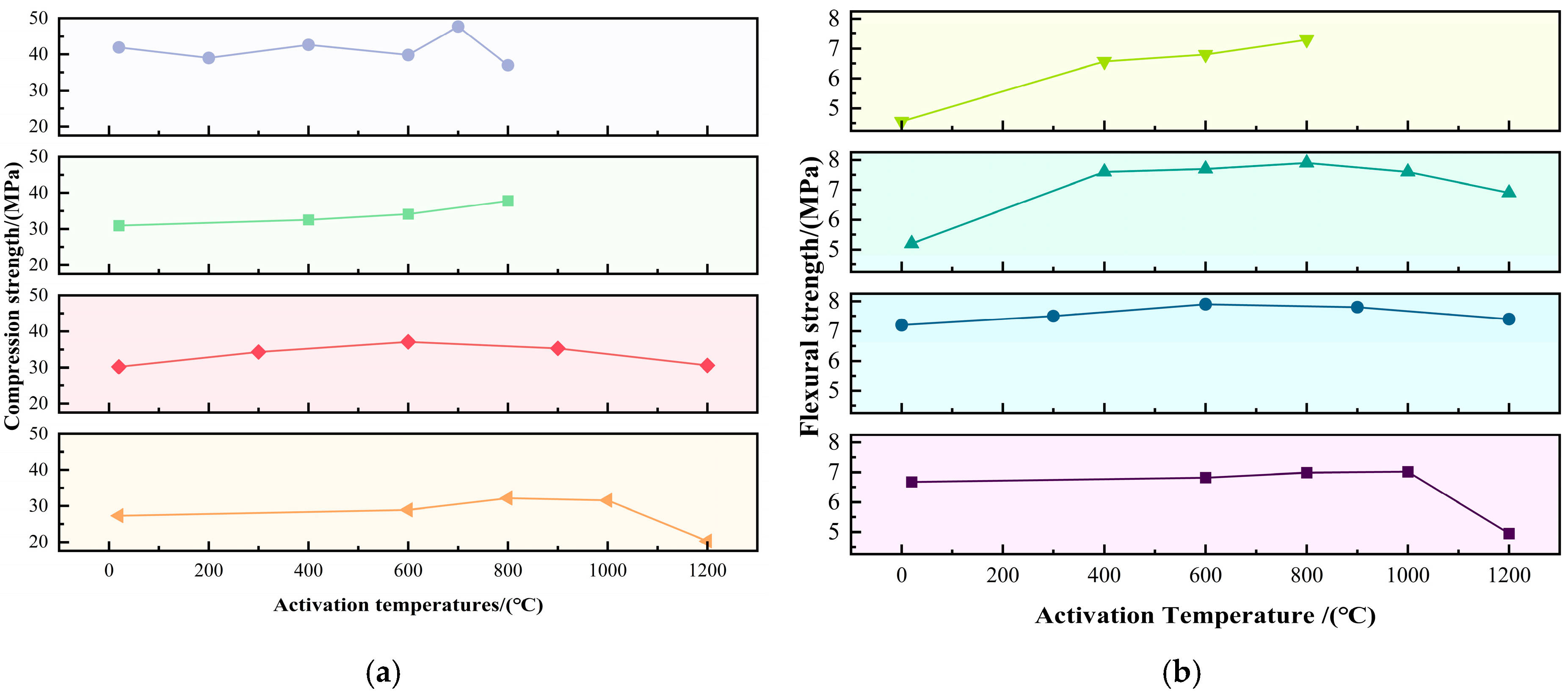
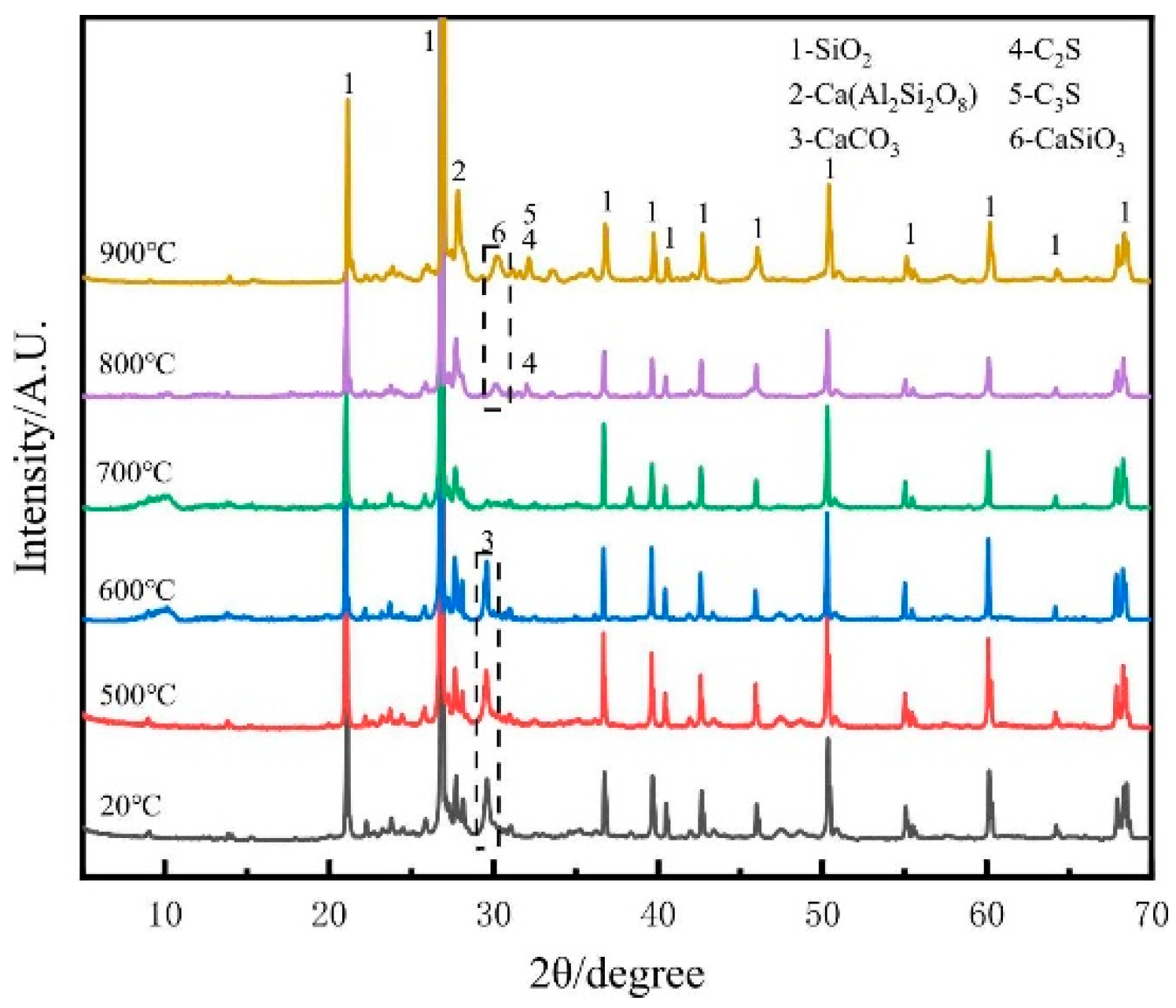
The thermal activation temperature is a critical parameter governing the pozzolanic activity of RP. As shown in Figure 21, the compressive and flexural strengths of the mortar initially increase and then decrease with increasing activation temperature, reaching a maximum at approximately 800 °C, which corresponds to the peak pozzolanic reactivity of RP under different thermal treatment conditions. Studies indicate that within the temperature range of 750–800 °C, RP attains an optimal reactive state. Under thermal activation, portlandite (Ca(OH)2) fully decomposes, and the C-S-H gel is largely converted into an active amorphous phase, whereas the decomposition of calcite (CaCO3) remains limited. This limitation mitigates the potential volume instability caused by excessive free CaO [115], thereby contributing to strength enhancement. However, when the temperature exceeds 800 °C, some amorphous phases undergo sintering and crystallization, forming low-reactivity crystalline phases such as wollastonite (CaSiO3) and gehlenite (Ca2Al2SiO7), as evidenced by the distinct diffraction peaks in the XRD patterns (Figure 22) [116]. Owing to their chemical stability and low reactivity, the formation of these crystalline phases significantly diminishes the pozzolanic effect, thereby restricting further development of mechanical properties. At temperatures above 1000 °C, the gypsum (CaSO4·2H2O) potentially present in RP decomposes into soluble anhydrite (CaSO4) [117], which can rapidly rehydrate upon contact with water, disrupting normal hydration processes and adversely affecting the final mortar strength.

4.2.2. The Influence of Carbonation on the Mortar Strength

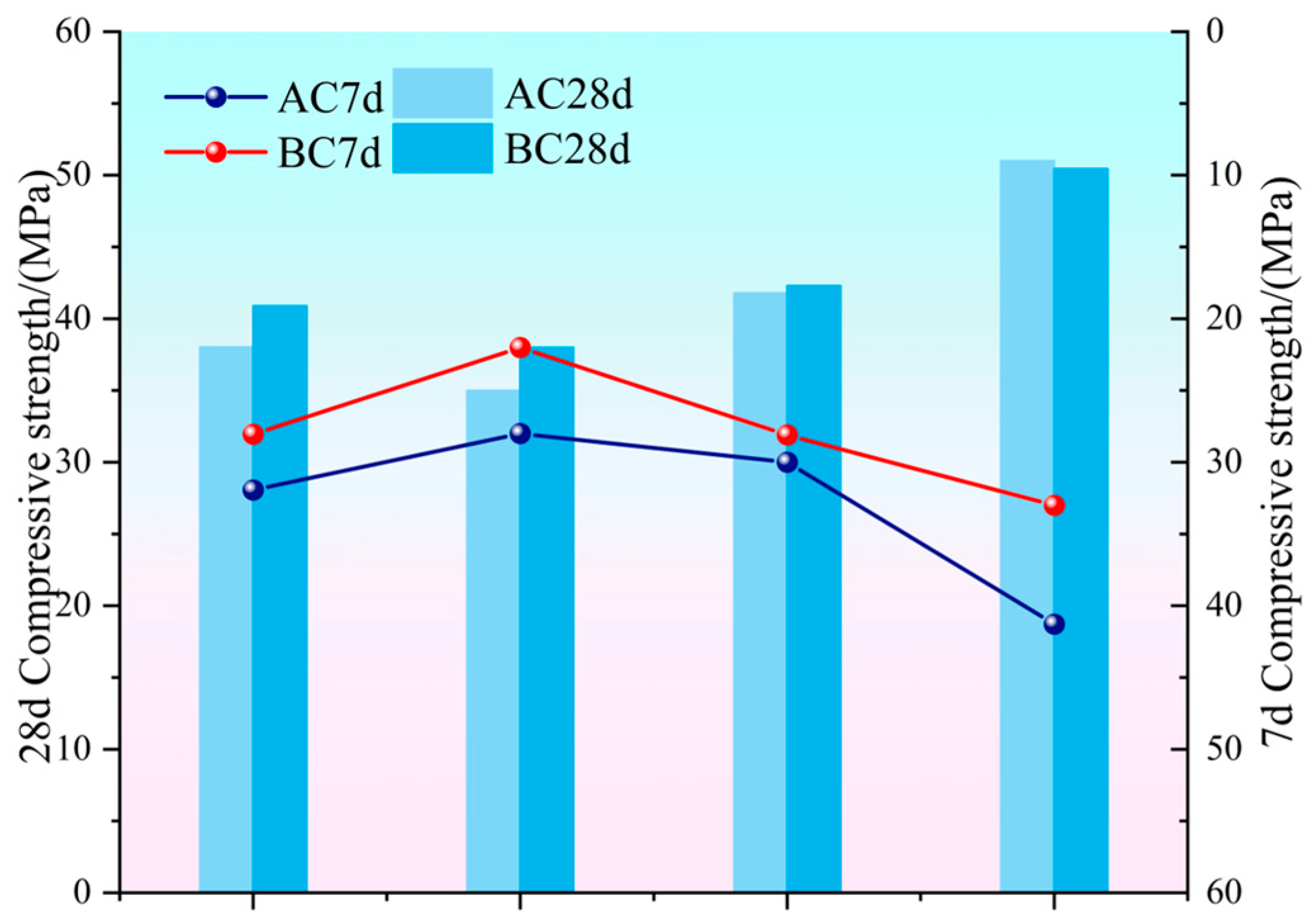
After carbonation treatment, the strength of the mortar significantly improves. As shown in Figure 23, the compressive strength of the carbonized mortar at both 7 d and 28 d is higher than that of the non-carbonized group. This improvement is attributed to the formation of dense calcite microcrystals on the surface of WCP following carbonation [118]. These microcrystals possess a high specific surface area and active surfaces, which serve as nucleation sites for the C-S-H gel, thereby promoting early-age cement hydration. Furthermore, CaCO3 can guide the ordered growth of C-S-H gel, contributing to early strength development. The influence of the carbonation treatment on the mortar strength is illustrated in Figure 23. Additionally, CaCO3 reacts with aluminate phases such as C3A in cement to form needle-like monocarboaluminate (Ca4Al2(CO3)(OH)12·5H2O). This reaction product not only enhances matrix densification but also consumes free water during its formation, reducing overall porosity [66]. Simultaneously, the precipitation of CaCO3 fills the capillary pores within the WCP, helping mitigate internal defects. As mentioned in Section 3.2.2, carbonation treatment increases the WCP particle size and optimizes the particle size distribution, which improves the ITZ between the aggregates and the cement paste, thereby refining the microstructure and mechanical performance of the mortar. Moreover, carbonated WCP retains partially unhydrated reactive components such as Ca(OH)2, C2S, and C3S [119]. With prolonged curing, these components continue to hydrate, generating additional C-S-H gel, which contributes to the favorable long-term mechanical performance of the mortar.
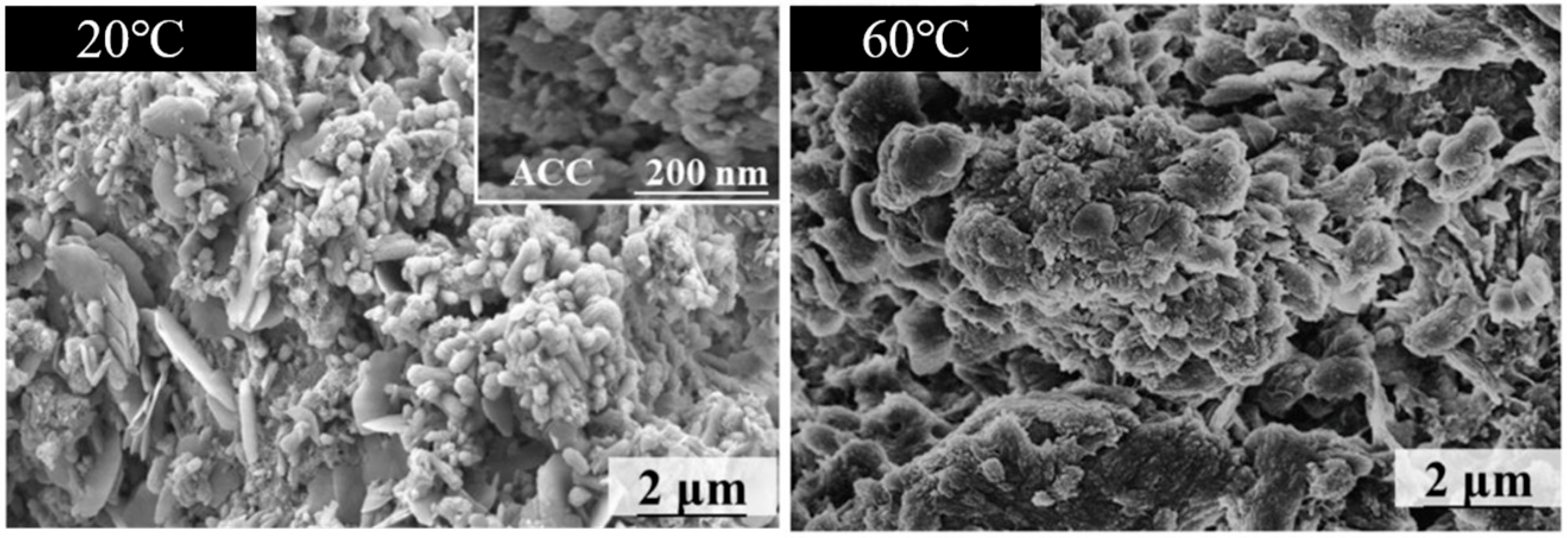
The carbonation temperature serves as a pivotal factor in regulating the polymorph of CaCO3 crystals, thereby influencing the microstructure and resultant strength of mortar. The microstructural evolution of WCP carbonized at different temperatures is presented in Figure 24 [78]. At 20 °C, spherical vaterite constituted the primary carbonation product. As the temperature increased, the proportion of cubic calcite gradually increased. By 140 °C, vaterite is almost entirely replaced, and the calcite crystals exhibit larger dimensions than those formed at 100 °C. At 60 °C, carbonation predominantly yields vaterite, which has a high specific surface area and a fine particle size. Its high surface activity provides effective nucleation sites for cement hydration, accelerating the early hydration of C3S and C3A [120] and promoting the formation of hydration products, thereby increasing early strength. However, owing to its metastable nature, vaterite tends to dissolve readily [121], which limits the extent of early strength improvement. When the temperature exceeds 100 °C, vaterite transforms into more stable calcite through a dissolution–reprecipitation process [122]. Calcite crystals are dense and stable; although their nucleation effect is relatively weaker in the early stages, their stability helps retard the decomposition of hydration products at later ages. Through pore filling and reinforcement of the ITZ, calcite compensates for some of the strength loss resulting from reduced cement content. A temperature of 100 °C promotes CO2 diffusion and ion migration, thereby improving the carbonation efficiency. However, beyond 140 °C, moisture evaporation reduces the relative humidity in the system, inhibiting the carbonation reaction [34]. Under such conditions, although the calcite content increases, its larger particle size may weaken the nucleation effect. In addition, insufficient encapsulation by CaCO3 leaves unreacted siliceous gels, which can lead to a decline in long-term strength.

4.2.3. The Influence of Alkaline Activation on the Mortar Strength

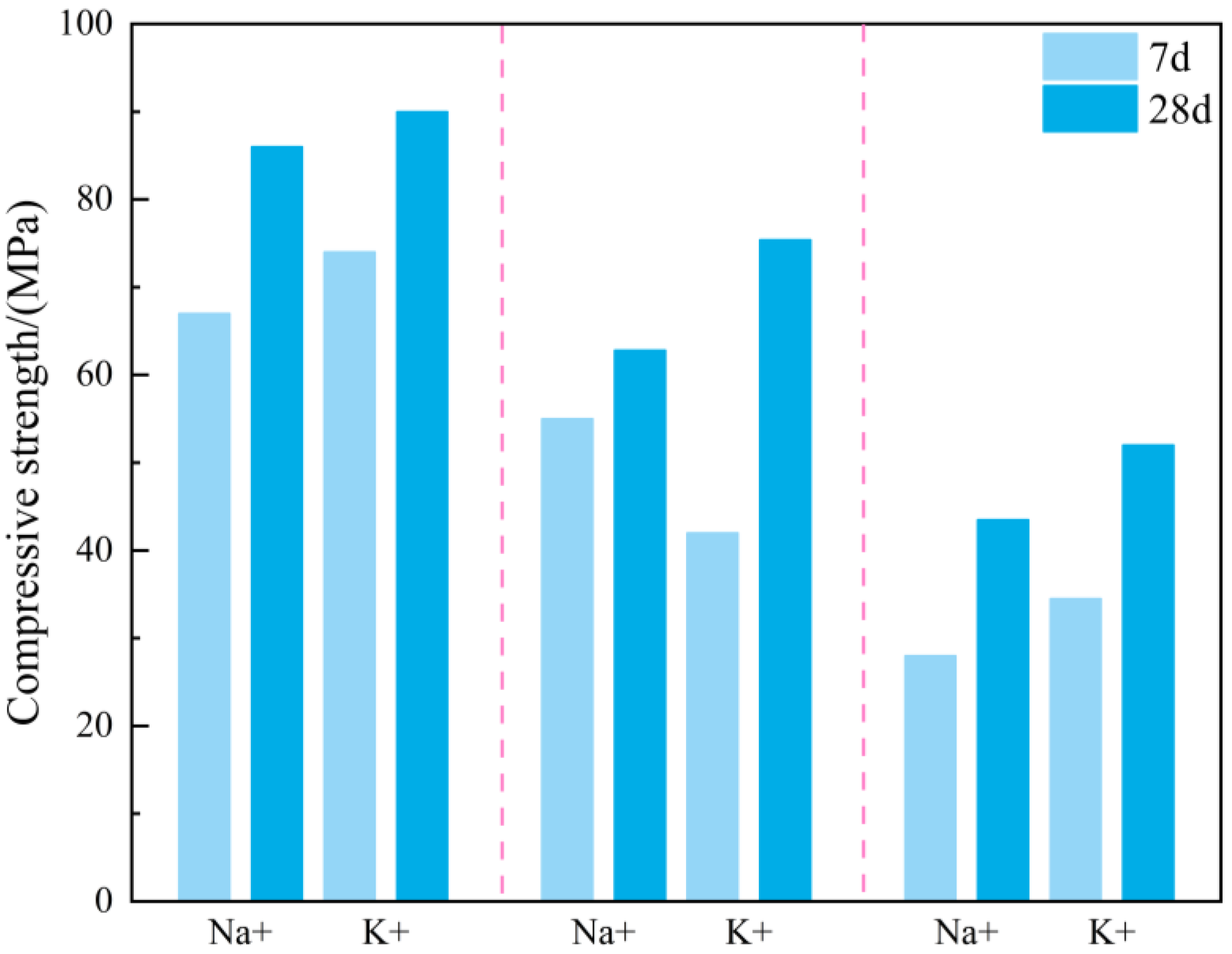
The type of alkaline activator significantly influences the strength development and microstructure formation of mortar. Sodium-based activators create a highly alkaline environment that rapidly dissolves Si and Al from the raw materials, accelerating early gel formation and resulting in high early-age strength. However, this rapid reaction alters the internal moisture distribution through the fast consumption and migration of water, leading to structural stress imbalances and inducing shrinkage. In contrast, potassium-based activators promote a more moderate reaction process with different moisture retention and migration behaviors, avoiding significant structural stress changes at early stages and thus resulting in negligible shrinkage. Compared with that of sodium-based systems, the resulting gel structure is more homogeneous, contributing to a denser microstructure and consequently better strength development [105]. As shown in Figure 25 [51,52,53], the compressive strength of mortar activated with either sodium- or potassium-based activators at 28 days is significantly greater than that at 7 days, indicating a continuous reaction and stable microstructural development in both systems at later ages. Notably, the 28-day compressive strength of the K+-activated mortar is consistently greater than that of the Na+-activated samples. This confirms that the denser microstructure guided by K+ ultimately results in superior macroscopic mechanical performance.
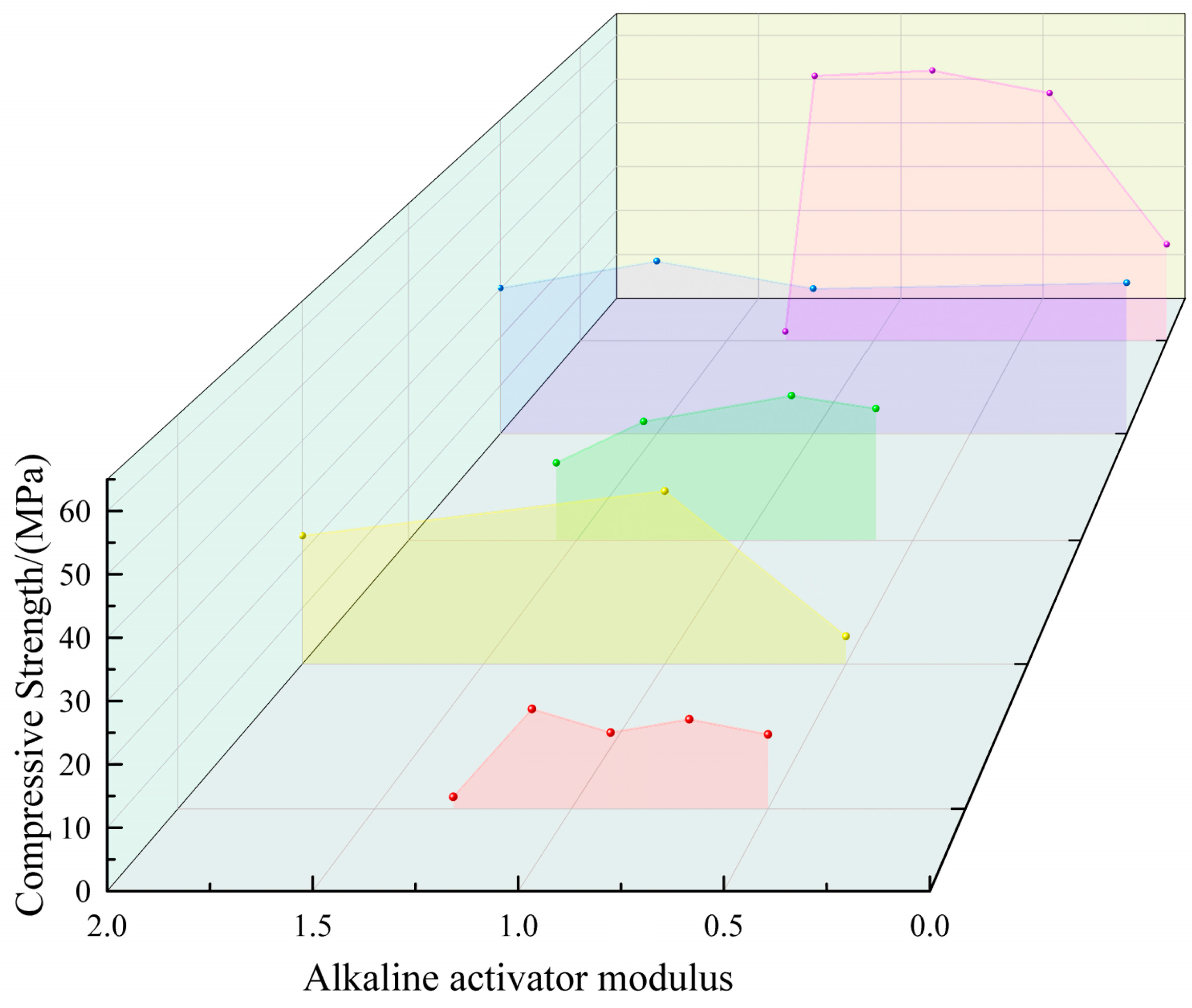
The silicate modulus of the alkali activator is a critical parameter influencing the mechanical performance of mortar. As shown in Figure 26 [49,54,55,123,124], the effect of the modulus on the compressive strength generally tends to initially increase but then decreases. At lower moduli, the relatively high Na2O content in the activator rapidly elevates the pH of the system, promoting the breakage of Si-O and Al-O bonds in the precursor and accelerating the release of reactive aluminosilicate monomers. This facilitates the early formation and cross-linking of the gel phase, thereby enhancing early strength. Within the optimal modulus range, a balanced ratio of SiO2 to Na2O in the activator maintains sufficient alkalinity while supplying adequate silicate species for polycondensations [125]. The resulting gel phase exhibited a high degree of polymerization, significantly reduced microporosity, and a dense matrix structure. The reduction in strength observed at a lower modulus is attributed to the high alkali concentration in the mixture. This high alkalinity systematically shortens the silicate chain length, hindering the polymerization of alkali-activated materials and consequently compromising the mortar’s durability and stability. An appropriately modulated activator can enhance the interfacial bonding between the cementitious matrix and aggregates, reducing microcracking at the interface and consequently improving the overall compressive strength. However, when the modulus is too high, the significantly increased SiO2 proportion in the silicate activator increases the system’s viscosity and reduces the OH concentration [56]. This slows the dissolution rate of the precursor, limits the release of reactive aluminosilicate monomers, and leads to an incomplete reaction. Unreacted SiO2 may remain in a free state, creating structural defects. Excessive SiO2 can also interfere with the polycondensation process of the gel, resulting in a loose gel structure and increased porosity. Furthermore, an insufficient Na+ concentration in high-modulus systems may lead to dealkalization of the gel phase, reducing the matrix density and consequently diminishing the strength.
The influence of solid waste as a cement substitute on mortar strength is complex and variable. At low replacement ratios, the “microaggregate effect” contributes to structural refinement, resulting in only a marginal reduction in strength. However, at high replacement levels, the predominance of inert components and insufficient hydration lead to a significant decline in strength. Activation methods such as thermal treatment, carbonation, and alkali activation can enhance the mechanical performance. To clearly present the strength development patterns of solid waste-based recycled mortar under various research conditions, the key findings of this section are summarized in Table 3. Nevertheless, the large-scale application of these materials continues to face multiple constraints. These include the high energy consumption of thermal activation, the elevated cost and inconsistent efficiency of carbonation, as well as the stringent control requirements and long-term reaction risks related to alkali activation. Future research should prioritize the development of green activation technologies, such as low-temperature alkali activation and biocatalyzed carbonation, to reduce energy consumption and carbon emissions. Additionally, further investigations are needed to explore the synergistic “complementary Ca-Si-Al mechanism” through blending construction and industrial solid wastes, establish accelerated aging models to clarify long-term strength degradation patterns, and incorporate internal curing materials to balance strength development and shrinkage.

5. Durability of Solid Waste-Based Cementitious Recycled Mortars Against Chemical Attacks

In practical engineering applications, mortar is often subjected to complex and variable service environments, such as normal, marine, or industrial settings. When used in structures exposed to contaminants, the intrusion of corrosive media can significantly compromise structural durability. Therefore, investigating the corrosion resistance of solid waste-based mortar is not only essential for enhancing its overall performance but also a necessary prerequisite for promoting its application in harsh environments. This chapter focuses on typical corrosive scenarios, including sulfate attack, acid corrosion, and chloride ion ingress, and analyses the corrosion resistance mechanisms, performance variations, and influencing factors of solid waste-based mortar.

5.1. Corrosion Resistance

5.1.1. Sulfate Attack

Sulfate ions represent one of the most common anions in aqueous environments. During sulfate attack, sulfate ions (SO42−) first penetrate the cementitious matrix, where they react with portlandite (CH) to form gypsum (CaSO4·2H2O). The gypsum subsequently reacts with aluminum-containing phases (e.g., C-A-H) in the cement paste to generate ettringite (AFt). Under specific conditions such as low temperatures, SO42− can also interact with C-S-H and carbonates to form thaumasite, as illustrated by the following reaction equations. The formation of these products can induce substantial internal stresses, leading to cracking and degradation, which explains the generally poor sulfate resistance of conventional cement-based materials. In contrast, alkali-activated cementitious materials prepared from industrial solid wastes, such as slag and fly ash, exhibit improved resistance to sulfate attack to a certain extent.
C a ( O H ) 2 + S O 4 2 + 2 H 2 O C a S O 4 2 H 2 O + 2 O H
3 C aO Al 2 O 3 6 H 2 O + 3 C a ( O H ) 2 + 3 S O 4 2 + 25 H 2 O 3 C aO Al 2 O 3 3 C a S O 4 31 H 2 O + 6 O H
C aSi 2 O 7 3 H 2 O + 2 C a S O 4 2 H 2 O + 2 C a C O 3 + 24 H 2 O C a 6 [ Si ( OH ) 6 ] ( C O 3 ) 2 ( S O 4 ) 2 24 H 2 O + C a ( O H ) 2
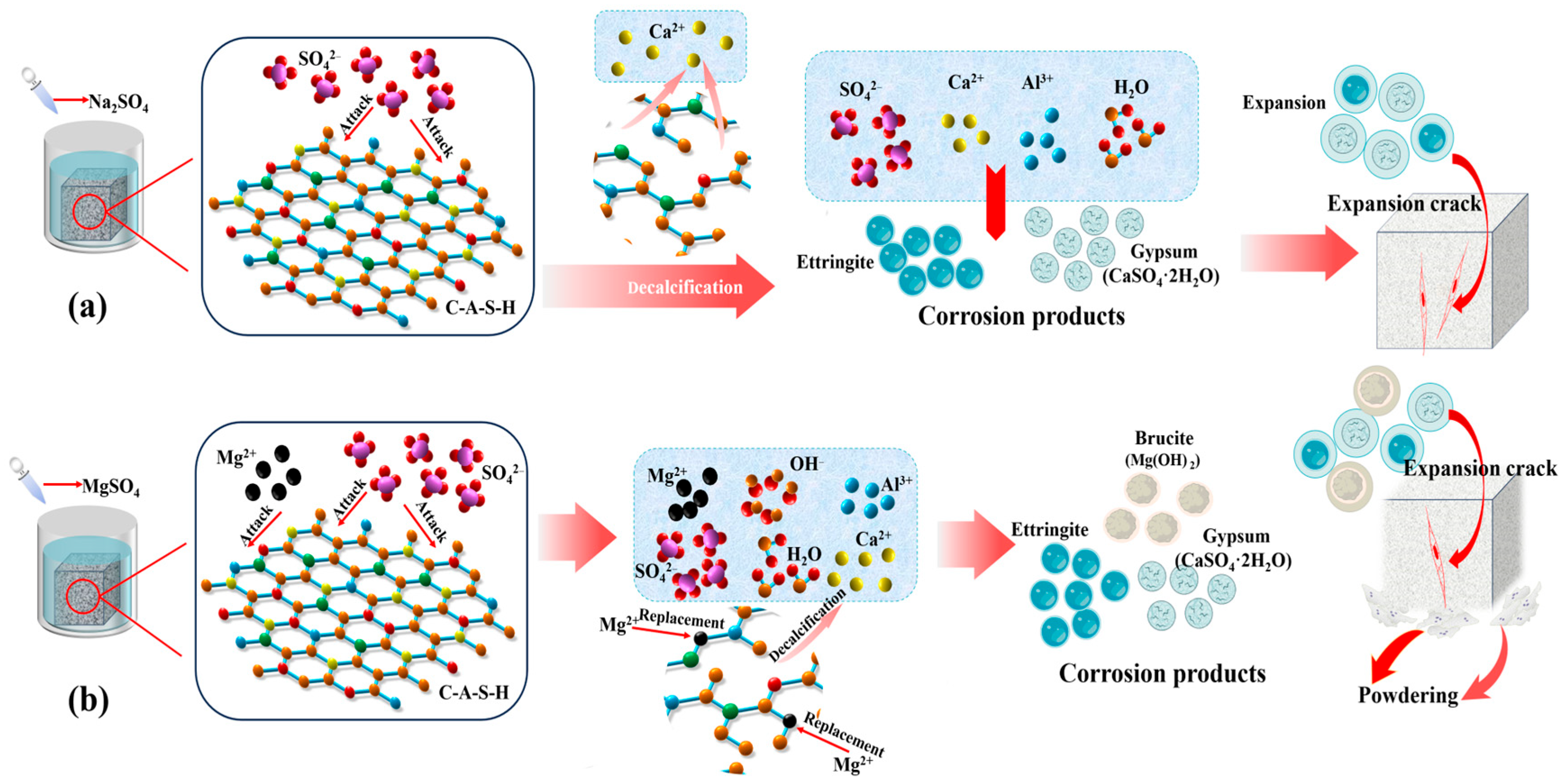
Sulfate attack on cement-based materials involves a complex combination of physicochemical processes. When sulfate ions (SO42−) penetrate the paste, chemical attack is initiated as SO42− reacts with the C-(A)-S-H gel, leading to its decalcification. The released calcium ions dissolve into the pore mixture, where they combine with water and SO42− to form gypsum and ettringite (AFt) [57]. In the initial stage, an appropriate amount of gypsum can promote the formation of well-developed and stable AFt crystals. The precipitation of AFt helps fill pores and microcracks, thereby increasing the compactness of the mortar and temporarily mitigating further sulfate ingress. However, as the attack continues, excessive gypsum leads to a high sulfate ion concentration in the matrix. Under these conditions, AFt continues to grow and crystallize, generating a crystallization pressure that induces internal microcracks and porosity [126]. At this stage, physical damage begins to dominate the degradation process, establishing a cyclic “ingress–damage–accelerated ingress” feedback loop that ultimately results in structural failure [127]. When the attacking medium is magnesium sulfate (MgSO4), the deterioration mechanism becomes even more severe. Because Mg2+ is more reactive than Ca2+, it displaces Ca2+ in cement hydration products such as CH and C-S-H, forming noncementitious Mg(OH)2 and low-strength M-S-H [128], as shown in the following equations. This process not only consumes the key cementitious phase in the system but also leads to disintegration of the cementitious structure and a sudden drop in strength. Moreover, the released SO42− continues to participate in the abovementioned sulfate erosion cycle, exacerbating the deterioration of the material.
C a ( O H ) 2 + M g S O 4 M g ( O H ) 2 + C a S O 4
C-S-H + M g S O 4 M-S-H + C a S O 4
The composition of raw materials significantly influences the mechanical properties and sulfate resistance of alkali-activated materials by determining the types of hydration products formed. In alkali-activated slag-fly ash systems, as the slag content gradually decreases, the dominant gel phase transitions from calcium-rich C-A-S-H to sodium-containing C-(N)-A-S-H. With further reduction in slag content, the system primarily forms N-A-S-H gel. This phase evolution is attributed to the decreasing Ca2+ concentration resulting from the reduced addition of high-CaO slag. The mechanical strength of the mortar varies with these changes in gel type. A decrease in slag content leads to a gradual reduction in strength, which can be explained by the dense layered structure of the C-A-S-H gel, which minimizes structural defects. However, the three-dimensional network of the N-A-S-H gel tends to contain more micropores [129], resulting in a comparatively lower strength. Thus, variations in the hydration product content substantially affect the mechanical performance of the matrix.
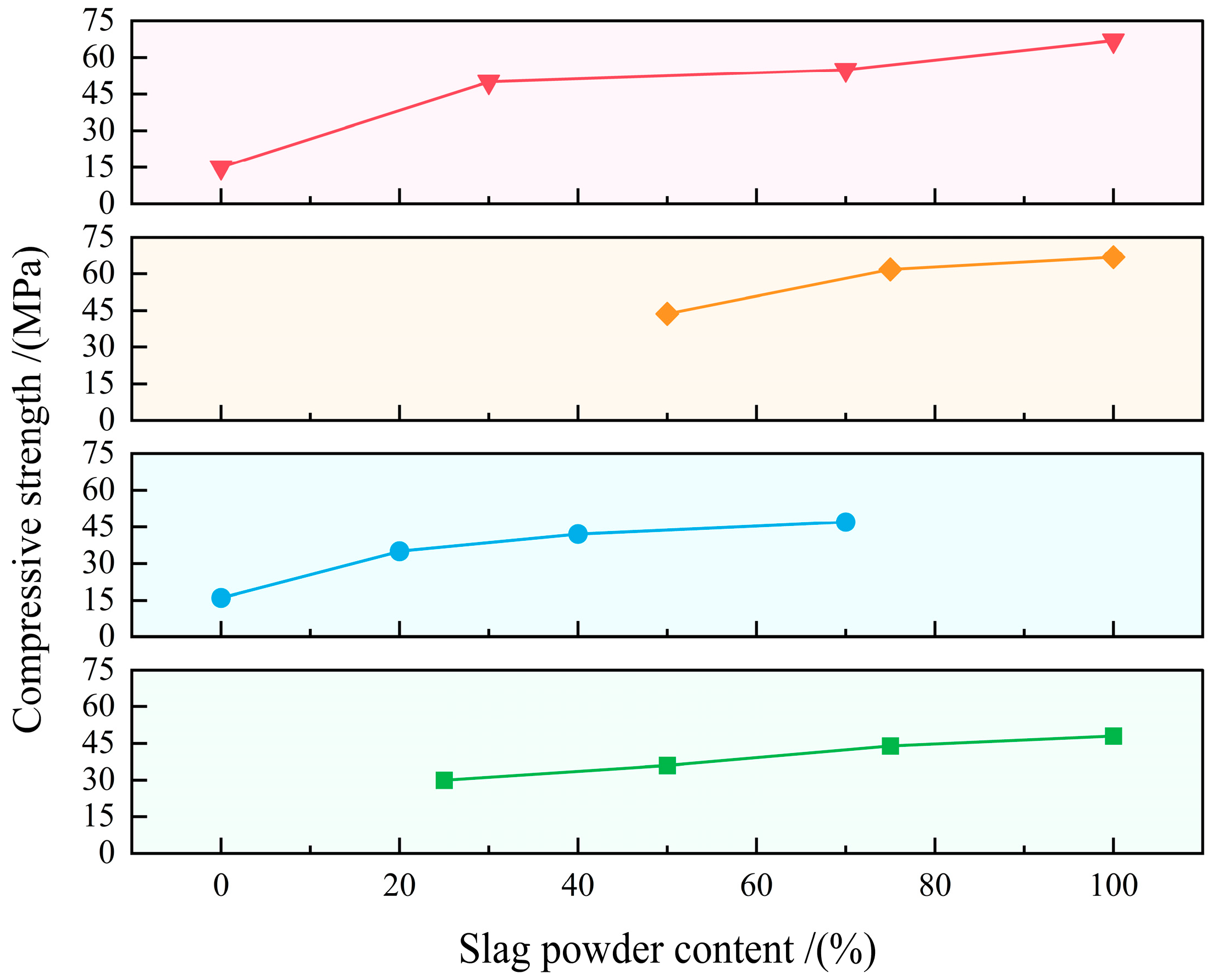
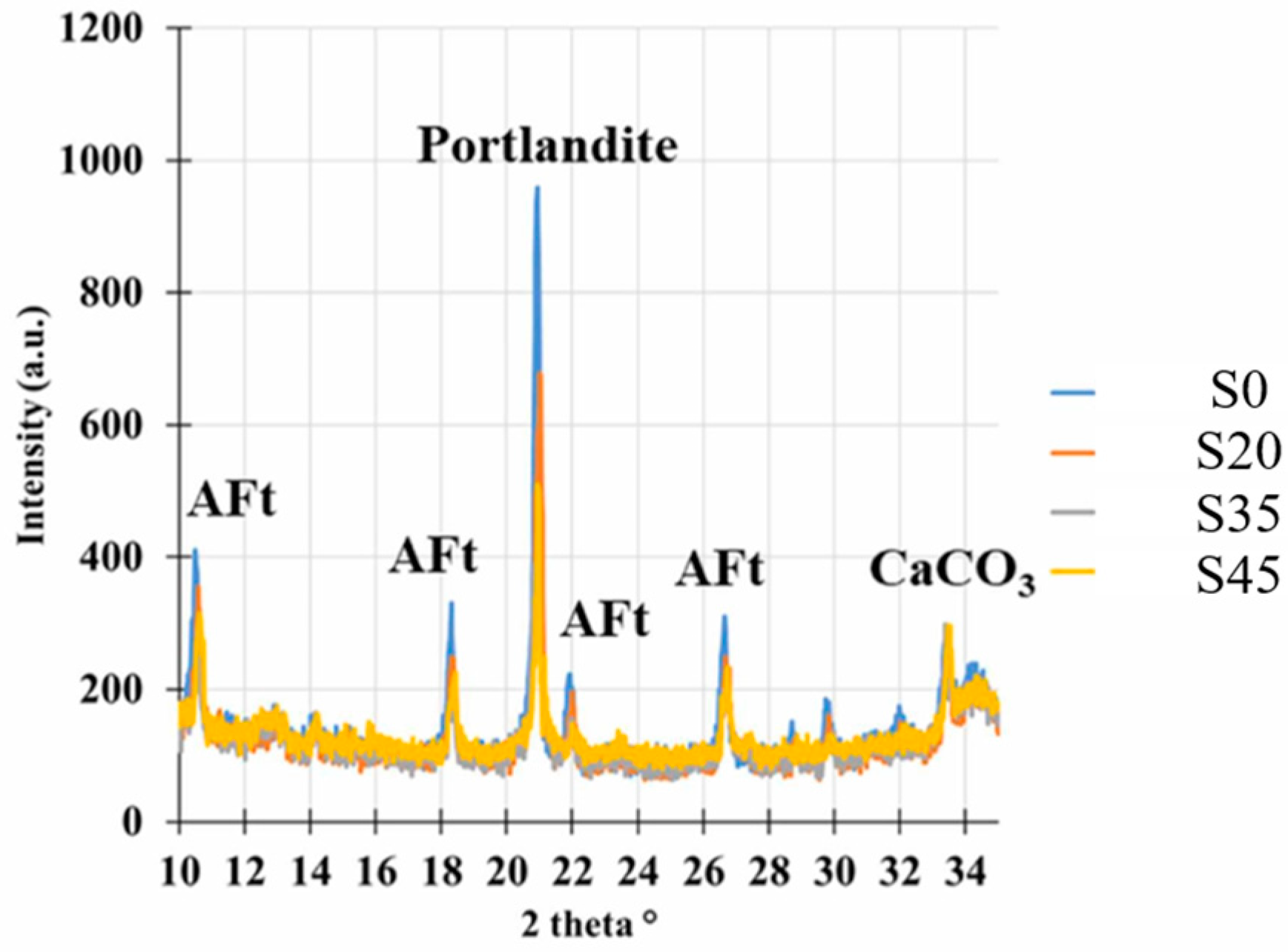
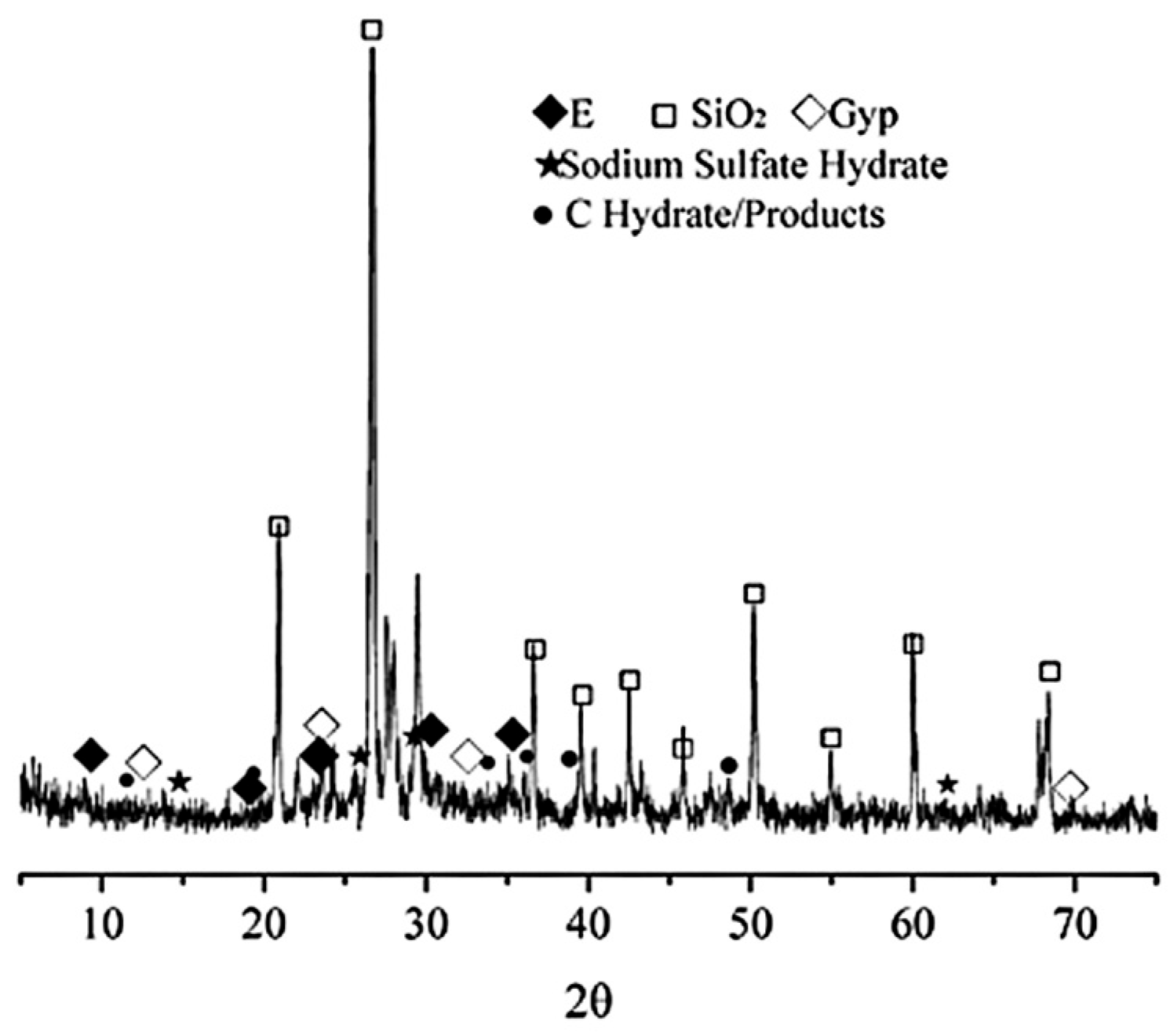
Under sulfate attack conditions, the degradation mechanisms and resistance of different gel structures exhibit distinct behaviors. As the immersion time in the Na2SO4 solution increased, all the mortar samples experienced progressive strength loss. In the case of the C-A-S-H gel, SO42− ions induce decalcification through ion exchange reactions, leading to disintegration of the gel framework. This process is accompanied by the formation of expansive products such as gypsum and ettringite (AFt), which significantly increase internal porosity and microcracking, resulting in rapid strength deterioration. As shown in Figure 27 [130,131,132,133], mortar formulations with higher slag contents exhibit more pronounced strength loss in the later stages of sulfate exposure. In contrast, although the N-A-S-H gel undergoes dealumination [134], this reaction typically does not cause complete breakdown of the gel network. The three-dimensional aluminosilicate framework remains largely intact. Moreover, the XRD pattern of sulfate erosion (Figure 28) shows that the peak intensity of the corrosion product ettringite decreases or even disappears at low slag ratios. This phenomenon may be attributed to the reduced slag content, which lowers the Ca/Si ratio. Consequently, the hydration products gradually transform from C-A-S-H to N-A-S-H gel, with the Al used for ettringite formation being redirected to generate N-A-S-H gel. Therefore, the strength degradation rate of low-calcium materials is slower, demonstrating superior long-term resistance.
Studies on the durability of alkali-activated cementitious materials in sulfate environments have revealed significantly lower resistance to MgSO4 attack than Na2SO4 exposure [44,136,137]. The erosion mechanism of sodium sulfate and magnesium sulfate on mortar is shown in Figure 29. This difference stems from the high charge density of Mg2+, which replaces Ca2+ in the C-A-S-H gel, leading to the formation of gypsum and AFt. It can further substitute for Al3+ in the gel network, resulting in depolymerization of the three-dimensional framework composed of silicon (aluminum) oxygen tetrahedra [138]. Concurrently, H+ ions generated by the hydrolysis of MgSO4 decrease the pH of the system, accelerating gel decomposition [58]. The XRD patterns of the mortar samples under magnesium sulfate attack are shown in Figure 30. Under the exposure of magnesium sulfate, the diffraction peaks of C-A-S-H gradually diminished, whereas those of gypsum and brucite became more pronounced. Notably, AFt does not exhibit clear diffraction peaks in the XRD patterns, as it becomes unstable at pH values below 10.7 [139]. From a microstructural perspective [58,59], all mortar samples after sulfate attack exhibit noticeable pores and cracks caused by crystallization pressure from expansive products, ultimately forming interconnected microcracks and significantly reducing the density of the ITZ. Compared with the samples exposed to Na2SO4, those subjected to MgSO4 presented a more porous and loose microstructure, indicating a greater degree of deterioration and a faster rate of performance degradation.

5.1.2. Acid Corrosion

When the surface of traditional Portland cement building structures comes into contact with acid rain or other acidic media, H+ ions initially undergo a neutralization reaction with Ca(OH)2 in the structure. This process causes the dissolution of solid-phase hydrated silicates and hydrated aluminate salts, thereby reducing the alkalinity of the structure. The H+ ions further attack the Ca2+ in C-S-H, forming a noncementitious silica gel (SiO2·nH2O), as represented in reaction Equations (12) and (13). This process degrades the cementitious framework and leads to a decrease in mortar strength. Notably, H+ corrosion often occurs in conjunction with sulfate attack and carbonation, which collectively accelerate the deterioration process.
C a ( O H ) 2 + 2 H + C a 2 + + 2 H 2 O
C-S-H + n H + Ca 2 + + SiO 2 n H 2 O
In contrast to ordinary Portland cement systems, alkali-activated materials derived from industrial solid wastes primarily form a three-dimensional network-structured aluminosilicate gel (N-A-S-H). The superior acid resistance of these systems can be attributed to their distinct chemical compositions and microstructures. On the one hand, the three-dimensional framework composed of [SiO4]4− and [AlO4]5− tetrahedra exhibits better resistance to acid attack than the C-S-H gel in conventional cement [122]. The absence of Ca(OH)2 as a vulnerable phase for acid reactions further enhances the overall chemical stability. On the other hand, since calcium is the primary target during acid corrosion and tends to form soluble salts such as CaCl2 or CaSO4, the C-(A)-S-H gel formed in industrial waste-based systems generally has a low Ca/Si ratio. Compared with the high Ca/Si C-S-H in OPC, the low-Ca C-(A)-S-H releases fewer Ca2+ ions under H+ attack, thereby reducing gypsum formation and avoiding the expansion caused by AFt and internal cracking due to gypsum precipitation [90]. Furthermore, the alkali activation process leads to the formation of a highly dense microstructure characterized by low porosity and poor pore connectivity, effectively hindering the penetration and diffusion of acidic media. Compared with traditional Portland cement systems, alkali-activated materials derived from industrial solid waste generally exhibit better acid resistance.
In alkali-activated systems, H+ ions initially undergo ion exchange with cations (e.g., Na+, K+, and Ca2+) in the gel network. This constitutes the primary degradation mechanism at the early stage, which elevates the pH of the pore solution [60] and induces weight gain due to water absorption after cation leaching. As the acid concentration increases or is prolonged, H+ begins to attack and breakdown the Si-O-Al and Si-O-Si network structures [61], triggering dealumination and desilication reactions that ultimately dissolve the gel framework. This process represents the fundamental cause of severe material deterioration.
The chemical composition of raw materials fundamentally governs the acid resistance of mortar, with the calcium content and silicon-to-aluminum (Si/Al) ratio being particularly influential in determining the acid degradation mechanism. From the perspective of phase composition, the calcium content of the system directly dictates the type of dominant gel phase and its stability under acidic conditions. High-calcium systems such as slag-based materials primarily form C-A-S-H gels. This gel is prone to calcium leaching during acid attack, which leads to structural disintegration and loss of cohesion. Consequently, these systems exhibit relatively poor acid resistance [141]. In contrast, low-calcium systems such as fly ash-based materials primarily form a three-dimensional N-A-S-H-dominated network. Owing to the lower content of exchangeable calcium ions that can be replaced by H+, the aluminosilicate framework remains more stable in acidic environments, resulting in superior durability [142]. Furthermore, from the perspective of chemical bond stability, the Si/Al ratio of the raw material directly affects the degree of polymerization and hydrolytic stability of the gel network. Since the bond energy of Si-O is significantly greater than that of Al-O, a higher Si/Al ratio implies a greater proportion of more hydrolysis-resistant Si-O-Si bonds and a lower proportion of more acid-vulnerable Si-O-Al and Al-O-Al bonds within the gel structure. Therefore, increasing the Si/Al ratio effectively enhances the resistance of a material to acid attack [138].
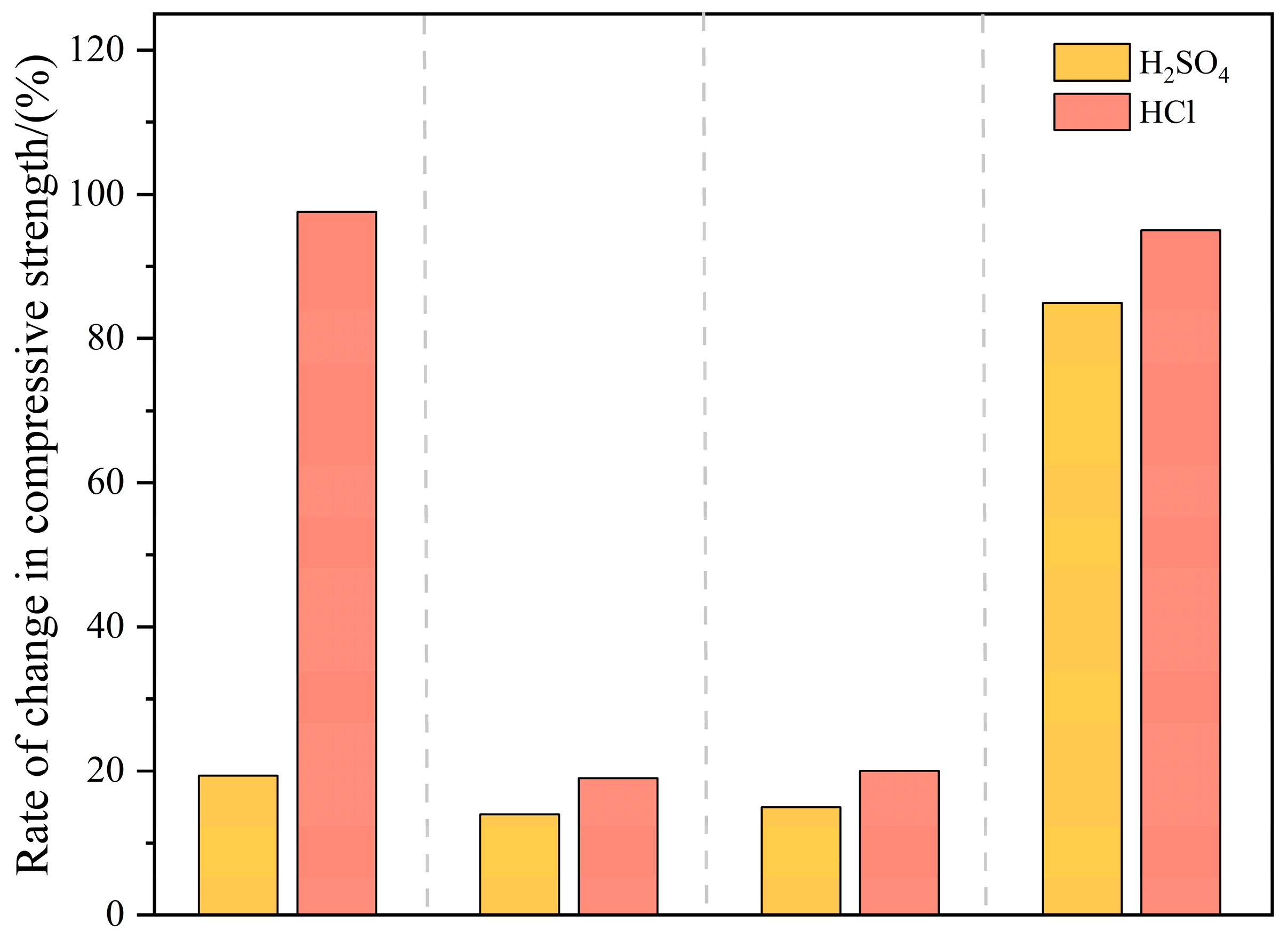
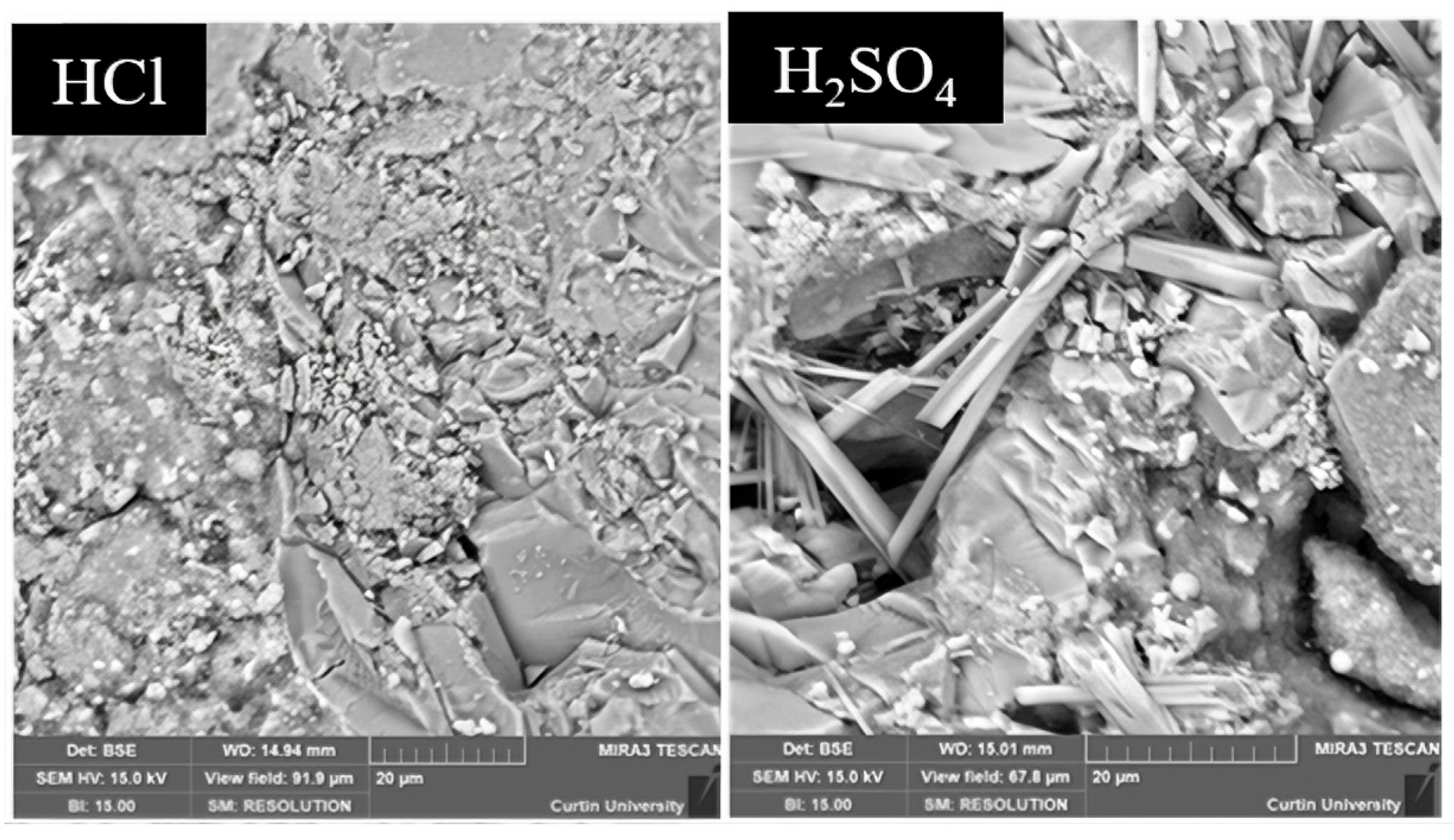
Furthermore, the deterioration mechanisms of alkali-activated cementitious materials in hydrochloric acid (HCl) and sulfuric acid (H2SO4) environments are fundamentally distinct. This is primarily manifested in the differences in attack mechanisms, reaction products, and failure modes. Figure 31 shows the change ratios of the compressive strength of mortar after corrosion by sulfuric acid and hydrochloric acid, respectively. It is evident that the reduction in compressive strength after sulfuric acid exposure is less pronounced than that after hydrochloric acid exposure. The microstructures of the mortar samples after exposure to sulfuric and hydrochloric acid are compared in Figure 32 [143]. The corrosion mechanism in HCl is predominantly governed by H+ attack, leading to dissolution-based degradation. Chloride ions do not participate directly in chemical reactions but accelerate H+ penetration through ion exchange. The resulting corrosion products (e.g., chlorides) are highly soluble and can be continuously leached away by the acid solution, constantly exposing fresh surfaces and allowing the corrosion front to progress inwards [144]. In contrast, sulfuric acid attack involves a dual degradation mechanism. In addition to the direct damage to the gel network caused by H+, it is accompanied by sulfate-related reactions [145], which constitute the key difference between the two acids. SO42− reacts with Ca2+ and Al3+ in the system to form low-solubility precipitates such as gypsum and ettringite. These products may initially block capillary pores and slow acid ingress; however, as the reaction continues, their continued precipitation generates increasing crystallization pressure, leading to internal stress accumulation, microcrack propagation, and eventual surface spalling. Consequently, mortar exposed to HCl exposure exhibits a relatively linear strength loss due to progressive dissolution, whereas H2SO4 attack causes expansion and cracking, which often leads to sudden failure, reflected in a more abrupt, nonlinear decline in strength.

5.1.3. Chloride Ion Ingress

Chloride ion ingress is one of the primary causes of deterioration in the durability of reinforced concrete structures, posing a particularly severe threat to constructions in coastal or saline soil environments. Although chloride ions do not corrode the cement paste or coarse aggregates in concrete, they induce corrosion of the steel reinforcement. This corrosion generates expansion stress, leading to cracking along the reinforcement, a reduction in the bond strength between the steel and the concrete, and eventual spalling of the concrete cover. These processes further accelerate chloride penetration, ultimately resulting in structural deterioration. Therefore, the porosity and water absorption capacity of a material are critical indicators of its resistance to chloride ion attack.
After chloride ions (Cl) penetrate cement-based materials via capillary action, they initiate a series of physicochemical processes. Upon entering the matrix through capillary pores, Cl reacts with C3A to form Friedel’s salt, as shown in Equation (14). This low-solubility product can initially bind chlorides and slow the ingress process. However, in later stages, the expansion associated with Friedel’s salt generates internal stress [62], inducing microcracks that facilitate further chloride penetration. Simultaneously, Cl reacts with portlandite (CH) to form highly soluble CaCl2 [63], as indicated in Equation (15). This process continuously consumes the CH phase, which is essential for maintaining high alkalinity, and significantly reduces the pore solution pH. It also diminishes the contribution of CH to the strength framework, thereby destabilizing the chemical environment required for C-S-H gel stability. In addition, Cl can adsorb onto the surface of C-S-H gel [150], where it interacts with Ca2+ to form soluble CaCl2. This leads to depolymerization of the gel network, increased gel porosity, and enhanced permeability, collectively accelerating chloride ingress.
2 C 3 A + C a 2 + + 2 C l + 10 H 2 O 3 C a O A l 2 O 3 C a C l 2 10 H 2 O
C a O H 2 + 2 C l C a C l 2 + 2 O H
In contrast to ordinary Portland cement (OPC), the main hydration products of alkali-activated materials (AAMs) derived from solid wastes are aluminosilicate gels with low calcium-to-silicon ratios, such as N-A-S-H or C-A-S-H. These gels generally form a denser and more homogeneous microstructure than do the high Ca/Si and C-S-H gels in OPC systems [151]. At the microscale, this compact structure creates tortuous transport paths that significantly hinder the diffusion of chloride ions in the pore solution. Moreover, the refined pore system with reduced connectivity further restricted Cl migration. Unlike OPC, AAMs contain little or no free CH, which fundamentally minimizes the formation of expansive phases such as Friedel’s salt, thereby avoiding the associated crystallization pressure and microcrack propagation [152]. The low-calcium nature of AAM gels limits not only the total amount of Ca2+ available for reaction with Cl but also the tendency to form expansive products [153]. However, more importantly, under corrosive conditions, the limited leachable calcium helps preserve the structural integrity of the main silicate-aluminate framework, which is composed of [SiO4]4− and [AlO4]5− tetrahedral units. This considerably slows the gel depolymerization caused by calcium leaching [154]. Consequently, AAMs establish multiple protective mechanisms through their dense microstructure, optimized phase composition, and stable chemical bonding, collectively contributing to their superior resistance to chloride ion penetration compared with that of conventional OPC systems.
The composition of raw materials in solid wastes significantly influences the chloride resistance of mortar. In high-calcium systems, Ca2+ promotes the formation of the C-(A)-S-H gel [155], which develops a dense microstructure during early hydration. This not only enhances early-age strength but also establishes an effective physical barrier by reducing pore connectivity, thereby significantly hindering chloride transport and diffusion. Moreover, the resulting Friedel’s salt exhibited excellent chloride-binding capacity, contributing to the immobilization of chloride ions [156]. In addition, aluminum and silicon, as essential elements in the aluminosilicate gel network, play a vital role in forming a dense binding framework. A lower Si/Al ratio facilitates the formation of highly cross-linked N-A-S-H or C-N-A-S-H gels [157]. In such structures, the increased proportion of [AlO4]5− tetrahedra promotes a more compact three-dimensional network, which reduces the overall porosity and suppresses potential chloride penetration pathways, thereby achieving an efficient physical blocking effect against Cl ingress.
The corrosion behavior of different chloride salts in mortar is notably different. Owing to their smaller ionic radius, monovalent cationic chlorides (e.g., NaCl and KCl) exhibit greater mobility in the pore solution, which may facilitate faster diffusion of Cl into the mortar. In contrast, divalent cationic chlorides, characterized by larger ionic radii and higher charge densities, migrate more slowly, potentially slowing the overall Cl penetration rate [158]. More importantly, divalent cations such as Ca2+ and Mg2+ contribute to the formation of Friedel’s salt, brucite, and minor calcium chloride hydrate (CaCl2·6H2O) [64], which can partially fill pores and refine the pore structure, thereby mitigating the chloride ingress rate. However, compared with CaCl2, MgCl2 is more destructive to mortar. The underlying mechanism lies in the direct degradation of the gel network by Mg2+, leading to the formation of weakly cementitious M-S-H and crystalline Mg(OH)2. Although these products may initially fill pores to some extent, the resulting M-S-H phase has very low strength. Furthermore, this cation exchange process directly disrupts the chemical structure and binding capacity of the primary gel phases, ultimately causing significant deterioration in mortar strength, as shown in Figure 33.
Solid waste-based cementitious materials have remarkable advantages in terms of corrosion resistance. Their low-calcium aluminosilicate gels (e.g., N-A-S-H) possess a dense microstructure and high chemical stability, providing effective resistance against sulfate, acid, and chloride ion attack. Compared with conventional cement, low-calcium systems exhibit superior resistance to Na2SO4 exposure, although their performance against MgSO4 remains relatively limited. Under acid corrosion, systems with high Si/Al ratios exhibit increased durability due to the stability of Si-O-Si bonds. In the case of chloride ingress, the dense gel matrix acts as a physical barrier, whereas Friedel’s salt contributes to chemical binding, synergistically inhibiting chloride penetration. However, the current understanding of the degradation mechanisms under combined multi-ion corrosion conditions remains insufficient, and variability in solid waste composition may pose long-term environmental risks. Future efforts should prioritize the development of multifactor corrosion models, optimize the gel composition through blending diverse solid wastes, and strengthen engineering validation in aggressive environments such as marine and saline–alkali areas. These advances are essential for promoting the large-scale application of solid waste-based mortar in high-durability green construction.

5.2. Freeze–Thaw Resistance

Freeze–thaw damage is one of the most significant forms of deterioration affecting building structures in cold regions, including walls, floors, water conservancy projects, bridges, and culverts. Freeze–thaw failure is a complex physical fatigue process. It mainly occurs when water penetrates the internal pores of a structure and freezes at low temperatures. This freezing causes the pore volume to expand, resulting in the formation of microcracks. As the temperature rises, water gradually seeps deeper into the structure through these pores and cracks. Under repeated cycles of expansion pressure and water osmotic pressure, the surface of the structure shows a peeling process, progressing layer by layer from the outside inward. Consequently, the microcracks and pores within the structure increase and expand, leading to a loss of quality and deterioration in structural strength [162].
Compared to ordinary Portland cement, industrial solid wastes such as fly ash, mineral powder and silica fume have smaller particle sizes and a slower hydration rate. These characteristics enable them to effectively fill the voids within cement-based materials, thereby enhancing structural density [11,91]. Calcium hydroxide, a primary hydration product of cement, possesses a loose and fragile microstructure with large pore diameters. Through the pozzolanic reaction, solid wastes consume calcium hydroxide, producing additional C-S-H and C-A-S-H gels. The newly formed gels deposit within existing capillary pores and macropores, dividing them into smaller, more closed pores [163]. This significantly reduces the number of harmful pores (>50 nm) while increasing the number of harmless pores (<20 nm). This denser and more refined pore structure effectively hinders the intrusion of external moisture and significantly reduces the total amount of internal frozen water and its migration ability. Therefore, solid waste systems typically demonstrate superior freeze–thaw resistance compared to OPC, as shown in Figure 34 [164,165]. However, due to the relatively slow hydration reaction rate of solid waste materials, their early strength development is relatively sluggish [11,25]. Exposure to freeze–thaw cycles during the early stages can cause more severe structural damage. Additionally, solid waste particles are small and possess a large specific surface area, which increases water demand. Excessive water demand may lead to a higher water-to-binder ratio, thereby increasing the system’s porosity [166] and adversely affecting freeze–thaw resistance.
Pore structure is a key factor affecting the freeze–thaw resistance of mortar. High porosity indicates that, in a saturated state, the mortar contains more freezable water. When freezing occurs, the volume expansion potential is greater, resulting in stronger destructive forces. However, total porosity alone is not a decisive indicator; pore size distribution is more critical. Generally, pores with diameters greater than 50 μm are classified as harmful pores, while those exceeding 200 μm are considered highly harmful pores [165]. These pores are the primary sites of freeze–thaw damage because they facilitate rapid water penetration and migration and serve as main reservoirs for free water. Their abundance directly determines the quality of the freeze–thaw resistance of the mortar. With the increase of the number of freeze–thaw cycles, the number of pores within the mortar also rises, causing cumulative damage until the material’s performance deteriorates completely [164,167,168].
Based on the above, solid waste-based cementitious materials have demonstrated significant advantages in freeze–thaw resistance. These solid waste materials enhance the density of mortar by refining its pore structure, thereby optimizing its microstructure and further improving its freeze–thaw resistance. Although the use of solid waste materials may result in slower early strength development and an increased risk of early freeze–thaw damage, their ongoing secondary hydration reactions continuously optimize the pore structure over time. Consequently, the frost resistance of these materials improves with age, exhibiting a long-term durability advantage compared to traditional cement mortar.

6. Future Prospects

Future research should prioritize three key directions to advance the field:
(1) Develop a synergistic utilization strategy for multi-component solid waste systems to achieve complementary effects in chemistry and microstructure. In the future, this approach will lead to the creation of high-performance, multifunctional, and recyclable advanced building material systems. Furthermore, the application of solid waste materials should not be limited to building materials alone. For example, copper slag and zinc slag inherently provide antibacterial metal ions [169]. Future developments could include sustained-release antibacterial coatings for use in environments with stringent hygiene requirements, such as hospitals and schools. By leveraging the alkaline properties of steel slag, mine slag, red mud and other materials, along with the various metal oxides they contain [170], non-toxic anti-rust coating pigments can be produced to gradually replace traditional heavy metal-based anti-corrosion pigments, such as those containing chromium and lead. The application of solid waste materials offers new sustainable development pathways for the construction, industrial and household sectors.
(2) The focus is shifting from the activation of a single type of solid waste to the coordinated activation of multiple solid wastes. By scientifically designing the proportions of different solid wastes and leveraging the solid-phase reactions that occur during the heat treatment process, new highly active phases are generated, achieving a synergistic enhancement of the activation effect. Non-traditional thermal activation methods, such as microwave and infrared radiation activation, are being developed. These technologies utilize the selective coupling of electromagnetic waves with materials to achieve internal heating, significantly enhancing thermal efficiency and potentially generating more active phases. Future carbonation technologies will evolve from merely treating solid waste to manufacturing value-added products. By precisely controlling process parameters such as temperature, humidity and CO2 concentration, the crystal form, morphology, and particle size of calcium carbonate can be directionally regulated to produce specialized calcium carbonate suitable for high-value industrial applications, including plastics, coatings, and papermaking, thereby maximizing value. Additionally, solid activators based on industrial by-products (such as complex alkali salts) are being developed to address issues related to the strong corrosiveness and inconvenient transportation of liquid activators. Through precise regulation of proportions and processes, alkali-activated materials with intelligent properties, such as self-repair, self-sensing, moisture regulation, and antibacterial are prepared, greatly enhancing their added value. Furthermore, innovative low-carbon activation approaches are being pursued to minimize energy consumption and environmental impact while maintaining performance.
(3) Establish a reliable long-term durability model based on on-site performance under actual usage conditions. These efforts aim to transform laboratory-scale achievements into structurally feasible and environmentally sustainable applications. In future developments, solid waste materials will become advanced engineering materials characterized by longer lifespans, enhanced safety, and reduced maintenance requirements in harsh environments. This will be achieved through mechanism-driven material design and performance improvement through the integration of multiple technologies. Develop pH-sensitive coatings based on solid waste that change color when an internal corrosive environment is initiated, providing a visual early warning of corrosion. Combine solid waste carriers with phase change materials. When the temperature drops, the phase change material solidifies and releases heat, mitigating sudden temperature declines within the mortar. This process delays the formation of ice crystals and reduces freeze–thaw damage.

7. Conclusions

This review provides a systematic analysis of solid waste-based cementitious materials for recycled mortar, focusing on raw material properties, activation methods, mechanical strength, and corrosion resistance. The main conclusions are as follows:
(1) By analyzing the composition, mineral composition and microscopic morphology of solid waste, it has been found that construction solid waste (such as discarded concrete powder and brick powder) and industrial solid waste (such as slag and fly ash) possess the technical feasibility to partially or fully replace cement in the preparation of recycled mortar due to their high content of active SiO2, Al2O3 and CaO components. However, their inherent inertness limits direct utilization efficiency, and their active ingredients must be activated through specific methods.
(2) Activated solid waste materials exhibit a higher utilization rate. Thermal activation can significantly enhance material reactivity; however, it is limited by high energy consumption and process complexity. Carbonation technology, which fixes CO2 and generates calcite, offers both environmental protection and structural enhancement benefits. However, its efficiency is significantly affected by variations in raw material composition. Alkali-activated systems are most effective in forming high-strength and high-density gels, but require precise control of the activator modulus and alkali content, as well as management of potential alkali-aggregate reactions and long-term shrinkage risks. Future efforts should focus on the coordinated optimization of multiple activation methods and the development of low-energy, environmentally friendly activation pathways.
(3) The solid waste substitution rate significantly impacts the strength of mortar. At low substitution levels, the “micro-aggregate effect” predominates, resulting in limited strength loss. However, a high substitution rate causes a significant decrease in strength due to the dilution of cementitious components and insufficient hydration. Activation treatments can improve strength to varying degrees, with alkaline activation showing particularly notable effects. Future research should further explore the synergistic effects of multi-source solid waste to promote the precision of mix proportion design.
(4) Solid waste-based mortar generally outperforms traditional cement in terms of corrosion resistance. Its dense low-calcium silicoaluminate gel structure significantly enhances resistance to acid attack and chloride ion penetration. Specifically, it exhibits superior resistance to Na2SO4 erosion but is more susceptible to damage from MgSO4. The mortar remains stable against HCl erosion; however, exposure to H2SO4 can lead to gypsum-induced expansion failure. Chloride ion erosion is inhibited through the combined effects of the gel’s physical barrier and chemical curing. Additionally, solid waste particles refine the pore structure, reduce the amount of freeze–thaw water, and enhance frost resistance. However, caution is required regarding the potential risk of early freeze–thaw damage due to the slow development of early strength.
Through systematic analysis, this review demonstrates that solid waste-based recycled mortar is technically feasible. Its mechanical properties and durability can be effectively enhanced through activation methods.

Author Contributions

Y.G.: investigation, conceptualization, writing—original draft. J.C. and M.L.: data curation, formal analysis, writing—original draft. Q.L.: software. B.L.: data curation, funding acquisition. T.S. and X.M.: conceptualization, funding acquisition, supervision, writing—review and editing. All authors have read and agreed to the published version of the manuscript.

Funding

This work was supported by the National Natural Science Foundation of China (52309137 (Bangxiang Li)), the Natural Science Foundation of Shandong Province (ZR2025MS802 (Tian Su); ZR2024QE218 (Bangxiang Li)), and the Natural Science Foundation of Inner Mongolia Autonomous Region (2025MS05007 (Xuefeng Mei)).

Institutional Review Board Statement

Not applicable.

Informed Consent Statement

Not applicable.

Conflicts of Interest

The authors declare no conflicts of interest.

References

  1. Bilal, M.; Khan, K.I.A.; Thaheem, M.J.; Nasir, A.R. Current state and barriers to the circular economy in the building sector: Towards a mitigation framework. J. Clean. Prod. 2020, 276, 123250. [Google Scholar] [CrossRef]
  2. GEP Research. Global and China Construction and Demolition Waste Industry Market Research Report. 2025. Available online: https://www.gepresearch.com/ (accessed on 26 July 2025).
  3. Hamilton, I.; Rapf, O.; Kockat, D.J.; Kockat, D.J.; Zuhaib, D.S.; Abergel, T.; Oppermann, M.; Otto, M.; Loran, S.; Fagotto, I.; et al. 2020 Global Status Report for Buildings and Construction; United Nations Environmental Programme: Nairobi, Kenya, 2020. [Google Scholar]
  4. Akhtar, A.; Sarmah, A.K. Construction and demolition waste generation and properties of recycled aggregate concrete: A global perspective. J. Clean. Prod. 2018, 186, 262–281. [Google Scholar] [CrossRef]
  5. Rissman, J.; Bataille, C.; Masanet, E.; Aden, N.; Morrow III, W.R.; Zhou, N.; Elliott, N.; Dell, R.; Heeren, N.; Huckestein, B.; et al. Technologies and policies to decarbonize global industry: Review and assessment of mitigation drivers through 2070. Appl. Energy 2020, 266, 114848. [Google Scholar] [CrossRef]
  6. Soto-Paz, J.; Arroyo, O.; Torres-Guevara, L.E.; Parra-Orobio, B.A.; Casallas-Ojeda, M. The circular economy in the construction and demolition waste management: A comparative analysis in emerging and developed countries. J. Build. Eng. 2023, 78, 107724. [Google Scholar] [CrossRef]
  7. Ma, S.; Yin, J.; Wu, W.; Zeng, Q.; Zhao, Y. Review on Alkali-Activated Cementitious Materials Based on Recycled Fine Powder from Construction Waste. Concrete 2023, 170–174+180. [Google Scholar] [CrossRef]
  8. Xiao, J.; Ma, Z.; Sui, T.; Akbarnezhad, A.; Duan, Z. Mechanical properties of concrete mixed with recycled powder produced from construction and demolition waste. J. Clean. Prod. 2018, 188, 720–731. [Google Scholar] [CrossRef]
  9. Provis, J.L.; Bernal, S.A. Geopolymers and related alkali-activated materials. Annu. Rev. Mater. Res. 2014, 44, 299–327. [Google Scholar] [CrossRef]
  10. Zheng, W.; Zou, M.; Wang, Y. Research Progress on Alkali-Activated Cementitious Materials. J. Build. Struct. 2019, 40, 28–39. [Google Scholar]
  11. Zhang, P.; Zheng, Y.; Wang, K.; Zhang, J. A review on properties of fresh and hardened geopolymer mortar. Compos. Part B Eng. 2018, 152, 79–95. [Google Scholar] [CrossRef]
  12. Zhang, J.; Shi, C.; Zhang, Z.; Ou, Z. Durability of alkali-activated materials in aggressive environments: A review on recent studies. Constr. Build. Mater. 2017, 152, 598–613. [Google Scholar] [CrossRef]
  13. Almutairi, A.L.; Tayeh, B.A.; Adesina, A.; Isleem, H.F.; Zeyad, A.M. Potential applications of geopolymer concrete in construction: A review. Case Stud. Constr. Mater. 2021, 15, e00733. [Google Scholar] [CrossRef]
  14. Rashad, A.M. Metakaolin as cementitious material: History, scours, production and composition—A comprehensive overview. Constr. Build. Mater. 2013, 41, 303–318. [Google Scholar] [CrossRef]
  15. Rashad, A.M. A comprehensive overview about the influence of different admixtures and additives on the properties of alkali-activated fly ash. Mater. Des. 2014, 53, 1005–1025. [Google Scholar] [CrossRef]
  16. Kong, Y.K.; Kurumisawa, K. Fresh properties and characteristic testing methods for alkali-activated materials: A review. J. Build. Eng. 2023, 75, 106830. [Google Scholar] [CrossRef]
  17. Chen, B.; Perumal, P.; Aghabeyk, F.; Adediran, A.; Illikainen, M.; Ye, G. Advances in using municipal solid waste incineration (MSWI) bottom ash as precursor for alkali-activated materials: A critical review. Resour. Conserv. Recycl. 2024, 204, 107516. [Google Scholar] [CrossRef]
  18. Sun, Y.; Mohan, M.K.; Tao, Y.; Zhang, Y.; Van Tittelboom, K.; Ye, G.; De Schutter, G. A conceptual design of two-stream alkali-activated materials. Cem. Concr. Compos. 2024, 148, 105485. [Google Scholar] [CrossRef]
  19. Yusslee, E.; Beskhyroun, S. Performance evaluation of hybrid one-Part Alkali activated materials (AAMs) for concrete structural repair. Buildings 2022, 12, 2025. [Google Scholar] [CrossRef]
  20. Liu, J.; Tian, Y.; Ge, X.; Liu, B.; Liu, K.; Song, G. Experimental study on MgO-Na2CO3 combined excitation recycled fine-powder-slag cementitious system and modification. Buildings 2024, 14, 592. [Google Scholar] [CrossRef]
  21. Li, Q.; Li, J.; Zhang, S.; Huang, X.; Wang, X.; Wang, Y.; Ni, W. Research progress of low-carbon cementitious materials based on synergistic industrial wastes. Energies 2023, 16, 2376. [Google Scholar] [CrossRef]
  22. Alibeigibeni, A.; Stochino, F.; Zucca, M.; Gayarre, F.L. Enhancing concrete sustainability: A critical review of the performance of recycled concrete aggregates (RCAs) in structural concrete. Buildings 2025, 15, 1361. [Google Scholar] [CrossRef]
  23. Zou, Z.; Li, J.; Li, J.; Gao, H.; Zhang, Y.; Yu, Y.; Zhang, C. Effect of high-volume recycled concrete powder on microstructure and mechanical performance of alkali-activated slag mortar using response surface approach. Structures 2025, 79, 109515. [Google Scholar] [CrossRef]
  24. Sharmin, S.; Sarker, P.K.; Biswas, W.K.; Abousnina, R.M.; Javed, U. Characterization of waste clay brick powder and its effect on the mechanical properties and microstructure of geopolymer mortar. Constr. Build. Mater. 2024, 412, 134848. [Google Scholar] [CrossRef]
  25. Sallı Bideci, Ö.; Bideci, A.; Ashour, A. Utilization of recycled brick powder as supplementary cementitious materials—A comprehensive review. Materials 2024, 17, 637. [Google Scholar] [CrossRef]
  26. Shi, C.; Day, R.L. Early strength development and hydration of alkali-activated blast furnace slag/fly ash blends. Adv. Cem. Res. 1999, 11, 189–196. [Google Scholar] [CrossRef]
  27. Peng, L.; Jiang, Y.; Ban, J.; Shen, Y.; Ma, Z.; Zhao, Y.; Shen, P.; Poon, C.S. Mechanism underlying early hydration kinetics of carbonated recycled concrete fines-ordinary portland cement (CRCF-OPC) paste. Cem. Concr. Compos. 2023, 144, 105275. [Google Scholar] [CrossRef]
  28. Sui, Y.; Ou, C.; Liu, S.; Zhang, J.; Tian, Q. Study on properties of waste concrete powder by thermal treatment and application in mortar. Appl. Sci. 2020, 10, 998. [Google Scholar] [CrossRef]
  29. Kaliyavaradhan, S.K.; Li, L.; Ling, T.C. Response surface methodology for the optimization of CO2 uptake using waste concrete powder. Constr. Build. Mater. 2022, 340, 127758. [Google Scholar] [CrossRef]
  30. Kaliyavaradhan, S.K.; Ling, T.C.; Mo, K.H. CO2 sequestration of fresh concrete slurry waste: Optimization of CO2 uptake and feasible use as a potential cement binder. J. CO2 Util. 2020, 42, 101330. [Google Scholar] [CrossRef]
  31. Zhang, D.; Zhang, S.; Huang, B.; Yang, Q.; Li, J. Comparison of mechanical, chemical, and thermal activation methods on the utilisation of recycled concrete powder from construction and demolition waste. J. Build. Eng. 2022, 61, 105295. [Google Scholar] [CrossRef]
  32. Hu, R.; Wang, C.; Shen, J.; Ma, Z. Chloride transport and thermoactivated modification of sustainable cement-based materials with high-content waste concrete powder. J. Mater. Res. Technol. 2023, 23, 4012–4031. [Google Scholar] [CrossRef]
  33. Zhao, Y.; Cui, K.; He, J.; Zheng, Y.; Shen, P.; Poon, C.S.; Peng, G.; Guo, R.; Xia, D. Highly reactive carbonated recycled concrete fines prepared via mechanochemical carbonation: Influence on the early performance of cement composites. Cem. Concr. Compos. 2024, 152, 105636. [Google Scholar] [CrossRef]
  34. Wu, Y.; Mehdizadeh, H.; Mo, K.H.; Ling, T.C. High-temperature CO2 for accelerating the carbonation of recycled concrete fines. J. Build. Eng. 2022, 52, 104526. [Google Scholar] [CrossRef]
  35. Shao, J.; Gao, J.; Zhao, Y.; Chen, X. Study on the pozzolanic reaction of clay brick powder in blended cement pastes. Constr. Build. Mater. 2019, 213, 209–215. [Google Scholar] [CrossRef]
  36. Duan, Z.; Hou, S.; Xiao, J.; Li, B. Study on the essential properties of recycled powders from construction and demolition waste. J. Clean. Prod. 2020, 253, 119865. [Google Scholar] [CrossRef]
  37. Lam, M.N.T.; Nguyen, D.T.; Nguyen, D.L. Potential use of clay brick waste powder and ceramic waste aggregate in mortar. Constr. Build. Mater. 2021, 313, 125516. [Google Scholar] [CrossRef]
  38. Mansoor, S.S.; Hama, S.M.; Hamdullah, D.N. Effectiveness of replacing cement partially with waste brick powder in mortar. J. King Saud Univ.-Eng. Sci. 2024, 36, 524–532. [Google Scholar] [CrossRef]
  39. Wang, X.; Zhang, T.; Chen, P.; Xu, G.; Guo, Y.; Wei, J.; Yu, Q. Hydration mechanism and microstructure evolution of recycled brick powder blended cement toward low-carbon and cleaner production. Constr. Build. Mater. 2024, 438, 137097. [Google Scholar] [CrossRef]
  40. Wu, H.; Liang, C.; Xiao, J.; Ma, Z. Properties and CO2-curing enhancement of cement-based materials containing various sources of waste hardened cement paste powder. J. Build. Eng. 2021, 44, 102677. [Google Scholar] [CrossRef]
  41. Ouyang, X.; Wang, L.; Xu, S.; Ma, Y.; Ye, G. Surface characterization of carbonated recycled concrete fines and its effect on the rheology, hydration and strength development of cement paste. Cem. Concr. Compos. 2020, 114, 103809. [Google Scholar] [CrossRef]
  42. Wang, T.; Fan, X.; Gao, C. Strength, pore characteristics, and characterization of fly ash-slag-based geopolymer mortar modified with silica fume. Structures 2024, 69, 107525. [Google Scholar] [CrossRef]
  43. Khan, M.N.N.; Kuri, J.C.; Sarker, P.K. Effect of waste glass powder as a partial precursor in ambient cured alkali activated fly ash and fly ash-GGBFS mortars. J. Build. Eng. 2021, 34, 101934. [Google Scholar] [CrossRef]
  44. Zhang, J.; Shi, C.; Zhang, Z.; Hu, X. Reaction mechanism of sulfate attack on alkali-activated slag/fly ash cements. Constr. Build. Mater. 2022, 318, 126052. [Google Scholar] [CrossRef]
  45. Xiaoshuang, S.; Yanpeng, S.; Jinqian, L.; Yuhao, Z.; Ruihan, H. Preparation and performance optimization of fly ash-slag-red mud based geopolymer mortar: Simplex-centroid experimental design method. Constr. Build. Mater. 2024, 450, 138573. [Google Scholar] [CrossRef]
  46. Xue, L.; Ni, Z.; Zhou, Z.; Zhang, Z.; Xiong, H.; Wang, H.; Zhuge, X.; Liu, H. Effects of desulfurized gypsum on shrinkage behavior of alkali-activated slag (AAS) and hybrid alkali-activated cement (HAC). Case Stud. Constr. Mater. 2025, 22, e04320. [Google Scholar] [CrossRef]
  47. Wan, X.; Wang, B.; Jin, Z.; Li, S.; Yu, Q.; Cao, J. Solidification of chloride ion in alkali-activated slag-red mud. Constr. Build. Mater. 2024, 451, 138838. [Google Scholar] [CrossRef]
  48. Haha, M.B.; Le Saout, G.; Winnefeld, F.; Lothenbach, B. Influence of activator type on hydration kinetics, hydrate assemblage and microstructural development of alkali activated blast-furnace slags. Cem. Concr. Res. 2011, 41, 301–310. [Google Scholar] [CrossRef]
  49. Aydın, S.; Baradan, B. Effect of activator type and content on properties of alkali-activated slag mortars. Compos. Part B Eng. 2014, 57, 166–172. [Google Scholar] [CrossRef]
  50. Palacios, M.; Gismera, S.; Alonso, M.D.M.; De Lacaillerie, J.D.E.; Lothenbach, B.; Favier, A.; Brumaud, C.; Puertas, F. Early reactivity of sodium silicate-activated slag pastes and its impact on rheological properties. Cem. Concr. Res. 2021, 140, 106302. [Google Scholar] [CrossRef]
  51. Wang, W.; Noguchi, T.; Maruyama, I. Effects of alkali cations from silicate activators and exposure conditions on the alkali-silica reaction in alkali-activated slag mortars. Constr. Build. Mater. 2024, 451, 138929. [Google Scholar] [CrossRef]
  52. Sitarz, M.; Castro-Gomes, J.; Hager, I. Strength and microstructure characteristics of blended fly ash and ground granulated blast furnace slag geopolymer mortars with Na and K silicate solution. Materials 2021, 15, 211. [Google Scholar] [CrossRef]
  53. Omur, T.; Kabay, N.; Miyan, N.; Özkan, H.; Özkan, Ç. The effect of alkaline activators and sand ratio on the physico-mechanical properties of blast furnace slag based mortars. J. Build. Eng. 2022, 58, 104998. [Google Scholar] [CrossRef]
  54. Guo, Y.; Xu, X.; Guo, W. Effect of alkaline activator on SIOT-GGBS-MK based alkali-activated mortar. Constr. Build. Mater. 2025, 467, 140322. [Google Scholar] [CrossRef]
  55. Wang, D.; Zou, K.; Zhu, S.; Guo, L. Optimization of Mix Proportions and Mechanical Properties of Coal Gangue-Based Multi-Solid-Waste Geopolymer Mortars. Case Stud. Constr. Mater. 2025, 23, e05134. [Google Scholar] [CrossRef]
  56. De Vargas, A.S.; Dal Molin, D.C.C.; Vilela, A.C.F.; Da Silva, F.J.; Pavao, B.; Veit, H. The effects of Na2O/SiO2 molar ratio, curing temperature and age on compressive strength, morphology and microstructure of alkali-activated fly ash-based geopolymers. Cem. Concr. Compos. 2011, 33, 653–660. [Google Scholar] [CrossRef]
  57. Al-Dulaijan, S.U.; Maslehuddin, M.; Al-Zahrani, M.M.; Sharif, A.M.; Shameem, M.; Ibrahim, M. Sulfate resistance of plain and blended cements exposed to varying concentrations of sodium sulfate. Cem. Concr. Compos. 2003, 25, 429–437. [Google Scholar] [CrossRef]
  58. Elyamany, H.E.; Abd Elmoaty, M.; Elshaboury, A.M. Magnesium sulfate resistance of geopolymer mortar. Constr. Build. Mater. 2018, 184, 111–127. [Google Scholar] [CrossRef]
  59. Komljenović, M.; Baščarević, Z.; Marjanović, N.; Nikolić, V. External sulfate attack on alkali-activated slag. Constr. Build. Mater. 2013, 49, 31–39. [Google Scholar] [CrossRef]
  60. Komljenović, M.M.; Baščarević, Z.; Marjanović, N.; Nikolić, V. Decalcification resistance of alkali-activated slag. J. Hazard. Mater. 2012, 233, 112–121. [Google Scholar] [CrossRef]
  61. Deir, E.; Gebregziabiher, B.S.; Peethamparan, S. Influence of starting material on the early age hydration kinetics, microstructure and composition of binding gel in alkali activated binder systems. Cem. Concr. Compos. 2014, 48, 108–117. [Google Scholar] [CrossRef]
  62. Geng, J.; Easterbrook, D.; Li, L.Y.; Mo, L.W. The stability of bound chlorides in cement paste with sulfate attack. Cem. Concr. Res. 2015, 68, 211–222. [Google Scholar] [CrossRef]
  63. Maes, M.; De Belie, N. Resistance of concrete and mortar against combined attack of chloride and sodium sulphate. Cem. Concr. Compos. 2014, 53, 59–72. [Google Scholar] [CrossRef]
  64. Chen, Z.; Ye, H. Understanding the impact of main seawater ions and leaching on the chloride transport in alkali-activated slag and Portland cement. Cem. Concr. Res. 2023, 164, 107063. [Google Scholar] [CrossRef]
  65. Jiang, L.; Niu, Y.; Jin, W.; Gao, H.; Chen, L. Influence of chloride salt type on chloride ion diffusion performance of alkali-activated slag mortar. Constr. Build. Mater. 2022, 351, 128930. [Google Scholar] [CrossRef]
  66. Xu, R.; Kong, F.; Yang, R.; Wang, H.; Hong, T. Influences of silicate modulus and alkali content on macroscopic properties and microstructure of alkali-activated blast furnace slag-copper slag. Constr. Build. Mater. 2024, 442, 137622. [Google Scholar] [CrossRef]
  67. Yu, M.; Wang, T.; Chi, Y.; Li, D.; Li, L.Y.; Shi, F. Residual mechanical properties of GGBS-FA-SF blended geopolymer concrete after exposed to elevated temperatures. Constr. Build. Mater. 2024, 411, 134378. [Google Scholar] [CrossRef]
  68. Jia, R.; Ran, B.; Lv, T.; Yu, Y.; Hu, X.; Xu, L. Synergistic effect of waste concrete powder and traditional SCMs in preparing clinker-free cement: Hydration and microstructure evolution. Constr. Build. Mater. 2025, 491, 142798. [Google Scholar] [CrossRef]
  69. Yön, M.Ş. Mechanical, durability and microstructure properties of eco-friendly self-compacting mortars with addition of volcanic scoria, silica fume and boron waste as cement replacement. Constr. Build. Mater. 2025, 462, 139894. [Google Scholar]
  70. Li, Z.; Gao, M.; Lei, Z.; Tong, L.; Sun, J.; Wang, Y.; Wang, X.; Jiang, X. Ternary cementless composite based on red mud, ultra-fine fly ash, and GGBS: Synergistic utilization and geopolymerization mechanism. Case Stud. Constr. Mater. 2023, 19, e02410. [Google Scholar] [CrossRef]
  71. Sun, D.M.; Beulah, M.; Saji, J. Sustainable synergies: Performance evaluation of cement mortar with red mud and industrial by-products. Next Mater. 2026, 10, 101479. [Google Scholar] [CrossRef]
  72. Bogas, J.A.; Carriço, A.; Pereira, M.F.C. Mechanical characterization of thermal activated low-carbon recycled cement mortars. J. Clean. Prod. 2019, 218, 377–389. [Google Scholar] [CrossRef]
  73. Wu, H.; Yang, D.; Ma, Z. Micro-structure, mechanical and transport properties of cementitious materials with high-volume waste concrete powder and thermal modification. Constr. Build. Mater. 2021, 313, 125477. [Google Scholar] [CrossRef]
  74. Ma, Z.; Shen, J.; Wu, H.; Zhang, P. Properties and activation modification of eco-friendly cementitious materials incorporating high-volume hydrated cement powder from construction waste. Constr. Build. Mater. 2022, 316, 125788. [Google Scholar] [CrossRef]
  75. Wu, H.; Xu, J.; Yang, D.; Ma, Z. Utilizing thermal activation treatment to improve the properties of waste cementitious powder and its newmade cementitious materials. J. Clean. Prod. 2021, 322, 129074. [Google Scholar] [CrossRef]
  76. Zhao, Y.; Gao, J.; Liu, C.; Chen, X.; Xu, Z. The particle-size effect of waste clay brick powder on its pozzolanic activity and properties of blended cement. J. Clean. Prod. 2020, 242, 118521. [Google Scholar] [CrossRef]
  77. Shao, Z.; Fang, Z.; Sakai, Y. Enhancement of compacted hardened cement paste powder through carbonation: Evolution of CO2 diffusion, phase assemblage and pore structure. Case Stud. Constr. Mater. 2025, 23, e05293. [Google Scholar] [CrossRef]
  78. Huang, J.; Chen, Y.; Yu, Q. Amorphous calcium carbonate formation from carbonated recycled cement powder: A novel carbonation-activated cementitious material. Compos. Part B Eng. 2025, 297, 112336. [Google Scholar] [CrossRef]
  79. Kong, X.; Yao, Y.; Kai, M.; Guan, Y.; Ding, X.; Gu, Z.; Liu, J. The assessment of the mechanical and durability properties of mortar prepared with carbon dioxide-treated recycled concrete-brick powder. Constr. Build. Mater. 2025, 466, 140305. [Google Scholar] [CrossRef]
  80. Kaliyavaradhan, S.K.; Ling, T.C. Potential of CO2 sequestration through construction and demolition (C&D) waste—An overview. J. CO2 Util. 2017, 20, 234–242. [Google Scholar]
  81. Pan, S.Y.; Chen, Y.H.; Fan, L.S.; Fan, L.S.; Kim, H.; Gao, X.; Ling, T.C.; Chiang, P.C.; Gu, G. CO2 mineralization and utilization by alkaline solid wastes for potential carbon reduction. Nat. Sustain. 2020, 3, 399–405. [Google Scholar] [CrossRef]
  82. Lu, B.; Shi, C.; Zhang, J.; Wang, J. Effects of carbonated hardened cement paste powder on hydration and microstructure of Portland cement. Constr. Build. Mater. 2018, 186, 699–708. [Google Scholar] [CrossRef]
  83. Mehdizadeh, H.; Cheng, X.; Mo, K.H.; Ling, T.C. Upcycling of waste hydrated cement paste containing high-volume supplementary cementitious materials via CO2 pre-treatment. J. Build. Eng. 2022, 52, 104396. [Google Scholar] [CrossRef]
  84. Zhang, Y.; Yang, M.; Kang, L.; Zhang, L.; Zhang, K. Research progress on catalysts for a new type of alkali-activated cementitious materials. J. Inorg. Mater. 2016, 31, 225–233. [Google Scholar]
  85. Purdon, A.O. The action of alkalis on blast-furnace slag. Soc. Chem. Ind. 1940, 59, 191–202. [Google Scholar]
  86. Puligilla, S.; Chen, X.; Mondal, P. Understanding the role of silicate concentration on the early-age reaction kinetics of a calcium containing geopolymeric binder. Constr. Build. Mater. 2018, 191, 206–215. [Google Scholar] [CrossRef]
  87. Davidovits, J. Geopolymers and geopolymeric materials. J. Therm. Anal. 1989, 35, 429–441. [Google Scholar] [CrossRef]
  88. Buchwald, A.; Schulz, M. Alkali-activated binders by use of industrial by-products. Cem. Concr. Res. 2005, 35, 968–973. [Google Scholar] [CrossRef]
  89. Duxson, P.; Fernández-Jiménez, A.; Provis, J.L.; Lukey, G.C.; Palomo, A.; van Deventer, J.S. Geopolymer technology: The current state of the art. J. Mater. Sci. 2007, 42, 2917–2933. [Google Scholar] [CrossRef]
  90. Chen, Y.; de Lima, L.M.; Li, Z.; Ma, B.; Lothenbach, B.; Yin, S.; Yu, Q.; Ye, G. Synthesis, solubility and thermodynamic properties of NASH gels with various target Si/Al ratios. Cem. Concr. Res. 2024, 180, 107484. [Google Scholar] [CrossRef]
  91. Venkatesan, G.; Alengaram, U.J.; Ibrahim, S.; Ibrahim, M.S.I. Effect of Fly Ash characteristics, sodium-based alkaline activators, and process variables on the compressive strength of siliceous Fly Ash geopolymers with microstructural properties: A comprehensive review. Constr. Build. Mater. 2024, 437, 136808. [Google Scholar] [CrossRef]
  92. da Silva Rocha, T.; Dias, D.P.; França, F.C.C.; de Salles Guerra, R.R.; de Oliveira, L.R.D.C. Metakaolin-based geopolymer mortars with different alkaline activators (Na+ and K+). Constr. Build. Mater. 2018, 178, 453–461. [Google Scholar] [CrossRef]
  93. Ye, H.; Radlińska, A. A Review and Comparative Study of Existing Shrinkage Prediction Models for Portland and Non-Portland Cementitious Materials. Adv. Mater. Sci. Eng. 2016, 2016, 2418219. [Google Scholar] [CrossRef]
  94. Zhao, L.; Ma, X.; Song, S.; You, P.; Wu, H. Activating effect of potassium silicate solution in low portland cement binder. Constr. Build. Mater. 2022, 319, 126091. [Google Scholar] [CrossRef]
  95. Tian, L.; Chen, X.; Liu, X.; Li, H.; Ge, Y. Mechanisms of recycled fine brick aggregate in autogenous shrinkage mitigation, mechanical properties enhancement and microstructure improvement of alkali-activated slag-fly ash mortar. Constr. Build. Mater. 2023, 373, 130755. [Google Scholar] [CrossRef]
  96. Ye, H. Creep mechanisms of calcium–silicate–hydrate: An overview of recent advances and challenges. Int. J. Concr. Struct. Mater. 2015, 9, 453–462. [Google Scholar] [CrossRef]
  97. Ye, H.; Radlińska, A. Shrinkage mechanisms of alkali-activated slag. Cem. Concr. Res. 2016, 88, 126–135. [Google Scholar] [CrossRef]
  98. Maruyama, I.; Nishioka, Y.; Igarashi, G.; Matsui, K. Microstructural and bulk property changes in hardened cement paste during the first drying process. Cem. Concr. Res. 2014, 58, 20–34. [Google Scholar] [CrossRef]
  99. Kovler, K.; Zhutovsky, S. Overview and future trends of shrinkage research. Mater. Struct. 2006, 39, 827–847. [Google Scholar] [CrossRef]
  100. Ma, X.; Zheng, Y.; Xu, L.; Cai, J.; Zhang, Z.; Pan, J. Enhancing post-fire performance of CFST columns using novel solid waste-based coating: Experiments, Simulation and Design. J. Build. Eng. 2025, 115, 114548. [Google Scholar] [CrossRef]
  101. Verma, J.; Aliasghari, S.; Ameli, N.; Irungu, B.M.; Aleem, E.; Gaur, G.; Shishkin, A.; Matthews, A.; Goel, S. Towards Net-Zero Architecture: Functional Coatings from Fly Ash Waste for Energy-Efficient and Hygienic Building Surfaces. J. Build. Eng. 2025, 116, 114461. [Google Scholar] [CrossRef]
  102. Fayed, E.K.; El-Khayatt, A.M.; El-Hosiny, F.I.; Ghareb, M.; Abd El-Gawad, W.M.; Sabik, A.; Al-Jabri, K.; Abdel-Gawwad, H.A. Alkali-activated concrete waste powder-based coating: Preparation, performance, and electrochemical resistance. Dev. Built Environ. 2025, 23, 100714. [Google Scholar] [CrossRef]
  103. Li, L.; Joseph, P.; Zhang, X.; Zhang, L. A study of some relevant properties of concrete incorporating waste ceramic powder as a cement replacement agent. J. Build. Eng. 2024, 87, 109106. [Google Scholar] [CrossRef]
  104. Raini, I.; Mesrar, L.; Touache, A.; Raini, I.; Jabrane, R. Performance evaluation of cement mortar containing construction and demolition waste as supplementary cement materials. Ceram. Silik 2022, 66, 407–418. [Google Scholar] [CrossRef]
  105. Ma, Z.; Liu, X.; Hu, R.; Ba, G.; Wang, C. Using recycled aggregate and powder from high-strength mortar waste for durable cement-based materials: Microstructure and chloride transport. J. Clean. Prod. 2023, 417, 137998. [Google Scholar] [CrossRef]
  106. Zhao, G.Y. Basic Properties of Recycled Concrete Micronized Powder and Its Activation Technology. Master’s Thesis, China University of Mining and Technology, Beijing, China, 2014. [Google Scholar]
  107. Zhao, L.; Zhou, W.J.; Duan, P.X. Research on the Basic Properties and Application of Recycled Construction Waste Micronized Powder. Master’s Thesis, Beijing University of Architecture, Beijing, China, 2019. [Google Scholar]
  108. Wu, H.; Liang, C.; Wang, C.; Ma, Z. Properties of green mortar blended with waste concrete-brick powder at various components, replacement ratios and particle sizes. Constr. Build. Mater. 2022, 342, 128050. [Google Scholar] [CrossRef]
  109. Ayaz Khan, M.N.; Liaqat, N.; Ahmed, I.; Basit, A.; Umar, M.; Khan, M.A. Effect of brick dust on strength and workability of concrete. IOP Conf. Ser. Mater. Sci. Eng. 2018, 414, 012005. [Google Scholar] [CrossRef]
  110. O’farrell, M.; Wild, S.; Sabir, B.B. Pore size distribution and compressive strength of waste clay brick mortar. Cem. Concr. Compos. 2001, 23, 81–91. [Google Scholar] [CrossRef]
  111. Wu, H.; Xiao, J.; Liang, C.; Ma, Z. Properties of cementitious materials with recycled aggregate and powder both from clay brick waste. Buildings 2021, 11, 119. [Google Scholar] [CrossRef]
  112. Bian, Y.; Qiu, X.; Zhao, J.; Li, Z.; Ouyang, J. Influence of Recycled Concrete Fine Powder on Durability of Cement Mortar. Fluid Dyn. Mater. Process. 2024, 20, 45–58. [Google Scholar] [CrossRef]
  113. Kryzhanovskyi, V.; Orlowsky, J.; Skocek, J.; Macias Barrientos, M. Utilization of Brick Powder in Blended Cement Compositions: Rheological, Mechanical, and Microstructural Properties. Materials 2025, 18, 5120. [Google Scholar] [CrossRef]
  114. Tian, Q.; Qu, M.; Zhang, M.; Wu, J.; Cai, J. Research Progress on Activation Methods of Recycled Micro-powder from Waste Concrete. Bull. Silic. Ind. 2020, 39, 2476–2485. [Google Scholar]
  115. Medina, G.; Del Bosque, I.F.S.; Frías, M.; De Rojas, M.S.; Medina, C. Mineralogical study of granite waste in a pozzolan/Ca (OH)2 system: Influence of the activation process. Appl. Clay Sci. 2017, 135, 362–371. [Google Scholar] [CrossRef]
  116. Chen, L.; Wei, M.; Lei, N.; Li, H. Effect of chemical–thermal activation on the properties of recycled fine powder cementitious materials. Case Stud. Constr. Mater. 2024, 20, e02956. [Google Scholar] [CrossRef]
  117. Lin, K.L.; Chen, B.Y.; Chiou, C.S.; Cheng, A. Waste brick’s potential for use as a pozzolan in blended Portland cement. Waste Manag. Res. 2010, 28, 647–652. [Google Scholar] [CrossRef]
  118. Rostami, V.; Shao, Y.; Boyd, A.J.; He, Z. Microstructure of cement paste subject to early carbonation curing. Cem. Concr. Res. 2012, 42, 186–193. [Google Scholar] [CrossRef]
  119. Zhang, D.; Ghouleh, Z.; Shao, Y. Review on carbonation curing of cement-based materials. J. CO2 Util. 2017, 21, 119–131. [Google Scholar] [CrossRef]
  120. Mehdizadeh, H.; Ling, T.C. Hydration and strength of cement paste containing metastable vaterite derived from recycled concrete fines and CO2. Cem. Concr. Res. 2025, 194, 107891. [Google Scholar] [CrossRef]
  121. de Leeuw, N.H.; Parker, S.C. Surface structure and morphology of calcium carbonate polymorphs calcite, aragonite, and vaterite: An atomistic approach. J. Phys. Chem. B 1998, 102, 2914–2922. [Google Scholar] [CrossRef]
  122. Rodriguez-Blanco, J.D.; Shaw, S.; Benning, L.G. The kinetics and mechanisms of amorphous calcium carbonate (ACC) crystallization to calcite, via vaterite. Nanoscale 2011, 3, 265–271. [Google Scholar] [CrossRef] [PubMed]
  123. García-Díaz, A.; Delgado-Plana, P.; Bueno-Rodríguez, S.; Eliche-Quesada, D. Investigation of waste clay brick (chamotte) addition and activator modulus in the properties of alkaline activation cements based on construction and demolition waste. J. Build. Eng. 2024, 84, 108568. [Google Scholar] [CrossRef]
  124. Che, J.; Yang, R.; Wang, J.; Liu, H.; Hu, Y.; Doh, S.I. Research on basic mechanical properties of different modulus alkaline excited ECC. Phys. Chem. Earth Parts A/B/C 2022, 128, 103233. [Google Scholar] [CrossRef]
  125. Duxson, P.; Provis, J.L.; Lukey, G.C.; Mallicoat, S.W.; Kriven, W.M.; Van Deventer, J.S. Understanding the relationship between geopolymer composition, microstructure and mechanical properties. Colloids Surf. A Physicochem. Eng. Asp. 2005, 269, 47–58. [Google Scholar] [CrossRef]
  126. Santhanam, M.; Cohen, M.D.; Olek, J. Effects of gypsum formation on the performance of cement mortars during external sulfate attack. Cem. Concr. Res. 2003, 33, 325–332. [Google Scholar] [CrossRef]
  127. Chen, J.; Jiang, M. Long-term evolution of delayed ettringite and gypsum in Portland cement mortars under sulfate erosion. Constr. Build. Mater. 2009, 23, 812–816. [Google Scholar] [CrossRef]
  128. Sotiriadis, K.; Mazur, A.S.; Tolstoy, P.M.; Mácová, P.; Viani, A. External magnesium sulfate attack on hydrated Portland-limestone cements: Effect of the concurrent presence of sodium chloride in the corrosive environment and metakaolin admixture in the binder. Cem. Concr. Compos. 2024, 151, 105614. [Google Scholar] [CrossRef]
  129. Bernal, S.A.; Provis, J.L.; Walkley, B.; San Nicolas, R.; Gehman, J.D.; Brice, D.G.; Kilcullen, A.R.; Duxson, P.; Van Deventer, J.S. Gel nanostructure in alkali-activated binders based on slag and fly ash, and effects of accelerated carbonation. Cem. Concr. Res. 2013, 53, 127–144. [Google Scholar] [CrossRef]
  130. Zhou, S.; Ma, C.; Long, G.; Xie, Y. A novel non-Portland cementitious material: Mechanical properties, durability and characterization. Constr. Build. Mater. 2020, 238, 117671. [Google Scholar] [CrossRef]
  131. Aiken, T.A.; Kwasny, J.; Sha, W.; Soutsos, M.N. Effect of slag content and activator dosage on the resistance of fly ash geopolymer binders to sulfuric acid attack. Cem. Concr. Res. 2018, 111, 23–40. [Google Scholar] [CrossRef]
  132. Mohamed, O.A.; Al Khattab, R. Fresh properties and sulfuric acid resistance of sustainable mortar using alkali-activated GGBS/fly ash binder. Polymers 2022, 14, 591. [Google Scholar] [CrossRef] [PubMed]
  133. Zhang, W.; Yao, X.; Yang, T.; Zhang, Z. The degradation mechanisms of alkali-activated fly ash/slag blend cements exposed to sulphuric acid. Constr. Build. Mater. 2018, 186, 1177–1187. [Google Scholar] [CrossRef]
  134. Wang, Y.; Cao, Y.; Zhang, Z.; Zhang, P.; Ma, Y.; Wang, A.; Wang, H. Intrinsic sulfuric acid resistance of C-(N)-ASH and NASH gels produced by alkali-activation of synthetic calcium aluminosilicate precursors. Cem. Concr. Res. 2023, 165, 107068. [Google Scholar] [CrossRef]
  135. El Inaty, F.; Marchetti, M.; Quiertant, M.; Metalssi, O.O. Effect of curing on the coupled attack of sulfate and chloride ions on low-carbon cementitious materials including slag, fly ash, and metakaolin. Constr. Build. Mater. 2024, 438, 137307. [Google Scholar] [CrossRef]
  136. Jia, R.; Wang, Q.; Luo, T. Mechanisms and differences between sodium and magnesium sulfate attacks on alkali-activated phosphorus slag. Constr. Build. Mater. 2023, 403, 133117. [Google Scholar] [CrossRef]
  137. Lou, Y.; Kang, S.; Wu, W.; Wang, X.; Sun, H.; Chen, F.; Xu, M. Sulfate resistance of recycled powder-slag-based geopolymers under different erosive environments. Constr. Build. Mater. 2025, 462, 139950. [Google Scholar] [CrossRef]
  138. Andersen, M.D.; Jakobsen, H.J.; Skibsted, J. Incorporation of aluminum in the calcium silicate hydrate (C-S-H) of hydrated Portland cements: A high-field 27Al and 29Si MAS NMR investigation. Inorg. Chem. 2003, 42, 2280–2287. [Google Scholar] [CrossRef]
  139. Gong, K.; White, C.E. Nanoscale chemical degradation mechanisms of sulfate attack in alkali-activated slag. J. Phys. Chem. C 2018, 122, 5992–6004. [Google Scholar] [CrossRef]
  140. Zhao, G.; Hu, Y.; Li, S.; Wang, Z.; Guo, M.; Han, F.; Wang, H. Degradation mechanisms of chloride contaminated cast-in-situ concrete partially exposed to magnesium-sulfate combined environment. KSCE J. Civ. Eng. 2023, 27, 618–629. [Google Scholar] [CrossRef]
  141. Yang, J.; Ding, Q.; Zhang, G.; Hou, D.; Zhao, M.; Cao, J. Effect of sulfate attack on the composition and micro-mechanical properties of CASH gel in cement-slag paste: A combined study of nanoindentation and SEM-EDS. Constr. Build. Mater. 2022, 345, 128275. [Google Scholar] [CrossRef]
  142. García-Lodeiro, I.; Palomo, A.; Fernández-Jiménez, A.; Macphee, D.E. Compatibility studies between NASH and CASH gels. Study in the ternary diagram Na2O-CaO-Al2O3-SiO2-H2O. Cem. Concr. Res. 2011, 41, 923–931. [Google Scholar] [CrossRef]
  143. Javed, U.; Shaikh, F.U.A.; Sarker, P.K. Corrosive effect of HCl and H2SO4 exposure on the strength and microstructure of lithium slag geopolymer mortars. Constr. Build. Mater. 2024, 411, 134588. [Google Scholar] [CrossRef]
  144. Huo, R.; Li, S.; Ding, Y. Experimental study on physicochemical and mechanical properties of mortar subjected to acid corrosion. Adv. Mater. Sci. Eng. 2018, 2018, 3283907. [Google Scholar] [CrossRef]
  145. Al-Amoudi, O.S.B.; Maslehuddin, M.; Abdul-Al, Y.A.B. Role of chloride ions on expansion and strength reduction in plain and blended cements in sulfate environments. Constr. Build. Mater. 1995, 9, 25–33. [Google Scholar] [CrossRef]
  146. Xu, H.; Zhang, W.; Liu, S.; Jiang, P.; Liu, S.; Zhang, N. Study on the degradation mechanism of lithium slag-gypsum-based geopolymers in sulfuric acid, hydrochloric acid, and acetic acid environments. Constr. Build. Mater. 2025, 494, 143272. [Google Scholar] [CrossRef]
  147. Mohapatra, A.K.; Pradhan, B. Evaluation of extent of corrosion degradation and deterioration mechanism of hybrid alkali-activated mortar subjected to sulfuric acid and hydrochloric acid solutions. Constr. Build. Mater. 2025, 470, 140506. [Google Scholar] [CrossRef]
  148. Hu, Y. Study on the Acid Resistance of Alkali-Activated Cementitious Materials. Ph.D. Thesis, Xi’an University of Architecture and Technology, Xi’an, China, 2019. [Google Scholar]
  149. Zheng, Y. Performance and Degradation Mechanism of Geopolymers Under Sulfate and Acid Environments. Ph.D. Thesis, Anhui University of Architecture, Hefei, China, 2020. [Google Scholar]
  150. Lothenbach, B.; Nonat, A. Calcium silicate hydrates: Solid and liquid phase composition. Cem. Concr. Res. 2015, 78, 57–70. [Google Scholar] [CrossRef]
  151. Provis, J.L.; Palomo, A.; Shi, C. Advances in understanding alkali-activated materials. Cem. Concr. Res. 2015, 78, 110–125. [Google Scholar] [CrossRef]
  152. Fan, X.; Wang, Y.; Yu, Q.; Gao, X.; Ye, J.; Zhang, Y. Improving the chloride binding capacity of alkali activated slag by calcium and aluminum enriched minerals. J. Build. Eng. 2023, 70, 106384. [Google Scholar] [CrossRef]
  153. Ye, H.; Huang, L.; Chen, Z. Influence of activator composition on the chloride binding capacity of alkali-activated slag. Cem. Concr. Compos. 2019, 104, 103368. [Google Scholar] [CrossRef]
  154. Wang, A.; Zheng, Y.; Zhang, Z.; Liu, K.; Li, Y.; Shi, L.; Sun, D. The durability of alkali-activated materials in comparison with ordinary Portland cements and concretes: A review. Engineering 2020, 6, 695–706. [Google Scholar] [CrossRef]
  155. García-Lodeiro, I.; Fernández-Jiménez, A.; Palomo, A.; Macphee, D.E. Effect of calcium additions on N-A-S-H cementitious gels. J. Am. Ceram. Soc. 2010, 93, 1934–1940. [Google Scholar] [CrossRef]
  156. Matschei, T.; Lothenbach, B.; Glasser, F.P. The AFm phase in Portland cement. Cem. Concr. Res. 2007, 37, 118–130. [Google Scholar] [CrossRef]
  157. Chen, Y.; Dolado, J.S.; Li, Z.; Yin, S.; Yu, Q.; Kostiuchenko, A.; Ye, G. A molecular dynamics study of N-A-S-H gel with various Si/Al ratios. J. Am. Ceram. Soc. 2022, 105, 6462–6474. [Google Scholar] [CrossRef]
  158. Song, Z.; Jiang, L.; Chu, H.; Xiong, C.; Liu, R.; You, L. Modeling of chloride diffusion in concrete immersed in CaCl2 and NaCl solutions with account of multi-phase reactions and ionic interactions. Constr. Build. Mater. 2014, 66, 1–9. [Google Scholar] [CrossRef]
  159. Wang, W.; Li, Q.; Xing, G.; Xu, S. Comparative study on the durability of ultra-high toughness cementitious composites and mortar under salt attacks. J. Clean. Prod. 2025, 494, 144844. [Google Scholar] [CrossRef]
  160. Yang, G.; Na, B.; Jin, W.; Zhi, F.; Zhang, J.; Zhang, L.; Jiang, L. Effect of chloride salt types on corrosion resistance of reinforcing steel in cement mortar mixed with DNA primer inhibitor. Cem. Concr. Compos. 2024, 148, 105454. [Google Scholar] [CrossRef]
  161. Liu, L.; Chen, X.; Pang, K.; Neupane, A.; Xie, L.; Shen, D. Degradation of alkali-activated slag pastes exposed to high-concentration chloride, sulfate and magnesium multi-salt solutions. Constr. Build. Mater. 2025, 464, 140182. [Google Scholar] [CrossRef]
  162. Zheng, X.; Wang, Y.; Zhang, S.; Xu, F.; Zhu, X.; Jiang, X.; Zhou, L.; Shen, Y.; Chen, Q.; Yan, Z.; et al. Research progress of the thermophysical and mechanical properties of concrete subjected to freeze-thaw cycles. Constr. Build. Mater. 2022, 330, 127254. [Google Scholar] [CrossRef]
  163. Liu, L.; Yuan, M.; Zheng, X.; Wu, J. One-Part Alkali-Activated Slag/Fly Ash for Soft Soil Stabilization: Freeze-Thaw Durability Assessment and Mechanism Elucidation. Buildings 2025, 15, 2386. [Google Scholar] [CrossRef]
  164. Wu, S.; Liang, Y.; Zhang, S.; Sun, H.; Ji, T.; Li, J. Damage mechanics of CaO-Na2CO3-Slag cement mortar under freeze-thaw in water and sulfate solution. J. Build. Eng. 2025, 111, 113621. [Google Scholar] [CrossRef]
  165. Wang, X.; Li, F.; Gao, F.; Wang, Y.; Li, M.; Wang, J.; Guo, X.; Nikolayevich, K.A.; Nikolaevich, L.S. Characteristics of alkali-activated slag mortar under combined freeze-thaw cycles and sulfate exposure: Microstructural and mechanical insights. Constr. Build. Mater. 2025, 493, 143087. [Google Scholar] [CrossRef]
  166. Hlobil, M.; Kumpová, I.; Hlobilová, A. Surface area and size distribution of cement particles in hydrating paste as indicators for the conceptualization of a cement paste representative volume element. Cem. Concr. Compos. 2022, 134, 104798. [Google Scholar] [CrossRef]
  167. Zhang, S.; Fan, Y.; Li, N. Pore structure and freezing resistance of nanoclay modified cement based materials. Mater. Res. Innov. 2014, 18, S2-358–S2-362. [Google Scholar] [CrossRef]
  168. Jiao, Z.; Li, X.; Yu, Q. Effect of curing conditions on freeze-thaw resistance of geopolymer mortars containing various calcium resources. Constr. Build. Mater. 2021, 313, 125507. [Google Scholar] [CrossRef]
  169. Jordán, M.M.; Rincón López, J.M.; Almendro-Candel, M.B.; Navarro-Pedreño, J. Technological and environmental behaviour of traditional ceramic bodies obtained by recycling of two types of residues. Coatings 2022, 12, 221. [Google Scholar] [CrossRef]
  170. Li, B.; Xu, F.; Ding, Y.; Zheng, F.; Zou, J. Integrated Utilization Strategies for Red Mud: Iron Extraction, Sintered Brick Production, and Non-Calcined Cementitious Binder Development for Environmental Sustainability. Coatings 2025, 15, 522. [Google Scholar] [CrossRef]
Figure 1. SEM images of recycled concrete powder and recycled brick powder [23,24].
Coatings 15 01483 g001
Figure 2. XRD pattern (a) and main chemical composition (b) of waste concrete powder [25,27,28,29,30,31,32,33,34].
Coatings 15 01483 g002
Figure 3. XRD pattern (a) and main chemical composition (b) of waste brick powder [24,35,36,37,38,39].
Coatings 15 01483 g003
Figure 4. The main chemical components of fly ash (a) and slag powder (b) [42,43,44,45,46,47,48,49,50,51,52,53,54,55,56,57,58,59,60,61,62,63,64,65,66].
Coatings 15 01483 g004
Figure 5. SEM images of fly ash (a) and XRD patterns of fly ash (b) and SEM images of ground granulated blast furnace slag (c) [67,68].
Coatings 15 01483 g005
Figure 6. SEM images of silica fume [67].
Coatings 15 01483 g006
Figure 7. SEM images (a) and XRD patterns (b) of Red Mud [70,71].
Coatings 15 01483 g007
Figure 8. SEM images (a) and XRD patterns (b) of Desulfurization Gypsum [46].
Coatings 15 01483 g008
Figure 9. XRD patterns of thermally activated WCP [28].
Coatings 15 01483 g009
Figure 10. SEM image of a thermally treated WCP [28].
Coatings 15 01483 g010
Figure 11. XRD patterns of WCP before and after carbonation [77].
Coatings 15 01483 g011
Figure 12. SEM images of the WCP before and after carbonation [78].
Coatings 15 01483 g012
Figure 13. Median diameter of the WCP before and after carbonation [29,40,41,79].
Coatings 15 01483 g013
Figure 14. Reaction mechanism of high-calcium alkali-activated materials.
Coatings 15 01483 g014
Figure 15. Reaction process of low-calcium alkali-activated systems.
Coatings 15 01483 g015
Figure 16. SEM images of the mortars produced with potassium silicate (a) and sodium silicate (b) [52].
Coatings 15 01483 g016
Figure 17. Compressive strength of the mortars with different WCP substitution rates [36,105,106,107,108].
Coatings 15 01483 g017
Figure 18. Compressive strength of mortar containing WBP [37,38,39,108].
Coatings 15 01483 g018
Figure 19. XRD patterns of the different WBP substitution rates [111].
Coatings 15 01483 g019
Figure 20. SEM images of paste with WCP (a) and WBP (b) [112,113].
Coatings 15 01483 g020
Figure 21. 28 d Compressive strength (a) and flexural strength (b) of mortar at different thermal activation temperatures containing 30% WCP [28,31,32,72,74,75].
Coatings 15 01483 g021
Figure 22. XRD patterns of thermally activated RP [116].
Coatings 15 01483 g022
Figure 23. 7-day and 28-day compressive strengths of mortar containing 20% WCP before and after carbonation [27,29,30,33].
Coatings 15 01483 g023
Figure 24. SEM images of WCP after carbonation at different temperatures [78].
Coatings 15 01483 g024
Figure 25. Compressive strengths of sodium-based and potassium-based activators [51,52,53]. Note: Due to differences in materials and moduli, the compressive strength data are not directly comparable. The integration of these data aims to qualitatively assess and verify the feasibility of using different activators.
Coatings 15 01483 g025
Figure 26. Effects of the alkaline activator modulus on the compressive strength [49,54,55,123,124]. Note: Due to the different types of materials and activators, the compressive strength data are not directly comparable. The purpose of integrating these data is to qualitatively assess and verify the feasibility of using different moduli.
Coatings 15 01483 g026
Figure 27. Compressive strength of different slag powder contents under sulfate attack [130,131,132,133]. Note: Due to variations in materials, the compressive strength data are not directly comparable. The purpose of integrating these data is to qualitatively assess and verify the feasibility of using different slag powder contents to resist sulfate corrosion.
Coatings 15 01483 g027
Figure 28. XRD patterns of mortar samples with different slag/fly ash ratios in 5% Na2SO4 solutions [135].
Coatings 15 01483 g028
Figure 29. Erosion mechanisms of sodium sulfate (a) and magnesium sulfate (b).
Coatings 15 01483 g029
Figure 30. XRD patterns of mortar samples in MgSO4 solutions: [140].
Coatings 15 01483 g030
Figure 31. The change ratio of compressive strength of mortar after different types of acid corrosion [146,147,148,149]. Note: Due to differences in materials, the compressive strength data are not directly comparable. The integration of these data is intended to qualitatively assess and verify the feasibility of the acid resistance of mortar.
Coatings 15 01483 g031
Figure 32. SEM images of mortar immersed in 0.31 mol/L solution. [143].
Coatings 15 01483 g032
Figure 33. The ratio of compressive strength to residual strength of mortar after corrosion by different types of chlorides [159,160,161]. Note: Due to differences in materials, the compressive strength data are not directly comparable. The purpose of integrating these data is to qualitatively assess and verify the mortar’s resistance to chloride corrosion.
Coatings 15 01483 g033
Figure 34. The relative dynamic elastic modulus of mortar after freeze–thaw [164,165]. Note: Due to differences in materials, the data on relative dynamic elastic modulus are not directly comparable. Their integration aims to qualitatively assess and verify the feasibility of the freeze–thaw resistance of solid waste mortar.
Coatings 15 01483 g034
Table 1. Energy consumption of cement, untreated RP and heat-activated RP.
RPOPCRef.
Before thermal activation18 kwh/t105 kwh/t[8]
After thermal activation70.5 kwh/t
Before thermal activation0.1–1.2 MJ/Kg5.5 MJ/Kg[76]
After thermal activation2.85–3.95 MJ/Kg
Table 2. Absorption of CO2 after carbonation.
Carbonation ConditionsAbsorption CapacityRef.
MaterialsRelative HumidityCarbonation TimeCO2 ConcentrationTemperature
Cement paste powder60 ± 5%-99%20 ± 1 °C47.5%[82]
50% OPC + 50% FA65%-0.04%20 ± 1 °C1.74[83]
50% OPC + 50% GGBS1.82
50% OPC + 50% FA65%28 d20%19.68
50% OPC + 50% GGBS28.41
Recycled concrete fines5–10%30 min>99%202.76[34]
6010.86
10021.65
14012.11
Recycled concrete fines70 ± 5%12 d20 ± 3%20 ± 244[41]
Table 3. The influence of different factors on the strength of recycled mortar made from solid waste-based cementitious materials.
Categories of Influencing FactorsSpecific ConditionsTrend or Range of Compressive Strength VariationRef.
Solid waste substitution rateWaste concrete powder, low substitution rate (<20%)The intensity is slightly reduced (approximately 85–95% of that in the control group)[36,105,106,107,108]
Waste concrete powder, high substitution rate (≥30%)The intensity decreases significantly (approximately 50–80% of that in the control group)[36,105,106,107,108]
Waste brick powder, with the same substitution rateThe strength is generally higher than that of the WCP system[37,38,39,108]
Activation methodThermal activationTemperatureThe intensity has increased significantly and reached its peak.[28,31,32,72,74,75]
Excessively high temperature (>1000 °C)The strength has decreased significantly.[28,31,32,72,74,75]
CarbonationCarbonationThe strength of both 7 d and 28 d has been enhanced.[27,29,30,33]
Carbonation temperatureRegulate early and long-term strength development by influencing the crystal type.[34,78,122]
Alkali activationCationic type of alkaline activatorThe strength of the K+ system at 28 d is usually higher.[51,52,53]
Modulus of alkali activatorThe intensity initially increases with the modulus, then decreases, indicating the presence of an optimal range.[49,54,55,123,124]
Disclaimer/Publisher’s Note: The statements, opinions and data contained in all publications are solely those of the individual author(s) and contributor(s) and not of MDPI and/or the editor(s). MDPI and/or the editor(s) disclaim responsibility for any injury to people or property resulting from any ideas, methods, instructions or products referred to in the content.