Article

Effects of Relaxation and Nanocrystallization on Wear and Corrosion Behaviors of Fe-Based Amorphous Coating

1
College of Materials Science and Engineering, Hohai University, Changzhou 213200, China
2
Defense Innovation Institute, Academy of Military Science, Beijing 100071, China
3
State Key Laboratory of Advanced Marine Materials, Institute of Oceanology, Chinese Academy of Sciences, Qingdao 266071, China
*
Authors to whom correspondence should be addressed.
Coatings 2025, 15(12), 1497; https://doi.org/10.3390/coatings15121497
Submission received: 21 November 2025 / Revised: 8 December 2025 / Accepted: 16 December 2025 / Published: 18 December 2025
(This article belongs to the Special Issue Advanced Corrosion- and Wear-Resistant Coatings)

Abstract

In this study, amorphous Fe60Nb3B17Si6Cr6Ni4Mo4 coatings were prepared using the high-velocity air fuel method. The microstructure, wear resistance, and corrosion resistance of the Fe60Nb3B17Si6Cr6Ni4Mo4 coatings were examined for various levels of nanocrystallization. In contrast to the as-sprayed coating, the samples that were heat-treated formed partial α-Fe and crystalline Cr2O3. The generated nanocrystals exerted a dispersion-strengthening effect on the coatings, leading to enhanced hardness and fracture toughness. When the annealing temperature was below the initial crystallization temperature, the wear resistance improved by approximately 1.65 times, the wear rate decreased to half of that in the as-sprayed state, and the depth of the wear scar reduced. However, the resistance of the coatings to corrosion deteriorated as the degree of crystallization increased. X-ray photoelectron spectroscopy analysis revealed that heat treatment modified the composition of the passive film, thereby influencing its corrosion resistance. These results provide crucial insights into the application of Fe-based amorphous coatings in wear- and corrosion-resistant environments.

1. Introduction

Marine engineering equipment, such as ship decks, propellers, and offshore platform support structures, is subjected to harsh environments, seawater scouring, and sediment abrasion. A strong protective coating that resists corrosion can significantly prevent damage and prolong the lifespan of equipment [1,2]. Fe-based amorphous alloys are isotropic and contain few microscopic defects such as vacancies and dislocations. They demonstrate high hardness, strength, and wear resistance [3,4,5,6,7,8,9]. Hence, they are suitable for surface protection applications. Amorphous coatings made from iron have the capability to greatly extend the durability of mechanical equipment operating in environments with high levels of wear. These coatings are crucial for reducing maintenance expenses and improving operational efficiency [9].
The high-velocity air fuel (HVAF) spraying technology is an important method for preparing coatings owing to its distinct advantages [10]. A relatively low flame temperature of approximately 1600 °C effectively reduces the oxidation of raw material particles during spraying. The high particle velocity (up to 700 m/s) ensures that particles undergo complete deformation and form a strong bond when they strike a substrate. This significantly reduces the porosity of the coating, which is beneficial for decreasing its wear resistance [11,12,13]. Moreover, the exceptionally rapid cooling rate of approximately 10−7 °C/s establishes ideal conditions for forming an amorphous structure. Owing to the above advantages, the HVAF method is effective for preparing high-performance Fe-based coatings [14,15]. Huang et al. [7] achieved an amorphous content of 88.95% in an Fe48Cr15Mo14C15B6Y2 coating using the HVAF method. The Fe-based coating demonstrated outstanding long-term corrosion resistance, and no noticeable corrosion was observed on its surface after a 15 day neutral salt spray test. Coatings with fully amorphous structures are still difficult to fabricate owing to the difficulty in precisely controlling parameters, such as the cooling rate and local temperature, during coating formation.
In terms of energy, amorphous structures inherently exist in a highly disordered and metastable state. This metastability lead to distinctive mechanical and chemical properties in coatings but renders them highly sensitive to external energy perturbations. When metastable amorphous structures are subjected to external energy stimuli, such as thermally activated heat treatment, temperature fluctuations in service environments, or mechanical stress loading [15,16,17], they tend to crystallize through atomic diffusion and rearrangement. As Fe-based alloys have a limited capacity to form amorphous structures, nanocrystalline precipitates [18,19,20] inevitably develop within the coating matrix during manufacturing. The formation of these precipitates is governed by the thermodynamic stability and kinetic factors of the alloy system, and their presence markedly impacts the overall performance of the coating. In complex marine environments, prolonged exposure to humidity, corrosive media, periodic temperature fluctuations, or external energy input can induce nanocrystallization of amorphous coatings [10], thereby affecting their durability, corrosion resistance, and service life.
The influence of microstructure on Fe-based amorphous coatings has garnered significant interest. However, existing research presents conflicting results, and the complex relationships between microstructures and wear and corrosion resistance have not been clarified. Studies have shown that integrating nanocrystals into the coating matrix improves the hardness and resistance to wear [14,15]. The nanocrystalline phase functions as a reinforcing constituent and effectively impedes dislocation motion during wear processes and reduces material loss [18]. However, nanocrystals may degrade corrosion resistance [7]. Owing to the differences between the chemical composition and electrochemical potential of nanocrystals and amorphous matrices, nanocrystals can create microgalvanic cells that significantly accelerate corrosion [13]. Therefore, it is essential to thoroughly investigate how the size and characteristics of precipitates affect wear and corrosion resistance [3].
This study systematically analyzes the influence of relaxation and nanocrystallization processes on the wear and corrosion resistance of Fe-based amorphous coatings. The results show a notable improvement in wear resistance as a result of nanocrystallization. Appropriate heat treatment promotes the development of fine α-Fe grains and an ideal amount of Cr2O3 nanocrystals within the coating matrix. The crystallized coating experiences a 40% lower wear rate compared to the amorphous coating that is applied as-sprayed. In addition, its hardness increases to 336 HV0.1. This study results can offer theoretical backing and technical direction for enhancing the microstructure of Fe-based amorphous coatings, thus boosting their performance in environments susceptible to wear.

2. Experimental

2.1. Coating Preparation

Powders with a composition of Fe60Nb3B17Si6Cr6Ni4Mo4 (at. %) were synthesized through gas atomization. Subsequently, the coatings were applied to a 45 carbon steel substrate by utilizing an HVAF C7 spraying system (Kermetico, Benicia, CA, USA). The substrate was rusted and degreased, and then, it underwent a grit blasting treatment using 80 mesh white fused alumina. The optimal nozzle was selected based on the melting temperature of the sprayed powder. Thereafter, the spraying parameters, including the gas flow rate and spraying distance, were optimized by evaluating the powder deposition efficiency and coating adhesion strength. The final parameter settings were as follows: a spray distance of 240 mm, air pressure of 94 psi, and fuel pressure of 89 psi. The hydrogen and nitrogen flow rates were 35 SLPM and 25 SLPM, respectively. The powder was delivered at 3 rpm. The traverse speed was 1000 mm/s. The thermal characteristics of the coating in its as-sprayed state were examined using differential scanning calorimetry (STA 449F3 Jupiter NETZSCH GmbH, Bavaria, Germany) in an argon environment at a heating rate of 20 °C/min. The crystallization onset temperature (Tx) for the coating was 597 °C. Annealing was conducted at temperatures below Tx (550 °C), close to Tx (600 °C), and above Tx (650 °C). At each target temperature, the coatings were maintained for 1 h before being cooled in a muffle furnace (MF-1100C-S BeyiKe Equipment Technology Co., Ltd., Hefei, China). The as-sprayed coating is denoted as AS, while those heat-treated at 550, 600, and 650 °C are labeled HT-550, HT-600, and HT-650, respectively. In addition, the aspects related to AS have already been demonstrated in previously published work [21].

2.2. Microstructure and Microhardness Characterization

The surface structures of the coatings were examined using scanning electron microscopy (SEM, ZEISS Sigma 300 system, Oberkochen, Germany). Energy-dispersive X-ray spectroscopy (EDS, Oxford Xplore 30, Oxford, UK) was conducted in the secondary electron mode using a detector (SmartEDX). Porosity was measured by analyzing 15 randomly selected SEM images of the coating cross sections using Image-Pro Plus 6. The phases present in the coatings were identified using X-ray diffraction (XRD) analysis (Rigaku SmartLab SE system, Tokyo, Japan) with Cu Kα radiation at a step size of 2°/min. The samples for transmission electron microscopy (TEM) analysis were prepared by sectioning and thinning both sides using the focused ion beam technology (FEI Talos F200X, Thermo Fisher Scientific, Waltham, MA, USA).
Microhardness measurements were conducted on the cross sections of the coatings using a Vickers microhardness tester at ambient temperature. A load of 100 gf was applied for 15 s. Indentations were created at intervals of 50 μm starting from the substrate until the coating surface. Ten measurements were obtained at each designated depth on the coating cross sections, and the average was calculated to improve the consistency and dependability of the results. Nanohardness and elastic modulus measurements were also performed on the coatings using an MTS indenter operating under load-controlled conditions. The load was increased at a rate of 0.5 mN/s until it reached 20 mN, maintained for 5 s to allow for full deformation, followed by a decrease at the same rate. For precise and reliable measurements, 100 indentations were made at multiple sites across the coatings.

2.3. Wear Measurements

Dry friction tests were performed using a multifunctional friction and wear tester (MFT-5000, Rtec Instruments, San Jose, CA, USA). A Si3N4 ceramic ball with a diameter of 12.7 mm served as the counterface. The experiments were conducted under dry conditions with the following parameters: a load of 50 N, a frequency of 5 Hz, a reciprocating stroke of 3 mm, and a duration of 20 min. The testing apparatus continuously monitored and recorded the friction coefficient of the coatings during the experiment. The 3D morphology and wear volume of the wear scar were mapped using an infrared microscope (Olympus Corporation, Tokyo, Japan). The wear rate was calculated using the following equation:
W = V D L
where W is the wear rate (mm3·N−1·m−1), V is the wear volume (mm3), D is the wear distance (m), and L is the load (N).

2.4. Electrochemical Measurements

Electrochemical measurements were carried out using a CHI660E(CH Instruments, Inc., Shanghai, China) electrochemical workstation with a standard three-electrode setup. A saturated calomel electrode filled with potassium chloride served as the reference electrode. The auxiliary electrode was fabricated from platinum, and the working electrode consisted of the coated sample. The nominal area of each coating sample working electrode was set as 1 cm2. Before conducting the tests, the coating samples were submerged in a 3.5 wt.% NaCl solution for 12 h. During the potentiodynamic polarization test, the potential scanning rate was controlled at 5 mV/s. In the electrochemical impedance spectroscopy (EIS) test, a sinusoidal potential disturbance with an amplitude of 10 mV was applied, and the test frequency was simultaneously adjusted from 105 Hz to 10−2 Hz. The data obtained from the EIS tests were analyzed using Zsimpwin 3.60 software. Mott–Schottky (M-S) measurements were conducted at a frequency of 5000 Hz in 10 mV increments. Electrochemical tests were performed three times go ensure data consistency. The electrochemically active surface area (ECSA) of the coatings was determined using cyclic voltammetry (CV) tests at scan rates of 20–160 mV/s.
The passive film on the surface was examined using X-ray photoelectron spectroscopy (XPS) (Thermo Fisher Nexsa, Waltham, MA, USA) under the same electrochemical testing conditions as previously described. The XPS spectra were analyzed and interpreted using Avantage 5.9 software, and the C 1s peak at 284.8 eV was used as the calibration standard for all other binding energy positions.

3. Results and Discussion

3.1. Phase Compositions and Microstructures

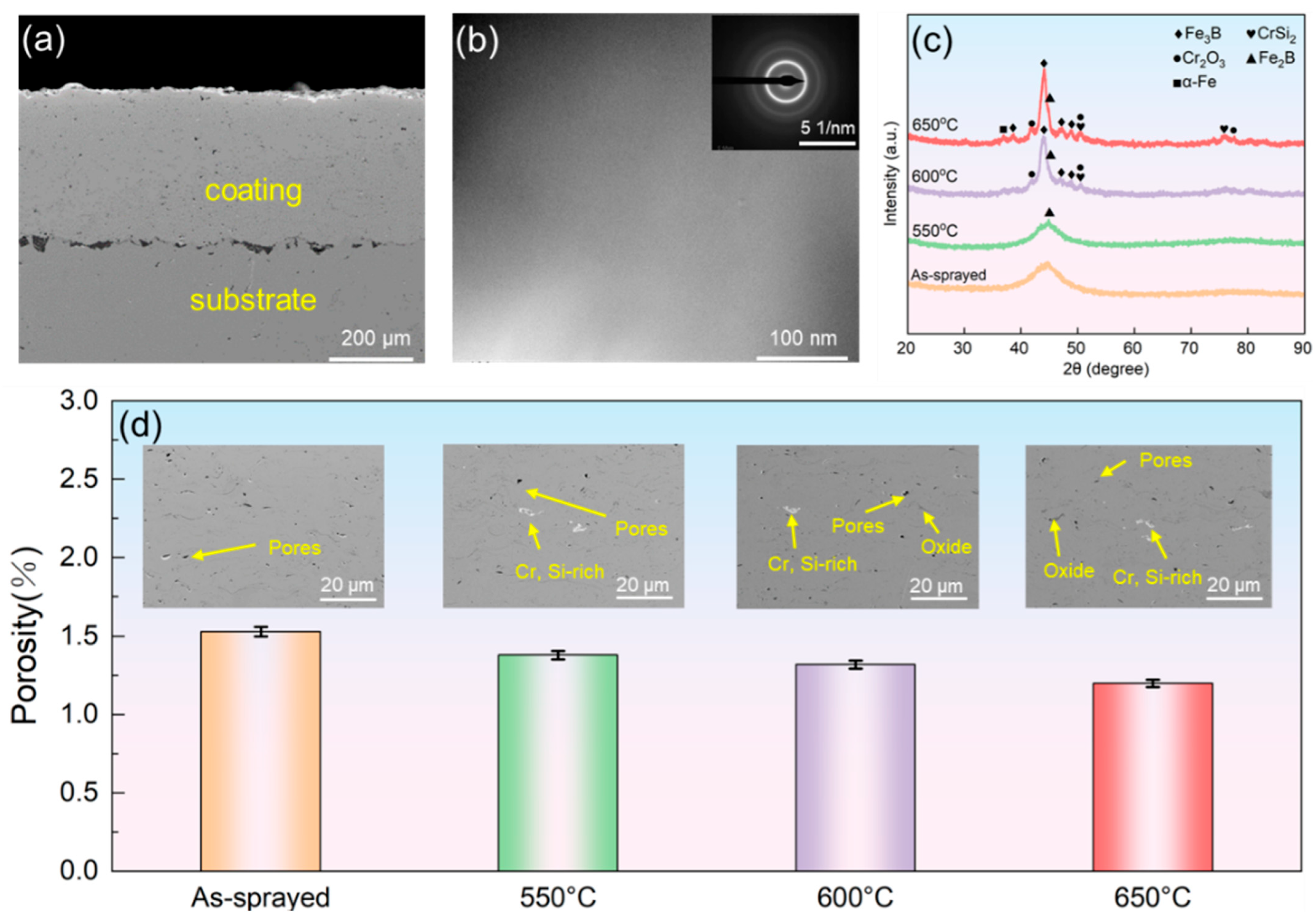
The morphology and microstructure of AS are shown in Figure 1. As illustrated in Figure 1a, AS has a compact microstructure and retains a strong connection with the substrate. Figure 1b shows TEM diffraction rings, which confirm that the coating is entirely amorphous. The XRD pattern in Figure 1c exhibits a broad diffuse peak at 2θ = 40°–50°, indicating that AS consists of a single amorphous phase. HT-550 displays a similar pattern, confirming that its amorphous structure is retained. The diffusion peak of HT-600 weakens, and peaks appear at approximately 44°, indicating the crystallization of the coating. The peak sharpening of HT-650 and the appearance of additional crystalline peaks indicate a significant crystallization process, and identified phases include Fe2B, Fe3B, CrSi2, and Cr2O3. The amorphous contents for HT-550, HT-600, and HT-650 calculated using MDI Jade 6.5 are ~92.1%, 45.5%, and 24.7%, respectively. Figure 1d presents the porosity of the coatings, with the insets showing the corresponding cross-sectional morphologies. The coatings contain pores, which are formed by the inadequate interlocking of pancake-shaped particles (formed via the plastic deformation of high-velocity molten particles that impact the substrate during HVAF), thus creating noncontact regions. The porosities of AS, HT-550, HT-600, and HT-650 are 1.53, 1.38, 1.32, and 1.20, respectively Three samples of each coating were tested, with the error values all around 1.5%. The reduction in porosity with increasing annealing temperature suggests a progressive densification of the coating structure. This is due to the self-fluxing reactions of B and Si during heat treatment [22]. Cr/Si-rich phases and oxides are observed in the heat-treated coatings, indicating concurrent crystallization and oxidation.
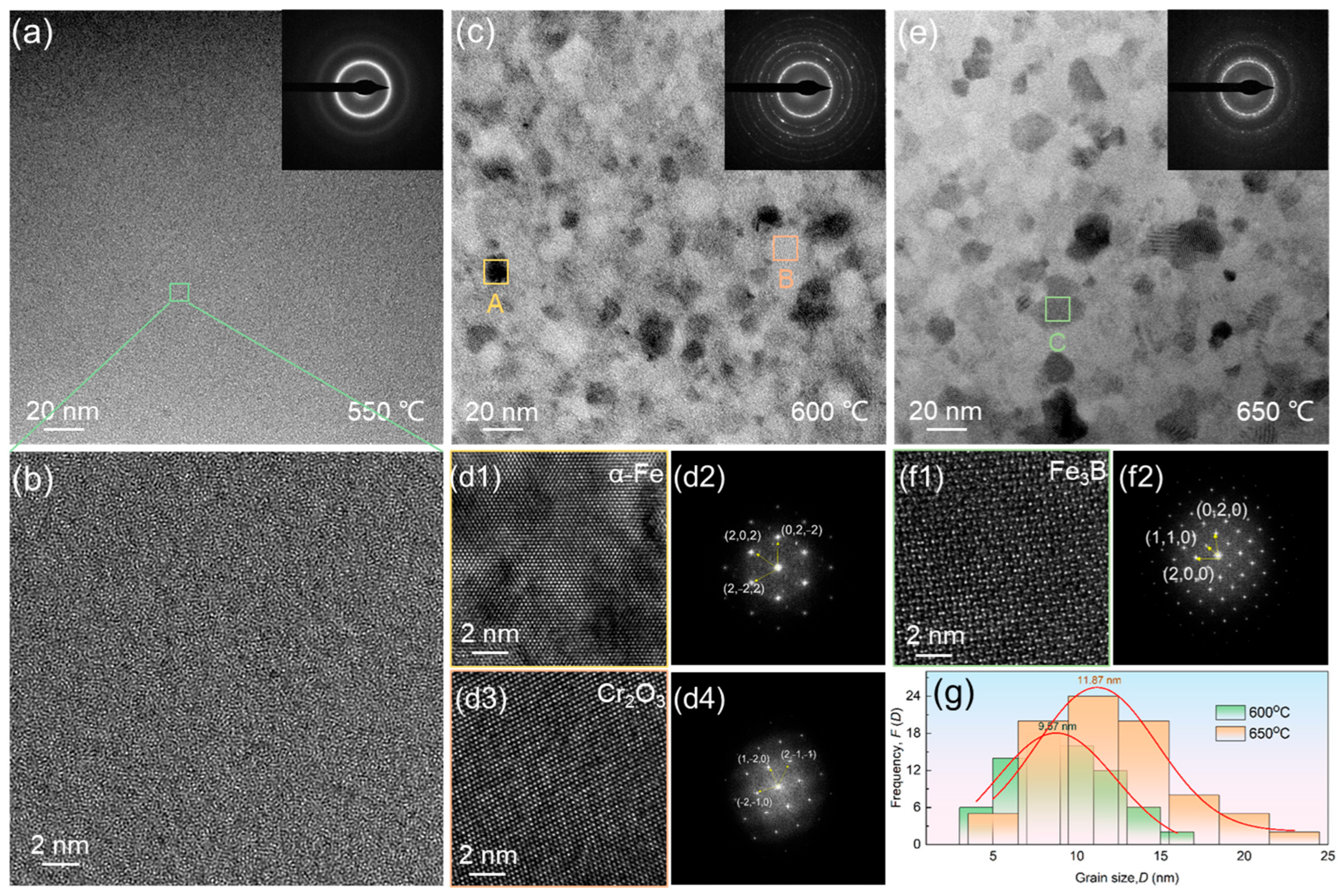
The TEM images illustrate the changes in the microstructure of Fe60Nb3B17Si6Cr6Ni4Mo4 at various annealing temperatures. Figure 2a,c,e present the morphologies of HT-550, HT-600, and HT-650, respectively. For HT-550, the microstructure remains uniform, and the inset SAED pattern confirms its amorphous nature. In contrast, HT-600 results in the emergence of distinct regions (A and B). HRTEM images shown in Figure 2(d1,d3) and the fast Fourier transform (FFT) patterns shown in Figure 2(d2,d4) verify the presence of the α-Fe and Cr2O3 phases. The HRTEM image (Figure 2(f1)) and FFT (Figure 2(f2)) of HT-650 confirm the formation of the Fe3B phase. The grain size distribution histogram further quantifies the microstructural changes, indicating that the grain size increases as the temperature increases from 600 °C to 650 °C. The fitted curve demonstrates the statistical distribution characteristics of the grain size and that the annealing temperature significantly affects the phase composition, grain size, and microstructural attributes of the coating.

3.2. Mechanical and Tribological Properties

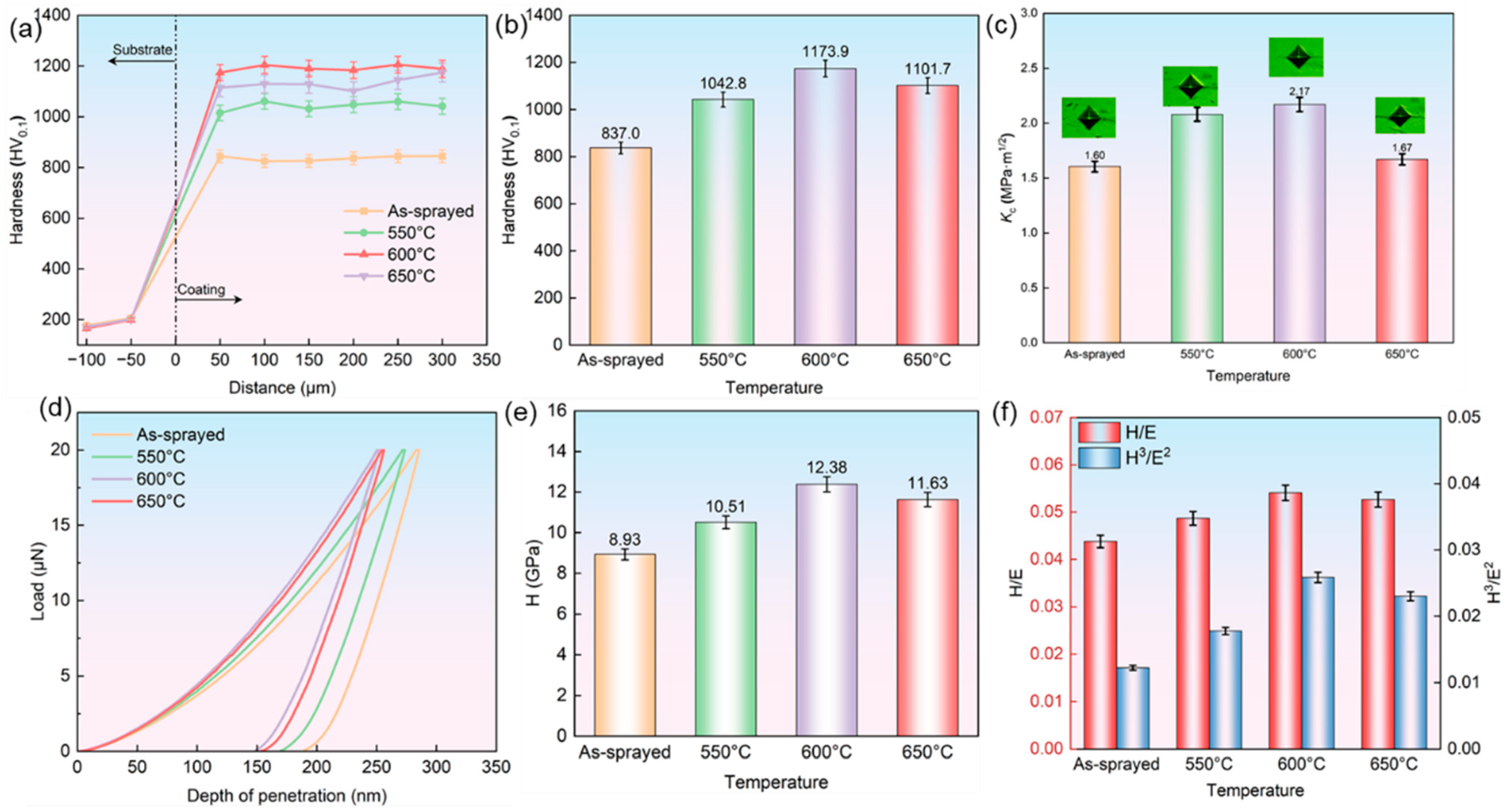
This study investigates the mechanical characteristics of different coatings by conducting hardness, tensile, and nanoindentation tests, and the results are shown in Figure 3. To ensure the validity of the regularity, three tests were conducted for each different coating, and the average value was calculated. Figure 3a shows the hardness distribution from the substrate to the coating surface. The hardness values for HT-550, HT-600, and HT-650 are 1042.8 HV0.1, 1173.9 HV0.1, and 1101.7 HV0.1, respectively, as shown in Figure 3b. The hardness of these coatings is better than that of AS. As shown in Figure 3c, the fracture toughness of AS and HT-600 is 1.60 MPa·m−1/2 and 2.17 MPa·m−1/2, respectively. This is because annealing regulates the density and grain boundaries. For HT-650, fine grains precipitate, the number of grain boundaries increases, and crack propagation is hindered owing to energy dissipation. However, for HT-650, grains grow, the number of grain boundaries reduces, and toughness decreases. As shown in the load–displacement curves in Figure 3d, the maximum indentation depth (hmax) initially decreases and then increases as the temperature increases. The values of hmax are 285.3 nm, 273.6 nm, 251.5 nm, and 256.3 nm for AS, HT-550, HT-600, and HT-650, respectively. As shown in Figure 3e, the nanohardness and elastic modulus are higher than those of AS and HT-600. The mechanism is as follows: small nanocrystals are precipitated at an annealing temperature of 550 °C, followed by the precipitation of large crystals at 600 °C. At 650 °C, grain growth weakens the grain boundary–dislocation interaction, thus reducing hindrance. As shown in Figure 3f, HT-600 exhibits optimal H/E and H3/E2 (related to wear resistance, reflecting the elastic limit and plastic deformation resistance), which is consistent with the hardness and toughness trends. This confirms the advantageous properties obtained at this temperature.
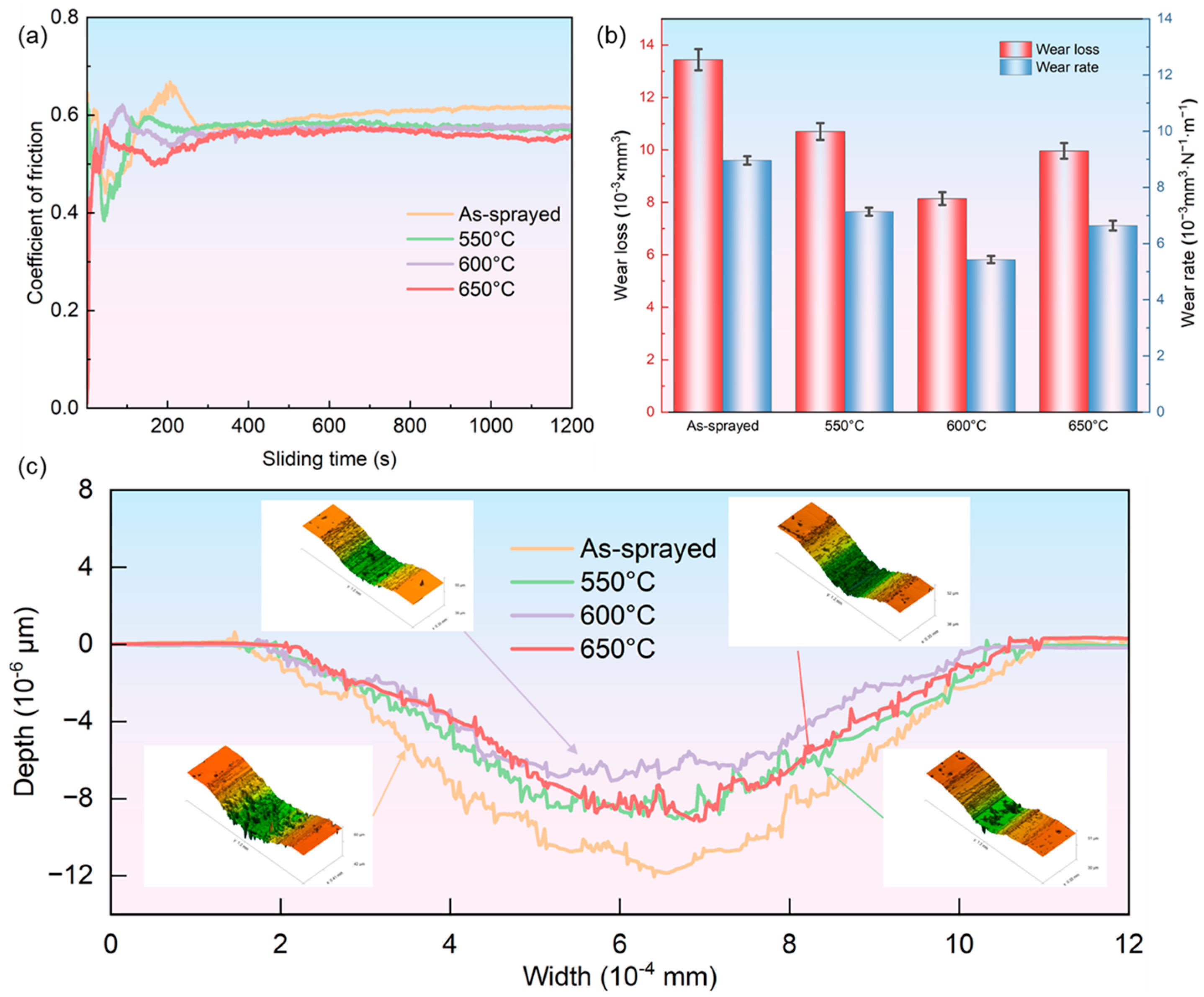
Tribological characteristics are essential for assessing the functional usability of coatings because they directly impact their lifespan and reliability in applications. Figure 4a shows the friction coefficient curves of the annealed coatings, all of which display a similar trend. In the steady-state phase, the friction coefficient shows minor variations and remains stable owing to the dynamic equilibrium between the formation and degradation of the oxide layer on the worn surface. The coatings exhibit comparable average friction coefficients, suggesting similar wear mechanisms. Figure 4b shows the wear-related data. The performance of all heat-treated coatings is superior to that of AS, and they show the same trend as the change in hardness. HT-600 shows the lowest wear rate of 4.53 × 10⁻⁶ mm3·N−1·m−1, with a wear resistance approximately 1.65 times that of AS. However, the reduced fracture toughness of HT-650 results in a higher wear rate compared with HT-600. The highest H/E and H3/E2 ratios obtained for HT-600 further support its excellent wear resistance. Figure 4c presents the cross-sectional profiles and 3D morphologies of the wear scars. For AS, the scar width (0.968 mm) and depth (12.04 mm) are greater than those of the heat-treated coatings, indicating the most severe wear under a 50 N load at 5 Hz. The wear scars became narrower and shallower as the annealing temperature increases. The wear scar width for HT-600 is 0.843 mm (~14.8% lower than that of AS), and the depth is 5.92 mm (~half of AS). This confirms that the optimal wear resistance is obtained at 600 °C. The worn surface becomes smoother as the annealing temperature increases, with reduced roughness, fewer and smaller pits, and more parallel plow grooves. These observations are consistent with the wear resistance trend reflected by the cross-sectional profiles.

3.3. Corrosion Resistance

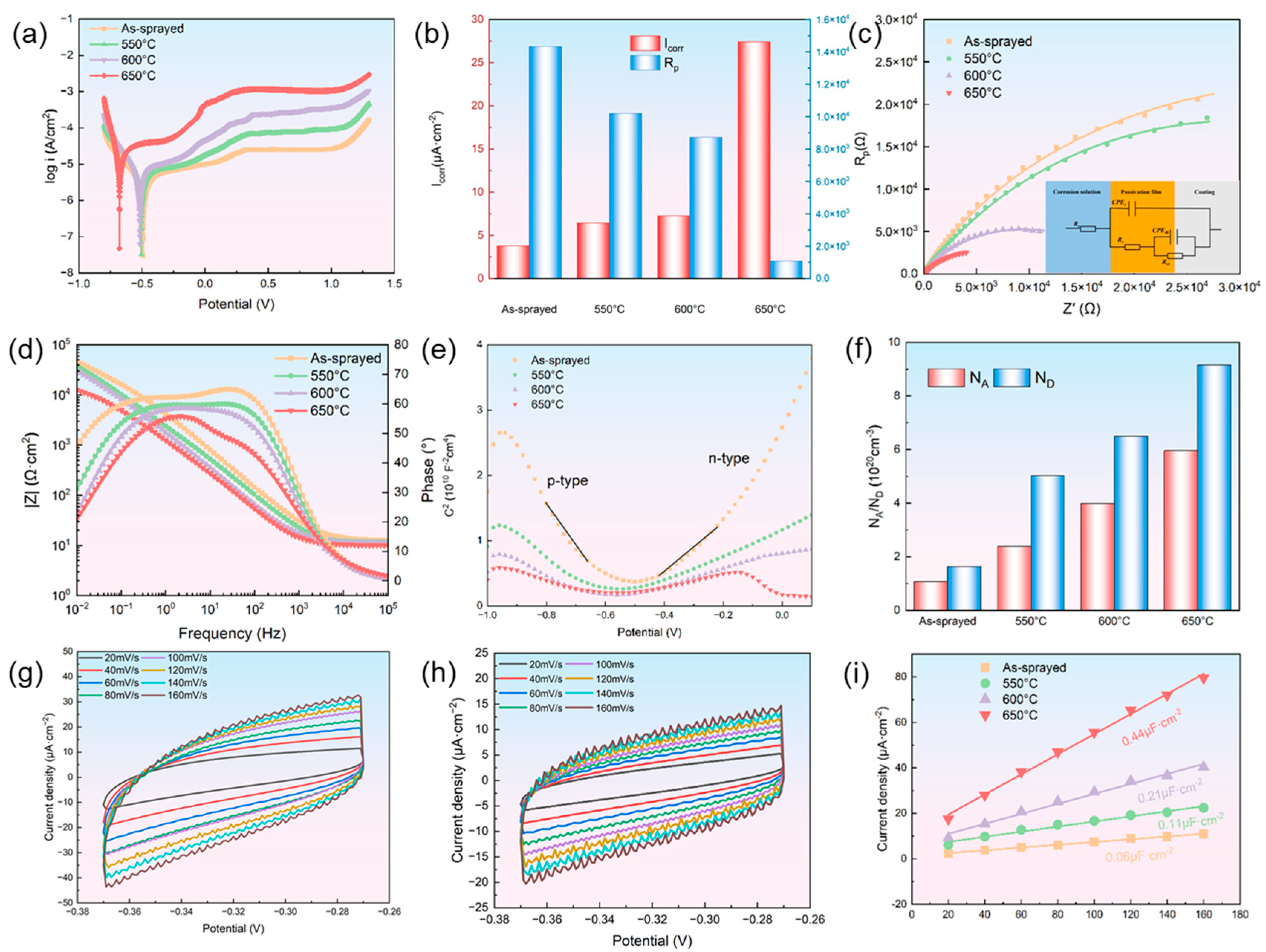
The potentiodynamic polarization behavior of the coatings is illustrated in Figure 5a, and the corresponding electrochemical parameters are summarized in Table 1. The shapes of the polarization curves of the heat-treated coatings are similar. All curves exhibit significantly higher anodic slopes than cathodic slopes, which is characteristic of the anodic-controlled electrochemical corrosion rate. AS exhibits the widest range in the cathodic and anodic polarization curves, with a distinct passive region. This indicates that AS can develop a compact passive layer that separates the coating from the solution during anodic corrosion and significantly decreases the rate of anodic dissolution [23]. The values of Ecorr and Icorr for AS are −491 mV and 3.78 μA·cm−2, respectively. For HT-550, HT-600, and HT-650, the values of Ecorr are −505 mV, −518 mV, and −732 mV and those of Icorr are 6.43 μA·cm−2, 7.26 μA·cm−2, and 27.42 μA·cm−2, respectively. As the temperature increases, Ecorr significantly decreases, whereas Icorr increases. The polarization resistance (Rp) is determined using the Stern–Geary equation [24], as follows:
R P = β A × β C 2.203 × I c o r r × β A + β C
where βA and βC represent the slopes of the anodic and cathodic sections of the polarization curve, respectively. The value of Rp for AS (14,334 Ω) is higher than that for the heat-treated coatings, as shown in Table 1. AS also shows the highest value of Ecorr and lowest value of Icorr among the coatings. An increase in the annealing temperature decreases the corrosion resistance of the coatings. There are several reasons for this. First, when the crystallinity of the coatings increases, it leads to the formation of more grain boundaries, which create additional routes for electrolyte diffusion. Second, the partial depletion of Cr in the coatings leads to the formation of Cr-depleted areas, thereby enhancing the local corrosion initiation strength. Third, recrystallisation due to heat treatment encourages microcellular corrosion reactions between different phases, resulting in phase corrosion. Fourth, the passive film formed by crystalline materials is loose and porous with more defects, whereas the passive film created by amorphous materials is uniformly dense and provides more effective protection for the material [25].
The EIS results obtained for the coatings are presented in Figure 5c,d. In the Nyquist plots, an increased semicircle radius indicates a modest reduction in corrosion rate and a corresponding enhancement in corrosion resistance [26]. The Nyquist plots exhibit semicircular impedance arcs, with AS showing the largest radius. The arc radius decreases progressively with increasing annealing temperature. In the Bode plot, |Z|10mHz reflects the corrosion resistance of the material, while the phase angle characterizes its ability to impede electrolyte penetration. Higher |Z|10mHz values and phase angles correspond to better corrosion resistance and stronger resistance to electrolyte penetration [27]. Figure 5d illustrates that |Z|10mHz and the phase angle for AS are the highest at 4.6 × 10⁴ Ω·cm2 and 64.89°, respectively. As the annealing temperature increases, |Z|10mHz and the phase angle gradually decrease, implying a steady reduction in corrosion resistance. Moreover, crystallization of the coatings leads to an increase in the corrosion rate.
The equivalent circuit model obtained after fitting the Nyquist plot is presented in Figure 5c. Rs, Rc, and Rct represent the solution, coating, and charge transfer resistance, respectively. Qc and Qdl represent the capacitance of the coatings and electric double-layer capacitance (EDLC), respectively. Table 2 shows the fitting parameters. The chi-squared (χ2) value is approximately 10−4, suggesting that the circuit selection is reasonable and reliable. A constant phase element (CPE) is used because of the uneven surface of the coating. The impedance of the CPE is calculated as follows [28]:
Z C P E = 1 Q j ω n
Here, ω represents the angular frequency, j denotes the imaginary unit, and n (−1 ≤ n ≤ 1) is the dispersion coefficient of the CPE. The thickness (d) of the passive film is estimated using the following formula [29,30,31]:
d = ε ε 0 A C e f f
where ε represents the vacuum permittivity (8.85 × 10⁻¹⁴ F/cm), ε0 denotes the relative dielectric constant of the passive film (15.6) [31], A is the area of the coating sample exposed to the solution (1 cm2), and Ceff is the effective capacitance, which is determined as follows [28,32]:
C e f f = Q c 1 n c R s 1 n c n c
where nc represents the CPE index associated with surface irregularities and Rs denotes the resistance of the solution.
Table 2 lists the passive film thicknesses for the coatings calculated using Equations (3) and (5). The maximum passive film thickness (2.72 nm) is obtained for AS. Generally, a higher value of Rct indicates a denser passive film, which makes charge transfer more difficult [33] and indicates that the passive film of AS is thick and dense. With increasing annealing temperature, both passive film thickness and Rct decrease, reflecting diminished resistance to corrosive medium penetration and a consequent acceleration of the corrosion rate.
The M–S test was conducted to evaluate the semiconductor characteristics of the passive films. Within the conventional M–S framework, variations in applied potential modulate electron transfer across defect states, leading to carrier movement into or out of the passive film. When the space charge region becomes depleted, an M-S relationship is formed between the applied voltage (E) and the capacitance of the space charge layer (C) [34,35], as follows:
n-type semiconductors:
1 C 2 = 2 e   ×   ε × ε 0 × N D E - E F B - K × T e
p-type semiconductors:
1 C 2 =   - 2 e   ×   ε × ε 0 × N A E - E F B - K × T e
The Boltzmann constant (denoted by K) is 1.38 × 10⁻²³ J·K-1, and e represents the elementary charge (1.602 × 10⁻¹⁹ C). The flat-band potential, EFB, can be determined when 1/C2 = 0. NA and ND refer to the densities of the acceptor and donor carriers, respectively. T represents the absolute temperature, and the value of (K × T)/e is approximately 25 mV at room temperature, which can be neglected.
Figure 5e shows the semiconductor characteristics of the passive films. The films on all coatings are dominated by cation vacancies at potentials below −0.5 V and by oxygen vacancies or cation interstitials above −0.5 V. Figure 5f shows the values of NA and ND for the passive film calculated from the slopes of the linear sections in the M-S plot using Equations (6) and (7). The highest value of EFB is obtained for AS, signifying the highest energy barrier, which hinders electron transfer and results in the formation of the most stable passive film [33]. Generally, NA is correlated with the electron transfer velocity at the interface of the passive film and solution. Conversely, ND characterizes the oxygen vacancy density in the passive film, and this concentration property can provide favorable conditions for the adsorption of corrosive chloride ions [34]. AS shows the lowest values of NA and ND, indicating the densest and most stable passive film with the fewest defects. NA and ND increase with the annealing temperature, suggesting that the passive films in the coatings become more porous, which diminishes their protective capabilities. AS shows the greatest corrosion resistance, in agreement with the polarization results.
ECSA is an important indicator of corrosion features. It provides a measure of the catalytically active sites engaged in interfacial redox processes. This metric allows for the normalization of electrochemical activity measurements, thereby enabling precise comparisons between different heterogeneous surfaces. The ECSA is typically assessed by determining the EDLC (Cdl) through CV in potential regions that exhibit non-Faradaic behavior. A higher ECSA implies an increased tendency for the initiation of localized corrosion because it indicates that more defect sites are exposed to the surrounding environment. The following formula can be used to calculate the ECSA:
E C S A = C d l C s
where Cs represents specific capacitance. Cdl, which is essential for evaluating the ECSA, is determined by subjecting the coatings to CV analyses at scan rates of 20–160 mV/s. Figure 5g,h present the CV curves of AS and HT-650, respectively, at different scan rates. The curves for both coatings exhibit a clear quasirectangular profile, which directly reflects the typical non-Faradaic charge–discharge behavior. In addition, it indicates that the material primarily relies on an EDLC mechanism for energy storage. As shown in Figure 5i, Cdl is estimated using the linear regression of the capacitive current (Δj = janodicjcathodic) against the scan rate (v). Then, the slope of the resulting linear regression is obtained. Finally, Cdl is derived using the formula Cdl = Δj/2v, which ensures the scientific validity and accuracy of the capacitance estimation. The magnitude of Cdl decreases in the order HT-650 > HT-600 > HT-550 > AS. Given that the ECSA is positively correlated to Cdl, AS shows the least exposure to reactive surface defects, slower kinetics of interfacial charge transfer, and enhanced barrier properties against the infiltration of corrosive ions, thereby achieving the highest corrosion resistance.
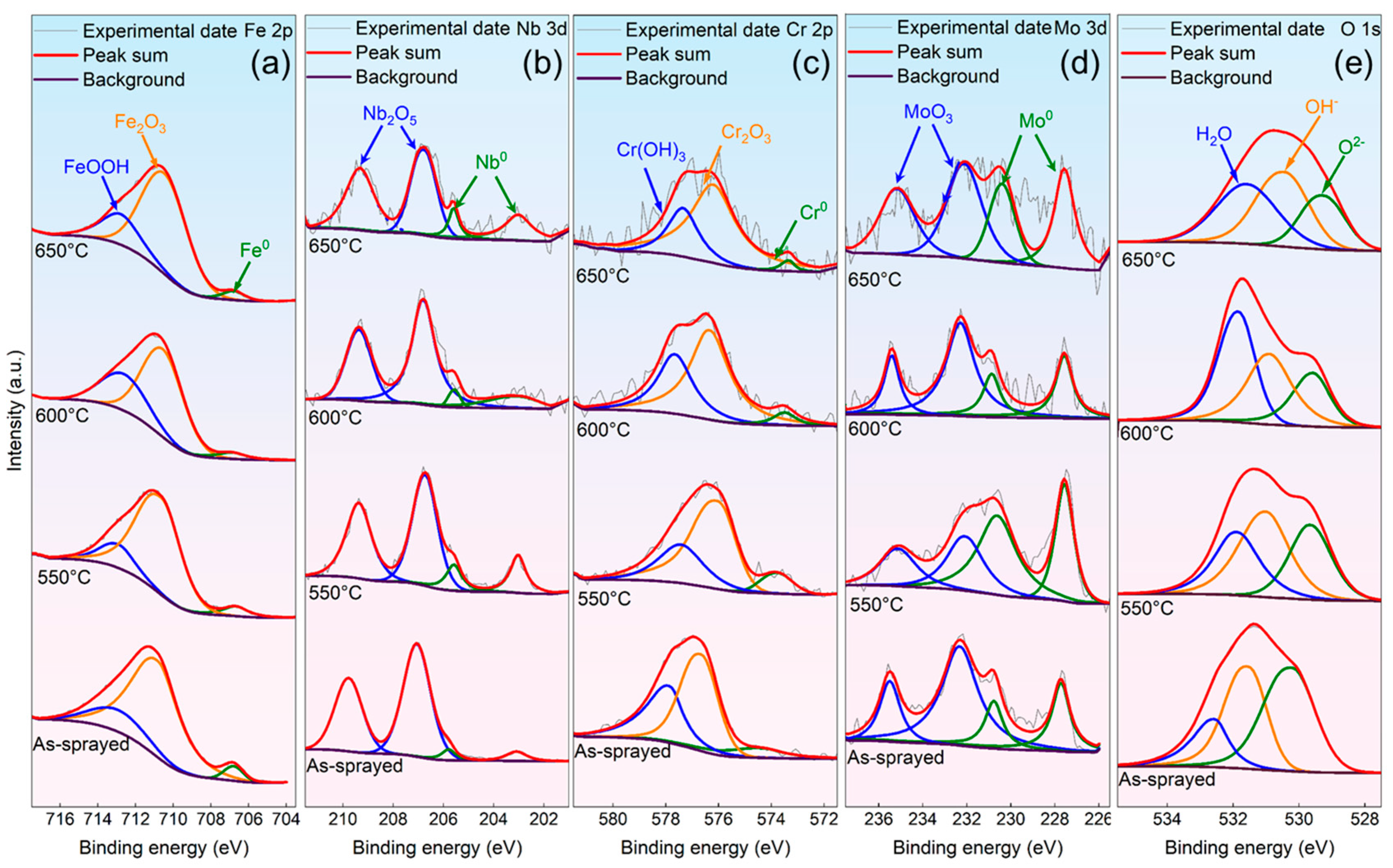
XPS analyses are performed on the samples to obtain detailed insights into the composition of the passive films on the coatings. The peaks associated with Fe 2p, Nb 3d, Cr 2p, Mo 3d, and O 1s are detected in all specimens, and Figure 6 presents the detailed XPS spectra for each element. Metallic Fe0 (706.5 eV), FeOOH (712.9 eV), and Fe2O3 (711.0 eV) are observed in the Fe 2p spectrum. The Nb 3d spectrum shows metallic Nb0 (203.1 eV, 205.8 eV) and Nb2O5 (207.0 eV, 209.8 eV). Metallic Cr0 (574.3 eV), Cr (OH)3 (577.6 eV), and Cr2O3 (576.8 eV) are identified in the Cr 2p spectrum. The Mo 3d spectrum exhibits peaks corresponding to metallic Mo0 (227.7 eV, 230.9 eV) and MoO3 (232.3 eV, 235.6 eV). H2O (532.8 eV), OH (531.8 eV), and O2−(530.1 eV) are observed in the O 1s spectrum. The detection of O2− and OH species suggests that the passive films on all the examined samples consist of a composite of metal oxides and hydroxides. Additionally, the presence of H2O indicates the presence of bound water within the passive film, which is essential for preserving its stability [34,35,36,37]. The dynamic properties of bound water enable it to efficiently mitigate the damage sustained by the passive film. Passive film degradation initiates its dissolution, causing metal ions to migrate from the substrate to the surface. There, their interaction with adsorbed water promotes film repair, thereby suppressing further degradation and pitting corrosion [28,38].
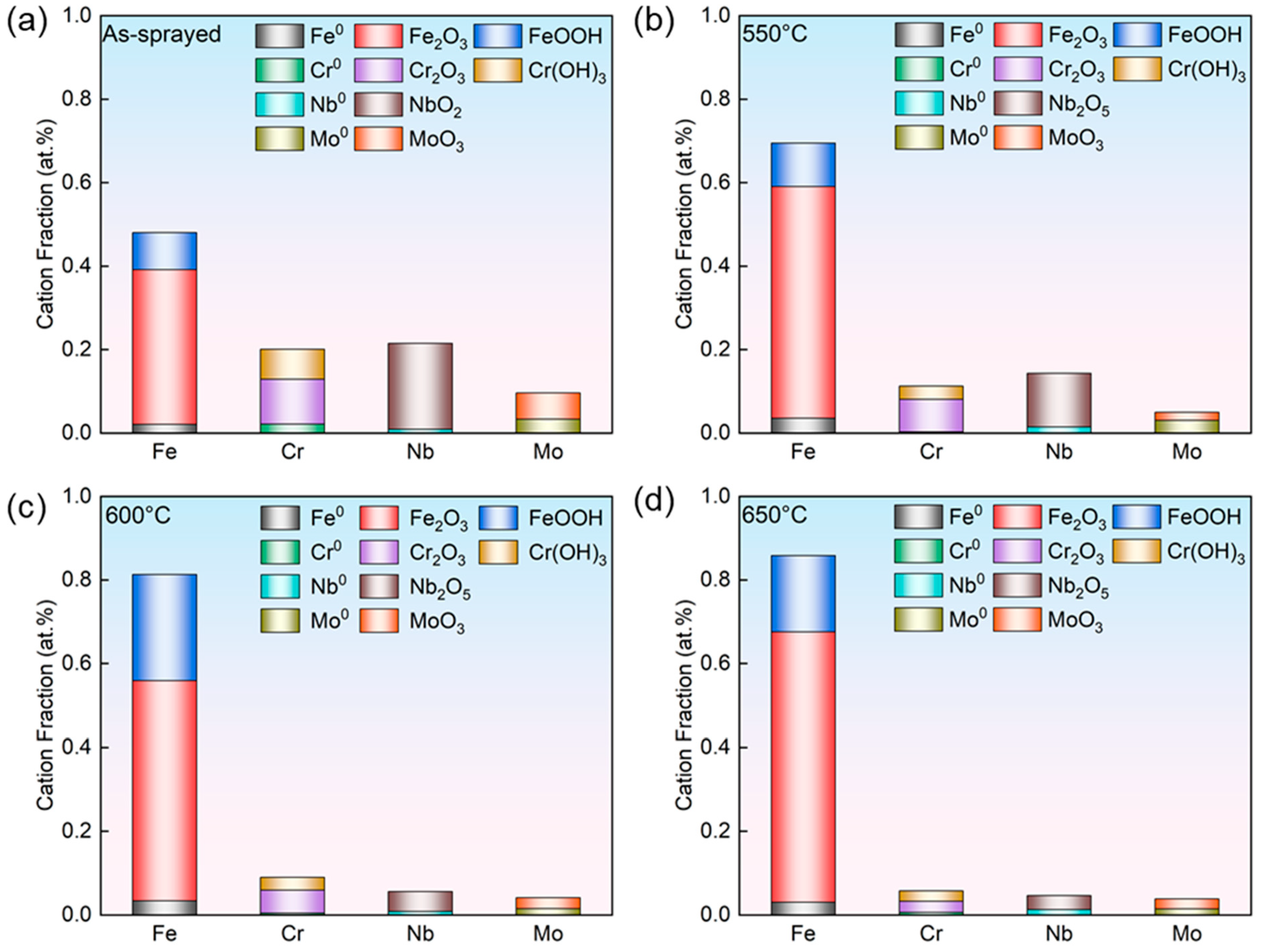
The area under the peaks in the XPS spectra indicates the amount of the substances present in the samples. The peak areas are adjusted to determine the relative proportions of metal oxides and hydroxides in the passive film. As shown from Figure 7a to Figure 7d, as the grain size increases, the contents of Cr, Nb, and Mo gradually decrease from their peak values, whereas the Fe content increases gradually. Iron oxides generally develop porous structures, which render them susceptible to corrosion under aggressive conditions. Conversely, the oxides of Cr, Ni, and Mo are characterized by their density and stability. As a result, they successfully prevent corrosion induced by chloride ions in neutral settings [39,40] and provide optimal protection for the coating. This factor is a primary determinant of the variation in corrosion resistance between the relaxed and as-sprayed conditions.
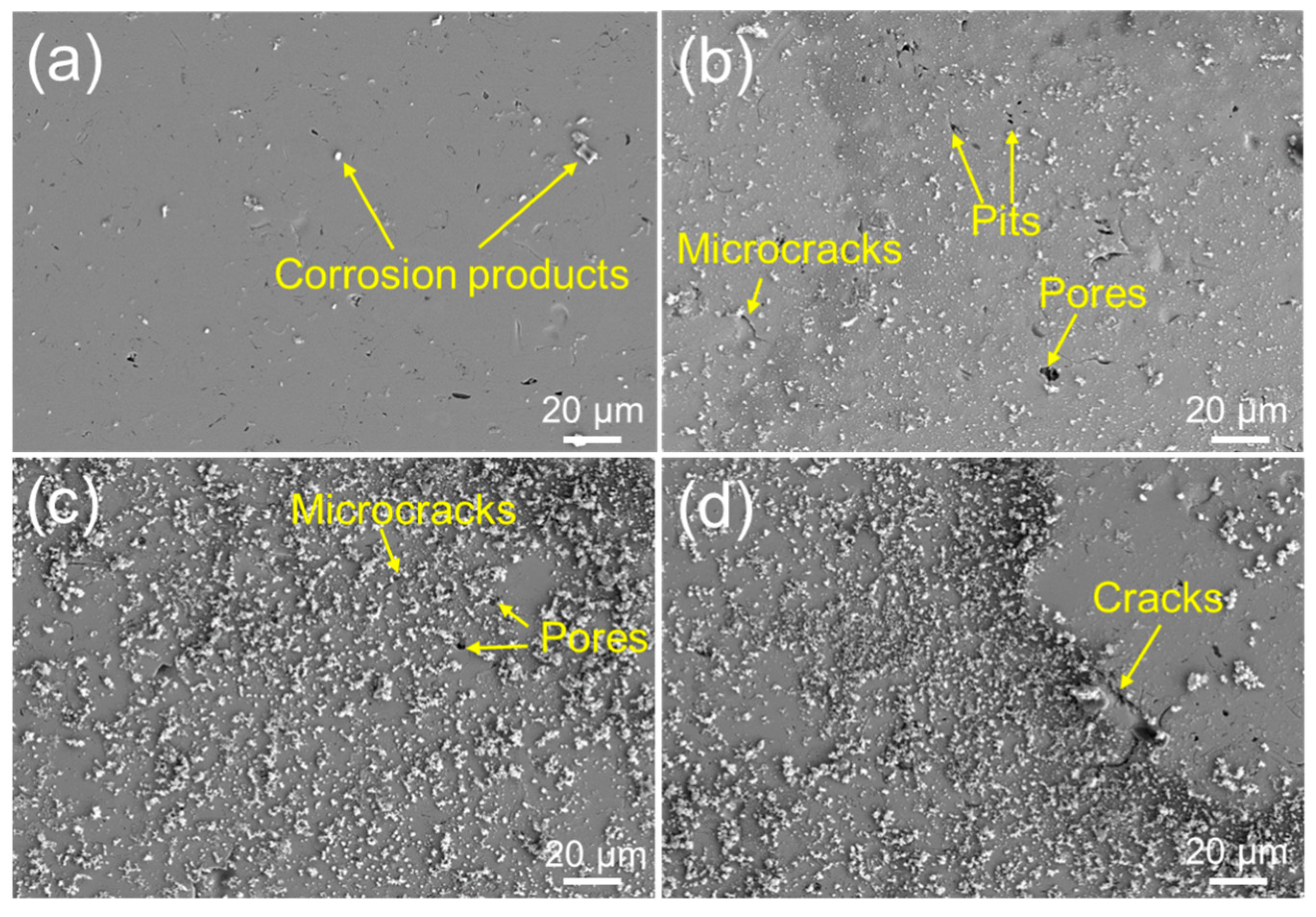
Figure 8 shows the surface morphologies of the coatings after the immersion test. A minimal presence of white, flocculent corrosion products is observed on the surface of AS. As the annealing temperature rises, the quantity of surface corrosion products progressively increases. The surface of HT-650 shows a large amount of corrosion products and a few pits, implying that this coating experiences the maximum corrosion. As illustrated in Figure 6, the passive layer on HT-650 contains relatively fewer Cr, Nb, and Mo oxides, and almost 85% of the surface consists of loosely distributed porous Fe oxides. The composition of HT-650 makes it particularly vulnerable to corrosion. Furthermore, the significant degree of crystallinity within the coating and a high density of active sites, such as the interfaces of precipitate phases and grain boundaries, increases the likelihood of corrosion along the grain boundaries. These factors reduce the overall corrosion resistance [41,42].

4. Conclusions

In this work, amorphous Fe60Nb3B17Si6Cr6Ni4Mo4 coatings were prepared via the HVAF process. The microstructural features alongside the wear and corrosion properties of coatings with varying crystallization extents were comprehensively assessed. The principal outcomes are detailed below.
(1) The coating that was annealed at 550 °C (47 °C below Tx) retained its amorphous structure. Crystalline phases, including Fe3B, CrSi2, and Cr2O3, were formed as the annealing temperature increased. In addition, the amorphous content of the coating gradually decreased, resulting in a decrease in porosity.
(2) Owing to partial crystallization and grain refinement in the coating annealed at 600 °C, a high microhardness, toughness, nanohardness, and elastic modulus of 1173.9 HV0.1, 2.17 MPa·m1/2, 12.38 GPa, and 229 GPa were obtained, respectively. Moreover, the coating demonstrated a low wear rate of 4.53 × 10⁻⁶ mm3·N−1·m−1, which was 1.65 times higher than that of AS.
(3) When the coating was in a relaxed state, the content of Cr-based, Mo-based, and Nb-based compounds in the passive film decreased, whereas the content of Fe-based compounds increased, which increased the number of active sites. These factors reduced the corrosion resistance of the coating.

Author Contributions

Conceptualization, J.C. and X.L.; Investigation, L.X. and Y.F.; Methodology, Z.Z., L.X., P.S., X.L., J.C. and B.Z.; Project administration, J.C.; Formal analysis, Y.F. and P.S.; Date curation, Y.F.; Validation, S.W.; Writing—original draft, S.W. Writing—review & editing, L.S. All authors have read and agreed to the published version of the manuscript.

Funding

This work was supported by National Natural Science Foundation of China (Grant No. 52375180 and 52275225).

Data Availability Statement

Data are contained within the article.

Acknowledgments

We thank the support of the Innovation Center for Critical Materials in Hydraulic Infrastructure Safety and Water Environment Restoration, Hohai University, and the Jiangsu Provincial Engineering Research Center for Structure-Function Integrated Metallic Materials for Harsh Environments.

Conflicts of Interest

The authors declare no conflict of interest.

References

  1. Zhang, H.L.; Yang, L.X.; Wang, Q.; Wu, J.T.; Zhang, S.D.; Zeng, C.L. Hot corrosion behaviors of 921A alloy and HVAF-sprayed Fe-based amorphous coating covered with KCl-ZnCl2 salts. J. Iron Steel Res. Int. 2023, 30, 1537–1549. [Google Scholar] [CrossRef]
  2. Bobzin, K.; Ote, M.; Knoch, M.A.; Sommer, J. Influence of Powder Size on the Corrosion and Wear Behavior of HVAF-Sprayed Fe-Based Coatings. J. Therm. Spray Technol. 2019, 28, 63–75. [Google Scholar] [CrossRef]
  3. Tsai, P.H.; Xiao, A.C.; Li, J.B.; Jiang, J.S.C.; Chu, J.P.; Huang, J.P. Prominent Fe-based bulk amorphous steel alloy with large supercooled liquid region and superior corrosion resistance. J. Alloys Compd. 2014, 586, 94–98. [Google Scholar] [CrossRef]
  4. Cai, M.J.; Wang, J.J.; Wang, Q.Q.; Li, J.; Dong, W.Y.; Guo, Z.J.; Shen, B.L. Improvement of soft-magnetic properties for Fe-based amorphous alloys with high saturation polarization by stress annealing. Mater. Res. Lett. 2023, 11, 595–603. [Google Scholar] [CrossRef]
  5. Farmer, J.; Choi, J.S.; Saw, C.; Haslam, J.; Day, D.; Hailey, P.; Lian, T.; Rebak, R.; Perepezko, J.; Payer, J.; et al. Iron-Based Amorphous Metals: High-Performance Corrosion-Resistant Material Development. Metall. Mater. Trans. A-Phys. Metall. Mater. Sci. 2009, 40, 1289–1305. [Google Scholar] [CrossRef]
  6. Shi, L.X.; Qin, X.L.; Yao, K.F. Tailoring soft magnetic properties of Fe-based amorphous alloys through C addition. Prog. Nat. Sci.-Mater. Int. 2020, 30, 208–212. [Google Scholar] [CrossRef]
  7. Huang, F.; Kang, J.J.; Yue, W.; Fu, Z.Q.; Zhu, L.N.; She, D.S.; Liang, J.; Wang, C.B. Corrosion Behavior of FeCrMoCBY Amorphous Coating Fabricated by High-Velocity Air Fuel Spraying. J. Therm. Spray Technol. 2019, 28, 842–850. [Google Scholar] [CrossRef]
  8. Shao, L.L.; Luo, Q.; Zhang, M.J.; Xue, L.; Cui, J.X.; Yang, Q.Z.; Ke, H.B.; Zhang, Y.; Shen, B.L.; Wang, W.H. Dual-phase nano-glass-hydrides overcome the strength-ductility trade-off and magnetocaloric bottlenecks of rare earth based amorphous alloys. Nat. Commun. 2024, 15, 4159. [Google Scholar] [CrossRef]
  9. Lu, K.J.; Aktaa, J. Short-term tensile creep behavior of CoCrNi-based multi-principal element alloys. Intermetallics 2024, 175, 108500. [Google Scholar] [CrossRef]
  10. Wang, G.; Huang, Z.J.; Xiao, P.; Zhu, X.B. Spraying of Fe-based amorphous coating with high corrosion resistance by HVAF. J. Manuf. Process. 2016, 22, 34–38. [Google Scholar] [CrossRef]
  11. Li, M.C.; Guan, H.M. Unified upper temperature for cryogenic thermal cycling treatment in Fe- based bulk metallic glasses. J. Alloys Compd. 2023, 931, 167263. [Google Scholar] [CrossRef]
  12. Li, G.; Gan, Y.Y.; Liu, C.H.; Shi, Y.; Zhao, Y.C.; Kou, S.Z. Corrosion and Wear Resistance of Fe-Based Amorphous Coatings. Coatings 2020, 10, 73. [Google Scholar] [CrossRef]
  13. Liu, X.Q.; Qiu, Z.G.; Zeng, D.C. Corrosion and Reciprocating Sliding Behavior of AC-HVAF Sprayed FeCrMoCBSi Amorphous Coating on Stainless Steel. J. Therm. Spray Technol. 2022, 31, 2207–2218. [Google Scholar] [CrossRef]
  14. Wang, J.W.; Yang, R.; Tian, Y.; Zhou, P.; Huang, J.; Li, H.; Chen, X.R. Effect of Annealing on the Cavitation Erosion Resistance of HVOF-Sprayed Fe-Based Amorphous Composite Coatings. J. Therm. Spray Technol. 2023, 32, 1758–1771. [Google Scholar] [CrossRef]
  15. Liu, L.C.; Shao, L.L.; Ma, Y.; Wen, Z.L.; Zhou, J.; Yan, Y.Q.; Yang, W.M.; Ke, H.B.; Wang, W.H. Sparse Nanocrystals Enable Ultra-Low Coercivity and Remarkable Mechanical Robustness in High-Entropy Amorphous Alloy. Adv. Sci. 2025, 12, e03546. [Google Scholar] [CrossRef] [PubMed]
  16. Shao, L.L.; Bai, R.; Wu, Y.; Zhou, J.; Tong, X.; Peng, H.L.; Liang, T.; Li, Z.Z.; Zeng, Q.S.; Zhang, B. Critical state-induced emergence of superior magnetic performances in an iron-based amorphous soft magnetic composite. Mater. Futures 2024, 3, 025301. [Google Scholar] [CrossRef]
  17. Bai, R.; Li, J.; Shao, L.L.; Zhou, J.; Lin, X.H.; Xue, Z.Y.; Lin, H.J.; Ke, H.B.; Wang, W.H. Ultrahigh saturation magnetization and optimized magnetic softness in a soft magnetic composite through nanoscale iron nitride. J. Mater. Sci. Technol. 2026, 248, 119–125. [Google Scholar] [CrossRef]
  18. Li, C.Y.; Wang, H.B.; Ding, J.Q.; Wang, S.P.; Li, J.L.; Kou, S.Z. Effects of heat treatment on HVOF-sprayed Fe-based amorphous coatings. Surf. Eng. 2021, 37, 590–598. [Google Scholar] [CrossRef]
  19. Lee, C.Y.; Sheu, H.H.; Tsay, L.W.; Hsiao, P.S.; Lin, T.J.; Lee, H.B. The Effect of Heat Treatment on the Corrosion Resistance of Fe-Based Amorphous Alloy Coating Prepared by High Velocity Oxygen Fuel Method. Materials 2021, 14, 7818. [Google Scholar] [CrossRef]
  20. Yang, Y.; Zhang, C.; Peng, Y.; Yu, Y.; Liu, L. Effects of crystallization on the corrosion resistance of Fe-based amorphous coatings. Corros. Sci. 2012, 59, 10–19. [Google Scholar] [CrossRef]
  21. Song, P.S.; Jing, Z.Y.; Zhang, Z.B.; Zhang, B.B.; Ge, Y.Y.; Xue, L.; Liang, X.B.; Cheng, J.B. Effect of Minor Mo Addition on Microstructure and Corrosion Resistance of High-Velocity Air Fuel-Sprayed Fe-Based Amorphous Coatings. Coatings 2023, 13, 2089. [Google Scholar] [CrossRef]
  22. Liu, W.H.; Shieu, F.S.; Hsiao, W.T. Enhancement of wear and corrosion resistance of iron-based hard coatings deposited by high-velocity oxygen fuel (HVOF) thermal spraying. Surf. Coat. Technol. 2014, 249, 24–41. [Google Scholar] [CrossRef]
  23. Liang, S.Y.; Zhu, F.; Wang, Y.J.; Pineda, E.; Wada, T.; Kato, H.; Qiao, J.C. On the kinetics of structural evolution in metallic glasses. Int. J. Eng. Sci. 2024, 205, 104146. [Google Scholar] [CrossRef]
  24. Mansfeld, F.; Lin, S.; Kim, S.; Shih, H. Corrosion Protection of Al Alloys and Al-Based Metal Matrix Composites by Chemical Passivation. Corrosion 1989, 45, 615–630. [Google Scholar] [CrossRef]
  25. Wang, D.P.; Wang, S.L.; Wang, J.Q. Relationship between amorphous structure and corrosion behaviour in a Zr-Ni metallic glass. Corros. Sci. 2012, 59, 88–95. [Google Scholar] [CrossRef]
  26. Cheng, J.B.; Wang, Z.H.; Xu, B.S. Wear and Corrosion Behaviors of FeCrBSiNbW Amorphous/Nanocrystalline Coating Prepared by Arc Spraying Process. J. Therm. Spray Technol. 2012, 21, 1025–1031. [Google Scholar] [CrossRef]
  27. Liu, X.; Wu, M.P.; Lu, P.P.; Ye, X.; Mxiao, X.J. Corrosion behavior of GO-reinforced TC4 nanocomposites manufactured by selective laser melting. Mater. Corros.-Werkst. Und Korros. 2020, 71, 628–636. [Google Scholar] [CrossRef]
  28. Liu, X.Y.; Chen, S.Y.; Zhang, J.J.; Yang, G.; Zhang, Y.; Wang, T.; Lei, J.B. Enhancement of the electrochemical corrosion resistance of Ti6Al4V alloy reinforced by nano- and micro-TiC particles through directed energy deposition. Corros. Sci. 2023, 221, 111343. [Google Scholar] [CrossRef]
  29. Navarro Laboulais, J.J.; Amigó Mata, A.; Amigó Borrás, V.; Igual Muñoz, A.N. Electrochemical characterization and passivation behaviour of new beta-titanium alloys (Ti35NblOTa-xFe). Electrochim. Acta 2017, 227, 410–418. [Google Scholar] [CrossRef]
  30. Hirschorn, B.; Orazem, M.E.; Tribollet, B.; Munoz, I.A. Determination of effective capacitance and film thickness from constant-phase-element parameters. Electrochim. Acta 2010, 55, 6218–6227. [Google Scholar] [CrossRef]
  31. Li, Z.; Zhang, C.; Liu, L. Wear behavior and corrosion properties of Fe-based thin film metallic glasses. J. Alloys Compd. 2015, 650, 127–135. [Google Scholar] [CrossRef]
  32. Qin, W.; Man, C.; Zhang, H.; Zhang, H.W.; Cui, Z.Y.; Wang, L.; Kong, D.C.; Dong, C.F.; Cui, H.Z. Corrosion behavior of L-PBF Ti6Al4V with heat treatments in the F--containing environments. Corros. Sci. 2023, 210, 110811. [Google Scholar] [CrossRef]
  33. Ge, T.; Chen, L.; Gu, P.F.; Ren, X.D.; Chen, X.M. Microstructure and corrosion resistance of TiC/Inconel 625 composite coatings by extreme high speed laser cladding. Opt. Laser Technol. 2022, 150, 107919. [Google Scholar] [CrossRef]
  34. Gong, P.; Wang, D.L.; Zhang, C.; Wang, Y.; Jamili-Shirvan, Z.; Yao, K.F.; Wang, X.Y. Corrosion behavior of TiZrHfBeCu(Ni) high-entropy bulk metallic glasses in 3.5 wt.% NaCl. npj Mater. Degrad. 2022, 6, 77. [Google Scholar] [CrossRef]
  35. Zhang, M.D.; Shi, X.L.; Li, Z.Y.; Xu, H.; Li, G. Corrosion behaviors and mechanism of CrFeNi2 based high-entropy alloys. Corros. Sci. 2022, 207, 110562. [Google Scholar] [CrossRef]
  36. Fattah-alhosseini, A.; Soltani, F.; Shirsalimi, F.; Xu, H.Q.; Li, G. The semiconducting properties of passive films formed on AISI 316 L and AISI 321 stainless steels: A test of the point defect model (PDM). Corros. Sci. 2011, 53, 3186–3192. [Google Scholar] [CrossRef]
  37. Wang, L.; Yu, H.Y.; Wang, K.; Xu, H.S.; Wang, S.Y.; Sun, D.H. Local Fine Structural Insight into Mechanism of Electrochemical Passivation of Titanium. ACS Appl. Mater. Interfaces 2016, 8, 18608–18619. [Google Scholar] [CrossRef]
  38. Zhao, Q.C.; Pan, Z.M.; Wang, X.F.; Luo, H.; Liu, Y.; Li, X.G. Corrosion and passive behavior of AlxCrFeNi3-x (x=0.6, 0.8, 1.0) eutectic high entropy alloys in chloride environment. Corros. Sci. 2022, 208, 110666. [Google Scholar] [CrossRef]
  39. Sun, M.H.; Pang, Y.J.; Du, C.W.; Li, X.G.; Wu, Y.M. Optimization of Mo on the corrosion resistance of Cr-advanced weathering steel designed for tropical marine atmosphere. Constr. Build. Mater. 2021, 302, 124346. [Google Scholar] [CrossRef]
  40. Nayak, S.K.; Kumar, A.; Laha, T. Fe-based metallic glass coatings by thermal spraying: A focused review on corrosion properties and related degradation mechanisms. Int. Mater. Rev. 2023, 68, 404–485. [Google Scholar] [CrossRef]
  41. Song, P.S.; Cheng, J.B.; Wang, X.Y.; Zhang, Z.B.; Shao, L.L.; Xue, L.; Jing, Z.Y.; Zhang, B.S.; Wu, Y.P.; Hong, S.; et al. Corrosion and corrosion-wear behavior of the (FeCoCrNi)75B15Si10 high-entropy amorphous alloy coatings prepared by plasma spraying. Corros. Sci. 2025, 253, 113013. [Google Scholar] [CrossRef]
  42. Ge, Y.Y.; Cheng, J.B.; Xue, L.; Zhang, B.S.; Hong, S.; Liang, X.B.; Wang, S.G.; Zhang, X.C. Pore defect and corrosion behavior of HVAF-sprayed Co21Fe14Ni8Cr16Mo16C15B10 high entropy metallic glass coatings. Corros. Sci. 2025, 242, 112564. [Google Scholar] [CrossRef]
Figure 1. (a) Morphology, (b) TEM of as-sprayed coating, inset image in (b) was the selected area electron diffraction, (c) XRD patterns of coatings, (d) porosity size and distribution.
Coatings 15 01497 g001
Figure 2. (a) TEM of the HT-550, (b) HRTEM of region marked in (a). (c) TEM of the HT-600, (d1) HRTEM of region A marked in (c), (d2) FFT pattern corresponding to (d1), (d3) HRTEM of region B marked in (c), (d4) FFT pattern corresponding to (d3). (e) TEM of thee HT-650, (f1) HRTEM of region C marked in (e), (f2) FFT pattern corresponding to (f1), (g) grain size distribution histograms for HT-600 and HT-650, the red curves representing the fitting results. Inset images in (ac) show the corresponding SAED.
Coatings 15 01497 g002
Figure 3. Coatings mechanical properties: (a,b) hardness, (c) fracture toughness, (d) nanoindentation curves and related parameters, (e) nano Scripta Materialia hardness and (f) ratio of nanohardness to elastic modulus.
Coatings 15 01497 g003
Figure 4. Tribological performance of coatings (a) friction coefficient curves, (b) wear loss and wear rate, and (c) 3D morphology and cross-sectional profile.
Coatings 15 01497 g004
Figure 5. (a) PDP curves, (b) PDP test dates, (c) Nyquist plots, and the equivalent circuit models inset, (d) Bode plots, (e) M-S plots and (f) M-S test dates and CV curves of the coatings, (g) as-sprayed, (h) HT-650, (i) double-layer capacitance.
Coatings 15 01497 g005
Figure 6. High-resolution XPS spectra of (a) Fe 2p, (b) Nb 3d, (c) Cr 2p, (d) Mo 3d, and (e) O 1s.
Coatings 15 01497 g006
Figure 7. Cation fraction within passive film of the coatings as determined by XPS analysis is shown for different conditions: (a) date of as-sprayed, (b) date of HT-550, (c) date of HT-600, (d) date of HT-650.
Coatings 15 01497 g007
Figure 8. SEM of surface of coatings after immersion corrosion. (a) surface of as-sprayed, (b) surface of HT-550, (c) surface of HT-600, (d) surface of HT-650.
Coatings 15 01497 g008
Table 1. Electrochemical parameters of coatings.
SamplesASHT-550HT-600HT-650
Ecorr (mV)−491−505−518−732
Icorr (μA·cm−2)3.786.437.2627.42
Rp (Ω)14,33410,19987261079
Table 2. Fitted results for EIS of coatings.
ParameterASHT-550HT-600HT-650
Rs (Ω·cm2)11.6710.1712.7711.07
Qc × 10−5 (S·cm−2·sn)7.0929.1916.2120.52
nc0.75560.79860.75070.7366
Rc (Ω·cm2)87142564720.899.66
Qdl × 10−5 (S·cm−2·sn)2.1646.76711.4154.91
ndl0.60260.63870.63800.5929
Rct × 104 (Ω·cm2)7.7365.3642.0290.967
χ2 × 10−43.583.632.793.68
Disclaimer/Publisher’s Note: The statements, opinions and data contained in all publications are solely those of the individual author(s) and contributor(s) and not of MDPI and/or the editor(s). MDPI and/or the editor(s) disclaim responsibility for any injury to people or property resulting from any ideas, methods, instructions or products referred to in the content.