Article

Research on the Formation Mechanisms of Red Stains on Outdoor Marble Cultural Relics at Beijing Confucian Temple and the Imperial College


1
Key Laboratory of Archaeomaterials and Conservation, Ministry of Education, Institute for Cultural Heritage and History of Science & Technology, University of Science and Technology Beijing, Beijing 100083, China
2
National Museum of China, Beijing 100005, China
3
Confucian Temple and Imperial College Museum, Beijing 100007, China
*
Author to whom correspondence should be addressed.
Coatings 2025, 15(12), 1488; https://doi.org/10.3390/coatings15121488
Submission received: 27 November 2025 / Revised: 7 December 2025 / Accepted: 10 December 2025 / Published: 17 December 2025

Abstract

Stone relics exposed to outdoor environments frequently experience surface deterioration, with red stains being a common and persistent issue. The stains often observed on marble and limestone surfaces arise from complex interactions involving chemical reaction, pollutant deposition, and microbiological process. Although microbial colonization has been associated with biodeterioration, the specific mechanisms remain poorly understood. This study focuses on the red stains found on the Danbi marble carvings at Beijing Confucian Temple and the Imperial College. Combining microbial cultivation, molecular identification (ITS sequencing), SEM-EDS (Scanning Electron Microscopy), Raman spectroscopy, and HPLC-MS (high-performance liquid chromatography with mass spectrometry), we identified the pigment-producing fungus Lizonia empirigonia as the dominant agent, with no evidence of inorganic contributors such as iron/lead oxides. Metabolite profiling revealed flavonoids and polyketides as key coloring material, while controlled infection experiments demonstrated the fungus’s reliance on exogenous organic matter rather than direct stone degradation. Our findings highlight microbial activity as a primary driver of red stains in marble relics and underscore the importance of organic contaminant control in conservation.

1. Introduction

Stone relics subjected to prolonged outdoor exposure frequently display surface deterioration phenomena, including discoloration, flaking, and crust formation, which pose significant challenges in the field of cultural heritage conservation [1]. Red stains are a typical deterioration feature widely observed on carbonate-based substrates, including marble and limestone, in historic buildings and stone carvings [2]. Although their formation mechanisms are complex and exhibit regional variability, existing studies generally suggest that red stains likely arise from two primary processes: (1) chemical alteration of substrate minerals, such as the oxidation of intrinsic iron-bearing minerals leading to the formation of iron oxides (e.g., hematite, Fe2O3) or manganese oxides [3]; (2) deposition of exogenous pollutants, for instance, atmospheric lead compounds derived from historical roofing, piping, or industrial emissions, which can form red lead (minium, Pb3O4) or other chromatic compounds on stone surfaces [4] (e.g., pigment secretion and mineral dissolution).
Early studies predominantly focused on inorganic chemical mechanisms, particularly redox reactions involving lead compounds. For instance, red stains on historic buildings in Florence, Italy, such as the Cathedral of Santa Maria del Fiore, have been verified to correlate with lead corrosion products, specifically minium (Pb3O4) and cerussite (PbCO3), likely derived from lead-based materials used in past restoration efforts, including metal fixtures or coatings [5]. Similarly, the corrosion of lead pipes or roof coverings has been recognized as a primary pathway for the migration of lead ion to stone surfaces, subsequently resulting in the formation of red oxides. The oxidation of lead requires strongly oxidizing conditions, which are rarely encountered spontaneously in natural environments. Consequently, some scholars propose that microbial metabolic activity may indirectly facilitate lead valence transformation [6]. Moreover, lead contamination is not a universal phenomenon globally. Many stone carvings still exhibit red stains, suggesting the involvement of alternative chromatic mechanisms.
Microbial colonization and metabolic activity by bacteria, fungi, and algae have been demonstrated to induce chromatic alterations on stone surfaces. For instance, Nick et al., using sterile swab sampling, nutrient agar cultivation at 22 °C, and repeated streaking for purification, isolated the pigment-producing bacterium Serratia marcescens from red stains on marble sculptures and identified prodigiosin as the responsible pigment using FT-IR spectroscopy [7]. Christine Hallmann et al. employed 18S rRNA gene sequencing to identify ascomycete fungi and green algae (e.g., Stichococcus, Chloroidium, and Apatococcus) responsible for black and green biofilms on a marble monument, highlighting the role of adhesive exopolysaccharides in microbial colonization [8]. Similarly, Franco et al. confirmed through field investigations and microscopic observations that reddish patinas on marble artifacts were directly associated with microbial colonization, with representative cases documented on marble slabs at both Siena Cathedral and the Certosa di Pavia [9,10]. However, current research exhibits several limitations: (1) Most studies rely on culture-dependent methods for microbial isolation, potentially underestimating the role of non-culturable communities. (2) The interaction mechanisms between microbial metabolites and mineral substrates remain unclear. (3) There is insufficient research on regional specificity, particularly regarding systematic analysis of stain formation mechanisms on stone carvings.
Beijing Confucian Temple and the Imperial College, located in Dongcheng District, Beijing, China, were originally constructed during the Yuan Dynasty (1306). This complex served as both the imperial sacrificial site for Confucius and the highest institution of learning (the Imperial College) in ancient China, and is now designated as a Major Historical and Cultural Site Protected at the National Level. As the ceremonial and educational center of the Yuan, Ming, and Qing dynasties, the architectural complex is renowned for its central-axis layout of halls, stele pavilions, and stone carvings, reflecting the institutional traditions of Confucian culture [11]. Among these structures, the Dacheng Hall (Great Achievement Hall), the main hall of the Confucius Temple, features a Danbi (ritual ramp) stone carving in front of its entrance. This Danbi, a ceremonial component dating back to the Ming and Qing periods, is crafted from white marble or bluestone and adorned with high-relief cloud-and-dragon motifs, exemplifying both functional and artistic value. Due to prolonged outdoor exposure, the Danbi surface has developed widespread red stains. The composition and formation mechanisms of these stains remain unclear but may involve a combination of factors unique to Beijing’s environment, including pollutant deposition, mineral transformation within the stone substrate, and microbial colonization. This makes the Danbi an excellent subject for research.
This study focuses on the red stains observed on the Danbi stone carvings at Beijing Confucian Temple and the Imperial College. By integrating microbial isolation/cultivation with chemical analytical techniques (e.g., SEM-EDS, XRD, HPLC), we aim to: 1. identify the microbial communities and chemical composition responsible for red stains on the Danbi marble carvings; 2. elucidate the interaction mechanisms between microbial metabolites (e.g., pigments) and the stone substrate; and 3. develop evidence-based conservation strategies to prevent and mitigate biologically induced discoloration in northern China. By integrating microbiological and chemical analyses, this research seeks to bridge gaps in regional understanding of stone deterioration and inform sustainable preservation practices.

2. Materials and Methods

2.1. Sampling Method and Sampling Site Conditions

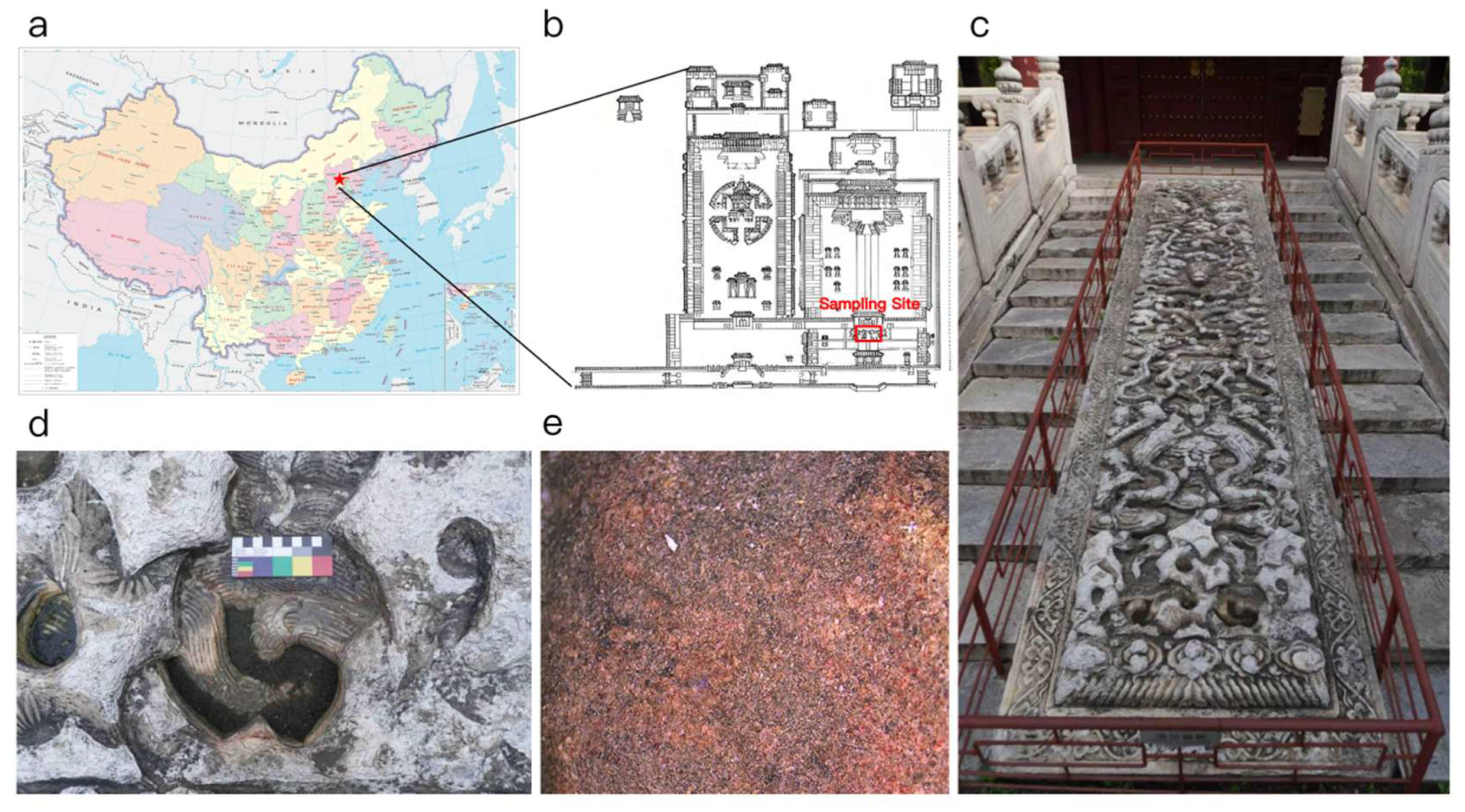
On 27 February 2025, an on-site microbial deterioration survey and sampling campaign was conducted at Beijing Confucian Temple and the Imperial College (Figure 1). Visible microbial colonization causing chromatic alterations was observed on the Danbi stone carvings at the Dacheng Gate, with extensive red biofilm distribution particularly on the vertical relief surfaces.
Sampling Protocol: 1. For physicochemical analysis: Microbial colonies were aseptically scraped using sterilized surgical blades and transferred into pre-sterilized EP tubes for subsequent Raman spectroscopy and scanning electron microscopy (SEM) examination. 2. For microbial cultivation: Sterile cotton swabs were gently rolled over distinct red biofilm areas, then streaked onto culture media. All samples were immediately sealed, labeled, and stored in cooling boxes (4 °C) for laboratory analysis.
Figure 1. The sampling locations and field conditions at Beijing Confucian Temple and the Imperial College: (a) Geographic coordinates of the site; (b) Position of sampled Danbi carvings; (c) The overall preservation status of Danbi stone carvings; (d) Red stain sampling point; (e) Portable microscope results for red stains.
Coatings 15 01488 g001

2.2. Extended Depth-of-Field Microscopy

The three-dimensional morphology of red stains on the Danbi stone carvings was examined using an extended depth-of-field microscope (Model: Keyence VHX-7000, Keyence Corporation, Osaka, Japan). Samples were observed directly in reflective mode without coating, with working distances ranging from 10 to 50 mm and magnification levels between 500× and 1000×. Depth composition technology was employed to obtain three-dimensional topographic characteristics of the stained areas, enabling evaluation of stain distribution patterns and their impact on the stone surface.

2.3. Micro-Raman Spectroscopy Analysis

Confocal micro-Raman spectroscopy (Model: HORIBA LabRAM Odyssey, HORIBA Ltd., Kyoto, Japan) was employed for non-destructive chemical characterization of the red stains. Experimental parameters were set as follows: 532 nm laser excitation, 50× objective (NA = 0.75), 1 mW laser power, spectral range 100–2000 cm−1, 10 s integration time, and 3 accumulations. Wavenumber calibration was performed using a silicon standard (520.7 cm−1). The spectral data were analyzed by comparing with both the RRUFF mineral database and a custom-built organic pigment reference library to identify inorganic components (e.g., iron oxides, lead compounds) and organic constituents (e.g., carotenoids, quinone derivatives) within the stains.

2.4. Scanning Electron Microscopy with Energy-Dispersive X-Ray Spectroscopy

Following gold sputter coating (5 nm thickness), the samples were analyzed using field-emission scanning electron microscopy (FE-SEM; Model: Hitachi SU8010, Hitachi High-Tech Corporation, Tokyo, Japan) coupled with energy-dispersive X-ray spectroscopy (EDS; Oxford X-MaxN 50, Oxford Instruments plc, Abingdon, UK). The analytical conditions were maintained at 15 kV accelerating voltage, 10 μA beam current, and 8 mm working distance. Microstructural characterization was performed using both secondary electron (SE) and backscattered electron (BSE) imaging modes. Representative areas (shown as Figure 2d,e) were selected for elemental mapping and point analysis to investigate the distribution patterns of characteristic elements (C, O, Fe, Pb, etc.), elucidating the chemical composition of stains and their interfacial interactions with the substrate [12].

2.5. Microbial Cultivation and Molecular Identification

Fungal strains were isolated using potato dextrose agar (PDA) medium containing 1.2% potato infusion powder, 2% glucose, and 2% agar, and incubated at 28 °C for 5 days [13]. After cultivation, all microbial colonies grown on the media were systematically isolated and purified. Genomic DNA was extracted from pure cultures and amplified by polymerase chain reaction (PCR). The ITS1 (5′-TCCGTAGGTGAACCTGCGG-3′) and ITS4 (5′-CCTCCGCTTATTGATATGC-3′) primers were employed for fungal amplification. The PCR protocol consisted of initial denaturation at 98 °C for 3 min, followed by 33 cycles of denaturation at 98 °C for 10 s, annealing at 57 °C for 10 s, and extension at 72 °C for 50 s, with a final extension at 72 °C for 5 min and storage at 4 °C. The amplified products were sequenced by GENEWIZ (Beijing, China), and sequence homology analysis was performed using the National Center for Biotechnology Information (NCBI) platform [14].

2.6. Extraction of Fungal Red Pigments

The laboratory strains were reactivated on PDA medium until pigment production covered the entire culture surface. The agar medium was sectioned into small pieces, and pigment extraction was performed using distilled water as the solvent under the following conditions: ultrasonic power 100 W, extraction temperature 60 °C, solid-to-liquid ratio 1:5 (g/mL) [15], extraction duration 20 min, with single ultrasonic treatment. The extracted solution was filtered, and the filtrate was subjected to full-wavelength scanning (380–780 nm) using a UV-Vis spectrophotometer at 5 nm intervals to determine the characteristic absorption peak of the pigment.

2.7. UHPLC-HRMS Analysis of Pigment Components

The red pigment components were analyzed using ultra-high performance liquid chromatography coupled with high-resolution mass spectrometry (UHPLC-HRMS, Thermo Fisher Scientific, Bremen, Germany). After ultrasonic extraction with 50% aqueous methanol, samples were filtered through 0.22 μm membranes and separated on a Thermo U3000 UHPLC system equipped with an ACQUITY UPLC HSS T3 (Waters Corporation, Milford, MA, USA) column (2.1 × 100 mm, 1.8 μm). The mobile phase consisted of 0.1% formic acid in water and 0.1% formic acid in acetonitrile with gradient elution. Mass spectrometric detection was performed using a Q Exactive Plus Orbitrap mass spectrometer with ESI source in positive/negative switching mode (scan range: m/z 100–1200; MS1 resolution: 70,000; MS2 resolution: 17,500). Data were processed using Compound Discoverer 3.3 software, with pigment identification achieved through comparison with reference standards and databases.

2.8. Infection Experiment

Sterilized experiments were conducted by adding 50 mL of PDA liquid medium into cleaned test tubes, with an additional control group containing 2 g of marble powder (three replicates per group). After autoclaving at 121 °C for 20 min and cooling to room temperature, red pigment-producing fungi were inoculated and cultured indoors under indirect light conditions. Photographic documentation was performed every 7 days to monitor colonization patterns.

2.9. Nucleotide Sequence Deposition

The nucleotide sequences generated in this study have been deposited in the GenBank database under the National Center for Biotechnology Information (NCBI). The accession numbers for the bacterial 16S rRNA gene sequences are PX130651-PX130654, and for the fungal ITS sequences are PX131132-PX131136. These data are publicly accessible upon publication.

3. Results

3.1. Compositional Analysis of Red Contaminants on Stone Carvings

The composition analysis of the red stains on the Danbi stone carvings is shown in Figure 2. Microscopic characterization of red contaminants collected from the Danbi stone carvings using extended depth-of-field microscopy shown in Figure 2a,b. At 500× magnification (Figure 2a), the contaminants appear as densely aggregated particulate matter, while higher magnification (1000×, Figure 2b) reveals that the red stains predominantly consist of elliptical or spherical particles measuring 10–15 μm in diameter. The particulate morphology suggests potential biological origin (e.g., microbial cells or spores) or inorganic precipitates (e.g., iron oxide microcrystals), requiring further analytical verification to determine their organic/inorganic nature.
The Raman peak (Figure 2c) at 1513 cm−1 can be attributed to C=C backbone vibrations (ν1), typically observed in conjugated polyene-chain pigments such as canthaxanthin (1512 cm−1) [16] and quinone compounds (1509 cm−1) [17]. The accompanying peak at 1151 cm−1 corresponds to C-C single bond stretching vibrations (ν2), forming a characteristic peak pair (1513/1151 cm−1) that serves as a fingerprint for carotenoids or quinoid pigments [17]. Notably, these organic signatures can be clearly distinguished from inorganic mineral interference-hematite (α-Fe2O3) exhibits characteristic peaks at 225 cm−1 and 500 cm−1 [18], while minium (Pb3O4) shows a strong peak at 550 cm−1 [19], none of which were detected in our study.
Scanning electron microscopy with energy-dispersive X-ray spectroscopy (SEM-EDS) analysis of the red spherical particles revealed smooth surface morphology (Figure 2d,e). Quantitative elemental analysis (Table 1) identified carbon (77.11%–88.22%) and oxygen (10.94%–17.28%) as predominant constituents, strongly suggesting organic contaminants or microbial metabolites, also a finding consistent with our Raman spectroscopic data. The presence of nitrogen (3.58%–4.74%) and phosphorus (0.42%–0.49%) further supports biological origins, likely from microbial biofilms or extracellular polymeric substances (EPS). In contrast, the detected amounts of sodium (0.10%–0.60%) and potassium (0.09%–0.32%) are at trace levels, potentially approaching the detection limits or within the range of analytical variability, and therefore their diagnostic significance in this context remains uncertain [20]. Notably, the absence of heavy metals (e.g., Fe, Hg) excludes synthetic pigments and reinforces organic/biological provenance.
Table 1. Compositional analysis by SEM-EDS of red contaminants shown in Figure 2 from the Danbi stone carvings at Beijing Confucian Temple and the Imperial College.
Analyzed PointCNONaPKMg
50,024h 3077.114.7417.230.330.420.15 
50,024h 3188.22 10.940.55 0.29 
50,024h 3987.96 11.800.60 0.32 
50,024h 4079.003.5816.290.390.490.26 
50,024h 4180.14 17.280.10 0.090.46

3.2. Microbial Community Composition Analysis of the Danbi Stone Carvings at Beijing Confucian Temple and the Imperial College

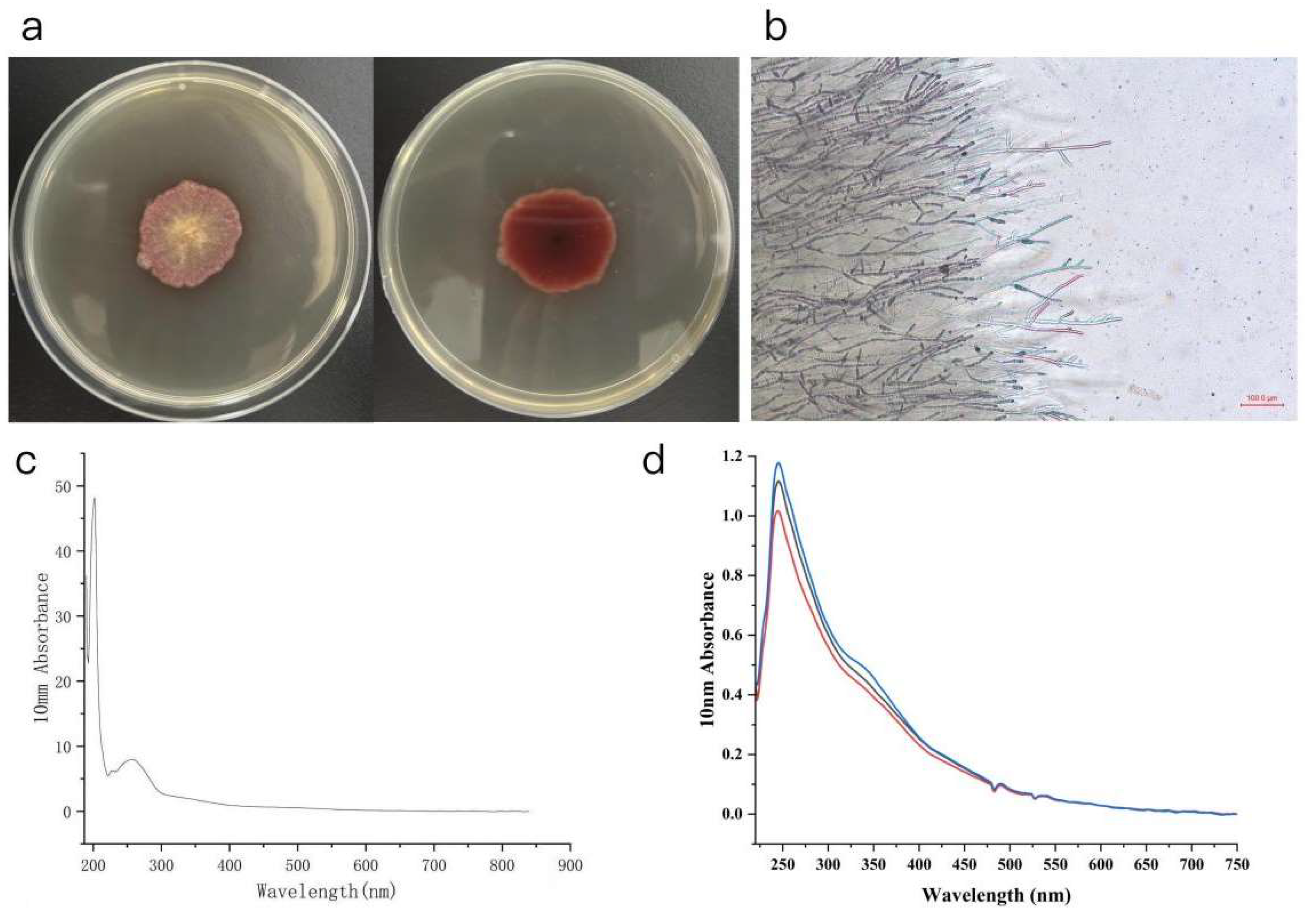
Through isolation, purification, molecular identification, and data comparison of collected microbial samples, we identified two bacterial strains (designated KG-B1 to KG-B2) and three fungal strains (KG-F1 to KG-F3), with detailed information presented in Table 2. Community analysis revealed that the red pigment-producing fungus Lizonia empirigonia (KG-F3) was one of the predominant colonizing fungi, with its morphological characteristics shown in Figure 3a,b. Notably, L. empirigonia demonstrated the ability to produce red pigments, potentially contributing to the reddish stains observed on the stone surface. Current understanding of L. empirigonia remains limited, though it is hypothesized to participate in organic matter degradation and colonize specific niches such as cultural heritage surfaces or plant debris. However, its precise metabolic pathways and ecological functions require further investigation. Genomic comparative studies indicate that L. empirigonia encodes effector proteins similar to those found in hemibiotrophic or necrotrophic pathogenic fungi, suggesting potential degradative capabilities (e.g., cell wall-degrading enzymes). Nevertheless, its direct pathogenicity and pigment biosynthesis mechanisms remain uncharacterized [21].
Table 2. Microbial community composition analysis of the Danbi stone carvings at Beijing Confucian Temple and the Imperial College.
Strain NumberCloset Relative StrainSimilarityAccession Number
BacteriaKG-B1Lysinibacillus fusiformis99.63%KY569483.1
KG-B2Bacillus cereus100.00%MH458752.1
FungiKG-F1Didymella exigua97.96%KAF1928462.1
KG-F2Trichoderma reesei97.62%EGR48663.1
KG-F3Lizonia empirigonia100.00%KAF1343396.1

3.3. Extraction and Analysis of Red Pigments from the Pigment-Producing Fungus Lizonia empirigonia

The extracted red pigments were subjected to UV-Vis spectrophotometric analysis using ddH2O as the reference solvent, with scanning performed across the 190–850 nm wavelength range. Spectral data revealed a maximum absorption peak at 200 nm, with no characteristic absorption peaks observed in the visible light region (400–700 nm). Absorbance values exhibited a progressive decrease with increasing wavelength (Figure 3c).
HPLC-MS analysis of the red pigments identified 65 compounds (Table 3), including amides, sugars, organic acids, amino acids and their derivatives, nucleosides, and flavonoids. The retention time (RT), molecular formula, compound name, calculated molecular weight (Calc. MW), matching score (mzVault Best Match), and peak area (Group Area) of each compound were recorded (Table 3). Among them, certain metabolites such as α,α-trehalose, betaine, and D-mannitol exhibited notably high peak areas, indicating their relative abundance in the fungal extracts. Of particular interest were the detected flavonoids, including genistein and glycitein, both of which belong to the isoflavone class and are known for their significant bioactivity and pigment properties. Genistein (Peak 36; Calc. MW 270.05258; match score 93.4%) and glycitein (Peak 51; Calc. MW 284.0685; match score 92.3%) displayed peak areas of 8,445,606.609 and 5,188,871.246, respectively, suggesting their substantial presence in the fungal metabolites. These isoflavonoids may serve as either the primary constituents of L. empirigonia’s red pigments or their precursor molecules [22,23].
The identification of genistein and glycitein, both isoflavonoids, in L. empirigonia extracts points to a potential biosynthetic route via the phenylpropanoid pathway, branching from the shikimate pathway. This pathway is often employed by microbes for producing secondary metabolites with protective functions, such as UV absorption and antioxidant activity [24].
Furthermore, other compounds potentially involved in pigment biosynthesis were detected, including 4-dodecylbenzenesulfonic acid [25] (Peak 12) and bis(4-ethylbenzylidene)sorbitol [26] (Peak 16). Their high matching scores (90.5% and 87.2%, respectively) and significant peak areas suggest possible roles in pigment synthesis or stabilization. The biosynthesis of red pigments in fungi likely involves multiple metabolic pathways. For instance, the detected L-glutamic acid (Peak 9) and L-proline (2-pyrrolidinecarboxylic acid, Peak 26) are known precursors of secondary metabolites and may participate in pigment biosynthesis through either the polyketide synthase pathway or the shikimate pathway [27,28]. Additionally, sugar compounds such as α,α-trehalose (Peak 3) and D-fructose (Peak 7) could provide energy or carbon skeletons for pigment synthesis [29].

3.4. Infection Experiment of Pigment-Producing Fungus L. empirigonia on Stone Materials
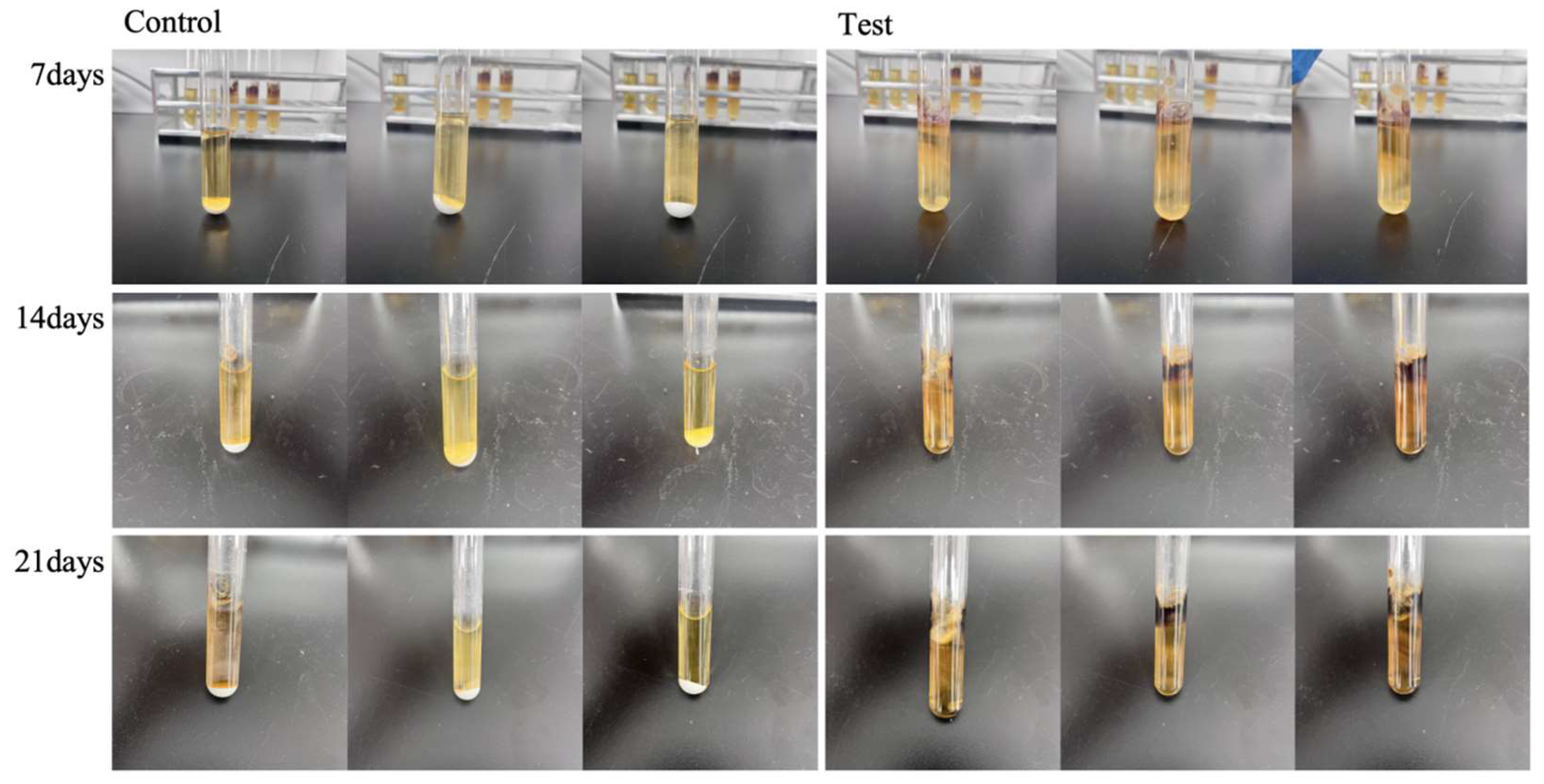
To assess the potential biodeterioration effects of L. empirigonia on stone substrates, simulated infection experiments were conducted (Figure 4). In the experimental group without marble powder, robust fungal growth was observed, with gradual darkening of the medium over time and high reproducibility across all three replicates. In contrast, the control group supplemented with marble powder exhibited negligible fungal growth, with only trace colonization visible in one test tube by day 14.
The control group was added with 3 g of marble powder. After the experiment, the stone powder in the test tube was extracted, dried, and weighed, with weights of 2.94 g, 3.02 g, and 3.12 g, respectively. After excluding operational and experimental errors, it can be basically confirmed that there is no significant mass loss of the marble powder was detected within the 21-day experimental period. This finding suggests that under the nutrient-limited conditions of our short-term experiment, the primary driver for the growth of L. empirigonia is the availability of exogenous organic substrates, rather than the utilization of the mineral matrix as a carbon source. This aligns with ecological strategies of many stone-inhabiting fungi, which rely on atmospheric deposits for nutrients [30]. However, the absence of measurable weight change does not preclude potential long-term biogeochemical interactions, metabolic byproducts (e.g., organic acids like citric acid and malic acid, along with pigments) by L. empirigonia may induce micro-etching of carbonate surfaces through dissolution processes.
The observation that the fermentation broth of L. empirigonia stabilized at pH 7–8 and the UV-Vis absorption spectrum shown in Figure 3d, despite the production of organic acids, indicates a sophisticated buffering capacity within its metabolic system. This self-regulation likely maintains an optimal pH for pigment biosynthesis. Furthermore, on marble surfaces, the calcite substrate (CaCO3) provides an external buffering effect by neutralizing acids [31], which may explain the fungus’s ability to colonize and produce visible stains without causing extensive macroscopic dissolution, aligning with our infection experiment results.
The dependence of L. empirigonia on exogenous organic matter underscores an ecological strategy for survival on nutrient-poor stone surfaces. Initial colonization is facilitated by organic films from atmospheric deposition, which provide essential carbon and nitrogen. Subsequent microbial metabolism, including the secretion of EPS, may then modify the niche, enhancing moisture retention and nutrient availability [32], thereby promoting further microbial proliferation.
Figure 4. Time-course documentation of L. empirigonia infection experiments on stone materials (both control and experimental groups included triplicates, monitored at 7, 14, and 21 days).
Coatings 15 01488 g004
These findings provide critical implications for stone heritage conservation. First, fungal colonization heavily relies on environmental organic matter, necessitating enhanced surface cleaning to minimize accumulations of dust, leaf litter, and anthropogenic contaminants (e.g., oils or residual conservation materials). Low-impact cleaning techniques (e.g., laser ablation or micro-particle blasting) could be periodically employed to remove surface biofilms without substrate damage [33]. However, it should be noted that such physical methods may not fully eradicate resilient microbial structures like spores or deeply embedded hyphae, potentially allowing for recolonization. Additionally, environmental optimization (e.g., humidity reduction and vegetation control) may suppress microbial proliferation. Regarding potential treatments, while mineral-based nanomaterials like nano-Ca(OH)2 are well-established for their consolidating properties on carbonate stones, their direct and broad-spectrum antimicrobial efficacy is not yet conclusively proven and requires further targeted investigation [34]. More established inorganic nanoparticles with known biocidal properties, such as those based on silver (Ag) or zinc (Zn), have been explored in heritage science.
However, long-term microbial-mineral interactions require deeper investigation. While L. empirigonia cannot directly degrade marble, its acidic metabolites may indirectly alter stone stability through micro-etching. Future work should integrate in situ monitoring (e.g., environmental DNA sequencing or micro-chemical imaging) to dynamically assess microbial succession and stone deterioration. The development of green biocides (e.g., plant-derived compounds) could also provide sustainable alternatives to conventional chemical treatments, mitigating risks to both heritage materials and ecosystems.
Future studies should investigate the potential synergistic or antagonistic interactions between L. empirigonia and other microorganisms isolated from the stains, as microbial consortia may influence pigment production in natural settings. Furthermore, seasonal variations in Beijing’s climate—particularly higher temperature and humidity in summer—could accelerate fungal metabolism and stain formation, warranting long-term environmental monitoring to validate these dynamics.

4. Conclusions

This study identifies the pigment-producing fungus L. empirigonia as the primary biological agent responsible for red stains on the Danbi marble carvings, with flavonoids and polyketides identified as key metabolites. Fungal colonization depends on exogenous organic matter rather than stone substrate degradation. These findings underscore the critical importance of regular surface cleaning to remove organic residues, alongside environmental control, as frontline preventive measures. The research provides a microbial-focused explanation for discoloration in temperate climates and offers practical conservation strategies for marble heritage.

Author Contributions

Conceptualization, Y.W. and J.Z.; methodology, Y.W.; software, Y.W.; validation, Y.W.; formal analysis, Y.W.; investigation, J.L. and J.Z.; resources, Y.Z.; data curation, W.H.; writing—original draft preparation, Y.W.; writing—review and editing, J.Z.; visualization, J.P.; supervision, J.P. and J.Z.; project administration, Y.Z.; funding acquisition, W.H. All authors have read and agreed to the published version of the manuscript.

Funding

This research was funded by Interdisciplinary Research Project for Young Teachers of USTB (Fundamental Research Funds for the Central Universities), grant number FRF-IDRY-23-002.

Institutional Review Board Statement

Not applicable.

Informed Consent Statement

Not applicable.

Data Availability Statement

Data supporting the findings of this study are available from the corresponding author upon reasonable request. The datasets presented in this study can be found in online repositories of NCBI Genebank under accession numbers PX130651-PX130654 and PX131132-PX131136.

Conflicts of Interest

The authors declare no conflicts of interest.

References

  1. Pu, H.; Wang, X. The Impact of Environment on Cultural Relics. Sci. Cult. 2023, 9, 49–62. [Google Scholar] [CrossRef]
  2. Cantisani, E.; Cuzman, O.A.; Vettori, S.; Chelazzi, L.; Ciattini, S.; Ricci, M.; Manganelli Del Fá, R.; Chiarantini, L.; Garzonio, C.A. A Multi-Analytical Approach for the Study of Red Stains on Heritage Marble. Analyst 2019, 144, 2375–2386. [Google Scholar] [CrossRef]
  3. Abdel-Maksoud, G.; Awad, H.; Rashed, U. Different Cleaning Techniques for Removal of Iron Stain from Archaeological Bone Artifacts: A Review. Egypt. J. Chem. 2021, 65, 73–87. [Google Scholar] [CrossRef]
  4. Zanardini, E.; Andreoni, V.; Borin, S.; Cappitelli, F.; Daffonchio, D.; Talotta, P.; Sorlini, C.; Ranalli, G.; Bruni, S.; Cariati, F. Lead-Resistant Microorganisms from Red Stains of Marble of the Certosa of Pavia, Italy and Use of Nucleic Acid-Based Techniques for Their Detection. Int. Biodeterior. Biodegrad. 1997, 40, 171–182. [Google Scholar] [CrossRef]
  5. Villani, E.; Suzuki, A.; Ricci, M.; Salvadori, B.; Vettori, S.; Cantisani, E. Red Stains on Heritage Marbles: Application of Micro-Scale Analyses to Assess the Presence and Distribution of Lead Compounds. Analyst 2024, 149, 4872–4880. [Google Scholar] [CrossRef]
  6. Gaylarde, C.; Little, B. Biodeterioration of Stone and Metal—Fundamental Microbial Cycling Processes with Spatial and Temporal Scale Differences. Sci. Total Environ. 2022, 823, 153193. [Google Scholar] [CrossRef]
  7. Konkol, N.; McNamara, C.; Sembrat, J.; Rabinowitz, M.; Mitchell, R. Enzymatic Decolorization of Bacterial Pigments from Culturally Significant Marble. J. Cult. Herit. 2009, 10, 362–366. [Google Scholar] [CrossRef]
  8. Hallmann, C.; Rüdrich, J.; Enseleit, M.; Friedl, T.; Hoppert, M. Microbial Diversity on a Marble Monument: A Case Study. Environ. Earth Sci. 2011, 63, 1701–1711. [Google Scholar] [CrossRef]
  9. Bruni, S.; Cariati, F.; Bianchi, C.L.; Zanardini, E.; Sorlini, C. Spectroscopic Investigation of Red Stains Affecting the Carrara Marble Façade of the Certosa of Pavia. Archaeometry 1995, 37, 249–255. [Google Scholar] [CrossRef]
  10. Palla, F.; Tartamella, E. Chromatic Alteration on Marble Surfaces Analysed by Molecular Biology Tools. Conserv. Sci. Cult. Herit. 2007, 7, 111–121. [Google Scholar] [CrossRef]
  11. Tang, L.K. Reinventing Confucius and His Shrine: The Temple of Culture (Wenmiao) in Late Imperial China. Ph.D. Thesis, University of Pennsylvania, Philadelphia, PA, USA, 2018. [Google Scholar]
  12. Barbosa, S.; Moura, P.C.; Dias, A.; Haneklaus, N.; Bellefqih, H.; Kiegiel, K.; Canovas, C.R.; Nieto, J.M.; Bilal, E.; Pessanha, S. An Advanced Image Processing and Multivariate Statistical Methodology to Interpret Micro-EDXRF 2D Maps: Uncovering Heterogeneity and Spatial Distribution Patterns of Rare Earth Elements in Phosphogypsum. Chemosphere 2025, 381, 144478. [Google Scholar] [CrossRef]
  13. Amadi, O.C. Use of Starch Containing Tubers for the Formulation of Culture Media for Fungal Cultivation. Afr. J. Microbiol. Res. 2012, 6, 4527–4532. [Google Scholar] [CrossRef]
  14. Li, P.; Han, S.; Wang, M.; Zhang, X.; Zhi, S.; Jin, M.; Jokela, J.; He, S.; Liu, L. Elucidation of Novel Turnagainolides and Their Biosynthetic Gene Cluster in Bacillus subtilis. Appl. Env. Microbiol. 2025, 91, e02574-24. [Google Scholar] [CrossRef]
  15. Li, Y.; Ma, J.; Zhang, J.; Liang, C.; Yang, B.; Zhao, N. Optimization of Extraction Process of Chaetomium Aureum Pigment by Response Surface Methodology. Food Chem. 2021, 42, 295–299. [Google Scholar]
  16. Li, C.; Zhang, X.; Liu, H.; Qu, L.; Zhu, M.; Duan, H. Application of Nanosecond Laser Cleaning Technology on Marble in the Forbidden City. Opt. Tech. 2024, 50, 500–507. [Google Scholar]
  17. Chen, C.-Y.; Huang, W.-Z.; Gao, Q.; Fan, L.-W.; Andy, H.S. Assignments on Raman Peaks of Red Coral Based on Experimental RamanSpectroscopy and Density Functional Theory Calculation. Spectrosc. Spectr. Anal. 2021, 41, 127–130. [Google Scholar]
  18. Liu, Y.; He, Q.; Wang, Z.; Jiao, X.; Zhang, Y. The Optical Properties of Nano-structural α-Fe2O3 Dependence on the Shape. Microsc. Res. Tech. 2025, 88, 154–162. [Google Scholar] [CrossRef] [PubMed]
  19. Salagram, M.; Prasad, V.K.; Subrahmanyam, K. IR and Optical Study of Pb3O4 (2PbO.PbO2) Glass Containing a Small Amount of Silica. J. Alloys Compd. 2002, 335, 228–232. [Google Scholar] [CrossRef]
  20. Grasso, D.; Strevett, K.; Pesari, H. Impact of Sodium and Potassium on Environmental Systems. J. Environ. Syst. 1992, 22, 297–323. [Google Scholar] [CrossRef]
  21. Liu, L.; Yang, C.; Liang, F.; Li, C.; Zeng, Q.; Han, S.; Li, S.; Liu, Y. Genome-Wide Survey of the Bipartite Structure and Pathogenesis-Related Genes of Neostagonosporella Sichuanensis, a Causal Agent of Fishscale Bamboo Rhombic-Spot Disease. Front. Microbiol. 2024, 15, 1456993. [Google Scholar] [CrossRef]
  22. Giusti, M.M.; Miyagusuku-Cruzado, G.; Wallace, T.C. Flavonoids as Natural Pigments. In Handbook of Natural Colorants; Stevens, C., Bechtold, T., Manian, A., Pham, T., Eds.; Wiley: Hoboken, NJ, USA, 2023; pp. 371–390. ISBN 978-1-119-81171-8. [Google Scholar]
  23. Iwashina, T. Contribution to Flower Colors of Flavonoids Including Anthocyanins: A Review. Nat. Prod. Commun. 2015, 10, 529–544. [Google Scholar] [CrossRef]
  24. Rani, A.; Saini, K.; Bast, F.; Mehariya, S.; Bhatia, S.; Lavecchia, R.; Zuorro, A. Microorganisms: A Potential Source of Bioactive Molecules for Antioxidant Applications. Molecules 2021, 26, 1142. [Google Scholar] [CrossRef] [PubMed]
  25. Rukmana, R.M.; Silfarohana, R.; Putra, A.D.P.; Safrina, D.; Susanti, D.; Wijaya, N.R.; Adi, M.B.S.; Prastiyanto, M.E.; Yanuar Cahyaningrum, A.; Nurmaulawati, R.; et al. Phytochemical Profile, Antioxidant Activity and Anticancer Activity of Gamma-Irradiated Black Rice Bran (Oryza sativa L.) Ethanolic Extract: In-Vitro and In-Silico Study. Sci. Technol. Indones. 2025, 10, 628–643. [Google Scholar] [CrossRef]
  26. Jahangiri, A.; Møller, A.H.; Madsen, B.; Joernsgaard, B.; Vaerbak, S.; Danielsen, M.; Dalsgaard, T.K. Incorporation of Bixin in Aqueous Media: Self-Formulation with Sorbitol Ester of Norbixin. Food Chem. 2019, 294, 433–439. [Google Scholar] [CrossRef] [PubMed]
  27. Cui, H.; Li, X.; Ji, Y.; Zhao, S.; Yang, J. Effects of L-Proline on the Stability of Mulberry Anthocyanins and the Mechanism of Interaction between L-Proline and Cyanidin-3-O-Glycoside. Molecules 2024, 29, 4544. [Google Scholar] [CrossRef]
  28. El-Metwally, I.M.; Sadak, M.S.; Saudy, H.S. Stimulation Effects of Glutamic and 5-Aminolevulinic Acids On Photosynthetic Pigments, Physio-Biochemical Constituents, Antioxidant Activity, and Yield of Peanut. Gesunde Pflanz. 2022, 74, 915–924. [Google Scholar] [CrossRef]
  29. Hari, R.K.; Patel, T.R.; Martin, A.M. An Overview of Pigment Production in Biological Systems: Functions, Biosynthesis, and Applications in Food Industry. Food Rev. Int. 1994, 10, 49–70. [Google Scholar] [CrossRef]
  30. Gadd, G.M.; Fomina, M.; Pinzari, F. Fungal Biodeterioration and Preservation of Cultural Heritage, Artwork, and Historical Artifacts: Extremophily and Adaptation. Microbiol. Mol. Biol. Rev. 2024, 88, e00200-22. [Google Scholar] [CrossRef]
  31. Graziani, G.; Sassoni, E.; Franzoni, E.; Scherer, G.W. Hydroxyapatite Coatings for Marble Protection: Optimization of Calcite Covering and Acid Resistance. Appl. Surf. Sci. 2016, 368, 241–257. [Google Scholar] [CrossRef]
  32. Bhattacharjee, A.; Thompson, A.M.; Schwarz, K.C.; Burnet, M.C.; Kim, Y.-M.; Nunez, J.R.; Fansler, S.J.; Farris, Y.; Brislawn, C.J.; Metz, T.O.; et al. Soil Microbial EPS Resiliency Is Influenced by Carbon Source Accessibility. Soil Biol. Biochem. 2020, 151, 108037. [Google Scholar] [CrossRef]
  33. Maravelaki, P.N. Surface Cleaning: Implications from Choices & Future Perspectives. In Conserving Stone Heritage;Cultural Heritage Science; Gherardi, F., Maravelaki, P.N., Eds.; Springer International Publishing: Cham, Switzerland, 2022; pp. 37–74. ISBN 978-3-030-82941-4. [Google Scholar]
  34. Sierra-Fernandez, A.; Gomez-Villalba, L.S.; De La Rosa-García, S.C.; Gomez-Cornelio, S.; Quintana, P.; Rabanal, M.E.; Fort, R. Inorganic Nanomaterials for the Consolidation and Antifungal Protection of Stone Heritage. In Advanced Materials for the Conservation of Stone; Hosseini, M., Karapanagiotis, I., Eds.; Springer International Publishing: Cham, Switzerland, 2018; pp. 125–149. ISBN 978-3-319-72259-7. [Google Scholar]
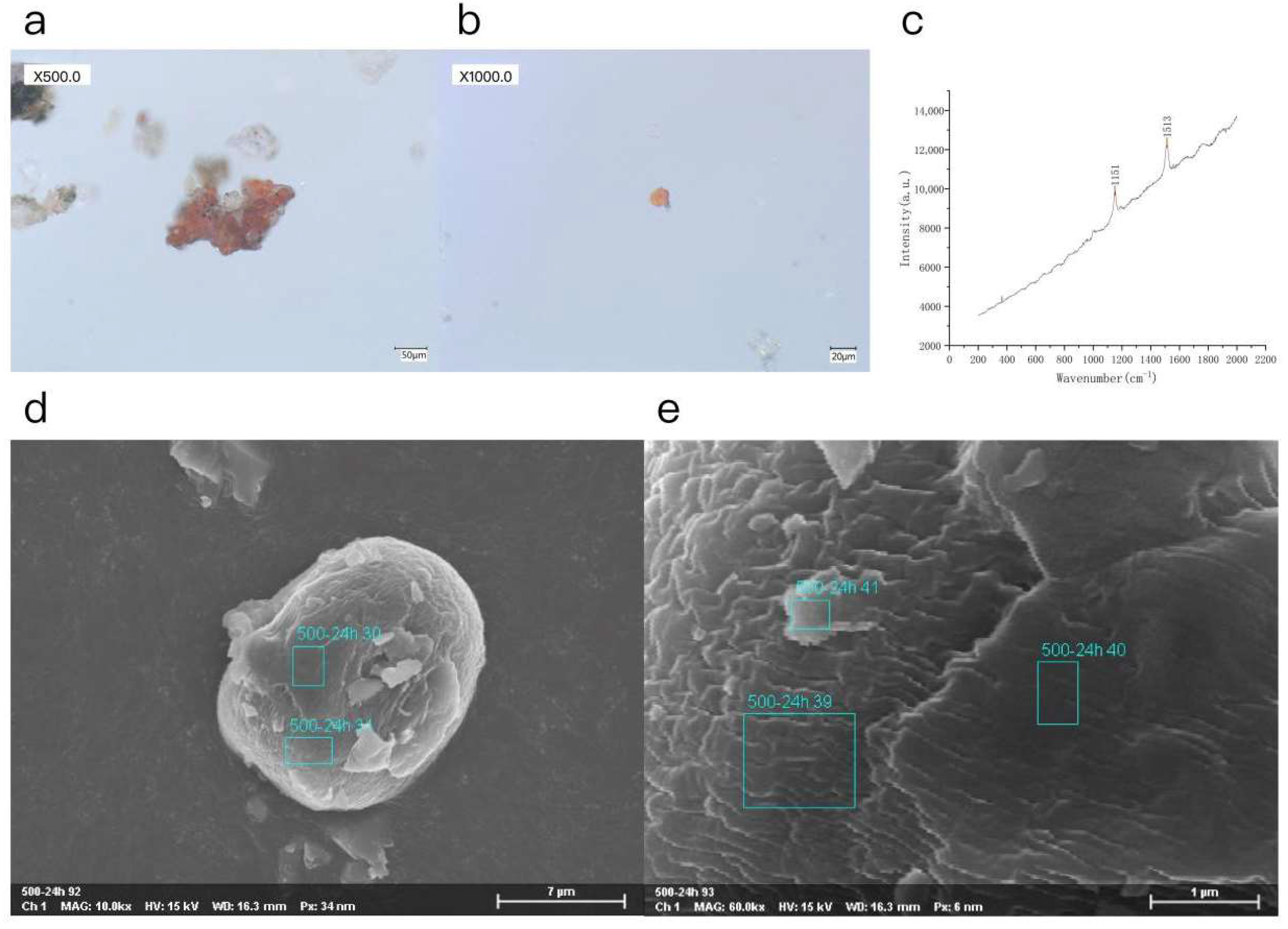
Figure 2. Analysis of the Composition of Red Stains on Danbi Stone Carvings at Beijing Confucian Temple and the Imperial College. (a) Microscopic characterization of red contaminants observed using extended depth-of-field microscopy (500×); (b) Microscopic characterization (1000×); (c) Micro-Raman spectra of red contaminants; (d) Scanning electron micrographs of red contaminants; (e) Scanning electron micrographs of red contaminants.
Coatings 15 01488 g002
Figure 3. Morphological characterization of the red pigment-producing fungus Lizonia empirigonia. (a) Front and reverse views of single colonies; (b) Chamber observation experiment after 5 days of cultivation at 28 °C (10×); (c) UV-Vis absorption spectrum of red pigments extracted from Lizonia empirigonia; (d) UV-Vis absorption spectrum of infection experiment from three test tubes in the infection experiment group.
Coatings 15 01488 g003
Table 3. HPLC-MS analysis results of red pigments produced by the pigment-producing fungus L. empirigonia.
No.RT [min]FormulaNameCalc. MWmzVault
Best Match
Group Area
152.475C22H43NOErucamide337.3342889.8820,227,807
247.428C16H33NOHexadecanamide255.2561689.968,811,881.67
31.686C12H22O11α,αTrehalose342.1158597.6159,702,808,1
41.626C5H11NO2Betaine117.0790383.4723,338,274.4
51.624C6H14O6D-(-)-Mannitol182.0788596.3325,425,455.2
656.348C22H45NODocosanamide339.3501288.327,854,718.91
71.662C6H12O6D-(-)-Fructose180.0631487256,867,999
81.634C7H15NO3DLCarnitine161.1052695.1204,158,667.1
91.615C5H9NO4LGlutamic acid147.0530596.7199,373,258.1
101.723C9H17NO4Acetyl-L-carnitine203.1159689.9125,104,158.3
119.585C10H13N5O4Adenosine267.0967585.3191,134,604
1244.672C18H30O3S4-Dodecylbenzenesulfonic acid326.1911590.575,398,867.34
131.524C6H14N4O2DL-Arginine174.1117796.2184,175,321.4
141.57C5H13NOCholine103.0997988.8169,656,092.2
151.631C6H12O7Gluconic acid196.0578995.8132,819,050.8
1636.801C24H30O6Bis(4-ethylbenzylidene)sorbitol414.2043387.286,732,885.87
171.595C5H9NO3cis-4-Hydroxy-D-proline131.0583186.2100,709,979.1
1821.662C11H18N2O2Cyclo(leucylprolyl)210.1369191.190,683,092.63
191.735C4H6O5L-(-)-Malic acid134.0213194.576,300,324.43
201.607C5H7NO3D-(+)-Pyroglutamic Acid129.0427172.265,357,423.24
213.545C6H8O7Citric acid192.0267991.163,419,235.77
2211.597C10H13N5O5Guanosine283.0915196.552,569,033.3
2319.064C7H8O32-Methoxyresorcinol140.0474360.351,097,512
241.602C5H10N2O3L-Glutamine146.0692888.92,705,521.505
2522.517C14H16N2O2Cyclo(phenylalanyl-prolyl)244.1212989.447,292,888.72
261.712C5H9NO22-Pyrrolidinecarboxylic acid 115.0634376.840,601,399.4
271.789C6H11N3O22-oxopiperidine-3-carbohydrazide157.0853352.639,392,996.08
281.639C5H12O5D-(+)-Arabitol152.0681794.738,666,127.63
291.467C9H20N2O2N6,N6,N6-Trimethyl-L-lysine188.152680.834,726,184.93
301.485C6H9N3O2L-Histidine155.0696483.525,785,807.45
311.716C24H42O21Stachyose666.2214489.223,797,225.01
3225.528C15H10O4Daidzein254.0577690.115,109,429.33
3317.986C11H9NO2trans-3-Indoleacrylic acid187.0635993.419,691,620.98
3418.098C11H15N5O3S5′-Methylthioadenosine297.0898673.97,012,109.486
3518.787C7H12O52-Isopropylmalic acid176.0682491.516,645,708.84
3628.332C15H10O5Genistein270.0525893.48,445,606.609
375.464C9H12N2O6Uridine244.0691790.515,068,491.57
3818.1C11H20N2O3Leucylproline228.1475188.613,137,288.88
397.125C6H11NO34-Acetamidobutanoic acid145.0737485.611,930,711.72
4017.985C11H12N2O2L-Tryptophan204.0901479.611,520,779.13
4116.265C7H13NO3N-Acetyl-DL-norvaline159.0895286.57,278,669.25
421.639C10H18N4O6Argininosuccinic acid290.1237569.69,767,673.54
431.739C4H4O4Fumaric acid116.0106861.69,065,606.105
4419.573C10H13NO2N-Acetyltyramine179.0947683.38,816,265.808
451.711C12H24O11Lactitol344.1322283.38,137,293.08
4624.416C10H9N2-Naphthylamine143.0735957.66,885,824.755
4726.445C11H12O5Trinexapac224.0681388.26,702,966.477
4817.986C8H7NIndole117.05882.26,480,463.816
4932.415C10H15NO2SN-Butylbenzenesulfonamide213.0823581.75,415,251.221
501.615C6H12O5D-(+)-Fucose164.0685282.75,344,430.341
5125.954C16H12O5Glycitein284.068592.35,188,871.246
5246.771C16H32O316-Hydroxyhexadecanoic acid272.2348380.82,012,426.871
533.548C5H4O32-Furoic acid112.0157679.43,584,579.635
5423.083C10H10O4Dimethyl Phthalate194.05763 3,439,623.277
5523.469C25H24O124,5-Dicaffeoylquinic acid516.126391.32,460,159.063
5620.355C6H12O32-Hydroxycaproic acid132.0784193.92,990,587.119
572.719C9H13N3O5Cytidine243.0853164.32,907,505.221
5820.207C14H18N2O6gamma-Glu-Tyr310.116454.32,736,273.22
5916.791C9H17NO5Pantothenic acid219.1105289.82,636,928.59
6015.798C9H11NO2Phenylalanine165.0787358.72,552,333.643
614.477C4H6O4Succinic acid118.0264390.12,273,761.998
6221.068C8H8O33-Methylsalicylic acid152.047189.31,942,393.343
6321.895C8H14O4Suberic acid174.08894841,697,284.831
646.062C10H15N3O53′-O-Methylcytidine257.1003958.21,238,264.001
652.489C8H14O7Ethyl-β-Dglucuronide222.0736252.4568,154.5422
Disclaimer/Publisher’s Note: The statements, opinions and data contained in all publications are solely those of the individual author(s) and contributor(s) and not of MDPI and/or the editor(s). MDPI and/or the editor(s) disclaim responsibility for any injury to people or property resulting from any ideas, methods, instructions or products referred to in the content.