


You are currently viewing a new version of our website. To view the old version click .

Microorganisms, Volume 8, Issue 1

January 2020 - 143 articles

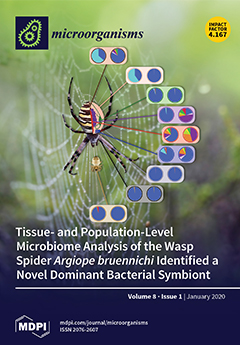
Cover Story: The European wasp spider, Argiope bruennichi, is an emerging arthropod model system, but its microbial community has never before been investigated in detail. Indeed, studies on the microbiota of spiders are just beginning to scratch the surface—with increasing evidence suggesting that spiders are an untapped source of novel commensal or (endo)symbiotic bacteria. In this study, Sheffer et al. discovered that A. bruennichi hosts a dominant, highly divergent bacterial symbiont of the Tenericutes phylum, which is present in every tissue type and is vertically transmitted from mother to offspring. The microbial community within A. bruennichi, beyond the dominant symbiont, varied significantly between individuals and populations, but not between tissue types. View this paper.
  • Issues are regarded as officially published after their release is announced to the table of contents alert mailing list .
  • You may sign up for email alerts to receive table of contents of newly released issues.
  • PDF is the official format for papers published in both, html and pdf forms. To view the papers in pdf format, click on the "PDF Full-text" link, and use the free Adobe Reader to open them.

Articles (143)

  • Article
  • Open Access
9 Citations
4,695 Views
8 Pages

Absence of Viable Toxoplasma gondii in Artisanal Raw-Milk Ewe Cheese Derived from Naturally Infected Animals

  • David Ranucci,
  • Elena Battisti,
  • Fabrizia Veronesi,
  • Manuela Diaferia,
  • Giulia Morganti,
  • Raffaella Branciari,
  • Ezio Ferroglio,
  • Andrea Valiani and
  • Francesco Chiesa

The presence of viable Toxoplasma gondii was investigated in artisanal cheeses made from milk of naturally infected ewes. Ewe milk was analyzed beforehand for the presence and vitality of T. gondii by loop-mediated isothermal amplification (LAMP) and...

  • Article
  • Open Access
51 Citations
5,225 Views
15 Pages

A Comprehensive Study on the Occurrence of Mycotoxins and Their Producing Fungi during the Maize Production Cycle in Spain

  • Marta García-Díaz,
  • Jéssica Gil-Serna,
  • Covadonga Vázquez,
  • María Nieves Botia and
  • Belén Patiño

Mycotoxin contamination is one of the main problems affecting corn production, due to its significant risk to human and animal health. The Fusarium and Aspergillus species are the main producers of mycotoxins in maize, infecting both pre-harvest and...

  • Article
  • Open Access
11 Citations
4,635 Views
14 Pages

Porcine Colostrum Protects the IPEC-J2 Cells and Piglet Colon Epithelium against Clostridioides (syn. Clostridium) difficile Toxin-Induced Effects

  • Łukasz Grześkowiak,
  • Robert Pieper,
  • Susan Kröger,
  • Beatriz Martínez-Vallespín,
  • Anja E. Hauser,
  • Raluca Niesner,
  • Wilfried Vahjen and
  • Jürgen Zentek

Clostridioides difficile toxins are one of the main causative agents for the clinical symptoms observed during C. difficile infection in piglets. Porcine milk has been shown to strengthen the epithelial barrier function in the piglet’s intestin...

  • Article
  • Open Access
32 Citations
5,258 Views
15 Pages

Characterization of ESBL-Producing Enterobacteria from Fruit Bats in an Unprotected Area of Makokou, Gabon

  • Pierre Philippe Mbehang Nguema,
  • Richard Onanga,
  • Guy Roger Ndong Atome,
  • Jean Constant Obague Mbeang,
  • Arsène Mabika Mabika,
  • Moussa Yaro,
  • Manon Lounnas,
  • Yann Dumont,
  • Zaidi Fatma Zohra and
  • Sylvain Godreuil
  • + 1 author

In Gabon, terrestrial mammals of protected areas have been identified as a possible source of antibiotic-resistant bacteria. Some studies on antibiotic resistance in bats have already been carried out. The main goal of our study was to detect extende...

  • Review
  • Open Access
47 Citations
6,435 Views
10 Pages

Dietary Factors as Triggers of Low-Grade Chronic Intestinal Inflammation in Poultry

  • Gabriela Cardoso Dal Pont,
  • Morgan Farnell,
  • Yuhua Farnell and
  • Michael H. Kogut

Inflammation is the reaction of the immune system to an injury; it is aimed at the recovery and repair of damaged tissue. The inflammatory response can be beneficial to the animal since it will reestablish tissue homeostasis if well regulated. Howeve...

  • Article
  • Open Access
38 Citations
5,553 Views
9 Pages

Ciprofloxacin-Resistant Salmonella enterica Serovar Kentucky ST198 in Broiler Chicken Supply Chain and Patients, China, 2010–2016

  • Zhiying Xiong,
  • Shaojun Wang,
  • Yumei Huang,
  • Yuan Gao,
  • Haiyan Shen,
  • Zhengquan Chen,
  • Jie Bai,
  • Zeqiang Zhan,
  • Junping Wen and
  • Ming Liao
  • + 1 author

Salmonella enterica serovar Kentucky (S. Kentucky) sequence type 198 has emerged as a global zoonotic pathogen. We explored Salmonella enterica serovar Kentucky ST198 samples from the broiler chicken supply chain and patients between 2010 and 2016. H...

  • Review
  • Open Access
19 Citations
5,563 Views
16 Pages

Chronic Inflammatory Diseases at Secondary Sites Ensuing Urogenital or Pulmonary Chlamydia Infections

  • Yi Ying Cheok,
  • Chalystha Yie Qin Lee,
  • Heng Choon Cheong,
  • Chung Yeng Looi and
  • Won Fen Wong

Chlamydia trachomatis and C. pneumoniae are members of the Chlamydiaceae family of obligate intracellular bacteria. The former causes diseases predominantly at the mucosal epithelial layer of the urogenital or eye, leading to pelvic inflammatory dise...

  • Article
  • Open Access
13 Citations
4,252 Views
13 Pages

Phenotypic Diversity of Lactobacillus casei Group Isolates as a Selection Criterion for Use as Secondary Adjunct Starters

  • Alessia Levante,
  • Elena Bancalari,
  • Martina Tambassi,
  • Camilla Lazzi,
  • Erasmo Neviani and
  • Monica Gatti

Autochthonous lactic acid bacteria (LAB) play a key role in the development of cheese flavor. As the pasteurization treatment on raw milk causes the elimination of LAB, secondary starter cultures are used in cheese manufacture to obtain cheeses with...

  • Review
  • Open Access
530 Citations
27,167 Views
39 Pages

The genus Aeromonas belongs to the Aeromonadaceae family and comprises a group of Gram-negative bacteria widely distributed in aquatic environments, with some species able to cause disease in humans, fish, and other aquatic animals. However, bacteria...

  • Review
  • Open Access
38 Citations
18,261 Views
16 Pages

Vaginal infections are the most prevalent women’s health problem. Incompetent diagnosis, inappropriate treatments, and antibiotic resistance are the main causes of the unsatisfactory results of conventional, antimicrobic treatment for these inf...

of 15

Get Alerted

Add your email address to receive forthcoming issues of this journal.

XFacebookLinkedIn
Microorganisms - ISSN 2076-2607