
You are currently viewing a new version of our website. To view the old version click .

Microorganisms, Volume 7, Issue 6

June 2019 - 31 articles

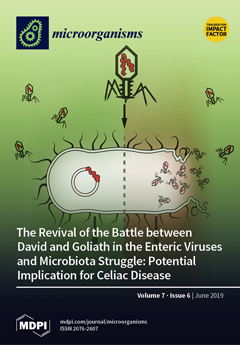
Cover Story: The human gut is inhabited by overcrowded prokaryotic communities, a major component of which is the virome, comprising viruses, bacteriophages, archaea, eukaryotes, and bacteria. The phageome is required for luminal homeostasis and, by their lytic or synergic capacities, can regulate the microbial community structure and activity. Dysbiosis is associated with numerous chronic human diseases, and enteric viral abnormal prints are just starting to emerge. Because the virome can impact microbial genetics and behavior, understanding its biology, composition, cellular cycle, regulation, mode of action, and potential beneficial or hostile activities can change the present paradigm of cross-talks in the luminal gut compartment. Celiac disease is a common autoimmune disease in which viruses are suggested to play a role in disease development. View this paper.
  • Issues are regarded as officially published after their release is announced to the table of contents alert mailing list .
  • You may sign up for email alerts to receive table of contents of newly released issues.
  • PDF is the official format for papers published in both, html and pdf forms. To view the papers in pdf format, click on the "PDF Full-text" link, and use the free Adobe Reader to open them.

Articles (31)

  • Communication
  • Open Access
36 Citations
7,818 Views
10 Pages

Survey of Biosynthetic Gene Clusters from Sequenced Myxobacteria Reveals Unexplored Biosynthetic Potential

  • Katherine Gregory,
  • Laura A. Salvador,
  • Shukria Akbar,
  • Barbara I. Adaikpoh and
  • D. Cole Stevens

Coinciding with the increase in sequenced bacteria, mining of bacterial genomes for biosynthetic gene clusters (BGCs) has become a critical component of natural product discovery. The order Myxococcales, a reputable source of biologically active seco...

  • Article
  • Open Access
29 Citations
4,351 Views
7 Pages

Host Richness Increases Tuberculosis Disease Risk in Game-Managed Areas

  • Jose Angel Barasona,
  • Christian Gortázar,
  • José de la Fuente and
  • Joaquín Vicente

Current scientific debate addresses whether species richness in animal communities may negatively moderate pathogen transmission and disease outcome (dilution effect), or to the contrary, if disease emergence benefits from more diverse community asse...

  • Review
  • Open Access
61 Citations
10,482 Views
23 Pages

Epstein–Barr Virus and Innate Immunity: Friends or Foes?

  • Sonia Jangra,
  • Kit-San Yuen,
  • Michael George Botelho and
  • Dong-Yan Jin

Epstein–Barr virus (EBV) successfully persists in the vast majority of adults but causes lymphoid and epithelial malignancies in a small fraction of latently infected individuals. Innate immunity is the first-line antiviral defense, which EBV h...

  • Review
  • Open Access
811 Citations
34,171 Views
24 Pages

Antibiotic Pollution in the Environment: From Microbial Ecology to Public Policy

  • Susanne A. Kraemer,
  • Arthi Ramachandran and
  • Gabriel G. Perron

The ability to fight bacterial infections with antibiotics has been a longstanding cornerstone of modern medicine. However, wide-spread overuse and misuse of antibiotics has led to unintended consequences, which in turn require large-scale changes of...

  • Review
  • Open Access
298 Citations
46,456 Views
17 Pages

Malaria: The Past and the Present

  • Jasminka Talapko,
  • Ivana Škrlec,
  • Tamara Alebić,
  • Melita Jukić and
  • Aleksandar Včev

Malaria is a severe disease caused by parasites of the genus Plasmodium, which is transmitted to humans by a bite of an infected female mosquito of the species Anopheles. Malaria remains the leading cause of mortality around the world, and early diag...

  • Review
  • Open Access
6 Citations
5,658 Views
14 Pages

Hydrocarbon extraction and exploitation is a global, trillion-dollar industry. However, for decades it has also been known that fossil fuel usage is environmentally detrimental; the burning of hydrocarbons results in climate change, and environmental...

  • Review
  • Open Access
20 Citations
6,371 Views
19 Pages

Comparing the Metabolic Capabilities of Bacteria in the Mycobacterium tuberculosis Complex

  • Rachael A. Fieweger,
  • Kaley M. Wilburn and
  • Brian C. VanderVen

Pathogenic mycobacteria are known for their ability to maintain persistent infections in various mammals. The canonical pathogen in this genus is Mycobacterium tuberculosis and this bacterium is particularly successful at surviving and replicating wi...

  • Article
  • Open Access
59 Citations
8,125 Views
12 Pages

Intestinal microbiota is closely associated with various metabolic diseases such as type 2 diabetes (T2D), and microbiota is definitely affected by diet. However, more work is required to gain detailed information about gut metagenome and their assoc...

  • Article
  • Open Access
31 Citations
6,128 Views
17 Pages

Identification and Functional Analysis of NLP-Encoding Genes from the Postharvest Pathogen Penicillium expansum

  • Elena Levin,
  • Ginat Raphael,
  • Jing Ma,
  • Ana-Rosa Ballester,
  • Oleg Feygenberg,
  • John Norelli,
  • Radi Aly,
  • Luis Gonzalez-Candelas,
  • Michael Wisniewski and
  • Samir Droby

Penicillium expansum is a major postharvest pathogen that infects different fruits, mainly through injuries inflicted during harvest or subsequent handling after harvest. Several effectors were suggested to mediate pathogenicity of P. expansum in fru...

  • Review
  • Open Access
17 Citations
5,081 Views
12 Pages

The human gut is inhabited by overcrowded prokaryotic communities, a major component of which is the virome, comprised of viruses, bacteriophages, archaea, eukaryotes and bacteria. The virome is required for luminal homeostasis and, by their lytic or...

of 4

Get Alerted

Add your email address to receive forthcoming issues of this journal.

XFacebookLinkedIn
Microorganisms - ISSN 2076-2607