

Skip to Content

Toxins, Volume 8, Issue 12

2016 December - 32 articles

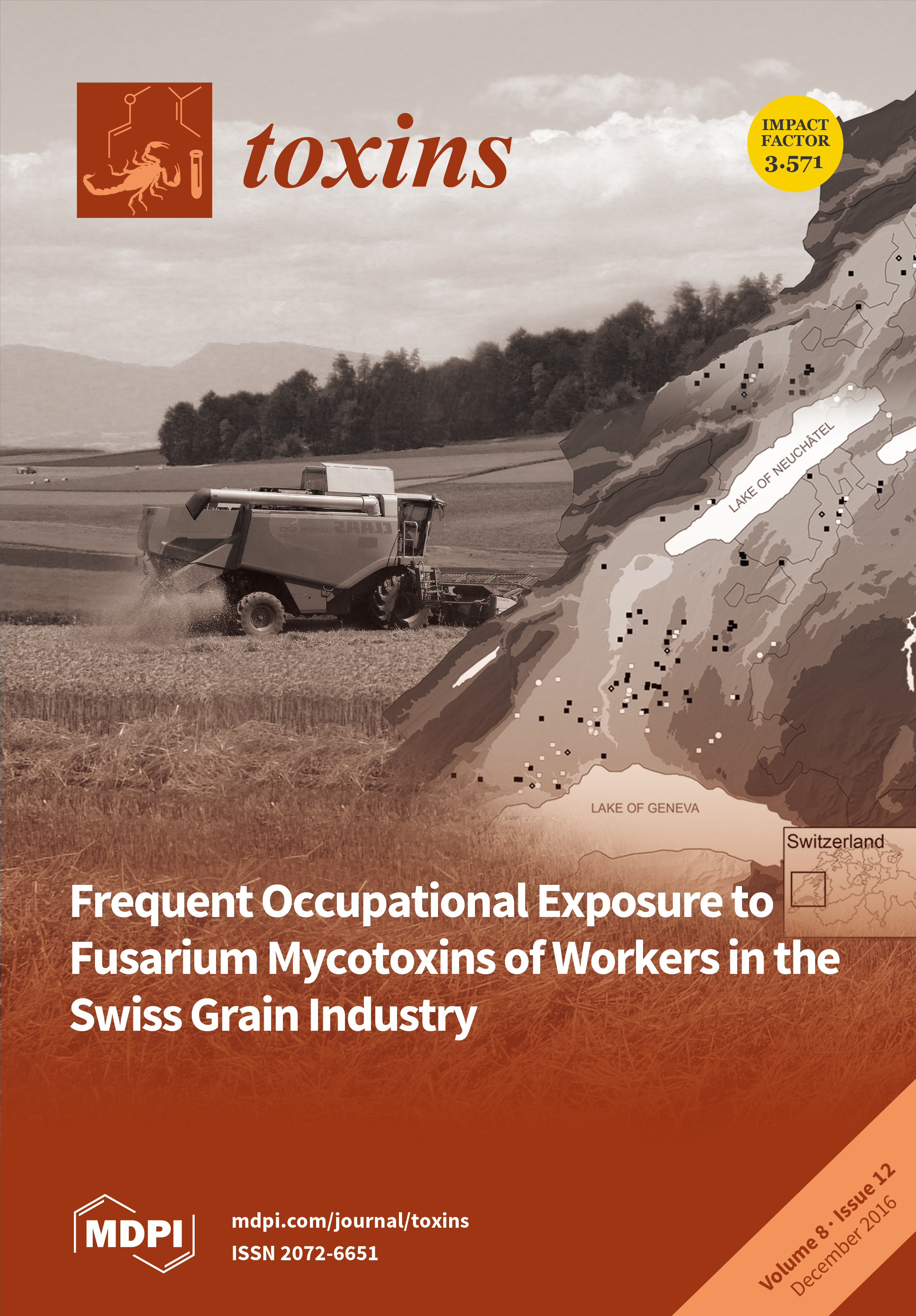
Cover Story: Deoxynivalenol, 3-acetyldeoxynivalenol, 15-acetyldeoxynivalenol, nivalenol and zearalenone are mycotoxins contaminating wheat dust. Mycotoxins are toxic upon ingestion and considered potentially toxic when inhaled. Whereas dietary exposure to mycotoxins is controlled in food, data on occupational exposure by inhalation by grain workers are scarce. The objectives of this study were to determine the incidence of those mycotoxins in aerosols generated during grain harvesting and unloading and the risk of exposure of workers. Personal sampling revealed that working in a cab was an efficient protective measure. However it was not sufficient to avoid chronic exposure to multiple mycotoxins, in particular during cleaning activities.View this paper.
  • Issues are regarded as officially published after their release is announced to the table of contents alert mailing list .
  • You may sign up for email alerts to receive table of contents of newly released issues.
  • PDF is the official format for papers published in both, html and pdf forms. To view the papers in pdf format, click on the "PDF Full-text" link, and use the free Adobe Reader to open them.

Articles (32)

  • Article
  • Open Access
16 Citations
7,526 Views
23 Pages

20 December 2016

Latrodectus tredecimguttatus is a kind of highly venomous black widow spider, with toxicity coming from not only venomous glands but also other parts of its body as well as newborn spiderlings and eggs. Up to date, although L. tredecimguttatus eggs h...

(This article belongs to the Section Animal Venoms)
  • Review
  • Open Access
97 Citations
15,933 Views
27 Pages

Modified Lipids and Lipoproteins in Chronic Kidney Disease: A New Class of Uremic Toxins

  • Nans Florens,
  • Catherine Calzada,
  • Egor Lyasko,
  • Laurent Juillard and
  • Christophe O. Soulage

16 December 2016

Chronic kidney disease (CKD) is associated with an enhanced oxidative stress and deep modifications in lipid and lipoprotein metabolism. First, many oxidized lipids accumulate in CKD and were shown to exert toxic effects on cells and tissues. These l...

(This article belongs to the Special Issue Novel Issues in Uremic Toxicity)
  • Article
  • Open Access
14 Citations
7,525 Views
15 Pages

Probiotic Microorganisms Inhibit Epithelial Cell Internalization of Botulinum Neurotoxin Serotype A

  • Tina I. Lam,
  • Christina C. Tam,
  • Larry H. Stanker and
  • Luisa W. Cheng

16 December 2016

Botulinum neurotoxins (BoNTs) are some of the most poisonous natural toxins known to man and are threats to public health and safety. Previous work from our laboratory showed that both BoNT serotype A complex and holotoxin can bind and transit throug...

(This article belongs to the Special Issue Novel Pharmacological Inhibitors for Bacterial Protein Toxins)
  • Article
  • Open Access
16 Citations
7,544 Views
8 Pages

Abobotulinum Toxin A in the Treatment of Chronic Low Back Pain

  • Duarte Machado,
  • Aditya Kumar and
  • Bahman Jabbari

15 December 2016

Chronic low back pain is a debilitating condition with a complex and multifactorial pathophysiology. Botulinum neurotoxins (BoNTs) have strong analgesic effects, as shown in both animal models of pain and in human beings. A randomized, double-blind,...

(This article belongs to the Collection Botulinum Toxins on Human Pain)
  • Article
  • Open Access
45 Citations
8,985 Views
18 Pages

15 December 2016

A method based on the QuEChERS (quick, easy, cheap, effective, rugged, and safe) purification combined with ultrahigh performance liquid chromatography tandem mass spectrometry (UPLC–MS/MS), was optimized for the simultaneous quantification of 25 myc...

(This article belongs to the Special Issue LC-MS/MS Method for Mycotoxin Analysis)
  • Article
  • Open Access
40 Citations
7,232 Views
15 Pages

Limited Link between Oxidative Stress and Ochratoxin A—Induced Renal Injury in an Acute Toxicity Rat Model

  • Liye Zhu,
  • Tao Yu,
  • Xiaozhe Qi,
  • Jing Gao,
  • Kunlun Huang,
  • Xiaoyun He,
  • Haoshu Luo and
  • Wentao Xu

14 December 2016

Ochratoxin A (OTA) displays nephrotoxicity and hepatotoxicity. However, in the acute toxicity rat model, there is no evidence on the relationship between OTA and nephrotoxicity and hepatotoxicity. Based on this, the integrated analysis of physiologic...

(This article belongs to the Collection Ochratoxins-Collection)
  • Article
  • Open Access
14 Citations
6,972 Views
13 Pages

Proteomic Analyses of Agkistrodon contortrix contortrix Venom Using 2D Electrophoresis and MS Techniques

  • Aleksandra Bocian,
  • Małgorzata Urbanik,
  • Konrad Hus,
  • Andrzej Łyskowski,
  • Vladimír Petrilla,
  • Zuzana Andrejčáková,
  • Monika Petrillová and
  • Jaroslav Legáth

13 December 2016

Snake venom is a complex mixture of proteins and peptides which in the Viperidae is mainly hemotoxic. The diversity of these components causes the venom to be an extremely interesting object of study. Discovered components can be used in search for n...

(This article belongs to the Section Animal Venoms)
  • Article
  • Open Access
21 Citations
5,335 Views
13 Pages

13 December 2016

An interlaboratory study was performed in eight laboratories to validate a liquid chromatography–tandem mass spectrometry (LC/MS/MS) method for the simultaneous determination of aflatoxins and sterigmatocystin (STC) in white rice and sorghum (Sorghum...

(This article belongs to the Special Issue LC-MS/MS Method for Mycotoxin Analysis)
  • Article
  • Open Access
34 Citations
7,946 Views
10 Pages

Frequent Occupational Exposure to Fusarium Mycotoxins of Workers in the Swiss Grain Industry

  • Hélène Niculita-Hirzel,
  • Gregoire Hantier,
  • Ferdinand Storti,
  • Gregory Plateel and
  • Thierry Roger

12 December 2016

Type B trichotecens such as deoxynivalenol (DON), 3-acetyldeoxynivalenol (3-ADON), 15-acetyldeoxynivalenol (15-ADON), nivalenol (NIV) and zearalenone (ZEN) are mycotoxins contaminating wheat and wheat dust. Mycotoxins are toxic upon ingestion and con...

(This article belongs to the Special Issue Exposure and Risk Assessment for Mycotoxins)
  • Article
  • Open Access
53 Citations
8,860 Views
24 Pages

9 December 2016

Venom gland transcriptomic and proteomic analyses have improved our knowledge on the diversity of the heterogeneous components present in scorpion venoms. However, most of these studies have focused on species from the family Buthidae. To gain insigh...

(This article belongs to the Section Animal Venoms)
  • Article
  • Open Access
41 Citations
8,077 Views
16 Pages

8 December 2016

Sea anemones (Cnidaria, Anthozoa, and Actiniaria) use toxic peptides to incapacitate and immobilize prey and to deter potential predators. Their toxin arsenal is complex, targeting a variety of functionally important protein complexes and macromolecu...

(This article belongs to the Collection Evolution of Venom Systems)
  • Review
  • Open Access
36 Citations
8,340 Views
11 Pages

Fibroblast Growth Factor-23—A Potential Uremic Toxin

  • Piotr Kuczera,
  • Marcin Adamczak and
  • Andrzej Wiecek

8 December 2016

Fibroblast growth factor-23 (FGF23) is a circulating member of the FGF family produced mainly by the osteocytes and osteoblasts that can act as a hormone. The main action of FGF23 is to lower phosphatemia via the reduction of urinary phosphate reabso...

(This article belongs to the Special Issue Novel Issues in Uremic Toxicity)
  • Article
  • Open Access
203 Citations
13,754 Views
29 Pages

Co-Occurrence of Regulated, Masked and Emerging Mycotoxins and Secondary Metabolites in Finished Feed and Maize—An Extensive Survey

  • Paula Kovalsky,
  • Gregor Kos,
  • Karin Nährer,
  • Christina Schwab,
  • Timothy Jenkins,
  • Gerd Schatzmayr,
  • Michael Sulyok and
  • Rudolf Krska

6 December 2016

Global trade of agricultural commodities (e.g., animal feed) requires monitoring for fungal toxins. Also, little is known about masked and emerging toxins and metabolites. 1926 samples from 52 countries were analysed for toxins and metabolites. Of 16...

(This article belongs to the Special Issue LC-MS/MS Method for Mycotoxin Analysis)
  • Article
  • Open Access
15 Citations
7,567 Views
13 Pages

ATP Release from Human Airway Epithelial Cells Exposed to Staphylococcus aureus Alpha-Toxin

  • Romina Baaske,
  • Mandy Richter,
  • Nils Möller,
  • Sabine Ziesemer,
  • Ina Eiffler,
  • Christian Müller and
  • Jan-Peter Hildebrandt

6 December 2016

Airway epithelial cells reduce cytosolic ATP content in response to treatment with S. aureus alpha-toxin (hemolysin A, Hla). This study was undertaken to investigate whether this is due to attenuated ATP generation or to release of ATP from the cytos...

(This article belongs to the Collection Staphylococcus aureus Toxins)
  • Communication
  • Open Access
6 Citations
5,940 Views
14 Pages

6 December 2016

RTA, the catalytic A-subunit of the ribosome inactivating A/B toxin ricin, inhibits eukaryotic protein biosynthesis by depurination of 28S rRNA. Although cell surface binding of ricin holotoxin is mainly mediated through its B-subunit (RTB), sole app...

(This article belongs to the Special Issue Ribosome Inactivating Toxins)
  • Article
  • Open Access
27 Citations
6,509 Views
12 Pages

Higher Levels of Aflatoxin M1 Contamination and Poorer Composition of Milk Supplied by Informal Milk Marketing Chains in Pakistan

  • Naveed Aslam,
  • Muhammad Yasin Tipu,
  • Muhammad Ishaq,
  • Ann Cowling,
  • David McGill,
  • Hassan Mahmood Warriach and
  • Peter Wynn

5 December 2016

The present study was conducted to observe the seasonal variation in aflatoxin M1 and nutritional quality of milk along informal marketing chains. Milk samples (485) were collected from three different chains over a period of one year. The average co...

(This article belongs to the Collection Understanding Mycotoxin Occurrence in Food and Feed Chains)
  • Article
  • Open Access
39 Citations
8,577 Views
22 Pages

Metabolism of HT-2 Toxin and T-2 Toxin in Oats

  • Jacqueline Meng-Reiterer,
  • Christoph Bueschl,
  • Justyna Rechthaler,
  • Franz Berthiller,
  • Marc Lemmens and
  • Rainer Schuhmacher

5 December 2016

The Fusarium mycotoxins HT-2 toxin (HT2) and T-2 toxin (T2) are frequent contaminants in oats. These toxins, but also their plant metabolites, may contribute to toxicological effects. This work describes the use of 13C-assisted liquid chromatography–...

(This article belongs to the Special Issue LC-MS/MS Method for Mycotoxin Analysis)
  • Article
  • Open Access
60 Citations
8,654 Views
12 Pages

A P-Glycoprotein Is Linked to Resistance to the Bacillus thuringiensis Cry3Aa Toxin in a Leaf Beetle

  • Yannick Pauchet,
  • Anne Bretschneider,
  • Sylvie Augustin and
  • David G. Heckel

5 December 2016

Chrysomela tremula is a polyvoltine oligophagous leaf beetle responsible for massive attacks on poplar trees. This beetle is an important model for understanding mechanisms of resistance to Bacillus thuringiensis (Bt) insecticidal toxins, because a r...

(This article belongs to the Special Issue The Insecticidal Bacterial Toxins in Modern Agriculture)
  • Correction
  • Open Access
1 Citations
4,919 Views
1 Page
  • Review
  • Open Access
72 Citations
10,003 Views
22 Pages

2 December 2016

Mycotoxins are secondary metabolites produced by pathogenic fungi in crops worldwide. These compounds can undergo modification in plants, leading to the formation of a large number of possible modified forms, whose toxicological relevance and occurre...

(This article belongs to the Special Issue LC-MS/MS Method for Mycotoxin Analysis)
  • Review
  • Open Access
24 Citations
10,103 Views
9 Pages

1 December 2016

Haff disease is a rare syndrome of unexplained myalgia and rhabdomyolysis occurring within 24 h of consumption of certain types of cooked freshwater fish or crustacean. It is caused by a yet unidentified heat-stable toxin. In the present review of pu...

(This article belongs to the Section Marine and Freshwater Toxins)
  • Review
  • Open Access
30 Citations
10,765 Views
15 Pages

Snake Genome Sequencing: Results and Future Prospects

  • Harald M. I. Kerkkamp,
  • R. Manjunatha Kini,
  • Alexey S. Pospelov,
  • Freek J. Vonk,
  • Christiaan V. Henkel and
  • Michael K. Richardson

1 December 2016

Snake genome sequencing is in its infancy—very much behind the progress made in sequencing the genomes of humans, model organisms and pathogens relevant to biomedical research, and agricultural species. We provide here an overview of some of the snak...

(This article belongs to the Special Issue Snake Venom Metalloproteinases)
  • Article
  • Open Access
14 Citations
7,547 Views
16 Pages

30 November 2016

Fusarium graminearum is the predominant causal species of Fusarium head blight in Europe and North America. Different chemotypes of the species exist, each producing a plethora of mycotoxins. Isolates of differing chemotypes produce nivalenol (NIV) a...

(This article belongs to the Collection Understanding Mycotoxin Occurrence in Food and Feed Chains)
  • Article
  • Open Access
16 Citations
6,059 Views
24 Pages

A Topographical Atlas of Shiga Toxin 2e Receptor Distribution in the Tissues of Weaned Piglets

  • Daniel Steil,
  • Robert Bonse,
  • Iris Meisen,
  • Gottfried Pohlentz,
  • German Vallejo,
  • Helge Karch and
  • Johannes Müthing

30 November 2016

Shiga toxin (Stx) 2e of Stx-producing Escherichia coli (STEC) is the primary virulence factor in the development of pig edema disease shortly after weaning. Stx2e binds to the globo-series glycosphingolipids (GSLs) globotriaosylceramide (Gb3Cer, Galα...

(This article belongs to the Collection Shiga Toxins)
  • Review
  • Open Access
237 Citations
14,647 Views
13 Pages

30 November 2016

Indoxyl sulfate is an extensively studied uremic solute. It is a small molecule that is more than 90% bound to plasma proteins. Indoxyl sulfate is derived from the breakdown of tryptophan by colon microbes. The kidneys achieve high clearances of indo...

(This article belongs to the Special Issue Novel Issues in Uremic Toxicity)
  • Review
  • Open Access
48 Citations
10,451 Views
15 Pages

Dehydropyrrolizidine Alkaloid Toxicity, Cytotoxicity, and Carcinogenicity

  • Bryan L. Stegelmeier,
  • Steven M. Colegate and
  • Ammon W. Brown

29 November 2016

Dehydropyrrolizidine alkaloid (DHPA)-producing plants have a worldwide distribution amongst flowering plants and commonly cause poisoning of livestock, wildlife, and humans. Previous work has produced considerable understanding of DHPA metabolism, to...

(This article belongs to the Collection Toxicity of Natural Alkaloids)
  • Communication
  • Open Access
40 Citations
8,276 Views
9 Pages

Fast Screening of Antibacterial Compounds from Fusaria

  • Teis Esben Sondergaard,
  • Marlene Fredborg,
  • Ann-Maria Oppenhagen Christensen,
  • Sofie K. Damsgaard,
  • Nikoline F. Kramer,
  • Henriette Giese and
  • Jens Laurids Sørensen

29 November 2016

Bio-guided screening is an important method to identify bioactive compounds from fungi. In this study we applied a fast digital time-lapse microscopic method for assessment of the antibacterial properties of secondary metabolites from the fungal genu...

(This article belongs to the Collection Fusarium Toxins – Relevance for Human and Animal Health)
  • Article
  • Open Access
18 Citations
6,028 Views
14 Pages

Growth-Phase Sterigmatocystin Formation on Lactose Is Mediated via Low Specific Growth Rates in Aspergillus nidulans

  • Zoltán Németh,
  • Ákos P. Molnár,
  • Balázs Fejes,
  • Levente Novák,
  • Levente Karaffa,
  • Nancy P. Keller and
  • Erzsébet Fekete

28 November 2016

Seed contamination with polyketide mycotoxins such as sterigmatocystin (ST) produced by Aspergilli is a worldwide issue. The ST biosynthetic pathway is well-characterized in A. nidulans, but regulatory aspects related to the carbon source are still e...

(This article belongs to the Collection Aflatoxins)
  • Article
  • Open Access
59 Citations
6,889 Views
14 Pages

Viperid Envenomation Wound Exudate Contributes to Increased Vascular Permeability via a DAMPs/TLR-4 Mediated Pathway

  • Alexandra Rucavado,
  • Carolina A. Nicolau,
  • Teresa Escalante,
  • Junho Kim,
  • Cristina Herrera,
  • José María Gutiérrez and
  • Jay W. Fox

24 November 2016

Viperid snakebite envenomation is characterized by inflammatory events including increase in vascular permeability. A copious exudate is generated in tissue injected with venom, whose proteomics analysis has provided insights into the mechanisms of v...

(This article belongs to the Special Issue Snake Venom Metalloproteinases)
  • Review
  • Open Access
88 Citations
11,291 Views
25 Pages

24 November 2016

The purpose of this review is to present information about raw materials that can be used in pig and poultry diets and the factors responsible for variations in their mycotoxin contents. The levels of mycotoxins in pig and poultry feeds are calculate...

(This article belongs to the Special Issue Exposure and Risk Assessment for Mycotoxins)
  • Article
  • Open Access
23 Citations
9,085 Views
16 Pages

Insights into the Hypertensive Effects of Tityus serrulatus Scorpion Venom: Purification of an Angiotensin-Converting Enzyme-Like Peptidase

  • Daniela Cajado-Carvalho,
  • Alexandre Kazuo Kuniyoshi,
  • Bruno Duzzi,
  • Leo Kei Iwai,
  • Úrsula Castro de Oliveira,
  • Inácio De Loiola Meirelles Junqueira de Azevedo,
  • Roberto Tadashi Kodama and
  • Fernanda Vieira Portaro

24 November 2016

The number of cases of envenomation by scorpions has grown significantly in Brazil since 2007, with the most severe cases being caused by the Tityus serrulatus scorpion. Although envenomed patients mostly suffer neurotoxic manifestations, other sympt...

(This article belongs to the Section Animal Venoms)
  • Conference Report
  • Open Access
77 Citations
11,796 Views
14 Pages

24 November 2016

The deliberations and conclusions of a Hinxton Retreat convened in September 2015, entitled “Mechanisms to reverse the public health neglect of snakebite victims” are reported. The participants recommended that the following priority actions be inclu...

(This article belongs to the Section Animal Venoms)
XFacebookLinkedIn
Toxins - ISSN 2072-6651