You are currently viewing a new version of our website. To view the old version click .

Toxins, Volume 10, Issue 7

July 2018 - 52 articles

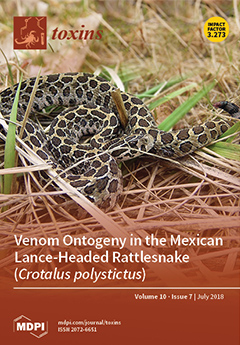
Cover Story: The Mexican Lance-headed Rattlesnake (Crotalus polystictus) occupies native and modified grasslands in central México and feeds primarily on rodents. Ontogeny of the venom proteome follows a typical type I pattern, with neonates showing very low venom SVMP activity that increases dramatically as snakes age, while PLA2 shows the opposite pattern. Increases in SVMP activity with age are due to increases in PIII and PI metalloproteinases in adult venoms, as demonstrated via MALDI-TOF-MS/MS. Venom ontogeny appears to be driven by changes in prey size rather than type as was observed in other species such as Crotalus oreganus helleri and C. o. oreganus. (Photo by Estrella Mociño-Deloya and Kirk Setser) View this paper.
  • Issues are regarded as officially published after their release is announced to the table of contents alert mailing list .
  • You may sign up for email alerts to receive table of contents of newly released issues.
  • PDF is the official format for papers published in both, html and pdf forms. To view the papers in pdf format, click on the "PDF Full-text" link, and use the free Adobe Reader to open them.

Articles (52)

  • Article
  • Open Access
14 Citations
5,151 Views
12 Pages

16 July 2018

Lipopolysaccharide (LPS) from Porphyromonas gingivalis (Pg-LPS) is a key bacterial structure involved in the maintenance of a chronic pro-inflammatory environment during periodontitis. Similar to other gram-negative LPS, Pg-LPS induces the release of...

  • Article
  • Open Access
30 Citations
5,983 Views
8 Pages

Label-Free Optical Detection of Mycotoxins Using Specific Aptamers Immobilized on Gold Nanostructures

  • Ali Ghanim Al-Rubaye,
  • Alexei Nabok,
  • Gaelle Catanante,
  • Jean-Louis Marty,
  • Eszter Takács and
  • András Székács

16 July 2018

This work focuses on the development of the novel label-free optical apta-sensors for detection of mycotoxins. A highly sensitive analytical method of total internal reflection ellipsometry (TIRE) combined with Localized Surface Plasmon Resonance (LS...

  • Review
  • Open Access
33 Citations
6,096 Views
23 Pages

16 July 2018

Venoms are evolutionary key adaptations that species employ for defense, predation or competition. However, the processes and forces that drive the evolution of venoms and their toxin components remain in many aspects understudied. In particular, the...

  • Article
  • Open Access
35 Citations
6,146 Views
10 Pages

Characterisation of the Mycobiota on the Shell Surface of Table Eggs Acquired from Different Egg-Laying Hen Breeding Systems

  • Łukasz Tomczyk,
  • Łukasz Stępień,
  • Monika Urbaniak,
  • Tomasz Szablewski,
  • Renata Cegielska-Radziejewska and
  • Kinga Stuper-Szablewska

16 July 2018

Microbial safety is an important factor contributing to the egg quality. During egg acquisition, there is significant risk of contamination of the eggshell surface with microscopic fungi. Mycelial hyphae may grow on the eggshell surface and penetrate...

  • Article
  • Open Access
39 Citations
7,280 Views
21 Pages

Multi-Mycotoxin Occurrence in Dairy Cattle Feeds from the Gauteng Province of South Africa: A Pilot Study Using UHPLC-QTOF-MS/MS

  • Rumbidzai Changwa,
  • Wilfred Abia,
  • Titus Msagati,
  • Hlengilizwe Nyoni,
  • Khanyisa Ndleve and
  • Patrick Njobeh

16 July 2018

The indispensable nature of toxigenic fungi and mycotoxins in agricultural systems is of worldwide concern, hence the need for surveillance studies to preserve public health. Thirteen dairy farms were surveyed and 40 dairy feeds of varying nature col...

  • Article
  • Open Access
14 Citations
5,892 Views
11 Pages

Detection of the Potential Inactivation of Tetrodotoxin by Lactic Acid Bacterial Exopolysaccharide

  • Nguyen Hoang Khue Tu,
  • Nghe Van Dat,
  • Le Van Canh and
  • Doan Thi Thanh Vinh

12 July 2018

Screening for compounds that can neutralize the toxicity of tetrodotoxin (TTX) or reduce its negative effects is necessary. Our study tested the TTX detoxification capacity of exopolysaccharide (EPS) extracted from lactic acid bacteria. EPS of Leucon...

  • Article
  • Open Access
10 Citations
5,645 Views
14 Pages

12 July 2018

Anthrax caused by Bacillus anthracis is a lethal infectious disease, especially when inhaled, and the mortality rate approaches 100% without treatment. The anthrax antitoxin monoclonal antibody (MAb) 5E11 is a humanized antibody that targets the anth...

  • Article
  • Open Access
15 Citations
5,053 Views
15 Pages

Synergistic Effects of Influenza and Staphylococcus aureus Toxins on Inflammation Activation and Cytotoxicity in Human Monocytic Cell Lines

  • Marion Jeannoel,
  • Jean-Sebastien Casalegno,
  • Michèle Ottmann,
  • Cédric Badiou,
  • Oana Dumitrescu,
  • Bruno Lina and
  • Gérard Lina

11 July 2018

In patients with influenza, morbidity and mortality are strongly influenced by infections with Staphylococcus aureus producing high amounts of certain toxins. Here we tested the impact of influenza virus on the pro-inflammatory and cytotoxic actions...

  • Feature Paper
  • Review
  • Open Access
71 Citations
15,890 Views
18 Pages

Gut Microbiota and Cardiovascular Uremic Toxicities

  • Manuel T. Velasquez,
  • Patricia Centron,
  • Ian Barrows,
  • Rama Dwivedi and
  • Dominic S. Raj

11 July 2018

Cardiovascular disease (CVD) remains a major cause of high morbidity and mortality in patients with chronic kidney disease (CKD). Numerous CVD risk factors in CKD patients have been described, but these do not fully explain the high pervasiveness of...

  • Article
  • Open Access
9 Citations
4,864 Views
15 Pages

10 July 2018

Cycopiazonic acid (CPA) is a neurotoxin that acts through inhibition of the sarco(endo)plasmic reticulum Ca2+-ATPase (SERCA). CPA blocks the calcium access channel of the enzyme. The inhibition may involve the binding of CPA with a divalent cation su...

of 6

Get Alerted

Add your email address to receive forthcoming issues of this journal.

XFacebookLinkedIn
Toxins - ISSN 2072-6651