

You are currently viewing a new version of our website. To view the old version click .

Toxins, Volume 10, Issue 6

June 2018 - 40 articles

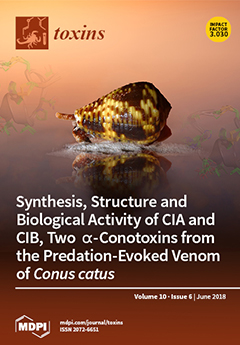
Cover Story: Cone snails are predatory marine gastropods that use venom to catch preys and defend against predators. In this issue, Giribaldi et al. synthesized and pharmacologically characterized two alpha-conotoxins from the piscivorous species Conus catus, namely CIA and CIB. CIA potently blocks the muscle type nicotinic acetylcholine receptor, whereas CIB inhibits neuronal subtypes. The 20 lowest energy NMR structures for CIB, superimposed over the backbone atoms, show a central α-helical region comprising residues 6-11. View Paper here.
  • Issues are regarded as officially published after their release is announced to the table of contents alert mailing list .
  • You may sign up for email alerts to receive table of contents of newly released issues.
  • PDF is the official format for papers published in both, html and pdf forms. To view the papers in pdf format, click on the "PDF Full-text" link, and use the free Adobe Reader to open them.

Articles (40)

  • Communication
  • Open Access
4 Citations
6,352 Views
9 Pages

Detection of Clostridium tetani Neurotoxins Inhibited In Vivo by Botulinum Antitoxin B: Potential for Misleading Mouse Test Results in Food Controls

  • Luca Bano,
  • Elena Tonon,
  • Ilenia Drigo,
  • Marco Pirazzini,
  • Angela Guolo,
  • Giovanni Farina,
  • Fabrizio Agnoletti and
  • Cesare Montecucco

19 June 2018

The presence of botulinum neurotoxin-producing Clostridia (BPC) in food sources is a public health concern. In favorable environmental conditions, BPC can produce botulinum neurotoxins (BoNTs) outside or inside the vertebrate host, leading to intoxic...

  • Article
  • Open Access
58 Citations
8,506 Views
21 Pages

Evaluating the Performance of De Novo Assembly Methods for Venom-Gland Transcriptomics

  • Matthew L. Holding,
  • Mark J. Margres,
  • Andrew J. Mason,
  • Christopher L. Parkinson and
  • Darin R. Rokyta

19 June 2018

Venom-gland transcriptomics is a key tool in the study of the evolution, ecology, function, and pharmacology of animal venoms. In particular, gene-expression variation and coding sequences gained through transcriptomics provide key information for ex...

  • Article
  • Open Access
12 Citations
4,793 Views
16 Pages

Tb II-I, a Fraction Isolated from Tityus bahiensis Scorpion Venom, Alters Cytokines’: Level and Induces Seizures When Intrahippocampally Injected in Rats

  • Emidio Beraldo Neto,
  • Douglas O. C. Mariano,
  • Lucas A. Freitas,
  • Ana L. C. Dorce,
  • Adriana N. Martins,
  • Daniel C. Pimenta,
  • Fernanda C. V. Portaro,
  • Daniela Cajado-Carvalho,
  • Valquiria A. C. Dorce and
  • Ana L. A. Nencioni

19 June 2018

Scorpion venoms are composed of several substances with different pharmacological activities. Neurotoxins exert their effects by targeting ion channels resulting in toxic effects to mammals, insects and crustaceans. Tb II-I, a fraction isolated from...

  • Review
  • Open Access
6 Citations
5,496 Views
16 Pages

19 June 2018

Cystine-stabilized peptides represent a large family of peptides characterized by high structural stability and bactericidal, fungicidal, or insecticidal properties. Found throughout a wide range of taxa, this broad and functionally important family...

  • Feature Paper
  • Review
  • Open Access
373 Citations
30,581 Views
19 Pages

19 June 2018

Staphylococcus aureus is a microorganism resident in the skin and nasal membranes with a dreadful pathogenic potential to cause a variety of community and hospital-acquired infections. The frequency of these infections is increasing and their treatme...

  • Article
  • Open Access
115 Citations
9,198 Views
22 Pages

Staphylococcus aureus Isolates from Bovine Mastitis in Eight Countries: Genotypes, Detection of Genes Encoding Different Toxins and Other Virulence Genes

  • Valentina Monistero,
  • Hans Ulrich Graber,
  • Claudia Pollera,
  • Paola Cremonesi,
  • Bianca Castiglioni,
  • Enriqueta Bottini,
  • Alejandro Ceballos-Marquez,
  • Laura Lasso-Rojas,
  • Volker Kroemker and
  • Nicole Wente
  • + 10 authors

17 June 2018

Staphylococcus aureus is recognized worldwide as one of the major agents of dairy cow intra-mammary infections. This microorganism can express a wide spectrum of pathogenic factors used to attach, colonize, invade and infect the host. The present stu...

  • Article
  • Open Access
5 Citations
4,115 Views
11 Pages

16 June 2018

The adenylate cyclase toxin-hemolysin (CyaA, ACT, or AC-Hly) plays a crucial role in virulence and airway colonization capacity of the whooping cough agent Bordetella pertussis. The toxin penetrates target cell membranes and exhibits three distinct b...

  • Article
  • Open Access
38 Citations
6,332 Views
18 Pages

16 June 2018

The objective of the current experiment was to explore the intestinal microbiota ecological response to oral administrations of hydrogen-rich water (HRW) and lactulose (LAC) in female piglets fed a Fusarium mycotoxin-contaminated diet. A total of 24...

  • Article
  • Open Access
43 Citations
5,854 Views
13 Pages

15 June 2018

Simultaneous determination of twenty-seven mycotoxins in ready-to-eat food samples using “Quick Easy Cheap Rough and Safe” (QuEChERS) extraction and chromatographic methods coupled to mass spectrometry in tandem is described in this study...

  • Feature Paper
  • Review
  • Open Access
139 Citations
9,682 Views
27 Pages

Fusarium Molds and Mycotoxins: Potential Species-Specific Effects

  • Alessia Bertero,
  • Antonio Moretti,
  • Leon J. Spicer and
  • Francesca Caloni

15 June 2018

This review summarizes the information on biochemical and biological activity of the main Fusarium mycotoxins, focusing on toxicological aspects in terms of species-specific effects. Both in vitro and in vivo studies have centered on the peculiarity...

of 4

Get Alerted

Add your email address to receive forthcoming issues of this journal.

XFacebookLinkedIn
Toxins - ISSN 2072-6651