
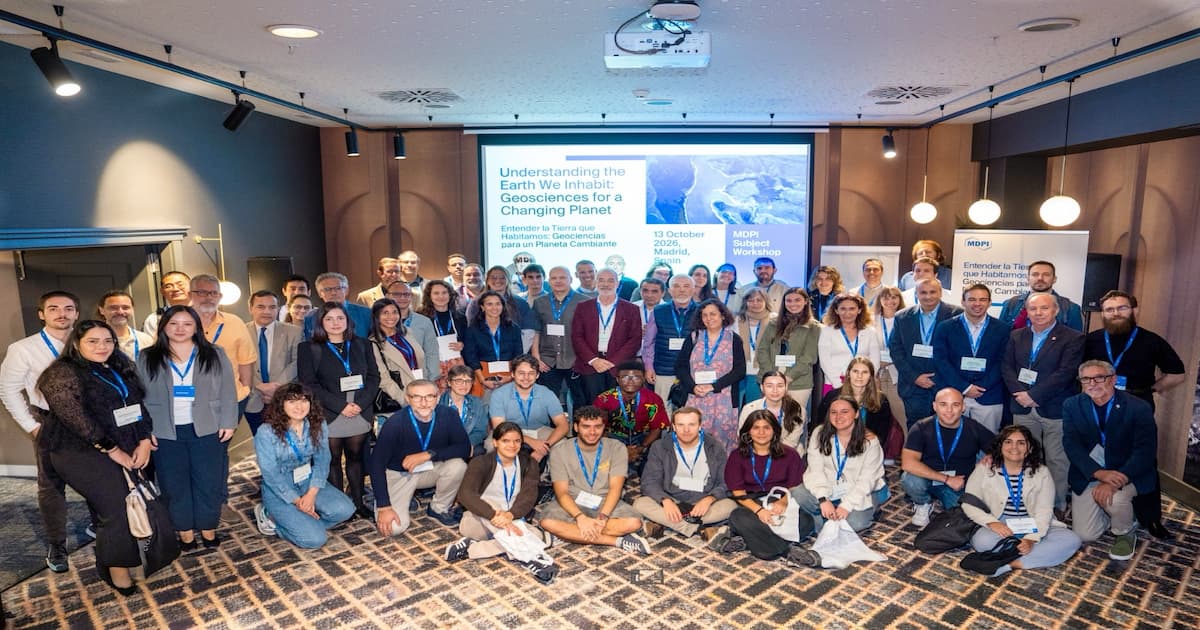
MDPI Geosciences Workshop Brings Together Researchers in Madrid to Explore Solutions for a Changing Planet
On 13 October 2026, MDPI successfully hosted the workshop “Understanding the Earth We Inhabit: Geosciences for a Changing Planet” in Madrid, Spain. The event brought together approximately 80 researchers, professors, early career scientists, and students from more than 30 universities and research institutions across the Madrid region to discuss some of the most pressing challenges facing our planet.
Participants represented leading institutions, including Universidad Politécnica de Madrid (UPM), Universidad Complutense de Madrid (UCM), Universidad Autónoma de Madrid (UAM), Universidad de Alcalá (UAH), Universidad Carlos III de Madrid, Consejo Superior de Investigaciones Científicas (CSIC), Centro de Astrobiología (CSIC-INTA), Instituto Geológico y Minero de España (IGME-CSIC), Instituto Nacional de Técnica Aeroespacial (INTA), Instituto de Salud Carlos III (ISCIII), and several other research centers and academic organizations.
Opening Remarks
The workshop was chaired by Prof. Dr. Emilio Chuvieco Salinero (Universidad de Alcalá), an Editorial Board Member for Fire (ISSN 2571-6255), and Prof. Dr. Alberto G. Fairén (Centro de Astrobiología, CSIC-INTA), the Editor-in-Chief for Geosciences (ISSN 2076-3263).
 |
 |
In their opening remarks, the Chairs emphasized the importance of interdisciplinary collaboration in addressing global environmental challenges such as climate change, sustainable resource management, natural hazards, and the growing role of advanced technologies in Earth system science. They encouraged participants to strengthen scientific cooperation and to continue fostering dialogue across research disciplines.
|
MDPI representative Mr. Iñigo Aristizabal welcomed the attendees and introduced MDPI’s Geosciences subject journals. He shared insights into open access publishing, research visibility, and opportunities for collaboration within the scientific community. |
 |
Scientific Program
The scientific programme featured presentations from leading experts covering a wide range of geoscience topics.
 |
Prof. Dr. Enrique Sánchez Sánchez, an Editorial Board Member for Geosciences, discussed the latest developments in regional climate modelling and future perspectives regarding climate change assessments in the context of upcoming IPCC reports. |
 |
Dr. Miguel Ángel Fernández Torres explored how artificial intelligence is transforming the modelling and understanding of extreme weather and climate events, highlighting its growing relevance for environmental research and forecasting. |
 |
Dr. Jorge Pla-García, a Guest Editor for Geosciences, presented current advances in planetary exploration, demonstrating how research on Mars and Titan contributes to a deeper understanding of Earth’s environmental systems. |
The workshop also addressed global challenges related to water resources and sustainable agriculture through presentations by Prof. Dr. Alberto Garrido, an author of papers published in Water (ISSN 2073-4441) and Sustainability (ISSN 2071-1050), and Prof. Dr. Alicia Palacios-Orueta, a Guest Editor for Remote Sensing (ISSN 2072-4292) and Agriculture (ISSN 2077-0472), who examined topics ranging from water security and climate resilience to sustainable land management and food production systems.
 |
 |
In the Earth observation session, Dr. María Pilar Martín, an author of papers published in Remote Sensing, highlighted the importance of integrating remote sensing with fieldwork, while Prof. Dr. Emilio Chuvieco Salinero, an Editorial Board Member for Fire, demonstrated the value of satellite observations for understanding long-term environmental change.
 |
 |
 |
The programme concluded with a presentation by Dr. Julio César López Gutiérrez, an author of papers published in Applied Sciences (ISSN 2076-3417), on geological hazards and risk assessment, focusing on current challenges associated with climate change and disaster prevention. |
Engaging Discussions and Audience Participation
Throughout the day, attendees actively participated in discussions and Q&A sessions. Questions covered varied topics, including climate adaptation strategies, artificial intelligence applications, remote sensing technologies, water management, planetary exploration, and geological risk assessment.
The high level of audience engagement reflected the strong interest in interdisciplinary approaches for understanding environmental change and addressing future societal challenges.
 |
 |
 |
 |
 |
 |
Round-Table Discussion on Scientific Publishing Ethics
A highlight of the event was the round-table discussion entitled “Current Ethical Challenges in Scientific Publishing”, featuring Prof. Dr. Emilio Chuvieco Salinero, Dr. María Pilar Martín, and Iñigo Aristizabal from MDPI Spain.
The discussion explored topics such as research integrity, authorship practices, transparency in scientific communication, responsible use of artificial intelligence, peer review, and data reproducibility.
Participants actively contributed their perspectives and raised questions regarding ethical publishing practices. MDPI representatives shared insights into editorial standards, peer-review processes, and the importance of maintaining transparency and research quality in an evolving publishing landscape.
 |
 |
 |
 |
Networking and Community Engagement
The workshop provided numerous opportunities for networking and collaboration. During coffee breaks and informal discussions, researchers exchanged ideas, established new professional connections, and explored potential future collaborations.
A group photograph featuring speakers, participants, Chairs, and members of the MDPI team marked the successful conclusion of the event and celebrated the vibrant scientific community brought together through the workshop.
 |
 |
 |
 |
 |
 |
 |
 |
 |
|
Positive Feedback and Future Outlook
Feedback from participants was overwhelmingly positive. Attendees praised the quality of the presentations, the diversity of scientific topics, the opportunities for discussion, and the smooth organization of the event.
Many participants expressed interest in attending future editions of the workshop and welcomed the continuation of similar initiatives that foster collaboration between researchers from different geoscience disciplines. Several attendees also indicated their interest in future cooperation with MDPI through workshops, Special Issues, editorial activities, and other scientific engagement opportunities.
The success of the workshop highlights the growing importance of interdisciplinary dialogue within the geosciences community and reinforces MDPI’s commitment to supporting scientific exchange and open research worldwide.
MDPI Geosciences Subject Journals
|
|
|
|
|
|
|
|
|
|
|
|
|
|
|
|
|
|
|
|
|
|
|
|
|
|
|
|
|
|


