
Energies 2026, 19(11), 2707; https://doi.org/10.3390/en19112707 (registering DOI) - 4 Jun 2026
Abstract
Wind–wave misalignment is a pervasive environmental phenomenon that significantly affects the structural integrity of floating offshore wind turbines (FOWTs). For a Spar-type FOWT across the full 0°–90° misalignment range, this study systematically conducts dynamic response characterization and parameter sensitivity analysis, quantifying the directional
[...] Read more.
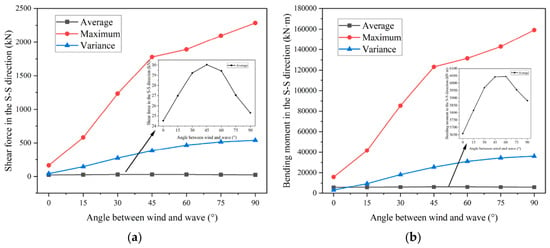
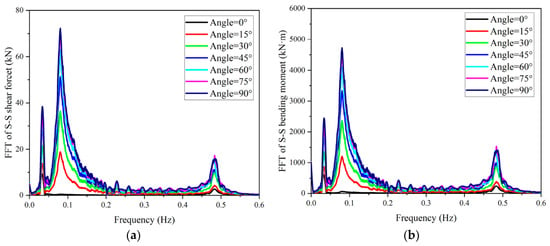
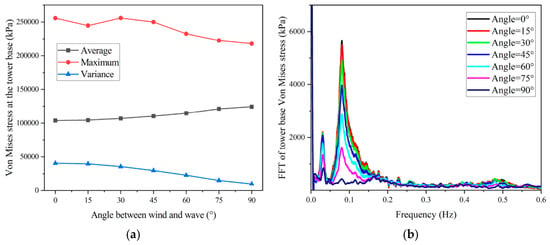
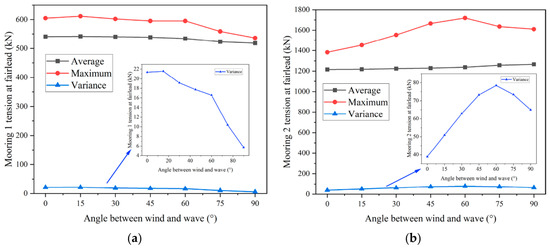
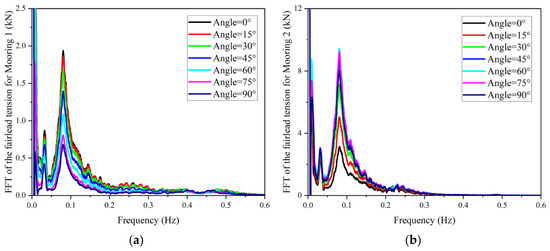
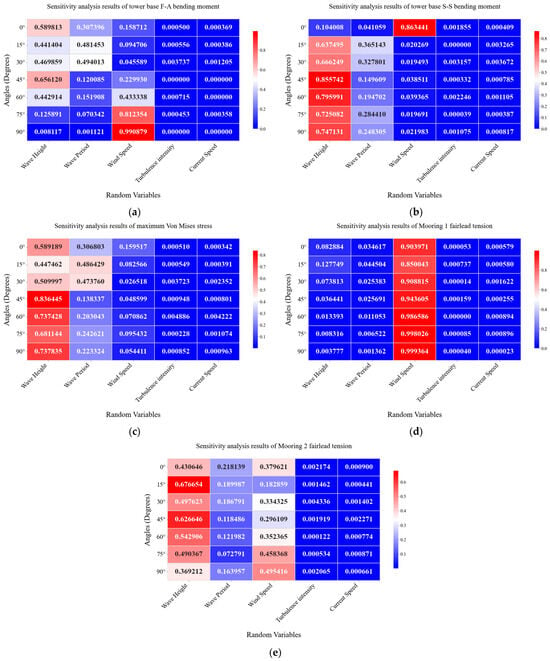
Wind–wave misalignment is a pervasive environmental phenomenon that significantly affects the structural integrity of floating offshore wind turbines (FOWTs). For a Spar-type FOWT across the full 0°–90° misalignment range, this study systematically conducts dynamic response characterization and parameter sensitivity analysis, quantifying the directional modulation effects on five critical dynamic indicators, including tower-base Fore-Aft (F-A) and side-to-side (S-S) bending moments, maximum Von Mises stress, and fairlead tensions. Results demonstrate that wind–wave misalignment triggers a significant redistribution of structural energy, where side-to-side bending moments and fairlead tensions exhibit distinct peak characteristics at specific non-collinear headings. Rather than merely evaluating structural responses, this study emphasizes the sensitivity of environmental parameters to reveal a dominance-switching mechanism. As the misalignment angle increases, the governing factors of structural response dynamically shift from wind variables to wave variables. This research provides a rigorous mechanical explanation for complex response evolution and offers a scientific basis for the robust design of floating wind turbines in multi-directional sea states.
Full article
(This article belongs to the Special Issue Advanced Control Technology of Integrated Wind and Wave Energy Conversion Systems: 2nd Edition)
►
Show Figures
Figure 1