An Interoperable User-Centred Digital Twin Framework for Sustainable Energy System Management



Abstract
1. Introduction
- RQ1: How can interoperability standards such as FMI be combined with user-centred design principles to support flexible and accessible digital twins for energy systems?
- RQ2: What architectural characteristics are required to decouple backend energy model execution from frontend user interaction while maintaining computational rigour and scalability?
- RQ3: How can a user-centred digital twin framework support diverse stakeholder needs across energy system design, planning, and operational phases?
2. Background and Related Work
2.1. Background: Energy Modelling and System Challenges
2.2. Literature Review: Interoperability and Interface Design in Energy Modelling
2.3. Digital Twins in Energy Systems
2.4. Research Gap and Motivation
2.5. Novelty and Contributions
- This study introduces the concept of user-centred interoperability, extending traditional notions of interoperability beyond technical model coupling to include meaningful, intuitive, and cognitively accessible interaction between different stakeholders and interoperable energy models.
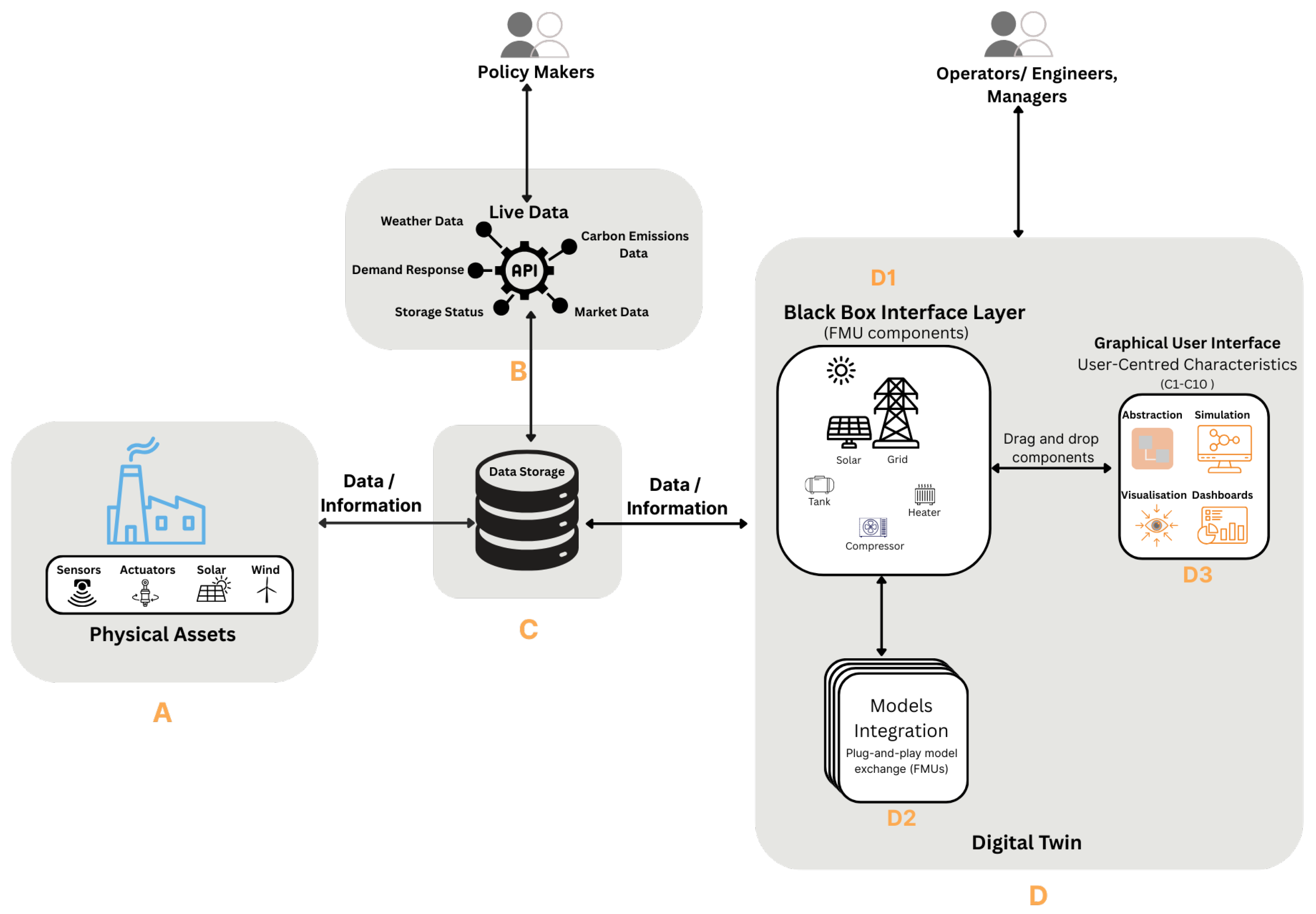
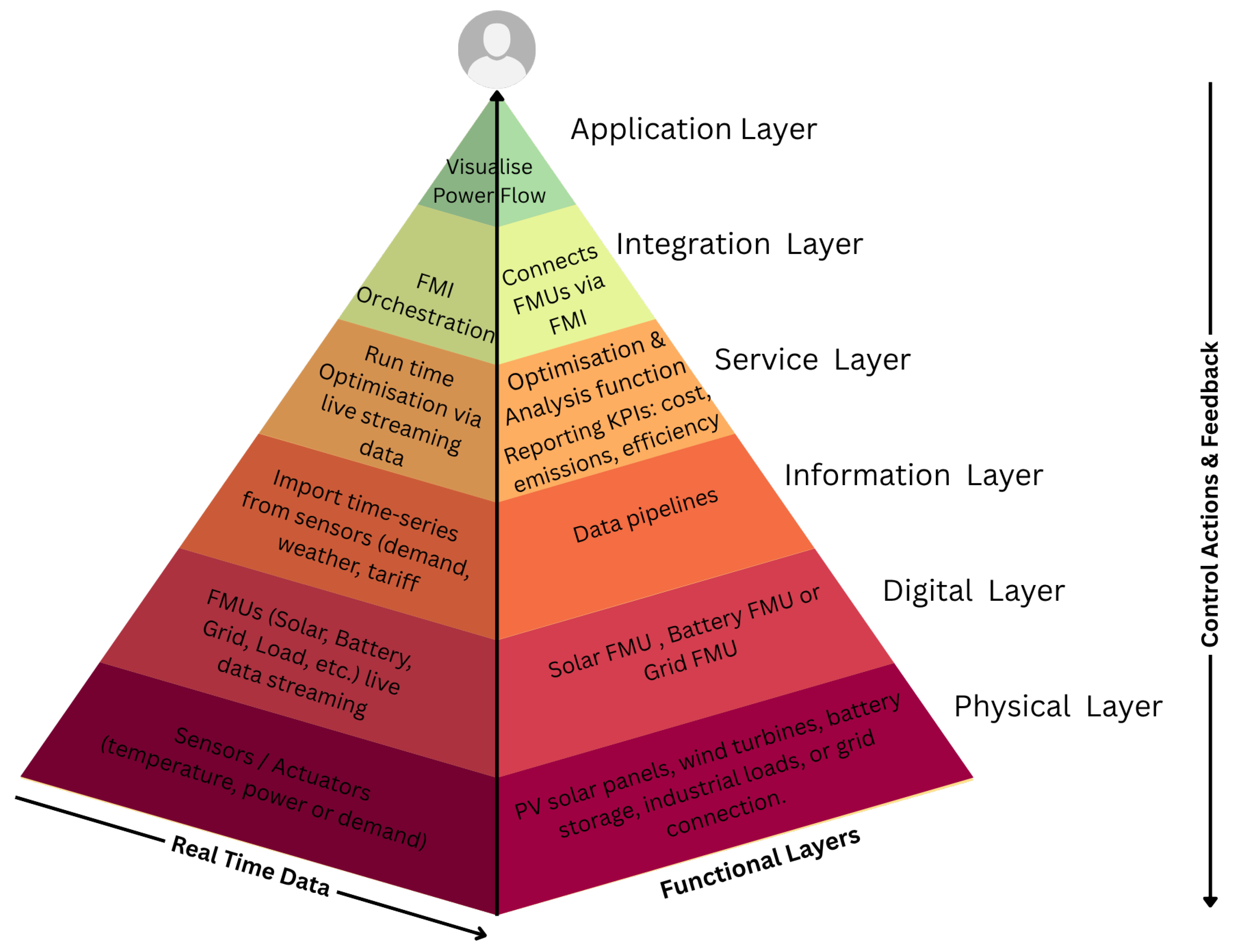
- A structured energy digital twin framework is proposed that combines modular, black-box architectural principles with layered user interaction and visualisation components. This structure enables scalable integration of simulation, optimisation, and data-driven models while preserving usability, transparency, and system interpretability.
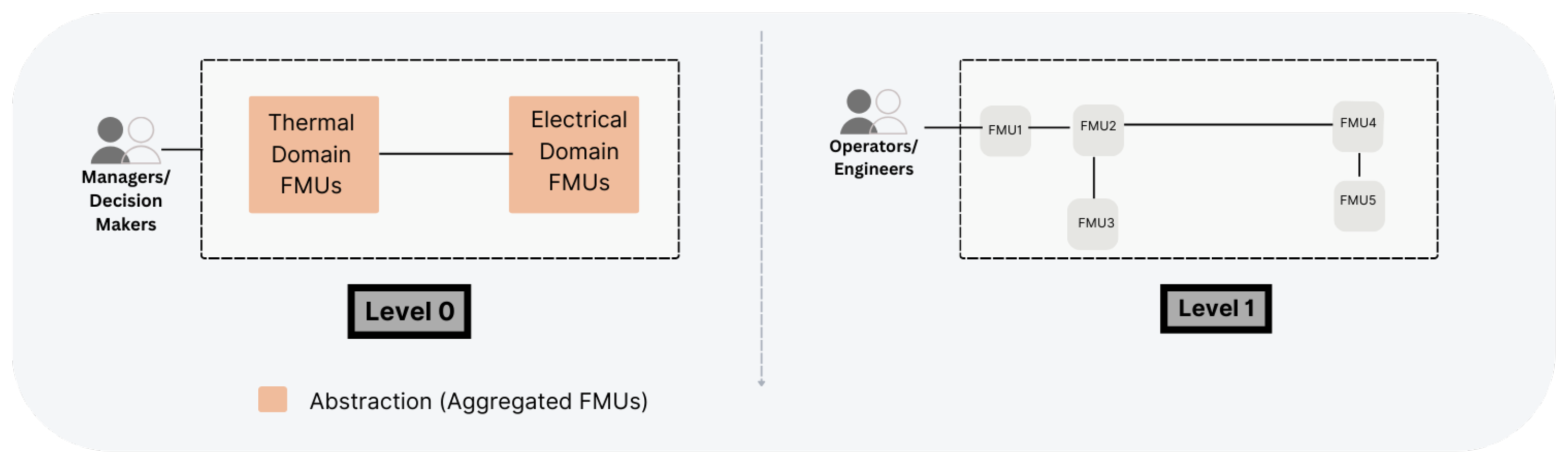
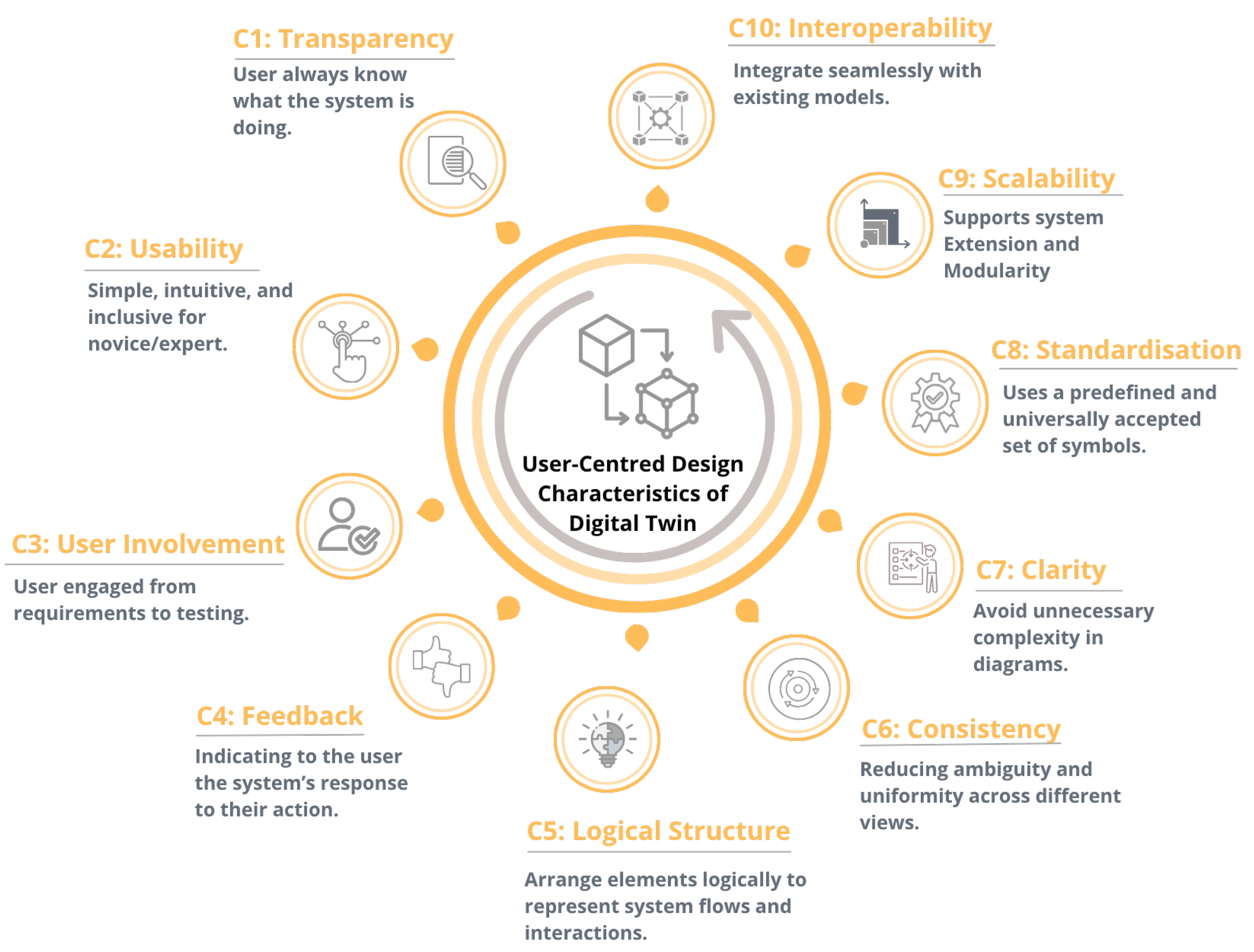
- A set of user-centred design characteristics is formalised for the development of energy digital twin interfaces, addressing interaction design, hierarchical abstraction, system configurability, and result interpretation to support effective decision-making by both expert and non-expert stakeholders.
3. Methodology
3.1. Architecture of the Proposed I-UCDT (Interoperable User-Centred Digital Twins) Framework
3.2. Layered Design of the I-UCDT Framework
3.3. User-Centred Design Characteristics for I-UCDT Framework
3.4. Summary of the I-UCDT Framework
4. Results
4.1. Comparative Evaluation of User-Centred Digital Twin Characteristics
4.2. Synthesis and Evaluation of the I-UCDT Framework
5. Case Study: Application of the I-UCDT Framework in a Dairy Processing Plant
6. Discussion
7. Conclusions
Author Contributions
Funding
Data Availability Statement
Acknowledgments
Conflicts of Interest
Abbreviations
| DTs | Digital Twins |
| GUI | Graphical User Interface |
| PAT | Pyramidal Activity Theory |
| UCD | User-Centred Design |
| I-UCDT | Interoperable User-Centred Digital Twin |
| FMI | Functional Mock-up Interface |
| FMU | Functional Mock-up Unit |
| HCI | Human–Computer Interaction |
| API | Application Programming Interface |
| MATLAB | MATrix LABoratory |
| RAMI 4.0 | Reference Architectural Model for Industry 4.0 |
| ISO 23247 | Digital Twin framework for manufacturing (ISO standard) |
| IIoT | Industrial Internet of Things |
| LP | Linear Programming |
| MILP | Mixed-Integer Linear Programming |
| NLP | Nonlinear Programming |
| TRIZ | Theory of Inventive Problem Solving |
| KPI | Key Performance Indicator |
| OSeMOSYS | Open-Source energy MOdeling SYStem |
| TIMES | The Integrated MARKAL-EFOM System |
| MARKAL | MARKet ALlocation model |
| MESSAGE | Model for Energy Supply Strategy Alternatives and their General Environmental Impact |
| LEAP | Long-range Energy Alternatives Planning System |
| EnergyPLAN | EnergyPLAN model (comprehensive energy system analysis) |
| Calliope | Calliope energy system modeling framework |
| PLEXOS | PLEXOS Integrated Energy Model |
| urbs | Urban Energy System Model |
| Switch | Switch electricity system model |
| EnergyScope | EnergyScope energy system model |
| GenX | GenX power system capacity expansion model |
| HOMER | Hybrid Optimization of Multiple Energy Resources |
| iHOGA | Improved Hybrid Optimization by Genetic Algorithms |
| Polysun | Polysun renewable energy design software |
| DER-CAM | Distributed Energy Resources Customer Adoption Model |
| RAPSim | Renewable Alternative Power Systems Simulation |
| RETScreen | RETScreen Clean Energy Management Software |
| SAM | System Advisor Model |
| EnergyPlus | EnergyPlus Building Energy Simulation Program |
| TRNSYS | Transient System Simulation Tool |
| CEA | City Energy Analyst |
| CitySim | CitySim urban energy modeling tool |
| IDA-ICE | IDA Indoor Climate and Energy |
| ESP-r | Environmental Systems Performance Research software |
| District-ECA | District Energy Concept Advisor |
| SimStadt | SimStadt urban energy simulation |
| TEASER | Tool for Energy Analysis and Simulation for Efficient Retrofit |
| UMI | Urban Modeling Interface |
| IDEAS | Integrated District Energy Assessment by Simulation (Python) |
| GridLAB-D | Grid Laboratory for Distributed Energy Resources |
| MATPOWER | MATPOWER power system simulation package |
| pandapower | Python for Power System Analysis |
| pandapipes | Python for Pipe Network Simulation |
| OpenDSS | Open Distribution System Simulator |
| Neplan | Neplan power system analysis software |
| NetSim | Network Simulation tool |
| COMPOSE | Comprehensive Power System Simulator |
| PyPSA | Python for Power System Analysis |
| TransiEnt | TransiEnt library for energy transition systems |
| ficus | Ficus energy system optimization framework |
| oemof | Open Energy Modelling Framework |
| GEMIS | Global Emission Model for Integrated Systems |
| MODEST | Model for Optimization of Dynamic Energy Systems with Time-dependent components |
| Termis | Termis District Heating Simulation Software |
References
- Iranshahi, K.; Brun, J.; Arnold, T.; Sergi, T.; Müller, U.C. Digital twins: Recent advances and future directions in engineering fields. Intell. Syst. Appl. 2025, 26, 200516. [Google Scholar] [CrossRef]
- Yu, W.; Patros, P.; Young, B.; Klinac, E.; Walmsley, T.G. Energy Digital Twin Technology for Industrial Energy Management: Classification, Challenges and Future. Renew. Sustain. Energy Rev. 2022, 161, 112407. [Google Scholar] [CrossRef]
- Harper, K.E.; Malakuti, S.; Ganz, C. Digital Twin Architecture and Standards. J. Innov. (IIC) 2019, 12. [Google Scholar] [CrossRef]
- Qi, Q.; Tao, F.; Hu, T.; Anwer, N.; Liu, A.; Wei, Y.; Wang, L.; Nee, A.Y. Enabling Technologies and Tools for Digital Twin. J. Manuf. Syst. 2021, 58, 3–21. [Google Scholar] [CrossRef]
- Höffner, D.; Glombik, S. Energy System Planning and Analysis software—A Comprehensive Meta-Review with Special Attention to Urban Energy Systems and District Heating. Energy 2024, 307, 132542. [Google Scholar] [CrossRef]
- Tao, F.; Zhang, H.; Liu, A.; Nee, A.Y.C. Digital Twin in Industry: State-of-the-Art. IEEE Trans. Ind. Inform. 2019, 15, 2405–2415. [Google Scholar] [CrossRef]
- Zomerdijk, W.; Palensky, P.; AlSkaif, T.; Vergara, P.P. On Future Power System Digital Twins: A Vision Towards a Standard Architecture. Digit. Twins Appl. 2024, 1, 103–117. [Google Scholar] [CrossRef]
- Tongsubanan, S.; Kasemsarn, K. Developing a Design Guideline for a User-Friendly Home Energy-Saving Application that Aligns with User-Centered Design (UCD) Principles. Int. J. Hum.–Comput. Interact. 2025, 41, 7424–7446. [Google Scholar] [CrossRef]
- Blochwitz, T.; Otter, M.; Åkesson, J.; Arnold, M.; Clauss, C.; Elmqvist, H.; Friedrich, M.; Junghanns, A.; Mauss, J.; Neumerkel, D.; et al. Functional Mock-up Interface 2.0: The Standard for Tool-Independent Exchange of Simulation Models. In Proceedings of the 9th International Modelica Conference, Munich, Germany, 3–5 September 2012; The Modelica Association: Munich, Germany, 2012; pp. 173–184. [Google Scholar]
- Jebaraj, S.; Iniyan, S. A Review of Energy Models. Renew. Sustain. Energy Rev. 2006, 10, 281–311. [Google Scholar] [CrossRef]
- Song, D.; Meng, W.; Dong, M.; Yang, J.; Wang, J.; Chen, X.; Huang, L. A Critical Survey of Integrated Energy System: Summaries, Methodologies and Analysis. Energy Convers. Manag. 2022, 266, 115863. [Google Scholar] [CrossRef]
- Groissböck, M. Are Open Source Energy System Optimization Tools Mature Enough for Serious Use? Renew. Sustain. Energy Rev. 2019, 102, 234–248. [Google Scholar] [CrossRef]
- Lopion, P.; Markewitz, P.; Robinius, M.; Stolten, D. A Review of Current Challenges and Trends in Energy Systems Modeling. Renew. Sustain. Energy Rev. 2018, 96, 156–166. [Google Scholar] [CrossRef]
- Pfenninger, S.; Hirth, L.; Schlecht, I.; Schmid, E.; Wiese, F.; Brown, T.; Davis, C.; Gidden, M.; Heinrichs, H.; Heuberger, C.; et al. Opening the Black Box of Energy Modelling: Strategies and Lessons Learned. Energy Strategy Rev. 2018, 19, 63–71. [Google Scholar] [CrossRef]
- Klemm, C.; Vennemann, P. Modeling and Optimization of Multi-Energy Systems in Mixed-Use Districts: A Review of Existing Methods and Approaches. Renew. Sustain. Energy Rev. 2021, 135, 110206. [Google Scholar] [CrossRef]
- Oberle, S.; Elsland, R. Are Open Access Models Able to Assess Today’s Energy Scenarios? Energy Strategy Rev. 2019, 26, 100396. [Google Scholar] [CrossRef]
- Howells, M.; Rogner, H.; Strachan, N.; Heaps, C.; Huntington, H.; Kypreos, S.; Hughes, A.; Silveira, S.; DeCarolis, J.; Bazillian, M.; et al. OSeMOSYS: The Open Source Energy Modeling System—An Introduction to Its Ethos, Structure and Development. Energy Policy 2011, 39, 5850–5870. [Google Scholar] [CrossRef]
- Cannone, C.; Allington, L.; de Wet, N.; Shivakumar, A.; Goyns, P.; Valderrama, C.; Kell, A.; Plazas Niño, F.A.; Mohanty, R.; Kapor, V.; et al. clicSAND for OSeMOSYS: A User-Friendly Interface Using Open-Source Optimisation Software for Energy System Modelling Analysis. Energies 2024, 17, 3923. [Google Scholar] [CrossRef]
- Loulou, R.; Goldstein, G.; Noble, K. Documentation for the MARKAL Family of Models; Technical Report, Energy Technology Systems Analysis Programme (ETSAP); International Energy Agency: Paris, France, 2004. [Google Scholar]
- Connolly, D.; Lund, H.; Mathiesen, B.V.; Leahy, M. A Review of Computer Tools for Analysing the Integration of Renewable Energy into Various Energy Systems. Appl. Energy 2010, 87, 1059–1082. [Google Scholar] [CrossRef]
- Loulou, R.; Remme, U.; Kanudia, A.; Lehtilä, A.; Goldstein, G. Documentation for the TIMES Model—Part I; Technical Report; IEA–ETSAP: Paris, France, 2005. [Google Scholar]
- Camargo-Bertel, A.A.; Lizarazo, C.; Corredor, L.; Campillo, J.; Gonzalez-Quiroga, A.; Pupo-Roncallo, O. Analyzing Trends in Energy Modeling Tools in Latin America: A Comprehensive Review. Energy Rep. 2024, 12, 3075–3095. [Google Scholar] [CrossRef]
- Messner, S.; Strubegger, M. User’s Guide for MESSAGE III. 1995. Available online: https://pure.iiasa.ac.at/id/eprint/4527/1/WP-95-069.pdf (accessed on 20 October 2025).
- Heaps, C.G. LEAP: The Long-Range Energy Alternatives Planning System; Stockholm Environment Institute: Stockholm, Sweden, 2016. [Google Scholar]
- Lund, H.; Thellufsen, J.Z. EnergyPLAN—Advanced Energy System Analysis Computer Model. 2024. Available online: https://energyplan.eu/wp-content/uploads/2024/10/documentation.pdf (accessed on 7 October 2025).
- Pfenninger, S.; Pickering, B. Calliope: A Multi-Scale Energy Systems Modeling Framework. J. Open Source Softw. 2018, 3, 825. [Google Scholar] [CrossRef]
- Energy Exemplar. PLEXOS Market Simulation Software. 2025. Available online: https://energyexemplar.com/solutions/plexos/ (accessed on 20 October 2025).
- Johnston, J.; Henriquez-Auba, R.; Maluenda, B.; Fripp, M. Switch 2.0: A modern platform for planning high-renewable power systems. SoftwareX 2019, 10, 100251. [Google Scholar] [CrossRef]
- Chang, M.; Thellufsen, J.Z.; Zakeri, B.; Pickering, B.; Pfenninger, S.; Lund, H.; Østergaard, P.A. Trends in Tools and Approaches for Modelling the Energy Transition. Appl. Energy 2021, 290, 116731. [Google Scholar] [CrossRef]
- Limpens, G.; Rixhon, X.; Contino, F.; Jeanmart, H. EnergyScope Pathway: An open-source model to optimise the energy transition pathways of a regional whole-energy system. Appl. Energy 2024, 358, 122501. [Google Scholar] [CrossRef]
- Jenkins, J.D.; Sepulveda, N.A.; Mallapragada, D.S. GenX: A Flexible Optimization Platform for Exploring Electricity Futures. 2020. Available online: https://energy.mit.edu/genx/#documentation (accessed on 7 October 2025).
- Martins, F.; Patrão, C.; Moura, P.; de Almeida, A.T. A Review of Energy Modeling Tools for Energy Efficiency in Smart Cities. Smart Cities 2021, 4, 1420–1436. [Google Scholar] [CrossRef]
- Tozzi, P., Jr.; Jo, J.H. A Comparative Analysis of Renewable Energy Simulation Tools: Performance Simulation Model vs. System Optimization. Renew. Sustain. Energy Rev. 2017, 80, 390–398. [Google Scholar] [CrossRef]
- Witzig, A.; Stöckli, U.; Kistler, P.; Bornatico, R.; Pfeiffer, M. Polysun Inside: A Universal Platform for Commercial Software and Research Applications. In Proceedings of the EuroSun 2010: Solar Energy and Buildings, Graz, Austria, 28 September–1 October 2010. [Google Scholar] [CrossRef]
- Wang, M.; Zhao, H.; Tian, H.; Chen, J.; Wu, Q. Review of typical simulation and planning platforms for integrated energy system. Dianwang Jishu/Power Syst. Technol. 2020, 44, 4702–4712. [Google Scholar]
- Pöchacker, M.; Elmenreich, W. Model implementation for the extendable open source power system simulator RAPSim. In Proceedings of the 12th International Workshop on Intelligent Solutions in Embedded Systems (WISES), Ancona, Italy, 29–30 October 2015; IEEE: Piscataway, NJ, USA, 2015; pp. 103–108. [Google Scholar]
- Sigue, S.; Abderafi, S.; Vaudreuil, S.; Bounahmidi, T. Design and Steady-State Simulation of a CSP-ORC Power Plant Using an Open-Source Co-Simulation Framework Combining SAM and DWSIM. Therm. Sci. Eng. Prog. 2023, 37, 101580. [Google Scholar] [CrossRef]
- Mazzeo, D.; Matera, N.; Cornaro, C.; Oliveti, G.; Romagnoni, P.; De Santoli, L. EnergyPlus, IDA ICE and TRNSYS Predictive Simulation Accuracy for Building Thermal Behaviour Evaluation by Using an Experimental Campaign in Solar Test Boxes with and Without a PCM Module. Energy Build. 2020, 212, 109812. [Google Scholar] [CrossRef]
- Allegrini, J.; Orehounig, K.; Mavromatidis, G.; Ruesch, F.; Dorer, V.; Evins, R. A Review of Modelling Approaches and Tools for the Simulation of District-Scale Energy Systems. Renew. Sustain. Energy Rev. 2015, 52, 1391–1404. [Google Scholar] [CrossRef]
- Ferrari, S.; Zagarella, F.; Caputo, P.; Bonomolo, M. Assessment of Tools for Urban Energy Planning. Energy 2019, 176, 544–551. [Google Scholar] [CrossRef]
- Deakin, M.; Vanin, M.; Fan, Z.; Van Hertem, D. Smart Energy Network Digital Twins: Findings from a UK-Based Demonstrator Project. Int. J. Electr. Power Energy Syst. 2024, 162, 110302. [Google Scholar] [CrossRef]
- Xu, Y.; Litardo, J.; Del Pero, C.; Leonforte, F.; Caputo, P. District Energy Models: A Comparative Assessment of Features and Criteria for Tools Selection. Energy Build. 2024, 314, 114291. [Google Scholar] [CrossRef]
- Kriechbaum, L.; Scheiber, G.; Kienberger, T. Grid-Based Multi-Energy Systems—modelling, Assessment, Open Source Modelling Frameworks and Challenges. Energy, Sustain. Soc. 2018, 8, 35. [Google Scholar] [CrossRef]
- Gebremeskel, D.; Bekele, G.; Ahlgren, E.O. Energy System Modeling Tools: Review and Comparison in the Context of Developing Countries. In Proceedings of the 2020 IEEE PES/IAS PowerAfrica, Nairobi, Kenya, 25–28 August 2020; pp. 1–5. [Google Scholar]
- Bica, D.; Moldovan, C.; Muji, M. Power engineering education using NEPLAN software. In Proceedings of the 2008 43rd International Universities Power Engineering Conference, Padua, Italy, 1–4 September 2008; IEEE: Piscataway, NJ, USA, 2008; pp. 1–3. [Google Scholar]
- Eklöf, M.; Ulriksson, J.; Moradi, F. NetSim–A Network Based Environment for Modelling and Simulation. In Proceedings of the C3I and Modelling and Simulation (M&S) Interoperability, Antalya, Turkey, 9–10 October 2003. [Google Scholar]
- Huang, Z.; Yu, H.; Peng, Z.; Zhao, M. Methods and Tools for Community Energy Planning: A Review. Renew. Sustain. Energy Rev. 2015, 42, 1335–1348. [Google Scholar] [CrossRef]
- Ali, M.S.; Sharma, A.; Joy, T.A.; Halim, M.A. A Comprehensive Review of Integrated Energy Management for Future Smart Energy System. Control Syst. Optim. Lett. 2024, 2, 43–51. [Google Scholar] [CrossRef]
- Berjawi, A.; Walker, S.; Patsios, C.; Hosseini, S. An Evaluation Framework for Future Integrated Energy Systems: A Whole Energy Systems Approach. Renew. Sustain. Energy Rev. 2021, 145, 111163. [Google Scholar] [CrossRef]
- Khan, A.; Bressel, M.; Davigny, A.; Abbes, D.; Ould Bouamama, B. Comprehensive Review of Hybrid Energy Systems: Challenges, Applications, and Optimization Strategies. Energies 2025, 18, 2612. [Google Scholar] [CrossRef]
- Acharya, S.; Khan, A.A.; Päivärinta, T. Interoperability levels and challenges of digital twins in cyber–physical systems. J. Ind. Inf. Integr. 2024, 42, 100714. [Google Scholar] [CrossRef]
- Hardy, T. Using Co-simulation to Model Interconnect-Scale Power Systems from Loads to Generators. In Proceedings of the 2024 Open Source Modelling and Simulation of Energy Systems (OSMSES), Vienna, Austria, 3–4 September 2024; IEEE: Piscataway, NJ, USA, 2024; pp. 1–6. [Google Scholar]
- Martin, M.V.; Ishii, K. Design for Variety: Developing Standardized and Modularized Product Platform Architectures. Res. Eng. Des. 2002, 13, 213–235. [Google Scholar] [CrossRef]
- Zhou, B.; Dvoryanchikova, A.; Lobov, A.; Lastra, J.L.M. Modeling System of Systems: A Generic Method Based on System Characteristics and Interface. In Proceedings of the 9th IEEE International Conference on Industrial Informatics, Lisbon, Portugal, 26–29 July 2011; IEEE: Piscataway, NJ, USA, 2011; pp. 361–368. [Google Scholar]
- Aron, D.; Reich, Y. Redefining Interfaces: A Generic Interface Architecture for Complex System Integration. Proc. Des. Soc. 2025, 5, 2691–2700. [Google Scholar] [CrossRef]
- Mishra, U. Improving Graphical User Interface Using TRIZ. 2009. Available online: https://books.google.com/books?id=0ac3AgAAQBAJ (accessed on 7 October 2025).
- Hansen, S.T.; Gomes, C.Â.G.; Najafi, M.; Sommer, T.; Blesken, M.; Zacharias, I.; Kotte, O.; Mai, P.R.; Schuch, K.; Wernersson, K.; et al. The fmi 3.0 standard interface for clocked and scheduled simulations. Electronics 2022, 11, 3635. [Google Scholar] [CrossRef]
- Junghanns, A.; Gomes, C.; Schulze, C.; Schuch, K.; Blaesken, M.; Zacharias, I.; Pillekeit, A.; Wernersson, K.; Sommer, T.; Bertsch, C.; et al. The Functional Mock-Up Interface 3.0-New Features Enabling New Applications. In Proceedings of the Modelica Conferences, Linköping, Sweden, 20–24 September 2021; pp. 17–26. [Google Scholar]
- Nouidui, T.; Wetter, M.; Zuo, W. Functional Mock-Up Unit for Co-Simulation Import in EnergyPlus. J. Build. Perform. Simul. 2014, 7, 192–202. [Google Scholar] [CrossRef]
- Hatledal, L.I.; Schaathun, H.G.; Zhang, H. A Software Architecture for Simulation and Visualisation Based on the Functional Mock-Up Interface and Web Technologies. In Proceedings of the 57th Conference on Simulation and Modelling (SIMS 56), Linköping, Sweden, 7–9 October 2015. [Google Scholar]
- Falcone, A.; Garro, A. Distributed Co-Simulation of Complex Engineered Systems by Combining the High Level Architecture and Functional Mock-Up Interface. Simul. Model. Pract. Theory 2019, 97, 101967. [Google Scholar] [CrossRef]
- Hueros-Barrios, P.J.; Rodriguez-Sánchez, F.J.; Martín-Sánchez, P.; Tradacete-Ágreda, M.; Santos-Perez, C. Digital Twin Design Framework for Photovoltaic Generation Systems Using FMU and Modelica. In Proceedings of the IEEE 22nd Mediterranean Electrotechnical Conference (MELECON), Porto, Portugal, 25–27 June 2024; pp. 461–466. [Google Scholar] [CrossRef]
- Brusa, E.; Dagna, A.; Delprete, C.; Gentile, R. An orchestration method for integrated multi-disciplinary simulation in digital twin applications. Aerospace 2023, 10, 601. [Google Scholar] [CrossRef]
- Schweiger, G.; Gomes, C.; Engel, G.; Hafner, I.; Schoeggl, J.; Posch, A.; Nouidui, T. An empirical survey on co-simulation: Promising standards, challenges and research needs. Simul. Model. Pract. Theory 2019, 95, 148–163. [Google Scholar] [CrossRef]
- Zhou, M.; Yan, J.; Feng, D. Digital Twin Framework and Its Application to Power Grid Online Analysis. CSEE J. Power Energy Syst. 2019, 5, 391–398. [Google Scholar]
- Wagner, T.; Kittl, C.; Jakob, J.; Hiry, J.; Häger, U. Digital Twins in Power Systems: A Proposal for a Definition. IEEE Power Energy Mag. 2024, 22, 16–23. [Google Scholar] [CrossRef]
- Ardebili, A.A.; Longo, A.; Ficarella, A. Digital Twin (Dt) in Smart Energy Systems-Systematic Literature Review of Dt as a Growing Solution for Energy Internet of the Things (Eiot). E3S Web Conf. 2021, 312, 09002. [Google Scholar]
- Do Amaral, J.; Dos Santos, C.; Montevechi, J.; De Queiroz, A. Energy digital twin applications: A review. Renew. Sustain. Energy Rev. 2023, 188, 113891. [Google Scholar] [CrossRef]
- Ba, L.; Tangour, F.; El Abbassi, I.; Absi, R. Analysis of Digital Twin Applications in Energy Efficiency: A Systematic Review. Sustainability 2025, 17, 3560. [Google Scholar] [CrossRef]
- Fu, K.; Mohapatra, A.; Häger, U.; Tonkoski, R.; Hamacher, T. Application-oriented Digital Twin for Integrated Energy System: A Review. Available at SSRN 5230556. 2025. Available online: https://papers.ssrn.com/sol3/papers.cfm?abstract_id=5230556 (accessed on 8 September 2025).
- Shahmoradi, S.; Mazza, A.; Pons, E. Digital Twin Applications in the Energy Sector. In Proceedings of the AEIT International Annual Conference (AEIT), Trento, Italy, 25–27 September 2024; IEEE: Piscataway, NJ, USA, 2024; pp. 01–06. [Google Scholar]
- Bazmohammadi, N.; Madary, A.; Vasquez, J.C.; Mohammadi, H.B.; Khan, B.; Wu, Y.; Guerrero, J.M. Microgrid Digital Twins: Concepts, Applications, and Future Trends. IEEE Access 2022, 10, 2284–2302. [Google Scholar] [CrossRef]
- Bai, H.; Kuprat, J.; Osório, C.; Liu, C.; Liserre, M.; Gao, F. Digital Twins for Modern Power Electronics: An Investigation into the Enabling Technologies and Applications. IEEE Electrif. Mag. 2024, 12, 50–67. [Google Scholar] [CrossRef]
- Al-Shetwi, A.Q.; Atawi, I.E.; El-Hameed, M.A.; Abuelrub, A. Digital Twin Technology for Renewable Energy, Smart Grids, Energy Storage and Vehicle-to-Grid Integration: Advancements, Applications, Key Players, Challenges and Future Perspectives in Modernising Sustainable Grids. IET Smart Grid 2025, 8, e70026. [Google Scholar] [CrossRef]
- Walmsley, T.G.; Patros, P.; Yu, W.; Young, B.R.; Burroughs, S.; Apperley, M.; Carson, J.K.; Udugama, I.A.; Aeowjaroenlap, H.; Atkins, M.J.; et al. Adaptive Digital Twins for Energy-Intensive Industries and Their Local Communities. Digit. Chem. Eng. 2024, 10, 100139. [Google Scholar] [CrossRef]
- Alford, M.; Udugama, I.; Yu, W.; Young, B. Flexible Digital Twins from Commercial Off-the-Shelf Software Solutions: A Driver for Energy Efficiency and Decarbonisation in Process Industries? Chem. Prod. Process Model. 2022, 17, 395–407. [Google Scholar] [CrossRef]
- Syed, Z.A. Development of a Graphical User Interface Using Digital Twins in Regards to Energy Storage. Ph.D. Thesis, University of Groningen, Groningen, The Netherlands, 2023. [Google Scholar]
- Preuss, K.; Schulte, S.N.; Rzazonka, L.; Befort, L.; Fresemann, C.; Stark, R.; Russwinkel, N. Towards a Human-Centered Digital Twin. Procedia CIRP 2023, 118, 324–329. [Google Scholar] [CrossRef]
- Aghazadeh Ardebili, A.; Zappatore, M.; Ramadan, A.I.H.A.; Longo, A.; Ficarella, A. Digital Twins of Smart Energy Systems: A Systematic Literature Review on Enablers, Design, Management and Computational Challenges. Energy Inform. 2024, 7, 94. [Google Scholar] [CrossRef]
- Ismail, F.B.; Al-Faiz, H.; Hasini, H.; Al-Bazi, A.; Kazem, H.A. A comprehensive review of the dynamic applications of the digital twin technology across diverse energy sectors. Energy Strategy Rev. 2024, 52, 101334. [Google Scholar] [CrossRef]
- Heluany, J.B.; Gkioulos, V. A Review on Digital Twins for Power Generation and Distribution. Int. J. Inf. Secur. 2024, 23, 1171–1195. [Google Scholar] [CrossRef]
- Abdeen, F.N.; Sepasgozar, S.M.; Shirowzhan, S.; Lee, C.L. A User-Driven Design Approach Towards Developing a Citizen-Centric Digital Twin for Maintaining Urban Infrastructure. Smart Sustain. Built Environ. 2025, 1–25. [Google Scholar] [CrossRef]
- Onan Demirel, H.; Irshad, L.; Ahmed, S.; Tumer, I.Y. Digital Twin-Driven Human-Centered Design Frameworks for Meeting Sustainability Objectives. J. Comput. Inf. Sci. Eng. 2021, 21, 031012. [Google Scholar] [CrossRef]
- Cotti, L.; Guizzardi, D.; Barricelli, B.R.; Fogli, D. Enabling end-user development in smart homes: A machine learning-powered digital twin for energy efficient management. Future Internet 2024, 16, 208. [Google Scholar] [CrossRef]
- 23247-1: 2021; Automation Systems and Integration–Digital Twin Framework for Manufacturing–Part 1: Overview and General Principles. International Organization for Standardization (ISO): Geneva, Switzerland, 2021.
- 9241-210: 2010; Ergonomics of Human System Interaction-Part 210: Human-Centred Design for Interactive Systems. International Standardization Organization (ISO): Geneva, Switzerland, 2009.
- Sievers, J.; Blank, T. A Systematic Literature Review on Data-Driven Residential and Industrial Energy Management Systems. Energies 2023, 16, 1688. [Google Scholar] [CrossRef]
- Laine, T. Digital Twin Implementation With Functional Mock-up Interface for Automation Systems. 2024. Available online: https://aaltodoc.aalto.fi/server/api/core/bitstreams/77a47703-ac73-4267-8e9b-25427b360206/content (accessed on 4 September 2025).
- Adeel, A.; Apperley, M. A Multidimensional Activity Theory Framework for Human Computer Interaction with Digital Twins; Working Paper 01/2025; University of Waikato, Department of Software Engineering: Hamilton, New Zealand, 2025. [Google Scholar]
- Khayyat, M. A proposed model for the fourth generation of activity theory to be applied on the smart city research. In Proceedings of the Thirty Seventh International Conference on Information Systems, Dublin, Ireland, 11–14 December 2016; pp. 1–9. [Google Scholar]
- Asad, U.; Khan, M.; Khalid, A.; Lughmani, W.A. Human-Centric Digital Twins in Industry: A Comprehensive Review of Enabling Technologies and Implementation Strategies. Sensors 2023, 23, 3938. [Google Scholar] [CrossRef]
- Fleury, S.; Chaniaud, N. Multi-User Centered Design: Acceptance, User Experience, User Research and User Testing. Theor. Issues Ergon. Sci. 2024, 25, 209–224. [Google Scholar] [CrossRef]
- Gulliksen, J.; Göransson, B.; Boivie, I.; Blomkvist, S.; Persson, J.; Cajander, Å. Key Principles for User-Centered Systems Design. Behav. Inf. Technol. 2003, 22, 397–409. [Google Scholar] [CrossRef]
- Vainionpää, F.; Kinnula, M.; Kinnula, A.; Kuutti, K.; Hosio, S. HCI and Digital Twins—A Critical Look. In Proceedings of the Academic Mindtrek 2022, Tampere Finland, 16–18 November 2022; ACM: New York, NY, USA, 2022. [Google Scholar] [CrossRef]
- Lauer-Schmaltz, M.W.; Cash, P.; Rivera, D.G. ETHICA: Designing Human Digital Twins—A Systematic Review and Proposed Methodology. IEEE Access 2024, 12, 86947–86973. [Google Scholar] [CrossRef]
- Mata, A.; El Mokhtari, K.; McArthur, J. Guidelines for Designing a Facility Management Digital Twin Dashboard. In Proceedings of the International Conference on Computing in Civil and Building Engineering, Montreal, QC, Canada, 25–28 August 2024; Springer: Berlin/Heidelberg, Germany, 2024; pp. 600–610. [Google Scholar]
- Parapanova, V. User-Centered Design in Digital Twins: Insights Based on Industrial Designers’ Activities. 2024. Available online: https://www.diva-portal.org/smash/get/diva2:1831563/FULLTEXT01.pdf (accessed on 9 September 2025).
- Salinas, E.; Cueva, R.; Paz, F. A Systematic Review of User-Centered Design Techniques. In Proceedings of the Design, User Experience, and Usability. Interaction Design, Copenhagen, Denmark, 19–24 July 2020; Springer: Berlin/Heidelberg, Germany, 2020; pp. 253–267. [Google Scholar] [CrossRef]
- Norman, D.A.; Draper, S.W. User Centered System Design; New Perspectives on Human-Computer Interaction; L. Erlbaum Associates Inc.: Mahwah, NY, USA, 1986. [Google Scholar]
- Camara Dit Pinto, S.; Masson, D.; Villeneuve, E.; Boy, G.; Urfels, L. From Requirements to Prototyping: Application of Human-System Integration Methodology to Digital Twin Design. Proc. Des. Soc. 2021, 1, 1617–1626. [Google Scholar] [CrossRef]
- Nielsen, J. Heuristic Evaluation. In Usability Inspection Methods; Nielsen, J., Mack, R.L., Eds.; John Wiley & Sons: Hoboken, NJ, USA, 1994; pp. 25–62. [Google Scholar]
- Human, C.; Basson, A.H.; Kruger, K. A design framework for a system of digital twins and services. Comput. Ind. 2023, 144, 103796. [Google Scholar] [CrossRef]
- Digital Twin Consortium. Digital Twin System Interoperability Framework. 2021. Available online: https://www.digitaltwinconsortium.org (accessed on 3 October 2025).
- Wang, K.J.; Lee, T.L. Designing a digital-twin based dashboard system for a flexible assembly line. Comput. Ind. Eng. 2024, 196, 110491. [Google Scholar] [CrossRef]
- Norman, D.A. The Design of Everyday Things: Revised and Expanded Edition; Basic Books: New York, NY, USA, 2013. [Google Scholar]
- Nielsen, J. Usability Engineering; Morgan Kaufmann: San Francisco, CA, USA, 1994. [Google Scholar]
- Berendes, S.; Hilpert, S.; Günther, S.; Muschner, C.; Candas, S.; Hainsch, K.; van Ouwerkerk, J.; Buchholz, S.; Söthe, M. Evaluating the Usability of Open Source Frameworks in Energy System Modelling. Renew. Sustain. Energy Rev. 2022, 159, 112174. [Google Scholar] [CrossRef]
- Bhattacharyya, S.C.; Timilsina, G.R. A Review of Energy System Models. Int. J. Energy Sect. Manag. 2010, 4, 494–518. [Google Scholar] [CrossRef]
- Strachan, N.; Fais, B.; Daly, H. Reinventing the Energy Modelling–Policy Interface. Nat. Energy 2016, 1, 16012. [Google Scholar] [CrossRef]
- Mendes, G.; Ioakimidis, C.; Ferrão, P. On the Planning and Analysis of Integrated Community Energy Systems: A Review and Survey of Available Tools. Renew. Sustain. Energy Rev. 2011, 15, 4836–4854. [Google Scholar] [CrossRef]
- Lyden, A.; Pepper, R.; Tuohy, P.G. A Modelling Tool Selection Process for Planning of Community Scale Energy Systems Including Storage and Demand Side Management. Sustain. Cities Soc. 2018, 39, 674–688. [Google Scholar] [CrossRef]
- Fodstad, M.; del Granado, P.C.; Hellemo, L.; Knudsen, B.R.; Pisciella, P.; Silvast, A.; Bordin, C.; Schmidt, S.; Straus, J. Next Frontiers in Energy System Modelling: A Review on Challenges and the State of the Art. Renew. Sustain. Energy Rev. 2022, 160, 112246. [Google Scholar] [CrossRef]
- Limpens, G.; Moret, S.; Jeanmart, H.; Maréchal, F. EnergyScope TD: A novel open-source model for regional energy systems. Appl. Energy 2019, 255, 113729. [Google Scholar] [CrossRef]
- Hilpert, S.; Kaldemeyer, C.; Krien, U.; Günther, S.; Wingenbach, C.; Plessmann, G. The Open Energy Modelling Framework (oemof)–A New Approach to Facilitate Open Science in Energy System Modeling. Energy Strategy Rev. 2018, 22, 16–25. [Google Scholar] [CrossRef]
- Lambert, T.; Gilman, P.; Lilienthal, P. Micropower System Modeling with HOMER; National Renewable Energy Laboratory (NREL): Golden, CO, USA, 2006. [Google Scholar]
- Sinha, S.; Chandel, S.S. Review of Software Tools for Hybrid Renewable Energy Systems. Renew. Sustain. Energy Rev. 2014, 32, 192–205. [Google Scholar] [CrossRef]
- Kavadias, K.A.; Triantafyllou, P. Hybrid Renewable Energy Systems’ Optimisation. a Review and Extended Comparison of the Most-Used Software Tools. Energies 2021, 14, 8268. [Google Scholar] [CrossRef]
- Bernal-Agustín, J.L.; Dufo-Lopez, R. Simulation and Optimization of Stand-Alone Hybrid Renewable Energy Systems. Renew. Sustain. Energy Rev. 2009, 13, 2111–2118. [Google Scholar] [CrossRef]
- iHOGA: Hybrid Renewable Energy Systems Optimisation Tool. Available online: http://ihoga.unizar.es/en (accessed on 11 October 2025).
- Kazem, H.A.; Chaichan, M.T.; Al-Waeli, A.H.; Gholami, A. A Systematic Review of Solar Photovoltaic Energy Systems Design Modelling, Algorithms, and Software. Energy Sources Part A Recover. Util. Environ. Eff. 2022, 44, 6709–6736. [Google Scholar]
- Ewald, F.; Stadler, M.; Cardoso, G.F.; Mashayekh, S.; Forget, T. Distributed Energy Resources Customer Adoption Model (DER-CAM)– Graphical User Interface, Version 2.1.8. OSTI ID: 1438448. 2017. Available online: https://www.osti.gov/biblio/1438448 (accessed on 13 November 2025).
- Van Beuzekom, I.; Gibescu, M.; Slootweg, J. A Review of Multi-Energy System Planning and Optimization Tools for Sustainable Urban Development. In Proceedings of the IEEE Eindhoven PowerTech, Eindhoven, The Netherlands, 29 June–2 July 2015; pp. 1–7. [Google Scholar]
- RETScreen Expert Software—Clean Energy Management Software System. 2021. Available online: https://natural-resources.canada.ca/maps-tools-publications/tools-applications/retscreen (accessed on 12 October 2025).
- Blair, N.; Dobos, A.; Freeman, J.; Neises, T.; Wagner, M. System Advisor Model (SAM) General Description (Version 2018.11.11); Technical Report NREL/TP-6A20-70414; National Renewable Energy Laboratory (NREL): Golden, CO, USA, 2018. [Google Scholar]
- Crawley, D.; Lawrie, L.; Winkelmann, F.; Buhl, W.; Huang, Y.; Pedersen, C. EnergyPlus: Creating a New-Generation Building Energy Simulation Program. Energy Build. 2001, 33, 319–331. [Google Scholar] [CrossRef]
- Klein, S.; Beckman, W.A.; Mitchell, J.W.; Duffie, J.A.; Duffie, N.A.; Freeman, T.L.; Mitchell, J.C.; Braun, J.E.; Evans, B.L.; Kummer, J.P.; et al. Trnsys—A Transient System Simulation Program; University of Wisconsin-Madison, Solar Energy Laboratory: Madison, WI, USA, 2000. [Google Scholar]
- Fonseca, J.; Schlueter, A. Integrated Model for Characterization of Spatio-Temporal Building Energy Demand Patterns. Appl. Energy 2015, 142, 247–265. [Google Scholar] [CrossRef]
- Robinson, D.; Haldi, F.; Kämpf, J.; Leroux, P.; Perez, D.; Rasheed, A.; Wilke, U. CitySim: Comprehensive Micro-Simulation of Resource Flows for Sustainable Urban Planning. In Proceedings of the Building Simulation 2009 Conference, Glasgow, UK, 27–30 July 2009; pp. 1083–1090. [Google Scholar]
- Sahlin, P.; Eriksson, L.; Grozman, P.; Johnsson, H.; Shapovalov, A.; Vuolle, M. Will equation-based building simulation make it?-experiences from the introduction of IDA Indoor Climate and Energy. In Proceedings of the Eighth International IBPSA Conference, Eindhoven, Netherlands, 11–14 August 2003. [Google Scholar]
- Clarke, J.A. Energy Simulation in Building Design; Butterworth-Heinemann: Oxford, UK, 2001. [Google Scholar]
- Nouvel, R.; Brassel, K.H.; Bruse, M.; Duminil, E.; Coors, V.; Eicker, U.; Robinson, D. SimStadt, A new workflow-driven urban energy simulation platform for CityGML city models. In Proceedings of the International Conference CISBAT, Lausanne, Switzerland, 9–11 September 2015; pp. 889–894. [Google Scholar]
- Remmen, P.; Lauster, M.; Mans, M.; Fuchs, M.; Osterhage, T.; Müller, D. TEASER: An Open Tool for Urban Energy Modeling of Building Stocks. Energy Build. 2018, 149, 58–69. [Google Scholar] [CrossRef]
- Chassin, D.P.; Fuller, J.C.; Djilali, N. GridLAB-D: An Agent-Based Simulation Framework for Smart Grids. J. Appl. Math. 2014, 2014, 492320. [Google Scholar] [CrossRef]
- Wang, D.; Liu, L.; Jia, H.; Wang, W.; Zhi, Y.; Meng, Z.; Zhou, B. Review of Key Problems Related to Integrated Energy Distribution Systems. CSEE J. Power Energy Syst. 2018, 4, 130–145. [Google Scholar] [CrossRef]
- Al-Badi, A.H.; Ahshan, R.; Hosseinzadeh, N.; Ghorbani, R.; Hossain, E. Survey of Smart Grid Concepts and Technological Demonstrations Worldwide Emphasizing on the Oman Perspective. Appl. Syst. Innov. 2020, 3, 5. [Google Scholar] [CrossRef]
- Zimmerman, R.D.; Murillo-Sánchez, C.E.; Thomas, R.J. MATPOWER: Steady-State Operations, Planning, and Analysis Tools for Power Systems Research and Education. IEEE Trans. Power Syst. 2011, 26, 12–19. [Google Scholar]
- Thurner, L.; Scheidler, A.; Schäfer, F.; Menke, J.H.; Dollichon, J.; Meier, F.; Meinecke, S.; Braun, M. pandapower—An Open-Source Python Tool for Convenient Modeling, Analysis, and Optimization of Electric Power Systems. IEEE Trans. Power Syst. 2018, 33, 6510–6521. [Google Scholar]
- Dugan, R.; Martinez, D.M.; Mcgranaghan, M. Coordinating Worldwide Distribution Planning Model Development via an Open Source Modeling Platform. Available online: https://cigre-usnc.org/wp-content/uploads/2015/10/Dugan.pdf (accessed on 11 October 2025).
- Brown, T.; Hörsch, J.; Schlachtberger, D. PyPSA: Python for Power System Analysis. J. Open Res. Softw. 2018, 6, 4. [Google Scholar] [CrossRef]
- Schmitz, G.; Dahmen, N.; Fränzle, M.; Arnemann, L.; Lück, L.; Wolgast, S. Status of the TransiEnt Library: Transient Simulation of Complex Integrated Energy Systems. In Proceedings of the 14th International Modelica Conference, Linköping, Sweden, 20–24 September 2021; Modelica Association: Linköping, Sweden, 2021; pp. 187–196. [Google Scholar] [CrossRef]
- Steindl, G.; Stagl, M.; Kasper, L.; Kastner, W.; Hofmann, R. Generic Digital Twin Architecture for Industrial Energy Systems. Appl. Sci. 2020, 10, 8903. [Google Scholar] [CrossRef]
- Fritsche, U.R.; Schmidt, K. Global Emission Model of Integrated Systems (Gemis); Institute for Applied Ecology: Canberra, Australia, 2008. [Google Scholar]
- Henning, D. MODEST—An energy-system optimisation model applicable to local utilities and countries. Energy 1997, 22, 1135–1150. [Google Scholar] [CrossRef]
- Dalla Rosa, A.; Christensen, J. Low-Energy District Heating in Denmark: Combining Energy Efficiency and District Heating. Energy 2011, 36, 2179–2187. [Google Scholar] [CrossRef]
- Bennani, N.; Friedrich, C.; Lombana, A.; Mendil, M.; Schlick, C. CoFMPy: A Flexible FMI-based Co-Simulation Framework for Digital Twin Applications. In Proceedings of the 19th MODPROD Workshop 2025, Linköping, Sweden, 3–5 February 2025; Center for Model-Based Cyber-Physical Product Development, Linköping University: Linköping, Sweden, 2025; Volume 37, p. 13. [Google Scholar]
- Barreto, N.E.M.; Aoki, A.R. Cyber-Physical Power System Digital Twins—A Study on the State of the Art. Energies 2025, 18, 5960. [Google Scholar] [CrossRef]
- Kochunas, B.; Huan, X. Digital Twin Concepts with Uncertainty for Nuclear Power Applications. Energies 2021, 14, 4235. [Google Scholar] [CrossRef]
- Turco, P.; Zanella, E.; Valentini, A.; Gaiardelli, S.; Dall’Ora, N.; Lora, M.; Fummi, F. Digital Twin Integration using Lingua Franca and FMI for Testing Factory Automation Software. In Proceedings of the IECON 2024—50th Annual Conference of the IEEE Industrial Electronics Society, Chicago, IL, USA, 3–6 November 2024; IEEE: Piscataway, NJ, USA, 2024; pp. 1–6. [Google Scholar]
- Granacher, J.; Nguyen, T.V.; Castro-Amoedo, R.; Maréchal, F. Overcoming Decision paralysis—A Digital Twin for Decision Making in Energy System Design. Appl. Energy 2022, 306, 117954. [Google Scholar] [CrossRef]
- Infante, S.; Martín, C.; Robles, J.; Rubio, B.; Díaz, M.; Perea, R.G.; Montesinos, P.; Poyato, E.C. Integrating FMI and ML/AI models on the open-source digital twin framework OpenTwins. Software Pract. Exp. 2024, 54, 1470–1490. [Google Scholar] [CrossRef]
- Elsotohy, M.; Jaeschke, J.; Sehr, F.; Schneider-Ramelow, M. Mission profile-based digital twin framework using functional mock-up interfaces for assessing system’s degradation behaviour. Microelectron. Reliab. 2023, 150, 115086. [Google Scholar] [CrossRef]
- Vamvakas, D.; Papaioannou, I.; Tsaknakis, C.; Sgouros, T.; Korkas, C. Generative AI for Sustainable Smart Environments: A Review of Energy Systems, Buildings, and User-Centric Decision-Making. Energies 2025, 18, 6163. [Google Scholar] [CrossRef]
- Wiens, M.; Meyer, T.; Thomas, P. The potential of FMI for the development of digital twins for large modular multi-domain systems. In Proceedings of the Modelica Conferences, Linköping, Sweden, 20–24 September 2021; pp. 235–240. [Google Scholar]
- Osama, Z. The digital twin framework: A roadmap to the development of user-centred digital twin in the built environment. J. Build. Eng. 2024, 98, 111081. [Google Scholar] [CrossRef]
- Barbierato, L.; Schiera, D.S.; Scoccia, R.; Margara, A.; Bottaccioli, L.; Patti, E. COMET: Co-simulation of multi-energy systems for energy transition. In Proceedings of the 2022 IEEE 46th Annual Computers, Software, and Applications Conference (COMPSAC), Los Alamitos, CA, USA, 27 June–1 July 2022; IEEE: Piscataway, NJ, USA, 2022; pp. 1343–1348. [Google Scholar]
- Redelinghuys, A.; Basson, A.H.; Kruger, K. A Six-Layer Architecture for the Digital Twin: A Manufacturing Case Study Implementation. J. Intell. Manuf. 2020, 31, 1383–1402. [Google Scholar] [CrossRef]
- Jeong, D.Y.; Baek, M.S.; Lim, T.B.; Kim, Y.W.; Kim, S.H.; Lee, Y.T.; Jung, W.S.; Lee, I.B. Digital twin: Technology evolution stages and implementation layers with technology elements. IEEE Access 2022, 10, 52609–52620. [Google Scholar] [CrossRef]
- Tang, Q.Q.; Zhang, W.W.; Hu, J.Q.; He, C.; Chen, Q.L.; Zhang, B.J. Design Optimization of Industrial Energy Systems with Energy Consumption Relaxation Models for Coupling Process Units and Utility Streams. J. Clean. Prod. 2022, 344, 131072. [Google Scholar] [CrossRef]



| Category | Tools/Models | Area | Interface | References |
|---|---|---|---|---|
| Long-Term Energy System Planning & Optimization Tools | OSeMOSYS a / clicSAND v3.0 | Research | ⬤ | [17,18] |
| MARKAL/TIMES b | Mixed | ⬤ | [19,20,21] | |
| MESSAGE c | Mixed | ⬤ | [20,22,23] | |
| LEAP v2.5.551.2 | Mixed | ⬤ | [20,24] | |
| EnergyPLAN v16.1 | Mixed | ⬤ | [20,25] | |
| Calliope v0.9.1 | Research | ⬤ | [26] | |
| PLEXOS 11.0 | Commercial | ⬤ | [5,27] | |
| ficus d | Research | ⬤ | [22] | |
| oemof e | Research | ⬤ | [22] | |
| urbs f | Research | ⬤ | [22] | |
| Switch g | Research | ⬤ | [28] | |
| EnergyScope v1.0 | Research | ⬤ | [29,30] | |
| GenX v0.37 | Research | ⬤ | [31] | |
| Techno-Economic, Microgrid & Renewable Integration Tools | HOMER Pro/Grid v3.15 | Commercial | ⬤ | [32] |
| iHOGA h | Research | ⬤ | [33] | |
| Polysun v10.3 | Commercial | ⬤ | [34] | |
| DER-CAM i | Research | ⬤ | [35] | |
| RAPSim v1.0 | Research | ⬤ | [36] | |
| RETScreen j | Mixed | ⬤ | [35] | |
| SAM 2025.1.15 | Mixed | ⬤ | [37] | |
| Building & Urban Energy Modelling and Simulation Tools | EnergyPlus v24.1 | Mixed | ⬤ | [38] |
| TRNSYS v18.0 | Commercial | ⬤ | [38] | |
| City Energy Analyst (CEA) k | Research | ⬤ | [32,39,40,41,42] | |
| CitySim l | Mixed | ⬤ | [39] | |
| IDA-ICE m | Commercial | ⬤ | [38] | |
| ESP-r n | Research | ⬤ | [39] | |
| Building & Urban Energy Modelling and Simulation Tools | District-ECA o | Research | ⬤ | [41,42] |
| SimStadt p | Research | ⬤ | [41] | |
| TEASER q | Research | ⬤ | [41] | |
| UMI r | Research | ⬤ | [32,39,40,41,42] | |
| DIgSILENT PowerFactory s | Commercial | ⬤ | [5,43,44] | |
| Power System Analysis, Grid & Network Modelling Tools | GridLAB-D t | Mixed | ⬤ | [5,43,44] |
| MATPOWER u | Research | ⬤ | [5,43,44] | |
| pandapower v | Research | ⬤ | [5,43,44] | |
| OpenDSS/OpenDSS-G w | Mixed | ⬤ | [5,43,44] | |
| TransiEnt x | Research | ⬤ | [5] | |
| Neplan y | Commercial | ⬤ | [5,45] | |
| NetSim z | Commercial | ⬤ | [5,46] | |
| COMPOSE zi | Research | ⬤ | [5] | |
| PyPSA zii | Research | ⬤ | [5,43,44] | |
| Specialized Energy & Environmental Assessment Tools | GEMIS ziii | Mixed | ⬤ | [5,47] |
| Termis v2.0.93 | Commercial | ⬤ | [5,47] |
| Tool | C1 | C2 | C3 | C4 | C5 | C6 | C7 | C8 | C9 | C10 | References |
|---|---|---|---|---|---|---|---|---|---|---|---|
| Long-Term Energy System Planning & Optimization Tools | |||||||||||
| OSeMOSYS a / clicSAND v3.0 | ✓ | ✗ | ✗ | ✗ | ~ | ~ | ✗ | ✗ | ✓ | ~ | [12,14,17,18,107] |
| MARKAL/TIMES b | ~ | ✗ | ✗ | ✗ | ~ | ~ | ✗ | ✗ | ✓ | ~ | [19,20,108,109] |
| MESSAGE c | ~ | ✗ | ✗ | ✗ | ~ | ~ | ✗ | ✗ | ✓ | ~ | [20,23,29,108] |
| LEAP v2.5.551.2 | ✗ | ✓ | ~ | ~ | ✓ | ~ | ✓ | ✗ | ✗ | ✗ | [20,24,110,111] |
| EnergyPLAN v16.1 | ~ | ~ | ✗ | ✗ | ~ | ~ | ✗ | ✗ | ~ | ✗ | [20,25,29] |
| Calliope v0.9.1 | ✓ | ✗ | ✗ | ✗ | ~ | ~ | ✗ | ✗ | ✓ | ✓ | [26,107,112] |
| PLEXOS v11.0 | ✗ | ✓ | ✗ | ~ | ✓ | ✓ | ✓ | ✗ | ~ | ✗ | [27,29,112] |
| urbs d | ✓ | ✗ | ✗ | ✗ | ~ | ~ | ✗ | ✗ | ✓ | ✓ | [12,107] |
| Switch e | ✓ | ✗ | ✗ | ✗ | ~ | ~ | ✗ | ✗ | ✓ | ✓ | [28,29,112] |
| EnergyScope v1.0 | ~ | ✗ | ✗ | ✗ | ~ | ~ | ✗ | ✗ | ~ | ~ | [22,112,113] |
| GenX v0.37 | ✓ | ✗ | ✗ | ✗ | ~ | ~ | ✗ | ✗ | ✓ | ✓ | [29,31,112] |
| ficus f | ✓ | ✗ | ✗ | ✗ | ~ | ~ | ✗ | ✗ | ~ | ✓ | [12,107] |
| oemof g | ✓ | ✗ | ✗ | ~ | ~ | ~ | ✗ | ~ | ✓ | ✓ | [12,14,107,114] |
| Techno-Economic, Microgrid & Renewable Integration Tools | |||||||||||
| HOMER (Pro/Grid) v3.15 | ✗ | ✓ | ✗ | ~ | ✓ | ✓ | ✓ | ✗ | ✗ | ✗ | [115,116,117,118] |
| iHOGA h | ~ | ~ | ✗ | ✗ | ~ | ~ | ✗ | ✗ | ~ | ~ | [116,117,119] |
| Polysun v10.3 | ✗ | ✓ | ✗ | ~ | ✓ | ✓ | ✓ | ✗ | ✗ | ✗ | [33,34,120] |
| DER-CAM i | ~ | ✗ | ✗ | ✗ | ~ | ~ | ✗ | ✗ | ~ | ~ | [110,121,122] |
| RAPSim v1.0 | ✓ | ✗ | ✗ | ✗ | ~ | ~ | ✗ | ✗ | ~ | ~ | [36,117,120] |
| RETScreen j | ✗ | ~ | ✗ | ~ | ~ | ~ | ✓ | ✗ | ✗ | ✗ | [33,116,123] |
| SAM 2025.1.15 | ✗ | ✓ | ~ | ~ | ✓ | ✓ | ✓ | ✗ | ✗ | ✗ | [33,37,120,124] |
| Building & Urban Energy Modelling and Simulation Tools | |||||||||||
| EnergyPlus v24.1 | ✓ | ✗ | ✗ | ~ | ✓ | ~ | ✗ | ✗ | ✓ | ~ | [5,38,59,125] |
| TRNSYS v18.0 | ~ | ~ | ✗ | ~ | ✓ | ~ | ✗ | ✗ | ~ | ~ | [5,33,38,126] |
| City Energy Analyst (CEA) k | ✓ | ✗ | ✗ | ~ | ✓ | ~ | ✗ | ✗ | ✓ | ~ | [5,32,127] |
| CitySim l | ~ | ~ | ✗ | ~ | ✓ | ~ | ✗ | ✗ | ~ | ~ | [32,39,128] |
| IDA-ICE m | ✗ | ~ | ✗ | ~ | ✓ | ~ | ✓ | ✗ | ✗ | ✗ | [5,38,129] |
| ESP-r n | ✓ | ✗ | ✗ | ~ | ~ | ~ | ✗ | ✗ | ~ | ~ | [32,39,130] |
| SimStadt o | ~ | ✗ | ✗ | ✗ | ~ | ~ | ✗ | ✗ | ~ | ~ | [5,39,131] |
| TEASER p | ~ | ✗ | ✗ | ✗ | ~ | ~ | ✗ | ✗ | ~ | ~ | [5,39,42,132] |
| UMI q | ~ | ✗ | ✗ | ✗ | ~ | ~ | ✗ | ✗ | ~ | ~ | [32,39] |
| Power System Analysis, Grid & Network Modelling Tools | |||||||||||
| GridLAB-D r | ✓ | ✗ | ✗ | ~ | ~ | ~ | ✗ | ✗ | ✓ | ~ | [133,134,135] |
| MATPOWER s | ✓ | ✗ | ✗ | ✗ | ~ | ~ | ✗ | ✗ | ✓ | ~ | [112,134,136] |
| pandapower t | ✓ | ✗ | ✗ | ~ | ~ | ~ | ✗ | ✗ | ✓ | ✓ | [107,112,137] |
| OpenDSS/OpenDSS-G u | ✓ | ✗ | ✗ | ~ | ~ | ~ | ✗ | ✗ | ✓ | ~ | [134,135,138] |
| PyPSA v | ✓ | ✗ | ✗ | ~ | ~ | ~ | ✗ | ~ | ✓ | ✓ | [14,107,112,139] |
| TransiEnt w | ✓ | ✗ | ✗ | ~ | ✓ | ✓ | ✗ | ~ | ✓ | ✓ | [43,140,141] |
| Specialized Energy & Environmental Assessment Tools | |||||||||||
| GEMIS x | ✓ | ✗ | ✗ | ✗ | ~ | ~ | ✗ | ✗ | ~ | ~ | [5,39,142] |
| MODEST | ~ | ✗ | ✗ | ✗ | ~ | ~ | ✗ | ✗ | ~ | ~ | [5,42,143] |
| Termis v2.0.93 | ~ | ✗ | ✗ | ✗ | ~ | ~ | ✗ | ✗ | ~ | ~ | [5,42,144] |
| Framework/Study | Reference | A1 | A2 | A3 | A4 | A5 | A6 |
|---|---|---|---|---|---|---|---|
| Digital Twin Applications in the Energy Sector | [71] | ⯀ | ⯀ | ⯀ | ⯀ | ⯀ | ⯀ |
| CoFMPy: A Flexible FMI-based Co-Simulation Framework for Digital Twin Application | [145] | ⯀ | ⯀ | ⯀ | ⯀ | ⯀ | ⯀ |
| Cyber–Physical Power System Digital Twins—A Study on the State of the Art | [146] | ⯀ | ⯀ | ⯀ | ⯀ | ⯀ | ⯀ |
| Application-oriented Digital Twin for Integrated Energy System | [70] | ⯀ | ⯀ | ⯀ | ⯀ | ⯀ | ⯀ |
| Energy digital twin applications: a review | [68] | ⯀ | ⯀ | ⯀ | ⯀ | ⯀ | ⯀ |
| Analysis of Digital Twin Applications in Energy Efficiency | [69] | ⯀ | ⯀ | ⯀ | ⯀ | ⯀ | ⯀ |
| Digital Twin Concepts with Uncertainty for Nuclear Power Applications | [147] | ⯀ | ⯀ | ⯀ | ⯀ | ⯀ | ⯀ |
| Key Problems Related to Integrated Energy Distribution Systems | [134] | ⯀ | ⯀ | ⯀ | ⯀ | ⯀ | ⯀ |
| Future Power System Digital Twins | [7] | ⯀ | ⯀ | ⯀ | ⯀ | ⯀ | ⯀ |
| Adaptive Digital Twins for Energy-Intensive Industries | [75] | ⯀ | ⯀ | ⯀ | ⯀ | ⯀ | ⯀ |
| Digital Twins of Smart Energy Systems | [79] | ⯀ | ⯀ | ⯀ | ⯀ | ⯀ | ⯀ |
| Design Guideline for a User-Friendly Home Energy-Saving Application | [8] | ⯀ | ⯀ | ⯀ | ⯀ | ⯀ | ⯀ |
| A Systematic Review of Solar Photovoltaic Energy System Design Modelling framework | [120] | ⯀ | ⯀ | ⯀ | ⯀ | ⯀ | ⯀ |
| Digital Twin Integration using Lingua Franca and FMI | [148] | ⯀ | ⯀ | ⯀ | ⯀ | ⯀ | ⯀ |
| Energy Digital Twin Technology for Industrial Energy Management | [2] | ⯀ | ⯀ | ⯀ | ⯀ | ⯀ | ⯀ |
| Digital Twin for Decision Making in Energy System Design | [149] | ⯀ | ⯀ | ⯀ | ⯀ | ⯀ | ⯀ |
| Integrating FMI and ML/AI models on the open-source digital twin framework | [150] | ⯀ | ⯀ | ⯀ | ⯀ | ⯀ | ⯀ |
| Mission profile-based digital twin framework using functional mock-up interfaces | [151] | ⯀ | ⯀ | ⯀ | ⯀ | ⯀ | ⯀ |
| Generative AI for Sustainable Smart Environments | [152] | ⯀ | ⯀ | ⯀ | ⯀ | ⯀ | ⯀ |
| The potential of FMI for the development of digital twins for large modular multi-domain systems | [153] | ⯀ | ⯀ | ⯀ | ⯀ | ⯀ | ⯀ |
| A roadmap to the development of user-centred digital twin | [154] | ⯀ | ⯀ | ⯀ | ⯀ | ⯀ | ⯀ |
| Digital Twin Framework and Its Application to Power Grid Online Analysis | [65] | ⯀ | ⯀ | ⯀ | ⯀ | ⯀ | ⯀ |
| COMET: co-simulation of multi-energy systems for energy transition | [155] | ⯀ | ⯀ | ⯀ | ⯀ | ⯀ | ⯀ |
| I-UCDT Framework | Current | ⯀ | ⯀ | ⯀ | ⯀ | ⯀ | ⯀ |
| Characteristic | Framework Capabilities |
|---|---|
| C1—Transparency | Real-time visualisation of thermal and electrical energy flows, boiler operation, and subsystem performance, with explicit input–output links between physical measurements and digital twin outputs |
| C2—Usability | Role-specific dashboards support operators in monitoring boilers, loads, and energy use, while managers access aggregated cost and emission indicators without interacting with model internals |
| C3—User Involvement | Users interact with the system through scenario-based exploration, including adjustment of boiler operation, production schedules, and renewable energy utilisation |
| C4—Feedback | Dashboards provide immediate feedback by updating energy cost, efficiency, and carbon intensity indicators in response to operational changes |
| C5—Logical Structure | The interface enables drag-and-drop configuration of dairy plant energy components, supporting intuitive understanding of interactions between thermal and electrical subsystems. |
| C6—Consistency | Consistent interface layout, colour coding, and interaction logic are applied across thermal and electrical domains and across abstraction levels |
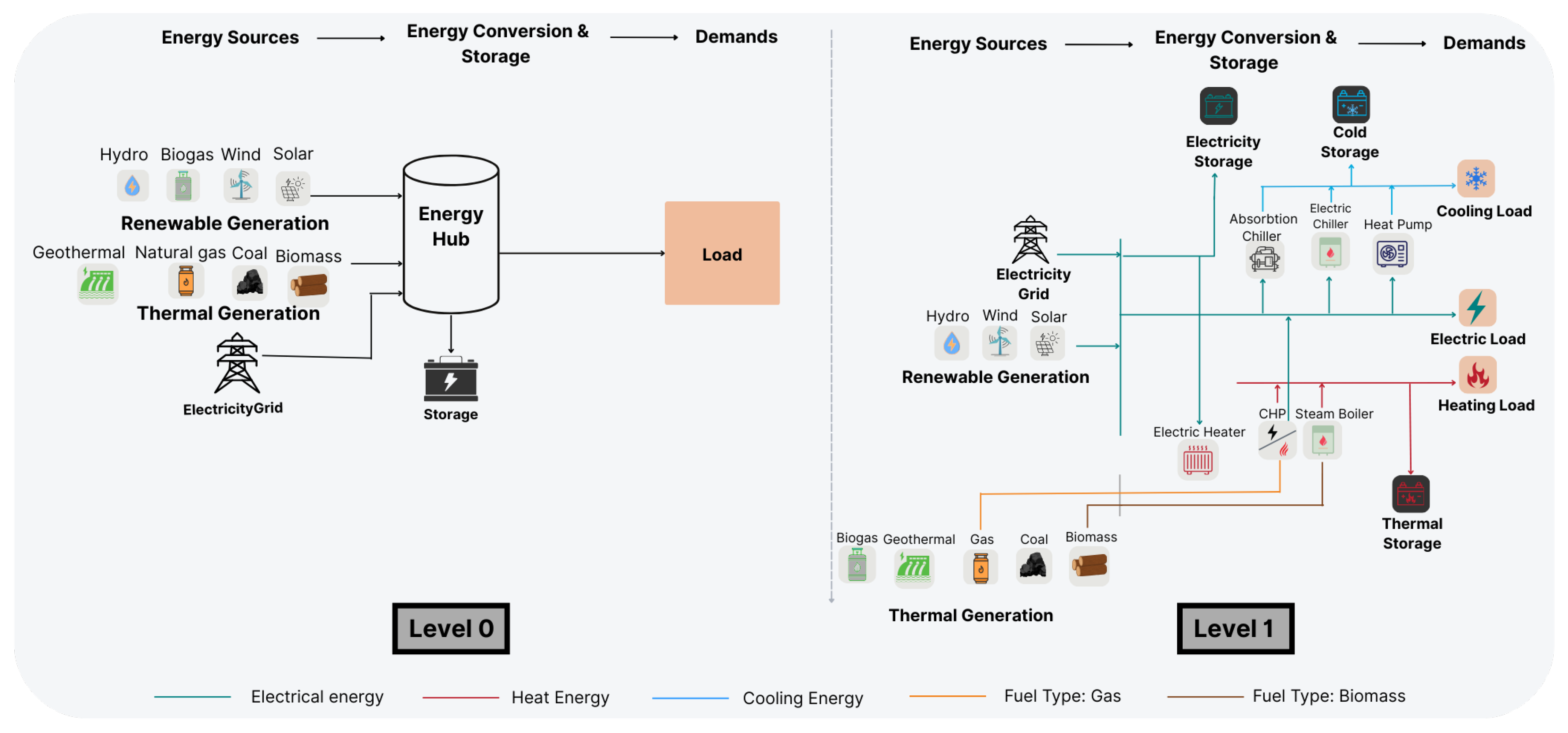
| C7—Clarity | Hierarchical abstraction provides Level 0 plant-wide energy overviews and Level 1 subsystem-level views, such as boiler–thermal load interactions |
| C8—Standardisation | Dairy plant subsystems are represented as FMI-compliant FMUs, enabling standardised data exchange and model execution |
| C9—Scalability | Modular FMU-based representation allows additional processing units, renewable sources, or storage systems to be incorporated without redesign |
| C10—Interoperability | Thermal and electrical subsystems, including boilers, loads, grid interaction, and renewables, are coordinated through black-box FMU orchestration within a single digital twin |
Disclaimer/Publisher’s Note: The statements, opinions and data contained in all publications are solely those of the individual author(s) and contributor(s) and not of MDPI and/or the editor(s). MDPI and/or the editor(s) disclaim responsibility for any injury to people or property resulting from any ideas, methods, instructions or products referred to in the content. |
© 2026 by the authors. Licensee MDPI, Basel, Switzerland. This article is an open access article distributed under the terms and conditions of the Creative Commons Attribution (CC BY) license.
Share and Cite
Adeel, A.; Apperley, M.; Walmsley, T.G. An Interoperable User-Centred Digital Twin Framework for Sustainable Energy System Management. Energies 2026, 19, 333. https://doi.org/10.3390/en19020333
Adeel A, Apperley M, Walmsley TG. An Interoperable User-Centred Digital Twin Framework for Sustainable Energy System Management. Energies. 2026; 19(2):333. https://doi.org/10.3390/en19020333
Chicago/Turabian StyleAdeel, Aleeza, Mark Apperley, and Timothy Gordon Walmsley. 2026. "An Interoperable User-Centred Digital Twin Framework for Sustainable Energy System Management" Energies 19, no. 2: 333. https://doi.org/10.3390/en19020333
APA StyleAdeel, A., Apperley, M., & Walmsley, T. G. (2026). An Interoperable User-Centred Digital Twin Framework for Sustainable Energy System Management. Energies, 19(2), 333. https://doi.org/10.3390/en19020333