Skip Content
You are currently on the new version of our website. Access the old version .

Horticulturae, Volume 8, Issue 9

2022 September - 99 articles

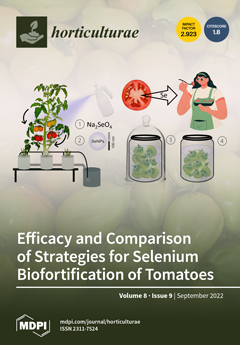
Cover Story: Approximately one billion people globally do not obtain the recommended amount of selenium (Se). In severe cases, dietary Se deficiency causes health problems. Plants are capable of transforming mineral selenium into organic forms, more bioavailable for humans. Tomato, one of the most consumed fresh horticultural produce worldwide, is a good candidate to supplement the human diet with organic Se. We designed four alternative strategies for producing Se-enriched tomato fruit. Spraying tomato plants with sodium selenate or chemically synthesized Se nanoparticles and dipping the harvested fruit in a sodium selenate solution allow us to sustainably produce tomatoes containing different Se levels, providing fruit with nutraceutical properties. View this paper
  • Issues are regarded as officially published after their release is announced to the table of contents alert mailing list .
  • You may sign up for email alerts to receive table of contents of newly released issues.
  • PDF is the official format for papers published in both, html and pdf forms. To view the papers in pdf format, click on the "PDF Full-text" link, and use the free Adobe Reader to open them.

Articles (99)

  • Article
  • Open Access
4 Citations
3,013 Views
17 Pages

Persimmon (Diospyros kaki Thunb.) is becoming a fruit that is used worldwide because it contains high nutritional and medicinal value. However, the trait evaluation of persimmon is still needed and is critical for marketing and breeding, especially i...

  • Article
  • Open Access
9 Citations
2,888 Views
15 Pages

Grape ripe rot (Colletotrichum viniferum) causes huge losses in grape production in vineyards in southern China. However, the molecular mechanism against ripe rot in grape species and the responsive genes implicated in these processes are relatively...

  • Article
  • Open Access
8 Citations
3,079 Views
20 Pages

Lady’s slipper orchids (Paphiopedilum spp.) are highly valuable within the flower industry. Recently, both Paphiopedilum concolor and Paphiopedilum hirsutissimum (2n = 2x = 26) have been widely used for hybrid parents, ornamental, and economic...

  • Article
  • Open Access
7 Citations
2,736 Views
14 Pages

Use Optimization of Organic Wastes in Anaerobic Soil Disinfestation against Strawberry Charcoal Rot Root

  • Ana Márquez-Caro,
  • Celia Borrero,
  • Paloma Hernández-Muñiz and
  • Manuel Avilés

The imminent removal of agrochemicals in Europe is directly affecting the strawberry sector in Spain, specifically in the Huelva province. Huelva is currently the main producer in the country. The lack of efficient fumigants has led to the rise of so...

  • Article
  • Open Access
1 Citations
2,963 Views
16 Pages

Jasmonic Acid and Salicylic Acid Levels in Defense Response of Azalea (Rhododendron simsii Hybrid) to Broad Mite (Polyphagotarsonemus latus)

  • Leen Leus,
  • Gil Luypaert,
  • Emmy Dhooghe,
  • Johan Witters,
  • Els Pauwels,
  • Christof Van Poucke,
  • Els Van Pamel,
  • Johan Van Huylenbroeck and
  • Joachim Audenaert

The broad mite (Polyphagotarsonemus latus (Banks)) is an important pest in many crops, including azalea (Rhododendron simsii Planch. hybrid). Broad mites cause the malformation of shoot tips, leaves and flowers in azalea. It is known that the jasmoni...

  • Article
  • Open Access
5 Citations
5,439 Views
11 Pages

Wild Chrysanthemums Core Collection: Studies on Leaf Identification

  • Toan Khac Nguyen,
  • L. Minh Dang,
  • Hyoung-Kyu Song,
  • Hyeonjoon Moon,
  • Sung Jae Lee and
  • Jin Hee Lim

Wild chrysanthemums mainly present germplasm collections such as leaf multiform, flower color, aroma, and secondary compounds. Wild chrysanthemum leaf identification is critical for farm owners, breeders, and researchers with or without the flowering...

  • Article
  • Open Access
4 Citations
6,215 Views
13 Pages

Fruit Characterization of Prunus serotina subsp. capuli

  • Sakshi Pathania,
  • Rachel A. Itle,
  • Carlos R. Chávez,
  • Luis F. Lema,
  • Veronica Caballero-Serrano,
  • Juan C. Carrasco and
  • Dario J. Chavez

Prunus serotina is divided into five subspecies. Among these, P. serotina subsp. capuli, commonly known as capuli, is native to Central and South America. Its fruits are big, sweet, and consumed by locals in various forms, with the Ecuadorian Andes r...

  • Article
  • Open Access
2,401 Views
11 Pages

Analysis of Greenness Value and Photosynthetic Rate of Tomato Leaves Based on Spectral Technologies

  • Jitong Xu,
  • Fang Wang,
  • Zhe Zhang,
  • Yuhang Guo,
  • Yufeng Liu and
  • Xiaofeng Ning

Tomatoes, a major vegetable crop, are not only delicious but can also prevent cancer and lower blood pressure. However, they are easily infected with diseases during the growth process, so it is of great significance to find a technology for nondestr...

  • Article
  • Open Access
2 Citations
3,373 Views
10 Pages

Seed Dormancy and Germination Characteristics of Vaccinium oldhamii Miq. (Ericaceae)

  • Da Hyun Lee,
  • Chung Youl Park,
  • Young Ho Jung,
  • Jun Hyeok Kim,
  • Sung Hyuk Park,
  • Ho Jun Son,
  • Chae Sun Na and
  • Wan Geun Park

Vaccinium oldhamii Miq. is an edible berry; however, little is known about its seed dormancy-break and germination. Therefore, the aim of this study was to elucidate the seed-dormancy break and germination characteristics of V. oldhamii. The results...

  • Article
  • Open Access
9 Citations
2,988 Views
13 Pages

Hydrangea spp. is renowned for its variety of color changes in its developmental stage and before and after aluminum treatment. We analyzed gene expression in hydrangeas sepals to study the causes of color change. The accuracy of quantitative RT-qPCR...

of 10

Get Alerted

Add your email address to receive forthcoming issues of this journal.

XFacebookLinkedIn
Horticulturae - ISSN 2311-7524