You are currently viewing a new version of our website. To view the old version click .

Microorganisms, Volume 7, Issue 2

February 2019 - 35 articles

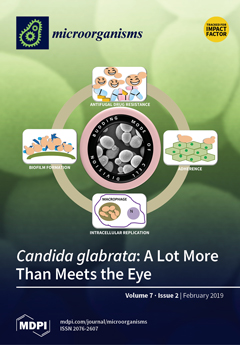
Cover Story: Candida glabrata is an opportunistic human fungal pathogen that is capable of causing both superficial mucosal and life-threatening bloodstream infections in immunocompromised individuals. In this article, we provide an overview of its pathogenesis traits, nutrient acquisition pathways, and host interaction mechanisms. The ability of C. glabrata to adhere to host cells, form biofilms on biotic and abiotic surfaces, replicate in macrophages, and survive diverse stresses including antifungal drugs contributes to its success as a nosocomial pathogen. View this paper.
  • Issues are regarded as officially published after their release is announced to the table of contents alert mailing list .
  • You may sign up for email alerts to receive table of contents of newly released issues.
  • PDF is the official format for papers published in both, html and pdf forms. To view the papers in pdf format, click on the "PDF Full-text" link, and use the free Adobe Reader to open them.

Articles (35)

  • Correction
  • Open Access
3 Citations
2,836 Views
1 Page

Correction: Hokynar, K. et al. Chlamydia-Like Organisms (CLOs) in Finnish Ixodes ricinus Ticks and Human Skin. Microorganisms 2016, 4, 28

  • Kati Hokynar,
  • Jani J. Sormunen,
  • Eero J. Vesterinen,
  • Esa K. Partio,
  • Thomas Lilley,
  • Veera Timonen,
  • Jaana Panelius,
  • Annamari Ranki and
  • Mirja Puolakkainen

The authors wish to make the following modification to this paper [...]

  • Article
  • Open Access
40 Citations
6,628 Views
13 Pages

Refined versus Extra Virgin Olive Oil High-Fat Diet Impact on Intestinal Microbiota of Mice and Its Relation to Different Physiological Variables

  • Nieves Martínez,
  • Isabel Prieto,
  • Marina Hidalgo,
  • Ana Belén Segarra,
  • Ana M. Martínez-Rodríguez,
  • Antonio Cobo,
  • Manuel Ramírez,
  • Antonio Gálvez and
  • Magdalena Martínez-Cañamero

Extra virgin olive oil (EVOO) has been reported to have a distinct influence on gut microbiota in comparison to other fats, with its physiological benefits widely studied. However, a large proportion of the population consumes olive oil after a depur...

  • Review
  • Open Access
11 Citations
9,044 Views
11 Pages

Can Gut Microbiota and Lifestyle Help Us in the Handling of Anorexia Nervosa Patients?

  • Vanessa Mendez-Figueroa,
  • Jose Miguel Biscaia,
  • Rosa B. Mohedano,
  • Ascension Blanco-Fernandez,
  • Maria Bailen,
  • Carlo Bressa,
  • Mar Larrosa and
  • Rocio Gonzalez-Soltero

Gut microbiota is composed of different microorganisms that play an important role in the host. New research shows that bidirectional communications happen between intestinal microbiota and the brain, which is known as the gut–brain axis. This...

  • Article
  • Open Access
36 Citations
7,582 Views
23 Pages

What an Escherichia coli Mutant Can Teach Us About the Antibacterial Effect of Chlorophyllin

  • Marcus Krüger,
  • Peter Richter,
  • Sebastian M. Strauch,
  • Adeel Nasir,
  • Andreas Burkovski,
  • Camila A. Antunes,
  • Tina Meißgeier,
  • Eberhard Schlücker,
  • Stefan Schwab and
  • Michael Lebert

Due to the increasing development of antibiotic resistances in recent years, scientists search intensely for new methods to control bacteria. Photodynamic treatment with porphyrins such as chlorophyll derivatives is one of the most promising methods...

  • Article
  • Open Access
38 Citations
5,566 Views
15 Pages

Crop monocropping usually results in an enrichment of soil-borne pathogens in soil. Crop rotation is an environmentally friendly method for controlling soil-borne diseases. Plant rhizosphere microorganisms, especially plant-beneficial microorganisms,...

  • Article
  • Open Access
7 Citations
4,877 Views
18 Pages

In Silico Analysis of Genetic VapC Profiles from the Toxin-Antitoxin Type II VapBC Modules among Pathogenic, Intermediate, and Non-Pathogenic Leptospira

  • Alexandre P. Y. Lopes,
  • Bruna O. P. Azevedo,
  • Rebeca C. Emídio,
  • Deborah K. Damiano,
  • Ana L. T. O. Nascimento and
  • Giovana C. Barazzone

Pathogenic Leptospira spp. is the etiological agent of leptospirosis. The high diversity among Leptospira species provides an array to look for important mediators involved in pathogenesis. Toxin-antitoxin (TA) systems represent an important survival...

  • Article
  • Open Access
11 Citations
4,227 Views
12 Pages

Merkel Cell Polyomavirus Is Associated with Anal Infections in Men Who Have Sex with Men

  • Nunzia Zanotta,
  • Serena Delbue,
  • Lucia Signorini,
  • Sonia Villani,
  • Sarah D’Alessandro,
  • Giuseppina Campisciano,
  • Claudia Colli,
  • Francesco De Seta,
  • Pasquale Ferrante and
  • Manola Comar

Background: Viral infections of the anal/rectal tract of men who have sex with men (MSM) have been poorly studied. Methods: In total, 158 swab samples (81 anal/rectal, 65 throat/oral and 12 urethral) were collected from 126 MSM. DNA was isolated and...

  • Review
  • Open Access
84 Citations
8,953 Views
17 Pages

Plasmid-Mediated Colistin Resistance in Salmonella enterica: A Review

  • Tiago Lima,
  • Sara Domingues and
  • Gabriela Jorge Da Silva

Colistin is widely used in food-animal production. Salmonella enterica is a zoonotic pathogen, which can pass from animal to human microbiota through the consumption of contaminated food, and cause disease, often severe, especially in young children,...

  • Review
  • Open Access
206 Citations
13,171 Views
27 Pages

Subsurface Microbial Hydrogen Cycling: Natural Occurrence and Implications for Industry

  • Simon P. Gregory,
  • Megan J. Barnett,
  • Lorraine P. Field and
  • Antoni E. Milodowski

Hydrogen is a key energy source for subsurface microbial processes, particularly in subsurface environments with limited alternative electron donors, and environments that are not well connected to the surface. In addition to consumption of hydrogen,...

  • Article
  • Open Access
5 Citations
5,148 Views
11 Pages

Effects of Bifidobacterium bifidum in Mice Infected with Citrobacter rodentium

  • Bijun Wen,
  • Amel Taibi,
  • Christopher R. Villa,
  • Shin-Hann Lee,
  • Sofia Sagaidak and
  • Elena M. Comelli

In vitro and in vivo studies suggest that selected Bifidobacterium bifidum strains sustain intestinal homeostasis. This study aimed to examine whether the administration of B. bifidum MIMBb75 (BB75) attenuates Citrobacter rodentium infection, a murin...

of 4

Get Alerted

Add your email address to receive forthcoming issues of this journal.

XFacebookLinkedIn
Microorganisms - ISSN 2076-2607