



Next Issue
Volume 15, December-2
Previous Issue
Volume 15, November-2


Buildings, Volume 15, Issue 23 (December-1 2025) – 188 articles
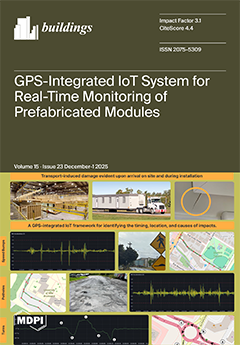
Cover Story (view full-size image): Prefabricated building modules often endure severe vibrations, shocks, and handling loads during transport, conditions that can cause hidden damage before arrival. Current monitoring relies on isolated data loggers, providing delayed, localized readings with little insight into where or why impacts occur. To solve this, a scalable framework is introduced to track a module’s journey from factory to site, delivering real-time intelligence on the following: What happens (structural response); Why it happens (road vs. driver factors); Where it happens (geo-tagged events); When it happens (time-synchronized sensing). By fusing inertial data with spatial and causal context, this framework turns raw vibration readings into actionable insights, enabling smarter route planning, targeted inspections, and more resilient off-site logistics. View this paper
  • Issues are regarded as officially published after their release is announced to the table of contents alert mailing list.
  • You may sign up for e-mail alerts to receive table of contents of newly released issues.
  • PDF is the official format for papers published in both, html and pdf forms. To view the papers in pdf format, click on the "PDF Full-text" link, and use the free Adobe Reader to open them.
Order results
Result details
Section
Select all
Export citation of selected articles as:
16 pages, 5097 KB  
Article
Brazilian Tensile Strength of High-Water Content Clayey Soils Stabilized with Cement and Super-Absorbent Polymers
by Zhenhua Wang, Joachim Rohn, Jens Winkler and Wei Xiang
Buildings 2025, 15(23), 4395; https://doi.org/10.3390/buildings15234395 - 4 Dec 2025
Viewed by 336
Abstract
The tensile strength of stabilized clayey soil is a key indicator of its resistance to cracking and directly governs its performance when used as subgrade fill. In this study, ordinary Portland cement and polyacrylate-based super-absorbent polymers (SAP) were combined to stabilize four typical [...] Read more.
The tensile strength of stabilized clayey soil is a key indicator of its resistance to cracking and directly governs its performance when used as subgrade fill. In this study, ordinary Portland cement and polyacrylate-based super-absorbent polymers (SAP) were combined to stabilize four typical high-water content clayey soils sourced from Northern Bavaria. The optimal SAP content was determined based on absorption capacity by the tea-bag method. Subsequently, the effects of cement content and curing period on the Brazilian tensile strength (BTS) of clayey soils were investigated, and the correlation between Brazilian tensile strength and unconfined compressive strength (UCS) was discussed. The results indicated the following: the optimal SAP content was 0.3%; the BTS increased significantly with higher cement content and a longer curing period; the failure modes of BTS specimens were revealed, including multiple non-through fracture, non-central fracture, and central fracture; a strong linear correlation was established between BTS and UCS, with the proportional coefficient ranging from 0.129 to 0.233. The findings of this study can provide a valuable reference for the design and application of cement-SAP stabilized soils in practical engineering. Full article
(This article belongs to the Special Issue Advanced Research on Cementitious Composites for Construction)
Show Figures

Figure 1

23 pages, 5438 KB  
Article
Heritage Conservation and Environmental Protection: Conflicting Interests in a Case Study of Historic Box-Type Windows
by Günther Kain, Friedrich Idam, Nadine Brunnhuber and Stefan Salhofer
Buildings 2025, 15(23), 4394; https://doi.org/10.3390/buildings15234394 - 4 Dec 2025
Viewed by 255
Abstract
Heritage conservation and environmental protection have similarities, both aiming at conserving structures and systems in their original state. While environmental protection prioritizes intact ecosystems, heritage conservation values past cultural achievements, thus reflecting the difference between nature and culture. Our research purpose is to [...] Read more.
Heritage conservation and environmental protection have similarities, both aiming at conserving structures and systems in their original state. While environmental protection prioritizes intact ecosystems, heritage conservation values past cultural achievements, thus reflecting the difference between nature and culture. Our research purpose is to analyze the interaction of these two disciplines for historic windows, which can be renovated, technically upgraded, or replaced by a new window. As the methodology, an LCA model was applied, where, after defining a model window material and energy flows in three scenarios, the related environmental impacts were investigated. The results show that the considerably lower loss of energy with a new window by far outweighs the impacts from the production of the new window. This becomes apparent for nearly all impact categories. The sensitivity analysis reveals that the energy source for heating has a major impact. Changing from fossil to renewable energy in the future will reduce the advantage of new windows markedly. Such novel approaches should support the integration of environmental considerations into heritage conservation. Full article
(This article belongs to the Section Building Materials, and Repair & Renovation)
Show Figures

Graphical abstract

31 pages, 4696 KB  
Review
Review of Dynamic Response and Pier Damage Mechanisms in Girder Bridges Under Bidirectional Seismic Excitations: Critical Role of Vertical Components in Near-Field Effects
by Shutong Chen, Wenjun An, Hao Fu, Yan Shan, Feng Xi, Yuwen Wen, Fadzli Mohamed Nazri, Chee-Loong Chin and Chau-Khun Ma
Buildings 2025, 15(23), 4393; https://doi.org/10.3390/buildings15234393 - 4 Dec 2025
Viewed by 293
Abstract
This paper systematically reviews bridge structural dynamics and pier damage mechanisms under seismic excitation over recent decades, addressing four key aspects: (1) the structural response of simply supported bridges subjected to horizontal seismic forces and corresponding damage in shear keys and piers; (2) [...] Read more.
This paper systematically reviews bridge structural dynamics and pier damage mechanisms under seismic excitation over recent decades, addressing four key aspects: (1) the structural response of simply supported bridges subjected to horizontal seismic forces and corresponding damage in shear keys and piers; (2) the impact of near-fault vertical ground motion on vertical constraint degradation and its contribution to pier damage; (3) the failure mechanisms of piers under bidirectional coupled seismic excitations; (4) recent advances in innovative design concepts, structural configurations, and material applications for seismic-resistant piers. Eventually, the limitations of current research are identified, and potential future research directions and methodologies are proposed. Full article
(This article belongs to the Section Building Structures)
Show Figures

Figure 1

25 pages, 5842 KB  
Article
Temperature Prediction of Mass Concrete During the Construction with a Deeply Optimized Intelligent Model
by Fuwen Zheng, Shiyu Xia, Jin Chen, Dijia Li, Qinfeng Lu, Lijin Hu, Xianshan Liu, Yulin Song and Yuhang Dai
Buildings 2025, 15(23), 4392; https://doi.org/10.3390/buildings15234392 - 4 Dec 2025
Viewed by 310
Abstract
In the construction of ultra-high voltage (UHV) transformation substations, mass concrete is highly susceptible to temperature-induced cracking due to thermal gradients arising from the disparity between internal hydration heat and external environmental conditions. Such cracks can severely compromise the structural integrity and load-bearing [...] Read more.
In the construction of ultra-high voltage (UHV) transformation substations, mass concrete is highly susceptible to temperature-induced cracking due to thermal gradients arising from the disparity between internal hydration heat and external environmental conditions. Such cracks can severely compromise the structural integrity and load-bearing capacity of foundations, making accurate temperature prediction and effective thermal control critical challenges in engineering practice. To address these challenges and enable real-time monitoring and dynamic regulation of temperature evolution, this study proposes a novel hybrid forecasting model named CPO-VMD-SSA-Transformer-GRU for predicting temperature behavior in mass concrete. First, sine wave simulations with varying sample sizes were conducted using three models: Transformer-GRU, VMD-Transformer-GRU, and CPO-VMD-SSA-Transformer-GRU. The results demonstrate that the proposed CPO-VMD-SSA-Transformer-GRU model achieves superior predictive accuracy and exhibits faster convergence toward theoretical values. Subsequently, four performance metrics were evaluated: Mean Absolute Error (MAE), Mean Squared Error (MSE), Root Mean Square Error (RMSE), and Coefficient of Determination (R2). The model was then applied to predict temperature variations in mass concrete under laboratory conditions. For the univariate time series at Checkpoint 1, the evaluation metrics were MAE: 0.033736, MSE: 0.0018812, RMSE: 0.036127, and R2: 0.98832; at Checkpoint 2, the values were MAE: 0.016725, MSE: 0.00091304, RMSE: 0.019114, and R2: 0.96773. In addition, the proposed model was used to predict the temperature in the rising stage, indicating high reliability in capturing nonlinear and high-dimensional thermal dynamics in the whole construction process. Furthermore, the model was extended to multivariate time series to enhance its practical applicability in real-world concrete construction. At Checkpoint 1, the corresponding metrics were MAE: 0.56293, MSE: 0.34035, RMSE: 0.58339, and R2: 0.95414; at Checkpoint 2, they were MAE: 0.85052, MSE: 0.78779, RMSE: 0.88757, and R2: 0.91385. These results indicate significantly improved predictive performance compared to the univariate configuration, thereby further validating the accuracy, stability, and robustness of the multivariate CPO-VMD-SSA-Transformer-GRU framework. The model effectively captures complex temperature fluctuation patterns under dynamic environmental and operational conditions, enabling precise, reliable, and adaptive temperature forecasting. This comprehensive analysis establishes a robust methodological foundation for advanced temperature prediction and optimized thermal management strategies in real-world civil engineering applications. Full article
(This article belongs to the Special Issue Innovation and Technology in Sustainable Construction)
Show Figures

Figure 1

21 pages, 1436 KB  
Article
Reframing the Body–Space Relation in Architecture: A Trialectical Perspective
by Reyya Kalay Yüzen and Senem Kaymaz
Buildings 2025, 15(23), 4391; https://doi.org/10.3390/buildings15234391 - 4 Dec 2025
Viewed by 441
Abstract
This article interrogates the theoretical articulations of the body–space nexus through the formulation of an alternative methodological framework. It advances the premise that body and space cannot be reduced to physical parameters or representational models; rather, they are continually reconstituted through experience, perception, [...] Read more.
This article interrogates the theoretical articulations of the body–space nexus through the formulation of an alternative methodological framework. It advances the premise that body and space cannot be reduced to physical parameters or representational models; rather, they are continually reconstituted through experience, perception, cultural contexts, and relational processes. Against the backdrop of fragmented spatial, phenomenological, and socio-political readings of space, Joseph Kosuth’s “One and Three Chairs” [1965] is posited as a conceptual compass, while semiotic instruments are mobilized as analytical devices. Within this constellation, the body–space relation is examined through a trialectical configuration that couples three relational modalities—distance, togetherness, and plurality—with three representational dimensions: object, image, and definition. The analysis shows how each modality delineates a distinct regime of bodily–spatial interaction and exposes the ways in which these regimes become manifest within architectural experience, social production, and conceptual potential. Within this framework, the notion of the flesh of space is advanced to describe space as a relational field in which bodies, materials, images, and definitions become mutually entangled. The principal contribution of this study lies in advancing a methodological orientation that transcends normative metrics and reductionist representational paradigms, thereby enabling body–space relations to be apprehended through relational dynamics and multilayered processes of signification. In doing so, this article provides a critical ground for rethinking architectural epistemology from a more flexible, experiential, and plural perspective, and proposes a transferable analytical scaffold for future case-based and design-oriented research. Full article
(This article belongs to the Section Architectural Design, Urban Science, and Real Estate)
Show Figures

Figure 1

16 pages, 3991 KB  
Article
Study on Wind Load Distribution and Aerodynamic Characteristics of a Yawed Cylinder
by Xinxin Yuan, Zetao Li, He Yang, Fei Wang, Wenyong Ma, Qiaochu Zhao and Yong Yang
Buildings 2025, 15(23), 4390; https://doi.org/10.3390/buildings15234390 - 4 Dec 2025
Viewed by 262
Abstract
The flow mechanism around a yawed cylinder is highly complex. While previous research has confirmed the limitation of the Independence Principle at high yaw angles, the specific flow phenomena beyond 20° yaw remain poorly understood, particularly concerning the spanwise development of the critical [...] Read more.
The flow mechanism around a yawed cylinder is highly complex. While previous research has confirmed the limitation of the Independence Principle at high yaw angles, the specific flow phenomena beyond 20° yaw remain poorly understood, particularly concerning the spanwise development of the critical regime and the mechanism behind asymmetric surface pressure. Most studies have focused on spatially averaged forces or specific angles, lacking a systematic investigation of the inherent flow characteristics in the intermediate region of finite-length cylinders. To bridge this gap, the present study conducts a detailed wind tunnel test on a yawed cylinder across a wide range of yaw angles (0–60°). By analyzing the pressure distribution and aerodynamic forces in the mid-span region, this study yields the following core findings of universal significance: (1) As the yaw angle increases, the critical flow regime in the intermediate section occurs prematurely. This leads to a decrease in the Reynolds number at which the critical region begins, resulting in the formation of separation bubbles and consequent localized negative-pressure zones on either the upper or lower windward surface of the cylinder. (2) When the yaw angle β ≤ 17.4°, the mean drag and lift in the middle region resemble those of a straight cylinder. However, as the yaw angle increases further, the drag coefficient decreases beyond a certain critical Reynolds number, which itself decreases with increasing yaw angle. (3) At β = 0°, the circumferential mean pressure distribution is symmetric about the cross-sectional axis and remains largely uniform along the span. High yaw angles disrupt this symmetry and uniformity, leading to complex three-dimensional flow structures. These findings have critical implications for the design of structures like inclined bridge towers and cables under oblique winds. Full article
(This article belongs to the Special Issue Innovations in Composite Material Technologies and Structural Design)
Show Figures

Figure 1

22 pages, 3863 KB  
Article
Enhancing Pedestrian Satisfaction: A Quantitative Study of Visual Perception Elements
by Yi Tian, Dong Sun, Mei Lyu and Shujiao Wang
Buildings 2025, 15(23), 4389; https://doi.org/10.3390/buildings15234389 - 4 Dec 2025
Viewed by 644
Abstract
The urban street environment strongly influences pedestrian satisfaction, with visual perception elements playing a pivotal role. Historic districts serve not only as carriers of urban culture but also as key tourism resources, where spatial quality directly shapes visitor experience and city image. This [...] Read more.
The urban street environment strongly influences pedestrian satisfaction, with visual perception elements playing a pivotal role. Historic districts serve not only as carriers of urban culture but also as key tourism resources, where spatial quality directly shapes visitor experience and city image. This study takes the Shenyang Fangcheng historic district as a case, combining field surveys and questionnaires to gather pedestrian satisfaction data, while applying semantic segmentation of street imagery to quantify visual elements. Using correlation analysis and multiple regression models, the research systematically reveals relationships and mechanisms linking visual elements with pedestrian satisfaction. Results show that an increase in landmark buildings and landscape features enhances legibility and attractiveness; optimizing spatial configuration improves openness and walking comfort; and reducing vehicle presence strengthens perceived safety and overall experiential quality. By integrating subjective perceptions with objective visual indicators, this study offers empirical evidence and methodological innovation to support enhancement of walkability and promote human-centered street design in historic districts. Full article
(This article belongs to the Section Architectural Design, Urban Science, and Real Estate)
Show Figures

Figure 1

16 pages, 7804 KB  
Article
Linear Seismic Analysis and Structural Optimization of Reinforced Concrete Frames Using OpenSeesPy
by Diego Llanos and Rick M. Delgadillo
Buildings 2025, 15(23), 4388; https://doi.org/10.3390/buildings15234388 - 4 Dec 2025
Viewed by 499
Abstract
Seismic design of reinforced concrete buildings in highly active seismic regions is challenging, as structural members are often oversized due to conservative design practices, leading to inefficient use of materials. This study proposes an optimization methodology based on the Peruvian seismic code E.030, [...] Read more.
Seismic design of reinforced concrete buildings in highly active seismic regions is challenging, as structural members are often oversized due to conservative design practices, leading to inefficient use of materials. This study proposes an optimization methodology based on the Peruvian seismic code E.030, implemented with the OpenSeesPy library for modeling and numerical analysis. The methodology automates the linear analysis of frame structures through the parametrization of member dimensions, span lengths, and material properties. Optimization is carried out using the Hill Climbing algorithm, which iteratively explores design alternatives and verifies compliance with code requirements for interstory drift and base shear. Results show material savings of up to 20% in beams and columns. Although interstory drifts increased by 60–85% compared to the initial configuration, they remained within code limits. The methodology establishes a framework for integrating optimization techniques into the seismic design of reinforced concrete frame buildings. Full article
Show Figures

Figure 1

20 pages, 7395 KB  
Article
Assessing the Seismic Performance of Prefabricated Coupling Beams Using Double-Lap Sleeves: An Experimental and Numerical Investigation
by Mei Jin, Hao Wu, Lei Su, Xiaoyi Hu, Yong Zeng, Qiang Cai and Wenju Yang
Buildings 2025, 15(23), 4387; https://doi.org/10.3390/buildings15234387 - 3 Dec 2025
Viewed by 333
Abstract
To advance the application of prefabricated structures, this study proposes a novel sleeve connection for reinforced concrete coupling beams, aiming to balance the construction efficiency with seismic performance in prefabricated structures. Quasi-static tests and numerical simulations were conducted, investigating the effects of span-to-depth [...] Read more.
To advance the application of prefabricated structures, this study proposes a novel sleeve connection for reinforced concrete coupling beams, aiming to balance the construction efficiency with seismic performance in prefabricated structures. Quasi-static tests and numerical simulations were conducted, investigating the effects of span-to-depth ratio, connection type, and casting method. The experimental results demonstrate that the proposed sleeve-connected beams exhibit seismic performance comparable to, and in some cases superior to, their cast-in-place counterparts. Specifically, the prefabricated specimen with a span-to-depth ratio of 4 achieved approximately 85% of the energy dissipation capacity of its cast-in-place counterpart. However, as the span-to-depth ratio decreased, the energy dissipation capacity of the prefabricated beams increased significantly, reaching up to 2.5 times that of the cast-in-place specimens. Numerical simulations, which showed good agreement with experimental results in terms of failure modes and hysteresis curves, further revealed that concrete compressive strength has a limited influence on seismic behavior. In contrast, increasing the reinforcement ratio effectively improved stiffness and ductility. Notably, increasing the rebar diameter from 18 mm to 22 mm resulted in approximately 25% improvement in energy dissipation capacity. The findings provide novel insights and a scientific basis for the practical application of this innovative prefabricated solution. Full article
(This article belongs to the Special Issue Advances in Mechanical Behavior of Prefabricated Structures)
Show Figures

Figure 1

24 pages, 4831 KB  
Article
Ultimate Bearing Capacity of Vertically Uniform Loaded Strip Foundations near Slopes Considering Heterogeneity, Anisotropy, and Intermediate Principal Stress Effects
by Qing Yan, Yuhao Wang, Tian Su, Zengzeng Zhang and Shanshan Sun
Buildings 2025, 15(23), 4386; https://doi.org/10.3390/buildings15234386 - 3 Dec 2025
Viewed by 346
Abstract
Accurate prediction of the bearing capacity of foundations near slopes remains challenging when soils exhibit heterogeneity and anisotropy. Although numerical simulations can account for these effects with high precision, they are computationally demanding and provide limited physical insight. Analytical solutions that can explicitly [...] Read more.
Accurate prediction of the bearing capacity of foundations near slopes remains challenging when soils exhibit heterogeneity and anisotropy. Although numerical simulations can account for these effects with high precision, they are computationally demanding and provide limited physical insight. Analytical solutions that can explicitly incorporate spatial variability, directional dependence, and the influence of intermediate principal stress are still lacking. This study addresses this gap by developing an analytical solution for the ultimate bearing capacity of strip foundations near slopes based on the Unified Strength Theory (UST). The method assumes a uniformly distributed surface load and a single-sided failure mode, while introducing heterogeneity and anisotropy coefficients to represent the depth dependent and directional variation of cohesion. Validation against published theoretical, numerical, and experimental results demonstrates strong agreement, with a maximum deviation of 6.2%. Parametric sensitivity analysis indicates that increasing the heterogeneity coefficient from 0 to 1 enhances bearing capacity by 67.9–83.4%, while increasing the anisotropy coefficient from 0.6 to 1.4 reduces it by 20.8–22.3% for different base roughness. Neglecting the intermediate principal stress results in a 64.5–67.9% underestimation of the ultimate bearing capacity with different anisotropy coefficients and base roughness. The proposed analytical model based on the UST provides improved quantitative accuracy and theoretical generality, enabling safer and more economical design of foundations near slopes under heterogeneous and anisotropic soil conditions. Full article
(This article belongs to the Section Building Structures)
Show Figures

Figure 1

38 pages, 8608 KB  
Article
Effect of Horizontal Stiffeners on the Efficiency of Steel Beams in Resisting Bending and Torsional Moments: Finite Element Analysis
by Mishal H. Aljarbou and Ahmed M. Sayed
Buildings 2025, 15(23), 4385; https://doi.org/10.3390/buildings15234385 - 3 Dec 2025
Viewed by 396
Abstract
Steel beams with eccentric loads are subjected to combined bending and torsional moments that lead to lateral displacements, unwanted stresses at the top and bottom flanges, and global buckling along their length. To resist these displacements and stresses, horizontal stiffeners were used in [...] Read more.
Steel beams with eccentric loads are subjected to combined bending and torsional moments that lead to lateral displacements, unwanted stresses at the top and bottom flanges, and global buckling along their length. To resist these displacements and stresses, horizontal stiffeners were used in the direction of the beam axis at locations of the beam’s web height. To conduct this study, Finite Element Modeling (FEM) was used to simulate these steel beams. The reliability of the FEM results was first verified by comparing them with the results of 25 steel beams that had been experimentally tested in previous studies, and the results showed high accuracy in modeling these steel beams. Secondly, a FEM analysis was performed on 70 steel beams, considering certain variables, namely the locations of the horizontal stiffeners relative to the beam’s web height, the width of the horizontal stiffeners, and the reduction in the spacing between the vertical stiffeners. The results showed that locating the horizontal stiffeners closer to the top or bottom flange enhances the beam’s resistance to eccentric loads. The placement of horizontal stiffeners near the flanges influences the stress distribution at their edges and the overall load capacity, with optimal locations at 10%, 20%, and 90% of the web height. Additionally, combining stiffeners at two web height locations increased capacity synergistically, though less than the sum of their individual effects. Using small-width horizontal stiffeners at low ratios of web height achieved similar efficiency to full-width stiffeners at higher ratios, allowing for material savings. Reducing the distance between vertical stiffeners by half also led to similar improvements to using steel beams with horizontal stiffeners of 20% or 90% of the web height. An interaction diagram was developed to predict the ultimate load capacity of steel beams under combined bending and torsion moments with varying horizontal stiffeners. Full article
(This article belongs to the Section Building Structures)
Show Figures

Figure 1

18 pages, 23685 KB  
Article
Molecular-Scale Analysis of the Interfacial Adhesion Behavior Between Asphalt Binder and Aggregates with Distinct Chemical Compositions
by Yan Li, Shihao Li, Xinhao Sui, Xinzheng Wang and Yizhen Wang
Buildings 2025, 15(23), 4384; https://doi.org/10.3390/buildings15234384 - 3 Dec 2025
Viewed by 369
Abstract
The asphalt–aggregate interface is the weakest yet most critical component in asphalt mixtures, directly governing the pavement performance. In this study, the interfacial adhesion behavior between asphalt binder and aggregates with different chemical compositions (Al2O3, CaCO3, and [...] Read more.
The asphalt–aggregate interface is the weakest yet most critical component in asphalt mixtures, directly governing the pavement performance. In this study, the interfacial adhesion behavior between asphalt binder and aggregates with different chemical compositions (Al2O3, CaCO3, and SiO2) was investigated under varying conditions using molecular dynamics simulations. The effects of aggregate composition, environmental temperature, and asphalt aging were quantitatively assessed using key metrics, specifically interfacial adhesion energy and molecular concentration profiles near the interface. Results demonstrated that the chemical composition of aggregates fundamentally governed the asphalt–aggregate interfacial adhesion strength. Al2O3 exhibited the highest interfacial adhesion strength with asphalt binder, followed by CaCO3, with SiO2 showing the lowest strength. In terms of asphalt fractions, resins and aromatics were found to dominate the interfacial adhesion behavior due to their high molecular concentrations at the interface, with the contribution ranking as: resin > aromatic > saturate > asphaltene. The interfacial adhesion strength exhibited a non-monotonic temperature dependence. It increased with rising temperature and reached a peak value at 25–45 °C, and therefore declined because of excessive softening of asphalt binder. Furthermore, oxidative aging enhanced interfacial adhesion through strengthened electrostatic interactions. These molecular-level insights provide a fundamental understanding crucial for optimizing asphalt mixture design and enhancing pavement durability. Full article
(This article belongs to the Special Issue Advanced Characterization and Evaluation of Construction Materials)
Show Figures

Figure 1

24 pages, 3331 KB  
Article
Attention-Enhanced Progressive Transfer Learning for Scalable Seismic Vulnerability Assessment of RC Frame Buildings
by Kaushik M. Gondaliya, Konstantinos Daniel Tsavdaridis, Aanal Raval, Jignesh A. Amin and Komal Borisagar
Buildings 2025, 15(23), 4383; https://doi.org/10.3390/buildings15234383 - 3 Dec 2025
Viewed by 410
Abstract
Urban infrastructure in seismic zones demands efficient and scalable tools for damage prediction. This study introduces an attention-integrated progressive transfer learning (PTL) framework for the seismic vulnerability assessment (SVA) of reinforced concrete (RC) frame buildings. Traditional simulation-based vulnerability models are computationally expensive and [...] Read more.
Urban infrastructure in seismic zones demands efficient and scalable tools for damage prediction. This study introduces an attention-integrated progressive transfer learning (PTL) framework for the seismic vulnerability assessment (SVA) of reinforced concrete (RC) frame buildings. Traditional simulation-based vulnerability models are computationally expensive and dataset-specific, limiting their adaptability. To address this, we leverage a pretrained artificial neural network (ANN) model based on nonlinear static pushover analysis (NSPA) and Monte Carlo simulations for a 4-story RC frame, and extended its applicability to 2-, 8-, and 12-story configurations via PTL. An attention mechanism is incorporated to prioritize critical features, enhancing interpretability and classification accuracy. The model achieves 95.64% accuracy across five damage categories and an R2 of 0.98 for regression-based damage index predictions. Comparative evaluation against classical and deep learning models demonstrates superior generalization and computational efficiency. The proposed framework reduced retraining requirements across varying building heights, shows potential adaptability to other structural typologies, and maintains high predictive fidelity, making it a practical AI solution for structural risk evaluation in seismically active regions. Full article
Show Figures

Figure 1

29 pages, 1008 KB  
Article
Assessing Climate Sensitivity of LEED Credit Performance in U.S. Hotel Buildings: A Hierarchical Regression and Machine Learning Verification Approach
by Mohsen Goodarzi, Ava Nafiseh Goodarzi, Sajjad Naseri, Mojtaba Parsaee and Tarlan Abazari
Buildings 2025, 15(23), 4382; https://doi.org/10.3390/buildings15234382 - 3 Dec 2025
Cited by 1 | Viewed by 378
Abstract
This study examines how climatic factors influence the predictive power of LEED credits in determining certification outcomes for hotel buildings across the United States. Using data from 259 LEED-NC v2009 certified hotels, project-level information was integrated with 30-year climate normals from the PRISM [...] Read more.
This study examines how climatic factors influence the predictive power of LEED credits in determining certification outcomes for hotel buildings across the United States. Using data from 259 LEED-NC v2009 certified hotels, project-level information was integrated with 30-year climate normals from the PRISM database and Building America climate zones. A three-step hierarchical linear regression was conducted to identify the LEED credits that most strongly predict total certification points while controlling for project size, certification year, and baseline climatic conditions, and to test whether climatic factors moderate these relationships. Regularized Linear Regression (LASSO) was then applied to address multicollinearity and assess model stability, followed by Support Vector Regression (SVR) to capture potential nonlinear relationships. This integrated methodological framework, combining hierarchical regression for interpretability, LASSO for coefficient stability, and Support Vector Regression for nonlinear verification, provides a novel, multi-dimensional assessment of climate-sensitive credit behavior at the individual credit level. Results show that energy- and site-related credits, particularly Optimize Energy Performance (EA1), On-Site Renewable Energy (EA2), Green Power (EA6), and Alternative Transportation (SS4), consistently dominate LEED performance across all climate zones. In contrast, indoor environmental quality credits exhibit modest but significant climate sensitivity: higher mean temperatures reduce the contribution of Increased Ventilation (EQ2) while slightly enhancing Outdoor Air Delivery Monitoring (EQ1). Cross-model consistency confirms the robustness of these findings. The findings highlight the need for climate-responsive benchmarking of indoor environmental quality credits to improve regional equity and advance the next generation of climate-adaptive LEED standards. Full article
(This article belongs to the Section Building Energy, Physics, Environment, and Systems)
Show Figures

Figure 1

23 pages, 7706 KB  
Article
Dynamic Splitting Tensile Behavior of Hybrid Fibers-Reinforced Cementitious Composites: SHPB Tests and Mesoscale Industrial CT Analysis
by Xiudi Li, Tao Cai, Weilai Yao, Hui Wang and Xin Shu
Buildings 2025, 15(23), 4381; https://doi.org/10.3390/buildings15234381 - 3 Dec 2025
Viewed by 346
Abstract
Building structures are inherently susceptible to damage from extreme dynamic loads, while conventional concrete exhibits inadequate tensile resistance. While hybrid fibers systems can surpass the limitations of single-fiber reinforcement through their synergistic action, their internal damage mechanisms under impact loading remain inadequately understood. [...] Read more.
Building structures are inherently susceptible to damage from extreme dynamic loads, while conventional concrete exhibits inadequate tensile resistance. While hybrid fibers systems can surpass the limitations of single-fiber reinforcement through their synergistic action, their internal damage mechanisms under impact loading remain inadequately understood. This study investigates the dynamic splitting behavior of hybrid fibers-reinforced cementitious composites combining polyvinyl alcohol (PVA) with either steel (SF) or polyethylene (PE) fibers, using Split Hopkinson Pressure Bar (SHPB) tests at strain rates of 5–31 s−1, along with industrial CT scanning for meso-scale damage analysis. Results indicate that the SF–PVA hybrid improved strength by up to 15.6% compared to mono-PVA, while the PE–PVA hybrid achieved an 11.1% increase. All hybrid systems exhibited improved energy dissipation (which rose 25–45% with strain rate) and displayed secondary stress peaks. Quantitative CT analysis revealed distinct damage patterns: the mono-PVA specimen developed extensive damage networks (porosity: 7.20%; crack ratio: 4.48%), the SF-PVA hybrid system displayed the lowest damage indices (porosity: 3.29%; crack ratio: 1.76%), whereas the PE-PVA hybrid system exhibited the most significant dispersed damage pattern (crack-to-pore ratio: 39.32%). The hybrid systems function via distinct mechanisms: SF–PVA offers multi-scale reinforcement and superior damage suppression, whereas PE–PVA enables sequential energy dissipation, effectively dispersing concentrated damage. These insights support tailored fiber hybridization for impact-resistant structural design. Full article
(This article belongs to the Section Building Materials, and Repair & Renovation)
Show Figures

Figure 1

25 pages, 1241 KB  
Article
Structural Equation Model (SEM)-Based Productivity Evaluation for Digitalization of Construction Supervision
by Da Hee Kim, Chan Hyuk Park, Wi Sung Yoo and Seong Mi Kang
Buildings 2025, 15(23), 4380; https://doi.org/10.3390/buildings15234380 - 3 Dec 2025
Viewed by 579
Abstract
The construction industry continues to face declining productivity due to its heavy reliance on labor and the repetitive, non-value-adding nature of supervision tasks. This study provides an exploratory, practitioner-based evaluation of how selected digital technologies, PDF-based documentation systems, object recognition algorithms, and 3D [...] Read more.
The construction industry continues to face declining productivity due to its heavy reliance on labor and the repetitive, non-value-adding nature of supervision tasks. This study provides an exploratory, practitioner-based evaluation of how selected digital technologies, PDF-based documentation systems, object recognition algorithms, and 3D vision technology may contribute to productivity improvements in construction supervision. A total of 82 valid responses from field engineers were collected to examine perceived task substitution effects across major construction work types and management functions. The findings indicate that higher work-adoption rates of digital technologies are generally associated with improved supervisory productivity, with the strongest perceived benefits observed for PDF-based documentation in reinforced concrete and formwork tasks. However, other expected relationships, particularly those involving work responsibility, did not appear consistently in the practitioner data, suggesting that such perceptions may be influenced by task context and adaptation burden. This study offers a practical and context-specific framework for understanding how digital tools may support productivity enhancement in supervision work. While the results reflect tendencies based on a limited sample, they provide field-grounded insights that can inform the phased and targeted application of digital technologies in construction supervision and guide future empirical model development. Full article
(This article belongs to the Topic Application of Smart Technologies in Buildings)
Show Figures

Figure 1

25 pages, 6142 KB  
Article
Numerical Analysis on Seismic Performance of Concrete-Encased CFST Columns with Two-Stage Initial Stresses
by Min Zheng, Bing Tu and Enyu Mao
Buildings 2025, 15(23), 4379; https://doi.org/10.3390/buildings15234379 - 3 Dec 2025
Viewed by 291
Abstract
The three-stage construction of concrete-encased concrete-filled steel tubular (CE-CFST) arches introduces two-stage preloads (namely, two-stage initial stresses) within the members that critically affect their seismic behavior. This paper presents a numerical investigation into this phenomenon, employing a validated nonlinear fiber element model. The [...] Read more.
The three-stage construction of concrete-encased concrete-filled steel tubular (CE-CFST) arches introduces two-stage preloads (namely, two-stage initial stresses) within the members that critically affect their seismic behavior. This paper presents a numerical investigation into this phenomenon, employing a validated nonlinear fiber element model. The key finding is a stress-induced redistribution of internal forces that produces a dual effect: it enhances lateral capacity and ductility at low global axial compression ratios (n < 0.5) but impairs them at high ratios. For instance, at n = 0.3, gains of 3.4% in strength and 18.9% in displacement were observed. Based on parametric and theoretical analysis, a degenerate trilinear restoring force model is proposed, establishing a restoring force model for the seismic analysis of pre-stressed CE-CFST members. Full article
(This article belongs to the Special Issue Applications of Advanced Composites in Civil Engineering)
Show Figures

Figure 1

30 pages, 9301 KB  
Article
Evaluating the Effects of Climate Change on the Thermal Performance of Residential Buildings in Hot and Arid Regions
by Khaoula Amraoui, Sara Ouanes, Safa Daich, Imadeddine Reghiss, Silvia Di Turi, Roberto Stasi and Francesco Ruggiero
Buildings 2025, 15(23), 4378; https://doi.org/10.3390/buildings15234378 - 2 Dec 2025
Viewed by 445
Abstract
The main challenge for the scientific community is to mitigate climate change impacts while reducing energy consumption, without compromising comfort and quality of life. Buildings in hot climates require specific design strategies to limit the effects of extreme weather and heat waves. Standardized [...] Read more.
The main challenge for the scientific community is to mitigate climate change impacts while reducing energy consumption, without compromising comfort and quality of life. Buildings in hot climates require specific design strategies to limit the effects of extreme weather and heat waves. Standardized modern buildings, often unsuitable for hot and arid climates, lead to high energy consumption, mainly due to cooling systems, causing both discomfort and energy inefficiency. Previous studies have shown that solutions inspired by local vernacular architecture are often more effective than conventional construction techniques. This paper investigates the thermal response and discomfort intensity in two building models exposed to various climate scenarios: a typical modern residential building and a bioclimatic vernacular-inspired building. The analysis is conducted through dynamic thermal simulations under current as well as future medium- and long-term climate change scenarios. The study evaluates the buildings’ ability to adapt to future environmental changes, an aspect that has not yet been studied in depth. Results show that contemporary buildings experience significantly higher levels of thermal discomfort than vernacular buildings under both present (TMY) and future (SSP1-2.6 and SSP5-8.5, 2080) climate conditions. Results show that under the present climate, the vernacular building exhibits about 22% fewer discomfort hours than the contemporary one and roughly half the overheating integrated degree-hours. Under future scenarios, overheating increases by 25.8% to 67.7% in the contemporary building and 36.1% to 89.6% in the vernacular building, yet the vernacular building consistently maintains substantially lower discomfort levels. Overall, vernacular inspired envelopes remain more resilient to warming in all scenarios, but additional adaptation measures are required to ensure acceptable summer comfort by late century. Full article
(This article belongs to the Special Issue Development of Indoor Environment Comfort in Buildings)
Show Figures

Figure 1

19 pages, 3652 KB  
Article
Experimental Investigation on the Dynamic Flexural Performance of High-Strength Rubber Concrete
by Jiahao Wen, Fei Yang, Dawei Chen, Wanhui Feng and Sheng Lan
Buildings 2025, 15(23), 4377; https://doi.org/10.3390/buildings15234377 - 2 Dec 2025
Viewed by 306
Abstract
Traditional concrete suffers from high energy consumption during production and low flexural strength, making it prone to flexural failure under impact loading. To address these issues, an eco-friendly non-autoclaved rubber concrete (NARC) was developed. The dynamic flexural performance of NARC was systematically investigated [...] Read more.
Traditional concrete suffers from high energy consumption during production and low flexural strength, making it prone to flexural failure under impact loading. To address these issues, an eco-friendly non-autoclaved rubber concrete (NARC) was developed. The dynamic flexural performance of NARC was systematically investigated using a 100 mm diameter split Hopkinson pressure bar (SHPB) apparatus, with variations in rubber content (0%, 5%, 10%, 15%, and 20%). The results demonstrate an inverse correlation between dynamic flexural strength and rubber content. A replacement level exceeding 10% resulted in strengths inadequate for practical applications. At a 5% rubber content, the strain rate sensitivity was the most pronounced, where both dynamic strength and mid-span displacement exhibited a significant positive correlation with increasing strain rate. This enhanced performance is attributed to the high strength and dense microstructure of NARC, which facilitates more effective aggregate fracture under high-energy, short-duration impacts, thereby improving its dynamic load resistance. These findings provide valuable insights for promoting the practical and environmentally friendly production of rubber concrete. Full article
(This article belongs to the Section Building Materials, and Repair & Renovation)
Show Figures

Figure 1

19 pages, 1534 KB  
Review
An Analytical Review of Humidity-Regulating Materials: Performance Optimization and Applications in Hot and Humid Regions
by Dongliang Zhang, Tingyu Wang, Bo Zhou, Pengfei Zhang and Jiankun Yang
Buildings 2025, 15(23), 4376; https://doi.org/10.3390/buildings15234376 - 2 Dec 2025
Viewed by 571
Abstract
Humidity-regulating materials (HRMs) represent a promising class of passive, energy-efficient materials capable of autonomously modulating indoor environmental conditions, particularly in hot and humid regions where conventional HVAC systems account for up to 50% of building energy consumption. While prior reviews have focused on [...] Read more.
Humidity-regulating materials (HRMs) represent a promising class of passive, energy-efficient materials capable of autonomously modulating indoor environmental conditions, particularly in hot and humid regions where conventional HVAC systems account for up to 50% of building energy consumption. While prior reviews have focused on material classification and performance metrics, a systematic synthesis of performance optimization strategies and quantitative application outcomes remains lacking. This review addresses this gap by consolidating advances in HRM enhancement through material compounding, physical modification, and chemical functionalization, resulting in performance improvements such as a 70% increase in moisture absorption with 3% fiber addition, a 1.2-fold enhancement in adsorption capacity via pore optimization, and up to 50% energy savings in building applications. Furthermore, the integration of HRMs into radiant cooling systems elevates the dew point temperature difference by 181%, effectively mitigating condensation risks. Simulation tools—ranging from 1D to 3D multiphysics models—have advanced predictive accuracy for coupled heat and moisture transfer, supporting optimized material design and system integration. By systematically summarizing performance metrics, enhancement mechanisms, and real-world applications, this work provides a quantitative and structured reference for the development and deployment of next-generation HRMs in sustainable building systems. Full article
(This article belongs to the Special Issue Enhancing Building Resilience Under Climate Change)
Show Figures

Figure 1

23 pages, 7374 KB  
Article
Analysis of Pressure Transfer and Failure Mechanisms of Tunnel Faces Subject to Excess Slurry Pressure
by Peihua Xia, Jianbo Zhang, Ming Gao, Chuantan Hou and Yue Qin
Buildings 2025, 15(23), 4375; https://doi.org/10.3390/buildings15234375 - 2 Dec 2025
Viewed by 271
Abstract
Conventional tunnel face stability models are constrained by idealized steady-state seepage assumptions, one-dimensional formulations for inherently three-dimensional flow, and the neglect of transient filter-cake effects. To address these limitations, this study focuses on blowout failure triggered by excess slurry pressure in slurry pressure [...] Read more.
Conventional tunnel face stability models are constrained by idealized steady-state seepage assumptions, one-dimensional formulations for inherently three-dimensional flow, and the neglect of transient filter-cake effects. To address these limitations, this study focuses on blowout failure triggered by excess slurry pressure in slurry pressure balance shield tunneling. We establish a limit-analysis framework that couples slurry infiltration with transient seepage, developing a work rate-balance formulation and a three-dimensional rotational failure mechanism. This framework incorporates heterogeneous, time-dependent filter-cake pressure transfer and the spatiotemporal evolution of pore pressure—key factors overlooked in traditional models. Transient seepage simulations demonstrate that the spatiotemporal heterogeneity of the dynamic filter cake provides the fundamental pressure basis for blowout failure. A prominent hydraulic gradient within the potential core failure zone (Z/R ≤ 2.0, Y/R ≤ 2.0) drives failure initiation and propagation, with the vertical hydraulic gradient in the high-risk subregion (Z/R < 0.5) reaching values as high as 12. Results indicate that passive failure risk increases markedly when excess slurry pressure exceeds 200 kPa, accompanied by a sharp decline in the safety factor. Validation against the Heinenoord No. 2 Tunnel case confirms that the proposed three-dimensional model more accurately captures 3D seepage characteristics and critical failure pressures compared to traditional wedge–prism approaches. By overcoming steady-state and one-dimensional simplifications, this framework deepens the understanding of blowout evolution and provides theoretical guidance for the rational control of slurry pressure and improved tunnel-face stability assessment under complex transient conditions. Full article
(This article belongs to the Special Issue Solid Mechanics as Applied to Civil Engineering)
Show Figures

Figure 1

19 pages, 3935 KB  
Article
Deflection Calculation of Fatigue-Damaged RC Beams Under Chloride Exposure
by Jian Yang, Jieqiong Wu, Liu Jin and Xiuli Du
Buildings 2025, 15(23), 4374; https://doi.org/10.3390/buildings15234374 - 2 Dec 2025
Viewed by 234
Abstract
A prediction methodology for the mid-span deflection of fatigue-damaged RC beams subjected to chloride-induced corrosion is proposed, incorporating the coupled effects of fatigue stress levels and localized pitting corrosion in steel reinforcement. The reliability of the methodology is validated through experimental comparisons. The [...] Read more.
A prediction methodology for the mid-span deflection of fatigue-damaged RC beams subjected to chloride-induced corrosion is proposed, incorporating the coupled effects of fatigue stress levels and localized pitting corrosion in steel reinforcement. The reliability of the methodology is validated through experimental comparisons. The effects of fatigue stress are quantified via two mechanisms: degradation of the concrete elastic modulus and the development of fatigue-induced cracks in the steel reinforcement, which reduces its effective cross-sectional area. Pitting corrosion is simplified as equivalent surface cracks. To determine the chloride concentration within the concrete cover for predicting steel pit depth, a 3D meso-scale model is developed to simulate chloride ingress in fatigue-damaged concrete. The concrete is treated as a three-phase composite composed of coarse aggregate, mortar matrix, and the interfacial transition zone (ITZ), and each phase has its own diffusion coefficient. Based on previous chloride concentration tests, the effect of fatigue loading is considered by the accelerated and depth-dependent diffusion coefficients. Based on the meso-scale simulation results, mid-span deflections of fatigue-damaged RC beams under varying chloride exposure durations are predicted. The findings conclusively demonstrate that, under prolonged chloride erosion, the mechanical stress state remains the predominant factor governing structural deformation, overshadowing time-dependent corrosion effects. Full article
(This article belongs to the Section Building Structures)
Show Figures

Figure 1

27 pages, 11436 KB  
Article
Quantitative Evaluation and Optimization of the Light Environment in Sleep-Conducive Workplaces
by Baogang Zhang, Fei Xu, Ming Liu, Ruicong Li and Kehui Zhao
Buildings 2025, 15(23), 4373; https://doi.org/10.3390/buildings15234373 - 2 Dec 2025
Viewed by 546
Abstract
Sleep is an essential physiological process, and residential lighting environments significantly impact sleep quality. To address circadian phase delays exacerbated by pre-sleep smartphone use in youth, this study developed targeted lighting interventions. Through laboratory simulations, the effects of color temperature, illuminance, and horizontal [...] Read more.
Sleep is an essential physiological process, and residential lighting environments significantly impact sleep quality. To address circadian phase delays exacerbated by pre-sleep smartphone use in youth, this study developed targeted lighting interventions. Through laboratory simulations, the effects of color temperature, illuminance, and horizontal blue light ratio on multisensory responses (visual, psychological, physiological) and sleep quality were examined. A rhythmic lighting strategy for healthy environments was proposed. Key findings: (1) Lighting factors revealed a hierarchy of influence on sleep quality—color temperature had the greatest influence on sleep quality, followed by illuminance and horizontal blue light ratio. Optimal conditions include cycling color temperature, 800 lx illuminance, and 25% blue light ratio. (2) Context-specific interventions were proposed—high illuminance with low color temperature enhances comfort in healthcare/leisure spaces, while medium–high color temperature, high illuminance, and cycling blue light ratios improve efficiency in office/study environments. (3) A time-sequenced rhythmic lighting scheme aligned with daily routines was implemented. This study establishes a novel health evaluation framework for residential lighting, combining sleep quality, psychological, and physiological metrics, redefines research paradigms for light-induced health effects, and provides actionable insights for optimizing workplace lighting. Full article
Show Figures

Figure 1

22 pages, 6757 KB  
Article
Prediction of Excavation-Induced Displacement Using Interpretable and SSA-Enhanced XGBoost Model
by Guiliang You, Fan Zhang, Dianta Guo, Anfu Yan, Qiang Fu and Zhiwei He
Buildings 2025, 15(23), 4372; https://doi.org/10.3390/buildings15234372 - 2 Dec 2025
Viewed by 326
Abstract
During the construction of deep foundation pits, closely monitoring the deformation of the foundation pit retaining structure is of vital importance for ensuring the stability and safety of the foundation pit and reducing the risk of structural damage caused by foundation pit deformation. [...] Read more.
During the construction of deep foundation pits, closely monitoring the deformation of the foundation pit retaining structure is of vital importance for ensuring the stability and safety of the foundation pit and reducing the risk of structural damage caused by foundation pit deformation. While theoretical and numerical methods exist for displacement prediction, their practical application is often hindered by the complex, non-linear nature of soil behavior and the numerous influencing parameters involved, making direct calculation methods challenging for real-time prediction and control. To address this, this study proposes a novel and interpretable machine learning framework for modeling both vertical and horizontal displacements in foundation pit engineering. Six widely used machine learning algorithms—Decision Tree (DT), Random Forest (RF), Extremely Randomized Trees (ET), K-Nearest Neighbors (KNN), Extreme Gradient Boosting (XGB), and Light Gradient Boosting Machine (LGBM)—were developed and compared. To improve model performance, the Sparrow Search Algorithm (SSA) was employed for hyperparameter optimization, leading to the creation of hybrid models such as SSA-XGB and SSA-LGBM. The SSA-optimized XGBoost (SSA-XGB) model achieved superior performance, with R2 values of 0.988 and 0.990 for vertical and horizontal displacement prediction, respectively, alongside the lowest RMSE (0.785 and 5.684) and MAE (0.562 and 2.427). Notably, the study also found that hyperparameter tuning does not consistently enhance model performance; in some cases, simpler baseline models such as unoptimized ET performed better in noisy environments. Furthermore, SHAP-based interpretability analysis revealed a strong mutual dependency between vertical and horizontal displacements: horizontal displacement was the most influential feature in predicting vertical displacement, and vice versa. Overall, the proposed SSA-XGB model offers a reliable, cost-effective, and interpretable tool for excavation-induced displacement prediction. Full article
Show Figures

Figure 1

30 pages, 11915 KB  
Article
Structural Response of a Two-Side-Supported Square Slab Under Varying Blast Positions from Center to Free Edge and Beyond in a Touch-Off Explosion Scenario
by S. M. Anas, Rayeh Nasr Al-Dala’ien, Mohammed Benzerara and Mohammed Jalal Al-Ezzi
Buildings 2025, 15(23), 4371; https://doi.org/10.3390/buildings15234371 - 2 Dec 2025
Viewed by 280
Abstract
A touch-off explosion on concrete slabs is considered one of the simplest yet most destructive forms of adversarial loading on building elements. It causes far greater damage than explosions occurring at a distance. The impact is usually concentrated in a small area, leading [...] Read more.
A touch-off explosion on concrete slabs is considered one of the simplest yet most destructive forms of adversarial loading on building elements. It causes far greater damage than explosions occurring at a distance. The impact is usually concentrated in a small area, leading to surface cratering, scabbing of concrete, and even tearing or rupture of the reinforcement. Studies available on the behavior of reinforced concrete (RC) slabs under touch-off (contact) and standoff explosions commonly indicate that the maximum damage occurs when the blast is applied to the center of the slab. This observation raises an important question about how the position of an explosive charge, especially relative to the free edge of the slab, affects the overall damage pattern in slabs supported on only two sides with clamped supports. This study uses a modeling strategy combining Eulerian and Lagrangian domains using the finite element tools of Abaqus Explicit v2020 to examine the behavior of a square slab supported on two sides with clamped ends subjected to blast loads at different positions, ranging from the center to the free edge and beyond, under touch-off explosion conditions. The behavior of concrete was captured using the Concrete Damage Plasticity model, while the reinforcement was represented with the Johnson–Cook model. Effects of strain rate were included by applying calibrated dynamic increase factors. The developed numerical model is validated first with experimental data available in the published literature for the case where the explosive charge is positioned at the slab’s center, showing a very close agreement with the reported results. Along with the central blast position, five additional cases were considered for further investigation as they have not been investigated in the existing literature and were found to be worthy of study. The selected locations of the explosive charge included an intermediate zone (between the slab center and free edge), an in-slab region (partly embedded at the free edge), a partial edge (partially outside the slab), an external edge (fully outside the free edge), and an offset position (250 mm beyond the free edge along the central axis). Results indicated a noticeable transition in damage patterns as the detonation point shifted from the slab’s center toward and beyond the free edge. The failure mode changed from a balanced perforation under confined conditions to an asymmetric response near the free edge, dominated by weaker surface coupling but more pronounced tensile cracking and bottom-face perforation. The reinforcement experienced significantly varying tensile and compressive stresses depending on blast position, with the highest tensile demand occurring near free-edge detonations due to intensified local bending and uneven shock reflection. Full article
(This article belongs to the Section Building Structures)
Show Figures

Figure 1

20 pages, 14008 KB  
Article
Flexural Performance of Prefabricated Steel-Fiber-Reinforced Concrete Wall Panels: Finite Element Analysis
by Quanpeng Li, Zhenyu Wang, Shiru Zhou and Yangyang Chen
Buildings 2025, 15(23), 4370; https://doi.org/10.3390/buildings15234370 - 2 Dec 2025
Viewed by 339
Abstract
This study proposes and evaluates a prefabricated steel-fiber-reinforced concrete (SFRC) wall-panel system for flexural performance. Material tests were used to calibrate and validate a compression stress–strain model for SFRC with good predictive accuracy. Finite element analyses quantify the panels’ flexural capacity and the [...] Read more.
This study proposes and evaluates a prefabricated steel-fiber-reinforced concrete (SFRC) wall-panel system for flexural performance. Material tests were used to calibrate and validate a compression stress–strain model for SFRC with good predictive accuracy. Finite element analyses quantify the panels’ flexural capacity and the effects of wythe thickness, connector spacing, and connector layout. Results show that adding glass-fiber grids produces synergy with steel fibers, improving the composite wall system’s flexural performance. Relative to plain-concrete panels, SFRC panels exhibit 29.5% lower peak strain and 27.2% higher peak stress. FE analyses indicate that shortening the connector length reduces flexural capacity. Within the studied range, a 200 mm connector spacing delivers the best structural performance. A full-height connector layout is recommended to ensure structural integrity. Full article
Show Figures

Figure 1

27 pages, 7703 KB  
Review
Application of 4D Technologies in Heritage: A Comprehensive Review
by Yibin Hu, Bo Gao and Haoxi Chen
Buildings 2025, 15(23), 4369; https://doi.org/10.3390/buildings15234369 - 2 Dec 2025
Viewed by 380
Abstract
Three-dimensional (3D) modelling has become essential in the heritage field, but static models cannot capture how heritages evolve over time. To this end, more and more studies have presented four-dimensional (4D, i.e., 3D + time) applications. However, there is no systematic overview. Hence, [...] Read more.
Three-dimensional (3D) modelling has become essential in the heritage field, but static models cannot capture how heritages evolve over time. To this end, more and more studies have presented four-dimensional (4D, i.e., 3D + time) applications. However, there is no systematic overview. Hence, this study provides a comprehensive review of 4D technologies applied to heritage. Through a two-stage Web of Science retrieval, 56 studies (2000–2025) were analysed, covering 3D and heritage building information modelling (HBIM) construction, time incorporation, calibration, and interaction. This review explicitly focuses on how time is incorporated into survey-anchored 3D and HBIM models, and how calibration ensures the reliability of diachronic interpretation. The review distinguishes between survey-anchored 3D and HBIM pipelines, outlines diachronic modelling and calibration workflows, and summarises emerging extensions such as depth sensing, temporal lensing, and time traceback. Moreover, it also provides a mini-review of five-dimensional (5D) applications and their future directions inspired by the 4D overview. The specific contributions of this study are threefold: (i) it synthesises a complete and comparable workflow for integrating time into ordinary 3D models and HBIM; (ii) it formalises calibration principles and reportable metrics for trustworthy temporal reconstruction; and (iii) it clarifies how emerging 5D extensions build on 4D practice rather than replace it. Full article
Show Figures

Figure 1

19 pages, 2125 KB  
Article
Investigation on Electricity Flexibility and Demand-Response Strategies for Grid-Interactive Buildings
by Haiyang Yuan, Yongbao Chen and Zhe Chen
Buildings 2025, 15(23), 4368; https://doi.org/10.3390/buildings15234368 - 2 Dec 2025
Viewed by 427
Abstract
In line with the global goal of achieving climate neutrality, a flexible energy system capable of accommodating the uncertainties induced by renewable energy sources becomes vitally important. This paper investigates the electricity demand flexibility characteristics and develops demand-response (DR) control strategies for grid-interactive [...] Read more.
In line with the global goal of achieving climate neutrality, a flexible energy system capable of accommodating the uncertainties induced by renewable energy sources becomes vitally important. This paper investigates the electricity demand flexibility characteristics and develops demand-response (DR) control strategies for grid-interactive buildings. First, a building’s flexible loads are classified into three types, interruptible loads (ILs), shiftable loads (SLs), and adjustable loads (ALs). The load flexibility characteristics, including real-time response capabilities, the time window range, and the adaptive adjustment ratios, are investigated. Second, DR control strategies and their features, which form the basis for achieving different optimization objectives, are detailed. Finally, three DR optimization objectives are proposed, including maximizing load reduction, maximizing economic benefits, and ensuring stable load reduction and recovery. Through case studies of a residential building and an office building, the results demonstrate the effectiveness of these DR strategies for load reduction and cost savings under different DR objectives. For the residential building, our results showed that over 50% of the electricity load could be shifted, resulting in electricity bill savings of over 17.6%. For office buildings, various DR control strategies involving zone temperature resetting, lighting dimming, and water storage utilization can achieve a total electricity load reduction of 28.1% to 63.6% and electricity bill savings of 7.39% to 26.79%. The findings from this study provide valuable benchmarks for assessing electricity flexibility and DR performance for other buildings. Full article
Show Figures

Figure 1

44 pages, 7311 KB  
Article
Digital Twin–Based Simulation and Decision-Making Framework for the Renewal Design of Urban Industrial Heritage Buildings and Environments: A Case Study of the Xi’an Old Steel Plant Industrial Park
by Yian Zhao, Kangxing Li and Weiping Zhang
Buildings 2025, 15(23), 4367; https://doi.org/10.3390/buildings15234367 - 2 Dec 2025
Viewed by 1006
Abstract
In response to the coexistence of multi-objective conflicts and environmental complexity in the renewal of contemporary urban industrial heritage, this study develops a simulation and decision-making methodology for architectural and environmental renewal based on a digital twin framework. Using the Xi’an Old Steel [...] Read more.
In response to the coexistence of multi-objective conflicts and environmental complexity in the renewal of contemporary urban industrial heritage, this study develops a simulation and decision-making methodology for architectural and environmental renewal based on a digital twin framework. Using the Xi’an Old Steel Plant Industrial Heritage Park as a case study, a community-scale digital twin model integrating multiple dimensions—architecture, environment, population, and energy systems—was constructed to enable dynamic integration of multi-source data and cross-scale response analysis. The proposed methodology comprises four core components: (1) integration of multi-source baseline datasets—including typical meteorological year data, industry standards, and open geospatial information—through BIM, GIS, and parametric modeling, to establish a unified data environment for methodological validation; (2) development of a high-performance dynamic simulation system integrating ENVI-met for microclimate and thermal comfort modeling, EnergyPlus for building energy and carbon emission assessment, and AnyLogic for multi-agent spatial behavior simulation; (3) establishment of a comprehensive performance evaluation model based on Multi-Criteria Decision Analysis (MCDA) and the Analytic Hierarchy Process (AHP); (4) implementation of a visual interactive platform for design feedback and scheme optimization. The results demonstrate that under parameter-calibrated simulation conditions, the digital twin system accurately reflects environmental variations and crowd behavioral dynamics within the industrial heritage site. Under the optimized renewal scheme, the annual carbon emissions of the park decrease relative to the baseline scenario, while the Universal Thermal Climate Index (UTCI) and spatial vitality index both show significant improvement. The findings confirm that digital twin-driven design interventions can substantially enhance environmental performance, energy efficiency, and social vitality in industrial heritage renewal. This approach marks a shift from experience-driven to evidence-based design, providing a replicable technological pathway and decision-support framework for the intelligent, adaptive, and sustainable renewal of post-industrial urban spaces. The digital twin framework proposed in this study establishes a validated paradigm for model coupling and decision-making processes, laying a methodological foundation for future integration of comprehensive real-world data and dynamic precision mapping. Full article
(This article belongs to the Section Architectural Design, Urban Science, and Real Estate)
Show Figures

Figure 1

18 pages, 2541 KB  
Article
Analysis of the Effect of Reinforced Insulation Design Standards on Energy Performance to Establish ZEB Strategies for Non-Residential Buildings
by Hye-Sun Jin and Young-Sun Jeong
Buildings 2025, 15(23), 4366; https://doi.org/10.3390/buildings15234366 - 2 Dec 2025
Viewed by 313
Abstract
To support national carbon neutrality goals, enhancing the thermal insulation of building envelopes has emerged as a crucial strategy in reducing building energy consumption. This study conducted a detailed quantitative analysis of energy performance improvements achieved through enhanced insulation levels in four representative [...] Read more.
To support national carbon neutrality goals, enhancing the thermal insulation of building envelopes has emerged as a crucial strategy in reducing building energy consumption. This study conducted a detailed quantitative analysis of energy performance improvements achieved through enhanced insulation levels in four representative non-residential building types: office, accommodation, educational, and sales facilities. Based on four scenarios—Baseline (2019), Insulation Reinforced, Passive House, and Zero Energy Building (ZEB)—EnergyPlus simulations were performed to calculate end-use energy demand and consumption. The results revealed that office buildings achieved the highest improvement, with up to 34.7% energy reduction, while educational and sales facilities showed moderate and limited improvements, respectively. These findings provide quantitative evidence for prioritizing insulation-based policies and differentiated ZEB strategies tailored to each building type. The proposed RB models and scenario-based methodology offer a robust foundation for establishing future ZEB regulations and performance-based energy policies in South Korea. To ensure clarity, the study explicitly referenced verified data sources and field measurements. The IdealLoadsAirSystem used in the simulation assumes 100% system efficiency; thus, the reported outcomes represent building system loads rather than final energy consumption. The ZEB-level scenario analyzed in this study focuses on envelope and lighting improvements only, not on HVAC system optimization. Full article
Show Figures

Figure 1

Previous Issue
Back to TopTop
