Review of Dynamic Response and Pier Damage Mechanisms in Girder Bridges Under Bidirectional Seismic Excitations: Critical Role of Vertical Components in Near-Field Effects


 ,
,  ,
,
Abstract
1. Introduction
2. Impact of Horizontal Seismic Excitation on Bridge Substructure
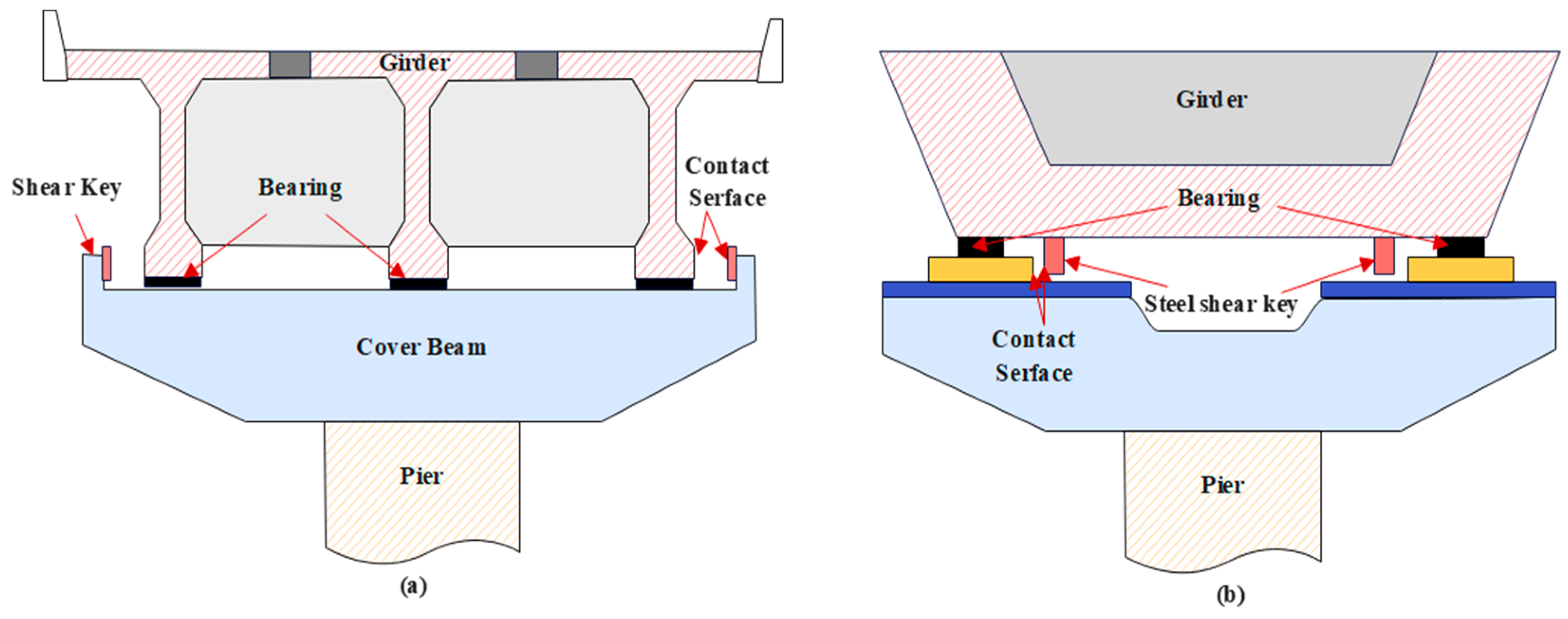
2.1. The Impact of Horizontal Seismic to Shear Keys
2.1.1. Failure Models of Shear Key
2.1.2. Seismic Shear Key Design Methodology in Earthquake-Prone Countries
2.2. The Impact of Horizontal Seismic to Bridge Piers
2.3. Seismic Resistance and Strengthening of Girder Bridges
2.4. Summary
3. Impact of Vertical Seismic Excitation on Bridge Piers
3.1. Vertical Responses of Bridge Structures
3.2. Vertical Responses on Bridge Piers
3.3. Summary
4. Impact of Horizontal and Vertical Seismic Excitations on Bridge Piers
4.1. The Characteristics of near Field Ground Motions
4.2. Impact of Bidirectional Seismic Excitations on Piers
4.3. Summary
5. Seismic Performance of Bridge Piers
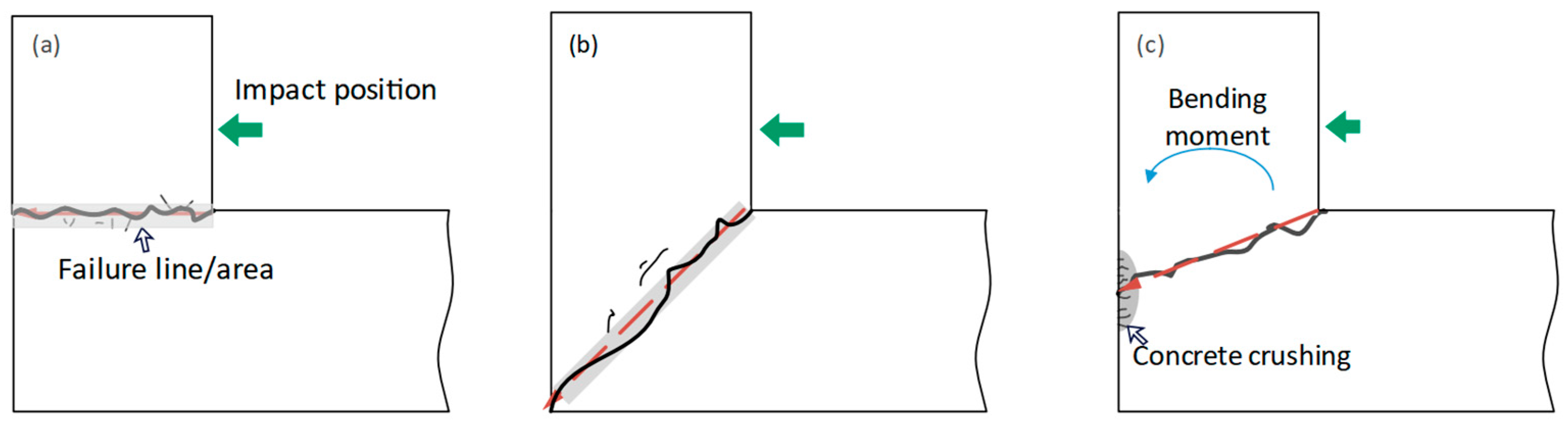
5.1. Failure Modes of Bridge Piers
5.2. Seismic Mitigation Measures for Bridge Piers and Their Design Philosophies
5.3. Summary
6. Research Prospects
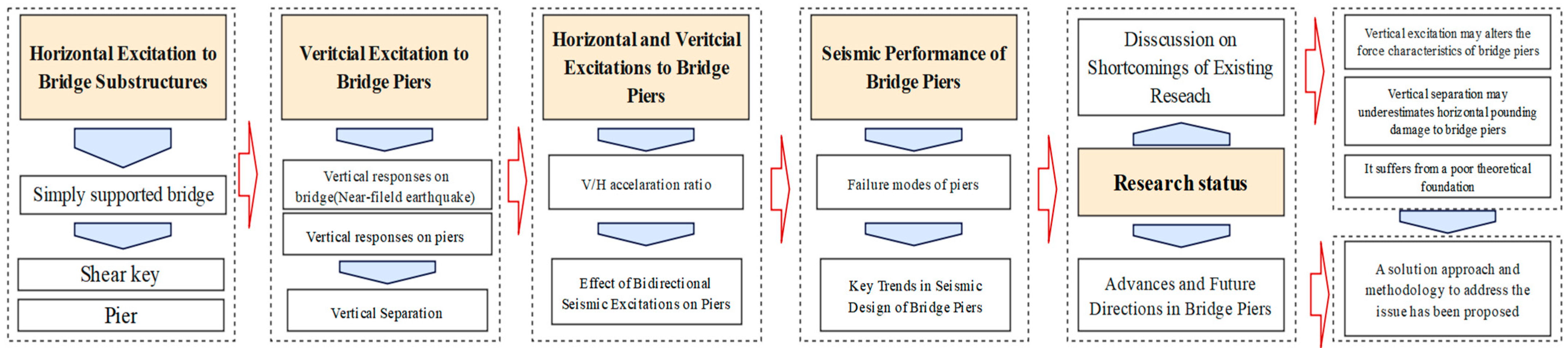
6.1. Shortcomings of Existing Research
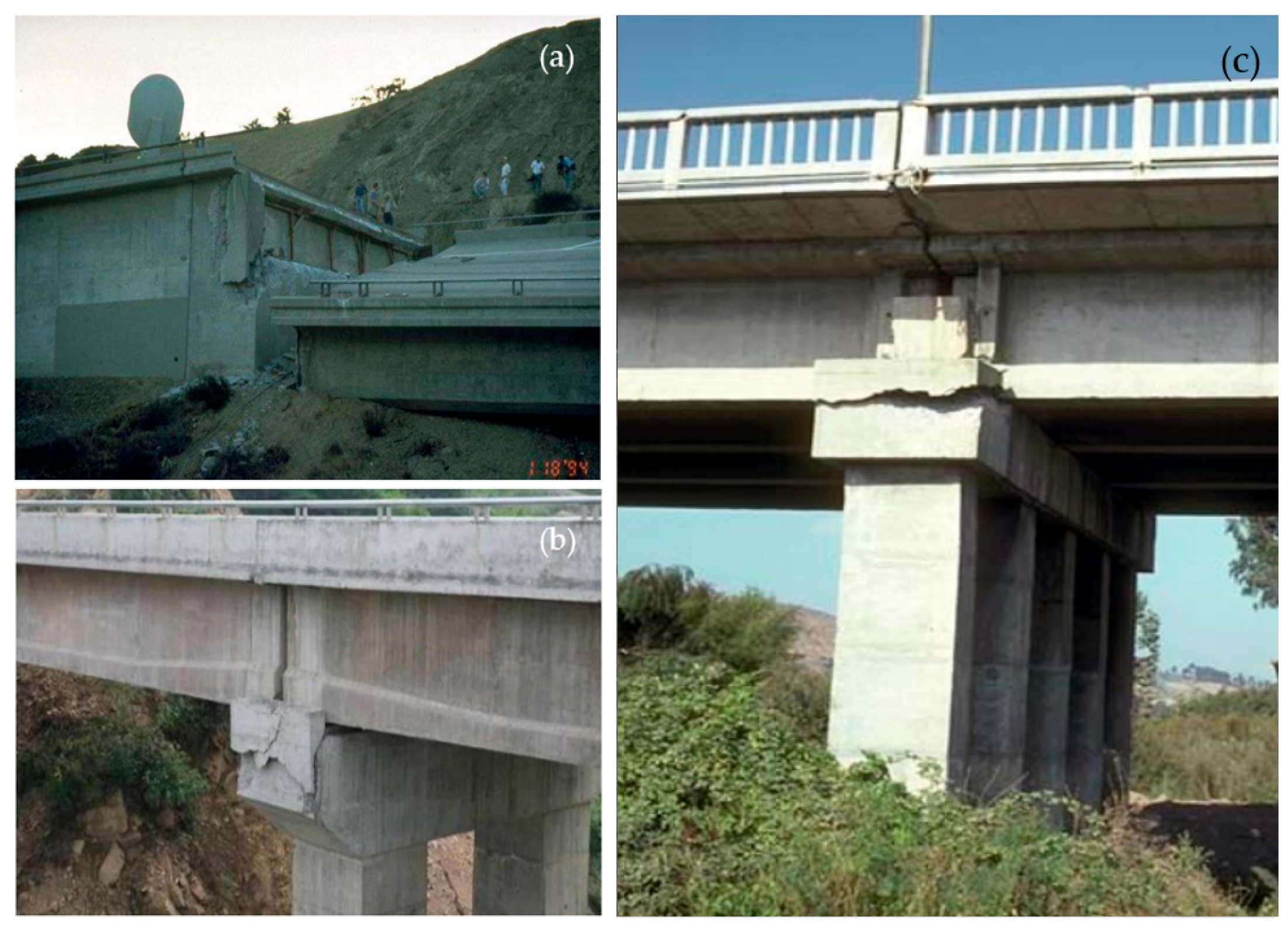
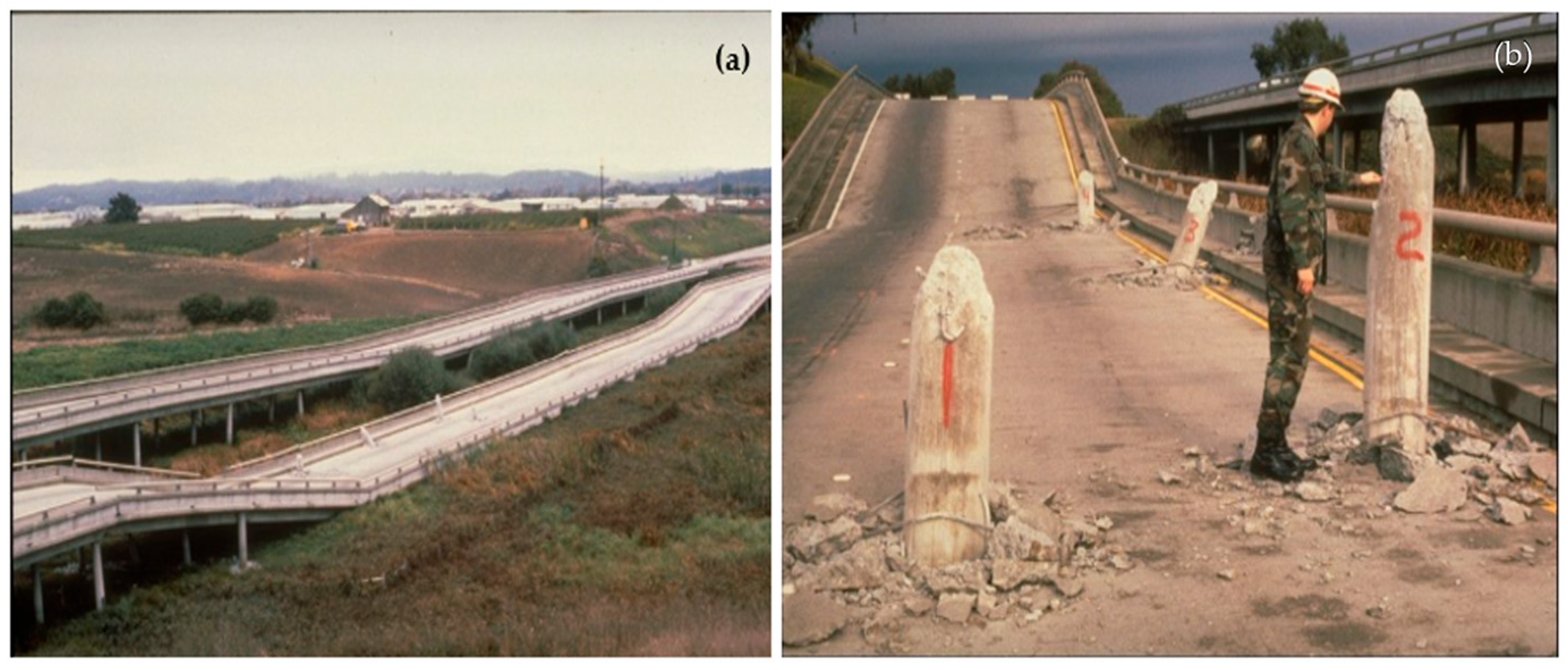
- Current research on seismic performance of bridge piers primarily focuses on horizontal ground motion response analyses, which inadequately represent actual earthquake scenarios. A representative case is the brittle shear failure of piers induced by high-frequency cyclic axial forces during the 1994 Northridge earthquake. This failure mechanism likely results from the combined dynamic effects of high-amplitude vertical and horizontal seismic excitations. The influence of vertical excitation on the horizontal internal forces and dynamic response of bridge piers urgently requires systematic investigation.
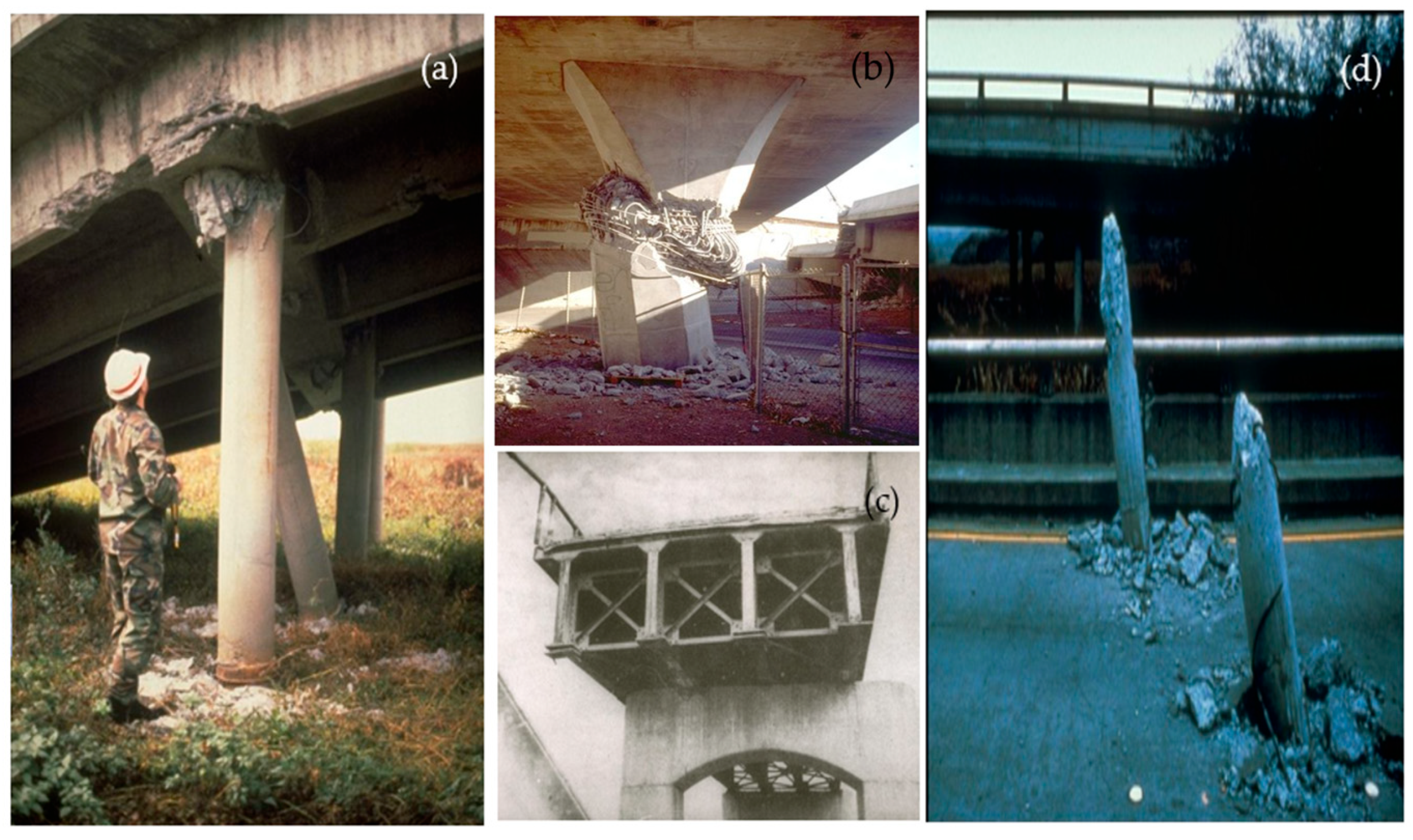
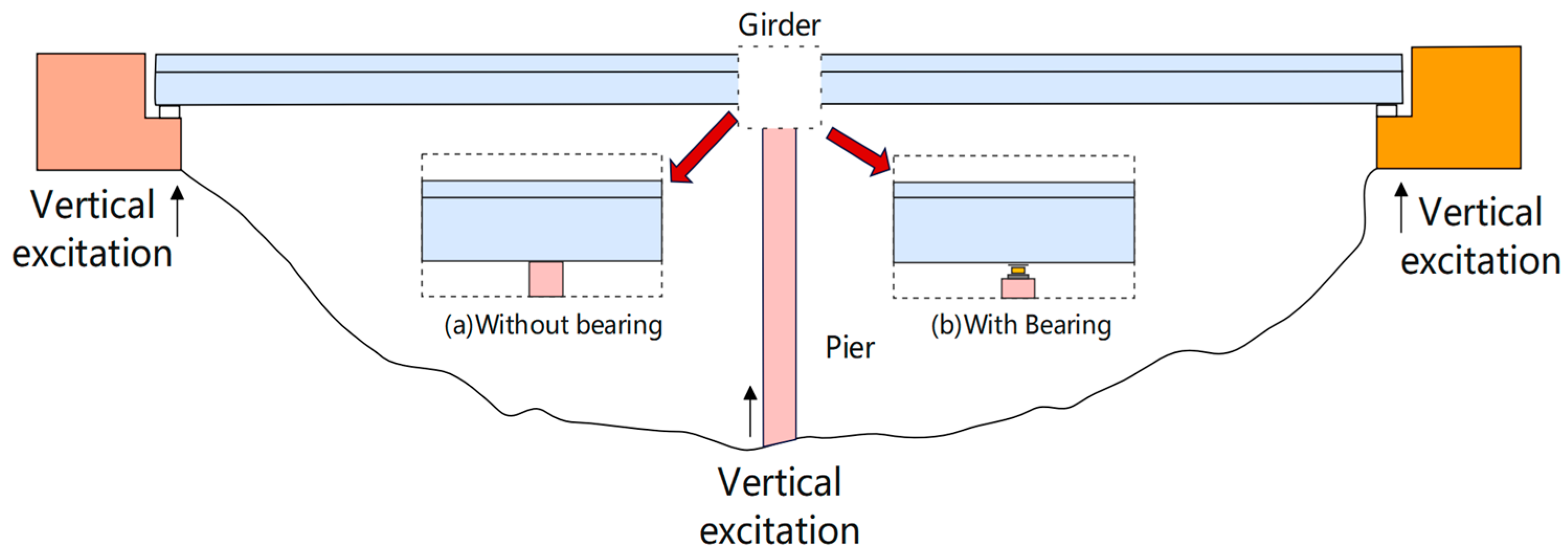
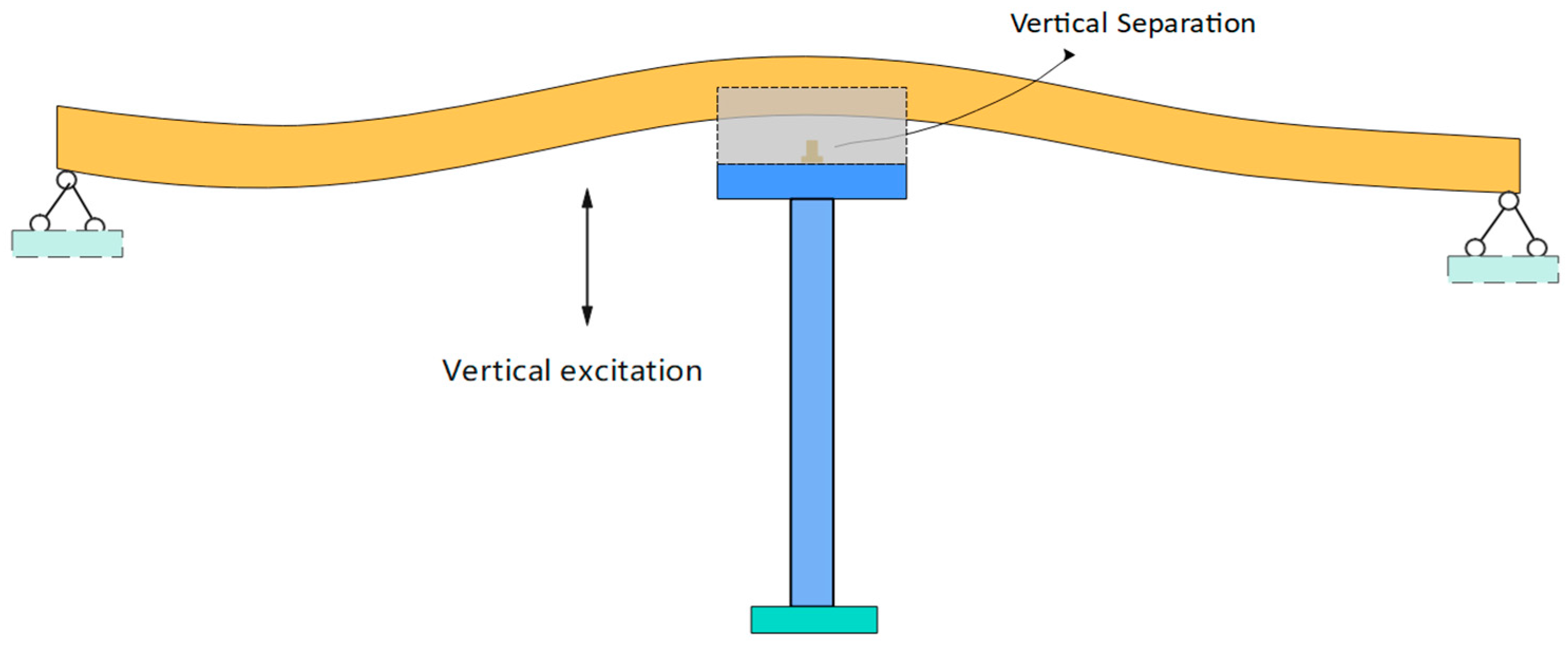
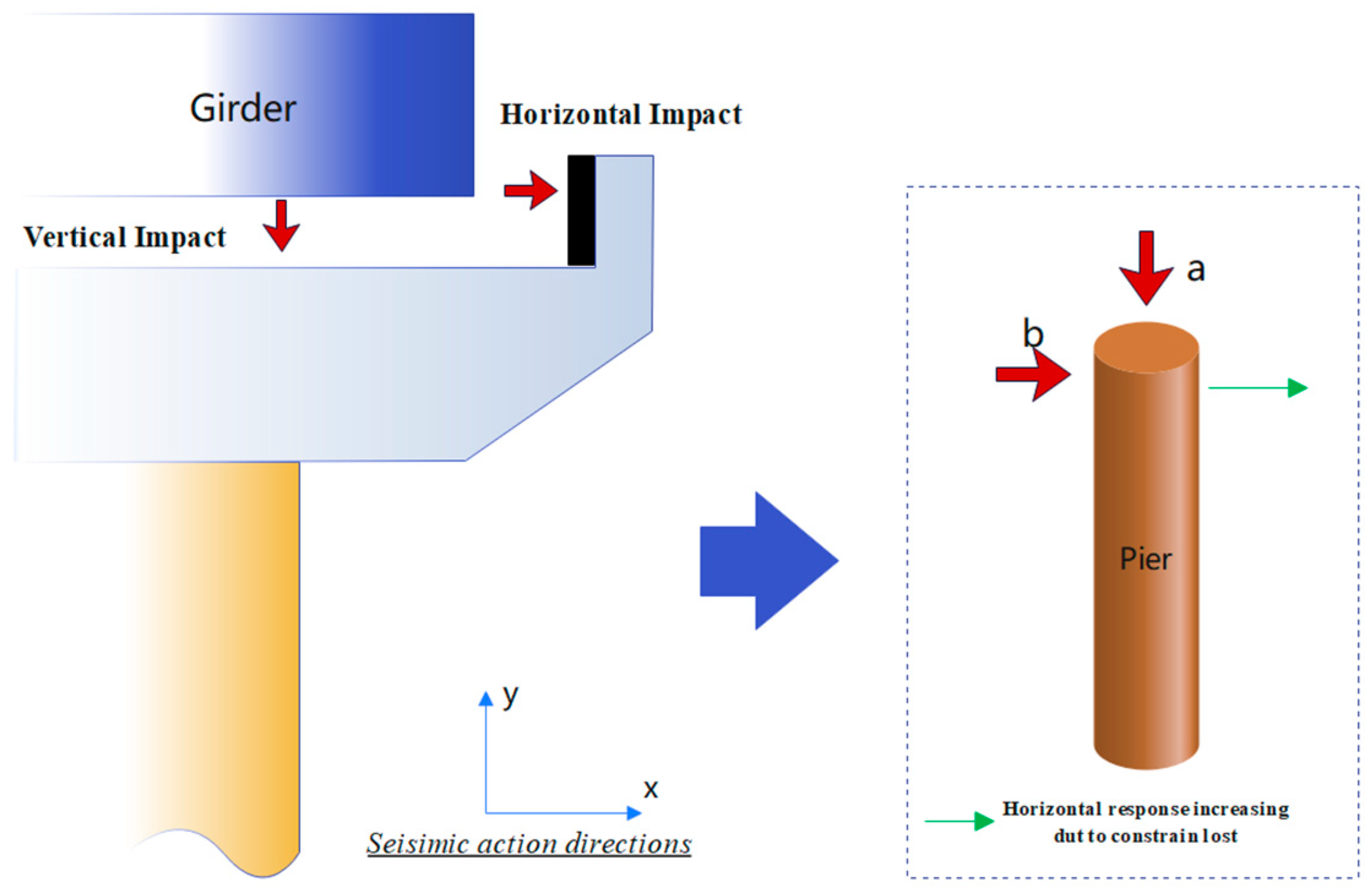
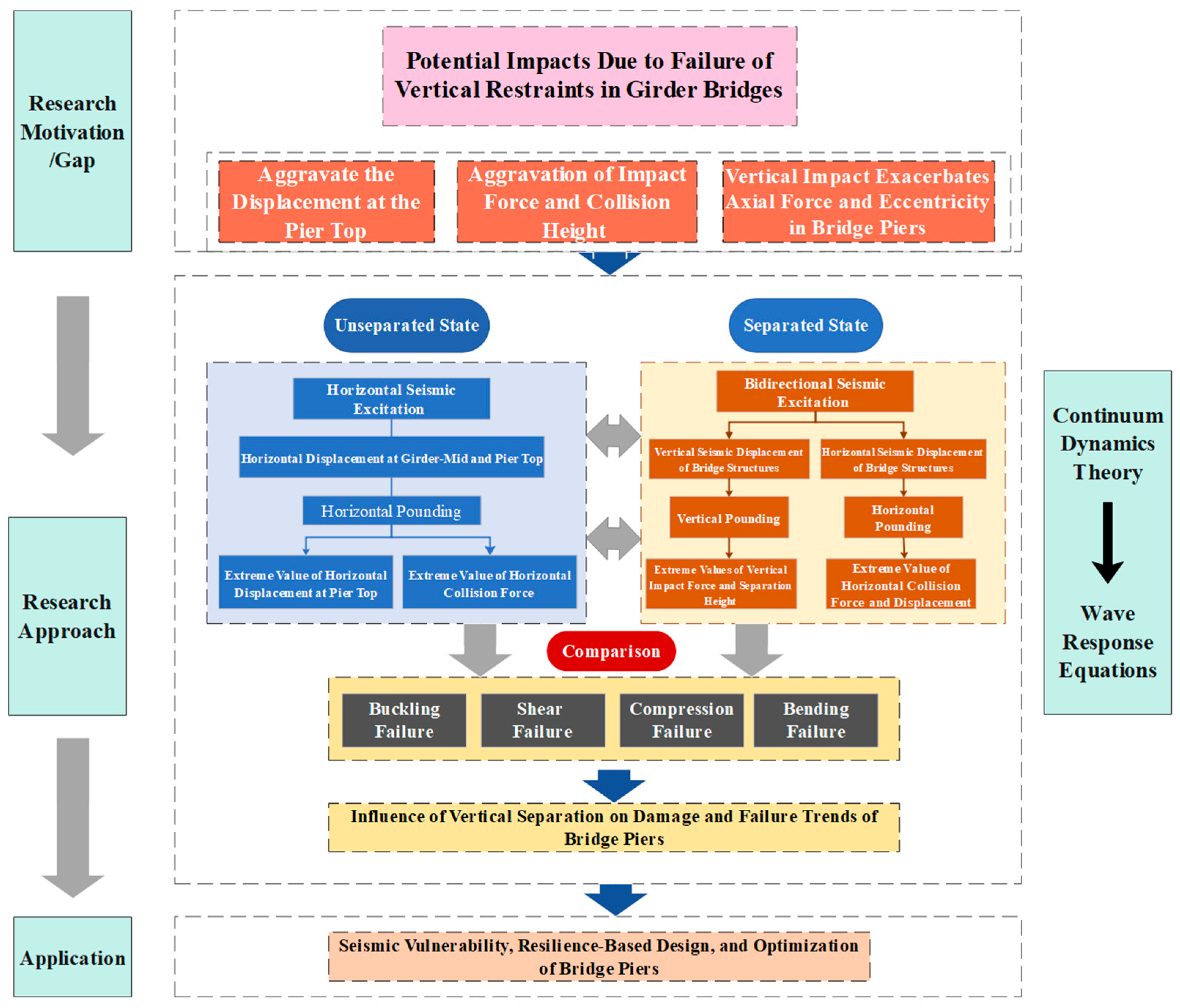
- Current research endeavors concerning vertical seismic effects predominantly focus on validating separation phenomena and conducting preliminary exploration into failure mechanisms, while giving scant consideration to the secondary hazards stemming from vertical separation. As previously discussed, the girder–bearing separation phenomenon in girder bridges significantly intensifies the impact forces and exacerbates both horizontal and vertical load requirements on piers, thereby substantially elevating collapse risks (Figure 14). This critical issue has, thus far, failed to garner adequate attention. Notably, girder bridges have emerged as the dominant selection for small-to-medium span highway bridges, attributable to their structural simplicity, rapid construction process, and high degree of standardization. Nevertheless, these inherent structural attributes also render them particularly vulnerable to seismic-related challenges, necessitating urgent and focused research efforts.
- Current bridge design paradigm has undergone a significant transformation, embracing the principles of “ductility” and “recoverability”, which substantially improves seismic performance. However, a considerable proportion of these performance indicators remain established based on unidirectional seismic and pounding response analyses. Consequently, such design standards run the risk of potentially underestimating the magnitude of structural damage under actual earthquake scenarios.
6.2. Advances and Future Directions in Bridge Piers
7. Conclusions
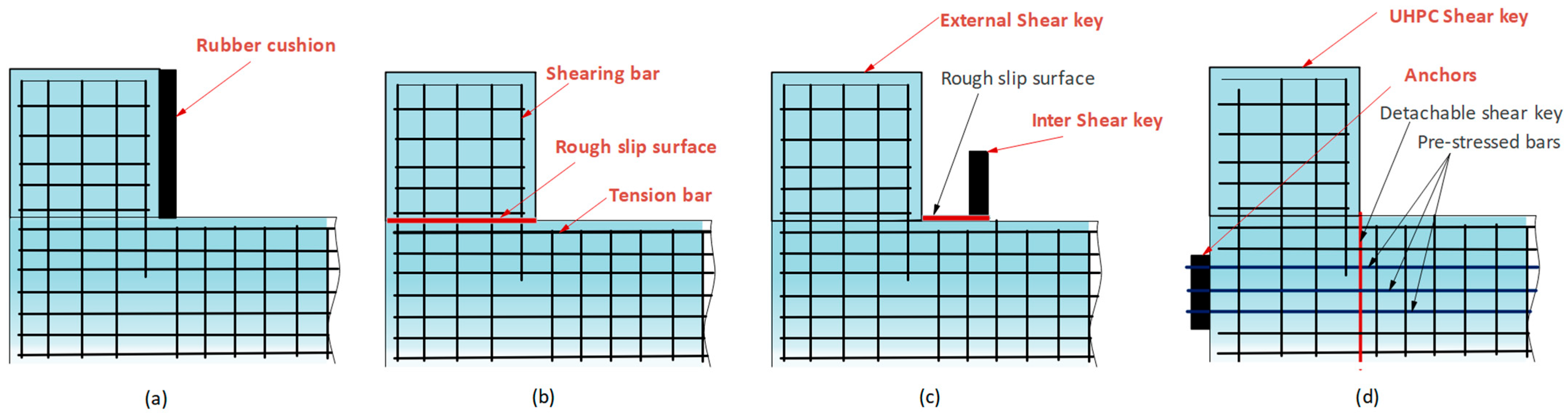
- Under horizontal seismic excitation, bridge structures demonstrate intricate collision phenomena, encompassing girder-to-girder impacts and girder-to-shear-key pounding. Notable advancements in the characterization of shear key failure modes when subjected to impact loads, thereby confirming their pivotal function in mitigating unseating failures through effective girder restraint. However, excessively rigid shear keys may inadvertently exacerbate damage to pier and cap beam, while simultaneously failing to prevent the unseating design conundrum starkly illustrated by catastrophic shear key failures observed during the 2008 Wenchuan earthquake. Consequently, the optimization of shear key constraint forces to achieve an equilibrium between unseating prevention and substructure protection remains a pivotal challenge in seismic design.
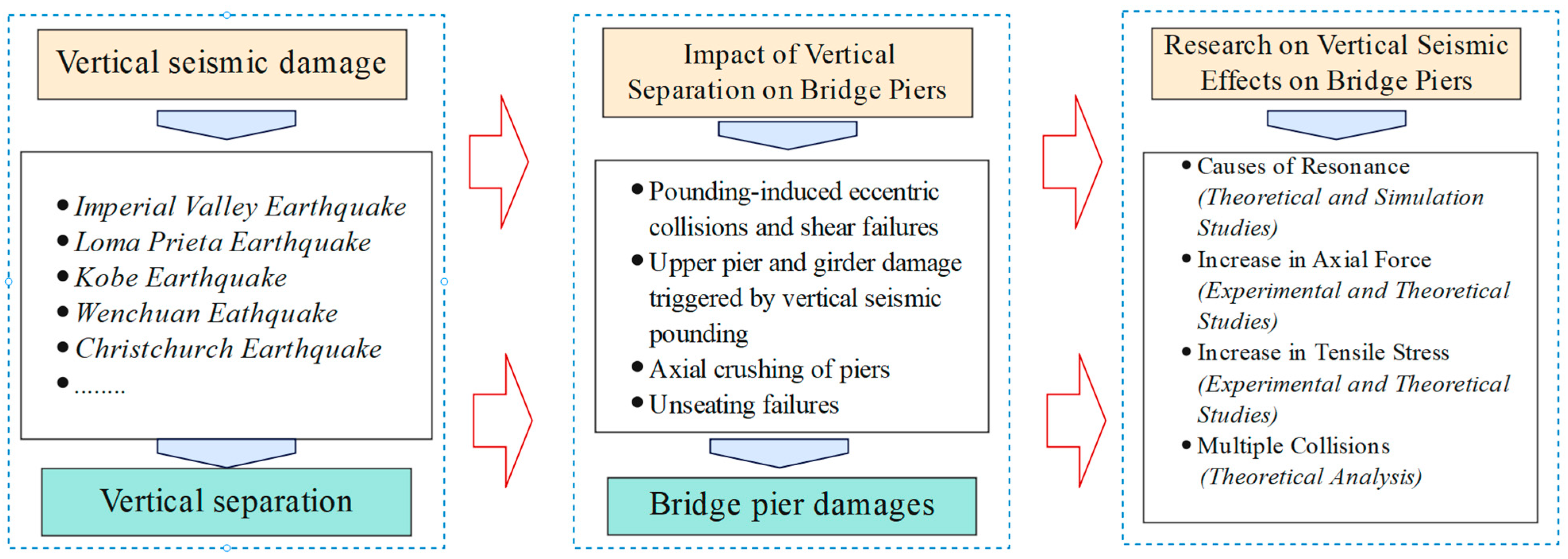
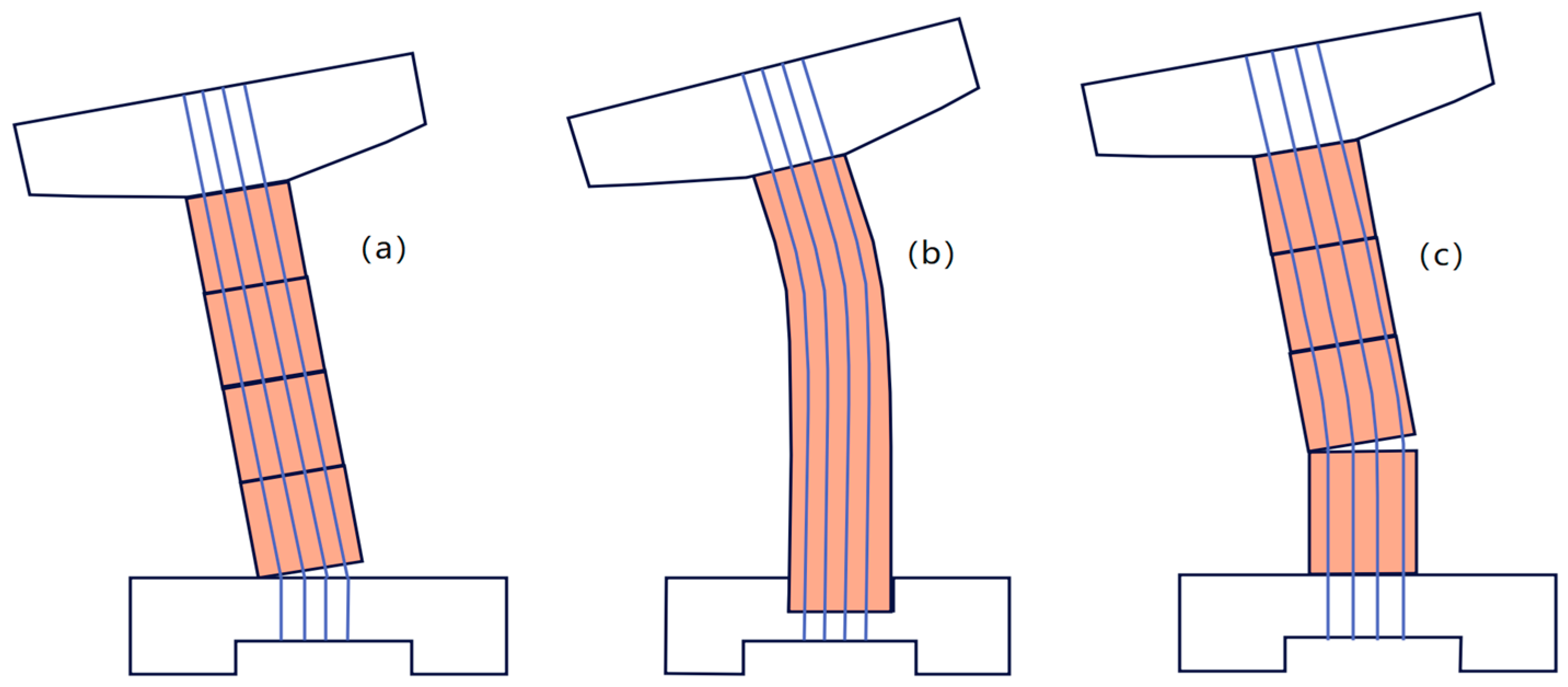
- Existing research endeavors have unveiled a spectrum of impacts induced by vertical earthquakes, which primarily encompass the following aspects: (1) eccentric collisions and shear failures; (2) upper pier damage triggered by pounding; (3) pier crushing; (4) unseating failures due to weakened girder–bearing contact; (5) bridge collapse scenarios. These seismic damages primarily originate from the displacement amplification and intensified collisions exacerbated by diminished contact between girders and piers under vertical excitation. Studies provide mechanistic elucidation for these phenomena, thereby deepening the comprehension of bridge responses under vertical earthquakes and furnishing scientific foundations for seismic design and assessment.
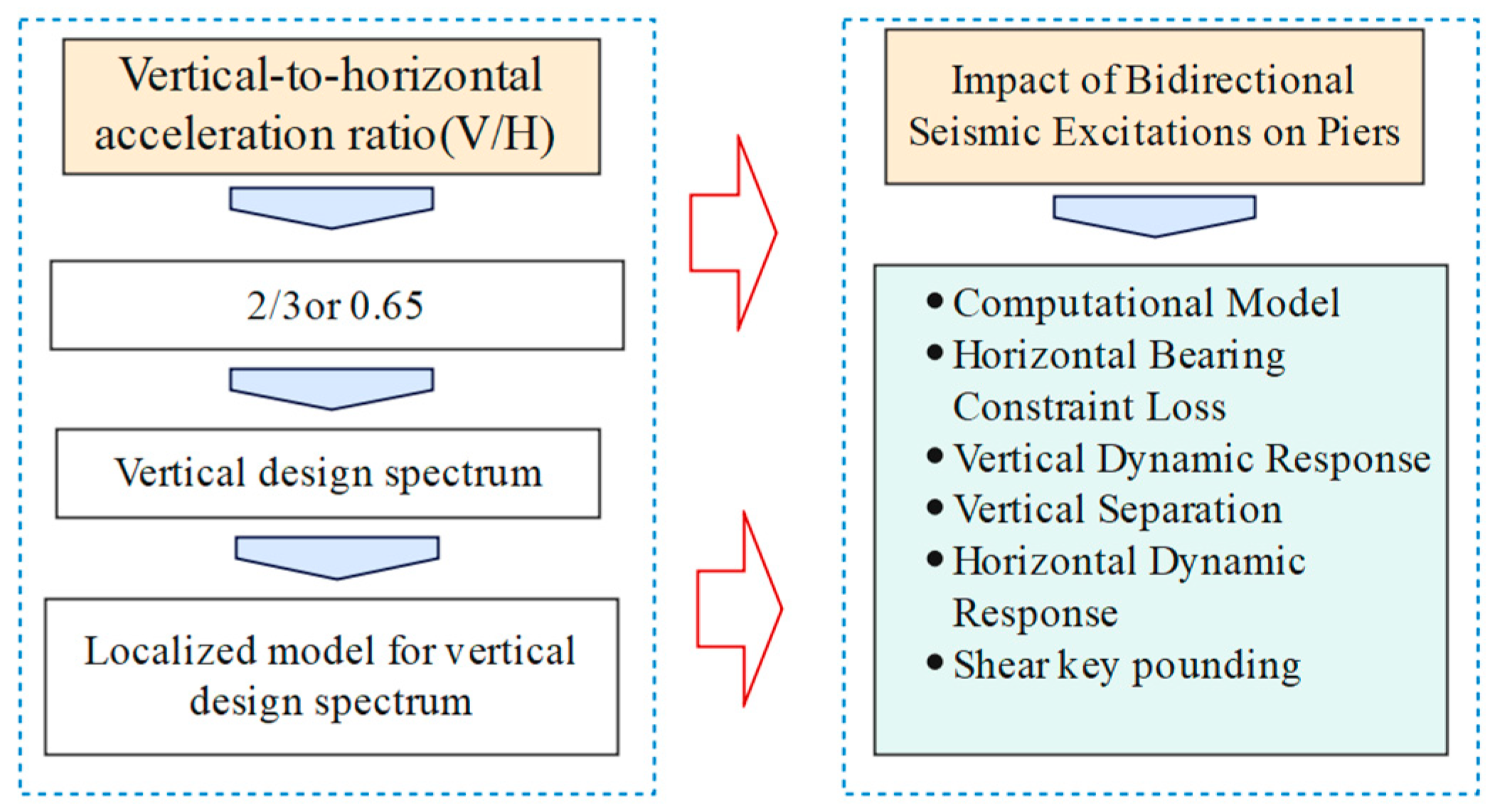
- In investigating the effects of coupled horizontal–vertical seismic actions on structures, the V/H serves as a critical parameter. Current research consensus confirms that the V/H ratio exhibits strong correlations with multiple factors, including site conditions, excitation periods, and focal depths. Consequently, adopting a fixed V/H ratio (e.g., 2/3 or 65%) may inadequately represent actual seismic scenarios, revealing methodological limitations in current approaches. Advances in seismic monitoring technologies and expanded datasets have enabled the development of dynamic V/H ratio prediction models, which significantly improve the accuracy of structural response simulations under multi-directional seismic actions. Both theoretical and experimental analyses demonstrate that bridge piers subjected to coupled horizontal–vertical excitations may experience significantly more severe damage compared to unidirectional seismic inputs. This coupling effect manifests through increased displacement demands and amplified curvature ductility requirements, exacerbating structural damage during actual earthquakes. To improve the safety and reliability of bridge structures under seismic events, it is imperative to deepen investigations into coupled horizontal–vertical seismic influences and systematically incorporate dynamic V/H ratio variations and coupling effects into design frameworks.
- The seismic performance of bridge piers has advanced substantially in recent decades, with significant progress achieved through innovations in design concepts, materials, and structural systems. From a philosophical perspective, the field has transitioned from traditional strength-based failure criteria toward designs that prioritize ductile failure performance, establishing a more robust foundation for pier engineering. Future development trends will emphasize recoverability and self-centering capabilities. Precast segmental piers represent an emerging paradigm in this context, while innovative configurations such as rocking piers constitute a critical focus for seismic research. Concurrently, the application of advanced materials offers transformative potential for enhancing bridge seismic resilience. Notably, UHPC and FRP composites contribute not only to improved seismic resistance but also enhanced durability, safety, and cost-effectiveness. These materials endow piers with superior toughness and reliability under extreme seismic events, fundamentally redefining structural response mechanisms.
- Current theoretical frameworks for seismic response analysis remain limited, with particularly inadequate research on dynamic collision forces and contact evolution mechanisms. Crucially, bidirectional coupled seismic excitation significantly induces girder uplift phenomena, amplifying transverse pounding forces at shear keys and generating more severe damage effects on piers compared to uniaxial static collisions. Notably, a critical research gap persists regarding the seismic damage mechanisms of bridge piers under this specific phenomenon, with no systematic investigations reported in existing literature. While continuum dynamics contact methodologies show promise for simulating these evolutionary processes, both the underlying theoretical foundations and subsequent seismic-resistant design systems require substantial refinement.
Author Contributions
Funding
Data Availability Statement
Acknowledgments
Conflicts of Interest
References
- Amir Mazaheri, D. Seismic design methodology of bridges: Point of present reflections. In Proceedings of the 10th European Conference on Earthquake Engineering, Vienna, Austria, 28 August–2 September 1994. [Google Scholar]
- Iwasaki, J.P.; Clough, R. Literature Survey-Seismic Effect on Highway Bridges; College of Engineering, University of California: Oakland, CA, USA, 1972. [Google Scholar]
- Kawashima, K.; Unjoh, S. Impact of Hanshin/Awaji earthquake on seismic design and seismic strengthening of highway bridge. Doboku Gakkai Ronbunshu 1997, 556, 211–240. [Google Scholar] [CrossRef]
- Wang, K.H.; Sun, Y.H.; Wei, H.; Jiang, Z.Y. Comments on seismic strengthening for Structural Engineering in China after Wenchuan Earthquake. J. Highw. Transp. Res. Dev. 2008, 11, 54–59. [Google Scholar]
- Zhuang, W.L.; Liu, Z.Y.; Jiang, J.S. Earthquake-induced damage analysis of highway bridges in Wenchuan earthquake and countermeasures. Chin. J. Rock Mech. Eng. 2009, 7, 1377–1387. [Google Scholar]
- Papazoglou, A.J.; Elnashai, A.S. Analytical and filed evidence of the damaging effect of vertical earthquake ground motion. Earthq. Eng. Struct. Dyn. 1996, 10, 1109–1137. [Google Scholar] [CrossRef]
- Yang, J.; Lee, C.M. Characteristics of vertical and horizontal ground motions recorded during the Niigata-ken Chuetsu, Japanese Earthquake of 23 October. Eng. Geol. 2007, 94, 50–64. [Google Scholar] [CrossRef]
- Lew, M.; Bonneville, D. New building code requirements for the seismic design of tall buildings near active faults. Struct. Des. Tall Build. 1997, 4, 279–297. [Google Scholar] [CrossRef]
- Somerville, P.K. Engineering Characteristics of Near-Fault Ground, in SMIP97; Department of Conservation: Los Angeles, CA, USA, 1997; pp. 9–28. [Google Scholar]
- Fan, L.C.; Wang, J.J. Design code for earthquake-resistance of bridge: Current situation and trend. Earthq. Eng. Eng. Vib. 2001, 2, 70–77. [Google Scholar]
- Loh, C.-H.; Liao, W.-I.; Chai, J.-F. Effect of near-fault earthquake on bridges: Lessons learned from Chi-Chi earthquake. J. Earthq. Eng. Eng. Vib. 2002, 1, 86–93. [Google Scholar] [CrossRef]
- Yang, H.B.; Yin, X.C. Theoretical investigation of bridge seismic responses with pounding under near-fault vertical ground motions. Adv. Struct. Eng. 2014, 4, 453–468. [Google Scholar] [CrossRef]
- Yang, H.B.; Yin, X.C.; Xu, R. Effect of bridge bearings on vertical pounding in bridges under near-fault vertical earthquakes. Eng. Mech. 2014, 31, 183–189. [Google Scholar]
- An, W.J.; Zhou, P.; Wang, P.; Zheng, Z.; Yang, H. Analysis of dynamic interaction and response in multi-span girder bridges subjected to near-fault earthquakes. Structures 2023, 58, 105622. [Google Scholar] [CrossRef]
- Wang, C.F.; Chen, X.C. The effect of vertical seismic motion on the seismic response of bridge structures. J. Vib. Shock 2007, 26, 31–35. [Google Scholar] [CrossRef]
- Li, H.F.; Luo, Y.F.; Chen, L.C.; Meng, Z. Effect of axial force fluctuation on seismic behavior of steel box column. J. Southwest Jiaotong Univ. 2014, 49, 425–431. [Google Scholar]
- Zhao, W.F.; Tian, S.W.; Zhao, J. Shear resistant performance of RC columns subjected to vertical near-fault velocity pulse-like earthquake actions. J. Chongqing Univ. 2013, 6, 103–111. [Google Scholar]
- Xin, L.F.; Li, X.Z.; Fu, P.Y.; Mu, D. Seismic behavior of precast segmental column bridges under near-fault forward-directivity ground motions. Earthq. Eng. Eng. Vib. 2022, 2, 559–571. [Google Scholar]
- Chen, S.T.; Fadzli, M.N.; An, W.J.; Fu, H. A theoretical calculation method of seismic shear key pounding based on continuum model. MethodsX 2023, 2023, 102370. [Google Scholar] [CrossRef]
- Bi, K.H.H. Modelling of shear keys in bridge structures under seismic loads. Soil Dyn. Earthq. Eng. 2015, 74, 56–68. [Google Scholar] [CrossRef]
- Wang, X.W.; Ye, A.G.; Wu, X.P.; Zhou, X.P.; Song, K.H.; Li, J.; Lou, L.; Wei, X.N.; Peng, J. Seismic resilience assessment method for girder bridges: Expert opinion-based post-earthquake functionality recovery models of bridge components. China Civ. Eng. J. 2025, 58, 65–76. [Google Scholar]
- Wang, M.Q. Performance Based Design Method of Bridge Seismic Resistance; Chongqing Jiaotong University: Chongqing, China, 2021. [Google Scholar]
- Wang, Y.X.; Sun, Z.G.; Men, J.J.; Chen, X.Y. Research on seismic behavior of RC double-deck viaduct under near-fault vertical ground motions. Eng. Mech. 2024, 42, 1–11. [Google Scholar]
- Megally, S.H.; Filva, P.; Seible, F. Seismic Response of Sacrificial Shear Keys in Bridge Abutments; University of California: San Diego, CA, USA, 2001. [Google Scholar]
- Liu, P. Reseach on Dynamic Pounding Between Grider and Transverse Shear Key of Bridge Under Earthquake; Southwest Jiaotong University: Chengdu, China, 2010. [Google Scholar]
- Norton, J.A.; King, A.B.; Bull, D.K.; Chapman, H.E.; McVerry, G.H.; Larkin, T.J.; Spring, K.C. Northridge earthquake reconnaissance report. Bull. N. Z. Soc. Eathq 1994, 27, 235–344. [Google Scholar] [CrossRef]
- Shamsabadi, A. Three-Dimensional Nonlinear Seismic Soil-Foundation-Structure Interaction Analysis of Skewed Bridge; University of Southern California: Los Angeles, CA, USA, 2007. [Google Scholar]
- Wang, D.S.; Guo, X.; Sun, Z.G.; Meng, Q.L.; Yu, D.H.; Li, X.L. Damage to highway bridges during Wenchuan Earthquake. J. Earthq. Eng. Vib. 2009, 3, 84–94. [Google Scholar]
- Jonsson, M.H.; Bessason, B.; Haflidason, E. Earthquake response of a base-isolated bridge subjected to strong near-fault ground motion. Soil Dyn. Earthq. Eng. 2010, 36, 447–455. [Google Scholar] [CrossRef]
- Schanack, F.; Valdebenito, G. Seismic damage to bridge during the 27 February 2010 magnitude 8.8 Chile earthquake. Earthq. Spectra 2012, 1, 301–315. [Google Scholar] [CrossRef]
- Bi, K.; Hong, H.; Chow, N. Required separation distance between decks and at abutments of bridge crossing a canyon site to avoid seismic pounding. Earthq. Eng. Struct Dyn. 2010, 39, 303–323. [Google Scholar] [CrossRef]
- Xu, H.Z.; Liu, Z.; Zhang, Y.K. Study on horizontal displacement characteristics of plate rubber bearing. Sci. Technol. Eng. 2023, 7, 3038–3043. [Google Scholar]
- I-5/Hwy 14 Interchange. Northridge Earthquake; NISEE-PPER; University of California: Berkeley, CA, USA, 1994. [Google Scholar]
- Wyllie, L.A. Cracked Bridge Shear Block After 1985 Chile Earthquake; NISEE-PEER; University of California: Berkeley, CA, USA, 1985. [Google Scholar]
- Bozorgzadeh, A.; Megally, S.H.; Restrepo, J.I. Capacity evaluation of exterior sacrificial shear keys of bridge abatements. J. Pf Bridge Eng. 2006, 5, 555–565. [Google Scholar]
- Xu, L.Q.; Li, J.Z. Experiment on seismic performance and its improvement of reinforced concrete retainers. China J. Highw. Transp. 2014, 9, 41–48. [Google Scholar]
- Zheng, W.S.; Tang, G.W. Quasi-static test research on seismic block of bridges. Technol. Highw. Transp. 2013, 4, 54–58. [Google Scholar]
- Xu, J.L. Research on Resilient Concrete Continuous Bridges Under Earthquake and Over-Height Trunk Collision; Tsinghua University: Beijing, China, 2016. [Google Scholar]
- Wang, C.; Xu, W.B.; Hu, W.B.; Hu, Z.Q.; Hou, P.; Guang, G.Z.; Cui, F.K. Research on the seismic vulnerability of prefabricated bridge reinforced concrete lateral limit blocks. Transp. World 2024, 20, 16–18. [Google Scholar] [CrossRef]
- Liu, P. Improved algorithm of contact element model for earthquake-induced pounding between structures. J. Chongqing Univ. 2012, 35, 135–142. [Google Scholar]
- Xu, L.Q.; LI, J.Z. Seismic strength prediction of reinforced concrete retainers based on rigid body rotation model. Eng. Mech. 2014, 10, 143–150. [Google Scholar]
- Xu, L.Q.; Li, J.Z. Dual-level design method of sacrificial seismic retainers. China Highw. Transp. 2015, 10, 59–66. [Google Scholar]
- Kottari, A. Horizontal Load Resisting Mechanisms of External Shear Keys in Bridge Abutments; University of California: San Diego, CA, USA, 2016. [Google Scholar]
- Han, Q.; Zhou, Y.; Ou, Y.; Du, X. Seismic behavior of reinforced concrete sacrificial exterior shear keys of highway bridges. Eng. Struct. 2017, 139, 59–70. [Google Scholar] [CrossRef]
- Han, Q.; Hu, M.H.; Wen, J.N. Seismic capacity evaluation of interior shear keys for highway bridges. J. Earthq. Eng. 2018, 24, 972–987. [Google Scholar] [CrossRef]
- Meng, D.L.; Yang, M.G.; Fei, F. Shake-table tests on the influence of the pounding on transverse seismic responses of high-speed railway Simply supported bridges. Eng. Mech. 2019, 8, 161–170. [Google Scholar]
- Fan, L.C.; Nie, L.Y.; Li, J.Z. Dynamic characteristic analysis of laminated rubber bearing sliding under earthquake. China J. Highw. Transp. 2003, 4, 30–35. [Google Scholar]
- Wang, K.H.; Hui, Y.X.; Wu, G. Study on seismic performance of seismic earthquake double-layer stopper. Earthq. Eng. Eng. Dyn. 2014, 505–510. [Google Scholar] [CrossRef]
- Xiang, N.L.; Li, J.Z. Effect of different types of retainers on transverse seismic performance of small and mid-span girder bridges. Eng. Mech. 2016, 3, 188–195. [Google Scholar]
- Bhuiyan, A.R.; Alam, M.S. Seismic performance assessment of highway bridges equipped with super-elastic shape memory alloy-based laminated rubber isolation bearing. Eng. Struct. 2013, 2, 396–407. [Google Scholar] [CrossRef]
- Wu, W.P.; He, J.; Li, L.; Li, H. Experimental study on the post-tensioned unbonded prestressing UHPC prefabricated retaining blocks for highway bridges. Bull. Earthq. Eng. 2023, 21, 6477–6498. [Google Scholar] [CrossRef]
- Kelly, J.M.; Skinner, R.I.; Heine, A.J. Mechanisms of Energy Absorption in Special Devices for Use in Earthquake Resistant Structures. Bull. New Zealand Natl. Soc. Earthq. Eng. 1972, 5, 63–88. [Google Scholar]
- Ciampi, V. Use of energy dissipating devices, based on yielding of steel, for earthquake protection of structures. In Proceedings of the International Meeting on Earthquake Protection of Buildings, Ancona, Italy, 22 April 1991; pp. 41–58. [Google Scholar]
- Vasseghi, A. Energy dissipating shear key for precast concrete girder bridges. Sci. Iran. 2011, 3, 296–303. [Google Scholar] [CrossRef]
- Tang, Z.H. Experimental Study and Calculation Method on Bridge Seismic Stoppers; Chongqing Jiaotong University: Chongqing, China, 2015. [Google Scholar]
- Zhu, C.; Fan, B.B. Methods to calculatekey mechanical parameters of H-beam stopper. World Earthq. Eng. 2019, 3, 186–197. [Google Scholar]
- Wei, B.; Wan, K.; Wang, W.; Hu, Z.; Jiang, L.; Li, S. Seismic isolation effect of a new type of friction pendulum bearing in high-speed railway girder bridge. Structures 2023, 51, 776–790. [Google Scholar] [CrossRef]
- South Carolina Department of Transportation. Seismic Design Specification for Highway Bridges, In Version 2.0; South Carolina Department of Transportation: Columbia, SC, USA, 2008; Available online: http://hdl.handle.net/10827/30251 (accessed on 23 November 2025).
- Guide Specifications for LRFD Seismic Bridge Design, 2nd ed.; American Association of State Highway and Transportation Officials: Washington, DC, USA, 2014.
- Seismic Design Criteria; California Department of Transportation: Saramento, CA, USA, 2013.
- FHWA-RD-94-052; Federal Highway Administration. Seismic Retrofitting Manual for Highway Bridges. Turner Fairbank Highway Research Center: McLean, VA, USA, 1995.
- ACI 318-14; Building Code Requirements for Structural Concrete. American Concrete Institute: Farmington Hills, MI, USA, 2014.
- ASCE-7; Minimum Design Loads and Associated Criteria for Buildings and Other Structures. American Society of Civil Engineers Press: Reston, VA, USA, 2022.
- Hanshin Expressway Company. Seismic and Retrofit of Bridges-From Post-Disaster Emergency Repair to Seismic Maintenance and Reinforcement; China Architecture and Building Press: Beijing, China, 2013; ISBN 978-7-1121-4891-2. [Google Scholar]
- New Zealand Transport Agency. Bridge Manual; NZTA: Wellington, New Zealand, 1994. [Google Scholar]
- JTG/TB02-01-2008; Guidelines for Seismic Design of Highway Bridges. China Communication Press: Beijing, China, 2008.
- GB50111-2006; Code for Seismic Design of Railway Engineering (Version 2009). China Planning Press: Beijing, China, 2009.
- Priestley, M.J.N.; Seible, F.; Calvi, G.M. Seismic Design and Retrofit of Bridges; John Wiley & Sons Inc.: Hoboken, NJ, USA, 1996. [Google Scholar] [CrossRef]
- Nielson, B.G.; DesRoches, R. Seismic performance assessment of simply supported and continuous multi-span concrete girder highway bridges. J. Bridge Eng. 2007, 5, 611–620. [Google Scholar] [CrossRef]
- Wang, K.H. Bridge Seismic Research, 1st ed.; China railway publishing house: Shanghai, China, 2012; pp. 269–279. [Google Scholar]
- Wang, K.H.; Wei, H.; Li, X. Philosophies on Seismic Design of Highway Bridges of Small or Medium Spans. China Civ. Eng. J. 2012, 9, 115–121. [Google Scholar]
- Xu, L.Q.; Li, J.Z. Effects of retainer on simplified seismic analytical methods for regular continuous girder bridge. World Earthq. Eng. 2013, 2, 124–131. [Google Scholar]
- Li, J.Z.; Xiang, N.L.; Tang, H. Shake-table tests and numerical simulation of an innovative isolation system for highway bridges. Soil Dyn. Earthq. Eng. 2020, 86, 55–70. [Google Scholar] [CrossRef]
- Pi, S.M.; Xu, L.Q.; Sun, R.W. Research on bearing-shear key-pier interaction of simply-supported girder bridges under earthquake excitation. World Earthq. Eng. 2020, 1, 137–145. [Google Scholar]
- Ma, Y.T.; Wang, J.M.; Wu, D.C. Study on the effect of transvers retainers on seismic vulnerability of typical highway continuous beam bridge in high seismic region. Earthq. Resist. Eng. Retrofit. 2022, 5, 67–75. [Google Scholar]
- Nettis, A.; Di Mucci, V.M.; Ruggieri, S.; Uva, G. Seismic fragility and risk assessment of isolated bridges subjected to pre-existing ground displacements. Soil Dyn. Earthq. Eng. 2025, 194, 109335. [Google Scholar] [CrossRef]
- Di Mucci, V.M.; Cardellicchio, A.; Ruggieri, S.; Nettis, A.; Reno, V.; Uva, G. Computer vision-based seismic assessment of RC simply supported bridges characterized by corroded circular piers. Bull. Earthq. Eng. 2025. [Google Scholar] [CrossRef]
- Zheng, S.X.; Lei, C.H.; Jia, H.Y.; Zheng, Y.P.; Liu, L.W.; Zhao, C.H. LSTM-based method for fast prediction of seismic response and vulnerability of Near-fault bridges. China J. Highw. Transp. 2025, 38, 18–30. [Google Scholar]
- Pan, P.; Yan, H.; Wang, T. Development of steel dampers for bridges to allow large displacement through a vertical free mechanism. Earthq. Eng. Eng. Vibration 2014, 3, 375–388. [Google Scholar] [CrossRef]
- Selna, L.G.; Malvar, L.J.; Zelinski, R.J. Bridge retrofit testing: Hinge cable restrainers. J. Struct. Eng. 1989, 4, 920–934. [Google Scholar] [CrossRef]
- JTG 5410-2020; Specifications for Design of Highway Maintenance Engineering. Jiaoke Transport Consultants Co., Ltd.: Beijing, China, 2020.
- Wu, W.P.; Li, L.F.; Hu, Z.L. Effects of the bearing arrangement on seismic performance of continuous girder bridges under near-fault ground motions. Earthq. Eng. Eng. Vib. 2015, 4, 155–163. [Google Scholar]
- Liu, B.D.; Liu, H.F. Dynamic characteristic analysis and performance evaluation of the existing piers. J. Highw. Transp. Res. Dev. 2006, 6, 95–97. [Google Scholar]
- Meng, X.; Gao, R.; Li, C.G. Theoretical and experimental study of hysteric behavior of shock absorbers. Bridge Constr. 2015, 3, 20–25. [Google Scholar]
- Li, C.G.; Gao, R. Study on the shock absorbing technique of high-speed railway bridges. Railw. Constr. Technol. 2009, 2, 24–29. [Google Scholar]
- Zhou, Y.Q.; Li, C.G. Simplified calculation method for steel bar damper and steel bar restrainer applied to high-speed railway simply supported beam bridge. Railw. Stand. Des. 2019, 5, 65–70. [Google Scholar]
- Zhou, Y.Q.; Wen, Q.; Kang, W. Research on the effect of steel bar damper and steel bar restrainer applied to railway simply supported bridge. Railw. Stand. Des. 2020, S1, 79–84. [Google Scholar]
- Meng, X.; Gao, R.; Li, C.G. Design and seismic mitigation performance study of shock absorber for railway simply-supported beam bridge. Bridge Constr. 2014, 3, 81–86. [Google Scholar]
- Ma, Y.B.; Li, Y.; Zhang, Y.L.; Huang, Y.B. Analysis of the seismic isolation and energy dissipation effects of the damping tenons in high-speed railway simply supported beam bridges. Railw. Stand. Des. 2025, 5. [Google Scholar] [CrossRef]
- He, Z.Y.; Wang, Y. Safety assessment and reinforcement design of a single column pier curved girder bridge. J. China Foregin Highw. 2018, 3, 124–130. [Google Scholar]
- Zhou, J.M.; Wu, W.P.; Wang, C.J. Study on anti-overturning reinforcement structure and design method of single pillar pier based on strut-and-tie. J. Highw. Transp. Res. Dev. 2021, 8, 110–115. [Google Scholar]
- Chen, C.C.; Huang, J.Z.; Yu, Y.G. Robustness design of bridge collapse resistance. J. Chongqing Jiaotong Univ. (Nat. Sci.) 2014, 1, 1–7. [Google Scholar]
- Xiong, Z.H.; Liu, X.Y.; Li, J.Q.; Liu, C. Seismic resilience evaluation of steel-concrete composite girder bridge in cold regions with high seismic intensity. Prog. Steel Struct. 2023, 9, 65–85. [Google Scholar]
- Zhang, J.R.; Wei, K.; Qin, J.X. Resilience and economic loss assessment of highway bridges in deep reservoir under near-fault ground motion. J. Bridges Eng. 2021, 3, 04021007. [Google Scholar] [CrossRef]
- Xu, J.G.; Cai, Z.K.; Feng, D.C. Life-cycle seismic performance assessment of aging RC considering multi-failure modes of bridge columns. Eng. Structures 2021, 244, 112818. [Google Scholar]
- Huang, C.G.; Huang, S.R. Seismic resilience assessment of aging bridges with different failure modes. Structures 2021, 33, 36823690. [Google Scholar] [CrossRef]
- Yang, G.J.; Ye, S.; Li, X.M. Time-dependent seismic resilience analysis of RC bridge piers considering chloride induced erosion. J. Huazhong Univ. Sci. Technol. (Nat. Sci. Ed.) 2023, 8, 60–66. [Google Scholar]
- Li, X.M.; Ye, S.; Yang, G.J. Improved evaluation method for seismic resilience of continuous beam bridges based on system vulnerability. Eng. J. Wuhan Univ. 2024, 12, 1716–1724. [Google Scholar]
- Qian, J.; Zheng, Y.; Dong, Y. Sustainability and resilience of steel-shape memory alloy reinforced concrete bridge under compound earthquakes and functional deterioration within entire life cycle. Eng. Struct. 2022, 271, 114937. [Google Scholar] [CrossRef]
- Boore, D.M.; Joyner, W.B.; Oliver, A.A., III; Page, R.A. Peak acceleration, velocity, and displacement from strong-motion records. Bull. Seismol. Soc. Am. 1980, 70, 305–321. [Google Scholar] [CrossRef]
- EN 1998-1:2004 Eurocode 8; Design of Structures for Earthquake Resistance. European Committee for Standardization: Brussels, Belgium, 2004.
- Bozorgnia, Y.; Niazi, M.; Campbell, K.W. Characteristics of free-field vertical ground motion during the Northridge earthquake. Earthq. Spectra 1995, 4, 515–526. [Google Scholar] [CrossRef]
- Wang, G.Q.; Zhou, X.Y.; Zhang, P.Z. Characteristics of amplitude and duration for near fault strong ground motion from the 1999 Chi-Chi, Taiwan earthquake. Soil Dyna Earthq. Eng. 2002, 1, 73–96. [Google Scholar] [CrossRef]
- Fukushima, Y.; Irikura, K.; Uetake, T. Characteristics of observed peak amplitude for Stronge ground motion from the 1995 Hygoken Nanbu (Kobe) earthquake. Bull. Seismol. Soc. Am. 2000, 90, 545–565. [Google Scholar] [CrossRef]
- Wang, D.; Xie, L. Attenuation of peak ground accelerations from the great Wenchuan earthquake. Earthq. Eng. Vib. 2009, 2, 179–188. [Google Scholar] [CrossRef]
- Han, W.F.; Song, C.; Liang, Q.G. Strong ground motion at meizoseismal area & safety of important engineering projects at potential earthquake region. J. Eng. Geol. 2004, 4, 346–353. [Google Scholar]
- Chen, S.T.; An, W.J.; Fu, H.; Fadzli, M.N. The effect of bridge girder-bearing separation on shear key pounding under vertical earthquake action—A state-of-the-art review. Structures 2023, 2023, 2445–2460. [Google Scholar]
- Boulanger, R.W. Collapse of Bridge at Struve Slough; NISEE-PEER; University of California: Berkeley, CA, USA, 1989. [Google Scholar]
- Boulanger, R.W. Detail of Punching Failure; NISEE-PEER; University of California: Berkeley, CA, USA, 1989. [Google Scholar]
- Yang, H. Research on Multiple Pounding Responses and Characteristics of Bridges Under Near-Fault Vertical Ground Motions. Doctoral Dissertation, Nanjing University of Science & Technology, Nanjing, China, 2014. [Google Scholar]
- Bozorgnia, Y.; Campbell, K.W. Vertical Ground Motion: Characteristics, Modeling, and Applications in Seismic Design; University of California: Berkeley, CA, USA, 2004. [Google Scholar]
- Tanimura, S.; Heya, H.; Umeda, T.; Mimura, K.; Yoshikawa, O. 3-Dimensional Analysis of Dynamic Behavior of Bearing of Nielsen Bridge. JSME Int. J. 2002, 2, 190–198. [Google Scholar] [CrossRef][Green Version]
- Xu, R.; Yin, X.C. Transient wave response analysis of a bridge under vertical earthquakes. J. Vib. Shock. 2012, 1, 49–55. [Google Scholar]
- An, W.J.; Zhou, L.; Kang, M.; Yang, H.; Mo, L. Failure mode analysis of bridge pier due to eccentric impact based on separation of pier and beam. Sustainability 2023, 15, 1435. [Google Scholar] [CrossRef]
- Saadeghvaziri, M.A.; Foutch, D.A. Dynamic behavior of RC highway bridge under the combined effect of vertical and horizontal earthquake motions. Earthq. Eng. Struct. Dyn. 1991, 20, 535–549. [Google Scholar]
- Kim, S.J.; Holub, C.J.; Elnashai, A.S. Experimental investigation of the behavior of RC bridge piers subjected to horizontal and vertical earthquake motion. Eng. Struct. 2011, 7, 2221–2235. [Google Scholar] [CrossRef]
- Wang, C.J.; Shih, M.H. Performance study of a bridge involving sliding decks and pounded abutment during a violent earthquake. Eng. Struct. 2010, 32, 1100–1112. [Google Scholar]
- Boulanger, R.W. Struve Slough Bridge; NISEE-PEER; University of California: Berkeley, CA, USA, 1989. [Google Scholar]
- Aschheim, M.A. Mission-Gothic Bridge; NISEE-PEER; University of California: Berkeley, CA, USA, 1994. [Google Scholar]
- Nakatsuno Bridge Pier; University of California: Berkeley, CA, USA, 1948.
- Sun, G.J.; Li, H.J.; Wang, T. Vertical earthquake response analysis of girder bridges considering influence of piers and supports. Eng. Mech. 2012, 10, 232–239. [Google Scholar]
- Lee, H.; Mosalam, M.K. Seismic evaluation of the shear behavior in reinforced concrete bridge columns including effect of vertical accelerations. Earthq. Eng. Eng. Vib. 2014, 3, 317–337. [Google Scholar]
- Xu, R.; Yin, X.C. Calculations of multiple pounding forces between girder and pier bridges under vertical earthquakes. Eng. Mech. 2010, 10, 124–130. [Google Scholar]
- International Conference of Building Officials, Uniform Building Code (UBC-97); International Code Council: Whittier, CA, USA, 1997.
- Zhou, Z.H. Study on characteristics of vertical ground motion. Earthq. Eng. Eng. Vib. 2003, 3, 25–28. [Google Scholar]
- GB 50011-2010; Code for Seismic Design of Buildings (2016 Revision). China Architecture & Building Press: Beijing, China, 2016.
- Niazi, M.; Bozorgnia, Y.; Campbell, K.W. Behavior of near-source peak vertical and horizontal ground motions over SMART-1 array, Taiwan. Earthq. Eng. Struct. Dyn. 1992, 21, 37–50. [Google Scholar] [CrossRef]
- Bozorgnia, Y.; Niazi, M. Distance scaling of vertical and horizontal response spectra of the Loma Prieta earthquake. Earthq. Eng. Structrue Dyn. 1993, 8, 695–707. [Google Scholar] [CrossRef]
- Ambraseys, N.N.; Douglas, J. Near-field horizontal and vertical earthquake ground motions. Soil Dyn. Earthq. Eng. 2003, 1, 1–18. [Google Scholar] [CrossRef]
- Sreejaya, K.P.; Bhargavi, P.; Raghukanth, S.T.G. Hazard consistent vertical design spectra for active regions of India. Soil Dyn. Earthq. Eng. 2022, 161, 107395. [Google Scholar] [CrossRef]
- Watabe, M.; Tohdo, M.; Chiba, O.; Fukuzawa, R. Peak accelerations and response spectra of vertical strong motions from near-field records in USA. In Proceedings of the 8th Japan Earthquake Engineering Symposium, Tokyo, Japan, 12–14 December 1990; Volume 1, pp. 301–306. [Google Scholar]
- Silva, W. Characteristics of vertical strong ground motions for applications to engineering design. In FHWA/NCEER Workshop on the National Representation of Seismic Ground Motion for New and Existing Highway Facilities; National Center for Earthquake Engineering Research: New York, NY, USA, 1997. [Google Scholar]
- FEMA P-750; NEHRP Recommended Seismic Provisions for New Buildings and Other Structures. FEMA: Washington, DC, USA, 2009.
- Gen, S.W.; Tao, X.X. The ratios of vertical to horizontal acceleration response spectra. Earthq. Eng. Eng. Vib. 2004, 5, 33–38. [Google Scholar]
- Yilar, E.; Baise, L.G.; Ebel, J.E. Using H/V measurements to determine depth to bedrock and Vs30 in Boston, Massachusetts. Eng. Geol. 2017, 217, 12–22. [Google Scholar] [CrossRef]
- Mazloom, S.; Assi, R. Estimate of V/H spectral acceleration ratios for firm soil sites in Eastern Canada. Soil Dyn. Earthq. Eng. 2022, 159, 107350. [Google Scholar] [CrossRef]
- Chieppa, D.; Hobiger, M.; Nagashima, F.; Kawase, H.; Fäh, D. Identification of subsurface structures using H/V curves from earthquake recordings: Application to seismic stations in Switzerland. Pure Appl. Geophys. 2023, 180, 755–787. [Google Scholar] [CrossRef]
- Jankowski, R.; Wilde, K.; Fujino, Y. Pounding of superstructure segments in isolated elevated bridge during earthquakes. Earthq. Eng. Struct. Dyn. 1998, 5, 487–501. [Google Scholar] [CrossRef]
- Shrestha, B.; Hao, H.; Bi, K. Numerical and Experimental Study of Pounding Damages in Adjacent Bridge Structures Subjected to Spatially Varying Ground Motion and Its Mitigation Method; Curtin University: Bentley, Australia, 2016. [Google Scholar]
- Bi, K.M.; Hao, H.; Chouw, N.W. 3D FEM analysis of pounding response of bridge structures at canyon site to spatially varying ground motions. Adv. Struct. Eng. 2012, 4, 619–640. [Google Scholar] [CrossRef]
- Jiao, C.Y.; Liu, W.B.; Gui, X.S.; Long, P.H.; Wu, Y.F. Shaking table tests of the seismic pounding effect on a small radius curved bridge under near fault ground motions. Eng. Mech. 2020, 8, 189–201. [Google Scholar]
- Chen, S.L.; Wu, R.; Zhang, J.; Gu, Y. Topography and soil-structure interaction effects on the seismic response of three-dimensional canyon-crossing bridge. Chin. J. Theor. Appl. Mech. 2021, 6, 1781–1794. [Google Scholar]
- Sun, Z.G.; Wang, Y.X.; Wang, D.S. Analysis on seismic behavior of double-deck bridge bents under near fault vertical earthquake ground motions. J. Basic Eng. 2022, 6, 1494–1504. [Google Scholar]
- Wu, B.Y.; Chen, B.; Sun, G.; Li, H. Effect of bidirectional haricots cyclic loading on seismic behavior of reinforced concrete circular highway bridge pier. Structures 2025, 79, 109593. [Google Scholar] [CrossRef]
- Fan, J.S.; Wang, Y.X.; Wang, D.S. Seismic performance investigation of composite rigid frame bridge under bi-directional seismic excitations. J. Vib. Shock 2014, 13, 135–141. [Google Scholar]
- Xu, C.X.; Deng, J.T.; Zhu, H.B. Bidirectional seismic fragility analysis of double-deck viaduct frame piers based on stripe-cloud method. Structures 2024, 70, 107597. [Google Scholar] [CrossRef]
- Xu, C.X.; Wu, S.Y.; Zhu, H.B.; Yang, Z. Seismic fragility analysis of double-deck viaduct frame piers under multi-dimensional seismic actions. Eng. Mech. 2025, 42. [Google Scholar] [CrossRef]
- Bazaez, A.S.; Heresi, P.; Astroza, R. Effect of bidirectional hysteretic dampers on the seismic performance of skewed multi-span highway bridges. Buildings 2024, 6, 1778. [Google Scholar] [CrossRef]
- An, W.J.; Song, G.Q.; Chen, S.T. Near-fault seismic response analysis of bridges considering girder impact and pier size. Mathematics 2021, 9, 704. [Google Scholar] [CrossRef]
- Chen, S.T.; An, W.J.; Fu, H.; Fadzli, M.N. Effect of girder-bearing separation on horizontal collision of shear keys under seismic excitations. Struct. Infrastruct. Eng. 2025. [Google Scholar] [CrossRef]
- Fan, L.C.; Gu, A.B. Bridge Engineering; China Communications Press: Beijing, China, 2017. [Google Scholar]
- Editorial Department of China Journal of Highway and Transport. Review on China’s bridge engineering research: 2021. China J. Highw. Transp. 2021, 2, 1–97. [Google Scholar]
- Ghannoum, W.M.; Moehle, J.P. Shear failure model for flexure-shear critical reinforced concrete columns. In Proceedings of the 14th World Conference on Earthquake Engineering, Beijing, China, 12–17 October 2008. [Google Scholar]
- Kunnath, S.K.; Erduran, E. Effect of near-fault vertical ground motions on seismic response of highway overcrossings. J. Bridge Eng. 2008, 13, 282–290. [Google Scholar] [CrossRef]
- Kim, S.; Kim, S.J.; Chang, C. Analytical assessment of the effect of vertical ground motion on RC frames designed for gravity loads with various geometric configurations. Struct. Eng. Mech. 2018, 5, 493–504. [Google Scholar] [CrossRef]
- KDS 41 17 00; Korean Design Standard: Seismic Design Criteria for Buildings. K.A.F.T. Standards Editors: Seoul, Republic of Korea, 2019.
- Sun, Z.G.; Guo, X.; Wang, D.S.; Sun, D.Y. Analysis on ductile deformability of hollow reinforced concrete bridge piers. J. China Railw. Soc. 2012, 1, 91–96. [Google Scholar]
- Sun, Z.G.; Li, H.N.; Wang, D.S. Discrimination criteria for flexural-shear failure of RC bridge piers and improved seismic analysis model. China J. Highw. Transp. 2015, 6, 42–50. [Google Scholar]
- Lu, J.H.; Chen, X.C.; Ding, M.B. Influence of longitudinal reinforcement ratio change in plastic hinge area on seismic performance of gravity bridge piers. J. Railw. Sci. Eng. 2020, 9, 2288–2295. [Google Scholar]
- Liu, Y.; Mei, Z.; Wu, B.; Bursi, O.S.; Dai, K.-S.; Li, B.; Lu, Y. Seismic behaviour and failure-mode-prediction method of a reinforced-concrete rigid-frame bridge with thin-walled tall piers: Investigation by model-updating hybrid test. Eng. Struct. 2020, 208, 110302. [Google Scholar] [CrossRef]
- AASHTO Guide Specifications for LRFD Seismic Bridge Design; American Association of State Highway and Transportation Officials: Washington, DC, USA, 1983.
- Ministry of Communications of the People’s Republic of China. Specifications of Earthquake Resistant Design for Highway Engineering; China Communication Press: Beijing, China, 1989. [Google Scholar]
- Park, R.; Paulay, T. Reinforced Concrete Structures; John Wiley & Sons: Hoboken, NJ, USA, 1975. [Google Scholar]
- JTG/T 2231-01-2020; Specifications for Seismic Design of Highway Bridges. People’s Communications Publishing House: Beijing, China, 2020.
- Brando, M.; Lin, S.L.; Giovinazzi, S.; Palermo, A. Observed and predicted bridge damage following the recent Canterbury earthquakes: Toward the calibration and refinement of damage and loss estimation tools. In Proceedings of the 6th International Conference on Bridge Maintenance, Stresa, Italy, 8–12 July 2012; pp. 103–110. [Google Scholar]
- Mahin, S. Resilience by design: A structural engineering perspective. In Proceedings of the 16th World Conference on Earthquake Engineering (16WCEE), Santiago, Chile, 9–13 January 2017. [Google Scholar]
- Li, J.Z.; Guan, Z.G. Research progress on bridge seismic design: Target from seismic alleviation to post-earthquake structural resilience. China J. Highw. Transp. 2017, 12, 1–9. [Google Scholar]
- Ameli, M.; Parks, J.E.; Brown, D.N.; Pantelides, C.P. Seismic evaluation of grouted splice sleeve connections for reinforced precast concrete column-to-cap beam joints in accelerated bridge construction. PCI J. 2015, 2, 80–102. [Google Scholar] [CrossRef]
- Geuerrini, G.; Restrepo, J.I.; Massari, M.; Vervelidis, A. Seismic behavior of posttensioned self-centering precast concrete dual-shell steel columns. J. Struct. Eng. 2015, 4, 04014115. [Google Scholar]
- Guo, Z.; Chen, X.C.; Ding, M.B. Experimental study and analysis on the seismic performance of new base rocking isolation bridge piers. J. Vib. Shock 2020, 4, 69–74. [Google Scholar]
- Guo, Z.; Chen, Y.; He, K. Shaking table test and numerical simulation study on base rocking isolation bridge piers. J. Build. Struct. 2020, 6, 38–48. [Google Scholar]
- Yang, C.; Okumus, P. Impact of connections on the seismic performance of precast concrete bridge piers. In The 17th World Conference on Earthquake Engineering; International Association for Earthquake Engineering: Sendai, Japan, 2021. [Google Scholar]
- Liu, Y.Q.; Liang, F.; Au, F.T.K. Precast segmental bridge columns with resettable sliding joints: An inspiration from ancient Chinese pagodas. Structures 2021, 33, 615–626. [Google Scholar] [CrossRef]
- Liu, Y.Q.; Liang, F.; Au, F.T.K. Experimental study of durable low-friction concrete contacts for precast segmental columns with resettable sliding joints. Constr. Build. Mater. 2022, 318, 126192. [Google Scholar] [CrossRef]
- Rahmzadeh, A.; Alam, M.S.; Tremblay, R.; King, P. Experimental and finite element studies on the cyclic response of post-tensioned rocking steel bridge piers. In Proceedings of the 17th World Conference on Earthquake Engineering, Sendai, Japan, 27 September–2 October 2021; International Association for Earthquake Engineering: Sendai, Japan, 2021. [Google Scholar]
- Shen, Y.L.; Zhao, Z.H.; Wei, B. Experimental evaluation of reinforced concrete hollow piers based on shaking table test. World Earthq. Eng. 2021, 1, 93–102. [Google Scholar]
- Sun, H.; Xu, Q.; Ding, F.; Wang, L.; Lyu, F.; Sadat, S.I. Research on seismic performance of thin-walled stirrup-confined rectangular concrete filled steel tube piers. J. Railw. Sci. Eng. 2024, 176, 108310. [Google Scholar]
- Zhang, Y.; Zhu, Y.P.; Yeseta, M. Flexural behaviors and capacity prediction on damaged reinforcement concrete bridge deck strengthened by Ultra-High-Performance Concrete (UHPC) layer. Constr. Building Mater. 2019, 215, 347–359. [Google Scholar] [CrossRef]
- Xu, W.J.; Shao, X.D.; Ma, B. Technical and experimental studies of precast bridge piers with the UHPC connection. China Civ. Eng. J. 2022, 12, 105–116+127. [Google Scholar]
- Pu, Q.; Yang, Y.; Lin, Q.; Yang, D. Experimental Study on RC Eccentric Compressive Column Strengthened by HTRCS. J. Southwest Jiaotong Univ. 2018, 3, 177–184. [Google Scholar]
- Xu, T.F.; Chen, Y.; Li, Q. Life cycle sustainability assessment of high-performance concrete bridge piers with resin-based composite connections. J. Clean. Prod. 2023, 13, 135542. [Google Scholar]
- Fu, H.; Zhao, H.; Pan, Z. Behaviour of corroded circular steel tube strengthened with external FRP tube grouting under eccentric loading: Numerical study. Structures 2023, 56, 104810. [Google Scholar] [CrossRef]
- Fu, H.; Guo, K.; Wu, Z. Experimental investigation of a novel CFRP-Steel composite tube-confined seawater-sea sand concrete intermediate long column. Int. J. Integr. Eng. 2024, 5, 466–475. [Google Scholar] [CrossRef]
- Fu, H.; Tian, J.; Chen, S.T. Axial compressive performance of CFRP-steel composite tube confined seawater sea-sand concrete intermediate slender columns. Constr. Build. Mater. 2024, 441, 137399. [Google Scholar] [CrossRef]
- Fu, H.; Tian, J.; Chin, C.L. Axial compression behavior of GFRP-steel composite tube confined seawater sea-sand concrete intermediate long columns. Eng. Struct. 2025, 333, 120157. [Google Scholar]
- Tazarv, M.; Saiidi, M.S. Low-damage precast columns for accelerated bridge construction in high seismic zones. J. Bridge Eng. 2015, 21, 3. [Google Scholar] [CrossRef]
- Cao, S.; Ozbulut, O.E.; Shi, F.; Deng, J. Experimental and Numerical Investigations on Hysteretic Response of a Multi-level SMA/lead Rubber Bearing Seismic Isolation System. Smart Mater. Struct. 2022, 31, 035024. [Google Scholar] [CrossRef]
- Tian, J.; Zhang, S.; Wu, X.; Zheng, Y.; Yu, W.; Wang, W.-W.; Yuan, J.; Fu, H.; Pang, S.; Zuo, Y. Study on the comprehensive performances of self-sensing ECC under coupling effect of temperature and load: Microscopic characterization, self-sensing performance, damage self-sensing theoretical model. Constr Build Mater. 2025, 499, 144088. [Google Scholar] [CrossRef]
- Wu, X.; He, J.; Tian, J.; Zheng, Y.; Fu, H.; Yuan, J.; Lu, S.; Huang, W. Degradation behaviors and damage model of the interface between ECC and concrete under sulfate wet-dry cycling. Constr Build Mater. 2025, 476, 141283. [Google Scholar]
- Tong, L.; Fu, L.; Wu, B. Packing fraction effect on dynamic creep deformation of granular materials. Acta Geotech. 2025, 20, 2135–2144. [Google Scholar] [CrossRef]
- Tong, L.; Fu, L.; Wu, B.; Xu, C.J.; Lim, W.C.; Ding, H.B. Particle Shape Effect on Creep and Fluidity of Granular Packing. J. Eng. Mech. 2025, 151, 04025067. [Google Scholar] [CrossRef]
- Ding, H.; Yu, Y.; Xu, C.; Pu, X.; Guo, W.; Tong, L. Analytical Modeling for Nonlinear Seismic Metasurfaces of Saturated Porous Media. Int. J. Mech. Sci. 2025, 303, 110666. [Google Scholar] [CrossRef]



| Author(s) | Number of Specimens | Research Parameter(s) | References | |
|---|---|---|---|---|
| 1 | Bozorgzadeh et al. | 12 | Reinforcement ratio and location | [35] |
| 2 | Zheng et al. | 4 | Thickness, stirrup and reinforcement ratio | [40] |
| 3 | Xu et al. | 12 | Longitudinal reinforcement ratio, loading height, and other factors | [36,41,42] |
| 4 | Xu Jinliang | 8 | Concrete strength, stirrup configuration | [38] |
| 5 | Kottari et al. | 12 | Location and smoothness of the sliding surface | [43] |
| 6 | Han et al. | 12 | Concrete strength, and horizontal tie reinforcement ratio and location | [44,45] |
| 7 | Meng et al. | 4 | Initial gap | [46] |
| Country /Region | Design and Structural Requirements of Shear Key (Retaining Block) | ||||
|---|---|---|---|---|---|
| Constructional Measure | Design of Classification | Bearing Capacity | Layout of Reinforcement | Other Requirements | |
| American | √ | √ | √ | √ | √ |
| Japan | √ | √ | — | — | — |
| China | √ | — | — | — | — |
| New Zealand | √ | — | — | — | — |
| European Union | √ | — | — | — | √ |
| Author(s) | Research Model(s) | Factors | References |
|---|---|---|---|
| Wang et al. | Baihuahu Bridge | Excessively high strength of shear keys can adversely affect the piers | [70,71] |
| Meng et al. | A 1:6-scale model of high-speed railway simply supported bridge | Transverse shear keys effectively restrain girder displacement; but significantly increases the bending moment at the pier bottom. | [46] |
| Li et al. | Typical highway simply supported box girder bridges in China | Short piers are more sensitive to variations in shear key strength | [73] |
| Pi et al. | Shoujiang Bridge | For short piers, the design strength of shear keys should not be excessive. | [74] |
| Ma et al. | High-intensity seismic zone typical highway 5 span continuous girder bridge | The strength of shear keys should be maintained within a reasonable range; otherwise, it may increase the probability of pier damage | [75] |
Disclaimer/Publisher’s Note: The statements, opinions and data contained in all publications are solely those of the individual author(s) and contributor(s) and not of MDPI and/or the editor(s). MDPI and/or the editor(s) disclaim responsibility for any injury to people or property resulting from any ideas, methods, instructions or products referred to in the content. |
© 2025 by the authors. Licensee MDPI, Basel, Switzerland. This article is an open access article distributed under the terms and conditions of the Creative Commons Attribution (CC BY) license (https://creativecommons.org/licenses/by/4.0/).
Share and Cite
Chen, S.; An, W.; Fu, H.; Shan, Y.; Xi, F.; Wen, Y.; Mohamed Nazri, F.; Chin, C.-L.; Ma, C.-K. Review of Dynamic Response and Pier Damage Mechanisms in Girder Bridges Under Bidirectional Seismic Excitations: Critical Role of Vertical Components in Near-Field Effects. Buildings 2025, 15, 4393. https://doi.org/10.3390/buildings15234393
Chen S, An W, Fu H, Shan Y, Xi F, Wen Y, Mohamed Nazri F, Chin C-L, Ma C-K. Review of Dynamic Response and Pier Damage Mechanisms in Girder Bridges Under Bidirectional Seismic Excitations: Critical Role of Vertical Components in Near-Field Effects. Buildings. 2025; 15(23):4393. https://doi.org/10.3390/buildings15234393
Chicago/Turabian StyleChen, Shutong, Wenjun An, Hao Fu, Yan Shan, Feng Xi, Yuwen Wen, Fadzli Mohamed Nazri, Chee-Loong Chin, and Chau-Khun Ma. 2025. "Review of Dynamic Response and Pier Damage Mechanisms in Girder Bridges Under Bidirectional Seismic Excitations: Critical Role of Vertical Components in Near-Field Effects" Buildings 15, no. 23: 4393. https://doi.org/10.3390/buildings15234393
APA StyleChen, S., An, W., Fu, H., Shan, Y., Xi, F., Wen, Y., Mohamed Nazri, F., Chin, C.-L., & Ma, C.-K. (2025). Review of Dynamic Response and Pier Damage Mechanisms in Girder Bridges Under Bidirectional Seismic Excitations: Critical Role of Vertical Components in Near-Field Effects. Buildings, 15(23), 4393. https://doi.org/10.3390/buildings15234393