1. Introduction
The Leadership in Energy and Environmental Design (LEED) rating system, developed by the U.S. Green Building Council (USGBC), is one of the most widely adopted frameworks for certifying sustainable buildings worldwide. As of 2025, LEED has been implemented in more than 180 countries with over 190,000 registered projects, spanning diverse climatic and economic contexts [
1].
The LEED rating system has undergone several iterations to address evolving sustainability challenges and incorporate new technologies and practices. The most recent update, LEED v4.1, introduced in 2024, focused on raising thresholds for energy performance and greenhouse gas emissions reductions [
1]. This update required newly registered projects to demonstrate a 15% improvement over the ASHRAE 90.1-2010 baseline, higher than the previous 5% requirement. Additionally, the update implemented a dual metric structure, tying points to both greenhouse gas emissions performance and source energy/energy cost metrics [
1].
While LEED has made substantial progress in promoting sustainable building practices, research has identified several areas for improvement. Studies have shown that the relationship between achieved scores, LEED categories, and certification levels can vary significantly [
2]. Analysis of LEED v4.1 healthcare certification data revealed that categories like Energy and Atmosphere (EA) and Water Efficiency (WE) have a stronger correlation with overall scores compared to Materials and Resources (MR) and Indoor Environmental Quality (EQ) [
2].
The hospitality industry has increasingly recognized the importance of sustainable practices in recent years, and a growing body of research has focused on understanding the most efficient sustainable practices in this industry and their effects on the performance and guest ratings (e.g., [
3,
4,
5,
6]). LEED certification for hotels presents unique challenges and opportunities due to their specific features, such as on-site amenities, food and beverage operations, pool and laundry facilities, convention spaces, frequent renovation cycles, and transient guest populations. While the LEED rating system has been widely adopted in the hospitality sector, there is a notable research gap regarding the influence of climatic factors on the predictive power of LEED credits in determining overall LEED scores for hotel projects. Climate plays a crucial role in building performance and energy efficiency, yet its impact on LEED scoring patterns across different geographical regions remains understudied. The current LEED system applies uniform standards across diverse geographical areas, potentially overlooking the unique challenges and opportunities presented by varying climate conditions. This gap is particularly relevant given the growing recognition of climate change’s impact on building performance and the need for more localized, climate-responsive, sustainable design strategies.
The present study addresses this research gap by investigating the role of climatic factors in influencing the predictive power of LEED credits in determining overall LEED scores across hotel projects. By integrating climate data with LEED certification information, this research aims to provide valuable insights into how the effectiveness of specific LEED credits may vary across different climate zones. The focus on the hotel sector is particularly relevant, as hospitality buildings often have unique energy and resource consumption patterns that may be more sensitive to climatic variations. Understanding the interaction between climatic factors and LEED credits is crucial for several reasons. First, it can help refine the LEED rating system to better account for regional climate differences, potentially leading to more accurate and fair assessments of building sustainability. Second, this knowledge can guide architects, engineers, and developers in selecting the most effective sustainable design strategies for specific climate zones, optimizing both environmental performance and LEED scoring potential. Finally, policymakers can use these insights to develop more nuanced green building policies that consider local climatic conditions.
2. Literature Review
Research has investigated how individual LEED credits and credit categories contribute to overall scores and certification pathways, providing important context but only partially addressing credit-level climate sensitivity, particularly in hotels. Jun and Cheng [
7] focused on selecting the right LEED credits for building projects by using data mining techniques. Their analysis, based on 912 LEED-EB projects and their surrounding climatic conditions, applied 55 classification models to 47 LEED-EB credits using Random Forests, AdaBoost Decision Tree, and Support Vector Machine (SVM). The study optimized these models and developed a web-based decision support system that helps LEED credit selection based on climatic factors. However, their work does not quantify how local climate conditions modify the predictive power of specific credits for certification outcomes or examine hotel projects as a distinct building type. In contrast, the present study employs LASSO and Support Vector Regression as the primary machine-learning methods for verification, focusing on regularized linear and kernel-based approaches that are well-suited to moderate sample sizes and continuous outcomes.
Several studies have analyzed the relative importance of LEED credit categories in shaping overall certification outcomes (e.g., [
8,
9]). Pushkar and Verbitsky [
10] investigated LEED-NC V3 certifications, identifying four primary categories with the most significant contributions to sustainability scores: Sustainable Sites, Energy and Atmosphere, Indoor Environmental Quality, and Innovation in Design. Similarly, Wu et al. [
11] found Sustainable Sites, Water Efficiency, and Indoor Environmental Quality to be the most influential credit categories in LEED 2009 projects, while noting that Materials and Resources credits were less frequently achieved due to their complexity.
The prominence of the Energy and Atmosphere category in determining overall LEED-NC v4 sustainability scores was further emphasized by Goodarzi et al. [
12], who identified Materials and Resources and Indoor Environmental Quality as the next most influential categories. Their findings indicated that, despite its expected significance, Water Efficiency credits had minimal influence on achieving overall LEED scores, a trend also observed in studies on LEED-certified university residence halls [
13] and multifamily residential buildings [
14] under LEED NC v2009. Li et al. [
15] further highlighted that Sustainable Sites and Indoor Environmental Quality were among the most accessible credits in LEED-NC V3 projects, reflecting their broad applicability in green building practices.
Beyond credit selection, practical challenges in implementing LEED recommendations have been noted. Krueger et al. [
16] found that, despite green building rating systems advocating the use of alternative materials, their adoption remains limited due to the complexity and uncertainty associated with their impacts and the challenges in interpreting sustainability guidelines. These findings collectively underscore the need for data-driven decision support tools and refinements in LEED credit structures to enhance the effectiveness and practical applicability of sustainability certification frameworks.
2.1. Climate-Responsive Certification Frameworks
Research challenges LEED’s assumption of universal credit applicability through climate-specific performance analyses. Researchers have explored ways to customize green building assessment tools for different climates. Sadeghi et al. [
17] presented a framework to customize green building assessment tools for regions with diverse climates using K-means clustering and fuzzy AHP. The methodology involved collecting climatic data, clustering regions based on these data, and incorporating expert judgments to adjust the assessment criteria. The study identified four distinct climatic zones in Iran and customized the LEED EB 2009 tool accordingly. Their findings showed that sustainability priorities vary significantly across different climates, with water efficiency and energy efficiency being the most critical categories.
Zhao et al. [
18] analyzed factors influencing LEED building markets in U.S. East Coast cities by a comparative analysis of three commonly used machine learning algorithms: Linear Regression, Locally Weighted Regression, and Support Vector Regression (SVR) to investigate the factors affecting LEED constructions in cities around the East Coast of the United States. They discovered that economic conditions, urbanization levels, and energy policies have an impact on LEED adoption in these areas. According to their research, local market factors impact green building construction. The study emphasizes the need to address regional, economic, urban, and climate problems while adopting LEED standards that incorporate these ideas.
Benites et al. [
19] explored how LEED-ND and climate tools could support environmentally friendly communities in São Paulo, Brazil. They emphasized how sustainable urban planning and municipal policy may collaborate to lower emissions to support sustainable development. Among LEED credits, energy and water credits exhibit particularly strong climate dependencies. Reference [
20] studied the relationship between LEED points for energy efficiency, water efficiency, and climate impacts. Their study’s findings indicated significant variability in the climate impact of LEED energy and Water Efficiency credits, with emissions reductions varying by multiple orders of magnitude even within similar building contexts. The authors argued that LEED’s current framework lacks a strong connection between credits and real-world sustainability outcomes, suggesting that future iterations should integrate regional energy grids, water infrastructure, and supply chains to enhance the effectiveness of sustainability measures.
These studies demonstrate that sustainability priorities and environmental impacts of LEED credits can vary substantially across climates, especially for energy- and water-related measures. However, they do not examine whether and how climate alters the predictive strength of individual credits for overall LEED scores, nor do they focus on lodging projects, leaving credit-level climate sensitivity in hotel certifications unaddressed.
2.2. Hotel-Specific LEED Certified Project Performance
The hospitality sector’s unique operational profile, characterized by full-time occupancy, high occupant density, and intensive laundry, kitchen, and HVAC operations, creates distinct credit interaction dynamics. Recent studies have investigated the financial impact of LEED certification on hotel performance, yielding mixed results. Reference [
21] found that LEED-certified hotels outperformed their non-certified counterparts in terms of financial performance. Similarly, a study by [
6] examined 93 LEED-certified hotels and 514 comparable competitors, finding that certified hotels obtained superior financial performance for at least the first two years after certification. However, contrasting results were reported by [
22], who found that LEED-labeled hotels experienced higher average daily rates but lower occupancy rates, resulting in a statistically insignificant difference in revenue per available room.
Bianco et al. [
3] investigated the impact of sustainability certifications on the financial performance and competitive positioning of hotels. Using panel data from 251 certified hotels in Florida over ten years, the authors applied a random effects model to examine how sustainability certification affects key performance indicators such as occupancy rates, average daily rates, and revenue per available room compared to competitors in their competitive set. Their findings showed that certified hotels generally outperformed their competitors in all categories but for occupancy rates.
One aspect of sustainability that has been a focus in the hospitality industry is energy efficiency. A study by Clay et al. [
23] evaluated the causal impact of LEED certification on energy consumption in federally owned buildings that were retrofitted between 1990 and 2019. Using a difference-in-differences propensity score matching approach, the authors compared LEED-certified buildings with similar non-certified federal buildings to determine if certification results in actual energy savings. The study findings indicated that, on average, LEED certification did not lead to statistically significant energy savings. However, LEED buildings with higher energy scores demonstrated greater post-certification energy efficiency, with a 12.6% reduction in energy use for all buildings and 13.9% for office buildings. The study suggested that trade-offs in LEED point allocation, behavioral changes post-certification, and overall improvements in federal building efficiency may explain the lack of average energy savings, highlighting the importance of refining LEED criteria to ensure that certification translates into meaningful energy reductions.
Despite this growing body of research, existing studies of LEED performance in hotels primarily evaluate certification outcomes at the aggregated category or project level and do not examine how climatic factors alter the relative contribution of individual credits. Prior work identifies which credits are commonly achieved or associated with stronger energy or financial outcomes, but it does not assess whether the predictive value of specific credits changes across climate zones or due to temperature- and precipitation-driven load profiles. This lack of credit-level, climate-sensitive analysis is particularly consequential for hotels, whose energy, ventilation, and water demands are tightly coupled with outdoor environmental conditions. As a result, the extent to which climate moderates the effectiveness or scoring weight of particular LEED strategies in hotels remains largely unknown.
Hotels present distinct operational and environmental characteristics that make them particularly sensitive to climate–design interactions in ways not captured by broader commercial-building studies. Unlike typical office or institutional buildings, hotels operate on a 24/7 occupancy cycle with high internal loads from kitchens, laundry, pools, spas, and plug-intensive guest rooms. These loads amplify the climate dependence of energy- and water-related processes, creating stronger expected interactions with credits such as Optimize Energy Performance (EA1), Water Efficient Landscaping (WE1), and Water Use Reduction (WE3). Hotels also rely heavily on ventilation and comfort-driven HVAC operation due to frequent guest turnover and stringent indoor air quality expectations, making Increased Ventilation (EQ2), Outdoor Air Delivery Monitoring (EQ1), Controllability of Systems (EQ6), and Thermal Comfort (EQ7) more sensitive to outdoor temperature and humidity than in other building types. Additionally, latent-load dominance in humid climates and seasonal tourism patterns further heighten the potential for climate to modulate the performance and feasibility of specific credits. These sector-specific mechanisms provide a strong justification for focusing on hotels as a distinct context in which to examine credit-level climate sensitivity.
These sector-specific characteristics underscore the need for a methodological approach capable of distinguishing structural, climate-invariant credit effects from those that may shift under nonlinear or regionally moderated conditions.
2.3. Research Gaps and Study Purpose
Although existing research highlights geographic variability in LEED achievement patterns and identifies differences in credit attainment across building types, no studies to date have directly evaluated climate sensitivity at the credit level. Current scholarship typically aggregates sustainability performance into category-level scores or total certification outcomes, which masks whether and to what degree specific credits become more or less predictive under different climatic conditions. This is a critical omission for hotel buildings, whose operational energy, ventilation, and water-use profiles are among the most climate-dependent in the commercial sector. Accordingly, the literature has not yet established how individual LEED credits respond to climatic variation or whether credit importance shifts systematically across climate zones. As a result, there is a clear gap regarding credit-level climate sensitivity in hotel projects, whether and how climatic factors moderate the predictive power of individual credits for total LEED scores.
Because these climate–operation couplings are uniquely pronounced in hotels relative to other commercial building types, this sector provides a particularly sensitive and theoretically motivated testbed for detecting whether, and how, the predictive contribution of individual credits shifts across climatic conditions.
By demonstrating how Building America climate zones moderate the efficacy of specific credits in hotel projects, this research provides both theoretical advancement and practical methodology for climate-responsive certification systems. The results directly inform USGBC’s ongoing efforts to reduce outcome variability through regionally tailored criteria while offering architects evidence-based strategies for climate-optimized credit selection.
This study’s novel integration of climate normal data with project certification records enables direct analysis of environmental context during the design phase, when credit selection decisions occur. The analysis reveals fundamental limitations in the current LEED credit structures’ ability to address climate-specific sustainability challenges. These disparities highlight the need for dynamic credit weighting systems responsive to regional climate stressors.
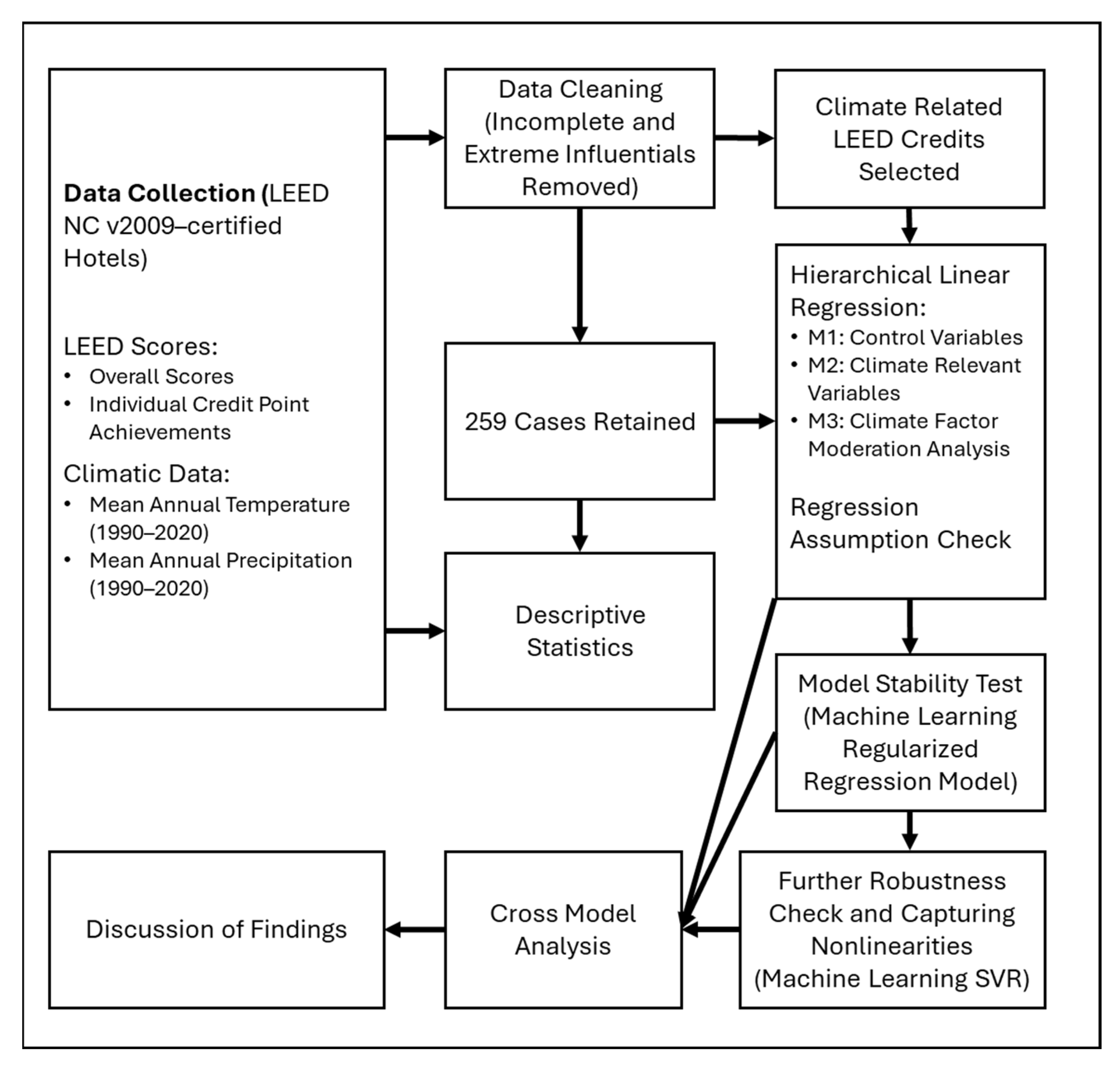
This study bridges these gaps through a climate-credit interaction framework analyzing 259 LEED-certified hotels across all U.S. climate zones. By integrating PRISM climate data with USGBC project records, the research advances LEED optimization theory in three key dimensions:
Identifying and ranking the significant contributor credits in predicting LEED certification of hotel projects.
Evaluating and quantifying the moderation effects of climate factors on the predictive power of LEED credits.
Disaggregating temperature versus precipitation impacts on LEED credit performance, which can help establish climate-weighted credit prioritization models for hotel projects.
The findings challenge the universal applicability of current LEED credit weightings while providing empirical evidence for context-sensitive certification frameworks. This theoretical advancement aligns with USGBC’s stated goal of “enhancing regional applicability” in future LEED versions but provides the first systematic methodology for implementing climate-responsive credit evaluations at scale. By directly modeling credit-level interactions with temperature and precipitation, the present study addresses this unresolved gap and provides the first empirical evidence of how climatic factors shape the predictive role of individual LEED credits in hotel projects.
Addressing this gap required an analytical framework capable of capturing complementary dimensions of credit–climate behavior that no single method could provide. Hierarchical regression was needed to decompose variance attributable to project controls, credit main effects, and climate interactions in a transparent, theory-driven manner. However, hierarchical models alone cannot assess coefficient stability under correlated predictors or determine whether observed relationships persist after penalizing overfitting. LASSO regularization, therefore, served to evaluate variable importance under shrinkage constraints, revealing whether the dominance of certain credits (e.g., EA1 and SS4) remained robust when weaker or collinear predictors were penalized. Finally, Support Vector Regression enabled the detection of nonlinear associations that linear models cannot capture, testing whether climate–credit relationships intensify, plateau, or invert outside linear ranges. Together, this multi-method design provides a richer analytical lens than any individual technique and represents a novel contribution to credit-level sustainability assessment by integrating interpretability, stability, and nonlinearity into a unified climate-sensitivity framework.
4. Results
4.1. BA Climate Regions of Projects
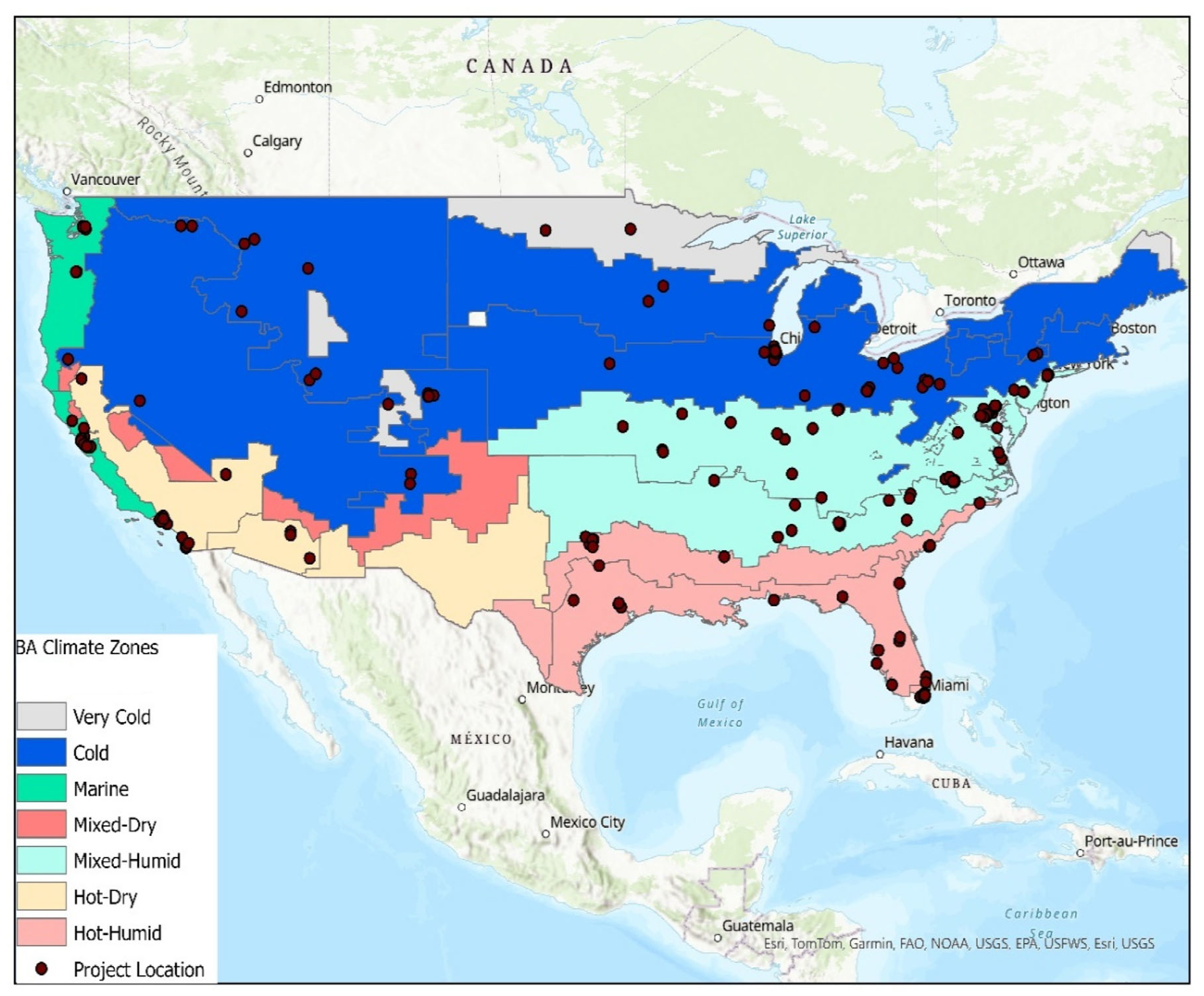
After preparing the data, the dataset consisted of 259 projects across the United States.
Table 4 presents the number of projects in each of the eight climate regions. The highest number of projects is in the mixed humid climate zone, accounting for 37.1 percent of the total (N = 96). The second climate zone, having a high number of projects, is the cold climate, accounting for 22.4 percent of the total studied projects (N = 58). Hot–humid climate is the third climate, including the certified projects accounting for 17.8 percent of the total (N = 46). The marine and hot–dry regions contribute 12.0% and 9.3% of certified projects, respectively. Very few projects are in the very cold region (0.8%), while no projects were recorded in the subarctic or mixed–dry regions. This distribution suggests that LEED certification is more prevalent in temperate and humid climates, likely due to the concentration of urban developments and greater emphasis on sustainability measures in these regions.
Figure 2 visualizes the distribution of the studied projects across the United States.
4.2. Hierarchical Linear Regression
A three-step hierarchical regression analysis was conducted to evaluate the effects of project size, certification year, and climatic conditions on total LEED points, and to assess the incremental predictive contribution of climate-relevant credits and their interactions. The model summary statistics are presented in
Table 5, and the corresponding ANOVA results are reported in
Table 6.
The first model (M1), which included the control variables, log-transformed gross square footage, mean-centered certification year, mean annual temperature, and mean annual precipitation, explained 11.8% of the variance in total LEED points (R2 = 0.118, p < 0.001). Within this model, gross square footage was a significant positive predictor (β = 0.19, p = 0.002), indicating that larger projects tended to achieve higher certification scores, whereas certification year and climatic means were not significant predictors.
Adding the climate-relevant credits in M2 substantially improved the model’s explanatory power (ΔR
2 = 0.689,
p < 0.001), yielding R
2 = 0.807 and adjusted R
2 = 0.790. As shown in
Table 7, several credits demonstrated strong and statistically significant positive associations with total LEED points. The most influential were Optimize Energy Performance EA1 (β = 0.541,
p < 0.001), SS4 (β = 0.278,
p < 0.001), and EA2 (β = 0.196,
p < 0.001). Additional contributions came from EA6, WE3, and SS7, all of which were significant at
p < 0.001. Collinearity diagnostics (VIF < 1.5) confirmed the absence of multicollinearity among predictors.
The inclusion of interaction terms between climatic variables and credit scores in M3 further improved the model fit (R2 = 0.823, adjusted R2 = 0.789), representing a small but statistically meaningful increase in explained variance (ΔR2 = 0.016, p < 0.05). Although most interaction effects were not significant, two stood out. A significant negative interaction was found between mean annual temperature and EQ2 (β = –0.388, p = 0.002), suggesting that higher outdoor temperatures reduced the contribution of ventilation-related performance to overall certification outcomes. In contrast, a marginally positive interaction between mean annual temperature and EQ1 (β = 0.226, p = 0.065) indicated slightly greater benefits of this credit under warmer conditions.
It is important to note that Model 3 exhibits very large VIF values for several interaction terms (
Table 7). This inflation is expected and arises because interaction terms (e.g., Tmean × EQ2) are mathematically constructed from the product of two predictors, producing near-linear dependencies between interaction terms and their constituent main effects. Even when predictors are standardized and exhibit low pairwise correlations (
Section 4.3), the algebraic structure of interaction terms yields inherently high VIF values. This phenomenon is well documented in the regression-methodology literature and does not necessarily indicate problematic multicollinearity in the underlying data, but rather a statistical artifact of including multiple climate–credit interactions simultaneously. Consequently, the sign, magnitude, and significance of interaction coefficients in M3 should be interpreted with caution, and the climate-moderation effects reported here are best viewed in conjunction with the stability results from LASSO and the nonlinear validation from SVR.
4.3. Linear Regression Assumption Checks
The Durbin–Watson statistics for all hierarchical models (1.95–2.03) indicated no meaningful autocorrelation in the residuals. Prior to estimation, we examined the Pearson correlation matrix of all predictors; no pairwise correlation exceeded |r| = 0.70, suggesting that bivariate multicollinearity was limited. In addition, we computed variance inflation factors (VIFs) for Model 2, where all main-effect predictors were entered simultaneously. All VIF values were below 1.5, well under conservative thresholds commonly used in the literature, indicating that multicollinearity was not a concern [
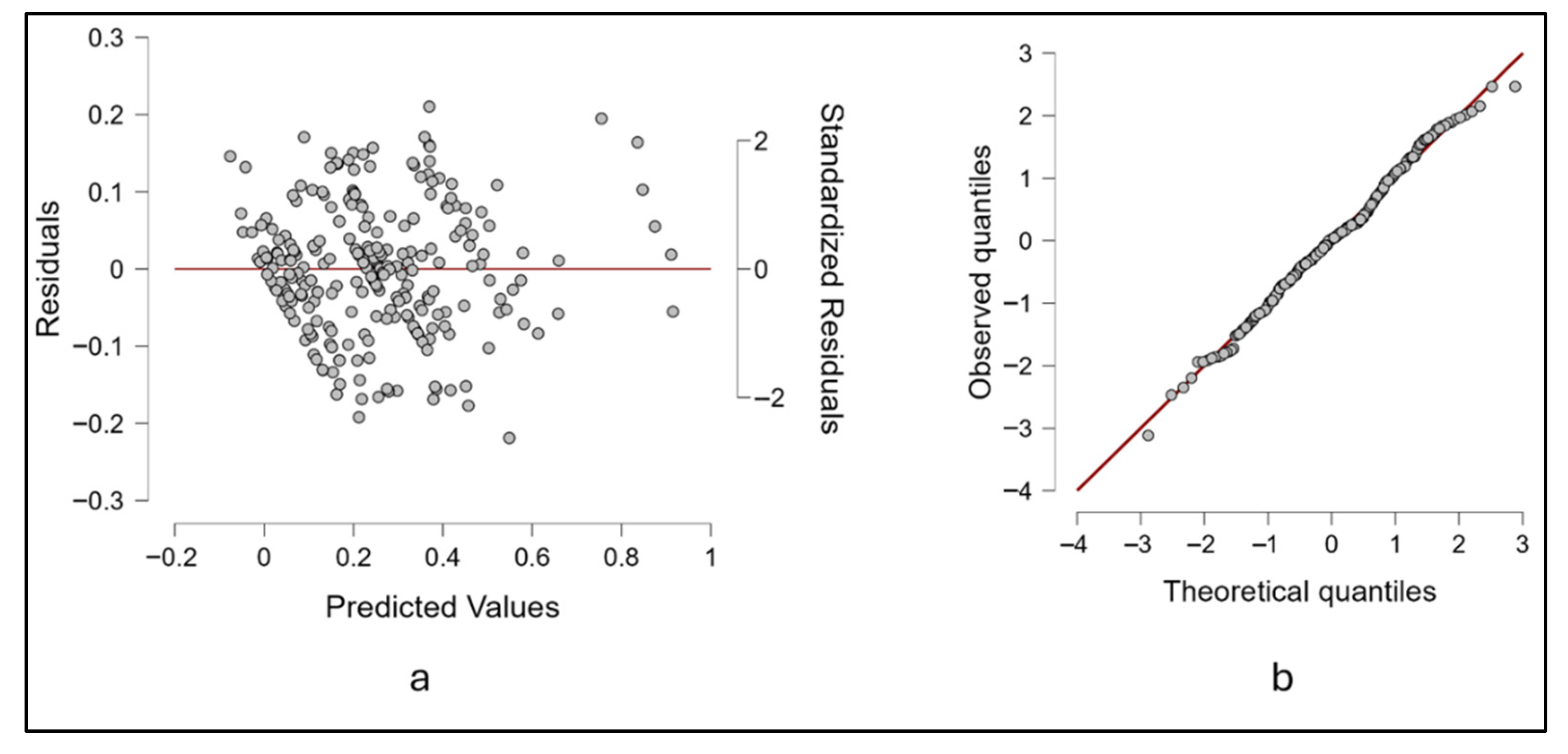
35]. The standardization of LEED credits and climatic variables, along with mean-centering of certification year, further reduced non-essential multicollinearity when interaction terms were introduced in Model 3. Visual inspection of residual-versus-fitted plots and Q–Q plots of standardized residuals (
Figure 3a,b) confirmed that the assumptions of linearity, homoscedasticity, and approximate normality were reasonably satisfied.
The extremely large VIF values observed only in M3 arise from the presence of multiple standardized interaction terms and do not reflect multicollinearity among the original predictors; this is consistent with established statistical guidance that interaction models naturally inflate VIF even when main-effect predictors are well behaved.
Overall, the hierarchical regression results suggest that, after controlling for project certification year, size, and baseline climate, energy and site-related credits are the most powerful predictors of total LEED performance, while indoor environmental quality credits exhibit modest climate sensitivity.
4.4. Regularized Linear Regression (LASSO)
To examine model stability and mitigate potential overfitting, a Regularized Linear Regression using the LASSO penalty was conducted. Model fit and performance metrics are summarized in
Table 8 and
Table 9.
The optimal penalty parameter (λ = 0.002) yielded a parsimonious model with strong predictive accuracy (R2 = 0.796, RMSE = 0.452, MAE = 0.368).
The relative feature importance derived from mean dropout loss confirmed EA1 as the most influential predictor (mean dropout = 0.884), followed by SS4, EA6, SS2, and EA2. In this context, mean dropout loss refers to a permutation-based feature importance metric in which the values of a given predictor are randomly shuffled while all other predictors remain unchanged; the resulting decrease in model performance is quantified as the average increase in RMSE over 50 permutations. Larger mean dropout loss values, therefore, indicate that removing the true information content of that predictor degrades the model’s predictive accuracy more strongly. The regularized coefficients closely mirrored the standardized coefficients in the hierarchical model, with consistently positive and significant weights for energy and site-related variables (
Table 10). These importance values are derived from the permutation-based mean dropout loss described in
Section 3.6.3 and thus provide a robust ranking of predictors that is directly comparable to the SVR results.
The similarity between validation and test MSE values (0.303 vs. 0.204;
Table 8) suggests that the LASSO model generalizes reasonably well to unseen data and does not exhibit substantial overfitting.
Beyond serving as a robustness check, the LASSO model also provides insight into the structural redundancy among credits. The shrinkage path indicates that only a small subset of predictors, primarily EA1, SS4, EA6, SS2, and EA2, retain nonzero coefficients across a wide range of penalty values. This pattern suggests that much of the explanatory power attributed to other credits in linear models is absorbed by these dominant predictors under regularization, reflecting underlying conceptual overlap among credits that target similar operational or load-driven mechanisms. The fact that these same credits remain after shrinkage indicates that their contribution is not sensitive to correlated predictors or model specification, reinforcing their role as central determinants of LEED performance.
4.5. Support Vector Regression
A nonlinear Support Vector Regression (SVR) model with a Gaussian kernel was used to further test model robustness and capture potential nonlinearities in credit–climate relationships. As shown in
Table 11 and
Table 12, the SVR achieved the best predictive performance among all models (
R2 = 0.835, RMSE = 0.431, MAE = 0.338), with low validation and test MSE values (0.192 and 0.186, respectively), suggesting minimal overfitting.
The feature importance ranking (
Table 13) again placed EA1, EA6, and SS4 as the three most influential predictors, followed by SS2, EA2, and EQ1, in agreement with both the hierarchical and LASSO models. The stability of these rankings across modeling techniques underscores the robustness of the identified drivers of certification performance. Likewise, the small gap between validation and test MSE for the SVR model (0.192 vs. 0.186;
Table 11) indicates stable generalization performance and limited overfitting.
Because the same permutation-based mean dropout loss metric is used for SVR and LASSO, the feature importance rankings in
Table 10 and
Table 13 can be directly compared across models.
The SVR results also offer substantive interpretive value beyond validation. Because the Gaussian kernel allows nonlinear responses, credits that exhibit diminishing returns, threshold effects, or nonlinear climate interactions would be expected to shift in rank or gain importance relative to the linear models. However, SVR identifies the same core set of predictors—EA1, SS4, EA6, SS2, and EA2—as the largest contributors to predictive accuracy. This alignment suggests that the functional relationship between these credits and total LEED points is largely monotonic and stable across climatic conditions. Moreover, the similarity in importance rankings across linear, regularized, and nonlinear models indicates that the dominant credit effects are structural rather than artifacts of a particular modeling assumption. In this way, SVR contributes not only a validation step but also substantive evidence of functional robustness in climate-sensitive credit behavior.
4.6. Cross-Model Analysis
A structured comparison of M2, LASSO, and SVR provides additional insight into the stability and functional robustness of the identified predictors. Model 2 offers transparent coefficient estimates and variance partitioning but assumes linearity and can be sensitive to correlated predictors. LASSO, by contrast, applies shrinkage to penalize unstable or redundant variables; the persistence of EA1, SS4, EA6, SS2, and EA2 as dominant predictors under regularization indicates that their influence is not an artifact of multicollinearity or model specification. SVR further tests whether nonlinear relationships alter predictor importance: despite its different functional form, SVR ranks the same credits at the top, confirming that their contribution does not depend on linear assumptions. Taken together, these results show that energy and site credits exhibit structural robustness across linear, regularized, and nonlinear models, whereas the climate interactions in M3, subject to inflated VIF due to constructed terms, capture more selective, credit-specific moderation rather than widespread climate dependence.
Across all analytical frameworks, hierarchical regression, LASSO, and SVR, a consistent pattern of predictor dominance emerged. Credits related to energy optimization (EA1, EA2, and EA6) and site connectivity (SS2 and SS4) repeatedly ranked as the strongest contributors to total LEED points, regardless of model specification or functional form. This cross-method convergence confirms that these credits exert robust and stable influence on certification outcomes and shows that the core drivers of LEED performance are largely insensitive to the modeling technique applied. By consolidating these repeated findings here, the results provide a concise synthesis of predictor stability across methods.
Taken together, the machine-learning results reveal that the predictive dominance of EA1, SS4, EA6, SS2, and EA2 is not only robust under coefficient shrinkage and variable penalization (LASSO) but also persistent under a nonlinear functional form (SVR). Thus, the ML models contribute interpretive depth by confirming that the relationships identified in the hierarchical regression are stable, structurally consistent, and not dependent on linear modeling assumptions.
5. Discussion
This study examined how climatic factors interact with project-level and design-related variables to influence LEED certification outcomes in U.S. hotel projects. By integrating hierarchical regression with regularized and nonlinear machine-learning models, the analysis provides convergent evidence that a small cluster of site and energy credits consistently exerts the strongest influence on total LEED points. Optimize Energy Performance, Alternative Transportation, Green Power, Development Density and Community Connectivity, and On-Site Renewable Energy remained the top predictors across all modeling approaches, indicating that these credits form the structural core of LEED performance in the hotel sector regardless of climatic conditions. Rather than reiterating the numerical results presented earlier, this section focuses on interpreting the relative robustness of these drivers and the credit domains in which climate most strongly modulates performance.
Across all three analytical approaches, hierarchical regression, LASSO, and SVR, the same hierarchy of influential credits emerged. Optimize Energy Performance was by far the strongest single predictor of total LEED points, consistent with previous studies emphasizing energy performance as the core driver of certification level [
10,
11], followed by Alternative Transportation, Green Power, Development Density and Community Connectivity, and On-Site Renewable Energy. That ranking remained stable across ordinary least squares with controls, a shrinkage estimator that penalizes instability and collinearity, and a nonlinear kernel method. This cross-model convergence suggests that envelope and HVAC optimization, low-carbon energy sourcing, and site-level connectivity are structurally important levers for achieving higher certification levels in hotel projects, and that their predictive power is largely robust to both model specification and regional climatic variation. In practical terms, the results support design strategies that first secure energy and site optimization and then layer additional climate-responsive measures.
Climate sensitivity was not uniform across credits. The regression interaction terms showed that Increased Ventilation experienced a negative moderation effect from mean annual temperature, consistent with the higher conditioning penalties associated with bringing warmer outdoor air into hotel spaces. In contrast, Outdoor Air Delivery Monitoring showed a marginally positive moderation effect, suggesting that monitoring-focused strategies gain value in warmer climates where maintaining acceptable indoor air quality is more challenging. No other credit domains exhibited consistent or statistically meaningful climate interactions, indicating that the influence of most credits on total LEED points remains climate-invariant across the range of the U.S. Building America climates represented in the dataset. These results reinforce the finding that only specific Indoor Environmental Quality strategies, particularly those tied to ventilation loads, display tangible climate responsiveness.
The modest moderation effects identified for indoor environmental quality credits also indicate that climate primarily affects occupant-related environmental performance rather than system-level efficiency. Specifically, the negative interaction between mean annual temperature and Increased Ventilation suggests that higher outdoor temperatures may reduce the practical feasibility or net benefit of enhanced ventilation strategies, as additional conditioning energy is required to maintain thermal comfort. Conversely, the marginal positive association between temperature and Outdoor Air Delivery Monitoring implies that proactive monitoring may be more advantageous in warmer climates where maintaining air quality within comfort thresholds is more challenging. Together, these results align with prior work showing that indoor environmental quality strategies are more climate-sensitive than energy or site strategies, as they rely directly on outdoor air conditions and seasonal thermal gradients. Relatedly, large comparative studies on occupant satisfaction report that LEED buildings do not uniformly outperform non-LEED peers on IEQ, pointing to context-dependent outcomes and the importance of local conditions and operations (e.g., [
36,
37,
38]). In short, the EQ domain appears to be where climate most tangibly modulates LEED credit effectiveness, a pattern the results of this study quantify at the credit level.
The machine-learning results also deepen the interpretation of the hierarchical models. The LASSO shrinkage paths show that, when weaker or redundant predictors are penalized, only a small subset of credits, primarily EA1, SS4, EA6, SS2, and EA2, retain nonzero coefficients across a wide range of penalty values. This indicates that much of the predictive signal attributed to other credits in the linear model is absorbed by this core set, reflecting conceptual overlap among credits that target similar operational or load-driven mechanisms. Rather than serving only as a robustness test, LASSO therefore helps reveal the structural hierarchy among credits by identifying which predictors retain explanatory power even under strong penalization and which are subsumed by more influential variables.
The SVR model similarly contributes more than validation by assessing whether nonlinear relationships alter the climate–credit dynamics observed in the linear models. If the effects of key credits exhibited diminishing returns, threshold behavior, or nonlinear interactions with temperature or precipitation, SVR would be expected to reorder feature importance. Instead, the same core energy and site credits remain dominant under the nonlinear kernel formulation, suggesting that their influence on total LEED points is largely monotonic and stable across the climatic gradients represented in the dataset. This functional stability reinforces the conclusion that the most influential credits behave consistently across modeling assumptions, whereas climate-sensitive EQ strategies exhibit more localized, context-specific responses.
These findings should also be interpreted in light of the regional climate framework adopted in this study. Project locations were classified using the U.S. Department of Energy’s Building America climate regions, which are derived from IECC and ASHRAE climate designations and characterized by heating degree-days, temperature, and precipitation patterns. While our models estimate climate sensitivity through continuous interactions with mean annual temperature and precipitation, the Building America regions provide a categorical representation of broad climatic regimes that are functionally similar to ASHRAE climate zones. Prior work has shown that energy efficiency and Water Efficiency measures can yield highly climate-dependent environmental impacts even when nominal LEED points are constant across regions [
20]. In contrast, the present results indicate that, within the hotel projects studied here, energy and site credits retain relatively stable predictive power across climates, whereas ventilation-related indoor environmental quality credits exhibit the clearest temperature sensitivity. This suggests that climate-adjusted benchmarking may be particularly critical for EQ and potentially water-related credits, even when energy-optimization credits remain structurally dominant in determining total scores.
From a methodological standpoint, the triangulation of hierarchical regression, LASSO, and SVR strengthens confidence in the findings. Hierarchical regression provides transparent coefficient estimates for interpreting main effects and climate interactions, but is susceptible to inflated VIF values when interaction terms are included. LASSO addresses this by penalizing unstable or redundant coefficients, while SVR tests whether nonlinear functional forms alter predictor rankings. The consistent dominance of the same core credits across all three approaches demonstrates that the underlying relationships are robust to multicollinearity, regularization, nonlinear transformations, and model specification. Together, these results underscore that the most impactful credits operate in a structurally stable manner across the climatic and operational diversity of hotel projects.
The results also position this study as an intermediate step toward optimization-guided and physics-aware sustainability analytics. The current framework combines hierarchical regression with regularized and kernel-based machine learning in a largely single-objective setting, prioritizing prediction accuracy and interpretability. Multi-objective optimization approaches, such as the improved non-dominated sorting genetic algorithm applied by Liao et al. [
39] to balance surveillance coverage, cost, and early-warning performance in bridge–ship collision monitoring, demonstrate how conflicting design criteria can be systematically traded off rather than optimized in isolation. Similarly, Zhang et al. [
40] show that physics-aware, data-driven models for wind-induced response prediction in slender infrastructure can embed structural dynamics and loading characteristics directly into the learning process, thereby enhancing transparency and robustness. By analogy, future LEED analytics could be formulated as multi-objective problems that jointly optimize predictive accuracy, model sparsity (or interpretability), and regional equity in credit performance, while incorporating building-physics constraints (e.g., energy balances and load–response relationships) to regularize climate–credit interactions.
Finally, the observed influence of project size and certification year provides additional context for interpreting LEED performance trends. Larger projects achieved slightly higher total points, likely due to economies of scale and resource capacity for pursuing optional credits, while certification year effects were nonsignificant after controlling for other variables, suggesting that improvements in design practice have been offset by rising performance expectations in newer certification cycles.
Overall, this study demonstrates that climate exerts a selective rather than uniform influence on LEED performance of hotel buildings, primarily affecting indoor environmental quality and comfort-related measures while leaving energy and site optimization credits largely robust across contexts. These findings emphasize the importance of regional climate adaptation in sustainability rating systems and support the continued refinement of credit structures to better reflect climatic diversity in building performance outcomes.
In practical terms, the findings of this study carry several implications for both LEED implementation and sustainable building design and construction practice. First, the consistent dominance of energy and site-related credits across climatic contexts underscores the continued importance of energy efficiency, renewable integration, and compact urban siting as universally effective strategies. However, the identified climatic sensitivity of indoor environmental quality credits indicates that LEED rating procedures should incorporate regional climate adjustments when evaluating ventilation, comfort, and daylighting performance. Such adjustments would ensure more equitable scoring and a more accurate reflection of environmental challenges faced by projects in extreme or variable climates.
For design and construction practitioners, these results suggest that project teams should adopt climate-responsive strategies early in the planning phase, especially when targeting credits in the Indoor Environmental Quality and Water Efficiency categories. In warm or humid regions, ventilation and comfort strategies should be integrated with envelope optimization and passive cooling measures to maintain performance without excessive energy penalties. At the policy level, the evidence supports the introduction of climate-adaptive credit weighting or regional benchmarking tools within LEED and similar rating systems, enabling certification programs to better align with climate resilience objectives and equitable sustainability outcomes.
6. Conclusions
This study examined how climatic factors influence the predictive contribution of individual LEED credits in hotel projects, integrating hierarchical regression with regularized and nonlinear machine-learning models. The results demonstrate that while a broad set of credits contributes to certification outcomes, a small cluster of energy and site-related credits consistently exerts the strongest influence. Optimize Energy Performance, Alternative Transportation, Green Power, Development Density and Community Connectivity, and On-Site Renewable Energy remained the top predictors across linear, shrinkage, and kernel-based models, indicating that these credits constitute the structural core of LEED performance in the hotel sector.
At the same time, climate sensitivity was not widespread but selective. Temperature-driven interactions were most evident in the Indoor Environmental Quality domain: Increased Ventilation showed a significant negative interaction with mean annual temperature, while Outdoor Air Delivery Monitoring exhibited a marginally positive interaction. These findings suggest that climate may reduce the marginal utility of certain ventilation-intensive strategies in warmer regions while heightening the value of monitoring-focused approaches. Across all other domains, credit contributions remained largely climate-invariant, reflecting the stability of underlying design and operational strategies.
Quantitatively, the hierarchical regression showed that the strongest predictors, Optimize Energy Performance, Alternative Transportation, and Green Power, show large and statistically significant standardized coefficients (β = 0.38–0.56), collectively accounting for more than half of the explained variance in Model 2 (M2 R
2 = 0.58). LASSO regularization confirmed this hierarchy: EA1, SS4, and EA6 produced the largest permutation-based mean dropout loss values (MDL ≈ 0.44–0.88 RMSE units,
Table 10), indicating substantial degradation in model accuracy when their information was removed. SVR yielded a nearly identical importance structure, with MDL values of comparable magnitude for these same credits (
Table 13) and a test-set R
2 of 0.61, demonstrating that their influence remains stable even under a nonlinear kernel formulation. With respect to climate sensitivity, the interaction between mean annual temperature and Increased Ventilation was negative and statistically significant (β = −0.21,
p < 0.05), while the interaction with Outdoor Air Delivery Monitoring was marginally positive (β = 0.14,
p < 0.10). These selective climate effects reinforce that the most influential energy and site credits are structurally robust across climatic conditions, whereas specific indoor environmental quality strategies exhibit measurable moderation by temperature.
These findings highlight that the most impactful credits on LEED certification outcomes are robust to climatic variation, whereas specific indoor environmental quality strategies display targeted climate responsiveness. As a result, climate-adaptive certification guidance for hotels may be best directed toward ventilation and comfort-related credits, rather than the core energy optimization or sustainable site strategies that appear structurally climate-independent.
By integrating hierarchical regression with regularized and nonlinear machine-learning models, this study introduces a novel multi-method framework for examining climate-sensitive LEED credit performance, offering a more interpretable, stable, and generalizable approach than any single technique alone.
Limitations and Future Research
While this study provides robust, cross-validated evidence of climatic influences on LEED credit performance, several limitations should be acknowledged. The analysis was restricted to project-level data available in public LEED certification records, which limited the ability to capture detailed design or operational variables such as system type, occupancy profile, or building orientation. Climatic characterization was based on mean annual temperature and precipitation, which, although representative, may not fully reflect the dynamic influence of extreme weather or seasonal variability on building performance. Additionally, the moderation effects were modeled linearly, whereas climate–design interactions may be nonlinear or threshold-based in practice. Future research should employ higher-resolution climatic indicators (e.g., heating and cooling degree-days, as well as global tilted irradiance) and expand the framework to longitudinal datasets that track performance across certification cycles. Applying this analytical structure to other sustainability rating systems, such as BREEAM, DGNB, or EDGE, would further clarify how regional climate adaptation is incorporated into global building assessment standards.
A further methodological limitation is that the prediction-error metrics for the LASSO and SVR models (RMSE, MAE, and R2) are reported as point estimates based on a single held-out test set. Although the use of k-fold cross-validation for hyperparameter selection and a separate test split reduces overfitting risk, it does not provide formal confidence intervals for these metrics. Future research should implement bootstrap resampling or repeated cross-validation to derive 95% confidence intervals for prediction errors and model-comparison statistics, thereby offering a more explicit quantification of predictive uncertainty.
Another limitation is that climate sensitivity was modeled using linear interaction terms between z-scored mean annual temperature, mean annual precipitation, and credit achievements, rather than through explicit threshold or nonlinear response functions. Although the inclusion of Building America climate regions incorporates broad climatic regimes tied to heating degree-days and hydrological conditions, the analysis does not identify specific temperature or degree-day thresholds beyond which the marginal contribution of particular credits to LEED performance changes sharply. Prior research on building energy use has documented nonlinear and threshold-like responses of electricity and cooling demand to temperature and degree-day metrics. Future work should therefore crosswalk LEED project data to ASHRAE/IECC climate zones and incorporate higher-resolution climatic indicators (e.g., heating and cooling degree-days, as well as solar irradiance) within flexible modeling frameworks such as piecewise regression or generalized additive models. Such analyses would enable explicit identification of climatic thresholds where the effectiveness or feasibility of specific LEED credits, particularly in the Energy, Water Efficiency, and Indoor Environmental Quality categories, begins to change.
Finally, the modeling framework adopted here remains single-objective and purely data-driven in the sense that it optimizes predictive performance under statistical assumptions without explicitly encoding trade-offs or building-physics constraints. In parallel domains, multi-objective optimization has been used to balance competing criteria such as coverage, cost, and early-warning reliability in surveillance system design, illustrating how non-dominated solution sets can guide design decisions under conflicting objectives [
39]. Likewise, recent work on data-driven prediction of wind-induced responses in slender civil infrastructure highlights the benefits of physics-aware learning, in which structural dynamics and loading mechanisms inform model architectures, constraints, or regularization strategies [
40]. Future research on climate-sensitive LEED performance could therefore extend the present framework by (i) formulating multi-objective optimization problems that simultaneously target prediction accuracy, interpretability/sparsity, and regional fairness in credit outcomes, and (ii) developing physics-informed models that couple building energy simulations or simplified energy-balance relationships with data-driven predictors to improve generalizability and transparency.



 ,
,